Cross-docking breaks down when the software underneath it treats every shipment like it needs a storage bin. Goods land at the inbound dock, wait for someone to key in a receipt, then sit while a picker walks to a location that was never meant to hold them. The whole point of cross-docking is to skip that middle step, but generic warehouse management software often forces it back in. The right cross docking software moves inbound freight straight to the outbound dock with fewer touches, lower holding cost, and clearer control over where each item goes.
The stakes are getting bigger. The global cross-dock software market was valued at $1.2 billion in 2025 and is projected to reach $2.5 billion by 2034 at a 9.8% CAGR, according to MarketIntelo (2026). Warehouse management applications already account for 32.5% of that revenue, the largest functional segment. That growth tells you something: teams are done accepting warehouse dwell time as a fixed cost. They want inbound to outbound flow that actually flows.
This guide treats cross-docking as a software decision, not just a warehouse concept. The tools below solve different parts of the problem, and picking the wrong one means paying for capabilities you never use.
What's inside
This list covers seven software tools and modules that support cross-docking within warehouse, routing, and fulfillment operations. Some are full warehouse management platforms, some are dedicated modules, and some handle the routing or fulfillment layer that cross-docking depends on. We ranked them by relevance to real warehouse and fulfillment workflows, then judged each against five criteria:
- Workflow fit: how directly it supports inbound to outbound routing without interim storage
- Configuration depth: item, packaging, and location level control over what qualifies for cross-docking
- Routing or dock coordination: how well it sequences carriers, stops, and dock assignments
- Visibility and analytics: real-time tracking and reporting across the flow
- Implementation practicality: how realistic setup is for your team size and stack
TL;DR
Short on time? Here is the fast version.
- Best overall for WMS-driven logistics suppliers: Boltrics WMS software, a modular warehouse management platform built for 3PLs and logistics service providers.
- Best for cross-docking as a configurable module: the Boltrics Cross-docking module, which narrows the workflow to item- and location-level cross-dock rules inside an existing WMS.
- Best for route planning and outbound optimization: Route4Me fleet routing software, when cross-docking success depends on how inbound and outbound transport is sequenced.
- Best for fulfillment orchestration and shipping control: the Flxpoint cross docking feature, for merchants preventing partial shipments across multiple suppliers.
- Best for warehouse scanning and floor-level visibility: Zebra cross-docking technology solutions, built around scan and RFID workflows at the dock.
- Best for enterprise logistics platforms: Descartes Systems Group for transport-heavy operations, and Manhattan Associates WMS for large-scale warehouse execution.
What is cross docking software?
Cross docking software coordinates the movement of inbound goods directly to outbound shipment with minimal or zero long-term storage. Instead of receiving freight into a storage location and picking it later, the software routes each item, pallet, or carton from the receiving dock straight to a staging or shipping area based on where it needs to go next. It sits inside warehouse management software, fulfillment platforms, or logistics software and enforces the rules that make direct transfer work.
The category exists because storage is expensive and every touch adds cost and error risk. Cross docking warehouse software removes storage from the equation for fast-turn inventory, which is why it matters most in distribution center operations, retail replenishment, and 3PL environments where dwell time directly eats margin.
Core capabilities of cross docking software usually include:
- Inbound to outbound routing: linking received goods to outgoing transport requests or shipments
- Dock or location assignment: directing items to the right staging area or outbound door
- Item-level eligibility rules: deciding which SKUs, packaging types, or locations qualify for cross-docking
- Scanner or terminal guidance: telling floor staff via a hand terminal whether an item goes to a cross-dock lane or a standard pick location
- Route and shipment coordination: sequencing carriers, stops, and delivery windows
- Operational visibility and reporting: real-time tracking of what moved, when, and where
The distinction that trips up buyers: cross-docking can be a full workflow inside a WMS, a dedicated cross docking module, or a fulfillment behavior in an orchestration platform. The right frame depends on whether your bottleneck is warehouse control, routing, or shipping logic.
When to use cross docking software
Cross-docking is not the right answer for every warehouse. It pays off in specific conditions, and forcing it where it does not fit just adds complexity. Here is when it earns its place.
Speed up inbound to outbound transfer
Use cross-docking when goods need to move fast and storage only slows them down. Fast-turn inventory, perishables, and pre-allocated orders benefit most, because the freight is already spoken for before it arrives. Software that supports direct transfer cuts warehouse dwell time by routing items to the outbound dock the moment they are received and scanned. If your inventory sits for hours instead of days, cross docking software turns that dwell time into throughput.
Reduce storage and handling costs
Use it when the business model depends on minimizing holding time and touches. Every time a worker picks up, walks, and puts down a pallet, cost accrues. Inventory reduction is the point: less storage space, fewer handling events, lower labor per unit. For 3PLs and distributors running on thin margins, that reduction in touches is often the difference between a profitable lane and a break-even one. The software enforces the discipline that manual coordination cannot sustain at scale.
Coordinate complex fulfillment across multiple locations
Use it when multiple depots, carriers, or distribution points need routing control. Mixed pallets, multi-stop routes, and consolidation across suppliers all demand a system that knows where each item is headed before it lands. Route optimization and dock scheduling become part of the fulfillment workflow rather than afterthoughts. This is where cross docking software overlaps with transportation management, and where enterprise platforms start to justify their price.
Comparison table
Here is how the seven cross docking software options compare at a glance. Pricing and ratings reflect the most current verified figures available; where a vendor does not publish numbers, we note that plainly rather than guess.
| # | Product | Intent | Key differentiation | Pricing | G2 rating |
|---|---|---|---|---|---|
| 1 | Boltrics WMS software | WMS cross-docking control | Modular WMS for 3PLs on Microsoft tech, with RF scanning and stock locating | Contact vendor | Not listed |
| 2 | Boltrics Cross-docking module | Cross-docking module | Item, packaging, and location level cross-dock rules inside Boltrics WMS | Bundled / quote-based | Not listed |
| 3 | Route4Me | Route optimization | Last-mile route planning, dispatch, and real-time tracking at fleet scale | Contact vendor, 7-day free trial | 4.7/5 |
| 4 | Flxpoint | Fulfillment orchestration | Consolidates fulfillment into single POs, overrides shipping and suppresses tracking | From $499/month (billed annually) | 4.7/5 |
| 5 | Zebra cross-docking solutions | Warehouse scanning workflow | On-the-spot dock visibility with scan and RFID movement tracking | Contact vendor | Not listed |
| 6 | Descartes Systems Group | Enterprise logistics platform | Transport, compliance, and fulfillment SaaS across the supply chain | From $2,050/month (Peoplevox WMS) | 4.6/5 |
| 7 | Manhattan Associates WMS | Enterprise warehouse execution | Cloud-native warehouse execution with labor and automation control | Contact vendor | 4.0/5 |
1. Boltrics WMS software
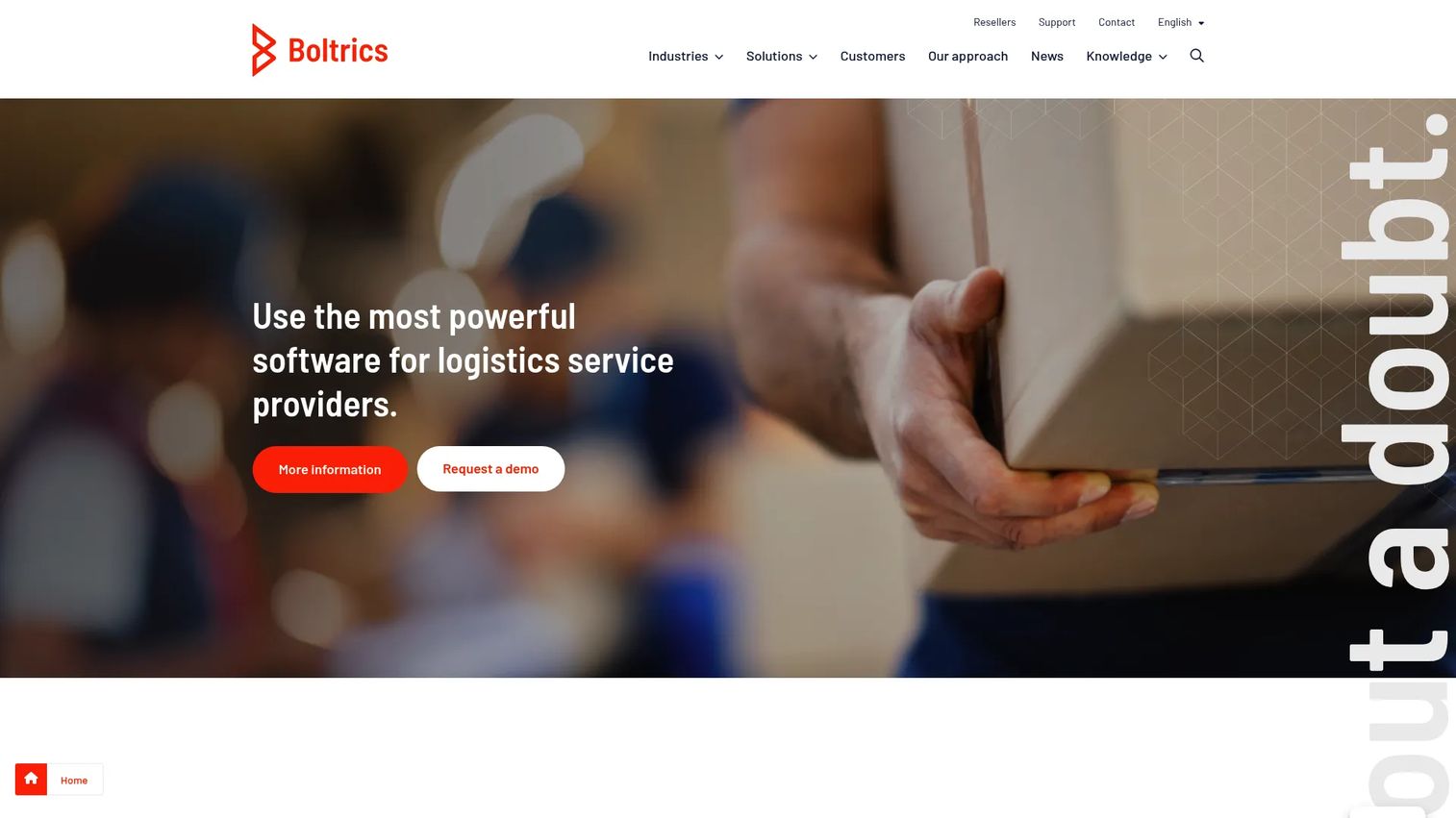
Boltrics is warehouse management software built specifically for logistics service providers and 3PLs, running on Microsoft technology. It treats cross-docking as a native part of the warehouse workflow rather than a bolt-on. If your operation lives and dies on warehouse execution, Boltrics gives you the WMS layer that governs receiving, locating, and outbound flow, with cross-docking woven into the same system your floor already uses.
Best for: 3PLs and logistics service providers that need a modular WMS where cross-docking is one workflow among many, not a separate tool.
Key strengths
- RF scanning: hand terminal guidance that tells floor staff in real time whether goods go to a cross-dock lane or a standard location.
- Label printing: integrated labeling so outbound freight is ready to ship the moment it clears the dock.
- Stock locating: location-level control that keeps direct transfer and stored inventory cleanly separated.
Why choose Boltrics WMS software: The appeal is depth. Because Boltrics is a full WMS and not a narrow feature, you get item settings, packaging settings, and location settings that all feed the same cross-docking logic. Logistics suppliers running multiple clients under one roof get configuration control that a single-purpose tool cannot match. The scanner workflow keeps the floor moving without paper or guesswork, which is where dwell time usually leaks.
Boltrics WMS software pricing: Boltrics does not publish public pricing on its site. Cost is quote-based and depends on modules, users, and deployment scope, so you will need to contact the vendor for a figure tied to your operation. There was no publicly displayed price or free tier visible during this review.
2. Boltrics Cross-docking module
The Boltrics Cross-docking module narrows the full WMS down to the cross-docking workflow itself. It links incoming goods to outgoing goods based on transport requests or route and postcode allocation, then drives scanner-based receiving instructions that send each item to either a cross-dock lane or a standard pick location. This is the piece that makes inbound to outbound flow deliberate rather than accidental.
Best for: logistics service providers already running Boltrics WMS who need dedicated cross-docking controls layered onto their existing setup.
Key strengths
- Conditional routing: links incoming goods to outgoing shipments using transport requests or route and postcode allocation.
- Scanner-driven receiving: hand terminal instructions that route items to cross-dock or standard locations at the moment of receipt.
- Multi-level settings: cross-docking rules at the item, packaging, and location level for precise eligibility control.
Why choose the Boltrics Cross-docking module: Teams choose the module when they already run Boltrics WMS and want cross-docking behavior turned on and configured without adopting a separate platform. It is the natural path when the WMS is already in place and the goal is to sharpen the inbound to outbound workflow. If you are not already on Boltrics, evaluating the full WMS makes more sense than the module in isolation, since the module depends on the broader system to function.
Boltrics Cross-docking module pricing: No public price is displayed on the Boltrics site for the module. It is typically bundled into or priced alongside the broader WMS, so pricing is quote-based and best confirmed directly with Boltrics.
3. Route4Me fleet routing software
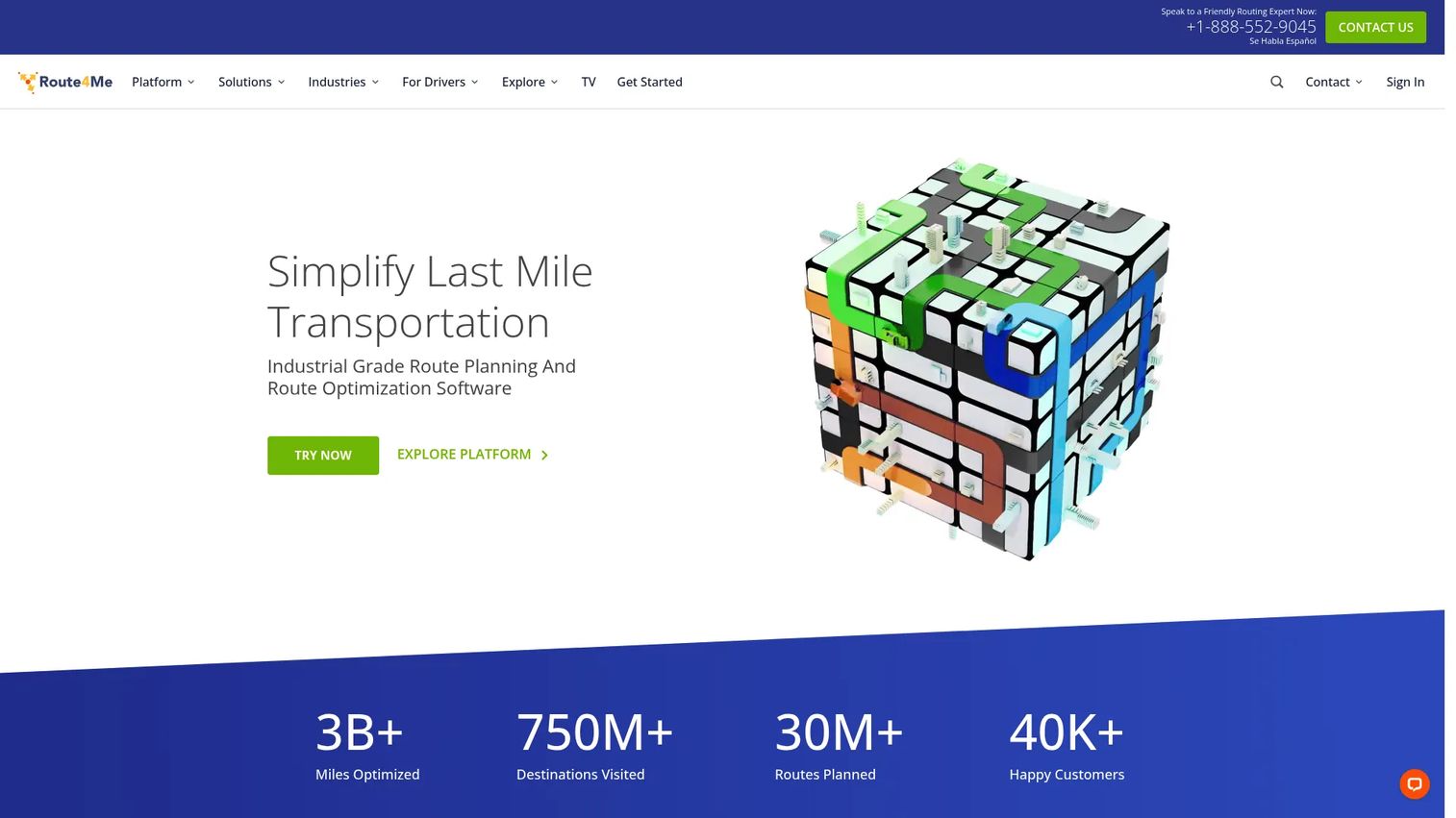
Route4Me is last-mile route optimization and transportation management software for delivery, logistics, and field-service teams. It earns a spot here because cross-docking often fails not at the dock but on the road: if inbound and outbound transport is not sequenced well, the fastest dock in the world still ships late. Route4Me handles the routing side of the fulfillment workflow, planning stops, dispatching drivers, and tracking delivery in real time.
Best for: operations where cross-docking success hinges on route planning, multi-depot coordination, and outbound delivery sequencing rather than warehouse execution alone.
Key strengths
- Route planning and optimization: sequences stops and mixed pallet loads so outbound freight leaves in the right order.
- Dispatching and real-time tracking: live visibility into where each vehicle is against the plan.
- Customer notifications and proof of delivery: closes the loop with delivery confirmation and service records.
Why choose Route4Me: Route4Me is strongest when routing is genuinely part of your cross-docking problem, not a downstream afterthought. Multi-depot operations moving mixed pallets across regions get the route optimization layer that turns cross-docked freight into on-time deliveries. It is not a warehouse execution tool, so pair it with a WMS when you need both. On its own, it excels at the transport sequencing that determines whether cross-docking actually saves time.
Route4Me pricing: Route4Me's public pricing page lists multiple plans, including Route Optimization, Business Optimization, and Enterprise tiers, plus commercial truck variants, but all are contact-us only with no public numeric prices. A 7-day free trial is available. Route4Me holds a 4.7/5 rating on G2.
4. Flxpoint cross docking feature
Flxpoint is ecommerce operations software for connected commerce and fulfillment automation, and its cross docking feature targets a specific problem: partial shipments and messy multi-source fulfillment. When an order pulls inventory from several suppliers, Flxpoint consolidates those fulfillment requests into a single purchase order so goods can be routed through your warehouse and shipped as one clean package.
Best for: retailers and operators running distributed, multi-source fulfillment who need to prevent partial shipments and control shipping behavior.
Key strengths
- Fulfillment consolidation: merges fulfillment requests into a single PO for cross-docked routing through one warehouse.
- Shipping address override: redirects supplier shipments to your facility for consolidation before final dispatch.
- Tracking suppression and stub POs: hides internal routing tracking and auto-creates stub purchase orders that sync shipment data.
Why choose Flxpoint: Flxpoint fits when your cross-docking problem is really a fulfillment orchestration problem. Merchants sourcing from multiple suppliers use it to route everything through a central point, avoid shipping partial orders, and keep the customer-facing tracking clean. It is less about warehouse floor mechanics and more about controlling order flow across a distributed supply base. If your challenge is coordinating suppliers rather than moving pallets, this is the layer that solves it.
Flxpoint pricing: Flxpoint publicly lists a Business plan at $499/month and a Pro plan at $999/month, both billed annually. There is no free tier. Flxpoint holds a 4.7/5 rating on G2.
5. Zebra cross-docking technology solutions
Zebra offers cross-docking technology and automation solutions aimed at the warehouse floor itself: visibility, scanning speed, and movement accuracy at the dock. Where a WMS governs the rules, Zebra focuses on the hardware-adjacent execution layer that makes those rules fast to follow. Goods-in notifications, automated scanning, and RFID tracking give operations teams real-time visibility into what is moving through the cross-dock.
Best for: logistics teams that need floor-level dock visibility and scan or RFID workflow automation to move goods quickly through cross-docking.
Key strengths
- On-the-spot visibility: real-time view of cross-docking activity as freight moves through the dock.
- Automated scanning: fast, accurate scan workflows that reduce manual receiving and routing steps.
- RFID movement tracking: tag-based tracking that follows items through inbound to outbound flow without line-of-sight scanning.
Why choose Zebra cross-docking technology solutions: Zebra matters most to operations teams that care about the physical execution layer. If your bottleneck is speed and accuracy at the dock, and your team already works with handheld scanners and RFID, Zebra strengthens the fulfillment workflow at the point where goods actually move. It complements a WMS rather than replacing it, adding the scanning and tracking muscle that turns cross-docking rules into fast floor action.
Zebra pricing: Zebra does not publish public pricing for its cross-docking technology solution. Cost depends on hardware, software, and deployment scope, so pricing is best confirmed directly with Zebra or a Zebra partner.
6. Descartes Systems Group
Descartes Systems Group is a global logistics software company delivering SaaS across supply chain, trade compliance, transportation, and ecommerce operations. For cross-docking, its value shows up in transportation and warehouse coordination, especially where dock planning and delivery sequencing intersect. Larger operations with multi-node fulfillment and real transport complexity get a platform that connects the moving parts rather than a single-purpose tool.
Best for: large logistics-intensive businesses needing modular SaaS across transportation, compliance, and warehouse operations, where cross-docking is one piece of a bigger network.
Key strengths
- B2B connectivity and EDI messaging: connects carriers, suppliers, and partners so shipment data flows across the network.
- Fleet performance management: coordinates transport and delivery sequencing that cross-docking depends on.
- Customs and regulatory compliance: handles trade compliance for operations moving goods across borders.
Why choose Descartes Systems Group: Descartes appeals to operations that have outgrown point tools. When cross-docking is entangled with transportation management, EDI, and compliance across many nodes, a modular platform that covers all of it reduces the integration burden. It is enterprise-oriented, so smaller operations may find it more than they need. For complex, transport-heavy networks, the breadth is the point.
Descartes Systems Group pricing: Descartes offers many products with separate pricing. Its Peoplevox WMS is publicly priced starting at $2,050/month, with implementation starting at $11,600 and additional users at $234 per user per month. Other Descartes products are quoted separately. Descartes holds a 4.6/5 rating on G2 at the company level.
7. Manhattan Associates WMS
Manhattan Associates offers warehouse management software built for large-scale distribution, labor, and automation execution. Its WMS handles complex fulfillment rules and high-volume operations where cross-docking is just one workflow inside a much larger execution engine. Teams with broad WMS needs, rather than a narrow cross-docking use case, tend to gravitate here.
Best for: enterprises needing highly extensible warehouse execution with labor management and automation control across large facilities.
Key strengths
- Cloud-native warehouse management: modern architecture built for high-volume, multi-site distribution.
- Labor management and real-time guidance: directs floor staff and balances workload across the operation.
- Automation integrations: connects with warehouse controls and automation equipment for hands-off movement.
Why choose Manhattan Associates WMS: Manhattan fits when cross-docking is a feature you need inside a comprehensive warehouse execution system, not the whole reason you are buying software. Enterprises with complex fulfillment logic, heavy labor coordination, and automation on the floor get a platform that scales with them. If cross-docking is your only requirement, a narrower tool will be simpler and cheaper. If it is one demand among many, Manhattan's depth pays off.
Manhattan Associates WMS pricing: Manhattan does not publish public pricing on its site. Cost is quote-based and depends on scope, modules, and deployment. Manhattan Active Warehouse Management holds a 4.0/5 rating on G2.
What to look for in cross docking software
Before you shortlist, get clear on which layer of the problem you are actually solving. These criteria separate a tool that fits from one that just looks good in a demo.
Workflow and eligibility rules
The core question is how granularly the software decides what qualifies for cross-docking. Item-level, packaging-level, and location-level rules let you cross-dock the right freight and store the rest. If the tool forces an all-or-nothing approach, it will fight your operation instead of supporting it. Look for conditional routing tied to transport requests, postcodes, or pre-allocated orders.
Scanning and terminal support
Floor execution is where dwell time leaks. Strong scanner workflow and hand terminal guidance tell staff exactly where each item goes at the moment of receipt, without paper or guesswork. Evaluate how the software directs cross-dock versus standard routing on the device your team already carries.
Visibility and real-time tracking
You cannot manage what you cannot see. Real-time tracking of inbound receipts, dock assignments, and outbound shipments gives you the operational picture to spot bottlenecks before they cascade. Check whether reporting covers the full inbound to outbound flow, not just receiving.
Integration depth
Cross docking software rarely works alone. It has to connect with your WMS, transportation management, carriers, and order systems. Verify which integrations are native versus custom, and whether route optimization and shipping automation plug in cleanly or require middleware.
Implementation practicality
A powerful tool your team cannot deploy is not powerful. Weigh setup effort against team size, existing stack, and how quickly you need results. Enterprise platforms deliver breadth but demand more implementation; focused modules turn on faster when the surrounding system is already there.
Conclusion
The right cross docking software depends entirely on which part of the workflow is your bottleneck. If you run warehouse-heavy logistics operations as a 3PL or service provider, Boltrics gives you WMS control with cross-docking built into the same system, either as the full platform or the dedicated cross docking module. If your cross-docking success rides on how inbound and outbound transport is sequenced, Route4Me's route optimization is the layer that makes direct transfer actually save time. If your problem is preventing partial shipments across multiple suppliers, Flxpoint's fulfillment orchestration solves the order-flow side. Zebra strengthens floor-level scanning and visibility, while Descartes and Manhattan Associates serve enterprise networks with transport complexity and large-scale warehouse execution.
Here is the practical next step. Shortlist two tools that match your actual bottleneck, map one real inbound-to-outbound process end to end, and validate each option against real dock data before you commit. Warehouse efficiency comes from matching the software to the workflow, not from buying the biggest platform and hoping it fits. Order fulfillment software should reduce touches and shipping complexity, so measure each candidate against the number of handling events it removes.
FAQs
Cross docking software is warehouse or logistics software that moves inbound goods directly to outbound shipment with minimal or zero long-term storage. It routes received items to a staging or outbound area based on where they need to go next, cutting warehouse dwell time and handling costs. It usually lives inside a WMS, fulfillment platform, or broader logistics software.
Not always. Cross-docking can be a feature inside a warehouse management system, a dedicated cross docking module layered onto an existing WMS, or a fulfillment behavior in an orchestration platform. Which form you need depends on whether your bottleneck is warehouse control, routing, or shipping logic, so match the tool to the actual problem.
Logistics service providers and 3PLs are the heaviest users, along with distributors, e-commerce operations, and retail replenishment networks. Any operation with fast-turn inventory, pre-allocated orders, or thin margins on holding cost benefits from cross docking warehouse software. The common thread is a business model where storage adds cost without adding value.
Start with workflow and eligibility rules at the item, packaging, and location level, then check scanning and hand terminal support for the floor. Real-time tracking, reporting across the full inbound to outbound flow, and integration depth with your WMS and carriers matter next. Finally, weigh implementation practicality against your team size and existing stack.
Yes, when the operation is designed for it. Cross docking software drives inventory reduction by removing long-term storage, and it cuts labor by reducing the number of touches each item requires. The savings show up as lower storage space, fewer handling events, and lower cost per unit moved, but only when your inventory genuinely turns fast enough to skip storage.
Yes, and the two are often complementary. Route optimization sequences outbound stops and multi-depot deliveries, which determines whether cross-docked freight actually ships on time. For multi-stop or multi-depot operations, pairing a WMS or cross docking module with route planning software closes the gap between a fast dock and an on-time delivery.
Cross-docking moves goods from inbound to outbound with minimal handling, often keeping the same packaging and routing items to their final destination fast. Transloading shifts freight between transport modes, for example from a rail car to trucks, and may involve reconfiguring loads. Cross-docking is about speed through the facility; transloading is about changing how goods travel.
It is most often bundled inside a larger system. Cross docking capabilities typically ship as part of a WMS, a fulfillment platform, or a broader logistics software suite rather than as a standalone product. Dedicated modules exist, but they usually depend on an underlying warehouse management software layer to handle receiving, locating, and outbound flow.