

Your traffic is fine. Your conversion rate is not.
You spent the budget. The visitors showed up. Then most of them left without signing up, buying, or booking a call. The instinct is to blame traffic quality, so you tighten targeting and pour more into paid. The number barely moves.
The problem is usually not the traffic. It is trust. A new visitor lands on a page from a brand they have never used, and they have no reason to believe the promises on it. According to HubSpot data cited by Software Equity Group in 2024, a typical visitor reads 10 online customer reviews before buying, and sites with testimonials pull 45% more traffic than sites without them. People buy what other people already bought.
Social proof software closes that gap. It puts reviews, testimonials, live purchase activity, and website trust signals directly on the pages that need to convert. The market is voting with its wallet: MarketIntelo valued the social proof platform market at $1.2 billion in 2025, with software making up 58.3% of that, and projected it to reach $4.4 billion by 2034.
This guide ranks 7 social proof tools worth your time in 2026, with pricing, G2 ratings, and clear guidance on which format fits which page.
What's inside
This guide is for marketers, founders, and ecommerce teams who want to add trust cues to high-intent pages without a heavy build. No engineering ticket required.
We picked and ranked tools on four criteria:
- Notification formats: live purchase alerts, recent activity popups, and live visitor count support
- Review and testimonial support: collection, moderation, and display widgets
- Integrations: ecommerce platforms, CMS, email, and CRM compatibility
- Pricing and setup: free tiers, entry price, and time to first install
Every pricing figure and G2 rating below was verified against live sources in August 2026. Verify current numbers before you buy, since vendors change plans often.
TL;DR
- Best all-in-one testimonial hub: Senja collects, manages, and displays text and video testimonials from a free tier up.
- Best for live notifications: TrustPulse runs recent activity and purchase popups with tight targeting, set up in minutes.
- Best lightweight notification setup: ProveSource layers purchase alerts, visitor counts, and review popups on any site.
- Best for configurable targeting: WiserNotify offers deep display rules, 50-plus notification designs, and A/B testing.
- Best for ecommerce review and UGC depth: Yotpo pairs reviews and photo UGC with loyalty and referrals.
- Best for visual product reviews: Loox is built for photo-heavy Shopify product pages.
Pick the format that matches your page. Notifications drive urgency, reviews build ecommerce trust, and testimonials carry credibility. The conversion lift comes from the right proof in the right place, not from stacking every widget everywhere.
What is social proof software?
Social proof software is a category of tools that display real customer activity, reviews, and endorsements on your website to build trust and increase conversions. It turns other people's behavior, buying, reviewing, signing up, into visible cues that reassure new visitors and reduce hesitation at the moment of decision.
The main types you will run into:
- Live purchase or signup notifications: small popups showing that someone just bought or subscribed
- Recent activity notifications: rolling feeds of recent actions across your site
- Visitor counters: a live visitor count showing how many people are viewing a page or product right now
- Review widgets: embedded star ratings and written reviews pulled from customers
- Testimonial widgets: curated quotes, video clips, and walls of love
- Customer logo walls: rows of recognizable brand logos that signal traction
Key capabilities to expect from social proof tools:
- Targeting and timing: show the right proof to the right visitor on the right page
- Design control: match notifications and widgets to your brand
- Integrations: connect to your ecommerce platform, CMS, email tool, and CRM
- Analytics: track impressions, clicks, and conversion impact
- Moderation: approve, filter, and manage what appears
These website trust signals work because of a simple pattern in buyer behavior. When people are unsure, they copy what others do. Social proof marketing makes that copying easy by putting the evidence in front of them, right where they decide.
When to use social proof software
Not every page needs the same proof. Match the format to the moment.
Boost landing page conversion
High-intent landing pages carry the most pressure. A demo request page, a pricing page, a free trial signup, or a lead-gen form all ask the visitor to commit. Visible activity and credibility cues lower the perceived risk of saying yes. FOMO popups and live visitor count widgets add urgency without feeling spammy when you cap frequency and keep the message honest. A recent purchase notification next to a signup form tells the visitor: real people are doing this right now.
Increase trust on checkout and ecommerce pages
Near a purchase decision, reviews and ratings do the heavy lifting. Star ratings on the product page, photo reviews below the fold, and recent activity notifications in the cart all reduce second-guessing. Ecommerce social proof works hardest at the exact points where carts get abandoned: the product page, the cart, and checkout. Trust badges and customer logos reinforce that the store is legitimate and safe to pay.
Prove traction on SaaS, app, and lead gen pages
For SaaS and app pages, recent signups, live visitors, and customer logos show momentum. Put them on the homepage hero, the pricing page, and webinar signup flows. A logo wall of known customers answers the unspoken question every B2B buyer has: who else like me already trusts this? Recent activity notifications turn an empty-feeling page into one that looks busy and alive.
Comparison table
Compare these tools on what they are built for, what sets them apart, entry price, and current G2 rating. Notification-first tools and review-first platforms solve different jobs, so read the "best for" column before price. Pricing and ratings were checked in August 2026 and may change.
| # | Product | Best for | Key differentiator | Pricing | G2 rating |
|---|---|---|---|---|---|
| 1 | Senja | Testimonial collection and display | Import testimonials from 30+ platforms | Free; paid from $29/mo | 4.6/5 |
| 2 | TrustPulse | Live conversion notifications | Real-time event tracking with smart timing | Free plan; paid from $5/mo (annual) | Not listed |
| 3 | ProveSource | Lightweight notification setup | Purchase alerts, counters, and review popups | Free; paid from $24/mo (annual) | 3.6/5 |
| 4 | WiserNotify | Configurable targeting and testing | Targeting by page, device, geo, and behavior | Free plan; paid from $16/mo | 4.8/5 |
| 5 | Fomo | Multi-source live activity feeds | Live notifications from many connected sources | Custom pricing | 4.4/5 |
| 6 | Yotpo | Ecommerce reviews and UGC depth | Reviews plus loyalty and referrals | Free; paid from $89/mo | Not listed |
| 7 | Loox | Visual product reviews | Photo and video reviews for Shopify | Free; paid from $49.99/mo | 4.9/5 |
Best 7 social proof software for 2026
1. Senja

Senja is a testimonial collection and social proof hub. It handles the full loop: collect text and video testimonials, manage them in one place, then display them across your site. If your proof lives scattered across email, LinkedIn, and old review sites, Senja pulls it together. You can import testimonials from over 30 platforms, so you are not starting from zero.
Best for: teams that want to collect, manage, and display customer testimonials fast, without stitching together three tools.
Key strengths
- Collect text and video testimonials in one flow
- Import testimonials from 30+ platforms
- Widgets, pop-ups, and Walls of Love for display
- Branding and embed controls to match your site
Why choose Senja: it fits marketers who need versatile proof assets, not just one widget type. You collect once and reuse the same testimonials across landing pages, emails, and social. The free tier lets you test the full loop before you pay, which lowers the risk of another tool that never sticks.
Senja pricing: free forever plan with up to 15 testimonials. Paid plans start at $29/month for Starter, with Pro at $59/month. Yearly billing is available at a discount.
2. TrustPulse
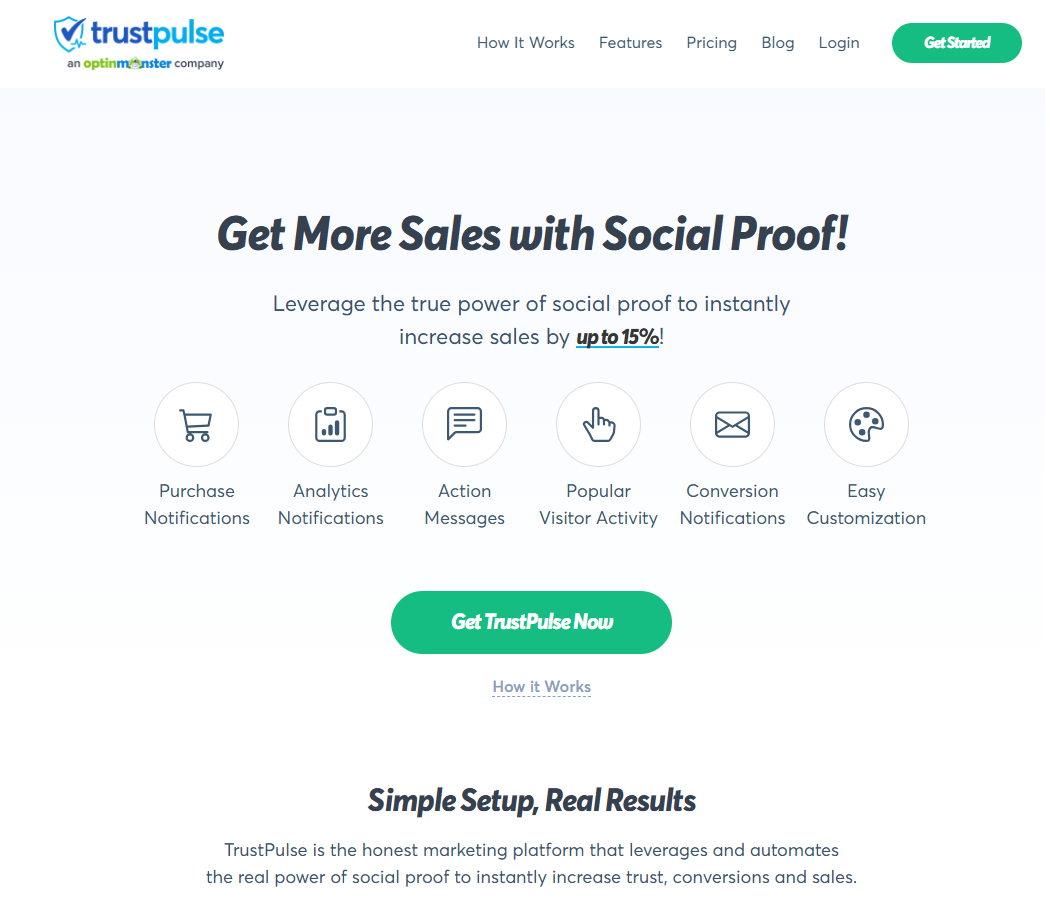
TrustPulse is notification-led social proof for conversion-focused pages. It shows real-time activity, recent purchases, signups, and other actions, as small popups that build urgency. It comes from the team behind OptinMonster, so it fits neatly into a conversion-optimization workflow. Setup is fast, and the targeting controls decide who sees what and when.
Best for: teams that want a simple, high-intent overlay to add urgency without a heavy build.
Key strengths
- Real-time event tracking for live activity
- Smart targeting and timing controls
- Flexible notification design
- Analytics on notification performance
Why choose TrustPulse: it is the fastest path to social proof notifications on a landing page or checkout. The smart timing keeps popups from feeling constant, and page-level targeting means the message matches the moment. If your main goal is urgency on high-intent pages, this is a clean pick.
TrustPulse pricing: free plan covers up to 500 sessions. Paid plans start at $5/month for Basic, then Plus at $10/month, Pro at $19/month, and Growth at $39/month, all billed annually. Enterprise plans are available by contacting sales.
3. ProveSource
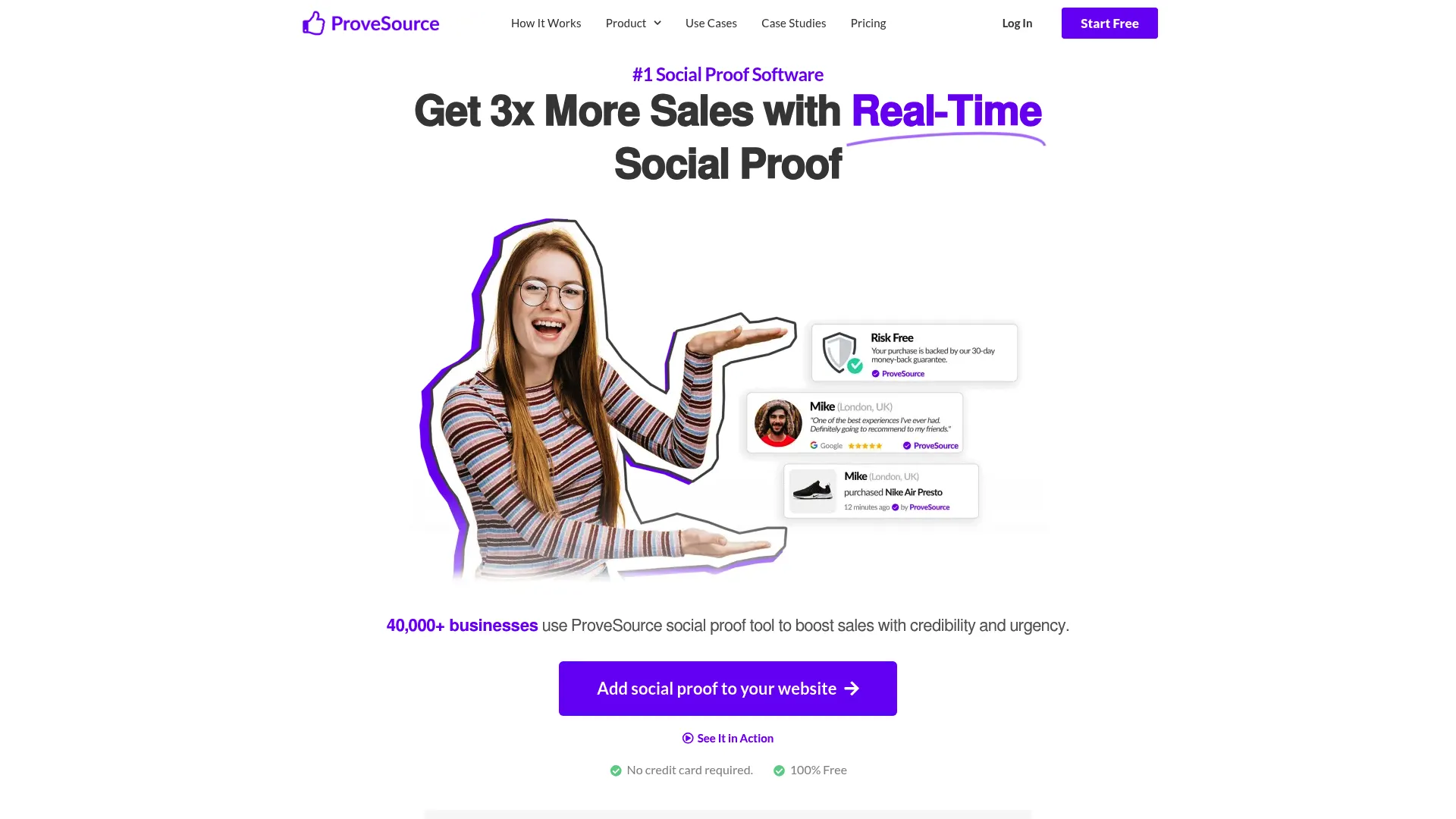
ProveSource is a live social proof and trust widget platform. It mixes notification types in one tool: live purchase and signup alerts, visitor counters, and review popups. Founded in 2018, it is used by a large base of small and mid-size businesses that want broader trust stacking than a single popup type. You add credibility and urgency across the funnel from one install.
Best for: growth teams that want a mix of notifications, counters, and review-style proof from one dashboard.
Key strengths
- Live purchase and recent sales notifications
- Visitor count and counter notifications
- Review popups and social proof integrations
- Customer logos and trust badge display
Why choose ProveSource: it fits teams that want to combine several proof types without buying separate tools. The free tier makes it easy to trial on a live page, and the integration list covers common ecommerce and marketing setups. Good pick when you want variety over depth in any single format.
ProveSource pricing: free plan available. Paid plans start at $24/month for Starter (billed yearly), then Growth at $45/month, Monster at $91/month, and Gorilla at $183/month. Enterprise pricing is custom.
4. WiserNotify

WiserNotify is real-time notifications plus conversion-focused widgets with deep targeting. Where lighter tools keep rules simple, WiserNotify lets you target by page, referrer, device, geo, and behavior. It offers 50-plus notification designs and A/B testing, so you can tune what shows and measure what works. Multi-site management runs several properties from one account.
Best for: ecommerce and marketing teams that want configurable notifications, targeting, and testing in the mid-market stack.
Key strengths
- Display targeting by page, referrer, device, geo, and behavior
- Multi-site management from one account
- 50+ notification designs
- A/B testing and analytics
Why choose WiserNotify: it fits teams that have outgrown basic popups and want rules that match their traffic. The targeting depth means you show recent activity notifications only where they help, and the built-in A/B testing keeps you honest about impact. A strong mid-market choice when configurability matters.
WiserNotify pricing: free plan available. Paid plans start at $16/month for Pro and $65/month for Growth on monthly billing, with a Basic plan at $59/year. A 7-day free trial is offered on paid tiers.
5. Fomo

Fomo is a social proof marketing platform built around live event notifications. Its edge is pulling activity from many connected sources, then showing it as real-time notifications on your site. You control the design, placement, and rules, and it integrates with common ecommerce and marketing platforms. For fast-moving conversion pages, it keeps the activity feed fresh and credible.
Best for: ecommerce and SaaS teams that want to show live activity aggregated from many sources.
Key strengths
- Real-time social proof notifications
- Customizable notifications and placement
- Integrations with ecommerce and marketing platforms
- Rule-based automation for what shows
Why choose Fomo: it works well when your proof comes from multiple systems and you want one clean feed. The customization controls keep notifications on-brand, and the automation rules decide what surfaces without manual work. A solid choice for teams that value breadth of sources and design control.
Fomo pricing: pricing is custom, shown as "get custom pricing" on the site, with a 14-day free trial and two free months on the annual plan. Contact Fomo for a quote based on your traffic and sources.
6. Yotpo
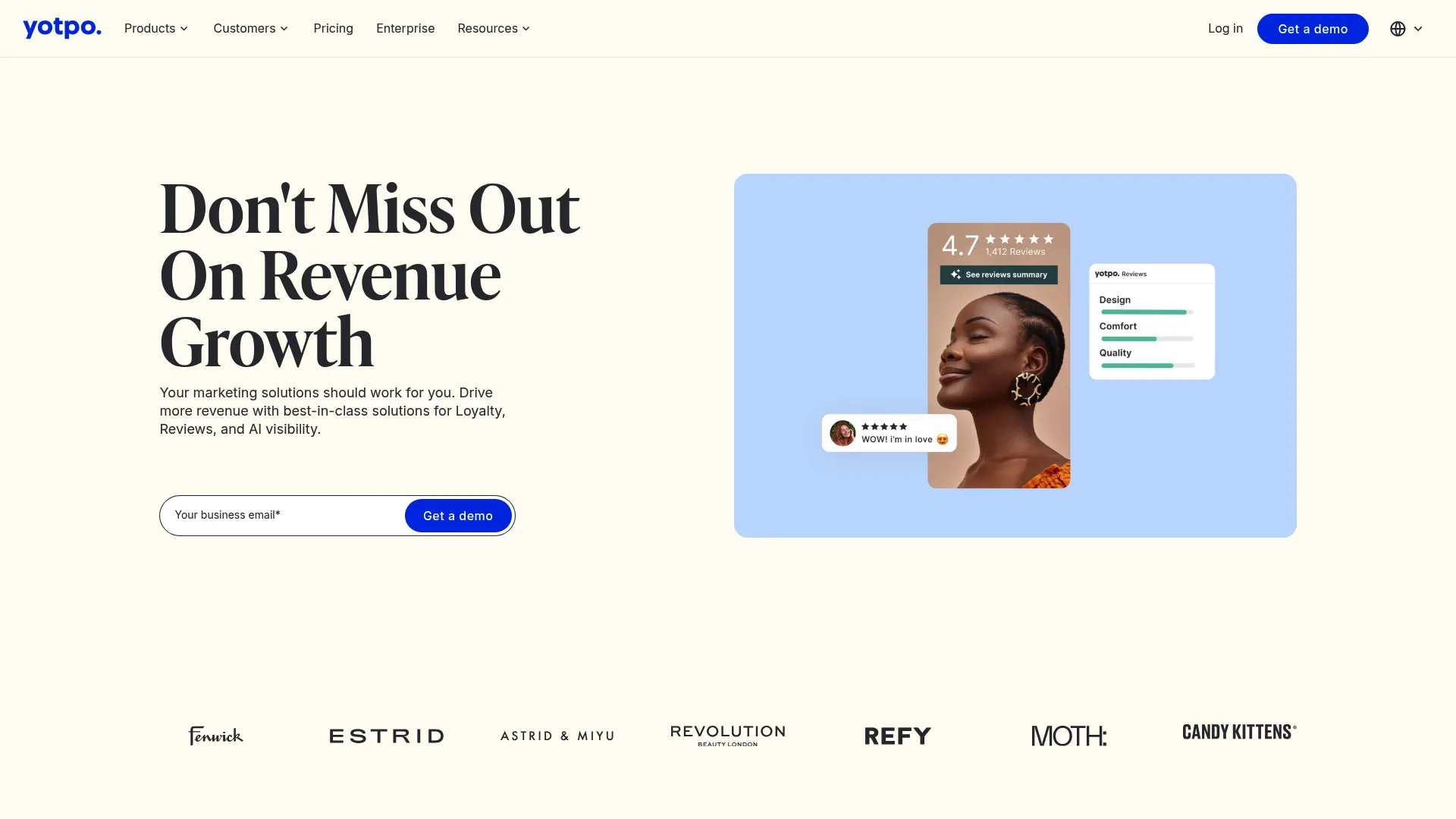
Yotpo is a customer content marketing platform for reviews, UGC, loyalty, and referrals. It goes deeper than popups, covering the full ecommerce retention picture: collect reviews and photo or video UGC, display ratings, and add loyalty and referral programs on top. Fraud detection and moderation keep the review stream clean. It is stronger for commerce ecosystems than for simple notification overlays.
Best for: ecommerce brands that want reviews plus broader retention proof in one platform.
Key strengths
- Reviews and UGC collection and display
- Loyalty and referrals
- Fraud detection and moderation
- Ecommerce integrations across major platforms
Why choose Yotpo: it fits brands that treat reviews as part of a wider retention motion, not a standalone widget. You get ecommerce social proof, loyalty, and referrals under one roof, which reduces tool sprawl for commerce teams. Best when your review and retention needs justify a broader platform.
Yotpo pricing: the Reviews and UGC line includes a free plan. Paid plans start at $89/month for Starter and $169/month for Pro. Additional products and add-ons are priced separately.
7. Loox
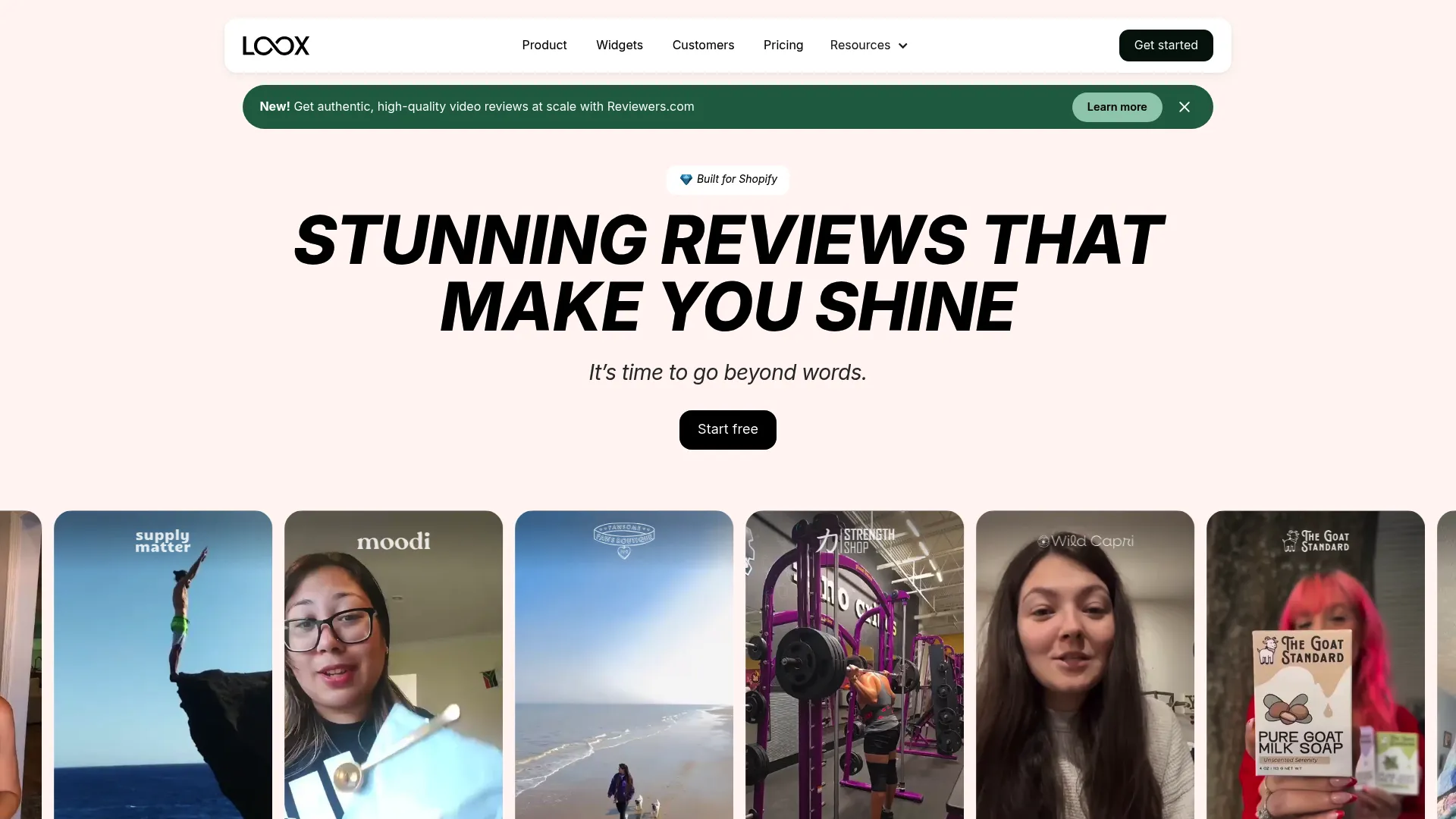
Loox is a Shopify review and referral app focused on visual social proof. It centers on photo and video reviews, which matter most for products people judge with their eyes. Review widgets and display customization let you show visual proof right on the product page, and AI-powered sorting surfaces the best reviews. Launched in 2015, it is a go-to for Shopify merchants who sell visually driven products.
Best for: Shopify merchants whose product pages depend on photo-heavy customer proof.
Key strengths
- Photo and video reviews
- Review widgets and display customization
- AI-powered review sorting, highlights, and summaries
- Product page embeds built for Shopify
Why choose Loox: it is the strongest pick when the visual is the sell. Fashion, beauty, home, and food brands get customer photos on the product page, which does more than star ratings alone. If you run on Shopify and your buyers want to see the product in real use, Loox fits.
Loox pricing: the Beginner plan starts at $0/month. Convert starts at $49.99/month and Unlimited at $299.99/month. A 14-day free trial is available.
Considerations
Before you commit, run through this checklist.
Match the proof type to the page
Notifications, reviews, and testimonials solve different problems. Live activity creates urgency, reviews build purchase confidence, and testimonials carry credibility. Do not put live activity on every page. A quiet B2B pricing page rarely needs a purchase popup, but it may need customer logos and a testimonial.
Check integrations first
Confirm the tool connects to your CMS, ecommerce platform, email tool, and CRM before you buy. A social proof tool that cannot read your order data or sync your reviews creates manual work. Make sure the data flows match your existing stack, especially if you run Shopify, WordPress, or a headless setup.
Watch for targeting and frequency control
Too many popups train visitors to ignore them. Look for page-level, device-level, and traffic-source rules so proof shows only where it helps. Frequency caps keep notifications from turning into noise. The goal is one clear signal at the right moment, not a wall of alerts.
Verify analytics and testing
Decorative proof is guesswork. Look for A/B testing, conversion tracking, and clear reporting so you know what the widget actually did to your numbers. Tie every implementation to a metric. If a tool cannot show impact, you cannot defend the spend.
Keep proof current
Social proof goes stale fast. A review from three years ago or a "recent" purchase that never updates hurts trust more than no proof. Check recency, set moderation rules, and audit display logic on a schedule. Fresh proof reads as an active, trusted business.
Conclusion
The right pick depends on the page you are trying to fix.
For all-in-one testimonial collection and display, Senja is the versatile choice. For live notifications and urgency on high-intent pages, TrustPulse and ProveSource are fast to deploy. WiserNotify wins when you need deep targeting and A/B testing. For ecommerce, Yotpo covers reviews plus loyalty and referrals, while Loox owns visual, photo-heavy product pages.
The core buying logic is simple: testimonials for credibility, notifications for urgency, and review widgets for ecommerce trust. Stack the format to the job, not the other way around.
Next step: shortlist two or three tools that match your stack, then test them on your single highest-intent page first. Measure the conversion lift against a clean baseline before you roll social proof out site-wide. One good test on the right page beats ten widgets on the wrong ones.
FAQs
It adds trust and urgency to your website by showing real customer activity, reviews, and testimonials. The goal is to reduce hesitation at the moment of decision and lift conversion on signup, checkout, and lead-gen pages. Most tools also track how those cues affect your numbers.
They can, when they are honest and well-targeted. A recent purchase or signup popup reassures a hesitant visitor that real people are acting. The lift depends on placement and frequency, so test on one high-intent page and compare against a baseline before rolling out.
For deep ecommerce social proof, Yotpo covers reviews, UGC, loyalty, and referrals in one platform. Loox is the strongest choice for visual, photo-heavy Shopify product pages. If you want notification-style urgency instead, ProveSource and WiserNotify both fit commerce stacks well.
Review widgets display written or photo reviews and star ratings directly on a page, usually near the product or pricing. Notification popups show live activity, such as a recent purchase or signup, to create urgency. Reviews build confidence at the decision; popups nudge action in the moment.
Put credibility cues near the ask. Customer logos and testimonials work in the hero and next to your main call to action. Reviews and ratings belong close to the product or pricing. Save live activity notifications for high-intent pages where urgency helps rather than distracts.
Most tools do, through native apps, plugins, or a script snippet. Loox and Yotpo are built around Shopify, while ProveSource, WiserNotify, and TrustPulse work across WordPress, Webflow, and custom sites. Confirm the specific integration and data sync before you commit.
Cap frequency and use targeting so proof shows only where it helps. Limit yourself to one active notification type per page, and turn popups off on low-intent or already-converting pages. If visitors start ignoring them, you have too many. Fewer, better-timed cues outperform a constant stream.
Yes, when you use the right format. Customer logos, testimonials, and recent signup activity prove traction on homepages, pricing pages, and trial signups. B2B buyers want to see who else like them already trusts you. Skip constant purchase popups and lean on credibility cues that fit a considered buying decision.