

Your agents dial. They wait. Voicemail. They dial again. Busy signal. Again. Dead air. By the time a real person picks up, the momentum is gone and half the shift is already spent listening to nothing.
That gap between dials is where outbound teams lose money. The global predictive dialer software market sat at USD 4.66B in 2025 and is projected to reach USD 116.67B by 2034, according to Fortune Business Insights (2025). Teams are spending because the math is simple: a rep who talks to more live humans per hour books more meetings, closes more deals, and burns out slower.
Predictive dialing solves the wait. It reads agent availability, dials several numbers ahead, and routes only connected calls to a free rep. Done right, it lifts connect rates and cuts idle time. Done wrong, it triggers abandoned calls and compliance headaches.
This guide compares seven platforms on the criteria that actually matter for outbound teams: connect efficiency, compliance controls, CRM fit, deployment style, and reporting depth.
What's inside
This guide is for outbound sales leaders, SDR managers, and call center operators comparing predictive dialer software in 2026. We looked past marketing claims and focused on four things:
- Dialing efficiency: pacing algorithms, live-answer routing, and abandon rate control
- Compliance: TCPA, DNC, local presence, and time zone handling
- Stack fit: CRM integration depth and workflow compatibility
- Deployment and pricing: cloud versus on-prem, and transparent starting costs
Every pricing figure and G2 rating below reflects verified, current values at the time of writing.
TL;DR
- Best for enterprise outbound: Five9, deep contact center breadth with omnichannel and AI.
- Best for unified communications: Nextiva Enterprise, dialer plus a full comms stack.
- Best for AI-first contact centers: RingCentral CX, published per-seat pricing and omnichannel routing.
- Best for large, complex operations: Genesys, orchestration and workforce tools at scale.
- Best for analytics depth: NICE CXone, AI-driven CX with strong reporting.
- Best for pure dialing efficiency: DialedIn, predictive, progressive, and preview modes.
- Best for high-volume lead gen: Convoso, configurable outbound with compliance tooling.
What is predictive dialer software?
Predictive dialer software is outbound calling software that predicts agent availability and dials multiple numbers ahead of live reps, so agents spend more time talking and less time waiting for connects. It sits at the core of most modern outbound and call center operations.
The mechanics come down to four moving parts:
- Pacing algorithm: calculates how many numbers to dial based on agent count, average call length, and connect rates
- Live-answer routing: filters out voicemail, busy signals, and no-answers, then routes only human pickups to a free agent
- Answering machine detection: identifies voicemail so agents skip dead calls
- Abandon rate control: caps how often a connected call has no agent ready, which keeps you inside compliance limits
Predictive dialing is not the only mode. Here is how it compares to the two other common approaches.
| Dialer type | How it paces | Best for |
|---|---|---|
| Predictive dialer | Dials several numbers ahead of agent availability | High-volume outbound with large agent pools |
| Progressive dialer | Dials one number as soon as an agent is free | Balanced throughput with lower abandon risk |
| Preview dialer | Shows the contact record, agent chooses when to dial | Complex or high-value accounts needing research |
A predictive dialer wins on raw throughput. A progressive dialer trades some speed for tighter abandon control. A preview dialer is the choice when every call needs context before it goes out. Most serious dialer software for call centers supports all three so you can match the mode to the campaign.
When to use predictive dialer software
Scale outbound calling without wasting agent time
When you run a team of 10 or more agents making cold or warm outbound calls, idle time between connects becomes your biggest hidden cost. A predictive dialer keeps agents on live conversations instead of listening to ring tones. This is the classic fit for SDR teams, collections operations, and outbound call centers where volume drives the number.
Improve speed-to-lead for inbound handoff
Inbound leads go cold fast. When a form fill or demo request comes in, a predictive dialer can immediately route the call to the next available rep, cutting the gap between interest and conversation. Faster speed-to-lead means higher connect rates and more meetings held, not just booked.
Run multi-campaign outbound operations
When you juggle several campaigns, lists, and offers at once, you need pacing controls and list management that keep each campaign compliant and productive. Predictive dialing with campaign-level settings lets you run different pacing, caller IDs, and scripts per campaign without stepping on compliance limits or agent capacity.
Comparison table
The table below sorts the seven tools by relevance to outbound and call center use. Read the "Best for" column first to find your operating context, then check pricing and deployment style. Ratings come from each vendor's live G2 listing.
| # | Product | Best for | Key differentiator | Pricing | G2 rating |
|---|---|---|---|---|---|
| 1 | Five9 | Mid-market to enterprise contact centers | Omnichannel plus AI agent assist | From $119/seat/mo | 4.1/5 |
| 2 | Nextiva Enterprise | Teams wanting dialer plus full comms stack | Unified voice, chat, email, SMS, social | Essential from $75/agent/mo | 4.6/5 |
| 3 | RingCentral CX | AI-first contact centers | Published per-seat pricing, 20+ digital channels | Standard $65/user/mo | 4.5/5 |
| 4 | Genesys | Large, complex operations | Orchestration and workforce management | Cloud CX 1 from $75/user/mo | 4.4/5 |
| 5 | NICE CXone | Analytics-heavy enterprise teams | AI-first CX orchestration | Omnichannel Suite from $110/agent/mo | 4.3/5 |
| 6 | DialedIn | Outbound sales and call center teams | Preview, progressive, and predictive dialing | Enterprise Plus from $25 | 4.7/5 |
| 7 | Convoso | High-volume outbound and lead gen | Configurable dialer with compliance tooling | Custom pricing | 4.5/5 |
Best predictive dialer software for 2026
1. Five9
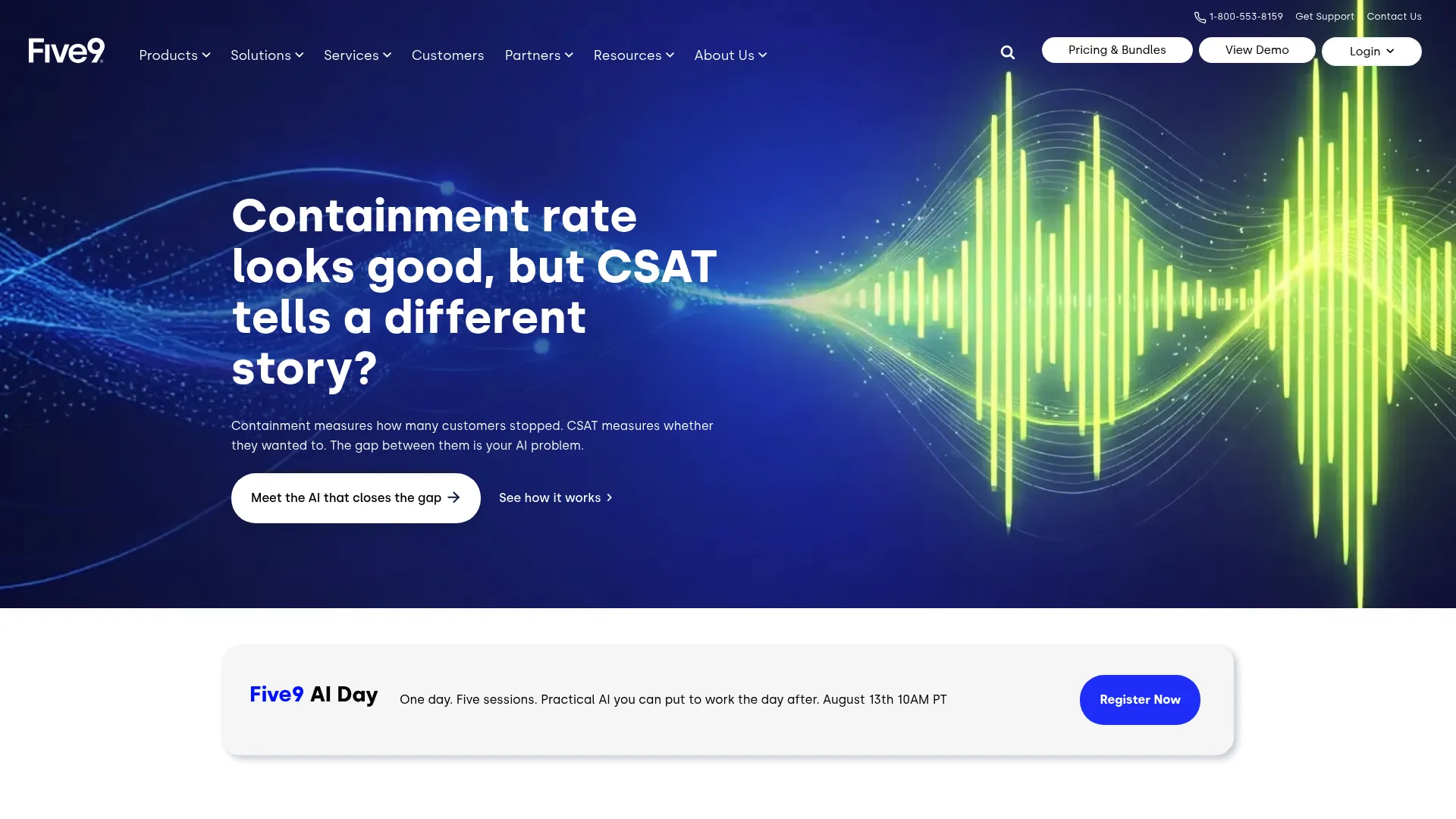
Five9 is a cloud contact center platform built for omnichannel customer service, outbound dialing, analytics, and AI-assisted agent workflows. It supports inbound, outbound, and blended operations, which makes it a fit for teams running both service queues and outbound campaigns from one system. For high-volume outbound, its dialer sits inside a broader contact center that most enterprise operations already need.
Best for: Mid-market to enterprise teams needing a cloud contact center platform with omnichannel and AI capabilities.
Key features
- Omnichannel channels: voice, chat, email, SMS/MMS, social
- AI features: summaries, live transcription, agent assist, knowledge
- Inbound, outbound, and blended contact center modes
- Routing, recording, dialer, and analytics in one platform
Why choose Five9: If you already run a multichannel contact center and want predictive dialing without bolting on a separate tool, Five9 keeps everything under one roof. The breadth suits larger teams more than lean outbound squads.
Five9 pricing: The Digital plan starts at $119 per seat per month and Core at $159 per seat per month. Plus, Pro, and Enterprise plans are contact sales, with a minimum of 50 seats.
2. Nextiva Enterprise
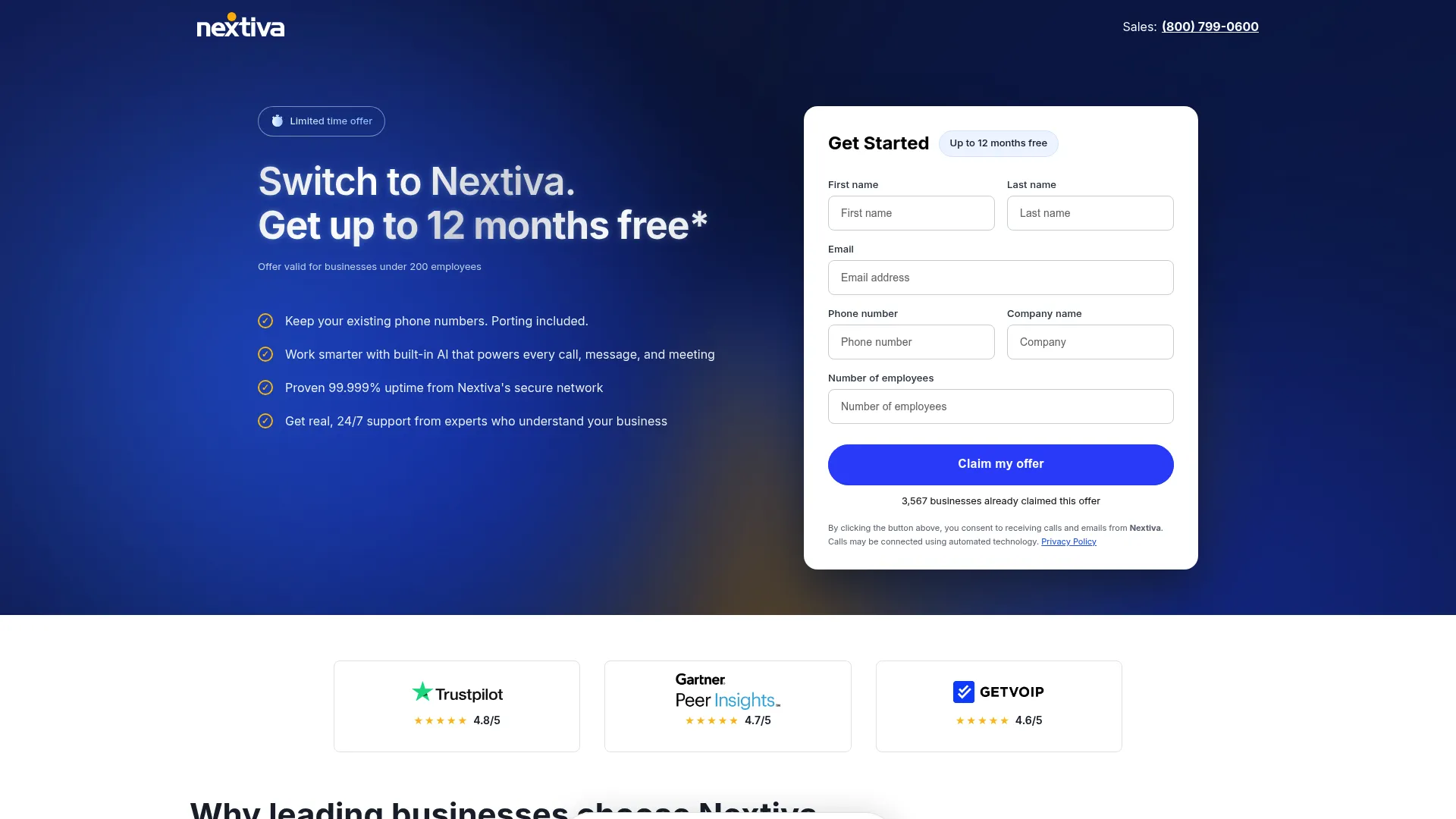
Nextiva Enterprise is an enterprise AI customer experience and communications platform that pairs contact center capabilities with a full communications stack. For teams that want predictive dialing alongside voice, chat, email, social, and SMS in one place, it removes the need to stitch tools together. The enterprise integrations run deep across common sales and service systems.
Best for: Large organizations needing a unified communications and contact center platform with enterprise integrations.
Key features
- Unified voice, chat, email, social, and SMS on one platform
- Integrations with Salesforce, Microsoft Teams, HubSpot, Zendesk, ServiceNow
- Security and compliance: SOC 2, HIPAA, PCI-DSS, ISO/IEC 27001
- 99.999% uptime claim
Why choose Nextiva Enterprise: This suits organizations consolidating communications and contact center into a single vendor. Outbound-only teams may not need the full breadth, but teams that want one platform for everything get strong integration coverage.
Nextiva Enterprise pricing: The Essential plan starts from $75 per agent per month, billed annually. Professional and Premium plans are contact sales with customized enterprise pricing.
3. RingCentral CX
RingCentral CX is AI-powered omnichannel contact center software with published per-seat pricing, which is rare in a category full of quote-only vendors. It covers voice and more than 20 digital channels, with a unified agent workspace and built-in analytics. Teams already inside the RingCentral ecosystem get the tightest fit here.
Best for: Teams wanting an AI-first contact center with omnichannel support and transparent per-seat pricing.
Key features
- AI virtual agents and real-time coaching
- Omnichannel support across voice and 20+ digital channels
- Unified agent workspace with analytics
- Integrations with common CRM and business tools
Why choose RingCentral CX: The published pricing makes budgeting easier for teams that hate chasing sales quotes. It fits companies that value an AI-first workspace and want omnichannel routing beyond just outbound dialing.
RingCentral CX pricing: The Standard plan is $65 per user per month and Professional is $95 per user per month.
4. Genesys
Genesys is a customer experience platform focused on contact center, digital engagement, AI, and workforce optimization. It targets mid-to-large contact centers that need omnichannel CX plus the orchestration and workforce tooling to run complex operations. For teams past the point where a simple dialer is enough, Genesys offers the depth to manage scale.
Best for: Mid-to-large contact centers needing omnichannel CX, AI, and workforce tools.
Key features
- Voice and digital customer engagement
- AI automation and copilot tools
- Workforce management and quality assurance
- Four public tiers plus add-on offerings
Why choose Genesys: Larger operations with sophisticated routing, forecasting, and quality needs get the orchestration layer here. Smaller outbound teams may find the platform broader than they need, but scaling teams grow into it.
Genesys pricing: Genesys Cloud CX 1 starts at $75 per user per month, CX 2 at $115, CX 3 at $155, and CX 4 at $240, all billed annually.
5. NICE CXone
NICE CXone is an AI-powered customer experience platform for contact centers and enterprise customer engagement. It leans hard into AI-first orchestration, omnichannel routing, and workforce, quality, and performance management. For outbound teams that need deep analytics alongside their dialing throughput, the reporting depth is the draw.
Best for: Enterprises needing an all-in-one AI contact center and CX platform.
Key features
- AI-first customer engagement orchestration
- Voice and digital omnichannel routing
- Workforce, quality, and performance management
- Tiered suites with monthly and usage-based billing
Why choose NICE CXone: Analytics-heavy teams that treat reporting as a core requirement, not an afterthought, get real depth here. It fits enterprises willing to invest in a full CX platform rather than a standalone dialer.
NICE CXone pricing: The Omnichannel Suite starts at $110 per agent per month, Essential at $135, Core at $169, Complete at $209, and Ultimate at $249 per agent per month.
6. DialedIn
DialedIn is contact center software built for outbound calling and campaign management, with a clear focus on dialing efficiency. It supports preview, progressive, and predictive dialing, so teams can match the mode to each campaign. For outbound sales and call center teams that want dialing at the center rather than as one feature among many, it is a focused pick.
Best for: Outbound sales and call center teams needing auto-dialing and coaching tools.
Key features
- Preview dialing for high-value accounts
- Progressive dialing for balanced pacing
- Predictive dialing for high-volume throughput
- Campaign management and coaching tools
Why choose DialedIn: Teams that want a dialer-first platform rather than a full contact center suite get exactly that. The multi-mode dialing means one tool handles cold volume and considered outreach.
DialedIn pricing: G2 lists four paid editions: Enterprise Plus at $25, Enterprise at $39, Professional at $59, and Small Business at $79. No free plan or trial is shown.
7. Convoso
Convoso is cloud-based outbound contact center software built for sales and lead-generation teams. It combines predictive and power dialing with omnichannel voice, email, and SMS, plus workflow automation and compliance tooling. For high-volume lead gen operations that live and die by connect rates, the configurability is the appeal.
Best for: Outbound sales teams needing a configurable dialer and contact center platform.
Key features
- Predictive and power dialing
- Omnichannel voice, email, and SMS
- Workflow automation and real-time monitoring
- Compliance features and CRM integrations
Why choose Convoso: High-volume outbound and lead gen teams that need pacing control and compliance tooling in one configurable platform will find the fit here. The trade-off is that pricing requires a sales conversation.
Convoso pricing: Convoso customizes pricing by seats, features, and integrations. It primarily offers annual plans and does not offer a free trial.
Considerations
Check CRM compatibility first
The best dialing engine loses value if it does not sync cleanly with your CRM. Before you shortlist, confirm the platform connects to Salesforce, HubSpot, or whatever your team runs. Watch for two-way sync, click-to-dial from records, and automatic call logging, because manual data entry between systems eats the time a dialer is supposed to save.
Verify compliance controls
A TCPA compliant predictive dialer is not optional in the US. Confirm the platform handles DNC scrubbing, local presence dialing, time zone controls, and abandon rate caps. Ask specifically how the vendor keeps abandoned calls under the legal threshold, since that is where fines start.
Decide between cloud and on-prem
Around 65% of deployments used cloud-based predictive dialer systems in 2024, with 35% on-premises, per Industry Research. A cloud based predictive dialer means faster setup, remote agents, and no server maintenance. A hosted predictive dialer or on-prem build gives IT-heavy teams more control over data and configuration. Match the choice to your infrastructure and compliance posture.
Match the dialer mode to the motion
Predictive dialing suits high volume with large agent pools. Progressive dialing balances throughput and abandon risk. Preview dialing fits complex or high-value accounts that need research first. Pick a platform that supports all three so you can adjust per campaign instead of forcing one mode on every list.
Confirm reporting and coaching depth
Managers need more than dial counts. Look for call recording, live monitoring, whisper coaching, and analytics that tie activity to outcomes like connects, conversions, and meetings held. Throughput without visibility just means you dial faster into the dark.
Conclusion
The right predictive dialer software depends on your operating context, not a leaderboard. For enterprise contact centers that need omnichannel and AI, Five9 and Genesys carry the depth. Teams that want a dialer inside a full communications stack should look at Nextiva Enterprise or RingCentral CX, which also publishes transparent per-seat pricing. Analytics-heavy enterprises get reporting depth from NICE CXone.
If dialing efficiency is the whole point, DialedIn gives you preview, progressive, and predictive modes in a focused platform, and Convoso brings configurable high-volume outbound with compliance tooling built in.
Shortlist two or three tools that match your volume, compliance needs, CRM stack, and deployment preference. Then book demos and run a live pilot with real lists before you commit. The dialer that lifts your connect rate on your data is the one worth buying.
FAQs
Predictive dialer software is outbound calling software that dials multiple numbers ahead of agent availability and routes only live answers to free reps. It uses pacing algorithms and answering machine detection to cut idle time between calls. The result is more live conversations per agent hour.
A predictive dialer dials several numbers ahead of agents to maximize throughput, which suits large teams and high volume. A progressive dialer dials one number as soon as an agent frees up, which lowers abandon risk. Predictive wins on speed; progressive wins on tighter control.
The system reads agent count, average call duration, and connect rates, then calculates how many numbers to dial at once. It filters out voicemail, busy signals, and no-answers, and routes only human pickups to an available agent. Abandon rate controls keep connected-but-unstaffed calls within legal limits.
Yes, predictive dialing is legal in the US when used within TCPA rules. That means honoring DNC lists, keeping abandoned calls under the regulated threshold, and respecting calling time windows. A TCPA compliant predictive dialer with DNC scrubbing and abandon rate caps helps you stay inside the rules.
Predictive dialer pricing ranges widely by deployment and features. Published entry points run from around $25 per seat on DialedIn to $65 to $119 per user on RingCentral CX and Five9. Enterprise platforms like Genesys and NICE CXone start near $75 to $110 per agent, and some vendors like Convoso quote custom pricing.
Prioritize pacing algorithms, answering machine detection, abandon rate control, and live-answer routing for dialing performance. On compliance, look for DNC management, local presence, and time zone controls. For workflow, confirm CRM integration, call recording, and analytics that measure connects and conversions, not just dials.
Salesforce and HubSpot are the two most common for sales and outbound teams, so native, two-way integration with those is the priority. Look for click-to-dial from CRM records, automatic call logging, and real-time activity sync. Clean integration removes the manual data entry that otherwise cancels out a dialer's speed gains.
It depends on scale and needs. Large omnichannel operations tend to choose Five9, Genesys, or NICE CXone for contact center breadth and analytics. Outbound-focused call centers often prefer DialedIn for multi-mode dialing efficiency or Convoso for high-volume lead gen with compliance tooling.