Last updated: October 5, 2026
Your branded merchandise campaign looks simple in the planning deck. Then the requests arrive. Someone needs a client-specific catalog. Another person needs an artwork revision approved. A supplier changes inventory mid-run. Finance asks where the invoice went.
Now the campaign lives across email threads, a separate spreadsheet, a store platform, and a shipping portal you check manually. Nothing connects.
According to PPAI's Product Power 2026 study, which surveyed more than 5,000 U.S. respondents, consumers judge promotional products against the same quality and value thresholds they apply to retail purchases. The operational bar is higher than ever. A disconnected stack makes it nearly impossible to meet it consistently.
Promotional products software brings catalog access, quote-to-order workflows, artwork approvals, supplier connections, branded stores, and fulfillment reporting into a single operating system. The right platform determines whether branded merchandise becomes a repeatable, attributable channel or a manual project you rebuild each campaign cycle.
Which platform matches the way your team sources, sells, produces, and distributes branded products?
What's inside
This guide covers seven platforms chosen for category fit across promotional product management software workflows. The shortlist serves promotional product distributors, decorators, print shops, and marketing teams managing branded merchandise programs.
- Who this is for: Promo distributors, decorators, and marketing operators managing employee stores, campaign kits, or client merchandise
- How tools were chosen: Category fit, promotional product catalog software capabilities, workflow coverage, current pricing, and review visibility
- Selection criteria used:
- Verified pricing and G2 ratings from each vendor's live pages
- Coverage of at least one core workflow: Distributor operations, production management, or branded merchandise fulfillment
- Fit for the promo products software industry specifically, not generic ecommerce or project management
TL;DR
- Best for connected distributor operations: commonsku, for teams that need CRM, product presentations, order management, client portals, and shops in one workflow
- Best for all-in-one promo operations: MPower, for distributors wanting catalog, production, accounting, inventory, and stores consolidated
- Best for product research at a lower entry price: SAGE Workplace, for smaller distributor teams that need a large searchable product database plus core business management
- Best for high-volume distributor complexity: Syncore, for larger North American distributors managing finance, production, and supplier rebates at scale
- Best for production-first print shops: Printavo, for decorators and apparel printers needing quotes, artwork approvals, and production scheduling
- Best for branded company store programs: Axomo, for marketing and people teams running employee merchandise with budget controls and fulfillment
- Best for swag, gifting, and distributed fulfillment: Stadium, for growth marketers running recipient-choice campaigns, employee gifts, and event kits globally
What is promotional products software?
Promotional products software is a category of tools that helps businesses source, customize, quote, sell, produce, manage, and distribute branded merchandise.
Core workflows the category supports
Different platforms cover different combinations of these workflow areas:
- Product research and supplier catalogs: Searchable databases of items across suppliers, with pricing, inventory, and decoration specifications
- Quotes, presentations, and customer approvals: Branded proposal builders, customer-facing presentations, and proof sign-off flows
- Artwork, mockups, and decoration details: Virtual samples, design uploads, print-ready file management, and decoration method specs
- Sales orders, purchase orders, invoicing, and payment collection: End-to-end order lifecycle from customer agreement to supplier payment
- Production scheduling, inventory, and fulfillment: Job routing, capacity planning, stock counts, pick-and-pack, and shipping tracking
- Branded company stores and employee merchandise programs: Self-serve storefronts with budget controls, approval workflows, and reporting
- Integrations with CRM, accounting, tax, and marketing tools: Data sync with the broader stack your sales and finance teams already use
Promotional products software vs. general ecommerce software
General ecommerce tools handle checkout and payments well. Promotional product operations add a layer that most ecommerce platforms do not cover: Supplier data, decoration specifications, proof approvals, customer-specific pricing, purchase orders, and production tracking. A Shopify store can sell merchandise. Dedicated promo software manages everything that happens before and after the order button.
Where PromoStandards fits
PromoStandards is an industry integration standard, not a standalone software platform. Participating suppliers and distributors use it to exchange inventory data, order status, shipping notifications, and electronic purchase orders automatically. When evaluating promotional product management software, ask whether the platform connects to PromoStandards-participating suppliers, and which data flows are live versus manually updated.
When to use promotional products software
Replace spreadsheet-based quote-to-order workflows
Your team should consider a dedicated platform when sales reps rebuild every quote from scratch, artwork feedback travels through email with no version control, and orders require repeated handoffs between sales, production, and finance before anything ships. The cost is order errors, delayed approvals, and a finance team that cannot reconcile invoices without chasing context from three different inboxes.
Launch branded company stores without creating a fulfillment side project
Marketing teams running repeat merchandise programs for employees, events, or partners need more than a product page. A store platform handles budgets, inventory visibility, approval gates, shipping rules, and program reporting. Without one, every reorder becomes a manual project and attribution back to campaign spend is nearly impossible.
Give sales teams current product data and faster presentations
Sales teams working on client gifts, partner kits, or ABM campaigns need to find products, generate virtual samples, and send customer-facing presentations without waiting on an operations team. Promotional product catalog software with built-in presentation tools cuts that cycle from days to hours and gives marketing a repeatable asset for campaign kits.
Promotional products software comparison
The seven tools below fall into three practical groups: Full distributor operations platforms (commonsku, MPower, SAGE Workplace, Syncore), production and print management systems (Printavo), and branded merchandise and fulfillment platforms (Axomo, Stadium). Pricing and G2 ratings reflect verified figures from each vendor's pricing page and G2 listing as of October 2026. Display "N/A" for any rating where a current verified figure was unavailable.
| # | Product | Best for | Key differentiator | Pricing | G2 rating |
|---|---|---|---|---|---|
| 1 | commonsku | Distributor teams managing sales, orders, and client stores | Connected workflow: Presentations, orders, supplier data, and shops | From $129/user/mo | 5.0/5 |
| 2 | MPower | Distributors seeking broad operational coverage | CRM, catalog, orders, accounting, production, inventory, and stores in one platform | From $99/mo | N/A |
| 3 | SAGE Workplace | Product research, presentations, CRM, and business management | Large promotional product database plus distributor workflow tools | From $59/mo (first user) | N/A |
| 4 | Syncore | High-volume North American distributors | Business-size pricing with operational controls and supplier rebate tracking | Contact for pricing | 4.4/5 |
| 5 | Printavo | Decorators and print shops with production complexity | Production scheduling, quotes, proof files, and pricing matrices | From $109/mo | 4.3/5 |
| 6 | Axomo | Company stores and employee merchandise programs | Branded storefronts, budget controls, inventory, and fulfillment support | From $3,499 minimum | 4.4/5 |
| 7 | Stadium | Global swag, gifting, and fulfillment programs | Recipient-choice gifting, global fulfillment, and engagement automations | Contact for pricing | 4.8/5 |
Best 7 promotional products software tools for 2026
1. commonsku
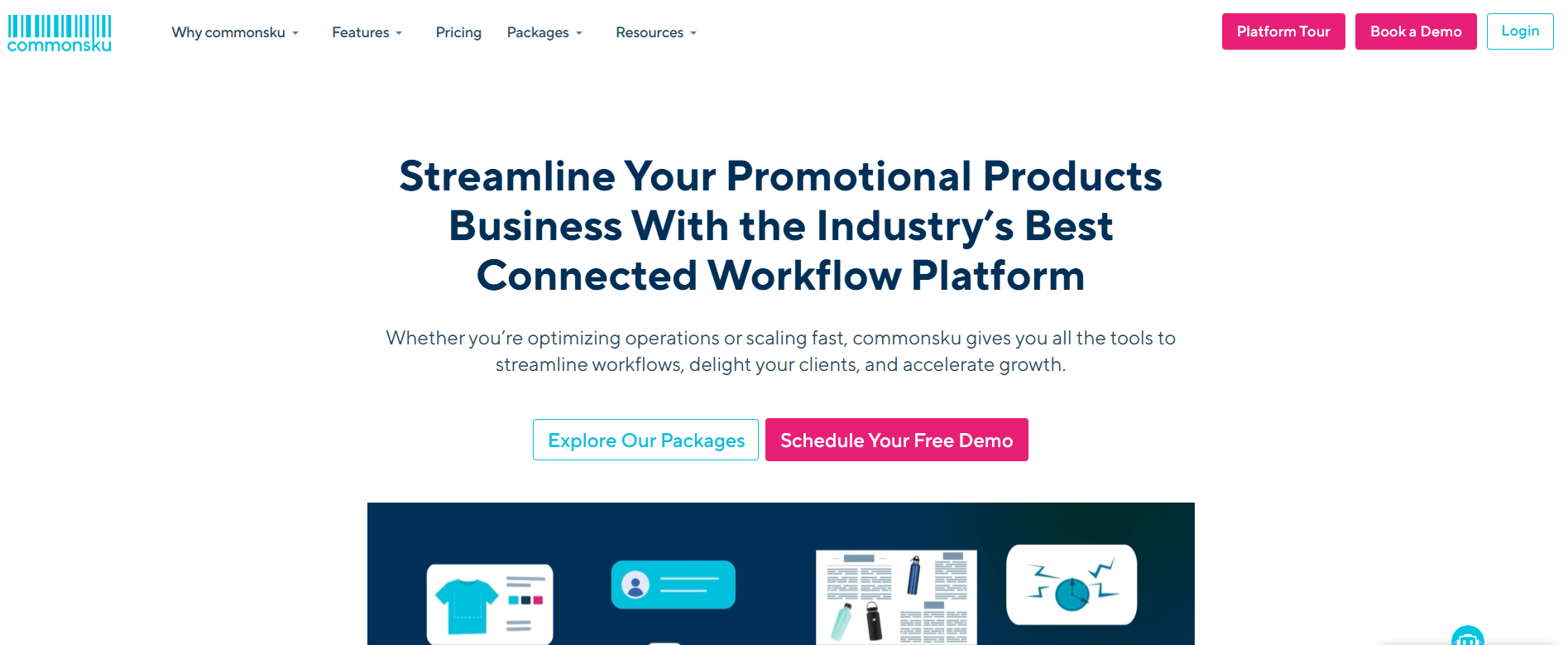
commonsku is a promotional products business platform built for distributors who need sales, operations, and client commerce to share the same project record. It connects product presentations, CRM activity, sales orders, purchase orders, production tracking, client portals, and online shops into one operating workflow. The platform covers the full distributor journey, from the first client conversation through to supplier payment and shop fulfillment.
Best for: Small to midsize promotional product distributors that need a connected sales-to-order workflow and client-facing shops.
Key features
- Interactive product presentations with client review and approval
- Client portals and project-level collaboration tools
- Promotional product order management software with production tracking
- Shops for branded company store programs (transaction fees apply)
- Supplier connectivity and electronic purchase orders via PromoStandards integration
Why choose commonsku: The platform suits distributors where the main bottleneck is keeping sales, operations, and clients aligned on the same order record. If your team loses time reconciling what was quoted versus what was ordered, or chasing artwork approvals across email, commonsku centralizes those handoffs.
commonsku pricing: Essentials starts at $129 per user per month with a two-user minimum. Advanced starts at $159 per user per month with a three-user minimum. Enterprise pricing is custom. Annual prepayment receives a 10% discount. Shops carry transaction fees starting at 2.5%, decreasing to 1% based on lifetime sales volume; Shopify-connected shops are charged 1% on all orders.
G2 rating: 5.0/5
2. MPower
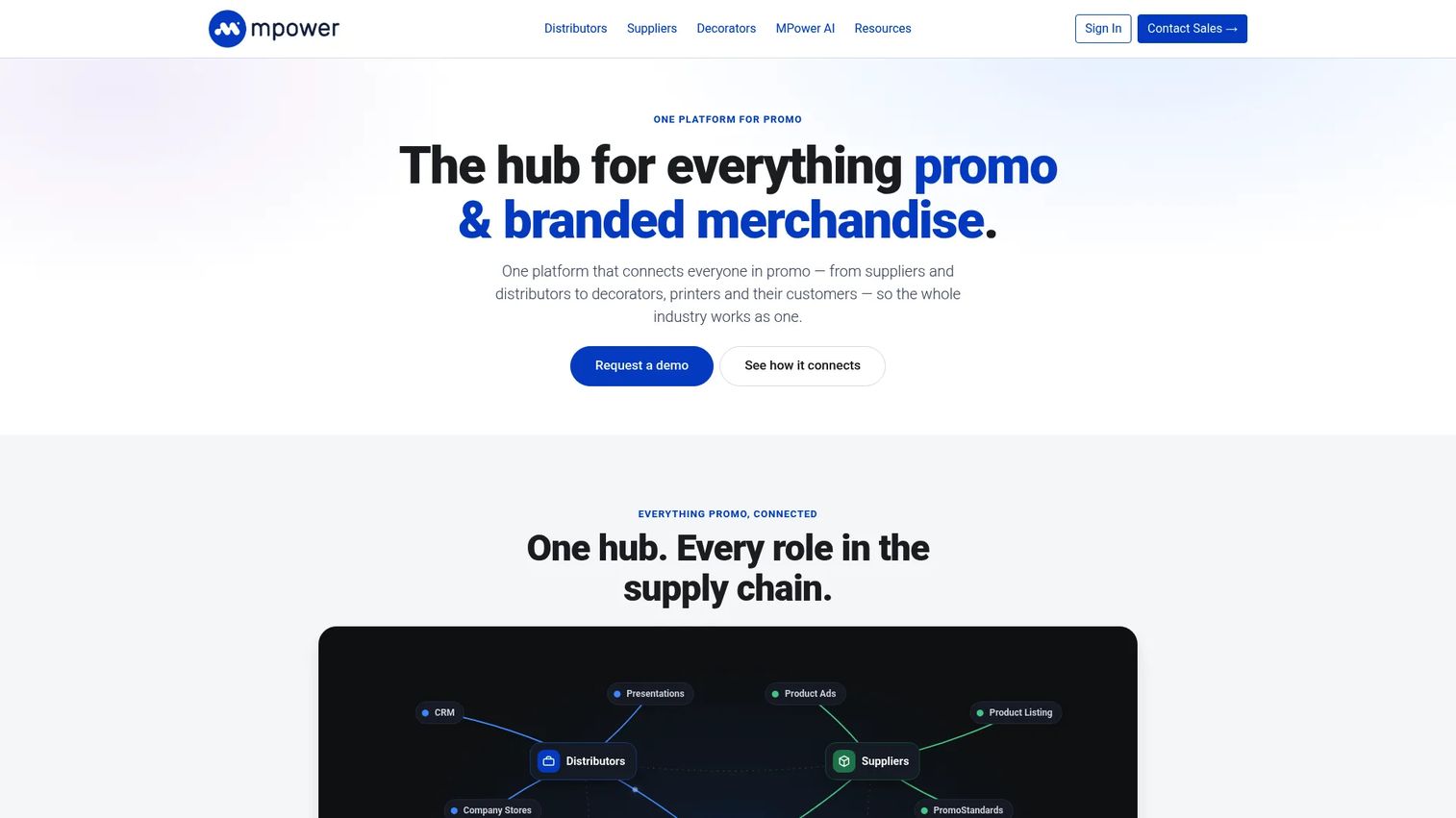
MPower is an all-in-one platform built specifically for promotional-products distributors, suppliers, decorators, and printers. It brings product research, CRM, presentations, promotional product order management, accounting, production, inventory, online stores, and AI-assisted features together in a single system. For distributors that have been running separate tools for their store, their accounting, and their order management, MPower is designed to consolidate those into one subscription.
Best for: Promo distributors that want to reduce system switching and need broad coverage across sales, production, fulfillment, and finance.
Key features
- Promotional product catalog software with live supplier pricing and inventory
- CRM, presentations, and art proofing in one workflow
- Order management, accounting, and production together
- Online stores with custom domains and unlimited store options (All-in-One tier and above)
- PromoStandards integrations for product, pricing, inventory, and order-status data
Why choose MPower: The strongest case for MPower is catalog depth combined with promo-specific workflow coverage across multiple departments. Teams that have been managing their store on one platform, their orders in another, and their accounting in a spreadsheet will find the consolidation meaningful.
MPower pricing: The Starter plan runs $99 per month (billed annually) and includes CRM, presentations, product search, and up to five users. All-in-One is $479.20 per month (billed annually) and adds unlimited stores, order processing, accounting, custom domain, and up to ten users. All-in-One Pro runs $959.20 per month (billed annually) and adds unlimited users, domains, API access, marketing automation, and priority support. Verify current tier details at mpowerpromo.com/pricing before committing.
3. SAGE Workplace
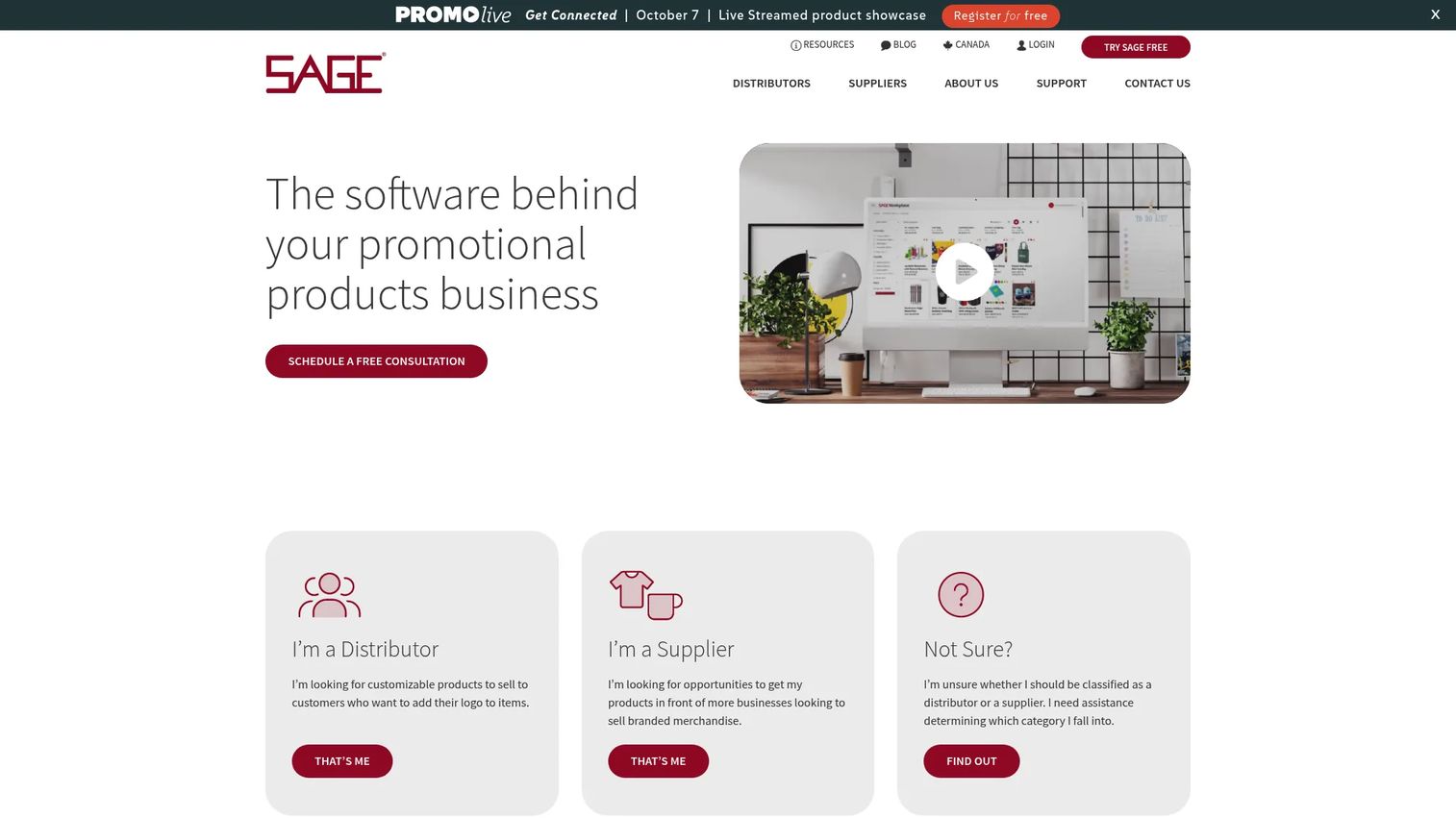
SAGE Workplace is an integrated product research and business management platform for promotional products distributors. It combines a large, verified promotional product database with CRM, presentations, projects, Catalog Studio, Design Studio, email campaigns, order management, and a Tradeshow Planner. SAGE is one of the longer-standing names in promo distributor software, and its product database breadth is a common reason teams choose it.
Best for: Smaller distributors and sales teams that need strong product research, customer presentations, and core business management at a published entry price.
Key features
- Verified promotional product catalog software with supplier information
- Product presentations, virtual samples, and client CRM
- Project and order management with SAGE Chat
- Email campaigns (up to 25 per month included at the base tier)
- Web, desktop, and mobile access across devices
Why choose SAGE Workplace: When the immediate bottleneck is finding the right product and getting a client-facing presentation out the door, SAGE Workplace covers that workflow at a lower starting price than most full-stack promo platforms. It is a practical entry point for teams that do not yet need broad production or inventory management.
SAGE Workplace pricing: The first user costs $59 per month or $595 per year. Each additional user costs $9 per month or $95 per year. Additional features such as websites and company stores are priced separately, so confirm the full scope of what each add-on costs before signing. A 30-day complimentary trial is promoted on select association partner pages; check eligibility at sageworld.com.
4. Syncore
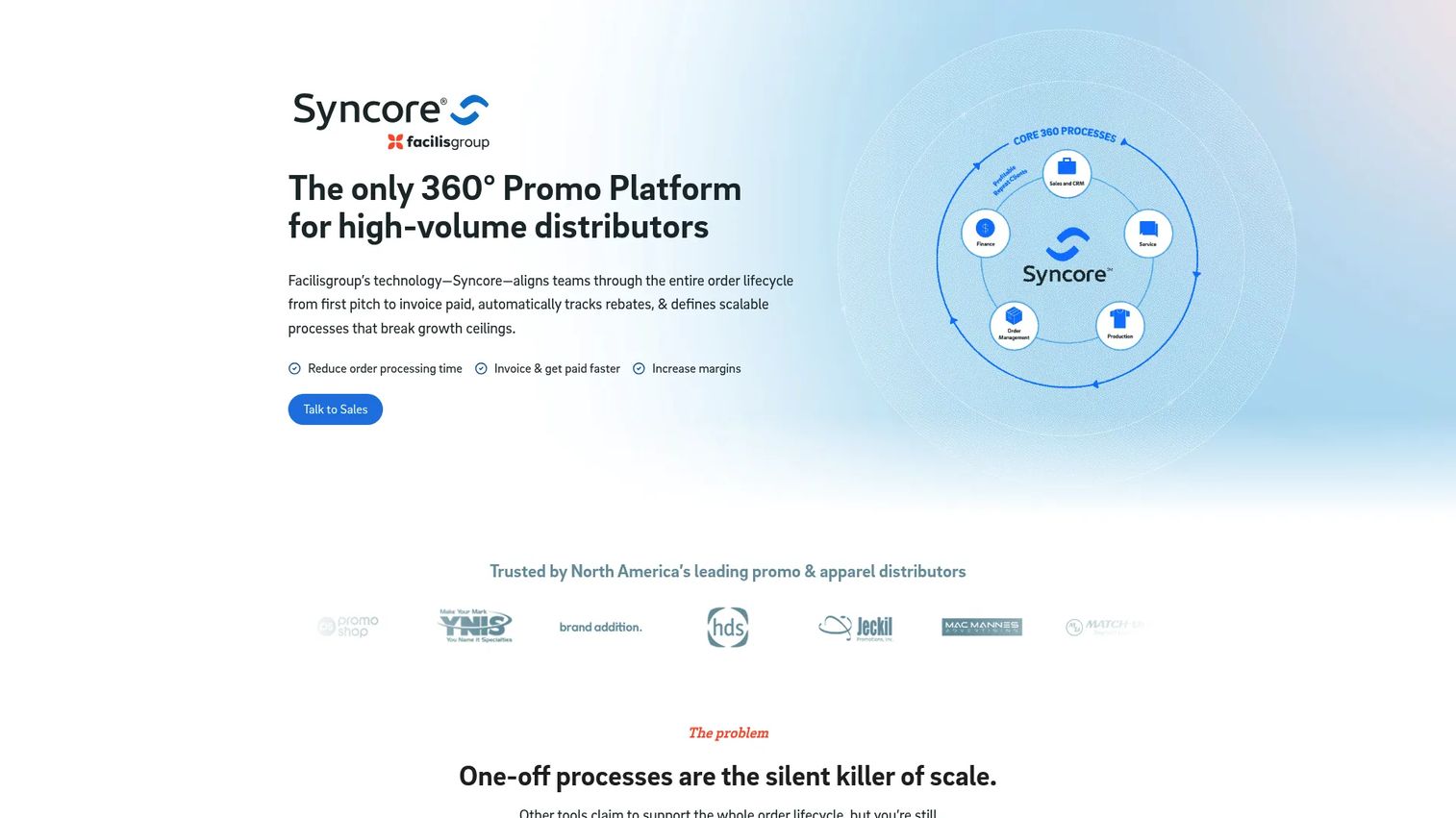
Syncore, part of Facilisgroup, is an end-to-end operational platform for high-volume North American promotional product distributors. It covers the full order lifecycle: CRM, product catalogs, proposals, quotes, purchase orders, production scheduling, invoicing, commissions, supplier payments, and month-end reporting. Facilisgroup identifies annual promo revenue above $1 million as a strong fit indicator for the platform.
Best for: Established North American distributors with complex order volumes, in-house decoration, multi-department finance workflows, and supplier rebate management.
Key features
- CRM, product search, proposals, quotes, and sales order management
- Production scheduling, spoilage tracking, and purchase-order visibility
- Invoicing, supplier payments, commissions, and month-end financial reporting
- Automatic supplier rebate tracking
- Integrations with Outlook, Avalara (tax), and Paya (payments)
Why choose Syncore: The platform is built for companies that have outgrown lightweight catalog or quoting tools and need standardized systems across departments. The Facilisgroup partnership model adds preferred supplier network benefits and rebate tracking that smaller platforms do not replicate.
Syncore pricing: Syncore prices based on business size rather than per-user counts, and the fee includes platform access plus Facilisgroup partner benefits. No numeric price is displayed on the pricing page. Request a written quote that separates platform costs, onboarding fees, and any participation requirements before evaluating total cost against your current stack.
G2 rating: 4.4/5
5. Printavo
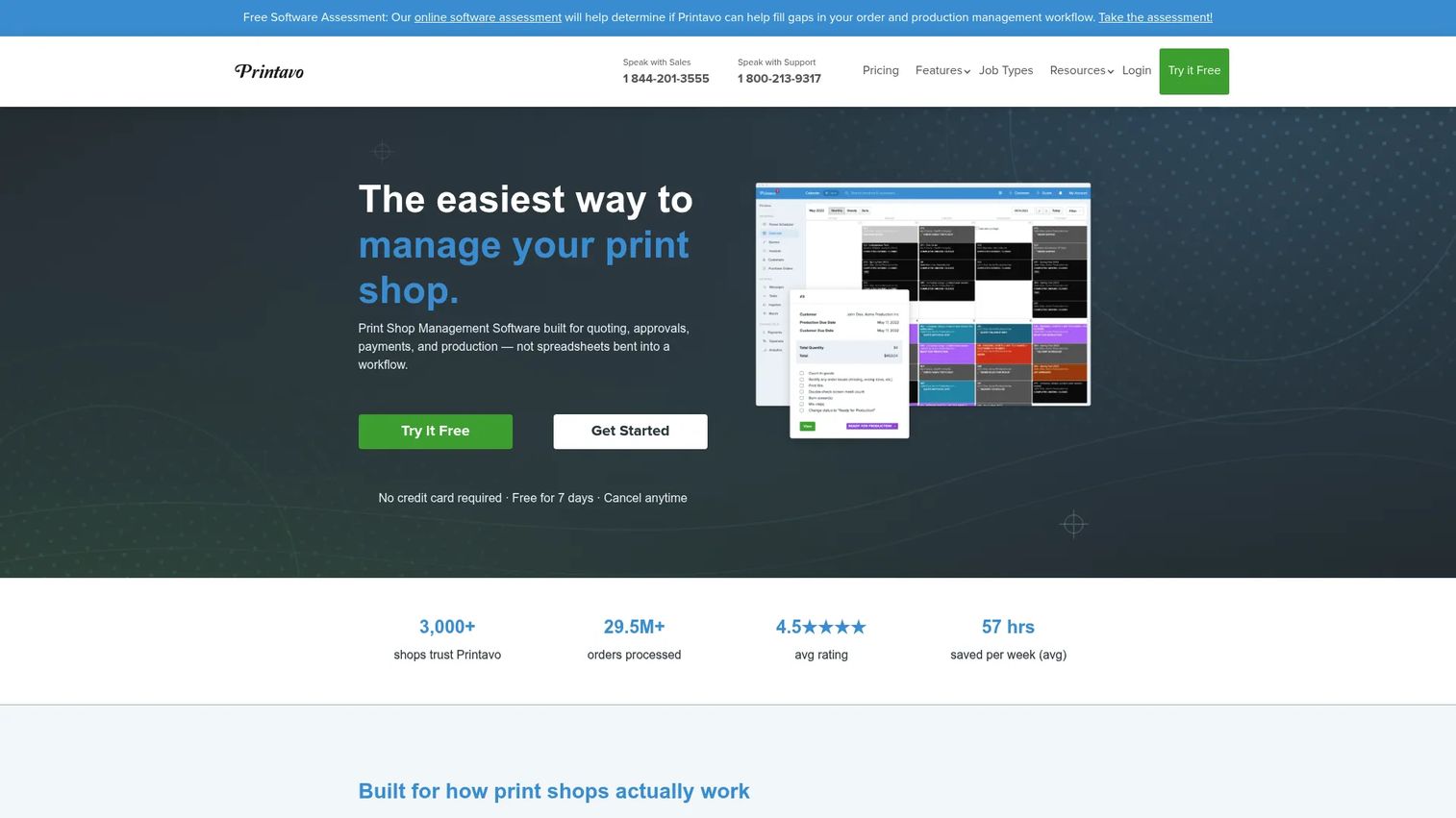
Printavo is cloud-based shop management software built for print, embroidery, digital graphics, and decorated-apparel businesses. It handles quotes, customer approvals, invoices, payment requests, production scheduling, task assignments, artwork file management, pricing matrices, purchase orders, and shipping workflows. Promotional product distributors with in-house decoration operations also use it where production visibility is the primary need.
Best for: Decorators, apparel printers, and production-led promotional product businesses that need tighter control of jobs after the order is sold.
Key features
- Quotes, invoices, and payment requests with customer approval tracking
- Visual production scheduling with task assignments and capacity planning
- Artwork files and proof management for customer sign-off
- Custom pricing matrices for decoration types and quantities
- Purchase orders and receiving workflows
Why choose Printavo: The core case for Printavo is production visibility. If your main operational problem is moving custom-decorated jobs through approvals, scheduling, and fulfillment with accurate margin tracking, Printavo is purpose-built for that job. Distributors who depend heavily on broad promo supplier catalog search should validate whether that coverage meets their needs during a trial.
Printavo pricing: Lite costs $109 per month and includes 2 users and 20 monthly quotes or invoices. Standard costs $244 per month and includes 5 users with unlimited quotes and invoices. Premium includes 20 users with unlimited quotes and invoices; contact Printavo for that rate. A 7-day free trial is available.
G2 rating: 4.3/5
6. Axomo
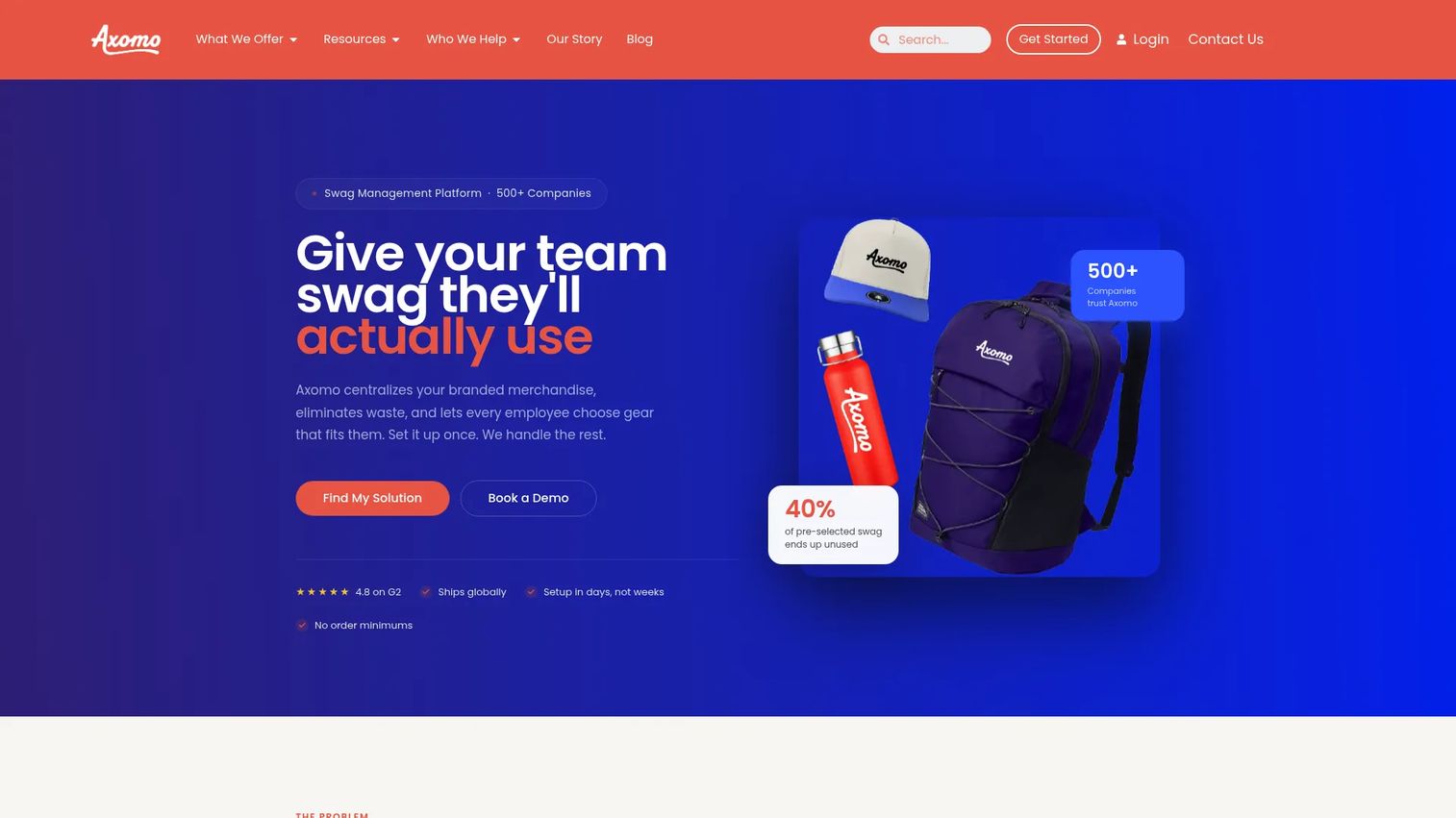
Axomo is a brand management and swag-management platform for building branded company stores, employee merchandise programs, and distributed gifting campaigns. It covers centralized purchasing, custom product categories, budget controls, store credit rewards, live inventory tracking with replenishment alerts, and both domestic and international shipping options. The platform is built for marketing, people operations, and brand teams, not for distributors needing broad supplier network connectivity.
Best for: Marketing, people operations, and brand teams that need a company store and swag distribution program without implementing a full promo distributor operating system.
Key features
- Branded company storefronts with large product catalogs
- Budget and store credit controls for employee or departmental ordering
- Inventory management with live stock counts and replenishment alerts
- On-demand ordering and bulk shipment options
- Reports, analytics, and ROI insights across programs
Why choose Axomo: Axomo fits a marketer who needs employee merchandise, event campaigns, and ongoing company stores to run without handling sourcing coordination and distribution manually. If the business problem is getting branded items to recipients with program-level reporting, Axomo covers that without requiring a full distributor workflow implementation.
Axomo pricing: The Essential plan has a $3,499 minimum commitment and includes 50 free users. A Non-Profit Plan is available for eligible organizations, including nonprofits, educators, and startups with fewer than 10 active users. Axomo+ (additional dedicated swag expertise and services) is priced through a direct conversation with their team. Confirm optional fulfillment and warehousing charges before finalizing your program cost model.
G2 rating: 4.4/5
7. Stadium
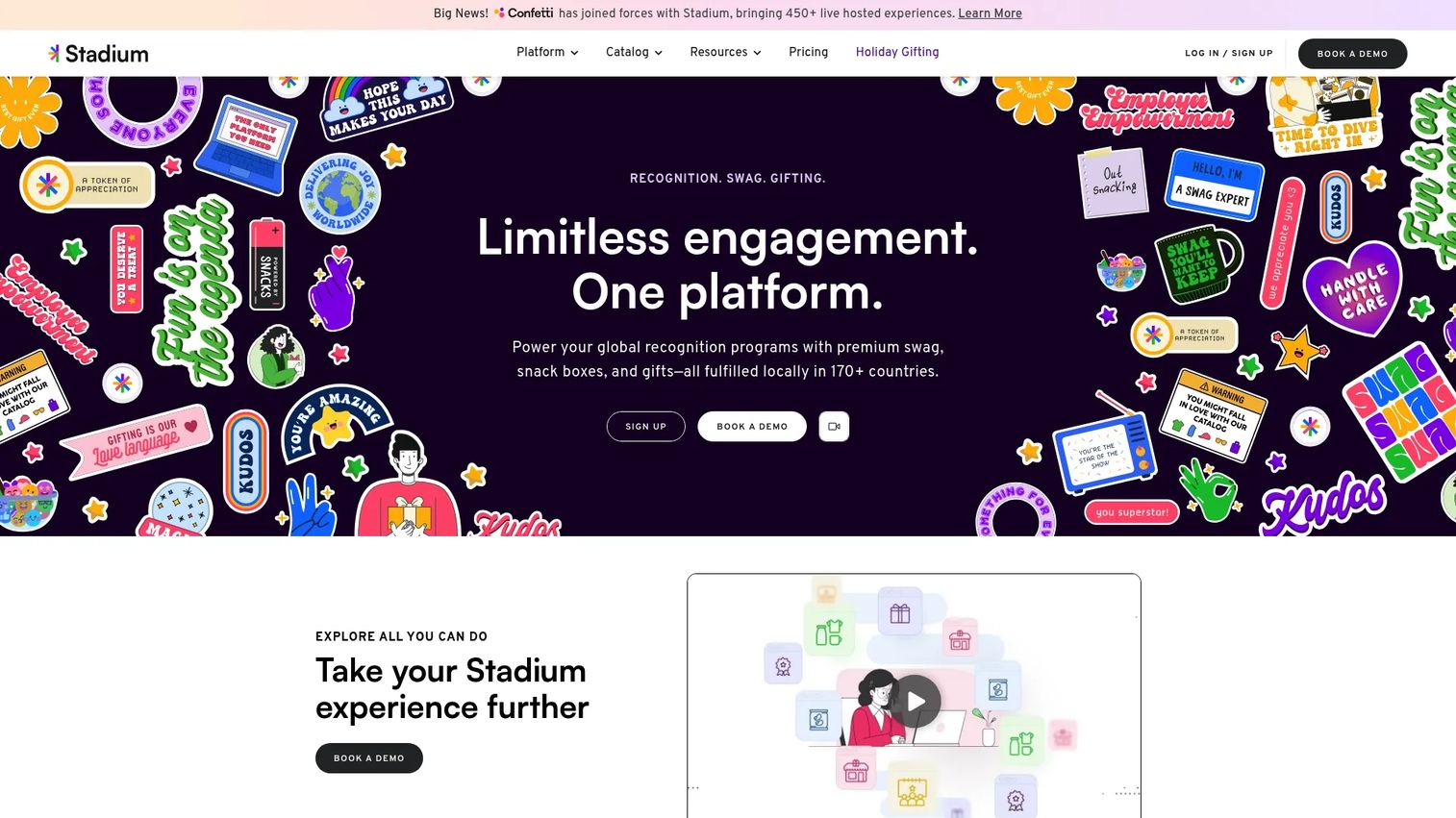
Stadium is a global employee recognition, gifting, rewards, and branded swag platform. It supports customizable gift shops, points-based gifting, branded on-demand and bulk swag, swag inventory management, automated gifting, HRIS/ATS/CRM integrations, shared wallets, and team administration. Growth marketers use it for recipient-choice campaigns, employee gifting at scale, event kits, and distributed merchandise programs across regions.
Best for: Growth marketers and people teams running employee gifts, client campaigns, event kits, and branded merchandise programs with distributed recipients across geographies.
Key features
- Customizable global gift shops with recipient-choice experiences
- Points-based gifting and recognition automations
- Branded on-demand swag and bulk inventory management
- Automated gifting with HRIS, ATS, and CRM integrations
- Program analytics, shared wallets, and team administration
Why choose Stadium: The strongest case is when your primary problem is getting branded items to recipients in multiple countries with minimal manual coordination, rather than managing distributor-specific quoting or supplier workflows. The platform's recognition and engagement automation layer sets it apart from pure merchandise fulfillment tools.
Stadium pricing: Stadium publishes four plan tiers (Shops Pass, Swag Pass, Engagement Pass, Enterprise Pass) with pricing available through sales. A 30-day premium-feature trial is offered. Additional fulfillment fees apply separately: $20 per domestic kit without a paid pass, $99 per international kit. Model your total program cost to include software, merchandise, and fulfillment before comparing against alternative branded merchandise management tools.
G2 rating: 4.8/5
Considerations when choosing promotional products software
Match the platform to your operating model
A marketing team launching employee stores and a promo distributor managing supplier purchase orders have fundamentally different requirements. Define whether your bottleneck is distributor operations, production, or branded merchandise fulfillment before evaluating features. Most platforms specialize in one of those three areas, and trying to force a production-first tool into a distributor workflow creates gaps you will fill manually.
Audit catalog and supplier data before buying
Ask each vendor which supplier networks the platform connects to, whether inventory data is live or updated on a delay, and which PromoStandards data flows are active. Some platforms advertise broad supplier access but route many queries through manual data entry. If supplier connectivity is central to your daily workflow, test it during the trial period with your actual suppliers.
Check the artwork approval to production handoff
Understand exactly how a customer-approved proof becomes a production-ready job in the platform. Where do mockup files live? Who receives an alert when a proof is approved? How are revisions tracked? A weak handoff at this step is where order errors and delays concentrate, and it is rarely visible in a demo until you walk through a real job.
Model the full cost of stores and fulfillment
Do not compare subscription costs alone. Include transaction fees (commonsku Shops start at 2.5%), warehouse and pick-and-pack charges (Axomo and Stadium both carry per-kit fulfillment fees), setup costs, and minimum commitments. A platform with a lower monthly rate can cost significantly more annually once fulfillment volume and transaction fees are factored in.
Verify reporting and integration requirements
If your team needs this data inside a CRM, accounting system, or marketing attribution tool, confirm which integrations exist and what data they sync. Check whether order data, store activity, and fulfillment status flow into your current stack automatically, or whether that requires manual export and import. For digital marketers especially, reporting that does not connect to pipeline metrics is hard to defend at budget reviews.
How to choose the right promotional products software for your team
Choose commonsku if your team runs sales, order management, and client portals in parallel and needs those workflows tied to the same project record. It fits distributors where the sales and operations handoff is the primary source of errors or delays.
Choose MPower if you want to consolidate catalog, CRM, finance, production, inventory, and online stores into one subscription. It is the right call when your team currently switches between three or four tools to complete a single order.
Choose SAGE Workplace if product research and customer presentations are the immediate bottleneck and your team needs a manageable entry price. Smaller distributor teams and sales-focused promo businesses get the most out of it.
Choose Syncore if you run a high-volume North American distributorship with multi-department complexity, in-house decoration, and active supplier rebate programs. The platform is built for companies that have already outgrown lighter catalog tools.
Choose Printavo if your team's main operational problem is moving custom-decorated jobs through quotes, artwork approvals, production scheduling, and margin tracking. Decorators and apparel printers will find the fit most direct.
Choose Axomo if branded merchandise programs for employees, departments, or events are the core use case, and you want a store with budget controls and fulfillment support without building out a full distributor workflow.
Choose Stadium if your team manages gifting, recognition, and swag across distributed recipients in multiple countries, and recipient-choice campaigns or HRIS-triggered automations are part of your program design.
For software teams that sell alongside their physical merchandise programs, showing a product experience before a sales call matters as much as the merchandise itself. Guideflow lets teams build interactive demos for catalog management software and approval workflow software use cases, so buyers can explore the product before committing to a call.
Start your journey with Guideflow today!
FAQs
Promotional products software helps organizations source, customize, quote, sell, produce, and distribute branded merchandise. Different platforms specialize in distributor operations, print production, or branded merchandise fulfillment. Choosing the right one depends on whether your bottleneck is supplier catalog access, order management, production scheduling, or company store administration.
Distributors should prioritize supplier catalog access, quote-to-order workflows, artwork approval tracking, electronic purchase orders, production scheduling, invoicing, and client portals. PromoStandards connectivity is worth confirming separately, as it determines whether inventory and order-status data updates automatically or requires manual input from your team.
No. PromoStandards is an industry integration standard, not a standalone software product. Participating suppliers and distributors use it to exchange data, including inventory levels, order status, shipping notifications, and electronic purchase orders. When evaluating promotional product management software, ask the vendor which PromoStandards data endpoints their platform connects to and whether those connections are live.
Smaller distributor teams should prioritize product research capability, presentation speed, core order management, transparent per-user pricing, and low implementation overhead. SAGE Workplace offers a published entry price starting at $59 per month for the first user, which makes it accessible for teams that are not yet ready for a full-stack platform with broader operational modules.
Yes, several platforms include company store functionality, but the depth varies. commonsku, MPower, and SAGE Workplace include or integrate stores as part of their distributor workflow. Axomo and Stadium are purpose-built for branded merchandise programs with budget controls, inventory management, approval gates, and fulfillment reporting. Verify whether a given store module supports budgets, custom catalogs, approval workflows, and shipping rules before assuming it covers your program requirements.
Pricing models vary across the category. commonsku charges per user per month, starting at $129 for the Essentials tier. MPower uses flat monthly plans, starting at $99 per month billed annually. SAGE Workplace charges per named user, starting at $59 for the first. Syncore and Stadium price through sales conversations based on business size or program scope. Axomo carries a $3,499 minimum commitment. Always model fulfillment fees, transaction fees, and add-on costs alongside the subscription rate to get a full picture.
Many platforms support accounting, CRM, tax, and payment integrations. MPower includes accounting within its All-in-One tier and connects to PromoStandards suppliers. Syncore integrates with Avalara for tax and Paya for payments. Stadium connects to HRIS, ATS, and CRM systems for automated gifting triggers. Confirm whether your specific accounting system and CRM are supported by the platform you are evaluating, and ask which data fields sync automatically versus requiring manual export.
Promotional products platforms focus on supplier catalogs, customer-specific pricing, distributor order workflows, and client-facing presentations. Print shop platforms, like Printavo, focus more on production scheduling, artwork file management, customer proof approvals, job costing, and shop floor coordination. Some distributors with in-house decoration use both. If your operation is primarily production-driven, a print shop platform may cover your core needs. If supplier sourcing and client presentations drive revenue, a distributor-focused platform is the stronger fit.