You launch a product. The price is right on your website, wrong on Amazon, and missing entirely from the partner portal. A spec sheet shows last quarter's dimensions. A customer flags it before your team does. Sound familiar?
That gap is what catalog management software exists to close. The global catalog management system market is projected to grow from roughly $2.34 billion in 2025 to nearly $4 billion by 2030, a CAGR around 9.5 to 11 percent, according to Grand View Research (2024) and Mordor Intelligence (2026). The reason is simple: product data has stopped living in one place. It spreads across ecommerce stores, marketplaces, ERP systems, CRM records, and a dozen spreadsheets, and every channel pulls from a slightly different version of the truth.
For a product marketing manager, this is not an abstract data problem. Message drift across the site, sales decks, ads, and the product UI starts with inconsistent product data. When a launch depends on accurate specs, localized copy, and channel-ready assets, the catalog layer decides how fast you ship and how clean the story stays. That same governance discipline shows up in adjacent categories like component content management systems and audit management software, where a single source of truth and review workflows matter just as much. Teams that lean on AI content creation tools for product copy still need a system that keeps every channel in sync after the copy ships.
This guide ranks eight real product catalog management systems. No filler, no inflated feature claims, just where each one fits.
What's inside
This guide is for teams drowning in product data: ecommerce, wholesale, manufacturing, B2B, and subscription operations that publish across multiple channels. We focused on products that centralize catalog data, support multichannel publishing, and make updates easier to govern.
We selected each tool on four criteria: pricing transparency, integrations with ecommerce, ERP, CRM, payments, and spreadsheets, AI-powered catalog enrichment, and workflow controls for catalog-heavy teams. Pricing and G2 ratings reflect verified, current values from each vendor's own pages and live G2 listings. Where a vendor gates pricing behind a quote, we say so plainly.
TL;DR
- Best for enterprise governance: Akeneo, for mid-market and enterprise teams managing complex, multilingual catalogs with strict approval workflows.
- Best for marketer-friendly product data: Sales Layer, for B2B teams that want a configurable PIM with built-in quality scoring.
- Best for affordability: Plytix, with a free Standard plan and a PIM-plus-DAM setup aimed at SMB and growth teams.
- Best for feed syndication: Productsup, for enterprises distributing product content across thousands of channels.
- Best for product feeds: DataFeedWatch, for merchants and agencies optimizing shopping feeds with AI titles and descriptions.
- Best for open-source flexibility: Pimcore, for engineering-led teams that want PIM, DAM, and MDM in one composable platform.
- Best for marketplace orchestration: ChannelEngine, for brands selling across many marketplaces with dynamic pricing rules.
What is catalog management software?
Catalog management software is a system that centralizes product information in a single source of truth, then publishes accurate, channel-ready data across every store, marketplace, and partner surface a business sells through.
It overlaps heavily with product information management (PIM), product experience management (PXM), and feed management, but the core job is consistent: take messy product data from many sources, clean and enrich it once, and keep every channel aligned. Most product catalog software shares a common set of capabilities:
- Centralized product database: one record per product, with attributes, variants, and relationships managed in one place.
- Bulk import and enrichment: mass uploads, imports from spreadsheets or ERP, and structured enrichment so data is complete before it ships.
- Categorization, search, and filtering: taxonomy, product families, and completeness tracking so teams find and fix gaps fast.
- Channel-specific publishing: omnichannel sync and multichannel publishing that adapt a single record to each channel's format.
- Pricing and attribute rules: pricing rules, formula-driven logic, and validation that catch errors before they reach a customer.
- Integrations: connections to ecommerce, ERP, CRM, payments, and spreadsheets so data flows without manual rekeying.
- AI-assisted enrichment and governance: AI tagging, AI descriptions, pricing intelligence, plus approvals and audit logs that keep quality high at scale.
Deployment models split three ways. Cloud and SaaS dominate, accounting for roughly 65 to 69 percent of market revenue in 2024 to 2025, per Grand View Research (2024) and Mordor Intelligence (2026). On-prem and open-source options trade hosted convenience for control and customization.
When to use catalog management software
Centralize product data across teams
Spreadsheets work until two people edit the same file, or until your catalog crosses a few thousand SKUs. At that point, ownership gets murky, versions diverge, and nobody trusts the master file. A centralized product database fixes the question of which record is correct, so marketing, sales, and ops all pull from the same source. Publishing speed follows, because there is one place to update instead of five.
Publish across multiple channels
If you sell on your own store, Amazon, a partner portal, and a printed or digital catalog, each channel needs the same product to look right in its own format. Manual updates guarantee drift. Catalog management solutions handle multichannel publishing and channel consistency by mapping a single record to each destination's requirements, then syncing changes everywhere at once. That is the difference between a same-day price change and a week of cleanup.
Enrich and govern product content at scale
Large catalogs fail quietly. A missing attribute here, an untranslated description there, and discoverability drops. AI-powered catalog enrichment fills gaps with AI tagging and AI descriptions, while approvals and workflows keep quality from slipping as volume grows. Governance is where catalog management connects directly to launch velocity: clean, reviewed data ships faster and breaks less.
Comparison table
Here are the eight product catalog management systems compared on intent, primary use case, pricing, and verified G2 rating. Pricing reflects each vendor's published figures as of mid-2026.
| # | Product | Intent | Key use case | Pricing | G2 rating |
|---|---|---|---|---|---|
| 1 | Akeneo | Enterprise PIM | Multilingual, governed catalogs at scale | Growth from $0/yr; Advanced and Premium quote-based; free Community Edition | 4.4/5 |
| 2 | Sales Layer | Configurable PIM | Multi-channel B2B product data | Quote-based across four plans; 30-day trial | 4.6/5 |
| 3 | Plytix | Affordable PIM + DAM | SMB and growth multichannel content | Standard free; Pro $499/mo; Enterprise custom | 4.7/5 |
| 4 | Productsup | Feed syndication | Distributing content across many channels | Quote-based | 4.5/5 |
| 5 | DataFeedWatch | Feed management | Optimizing shopping feeds | Quote-based; 15-day trial | 4.7/5 |
| 6 | Pimcore | Open-source + enterprise | PIM, DAM, MDM in one platform | Professional $9,900/yr; Enterprise $29,900/yr; PaaS from $39,900/yr | 4.5/5 |
| 7 | ChannelEngine | Marketplace orchestration | Multichannel marketplace selling | Start, Grow, Scale tiers (GMV-based) | 4.3/5 |
| 8 | CatalogIt | Collections management | Structured item cataloging and sharing | Free plan; Small Museum from $449.99/yr | 4.9/5 |
A quick read: enterprise teams cluster around Akeneo and Pimcore, mid-market B2B around Sales Layer, budget-conscious growth teams around Plytix, and channel-heavy sellers around Productsup, DataFeedWatch, and ChannelEngine. CatalogIt serves a distinct collections-management need. The sections below cover the fit details.
1. Akeneo
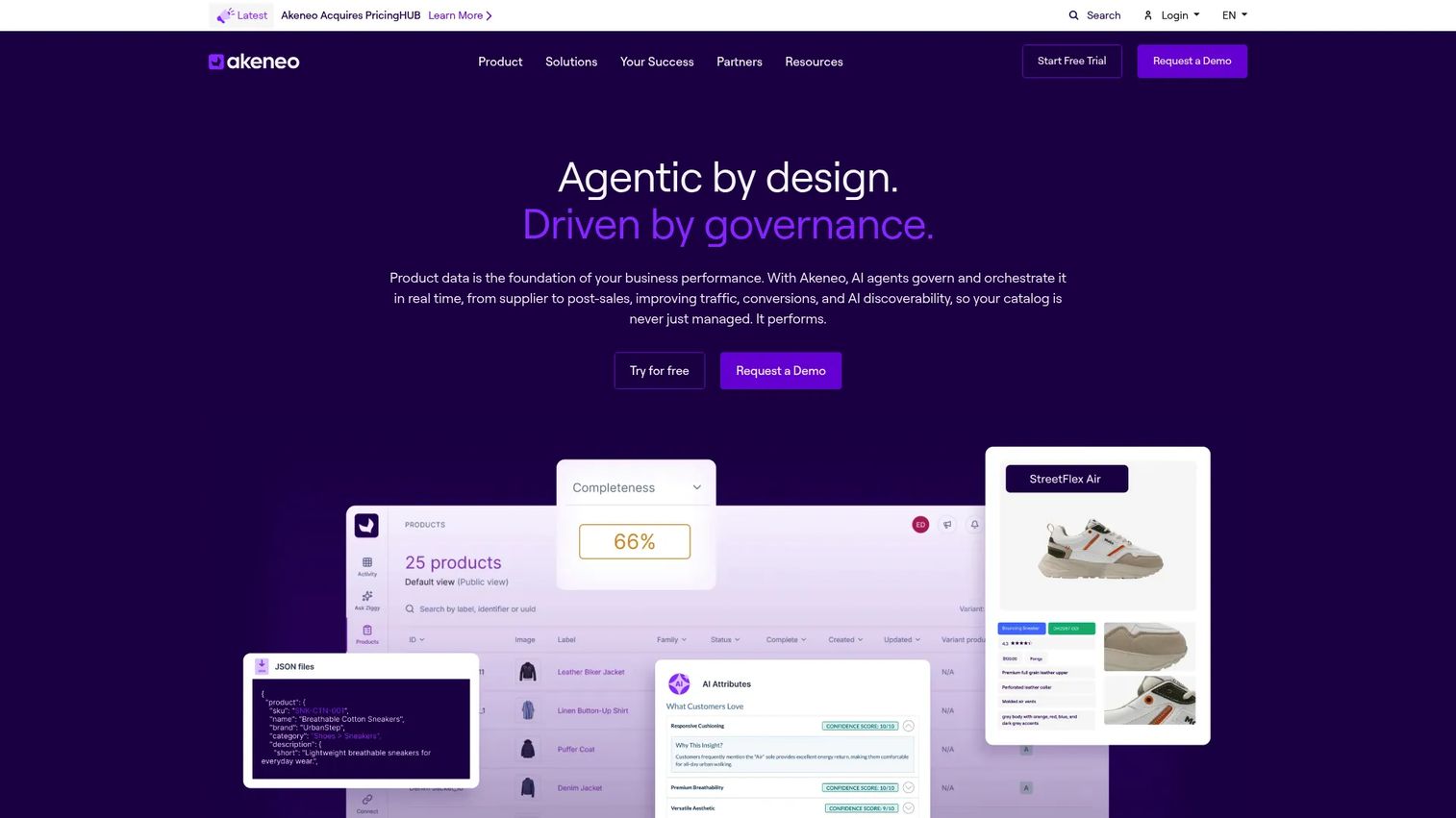
Akeneo is a product experience cloud built to centralize, enrich, and activate product information across channels. It pairs core PIM with digital asset management and AI-powered enrichment, and it is built for the kind of governed, multilingual catalog work that enterprise teams run every day. If your launches depend on localized, channel-ready product data, this is the heavyweight in the category.
Best for: Mid-market and enterprise teams managing complex product catalogs across multiple channels.
Key strengths
- Product Information Management: a centralized product database with structured attributes, families, and relationships that scales to large, complex catalogs.
- Digital Asset Management: images, videos, and files managed alongside product records so assets stay tied to the right SKU.
- Syndication and AI-powered enrichment: AI tagging, AI descriptions, and localization that cut manual enrichment work and keep channels consistent.
Why choose Akeneo: For a product marketing manager coordinating global launches, Akeneo's governance and localization are the draw. Approvals, workflows, and audit trails keep messaging consistent across regions, which matters when a launch spans multiple markets and languages. It is heavier than a lightweight PIM, and that weight is the point for teams with real complexity.
Akeneo pricing: Akeneo lists a Growth plan starting at $0 billed annually, with Advanced and Premium tiers as call-for-quote. There is also a free Community Edition for teams comfortable self-hosting. Higher-tier prices are not published, so expect a sales conversation for enterprise features. It carries a 4.4/5 rating on G2.
Where it fits in the stack: the enrichment and governance hub for enterprise catalogs, sitting between your ERP and every downstream sales channel.
2. Sales Layer
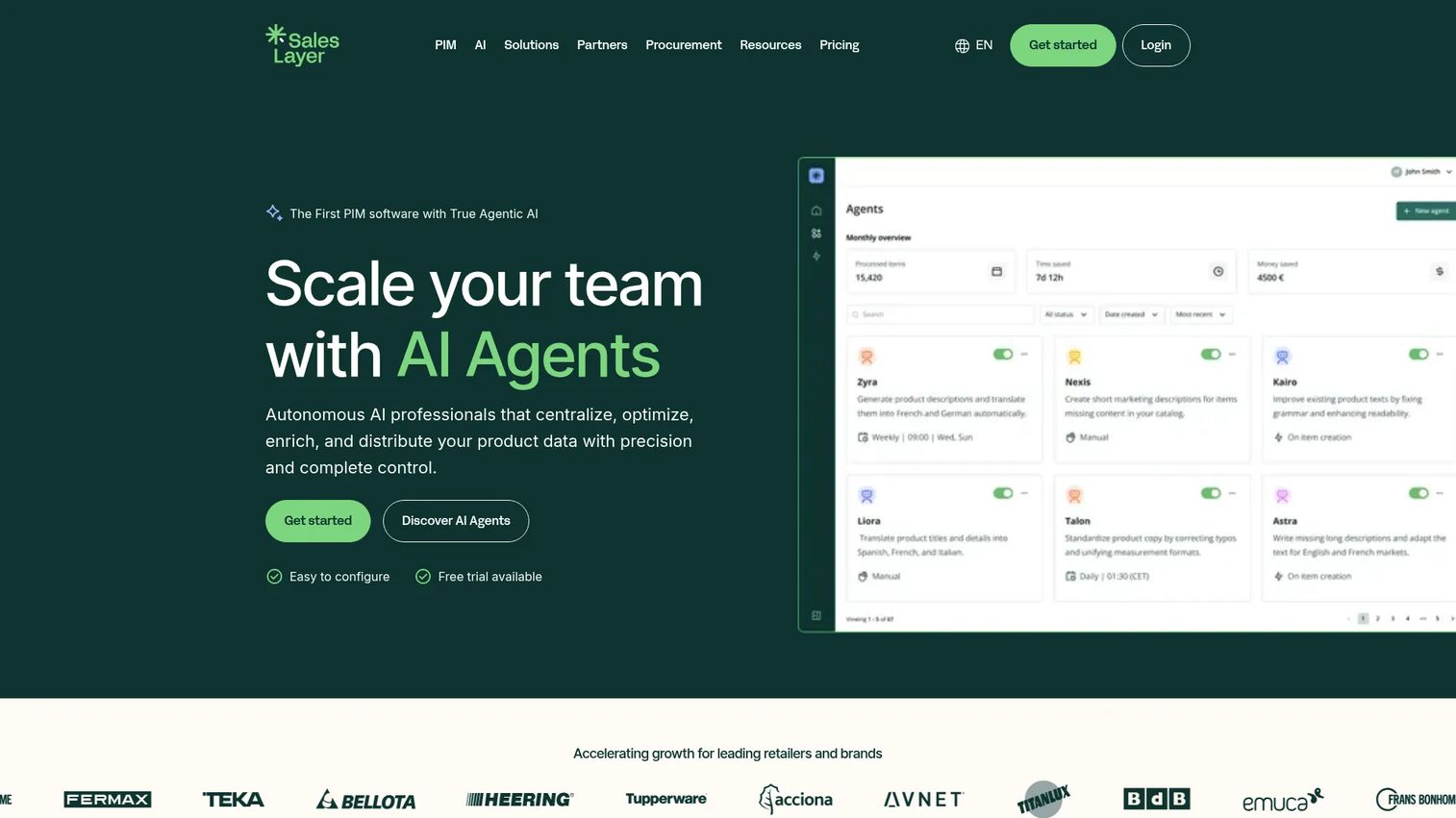
Sales Layer is a cloud-based PIM for centralizing, enriching, and distributing product data across channels. Its appeal is approachability: Excel-style views, formula-driven rules, and a built-in quality engine make it friendly to the marketers and operators who actually own the data, not just the IT team that installs it.
Best for: B2B teams needing a configurable PIM for multi-channel product data management.
Key strengths
- Bulk editing and data mapping: formula-driven rules, Excel-style views, and mapping templates speed up bulk uploads and imports.
- Collaboration and governance: comments, tasks, roles, permissions, workflows, version control, and audit logs keep teams aligned.
- Validation engine: product quality scoring and rules flag incomplete records before they reach a channel.
Why choose Sales Layer: If your catalog work lives in spreadsheets today, Sales Layer's Excel-style editing and quality scoring shorten the leap to a real PIM. The validation engine is the standout for PMMs who care about channel consistency, because it surfaces the gaps that cause message drift before launch.
Sales Layer pricing: Sales Layer publishes four quote-based plans: Scale, Premium, Enterprise, and Enterprise Plus, with monthly or annual billing and a 30-day free trial. No public numeric price is listed, so plan on a quote. It holds a 4.6/5 rating on G2.
Where it fits in the stack: the day-to-day workspace for marketing and product teams who own catalog quality and need to publish to multiple channels.
3. Plytix

Plytix is a PIM platform that bundles digital asset management, AI content tools, and catalog and brand-portal publishing. It is the affordability pick, built for SMB and growth teams that need real product catalog software without an enterprise budget or a long implementation.
Best for: Teams that need an affordable PIM and DAM platform for multichannel product content management.
Key strengths
- PIM product management: search, filtering, categories, completeness tracking, product families, and relationships in one place.
- Digital asset management: store and organize images, videos, PDFs, and other files alongside product data.
- Publishing tools: Brand Portals, Product Data Sheets, AI Content Studio, and a Shopify Content Manager for fast multichannel output.
Why choose Plytix: The free Standard plan lets a small team start without a procurement fight, which answers the common "setup will take forever" objection head-on. As you grow, the Pro tier adds room without a custom contract. For growth teams that want quick wins, this is the lowest-friction entry into structured catalog management.
Plytix pricing: Plytix publishes a free Standard plan at $0/mo, a Pro plan at $499/mo, and a custom Enterprise plan, with optional add-ons priced separately. It earns a 4.7/5 rating on G2.
Where it fits in the stack: the starting PIM for SMB and growth teams, with enough DAM and publishing to cover most multichannel needs out of the box.
4. Productsup
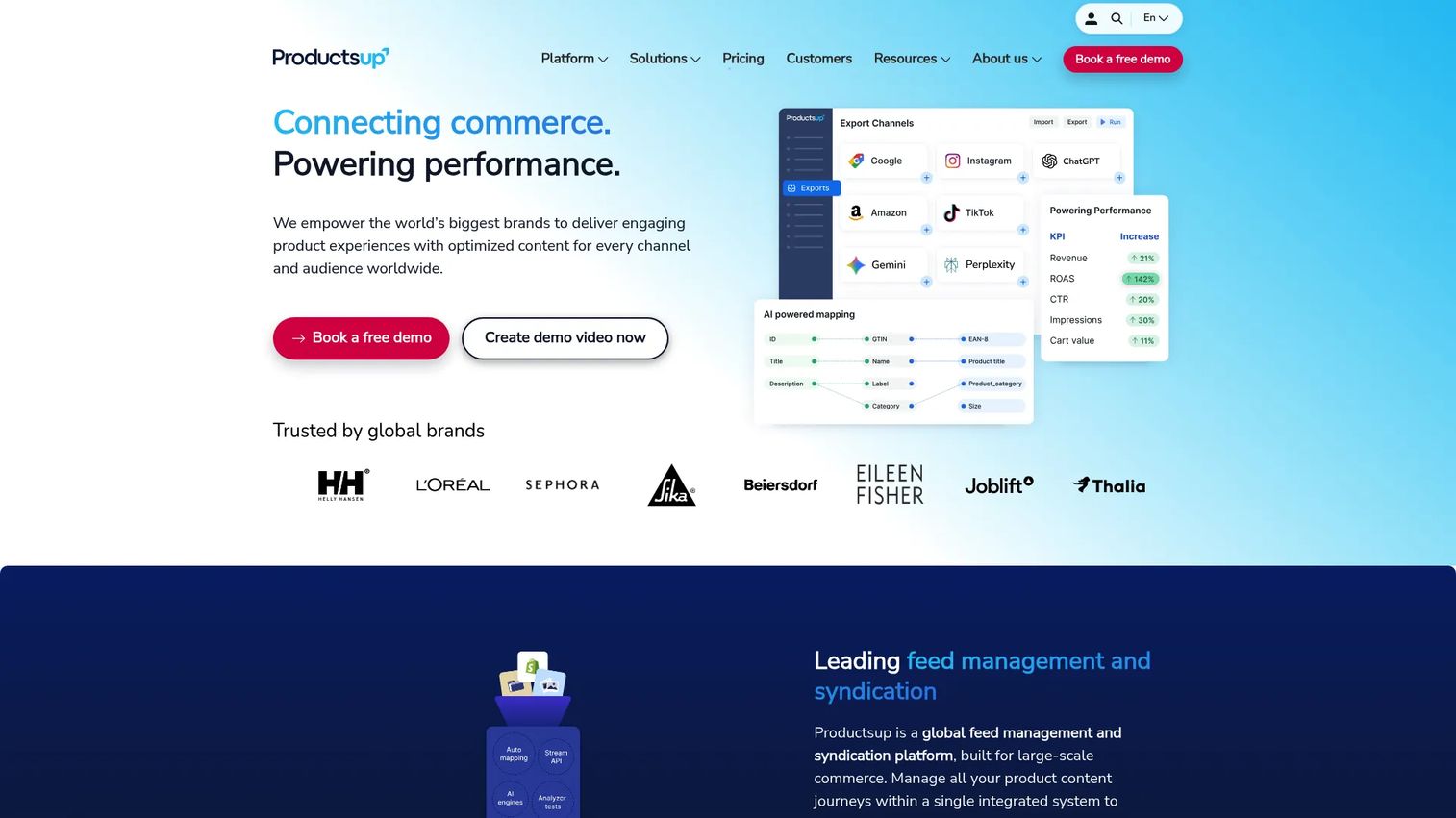
Productsup is an enterprise feed management and syndication platform for distributing and optimizing product content across commerce channels. Where a PIM focuses on the master record, Productsup focuses on getting that content out everywhere, processing enormous product volumes across thousands of marketing and retail destinations.
Best for: Large enterprises managing product feeds and syndication across many commerce channels.
Key strengths
- AI and automation: AI-driven product content workflows that reduce manual feed work at scale.
- Feed management and syndication: distribution across 2,500-plus channels and integrations, including marketplace feeds.
- Supplier onboarding: content portal capabilities that bring partner and supplier data into the pipeline.
Why choose Productsup: Productsup is the channel syndication specialist. If your bottleneck is not creating the master record but pushing optimized content to dozens of marketplaces and ad platforms, this is where it earns its keep. The scale of its channel coverage is the differentiator for large, omnichannel operations.
Productsup pricing: Productsup does not publish pricing on its site; plans are quote-based and scoped to enterprise needs. Expect a sales conversation tied to volume and channels. It shows a 4.5/5 rating on G2.
Where it fits in the stack: the syndication and feed-optimization layer that sits downstream of your PIM and pushes content to every selling channel.
5. DataFeedWatch
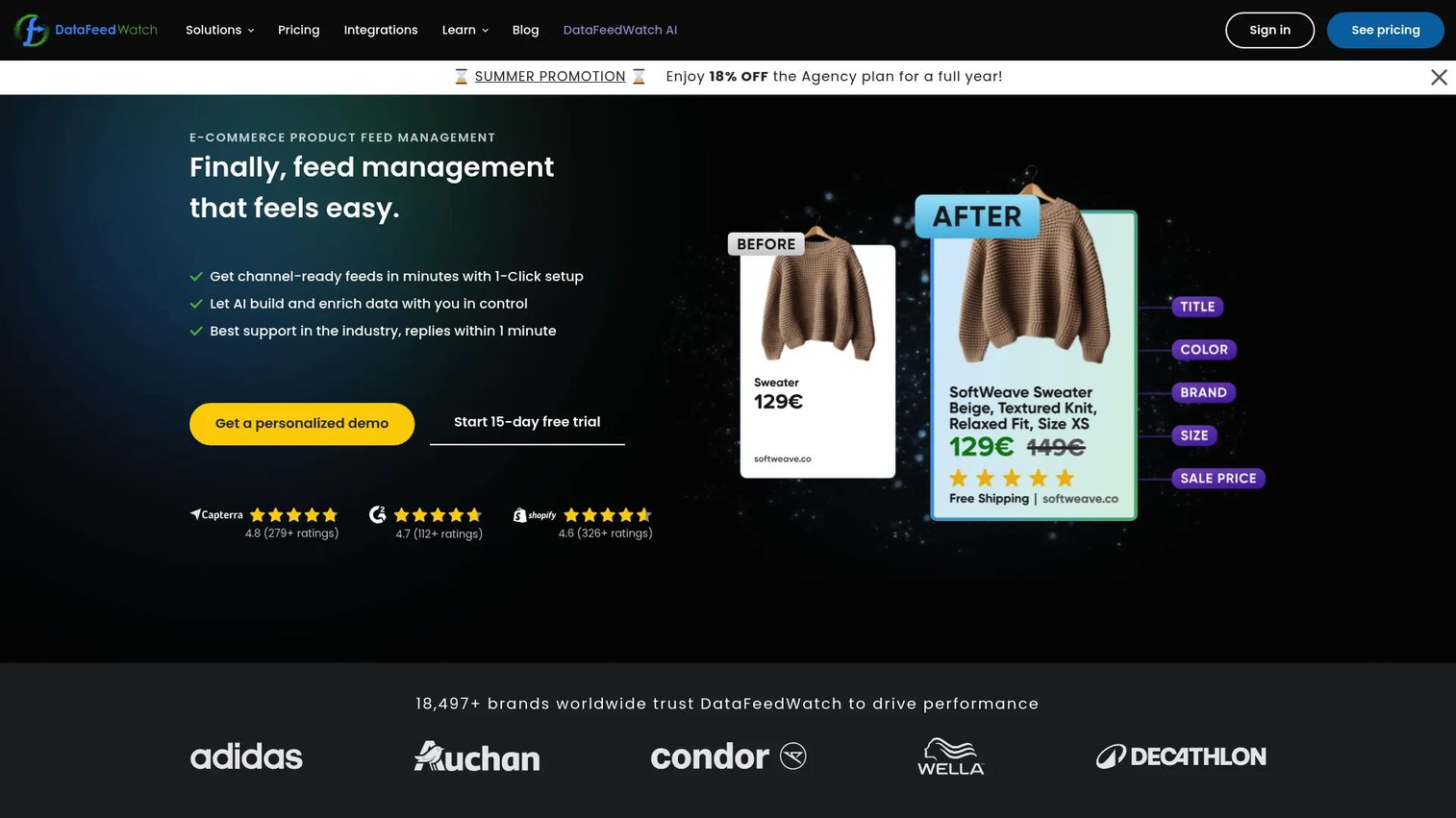
DataFeedWatch is product feed management and optimization software for merchants and agencies. It is the feed specialist on this list, focused squarely on turning your catalog into high-performing shopping feeds for Google, marketplaces, and social channels, with AI doing the heavy lifting on titles and categorization.
Best for: Merchants and agencies managing product feeds across multiple shopping channels.
Key strengths
- AI Titles and Descriptions: AI generates optimized product titles and descriptions tuned for shopping channels.
- AI Categorization: automated taxonomy mapping, including Google taxonomy support, so products land in the right category.
- AI Data Extraction: pulls and structures product attributes from existing data to fill feed gaps.
Why choose DataFeedWatch: For agencies and merchants whose primary job is shopping-feed performance, DataFeedWatch is purpose-built. The AI titles and categorization directly address discoverability, which is where feed quality turns into clicks. It is narrower than a full PIM by design, and that focus is its strength.
DataFeedWatch pricing: DataFeedWatch publishes Shop, Merchant, Agency, and Enterprise plans with monthly or yearly billing and a 15-day free trial. Numeric prices are not listed on the pricing page, so request a quote for your channel mix. It holds a 4.7/5 rating on G2.
Where it fits in the stack: the feed optimization layer for teams whose growth depends on shopping channels and marketplace feeds.
6. Pimcore

Pimcore is a composable data and experience platform that combines PIM, DAM, MDM, CDP, DXP, and ecommerce capabilities. It is the flexibility pick, available open-source and on-prem as well as enterprise editions, which makes it the default for engineering-led teams that want to own their architecture.
Best for: Enterprises needing a single platform for product data, assets, and digital experiences.
Key strengths
- Product Information Management: a centralized product database that anchors the wider platform.
- Digital Asset Management: asset storage and organization tied to product and content records.
- Master data and experience layers: MDM, CDP, DXP, and an ecommerce framework in one composable stack.
Why choose Pimcore: Pimcore wins when you want control. The open-source and on-prem options let teams customize deeply and avoid vendor lock-in, while the enterprise editions add support and managed hosting. For organizations with engineering bandwidth and complex architecture, it consolidates several systems into one.
Pimcore pricing: Pimcore publishes a Professional on-prem edition at $9,900 per year, an Enterprise on-prem edition at $29,900 per year, and a PaaS option from $39,900 per year, with some offers quote-based. A free open-source Community route is also part of the ecosystem. It carries a 4.5/5 rating on G2.
Where it fits in the stack: the consolidated data and experience backbone for enterprises that prefer one platform over several point tools.
7. ChannelEngine

ChannelEngine is marketplace integration and multichannel ecommerce software that connects product data, inventory, pricing, and orders across channels. Built to simplify marketplace operations, it leans into the parts of catalog management that touch revenue directly: pricing rules, repricing, and order sync across many marketplaces.
Best for: Brands and retailers selling across multiple marketplaces and channels.
Key strengths
- Connected commerce data: links product data, inventory, pricing, and orders across channels in one place.
- Dynamic pricing and margin guardrails: pricing rules and repricing logic that protect margin while staying competitive.
- Marketplace integration: automation and reporting tuned for high-volume marketplace selling.
Why choose ChannelEngine: If marketplaces drive your revenue, ChannelEngine's pricing intelligence and channel orchestration are the reason to pick it. The dynamic pricing and margin guardrails matter when you sell the same product across channels with different competitive pressures. It is an operations engine as much as a catalog tool.
ChannelEngine pricing: ChannelEngine publishes Start, Grow, and Scale plans, with pricing based on GMV and integration requirements and performance fees tied to growth. The listed plan figures scale from entry-level to higher volume. There is no free tier. It shows a 4.3/5 rating on G2.
Where it fits in the stack: the marketplace orchestration layer for brands that need pricing, inventory, and order management synced across many channels.
8. CatalogIt
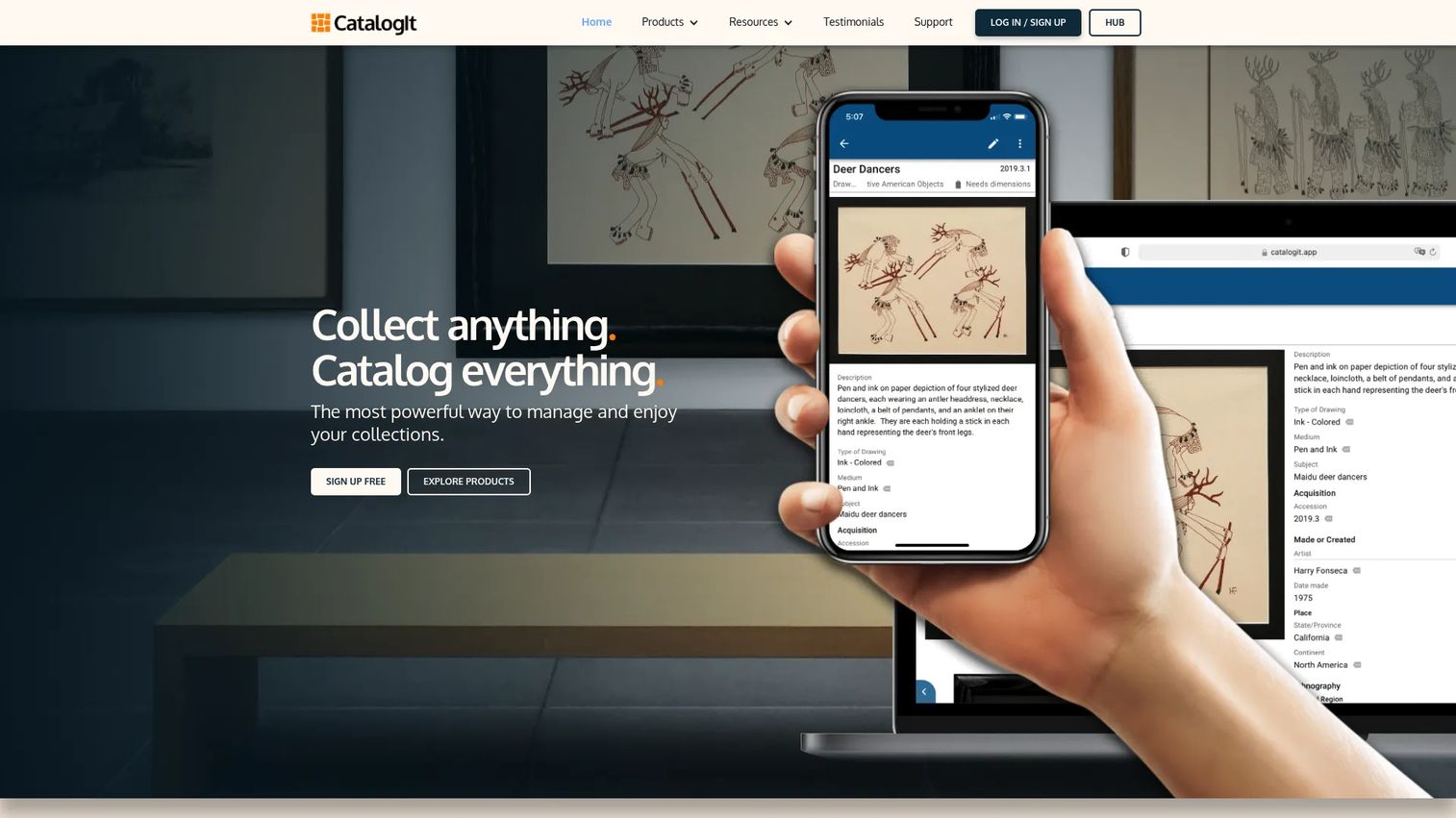
CatalogIt is cloud-based collections management software for museums, collectors, and organizations. It serves a different slice of "catalog" than the commerce-focused tools above, built for teams that need structured item organization, image-centric records, and secure sharing rather than marketplace syndication.
Best for: Museums and private collectors needing a secure, collaborative collections database.
Key strengths
- Mobile, web, and real-time collaboration: catalog items from any device with live multi-user editing.
- Image-centric cataloging: records built around visuals, ideal for collections where the object's image is the data.
- Web publishing: publish via CatalogIt HUB, API, a WordPress plugin, and iframe integration.
Why choose CatalogIt: CatalogIt is the right call when your "catalog" is a collection, not a commerce assortment. The image-first records and secure web publishing fit museums, archives, and serious collectors who need structured organization and controlled sharing. It is the most specialized tool on this list, and that focus is exactly why it fits its audience.
CatalogIt pricing: CatalogIt offers a free plan, and G2 lists a Small Museum Account from $449.99 annually, with additional Museum, Personal, Organization, and Conservator categories. Each subscription includes secure web publishing through the HUB. It earns a 4.9/5 rating on G2.
Where it fits in the stack: the dedicated system for collections and structured item management, distinct from commerce catalog tools.
How to choose the right catalog management software
Match the tool to your channel complexity
A team selling on one store has different needs than one syndicating to 30 marketplaces. PIM-first tools like Akeneo, Sales Layer, and Plytix excel at the master record and governance. Syndication-first tools like Productsup, DataFeedWatch, and ChannelEngine excel at pushing optimized content to many channels. Map your real channel count before you shortlist.
Check integration depth, not just logos
Every vendor lists ecommerce, ERP, CRM, and spreadsheet integrations. What matters is depth: does it sync two-way with your ERP, handle your payments data, and write back to your CRM? Ask for the specific connectors you need and confirm they are more than a one-way import.
Weigh AI enrichment honestly
AI tagging, AI descriptions, and pricing intelligence are now table stakes, but quality varies. The teams that get the most value treat AI as a first-draft engine paired with human review and approvals, not a hands-off autopilot. Test the AI output on your own messy data before you trust it at scale.
Decide on cloud, SaaS, or open-source
Cloud and SaaS options like Plytix and Sales Layer minimize implementation overhead. Open-source and on-prem options like Pimcore trade hosted convenience for control and customization. The right call depends on your engineering bandwidth and how much you need to own the architecture.
Plan for implementation and migration
Migration from spreadsheets is the step teams underestimate. Clean your data first, map your taxonomy, and stage the rollout by channel. Confirm what onboarding, support, and migration help each vendor includes, because the difference between a smooth launch and a stalled one usually lives here.
Conclusion
The right product catalog management system depends on three things: how many channels you publish to, how strict your governance needs are, and how much AI and automation you want doing the work.
For enterprise governance and multilingual catalogs, Akeneo and Pimcore lead, with Pimcore adding open-source flexibility for engineering-led teams. For configurable B2B product data, Sales Layer balances power and approachability. For affordability and a fast start, Plytix is hard to beat with its free tier. For channel syndication and feed performance, Productsup and DataFeedWatch are the specialists, while ChannelEngine owns marketplace pricing and orchestration. CatalogIt stands apart for collections rather than commerce.
Shortlist two or three based on your channel complexity, then run your own messy product data through a trial. The tool that keeps your catalog consistent across every channel is the one that protects your launches, your margins, and your team's time. Start with a free trial where one exists, and verify the integrations you actually depend on before you commit.
FAQs
Catalog management software centralizes product data in a single source of truth, then publishes accurate, channel-ready information across stores, marketplaces, and partner surfaces. Teams use it to enrich product content, enforce pricing and attribute rules, and keep every channel consistent. The payoff is faster launches, fewer errors, and less manual rework.
They overlap heavily but are not identical. Product information management (PIM) focuses on creating and governing the master product record, while catalog management is the broader job of organizing, enriching, and publishing that data across channels. Many tools, including Akeneo and Sales Layer, are PIMs that cover most catalog management needs.
It depends on your channel mix. Ecommerce teams selling across marketplaces lean toward ChannelEngine for pricing and order orchestration or Productsup for syndication. Teams optimizing shopping feeds favor DataFeedWatch. For a central PIM that feeds those channels, Plytix and Sales Layer are strong, affordable starting points.
Prioritize a centralized product database, bulk imports and enrichment, channel-specific publishing, and pricing and attribute rules. Then check integrations with your ecommerce, ERP, CRM, and payments stack, plus AI enrichment and governance controls like approvals and audit logs. The features that prevent message drift across channels matter most for launch-heavy teams.
It maps a single master record to each channel's specific format, then syncs changes everywhere at once. Instead of updating a price or spec in five places, you update it once and the system propagates it. Validation rules and quality scoring catch incomplete records before they publish, which is what keeps channels aligned.
SaaS tools like Plytix and Sales Layer are hosted and maintained by the vendor, so implementation is faster and overhead is lower. Open-source and on-prem tools like Pimcore give you full control over architecture and customization, at the cost of needing engineering resources to host and maintain them. The choice comes down to control versus convenience.
AI handles enrichment that used to be manual: generating product titles and descriptions, tagging and categorizing items, mapping to taxonomies like Google's, and extracting attributes from existing data. It also powers pricing intelligence for competitive channels. The best results come from pairing AI drafts with human review and approval workflows, not treating it as fully autonomous.
It varies widely by catalog size, channel count, and deployment model. SaaS PIMs with a free or self-serve tier can be running in days, while enterprise platforms with complex ERP integrations and migration from spreadsheets can take weeks or months. The biggest time sink is data cleanup and taxonomy mapping, so start there to keep the rollout on schedule.