The bill run is due Friday. Half your parcel records changed after the last assessment import. Three delinquency notices went to the wrong owners last cycle, and your auditor wants a reconciliation report by end of week.
That is the daily reality of property tax operations. Deadlines, delinquency, parcel records, reporting, and compliance all collide at once, and a single missed step can hold up revenue collection for an entire jurisdiction.
The global property tax management software market reached USD 3.8 billion in 2025 and is projected to hit USD 8.4 billion by 2034, according to Dataintelo (2025). That growth reflects a real shift. County treasurers, assessors, and tax collectors are replacing spreadsheets and legacy mainframes with systems built for the full tax lifecycle.
Most search results for this category are vendor landing pages. They sell features. They rarely tell you which platform fits which government scenario. This guide does the opposite. It is a buyer's shortlist for property tax software, sorted by how each tool maps to compliance, billing, collections, assessment, and ERP-connected workflows.
What's inside
This guide is for local government finance teams, county treasurers, assessors, tax collectors, and public-sector IT leaders evaluating property tax software for government use in 2026.
We selected and compared seven platforms against four criteria that matter most to public-sector buyers:
- Lifecycle coverage: assessment import, billing, collections, and delinquency in one system
- Real and personal property support: handling multiple tax types without workarounds
- Reporting and audit trails: visibility for leadership, auditors, and reconciliation
- Integration depth: ERP, finance, and GIS connections that reduce duplicate entry
Each tool below is scored on fit for a specific government scenario, not on feature count alone.
TL;DR
- Best for compliance-heavy workflows: Avalara automates tax compliance, filings, and returns for teams that treat deadline and audit risk as the primary concern.
- Best for ERP-connected government teams: Tyler Technologies delivers full-lifecycle property tax management inside an integrated public-sector suite.
- Best for revenue collection teams: OpenGov and Harris Govern focus on collections, delinquency tracking, and taxpayer payment workflows.
- Best for strong reporting and audit trails: Localgov and DEVNET emphasize revenue visibility and municipal recordkeeping across multiple tax and fee types.
- Best for assessment-first teams: CAMA Cloud supports valuation and parcel data workflows for assessment-heavy operations.
What is property tax software?
Property tax software is a system that helps local governments manage the property tax lifecycle, from assessment import through billing, collections, delinquency, reporting, and compliance.
It replaces fragmented spreadsheets and legacy tools with a single record of every parcel, bill, payment, and status change. That matters because property tax touches revenue, public service, and auditability at the same time.
Property tax management software typically covers a consistent set of functions:
- Parcel records: a master file of every parcel, owner, and assessed value
- Assessment import: loading valuation data from assessors into the billing system
- Deadline management: due dates, penalty schedules, and statutory calendars
- Billing and collections: generating bills, tracking payments, and reconciling accounts
- Delinquency tracking: flagging late accounts, calculating penalties, and managing liens
- Audit trails: a timestamped log of who changed what and when
- Taxpayer portals: self-service lookup and online payment for residents
- Property tax reporting: liabilities, collections, and status reports for leadership and auditors
Real property tax software handles land and buildings. Personal property tax software covers business equipment, machinery, and other taxable assets. Many local government teams need both, along with property tax assessment software that supports valuation work upstream of billing.
When to use property tax software
Automate billing and collections
Manual billing works until volume breaks it. When a treasurer's office runs thousands of parcels through spreadsheets, one formula error can misprice an entire batch. Property tax billing software generates bills from assessment data, applies the correct rates, and reconciles payments against parcel records automatically. That removes the reprint cycles and the after-the-fact corrections.
Track delinquency and deadlines
Penalty schedules are statutory. Miss a due date calculation and you either undercharge, which loses revenue, or overcharge, which triggers disputes. Property tax automation handles due dates, late payment flags, penalty accrual, and lien timelines without someone manually cross-checking a calendar. Delinquency tracking becomes a dashboard, not a fire drill.
Improve reporting and auditability
Leadership wants to know collection rates this quarter. Auditors want a clean reconciliation. Both need visibility fast. When your data lives across a billing spreadsheet, a payment log, and a separate assessment file, producing a single accurate report takes days. A system with a built-in audit trail and property tax reporting turns that into a query.
Comparison table
The table below sorts the seven platforms by relevance to compliance-heavy property tax workflows, then by lifecycle breadth. Pricing in public-sector software is frequently quote-based, so several vendors list custom pricing scoped to jurisdiction size and module selection.
| # | Product | Best for | Key differentiator | Pricing | G2 rating |
|---|---|---|---|---|---|
| 1 | Avalara | Compliance-heavy tax workflows | Automated filings, returns, and exemption certificate management | From $69 per state/month | 4.1/5 |
| 2 | Tyler Technologies | ERP-connected government teams | Full-lifecycle property tax inside an integrated public-sector suite | Custom pricing | Not listed |
| 3 | OpenGov | Revenue collection teams | End-to-end tax and revenue collection with taxpayer portal | Custom pricing | 4.4/5 |
| 4 | Harris Govern | Collections and appraisal offices | Combined CAMA and property tax collections | Custom pricing | Not listed |
| 5 | Localgov | Multi-tax municipal administration | Tax, fee, and short-term rental collection | Custom pricing | Not listed |
| 6 | DEVNET | Integrated land records | CAMA, billing, collection, and records in one suite | Custom pricing | Not listed |
| 7 | CAMA Cloud | Assessment-first teams | Cloud GIS and sketching for valuation workflows | Custom pricing | Not listed |
Best property tax software for 2026
1. Avalara
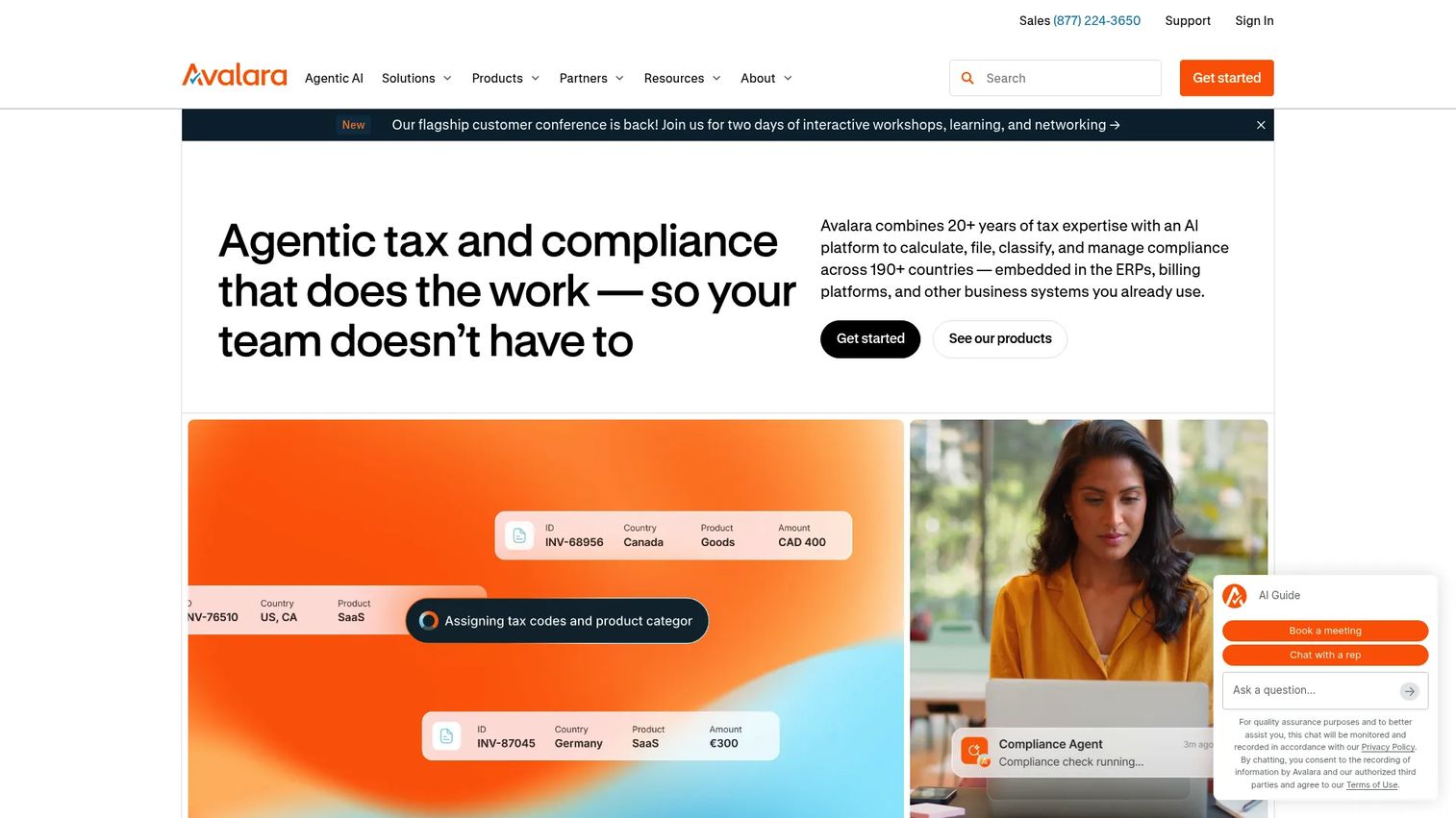
Avalara is tax compliance software built for automating sales tax, returns, registrations, and related indirect tax workflows. For property tax teams, the appeal is the compliance engine: document processing, deadline management, filings, and reporting that reduce the manual risk in every cycle. It is the strongest fit when audit exposure and filing accuracy are the primary concern, not just bill generation.
Best for: Teams that treat compliance, deadline, and audit risk as the highest-priority problem in property tax administration.
Key features
- Sales tax calculation across jurisdictions
- Returns filing and remittance
- Exemption certificate management
- Deadline and document processing automation
Why choose Avalara: If your operation lives or dies on filing accuracy and audit readiness, Avalara centers the compliance workflow instead of treating it as an afterthought. It is less about parcel administration and more about keeping the compliance side clean.
Avalara pricing: Core Compliance starts at $79 per state per month or $799 per state annually. Core Compliance plus SST Services runs $69 per state per month or $699 per state annually. Custom pricing applies to larger or more complex organizations. Select services carry set prices, such as License Guidance from $119.
Avalara holds a 4.1/5 rating on G2.
2. Tyler Technologies

Tyler Technologies provides integrated software and services for the public sector and K-12 education. Its property tax offering covers the full lifecycle: parcel management, cashiering, integrated recording, and assessor-to-auditor workflows. The differentiator is native suite fit. When property tax lives inside the same platform as your ERP, finance, and civic services, duplicate entry drops and records stay consistent.
Best for: County and municipal teams that want property tax administration inside a broader integrated government suite with deep recordkeeping.
Key features
- Integrated solutions across state and local government and schools
- Broad portfolio spanning ERP, payments, courts, and civic services
- Cloud and workflow tools for mission-critical operations
- Parcel lifecycle and assessor-to-auditor workflows
Why choose Tyler Technologies: If you already run other Tyler modules, or you want one system of record across finance and tax, the ERP integration is the reason. Fewer handoffs between systems means cleaner audit trails and less reconciliation.
Tyler Technologies pricing: Tyler doesn't list pricing for its property tax products. Cost depends on jurisdiction size, which modules you pick, and what the implementation involves, so you'll need to request a quote.
3. OpenGov
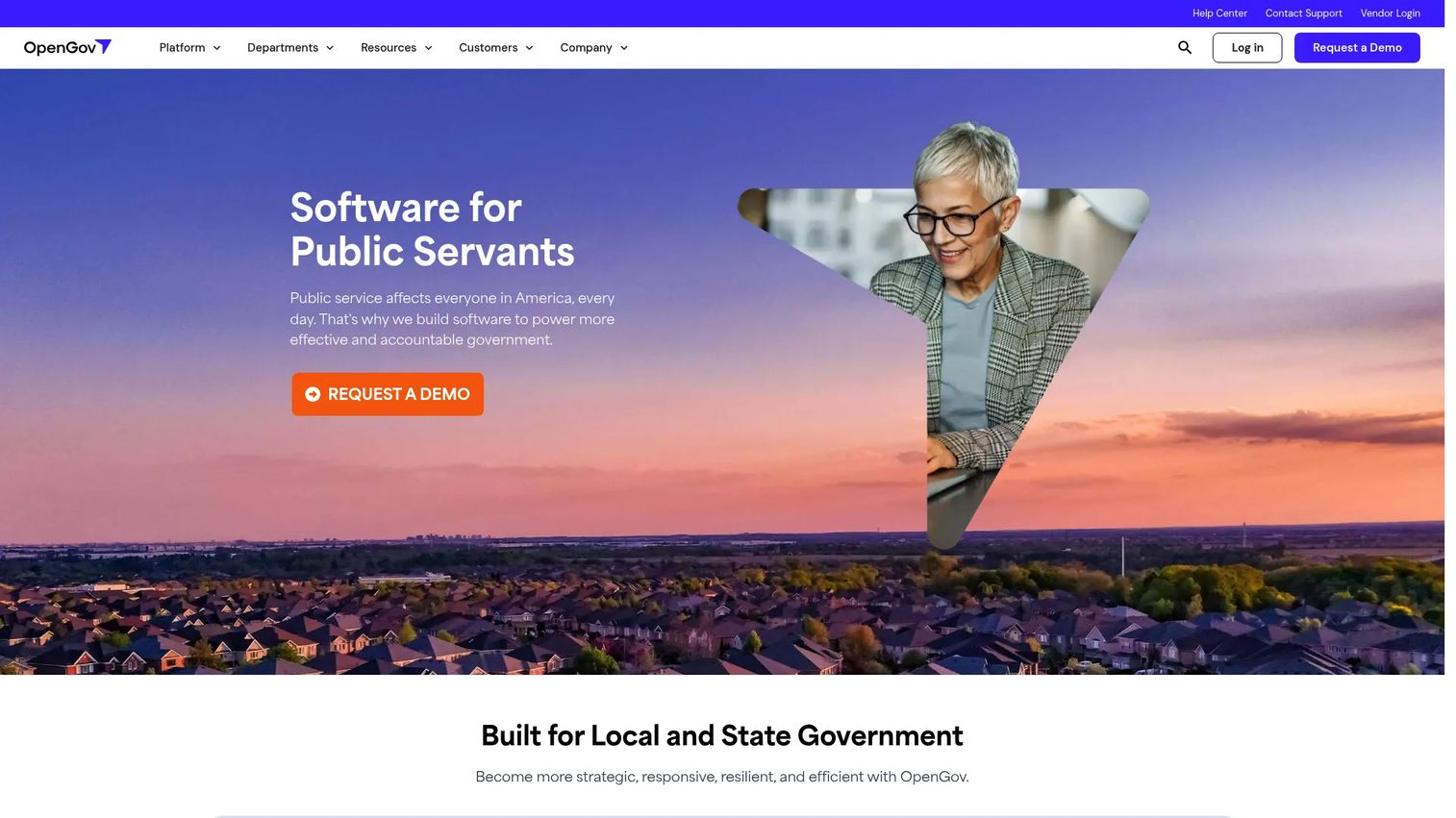
OpenGov builds cloud software for local and state governments, with strong emphasis on tax and revenue collection. Its property tax collection software covers taxpayer portals, delinquency tracking, bulk processing, and reporting dashboards. The framing is self-service and operational efficiency: residents pay online, and staff manage collections from a tax collections dashboard instead of chasing paper.
Best for: Revenue collection teams that want taxpayer self-service and a clear operational view of collections and delinquency.
Key features
- Budgeting and performance tools
- Permitting and licensing workflows
- Enterprise asset management
- Delinquency tracking and bulk billing and collections
Why choose OpenGov: If your top pain is collections efficiency and taxpayer experience, OpenGov leans into both. Support for multiple tax and fee types makes it flexible for jurisdictions collecting more than property tax.
OpenGov pricing: OpenGov doesn't list actual dollar figures for pricing. Their Enterprise Asset Management page mentions an all-inclusive package with unlimited users, but you'll still need to get a quote scoped to your agency.
OpenGov holds a 4.4/5 rating on G2.
4. Harris Govern
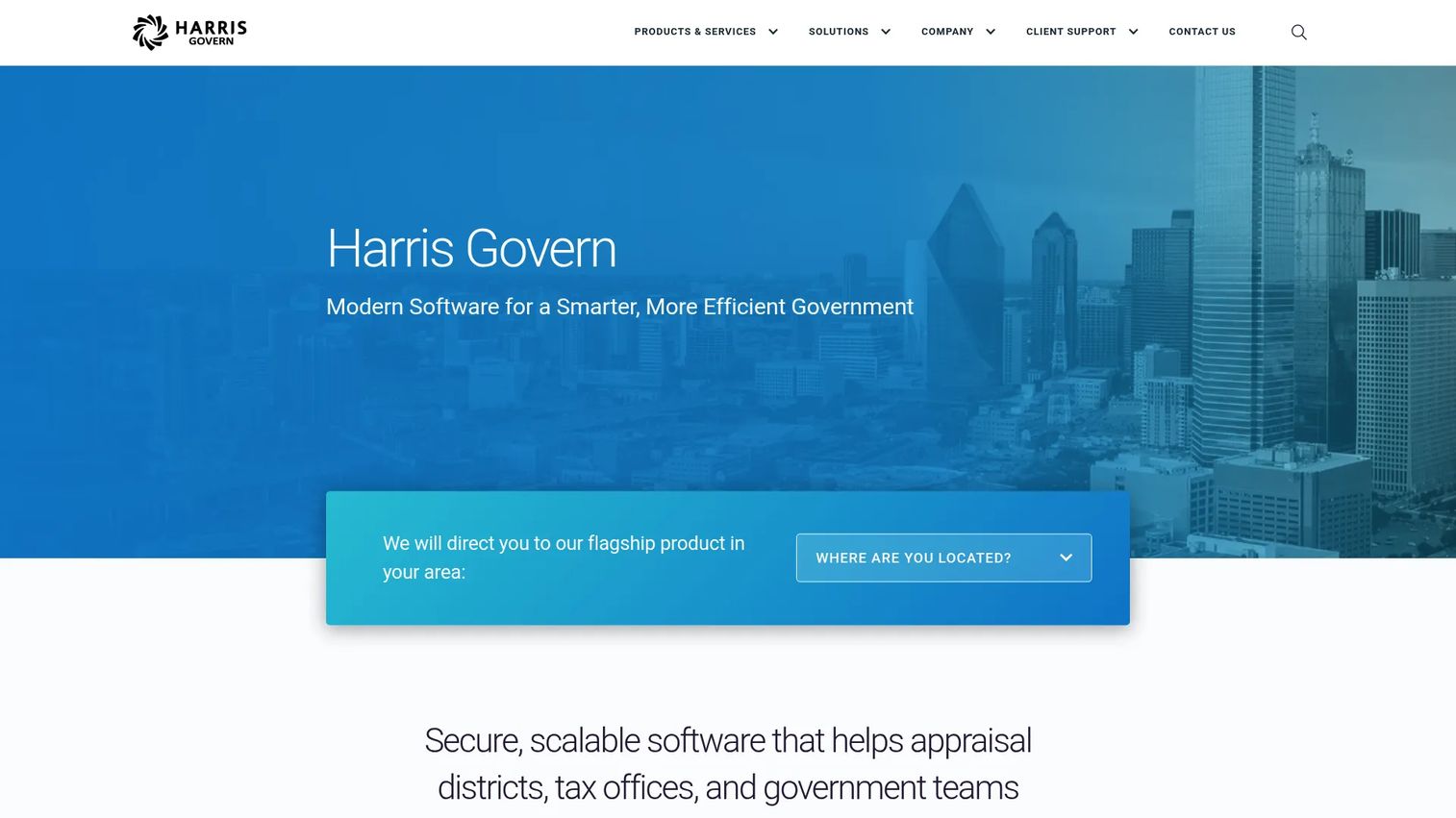
Harris Govern provides public-sector software for appraisal districts, tax offices, and local government agencies. It combines CAMA and property tax collections, with bill lifecycle tools, delinquency management, payment channels, searchability, and audit trails. The positioning is operations-led: it covers the collections workflow in specific, functional depth rather than as one module in a sprawling suite.
Best for: Appraisal districts and tax offices that need combined valuation and collections software with strong operational workflow coverage.
Key features
- CAMA and property tax collections software
- GIS and mobile field tools
- Bill lifecycle and delinquency management
- Implementation, support, and IT services
Why choose Harris Govern: If you run both an appraisal function and a collections function, having CAMA and tax collections under one vendor reduces the seams between assessment and billing. The audit trail and searchability support day-to-day reconciliation.
Harris Govern pricing: Harris Govern doesn't list its pricing. You'll need to contact them for a quote scoped to your jurisdiction and modules.
5. Localgov
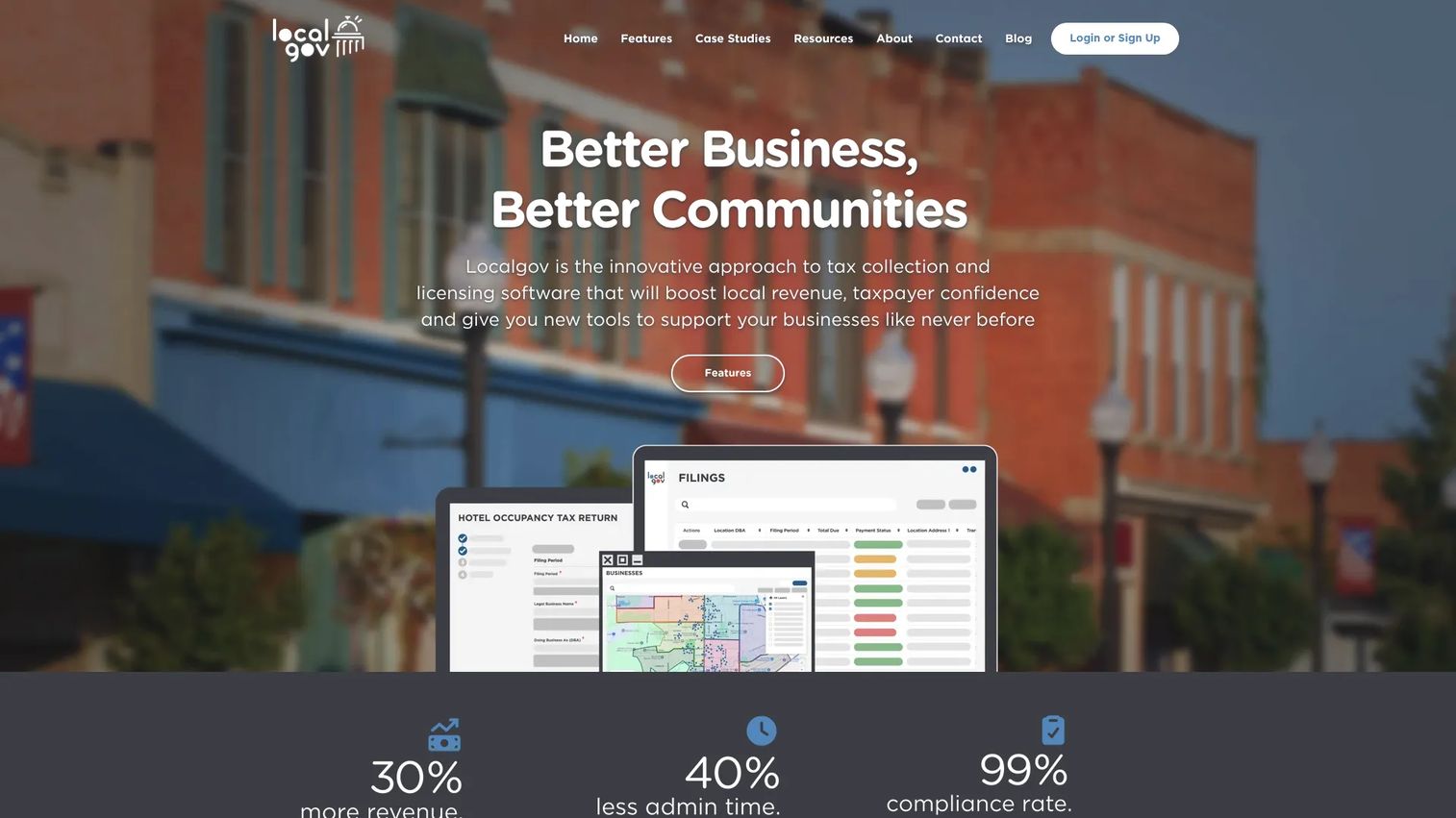
Localgov is a digital tax and fee administration platform for local governments. It handles tax and fee collection, registration and renewal workflows, and short-term rental compliance and monitoring. The strength is multi-tax support and revenue visibility, which fits municipalities collecting a mix of taxes and fees beyond property tax alone.
Best for: Local governments that administer multiple tax and fee types and want accountability and revenue visibility in one platform.
Key features
- Tax and fee collection
- Registration and renewal workflows
- Short-term rental compliance and monitoring
- Revenue visibility across tax types
Why choose Localgov: If your revenue base spans property tax, business fees, and short-term rentals, Localgov consolidates those into one collection and accountability workflow. That reduces the number of disconnected systems your finance team reconciles.
Localgov pricing: Localgov uses quote-based pricing: a one-time onboarding fee plus a fixed annual license fee based on estimated filing and renewal volume. Custom API and SSO work is scoped during onboarding.
6. DEVNET
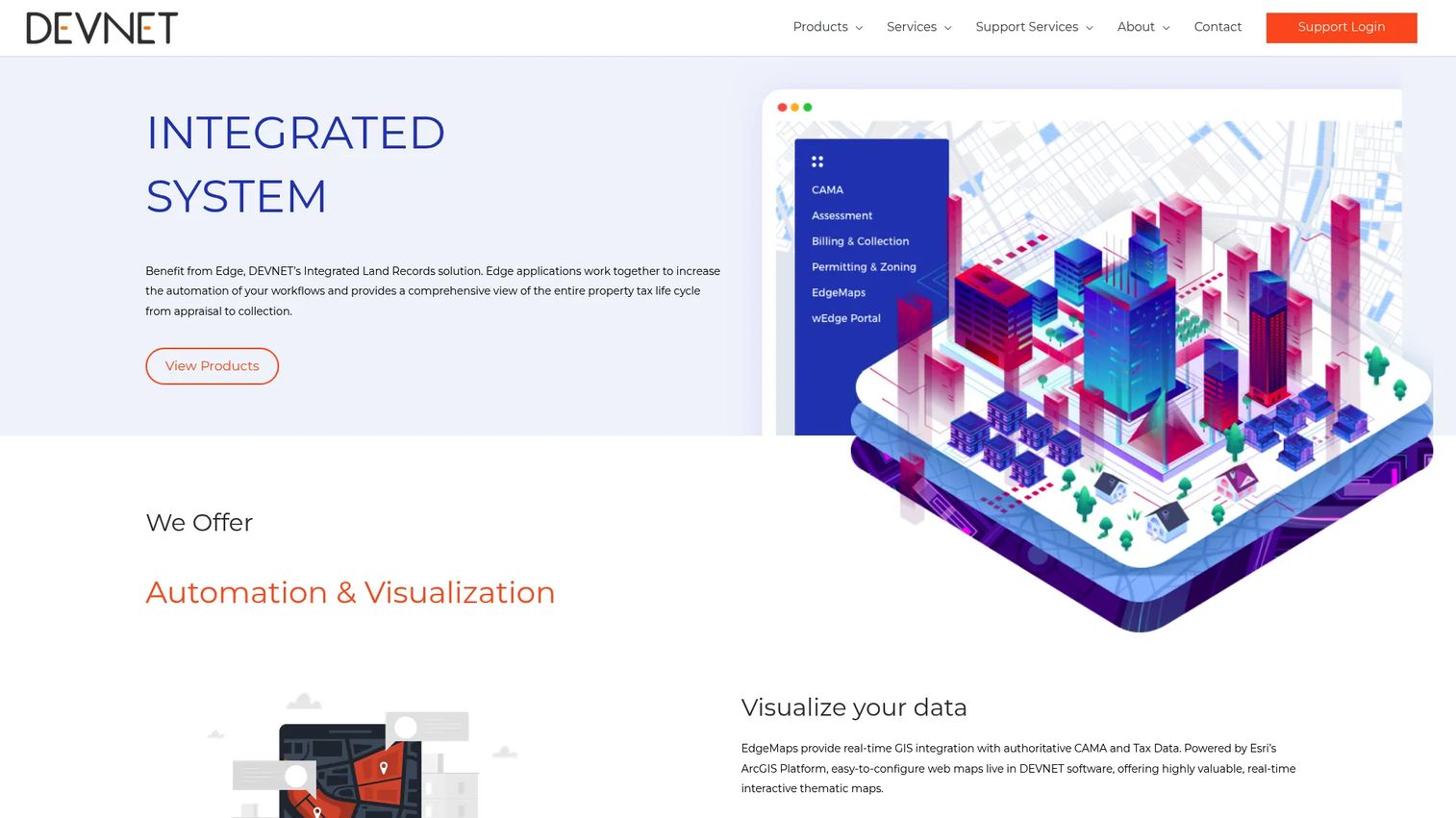
DEVNET offers integrated land records and property tax software for local government through its Edge suite. It covers CAMA and assessment administration, billing and collection for current and delinquent property taxes, permitting, zoning, records management, and GIS integration. The theme is workflow consolidation for municipal offices that want assessment, billing, and land records in one connected system.
Best for: Local government agencies that want property tax billing, collection, and land records management in a single integrated suite.
Key features
- CAMA and assessment administration
- Billing and collection for current and delinquent taxes
- Permitting, zoning, and records management
- GIS integration through EdgeMaps
Why choose DEVNET: If your office wants to connect assessment, billing, delinquency, and records rather than run separate tools, DEVNET's Edge suite ties them together. That connection is what keeps parcel data consistent across functions.
DEVNET pricing: DEVNET describes all-inclusive pricing on its site but does not publish a public price. Request a quote for pricing scoped to your agency.
7. CAMA Cloud
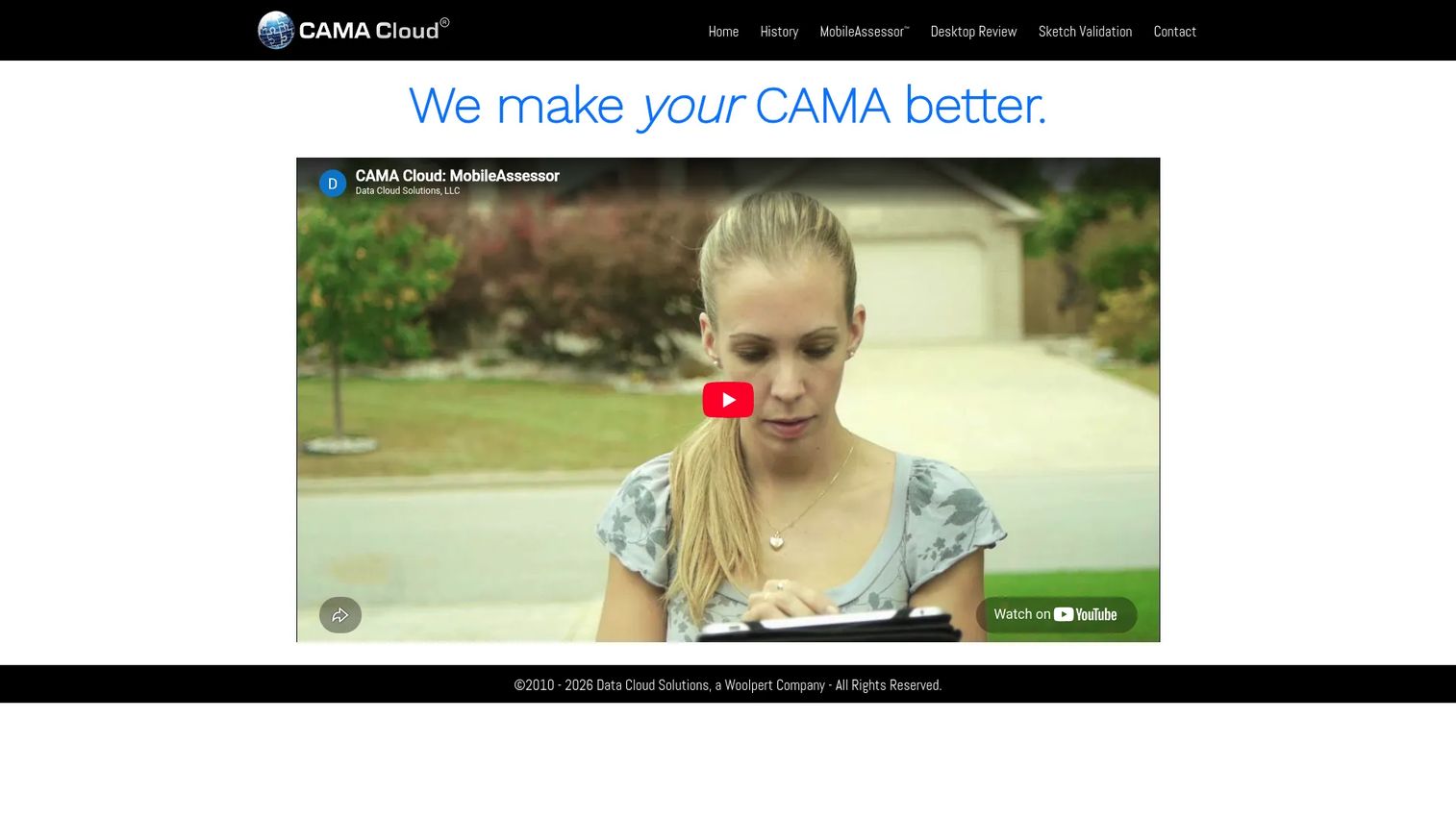
CAMA Cloud is cloud-based CAMA-related software from Data Cloud Solutions, built for property assessment workflows. It provides interactive GIS and GPS parcel access, sketching and vector data capture with validation, and browser-based integration with CAMA systems. The focus is assessment and parcel data, upstream of billing, for teams whose primary work is valuation.
Best for: Property assessment teams that need cloud-connected GIS, parcel access, and sketching tools for valuation-heavy work.
Key features
- Interactive GIS and GPS parcel access
- Sketching and vector data capture with validation
- Browser-based integration with CAMA systems
- Field data collection for assessment
Why choose CAMA Cloud: If your bottleneck is valuation and field assessment rather than billing, CAMA Cloud specializes in the parcel and sketching side. It pairs with a billing system rather than replacing one, which suits assessment-first offices.
CAMA Cloud pricing: CAMA Cloud doesn't list its pricing. You'll need to contact Data Cloud Solutions for a quote based on your assessment workload.
Considerations
Lifecycle coverage
Map the platform against your actual workflow before you buy. Does it cover assessment import, billing, collections, and delinquency, or only part of the chain? A tool that handles billing but not delinquency leaves you stitching systems together. The fewer handoffs between assessment and collections, the cleaner your data and audit trail stay.
Real and personal property support
If your jurisdiction taxes business equipment and machinery alongside land and buildings, confirm the system handles both real property tax software and personal property tax software workflows. Running two disconnected tools for two tax types doubles the reconciliation work and the chance of error.
Reporting and audit trails
Auditors expect a timestamped record of who changed what and when. Evaluate whether the audit trail is automatic or something staff maintain manually. Test the reporting: can you produce a collections summary, a delinquency report, and a liability reconciliation without exporting to a spreadsheet? Property tax reporting is only useful if it is fast and defensible.
ERP and finance integrations
Duplicate entry is where errors and wasted hours live. If your property tax system does not connect to your ERP and finance systems, staff key the same numbers twice. Native ERP integration keeps records consistent across finance and tax, which matters most during month-end and audit. Ask specifically which systems the vendor integrates with, not whether integration is possible.
Implementation and support model
Public-sector rollouts are rarely fast. Ask about implementation timelines, training for staff who are not power users, and the long-term maintenance model. A platform that ships with strong support and clear onboarding survives staff turnover. One that depends on a single internal expert becomes a risk the moment that person leaves.
Conclusion
The right property tax software depends on which part of the lifecycle hurts most.
If compliance, filings, and audit risk are your priority, Avalara centers that workflow. If you want property tax inside a broader integrated government suite with ERP connections, Tyler Technologies fits. For collections-first teams, OpenGov and Harris Govern lead on taxpayer portals and delinquency tracking. Localgov and DEVNET suit municipalities managing multiple tax types with strong recordkeeping. CAMA Cloud is the pick when assessment and valuation are the bottleneck.
The next step is to build a shortlist around your dominant need: compliance-heavy, ERP-connected, or collections-first. Pull two or three vendors that match that profile, then pressure-test each against your real parcel volume, tax types, and audit requirements. Most public-sector pricing is quote-based, so request scoped proposals and compare implementation timelines alongside license cost.
FAQs
Property tax software manages the full property tax lifecycle for local governments. It imports assessment data, generates bills, tracks payments and delinquency, calculates penalties, and produces reporting and audit trails. The goal is to run billing and collections from one system of record instead of stitching together spreadsheets and legacy tools.
Property tax management software covers the operational lifecycle: parcel records, assessment import, billing, collections, and delinquency. Property tax compliance software focuses on filings, returns, deadlines, and audit readiness. Some teams need the full management workflow, while others prioritize the compliance side, and a few platforms combine both.
Not always, but it helps significantly. Without ERP integration, staff often key the same figures into both the tax system and the finance system, which creates duplicate entry and reconciliation errors. Native integration keeps records consistent across finance and tax, which matters most during month-end close and audits.
Many platforms handle both real property tax software and personal property tax software workflows. Real property covers land and buildings. Personal property covers business equipment, machinery, and other taxable assets. If your jurisdiction taxes both, confirm the system manages them in one workflow rather than requiring two separate tools.
Look for automatic late-payment flags, statutory penalty calculation, and lien timeline management. Good delinquency tracking surfaces overdue accounts on a dashboard, applies the correct penalty schedule without manual math, and keeps a full history for each account. That reduces disputes and protects revenue you would otherwise lose to errors.
They are essential. An audit trail is a timestamped log of who changed what and when across parcels, bills, and payments. Auditors expect it, and it protects your office when a valuation or payment is questioned. Evaluate whether the trail is automatic or something staff must maintain by hand.
Yes. Platforms such as Localgov and OpenGov support multiple tax and fee types, including property tax, business fees, and short-term rentals. If your revenue base spans several categories, a multi-tax system consolidates billing and collections into one workflow, which cuts the number of disconnected tools your finance team has to reconcile.
Score each vendor against your dominant need: compliance, ERP-connected lifecycle management, or collections. Then evaluate lifecycle coverage, real and personal property support, reporting and audit trails, and integration depth. Because most public-sector pricing is quote-based, request scoped proposals and compare implementation timelines and support models alongside license cost.