

You run a survey in one tool. You post the public meeting agenda somewhere else. Comments land in email. Notes live in a spreadsheet. Then someone on council asks a simple question: what did residents actually say?
Now you are stitching together five systems to answer it.
That is the real problem community engagement software solves. Not "more feedback." Less scatter. When surveys, meeting records, comments, and reporting sit in separate places, you get duplicate data entry, weak reporting, and lost context. The market is voting on the fix: the global community engagement software market is projected to grow from USD 0.45 billion in 2025 to USD 2.12 billion by 2034, a CAGR of 18.79%, according to Business Research Insights (2025).
This guide compares seven platforms across government, association, and stakeholder-engagement workflows. It focuses on how each one fits a specific job, not on generic feature lists.
What's inside
This guide is built for teams choosing a community engagement platform they will run for years, not weeks.
- Who it's for: government and public-sector teams, associations and member organizations, nonprofits, and stakeholder-engagement teams
- How tools were selected: each platform has a clear primary use case, verified feature coverage, and a defined operating model (public engagement, member engagement, or stakeholder reporting)
- What we evaluated: workflow coverage, privacy and data handling, accessibility, reporting depth, and integration fit
- How it's organized: a comparison table, seven detailed picks, buyer considerations, and FAQs
TL;DR
Short on time? Here are the decision shortcuts.
- Best for government public meetings and recordkeeping: PublicInput
- Best for association engagement and renewals: Tradewing
- Best for branded private communities: Hivebrite
- Best for stakeholder mapping and reporting: Simply Stakeholders
- Best for public participation workflows and planning: EngagementHQ
- Best for community dialogue and prioritization: ThoughtExchange
- Best for resident engagement and participation planning: Go Vocal
The right pick depends on whether your core job is running public meetings, growing member engagement, or reporting on stakeholder input. Match the platform to the workflow, not the other way around.
What is community engagement software
Community engagement software is a platform that centralizes how organizations collect, manage, and report on input from residents, members, or stakeholders across surveys, meetings, comments, and other channels.
Instead of running surveys in one app, public meetings in another, and comments through email, these public engagement software platforms pull participation into a single system with shared records and reporting.
Core features usually include:
- Surveys and forms for structured feedback
- Public meetings workflow covering agendas, comments, and minutes
- Comments, forums, and town halls for open dialogue
- Notifications across email, text, and social channels
- Engagement analytics and dashboards
- Recordkeeping and audit trails for compliance
- Accessibility and multilingual support for inclusive participation
Here is how these platforms compare to the tools teams usually cobble together:
| Approach | What it does well | Where it strains |
|---|---|---|
| Spreadsheets | Cheap, flexible, familiar | No audit trail, manual reporting, version chaos |
| CRM | Tracks contacts and history | Not built for surveys, meetings, or public comments |
| Social media groups | Easy reach, low cost | No recordkeeping, weak reporting, privacy gaps |
| Community engagement platform | Unified workflow, reporting, records | Requires setup and platform ownership |
The distinction matters most when you need defensible records. A citizen engagement software platform keeps the survey, the comment, the meeting, and the report connected. A spreadsheet keeps them apart and hopes you remember which version is current.
When to use community engagement software
Not every team needs a dedicated platform. Here is when it pays off.
Manage public input without scattered tools
You are collecting survey responses, public comments, and meeting feedback on the same project. Each one lives somewhere different. When a decision gets challenged, you cannot reconstruct what the public said or when. A public input software platform keeps every response tied to the project and the meeting, so the record holds up.
Build a more organized member or stakeholder experience
Your community is spread across email threads, a LinkedIn group, and a couple of event tools. Members lose track of where to participate, and you lose track of who is engaged. A branded member engagement platform gives people one place to show up, and gives you one place to measure retention and participation.
Replace spreadsheet-heavy reporting workflows
You spend the end of every quarter copying data between sheets to build a report nobody trusts. History is scattered, and audit trails do not exist. When reporting, recordkeeping, and audit trails become the bottleneck, a platform with built-in dashboards and engagement analytics turns hours of manual work into a saved view.
Comparison table
Seven platforms, mapped to the workflow each one handles best. Pricing for most public-sector engagement tools is quote-based, so the pricing column reflects what each vendor publishes.
| # | Product | Best for | Key differentiator | Pricing | G2 rating |
|---|---|---|---|---|---|
| 1 | PublicInput | Government public meetings and recordkeeping | Unified engagement plus public meetings workflow | Request pricing | 4.5/5 |
| 2 | Tradewing | Association engagement and renewals | Community, learning, events, and membership in one | Contact sales | Not enough reviews |
| 3 | Hivebrite | Branded private communities | Fully customizable community hub | From $895/mo (billed annually) | 4.3/5 |
| 4 | Simply Stakeholders | Stakeholder mapping and reporting | Stakeholder register, mapping, and sentiment analysis | Per user, billed annually | Not listed |
| 5 | EngagementHQ | Public participation workflows | Broad participation toolset with project reporting | Contact sales | 5.0/5 |
| 6 | ThoughtExchange | Community dialogue and prioritization | Anonymous exchanges with AI analysis | Custom pricing | 4.7/5 |
| 7 | Go Vocal | Resident engagement and planning | Configurable public-sector participation methods | Contact sales | Not enough reviews |
Ratings and pricing reflect each vendor's published data and G2 listing at time of writing. Several vendors gate pricing behind a sales conversation, which is standard for enterprise public-sector procurement.
Best community engagement software for 2026
1. PublicInput
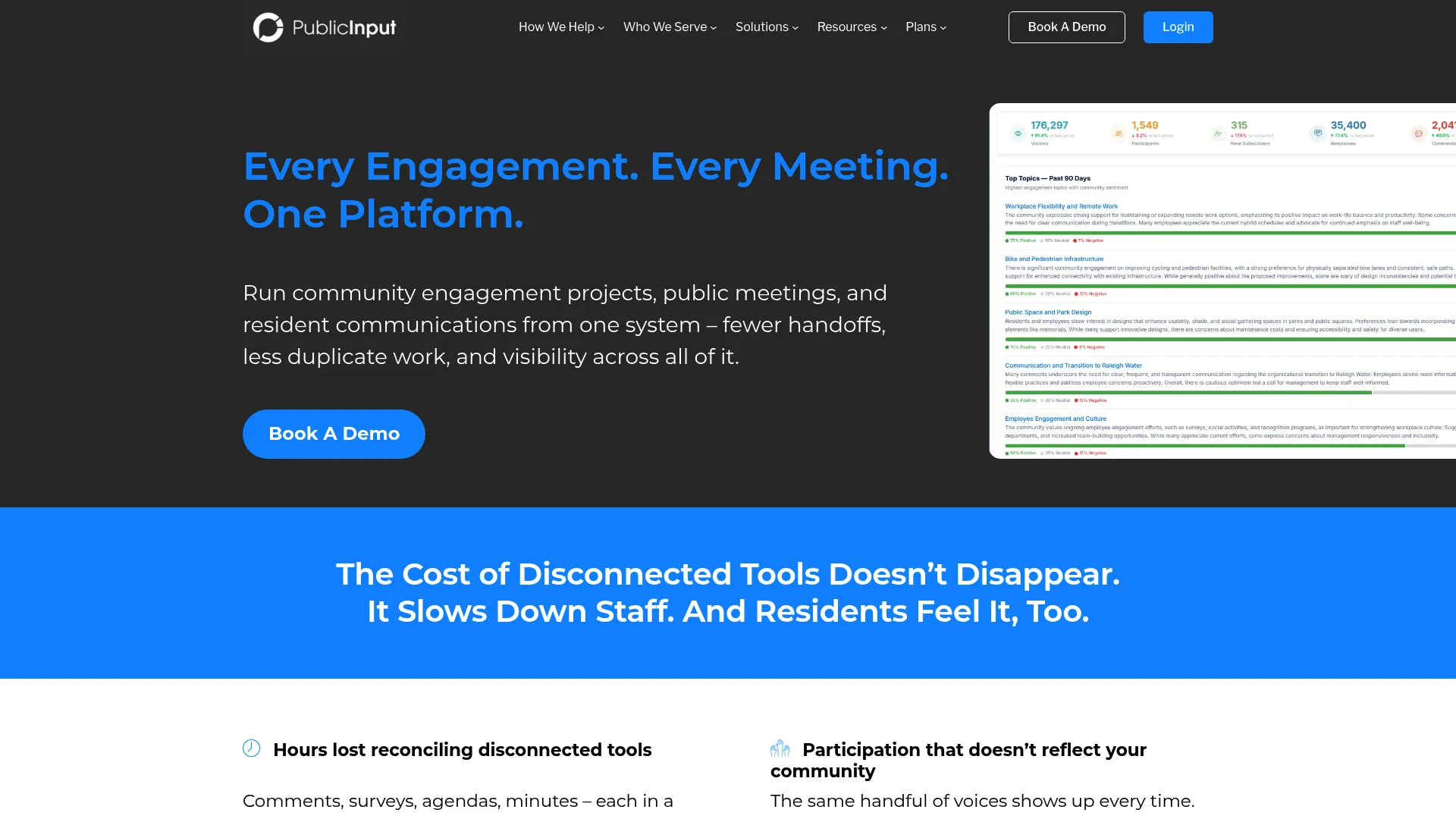
PublicInput is community engagement software built specifically for government teams. It combines an online engagement portal with a full public meetings workflow, so resident outreach and formal recordkeeping live in the same system. That connection is the whole point: the survey a resident answers and the minutes a council adopts stay linked.
For agencies juggling resident outreach, public meetings, and audit-ready records, this is the platform that treats all three as one process instead of three disconnected jobs.
Key strengths
- Online engagement portal: surveys, interactive maps, project websites
- Public meetings workflow from agenda posting to adopted minutes
- Omni-channel communication across email, text, social
- Executive dashboards for leadership visibility
- Accessibility and multilingual support for inclusive participation
Why choose PublicInput: If your team lives at the intersection of public engagement and formal governance, PublicInput removes the gap between what residents said and what the record shows. It fits agencies that need defensible, audit-ready documentation, not just feedback collection.
PublicInput pricing: PublicInput publishes separate Engagement and Meetings plan families. Engagement plans include Listen, Engage, and Engage Plus. Meetings plans include Core, Advanced, and Premier. Each plan shows "Request Pricing" rather than a public number, so you contact the team for a quote.
2. Tradewing
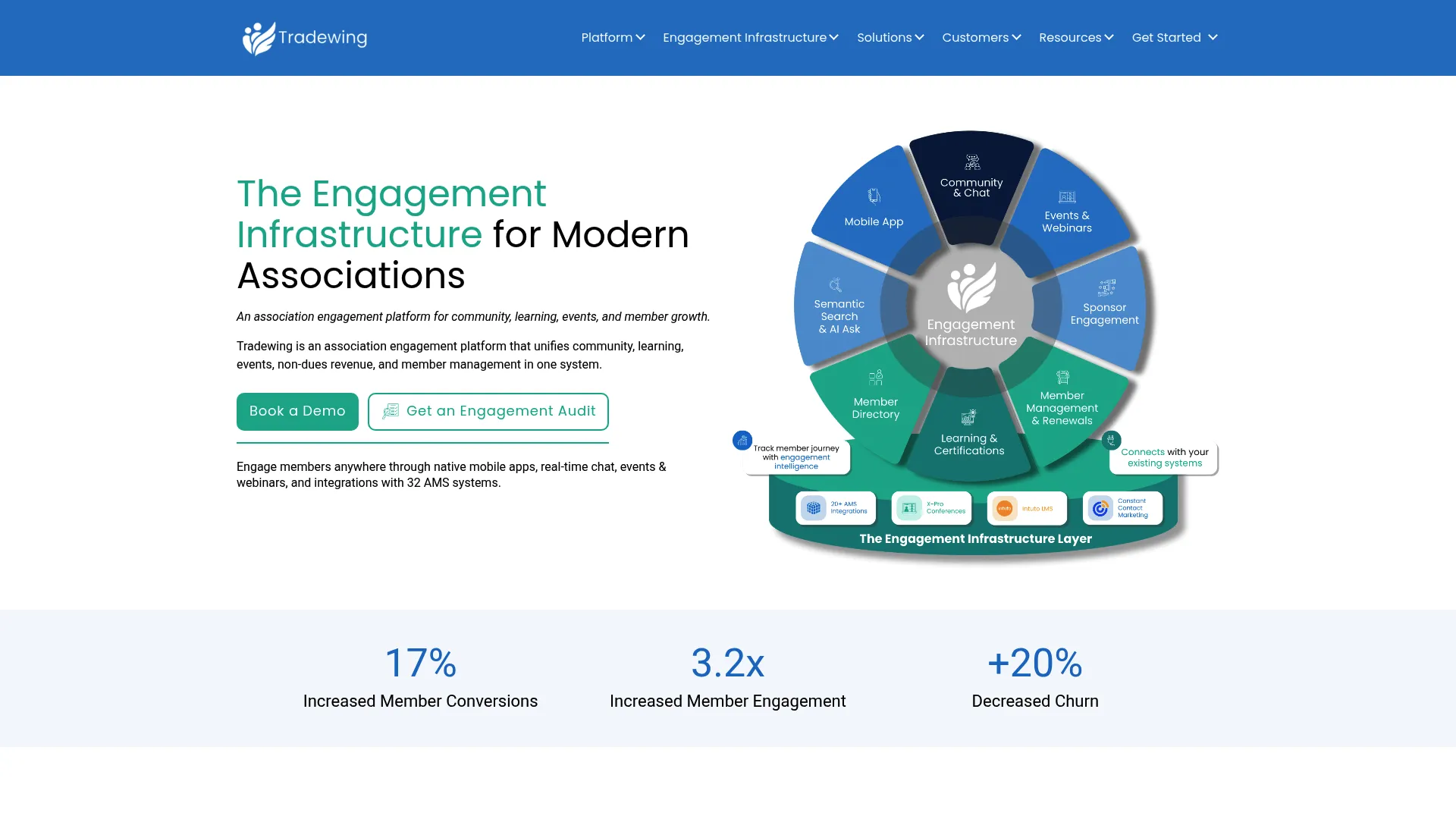
Tradewing is an association engagement platform that unifies community, learning, events, membership, and sponsorship tools in one place. It is built for trade and professional associations, not generic communities, which shows in how it ties engagement to renewals and retention.
The pitch is direct: engaged members renew. By pulling discussions, events, and learning into a single branded space with native mobile apps, Tradewing gives members fewer reasons to drift and gives staff a clearer read on who is active.
Key strengths
- Community discussions, direct messaging, and group collaboration
- Events, webinars, and hybrid conference support
- Native iOS and Android mobile apps
- Learning and sponsorship tools built for associations
- Member management integration
Why choose Tradewing: Choose Tradewing when your success metric is renewals, not raw activity. It fits associations that want one platform members actually open, with engagement data that connects to retention rather than sitting in a silo.
Tradewing pricing: Tradewing does not publish public pricing on its site. Contact the vendor for a quote based on your association's size and needs.
3. Hivebrite
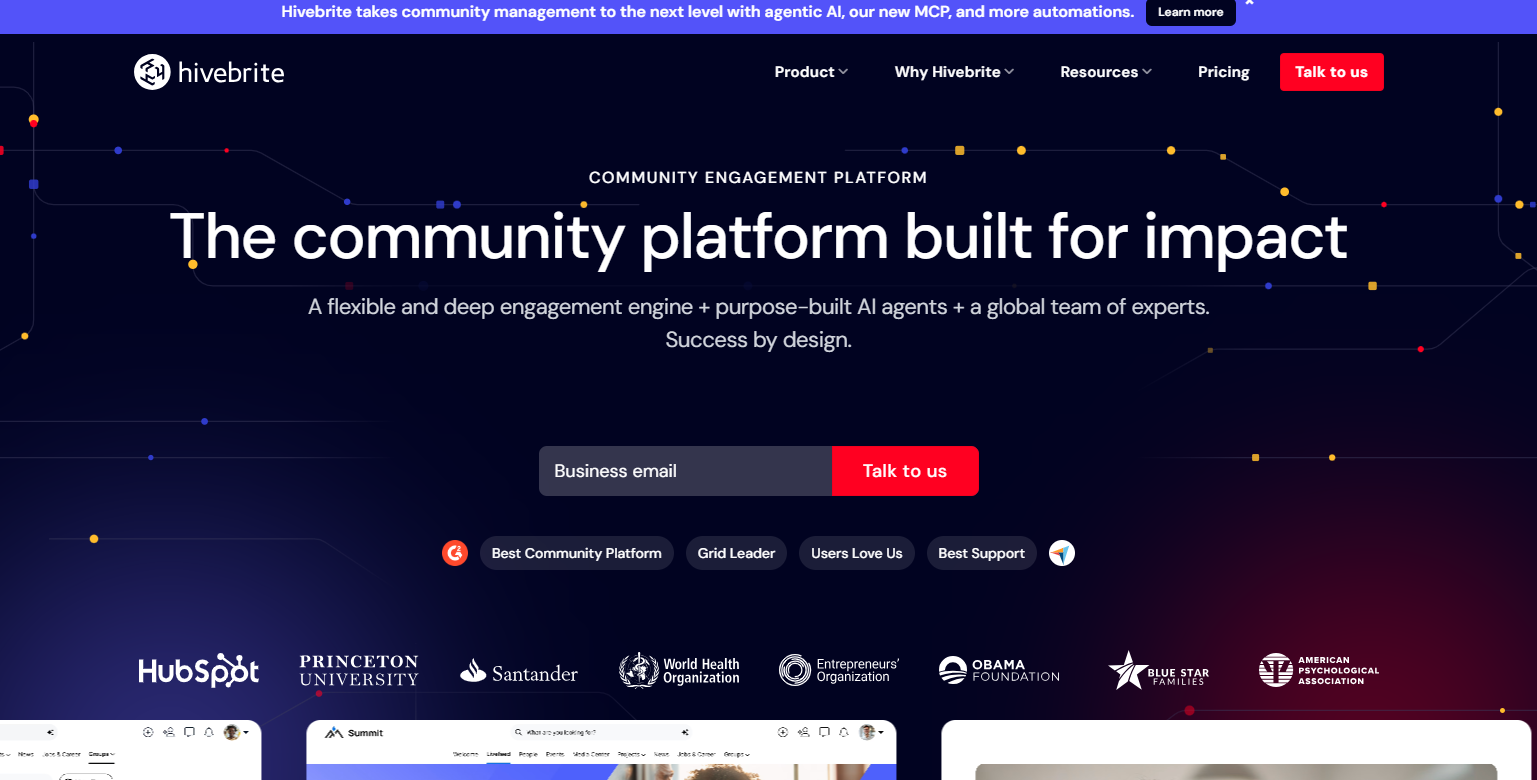
Hivebrite is an all-in-one community management platform for branded private communities. It gives organizations a fully customizable hub with memberships, events, directories, and forums, all under their own brand. The flexibility is the draw: you shape the space rather than fit into someone else's template.
For organizations that want a private community that looks and behaves like their own product, Hivebrite covers the range, from alumni networks to professional associations to customer communities.
Key strengths
- Custom branding and page builder
- Events, memberships, directory, messaging, groups, and forums
- AI matching, AI recommendations, and moderation
- Analytics and engagement tracking
- Flexible customization across the community experience
Why choose Hivebrite: Choose Hivebrite when brand control and customization matter as much as the feature set. It fits organizations building a private community hub they want to own end to end, with room to configure the experience per audience.
Hivebrite pricing: Core starts at $895 per month billed annually. Flex starts at $1,995 per month billed annually. Prime is priced after a discovery conversation, and Custom Fit is fully custom. There is no free tier.
4. Simply Stakeholders
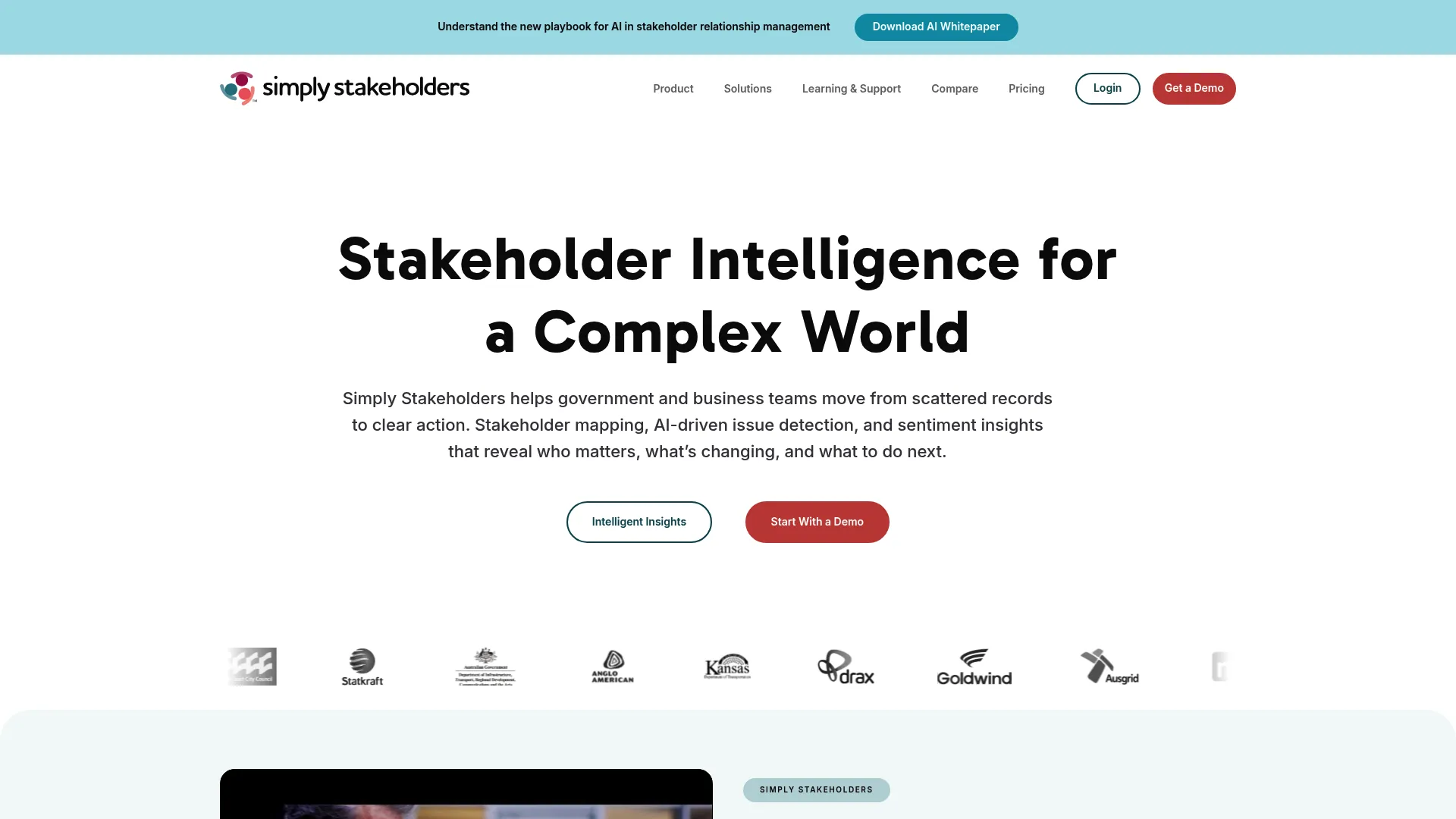
Simply Stakeholders is cloud-based stakeholder engagement software for mapping stakeholders, tracking engagement, analyzing sentiment, and reporting. It is more record-and-analysis focused than the public-portal platforms, which makes it a strong fit for teams that need to know who matters and how they feel.
The strength here is structure. A stakeholder register plus mapping plus sentiment analysis turns loose relationships into something you can segment, track, and report on with confidence.
Key strengths
- Stakeholder register and stakeholder mapping
- Issues and sentiment analysis
- Reporting and insights dashboards
- Commitments tracking and task management
- Communication tools and automations
Why choose Simply Stakeholders: Choose Simply Stakeholders when your job is relationship intelligence, not mass public consultation. It fits teams that need configurable stakeholder segmentation, trend tracking, and reporting they can defend to leadership.
Simply Stakeholders pricing: Plans are billed annually and priced per user, with volume discounts. The pricing page does not show public plan prices, so pricing depends on your plan, modules, and user count. Contact sales for details.
5. EngagementHQ
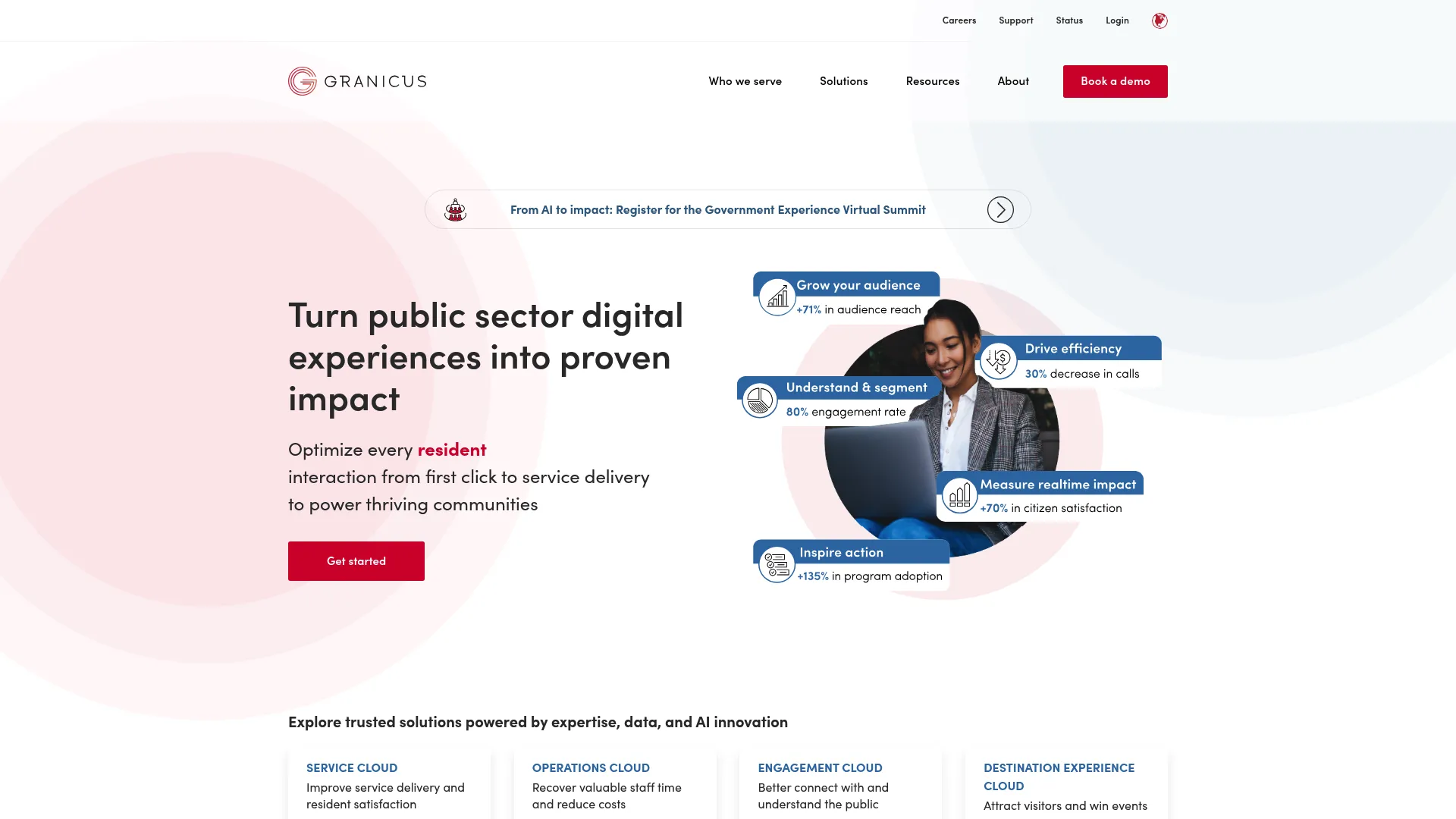
EngagementHQ is a digital community engagement and consultation platform from Granicus. It gives public-sector teams a broad set of participation tools, from surveys and polls to forums and idea boards, wrapped in project-level reporting. If your engagement programs need range, this platform brings the widest toolset on the list.
It fits teams running structured consultations where different projects call for different methods, and where a moderated, always-on environment matters.
Key strengths
- Surveys, polls, Q&A, ideas, stories, guestbook, places, forums, submissions
- Project-level reporting, dashboards, and text analysis
- 24/7 moderated engagement environment
- Multiple participation methods per project
- Public consultation and project page support
Why choose EngagementHQ: Choose EngagementHQ when your programs need many ways to participate under one roof. It fits local governments and public-sector teams that run varied, structured engagement projects and want reporting tied to each one.
EngagementHQ pricing: EngagementHQ structures pricing around four components and offers Single, Unlimited, and Enterprise plans. The site does not publish numeric prices and asks teams to contact them for a demonstration and proposal.
6. ThoughtExchange
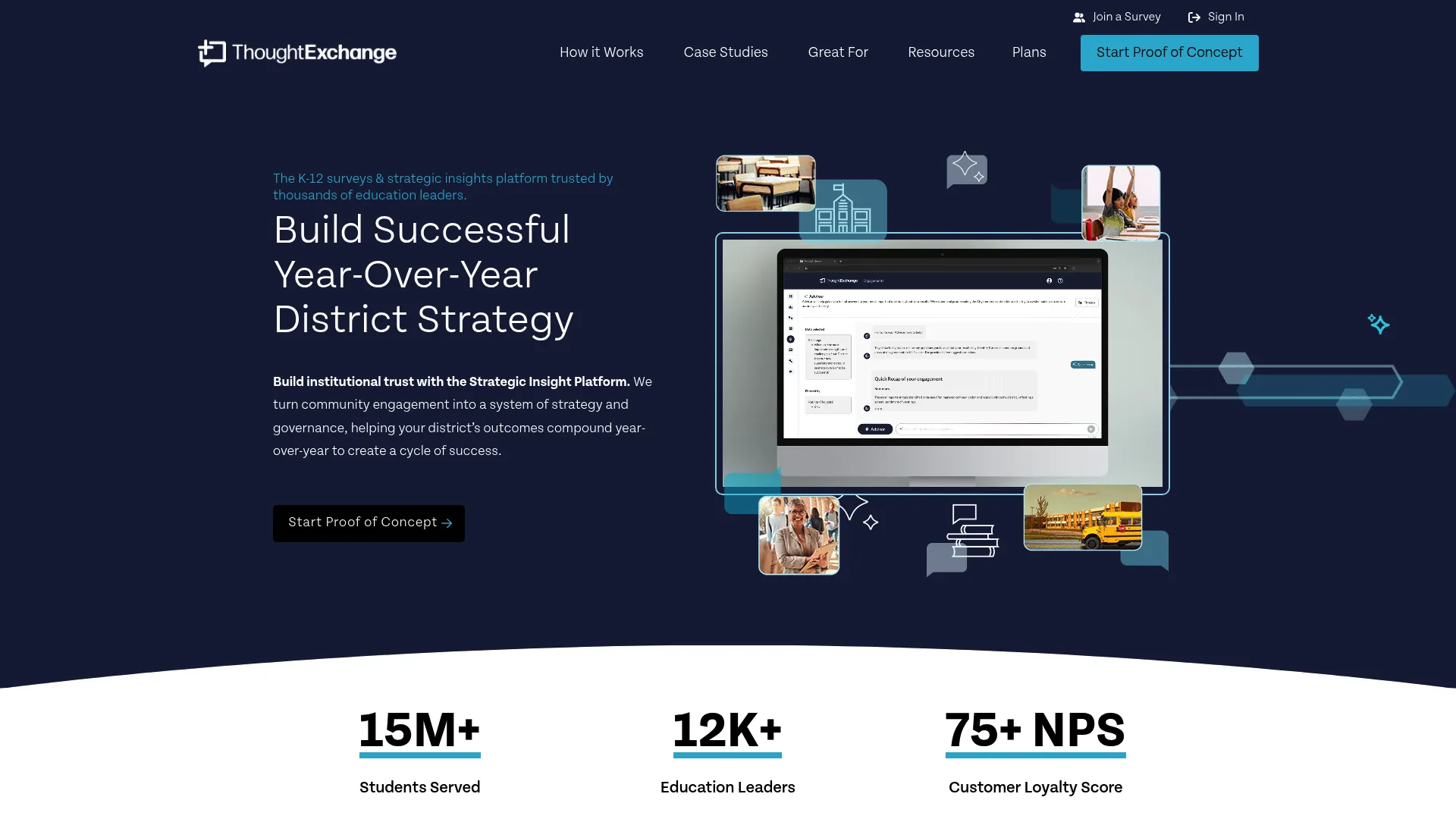
ThoughtExchange is a stakeholder engagement and strategic insights platform built around dialogue and prioritization. Its signature format lets participants share thoughts anonymously and rate each other's input, then uses AI to surface what the group actually prioritizes. It leans hard into K-12 and public-sector engagement.
The value is speed to insight. Instead of a survey that tells you what you asked, an Exchange tells you what the community rates as most important, with the analysis already done.
Key strengths
- Anonymous sharing and peer rating via Exchanges
- AI-powered data analysis and reporting
- Surveys and adaptive surveys
- Prioritization of community input at scale
- Strategic insights from open feedback
Why choose ThoughtExchange: Choose ThoughtExchange when you need fast, structured community dialogue and clear prioritization, not just raw response counts. It fits districts and public teams that want inclusive input plus analysis in one motion.
ThoughtExchange pricing: ThoughtExchange does not offer one-size-fits-all pricing or per-user fees. It builds a custom fit around each customer's use case, so contact the team for a quote.
7. Go Vocal
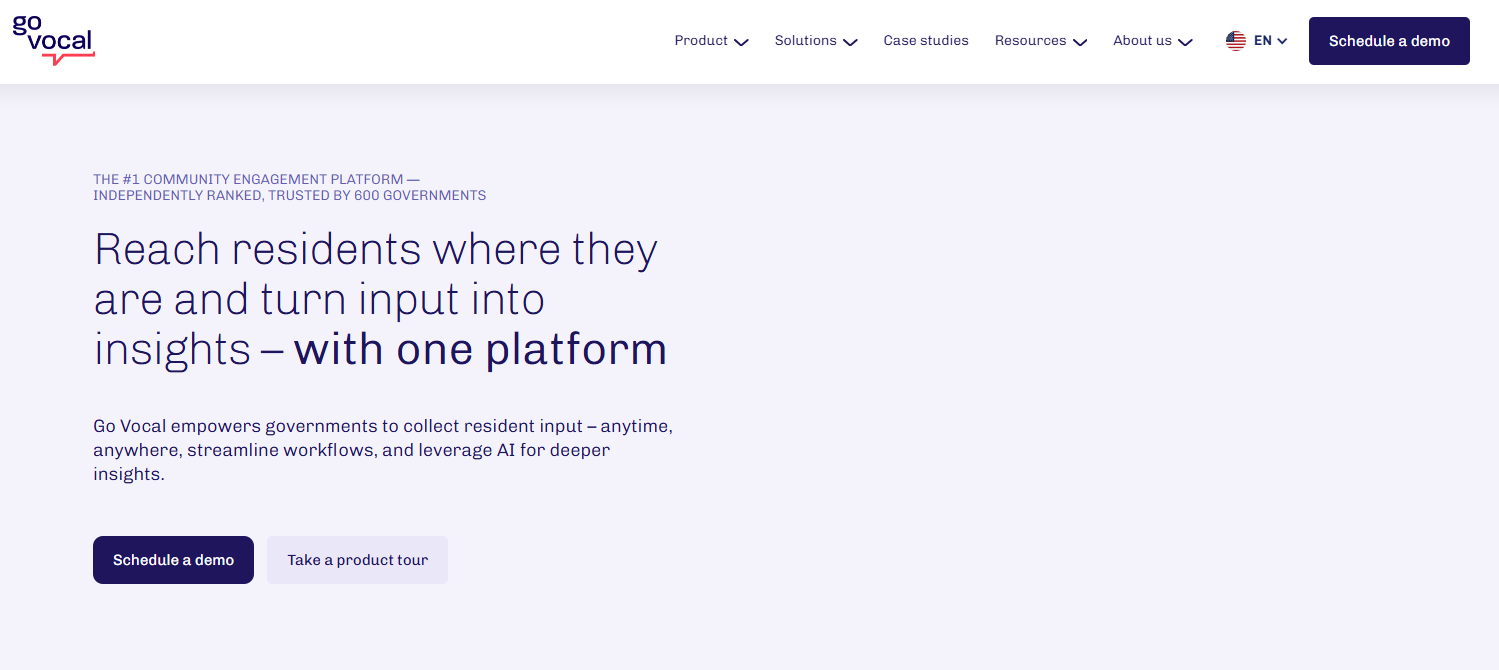
Go Vocal is a community engagement platform for public-sector participation, analysis, and decision-making. It gives cities and agencies a configurable set of methods, from surveys and ideation to participatory budgeting and voting, with a resident-friendly front end and strong back-end configuration.
For teams that want residents to actually finish what they start, Go Vocal pairs an approachable participation experience with the configuration depth staff need to run structured programs.
Key strengths
- Survey, ideation, mapping, participatory budgeting, voting, and more
- Configurable homepage, content builder, and project folders
- Smart groups, permissions, dashboards, and report builder
- SSO, webhooks, and data integrations
- ArcGIS and Power BI integrations plus auto-translation
Why choose Go Vocal: Choose Go Vocal when resident experience and configurability both matter. It fits cities and public agencies running participation programs that need a friendly front door and a serious reporting and integration layer behind it.
Go Vocal pricing: Go Vocal offers Essential, Standard, Premium, Department, and Enterprise plans. The site does not publish numeric prices and asks teams to talk to the sales team for a personalized offer.
Considerations
Before you shortlist, pressure-test each platform against the criteria that actually determine long-term fit.
Privacy and data handling
Know what data each platform collects, where it is stored, and who can access it. For government and stakeholder engagement software, this is not optional. Ask about data residency, anonymization options, and how sensitive resident or member records are protected.
Accessibility and multilingual support
Inclusive participation is a legal and practical requirement for most public-sector teams. Check for screen reader compatibility, WCAG alignment, and built-in translation. A platform that only reaches part of your community produces skewed input.
Reporting and analytics
Raw feedback is not a decision. Evaluate how well each platform turns responses into dashboards, trends, and audit-ready reports. Look for text analysis, sentiment tracking, and the ability to tie every data point back to a project or meeting.
Workflow fit
The best community engagement platforms handle meetings, comments, surveys, and notifications in one system. Map your actual process, then check whether the platform covers it end to end or leaves gaps you will fill with spreadsheets again.
Integration depth
Your engagement platform should connect to the tools you already run: CRM, email, GIS, and reporting systems. Ask about SSO, webhooks, and native integrations. Weak integration means duplicate entry, which is the exact problem you are trying to escape.
Conclusion
The right community engagement software depends entirely on the job in front of you.
If you run public meetings and need audit-ready records, PublicInput connects engagement and governance in one system. For association engagement tied to renewals, Tradewing is built for the motion. Hivebrite wins when you want a fully branded private community. Simply Stakeholders is the pick for stakeholder mapping and reporting, while EngagementHQ brings the widest set of public participation methods. ThoughtExchange excels at fast dialogue and prioritization, and Go Vocal balances resident-friendly participation with deep configuration.
Do not try to pick from a list alone. Shortlist two or three platforms that match your operating model, then compare their workflows side by side using your own real project. Run a survey, post a meeting, pull a report, and see which one holds up. The platform that fits your process, not the one with the longest feature list, is the one worth buying.
FAQs
A CRM tracks contacts, deals, and relationship history. Community engagement software is built to collect and manage participation: surveys, public comments, meetings, and forums, with reporting and records attached. A CRM tells you who someone is. An engagement platform captures what a whole community said and keeps it audit-ready. Many teams run both and integrate them.
For a one-off survey, a spreadsheet is fine. For ongoing participation across meetings, comments, and reports, spreadsheets break down fast. They offer no audit trail, no accessibility support, and manual reporting that nobody fully trusts. A dedicated platform keeps every response tied to its project and produces reports without hours of copy-paste. The switch pays off once scatter and recordkeeping become the bottleneck.
Public-sector teams should prioritize a public meetings workflow, audit-ready recordkeeping, accessibility, and multilingual support. Omni-channel notifications and executive dashboards also matter for reaching residents and reporting to leadership. The core test is whether the platform links resident input directly to the formal record, so decisions hold up when they are challenged.
Associations should look for community discussions, events, learning tools, and member management in one platform, ideally with native mobile apps. The goal is engagement that connects to renewals and retention, not activity for its own sake. A strong member engagement platform gives members one place to participate and gives staff a clear read on who is active before renewal season.
Strong platforms build in screen reader compatibility, WCAG alignment, keyboard navigation, and translation for multilingual communities. Some offer 24/7 moderated environments and auto-translation across dozens of languages. Always verify accessibility claims against your jurisdiction's requirements, because inclusive participation is often a legal obligation, not a nice-to-have.
Move past raw response counts. Track participation breadth (how many distinct people took part), completion rates, sentiment trends, and how input actually influenced decisions. For associations, tie engagement to retention and renewals. For government, tie it to decisions made and records produced. The best metric is whether the input changed an outcome, not how many clicks it collected.
For reach and casual conversation, social groups still have a place. For structured participation, they fall short: no recordkeeping, weak reporting, privacy gaps, and no audit trail. A dedicated platform gives you defensible records, accessibility, and analytics that a social group cannot. Many teams keep social for outreach and route real participation into a platform.
Ask the vendor to run your actual workflow, not a canned tour. Have them show a survey, a public comment, a meeting record, and a report end to end. Push on privacy, accessibility, integrations, and how records are audited. Ask what happens to your data if you leave. A demo that survives your real process is worth more than a polished feature reel.