Recognition programs rarely fall apart because nobody cares. They fall apart because praise is inconsistent, the tooling is clunky, and the whole thing lives outside the apps people actually work in. A manager means to thank someone for a great quarter. Then a fire drill hits. Three weeks later, the moment is gone.
Now multiply that by a distributed workforce. Some people sit in an office, some work from home, and some never touch a desk at all. Manager memory does not scale across that. Spreadsheets and ad hoc Slack shout-outs do not scale either. The global employee recognition software market is projected to reach USD 21.4 billion in 2026 and climb to USD 52.5 billion by 2036, a 9.4% CAGR, according to Future Market Insights. That growth tracks a simple shift: companies want appreciation that is frequent, visible, and measurable, not occasional and invisible.
That is exactly where dedicated software earns its place. The right platform makes recognition a daily habit, ties it to rewards people want, and gives leaders real data on whether the program is working. If you are the person rolling this out, you care less about feature counts and more about whether you can launch it, maintain it, and prove it moved employee engagement. The same instinct shows up when teams evaluate adjacent tooling like employee advocacy software or internal culture programs: adoption beats feature lists every time.
What's inside
This guide compares nine employee recognition software platforms built for real rollouts, not demos. We chose each one based on recognition workflows, rewards flexibility, integrations with tools like Slack and Microsoft Teams, analytics depth, ease of administration, and support for distributed teams. The list spans lightweight rewards tools and full enterprise culture suites, so you can match a platform to your actual operating reality. Every pricing note and G2 rating below reflects what each vendor publishes or what G2 reports, not estimates. If a vendor gates pricing behind sales, we say so plainly.
TL;DR
- Best overall fit for connected recognition and rewards: Bonusly
- Best for Microsoft 365-centric organizations: Recognize
- Best for enterprise culture and engagement programs: Workhuman
- Best for manager-led recognition and performance alignment: Achievers
- Best for flexible rewards and lightweight rollout: Guusto
- Best for balanced recognition, perks, and internal engagement: Motivosity
- Best for feedback-rich recognition and listening programs: WorkTango
- Best for curated rewards and global flexibility: Nectar
- Best for modular rewards and incentive programs: Bucketlist Rewards
What is employee recognition software?
Employee recognition software is a platform that lets coworkers and managers give frequent, visible appreciation, often paired with points or rewards, and tracks how recognition flows across the organization. It turns scattered praise into a repeatable program with data behind it.
Most employee recognition platforms ship with a recognizable set of modules. When you evaluate, expect to see:
- Peer-to-peer recognition: Anyone can recognize anyone, usually in a public social feed, so appreciation is not bottlenecked through managers.
- Manager recognition: Structured recognition tied to performance, goals, and one-on-ones.
- Milestones and celebrations: Automated work anniversaries, birthdays, and onboarding moments so nothing slips.
- Rewards catalogs: Gift cards, merchandise, donations, experiences, and custom swag that points redeem against.
- Reporting and analytics: Participation rates, recognition frequency, and program reach, so you can prove impact.
- Integrations: Connections into Slack, Microsoft Teams, email, SSO, and your HRIS so recognition lives where work happens.
Why these tools matter comes down to a few outcomes leaders actually track:
- Engagement: Frequent recognition correlates with employees who feel seen and stay invested.
- Retention: Appreciation and belonging reduce the quiet attrition that erodes teams.
- Culture: A public feed makes good behavior contagious and reinforces values daily.
- Burnout reduction: Consistent acknowledgment offsets the grind of heads-down work.
- Visibility: Analytics give leaders proof a program is alive, not theater.
These are the same levers that show up in performance management and manager enablement conversations, because recognition is where culture and behavior reinforcement actually meet.
When to use employee recognition software
Scale recognition beyond manager memory
A small team can run on verbal thank-yous. A growing or distributed one cannot. Once you cross a few dozen people, no manager remembers every win, every anniversary, every quiet contributor who never asks for credit. Software makes recognition systematic, so appreciation does not depend on whether a busy manager happened to catch the moment. This is the inflection point most companies hit during fast headcount growth.
Reinforce key behaviors and milestones
Recognition is one of the cheapest ways to reinforce the behaviors you want more of. A platform lets you celebrate wins, work anniversaries, onboarding milestones, and team achievements consistently, with values or competencies attached to each shout-out. That tagging turns vague praise into a signal: this is what good looks like here. Over time, that consistency shapes culture more reliably than any all-hands speech.
Improve visibility into culture and adoption
Leaders fund what they can measure. When a CFO or VP asks whether the recognition program is working, "people seem happier" is not an answer. Analytics and reporting give you participation rates, recognition frequency, and program reach by team. That visibility matters most for distributed team operations, where you cannot eyeball morale across a hallway. Data is also how you spot a team that has gone quiet before it becomes a retention problem.
Comparison table
We sorted the table by relevance to the keyword, leading with the platforms most teams shortlist first. Pricing reflects each vendor's public pricing page as of mid-2026, or notes when figures are quote-based. G2 ratings come straight from each tool's current G2 listing.
| # | Product | Intent | Key use case | Pricing | G2 rating |
|---|---|---|---|---|---|
| 1 | Bonusly | Connected recognition and rewards | Everyday peer recognition with rewards and analytics | Free; Team from $30/user/yr | 4.7/5 |
| 2 | Recognize | Microsoft 365-first recognition | Recognition inside Teams, Outlook, and SharePoint | Custom pricing | 4.7/5 |
| 3 | Achievers | Enterprise manager-led recognition | Structured programs with global rewards and analytics | Custom pricing | 4.6/5 |
| 4 | Workhuman | Enterprise culture and recognition | Social recognition across regions and business units | Custom pricing | 4.7/5 |
| 5 | Motivosity | People-first recognition and connection | Social feed recognition, perks, and engagement | Custom pricing | 4.7/5 |
| 6 | Nectar | All-in-one recognition and comms | Recognition, surveys, and internal communications | Custom pricing | 4.7/5 |
| 7 | WorkTango | Recognition plus listening | Recognition paired with surveys and insights | Custom pricing | 4.7/5 |
| 8 | Bucketlist Rewards | Modular rewards and incentives | Configurable recognition with broad rewards marketplace | Custom pricing | 4.8/5 |
| 9 | Guusto | Flexible rewards and lightweight rollout | Gifting for office and frontline teams | Free tier; Lite from $150/mo | 4.9/5 |
1. Bonusly
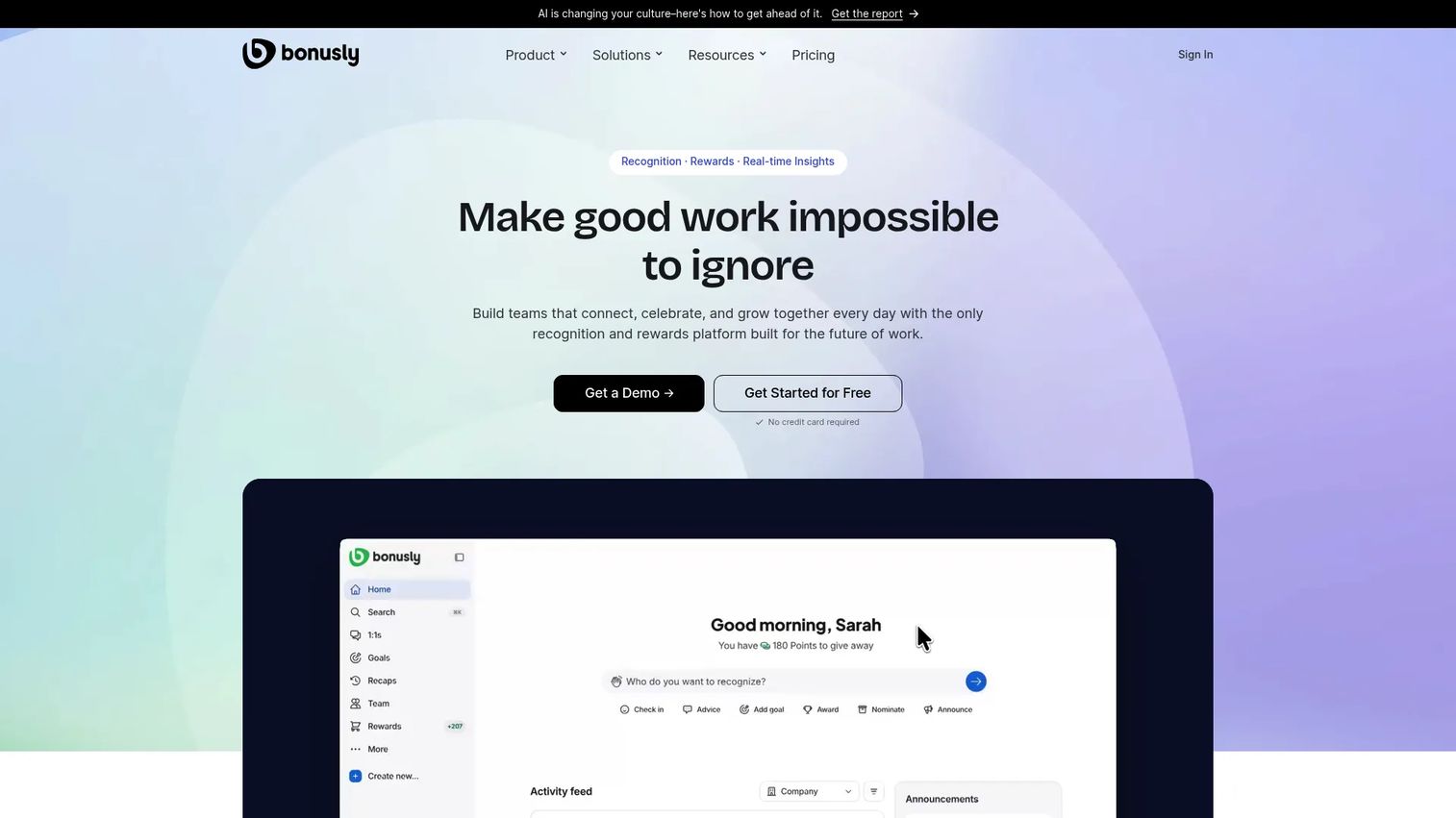
Bonusly is the platform most teams picture when they imagine connected recognition: a public feed where anyone can give small point-based bonuses, tied to company values, that employees redeem for rewards they actually want. It pairs that everyday recognition habit with automated milestones, meaningful rewards, and analytics that show leaders how appreciation moves across teams. The result is a program built for broad daily adoption rather than a rigid, top-down initiative.
What makes Bonusly resonate is how low-friction the giving motion is. Recognition happens inside Slack or Teams in seconds, which is why it tends to become a real habit instead of a quarterly ritual. AI-assisted features and performance tooling sit on top for teams that want more structure.
Best for: Teams that want recognition, rewards, and engagement workflows living in one platform with high day-to-day participation.
Key strengths
- Peer-to-peer recognition: A social feed where anyone can recognize anyone, keeping appreciation flowing without manager bottlenecks.
- Meaningful rewards: A broad catalog of gift cards, donations, and custom rewards that points redeem against.
- Automated milestones: Work anniversaries and birthdays fire automatically so no moment gets missed.
Why choose Bonusly: It hits the sweet spot between simple and capable. The everyday recognition flow is genuinely easy to adopt, which matters more than any feature list, while analytics and AI tools give it room to grow with a program. It fits simple rollouts cleanly and scales into more structured engagement work without forcing complexity on day one.
Bonusly pricing: Bonusly offers a Free forever plan, a Team plan, and a custom-priced Organization plan, all billed annually with rewards costs separate from the subscription. Team without Bizy AI runs $3/user/month or $30/user/year. Team with Bizy AI runs $5/user/month or $50/user/year. Organization pricing is custom on request.
2. Recognize
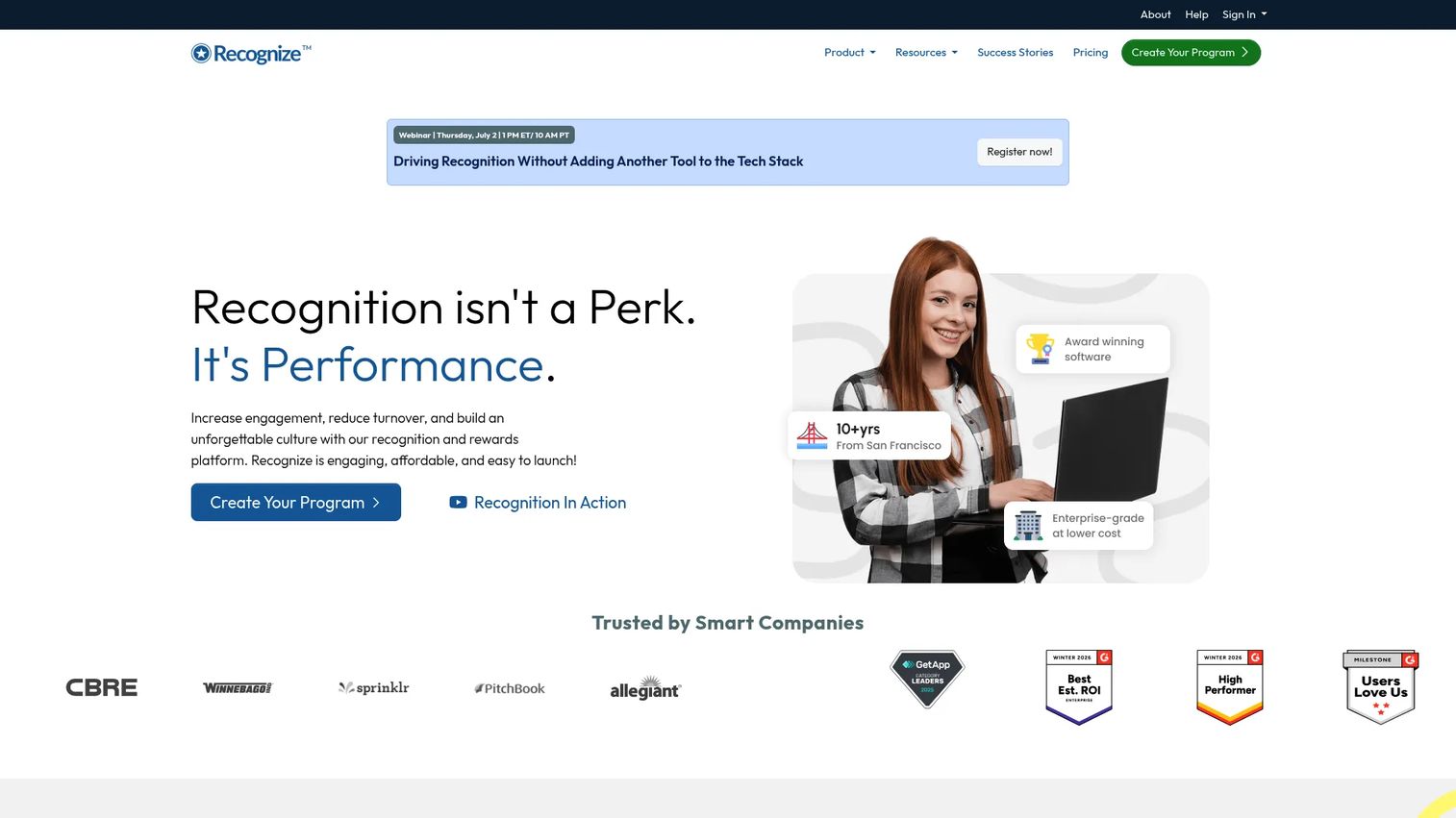
Recognize is built for organizations that already live inside Microsoft. Recognition, rewards, anniversaries, and surveys all run natively across Teams, Outlook, SharePoint, and Workday, so employees never leave the tools they use every day. For a company standardized on Microsoft 365, that native fit removes most of the adoption friction that sinks recognition programs.
The platform leans into enterprise needs: governance controls, mobile access for distributed and frontline staff, and the kind of administrative structure IT teams expect. Peer recognition, rewards, and work anniversaries round out a complete program rather than a single feature.
Best for: Companies standardized on Microsoft 365 that want recognition embedded directly in Teams, Outlook, and SharePoint.
Key strengths
- Microsoft 365 and Teams integrations: Recognition lives natively inside the Microsoft tools employees already use.
- Employee rewards and anniversaries: Automated work anniversaries and a rewards program keep celebrations consistent.
- Employee surveys: Built-in surveys add a listening layer alongside recognition.
Why choose Recognize: If your stack is Microsoft-heavy, the value is obvious. Native Teams, Outlook, SharePoint, and Workday integration means recognition shows up where people already work, and IT gets the governance and enterprise controls it needs to sign off. That ecosystem fit is the deciding factor for most buyers who land here.
Recognize pricing: Recognize lists three tiers, Start-Up, Mid-Market, and Enterprise, all billed annually with custom pricing rather than public list prices. The company offers a free trial, so you can evaluate fit before committing.
3. Achievers
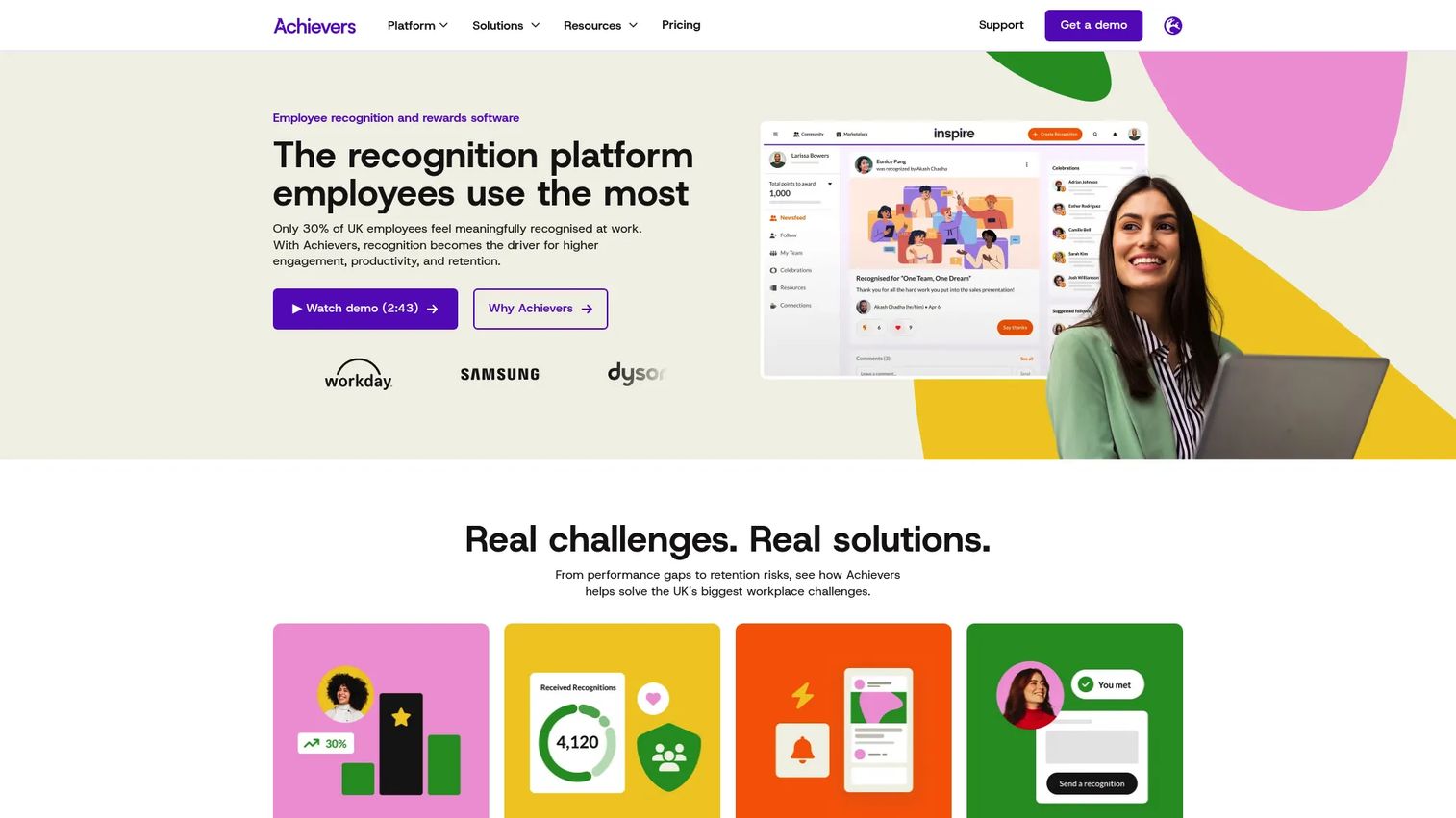
Achievers is built for larger organizations that need recognition as a structured, measurable program rather than a casual feed. It combines manager-led recognition, a global rewards marketplace, service awards, and AI-powered insights that connect recognition data to engagement and retention. For companies that report on people metrics to leadership, that measurement depth is the draw.
The platform fits organizations operating at scale, across regions, with more governance and stronger analytics than lighter tools carry. Manager workflows and performance alignment make it a fit where recognition needs to reinforce specific behaviors, not just spread good vibes.
Best for: Large or mid-market organizations that need global recognition, rewards, and analytics in a governed program.
Key strengths
- AI-powered recognition insights: Surfaces patterns in recognition data to inform engagement and retention work.
- Global rewards marketplace: Broad reward coverage suited to multi-region workforces.
- Milestones and service awards: Structured anniversary and service recognition at enterprise scale.
Why choose Achievers: It tends to be the better fit when a lightweight tool would not survive enterprise scrutiny. The governance, analytics, and global rewards make it suited to organizations that need recognition tied to measurable business outcomes and managed across many teams. Expect an implementation process rather than a same-day launch.
Achievers pricing: Achievers uses quote-based pricing across its recognition and rewards platform and years-of-service offerings. No public numeric price is listed, so you request a custom quote sized to your organization.
4. Workhuman
Workhuman is an enterprise recognition and culture platform built for scale and depth. Its Social Recognition product anchors a broader system that includes Workhuman iQ for people analytics and Service Milestones for anniversary recognition. For organizations running recognition across multiple regions and business units, the analytics and reach are the differentiators.
Workhuman is designed to support manager adoption, broad recognition visibility, and enterprise-grade reporting. It is a fit when recognition is a strategic, company-wide investment rather than a single-team experiment.
Best for: Large organizations seeking an enterprise recognition and engagement platform with deep people insights.
Key strengths
- Social Recognition: A company-wide recognition feed designed for enterprise scale and visibility.
- Workhuman iQ: People analytics that turn recognition activity into insight on culture and engagement.
- Service Milestones: Structured service and anniversary recognition across the organization.
Why choose Workhuman: It earns its place when recognition needs to operate as enterprise infrastructure across regions and business units. The analytics depth and manager adoption support make it a fit for organizations that treat recognition as a measurable culture program. Like other enterprise suites, expect a planned rollout rather than an instant switch-on.
Workhuman pricing: Workhuman does not publish public pricing on its site, and plans are quote-based. You will work with their team to size a package, so budget conversations happen early in the evaluation.
5. Motivosity
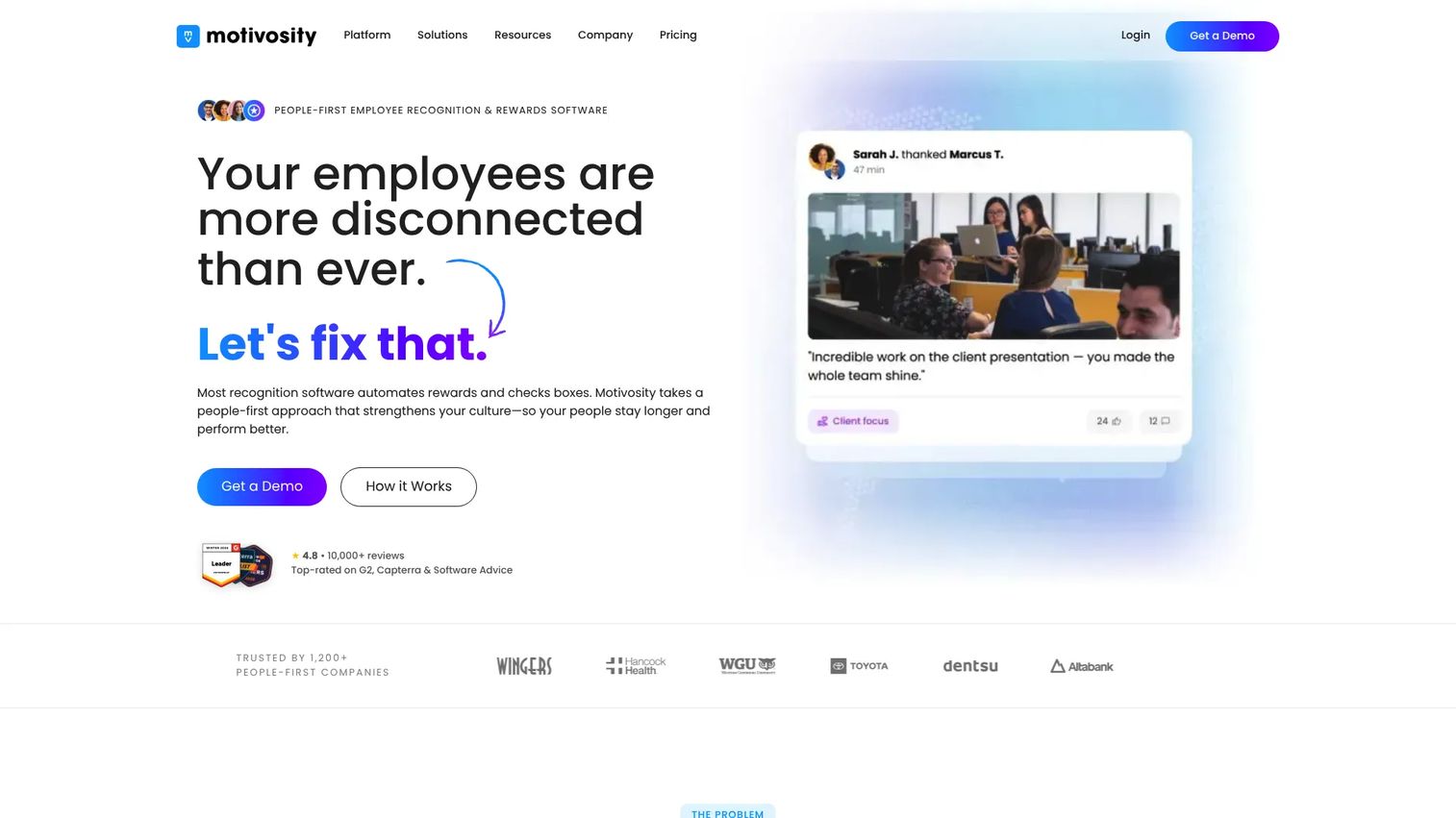
Motivosity leans into the social side of recognition. Its centerpiece is a recognition and communication feed that makes gratitude visible and frequent, supported by modules for milestones, challenges, surveys, internal communications, and rewards. The experience is friendly and people-first, which is why teams that want straightforward adoption tend to like it.
The platform supports both peer-to-peer and manager-to-employee recognition, with rewards and perks layered on. It is a good match for organizations that want community and day-to-day connection more than heavy enterprise governance.
Best for: Mid-market and enterprise teams wanting recognition, rewards, and culture-building in an approachable, social package.
Key strengths
- Social recognition feed: A central feed for recognition and communication that keeps gratitude visible.
- Peer and manager recognition: Both peer-to-peer and manager-to-employee recognition in one flow.
- Engagement modules: Milestones, challenges, surveys, internal comms, and rewards in a single platform.
Why choose Motivosity: Pick it when you want recognition that feels human and rolls out without friction. The social feed and connection features make appreciation a daily habit, and the bundled engagement modules cover culture work beyond pure recognition. It fits teams prioritizing community and ease over deep enterprise controls.
Motivosity pricing: Motivosity prices its plans, Celebrating People, Building Culture, and Scaling Globally, on a custom, per-employee basis rather than public list prices. You request a quote and the team scopes a bundle to your needs.
6. Nectar
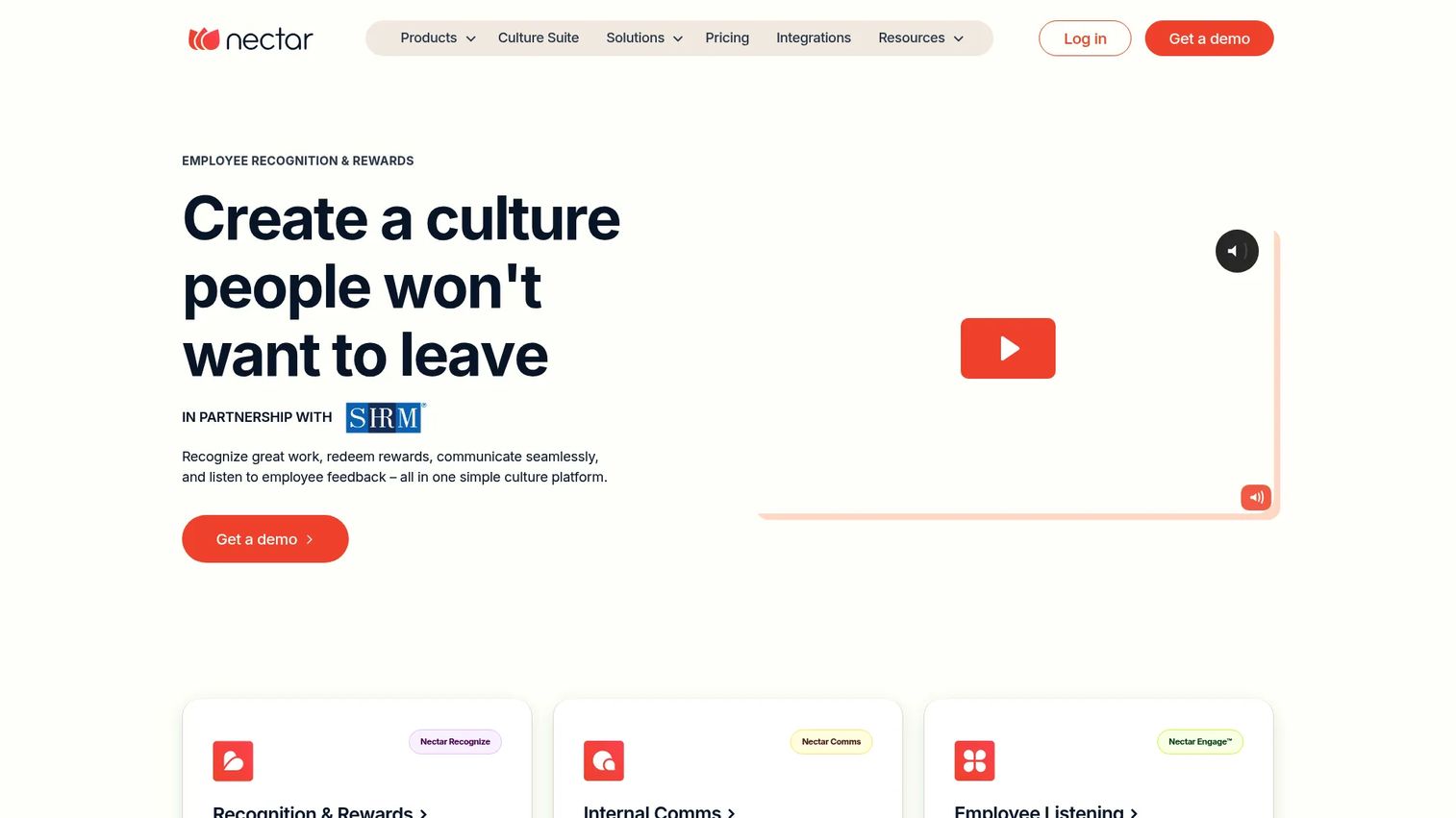
Nectar is a practical all-in-one option that pairs recognition with engagement surveys and internal communications. Peer-to-peer and manager recognition, eNPS surveys, and multi-channel comms across email, Slack, Teams, and SMS all live in one platform. For teams that want broad coverage without heavy complexity, that balance is the appeal.
Nectar keeps administration approachable while still covering milestones, rewards, and culture support. It fits organizations that want one tool to handle recognition and adjacent people work rather than stitching several together.
Best for: Mid-market and enterprise teams wanting recognition plus engagement and internal comms in a single platform.
Key strengths
- Peer and manager recognition: Both recognition directions in one straightforward flow.
- Engagement and eNPS surveys: Built-in listening to track sentiment alongside recognition.
- Multi-channel internal comms: Reach employees across email, Slack, Teams, and SMS.
Why choose Nectar: Choose it when you want a single, easy-to-run platform covering recognition, surveys, and communications. The all-in-one scope reduces tool sprawl, and the admin experience stays approachable for lean people teams. It fits best where breadth and simplicity matter more than deep enterprise customization.
Nectar pricing: Nectar structures its offering around product bundles, including Recognize, Engage, Comms, and a Culture Suite, plus vertical bundles. Public prices are not displayed on the pricing page, so you request pricing for the bundle you need.
7. WorkTango
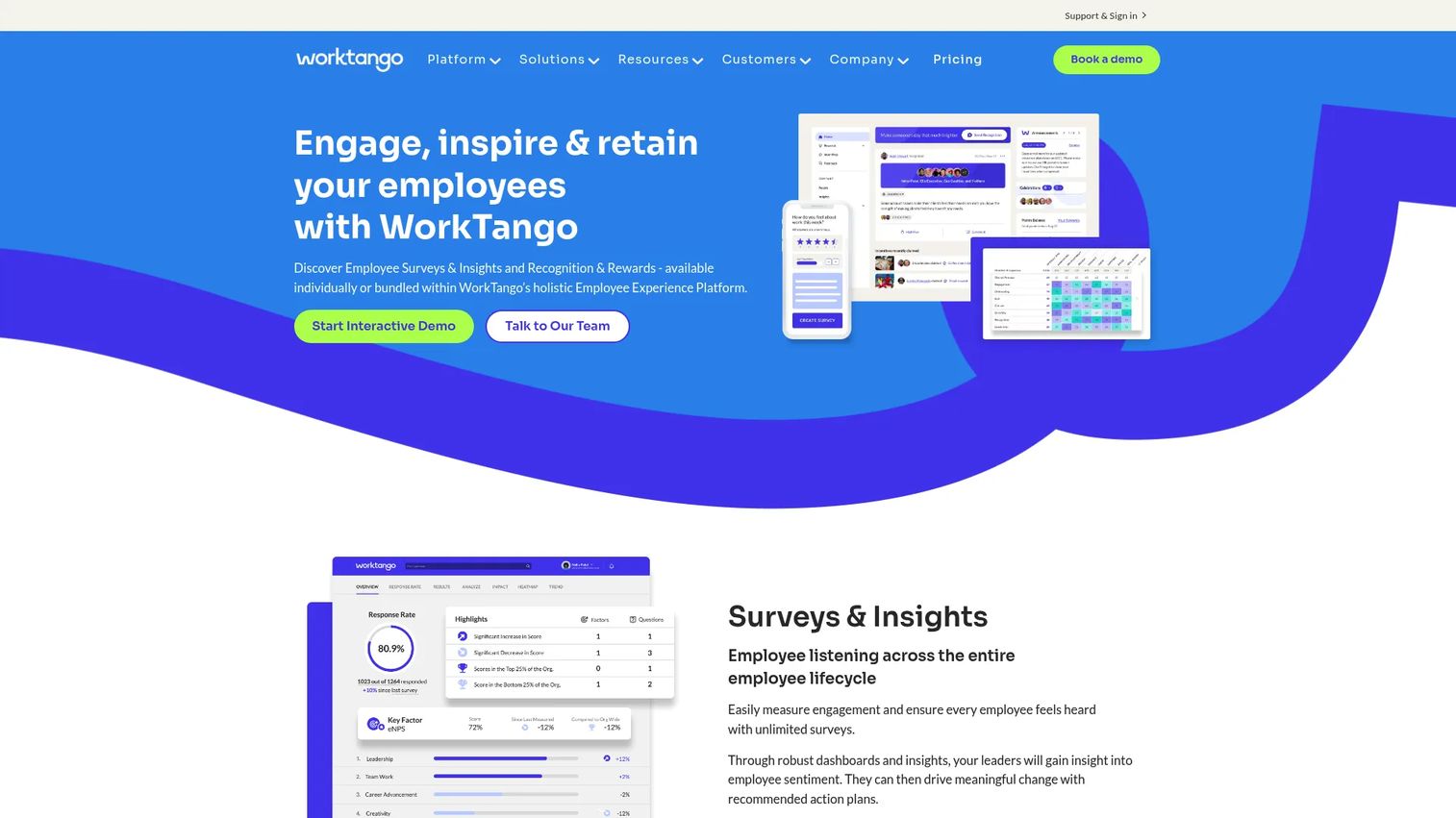
WorkTango pairs recognition with serious listening. Alongside recognition and rewards, it ships robust employee surveys, insights, and reporting, so the platform does more than distribute praise. For buyers who care about feedback loops and analytics as much as appreciation, that combination is the reason to look here.
WorkTango fits teams that want recognition to feed a broader employee-experience strategy. Recognition and rewards run no-markup on redemptions, with HRIS integrations and reporting connecting the data back to engagement work.
Best for: Mid-market and enterprise teams seeking recognition plus survey and engagement tools in one experience platform.
Key strengths
- Recognition and rewards: Point-based recognition with rewards redeemed at no markup.
- Surveys and insights: Robust employee surveys that pair listening with recognition.
- Reporting and HRIS integrations: Analytics and integrations that connect recognition to engagement data.
Why choose WorkTango: It is the pick when praise and rewards alone are not enough. The combination of recognition and a real survey-and-insights engine suits organizations building an employee-experience program, not just a recognition feed. Note the 12-month minimum contract, so plan the evaluation accordingly.
WorkTango pricing: WorkTango offers three packages: Employee Surveys & Insights, Recognition & Rewards, and a Full Employee Experience Platform. Pricing is request-based with a 12-month minimum contract, and rewards are redeemed at no markup.
8. Bucketlist Rewards
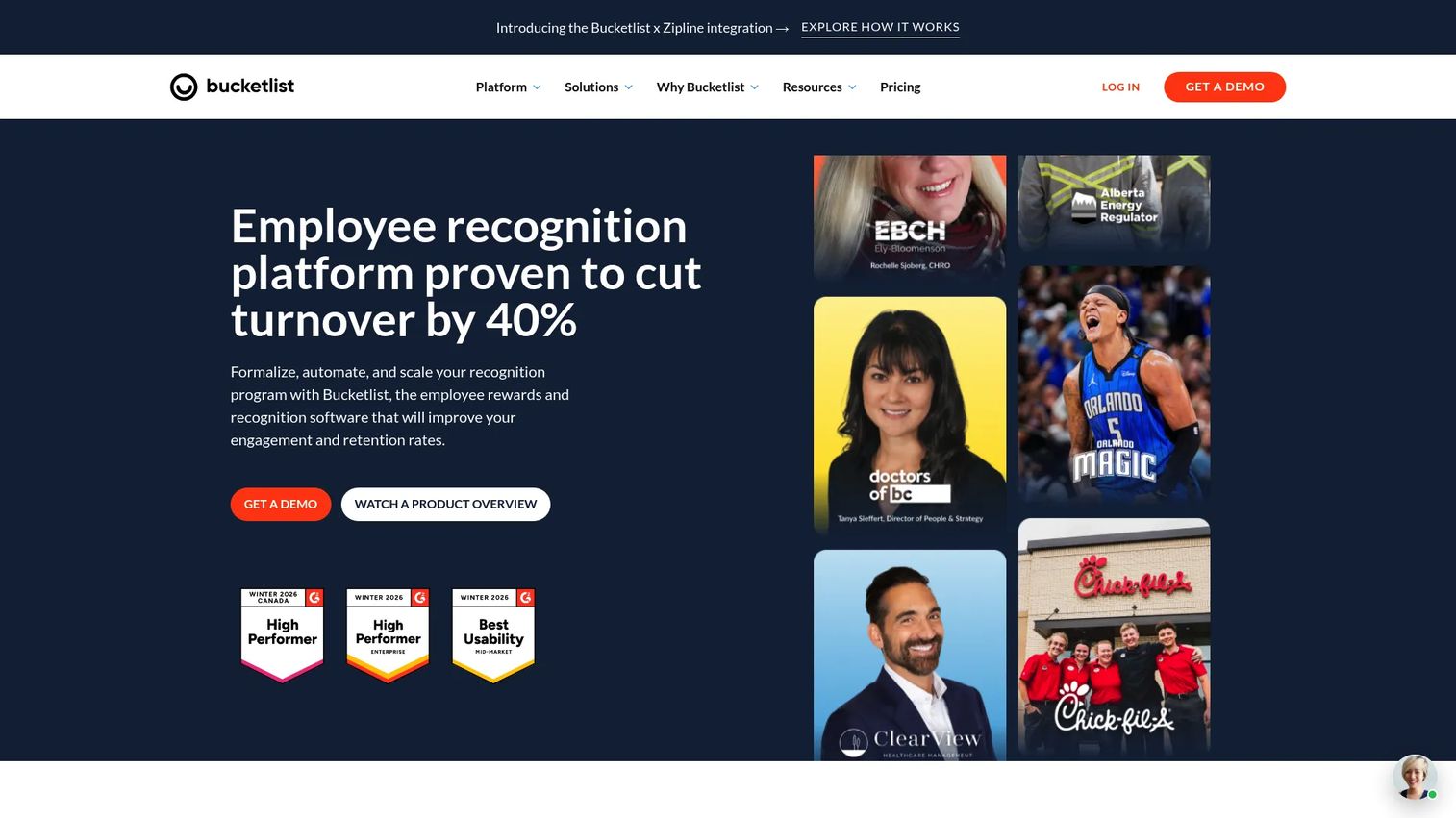
Bucketlist Rewards is built for teams that want rewards flexibility and program variety. Peer-to-peer and manager recognition, milestones and service awards, and a deep rewards marketplace spanning gift cards, merchandise, donations, experiences, and swag give program owners a lot to configure. For organizations that want recognition shaped to their own incentives, that modularity is the draw.
The platform supports customizable program design, which makes it a fit when off-the-shelf recognition is not enough. Incentive programs and varied reward types let you build something specific to your culture and goals.
Best for: Mid-market and enterprise teams needing a configurable recognition program with a broad rewards marketplace.
Key strengths
- Peer and manager recognition: Both recognition directions inside configurable program design.
- Milestones and service awards: Structured anniversary and service recognition.
- Broad rewards marketplace: Gift cards, merchandise, donations, experiences, and swag in one catalog.
Why choose Bucketlist Rewards: Reach for it when rewards variety and program customization top your list. The configurable design and wide marketplace suit teams running incentive programs alongside recognition. Plan for a setup process, since the flexibility that makes it powerful also means more decisions upfront.
Bucketlist Rewards pricing: Bucketlist Rewards uses quote-based pricing tiered by employee count across Starter, Professional, and Enterprise plans, billed annually. Expect a one-time setup fee plus an annual fee, with rewards billed separately.
9. Guusto
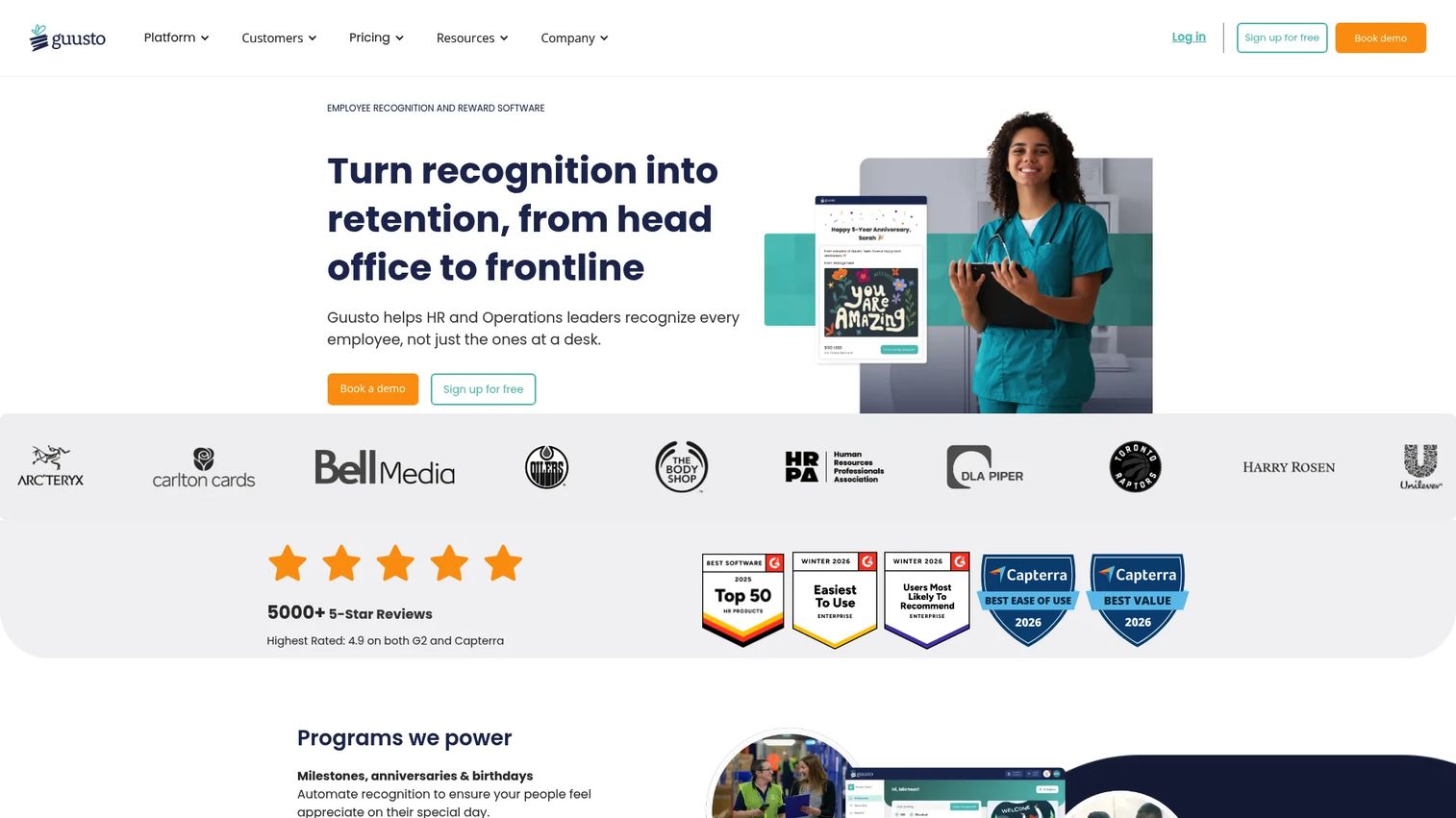
Guusto focuses on flexible, frictionless gifting that works for both office and frontline teams. Rewards can be sent by email, SMS, mobile, or printed QR codes, which makes it genuinely usable for deskless workers who never log into a desktop. A free tier for redeeming rewards at 100+ merchants lowers the barrier to getting started.
The platform keeps administration light while still offering social feeds, leaderboards, automated draws, and reporting. It is a strong fit when you want easy gifting and simple rollout rather than a full enterprise culture suite.
Best for: Companies needing frontline-friendly recognition and rewards with lightweight administration.
Key strengths
- Multi-channel reward delivery: Send rewards by email, SMS, mobile, and print or QR codes for deskless teams.
- Free redemption tier: A free tier to redeem rewards at 100+ merchants lowers the entry barrier.
- Engagement features: Social feeds, leaderboards, automated draws, and reporting built in.
Why choose Guusto: It makes sense over a comprehensive culture suite when reach to frontline staff and easy gifting matter most. The multi-channel delivery and light admin make it fast to roll out, and the free redemption tier means employees can use it without a steep onboarding. It excels where simplicity and frontline access beat heavy feature depth.
Guusto pricing: Guusto publishes pricing with USD/CAD and monthly/yearly toggles, and includes a free tier. Lite starts at $150/month. Essential runs $4.00/month per sender seat plus $0.70/month per recipient seat, and Premium runs $5.00/month per sender seat plus $1.00/month per recipient seat. The Run plan is sales-led.
Considerations
Integration fit
Recognition only sticks when it lives where people already work. Verify native support for Slack or Microsoft Teams depending on your stack, plus email, SSO, and mobile access for frontline staff. Check the HRIS or Workday connection too, since automated milestones depend on clean employee data flowing in. A platform that forces people to open a separate app every time will lose adoption fast.
Reward economics
The subscription is rarely the full cost. Look hard at how rewards are funded: budgets, any markup on redemptions, fulfillment fees, and catalog variety. Geographic coverage matters if you have international staff, since a US-centric gift card catalog is useless in another market. Some vendors redeem at no markup, which changes the math meaningfully at scale.
Governance and permissions
As programs grow, you need controls. Check approval flows, content moderation on the public feed, admin roles, and program-level controls like budget caps per team. Larger organizations especially need the ability to delegate administration without handing everyone the keys.
Analytics and reporting
Decide what you need to prove before you buy. At minimum, expect participation rates, recognition frequency, and program reach by team or region. Good reporting helps you spot a disengaged team early and gives leadership the proof points that keep the program funded.
Adoption and launch effort
This is where programs live or die, and it has little to do with feature counts. A strong rollout plan, visible executive participation, manager buy-in, and clear employee onboarding matter more than any single capability. Budget real time for change management. The best platform with a weak launch loses to a simpler one with a great launch.
Security and compliance
For larger organizations, run the platform past IT early. Check SSO support, data handling and residency, and whether the vendor can clear your security review. Catching a compliance blocker after you have socialized a tool internally is a painful way to learn this lesson.
Conclusion
The right pick depends on your operating reality, not the longest feature list. Bonusly is the strongest all-around choice for broad peer recognition and rewards that people actually use. Recognize is the clear fit for Microsoft-heavy organizations that want recognition inside Teams and Outlook. Workhuman and Achievers are built for enterprise programs that need governance, analytics, and global reach. Lighter tools like Guusto and Nectar shine when you want a simpler rollout, and Guusto in particular reaches frontline teams that desktop-bound tools miss.
Motivosity, WorkTango, and Bucketlist Rewards each carve out a clear niche: people-first community, recognition plus listening, and configurable rewards programs respectively. Before you commit, map your stack, your reward budget, and your rollout plan against the considerations above. Then choose the platform you can launch, maintain, and measure, because a recognition program only works if people use it.
Start your journey with Guideflow today!
FAQs
Employee recognition software is a platform that lets coworkers and managers give frequent, visible appreciation, usually with points or rewards attached, and tracks how recognition flows across the company. Expect core modules like peer-to-peer recognition, manager recognition, milestones and celebrations, a rewards catalog, reporting, and integrations into tools like Slack and Microsoft Teams.
Recognition, rewards, analytics, integrations, and admin controls each do different jobs. Recognition and rewards drive the daily habit and the payoff. Analytics prove the program works and surface teams going quiet. Integrations decide whether recognition lives where people work, and admin controls keep a growing program governed. Weigh them against your team size and rollout reality, not in the abstract.
Pricing varies by employee count, reward model, and enterprise requirements. Some vendors publish clear figures: Bonusly's Team plan starts at $30/user/year, and Guusto's Lite plan starts at $150/month with a free redemption tier. Many enterprise platforms, including Achievers, Workhuman, Motivosity, Nectar, WorkTango, Bucketlist Rewards, and Recognize, use custom or quote-based pricing. Remember that reward funding is usually separate from the subscription.
Adoption comes from launch, manager behavior, and workflow integration, not features. Pick a platform that lives inside Slack or Teams so recognition takes seconds. Get visible executive and manager participation early, since people mirror what leaders do. Then onboard employees with a clear, simple ask and reinforce it for the first few weeks until the habit sticks.
The right fit depends on where your people already work. If your company runs on Microsoft 365, a platform with native Teams, Outlook, and SharePoint support like Recognize removes friction. If your collaboration stack centers on Slack, prioritize a tool with deep Slack integration. For hybrid and frontline teams, also check mobile and SMS delivery so deskless staff are not left out.
Recognition reinforces belonging and appreciation, two things tied closely to whether people stay. Frequent, specific acknowledgment makes employees feel seen and signals that good work is noticed, which offsets burnout and the quiet drift toward the exit. Consistency is the key: a steady habit of recognition does far more for retention than occasional grand gestures.
Compare integrations with your collaboration stack, reward economics including markups and geographic coverage, analytics depth, governance and permissions, security and compliance fit, and ease of maintenance. Then weigh adoption and launch effort heavily, because the platform you can realistically roll out and sustain will outperform a more feature-rich one that nobody adopts.