A missed read on the 28th means an estimated bill on the 1st. That estimate gets disputed on the 5th, corrected on the 12th, and rebilled on the 15th. Multiply that across a few hundred meters and a couple of properties, and your billing cycle turns into a rolling backlog of exceptions, credits, and angry tenants.
Manual meter reading breaks in predictable ways: readings get transposed on paper, field notes never make it to billing, and nobody notices a stuck meter until three cycles later. The cost is not just labor. It is revenue leakage, disputed invoices, and hours of staff time reconciling numbers that should have flowed straight through.
The market has moved fast to fix this. As of 2026, roughly 41.7% of global electricity meters, about 892 million units, have automated meter reading capability deployed, according to MarketIntelo. The global automatic meter reading software market hit USD 2.98 billion in 2025 and is projected to reach USD 6.68 billion by 2034, per Business Research Insights. Meter reading software is what turns those reads into clean, billable data.
This guide evaluates meter reading software through the full operational chain, not just field capture. We look at how each tool handles data collection and upload, validation and exception handling, billing and invoicing workflows, reporting dashboards, deployment compatibility, and how well it scales as meter counts climb. The right pick depends on whether you run a single property, a mixed-meter portfolio, or a utility-scale operation.
What's inside
This guide is written for utility operators, property managers, facilities teams, and metering managers who are shortlisting meter reading software in 2026. We compare seven tools spanning free or entry-level options, app-first field capture, AMR-oriented software, and enterprise meter data management platforms.
We chose and ranked tools against four criteria that decide real-world fit: billing and invoicing support, data collection and processing reliability, reporting depth, and deployment compatibility with your existing meters and systems. We also weighed how each option scales across meter counts and multiple sites.
TL;DR
- Best for parts and account-based supply workflows: Encompass, if your meter operation runs through a parts and inventory portal.
- Best for app-first field capture with tenant billing: MyRead Pro app, which pairs a self-read iPhone app with managed billing support.
- Best for bridging AMR devices to billing systems: AutoRead® Software, built to move route data into utility billing software.
- Best for enterprise meter data management: Itron Enterprise Edition, for utilities validating and settling reads at massive scale.
- Best for cloud energy data and analytics: SAP Cloud for Energy and Energyworx Platform, for teams managing meter data inside a larger stack.
What is meter reading software?
Meter reading software is a class of utility operations software that captures, validates, transfers, and organizes meter data so it can flow into billing and operational reporting. It replaces manual reads and spreadsheet handoffs with a structured pipeline from the field to the invoice.
Most tools in this category cover some or all of the following:
- Reading capture and upload: collecting reads from handhelds, mobile apps, drive-by AMR, or fixed networks, then uploading them to a central system.
- Billing system transfer: passing validated reads into utility billing software or an ERP for invoice preparation.
- Validation and exception handling: running validation, estimation, and editing (VEE) checks to catch stuck meters, rollovers, and out-of-range values.
- Dashboards and reporting: giving operators reporting dashboards, read-completion tracking, and exception queues.
- Compatibility and deployment: supporting different meter types, AMR and AMI protocols, and cloud or on-premise deployment models.
The category splits roughly into two layers. Field-capture and AMR software focuses on getting reads collected and moved. A meter data management system, or MDM, sits deeper in the stack, storing and validating huge read volumes and feeding settlements. Meter data management software now processes more than 45 billion meter reads per day, and 98% of large utilities rely on automated VEE functions, according to Market Growth Reports. That scale is why the enterprise tier looks so different from a single-property app.
When to use meter reading software
Not every operation needs the same tier. Match the tool to the problem you actually have.
Reduce manual billing errors
If your team still keys reads from paper or juggles them in spreadsheets, you are one transposed digit away from a wrong invoice. Meter reading software adds validation at the point of capture, a traceable read history, and faster invoice preparation. That matters most when billing accuracy is contractual, when audits are frequent, or when a single missed read triggers a chain of disputes.
Support mixed meter environments
Buildings and utilities rarely run one meter type. You might have legacy electric meters, newer AMR water meters, and a handful of IoT submeters. Software that supports multi-utility environments keeps the workflow consistent regardless of read method, so field staff and billing teams work from one process instead of three. Confirm the tool reads your specific meter and protocol mix before you commit.
Scale reporting and visibility
At low meter counts you can eyeball completion. At a few thousand, you need reporting dashboards, exception tracking, and read-completion metrics to know what got missed and why. As portfolios grow, operational reporting becomes the difference between catching a stuck meter this cycle versus three cycles from now.
Comparison table
The table below compares each tool by its primary intent, its strongest use case, verified public pricing, and G2 rating where one exists. Many vendors in this category use quote-based pricing, so treat "Contact sales" as the norm, not a red flag.
| # | Product | Intent | Key use case | Pricing | G2 rating |
|---|---|---|---|---|---|
| 1 | Encompass | Parts and supply management | Account-based ordering and parts supply for meter operations | Not publicly listed | Not listed |
| 2 | MyRead Pro app | App-first manual reads plus managed billing | Tenant billing for commercial property teams | Custom quote | Not listed |
| 3 | AutoRead® Software | AMR route data to billing | Bridging AMR devices to utility billing software | Request proposal | Not listed |
| 4 | SAP Cloud for Energy | Cloud energy and meter data management | Meter data inside a larger SAP utility stack | 30-day trial, custom | Not listed |
| 5 | Itron Enterprise Edition | Enterprise meter data management | Utility-scale VEE and settlements | Contact sales | 5.0/5 |
| 6 | Terranova (TAMM) | Meter data management in AMR/AMI | Meter data and metadata within metering workflows | Contact vendor | Not listed |
| 7 | Energyworx Platform | Cloud energy data and analytics | Automated energy data processing and grid analytics | Quote-based | Not listed |
The best meter reading software for 2026
Each section below covers what the tool is, who it fits, its key strengths, and what public pricing we could verify. Where a vendor gates pricing behind sales, we say so plainly rather than guess.
1. Encompass
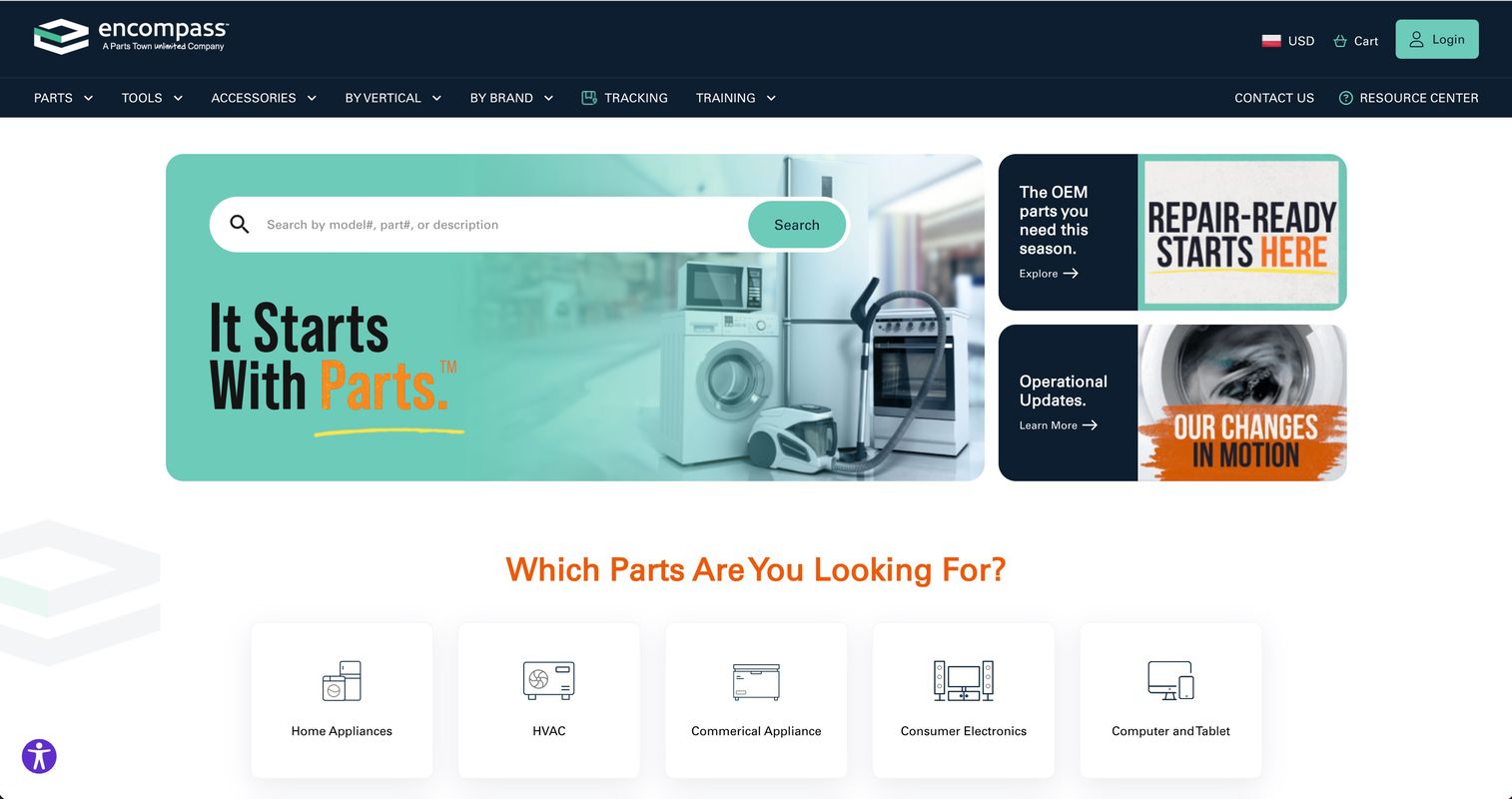
Encompass operates as a parts supply and supply-chain management platform, and it appears in this category for operations that run their meter parts, accessories, and replacement inventory through an account-based ordering portal. It is the supply layer behind a meter operation more than a field-reading tool. Teams use it to search millions of parts by part number or keyword, check availability and pricing, and track orders, returns, invoices, and billing statements in one account.
For a meter reading program, that matters when hardware logistics are part of the workflow. Stuck meters get replaced, submeters get added as tenants change, and accessories run out. Keeping parts sourcing, order tracking, and billing statements in a single account reduces the back-and-forth that slows repairs and, indirectly, delays the reads that depend on working hardware.
Best for: B2B buyers who manage OEM replacement parts and accessories alongside their metering operations.
Key strengths
- Deep parts search: Look up millions of parts by number or keyword to find the right meter component fast.
- Availability and pricing checks: Confirm stock and cost before ordering, so field repairs are not blocked by backorders.
- Order and billing tracking: Follow orders, returns, invoices, and billing statements from one account view.
Why choose Encompass: Choose Encompass when the hardware side of metering, parts, accessories, and replacements, is a real operational burden and you want ordering, returns, and billing consolidated. It is not a field-capture or MDM tool, so pair it with reading software that handles the data pipeline.
Encompass pricing: No public pricing page or visible price was found on Encompass's first-party site during this review. The site references wholesale pricing and account management, which points to account-based quoting rather than a published list price. Contact Encompass directly for an estimate tied to your account.
2. MyRead Pro app
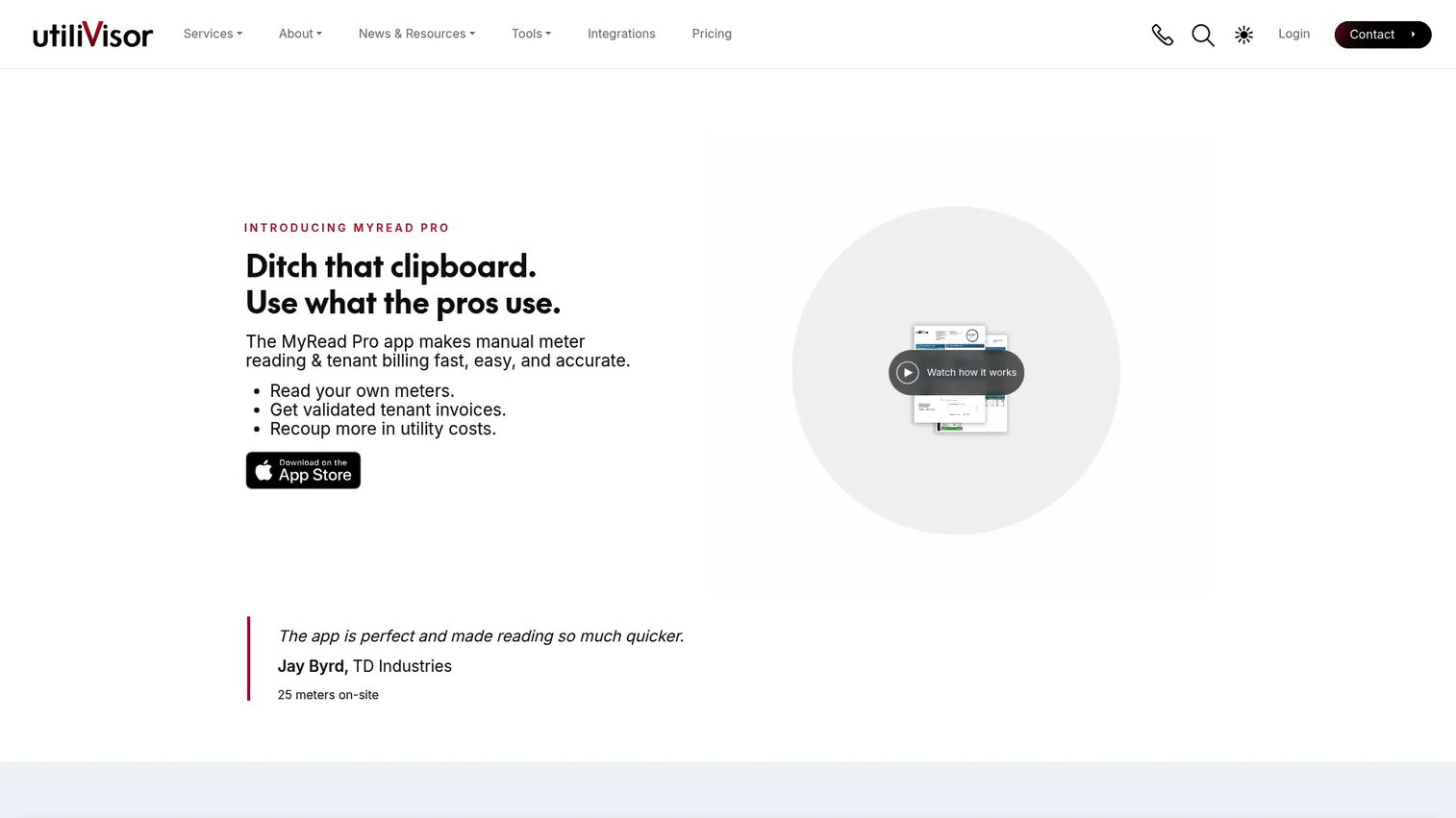
The MyRead Pro app is an iPhone app for manual meter reading paired with tenant billing support from utiliVisor. It targets commercial property teams that want to self-read meters in the field while outsourcing the billing math to an operations center. This hybrid, DIY-plus-managed model is the tool's whole point: your staff walks the meters, the app validates and flags problems, and the billing package comes back prepared.
The app captures reads with photo verification, so every value is backed by an image, and it raises real-time alerts when a reading is missing or looks inconsistent. That photo-based validation is what makes disputed reads defensible: you have a timestamped picture, not just a number. Prepared tenant billing packages then close the loop from field capture to invoice.
Best for: Commercial property teams that want to read their own meters but hand off tenant billing and reconciliation.
Key strengths
- Photo-verified reads: Every reading carries an image, giving you defensible proof against tenant disputes.
- Real-time alerts: The app flags missing or inconsistent values as they happen, before they reach billing.
- Prepared tenant billing: utiliVisor's operations support turns validated reads into ready-to-send billing packages.
Why choose MyRead Pro app: Choose it when you have field staff who can walk meters but no interest in owning the billing engine. The managed-service layer matters most for property teams without a dedicated utility billing function.
MyRead Pro app pricing: utiliVisor does not publish a numeric price. Its pricing page states that cost depends on the number of meters, tenants, and buildings involved, and asks prospects to contact them for an estimate. The company describes options for reading your own meters, hiring utiliVisor for manual reads, and networking smart meters, so scope drives the quote.
3. AutoRead® Software
AutoRead® Software from Xylem is utility meter-reading software built to manage AMR route data and move it into billing workflows. It sits squarely in the AMR software layer, acting as the bridge between meter-reading devices and billing systems. If your operation runs handheld reads or a Vehicle Gateway drive-by setup, AutoRead is designed to collect that data, prepare it, and hand it off cleanly.
Its interoperability is the selling point. AutoRead interfaces with FlexNet®, AMR, TouchRead®, and billing systems, uploads and prepares meter data from handheld or Vehicle Gateway base stations, and generates management and statistical reports. It also includes backup and restore, and it runs on Microsoft® Windows. For a utility that already owns Xylem or compatible meter hardware, that native compatibility removes a lot of integration guesswork.
Best for: Utilities that need a reliable bridge between AMR meter-reading devices and their billing systems.
Key strengths
- Broad device interoperability: Interfaces with FlexNet®, AMR, TouchRead®, and existing billing systems.
- Route data upload: Collects and prepares reads from handheld or Vehicle Gateway base stations.
- Operations reporting: Generates management and statistical reports for read completion and workflow visibility.
Why choose AutoRead® Software: Choose AutoRead when your meter fleet and billing stack already align with Xylem's ecosystem and you want route-to-billing data transfer without custom integration work. Confirm Windows deployment and your specific device compatibility during evaluation.
AutoRead® Software pricing: Xylem's AutoRead product page does not display a public price and uses a Request Proposal flow. Pricing is scoped to your deployment, so contact Xylem for a proposal based on your meter count and device mix.
4. SAP Cloud for Energy
SAP Cloud for Energy is SAP's cloud solution for managing energy and water meter data, including validation, anomaly detection, and billing integration. It positions itself as a broader utility data and energy management platform, which makes it a fit for teams that need meter data management inside a larger SAP-centric utility stack rather than a standalone reading tool.
The platform handles operational monitoring for metering data, supports customer case analyses to resolve data issues, and synchronizes device master data with SAP S/4HANA Utilities. That last point is the differentiator: if you already run SAP for utilities, keeping metering data in the same environment cuts the integration and reconciliation work between systems. Analytics, validation, and billing support come as part of that enterprise workflow fit.
Best for: Utilities organizations that need cloud-based energy and water meter data management inside an SAP environment.
Key strengths
- Operational monitoring: Continuous monitoring of metering data to surface issues early.
- Case-based issue resolution: Customer case analyses to investigate and fix data problems.
- S/4HANA synchronization: Device master data syncs with SAP S/4HANA Utilities for a unified stack.
Why choose SAP Cloud for Energy: Choose it when SAP is already your system of record and you want meter data validation, anomaly detection, and billing integration native to that environment. The value compounds when your billing and ERP already live in SAP.
SAP Cloud for Energy pricing: SAP's product page shows a subscription model and a 30-day basic trial at no cost, but it does not display a public starting price on the main product page. A "Plans and pricing" section exists without a visible numeric figure, so contact SAP for a quote scoped to your deployment.
5. Itron Enterprise Edition Meter Data Management
Itron Enterprise Edition is enterprise meter data management software for utilities handling meter, event, and sensor data at scale. This is the heavyweight of the list, built for a meter data management system role rather than field capture. It manages residential gas, water, and electric data, plus C&I and IoT sensor data, centralizing collection, processing, storage, and analysis of smart device data.
For large utility environments, its strength is validation, exception handling, and settlements at volume. Itron supports IEE Essentials and IEE MDM Settlements modules, which is what utilities need when reads number in the tens of millions and every one has to pass VEE before it feeds billing or wholesale settlement. This is where the 45-billion-reads-per-day scale of the MDM category lives. If your operation is utility-scale, this is the tier you are shopping in.
Best for: Utilities that need enterprise-scale meter data management and settlements support across multiple commodities.
Key strengths
- Multi-commodity data management: Handles residential gas, water, electric, C&I, and IoT sensor data in one platform.
- Centralized processing: Unifies collection, processing, storage, and analysis of smart device data.
- Settlements support: IEE Essentials and IEE MDM Settlements modules for wholesale and retail settlement.
Why choose Itron Enterprise Edition: Choose it when your meter volumes and regulatory reporting demand enterprise-grade VEE and settlements, and you have the implementation capacity to deploy an MDM platform. It carries a 5.0/5 rating on G2, though that reflects a single review.
Itron Enterprise Edition pricing: No public pricing is shown. The first-party product page directs prospects to Contact Sales, which is standard for enterprise MDM. Expect a scoped implementation quote tied to meter count, commodities, and settlement requirements.
6. Terranova Advanced Metering Management (TAMM)
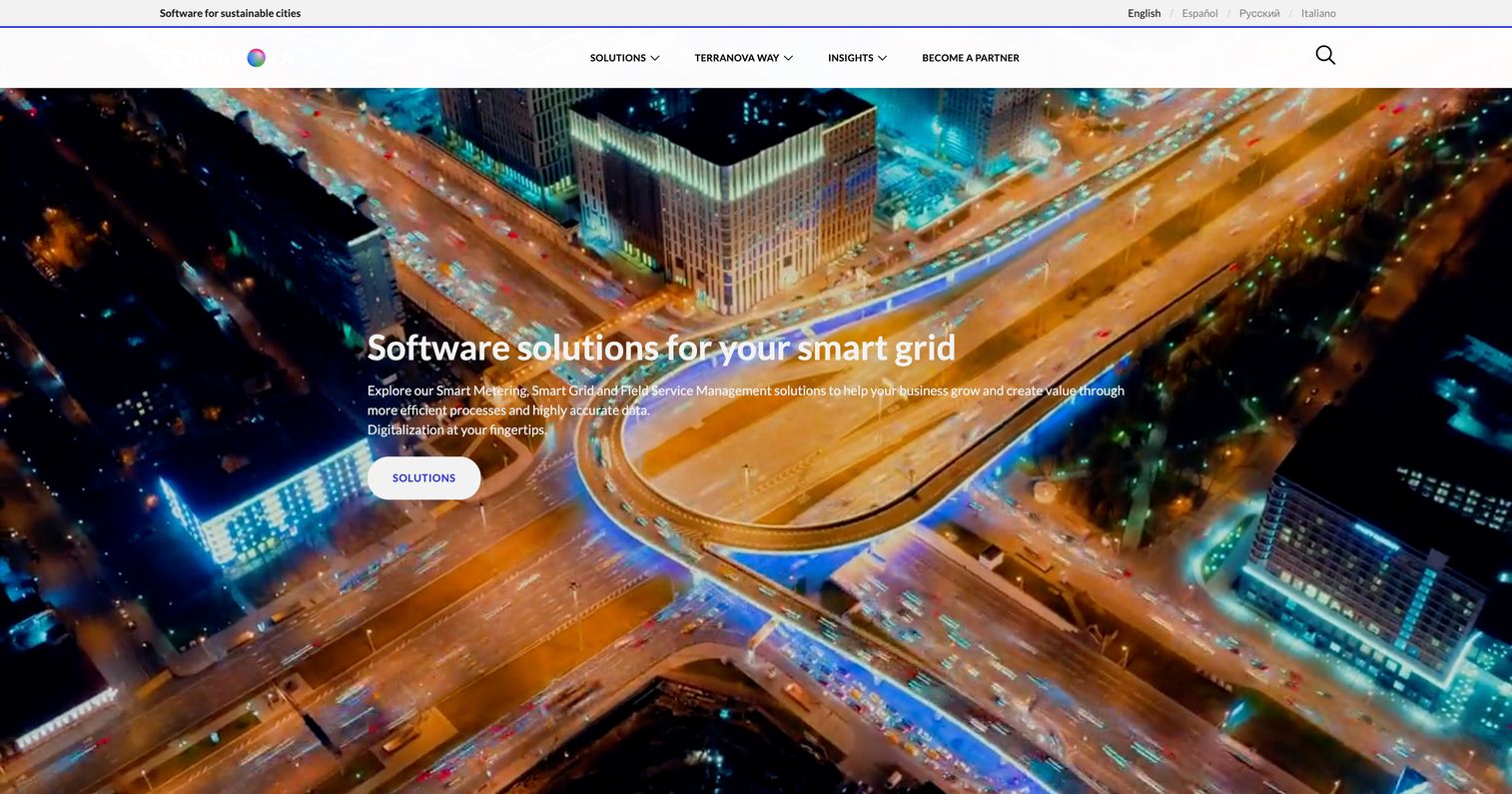
Terranova Advanced Metering Management, or TAMM, is a component of Terranova's utility metering software suite focused on managing meter data and metadata from AMR systems. It sits in the meter data management layer with an AMR and AMI orientation, supporting the collection, handling, and organization of reads within a broader metering workflow before they hand off to billing.
TAMM's role is meter data and metadata management and AMR data handling inside utility metering operations. For utilities running AMR or AMI infrastructure, that means a place to manage reads and their surrounding metadata rather than a general-purpose analytics tool. It is aimed at operations teams that need meter data management embedded in their metering workflow, from collection through cleansing to billing handoff.
Best for: Utilities that need meter data management within an established AMR or AMI workflow.
Key strengths
- Meter data and metadata management: Organizes both reads and the metadata that gives them context.
- AMR data handling: Built to process reads coming off AMR systems.
- Metering workflow support: Fits into an existing utility metering process rather than replacing it.
Why choose Terranova (TAMM): Choose it when you run AMR or AMI infrastructure and want a meter data management component that slots into that specific workflow. Buyers should validate current feature depth and integration fit directly with Terranova, since detailed first-party documentation was limited during this review.
Terranova (TAMM) pricing: No public pricing was verifiable from Terranova's own site during this review. Pricing for utility metering suites is typically quote-based and scoped to deployment, so contact the vendor for an estimate.
7. Energyworx Platform
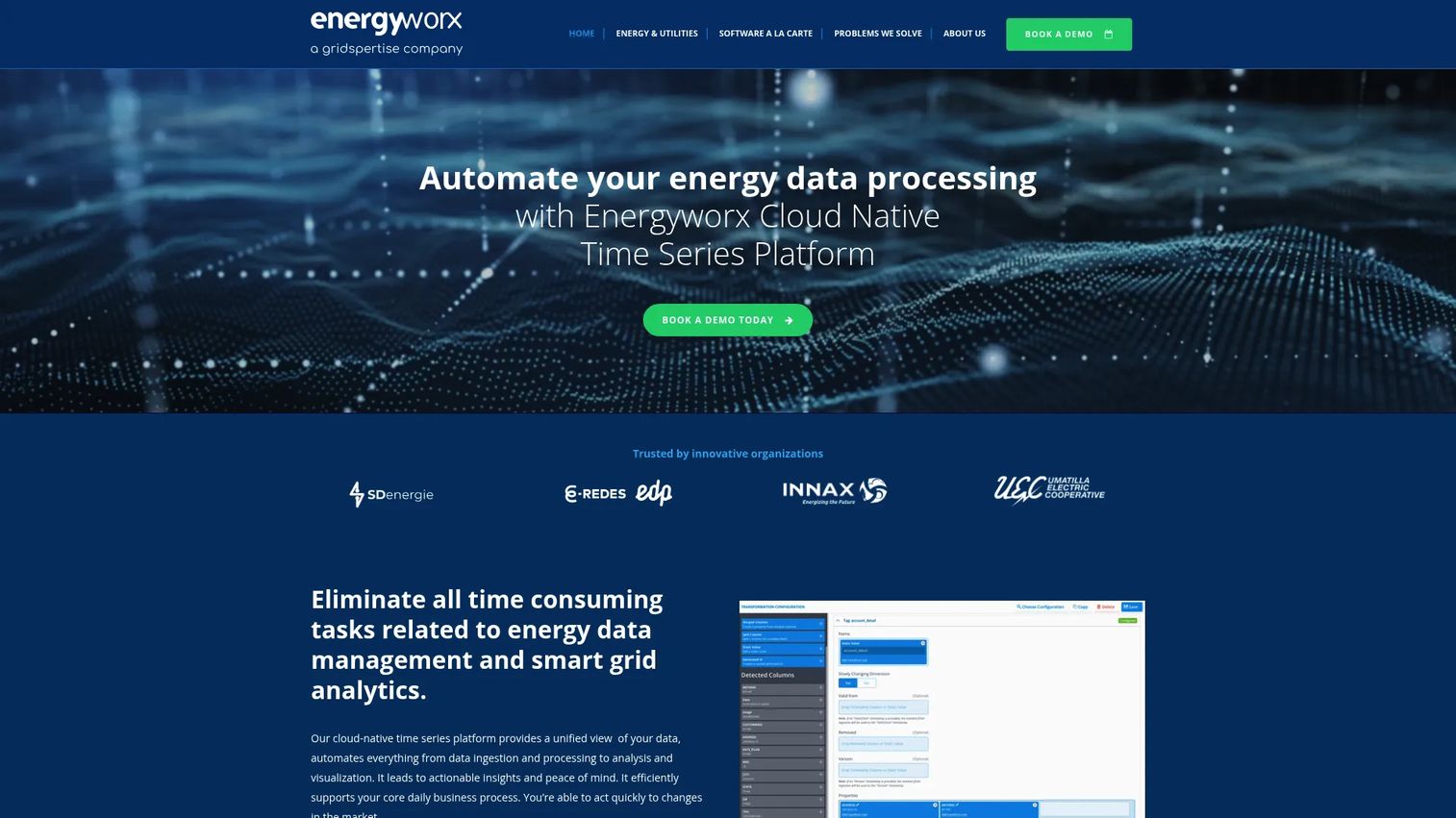
The Energyworx Platform is a cloud-native time series and energy data management platform for utilities. It is the most data-centric option on this list, leaning toward automated energy data processing, smart grid analytics, and operational visibility rather than field reading. Teams that want to go deep on the data layer, exception handling, and analytics choose it for that depth.
Its cloud-native time series foundation is built to ingest and process large volumes of interval and meter data, then apply analytics on top. Energyworx offers modular and preconfigured solutions, so utilities can adopt the pieces that match their maturity. For teams whose bottleneck is data processing and analytics rather than capture, this is the tier that addresses that specific problem.
Best for: Utilities that need automated energy data processing, grid analytics, and deep operational visibility.
Key strengths
- Cloud-native time series engine: Purpose-built to handle high-volume interval and meter data.
- Energy data management and analytics: Combines data management with smart grid analytics in one platform.
- Modular deployment: Preconfigured and modular solutions to match your data maturity.
Why choose Energyworx Platform: Choose it when your priority is a modern data-processing and analytics layer for meter and interval data, and you value cloud-native scalability. It fits teams treating meter data as an analytics asset, not just a billing input.
Energyworx Platform pricing: No public pricing page or visible price was found on the brand's site during this review; pricing appears to be quote-based. Contact Energyworx for a scoped estimate based on your data volumes and modules.
Considerations before you buy
Shortlist two or three tools, then pressure-test each against the criteria below before committing.
Billing workflow fit
Confirm whether the tool hands data directly to your billing system, prepares invoices, or only captures reads. A field-capture app and an MDM platform sit at opposite ends of the billing and invoicing workflows spectrum. Map exactly where the tool stops and where your billing engine picks up, so you do not discover a gap after go-live.
Deployment compatibility
Verify device, meter type, operating system, and integration requirements against what you actually own. AutoRead runs on Windows and favors Xylem-compatible devices. SAP Cloud for Energy assumes an SAP environment. Multi-utility support is only real if the tool reads your specific meter and protocol mix, so test it against your fleet.
Scale and reliability
Evaluate meter counts, multi-site support, and exception handling at volume. A tool that handles 200 meters cleanly can buckle at 20,000. Enterprise MDM platforms exist precisely because 98% of large utilities lean on automated VEE at scale, per Market Growth Reports. Match the tier to your real and projected volume.
Reporting and auditability
Look for reporting dashboards, export options, and a traceable read history. When a bill is disputed, you need to show exactly which read produced it and when. Photo-based validation and completion tracking turn a defensive scramble into a two-click answer.
Support and implementation model
Decide whether you need a self-serve app, a managed service, or enterprise onboarding. A property team may want MyRead Pro's managed billing. A large utility needs an MDM implementation partner. Matching the support model to your internal capacity prevents both under-resourced launches and paying for services you will not use.
Conclusion
Meter reading software spans a wide range, and the best pick is the one that matches your operational reality, not the longest feature list. For hardware and parts logistics, Encompass consolidates ordering and billing. For app-first field capture with managed tenant billing, MyRead Pro app fits commercial property teams. For moving AMR route data into billing, AutoRead® Software bridges devices and systems.
At the enterprise end, Itron Enterprise Edition and Terranova (TAMM) handle utility-scale meter data management, validation, and settlements, while SAP Cloud for Energy and the Energyworx Platform suit teams managing meter data inside a larger cloud stack with deep analytics.
Your next step is concrete: shortlist two or three tools that match your tier, then validate deployment compatibility against your current meters and billing systems before you sign anything. Test the read-to-invoice path end to end, not just the capture screen. That is where the operational cost and the payoff actually live.
FAQs
Meter reading software captures readings from meters, validates them for errors, and transfers clean data into billing and reporting systems. It replaces manual reads and spreadsheet handoffs with a structured pipeline. The goal is accurate, billable data with a traceable history from the field to the invoice.
They overlap but are not identical. Field-capture and AMR tools focus on collecting reads and moving them to billing. A meter data management system, or MDM, sits deeper in the stack, storing and validating huge read volumes and feeding settlements. Large utilities usually run both layers together.
It depends on the vendor and deployment model. App-based tools like MyRead Pro can run on an iPhone with no new fixed hardware. AMR software assumes compatible meter-reading devices, and enterprise MDM platforms integrate with existing AMI infrastructure. Always confirm compatibility with your current meters before buying.
Yes. Some tools, like MyRead Pro app, pair field capture with prepared tenant billing packages, so validated reads turn directly into invoices. Others hand data to a separate utility billing software or ERP. Confirm whether the tool prepares invoices itself or only feeds a downstream billing engine.
Prioritize compatibility with your meters and protocols, reporting depth, scale and exception handling at your projected meter count, and billing integration. Also weigh the support model: self-serve app, managed service, or enterprise onboarding. Test the full read-to-invoice workflow, not just data collection and upload.
Some vendors position free entry points or free trials, such as SAP Cloud for Energy's 30-day basic trial. Free meter reading software is more common at the entry or app tier than at the enterprise MDM tier. Verify current free-tier limits directly with each vendor, since terms change.
Automatic meter reading, or AMR, collects reads automatically from devices such as drive-by base stations or fixed networks, reducing manual field visits. Meter reading apps assist a human who walks the route and records reads, often with photo validation. AMR software scales for utilities; apps suit smaller or mixed-meter property portfolios.
Centralized reporting dashboards, real-time alerts for missing or inconsistent reads, and billing consistency across sites matter most. You want one workflow and one exception queue spanning every property, not separate processes per building. Photo-based validation and a traceable read history also make cross-site disputes far easier to resolve.