Last updated: October 2026
Your finance lead has one spreadsheet for USD revenue, another for EUR vendor bills, a bank portal for conversions, and no shared answer to "what happens if the pound moves five percent this quarter?" Add a third entity, a fourth currency, and a new market, and the spreadsheet breaks before the question does.
Global FX markets processed $9.5 trillion in average daily turnover in April 2025, a 27% increase from 2022, according to the Bank for International Settlements (BIS, 2025). The volume tells you how fast cross-border commerce is moving. The question for a Series B operator is simpler: How do you manage currency conversion costs, international payments, exposure, and reporting without stitching together five disconnected systems?
That is what foreign exchange software is for. The category spans exchange operations, corporate payments, treasury, and FX risk management, and the tools that belong to each are genuinely different. Choosing the wrong one means adding infrastructure you cannot use, or missing the controls you actually need.
The hidden cost is not only the exchange rate. It is the time spent reconciling decisions across disconnected systems.
What's inside
This guide covers seven foreign exchange software tools for 2026, selected across distinct FX operating models.
- Who it is for: SaaS founders, finance leaders, treasury teams, money service businesses, and FX desks
- Selection criteria: FX workflow depth, payment reach, risk visibility, accounting fit, and compliance controls
- What you will find: A side-by-side comparison table, per-tool profiles, and a buyer checklist to avoid category mistakes
- How tools were chosen: Each covers a different part of the FX stack; no two are direct substitutes
TL;DR
- Best for money exchange operations: CurrencyXchanger handles multi-currency POS, cash management, and compliance workflows for retail exchange businesses
- Best for front-to-back FX dealing: Datasoft FxOffice covers pricing, RFQs, exposure, and settlement for FX desks and corporate FX providers
- Best for market data and FX trading: OANDA gives finance teams access to rate data, charts, and multi-platform trading
- Best for corporate cross-border payments: iBanFirst and Airwallex both serve international payment needs, with iBanFirst leaning toward European corridors and Airwallex offering broader global infrastructure
- Best for FX risk visibility: HedgeFlows surfaces currency exposure and hedging recommendations for SMEs managing international cash
- Best for foreign currency cash services: CEIFX handles ordering, inventory, and pricing for banks and credit unions
What is foreign exchange software?
Foreign exchange software is a system that helps businesses, financial institutions, and currency exchange operators manage currency conversion, multi-currency transactions, exchange rates, FX exposure, payments, trading workflows, and related reporting.
The term covers several different operating models, and the features that matter shift substantially depending on which one applies to your business.
Core functions of foreign exchange software
- Live and quoted exchange rates, including spread and margin controls
- Multi-currency payment processing and local payment rails
- Foreign currency balances, cash inventory, and reconciliation
- Exposure tracking and hedging workflows
- Trade, quote, and settlement management
- KYC, AML, and transaction monitoring where regulations apply
- Reporting, audit logs, approval controls, and accounting exports
Main categories buyers confuse
| Category | Primary job | Typical buyer |
|---|---|---|
| Currency exchange operations | Run retail or wholesale exchange workflows | MSBs, branches, travel exchange desks |
| FX dealing software | Price, execute, and manage trades | Brokers, banks, dealing desks |
| Treasury and FX risk software | Monitor and manage currency exposure | CFOs, treasury, finance teams |
| Cross-border payment software | Send, receive, and hold global funds | Global operating companies |
| Currency data and trading platform | Access rates, markets, and execution tools | Traders, finance teams |
A cross-border payment platform does not replace a dealing desk system. A currency exchange POS product does not replace corporate treasury visibility. Start by identifying which workflow creates the most operational friction, then match to the category that solves it.
When to use foreign exchange software
Centralize international collections and payments
Your finance team is spending hours each month converting inbound revenue, paying overseas suppliers, and reconciling bank portal exports that do not match the general ledger. The pain here is operational: Too many steps, too much manual work, too little visibility across currency balances and payment status. Evaluate tools on local payment rails, approval workflows, supported currencies, and how cleanly they export to your accounting stack.
Monitor FX exposure before it becomes a forecast miss
Exchange rate movements start showing up in gross margin, cash forecasts, or contracted supplier spend, and the board wants an answer on FX impact that the finance team cannot produce from a spreadsheet. This is a risk and visibility problem, not a payments problem. Forecast inputs, exposure reporting by currency and entity, hedge workflows, and alerting are the evaluation priorities.
Run regulated or high-volume currency operations
A money service business, broker, or exchange desk needs repeatable controls across customers, quotes, transactions, cash positions, and compliance records. KYC, AML workflows, audit trails, rate controls, transaction monitoring, and settlement are the criteria here. Generic payment tools do not cover this; specialist exchange operation platforms do.
Foreign exchange software comparison
These products sit in adjacent FX categories. Compare them by the workflow that creates the most cost or risk in your business, not by feature count.
| # | Product | Best for | Key differentiator | Pricing | G2 rating |
|---|---|---|---|---|---|
| 1 | CurrencyXchanger | Money exchange businesses and branch operations | Multi-currency POS, cash control, and compliance | Contact for pricing | 4.8/5 |
| 2 | Datasoft FxOffice | FX dealing desks and corporate FX operators | Front, middle, and back office FX dealing workflows | Contact for pricing | Not listed on G2 |
| 3 | OANDA | Market data, FX trading, and currency conversion | Rate data API plus multi-platform trading | API plans from $450/month | 4.3/5 |
| 4 | iBanFirst | Corporate cross-border payments and FX execution | Multi-currency business payments and FX services | Custom pricing, free account opening | Not listed on G2 |
| 5 | Airwallex | SaaS finance teams managing global payments | Multi-currency accounts, cards, payments, and APIs | Free Explore plan; Grow from $12/user/month | 4.1/5 |
| 6 | HedgeFlows | SMEs managing currency exposure | FX risk visibility and hedging with accounting integrations | Starter from £99/month | 5.0/5 |
| 7 | CEIFX | Foreign currency cash services and financial institutions | Foreign currency ordering, inventory, and pricing | Contact for pricing | Not listed on G2 |
Pricing and ratings verified October 2026 from each vendor's pricing page and G2 listing.
Best 7 foreign exchange software tools for 2026
1. CurrencyXchanger
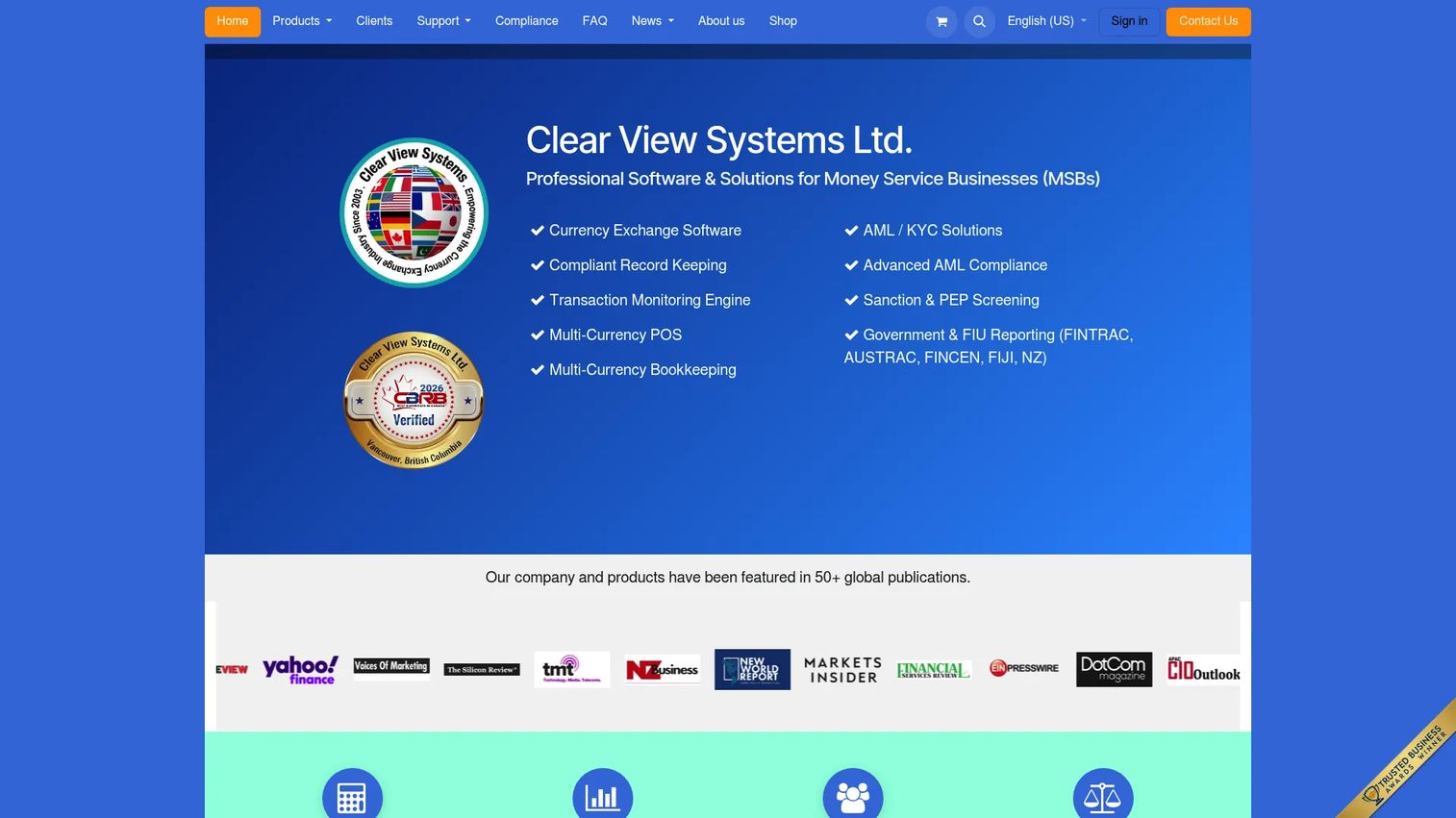
CurrencyXchanger is a specialist operations platform for retail and wholesale currency exchange businesses. It covers multi-currency point-of-sale workflows, rate and spread management, cash and denomination tracking, customer records, and compliance-adjacent features including KYC and AML workflow support. The product is built around the physical and operational realities of running an exchange desk or branch network, not around a corporate treasury or online payment model.
Best for: Money service businesses, multi-branch exchange operators, and travel currency providers that need transaction and cash controls as their core workflow.
Key features
- Multi-currency point-of-sale transaction management
- Rate board and spread management tools
- Cash inventory and denomination tracking
- Customer records with full transaction history
- KYC and AML workflow support
Why choose CurrencyXchanger: This is the right tool when running a regulated currency exchange operation is the core business, not a side function. It is not the right call for a SaaS company that needs international vendor payments or FX exposure reporting without a physical exchange operation.
CurrencyXchanger pricing: CurrencyXchanger uses a quote-based model. Contact the vendor for current package pricing based on branch count and transaction volume.
G2 rates CurrencyXchanger at 4.8/5 based on 13 reviews, making it one of the stronger-rated products in the MSB software space.
2. Datasoft FxOffice
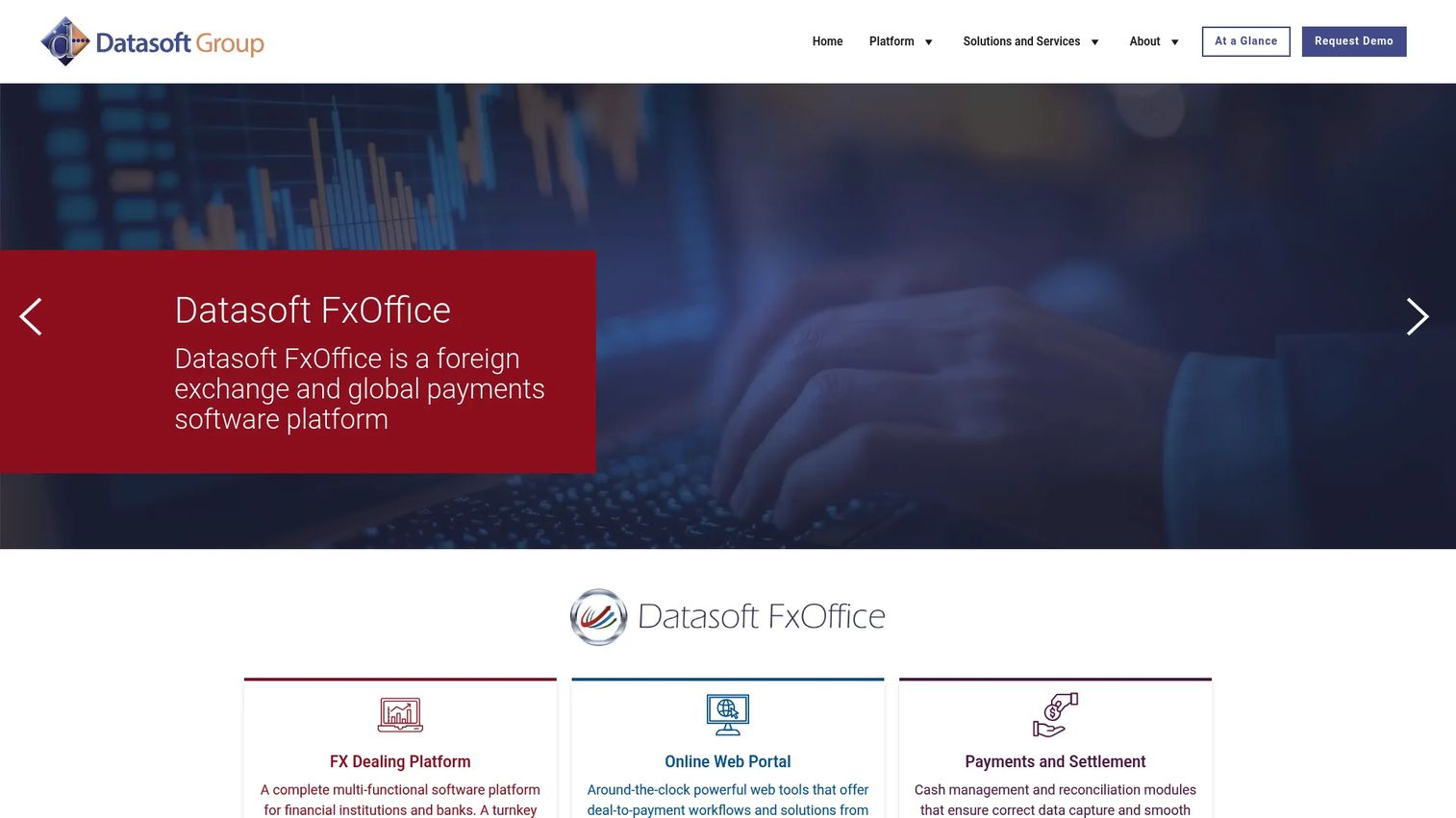
Datasoft FxOffice is a foreign exchange and global payments platform that integrates FX dealing, treasury, compliance, payments, accounting, and financial workflows into one system. It covers pre- and post-trade processing for spot, swaps, forwards, options, and market orders. Real-time exposure, position, P&L, cash-flow, blotter, and ladder monitoring give dealing desks the visibility they need across a live book.
Best for: Banks, money service businesses, FX brokers, fintechs, and corporate FX operators that need integrated front, middle, and back office workflows.
Key features
- Pre- and post-trade processing: Spot, swaps, forwards, and options
- Live FX pricing with customizable spread templates and manual RFQ pricing
- Real-time FX exposure, position, P&L, and cash-flow monitoring
- Liquidity provider and ECN connectivity
- Credit, collateral, and limit controls
Why choose Datasoft FxOffice: Shortlist this when pricing, risk, settlement, and client workflows all need to live in one operating system, and your organization runs an FX desk or builds a financial product around currency execution. It is not the right fit for a SaaS company managing routine accounts payable in multiple currencies.
Datasoft FxOffice pricing: Both SaaS and perpetual licensing models are available. Contact Datasoft directly for pricing based on deployment model, module scope, and organization size.
Datasoft FxOffice does not currently have a G2 rating with sufficient reviews to report a score. Check the G2 listing directly for any recent activity.
3. OANDA
!OANDA FX trading and currency conversion platform
OANDA is a broad FX platform spanning online forex and cryptocurrency trading, currency conversion, foreign-exchange data, and business FX services. Trading spans more than 68 major and minor currency pairs across web, mobile, TradingView, and MetaTrader 4 platforms. The FX data API provides historical and real-time exchange rate data for teams that need rate feeds, conversion calculations, or market analysis in their products and workflows.
Best for: Businesses needing foreign-exchange rate data, and traders or finance teams seeking multi-platform forex and crypto trading access.
Key features
- Trading across 68+ currency pairs on web and mobile platforms
- TradingView and MetaTrader 4 platform access
- Advanced charting, technical indicators, and risk-management orders
- Foreign-exchange rates API with historical and real-time data
- Multi-currency market coverage
Why choose OANDA: OANDA fits when the finance or product team needs market data infrastructure, trading access, or a rate API alongside conversion tools. It is not a substitute for a full MSB platform or a corporate accounts payable and cash reconciliation stack.
OANDA pricing: The foreign-exchange data API offers four plans: Lite at $450/month, Premium at $840/month, Premium Plus at $1,160/month, and Premium + Crypto at $1,680/month. Retail trading costs are spread-, commission-, and volume-based rather than a flat subscription fee. Verify current spreads and account terms on OANDA's pricing page by region.
G2 rates OANDA at 4.3/5. Check the live listing for the current review count.
4. iBanFirst
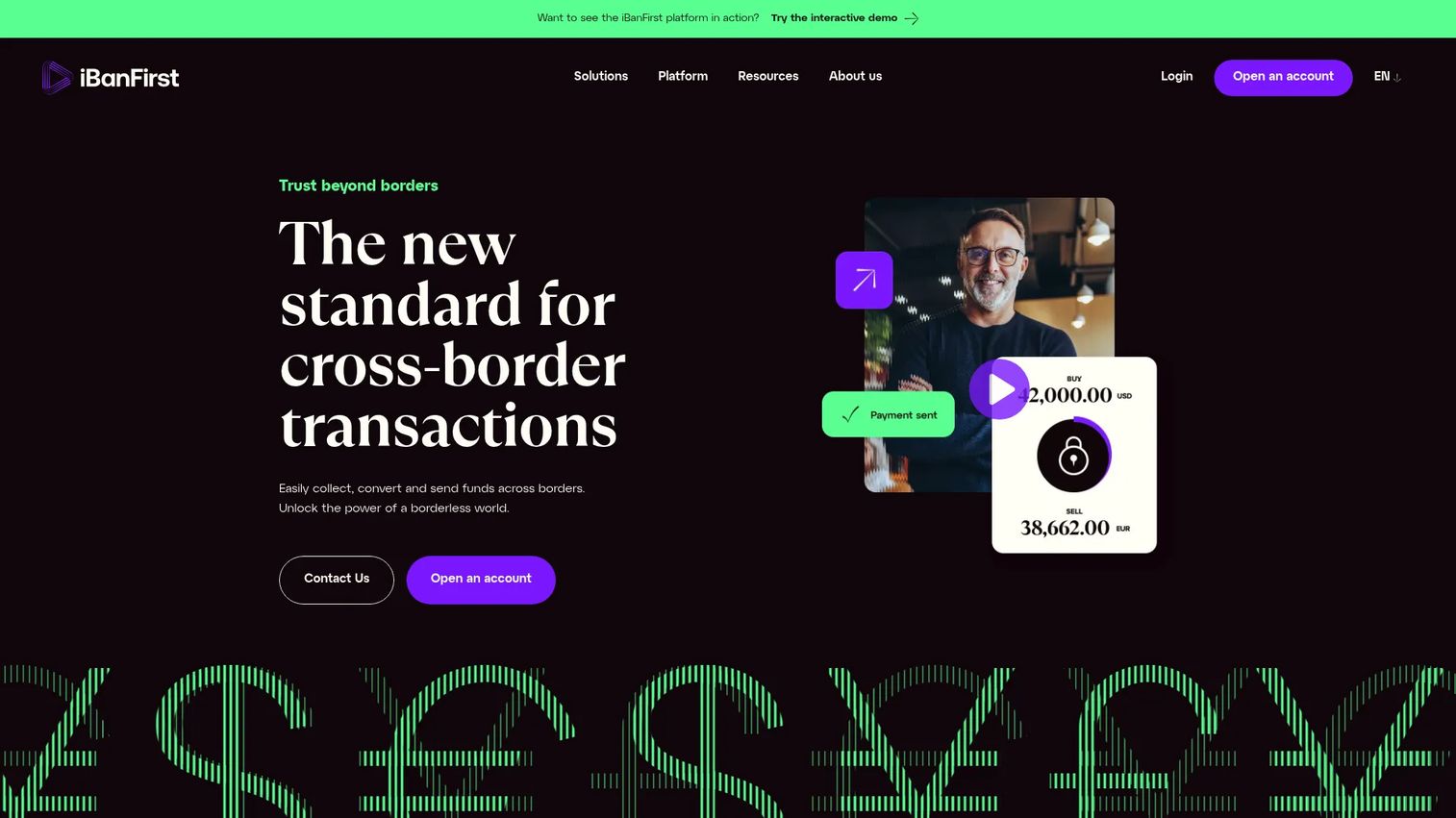
iBanFirst is a business platform for cross-border payments, multi-currency accounts, currency conversion, and foreign-exchange risk management. It focuses on the operational pain that mid-market companies feel when foreign suppliers, overseas entities, and material international payment volume outgrow a bank portal and a spreadsheet. The platform includes real-time FX rates, forward payment contracts, and user-level approval rules and payment thresholds that give finance teams practical controls without engineering overhead.
Best for: Mid-market companies with foreign suppliers, overseas entities, or consistent international payment volume, particularly across European corridors.
Key features
- Multi-currency accounts with cross-border payment support
- Real-time FX rates, alerts, and forward contracts
- Payment tracking and configurable approval rules
- User permissions and payment thresholds by role
- API and accounting software integrations
Why choose iBanFirst: This fits a finance team that needs a business payment layer with FX execution and approval controls. It is a different category from a specialized trading desk platform and from physical cash exchange operations. If European payment corridors are a priority and the main problem is international payables creating finance overhead, iBanFirst earns a close look.
iBanFirst pricing: Account opening and maintenance are listed as free in iBanFirst's official fee documentation. Payment fees and FX pricing vary by payment corridor, currency pair, and business volume. Contact iBanFirst for a current fee schedule specific to your payment flows.
5. Airwallex
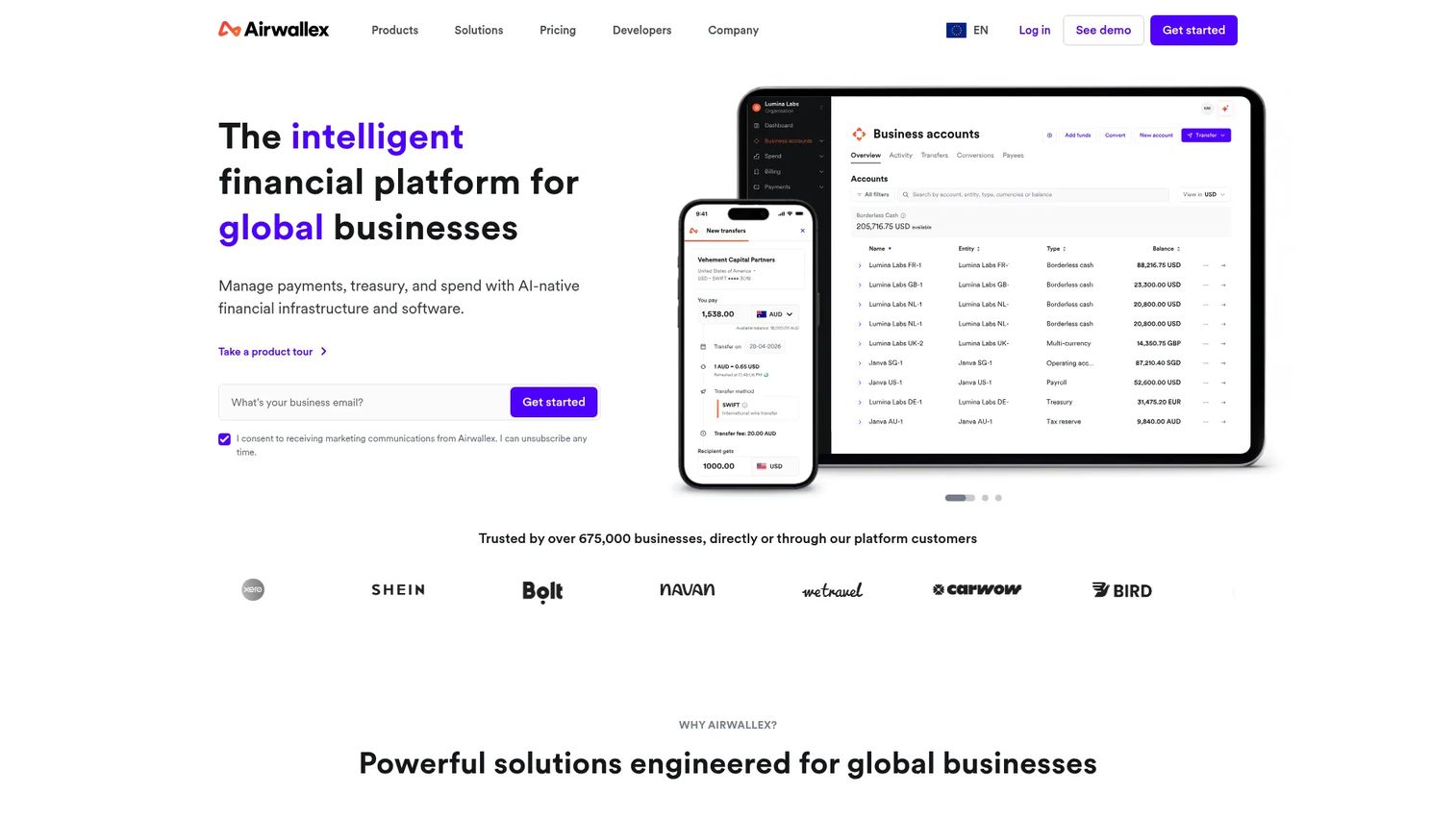
Airwallex is a global financial platform that combines multi-currency business accounts, cross-border payments, corporate cards, expense management, bill pay, and embedded finance APIs. For a scaling SaaS company, it is closer to operating infrastructure than a trading or exchange platform. Finance teams can hold balances in multiple currencies, pay out through local payment methods, issue cards with spend controls, and connect the whole stack through APIs to existing accounting and ERP workflows.
Best for: SaaS founders and finance teams operating across countries who want payment, account, card, and FX infrastructure in one product family.
Key features
- Multi-currency business accounts and wallets
- Cross-border payments with local payment method support
- Corporate cards and expense management
- Bill pay and global payout workflows
- Payment APIs and integrations with accounting tools
Why choose Airwallex: The key evaluation question is whether it covers the countries, entities, currencies, and accounting integrations your company already runs. For a Series B company adding entities and currencies quickly, Airwallex reduces fragmentation across global payments, currency balances, and spend controls. It is not a hedging or exposure monitoring tool; teams with material FX risk need a separate product for that.
Airwallex pricing: The Explore plan is free. Grow is $12 per user per month plus a platform fee based on team size. Accelerate is custom pricing for enterprise needs. Transaction fees, FX markups, and card fees apply separately. Verify current rates on the Airwallex pricing page for your region.
G2 rates Airwallex at 4.1/5.
6. HedgeFlows
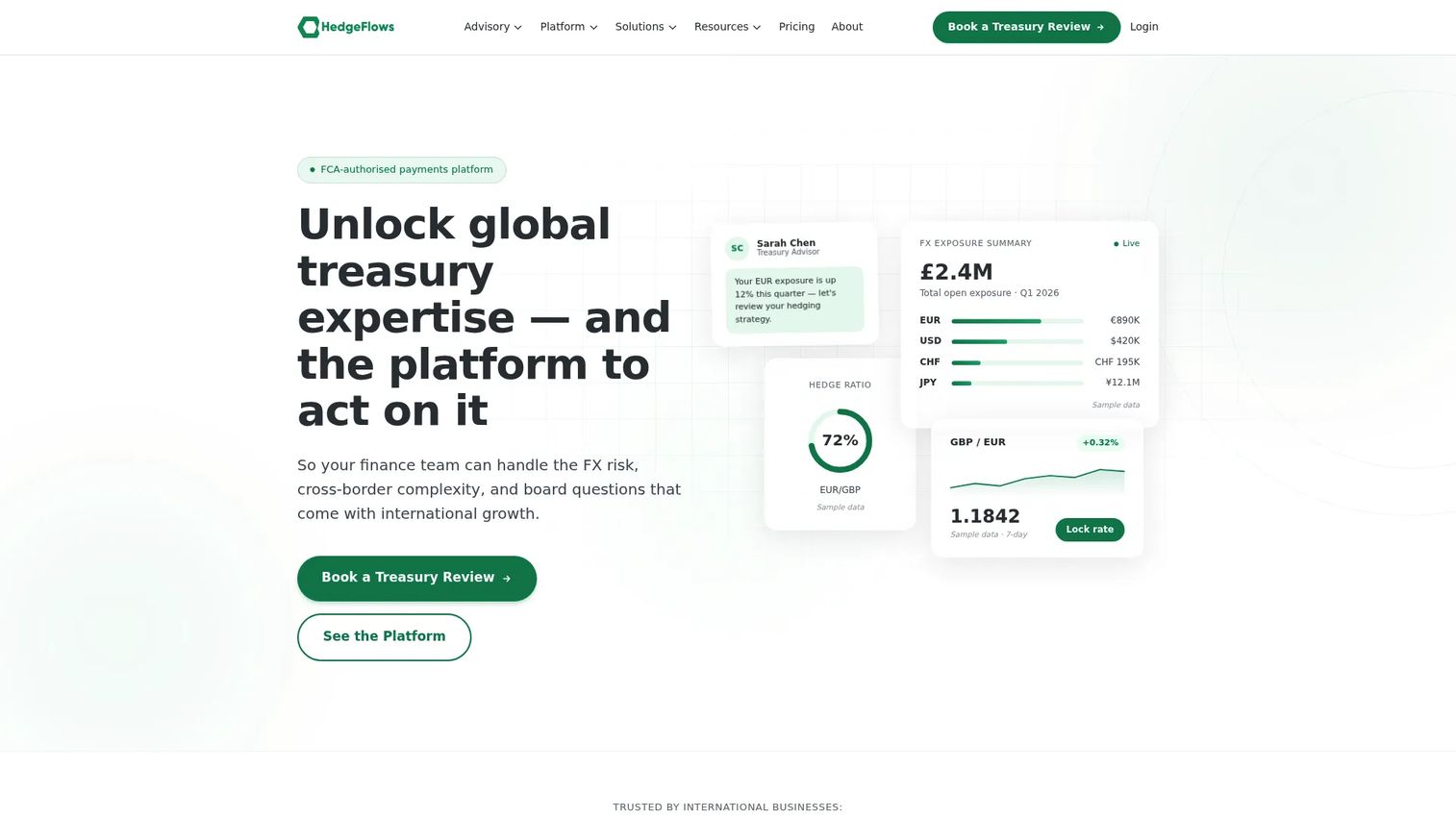
HedgeFlows is a treasury advisory and technology platform for businesses managing international payments, cash, and FX risk. Where payment tools handle execution, HedgeFlows handles the question before the execution: What is your currency exposure, how does it affect your forecast, and what should you do about it. The platform connects to accounting and ERP systems including Xero, NetSuite, QuickBooks, and Business Central, giving finance leaders a cash and exposure view that does not require a separate treasury team to maintain.
Best for: Finance leaders and operators at internationally active SMEs who need structured FX risk visibility, hedging support, and accounting connectivity.
Key features
- Real-time cash management across accounts, entities, and currencies
- FX exposure monitoring with AI-powered hedging recommendations
- Multi-currency payments and collections
- Accounting and ERP integrations: Xero, NetSuite, QuickBooks, Business Central
- Cashflow planning and error and fraud detection on Scaler and above
Why choose HedgeFlows: Payment tools tell you what you spent. HedgeFlows tells you what you are exposed to and what to do about it. This category earns its place on the shortlist when FX starts affecting board reporting, gross margin, or cash forecasts. It may be unnecessary before international revenue or foreign currency liabilities become material enough to move the numbers.
HedgeFlows pricing: The Starter plan is £99/month (or £950/year) and includes a global payment account, multi-currency payment automation, and 100 local payments included free. Scaler is £499/month (or £4,800/year) and adds multi-entity capability, a risk management co-pilot, cashflow planning, and API access. Enterprise pricing is custom and includes a treasury management system, custom ERP integrations, and hedge accounting.
G2 rates HedgeFlows at 5.0/5, currently from one review. Cross-check the live G2 listing for updated review volume.
7. CEIFX
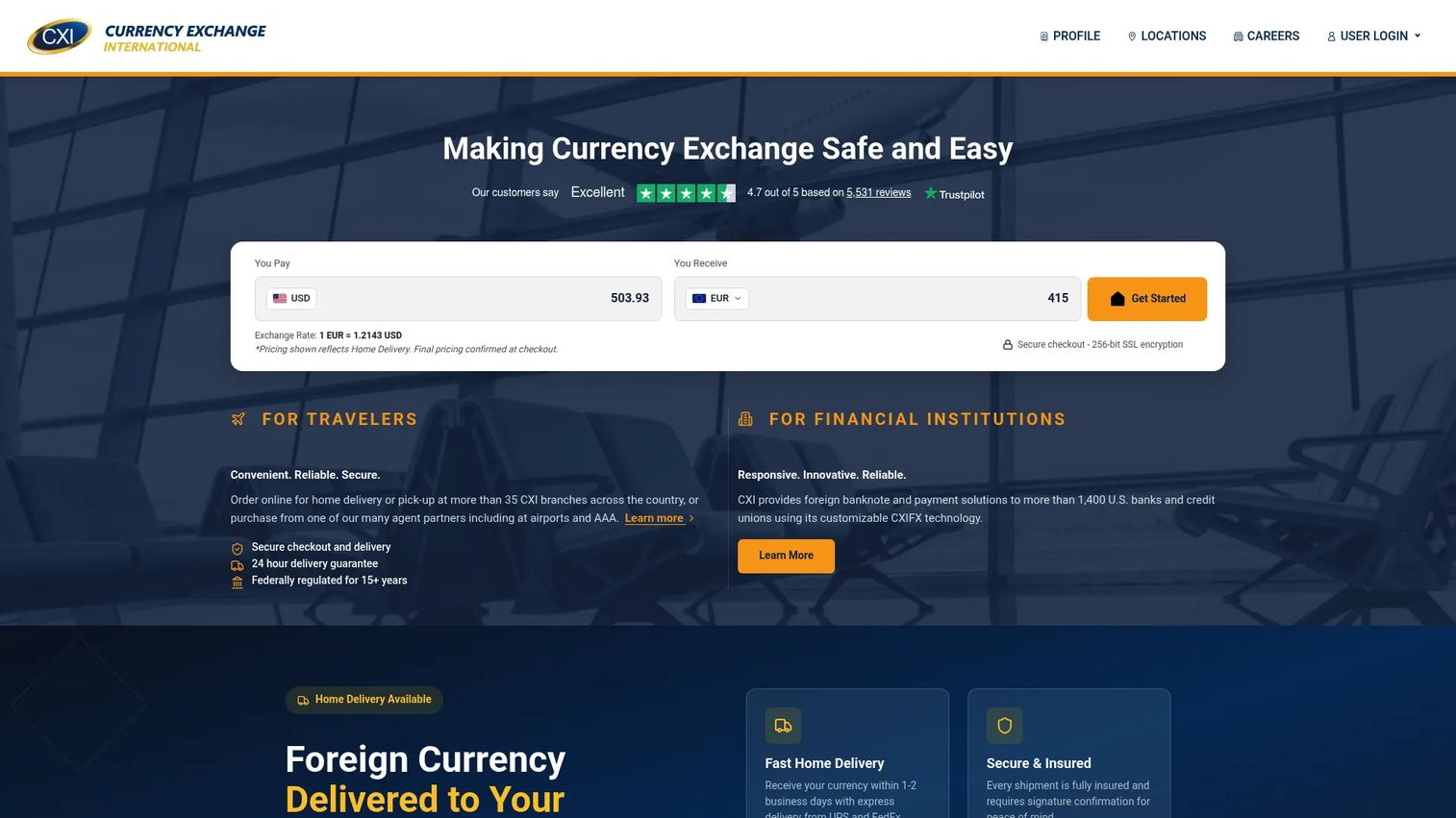
CEIFX is a web-based foreign currency exchange and international payments platform built for financial institutions. Banks, credit unions, and travel money providers use it to manage foreign currency ordering, inventory controls, customer pricing workflows, and reporting. The platform includes compliance verification, risk-management tools, automated transaction processing with real-time tracking, and white-label customization with user management, permissions, and API integrations.
Best for: Banks, credit unions, and financial institutions managing physical foreign currency workflows, ordering, and inventory.
Key features
- Foreign currency order management and inventory controls
- Customer pricing workflows and rate management
- Compliance verification and risk-management tools
- Automated transaction processing with real-time tracking
- White-label customization with user management and API integrations
Why choose CEIFX: This targets a specific operational model: Physical foreign cash services at a financial institution. It is distinct from international business payments, corporate treasury, and online FX trading platforms. A fintech building foreign currency cash services, or a credit union managing traveler currency orders, will find features that general-purpose payment tools do not cover.
CEIFX pricing: CEIFX does not display a standard subscription price. Reach out to the vendor for pricing based on institution size, branch count, and transaction volume.
Considerations when choosing foreign exchange software
Start with the operating model
Decide whether you need to run an FX desk, send international payments, manage foreign cash, or monitor currency risk. These are separate categories with limited overlap, and buying the wrong one means paying for features you cannot use. A SaaS company with international payables does not need branch POS or dealing desk capabilities.
Map the data flow into accounting
Ask how each product exports transactions, exchange rates, fees, settlement records, and revaluation data. Finance teams need a reconciliation path into the general ledger. If the export requires a manual CSV review every month, factor that operational burden into the total cost of the tool.
Test rate transparency and total cost
Subscription fees are only part of the picture. Evaluate spreads, payment corridor fees, account charges, trading commissions, minimum commitments, and implementation costs together. A low platform fee can still be expensive if the FX spread or transaction fee structure is unfavorable for your payment volumes.
Check controls before scale exposes the gap
Evaluate approval policies, user permissions, audit logs, and KYC or AML support where relevant. A founder should confirm that controls fit the company's risk profile before international volume rises enough to create compliance exposure or fraud risk.
Measure reporting usefulness
The right tool should help your finance team answer concrete questions: Current exposure, cash by currency, pending payments, realized FX costs, and forecast impact. If the reporting forces a manual export into another spreadsheet, that is infrastructure friction, not infrastructure.
Conclusion
The tools in this guide cover different parts of the FX stack, and the right choice starts with operating model clarity.
CurrencyXchanger fits money exchange operators managing branch-level cash and compliance. Datasoft FxOffice suits dealing desks and organizations whose product revolves around FX execution. OANDA serves teams that need market data, rate feeds, or trading access. iBanFirst handles corporate cross-border payments with a strong European focus. Airwallex works for scaling SaaS companies that want payment, account, card, and FX infrastructure under one roof. HedgeFlows belongs on the shortlist when currency exposure starts affecting your margin or cash forecast. CEIFX is purpose-built for banks and credit unions managing physical foreign currency services.
Start by mapping the financial workflow that creates the most friction today. If the pain is payments, evaluate payment platforms. If it is risk, look at exposure tools. If you run an exchange operation, prioritize transaction controls, compliance, and rate management.
Start your journey with Guideflow today!
FAQs
Foreign exchange software is a system used to manage currency conversion, exchange rates, foreign currency transactions, international payments, FX risk exposure, trading workflows, and related reporting. Features vary substantially depending on the buyer's operating model: A retail exchange business, a corporate treasury team, and an FX broker all need different capabilities from the same category label.
International payment software focuses on sending, receiving, and holding money across currencies, with an emphasis on payment rails, multi-currency accounts, and accounting exports. Foreign exchange software can include that function but may also cover trade pricing, rate setting, risk monitoring, hedging, exchange operations, and compliance workflows. Many cross-border payment tools handle the transaction layer; FX risk and dealing platforms go deeper into exposure and execution.
Focus on multi-currency accounts, payment corridors by country, accounting integrations, approval controls, FX fee visibility by transaction type, entity support, and reporting on cash and exposure. A SaaS company at Series B typically does not need branch POS or dealing desk capabilities. The evaluation should center on whether the tool covers the currencies and entities you operate in, and whether it exports cleanly to your existing accounting stack.
FX risk management software becomes useful when foreign currency revenue, supplier costs, debt, or payroll create material exposure that affects margin or cash planning. Early-stage companies often start with a payment tool to handle transactions and add dedicated risk management once international exposure becomes large enough to show up in board forecasts or gross margin discussions.
Yes, where it provides transaction records, exchange rates, fees, settlement data, and exports to accounting systems. The specific capability varies by product. Buyers should confirm how the tool handles realized and unrealized FX gains or losses, and whether the export format is compatible with their general ledger before committing. Some products offer direct accounting integrations; others export CSVs that require manual mapping.
Some exchange operation platforms include KYC, AML, sanctions screening, and transaction monitoring workflows as core features. These are typically present in products designed for money service businesses and financial institutions. Corporate payment and treasury tools may offer different controls focused on approval rules and user permissions rather than customer due diligence. Validate the specific compliance features against the regulations and internal policies that apply to your business before selecting a platform.
The right fit for international payments depends on the payment corridors you need, the number of entities and currencies you manage, your monthly payment volume, approval workflow requirements, and accounting integration needs. Cross-border payment platforms like Airwallex and iBanFirst are built specifically for this job. Trading or exchange operation platforms are not the right starting point when payment execution is the primary need.
Compare the full cost stack: Subscription fees, exchange rate spreads on each transaction, payment corridor fees, account maintenance charges, trading commissions where applicable, implementation costs, and minimum contract commitments. A low platform fee can still be expensive if the spread or per-transaction fee structure is unfavorable for your payment volumes. Ask each vendor for a cost estimate based on your actual transaction mix before drawing a comparison.