You can describe a marketplace in one sentence. Operating one is where things break.
The vendor onboarding queue fills up. Commission splits don't match what you promised sellers. Payouts require manual intervention every month. Catalog permissions are either too open or too locked down. And the integration your ops team assumed existed doesn't.
Online marketplaces generated $3.832 trillion in GMV in 2024, and 83.4% of global ecommerce revenue in 2025 is projected to come from third-party marketplaces, according to ECDB (2026). The opportunity is real. The operational complexity is equally real.
This guide is a shortlist for product and operations teams evaluating multi vendor ecommerce platforms in 2026. Every platform here was assessed on vendor management depth, monetization flexibility, integration maturity, scalability path, and realistic launch effort, not just feature count.
What's inside
This guide covers 8 multi vendor marketplace platforms evaluated for operator control, launch speed, commission handling, and total cost of ownership.
- Who it's for: Product managers, marketplace operators, and founders deciding on ecommerce marketplace software
- Selection criteria: Vendor management depth, commission and payout architecture, integration maturity, scalability, and maintainability across release cycles
- What you'll get: A comparison table, per-platform breakdowns, a buyer checklist, and FAQs
TL;DR
- Best for full operator control: CS-Cart Multi-Vendor gives self-hosted teams the most control over vendor permissions, storefronts, and commission logic
- Best for enterprise scale: Mirakl fits large retailers and B2B programs that need governance and vendor onboarding at volume
- Best for fast marketplace launch: Sharetribe gets a marketplace live without engineering, then extends with code when you're ready
- Best for existing Shopify stores: Shopify with marketplace apps is the lowest-friction path if you're already on that stack
- Best for WordPress teams: Dokan adds full vendor dashboard and commission management on top of WooCommerce
- Best open-source foundation: Bagisto gives developer teams a free Laravel base with multi-vendor and B2B support built in
What is a multi vendor ecommerce platform?
A multi vendor ecommerce platform is marketplace software that lets multiple independent sellers list, manage, and sell products through a single operator-controlled storefront, with built-in tools for vendor onboarding, commission collection, order routing, and payout management.
Unlike single-store ecommerce, where one brand owns all inventory and fulfillment, a multi vendor marketplace separates the operator role from the seller role. The operator sets the rules: Who can sell, what commission rate applies, how payouts are calculated. Sellers manage their own listings, orders, and sometimes their own shipping. Buyers see one unified storefront.
Core capabilities to look for in marketplace software:
- Vendor onboarding and approval: Registration flows, document collection, permission tiers, and dashboard access for each seller
- Vendor dashboards: Seller-facing views for inventory, orders, earnings, and support requests
- Commission management: Percentage-based, flat-fee, category-specific, or subscription-based commission rules per vendor or product type
- Split payments and payouts: Automated or manual payment splitting to vendors after marketplace fees, with payout scheduling and reconciliation
- Catalog and order management: Operator control over product approval, listing visibility, and order routing to the right seller
- Marketplace analytics: Sales by vendor, commission totals, top-performing categories, and payout history
- Marketplace integrations: Connections to payment gateways, shipping carriers, tax tools, and CRM or ERP systems
How it differs from single-store ecommerce: A standard ecommerce store centralizes inventory under one seller. A multi vendor marketplace platform routes each order to the appropriate vendor, splits the payment, and gives each seller their own operational view, while the operator maintains control over the overall experience and monetization.
When to use a multi vendor ecommerce platform
Launch a marketplace with independent sellers
If your business model depends on recruiting third-party sellers, you need purpose-built vendor onboarding, commission enforcement, and payout automation. A standard ecommerce store can't manage independent seller accounts, enforce per-vendor commission rules, or split payments automatically.
Add vendor operations to an existing ecommerce business
Some teams run a direct-to-consumer store first, then want to open it to third-party sellers. Platforms like Dokan and Webkul are built for this transition, layering marketplace vendor management onto existing WooCommerce or Shopify infrastructure without a full rebuild.
Scale monetization through commissions and vendor fees
Once you have seller traction, the monetization surface expands: Percentage commissions, listing fees, subscription tiers for premium vendor placement, and advertising slots. Choosing marketplace software that supports flexible commission structures from the start avoids an expensive re-platform later.
Multi vendor ecommerce platform comparison
The table below covers each platform's primary fit, key differentiator, entry pricing, and G2 rating. Shopify's listing reflects its base platform cost; marketplace functionality requires additional apps. Webkul's pricing reflects its Shopify multi-vendor app. Bagisto carries no license fee as an open-source build.
| # | Product | Best for | Key differentiator | Pricing | G2 rating |
|---|---|---|---|---|---|
| 1 | CS-Cart Multi-Vendor | Self-hosted marketplace operators | Full source code access with built-in vendor and commission tools | From $725/year | 4.8/5 |
| 2 | Mirakl | Enterprise retailers and B2B marketplace programs | Governance-grade vendor onboarding at scale | From $699/month (Connect) | 4.4/5 |
| 3 | Sharetribe | Founders launching a marketplace fast | No-code launch with API extensibility when needed | From $39/month | N/A on G2 |
| 4 | Shopify | Teams already on Shopify adding vendor workflows | Largest app ecosystem for extending a store into a marketplace | From $29/month (base) | 4.4/5 |
| 5 | WooCommerce | WordPress teams wanting plugin-driven marketplace control | Free core platform with extensive extension options | Free core | 4.4/5 |
| 6 | Dokan | WooCommerce stores adding multi-vendor capabilities | Frontend vendor dashboards and commission management on WooCommerce | Free; paid from $249/year | 4.6/5 |
| 7 | Webkul | Teams adding marketplace features to existing stacks | Multi-platform extension ecosystem across Shopify, Magento, and more | From $15/month (Shopify app) | N/A on G2 |
| 8 | Bagisto | Developer teams building a customizable open-source marketplace | Free Laravel foundation with multi-vendor and B2B support | Free (open source) | N/A on G2 |
Best 8 multi vendor ecommerce platforms for 2026
1. CS-Cart Multi-Vendor
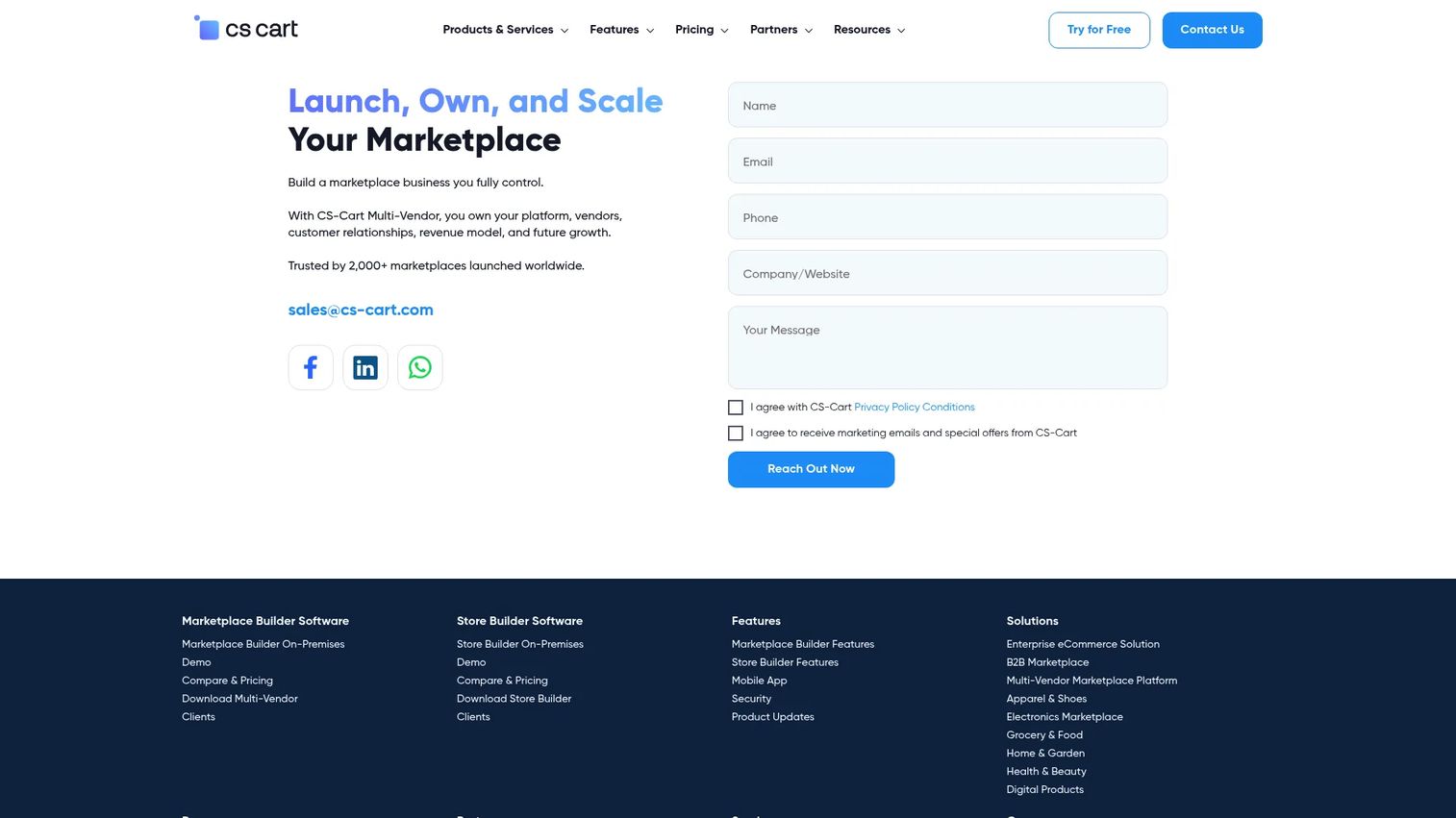
CS-Cart Multi-Vendor is self-hosted marketplace software built specifically for operators who want control over the entire platform stack. You get the source code, which means you can modify vendor permission logic, customize commission rules, and adjust the storefront without waiting on a vendor's product roadmap. CS-Cart ships with a complete multi-vendor feature set out of the box, including independent seller dashboards, approval workflows, product management per vendor, and built-in payment splitting.
Best for: Marketplace operators who need to own the infrastructure, customize the vendor experience, and avoid per-transaction SaaS fees.
Key features
- Vendor management: Separate storefronts, dashboards, and approval workflows per seller
- Commission management: Percentage, flat, and category-specific commission rules
- Multiple storefront support for scaling across regions or verticals
- Built-in payment tools with split payment and payout scheduling
- Source code access for deep customization of marketplace logic
Why choose CS-Cart Multi-Vendor: If your marketplace has non-standard commission rules, complex vendor permission tiers, or regulatory requirements that demand data residency on your own servers, CS-Cart's self-hosted model gives you the control that SaaS platforms don't. The tradeoff is that hosting, upgrades, and security patches are your team's responsibility.
CS-Cart Multi-Vendor pricing: Annual subscription plans start at $725/year (Standard) and $1,449/year (Plus). Lifetime license options are also available: Plus at $3,590, Ultimate at $7,990, and Unlim at $19,990, each as a one-time fee. No free tier is offered, but a demo is available.
CS-Cart Multi-Vendor holds a 4.8/5 on G2, making it one of the highest-rated platforms in this category.
2. Mirakl

Mirakl is enterprise marketplace infrastructure used by large retailers, manufacturers, and B2B operators that need to onboard hundreds or thousands of vendors with governance controls in place. The platform covers marketplace management, dropship, multichannel selling, ads, and payout as separate product lines. For teams evaluating enterprise-grade vendor marketplace software, Mirakl's maturity in vendor onboarding automation, compliance workflows, and multi-geography support is its clearest differentiator.
Best for: Enterprise retailers and B2B organizations that need structured vendor governance, high-volume seller onboarding, and integration with existing ERP or commerce infrastructure.
Key features
- Vendor onboarding at scale with automated qualification and compliance workflows
- Marketplace Platform, Dropship, and Multichannel selling as distinct modules
- Payout product for automated vendor disbursements
- Mirakl Connect multichannel selling across external platforms
- Agentic Activation for AI-assisted commerce operations
Why choose Mirakl: Mirakl performs best when your marketplace has a large and growing vendor base that requires consistent onboarding, data quality checks, and governance without manual intervention. For a 10-vendor startup marketplace, it's overbuilt. For a retailer adding a third-party seller program to an existing commerce operation, it fits the complexity.
Mirakl pricing: Mirakl Connect, the multichannel selling product, runs $699/month on the Growth plan and $2,299/month on Pro. Enterprise pricing requires a sales conversation. The core Mirakl Marketplace Platform operates on enterprise contract terms rather than a self-serve pricing page.
Mirakl holds a 4.4/5 on G2 based on verified reviewer data.
3. Sharetribe
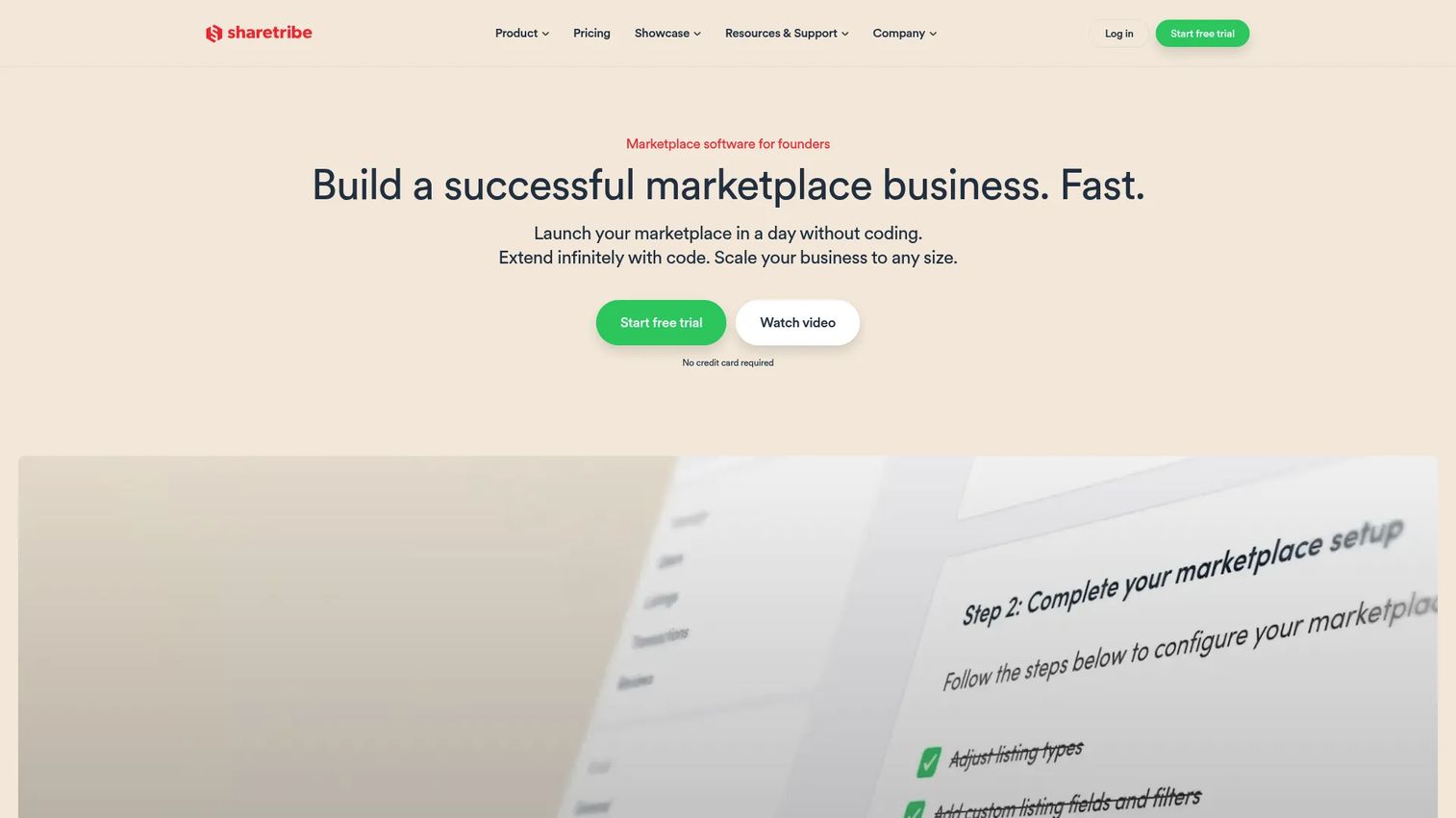
Sharetribe is purpose-built for founders who want to launch a marketplace fast, without writing infrastructure code from scratch. The no-code builder handles listings, onboarding flows, payments, messaging, and reviews out of the box. When your marketplace outgrows the no-code layer, Sharetribe's API lets you extend with custom code without migrating to a different platform. The company has supported marketplace founders across more than 70 countries.
Best for: Early-stage founders building a product or service marketplace who want to validate the model quickly before investing in custom development.
Key features
- No-code marketplace builder for listings, onboarding, and payments
- API and custom code extensibility for later-stage feature work
- Built-in payments, messaging, and review workflows
- 14-day free trial on the Build plan
Why choose Sharetribe: Sharetribe removes the infrastructure build phase. You test your marketplace model with real vendors and buyers before committing engineering resources. When the model validates, you extend with code rather than starting over. For teams that want to control every element of the tech stack from day one, a self-hosted option like CS-Cart fits better.
Sharetribe pricing: The Build plan starts at $39/month. Lite runs $99/month and Pro $199/month, both billed annually. The Extend plan is $299/month billed annually. A 14-day free trial is available on the Build plan.
Sharetribe does not have a verified G2 listing with public ratings at this time. Capterra shows positive reviewer sentiment.
4. Shopify

Shopify is not a native multi vendor marketplace platform, but it's the most common ecommerce foundation that teams extend into marketplace territory using apps. Marketplace app integrations available through the Shopify App Store add vendor onboarding, seller dashboards, commission tracking, and split payment logic on top of Shopify's core infrastructure. If you're already running a Shopify store and want to add third-party sellers, this path requires less migration than switching platforms.
Best for: Teams already operating on Shopify who want to add vendor marketplace capabilities without rebuilding their storefront from scratch.
Key features
- Extensive app ecosystem for marketplace vendor management extensions
- Shopify Payments and third-party gateway support for split payment workflows
- Established admin interface for catalog and order management
- Strong integration library for shipping, tax, and fulfillment tools
Why choose Shopify: The Shopify path makes sense when your baseline store is already running and your team has Shopify expertise. Native marketplace functionality requires apps rather than built-in tooling, so total cost of ownership includes both Shopify subscription fees and app costs. For teams starting from scratch with marketplace-first intent, a purpose-built platform may be a cleaner fit.
Shopify pricing: Base plans start at $29/month (Basic) billed annually. The Shopify plan runs $79/month annually. Marketplace app costs vary by provider. Webkul's Shopify multi-vendor app, covered separately below, starts at $15/month.
Shopify holds a 4.4/5 on G2.
5. WooCommerce
WooCommerce is the open-source ecommerce plugin for WordPress. The core platform is free, and marketplace functionality is added through extensions, either from the WooCommerce Marketplace or third-party plugins. For teams already running WordPress infrastructure, WooCommerce is a natural foundation. The range of available marketplace extensions, including Dokan covered next, gives operators significant flexibility in how they build out vendor onboarding, commission management, and payout workflows.
Best for: WordPress teams who want a plugin-driven approach to marketplace software and are comfortable managing hosting, security, and plugin maintenance.
Key features
- Free core platform with large extension marketplace
- Vendor management through plugins like Dokan or similar tools
- Payments, shipping, and tax integrations across major providers
- Full code access for custom marketplace logic
Why choose WooCommerce: WooCommerce gives you ownership over your data and codebase at no license cost. The marketplace functionality you actually get depends heavily on which plugins you choose and maintain. Teams that don't have internal WordPress expertise often underestimate the maintenance load across hosting, plugin updates, and security patching.
WooCommerce pricing: The core platform is free. Hosting runs roughly $25 to $350/month depending on provider and scale. Individual marketplace extensions cost $29 to $299/year each.
WooCommerce holds a 4.4/5 on G2.
6. Dokan
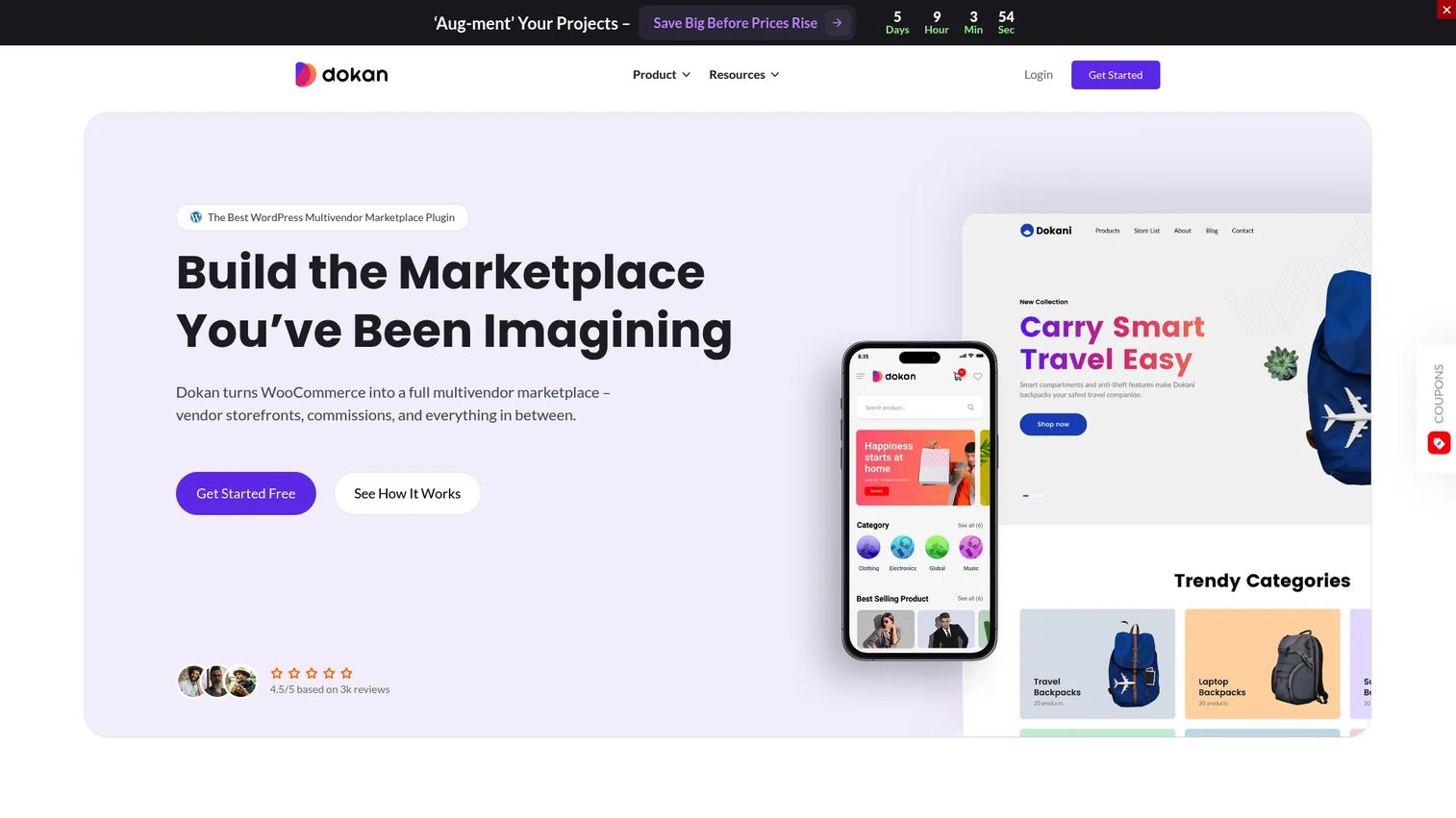
Dokan is the most widely adopted WooCommerce marketplace plugin, powering more than 50,000 active online marketplaces according to the vendor. It adds a complete frontend vendor dashboard on top of WooCommerce, giving each seller their own order management, product listings, earnings view, and customer communication tools without touching the WordPress admin. Commission splits, payout scheduling, and vendor approval workflows are built into the plugin rather than requiring additional extensions.
Best for: WooCommerce store owners adding multi-vendor functionality who want a mature, pre-built vendor dashboard and commission management system.
Key features
- Frontend vendor dashboards for independent seller management
- Built-in commission management: Percentage, flat, or combined rules
- Vendor approval and onboarding workflow tools
- 42+ add-on modules for shipping, subscriptions, and analytics
- Order management and payout scheduling per vendor
Why choose Dokan: Dokan solves the hardest parts of WooCommerce marketplace setup out of the box: Giving vendors their own operational view and automating commission calculation. The free version covers basic marketplace workflows. The paid tiers add module access for more advanced commission types, subscription vendors, and analytics. Teams not already on WooCommerce should evaluate whether adding WooCommerce plus Dokan is simpler than choosing a purpose-built marketplace platform.
Dokan pricing: A free Starter version is available. Paid plans run $249/year (Professional), $999/year (Enterprise), and $2,121/year (Business). Pricing is per site license on an annual basis.
Dokan holds a 4.6/5 on G2 based on current reviewer data.
7. Webkul
Webkul is an ecommerce extension company with marketplace modules across multiple platforms, including Shopify, Magento, WooCommerce, Odoo, and PrestaShop. Its multi-vendor marketplace apps give teams the ability to add seller onboarding, commission management, and vendor storefront functionality on top of whichever ecommerce platform they're already running. For teams locked into a specific platform that doesn't have native marketplace tooling, Webkul fills the gap without forcing a platform change.
Best for: Operators who have an existing ecommerce stack and need marketplace vendor management functionality added on top, without migrating platforms.
Key features
- Multi-platform marketplace extensions (Shopify, Magento, WooCommerce, Odoo, PrestaShop)
- Seller profiles, commission rules, reviews, and shipping or tax management per vendor
- AI and custom development services for marketplace customization
- Modular add-on architecture for extending marketplace functionality
Why choose Webkul: Webkul's value is in its breadth across platforms. If you're running Magento or Odoo and need multi-vendor functionality, Webkul likely has a module for it. The tradeoff is that multi-platform extension companies can vary in support responsiveness and product update cadence across their catalog, so validating which specific module fits your stack is worth doing before committing.
Webkul pricing: For the Shopify Multi-vendor Marketplace app specifically, plans run $15/month (Basic), $40/month (Executive), and $60/month (Pro). Enterprise pricing requires contacting sales. Pricing for other platform modules varies.
A verified G2 rating for Webkul as a company was not confirmed at generation time. Validate current ratings on G2 or Capterra before finalizing your shortlist.
8. Bagisto
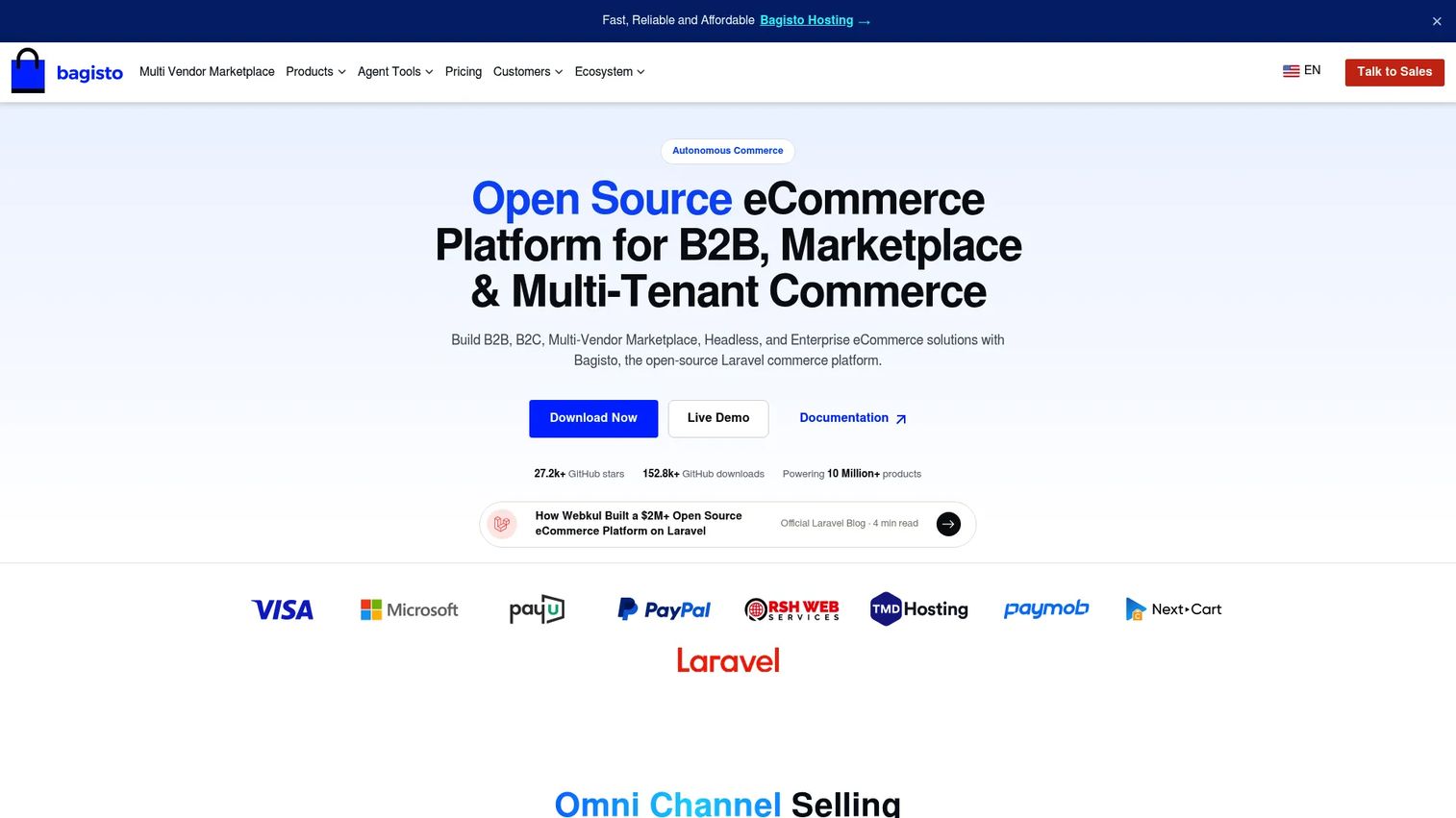
Bagisto is an open-source Laravel ecommerce platform with multi-vendor marketplace, B2B commerce, and headless architecture support built into the core. There are no license fees. Teams with PHP and Laravel expertise can build a fully customized marketplace without the cost of proprietary software or the constraints of a SaaS platform's roadmap. Bagisto suits technically capable teams who want a clean, modern codebase to build on and are comfortable owning the full infrastructure layer.
Best for: Developer teams who want a free, customizable open-source foundation for a marketplace with B2B or headless commerce requirements.
Key features
- Multi-vendor marketplace module with vendor onboarding and commission support
- B2B ecommerce capabilities including bulk ordering and account management
- Headless commerce support for decoupled frontend architecture
- Laravel-based codebase for PHP teams with existing expertise
- Active open-source community and extension ecosystem
Why choose Bagisto: Bagisto removes the license cost entirely. For teams with development capacity, it's the most cost-effective starting point for a custom marketplace build. The investment shifts from licensing to engineering. Teams without strong PHP or Laravel skills will find the maintenance and customization work more expensive than a SaaS alternative once developer time is factored in.
Bagisto pricing: The core platform is free and open source. Hosting, development, and any premium extensions are the primary cost drivers.
A verified G2 rating for Bagisto was not confirmed at generation time. Capterra shows positive early reviewer sentiment. Validate current ratings directly before finalizing.
Considerations when choosing marketplace software
Vendor onboarding complexity
Vendor onboarding is almost always more complex than the demo makes it look. Evaluate how each platform handles seller registration, document collection, permission tiers, and approval routing. A platform that automates onboarding at 50 vendors may not handle 500 without significant custom work or a plan upgrade.
Commission and payout architecture
Commission rules vary across marketplaces: Percentage of sale, flat fees, category-specific rates, subscription tiers, and promotional overrides. Confirm that the platform supports your actual commission model before committing. Payout architecture matters equally: Manual payout processes become a significant operational burden at scale.
Total cost of ownership
List price is the starting point, not the full cost. Add hosting (for self-hosted options), required extensions or apps, payment processing fees, developer time for customization, and ongoing maintenance. SaaS platforms have more predictable monthly costs; self-hosted platforms trade upfront control for ongoing infrastructure responsibility.
Integration depth with your existing stack
Your marketplace will need to connect to payment gateways, shipping carriers, tax tools, and likely a CRM or ERP. Confirm that the integration you need exists natively, not just through a third-party plugin with uncertain maintenance, before locking in a platform decision.
Scalability and maintainability
A platform that fits a 20-vendor marketplace may need to be replaced at 200. Assess the vendor onboarding capacity, catalog volume, and order throughput that each platform handles at its current tier. For self-hosted options, factor in release cadence and how often you'll need to patch or upgrade the core.
Conclusion
No single multi vendor marketplace platform wins for every operator. The right fit comes from matching the platform to the actual business model and operational context.
For self-hosted control and complex commission logic, CS-Cart Multi-Vendor gives the most operator flexibility. For enterprise-scale vendor governance, Mirakl fits large retailer and B2B programs. Sharetribe gets a marketplace live fast without engineering overhead. Shopify with marketplace apps is the lowest-friction path for existing Shopify operators. WooCommerce and Dokan together cover WordPress teams who want plugin-driven control with mature vendor dashboards. Webkul fills the gap when you need marketplace functionality on an existing stack without migrating. Bagisto is the open-source option for developer teams who want to own every layer.
Before committing, verify that the platform handles your specific commission model, supports payout automation at your projected vendor volume, and connects to the infrastructure you already run. Platform decisions made on demo impressions rather than operational requirements tend to be expensive to undo.
Start your journey with Guideflow today!
FAQs
A multi vendor ecommerce platform is marketplace software that enables multiple independent sellers to list and sell products through a single operator-managed storefront. The platform handles vendor onboarding, product approval, commission calculation, order routing, and payment splitting between the operator and each seller. Unlike a standard ecommerce store, the operator doesn't own the inventory - they own the rules and the marketplace infrastructure.
The operator sets up the platform, defines commission rates, and recruits sellers. Vendors register, get approved, and manage their own product listings through a vendor dashboard. When a buyer places an order, the platform routes it to the correct seller, collects payment, deducts the operator's commission, and schedules a payout to the vendor. The buyer sees a single storefront; behind it, each seller manages their own fulfillment.
Sharetribe is the most practical starting point for startups that want to validate the marketplace model quickly. The no-code builder gets listings, payments, and onboarding live without a development cycle. When the model validates, the API layer supports custom code extensions without a platform migration. Dokan on WooCommerce is a lower-cost alternative if the team is already on WordPress.
Mirakl is the most established option for enterprise retailers and B2B operators that need structured vendor governance, high-volume onboarding, and integration with existing commerce or ERP infrastructure. CS-Cart Multi-Vendor is worth evaluating for enterprise teams that want self-hosted control rather than a managed SaaS model.
Self-hosted platforms like CS-Cart and Bagisto give you full control over the codebase, data residency, and customization, but your team owns hosting, security, and upgrades. SaaS platforms like Sharetribe and Mirakl reduce infrastructure responsibility but limit how deeply you can modify the core. The right choice depends on your engineering capacity, compliance requirements, and how much of the platform you need to customize.
Commissions are deducted automatically when an order is placed, based on rules the operator defines: A percentage of the sale, a flat fee, or category-specific rates. The platform holds the gross payment, subtracts the commission, and schedules a payout to the vendor on the platform's payout cycle (daily, weekly, or monthly). More advanced platforms support promotional commission rates, vendor subscription tiers, and manual override controls.
Yes. Both platforms support marketplace extensions. Shopify operators can add vendor onboarding, seller dashboards, and commission management through App Store integrations. WooCommerce teams typically use plugins like Dokan or Webkul's WooCommerce extension. Neither Shopify nor WooCommerce provides native multi-vendor functionality out of the box, so the total cost includes both the base platform and the additional apps or plugins required.
Start with commission model compatibility: Confirm the platform handles your specific commission structure before anything else. Then assess vendor onboarding capacity at your projected seller volume, payout automation at scale, integration with your payment gateway and shipping providers, and total cost of ownership including hosting, extensions, and developer time. Finally, check the platform's release cadence and how upgrades are managed so you're not holding outdated software when your vendor base grows.