
Your exposed SSH port is getting hit right now. So is your web server, your RDP endpoint, and anything else with a public IP.
Most of that traffic is automated. Bots scan the internet nonstop, probing for weak credentials and unpatched services. You cannot stop the probing. But you can watch it, study it, and turn it into an early warning signal, without putting a single production asset at risk.
That is what a honeypot does. It sits there looking like a real target, logs whatever hits it, and tells you when something suspicious happens.
The market agrees this matters. The global honeypot technology market reached $820 million in 2025 and is projected to hit $2.1 billion by 2033, growing at a 12.4% CAGR, according to DataHorizzon Research (2025). One reason: PMarketResearch (2024) found that 68% of enterprises using deception technologies detected intrusion attempts 40% faster than teams relying only on firewalls and endpoint protection.
The catch is picking the right tool for the job. An SSH decoy is not an ICS decoy. A quick tripwire is not a research lab. This guide sorts that out.
What's inside
This guide is for security engineers, blue teams, and presales folks who need to understand or explain honeypot security tooling. Everything here is open source honeypot software you can download and run yourself.
We chose these tools on four criteria:
- Protocol coverage: which services and ports the honeypot can emulate
- Interaction depth: low, medium, or high interaction with attackers
- Deployment fit: how it slots into a lab, a SOC, or a production tripwire
- Logging and alerting: how well it captures and surfaces attacker activity
No hype, no vendor spin. Just what each tool is good at and when to reach for it.
TL;DR
- Best for a lightweight tripwire: OpenCanary. Multi-protocol deception with low maintenance and clean alerting.
- Best for SSH and Telnet deception: Cowrie. The de facto standard for shell interaction logging.
- Best for ICS and OT environments: Conpot. Purpose-built for SCADA and industrial control protocols.
- Best for an all-in-one lab: T-Pot. Bundles 20+ honeypots with dashboards and live attack maps.
- Best for a flexible framework: Honeytrap. Combines multiple services into one managed decoy.
- Best for a customizable Python stack: OWASP Python-Honeypot. Build honeypots and honeynets your way.
- Best for client-side web deception: phoneyc. Emulates a vulnerable browser to analyze malicious pages.
What is honeypot software
Honeypot software is a decoy system or service designed to detect, deflect, and study unauthorized activity by mimicking a real target that has no legitimate business purpose.
Because nobody should ever touch a honeypot, any interaction with it is inherently suspicious. That makes it a high-signal, low-noise detection tool. The honeypot meaning boils down to one idea: bait that reports back.
Core traits of a computer honeypot:
- Isolated from production systems so a compromise never reaches real assets
- Logs attacker interactions including commands, payloads, and source data
- Mimics real services or endpoints convincingly enough to draw activity
- Supports research, detection, or deception workflows depending on setup
- Runs at low, medium, or high interaction based on how much you let attackers do
Types of honeypots
Honeypots split along a few axes, and knowing them helps you pick a tool.
- Production vs research: Production honeypots add detection value inside your live network. Research honeypots exist to study attacker tooling and behavior in depth.
- Low-interaction vs high-interaction: Low-interaction honeypots emulate a limited surface and carry little risk. High-interaction honeypots present a fuller environment and gather richer data.
- Virtual vs physical: Most modern deployments are virtual or containerized. Physical honeypots are rare and usually reserved for specialized hardware research.
- Service-specific vs platform-style: Some honeypots emulate a single service like SSH. Others bundle many honeypots into one platform, sometimes wired together as a honeynet.
When to use honeypot software
Detect scanning and brute force attempts
If you have exposed SSH, Telnet, or web surfaces, a simple service honeypot is often enough. Deploy a low-interaction decoy on an unused IP or port and treat every hit as a lead. There is no false-positive noise to sort through, because legitimate users have no reason to connect. This is the fastest way to add a tripwire without touching production.
Study attacker behavior in a lab
When you want to understand how attackers operate, interaction depth matters more than volume. A high-interaction honeypot or a research honeynet lets you capture full command sequences, dropped malware, and post-exploitation moves. This is the setup for threat researchers, malware analysts, and blue teams building detections from real adversary activity.
Cover high-risk environments
Industrial control systems and OT networks need specialized decoys and careful isolation. A generic web honeypot will not fool an attacker probing Modbus or S7. Use an ICS honeypot that speaks the right protocols, and keep it segmented so it never bridges into real plant systems. The same isolation discipline applies to any sensitive environment where a pivot would be catastrophic.
Comparison table
Every tool below is free and open source. Ratings from mainstream review sites like G2 are not published for most security research projects, so that column reflects what could be verified. Pricing is uniform: these are community-maintained, download-and-run tools.
| # | Product | Best for | Key differentiator | Pricing | G2 rating |
|---|---|---|---|---|---|
| 1 | OpenCanary | Lightweight multi-protocol tripwire | Low-maintenance daemon with clean alerting | Free, open source | N/A |
| 2 | Cowrie | SSH and Telnet deception | Full shell emulation and session logging | Free, open source | N/A |
| 3 | Conpot | ICS and OT deception | Emulates industrial control protocols | Free, open source | N/A |
| 4 | T-Pot | All-in-one honeypot lab | 20+ honeypots with dashboards and attack maps | Free, open source | N/A |
| 5 | Honeytrap | Flexible honeypot framework | Combines multiple services into one decoy | Free, open source | N/A |
| 6 | OWASP Python-Honeypot | Customizable Python deception | API-driven honeypot and honeynet creation | Free, open source | N/A |
| 7 | phoneyc | Client-side web deception | Emulates a vulnerable browser to inspect pages | Free, open source | N/A |
Best 7 honeypot tools for 2026
1. OpenCanary
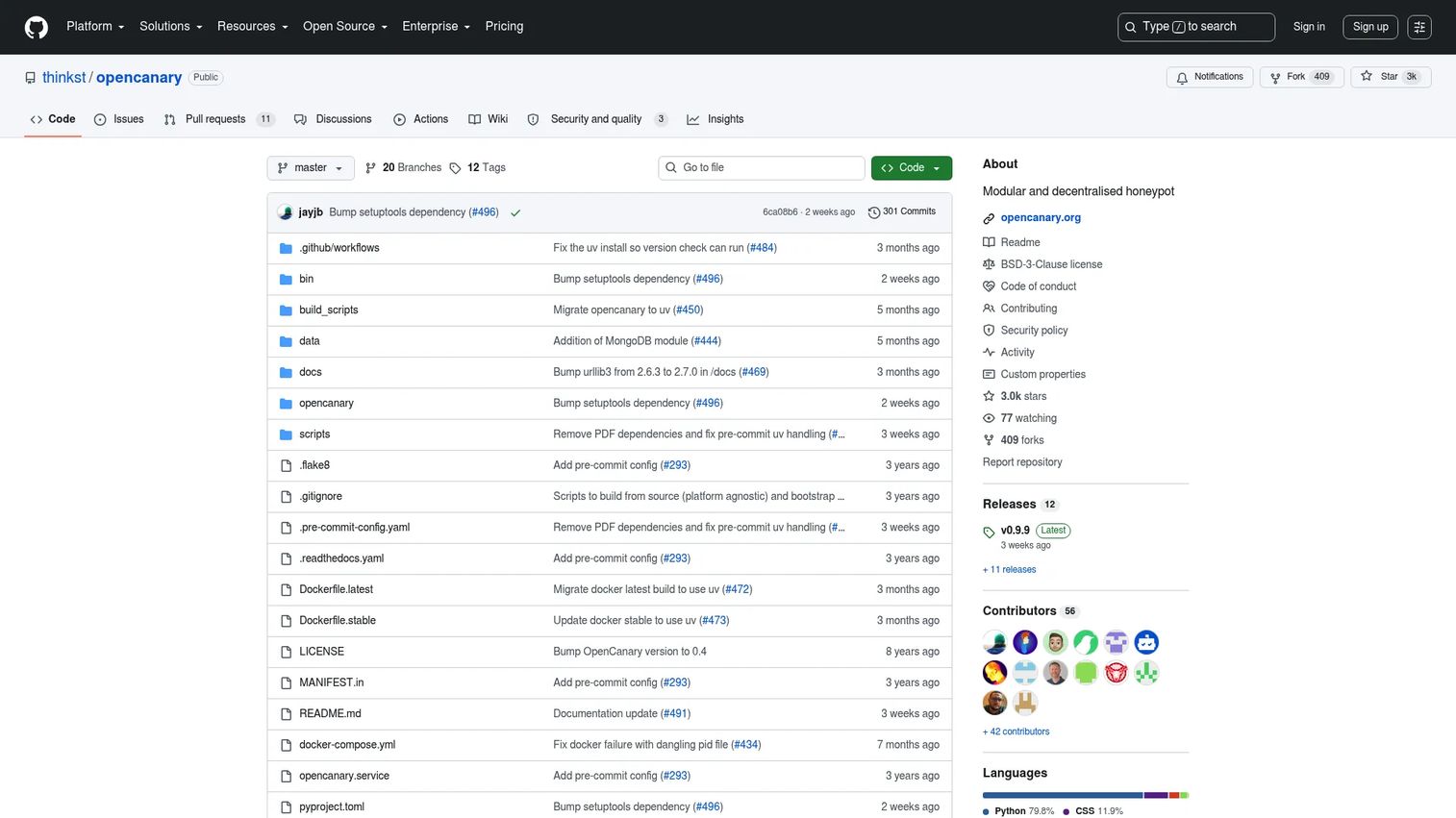
OpenCanary is an open-source, multi-protocol network honeypot from Thinkst, the team behind the commercial Canary product. It runs as a Python daemon and mimics a range of network-accessible services, so attackers interact with a decoy while you get an alert. It is built to be a quiet tripwire you drop onto an internal network and mostly forget about.
Best for: Teams wanting a low-maintenance honeypot for internal network defense and fast alerting.
Key features
- Mimics multiple network-accessible services for attackers
- Sends alerts when suspicious activity is detected
- Runs on Linux, macOS, Docker, or Raspberry Pi
- Lightweight Python daemon deployment
Why choose OpenCanary: If you want detection value without babysitting a research platform, this is the pick. It fits presales and IT teams who need a credible internal decoy that alerts on the first probe rather than a heavy lab to maintain.
OpenCanary pricing: Free and open source. There is no paid tier on the project repository, and you self-host it wherever you like.
2. Cowrie

Cowrie is the widely used standard for SSH and Telnet deception. It emulates a UNIX shell so attackers can log in, run commands, and poke around a fake filesystem while every keystroke gets logged. It can also run in proxy mode to a real system, or use an LLM backend for dynamic shell responses. For anyone studying credential attacks, this is usually the default starting point.
Best for: Security teams that need an SSH honeypot for attacker observation and detailed log collection.
Key features
- SSH and Telnet emulation or proxy mode
- Fake filesystem with file capture on upload and download
- LLM backend for dynamic shell responses
- Full session logging of attacker commands
Why choose Cowrie: Brute force against SSH is one of the most common attacks on any exposed host. Cowrie turns that noise into a rich record of what attackers try after they get in, which is exactly what blue teams need to build detections.
Cowrie pricing: Free and open source. You download it, install it on your own host, and run it with no license cost.
3. Conpot
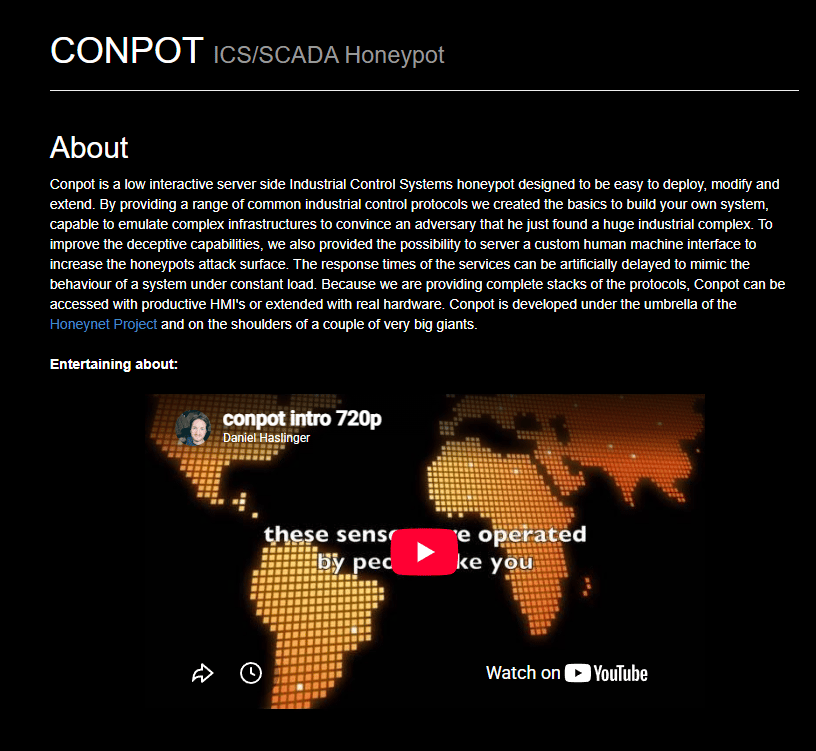
Conpot is an open-source ICS and SCADA honeypot for emulating industrial control environments. It is a low-interaction, server-side honeypot that speaks common industrial protocols, so it looks like a real controller to an attacker scanning OT networks. It can even serve a custom human-machine interface and delay responses to mimic the load of a busy device.
Best for: Security teams and researchers testing detection against industrial control system deception.
Key features
- Low-interaction server-side ICS honeypot
- Supports common industrial control protocols
- Serves a custom human-machine interface
- Delays responses to mimic device load
Why choose Conpot: Generic honeypots do not fool anyone targeting OT. Conpot is purpose-built for the protocols that matter in plant and utility networks, making it the right tool when you need to study threats against critical infrastructure.
Conpot pricing: Free and open source. The project is community-maintained with no paid plans, and you deploy it on your own infrastructure.
4. T-Pot
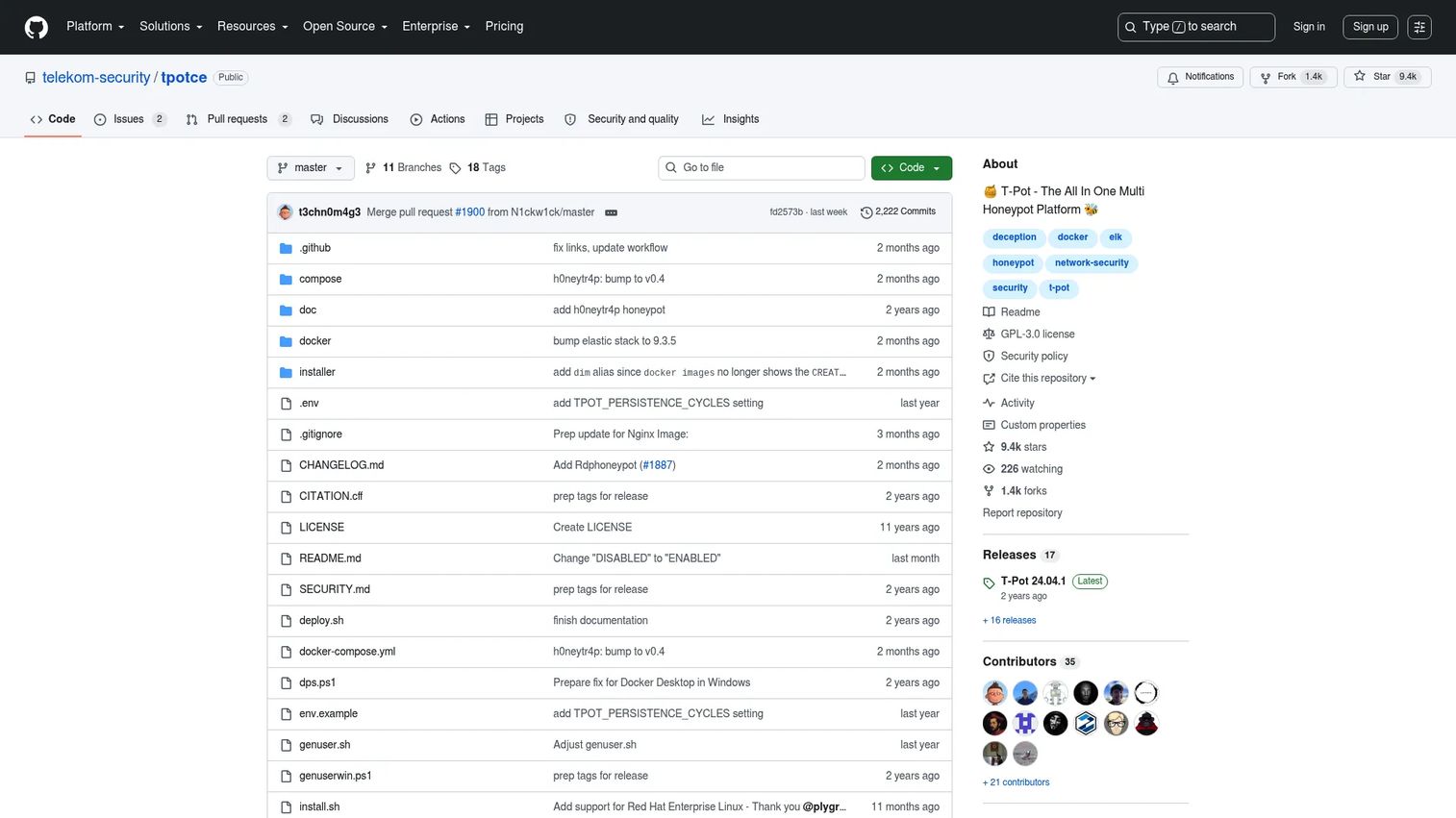
T-Pot is an all-in-one honeypot platform from Telekom Security. It bundles 20+ honeypots into one optionally distributed, multiarch install, then layers on Elastic Stack visualizations and animated live attack maps. It ships with tools like Kibana, Cyberchef, Elasticvue, and Spiderfoot, so you get a working deception lab out of the box.
Best for: Security teams and researchers who want a broad multi-honeypot deception lab quickly.
Key features
- Supports 20+ bundled honeypots
- Elastic Stack visualizations and live attack maps
- Bundled tooling: Kibana, Cyberchef, Elasticvue, Spiderfoot
- Optionally distributed, multiarch deployment
Why choose T-Pot: If you want breadth without stitching together a dozen separate honeypots and a dashboard stack, T-Pot hands you the whole thing. It suits teams building a research environment or a SOC visualization layer in one deployment.
T-Pot pricing: Free and open source. You run it on your own hardware or cloud instance with no license fee.
5. Honeytrap
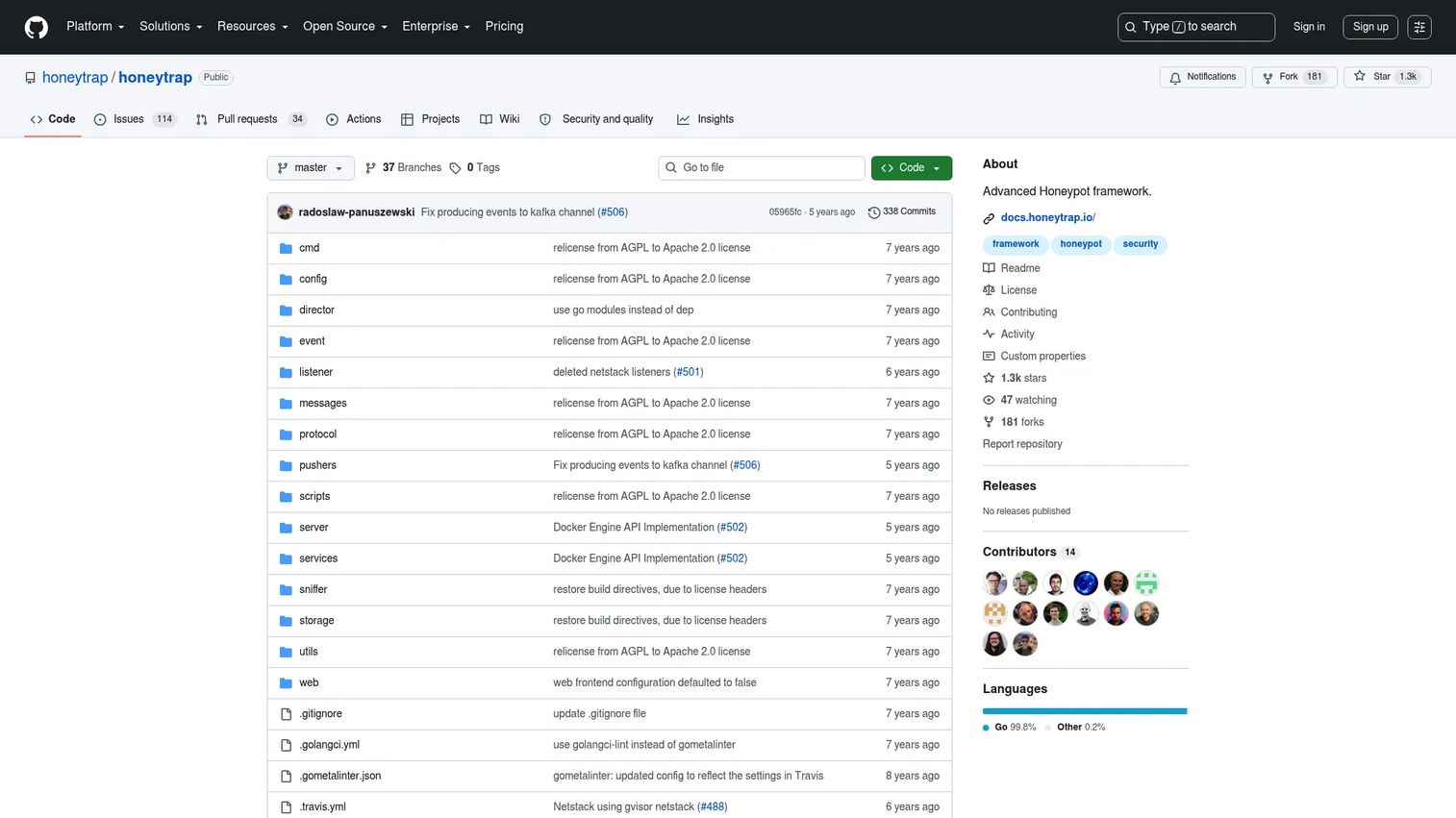
Honeytrap is an open-source honeypot framework for running, monitoring, and managing honeypots. Its strength is flexibility: it combines multiple services into one honeypot, pulls configuration from a Honeytrap Server via an agent, and centralizes logging. If you want to shape a decoy around several services rather than deploy separate single-service honeypots, this is the framework for it.
Best for: Security teams wanting an extensible framework to combine services into one decoy.
Key features
- Combines multiple services into one honeypot
- Downloads configuration from a Honeytrap Server via agent
- Centralized logging across services
- Extensible service handling
Why choose Honeytrap: The framework approach pays off when your requirements do not fit a prebuilt tool. You get building blocks to compose the exact deception surface you want, with central management holding it together.
Honeytrap pricing: Free and open source. The framework is available on GitHub with no cost to deploy.
6. OWASP Python-Honeypot
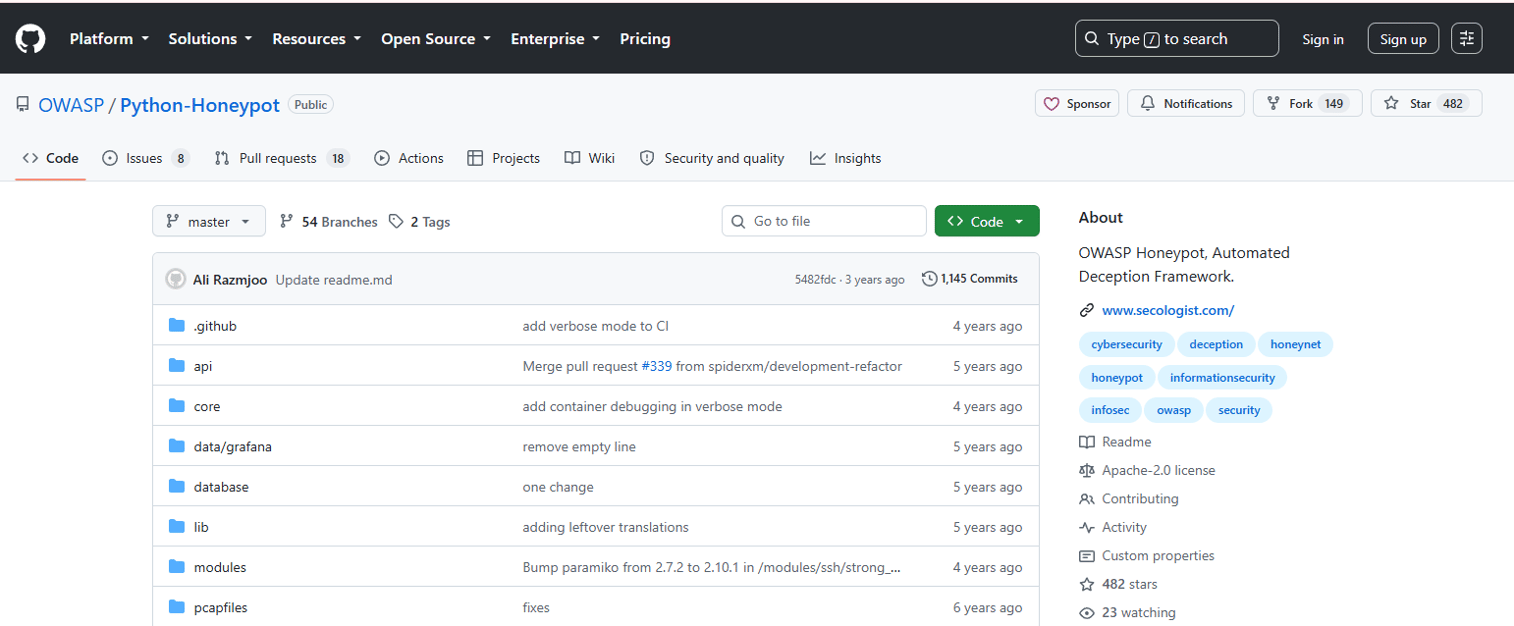
OWASP Python-Honeypot is an open-source Python framework for creating deceptive security services, honeypots, and honeynets. It ships with API actions, a web UI, and a Dockerized API deployment, and it runs on Python 3.x. As an OWASP project, it is a solid base for teams that want to build and customize their own honeypot network rather than run a fixed tool.
Best for: Security teams needing an open-source, customizable honeypot and honeynet framework.
Key features
- API actions and web UI
- Dockerized API deployment
- Python 3.x compatibility
- Framework for honeypots and honeynets
Why choose OWASP Python-Honeypot: The Python foundation and API-first design make this the pick when customization matters. Teams comfortable in Python can extend it to model exactly the deception technology they want to study or deploy.
OWASP Python-Honeypot pricing: Free and open source. It is maintained under OWASP with no paid tier, deployed from the project repository.
7. phoneyc
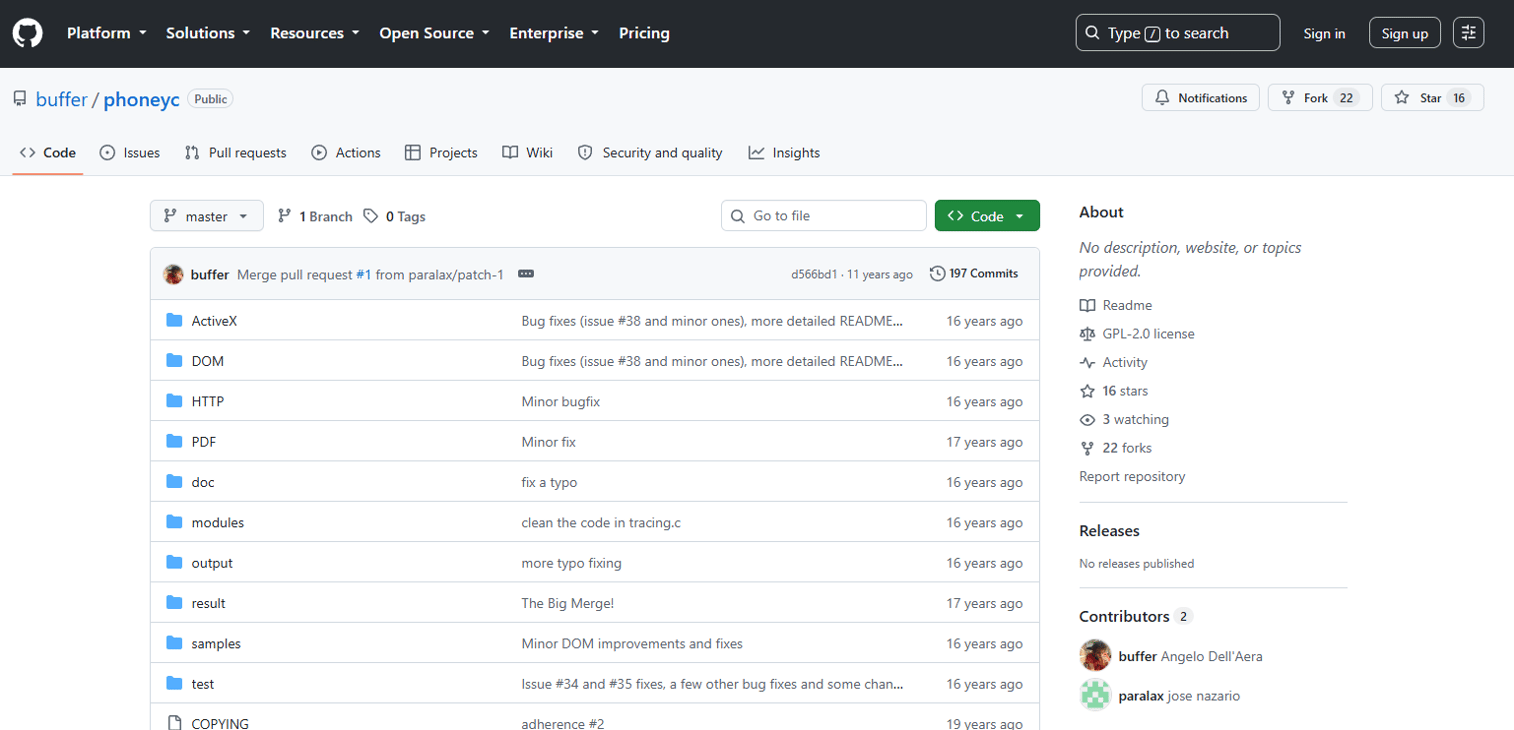
phoneyc is an open-source virtual client honeypot for detecting and analyzing malicious web content and browser-based exploits. Rather than waiting for attackers to come to a server, it emulates a vulnerable browser and visits pages to see what tries to attack it. It analyzes obfuscation and detects shellcode and heap sprays, which makes it a client-side complement to the server honeypots on this list.
Best for: Security researchers needing a client-side honeypot to inspect malicious web pages.
Key features
- Emulates vulnerable web browsers
- Analyzes malicious web pages and obfuscation
- Detects shellcode and heap sprays
- Client-side malware honeypot approach
Why choose phoneyc: Most honeypots are passive servers. phoneyc flips the model and goes looking for browser-based threats, which is what you want when your research question is about drive-by downloads and malicious pages rather than inbound scans.
phoneyc pricing: Free and open source. The project is available for download at no cost, in line with the other tools here.
Considerations
Before you deploy anything, run through this checklist. The right choice depends on where the honeypot sits and what you need out of it.
Protocol coverage
Match the honeypot to the services you want to watch. An SSH honeypot like Cowrie is useless for OT, and an ICS honeypot like Conpot will not help with web attacks. If you need breadth, a platform such as T-Pot covers many protocols at once.
Interaction depth
Decide how much you want to let attackers do. Low-interaction honeypots are safer and simpler, good for detection and alerting. High-interaction honeypots capture richer behavior but demand tighter isolation and more attention.
Isolation and pivot risk
A honeypot that gets compromised should never reach production. Segment it on its own network, restrict outbound traffic, and treat any high-interaction deployment as hostile territory. Pivot risk is the single biggest operational danger in a honeypot network.
Logging and alerting
A honeypot is only as useful as the data it surfaces. Confirm the tool logs the detail you need and can forward events to your SIEM or alerting stack. OpenCanary leans hard on clean alerts, while T-Pot leans on visualization.
Maintenance and updates
Community-maintained projects vary in activity. Check recent commits and release history before you commit, especially for research setups you plan to run long term. A stale honeypot is easier for attackers to fingerprint.
Conclusion
Pick by scenario, not by hype.
For a fast internal tripwire, start with OpenCanary and get alerting on day one. For SSH and Telnet attacks, Cowrie is the default and for good reason. If you run OT or industrial systems, Conpot speaks the protocols that matter. Want everything in one place? T-Pot bundles a full lab with dashboards. For custom builds, Honeytrap and OWASP Python-Honeypot give you framework-level control, and phoneyc covers the client-side web angle most tools miss.
The practical move: start small. Deploy one lightweight decoy, confirm it logs and alerts the way you expect, then expand to a multi-honeypot platform once your team needs broader coverage. Deception technology rewards iteration, not a big-bang rollout.
Then treat every hit as what it is: a signal that someone is looking where they should not be.
FAQs
Honeypot software is used to detect, deflect, and study unauthorized activity by presenting a decoy that has no legitimate purpose. Any interaction with it is suspicious by default, which makes it a high-signal early warning tool. Teams use honeypots for intrusion detection, threat research, and gathering intelligence on attacker behavior.
Deploying a honeypot on your own network or systems is generally legal, since you control the assets involved. The gray areas involve entrapment and data collection, so keep the honeypot inside your own infrastructure and log only what crosses your decoy. Check your local laws and organizational policy before capturing attacker traffic in regulated environments.
A honeypot is a single decoy system or service. A honeynet is a network of multiple honeypots, often wired together to look like a realistic environment and gather broader intelligence. You would use a honeynet when a single decoy is not convincing enough or when you want to study lateral movement across systems.
Use a low-interaction honeypot when you want detection and alerting with minimal risk and upkeep, such as a production tripwire. Use a high-interaction honeypot when you need to study attacker tooling and post-exploitation behavior in depth. High interaction gathers richer data but demands stricter isolation to prevent pivoting.
Yes. An SSH honeypot like Cowrie is built exactly for this, logging every credential attempt and command an attacker runs after a fake login. Because no real user should ever hit the decoy, every brute force attempt against it is a clean signal with no false positives to filter.
Cowrie is the widely used choice for SSH and Telnet deception. It emulates a full UNIX shell, captures uploaded and downloaded files, and logs entire attacker sessions. For a lighter tripwire that also covers SSH among other services, OpenCanary is a strong alternative.
Conpot is the standard open source honeypot for industrial control systems. It emulates common SCADA and industrial protocols and can present a custom human-machine interface, so it looks like a genuine controller to an attacker probing OT networks. Keep it strictly segmented from real plant systems.
Isolate it on a dedicated network segment with no route into production, and restrict outbound traffic so a compromised decoy cannot pivot. Treat any high-interaction honeypot as hostile territory and monitor it closely. Network segmentation and tight egress controls are the core defenses against pivot risk in any honeypot deployment.