
A dermatologist finishes a full-body skin exam, then spends the next twelve minutes clicking through a generic EHR that was never built for lesion tracking, Mohs staging, or cosmetic charting. Multiply that across thirty patients a day, and the charting tax alone eats hours that never make it back to patient care or to the bottom line.
That friction is why the category is growing fast. The dermatology software market is projected to move from USD 0.234B in 2025 to USD 0.44B by 2035, a 6.4% CAGR, according to Business Research Insights (2026). And ReAnIn (2025) reports that over 55% of dermatology practices already run software to manage appointments, records, and treatment plans. The practices still stitching together a general-purpose EHR, a separate billing tool, a photo folder, and a scheduling app feel every seam.
The core problem is not "we need software." Most practices have software. The problem is fragmentation: charting delays, billing leakage, and staff overload caused by tools that do not understand how a derm practice actually runs. Specialty-fit systems close those gaps by treating body mapping, teledermatology, imaging, and dermatology-specific documentation as first-class features, not add-ons. This guide compares eight platforms so you can narrow the field to a real shortlist without sitting through eight sales calls.
What's inside
This is a buyer-first comparison for practice owners, dermatologists, clinic administrators, and operations leaders choosing a system in 2026. It is not a vendor brochure. We selected platforms based on dermatology-specific workflow depth, practice management and revenue cycle coverage, imaging and body mapping, teledermatology support, patient engagement, and compliance readiness including HIPAA and MIPS. Each entry covers who it fits, what it replaces, key strengths, and pricing where a vendor publishes it. Where a price is quote-based, we say so plainly rather than guess.
TL;DR
- Best all-in-one specialty suite: ModMed bundles dermatology EHR, practice management, RCM, patient engagement, and AI-assisted documentation in one platform.
- Best for imaging and lesion tracking: DermEngine leads on total body photography, visual image search, and teledermatology.
- Best 100% dermatology-specific EHR and PM: Ezderm was built only for dermatology, with a 3D body map and Mohs tooling.
- Best for busy multi-service practices: Nextech covers medical, cosmetic, and procedural workflows with integrated payments.
- Best for multi-specialty and independent clinics: AdvancedMD and DrChrono offer broad practice management, billing, and patient engagement beyond derm alone.
What is dermatology software?
Dermatology software is a category of specialty healthcare technology that combines electronic health records, practice management, and clinical tooling built specifically for the workflows of a dermatology practice, including skin imaging, lesion tracking, and dermatology-specific documentation.
Unlike a general-purpose EHR, a derm-fit system understands that a single visit may involve a full-body exam, multiple biopsies, a cosmetic procedure, and a Mohs stage, each with its own documentation and billing logic. Most buyers evaluate several overlapping categories at once:
- Dermatology EHR software (EMR): Specialty charting templates, biopsy and procedure documentation, e-prescribing, and AI-assisted notes.
- Practice management: Scheduling, check-in and checkout, eligibility, custom fee schedules, and front-desk workflows.
- Revenue cycle management (RCM): Claims, coding support, denial management, and payment posting to reduce billing leakage.
- Imaging and body mapping: Total body photography, dermoscopy capture, lesion comparison over time, and standardized image storage.
- Teledermatology software: Store-and-forward image submission, live video consults, and asynchronous review.
- Patient portal and engagement: Online scheduling, intake forms, reminders, secure messaging, and post-visit instructions.
- Analytics and compliance: MIPS reporting, HIPAA safeguards, and operational dashboards for throughput and revenue.
The strongest platforms unify these so a full-body exam, its images, its billing, and its follow-up all live in one record.
When to use dermatology software
Replace a fragmented stack
If your team logs into a general EHR, a separate imaging folder, a billing service, and a scheduling app to finish one patient, you are paying the fragmentation tax daily. A specialty platform consolidates those into one record. That reduces double entry, cuts charting time, and makes it far harder for a billable procedure to slip through unbilled.
Support specialty documentation and billing
Dermatology coding is dense: multiple lesions, destruction versus excision, Mohs stages, cosmetic self-pay lines. Generic templates force workarounds that create denials and undercoding. Use dermatology-specific software when your documentation and billing need to match how derm visits actually happen, so claims go out clean the first time.
Bring imaging, telehealth, and engagement together
When lesion photos, teledermatology consults, and patient communication live in different tools, tracking a suspicious mole across visits becomes manual and risky. Choose a system that keeps imaging, teledermatology, and patient engagement in one place when longitudinal skin monitoring and remote care are core to your practice.
Dermatology software comparison
Here is a fast side-by-side of the eight platforms. Ratings reflect current G2 listings where available; several vendors keep pricing quote-based, which is standard for specialty healthcare systems.
| # | Product | Intent | Key use case | Pricing | G2 rating |
|---|---|---|---|---|---|
| 1 | ModMed | All-in-one specialty suite | EHR, PM, RCM, and AI documentation in one platform | Quote-based (Fundamentals+, Premium+, Enterprise) | 4.5/5 |
| 2 | DermEngine | Imaging and digital dermatology | Total body photography, lesion tracking, teledermatology | Quote-based | Not enough reviews |
| 3 | Ezderm | 100% dermatology EHR and PM | 3D body map, Mohs tools, RCM, patient engagement | Quote-based, 24-month term | 5.0/5 |
| 4 | Nextech | Multi-service specialty EHR | Medical, cosmetic, procedural workflows, payments | Quote-based | 4.3/5 |
| 5 | Derm-Cloud | Derm EHR with billing support | AI-assisted charting, dermatology templates, RCM | Billing services from 2.9% | Not listed |
| 6 | 1st Providers Choice | Configurable EHR and PM | Customizable workflows, billing, interoperability | Quote-based | No reviews yet |
| 7 | AdvancedMD | Broad practice management | PM, EHR, billing, patient engagement across specialties | From $130/month | 3.6/5 |
| 8 | DrChrono | Flexible EHR for independents | EHR, PM, billing, API ecosystem | Quote-based (Prometheus, Hippocrates, Apollo) | Not listed |
1. ModMed
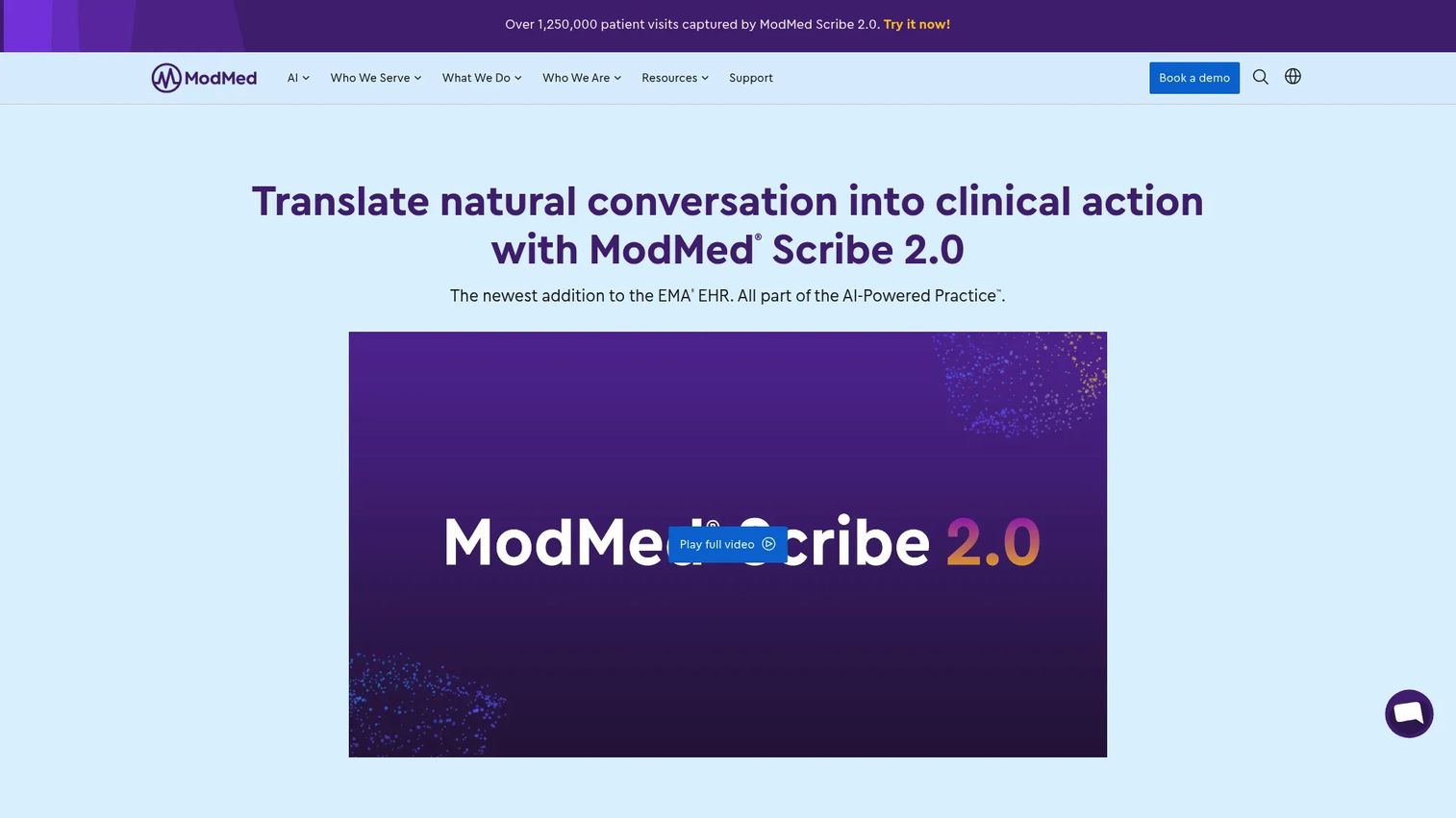
ModMed is a cloud-based, specialty-specific healthcare platform that packages dermatology EHR, practice management, revenue cycle, patient communication, and AI-assisted documentation into one connected system. It is the closest thing on this list to a single operating system for a derm practice, which is why it tends to show up on shortlists for groups that want to retire several point tools at once.
Best for: Specialty medical practices that want one integrated, AI-powered clinical and operational platform instead of a stitched-together stack.
Key strengths
- Specialty EHR with AI documentation: Dermatology-specific charting templates plus AI-assisted note generation cut time spent typing after each visit.
- Practice management and billing: Scheduling, eligibility, and integrated billing workflows keep front desk and revenue cycle in the same system.
- Patient communication and engagement: Built-in reminders, portal, and messaging reduce no-shows and inbound calls.
Why choose ModMed: If your priority is consolidation, ModMed replaces the most tools of any option here. It fits multi-provider practices that feel the pain of separate EHR, PM, RCM, and engagement systems and want clinical, financial, and patient-facing workflows under one roof. The tradeoff is that an all-in-one suite is a bigger commitment than a single-purpose tool, so it rewards practices ready to standardize.
ModMed pricing: ModMed does not publish public prices. It lists bundled tiers named Fundamentals+, Premium+, and Enterprise, and directs prospects to speak with a representative for a quote scoped to practice size and needs. Expect sales-led pricing rather than a self-serve plan.
2. DermEngine
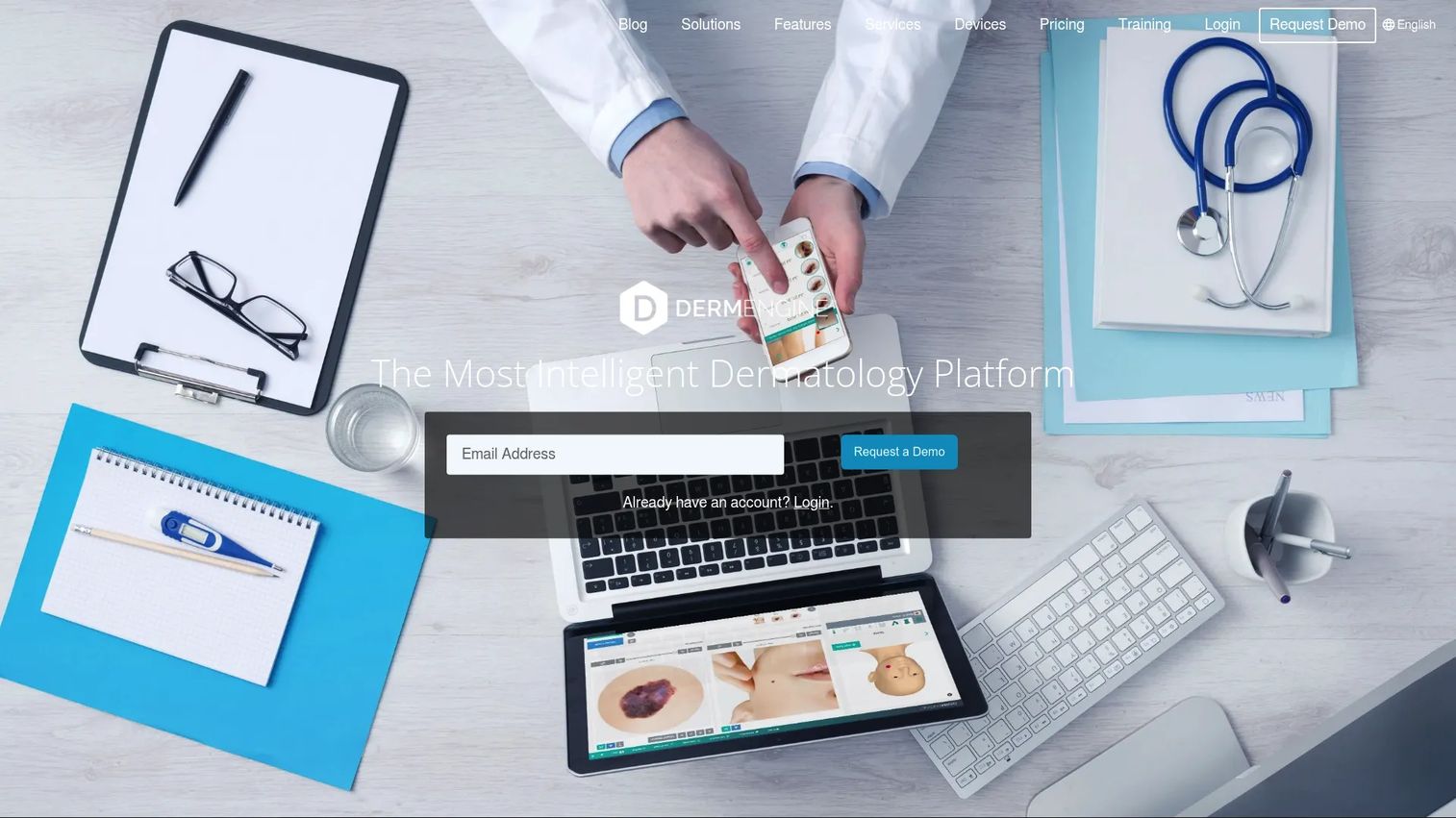
DermEngine is AI-powered dermatology software built around imaging, documentation, analysis, and teledermatology. Where most platforms treat photos as an attachment, DermEngine treats imaging as the spine of the record, with visual search, standardized total body photography, and lesion monitoring over time. That makes it a strong pick for practices where skin cancer surveillance and longitudinal tracking drive clinical value.
Best for: Dermatology clinics that need serious imaging, lesion tracking, and teledermatology in one platform.
Key strengths
- Visual image search and lesion monitoring: Compare lesions across visits and surface visually similar cases to support clinical decisions.
- Total body photography: Standardized capture creates a consistent baseline for tracking change over time.
- Teledermatology: Patient image submission and video consultation extend care beyond the exam room.
Why choose DermEngine: Choose it when dermatology imaging and skin monitoring are central rather than secondary. It pairs well with practices running mole-mapping programs, teledermatology triage, or research-grade photo documentation. If you need a full RCM and front-office suite as your primary need, weigh it against the all-in-one options and confirm how it fits alongside your existing practice management.
DermEngine pricing: DermEngine references flexible pricing plans on its site, but does not publicly list numeric prices. Pricing is quote-based, so contact the vendor for a figure scoped to your imaging volume and clinic size.
3. Ezderm
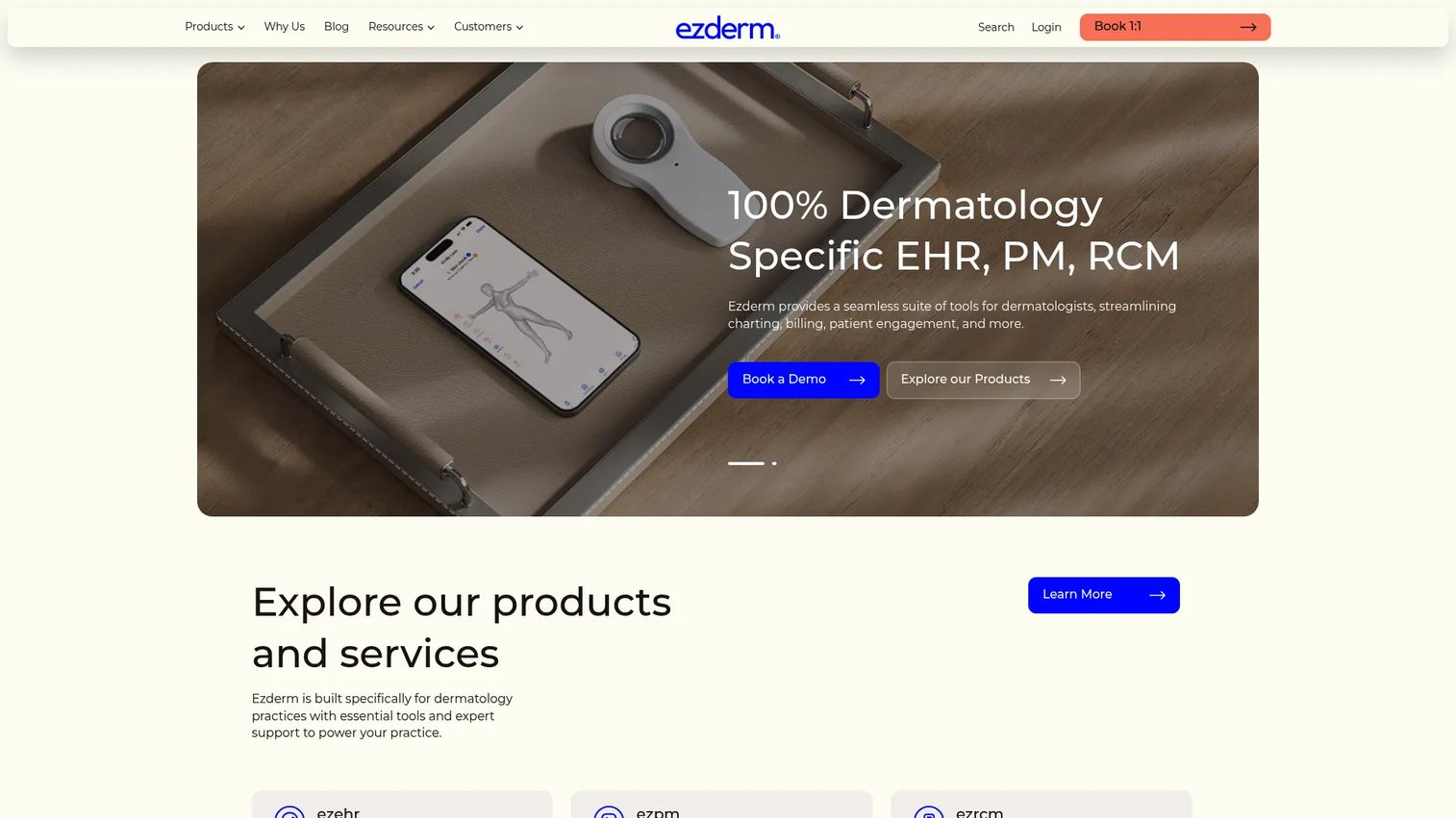
Ezderm is a dermatology-specific EHR, practice management, RCM, and patient engagement platform built exclusively for the specialty. Its signature is a 3D body map that mirrors how dermatologists document lesions and procedures, plus native Mohs tooling. Nothing about it is repurposed from a general EHR, which shows in the charting flow.
Best for: Dermatology practices that want an all-in-one specialty EHR and practice management suite with no compromise on derm-specific workflows.
Key strengths
- Dermatology EHR with 3D body map and Mohs tools: Document lesions on an anatomical map and run Mohs surgery workflows without workarounds.
- Practice management: Scheduling, checkout, and custom fee schedules keep the front office aligned with clinical work.
- Integrated patient portal and engagement: Patients handle intake, scheduling, and communication in one connected experience.
Why choose Ezderm: If you want software that was designed around dermatology from the first line of code, Ezderm makes a strong case. It fits practices that value specialty depth over multi-specialty flexibility. Note the commercial terms: Ezderm cites a standard 24-month contract and a typical one-time data import fee, so factor migration into your evaluation.
Ezderm pricing: Pricing is quote-based and varies by practice size and needs, so Ezderm directs prospects to contact sales. It publishes a standard 24-month term and a typical one-time $1,000 import fee for data migration. On G2, Ezderm shows a 5.0/5 rating.
4. Nextech
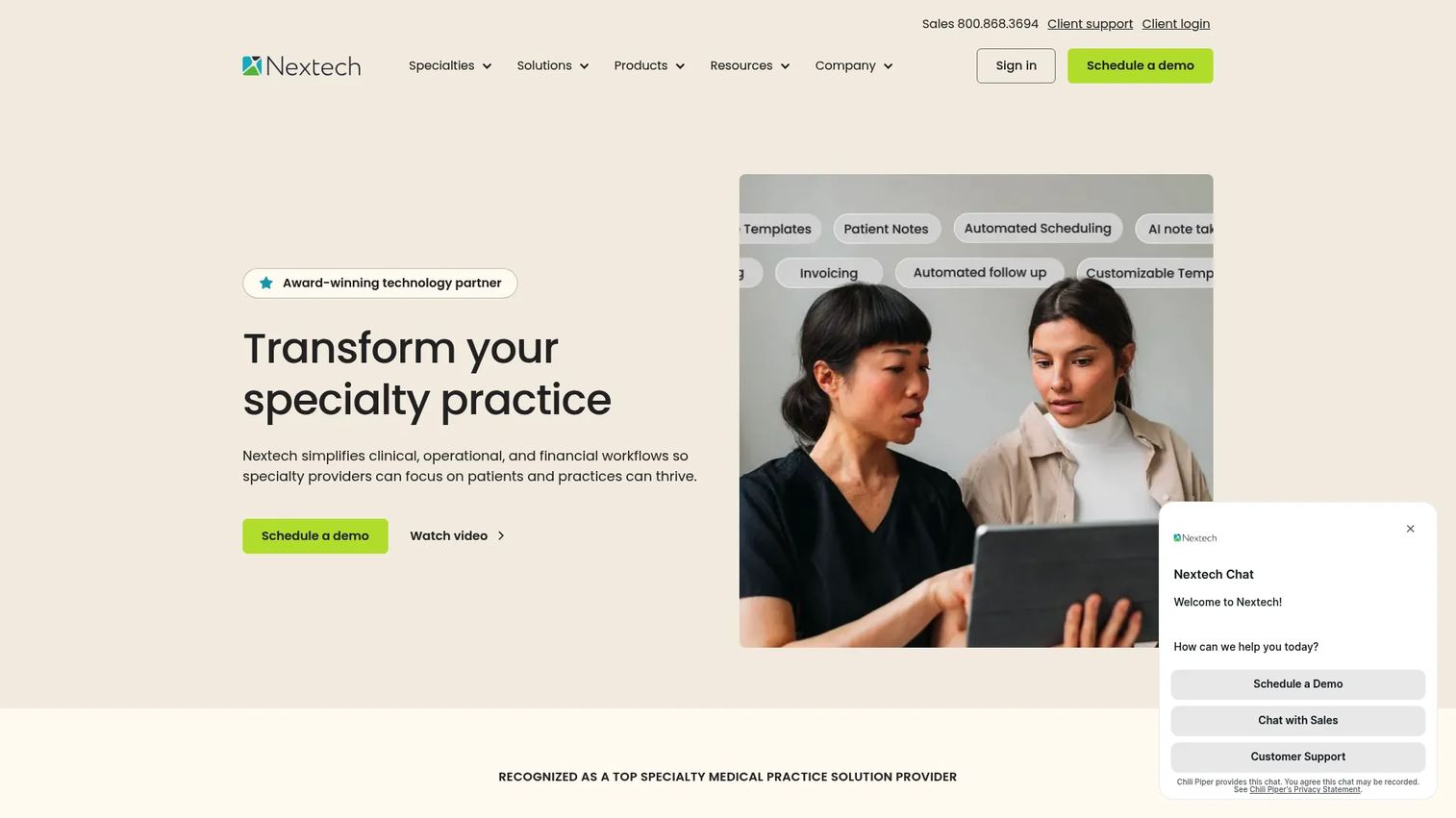
Nextech is a specialty-specific EHR and practice management platform with integrated payments, used across dermatology and other procedure-heavy specialties. It fits busy practices that mix medical dermatology, cosmetic services, biopsies, and Mohs, because its workflows and charting are built to flex across those visit types rather than force one template on all of them.
Best for: Specialty medical practices that need connected EHR, practice management, and payments across medical and cosmetic dermatology.
Key strengths
- Specialty-specific EHR: Charting and documentation tuned for procedural and cosmetic workflows, not generic primary care.
- Practice management: Scheduling and front-office tools that keep high-volume days moving.
- Integrated payments: Collect and reconcile payments inside the same system, reducing manual posting.
Why choose Nextech: Choose Nextech when your practice spans medical, cosmetic, and procedural care and you want one platform that handles all three plus payments. It suits mid-size and larger practices with real throughput. As with most specialty vendors, pricing is quote-based, so scope it against your provider count and service mix.
Nextech pricing: Nextech presents pricing as request-info and contact-sales only, with no public numeric prices on its site. On G2, Nextech carries a 4.3/5 rating. Plan for a scoped quote based on your practice size and modules.
5. Derm-Cloud
Derm-Cloud is a dermatology-focused EHR and practice management platform with AI-assisted charting and integrated billing. Its positioning centers on dermatology-specific templates and revenue cycle support, aimed at practices that want specialty documentation without adopting a large multi-module suite. The billing arm is a notable piece of the offering.
Best for: Dermatology practices that want a specialty-specific EHR paired with billing support.
Key strengths
- AI-assisted dermatology charting: Specialty templates and AI help speed documentation for common derm visit types.
- Integrated billing and revenue cycle: Billing services connect charting to claims and collections.
- Dermatology-specific templates: Documentation designed for derm rather than adapted from a generic EHR.
Why choose Derm-Cloud: Consider Derm-Cloud when you want dermatology-native charting plus a billing partner in one relationship. It fits smaller and mid-size practices that prefer a focused platform over a sprawling suite. Confirm current feature coverage and any teledermatology or imaging needs directly with the vendor during evaluation.
Derm-Cloud pricing: The site publicly displays pricing only for its billing services, listed as low as 2.9%. No public EHR subscription price is shown, so request a quote for the software itself. Treat the billing rate as a starting reference, not the full software cost.
6. 1st Providers Choice
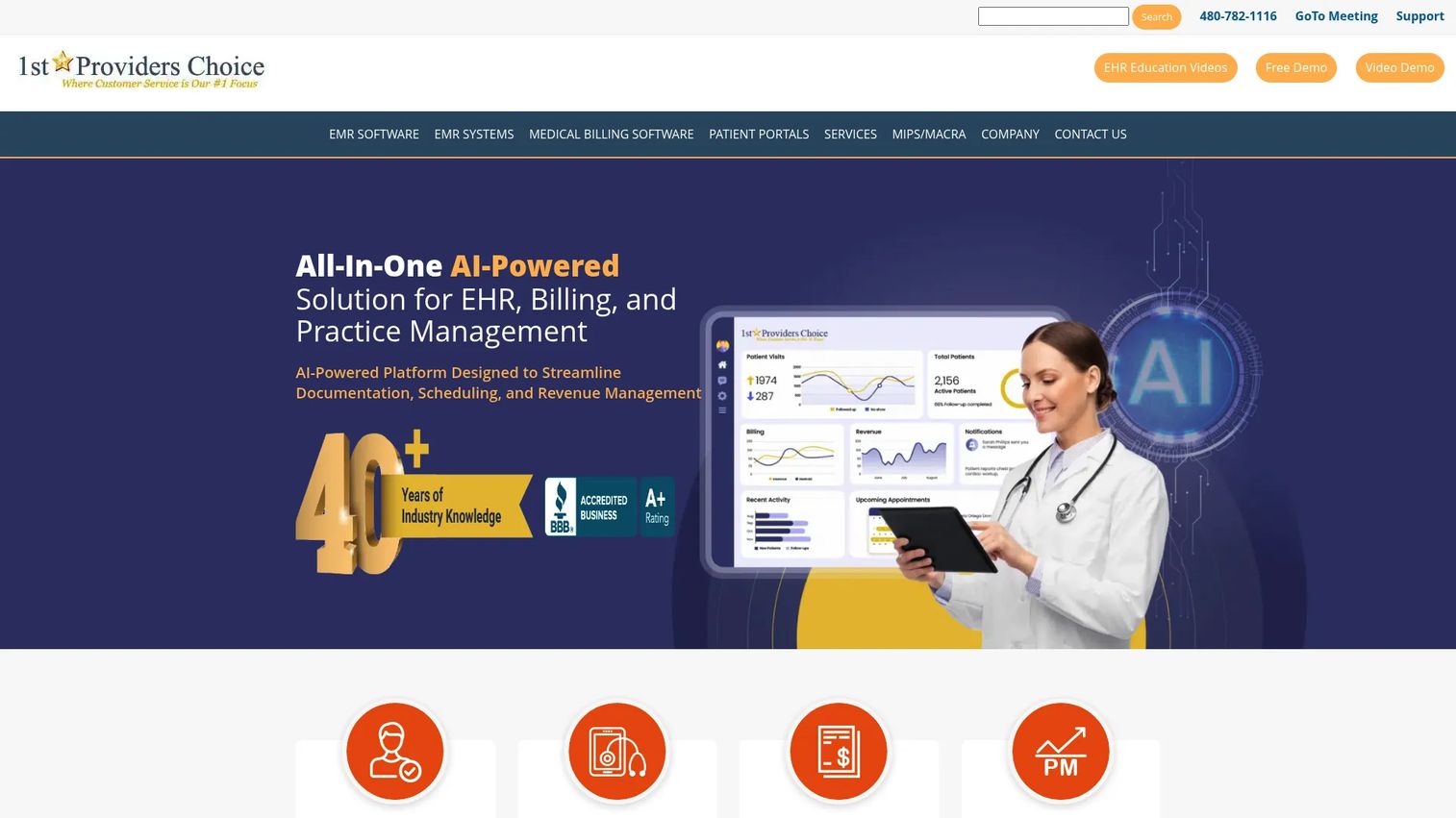
1st Providers Choice is a healthcare software company offering EHR, billing, practice management, and specialty-specific workflow tools, including dermatology configurations. Its angle is configurability: practices that want to shape workflows, documentation, and tracking around their own processes rather than accept a fixed template tend to look here.
Best for: Medical practices that want an all-in-one EHR, billing, and practice management platform they can configure to their workflow.
Key strengths
- EHR/EMR charting and documentation: Customizable charting to match how your providers actually work.
- Practice management and billing: Scheduling, billing, and front-office tools in one platform.
- Interoperability and integrations: Connections that help data move between systems.
Why choose 1st Providers Choice: Choose it when configuration flexibility matters more than a rigid, opinionated workflow, and you have the internal appetite to tailor the system. It fits practices that want authorization tracking, referral management, and customized documentation. Because it is broader than a derm-only tool, confirm how deep its dermatology-specific templates and body mapping go for your use case.
1st Providers Choice pricing: The site uses demo and contact-led CTAs rather than public pricing, so expect a scoped quote. Its G2 vendor page currently shows no reviews, so there is no meaningful user rating to cite yet. Ask for references from dermatology practices specifically during your evaluation.
7. AdvancedMD
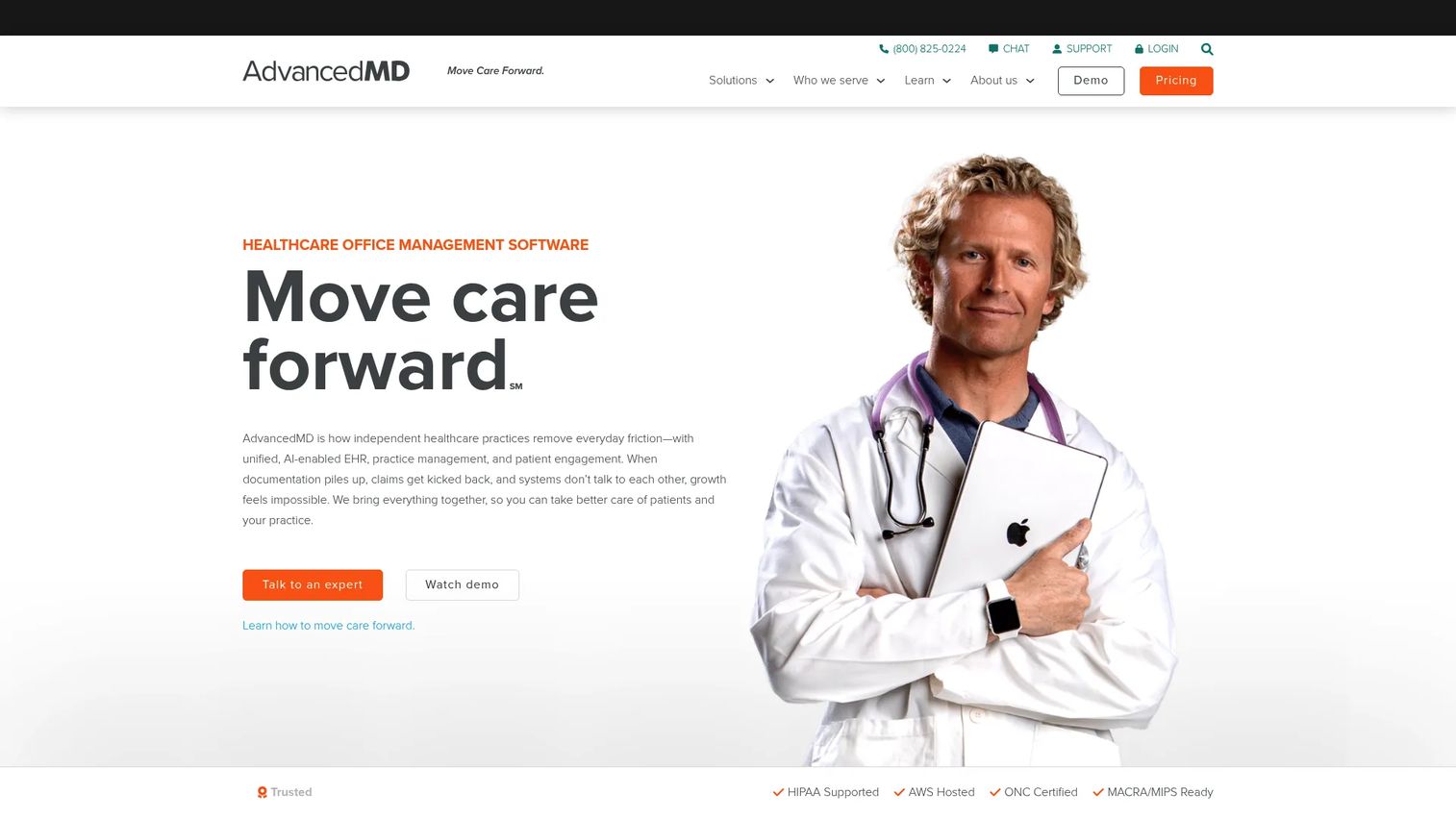
AdvancedMD is a cloud-based practice management, EHR, billing, and patient engagement platform for independent practices across many specialties. It is broader than a dermatology-only system, and that is the honest tradeoff: you gain mature practice management and billing plus published pricing, but you should confirm how well its templates map to derm-specific charting, body mapping, and Mohs documentation.
Best for: Independent healthcare practices that need an all-in-one practice management, EHR, and billing platform and value transparent pricing.
Key strengths
- Practice management: Scheduling, eligibility, and front-office workflows with a long operational track record.
- Electronic health records: Configurable EHR that adapts across specialties.
- Patient engagement: Portal, telehealth, and reminders to keep patients connected.
Why choose AdvancedMD: Choose AdvancedMD when you run a multi-specialty group or an independent practice that values strong practice management, revenue cycle, and public pricing over dermatology-only depth. It is a practical option when derm is one of several service lines. If skin imaging and lesion tracking are central, pair it against the imaging-first tools above.
AdvancedMD pricing: AdvancedMD publishes specialty-specific and per-encounter pricing. Published entry points include AdvancedMD Now at $130/month for small practices, a MedSpa edition at $278/month, and larger or group editions at $399/month. Per-encounter options run $0.87 to $1.74 per claim for practice management, and $1.08 to $2.17 per claim for practice management plus EHR. AdvancedMD says bundle pricing can save up to 40%. It carries a 3.6/5 rating on G2.
8. DrChrono
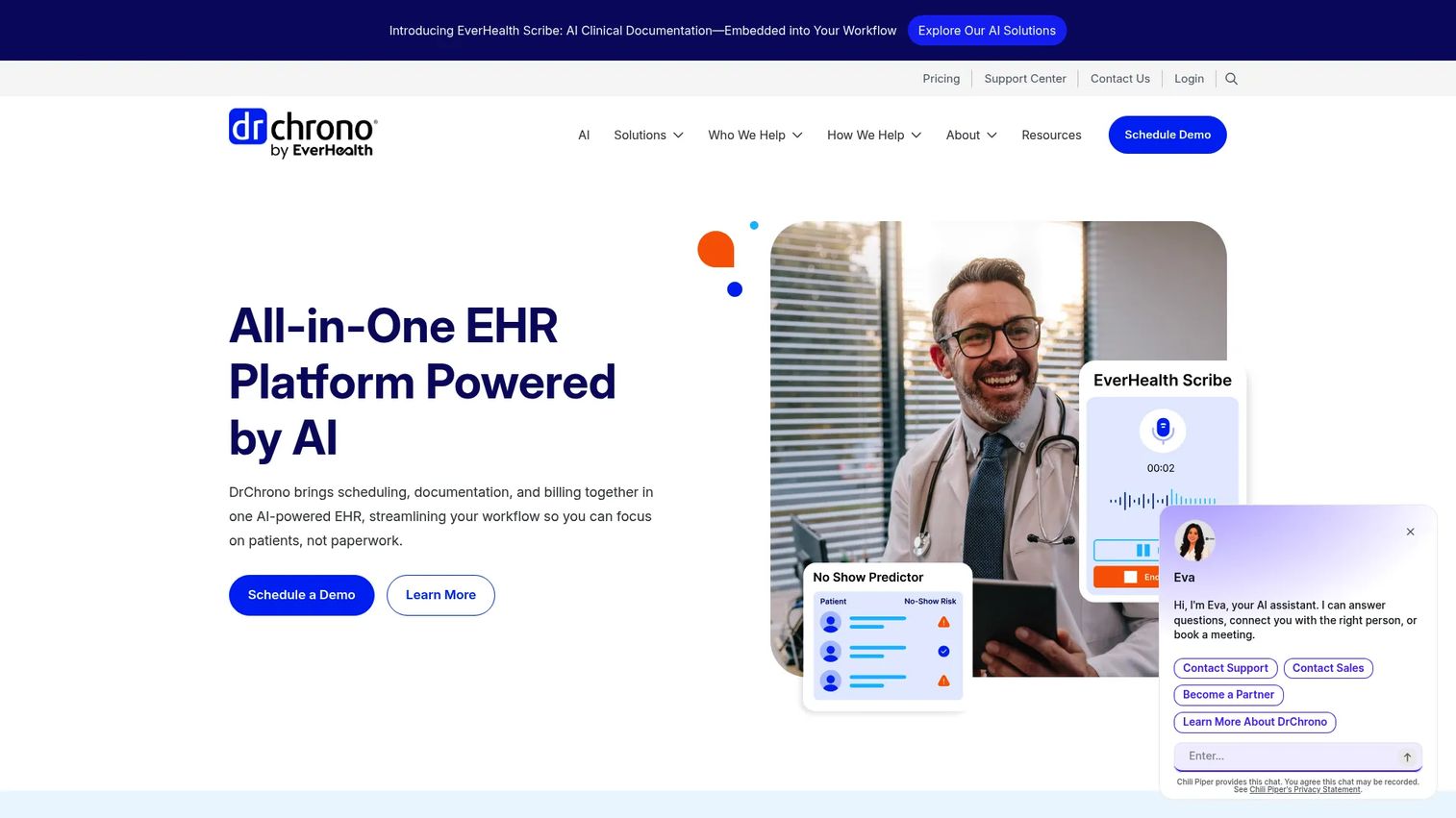
DrChrono is a cloud-based, AI-powered EHR, practice management, billing, and patient engagement platform for medical practices, with a strong developer and API ecosystem. Its mobile-first design and open integrations make it a favorite among independent practices that want flexibility and the ability to connect other tools rather than a closed suite.
Best for: Medical practices that need an integrated EHR, practice management, and billing workflow with room to extend via API.
Key strengths
- AI-powered documentation and workflow automation: Speeds charting and reduces repetitive administrative work.
- Integrated labs, billing, scheduling, telehealth, and portal: Core clinical and operational functions in one platform.
- Mobile-first, customizable EHR: Specialty-customizable templates and strong mobile access for on-the-go providers.
Why choose DrChrono: Choose DrChrono when flexibility, mobile access, and an open API matter, and you are comfortable customizing templates to fit dermatology. It fits independent practices and tech-forward teams. Because it is not dermatology-exclusive, validate that its charting, body mapping, and Mohs support meet your specialty needs before committing.
DrChrono pricing: DrChrono's public pricing page lists plan names, Prometheus, Hippocrates, Apollo, and Apollo Plus, but shows "Call for Quote" for paid tiers rather than a public starting price. Expect a scoped, sales-led quote based on providers and modules.
Considerations before you buy
Before you sign anything, run each finalist through this checklist. These are the criteria that separate a platform that fits derm from one that merely tolerates it.
Specialty workflow depth
Ask to see the exact charting flow for a full-body exam with multiple biopsies, a cosmetic line, and a Mohs stage. Generic templates create workarounds that slow providers and cause coding errors. The best dermatology EHR software makes these visits feel native, not forced.
Imaging, body mapping, and lesion tracking
Confirm how the system captures, stores, and compares images over time. For skin cancer surveillance, longitudinal lesion tracking and standardized total body photography matter more than a single photo attachment. Verify dermoscopy support if you use it.
Billing, RCM, and coding accuracy
Billing leakage is where margin quietly disappears. Evaluate how the system handles multiple-lesion coding, modifiers, self-pay cosmetic lines, and denial management. Ask for real denial-rate benchmarks from similar practices.
Teledermatology and patient engagement
If remote care is part of your model, test store-and-forward image submission, live video, and the patient portal. Strong patient engagement, online scheduling, reminders, and secure messaging directly reduces no-shows and front-desk load.
Compliance and total cost
Confirm HIPAA safeguards and MIPS reporting support. Then map the full cost: subscription, per-provider fees, implementation, data migration, and contract length. Quote-based vendors should still give you a written, itemized total before you commit.
Conclusion
The right pick depends on what your practice feels most acutely. If consolidation is the goal, ModMed offers the broadest all-in-one specialty suite. If imaging and skin surveillance drive your clinical value, DermEngine leads on total body photography and lesion tracking. For a system built only for dermatology, Ezderm is the purest specialty fit. Nextech suits busy practices spanning medical, cosmetic, and procedural care, while AdvancedMD and DrChrono give multi-specialty and independent clinics broad practice management with more pricing transparency.
Your next step: shortlist two or three based on your dominant workflow, then demo the exact visit types you run every day. Do not evaluate on a generic tour. Bring a real full-body exam, a real Mohs case, and a real cosmetic self-pay scenario, and watch how each system handles them end to end. The platform that charts, images, and bills those cases cleanly is the one that will pay for itself.
FAQs
Small practices usually want dermatology-specific depth without a heavy multi-module suite. Focused platforms like Ezderm or Derm-Cloud fit practices that value specialty charting and billing support, while AdvancedMD suits small independent clinics that want published pricing and broad practice management. Demo the exact visit types you run before deciding.
At minimum: dermatology-specific EHR templates, practice management, revenue cycle management, imaging and body mapping, lesion tracking, teledermatology, a patient portal, and compliance support for HIPAA and MIPS. The best platforms unify these so a full-body exam, its images, its billing, and its follow-up all live in one record.
Yes. A general EHR handles broad clinical documentation, while dermatology EHR software adds specialty tooling like 3D body maps, dermoscopy and total body photography, multiple-lesion coding, and Mohs workflows. Using a general EHR for derm often forces workarounds that slow charting and increase coding errors.
DermEngine is built around imaging and teledermatology, with patient image submission and video consultation. ModMed, DrChrono, and AdvancedMD also include telehealth as part of broader suites. Test store-and-forward image quality and the live video experience before committing if remote care is central to your model.
Scheduling that handles medical and cosmetic visit types, eligibility checks, custom fee schedules, checkout, and clean handoff to billing. Strong dermatology practice management software reduces front-desk friction and prevents billable procedures from slipping through unbilled, which is where many practices lose revenue.
Many specialty vendors keep pricing quote-based, so ask each finalist for a written, itemized total: subscription, per-provider fees, implementation, data migration, and contract length. AdvancedMD publishes specialty and per-encounter pricing, while ModMed, Ezderm, Nextech, and DrChrono are quote-based. Compare total cost of ownership over the contract term, not just the headline number.
Look for standardized total body photography, the ability to compare lesions across visits, dermoscopy support, and secure long-term image storage tied to the patient record. For skin cancer surveillance, longitudinal lesion tracking matters more than a single stored photo. Confirm how easily images move between the exam room and the chart.
For practices reporting under MIPS, built-in tracking and reporting can save significant manual effort and protect reimbursement. Confirm that any platform you evaluate supports current MIPS measures relevant to dermatology and generates the reports you need without exporting data to a separate tool.