Your current platform handles 200 orders an hour without breaking a sweat. Then a flagship launch spikes traffic, a new region needs local tax rules, and a B2B account asks for contract pricing your system was never built to support. Suddenly the platform that felt fine last quarter is the thing slowing every team down.
That is the real friction in enterprise commerce. The decision is rarely about which platform has the longest feature list. It is about which one supports your operating model: how you sell, where you sell, who you sell to, and how much control your team needs over the architecture underneath.
The stakes are large and growing. The global B2B e-commerce market is expected to reach $36 trillion by 2026, according to the International Trade Administration (2024), with manufacturing, energy, and healthcare driving most of the value. Worldwide eCommerce revenue is projected to hit $3.88 trillion in 2026, per Statista (2025). Platforms have to absorb that scale without forcing a rebuild every two years.
This guide compares 14 enterprise ecommerce platforms through the lens that actually predicts fit: control, complexity, and scale. If you are also mapping the wider stack, our roundups of the best customer data platform and best enterprise search software cover adjacent decisions that touch the same architecture. For the buyer evaluating commerce infrastructure right now, here is how the leading options compare.
What's inside
This guide is for buyers comparing enterprise ecommerce platforms in mid to late evaluation. You already know the category. You need a shortlist, clear decision criteria, and a sense of where each platform fits before you talk to vendors.
We selected platforms based on four filters that matter most at enterprise scale: architecture and deployment model (SaaS, PaaS, headless, composable), customization depth and B2B/B2C fit, compliance and global readiness (data residency, multi-region, multi-currency), and total cost of ownership beyond license price. Each entry covers where the platform fits best, its key strengths, and verified pricing and rating context where available.
TL;DR
- Best for composable, API-first architectures: commercetools and Spryker lead when you want modular control and headless flexibility.
- Best for Salesforce-native teams: Salesforce Commerce Cloud aligns commerce with CRM, personalization, and omnichannel in one stack.
- Best for complex B2B and procurement workflows: SAP Commerce Cloud, OroCommerce, and Intershop handle account hierarchies, contract pricing, and ERP depth.
- Best for faster deployment with less infrastructure overhead: BigCommerce Enterprise and Shopify Plus get high-volume brands live without heavy platform ownership.
- Best for global, unified commerce: VTEX combines D2C, B2B, and marketplace operations in a single stack.
- Best for Microsoft-centric operations: Dynamics 365 Commerce unifies in-store, online, and back-office on one platform.
What is enterprise ecommerce?
An enterprise ecommerce platform is commerce software built to support high transaction volumes, complex catalogs, multiple regions and brands, deep integrations, and governance requirements that smaller platforms cannot handle. Enterprise ecommerce software is defined less by who uses it and more by the operational complexity it absorbs without breaking.
At enterprise scale, the platform has to carry several capabilities at once:
- Catalog and PIM: large, multi-attribute catalogs with product information management, variants, and bundles across regions and brands.
- Pricing and promotions: customer-specific pricing, contract pricing, tiered B2B rates, and promotion logic that scales without manual work.
- Order management: distributed order management, inventory across warehouses, and fulfillment routing.
- Personalization: AI-driven merchandising, segment-based experiences, and recommendations tied to behavior.
- Performance: high concurrency, fast page loads, and stability under traffic spikes during launches and peak seasons.
- Analytics: commerce reporting, conversion tracking, and data feeds into the wider stack.
- Security and compliance: PCI DSS, data residency, role-based permissions, and audit trails.
The category also splits by operating model. A B2C ecommerce platform optimizes for high-traffic, conversion-driven storefronts. A B2B ecommerce platform handles account hierarchies, quotes, approval flows, and contract pricing. Unified commerce combines both, often with marketplace and in-store operations on one backend, so a single system serves every buyer type.
Architecture is the other axis. SaaS platforms are vendor-hosted and managed, fastest to deploy. PaaS gives you a managed platform with more room to customize. Self-hosted puts full control and responsibility on your team. Headless decouples the frontend from the commerce backend through APIs. Composable goes further, letting you assemble best-of-breed services into a custom commerce architecture. Each model trades control for operational overhead in a different way.
When to use an enterprise ecommerce platform
When your current stack cannot handle scale
The clearest signal is friction your team feels every week. Checkout slows during traffic spikes. Catalog updates take engineering tickets. Adding a region means brittle integrations and workarounds. If your platform caps the number of storefronts, SKUs, or currencies you can run, you have outgrown it. Enterprise platforms are built to absorb volume, catalog complexity, and multi-region operations without a rebuild each time you grow.
When governance and compliance matter
Enterprise commerce carries obligations that smaller setups skip. You need auditability for who changed pricing and when, data residency controls for regional regulations, role-based permissions across large teams, and security certifications procurement will demand. If your buyers run security reviews or your operations span regulated industries, the platform has to support these controls natively, not through custom code you maintain forever.
When you need a long-term commerce architecture
Sometimes the trigger is strategic, not operational. You are planning a multi-year roadmap and need a platform that fits your migration path, extends cleanly as requirements change, and keeps total cost of ownership predictable. This is where ecommerce architecture choices, SaaS versus composable, monolithic versus headless, become the decision. Pick for the operating model you will have in three years, not the one you have today.
Comparison table
The table below sorts the 14 platforms by overall relevance to enterprise commerce buyers. Most enterprise vendors price by quote, so several entries show custom pricing tied to GMV, volume, or contract terms. G2 ratings reflect current listings where a product-specific score was verifiable.
| # | Product | Intent | Key differentiation | Pricing | G2 rating |
|---|---|---|---|---|---|
| 1 | Adobe Commerce / Magento | B2B/B2C customization depth | Deep extensibility and composable options | Custom (contact sales) | 4.0/5 |
| 2 | Salesforce Commerce Cloud | CRM-native commerce | Unified Salesforce stack and personalization | Custom (contact sales) | 4.4/5 |
| 3 | SAP Commerce Cloud | Complex enterprise B2B/B2C | B2B2C on one platform, deep product data | Custom (contact sales) | 4.3/5 |
| 4 | commercetools | Composable, API-first | Headless modular commerce architecture | Custom (contact sales) | 4.5/5 |
| 5 | BigCommerce Enterprise | SaaS enterprise readiness | Multi-storefront with headless options | Custom (quote-based) | Not listed |
| 6 | Shopify Plus | Fast deployment at scale | Customizable checkout, B2B catalogs | From $2,300 USD/mo | 4.4/5 |
| 7 | Oracle CX Commerce | Oracle-centric enterprise | Customizable B2C and B2B storefronts | Custom (contact sales) | Not listed |
| 8 | VTEX | Unified global commerce | D2C, B2B, marketplace in one stack | Custom (contact sales) | 4.5/5 |
| 9 | Spryker | Composable B2B and marketplace | Modular, API-first architecture | Custom (contact sales) | 4.4/5 |
| 10 | Intershop | B2B manufacturers and wholesalers | Out-of-the-box B2B, headless | Custom (subscription tiers) | 4.4/5 |
| 11 | OroCommerce | B2B-first commerce | Built-in CRM, GMV-aligned licensing | Custom (contact sales) | 4.3/5 |
| 12 | Optimizely Configured Commerce | B2B with experimentation | Configurable commerce, pricing/quoting | Custom (request pricing) | 4.2/5 |
| 13 | Broadleaf Commerce | Highly extensible enterprise | Java/Spring microservices architecture | Custom (enterprise license) | 3.9/5 |
| 14 | Dynamics 365 Commerce | Microsoft-centric retail | Unified POS, online, back-office | From $210 user/mo | 4.3/5 |
1. Adobe Commerce / Magento
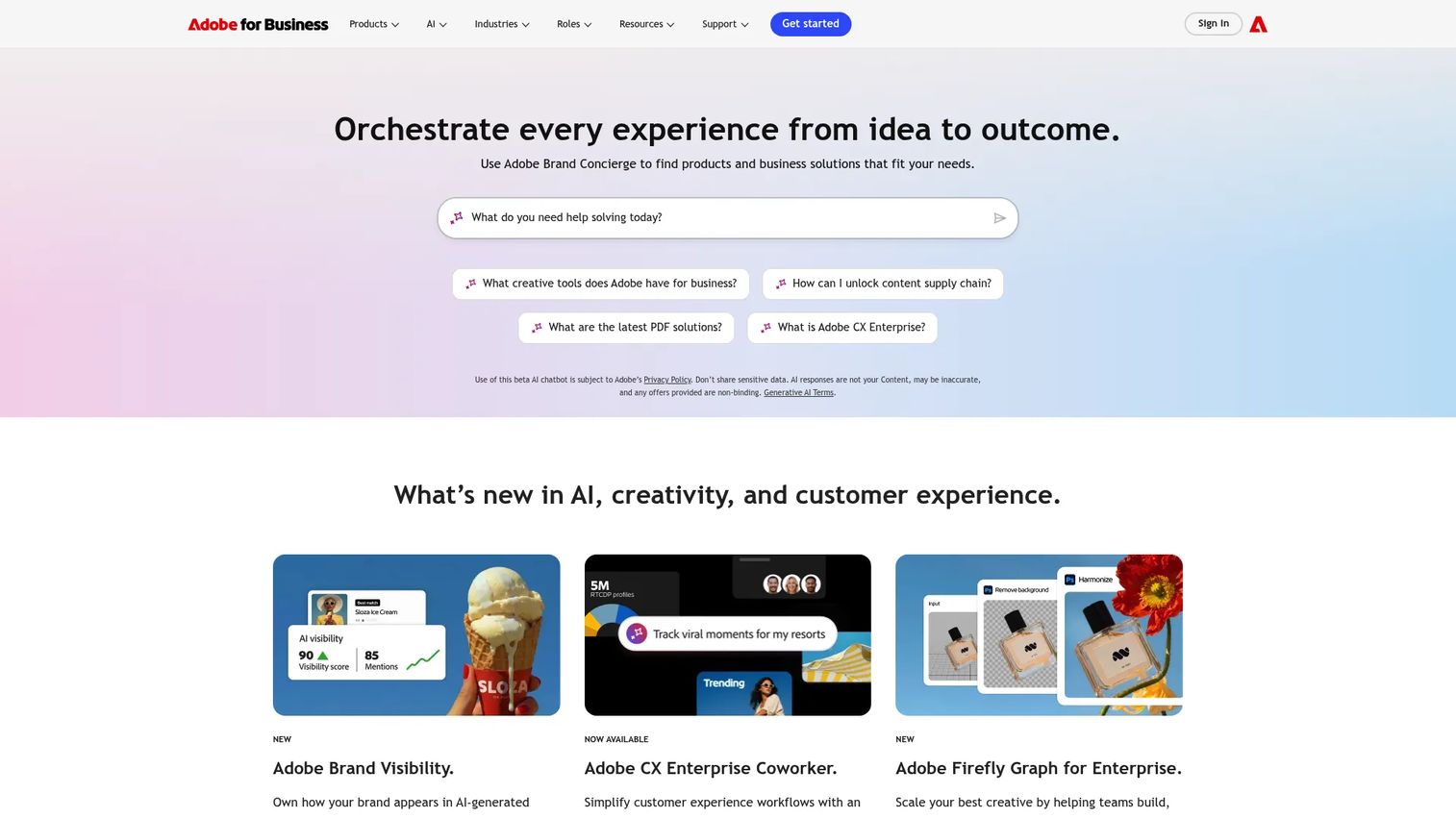
Adobe Commerce / Magento is a cloud-native digital commerce platform that runs both B2B and B2C operations with deep customization. It pairs scalable commerce operations with AI-driven merchandising and composable options, plus an extension ecosystem that has matured over years of Magento heritage. For brands that need to tailor nearly every part of the buying experience, it offers more control than most SaaS-only platforms.
Best for: Large brands that need scalable, heavily customizable B2B/B2C commerce with room to own the architecture.
Key strengths
- Customization depth: Open architecture and a large extension ecosystem let teams build almost any workflow or storefront behavior.
- Multi-store support: Run multiple brands, regions, and storefronts from a single backend with shared catalog and pricing logic.
- Composable and personalized commerce: AI-driven merchandising and composable building blocks adapt experiences by segment and behavior.
Why choose Adobe Commerce: It fits teams that want maximum control and have the platform ownership to use it. The trade-off is that customization depth rewards organizations with engineering capacity. If your roadmap demands tailored B2B workflows and tight integration with the broader Adobe ecosystem, the flexibility pays off.
Adobe Commerce pricing: Adobe does not publish a public price. The pricing page lists customized pricing and directs buyers to contact sales. G2 shows a 4.0/5 rating across more than 600 reviews, reflecting a broad and established install base.
2. Salesforce Commerce Cloud
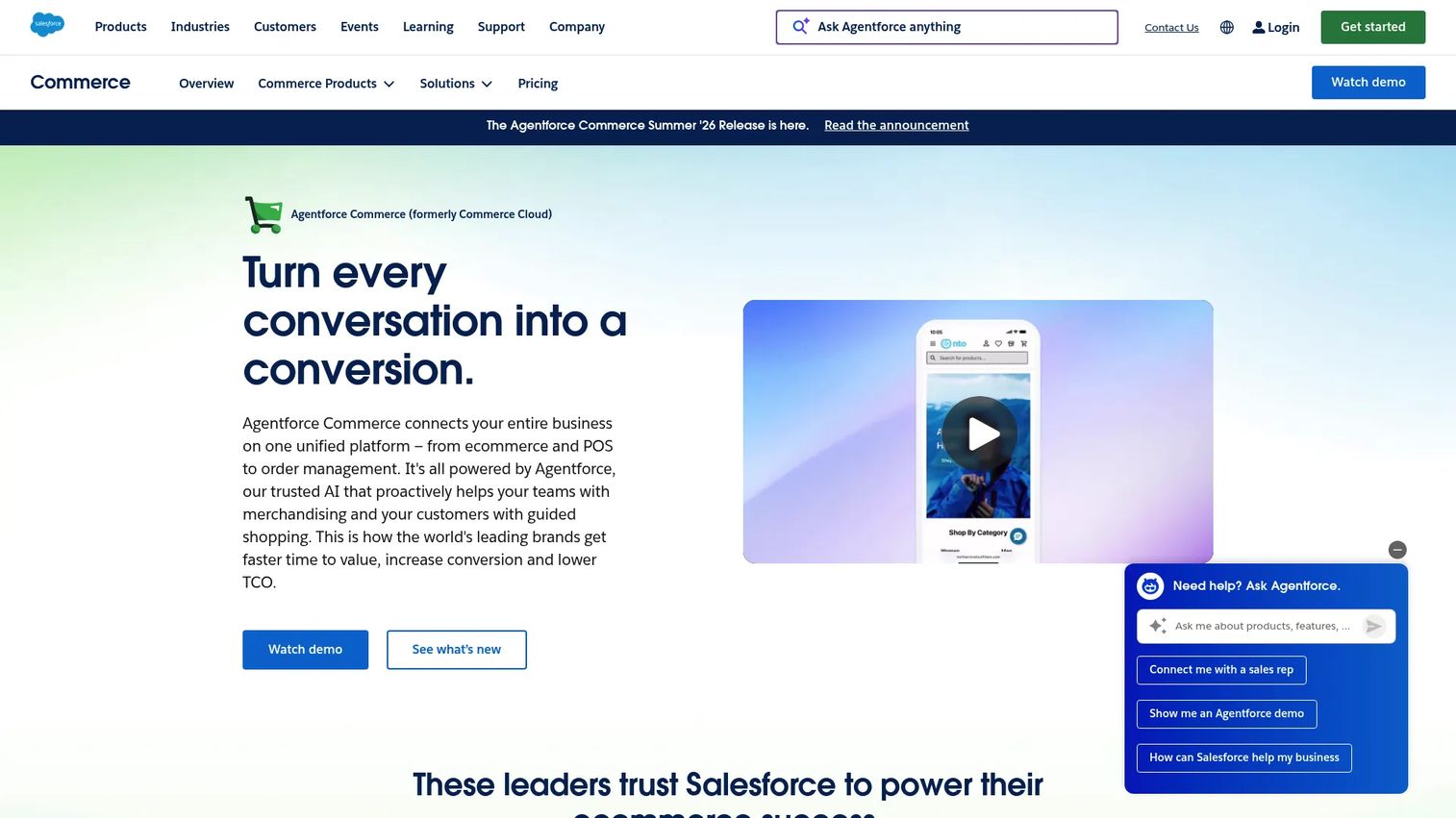
Salesforce Commerce Cloud is an enterprise ecommerce platform for B2C, B2B, and D2C commerce that sits inside the wider Salesforce ecosystem. It brings headless and composable commerce, order management, payments, and CRM-driven personalization into one stack. For teams already running Salesforce for sales and service, commerce data flows into the same customer record.
Best for: Large brands invested in Salesforce that want commerce, CRM, and personalization in a unified stack.
Key strengths
- CRM-native alignment: Commerce, sales, and service data share one customer record, which sharpens personalization and segmentation.
- Omnichannel and personalization: AI-driven recommendations and unified order management support consistent experiences across channels.
- Composable and headless options: Build flexible storefronts while keeping the managed platform underneath.
Why choose Salesforce Commerce Cloud: The case is strongest when Salesforce is already your system of record. Commerce becomes an extension of the customer data you already trust, rather than another silo. Teams without a Salesforce investment will weigh that ecosystem dependency carefully.
Salesforce Commerce Cloud pricing: Salesforce shows the B2C Premium plan as contact-for-pricing. Foundations is available at no cost for eligible Sales and Service Enterprise Edition customers, and success plans range from a standard tier included in licenses up to premier and signature tiers. G2 reports a 4.4/5 rating.
3. SAP Commerce Cloud
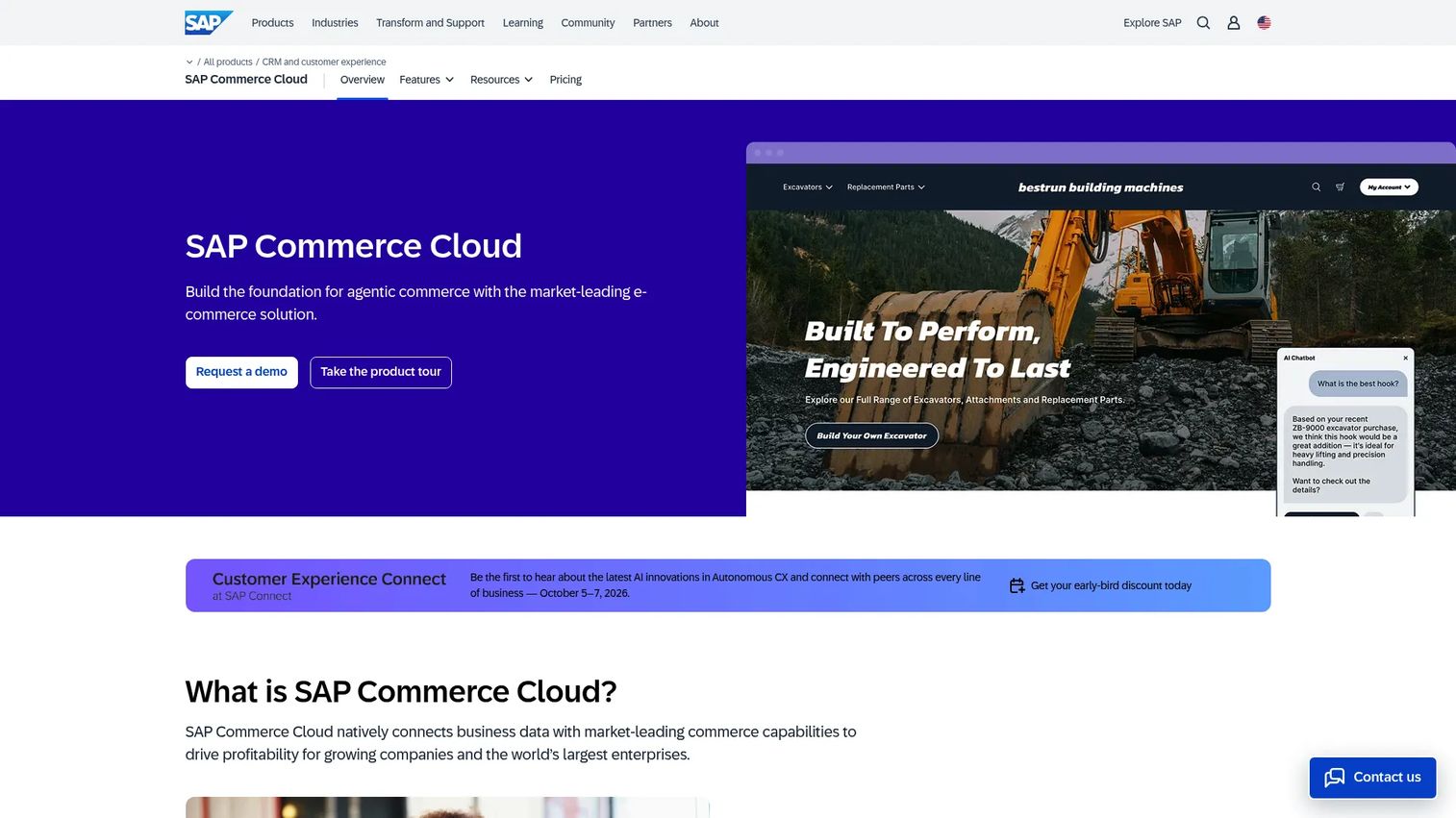
SAP Commerce Cloud runs B2B, B2C, and B2B2C commerce on a single platform built for complex enterprise requirements. It handles deep product catalogs, pricing, promotions, payments, search, and order management, with a composable storefront and broad customization. For organizations already standardized on SAP, the integration depth across ERP and back-office systems is the draw.
Best for: Large enterprises that need complex, scalable commerce across multiple channels and business models.
Key strengths
- Multi-model commerce: B2B, B2C, and B2B2C operate on one platform, so a single system serves distributors, retailers, and direct buyers.
- Deep product data: Robust catalog, pricing, and promotion handling supports complex, configurable product structures.
- Enterprise integration: Native fit with SAP ERP and back-office systems reduces integration work for SAP-standardized organizations.
Why choose SAP Commerce Cloud: It fits large organizations with mature SAP stacks and complex B2B requirements. The platform rewards enterprises that need one commerce backend across many business models and want it wired into existing SAP operations. G2 reports a 4.3/5 rating.
SAP Commerce Cloud pricing: SAP does not display a public price. Its technical documentation describes standard, professional, and enterprise editions with optional cloud subscriptions, and pricing is arranged through SAP directly.
4. commercetools
commercetools is a composable commerce platform built for enterprise brands that want API-first, headless flexibility. It supports unlimited catalogs, channels, and storefronts, plus B2B capabilities like business units, approval flows, and quote management. Technical teams choose it when they want to assemble best-of-breed services rather than accept a fixed monolith.
Best for: Enterprise teams building flexible, API-driven commerce experiences with full architectural control.
Key strengths
- Composable architecture: Packaged business capabilities for catalog, cart, and checkout assemble into a custom commerce stack.
- API-first and headless: Decoupled frontend and backend let teams deliver any experience across web, app, and emerging channels.
- B2B depth: Business units, approval flows, and quote management support complex account-based selling.
Why choose commercetools: It fits engineering-led organizations that treat commerce as composable infrastructure. The reward is freedom to evolve each piece independently without replatforming the whole system. Teams with the technical capacity to design and operate a composable stack get the most value.
commercetools pricing: commercetools does not list a numeric price publicly; the pricing page directs buyers to contact sales and offers a free trial entry point. Add-ons cover support, compliance, checkout, and testing. G2 reports a 4.5/5 rating.
5. BigCommerce Enterprise
BigCommerce Enterprise is a SaaS enterprise ecommerce platform for high-volume brands that want B2B and B2C capabilities without heavy infrastructure ownership. It offers multi-storefront management, headless capabilities, and price lists for account-specific pricing. The SaaS model means BigCommerce handles hosting, security, and platform maintenance.
Best for: Large merchants that want customizable enterprise commerce with B2B/B2C features and less platform overhead.
Key strengths
- Multi-storefront: Run several storefronts across brands and regions from one account.
- Headless capabilities: Decouple the frontend when you want a custom experience while keeping the SaaS backend.
- Price lists: Apply customer-specific and segment-specific pricing for B2B and wholesale buyers.
Why choose BigCommerce Enterprise: It fits companies that want enterprise capabilities while letting the vendor carry infrastructure responsibility. The SaaS model speeds deployment and reduces the operational load on your team, which suits organizations that prefer to focus engineering effort on the storefront rather than the stack underneath.
BigCommerce Enterprise pricing: BigCommerce prices the enterprise tier by quote; the enterprise page states pricing is customized and does not display a public figure. There is no free tier at the enterprise level.
6. Shopify Plus
Shopify Plus is an enterprise commerce platform for high-growth brands that want speed to launch and operational simplicity. It delivers a fully customizable checkout, unlimited staff accounts, and unlimited B2B catalogs on Shopify's managed infrastructure. Teams that prioritize getting live fast and running lean operations gravitate to it.
Best for: Large merchants that need enterprise commerce, B2B, and advanced checkout control without heavy implementation cycles.
Key strengths
- Fully customizable checkout: Control checkout logic and branding, which historically required workarounds on Shopify.
- Unlimited staff accounts: Scale team access without per-seat friction across large organizations.
- Unlimited B2B catalogs: Run B2B and B2C from the same platform with separate catalogs and pricing.
Why choose Shopify Plus: It fits teams that value speed and ease of operation over deep architectural control. You launch faster and maintain less, which is exactly the right trade for brands that want to move quickly and keep operations simple as they scale.
Shopify Plus pricing: Shopify Plus starts at $2,300 USD per month on a 3-year term, or $2,500 USD per month on a 1-year term, billed monthly. There is no free tier. More complex business structures may carry variable platform-fee terms. G2 reports a 4.4/5 rating.
7. Oracle CX Commerce

Oracle CX Commerce is Oracle's cloud commerce platform for building customizable B2C and B2B storefronts. It covers storefront design and management, multi-store operations, localization, search, SEO, promotions, and personalization. For organizations already running Oracle across the back office, it slots into a familiar ecosystem.
Best for: Enterprises that need a highly customizable, Oracle-hosted commerce storefront within an Oracle-centric stack.
Key strengths
- Customizable storefronts: Design and manage storefront experiences with control over layout and behavior.
- B2C and B2B support: Serve both direct consumers and business buyers from one platform.
- Global capabilities: Multi-store, localization, search, and promotions support multi-region operations.
Why choose Oracle CX Commerce: The case is strongest for Oracle-centric enterprises that want commerce inside the same vendor ecosystem as their ERP and CX tools. Integration dependencies and implementation effort favor organizations already committed to Oracle, where the alignment reduces friction across systems.
Oracle CX Commerce pricing: Oracle does not publish a public price. Its documentation indicates a subscription is required and directs buyers to contact Oracle sales for details.
8. VTEX
VTEX is an enterprise commerce platform built for unified operations across D2C, B2C, B2B, and marketplaces. It pairs native marketplace and order management capabilities with AI-powered customer experience and conversational commerce. For global brands that want one stack instead of stitching point solutions together, VTEX shows up in unified commerce conversations.
Best for: Large brands that need a single enterprise commerce stack spanning commerce, marketplace, and CX.
Key strengths
- Unified commerce: D2C, B2C, B2B, and marketplace operations run on one platform rather than separate systems.
- Native marketplace and OMS: Built-in marketplace and order management reduce the need for bolt-on tools.
- AI-powered CX: Conversational commerce and AI customer experience features extend engagement.
Why choose VTEX: It fits organizations operating across multiple commerce models and regions that want to consolidate onto one backend. The unified approach reduces the integration burden of running separate B2B, B2C, and marketplace platforms, which matters most for global operators. G2 reports a 4.5/5 rating.
VTEX pricing: VTEX does not display public pricing; the site directs visitors to contact the team or request a demo for pricing details.
9. Spryker
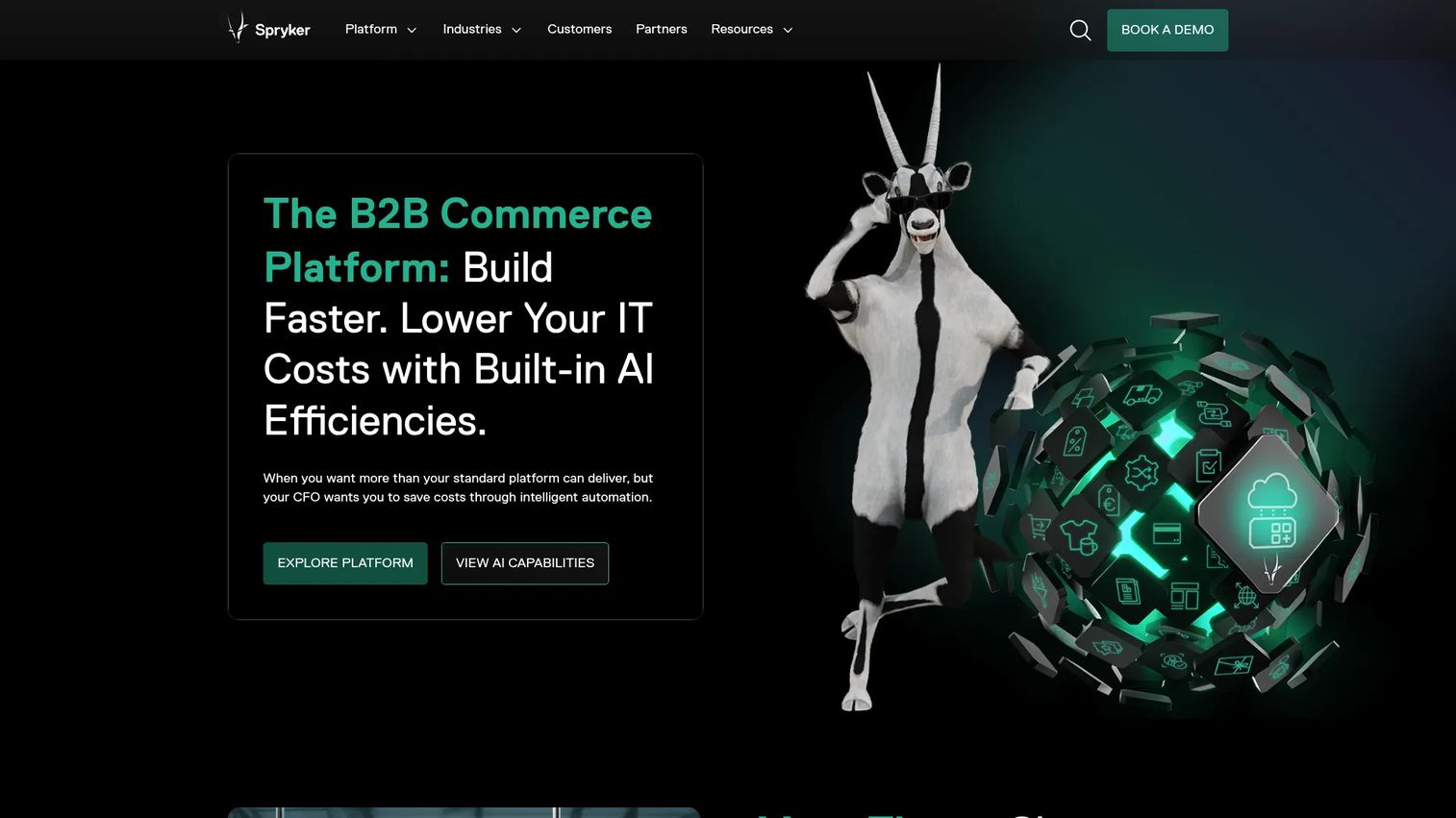
Spryker is an enterprise digital commerce platform for B2B, B2C, and marketplace use cases. Its headless, API-first design and modular architecture let technical and product-led teams build commerce around specific workflows rather than fitting workflows to the platform. It is a common choice for sophisticated B2B and marketplace models.
Best for: Large enterprises that need a composable commerce platform for complex B2B and marketplace workflows.
Key strengths
- Headless and API-first: Decoupled architecture supports any frontend and emerging channels.
- Modular and customizable: Assemble and extend modules to match specific commerce requirements.
- Multi-model support: Marketplace, B2B, and omnichannel scenarios run on the same flexible foundation.
Why choose Spryker: It fits technical and product-led commerce teams that treat the platform as a building block, not a finished product. The modular approach rewards organizations with the capacity to design commerce around their own workflows and unusual business models. G2 reports a 4.4/5 rating across roughly 140 reviews.
Spryker pricing: Spryker does not publish a public price. Pricing is sales-led and arranged through the vendor.
10. Intershop
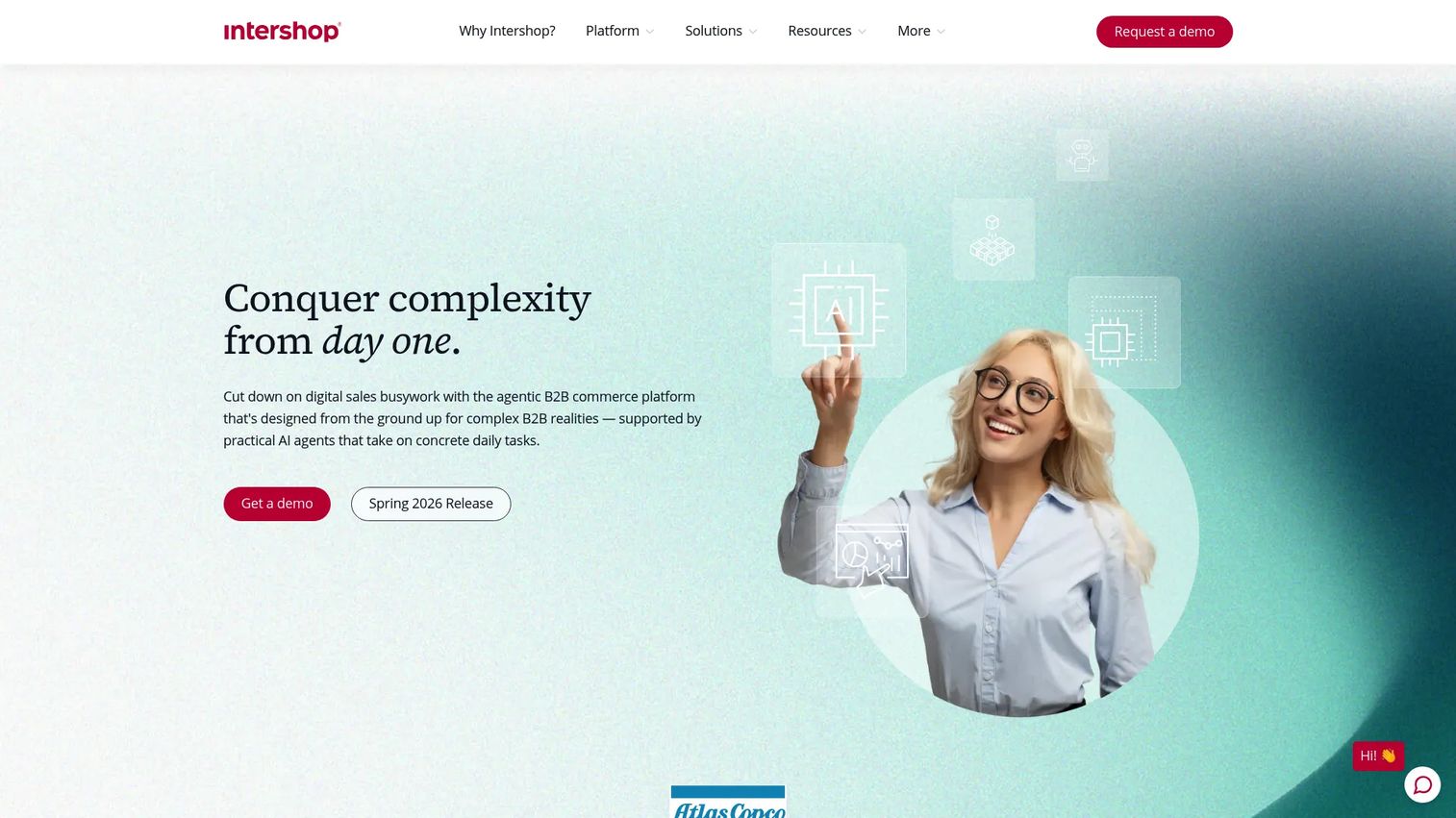
Intershop is a B2B commerce platform built for manufacturers and wholesalers. It pairs out-of-the-box B2B capabilities with an API-first, headless architecture and AI copilots and agents. For organizations with complex procurement, account structures, and long-term extensibility needs, it offers B2B depth without building from scratch.
Best for: Enterprise B2B manufacturers and wholesalers that need a scalable commerce platform with native B2B workflows.
Key strengths
- Out-of-the-box B2B: Account hierarchies, procurement workflows, and B2B logic ship as core capabilities.
- API-first and headless: Flexible architecture supports custom frontends and integrations.
- AI copilots and agents: Built-in AI assists merchandising and operational workflows.
Why choose Intershop: It fits manufacturers and wholesalers that need deep B2B functionality on day one and room to extend over time. The combination of native B2B workflows and headless flexibility suits organizations with complex account structures that want to avoid heavy custom development. G2 reports a 4.4/5 rating.
Intershop pricing: Intershop states there are three subscription levels but does not show a public numeric price on its pricing page.
11. OroCommerce
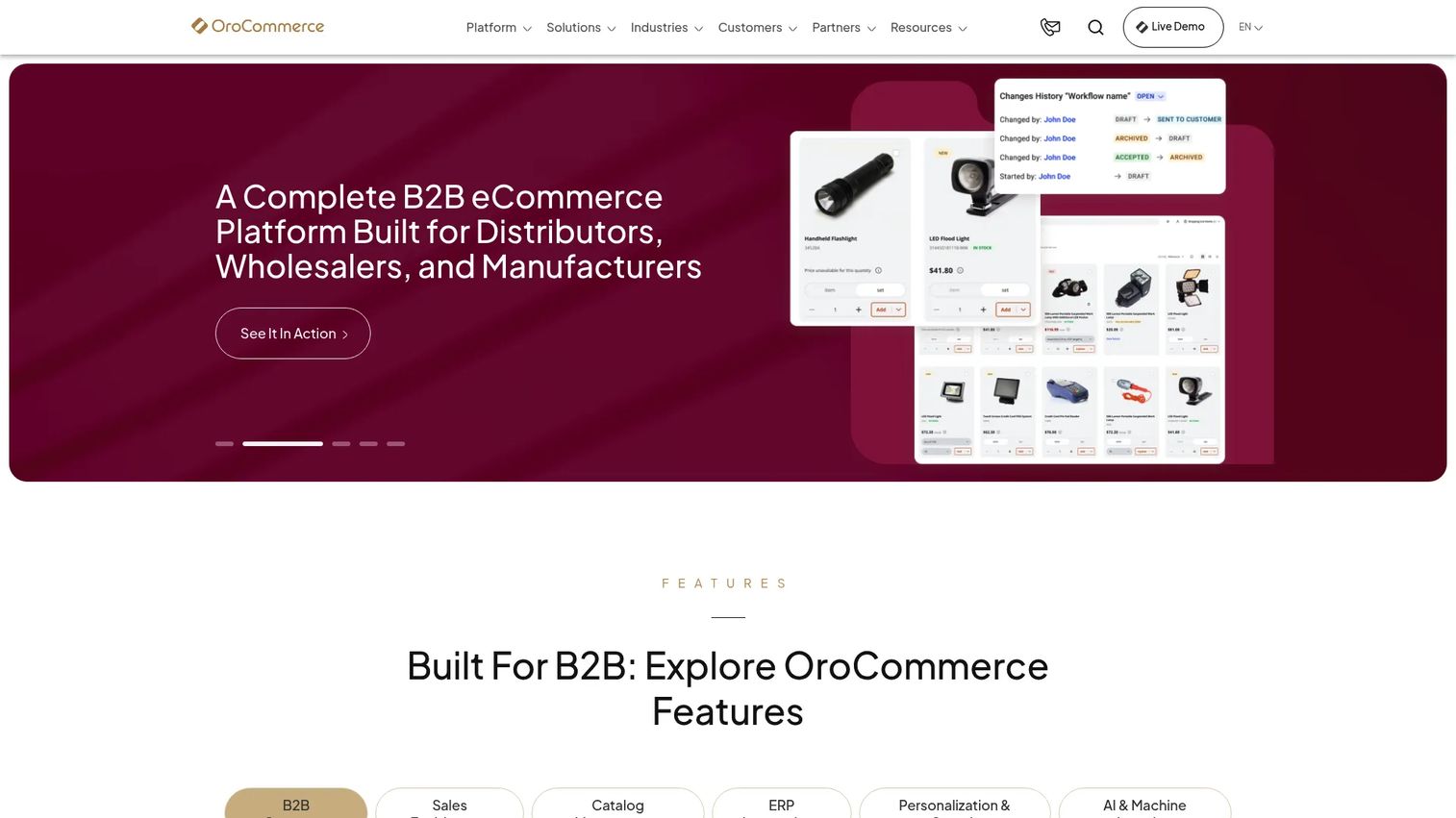
OroCommerce is an AI-enabled B2B commerce platform for manufacturers, distributors, and wholesalers. It combines multi-org and multi-site management, AI SmartOrder and Smart Agent features, and a built-in CRM with unified commerce workflows. The B2B-first architecture handles complex selling motions that consumer-oriented platforms struggle with.
Best for: Large B2B businesses that need a unified commerce platform for complex selling workflows and account management.
Key strengths
- Multi-org and multi-site: Manage multiple organizations and sites with distinct catalogs and pricing.
- Built-in CRM: Native CRM ties commerce to account management without a separate integration.
- AI commerce workflows: SmartOrder and Smart Agent features streamline ordering and operational tasks.
Why choose OroCommerce: It fits B2B manufacturers and distributors that need account management and complex selling workflows as first-class capabilities. The built-in CRM and B2B-first design reduce the work of bolting account logic onto a platform that was not built for it. G2 reports a 4.3/5 rating.
OroCommerce pricing: OroCommerce uses quote-based pricing aligned to GMV bands and admin users. The pricing page directs buyers to talk to sales; no public starting price is shown.
12. Optimizely Configured Commerce
Optimizely Configured Commerce is B2B commerce software for manufacturers and distributors, with built-in tools for pricing, quoting, self-service, and integrations. It supports customer-specific pricing and catalogs, quoting and self-service portals, and multi-site, multi-lingual commerce. Teams already using the Optimizely ecosystem gain access to experimentation and optimization alongside commerce.
Best for: B2B manufacturers and distributors that want a configurable commerce platform with experimentation built into the wider Optimizely ecosystem.
Key strengths
- Customer-specific pricing and catalogs: Tailor pricing and product visibility per account for B2B selling.
- Quoting and self-service portals: Support buyer self-service and quote-driven sales motions.
- Multi-site and multi-lingual: Run multiple sites and languages for regional operations.
Why choose Optimizely Configured Commerce: It fits companies that prioritize experimentation and optimization and already lean on Optimizely. The platform pairs configurable B2B commerce with the testing and personalization tools of the broader ecosystem, which appeals to teams that want to optimize commerce continuously. G2 reports a 4.2/5 rating.
Optimizely Configured Commerce pricing: Optimizely lists Configured Commerce on its plans page with a request-pricing CTA. Every plan is individually packaged, and no public price is shown.
13. Broadleaf Commerce
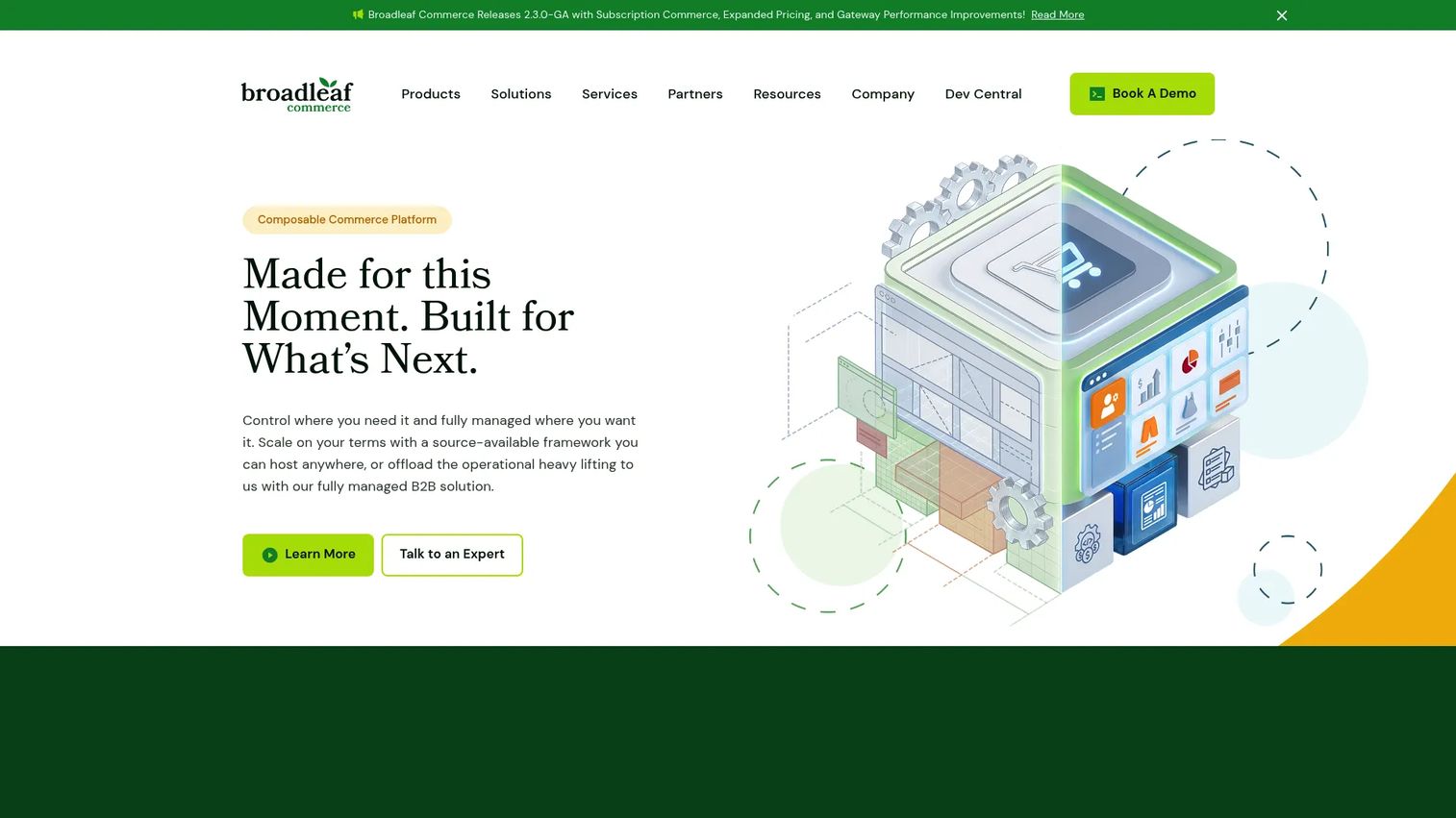
Broadleaf Commerce is a composable commerce platform for enterprise B2B, B2C, and marketplace use cases, built on a Java and Spring Boot microservices architecture. It covers catalog, cart, checkout, pricing, promotions, fulfillment, and order management, with headless and cloud-agnostic deployment. It appeals to teams that want deep extensibility with a practical, phased path to migration.
Best for: Large enterprises that need a highly extensible, customizable commerce platform with control over deployment.
Key strengths
- Microservices architecture: Java and Spring Boot microservices give engineering teams granular control and extensibility.
- Full commerce coverage: Catalog, cart, checkout, pricing, promotions, fulfillment, and order management ship as components.
- Headless and cloud-agnostic: Deploy on the infrastructure you choose with a decoupled frontend.
Why choose Broadleaf Commerce: It fits teams that want maximum control and prefer to migrate in phases rather than all at once. The microservices architecture appeals to engineering-led organizations that value extensibility and the freedom to deploy where they want. G2 reports a 3.9/5 rating.
Broadleaf Commerce pricing: Broadleaf uses enterprise licensing with custom contracts; pricing is not publicly listed.
14. Dynamics 365 Commerce
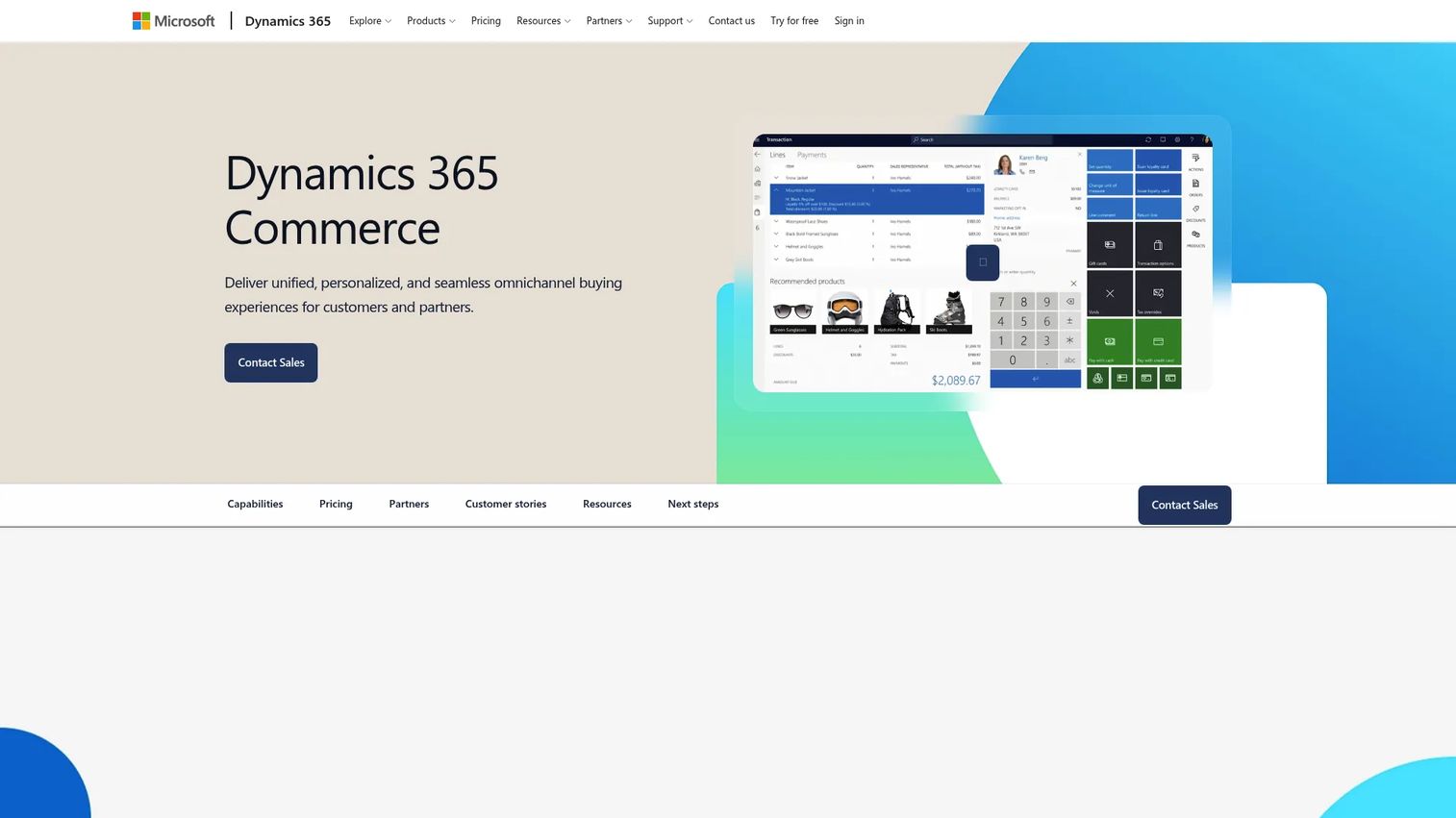
Dynamics 365 Commerce is Microsoft's cloud commerce platform for omnichannel retail. It unifies point of sale, headless composable commerce, distributed order management, and personalization on one platform. For Microsoft-centric organizations, it ties online, in-store, and back-office operations into the wider Dynamics 365 ecosystem.
Best for: Retailers that need unified in-store, online, and back-office commerce on Microsoft Dynamics 365.
Key strengths
- Point of sale: Native POS unifies in-store and online operations on one platform.
- Headless composable commerce: Decoupled architecture supports flexible storefront experiences.
- Distributed order management: Coordinate inventory and fulfillment across channels and locations.
Why choose Dynamics 365 Commerce: It fits retailers already invested in Microsoft that want commerce inside the Dynamics 365 ecosystem. The unified in-store, online, and back-office model suits organizations with physical and digital operations that want one backend across both. G2 reports a 4.3/5 rating.
Dynamics 365 Commerce pricing: The base Dynamics 365 Commerce plan starts at $210.00 per user per month, paid yearly, with an e-Commerce add-on at $4,000.00 per user per month, paid yearly. There is no free tier.
Considerations before you buy
Integration depth
Map every system the platform must connect to: ERP, CRM, PIM, OMS, payment, tax, and analytics. Verify that integrations are native or well-supported, not custom builds you maintain forever. The depth and quality of integrations often predicts implementation cost more than the platform's own feature set.
Data ownership and residency
Confirm where customer and order data lives and who controls it. For multi-region operations, data residency rules can dictate platform choice. Ask whether you can export your data cleanly and what happens to it if you leave the platform.
Security and compliance
Check for PCI DSS, relevant certifications, role-based permissions, and audit trails. If your buyers run security reviews, the platform has to pass them without custom work. Regulated industries should treat compliance support as a hard requirement, not a nice-to-have.
Customization model
Decide how much you want to build versus configure. SaaS platforms speed deployment and reduce maintenance. Composable and self-hosted give control at the cost of engineering ownership. Match the model to your team's capacity, not just your ambition.
Migration path
Replatforming is rarely clean. Evaluate whether the platform supports a phased migration, how it handles data import, and how long a realistic timeline runs. Catalog complexity, integration count, and data quality drive the schedule more than the platform brand.
Total cost of ownership
License price is the smallest part of enterprise ecommerce TCO. Add implementation, integration, ongoing maintenance, engineering time, and the cost of future changes. A cheaper license that demands heavy custom work often costs more over three years than a higher-priced platform that fits cleanly.
Conclusion
The strongest fit patterns across this list come down to operating model, not feature count. If you want composable, API-first control, commercetools, Spryker, and Broadleaf Commerce reward engineering-led teams. If your stack centers on a vendor ecosystem, Salesforce Commerce Cloud, Oracle CX Commerce, and Dynamics 365 Commerce keep commerce inside it. For complex B2B, SAP Commerce Cloud, OroCommerce, Intershop, and Optimizely Configured Commerce handle account hierarchies and contract pricing. For speed and simplicity at scale, BigCommerce Enterprise and Shopify Plus get high-volume brands live faster, and VTEX unifies global, multi-model commerce.
The next step is to build a shortlist of three platforms that match your control, complexity, and scale profile, then validate architecture fit against your real integration map and migration timeline. Run the TCO math across three years, not just the license quote. Choose for the operating model you will have when you grow, not the one you have today.
FAQs
Enterprise-grade means the platform absorbs high transaction volumes, complex catalogs, multiple regions and brands, deep integrations, and governance requirements without breaking. It is defined by the operational complexity it handles, scale, security, compliance, and global reach, rather than by who uses it. A platform that needs constant workarounds at volume is not enterprise-grade.
The answer depends on workflow depth, ERP integration, and account complexity. SAP Commerce Cloud and Intershop suit organizations needing deep B2B and ERP alignment, OroCommerce leads for built-in CRM and B2B-first selling, and Optimizely Configured Commerce fits manufacturers and distributors. Match the platform to your procurement workflows and account structures, not just the B2B label.
No. Headless is a fit question, not a default upgrade. It decouples the frontend from the commerce backend, which gives flexibility and supports multiple channels, but it also requires the engineering capacity to design and maintain a decoupled architecture. Choose headless when your channel and customization needs justify it, not because it sounds modern.
Total cost of ownership matters more than license price alone. Implementation, integration, ongoing maintenance, engineering time, and the cost of future changes usually dwarf the license fee. A lower-priced platform that demands heavy custom work can cost more over three years than a higher-priced one that fits your operating model cleanly.
Look at compliance and certifications, data residency and ownership, upgrade and replatforming impact, and integration burden. These factors determine whether the platform survives security reviews, supports your regions, and connects to your stack without endless custom builds. Features matter, but operational fit predicts long-term success.
Timelines vary widely by architecture, migration scope, and data complexity. SaaS deployments with straightforward catalogs move faster, while composable or heavily customized builds with complex integrations and data migration take longer. Catalog size, integration count, and data quality drive the schedule more than the platform brand itself.
SaaS is vendor-hosted and managed, fastest to deploy with the least operational overhead. PaaS gives a managed platform with more room to customize. Self-hosted puts full control and full responsibility on your team. Each model trades control against operational burden differently, so match it to your team's engineering capacity.
Yes. Enterprise platforms typically support multi-store, multi-currency, multi-language, and regional compliance, which are the building blocks of global operations. Platforms like VTEX and SAP Commerce Cloud are built for unified, multi-region commerce. Confirm specific data residency and tax handling for each region you plan to enter before committing.