
You crossed the economic nexus threshold in four new states last quarter. Nobody told finance. Then a filing deadline slipped, and a $600 penalty showed up on a state portal your team forgot existed.
That is how sales tax breaks at scale. Not with one big mistake, but with a slow accumulation of jurisdictions, rate changes, and deadlines that a spreadsheet can no longer track. An estimated 97% of retailers have automated or plan to automate their sales tax compliance processes, according to Swell (2025). The reason is simple: manual tax handling stops scaling right about when your revenue starts to.
Sales tax automation software calculates the right rate on every transaction, tracks where you owe, and files returns before the deadline. The right tool cuts error risk, gives your finance team hours back, and fits the ecommerce, ERP, or API stack you already run. The wrong one becomes another manual workflow wearing a subscription badge.
This guide compares the tools that actually reduce the drag, not just the ones with the loudest homepages.
What's inside
This guide is for finance leaders, founders, and RevOps operators who need to stop manual tax work from breaking compliance as the business scales.
We selected nine sales tax software tools based on four criteria that matter when you are choosing what to run:
- Real-time tax calculation across multi-jurisdiction rules and rate changes
- Filing and remittance automation so returns stop living in spreadsheets
- Integrations with ecommerce, ERP, marketplace, and API-based billing stacks
- Jurisdiction coverage and trust signals including nexus tracking and reliability
The list spans SMB-friendly, mid-market, and enterprise options so you can match the tool to your stage.
TL;DR
- Best for broad enterprise tax compliance: Avalara, with a modular indirect tax suite and 1,400+ integrations.
- Best for modern commerce teams: TaxJar, for fast setup and automated filing.
- Best for complex ERP-led global tax: Thomson Reuters ONESOURCE.
- Best for lean ecommerce teams: TaxCloud, starting at $19/month with a free tier.
- Best for SaaS and usage-based billing: Anrok.
- Best for Stripe-native automation: Stripe Tax.
- Best for enterprise tax engines: Vertex.
- Best for global compliance breadth: Sovos.
- Best for simpler invoice and digital-service cases: Quaderno.
If you sell across many states and file constantly, start your shortlist with Avalara or TaxJar. If your revenue runs through Stripe or a subscription model, Stripe Tax and Anrok deserve a first look.
Background
What sales tax automation software is
Sales tax automation software is a tool that calculates sales and use tax on transactions, monitors where a business owes tax, and automates the preparation, filing, and remittance of tax returns across jurisdictions.
It replaces the manual chain of looking up rates, tracking nexus by hand, and assembling returns from exported spreadsheets. Core capabilities include:
- Tax calculation: Real-time tax determination at checkout or invoice, accounting for product taxability and destination rules.
- Nexus tracking: Automatic monitoring of economic and physical nexus thresholds by state or country.
- Filing automation: Preparation and submission of returns, often with automated remittance to the right authority.
- Returns and reconciliation: Consolidated transaction records that map to what each jurisdiction expects.
- Integrations: Connections into ecommerce platforms, ERPs, marketplaces, and billing APIs.
- Reporting: Dashboards and exports that show liability, collected tax, and filing status.
The category overlaps with tax calculation software and sales and use tax software, but the defining feature is automation across the full cycle: calculate, track, file, remit.
Why it matters now
Tax rules do not sit still. Rates change at the county and city level, product taxability shifts, and economic nexus laws mean you can owe tax in a state where you have no office and no staff. Sell across marketplaces and multiple channels, and the number of jurisdictions you touch multiplies fast.
The global sales tax software market is projected to grow from about $6.9B in 2023 to $17.2B by 2033, at a 9.5% CAGR, according to Allied Market Research (2024). That growth tracks a real operational problem: manual tax work does not scale, and errors carry direct cost.
A missed filing is a penalty. A wrong rate collected is a liability you may have to repay. For a founder trying to remove themselves from day-to-day exceptions, deadline compliance handled by hand is exactly the kind of fragile, founder-dependent process that automation is built to retire.
When to use sales tax automation software
You sell across multiple states or jurisdictions
Once you trigger economic nexus in several states, tracking thresholds and rates by hand becomes a full-time job with no upside. Multi-jurisdiction tax rules differ by product category and destination, and they change without warning. Automation applies the correct rate on every transaction and flags new nexus obligations before they turn into a surprise liability.
You need filing and remittance to stop living in spreadsheets
If your month-end close involves exporting transactions, sorting by state, and manually keying returns into portals, you have a scaling problem. Sales tax filing software prepares and submits returns on schedule, often with automated remittance. That removes the deadline risk and the human error that comes from repetitive manual entry.
You run ecommerce, marketplaces, ERP, or API-based billing
Ecommerce tax automation matters most when transaction volume is high and channels are fragmented. If you sell through a storefront, a marketplace, and a subscription API, tax has to be consistent across all three. Tools with strong ERP tax integration and API tax integration calculate tax at the point of sale and feed clean records back into your finance stack.
Comparison table
Pricing and G2 ratings below are drawn from vendor pricing pages and G2 listings as of mid-2026. Verify current figures before you buy, since tiers and ratings shift.
| # | Product | Best for | Key differentiator | Pricing | G2 rating |
|---|---|---|---|---|---|
| 1 | Avalara | Broad enterprise compliance | Modular indirect tax suite, 1,400+ integrations | From $79 state/month | 4.0/5 |
| 2 | TaxJar | Modern commerce teams | AutoFile automated filing | From $39/mo | Not listed |
| 3 | Thomson Reuters ONESOURCE | ERP-led global tax | Corporate tax and trade suite | Custom pricing | 3.8/5 |
| 4 | TaxCloud | Lean ecommerce teams | Low entry price with free tier | From $19/mo | 4.5/5 |
| 5 | Anrok | SaaS and usage-based billing | Real-time exposure monitoring | From $100 per market/mo | 4.4/5 |
| 6 | Stripe Tax | Stripe-native teams | Native Stripe integration | From $90/mo or 0.5%/txn | 4.5/5 |
| 7 | Vertex | Enterprise tax engines | Revenue-based indirect tax engine | Custom pricing | 4.4/5 |
| 8 | Sovos | Global compliance breadth | E-invoicing and regulatory reporting | From $499 | Not listed |
| 9 | Quaderno | Invoicing and digital services | Flat-rate tax and invoicing | From €29/mo | Not listed |
Best sales tax automation software for 2026
1. Avalara

Avalara is a tax compliance platform built for businesses that need automated indirect tax across many jurisdictions. Its product family covers sales tax calculation, returns filing, exemption certificate management, and e-invoicing, so a growing finance team can consolidate several manual workflows into one system. The scale of its integration network makes it a common default for companies already running a complex stack.
Best for: Mid-market and enterprise teams that need broad, multi-jurisdiction tax compliance software across ecommerce and ERP.
Key strengths
- AvaTax: Real-time sales tax calculation by destination and product taxability
- Managed Returns: Automated filing and remittance across states
- Exemption Certificate Management: Collect and store exemption docs
- E-invoicing and live reporting: Compliance for global reporting mandates
- 1,400+ integrations: Connects to ecommerce, ERP, and billing systems
Why choose Avalara: If you are managing tax across dozens of jurisdictions and multiple systems, Avalara's breadth and integration count reduce the number of tools you stitch together. It fits teams that value consolidation over a single-purpose tool.
Avalara pricing: Core Compliance starts at $79 per state/month, or $799 per state/year. Core Compliance plus SST Services is $699 per state/year. Custom pricing applies to larger or quote-based deployments.
2. TaxJar
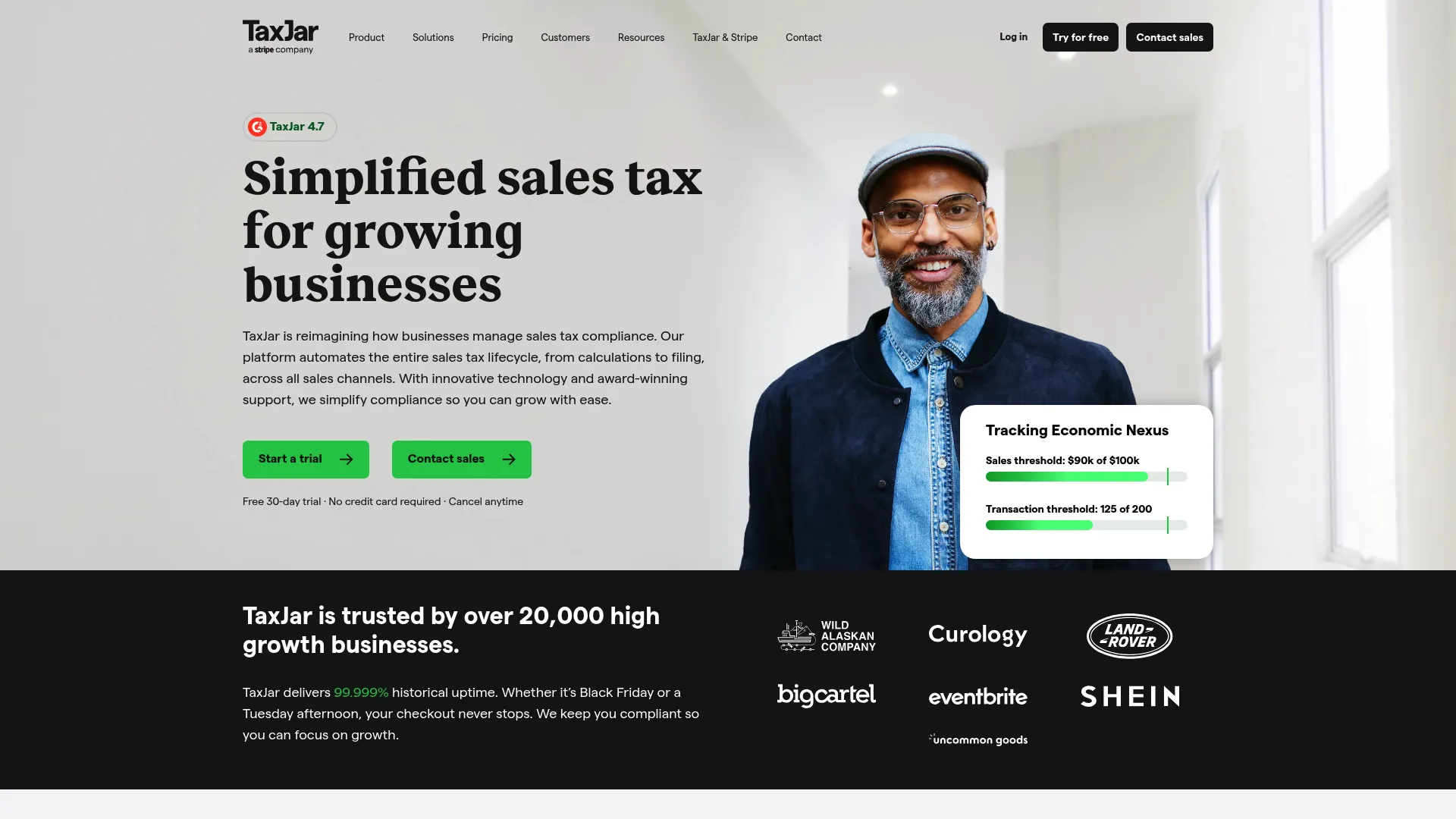
TaxJar is sales tax compliance software built for modern commerce, handling calculation, reporting, filing, and nexus monitoring in one place. It is known for fast implementation and reliable automated filing, which makes it a strong fit for leaner ecommerce and SaaS teams that want speed without heavy setup. A 30-day free trial lets you test the workflow before committing.
Best for: Ecommerce and SaaS businesses that want US sales tax automation and hands-off filing.
Key strengths
- Real-time calculations: Accurate rates at checkout across US jurisdictions
- Reporting and analysis: Clean transaction reports mapped to state requirements
- AutoFile: Automated return filing on schedule
- Economic nexus insights: Alerts when you approach new thresholds
- Integrations and API: Connects to major carts and custom billing
Why choose TaxJar: TaxJar suits teams that want to get running fast and trust filing to run in the background. It trades the sprawling enterprise feature set for a cleaner, commerce-focused path.
TaxJar pricing: Starter is $39/month and Professional is $99/month, with a 30-day free trial. Annual billing offers savings, and higher-volume Professional plans are available through sales.
3. Thomson Reuters ONESOURCE

Thomson Reuters ONESOURCE is a cloud-based corporate tax and trade suite for large enterprises with complex, global obligations. Beyond sales and use tax, it handles direct tax, statutory reporting, and global trade management, which makes it a fit for organizations that need tax governance woven into their ERP and finance operations.
Best for: Large enterprises needing integrated tax, trade, and compliance automation across regions.
Key strengths
- Indirect tax automation: Sales/use tax, GST, and VAT determination
- Direct tax and statutory reporting: Reconciliation and compliance workflows
- Global trade management: Cross-border trade and duty handling
- Integrations and APIs: Connects into enterprise ERP systems
Why choose Thomson Reuters ONESOURCE: Choose ONESOURCE when tax is an enterprise governance problem, not just a checkout calculation. It fits finance organizations that need one platform spanning indirect tax, direct tax, and trade.
Thomson Reuters ONESOURCE pricing: Public pricing is not listed; the vendor directs buyers to contact sales for a custom quote based on scope and modules.
4. TaxCloud
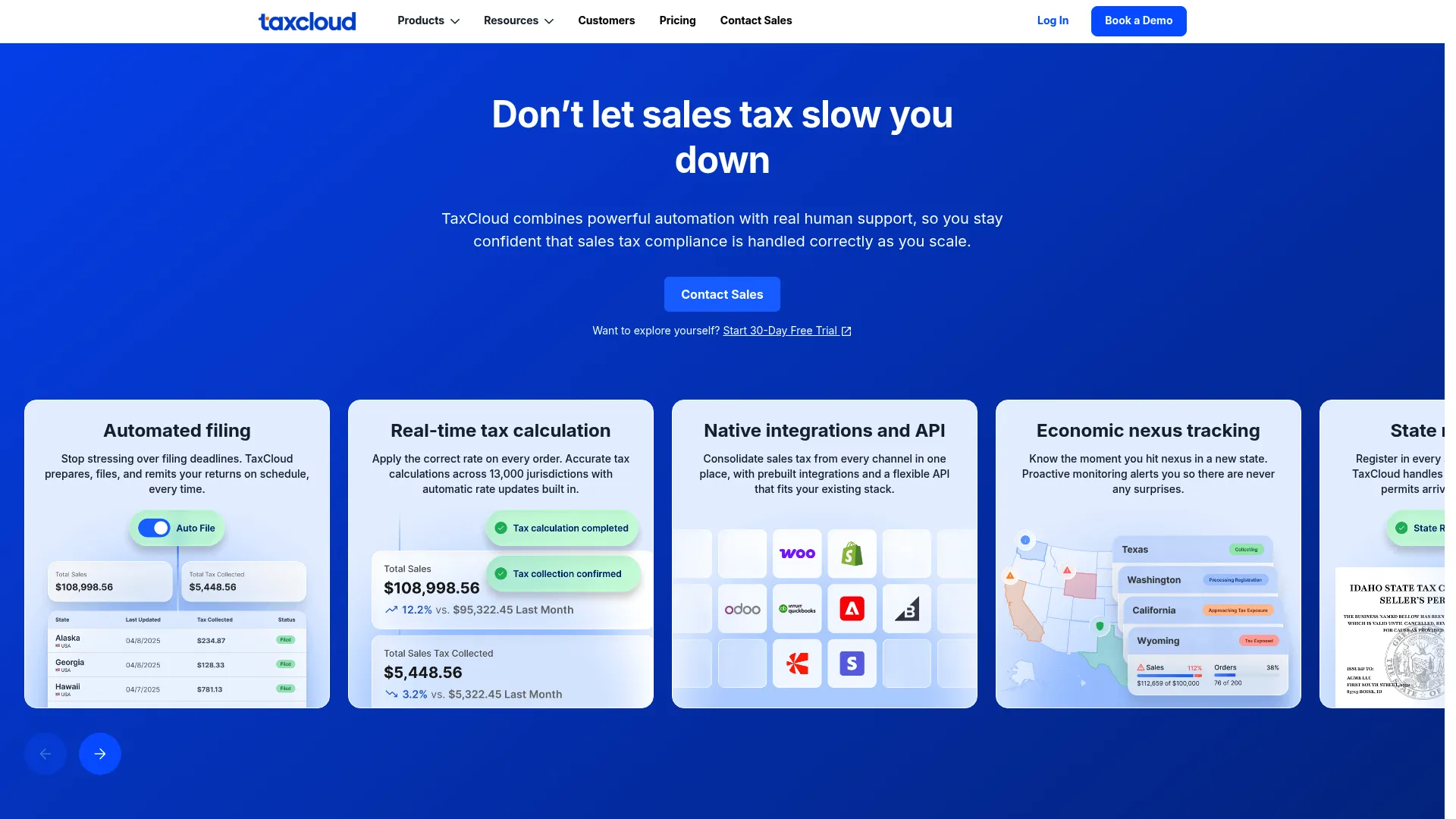
TaxCloud is sales tax compliance software aimed at ecommerce and SaaS brands that want straightforward compliance without enterprise pricing. It covers calculation, filing, remittance, nexus monitoring, and exemptions, and its low entry price and free trial make it accessible for smaller teams handling multi-state obligations for the first time.
Best for: US ecommerce or SaaS businesses that need affordable sales tax compliance automation.
Key strengths
- Real-time calculation: Accurate rates across US jurisdictions
- Filing and remittance: Returns prepared and submitted to authorities
- Nexus monitoring: Tracks where obligations arise
- Reporting and exemptions: Handles exempt transactions and reporting
Why choose TaxCloud: TaxCloud is the value pick for teams that want real compliance help without a large budget. It covers the core cycle cleanly and scales as your jurisdiction count grows.
TaxCloud pricing: Starter is $19/month or $199/year, and Premium is $79/month or $799/year. A 30-day free trial is available, and filing services are priced separately.
5. Anrok

Anrok is a sales tax and VAT compliance platform built for modern software businesses. It focuses on the tax logic that trips up SaaS and usage-based models, with real-time exposure monitoring, calculation, filing, remittance, and VAT ID validation. For subscription revenue that spans many markets, that specialization is the draw.
Best for: SaaS and digital-product companies needing automated sales tax and VAT across multiple markets.
Key strengths
- Real-time exposure monitoring: Tracks where you approach obligations
- Calculation, filing, and remittance: Full cycle for sales tax and VAT
- VAT ID validation: Verifies and reconciles VAT IDs
- Revenue-stack fit: Built for subscription and usage billing
Why choose Anrok: Anrok fits SaaS founders and finance teams whose tax complexity comes from subscription and usage models rather than physical goods. It speaks the language of the modern revenue stack.
Anrok pricing: The Starter plan is listed at $100 per market/month, with a separate ecommerce Starter offer at $50 per market/month. A Custom plan is quote-based for larger deployments.
6. Stripe Tax
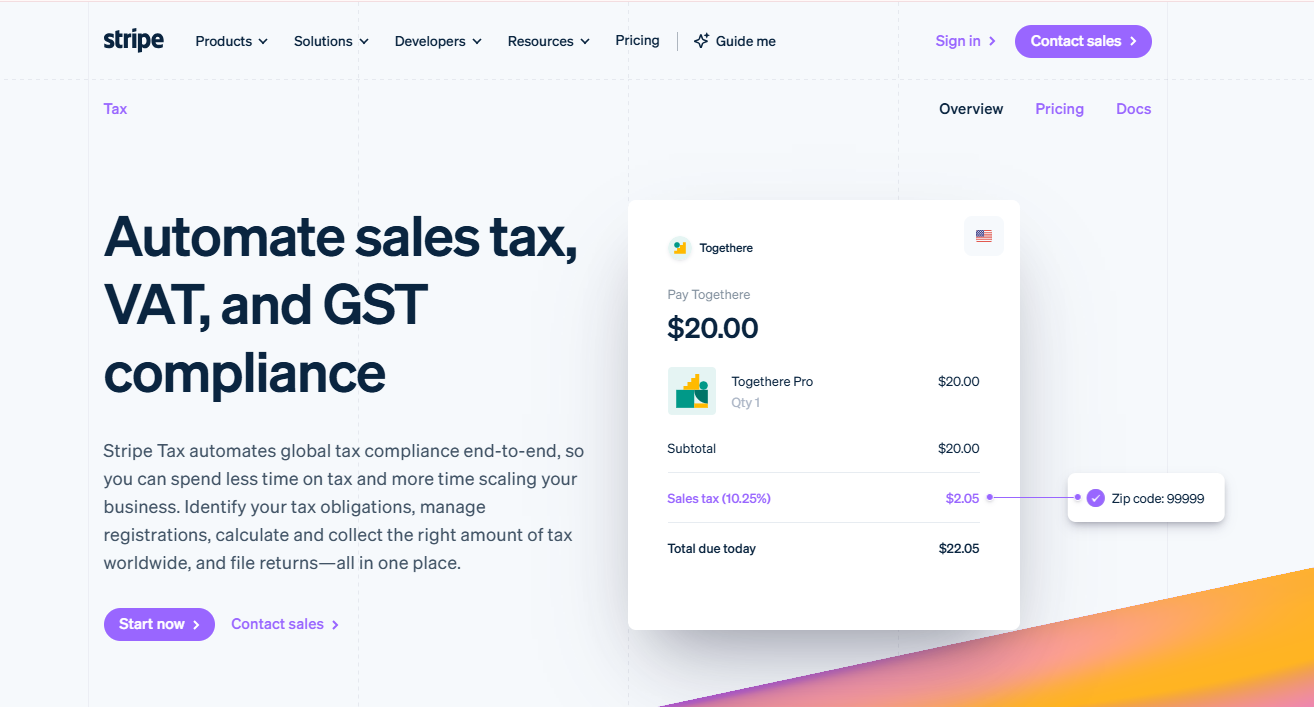
Stripe Tax is Stripe's tax compliance product for calculating, collecting, and filing taxes directly inside the payment flow. For teams already processing revenue through Stripe, it removes a layer of integration work by monitoring obligations, calculating tax in over 100 countries, and supporting filing through Stripe and partners.
Best for: Businesses that already run payments on Stripe and want tax automated in the same system.
Key strengths
- Obligation monitoring: Alerts when you cross tax thresholds
- Calculation and collection: Tax in 100+ countries at checkout
- Filing and reporting: Returns through Stripe and filing partners
- Native Stripe fit: No separate tax integration to build
Why choose Stripe Tax: If your billing already lives in Stripe, Stripe Tax is the lowest-friction path to compliance because there is no separate API tax integration to maintain. It fits developer-led teams that want tax handled where revenue already flows.
Stripe Tax pricing: Tax Basic is pay-as-you-go at 0.5% per transaction for no-code integrations or 50¢ per transaction via API. Tax Complete is subscription-based, starting at $90/month on a one-year contract with tiered pricing above that.
7. Vertex
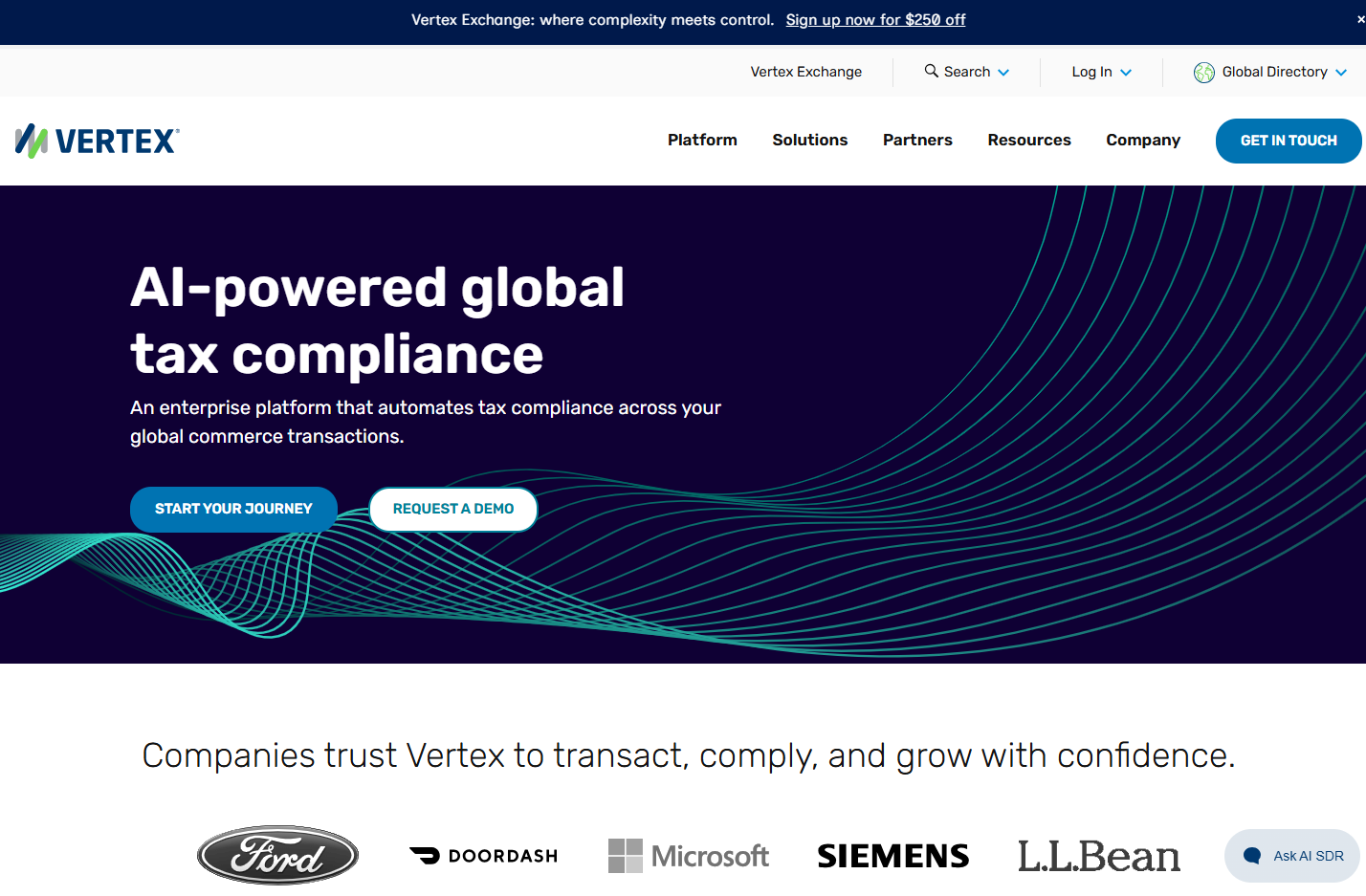
Vertex is enterprise tax compliance software and services for global indirect tax, e-invoicing, and reporting. Its tax engine handles real-time determination across many systems and jurisdictions, which makes it a fit for large-scale finance operations with heavy ERP deployments and complex regulatory exposure.
Best for: Large enterprises needing automated indirect tax across multiple systems and jurisdictions.
Key strengths
- Real-time tax determination: Accurate rates at high transaction volume
- E-invoicing and reporting: Compliance for global mandates
- VAT/GST and sales & use tax: Broad indirect tax coverage
- Enterprise system fit: Built to integrate with major ERPs
Why choose Vertex: Vertex fits enterprises that treat tax determination as core finance infrastructure. Its engine depth and omnichannel coverage suit organizations running high volumes across complex regulatory environments.
Vertex pricing: Vertex uses a revenue-based pricing model and does not publish a starting price. Contact sales for a quote scoped to your transaction volume and systems.
8. Sovos

Sovos is tax compliance and regulatory reporting software for global businesses that need wide international coverage. It combines indirect tax determination, e-invoicing, filing, and information reporting, which positions it for enterprises managing obligations across many countries and regulatory regimes.
Best for: Enterprises needing tax compliance, e-invoicing, and regulatory reporting automation at global scale.
Key strengths
- Global tax compliance: AI-powered compliance across regions
- Indirect tax and e-invoicing: Determination, filing, and reporting
- Information reporting: Withholding and 1099 workflows
- Identity and trust solutions: Verification for regulated processes
Why choose Sovos: Sovos suits organizations whose challenge is regulatory breadth across borders, not just US sales tax. It fits enterprises that need e-invoicing and reporting under many mandates in one platform.
Sovos pricing: Broad enterprise pricing is quote-based. The 1099 Professional sub-product lists public plans starting at $499, $684, and $714, each with a 7-day free trial.
9. Quaderno

Quaderno is tax compliance software for online businesses that automates sales tax, VAT, GST, invoicing, and filing. It leans toward simpler setup and clean invoicing, which makes it the lightweight option for smaller teams and digital-product sellers that want tax and invoicing handled together without heavy configuration.
Best for: SaaS, ecommerce, and digital businesses that want automated global tax compliance with minimal setup.
Key strengths
- Real-time tax calculations: Rates applied at the point of sale
- Tax-ready invoicing: Automated, compliant invoices
- Threshold monitoring: Alerts on approaching tax thresholds
- Filing support: Helps prepare returns across regions
Why choose Quaderno: Quaderno fits smaller teams that value simple setup and combined invoicing over a deep enterprise feature set. It is the straightforward choice for digital-service sellers.
Quaderno pricing: Flat-rate monthly plans scale by transaction volume: Hobby at €29, Startup at €49, Business at €99, and Growth at €149. Enterprise pricing is custom for 2,500+ transactions per month.
Considerations
Before you commit, run the shortlist through a practical checklist tied to how your finance stack actually works.
Integrations with your stack. Confirm the tool connects to your ecommerce platform, ERP, and billing API without custom engineering. ERP tax integration and clean API tax integration are where most implementations succeed or stall. A tool that requires manual exports defeats the purpose.
Filing automation, built in or add-on. Some platforms include tax returns automation in the base plan; others charge separately per filing or per state. Map the true cost across every jurisdiction you file in, not just the headline price.
Jurisdiction coverage and rate updates. Check how many jurisdictions the tool covers and how often it pushes tax rate updates. Nexus tracking should be automatic, flagging new obligations before you cross a threshold rather than after.
Support and onboarding. Review the support model and implementation timeline. Audit support matters if a state ever questions your filings, and fast onboarding matters if you are replacing a manual process mid-year.
Pricing transparency and contract terms. Understand whether pricing is per state, per market, per transaction, or flat. Confirm contract length and what triggers a tier jump, so a good deal at today's volume does not become expensive at next year's.
Match the tool to your internal ownership model. If no one owns tax full-time, favor automation depth and hands-off filing over configurability you will never use.
Conclusion
The right sales tax automation software depends on your stage and stack, not on which vendor has the most features. Avalara and Vertex fit enterprise and heavy ERP environments. Thomson Reuters ONESOURCE and Sovos suit global, multi-regime compliance. TaxJar and TaxCloud serve ecommerce teams that want fast setup and reliable filing. Anrok and Stripe Tax fit SaaS and usage-based revenue, especially when billing already runs through a modern stack. Quaderno covers simpler invoicing and digital-service cases.
The best tool is the one that reduces manual tax work without creating another operational bottleneck. For a founder trying to build founder-friendly operations, that means automation that handles nexus tracking, calculation, and deadline compliance quietly in the background.
Start by mapping your jurisdictions and your stack, then shortlist two tools that fit both. Run each through a trial before your next filing cycle, and pick the one that removes the most manual work from your close.
FAQs
It calculates the correct sales and use tax on each transaction, tracks where your business owes tax through nexus monitoring, and automates the preparation, filing, and remittance of returns. The goal is to replace manual rate lookups and spreadsheet-based filing with an accurate, hands-off workflow across every jurisdiction.
Accounting software records what happened financially; sales tax automation software determines and manages a specific liability. Your accounting tool tracks revenue and expenses, while a tax automation tool applies jurisdiction-specific rates, monitors nexus, and files returns. Many teams run both and connect them, so tax data flows into the books cleanly.
If your obligations are limited and stable, manual filing can work for a while. The trigger to automate is growth: new states, more channels, or rising volume that makes tracking thresholds and deadlines error-prone. Automation earns its place when a missed filing or wrong rate would cost more than the subscription.
Prioritize the systems where your transactions originate: your ecommerce platform, ERP, and billing API. Strong ERP tax integration and API tax integration mean tax is calculated at the point of sale and recorded cleanly, without manual exports. Marketplace and multichannel connections matter if you sell across several storefronts.
Start with real-time calculation accuracy across the states you sell in, then automated filing so returns do not pile up at month-end. Confirm the tool connects to your cart and marketplaces, and that nexus tracking flags new obligations automatically. For high transaction volume, check how pricing scales with orders.
Look for software built around subscription and usage-based billing, since taxability rules for digital products differ by jurisdiction and shift often. Real-time exposure monitoring, VAT handling for international customers, and clean fit with your revenue stack matter more than physical-goods features. Tools designed for SaaS models handle these cases without workarounds.
No. Some tools include filing and remittance in the base subscription, while others charge separately per return or per state. Always confirm whether automated filing is built in or an add-on, and calculate the full cost across every jurisdiction you file in before comparing headline prices.
Enterprise platforms like Vertex and Thomson Reuters ONESOURCE offer deep ERP integration, global coverage, and governance features, usually at custom pricing. SMB-focused tools like TaxCloud and Quaderno publish flat, low entry prices and prioritize fast setup. Match the choice to your jurisdiction count, transaction volume, and whether tax is a dedicated finance function or a background process.