

A pay transparency law just changed in one of the states you operate in. Your handbook references the old rules. Your offer letters quote the wrong disclosures. Your overtime classifications might not hold up. And you found out from a LinkedIn post, not your compliance process.
That is the reality of HR compliance in 2026. Employment law moves at the federal, state, county, and city level, and it moves on different timelines in each. A spreadsheet that tracks 8 states cannot keep pace, and the cost of falling behind is not abstract. According to Mitratech's 2026 State of HR Compliance Report, 75% of HR leaders say their compliance needs have changed, and 54% report those needs have become more complex.
That complexity is why HR teams are moving off manual tracking and onto dedicated software. The right tool monitors law changes for you, regenerates policies when rules shift, and keeps documentation defensible enough to survive an audit. The wrong tool adds another login and another bill without replacing anything.
This guide reviews the best HR compliance software for 2026 across every buyer reality: the solo HR generalist at a 40-person startup, the People Ops lead at a multistate mid-market company, and the compliance specialist at a 2,000-person enterprise. The goal is a shortlist you can actually act on, with pricing and G2 ratings in one place, so you can stop guessing which tool fits your jurisdiction footprint and your budget.
What's inside
This guide is for HR managers, People Ops leads, compliance officers, and operations leaders evaluating HR compliance software at companies from SMB through enterprise. It covers 15 tools, each reviewed for fit, pricing, and where it earns its place in your stack.
We selected and ranked tools on four criteria that matter most to a compliance buyer:
- Jurisdiction and multistate coverage: how many states, counties, and cities the tool tracks, and how it sources updates.
- Automation and payroll/HCM integration: how well it connects to your existing payroll and HRIS to avoid duplicate data entry.
- Audit-ready documentation and reporting: how defensible and exportable its records are.
- Ease of adoption and pricing transparency: how fast a small team can onboard, and whether pricing is published.
TL;DR
Short on time? Here are the decision shortcuts by buyer segment:
- Best for SMBs and first compliance hires: BambooHR, for compliance built into a full HRIS with published per-employee pricing.
- Best for outsourced SMB compliance: Justworks, a PEO that bundles payroll, benefits, and compliance support.
- Best for multistate policy and documents: SixFifty, attorney-built and updated as laws change.
- Best for payroll-adjacent compliance at scale: ADP SmartCompliance.
- Best for compliance training: Cornerstone OnDemand.
- Best for global and EOR compliance: Deel, with Oyster HR as a strong alternative.
- Best for employee relations and investigations: HR Acuity.
What is HR compliance software?
HR compliance software is a category of human resources tools that help employers track, automate, and document adherence to federal and state, and for many tools local (county and city), employment laws. It replaces the spreadsheets, shared folders, and email reminders that break down the moment a company operates in more than a handful of jurisdictions.
The category covers a wide range of compliance work. Some tools focus on one job, like background checks or workplace investigations. Others bundle compliance into a full HRIS or payroll platform. Most HR compliance solutions combine several of the following capabilities:
- Multistate labor-law monitoring and alerts: automatic flags when federal, state, or local rules change.
- Policy and handbook generation: state-specific handbooks and policies that regenerate as laws shift.
- I-9 and E-Verify and onboarding compliance: I-9 and E-Verify requirements verification workflows tied to hiring.
- ACA tracking and reporting: eligibility monitoring and ACA reporting requirements IRS filing support.
- Compliance training delivery: assignable courses with certification tracking.
- Audit-ready documentation and reporting: centralized, exportable records that hold up to scrutiny.
- Payroll and HCM integration: native connections so compliance data does not get re-keyed.
- Case management and investigations: structured intake, documentation, and reporting for employee relations.
No single tool does all of this well. That is why this list spans payroll-native platforms, pure-play employment law software, training LMS tools, and global EOR providers. Picking the right human resources compliance software starts with knowing which of these jobs is your biggest risk.
The shift toward automation is measurable. Airmason's 2026 analysis reports that AI-driven HR compliance tools can deliver a 62% improvement in compliance processes and cut compliance costs by up to 40%. For a function that has historically run on manual effort, that is the real argument for buying software at all.
When to use HR compliance software
Not every company needs dedicated HR compliance software on day one. Here are the three situations where it stops being optional.
Manage compliance across multiple states
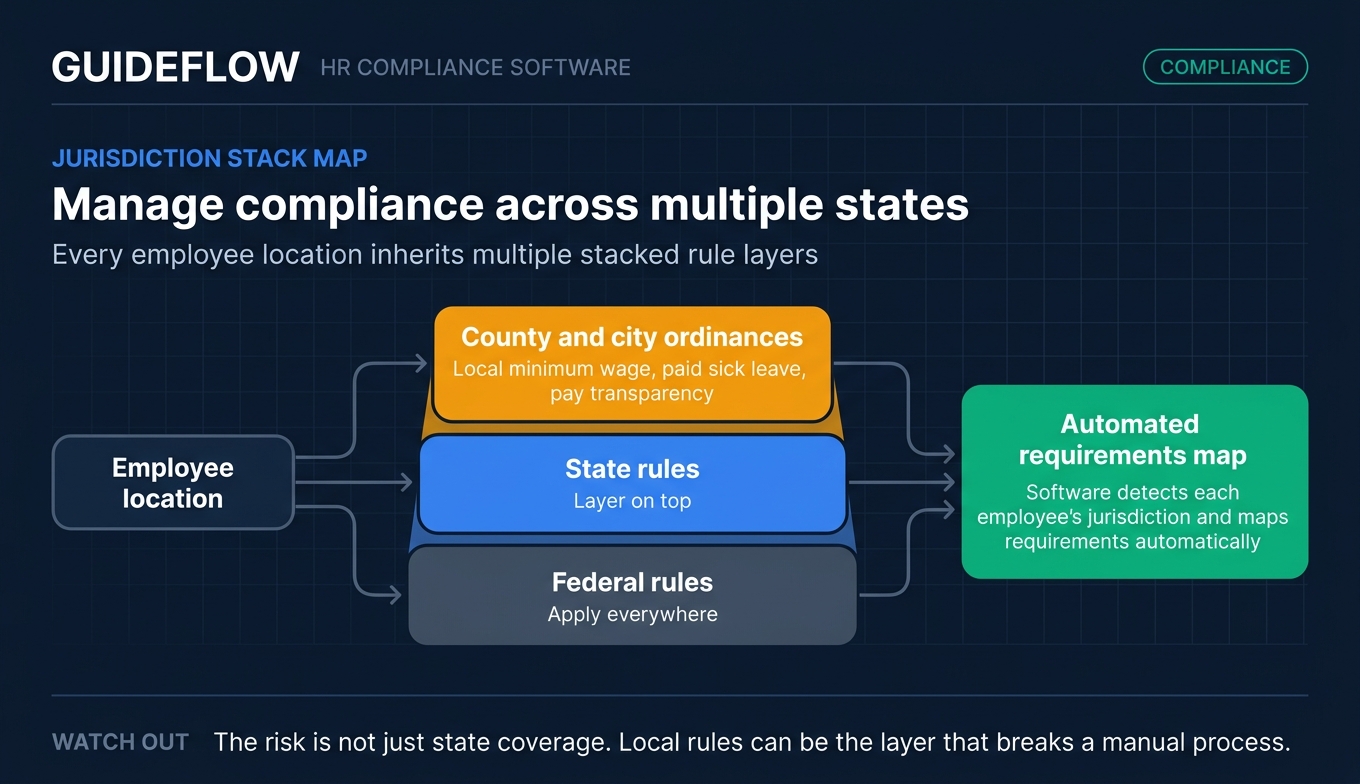
The moment you employ people in more than a few states, compliance obligations start stacking. Federal rules apply everywhere. State rules layer on top. County and city ordinances (think local minimum wage, paid sick leave, and pay transparency) layer on top of that. A spreadsheet cannot reconcile all three for every employee location, and it cannot tell you when one of them changes. Labor law compliance software detects each employee's jurisdiction and maps the requirements automatically, which is the only way this scales past a handful of locations.
Stay audit-ready without manual record-keeping
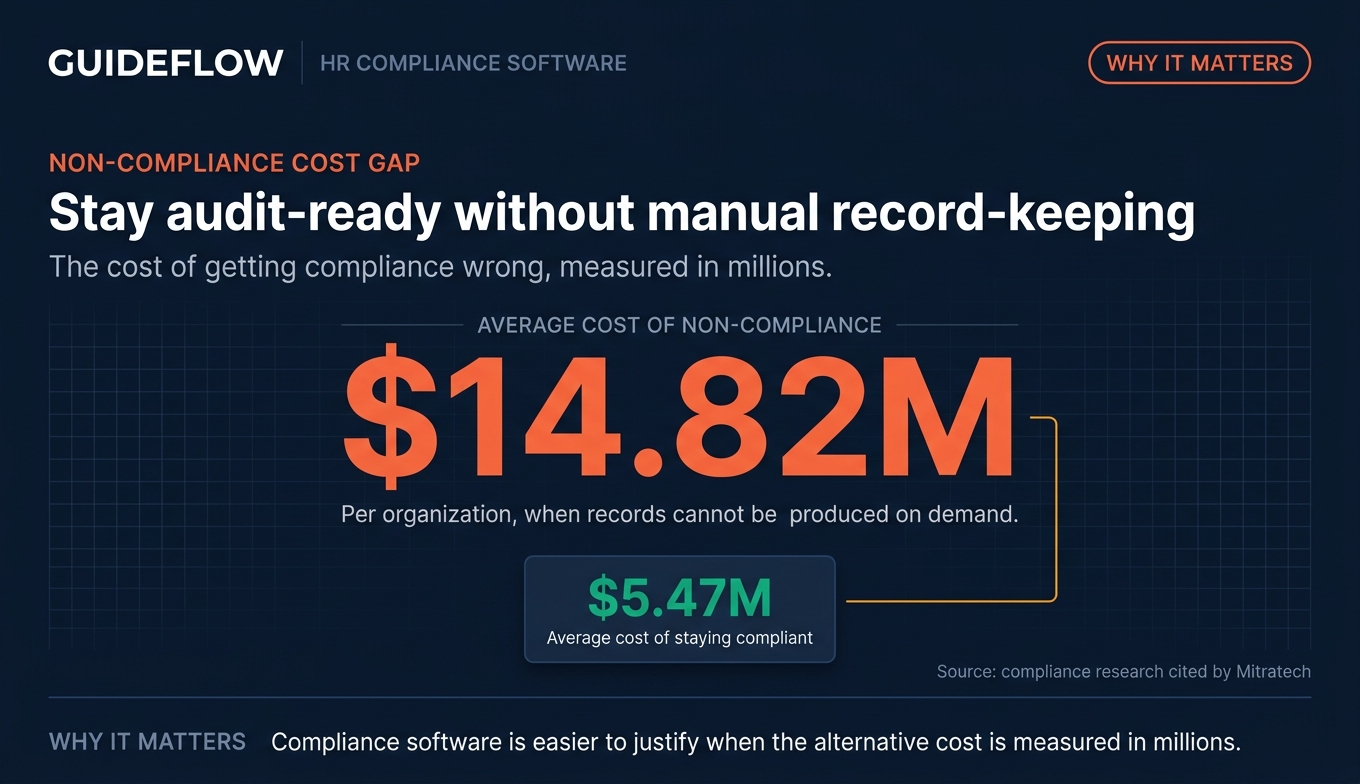
When an agency, plaintiff's attorney, or acquirer asks for records, "we think it's in a folder somewhere" is not an answer. Audit-ready means defensible: timestamped acknowledgments, version-controlled policies, and exportable documentation you can produce on demand. The cost of getting this wrong is real. Compliance research cited by Mitratech puts the average cost of non-compliance at $14.82 million per organization, against $5.47 million for staying compliant. Good documentation is cheap insurance against that gap.
Keep pace with changing labor laws
Employment law does not wait for your quarterly review. New pay transparency, leave, and classification rules take effect on rolling dates across jurisdictions. HR compliance services and software keep pace by monitoring legal sources, alerting you to relevant changes, regenerating affected handbook sections, and assigning required training. That turns compliance from a reactive scramble into a maintained system.
HR compliance software comparison
Most existing guides make you click into each tool to find pricing and ratings. The table below puts the leading HR compliance software companies in one scannable view, sorted by relevance to a compliance buyer. Pricing and G2 ratings were verified against vendor pricing pages and live G2 listings as of June 2026. Where a vendor lists no public price, pricing is custom and quote-based.
| # | Product | Intent | Key use case | Pricing | G2 rating |
|---|---|---|---|---|---|
| 1 | Deel | Global compliance | EOR and contractor compliance across countries | From $5/employee/mo (Core HR) | 4.7/5 |
| 2 | BambooHR | SMB HRIS compliance | Compliance inside a full HR platform | From $10/employee/mo (Core) | 4.4/5 |
| 3 | ADP SmartCompliance | Payroll-adjacent compliance | Tax, garnishment, ACA, verification at scale | Custom | 4.3/5 |
| 4 | Rippling | Consolidated HR/IT/payroll | Compliance automation across jurisdictions | Custom | 4.8/5 |
| 5 | HR Acuity | Employee relations | Case management and investigations | Custom | 4.6/5 |
| 6 | SixFifty | Employment law documents | Multistate handbooks and policy automation | Custom | 4.9/5 |
| 7 | Mitratech | Enterprise GRC | I-9, immigration, governance/risk/compliance | Custom | 4.2/5 |
| 8 | Checkr | Hiring compliance | Background checks (FCRA, ban-the-box) | From $29.99/report | 4.5/5 |
| 9 | Paylocity | Mid-market payroll + HR | Compliance dashboards, ACA, tax | Custom | 4.4/5 |
| 10 | Paycom | Single-database HCM | Compliance automation in one system | Custom | 4.5/5 |
| 11 | Workday | Enterprise HCM | Global compliance, audit, reporting | Custom (30-day trial) | 4.2/5 |
| 12 | Cornerstone OnDemand | Compliance training | Certification-tracking LMS | Custom | 4.0/5 |
| 13 | Connecteam | Frontline workforce | Certification tracking, policy acknowledgment | Free; paid from $29/mo | 4.6/5 |
| 14 | Justworks | Outsourced SMB compliance | PEO with payroll, benefits, compliance | From $8/employee/mo + $50 base | 4.6/5 |
| 15 | Oyster HR | Global employment | EOR and contractor compliance worldwide | From $29/contractor/mo | 4.4/5 |
The 15 best HR compliance software tools for 2026
1. Deel
Deel is an all-in-one HR platform for global teams to hire, manage, pay, and support workers across countries. For compliance buyers, its value is jurisdiction depth: Deel handles employment law, payroll filings, and worker classification in places where you have no legal entity and no in-house expertise. You can explore how it works through this Deel interactive demo before committing.
Best for: Companies hiring and managing international employees or contractors who need compliance handled in countries they do not operate entities in.
Key strengths
- Global EOR coverage: Legal employment in 110+ countries, with automated onboarding, managed payroll, tax filings, and benefits enrollment.
- Contractor compliance: Compliant contracts, automated invoicing, tax form guidance, and payments in 120+ currencies.
- Managed global payroll: Local tax and statutory filing, multi-currency payments, employee self-service, and reporting in one place.
Why choose Deel: If your compliance risk is spread across borders, Deel removes the need to stand up entities or hire local counsel in each market. It is less relevant if your entire workforce sits in the US, where a domestic-first tool will cover more of your day-to-day jurisdiction stacking.
Deel pricing: Deel uses modular pricing. Core HR starts at $5 per employee per month, Global Payroll at $29 per employee per month, contractor management at $49 per contractor per month, and Employer of Record at $599 per employee per month. Several modules list public prices, while others require a sales conversation. Deel holds a 4.7/5 rating on G2.
2. BambooHR
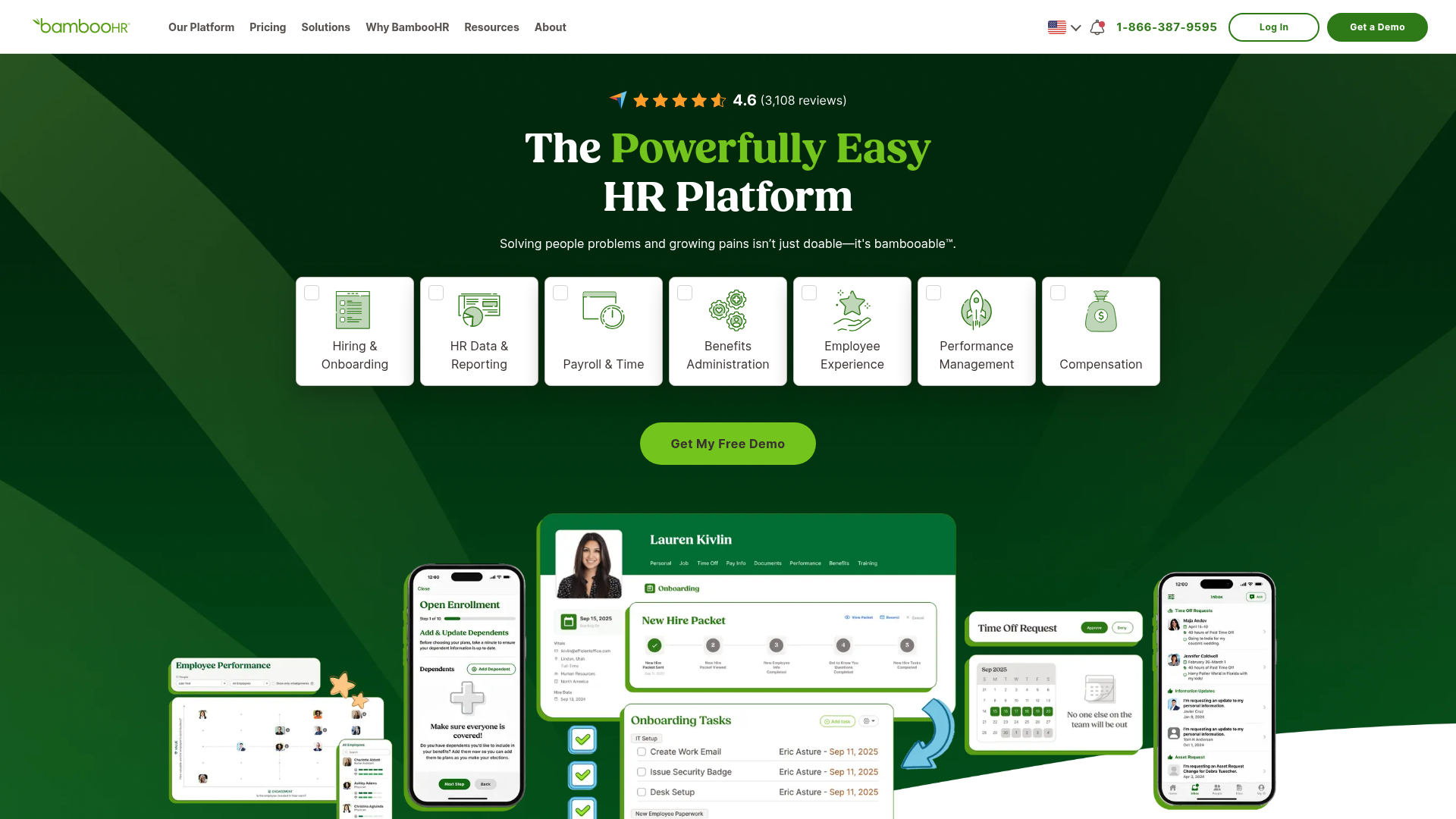
BambooHR is an all-in-one HR platform for growing teams, covering HR data, hiring and onboarding, time off, payroll, benefits, performance, compliance, and analytics. It is the natural pick when you want compliance to live inside the same system as employee records, not as a separate tool.
Best for: Growing small and midsize businesses that want a centralized HRIS with onboarding, time off, benefits, payroll add-ons, and compliance reporting.
Key strengths
- Centralized employee records: A single source of truth for HR data and reporting, which is the foundation of defensible documentation.
- Hiring and onboarding compliance: Applicant tracking, offer letter templates, and structured onboarding with compliance training included at higher tiers.
- Time off and benefits tracking: Time-off management, benefits tracking, and approval workflows that keep records consistent.
Why choose BambooHR: For an SMB making its first compliance hire, BambooHR consolidates the records, onboarding, and time-off data that most compliance work depends on. It is a full HRIS first and a compliance tool second, so deeply regulated employers may still pair it with a specialist tool. If smooth onboarding is your priority, it's worth reviewing the leading onboarding flow software options alongside it.
BambooHR pricing: BambooHR publishes per-employee pricing: Core at $10 per employee/month, Pro at $17, and Elite at $25, with Elite adding 300+ compliance training courses and advanced analytics. Companies with 25 employees or fewer are billed at a flat rate starting at $250/month. BambooHR holds a 4.4/5 rating on G2.
3. ADP SmartCompliance
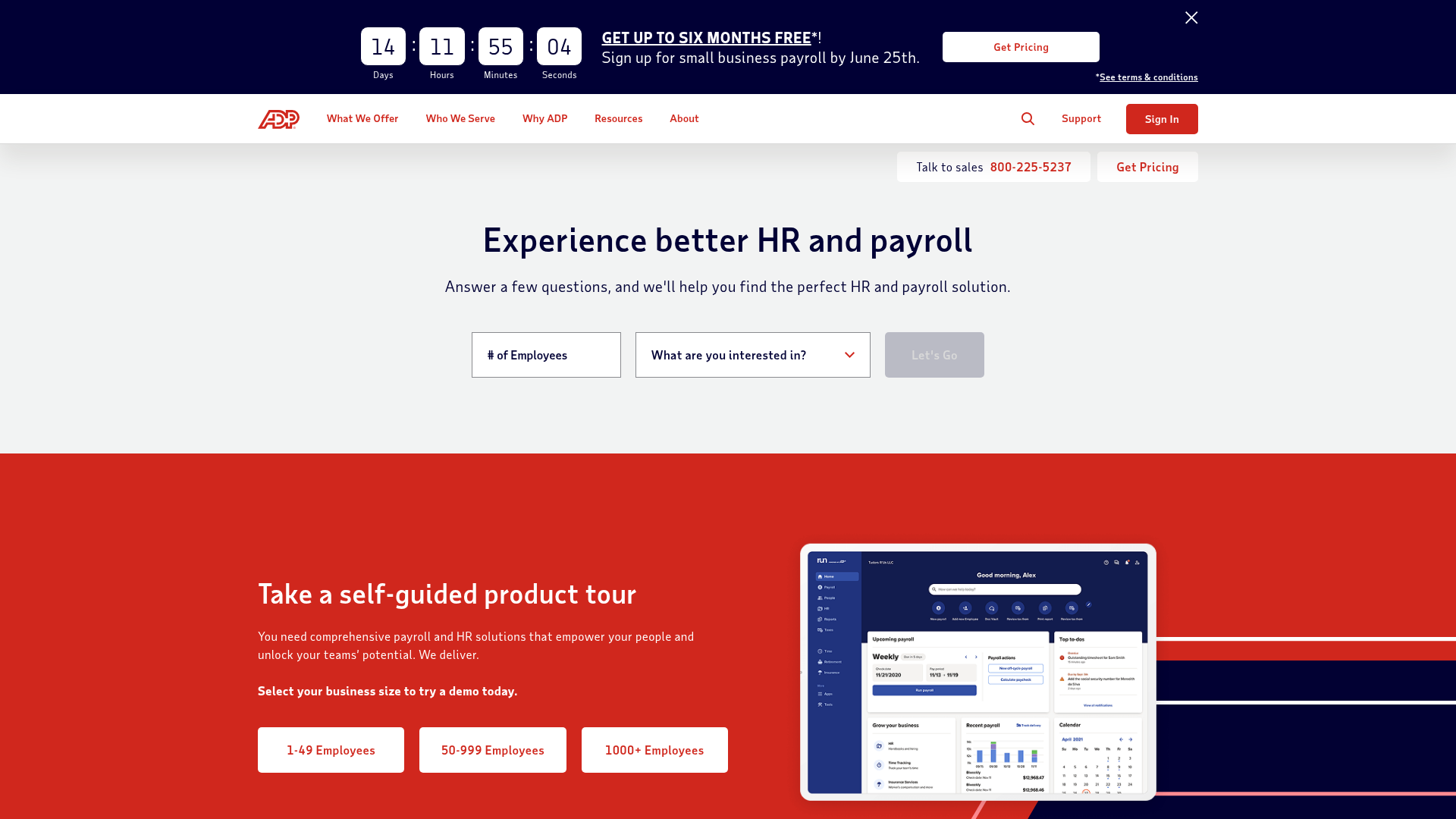
ADP SmartCompliance is a cloud-based payroll and HR compliance operating system that connects compliance workflows across payroll tax, payments, ACA compliance, wage garnishments, tax credits, employment verification, and unemployment claims. It is built for the compliance work that sits right next to payroll.
Best for: Large or complex employers that need payroll and HR compliance workflows across multiple systems, jurisdictions, and regulatory areas.
Key strengths
- Platform-agnostic integrations: Connects with many ERP, HR, and payroll systems, including ADP and third parties, so it layers onto your existing stack.
- Connected compliance workflows: Real-time visibility into compliance activity across tax, garnishments, ACA, and verification.
- Experts plus automation: AI-powered technology paired with dedicated compliance experts to flag issues and reduce manual effort.
Why choose ADP SmartCompliance: If your biggest exposure is payroll-adjacent (employment tax, garnishments, ACA filings), ADP handles it at enterprise scale with human experts backing the software. The trade-off is that pricing is quote-only, so it suits buyers past the SMB stage.
ADP SmartCompliance pricing: ADP does not publish numeric pricing for SmartCompliance. Its pages route to a demo or pricing request, so cost is custom and based on your modules and scale. ADP SmartCompliance holds a 4.3/5 rating on G2.
4. Rippling
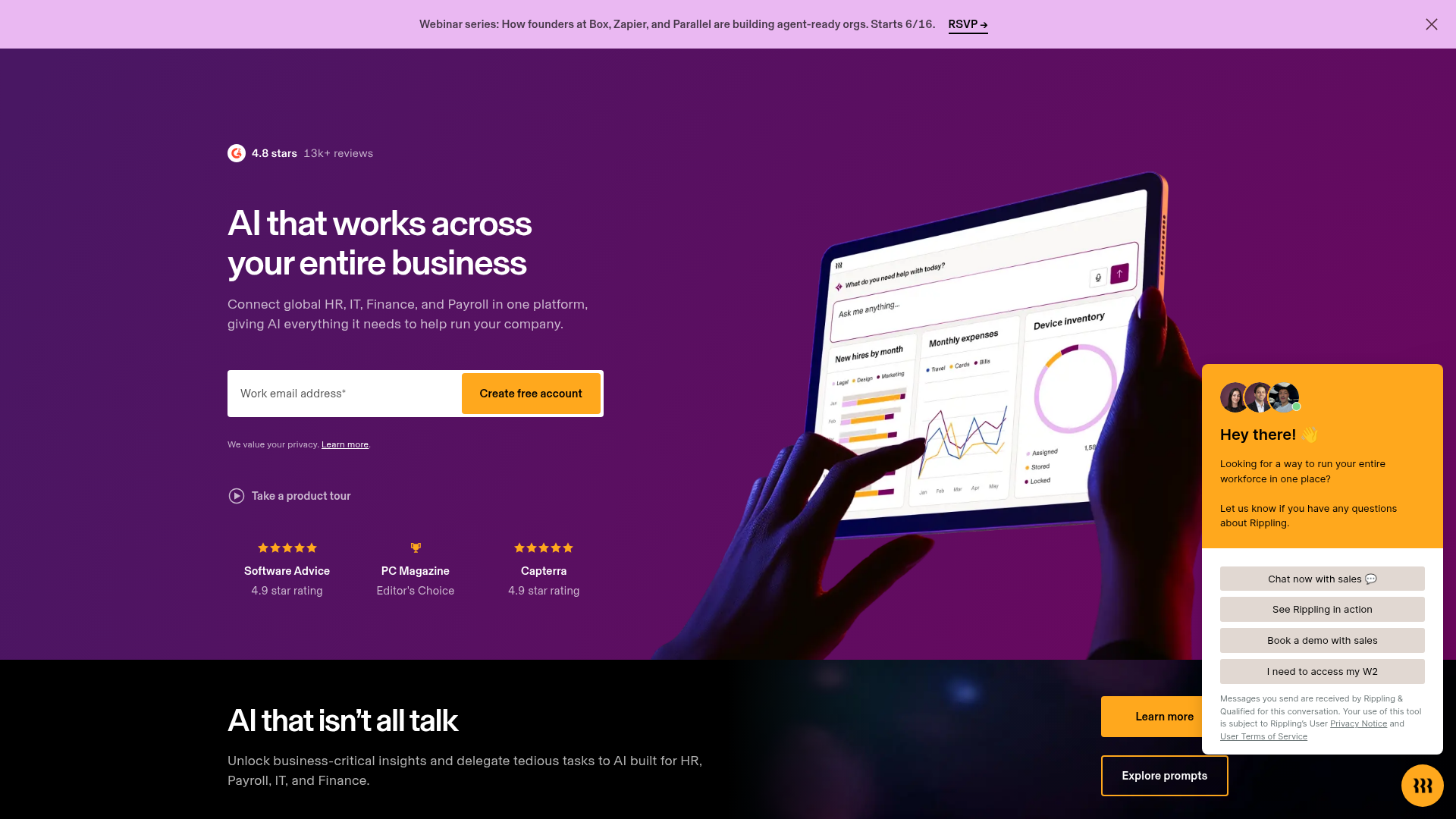
Rippling is a workforce management platform that connects global HR, IT, finance, and payroll in one system. Its compliance value comes from automation: policies, permissions, and workflows that enforce rules across jurisdictions without manual upkeep.
Best for: Companies that want a unified platform for HR, payroll, IT, finance, and global workforce operations, with compliance automation built in.
Key strengths
- Unified workforce system: HR, payroll, IT, finance, and global workforce management on one platform, which eliminates data silos.
- Workflow automation: Automated policies, permissions, approvals, and no-code custom apps that enforce compliance rules consistently.
- Broad operational coverage: Payroll, benefits, time and attendance, identity and access, and device management in one place.
Why choose Rippling: Teams trying to consolidate HR, IT, and compliance into fewer logins get the most from Rippling, since its automation engine spans all three. If you only need compliance and already have a payroll provider, a focused tool may be a cleaner buy.
Rippling pricing: Rippling does not display public numeric pricing. You select the products you need and request a custom quote, which includes the required core Rippling platform. Rippling holds a 4.8/5 rating on G2.
5. HR Acuity
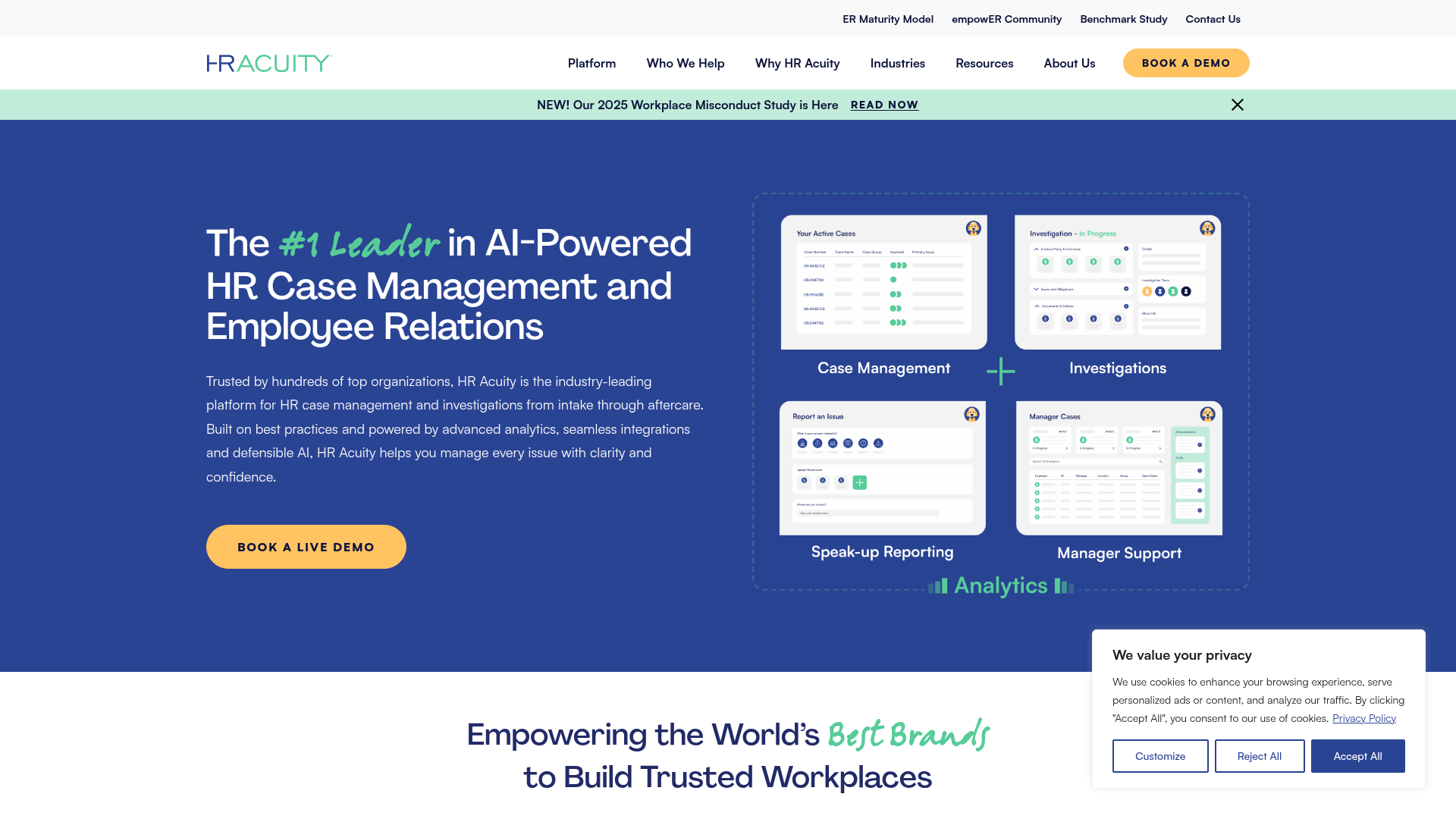
HR Acuity is an AI-powered employee relations platform for HR case management, workplace investigations, analytics, and speak-up reporting. It addresses a compliance gap most HRIS tools ignore: documenting and investigating employee relations issues defensibly.
Best for: Enterprise HR and employee relations teams that need structured, defensible case management and investigations.
Key strengths
- Centralized case management: Track and manage employee relations issues in one system, so nothing lives in scattered notes or inboxes.
- Structured investigations: Built-in best-practice methodology, interview templates, permission controls, and case reports.
- Analytics and benchmarks: Dashboards that surface trends, risks, case metrics, and benchmarks across the organization.
Why choose HR Acuity: When your compliance risk is concentrated in how you handle complaints and investigations, HR Acuity gives you the documented, consistent process that holds up in litigation. It is a specialist tool, so it complements rather than replaces a core HRIS.
HR Acuity pricing: HR Acuity does not publish public pricing. Its pages route to a demo request, so cost is custom and based on your organization's needs. HR Acuity holds a 4.6/5 rating on G2.
6. SixFifty
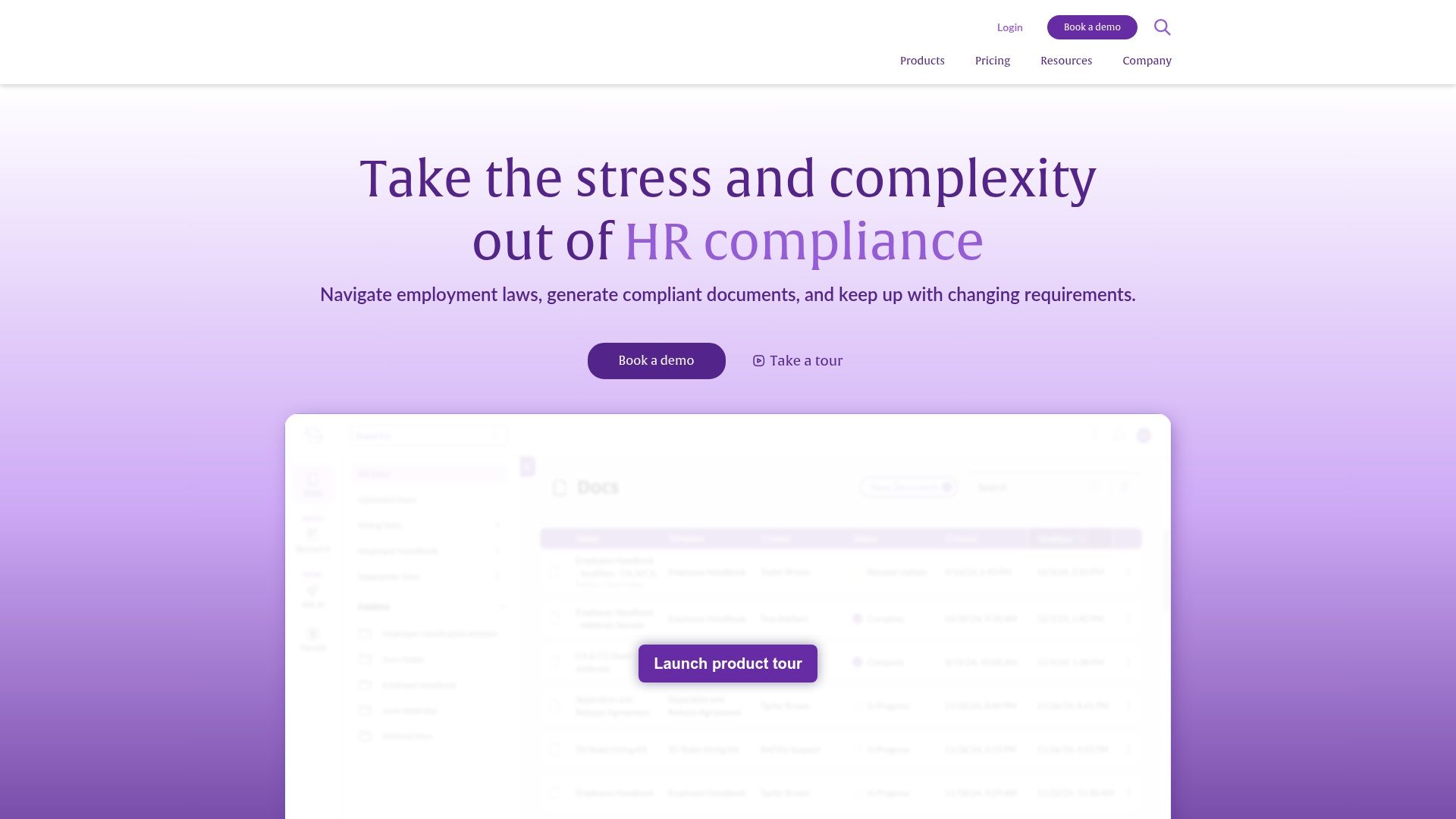
SixFifty is an employment law compliance platform for HR and legal teams to research laws, generate compliant documents, and keep policies updated as laws change. Built by attorneys, it is the strongest pick on this list for legally defensible policy and document workflows, and a clear example of purpose-built employment law software.
Best for: HR and legal teams managing multistate US employment law compliance and employee documentation.
Key strengths
- Employment law database: Coverage of federal, state, and local US employment laws, with AI search for plain-language answers.
- Document modules: Generate hiring, handbook, and separation documents that match each jurisdiction's requirements.
- AI-powered legal updates: Policies and documents stay current as laws change, with eSignature and employee portals for distribution and tracking.
Why choose SixFifty: If keeping multistate handbooks and policies legally current is your core problem, SixFifty's attorney-built content and update engine solve it directly. It focuses on documents and law, so you will pair it with a payroll or HRIS tool for the rest. For document signing workflows, you may also want to compare the best e-signature software options.
SixFifty pricing: SixFifty uses custom pricing based on how many employees you have and how many states you operate in. There is no public numeric price; you request a quote. SixFifty holds a 4.9/5 rating on G2, the highest on this list.
7. Mitratech
Mitratech provides AI-powered legal, governance/risk/compliance, and HR software for enterprise compliance management. It sits at the intersection of HR compliance and broader GRC, which makes it a fit for regulated, multi-department programs.
Best for: Enterprises that need connected legal operations, risk and compliance, and HR compliance management across multiple departments.
Key strengths
- HR compliance lifecycle: Background screening, onboarding, applicant tracking, I-9 compliance, training, and performance management.
- Governance, risk, and compliance: Enterprise risk, third-party risk, policy management, ethics hotline, and compliance training in one suite.
- Legal operations: Matter management and eBilling for teams that connect HR compliance to wider legal work.
Why choose Mitratech: For enterprises where HR compliance is one piece of a larger GRC mandate, Mitratech connects I-9, immigration, and HR workflows to risk and legal operations. It is heavier than most SMBs need.
Mitratech pricing: Mitratech does not publish public pricing; its pages route to a demo request. Cost is custom and based on the modules you select. On G2, Mitratech holds a 4.2/5 rating across more than 1,300 reviews.
8. Checkr
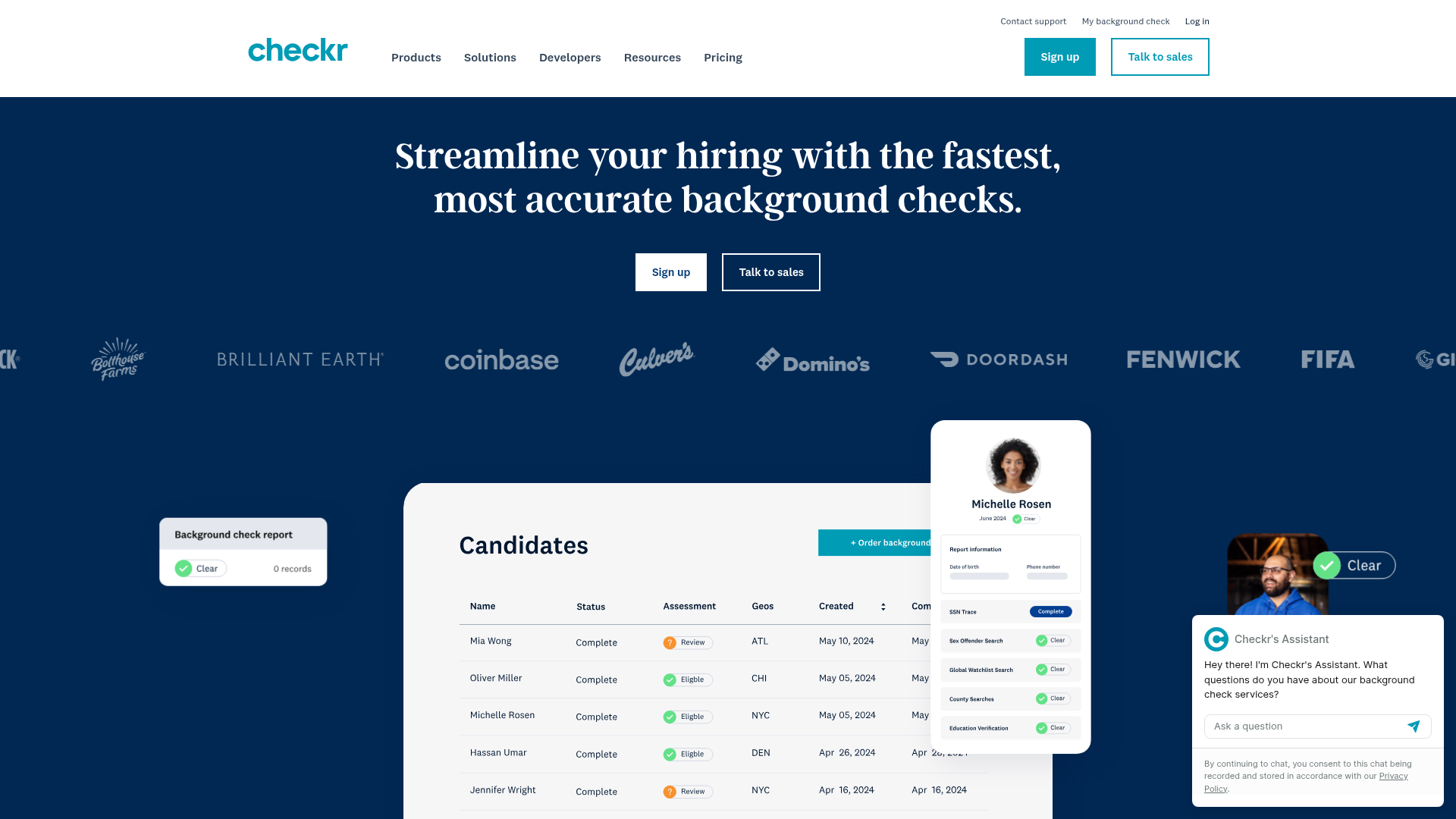
Checkr is a background check and employment screening platform for hiring, verification, compliance, and candidate trust workflows. It owns one specific compliance job: screening candidates without tripping over FCRA background check requirements, ban-the-box laws, and adjudication rules.
Best for: Businesses that need scalable employment background checks and candidate screening with integrations and compliance workflows.
Key strengths
- Multi-source criminal records: Checks across federal, state, county, and other public record sources, with built-in compliance tooling.
- Broad screening options: Drug, education, employment, identity, driver, registry, and civil screening from one platform.
- Integrations and automation: APIs, pre-built integrations, workflow automation, and analytics that scale with hiring volume.
Why choose Checkr: If you hire at volume or in regulated roles, Checkr keeps your screening compliant and consistent at scale. It is purpose-built for hiring compliance, so it is one piece of a broader compliance stack, not the whole thing.
Checkr pricing: Checkr uses pay-as-you-go report pricing. Basic is $29.99 per report, Essential is $54.99, and Complete is $89.99, with Enterprise priced by contract. Standard third-party passthrough fees may apply to some checks. Checkr holds a 4.5/5 rating on G2.
9. Paylocity
Paylocity provides a unified platform for HR, payroll, finance, and IT teams. For compliance, it pairs payroll processing with compliance dashboards, ACA support, and managed wage garnishment, which keeps payroll-driven obligations in one system.
Best for: Organizations looking to unify HR and payroll with workforce, benefits, talent, and compliance reporting in one platform.
Key strengths
- Payroll with compliance built in: Automated tax filings, on-demand pay options, and managed wage garnishment services.
- Compliance dashboards: Visibility into compliance status across the workforce, tied to live payroll and HR data.
- Broad HR and talent suite: Self-service, time and attendance, onboarding, performance, learning, and benefits administration.
Why choose Paylocity: Mid-market teams that want payroll and compliance in a single platform get strong coverage of payroll-driven obligations. Pricing is quote-only, so it suits buyers who have outgrown published per-seat tools.
Paylocity pricing: Paylocity tailors pricing to company size, selected products, and support needs. The pricing page requires a request and does not display public plan prices. Paylocity holds a 4.4/5 rating on G2 across more than 5,000 reviews.
10. Paycom
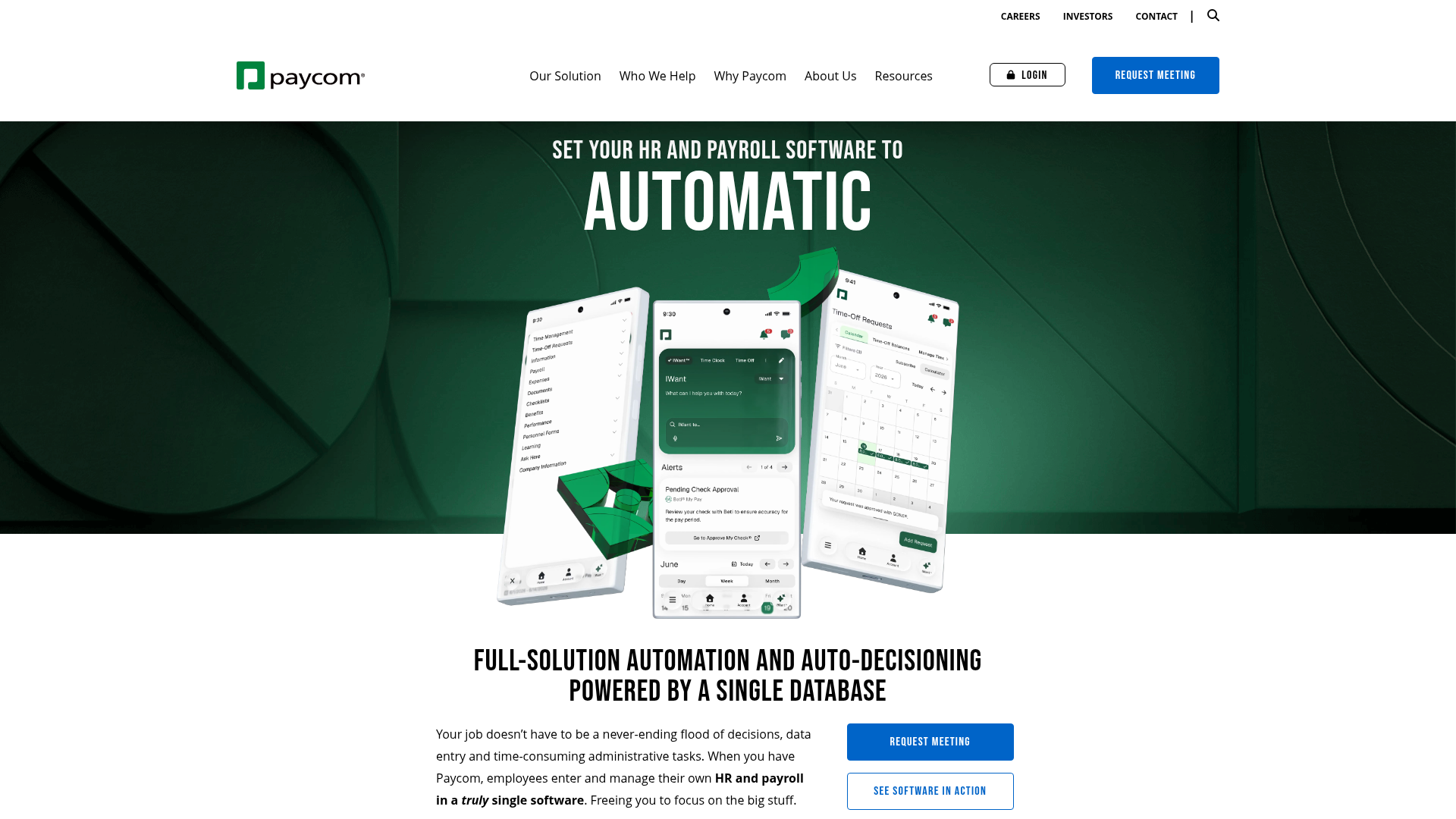
Paycom is a cloud-based human capital management platform for payroll, HR, talent, and time and labor management in a single database. The single-database design is the compliance advantage: one record per employee means fewer data mismatches that create compliance risk.
Best for: Organizations seeking an end-to-end HCM and payroll platform with employee self-service and automation across the employee lifecycle.
Key strengths
- Single database of record: One employee record across payroll, HR, talent, and time, which reduces the data errors that drive compliance gaps.
- Automated payroll: Payroll processing with Beti, Paycom's employee-driven payroll tool, for accuracy before submission.
- AI-driven access: Command-driven access to HR and payroll data through IWant, plus document workflows across the lifecycle.
Why choose Paycom: Teams that want one system of record, with no integrations to reconcile, get clean, consistent compliance data from Paycom. As with other enterprise HCM tools, pricing is custom.
Paycom pricing: Paycom customizes pricing based on workforce size and the tools you select. Core is the minimum used by all clients, with additional tools added to complete the setup. No public price is shown. Paycom holds a 4.5/5 rating on G2.
11. Workday
Workday is an enterprise AI platform for managing HR, finance, planning, and workforce operations. At enterprise and global scale, its compliance strength is unified data with deep audit and reporting across every region you operate in.
Best for: Large and midsize organizations that need a unified enterprise platform for HR, finance, workforce management, and planning.
Key strengths
- Unified HR and finance: A single AI-powered platform that ties workforce data to finance, which simplifies audit and reporting.
- Full HCM coverage: Core HR, workforce management, recruiting, talent, learning, benefits, and process automation.
- Global audit and reporting: Reporting and analytics built for multi-region compliance and audit readiness.
Why choose Workday: Large or global enterprises that need compliance, audit, and reporting unified across HR and finance are the core fit. It is a major implementation, so it rarely suits smaller teams.
Workday pricing: Workday's paid plans are quote-based, listed as "Pricing varies" on its public pages. Its Adaptive Planning product offers a 30-day free trial, but there is no permanent free tier. Workday holds a 4.2/5 rating on G2.
12. Cornerstone OnDemand
Cornerstone OnDemand provides an AI-powered workforce readiness platform for talent, learning, skills, recruiting, performance, and workforce intelligence. For compliance, its strength is training: delivering, tracking, and certifying the courses regulators and policies require.
Best for: Mid-market and enterprise organizations needing a scalable learning, skills, and compliance training platform.
Key strengths
- Compliance training delivery: An AI-powered learning platform for compliance, role readiness, and workforce growth.
- Certification tracking: Track completions and certifications across the workforce for audit-ready training records.
- Content library: Content subscriptions, content studio, and authoring tools for curated and internal compliance courses.
Why choose Cornerstone OnDemand: When your compliance program is training-led (think mandatory harassment, safety, or industry-specific certification), Cornerstone delivers and documents it at scale. It is an LMS first, so you will pair it with a policy or payroll tool. Teams running internal training programs often pair an LMS with interactive demos to walk employees through software hands-on.
Cornerstone OnDemand pricing: Cornerstone does not publish public pricing; its site directs you to book a demo or speak to an expert. Cost is custom. On G2, Cornerstone OnDemand holds a 4.0/5 rating across more than 800 reviews.
13. Connecteam
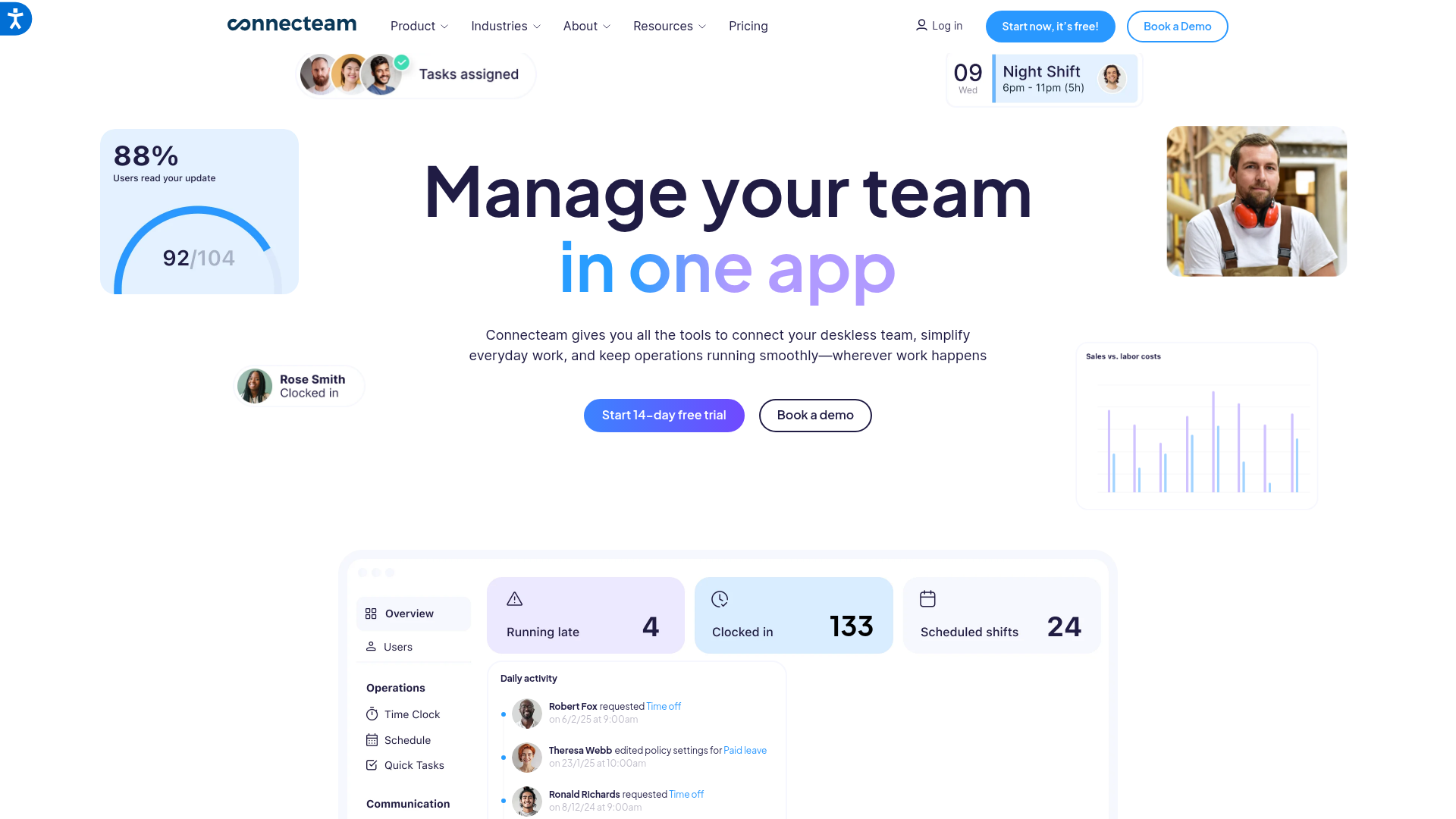
Connecteam is an all-in-one employee management app for deskless teams, covering operations, communications, and HR workflows. It solves a compliance problem most platforms ignore: tracking certifications and policy acknowledgments for a frontline workforce that does not sit at a desk. You can preview the platform through this Connecteam interactive demo.
Best for: Deskless or frontline teams that need scheduling, time tracking, communication, and HR compliance tools in one app.
Key strengths
- Certification and policy tracking: Courses, quizzes, and document acknowledgment that keep frontline workers compliant and documented.
- Time and scheduling compliance: Employee scheduling and time tracking that support wage and hour record-keeping.
- HR and skills tools: Time off, onboarding, recognition, and an org chart, all accessible from a mobile-first app.
Why choose Connecteam: For hourly and frontline workforces, Connecteam puts certification tracking and policy acknowledgment in workers' hands on mobile, which is where deskless compliance usually breaks. It is built for frontline teams rather than corporate multistate policy work.
Connecteam pricing: Connecteam offers a Small Business Plan that is free for life for up to 10 users. Paid plans for the first 30 users start at $29/month (Basic), $49/month (Advanced), and $99/month (Expert) billed yearly, with custom Enterprise pricing. Connecteam holds a 4.6/5 rating on G2.
14. Justworks
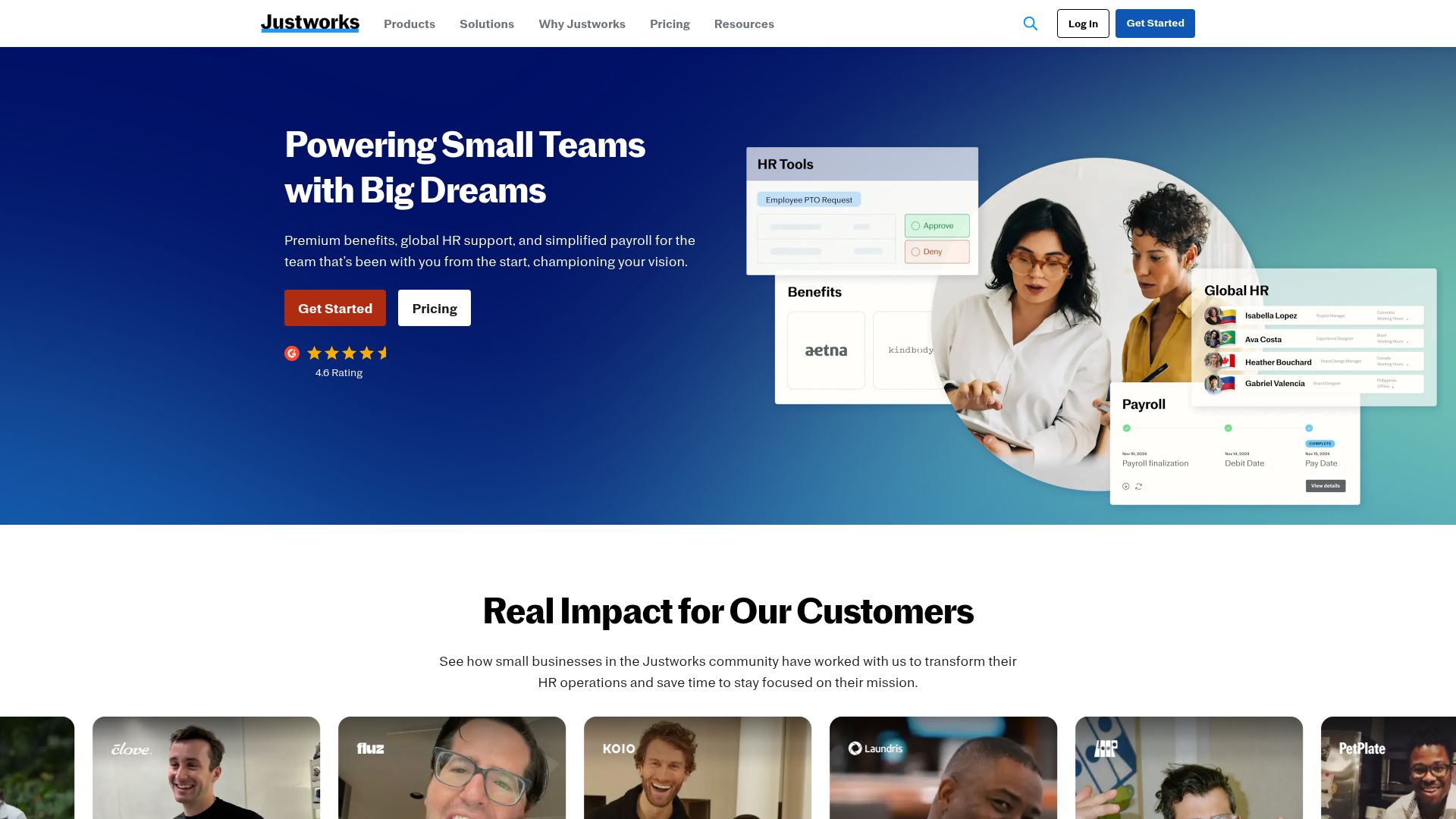
Justworks provides PEO, payroll, benefits, compliance support, HR tools, time tracking, and global hiring for small businesses. As a PEO, it effectively outsources a chunk of compliance work, which appeals to small teams without a dedicated HR function. See how the platform works in this Justworks interactive demo.
Best for: Small businesses that want bundled payroll, HR, compliance support, benefits administration, and PEO services in one platform.
Key strengths
- Compliance support built in: Employer payroll tax filings, W-2 and 1099 filings, and federal and state compliance alerts.
- Payroll and benefits: Multi-state payroll, contractor payments, off-cycle payments, and benefits administration.
- HR and team management: Online onboarding and offboarding, PTO management, a document center, and a mobile app.
Why choose Justworks: Small businesses that would rather outsource compliance than manage it get a PEO that handles filings, alerts, and benefits in one place. As your team grows and your needs specialize, you may move to a dedicated HRIS plus compliance tooling.
Justworks pricing: Justworks publishes per-employee pricing. Payroll starts at $8/month per employee plus a $50/month base fee. PEO Basic is $79/month per employee, and PEO Plus is $124/month per employee. There is no free tier. Justworks holds a 4.6/5 rating on G2.
15. Oyster HR
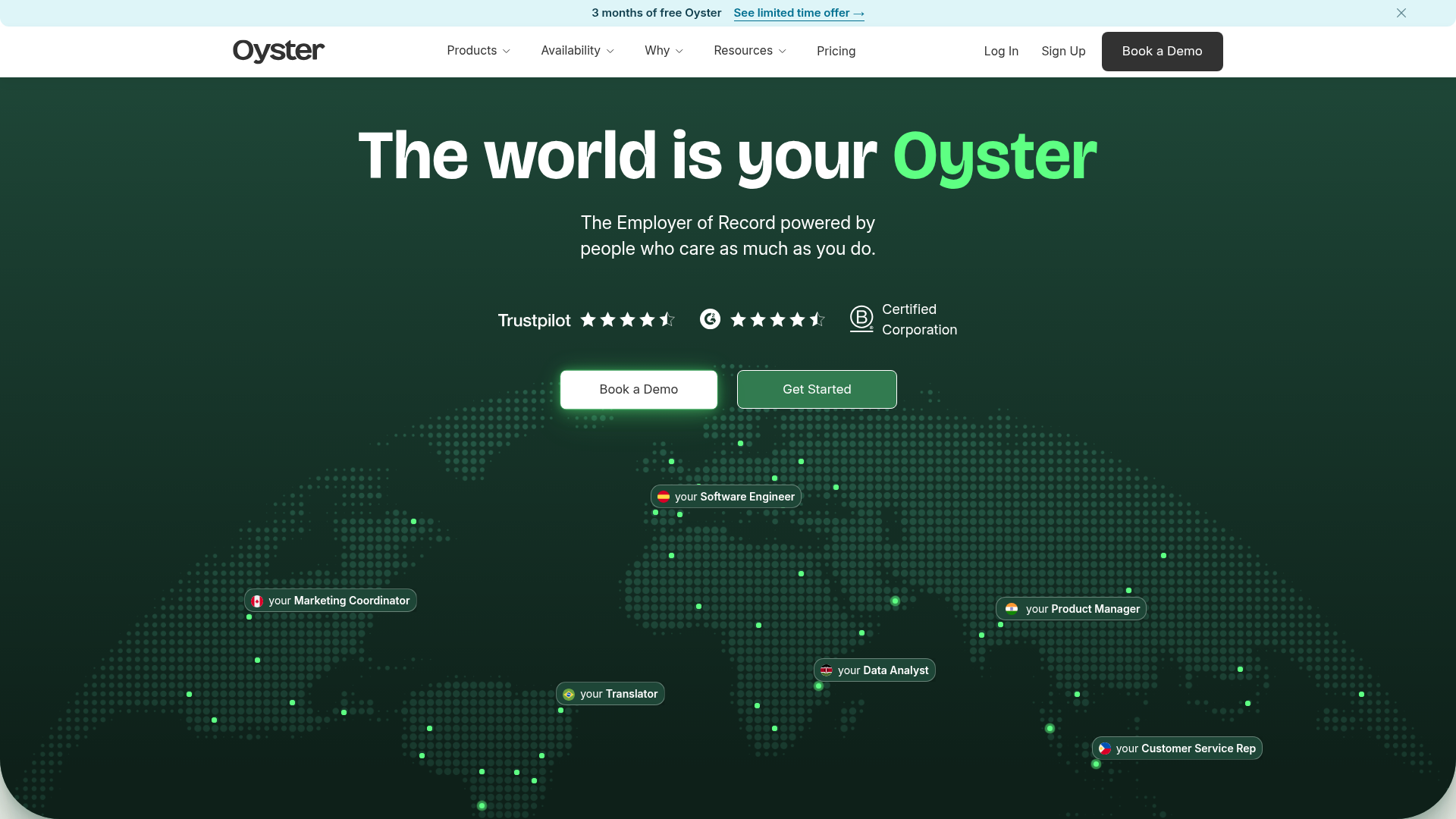
Oyster HR is an employer of record and global employment platform for hiring, paying, and caring for talent across 180+ countries. It is the strongest alternative to Deel for companies whose compliance challenge is hiring across borders.
Best for: Companies that want to hire and manage international employees or contractors without setting up local entities.
Key strengths
- Employer of Record: Hire in 180+ countries without standing up local entities, with employment compliance handled for you.
- Multi-country payroll: Payroll in 120+ currencies, with statutory compliance built into each market.
- Contractor management: Contract generation, payments, onboarding, invoices, and expense management for global contractors.
Why choose Oyster HR: If international hiring is your core compliance challenge, Oyster handles employment law and payroll in markets where you have no entity. As with Deel, it is global-first, so US-only teams will get more from a domestic platform.
Oyster HR pricing: Oyster's Global Contractors plan is free for 30 days, then $29 per contractor/month. US PEO is $114 per employee/month, Employer of Record is $699 per employee/month, and People Partner Services is $300 per hour. There is no permanent free tier. Oyster HR holds a 4.4/5 rating on G2.
How to choose HR compliance software: buyer's checklist
A high G2 score does not mean a tool fits your jurisdiction footprint or your budget. Run any shortlist through these criteria before you book demos. The fastest way to evaluate fit is to test the product directly, and many of these vendors now let you do that through an interactive demo before you ever talk to sales.
Jurisdiction and multistate coverage
Verify exactly which states, counties, and cities the tool covers and how it sources updates. A tool that tracks state law but misses local pay transparency or sick leave ordinances leaves a gap where your real risk lives. Ask how fast updates land after a law changes.
Integration with payroll and HCM
Check for native integrations with your existing payroll, HRIS, and ATS. The point of HR compliance solutions is to eliminate duplicate data entry, not create it. If compliance data has to be re-keyed from your payroll system, the tool adds work instead of removing it. Look for platforms with strong integration capabilities so your systems stay in sync.
Audit-readiness and reporting
Evaluate the documentation repository, exportable reports, and how defensible the records are. You want timestamped acknowledgments, version history on policies, and reports you can hand to an auditor or acquirer without a scramble. Ask to see a sample export.
Automation and alerting
Assess how proactively the tool flags law changes and assigns the required actions. The best tools do not just notify you; they regenerate the affected handbook section and assign the new training. Passive alerts that leave the work to you are only half a solution.
Pricing transparency and scalability
Confirm whether pricing is per-seat or flat, whether a free trial exists, and how cost scales with headcount and states. Per-employee pricing that looks cheap at 40 people can sting at 400. For multistate tools, ask whether adding states changes the price.
Conclusion
The right HR compliance software depends entirely on where your risk concentrates. For SMBs and first compliance hires, BambooHR and Justworks bundle compliance into systems you already need, with published pricing you can budget against. For multistate policy and document work, SixFifty's attorney-built, auto-updating handbooks are hard to beat. For payroll-adjacent compliance at scale, ADP SmartCompliance and Paylocity keep tax, ACA, and garnishments in line. For global hiring, Deel and Oyster HR handle employment law in markets where you have no entity. And for employee relations and investigations, HR Acuity gives you a defensible process.
The next step is not to buy the highest-rated tool. It is to map your jurisdiction footprint and your single biggest compliance gap, then shortlist 2 or 3 tools that match. Test each one, ideally through a self-serve demo built with a platform like Guideflow, and confirm it integrates with your existing payroll and HRIS before you sign. A tool that replaces a real risk is worth far more than one that just adds a dashboard.
FAQs
HR compliance software helps employers track, automate, and document adherence to federal, state, and local employment laws. Companies need it because manual tracking in spreadsheets cannot keep pace with changing rules across multiple jurisdictions, and the cost of getting compliance wrong is high. It reduces risk and saves time by monitoring laws, generating policies, and keeping records audit-ready.
The software monitors legal sources across jurisdictions and flags relevant changes automatically. When a law changes, it can regenerate the affected handbook section, update policies, and assign required training. This turns HR compliance from a reactive scramble into a maintained system, which matters most for employers operating in many states with different rules and timelines.
Spreadsheets rely on someone remembering to update them and cannot reconcile overlapping federal, state, and local rules at scale. HR compliance software automates monitoring, version-controls documents, and produces exportable, defensible records on demand. The difference shows up most during an audit, when "we think it's in a folder" is not an answer a regulator or acquirer will accept.
Pricing varies widely. SMB-friendly HRIS tools like BambooHR start around $10 per employee per month, and Justworks payroll starts at $8 per employee per month plus a base fee. Specialist and enterprise tools (ADP SmartCompliance, Workday, SixFifty, Mitratech) use custom, quote-based pricing tied to headcount, states, and modules. Background checks like Checkr are priced per report, starting at $29.99.
Start with your biggest compliance gap and your jurisdiction footprint, not the highest rating. Verify multistate and local coverage, native payroll and HCM integration, audit-ready reporting, and proactive alerting. Confirm how pricing scales with headcount and states. Then shortlist 2 or 3 tools and test each before committing.
For small businesses, BambooHR offers compliance inside a full HRIS with published per-employee pricing, and Justworks bundles compliance support into a PEO that handles filings and alerts for you. Gusto is an adjacent payroll-first option many small teams use for basic compliance. Connecteam suits small frontline and deskless teams that need certification and policy tracking.
Yes, and integration is one of the main reasons to buy it. Payroll-native options like ADP SmartCompliance, Paylocity, and Paycom build compliance directly into payroll, so tax, ACA, and garnishment data never gets re-keyed. Standalone tools should offer native connections to your payroll and HRIS to avoid duplicate data entry.
HR compliance software is a self-serve product you operate yourself: it monitors laws, generates documents, and tracks records on your platform. HR compliance services are people-led, such as consulting, managed PEO support, or outsourced advisory work. Many tools blend both. Justworks, for example, pairs software with PEO services, while SixFifty pairs software with attorney-built content.