
A critical vendor stops shipping updates. Or gets acquired. Or quietly shuts down. Your revenue, your onboarding, and your customer commitments all depend on software you do not control. You find out the hard way, during an outage or a board meeting, that you had no plan for that dependency.
Software escrow exists to remove that single point of failure. It puts a copy of the source code, build instructions, and data behind an independent third party who releases it only when a predefined event happens. The global software escrow services market was valued at USD 8.52 billion in 2025 and is projected to reach USD 23.03 billion by 2035, growing at 11.7% CAGR, according to Business Research Insights (2026). Adoption is not fringe: 67% of enterprises report using software escrow to secure source code and ensure business continuity in vendor disputes, per the same 2026 report.
For a Series B SaaS founder, this is a third-party risk management problem wearing an operational-continuity mask. Escrow shows up in enterprise diligence, in security reviews, and in your own vendor-risk planning. The buying decision comes down to five things: how release triggers are defined, how deposits stay current, whether the code is actually verified to build, whether the provider handles SaaS continuity and not just source code, and how much operational resilience the whole arrangement gives you when something breaks.
What's inside
This guide is for founders, finance leaders, legal, procurement, and RevOps teams at software companies who are evaluating escrow for the first time or replacing an arrangement that no longer fits a SaaS world. Every provider on this list was selected against the criteria that actually matter in 2026:
- Release mechanics: how clearly release triggers are defined and executed
- Verification depth: whether deposits are tested to compile, build, and run
- Deposit automation: support for automated, ongoing deposits from Git and cloud repositories
- SaaS and cloud continuity: coverage beyond source code, including access continuity and recovery
- Enterprise trust: governance, security, and diligence-readiness
TL;DR
- Best for enterprise escrow plus verification: Escode combines software escrow, SaaS escrow, and source code verification for business-critical applications.
- Best for SaaS continuity with automated deposits: Escrow London (now The Escrow Company) pairs source code escrow with SaaS access continuity and Git-based automated deposits.
- Best for transactional escrow and API use cases: Escrow.com covers secure transactions with a documented five-step process and an escrow API.
- Best for regulated buyers who want security assurance: NCC Group brings cyber security and technical assurance credibility to escrow-adjacent risk programs.
- Best for published, configurable pricing: EscrowTech lists setup and annual fees openly across single- and multi-beneficiary agreements.
What is software escrow?
Software escrow is a legal and operational arrangement where an independent third party holds a copy of a software product's source code, build instructions, documentation, and sometimes data, then releases those materials to the customer only when a predefined event occurs. It protects the buyer's ability to keep running mission-critical software if the vendor cannot or will not continue supporting it.
The structure is tri-party by design:
- Depositor (the vendor): the software company that deposits source code and materials.
- Beneficiary (the customer): the buyer who gains release rights under agreed conditions.
- Escrow agent (the independent third party): the neutral custodian that holds materials, verifies deposits, and manages release.
There are two dominant models. Source code escrow protects on-premises or licensed software by holding the code and build assets a customer would need to maintain the product themselves. SaaS escrow protects cloud-hosted applications, where handing over source code alone is not enough. SaaS escrow adds access continuity, replica cloud environments, hosting data, and recovery mechanics so the customer can keep the service running if the vendor's hosting disappears.
Release triggers are the conditions that unlock the deposit. Common triggers include vendor bankruptcy or insolvency, discontinuation of support, breach of a maintenance obligation, or a failure to meet contractual service levels. A well-drafted software escrow agreement spells these out precisely, along with the verification and release steps.
Verification is what separates a real safety net from a false one. A deposit that cannot compile is worthless in a crisis. Verification testing confirms the materials are complete, current, and able to build and run in the target environment. Depth ranges from a basic file inventory check to full build-and-run testing in a replicated environment.
When to use software escrow
Not every vendor relationship warrants escrow. These three scenarios are where it earns its place.
Protect a mission-critical SaaS dependency
If a vendor failure would stop your revenue, halt onboarding, or break a customer commitment, that dependency is a continuity risk. Escrow gives you a documented path to keep the software running if the vendor goes dark, loses funding, or stops shipping support. For SaaS dependencies specifically, that means access continuity and recovery, not just a zip file of source code. Tie the decision to what a 48-hour outage would cost you in churn and trust.
Support enterprise procurement and legal review
Enterprise buyers increasingly require escrow as a condition of the contract. Offering an escrow arrangement, or agreeing to one during diligence, reduces friction in security reviews and shortens the legal back-and-forth. It signals that you take business continuity and third-party risk management seriously, which matters when a buying committee is weighing you against larger, safer-looking vendors.
Reduce vendor lock-in and strengthen exit planning
Escrow preserves leverage. If a vendor is acquired, changes ownership, degrades service, or raises prices unreasonably, a release trigger gives you a fallback instead of a hostage situation. Founders use escrow as part of exit planning and acquisition readiness, so a critical dependency never becomes the reason a deal stalls or a renewal turns adversarial.
Comparison table
The table below ranks providers by relevance to software escrow specifically, weighting release mechanics, verification depth, and SaaS continuity over general transaction escrow. Pricing reflects each provider's published figures where available; several use quote-based or per-transaction models, noted below. Ratings are shown only where a verified source exists.
| # | Product | Intent | Key differentiation | Pricing | G2 rating |
|---|---|---|---|---|---|
| 1 | Escode | Enterprise software and SaaS escrow | Escrow plus source code verification and testing | From £1,600/year | Not available |
| 2 | Escrow London | SaaS continuity escrow | Automated Git deposits, SaaS access continuity | From £1,795/year | Not available |
| 3 | Escrow.com | Transactional escrow | Five-step process, escrow API, buyer inspection | 2.6% ($50 min) per transaction | Not available |
| 4 | Iron Mountain | Secure custody and information governance | Records, storage, and digital information management at scale | From $60 (storage) | 4.0/5 |
| 5 | NCC Group | Security-assured escrow | Cyber security and technical assurance credibility | Quote-based | Not available |
| 6 | Data Escrow | Continuity-focused escrow | Escrow management for continuity buyers | Quote-based | Not available |
| 7 | EscrowTech | Software and technology escrow | Published pricing, configurable agreement structures | From $995 setup | Not available |
| 8 | Software Escrow Services Ltd | Straightforward software escrow | Direct escrow provider | Quote-based | Not available |
1. Escode
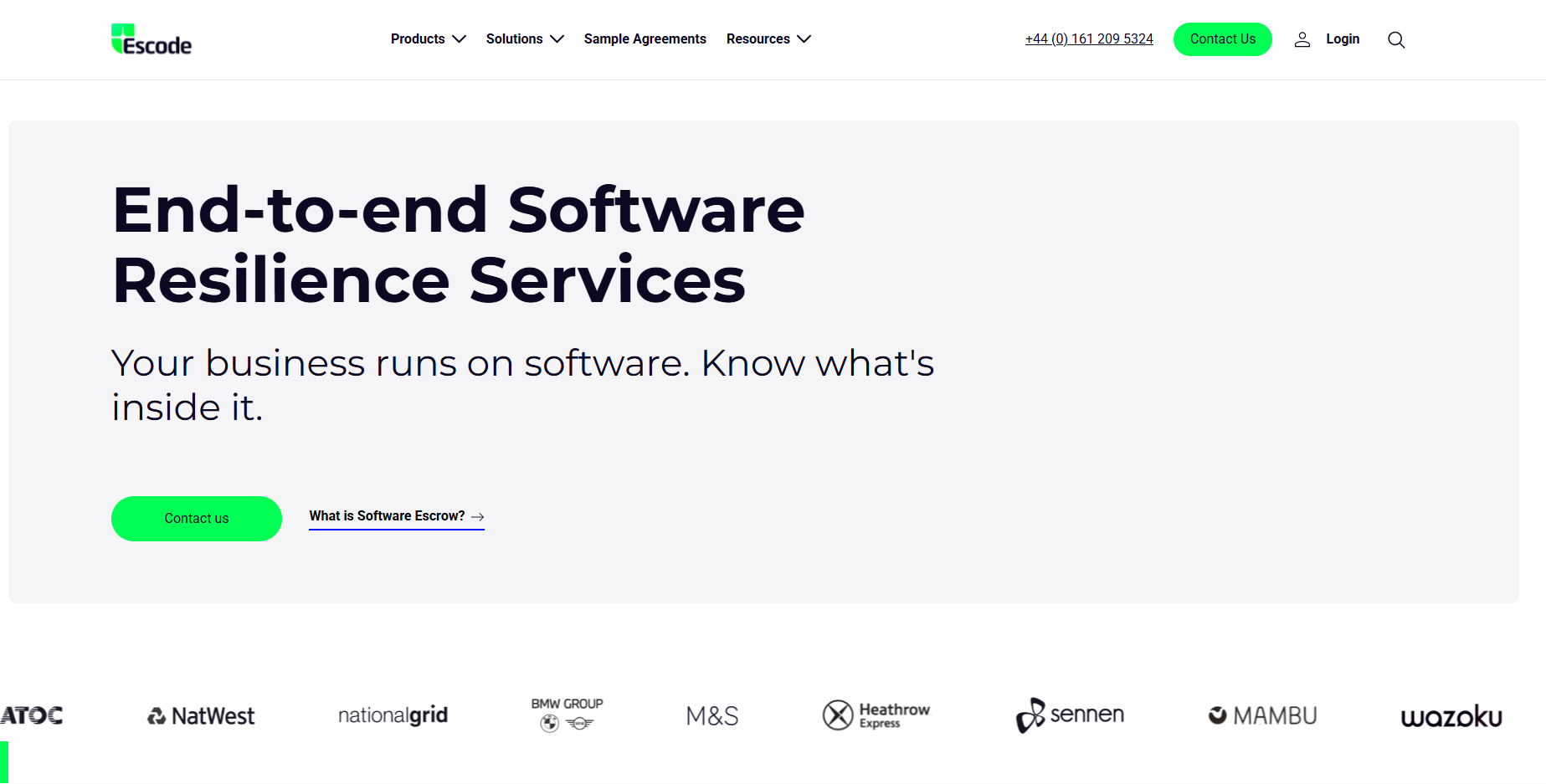
Escode is a software escrow and resilience provider focused on business-critical applications. It covers the full lifecycle: identify the dependency, agree the terms, deposit the materials, verify them, and release when a trigger fires. The verification piece is where Escode stands out, offering source code testing that confirms deposits can actually be built and run rather than simply stored. For enterprise buyers running diligence-heavy programs, that verification depth is the difference between a policy and a real fallback.
Best for: Enterprises that need escrow, verification, and continuity protection for third-party software.
Key strengths
- Software and SaaS escrow: Covers both on-premises source code and cloud-hosted SaaS continuity in one provider.
- Source code verification and testing: Confirms deposits compile and run, so the escrow holds up in an actual release.
- Continuity framing: Positions escrow inside a broader operational resilience and third-party risk program.
Why choose Escode: If your escrow requirement is coming from enterprise customers or a formal risk program, Escode's verification and continuity depth matches that scrutiny. It suits founders who need to satisfy sophisticated buyers and want the escrow arrangement to survive a real release event, not just check a procurement box.
Escode pricing: Basic services start at around £1,600 per year, with pricing adjusted upward when you add verification or SaaS continuity features. Escode uses tailored quotes rather than a fixed public tier table, so the exact figure depends on the number of beneficiaries, verification level, and continuity scope.
2. Escrow London
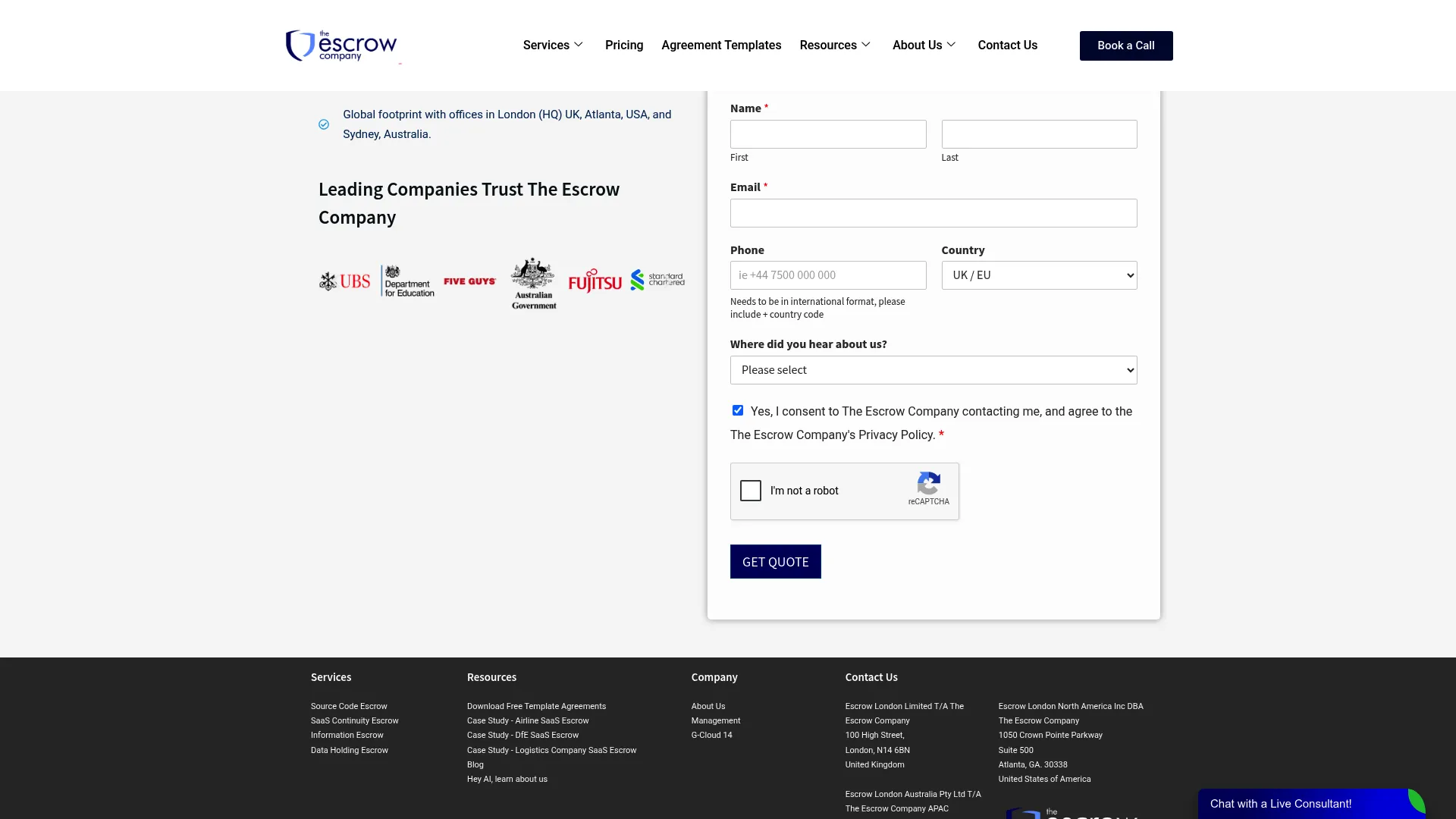
Escrow London, now branded as The Escrow Company, focuses on making software escrow easy to understand and SaaS continuity practical to execute. It covers traditional source code escrow alongside SaaS-specific options, including access continuity and recovery escrow. The standout mechanic is automated deposits pulled directly from Git platforms, which keeps the escrowed code current without manual uploads. That automation is what makes escrow viable for fast-moving SaaS teams shipping code weekly.
Best for: Businesses that need software escrow with automated deposits and clear SaaS continuity options.
Key strengths
- Source code escrow: Standard code and build-asset protection for licensed and on-premises software.
- SaaS escrow and continuity: Access continuity and recovery options built for cloud-hosted applications.
- Automated deposits from Git: Pulls updates directly from repositories so deposits stay current automatically.
Why choose Escrow London: If you want escrow that a non-lawyer can actually understand and a deposit process that does not depend on someone remembering to upload code every sprint, this is a strong fit. It suits SaaS teams that want continuity coverage without heavy technical overhead.
Escrow London pricing: Publicly shown plans include Software Escrow at £1,795 per year and SaaS Access Continuity at £2,995 per year. Higher tiers, SaaS Recovery Escrow and Managed SaaS Continuity, are priced on application, and some plans carry setup fees.
3. Escrow.com
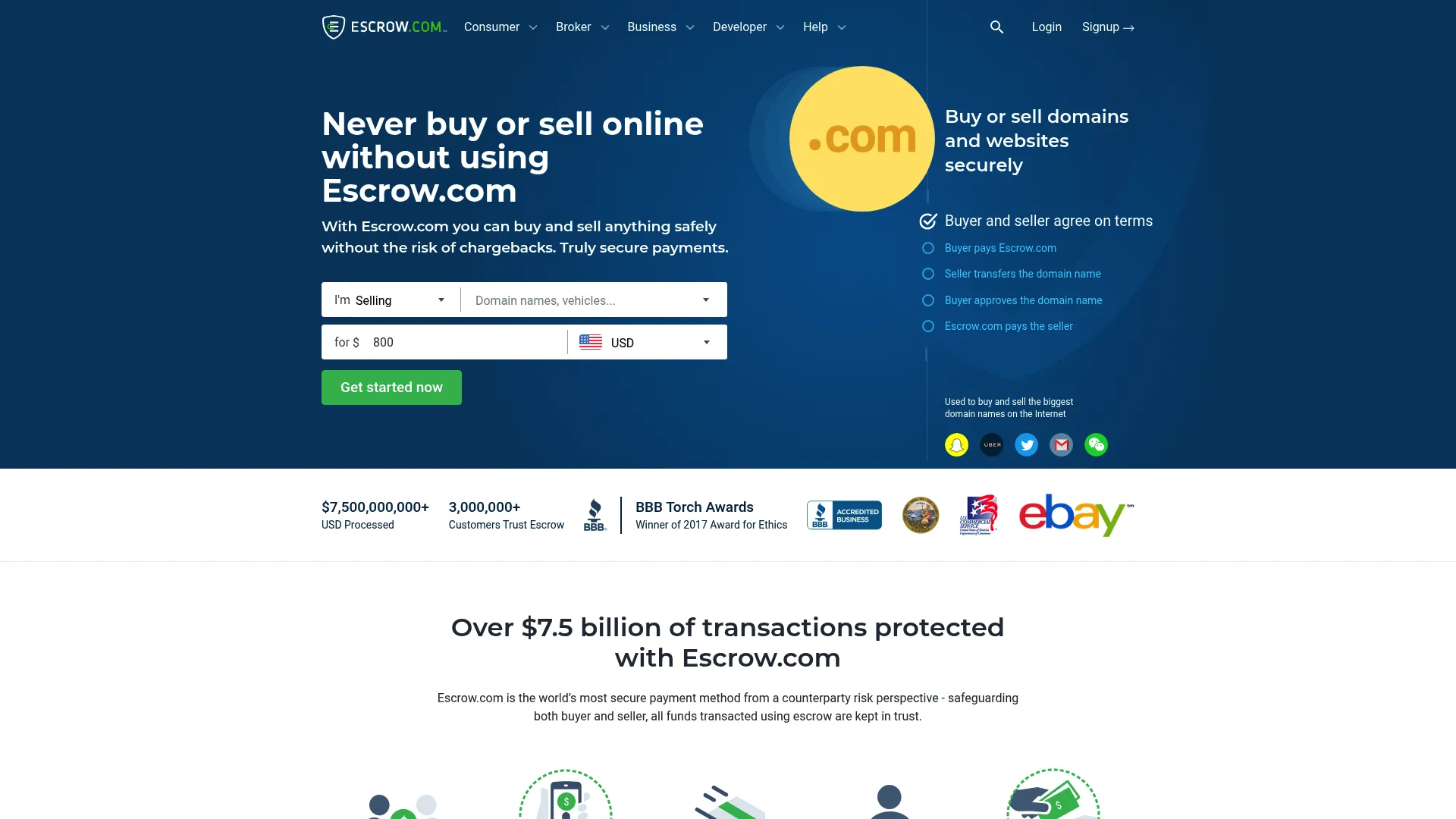
Escrow.com is a broad online escrow service for secure transactions across goods, domains, software, and other high-value items. It is not a source code escrow specialist, but it earns a place here for its transactional trust infrastructure and API. Its documented five-step process, with a buyer inspection period before the seller gets paid, is a clean model for software transactions, asset transfers, and marketplace-style deals rather than long-term continuity protection.
Best for: Businesses that need escrow protection for online purchases, software transactions, and high-value transfers.
Key strengths
- Five-step escrow payment service: A clear, documented flow from agreement to release.
- Escrow API and Escrow Pay: Programmatic integrations for building escrow into transaction flows.
- Buyer inspection period: Funds release only after the buyer confirms, protecting both sides.
Why choose Escrow.com: Choose it when the job is transactional, a software sale, a domain transfer, or a marketplace deal that needs a neutral party holding funds. If your requirement is long-term source code or SaaS continuity, the specialist providers on this list are the better fit for that specific job.
Escrow.com pricing: Standard fees run 2.6% of the transaction with a $50 minimum; the Concierge tier is 5.2% with a $100 minimum. U.S. payment processing adds the applicable fee plus 3.05% for certain payment methods. Pricing is per transaction rather than an annual subscription.
4. Iron Mountain
Iron Mountain is a global information management company known for records storage, secure shredding, data centers, and digital information management. Its relevance to escrow comes from decades of secure custody credibility and enterprise-scale governance. Buyers evaluating a broad third-party risk program often shortlist Iron Mountain for secure custody of critical materials alongside their records and data management, especially where physical and digital custody sit under one governance framework.
Best for: Enterprises that need secure physical and digital information management at scale.
Key strengths
- Records and document storage: Long-standing custody infrastructure for sensitive materials.
- Secure shredding: End-to-end handling of information from storage through destruction.
- Data centers and digital management: Digital custody and infrastructure alongside physical storage.
Why choose Iron Mountain: Choose it when custody, governance, and enterprise-scale trust are the priority and escrow is one line item in a larger information-management relationship. It fits organizations that already trust Iron Mountain with records and want continuity materials held under the same secure, audited umbrella.
Iron Mountain pricing: The Iron Mountain Express storefront shows transparent online pricing for some categories, including storage boxes starting at $60 and one-time document shredding starting at $140. Broader enterprise services, including tailored custody arrangements, typically use quote-based pricing. Iron Mountain holds a 4.0/5 rating on G2.
5. NCC Group
NCC Group is a global cyber security and managed services company whose escrow relevance is anchored in security assurance and technical verification credibility. For regulated or risk-sensitive buyers, an escrow arrangement backed by genuine technical assurance carries more weight in diligence. NCC Group's consulting, managed security, and technical assurance work means its verification and release processes are evaluated by teams that understand what a build actually requires to run.
Best for: Enterprises seeking cyber security, assurance, and resilience services alongside escrow.
Key strengths
- Cyber security consulting and advisory: Security expertise that informs how deposits and releases are handled.
- Managed security services: Ongoing security operations for risk-sensitive environments.
- Technical assurance and penetration testing: Verification credibility that satisfies regulated buyers.
Why choose NCC Group: Choose it when your buyers or regulators demand security assurance behind the escrow, not just custody. It suits diligence-heavy environments, financial services, healthcare, government, where the technical rigor of verification matters as much as the legal agreement.
NCC Group pricing: NCC Group does not publish list pricing. Engagements are typically scoped through statements of work or day-rate arrangements, so pricing is set per project. Contact their sales team for a quote tied to your verification and continuity scope.
6. Data Escrow
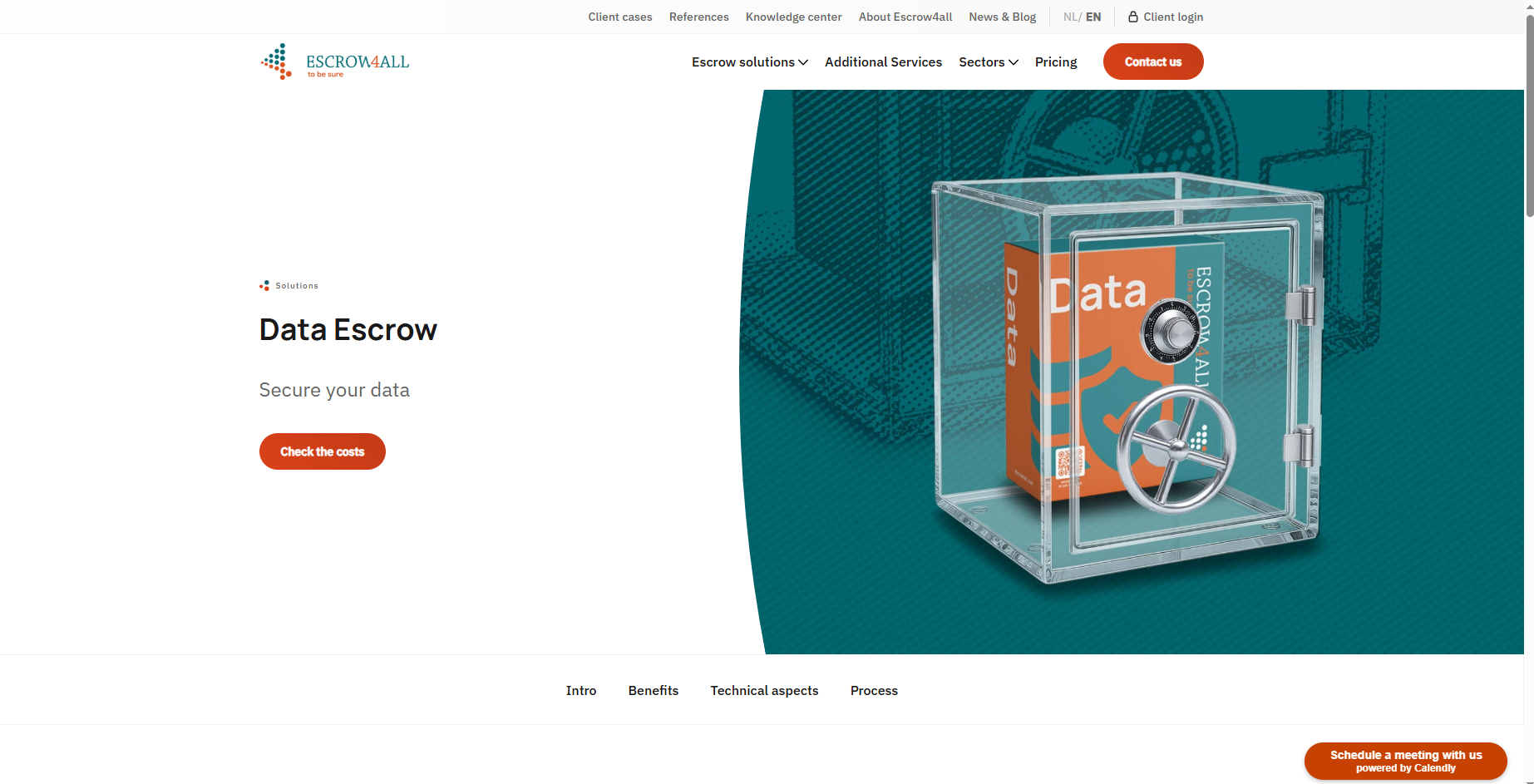
Data Escrow focuses on escrow management and continuity for organizations that want a dedicated provider for holding and releasing critical software materials. For mid-market SaaS teams, a continuity-focused provider can be a practical middle ground between the largest enterprise players and the simplest single-agreement services. The value is a straightforward relationship centered on the continuity job itself.
Best for: Organizations that need software escrow with a continuity-focused approach.
Key strengths
- Escrow management: Dedicated handling of deposit, custody, and release workflows.
- Continuity focus: Oriented around keeping critical software recoverable.
- Mid-market fit: A practical option between enterprise suites and bare-bones agreements.
Why choose Data Escrow: Choose it when you want a provider centered on continuity without the breadth of a full information-governance company. It suits teams that want the escrow relationship to stay focused and manageable.
Data Escrow pricing: Public pricing was not verifiable for Data Escrow. Contact the provider directly for a quote scoped to your number of agreements, deposit frequency, and verification needs.
7. EscrowTech
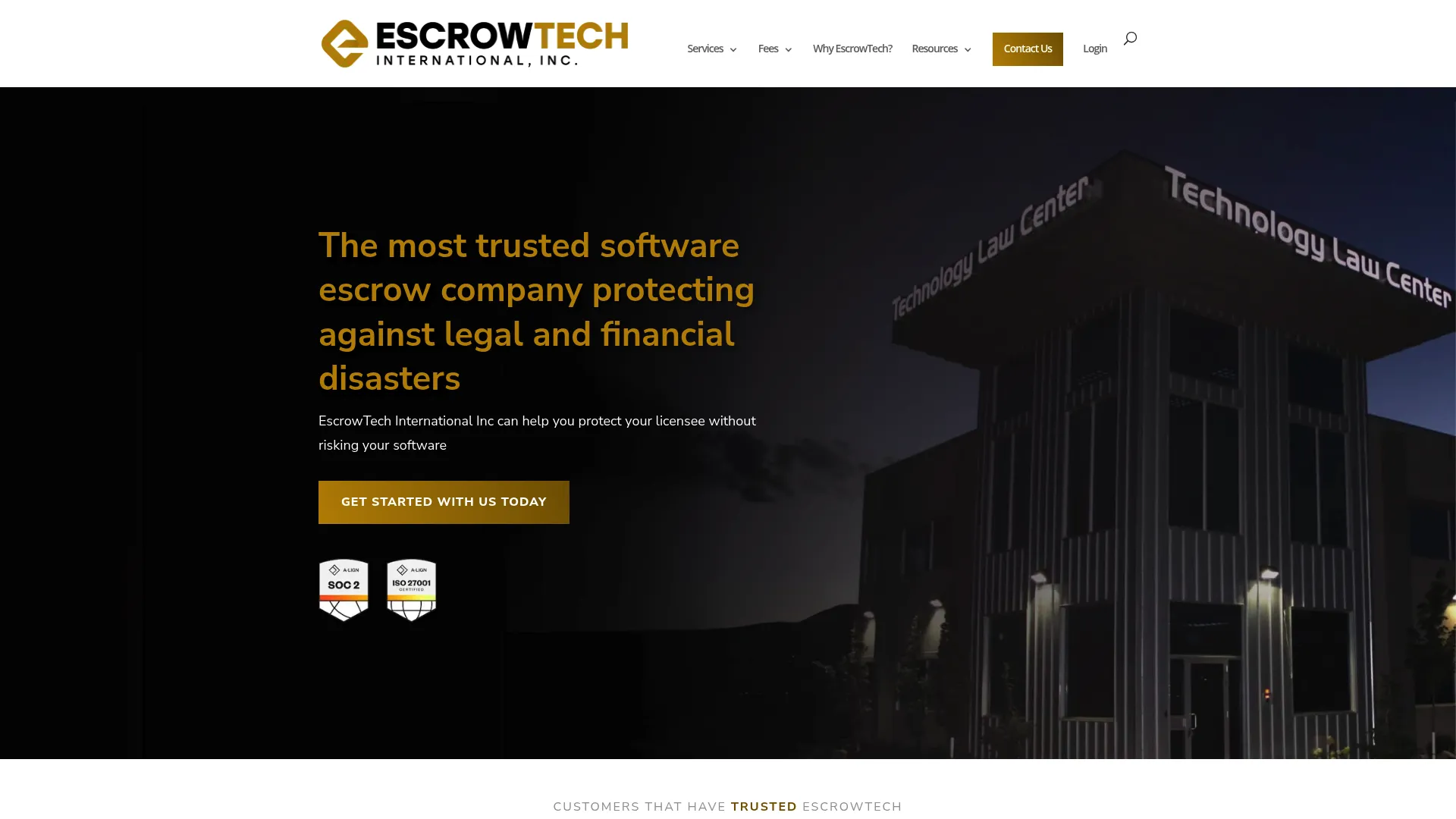
EscrowTech is a software and technology escrow provider offering source code, SaaS, and technology escrow with something rare in this category: published pricing. It supports single- and multi-beneficiary agreements, unlimited deposits and updates, and online account management with deposit confirmations. That transparency and configurability make it easy to model costs and structure agreements without a lengthy sales cycle, which matters to founders who want to move fast on a diligence deadline.
Best for: Businesses that need software, SaaS, or technology escrow with published pricing and configurable agreement structures.
Key strengths
- Single- and multi-beneficiary agreements: Flexible structures for one customer or many.
- Unlimited deposits and updates: Keep escrowed materials current without per-deposit charges.
- Online account management: Self-serve deposit confirmations and account visibility.
Why choose EscrowTech: Choose it when you want to see real numbers up front and configure the agreement to your beneficiary structure. It suits founders and RevOps teams who value pricing transparency and the ability to model costs before committing.
EscrowTech pricing: The single-beneficiary agreement carries a $995 setup fee and a $1,595 annual fee. Multi-beneficiary options start at a $995 setup with a $1,390 annual fee plus per-product and per-beneficiary charges, scaling up to separated-escrow structures with higher annual fees. Pricing is published openly on their site.
8. Software Escrow Services Ltd
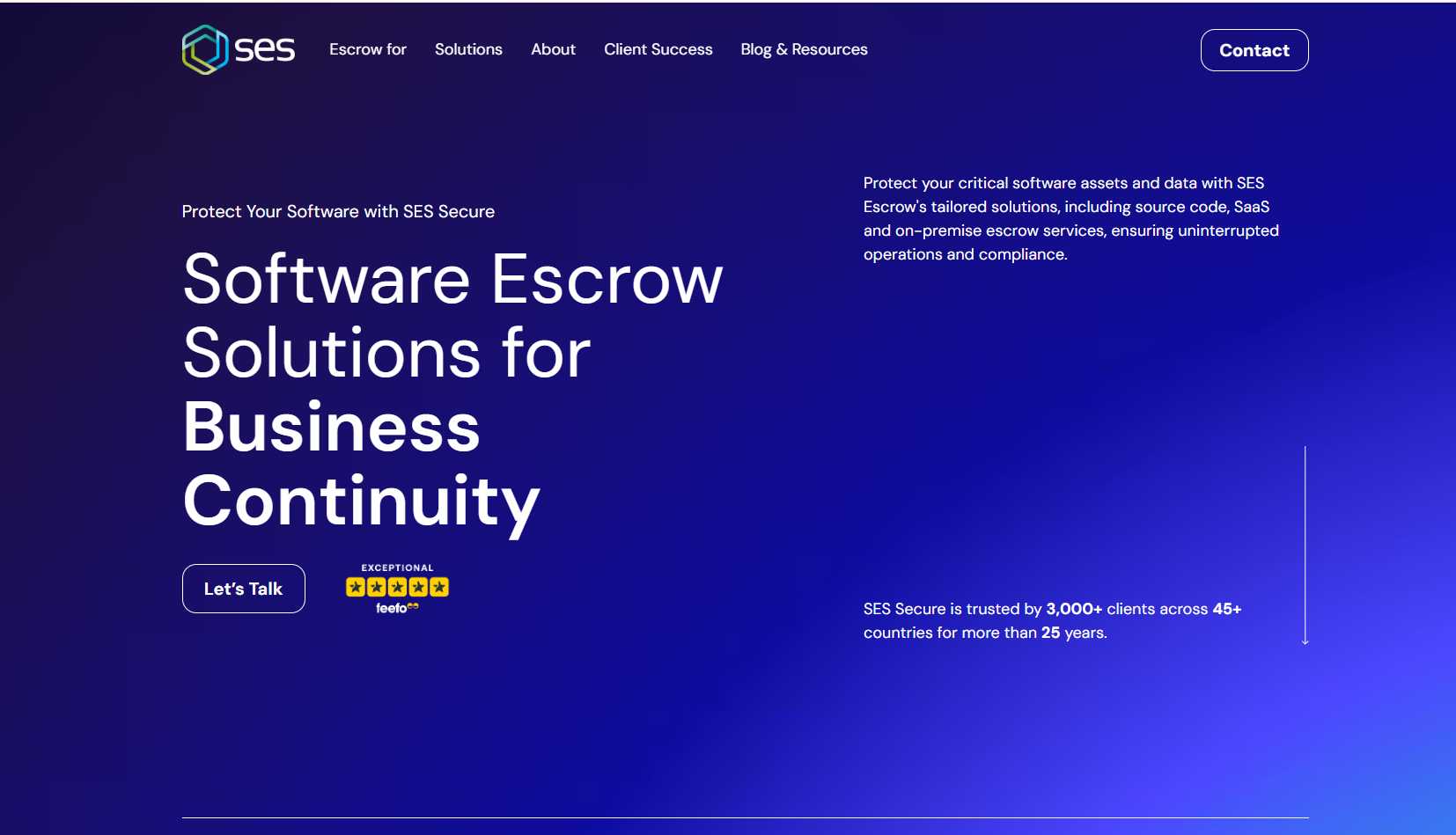
Software Escrow Services Ltd is a straightforward software escrow provider for companies that want a direct, no-frills arrangement. For teams whose requirement is a single clean escrow agreement rather than a broad continuity or assurance program, a focused provider like this can be the simplest path to satisfying a contract clause or a procurement requirement.
Best for: Organizations that need a straightforward software escrow arrangement.
Key strengths
- Direct escrow provider: Focused on the core software escrow job.
- Straightforward setup: Suited to single-agreement requirements.
- Contract-clause fit: A practical answer to procurement escrow clauses.
Why choose Software Escrow Services Ltd: Choose it when the requirement is narrow and specific, one agreement, one dependency, a clear procurement need, and you want a provider without the overhead of a large enterprise suite. It fits teams that value simplicity over breadth.
Software Escrow Services Ltd pricing: Public pricing was not verifiable for this provider. Contact them directly for a quote scoped to your specific escrow agreement and deposit requirements.
How to choose the right escrow provider
Before you sign, run each shortlisted provider through this checklist.
Release trigger clarity
Read exactly how release triggers are defined and executed. Vague triggers create disputes at the worst possible moment. Confirm the events that unlock the deposit, insolvency, discontinued support, breach of maintenance, and the steps between a trigger and actual access.
Verification depth
Ask what verification the provider performs. A file inventory is not the same as a full build-and-run test. If continuity actually matters to you, pay for verification that confirms the deposit compiles and runs in your target environment.
Deposit currency and automation
Escrowed code is only useful if it reflects your current product. Confirm how deposits are updated, ideally automated from your Git or cloud repositories, and how often. A deposit that is two years stale offers little protection.
SaaS and cloud continuity coverage
If the dependency is a cloud-hosted SaaS product, source code alone will not keep it running. Confirm the provider offers access continuity, hosting recovery, or replica environments, not just a code deposit.
Governance and diligence-readiness
If escrow is being driven by enterprise buyers or regulators, the provider's own governance, security posture, and audit trail matter. Confirm the arrangement will satisfy the security reviews it is meant to pass.
Conclusion
The right escrow software depends on what you are protecting and who is asking for it. For enterprise buyers who need verification plus continuity, Escode and NCC Group bring the depth and assurance that diligence-heavy programs demand. For SaaS continuity with automated, always-current deposits, Escrow London is built for the way modern teams ship. For transparent, configurable pricing you can model quickly, EscrowTech puts real numbers on the table, while Escrow.com fits transactional and API-driven escrow needs.
Your next step is not to pick a brand, it is to define your release triggers, your required verification depth, and whether your dependency is source code, SaaS, or both. Take that requirement to two or three providers and compare how each handles the release event, not just the deposit. The provider that survives that scrutiny is the one worth signing.
If your broader goal is proving operational resilience and reducing risk across your stack, tools that help you show your product clearly also matter to buyers, and Guideflow helps teams do exactly that.
Start your journey with Guideflow today!
FAQs
Software escrow is an arrangement where an independent third party holds a copy of a software product's source code, build instructions, and documentation, then releases those materials to the customer only when a predefined event occurs. It protects the customer's ability to keep running mission-critical software if the vendor cannot continue supporting it.
Three parties enter a software escrow agreement: the depositor (vendor), the beneficiary (customer), and the independent escrow agent. The vendor deposits source code and materials, the agent verifies and holds them, and the agent releases them to the customer only if an agreed release trigger fires. Deposits are updated on a schedule so the held materials stay current.
Source code escrow protects on-premises or licensed software by holding the code and build assets a customer would need to maintain the product themselves. SaaS escrow protects cloud-hosted applications and adds access continuity, hosting recovery, and sometimes replica environments, because handing over source code alone will not keep a live SaaS service running.
Use it when a vendor failure would stop revenue, halt onboarding, or break a customer commitment, when enterprise buyers require it during procurement, or when you want to reduce vendor lock-in as part of exit and continuity planning. It is most valuable for mission-critical dependencies you cannot quickly replace.
A complete deposit typically includes source code, build and compilation instructions, documentation, and any dependencies or configuration needed to rebuild the software. For SaaS escrow, it can also include hosting data, environment configurations, and recovery materials so the service can be restored.
Deposits should be updated frequently enough that the held materials match your current production code. Many modern providers support automated deposits pulled directly from Git or cloud repositories, keeping escrow current with every meaningful release rather than relying on manual quarterly or annual uploads.
Common release triggers include vendor bankruptcy or insolvency, discontinuation of product support, breach of a maintenance or service-level obligation, or ceasing business operations. The exact conditions and the release process should be spelled out precisely in the software escrow agreement to avoid disputes when a trigger event occurs.
Buyers assess the provider's verification testing depth, whether deposits are confirmed to compile and run, how release triggers are defined and executed, deposit automation and currency, SaaS and cloud continuity coverage, and the provider's own governance and security posture. The strongest test is asking exactly how the provider would handle an actual release event.