Your dashboards are green. Your data is a mess.
That contradiction is where most data programs live. You have more data than ever, but the numbers in the exec deck do not match the numbers in the pipeline report, and nobody can say which one is right. The problem is not volume. It is trust.
Stewardship is where trust breaks down first. Ownership is fuzzy, so nobody fixes the duplicate customer records. Metadata is scattered, so an analyst spends an afternoon just finding which table is the real one. Quality issues surface at the worst possible moment, usually in front of a customer or an auditor.
The market has noticed. The data stewardship workflows market was worth $2.3 billion in 2024 and is forecast to reach $8.1 billion by 2033 at a 14.7% CAGR, according to Research Intelo (2024). That growth tracks a simple reality: as AI governance moves from slideware to production, teams need someone (and something) to own data quality, lineage, and access at the asset level.
For product managers, data leads, and governance owners, the question is not whether to invest. It is which tool matches your actual bottleneck without adding another brittle system to maintain.
What's inside
This guide compares seven real data stewardship platforms, not tool categories or generic advice. It is written for product managers, data teams, and governance owners who already feel the pain and need practical selection criteria.
We chose the seven based on:
- Stewardship workflow depth (ownership, tasks, exceptions, approvals)
- Metadata and lineage support
- Data quality and profiling capabilities
- Governance, collaboration, and access controls
- Enterprise fit and AI readiness
Every pick below is an actual product you can evaluate, with current pricing signals and G2 ratings where available.
TL;DR
- Best for enterprise governance: Collibra, for workflow orchestration, policy enforcement, and governed data and AI context at scale.
- Best for metadata and cataloging: Alation, for search, collaboration, and knowledge-sharing across analysts and stewards.
- Best for data quality operations: Informatica and Talend, for profiling, cleansing, and quality workflows tied to integration.
- Best for AI governance alignment: IBM watsonx.governance, for model oversight, risk controls, and audit-ready reporting.
- Best for modern, collaborative data teams: Atlan, for a fast, collaborative workspace with catalog and lineage.
- Best for Microsoft-centric stacks: Microsoft Purview, for catalog, classification, and governance inside Microsoft 365 and Azure.
What is data stewardship software?
Data stewardship software is the operational layer that helps teams apply data governance in practice by managing data quality, metadata, lineage, ownership, classification, workflows, and access controls across data assets.
Governance writes the rules. Stewardship does the work. Where governance defines what "customer" means and who may see it, stewardship assigns an owner, flags the records that break the definition, routes the fix, and logs who approved it.
Core capabilities usually include:
- Metadata management: cataloging tables, columns, and business terms so people find and trust the right asset
- Data lineage: tracing where data comes from, how it transforms, and what it feeds downstream
- Data quality tools: profiling, rules, scoring, and remediation workflows
- Ownership and workflows: assigning stewards, tasks, exceptions, and approvals
- Classification and access: tagging sensitive data and enforcing RBAC (role-based access control)
- Audit trails: logging changes to support audit readiness and compliance
A quick distinction worth keeping straight. Data management is the broad discipline of storing, moving, and modeling data. Data governance is the policy and standards layer. Data stewardship is the day-to-day execution that keeps both real. Get stewardship right and AI readiness follows, because models trained on governed, documented, well-owned data are far easier to defend when someone asks how a decision was made.
How data stewardship differs from data governance
The confusion here is not academic. It changes who you hire, what you buy, and where accountability sits.
Governance is policy. It sets standards: definitions, classifications, retention rules, access policies, and who signs off. Stewardship is execution. It applies those standards to specific assets, resolves the exceptions, and keeps the metadata current as the product changes.
Here is the split in practice.
| Dimension | Data governance | Data stewardship |
|---|---|---|
| Focus | Policies, standards, definitions | Day-to-day execution and exceptions |
| Question it answers | What are the rules? | Are we following the rules on this asset? |
| Typical output | Data policy, glossary, access model | Resolved tickets, updated metadata, owned assets |
| Owner in practice | Data governance council, CDO | Data stewards, domain owners, sometimes PMs |
| Cadence | Set and reviewed periodically | Continuous |
Most teams get the policy done and then watch it drift. A glossary nobody maintains is worse than no glossary, because people trust it. Stewardship is what stops the drift. In practice, governance owners write the standard, and stewards (often embedded in product or domain teams) carry it out asset by asset.
What to look for in data stewardship software
Feature lists are long. Your bottleneck is specific. Evaluate against the friction you actually have, not the longest checklist.
Metadata and catalog depth
A catalog is only useful if people trust it and use it. Look for automated metadata harvesting, a business glossary that links terms to physical assets, and search that surfaces the right table over the near-duplicate one. Check how well it integrates with your warehouse, BI, and pipeline tools, because a data catalog that ignores half your stack becomes another silo.
Data lineage and traceability
When a number looks wrong, lineage answers "where did this come from?" in minutes instead of a Slack archaeology dig. Evaluate column-level lineage, not just table-level, and confirm it captures transformations across your pipelines. Strong lineage is also the backbone of impact analysis: change a source, and you want to see everything downstream that breaks before it breaks.
Data quality and profiling workflows
This is where stewardship earns its keep. Look for profiling that surfaces anomalies automatically, rule-based quality scoring, and remediation workflows that route issues to an owner. The best data quality tools close the loop: detect, assign, fix, verify, and log. Tie quality scores to specific assets so trust becomes measurable, not a feeling.
Access control, collaboration, and auditability
Stewardship is a team sport played across data, product, security, and compliance. You need RBAC to enforce who touches what, collaboration so stewards and domain owners work in the same place, and immutable audit logs for audit readiness. For PMs, the maintainability question matters most: can non-engineers own workflows without filing a ticket every time the schema changes?
When to use data stewardship software
Not every team needs a full platform on day one. Match the tool to the moment.
Clean up inconsistent critical data
When the same customer exists five times across three systems, and finance and sales cannot agree on a revenue number, you have a stewardship problem, not a reporting one. Platforms with strong profiling, matching, and MDM software capabilities help you converge on a trusted record and keep it clean. If the mess is contained to one domain, a focused data quality tool may be enough to start.
Support compliance and audit readiness
When an auditor asks who accessed a dataset, when, and under what policy, you either have an audit trail or you have a bad week. Stewardship software that logs changes, enforces classification, and ties access to RBAC turns audit prep from a fire drill into a query. This matters most in regulated environments and for any team handling personal data.
Prepare data for analytics and AI use
Models are only as trustworthy as the data behind them. Documented lineage, owned assets, and quality scores are what let you answer "why did the model decide that?" without guessing. As AI governance expectations rise, stewardship becomes the foundation that makes analytics and AI defensible rather than a liability.
Data stewardship software comparison
Seven platforms, sorted by relevance to the keyword. Pricing across this category is largely sales-led, so treat the pricing column as a signal, not a quote. G2 ratings reflect current listings at the time of writing.
| # | Product | Best for | Key differentiator | Pricing | G2 rating |
|---|---|---|---|---|---|
| 1 | Collibra | Enterprise governance and stewardship at scale | AI control plane for governed data and AI context | Sales-led | 4.2/5 |
| 2 | Alation | Metadata, cataloging, and collaboration | AI-powered catalog and data discovery | Sales-led | 4.4/5 |
| 3 | Informatica | Data quality and enterprise data management | Unified cloud platform with CLAIRE AI | Consumption-based, free trial | 4.3/5 |
| 4 | IBM watsonx.governance | AI governance and model oversight | Governance graph across the AI estate | From $42,000 (AWS Cloud) | 4.3/5 |
| 5 | Atlan | Modern, collaborative data teams | Context layer and active metadata | Sales-led | 4.5/5 |
| 6 | Talend | Data quality and integration operations | Integration plus quality under Qlik Talend | Sales-led | 4.3/5 |
| 7 | Microsoft Purview | Microsoft-centric governance | Native to Microsoft 365 and Azure | Suite and pay-as-you-go | 4.4/5 |
Best 7 tools for data stewardship
1. Collibra
Collibra is the enterprise choice when governance and stewardship need to run at scale across many domains, systems, and stakeholders. It positions itself as an AI control plane for governed data and AI context, tying cataloging, policy enforcement, and access control into one place. For large organizations, the draw is workflow orchestration: ownership, approvals, and policy applied consistently rather than one team at a time.
Best for: Large enterprises that need governed data and AI context, cataloging, and access control across the business.
Key features
- AI governance and monitoring
- Data catalog and data governance
- Data access and masking
Why choose Collibra: Choose it when your bottleneck is coordination across many teams, and you need policy enforcement and workflow orchestration that hold up under audit. It is strongest for mature programs; smaller teams with a single-domain problem may not need this much surface area yet.
Collibra pricing: Pricing is sales-led and not published publicly. Contact Collibra for a quote based on scope and modules.
2. Alation

Alation built its reputation on the data catalog, and it shows. The platform leans into search, collaboration, and knowledge-sharing, so analysts and stewards find trusted assets and document them in the same flow. AI-assisted discovery helps surface the right dataset instead of the near-duplicate one, which is often where trust quietly erodes.
Best for: Large enterprises that want governed data discovery and cataloging with strong collaboration.
Key features
- AI-powered data catalog and search
- Data governance and lineage
- Conversational analytics and AI governance
Why choose Alation: Choose it when adoption is your real problem, when you have the data but people cannot find or trust it. Its collaboration model fits analyst-heavy organizations and governance teams that want stewardship to feel like part of daily work, not a separate chore.
Alation pricing: Pricing is sales-led and not published publicly. Alation directs prospects to book a demo for a scoped quote.
3. Informatica
Informatica is built for depth. Its Intelligent Data Management Cloud spans catalog, integration, data quality, MDM, and governance, with CLAIRE AI running across the stack. For teams whose core pain is data quality and enterprise data management, the breadth means profiling, cleansing, lineage, and mastering can live in one platform rather than a patchwork.
Best for: Large organizations needing a unified cloud platform for enterprise data management.
Key features
- Intelligent Data Management Cloud
- Data Catalog and Data Quality & Observability
- MDM & 360 Applications
- Governance, Access & Privacy
- CLAIRE AI
Why choose Informatica: Choose it when your program is mature enough to use the full range: integration, quality, MDM software, and governance together. The consumption model scales with usage, which suits large or growing data estates more than a single-domain cleanup.
Informatica pricing: Public pricing is not displayed; Informatica uses consumption-based pricing. A free 30-day trial is available for selected products.
4. IBM watsonx.governance
IBM watsonx.governance approaches stewardship from the AI angle. Instead of centering the catalog, it centers model oversight: a governance graph gives visibility across your AI estate, with risk, policy, and compliance controls plus audit-ready reporting. As data stewardship and AI governance converge, this is the tool for teams whose stewardship question is really "can we defend this model?"
Best for: Enterprises that need governed, audit-ready AI oversight across hybrid and multi-vendor environments.
Key features
- Governance Graph for AI estate visibility
- Risk, policy, and compliance controls
- Model monitoring, evaluation, and audit-ready reporting
Why choose IBM watsonx.governance: Choose it when models, not just tables, are what you need to govern. It fits organizations already deploying AI in production who need lifecycle oversight and reporting that satisfies risk and compliance stakeholders.
IBM watsonx.governance pricing: An AWS Cloud offer starts at $42,000, and software pricing is based on virtual processor cores (VPC). A free tier is available.
5. Atlan
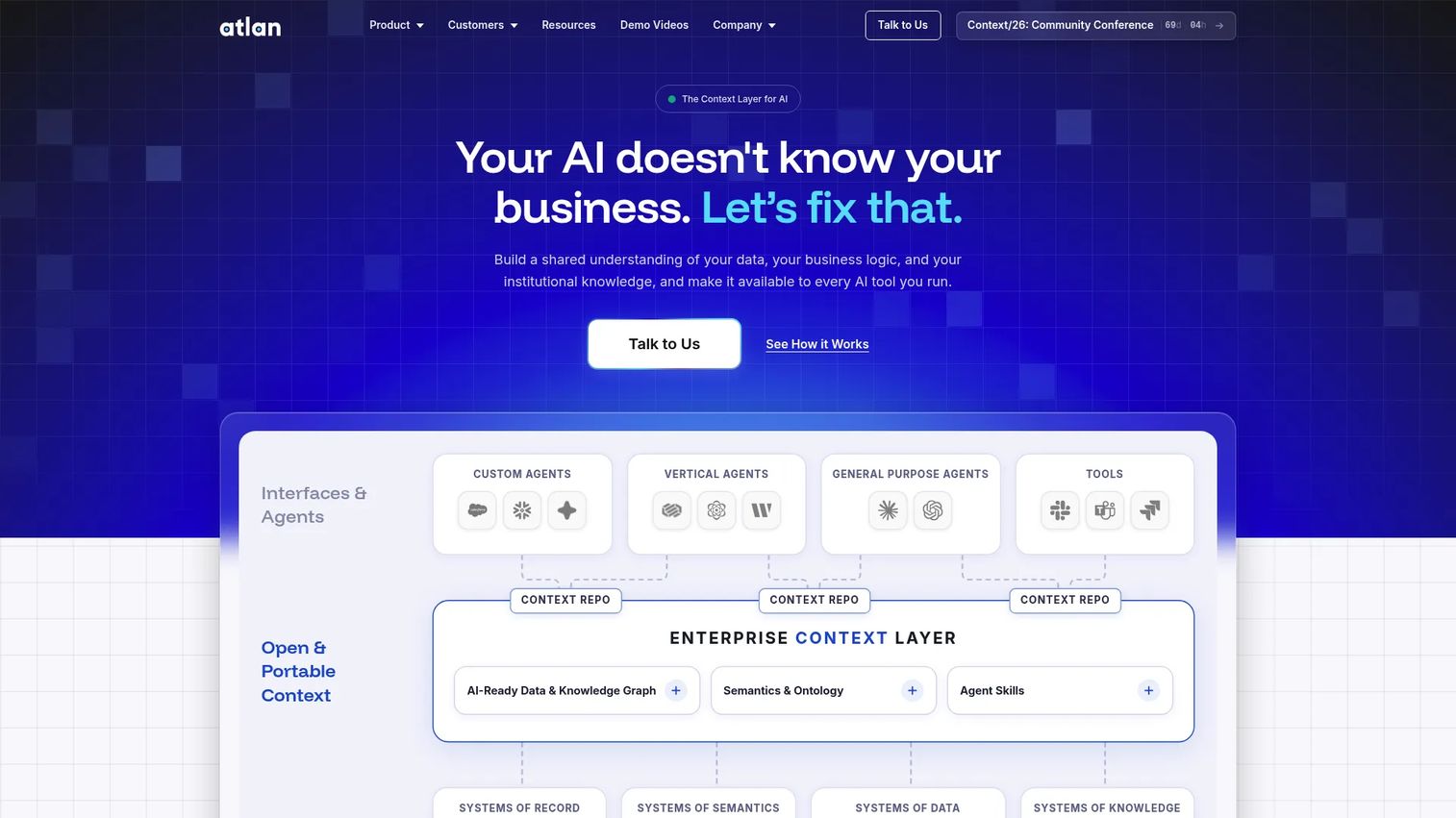
Atlan is the modern, collaborative option. It frames itself as a context layer and data catalog for enterprise data teams, with active metadata and lineage that flow into the tools people already use. For fast-moving teams, the appeal is speed and collaboration: stewardship workflows that feel native to a modern data stack rather than bolted on.
Best for: Enterprise teams managing data discovery, lineage, and AI governance who value collaboration and speed.
Key features
- Context layer / enterprise data graph
- Data lineage
- Context agents and data marketplace
Why choose Atlan: Choose it when your data team moves fast and wants stewardship to keep pace, not slow it down. Its collaborative model and active metadata suit teams that want catalog and lineage embedded in daily workflows across product, analytics, and engineering.
Atlan pricing: Pricing is sales-led and based on a monthly adoption model; Atlan directs prospects to book a demo for a quote.
6. Talend
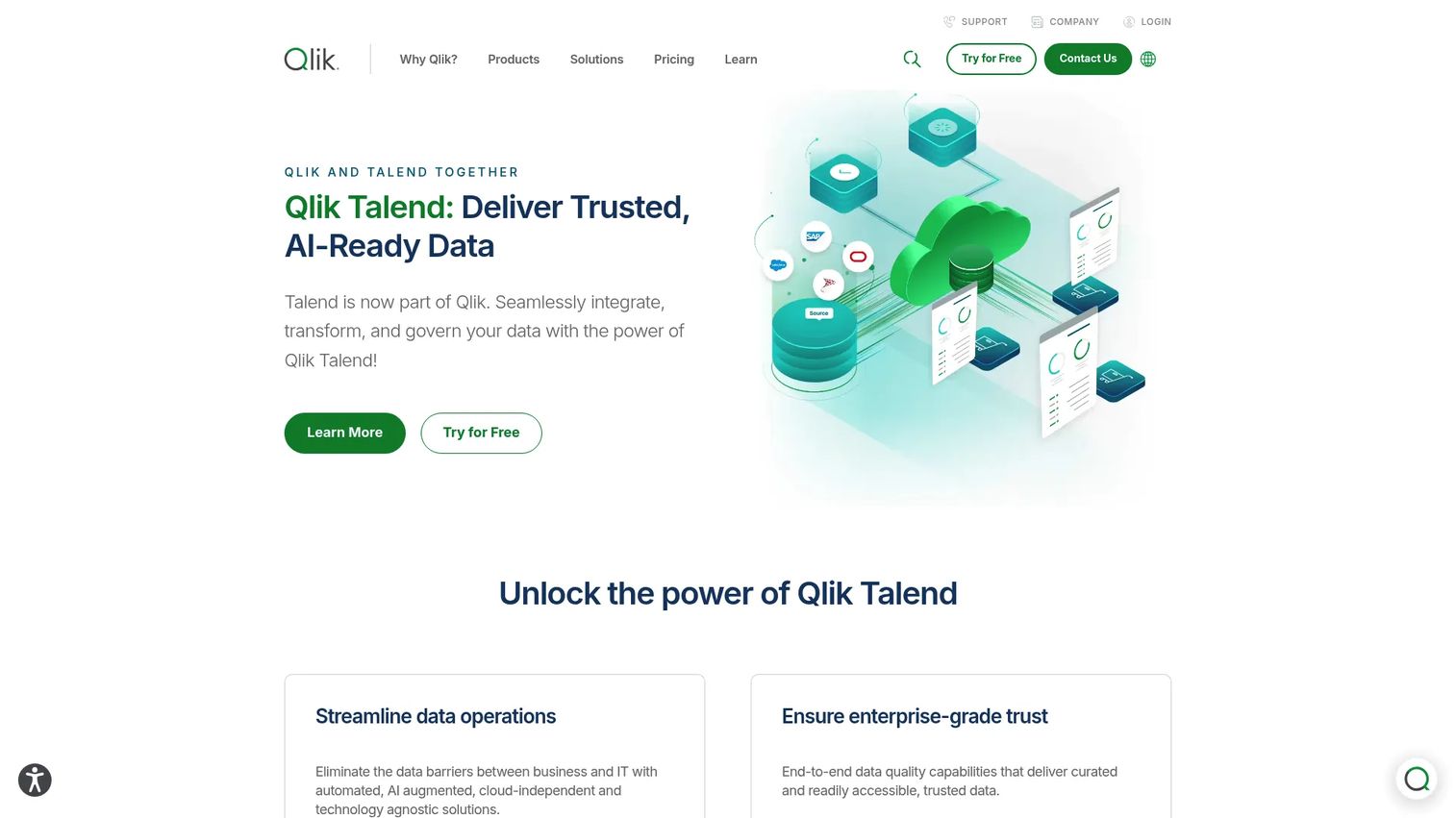
Talend, now offered under Qlik Talend Cloud and Talend Data Fabric, supports stewardship through the pipeline. Its strength is combining data integration with data quality: profiling, cleansing, and governance run alongside the movement of data, so issues get caught where they originate. For teams whose stewardship problem is really an integration-and-quality problem, that pairing is the point.
Best for: Enterprises needing unified data integration, quality, and governance.
Key features
- Data movement and integration
- Data quality and governance
- Application and API integration
Why choose Talend: Choose it when quality issues live in your pipelines and you want to fix them at the source rather than downstream. It fits teams that treat integration and stewardship as one workflow instead of two separate tools.
Talend pricing: Qlik Talend Cloud lists Starter, Standard, Premium, and Enterprise editions, all with contact-sales pricing. Public prices are not shown.
7. Microsoft Purview
Microsoft Purview is the natural fit when your stack already runs on Microsoft. It brings catalog, classification, lineage, and governance native to Microsoft 365 and Azure, with data security posture management, information protection, and data loss prevention built in. If your data lives in the Microsoft world, the ecosystem fit removes a lot of integration friction.
Best for: Organizations wanting Microsoft-native data security, governance, and compliance across Microsoft 365, Azure, and AI workloads.
Key features
- Data Security Posture Management
- Information Protection
- Data Loss Prevention
Why choose Microsoft Purview: Choose it when you are already invested in Microsoft and want governance that speaks the same language as the rest of your estate. The native integration is the differentiator; teams on non-Microsoft stacks will weigh that fit differently.
Microsoft Purview pricing: Microsoft offers the Microsoft Purview Suite and pay-as-you-go pricing, with usage-based meters rather than a single public entry price. A free tier is available.
Considerations
Before you commit, run every shortlisted tool through the same checklist. The longest feature list rarely wins; the best fit for your bottleneck does.
Ownership and operating model
Decide who actually owns stewardship before you buy. A tool cannot fix unclear accountability. Confirm the platform supports your model, whether that is a central governance team, embedded domain stewards, or PMs owning their own data assets.
Integration with your existing data stack
A stewardship platform that ignores half your warehouse, BI, and pipeline tools becomes another silo. Map your stack first, then verify native connectors and depth of integration. Shallow integration creates the exact fragmentation you are trying to kill.
Lineage and metadata completeness
Ask for column-level lineage, not just table-level, and test it on a real transformation. Metadata that stops at the surface will not answer the "where did this number come from?" question when it matters most.
Access control and auditability
Check that RBAC is granular enough for your compliance needs and that audit logs are immutable and queryable. For privacy and compliance, classification and access enforcement should be tightly linked, not bolted on afterward.
AI readiness and scalability
If AI is on your roadmap, evaluate how the platform handles model oversight, documented lineage, and governance of training data. AI governance is fast becoming a stewardship requirement, not a separate project.
Conclusion
Pick the tool that matches your biggest bottleneck, not the one with the longest feature list.
If your problem is coordination across many teams, Collibra brings governance and stewardship to enterprise scale. If people cannot find or trust data, Alation leads on cataloging and collaboration. For deep data quality and enterprise data management, Informatica and Talend both fit, with Talend strongest when the issue lives in your pipelines. If you are governing models as much as tables, IBM watsonx.governance is built for AI oversight. For a fast, collaborative modern data team, Atlan keeps pace. And if you live in Microsoft 365 and Azure, Microsoft Purview removes integration friction by default.
Start by naming the single friction point costing you the most: duplicate records, audit fire drills, or undefendable AI. Shortlist the two tools that target it, run both against the considerations checklist above, and pilot before you scale.
Start your journey with Guideflow today!
FAQs
Governance sets the rules: definitions, classifications, access policies, and who approves them. Stewardship executes those rules on specific data assets, resolving exceptions and keeping metadata current. Governance is the policy layer; stewardship is the day-to-day work that keeps the policy real.
It operationalizes governance by managing data quality, metadata, lineage, ownership, classification, workflows, and access controls. In practice, that means cataloging assets, tracing lineage, profiling for quality issues, assigning stewards, and logging changes for audit readiness. It turns policy documents into enforced, trackable work.
Match features to your bottleneck. Metadata and catalog depth solve discovery and trust, lineage answers "where did this come from?", and data quality tools detect and remediate bad records. Access control with RBAC and immutable audit logs cover compliance. Prioritize the two or three that hit your actual pain.
For most teams, yes. A data catalog is where metadata, ownership, and business definitions live, and it is what makes assets findable and trustworthy. Without one, stewards spend more time locating the right data than governing it. Smaller, single-domain efforts may start lighter and add a catalog as scope grows.
Models are only as trustworthy as the data behind them. Documented lineage, owned assets, and measurable quality scores let you explain why a model made a decision and defend it under scrutiny. As AI governance expectations rise, stewardship becomes the foundation that makes AI defensible rather than a compliance risk.
Look for strong segmentation and workflow ownership so non-engineers can maintain stewardship without filing tickets. Prioritize low maintenance, integration with your analytics and data stack, clear impact measurement, and security or compliance fit. The goal is improving data trust without adding a brittle system that decays every release.
When your data is contained to one domain, one team owns it, and quality issues are rare, a full platform can be more than you need. A focused data quality tool or a lightweight catalog may cover it. Adopt a full stewardship platform when coordination across teams, compliance pressure, or AI plans make ownership drift expensive.
Stewardship software logs who changed or accessed data, enforces classification of sensitive fields, and ties access to RBAC. That turns audit prep from a scramble into a query you can run on demand. For privacy and compliance obligations, the immutable audit trail is often the difference between a clean review and a costly one.