

Your cap table started as one clean spreadsheet. Then you raised a seed round. Added SAFE notes. Granted options to 12 hires, then 40. Ran a priced round with a new investor and a pro-rata clause nobody remembers the logic behind.
Now a board member asks a simple question: "What's fully diluted ownership if we do the next round at a $60M pre?" And you spend two days rebuilding formulas you don't trust.
That's the moment most founders realize the spreadsheet has quietly become a liability. In the United States, more than 79% of venture-backed startups now rely on cap table management software, with over 42,000 private companies using such platforms, according to IndustryResearch.biz (2024). The category exists because equity gets complex faster than any single person can track by hand, and because the cost of getting it wrong shows up during diligence, when you least want a surprise.
This guide compares the tools that manage that complexity for you.
What's inside
This is a practical comparison of cap table management software for SaaS founders and finance leads deciding whether to replace spreadsheets or switch providers in 2026.
We picked these seven tools and ranked them on the factors that actually matter when you're mid-consideration:
- Pricing transparency: whether you can see what you'll pay before a sales call
- Compliance depth: 409A valuations, Rule 701, Form 3921, and reporting support
- Scenario modeling: how well the tool handles fundraising and dilution math
- Stage fit: early startup, growth, or mature enterprise equity ops
- Migration: how painful it is to move off a spreadsheet or another provider
TL;DR
- Best overall for scaling founders who want broad capability: Carta. The default reference point, with the widest feature set across equity, fundraising, and compliance.
- Best for transparent pricing and startup teams: Pulley. Public prices, founder-friendly onboarding, and clean scenario modeling.
- Best for early-stage affordability and a free starter path: Cake Equity. Free plan for up to 5 stakeholders, then predictable annual tiers.
- Best for European or global equity workflows: Ledgy. Built for multi-country equity plans and cross-border compliance.
- Best for mature enterprise equity ops: Shareworks by Morgan Stanley. Governance-heavy administration for larger companies.
- Best for private-company equity administration: Astrella. Per-stakeholder pricing with scenario and exit modeling.
- Best for teams evaluating alternatives: LTSE Equity. Historically positioned as a Carta alternative, now transitioned to Astrella.
What is cap table management software
Cap table management software is a system that tracks who owns what in a private company, and automates the equity, compliance, and reporting workflows that come with ownership.
Instead of a spreadsheet, you get a single source of truth for every share, option, SAFE, and note on your cap table. It calculates dilution, models new rounds, issues grants, and produces the reports your lawyers, auditors, and investors need.
Core features across the category:
- Cap table tracking: ownership by shareholder, share class, and fully diluted view
- Equity issuance: stock grants, option pools, vesting schedules, and exercises
- Scenario modeling: fundraising rounds, dilution, and waterfall analysis
- Compliance reporting: 409A valuations, Rule 701, Form 3921, and ASC 718 support
- Investor and employee portals: shareholders see holdings, employees see grants
- Fundraising support: SAFE notes, convertible notes, and priced-round workflows
The broader equity management software market is forecast to grow from about USD 800 million in 2024 to USD 2.49 billion by 2034, at roughly 12% CAGR, per Zion Market Research (2024). Cloud-based deployments already account for over 65% of revenue, according to DataHorizzon Research (2024), which is why almost every tool below is browser-first.
When to use cap table management software
Replacing spreadsheets before they break
A spreadsheet works fine for a handful of founders and a small option pool. It stops working the moment vesting schedules, SAFE conversions, and multiple share classes start interacting.
The break point is usually your first priced round. Once you have preferred stock, liquidation preferences, and a dozen option holders, a single formula error can misstate ownership. Board members lose trust in numbers they can't audit. Cap table software removes the manual math and gives everyone one version of the truth.
Preparing for fundraising or diligence
When investors, lawyers, and your finance lead all need to reference ownership at once, fragmented spreadsheets slow the raise. Diligence teams want a clean audit trail: who was issued what, when, and under what terms.
Scenario modeling matters here too. Before you sign a term sheet, you want to see exactly how a new round dilutes founders, employees, and existing investors. Doing that math by hand under deal pressure is how mistakes happen.
Managing employee equity and compliance
As you hire, equity administration turns into a real job. You're issuing grants, tracking 83(b) elections, processing option exercises, and filing Form 3921 for ISO exercises. Rule 701 caps and 409A valuations govern how and when you can grant.
Good software handles the paperwork and the shareholder communications so a single finance hire can manage hundreds of grants without a spreadsheet per employee.
Comparison table
The table below sorts by relevance to scaling SaaS founders. We focused on pricing transparency and stage fit because those are the two questions founders ask first: what will this cost, and is it built for a company my size?
Pricing and ratings reflect verified values from each vendor at the time of writing.
| # | Product | Best for | Key differentiator | Pricing | G2 rating |
|---|---|---|---|---|---|
| 1 | Carta | Broad capability across equity and fundraising | Widest feature set and category default | Free Launch plan; paid plans quote-based | 4.3/5 |
| 2 | Pulley | Transparent pricing and startup teams | Public per-year pricing plus token cap tables | From $1,200/year | 4.7/5 |
| 3 | Cake Equity | Early-stage affordability | Free plan for up to 5 stakeholders | Free; Build from $1,000/year | 4.8/5 |
| 4 | Ledgy | European and global equity workflows | Multi-country equity plan automation | Free Launch; Scale from €5k/year | Not listed |
| 5 | Shareworks by Morgan Stanley | Mature enterprise equity ops | Governance-heavy share plan administration | Custom pricing | Not listed |
| 6 | Astrella | Private-company equity administration | Per-stakeholder pricing with exit modeling | Free trial; Plus $5/stakeholder/mo | 4.5/5 |
| 7 | LTSE Equity | Teams evaluating Carta alternatives | Historically a Carta alternative, now sunset | Transitioned to Astrella | 4.5/5 |
Best 7 cap table management software tools for 2026
1. Carta
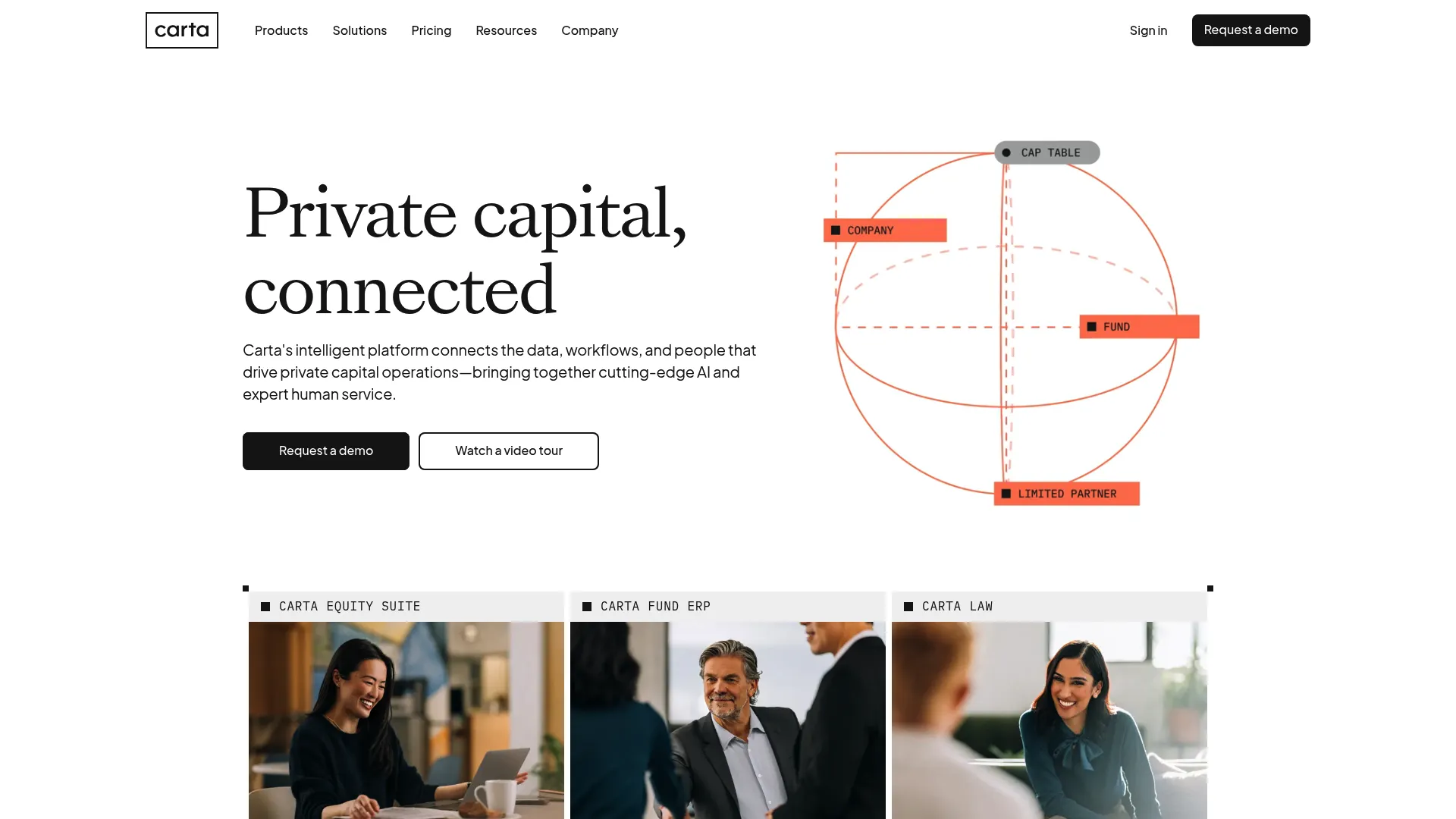
Carta is the name most founders reach for first, and for good reason: it covers the widest range of equity and private-capital workflows in the category. From cap table management to 409A valuations to fund administration, it aims to be the system of record for your entire equity story. That breadth is why it's the default comparison point for every other tool on this list.
For a Series B founder, Carta's appeal is coverage. You can run a priced round, issue grants, handle SAFE financings, and produce compliance reports without stitching tools together. The tradeoff is that most paid pricing is quote-based, so you won't see a clean number until you talk to sales.
Best for: Private companies and finance teams that want one platform for equity management, fundraising, and compliance as they scale.
Key strengths
- Cap table management with fully diluted views
- 409A valuations handled in-platform
- SAFE financings and priced-round workflows
- Fund administration for firms managing capital
Why choose Carta: If you want the broadest capability and expect your equity ops to get more complex through the next few rounds, Carta reduces the number of tools and vendors you juggle. Founders who want a lighter or cheaper option may prefer one of the startup-focused tools below.
Carta pricing: The Launch plan is free for new customers with up to 25 stakeholders and up to $1M raised. Build, Grow, and Scale are quote-based, priced by stakeholder count with a minimum annual fee.
2. Pulley

Pulley built its reputation on two things founders care about: transparent pricing and a clean, founder-friendly interface. You can see the price on the pricing page before anyone gets on a call, which is rare in this category. Onboarding is designed for startups that want cap table management without legacy complexity.
The scenario modeling is a highlight. When you're weighing a term sheet, Pulley lets you model fundraising rounds and see dilution across founders, employees, and investors quickly. It also supports token cap table management, which matters if your company touches crypto or web3.
Best for: Startups and growth-stage companies that want straightforward equity management with pricing they can evaluate on their own.
Key strengths
- Cap table management with a clean interface
- Scenario fundraising modeling for round planning
- 409A valuations
- Employee and investor portals
- Token cap table management
Why choose Pulley: If pricing transparency and speed to first value matter more than the widest possible feature set, Pulley is the pragmatic pick. It fits founders who want to trust the numbers without a long implementation.
Pulley pricing: The Startup plan is $1,200 per year and the Growth plan is $3,500 per year. Enterprise is a custom quote. Separate token cap table and distributions pricing is listed on the same page.
3. Cake Equity

Cake Equity is the easiest way to start managing equity without spending anything on day one. Its free plan covers up to 5 stakeholders, which is enough for many pre-seed and early-seed teams. As you grow, the paid tiers add fundraising modeling, 409A valuations, and employee equity features on predictable annual pricing.
It handles the equity instruments early-stage founders actually use: SAFE notes, convertible notes, vesting schedules, and grants. The My Cake employee portal gives your team a place to see their equity, which cuts down on the "what do I actually own?" questions that eat your time.
Best for: Early-stage to growth-stage startups that want a free starting point and a clear upgrade path as their cap table grows.
Key strengths
- Cap table management from a free tier
- SAFE and convertible note support
- Fundraising modeling and vesting schedules
- My Cake employee equity portal
Why choose Cake Equity: If you're not ready to commit budget but want to move off a spreadsheet now, the free plan is a genuine on-ramp. The tiered pricing means you only pay more as your stakeholder count and needs grow.
Cake Equity pricing: The Free plan supports 5 stakeholders. Build is $1,000 per year and adds cap table management and fundraising modeling. Team is $2,750 per year and adds 409A valuations and employee equity features. Pro is custom for advanced reporting and compliance.
4. Ledgy

Ledgy stands out when your equity program crosses borders. Built with international companies in mind, it automates equity plans across multiple countries and handles the compliance and reporting variation that comes with a global cap table. If you're a SaaS company hiring in Europe and beyond, that flexibility matters.
Beyond cap table management, Ledgy leans into employee and shareholder engagement, with dashboards and communications that keep your team informed about what they hold. It scales from startup to public company, so it can grow with a company that plans to stay independent for a long runway.
Best for: Companies with international teams or more complex, multi-country equity programs that need cross-border compliance.
Key strengths
- Cap table management and equity plan automation
- Employee and shareholder dashboards and communications
- Compliance and financial reporting across geographies
- Scales from startup to public company
Why choose Ledgy: If your equity story spans multiple countries, Ledgy's global focus saves you from forcing a US-centric tool to handle cross-border complexity. It fits founders building distributed teams.
Ledgy pricing: The Launch plan is free for up to 25 stakeholders. Scale starts at €5k per year and Enterprise starts at €18k per year. Public-company pricing is custom. Financial reporting add-ons start at €3k per year for Essentials and €5k per year for Advanced.
5. Shareworks by Morgan Stanley
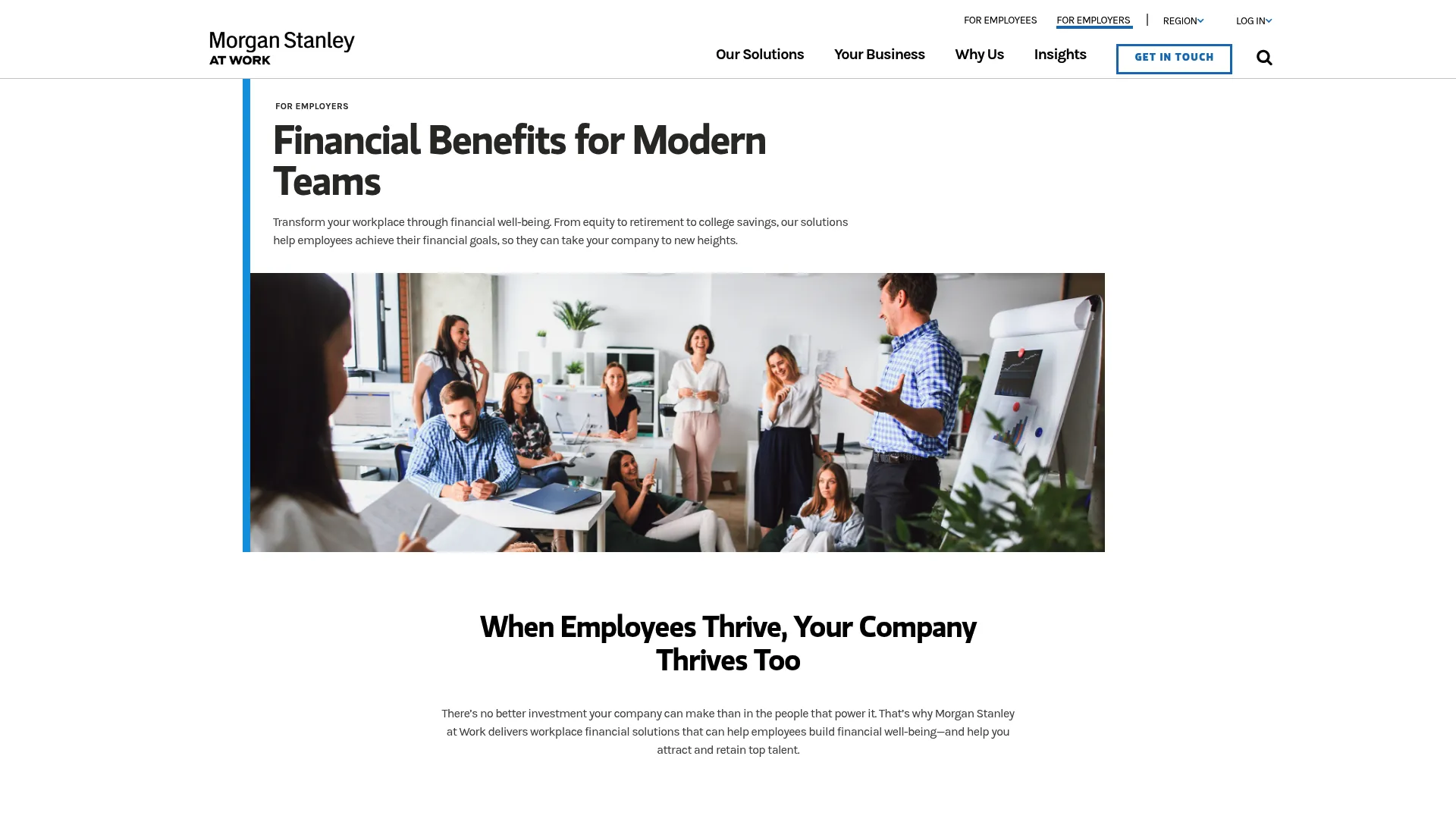
Shareworks by Morgan Stanley is built for the other end of the spectrum: mature companies with large equity programs and heavy governance requirements. It manages corporate capitalization data and administers share plans across the full lifecycle, from private company through public. The Morgan Stanley backing signals the enterprise focus.
Larger companies evaluate Shareworks when equity compensation becomes a serious operational function, with executive compensation workflows, participant support, and a mobile app for employees. This is administration at scale rather than a lightweight startup tool.
Best for: Companies with mature equity compensation programs and governance-heavy environments, often approaching or past a liquidity event.
Key strengths
- Management of corporate capitalization data
- Administration and execution of share plans
- Executive compensation workflows
- Mobile app and participant support
Why choose Shareworks: If your company has outgrown startup tools and needs enterprise-grade share plan administration with institutional backing, Shareworks is built for that scale. It's less about early scrappiness and more about governance and reliability.
Shareworks pricing: Pricing is not publicly disclosed and appears to be quote-based. Contact the vendor for a tailored quote based on your equity program.
6. Astrella

Astrella offers private companies a straightforward way to manage cap tables, stock options, shareholder data, and compliance with transparent per-stakeholder pricing. It covers the essentials most growing companies need, plus scenario and exit modeling so you can see how ownership plays out across future rounds and a potential exit.
The per-stakeholder model makes costs easy to predict as you add investors and employees. Astrella also became the destination for LTSE Equity customers after that platform's transition, so it now serves teams that were previously on a different provider.
Best for: Private companies that want equity management and cap table administration with clear, per-stakeholder pricing.
Key strengths
- Cap table management
- Employee stock administration
- Scenario and exit modeling
- Secure document management
Why choose Astrella: If you want predictable pricing that scales with your stakeholder count and the modeling to plan exits, Astrella keeps things simple. It's a solid option for teams that value cost clarity.
Astrella pricing: Basic is a free 30-day trial. Plus is $5 per month per stakeholder and Pro is $10 per month per stakeholder. Companies with more than 25 stakeholders get a custom quote.
7. LTSE Equity

LTSE Equity earned a spot on this list because it spent years positioning itself as a Carta alternative for startups, with cap table management, stock option administration, financing and exit modeling, and compliance reporting. For founders researching alternatives to Carta, it was a common name in the conversation.
Its status matters in 2026: LTSE has completed the sunset of its Equity platform and exited the cap table business, transitioning customers to Astrella. If you land on LTSE while researching, that's the context you need. Founders evaluating it today should look at Astrella as the continuation of that offering.
Best for: Teams researching Carta alternatives who should know where LTSE Equity customers have moved.
Key strengths
- Cap table management
- Stock option issuance and administration
- Financing and exit modeling
- Compliance and reporting
Why choose LTSE Equity: Given the platform sunset, most founders will evaluate Astrella instead. LTSE Equity belongs in the comparison mainly so you understand the current landscape when the name comes up.
LTSE Equity pricing: Historical plans included a free Basic tier, Fundamentals starting around $60 per month on an annual term, and Boost starting around $330 per month. The platform has since sunset and transitioned to Astrella.
Considerations before you buy
Before you commit, work through these criteria against your actual stage and stack.
Pricing model and stage fit
Look at how each tool charges: flat annual, per stakeholder, or quote-based. Per-stakeholder pricing scales cleanly with your team, while quote-based plans need a sales call to evaluate. Match the model to where you are, not where you hope to be in three years.
Compliance and reporting depth
Confirm the tool supports the compliance work you'll actually need: 409A valuations, Rule 701 tracking, Form 3921 filing for ISO exercises, and ASC 718 for stock compensation expense. The deeper your equity program, the more this matters at audit time.
Scenario modeling quality
You'll model rounds under deal pressure. Test how easily each tool handles SAFE notes and convertible note conversions, dilution across share classes, and waterfall analysis at exit. Weak modeling forces you back into spreadsheets exactly when you can't afford errors.
Migration effort
Ask how the vendor handles migration from a spreadsheet or another provider. Many offer white-glove import and data verification. Check whether they validate the migrated data against your source documents, because a bad import quietly carries old errors forward.
Data ownership and export
Confirm you can export your full cap table if you ever switch. Your equity data is yours, and lock-in should never be the reason you stay. Clean export also makes diligence smoother.
Conclusion
For most scaling SaaS founders, Carta remains the default because of its breadth across equity, fundraising, and compliance. If pricing transparency and startup-friendly onboarding matter more, Pulley is the pragmatic pick. On a tight budget, Cake Equity gives you a real free starting point with a clear upgrade path.
For global teams, Ledgy handles cross-border equity better than US-centric tools. And for mature companies with governance-heavy programs, Shareworks by Morgan Stanley is built for that scale.
Your next step depends on your situation. If you're replacing a spreadsheet, start with a free tier from Cake Equity or Carta and import your current cap table. If you're heading into a fundraise, prioritize scenario modeling and clean audit trails so diligence doesn't stall your round. If you're scaling equity ops, weigh compliance depth and per-stakeholder pricing against your headcount plan.
Pick the tool that fits your stage today and can grow one round ahead of you.
FAQs
A spreadsheet stores your ownership data but leaves every calculation to you, which invites formula errors as equity gets complex. Cap table management software automates dilution, vesting, scenario modeling, and compliance reporting from a single source of truth. It also gives investors and employees portal access, so you're not the bottleneck for every ownership question.
The clearest trigger is your first priced round, when preferred stock, liquidation preferences, and multiple share classes start interacting. Other triggers include your option pool passing a couple dozen holders, an upcoming fundraise or diligence, or a board asking for numbers you can't quickly verify. If you no longer trust your own spreadsheet, it's time.
Prioritize accurate cap table tracking, scenario modeling for fundraising and dilution, and compliance support like 409A valuations and Form 3921. Founders also value transparent pricing, clean migration, and portals that let employees and investors self-serve. The right mix depends on your stage: early teams weight affordability, later teams weight compliance depth.
Pricing ranges widely. Free tiers exist for small stakeholder counts, such as Cake Equity's free plan for 5 stakeholders and Carta's free Launch plan. Paid plans span from Pulley's $1,200 per year to per-stakeholder models like Astrella at $5 per month per stakeholder, up to quote-based enterprise plans. Match the pricing model to your stakeholder count and stage.
You don't strictly need it, but it makes the round far smoother. Investors and their lawyers expect a clean, auditable cap table, and scenario modeling helps you understand dilution before you sign a term sheet. Many founders set up software during the raise itself, importing a spreadsheet so diligence has one source of truth.
Yes. Handling SAFE notes and convertible notes is core to the category, including modeling how they convert into equity at a priced round. Good tools also calculate dilution across founders, employees, and investors, and run waterfall analysis for exit scenarios. Test the conversion math against a known example before you commit.
Look for 409A valuations, Rule 701 tracking for equity compensation limits, and Form 3921 filing for ISO exercises. For financial reporting, ASC 718 handles stock-based compensation expense under GAAP. Depending on your investors, you may also want QSBS attestation support and clean audit trails for diligence.
Most providers offer assisted migration, importing your existing cap table and validating it against source documents. From a spreadsheet, expect to clean up inconsistent data first. From another provider like Carta, confirm you can export your full data set, then verify the imported numbers match before you rely on them for any decision or filing.