You launched a new pricing tier last quarter. Sales loved it. Then finance spent three days reconciling proration on mid-cycle upgrades, a batch of cards failed silently, and your board deck showed recognized revenue that didn't match what the bank saw. Sound familiar?
That gap between "we sold it" and "we collected and recognized it correctly" is where subscription revenue quietly leaks. As a Series B founder, you feel it in the numbers that matter to your board: net revenue retention, gross margin, and whether the finance motion can run without you in the room. The global subscription billing management market is expected to rise from USD 8.51 billion in 2025 to USD 37.02 billion by 2035, growing at a 15.84% CAGR according to Precedence Research (2025). That growth is a proxy for how many companies are hitting the same wall you are: manual billing operations stop scaling right around the time you need them to be invisible.
Subscription fulfillment software is the system that keeps recurring revenue moving without spreadsheet heroics. It launches plans, handles upgrades and downgrades, retries failed payments, powers self-service, recognizes revenue correctly, and feeds clean data to finance and your board. Good subscription management software removes founder involvement from the parts of revenue operations that should never depend on a person. This guide evaluates eight platforms through a founder's operating lens: revenue scale, finance accuracy, customer autonomy, and how cleanly each tool fits the stack you already run.
What's inside
This guide covers subscription billing software and broader subscription management platforms used to run recurring revenue: plan creation, mid-cycle changes, dunning and payment recovery, customer self-service portals, usage-based billing, subscription analytics, and finance-grade revenue recognition. We evaluated tools on five criteria that matter at Series B: lifecycle coverage across the full subscription, integration depth with your CRM, ERP, accounting, and payment stack, revenue operations and reporting features, scalability from your current stage upward, and current market relevance in 2026. Every pricing figure and rating here was pulled from first-party sources at the time of writing.
TL;DR
- Best mature recurring revenue platform: Recurly, for lifecycle management, payment orchestration, and churn reduction at scale.
- Best for flexible pricing models: Chargebee, for usage-based, hybrid, and seat-based billing plus revenue recognition software built in.
- Best for SaaS finance ops: Maxio, for billing plus revenue recognition and SaaS metrics in one place.
- Best for engineering-led stacks: Stripe Billing, for API-driven recurring billing and usage-based billing on infrastructure you likely already run.
- Best for Salesforce-native teams: Salesforce Revenue Cloud, for quote-to-cash and revenue lifecycle management inside your CRM.
- Best accounting-grade finance system: Sage Intacct, for multi-entity ledger control and subscription revenue reporting.
What is subscription fulfillment software?
Subscription fulfillment software is the platform that automates the full recurring revenue lifecycle: creating plans, billing customers, collecting and recovering payments, managing subscription changes, and recognizing revenue so finance and sales stay aligned. It is the operating layer between "customer said yes" and "revenue landed correctly in the ledger."
That is a wider job than plain recurring billing software. Basic recurring billing charges a card on a schedule. A full subscription management platform runs the entire lifecycle and connects it to your financial system of record. The difference shows up the moment a customer upgrades mid-cycle, downgrades before renewal, adds usage overages, or fails a payment. A billing tool charges. A fulfillment system handles the change, prorates it, retries the failed card, updates the customer portal, and books the revenue correctly.
Core capabilities to expect:
- Plan creation and pricing changes: launch tiers, run promotions, and handle plan upgrades and downgrades with proration.
- Payment collection and retries: automated dunning software and payment retries to recover failed charges before they become churn.
- Customer self-service portal: let customers change plans, update cards, and download invoices without a support ticket.
- Usage-based and hybrid billing: meter consumption, mix seats with usage, and support consumption pricing.
- Revenue recognition and reporting: ASC 606 compliant revenue recognition software and subscription analytics for board-ready reporting.
- Integrations: connections into CRM, ERP, accounting, and payment processors so data flows without manual re-entry.
When to use subscription fulfillment software
Replace manual billing operations
Spreadsheets and one-off invoices work until they don't. The breaking point usually arrives when you run more than one pricing model, when upgrades and downgrades happen weekly, or when failed-payment volume climbs past what one person can chase by hand. If your finance lead spends the first week of every month reconciling billing instead of closing the books, the manual motion is already costing more than the software would. Billing automation removes that recurring tax and makes the process repeatable regardless of who is on the team.
Reduce churn and recover revenue
A meaningful slice of churn is not customers leaving. It is failed payments nobody recovered. Dunning software, smart payment retries, save flows, cancellation prevention, and win-back workflows recover revenue that would otherwise vanish silently. This maps directly to net revenue retention and cash collection, two numbers your board watches closely. Churn reduction that comes from recovering involuntary churn is the cheapest revenue you will ever protect.
Support finance and board reporting
At some point clean revenue data stops being nice and becomes mandatory. When you are preparing for a fundraise, running due diligence, or reporting to a board that scrutinizes recognized revenue against cash, you need auditability. Revenue recognition, forecasting, and subscription analytics that reconcile to your accounting system make the difference between a diligence process that flies and one that stalls on data questions.
Comparison table
Below is a concise comparison of the eight platforms, sorted by relevance to recurring revenue operations. Pricing and ratings reflect first-party and G2 sources verified at the time of writing.
| # | Product | Intent | Key differentiation | Pricing | G2 rating |
|---|---|---|---|---|---|
| 1 | Recurly | Mature recurring revenue platform | Payment orchestration and churn management at scale | From $249/mo + 0.9% of billing volume | 4.0/5 |
| 2 | Chargebee | Flexible subscription billing | Usage-based, hybrid, and seat-based billing plus rev rec | Free to start, then usage-based; enterprise custom | 4.4/5 |
| 3 | Maxio | SaaS financial operations | Billing plus revenue recognition and SaaS metrics | Grow from $599/mo; Scale quote-based | 4.3/5 |
| 4 | Stripe Billing | Developer-led recurring billing | API-first billing and usage pricing | 0.7% of billing volume, or from $620/mo annually | 4.4/5 |
| 5 | Salesforce Revenue Cloud | CRM-native quote-to-cash | Revenue lifecycle management inside Salesforce | From $150/user/mo billed annually | Not listed |
| 6 | Zenskar | Automated order-to-cash | Custom pricing and usage billing with rev rec | Custom pricing | 4.8/5 |
| 7 | Sage Intacct | Accounting-grade finance | Multi-entity ledger and subscription revenue reporting | Custom pricing | 4.3/5 |
| 8 | Zoho Billing | Simpler subscription billing | Recurring and metered billing in the Zoho ecosystem | From $39/org/mo billed annually | 4.4/5 |
1. Recurly
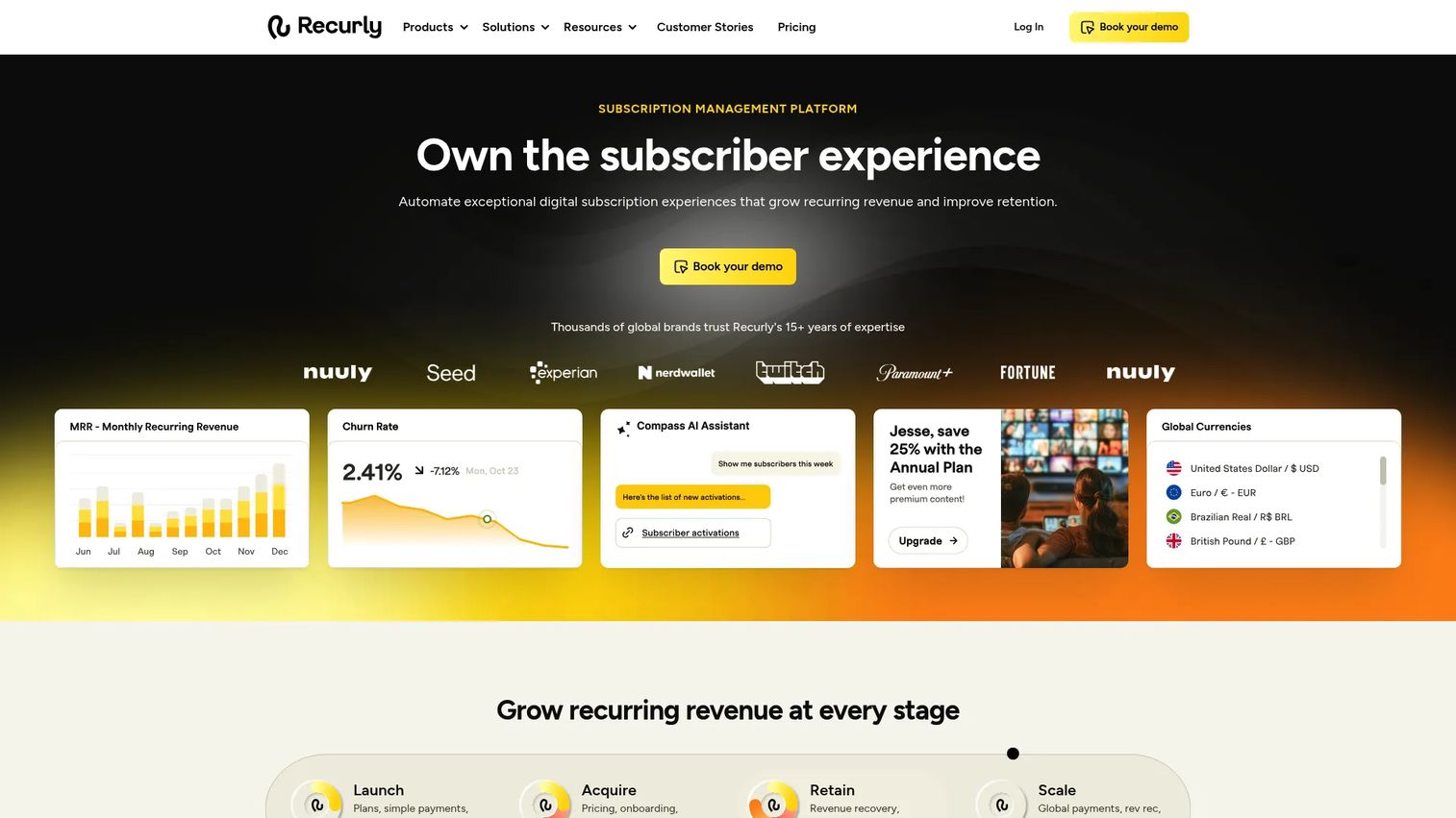
Recurly is a subscription management and recurring billing platform built for companies whose recurring revenue has outgrown a basic billing tool. It covers automated global subscription billing, flexible plans and promotions, and payment orchestration with active churn management. If your recurring revenue is the business, not a side line, Recurly is engineered for that scale.
Best for: Companies that need subscription billing, lifecycle management, and payment orchestration at scale.
Key strengths
- Global subscription billing: automate recurring charges across currencies and geographies without manual invoicing.
- Flexible plans, pricing, and promotions: launch tiers, run promos, and handle plan upgrades and downgrades cleanly.
- Payment orchestration and churn management: route payments intelligently and recover failed charges with built-in dunning software.
Why choose Recurly: Recurly earns its place when involuntary churn and payment recovery are material to your numbers. Its payment orchestration layer routes transactions to reduce declines, and its recovery flows chase failed payments automatically. For a founder watching net revenue retention, that recovered revenue often pays for the platform several times over. It suits teams that treat subscription operations as core infrastructure rather than an afterthought.
Recurly pricing: Recurly's Starter plan begins at $249 per month plus 0.9% of billing volume, billed monthly, and includes a 90-day free trial. An All-Access for Shopify option is available for as low as under 1% of billing volume, billed annually. There is no free tier. Pricing is publicly listed on Recurly's pricing page. Recurly holds a 4.0/5 rating on G2.
2. Chargebee
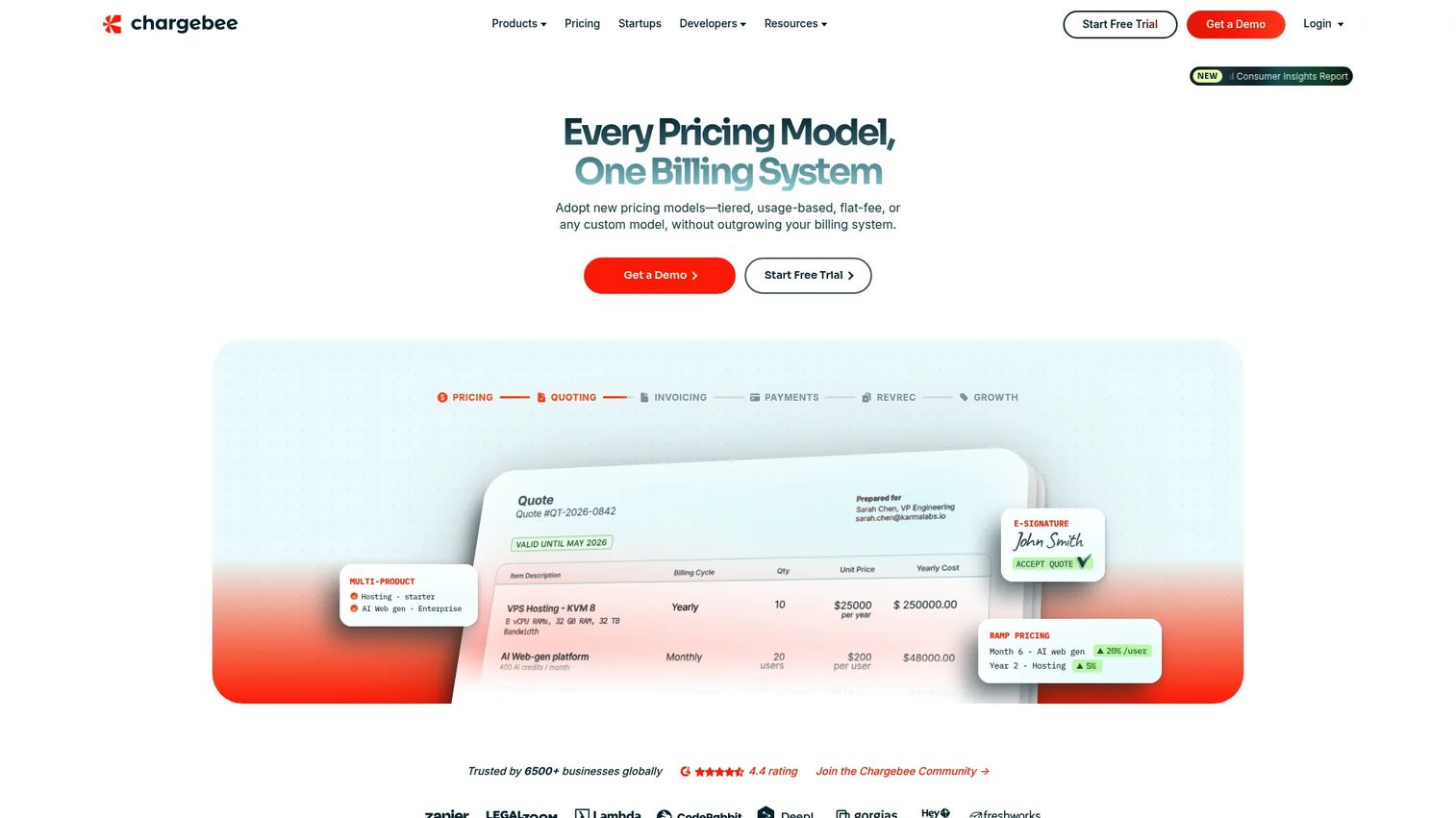
Chargebee is a subscription billing and revenue management platform built for teams that need flexibility across pricing models. It handles usage-based, subscription, hybrid, and seat-based billing, ships with checkout, hosted payments, and a customer self-service portal, and layers in entitlements, revenue recognition software, and reporting. If your pricing is evolving faster than any single billing model can keep up with, Chargebee is designed for that motion.
Best for: B2B SaaS and AI companies that need flexible subscription billing and monetization.
Key strengths
- Every billing model: usage-based, subscription, hybrid, and seat-based pricing in one platform.
- Checkout and self-serve portal: hosted payments and a customer self-service portal that cut support load.
- Entitlements and rev rec: map product access to plans and recognize revenue with built-in reporting.
Why choose Chargebee: Chargebee fits founders whose pricing keeps changing as the product matures. Moving from seats to usage, or blending both, does not require a re-platform. The self-service portal lets customers manage their own plan upgrades and downgrades, which keeps your CS team out of billing tickets. That combination of pricing flexibility and customer autonomy makes it a strong subscription management platform for scaling SaaS.
Chargebee pricing: Chargebee's Starter plan is free for the first USD 250K of cumulative billing, then charges 0.75% on billing beyond that. A CPQ Lite option is free for the first 50 quotes. Enterprise pricing is custom and scales based on the number of active subscribers. Pricing is listed on Chargebee's pricing page. Chargebee holds a 4.4/5 rating on G2.
3. Maxio
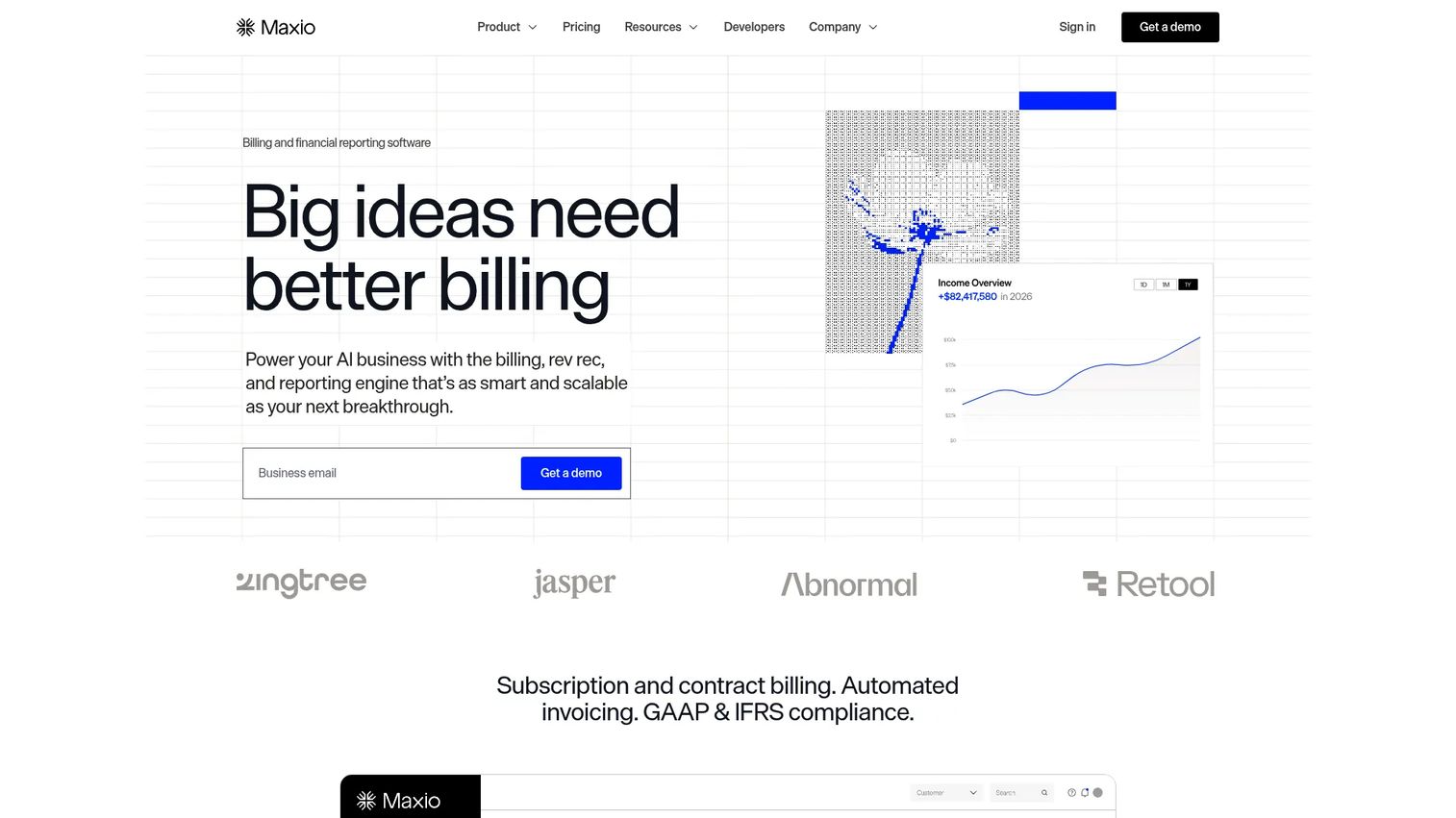
Maxio is a financial operations platform for B2B SaaS and AI companies, combining billing, subscription management, revenue recognition, and reporting in one system. It handles usage-based and recurring billing, manages the subscription lifecycle, and produces revenue recognition and SaaS metrics that finance can stand behind. For founders who feel the pain most in month-end close and board reporting, Maxio leans hard into finance ops.
Best for: B2B SaaS teams needing complex billing and financial operations automation.
Key strengths
- Usage-based and recurring billing: meter consumption and run recurring charges from one platform.
- Subscription management: handle the full lifecycle including proration on mid-cycle changes.
- Revenue recognition and SaaS metrics: ASC 606 compliant revenue recognition software plus the metrics your board asks for.
Why choose Maxio: Maxio suits founders who want billing and finance reporting to live in the same system rather than stitched across tools. The revenue recognition and SaaS metrics reduce the reconciliation work that eats finance time each month. When you are heading into a fundraise, having recognized revenue and subscription analytics that tie out cleanly shortens diligence considerably.
Maxio pricing: Maxio's Grow plan is publicly listed at $599 per month, with a Scale plan available on a quote basis. Maxio's pricing materials also reference a standard floor around $5,000 annually, and agreements are typically annual with monthly and quarterly options available. No free tier is shown. Pricing is on Maxio's pricing page. Maxio holds a 4.3/5 rating on G2.
4. Stripe Billing
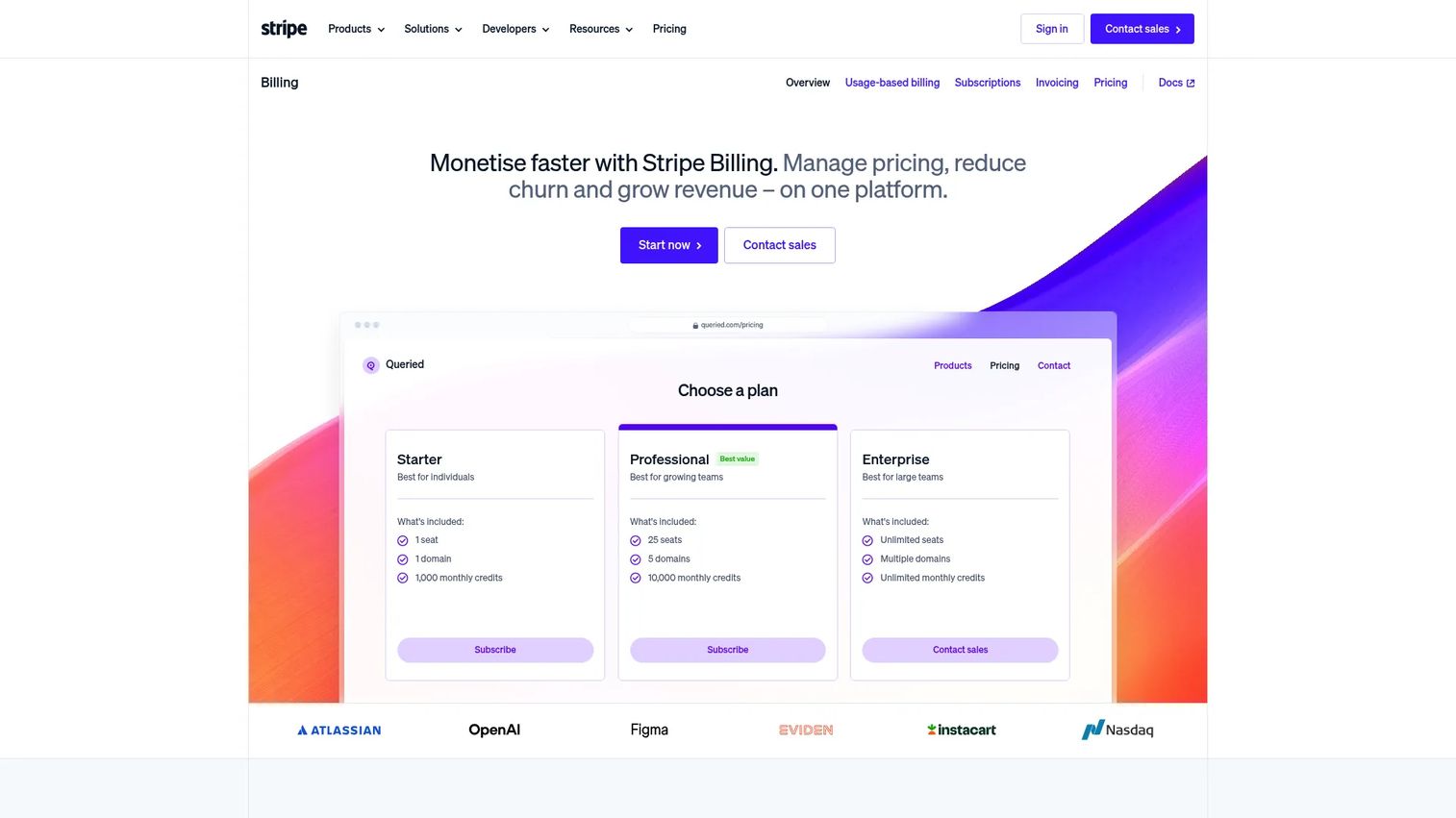
Stripe Billing is Stripe's subscription and recurring-billing product for automating billing, invoicing, and subscription management. It handles recurring billing, usage-based billing, and multiphase subscription schedules through an API-first model. For teams already built on Stripe or running an engineering-led stack, it slots in without introducing a new payment relationship.
Best for: Businesses that need recurring subscriptions, invoicing, and usage-based billing on Stripe.
Key strengths
- Recurring billing and subscriptions: automate charges and invoicing on flexible schedules.
- Usage-based billing: meter and bill consumption for consumption-priced products.
- Multiphase subscription schedules: model complex contracts with changing terms over time.
Why choose Stripe Billing: Stripe Billing is the pragmatic pick when your engineering team already runs Stripe for payments. Billing, invoicing, and payment retries live where your transactions already are, which removes a reconciliation seam. Developer flexibility is the draw: you can model unusual pricing and subscription logic in code. It fits founders who want billing to be an extension of infrastructure they already trust.
Stripe Billing pricing: Stripe Billing offers pay-as-you-go pricing at 0.7% of billing volume, with no free tier. Annual pay-monthly tiers start at $620 per month on a one-year contract, with higher-volume tiers at $1,500, $2,950, and $5,750 per month. Custom pricing is available for large volume or unique business models. Pricing is on Stripe's billing pricing page. Stripe Billing holds a 4.4/5 rating on G2.
5. Salesforce Revenue Cloud
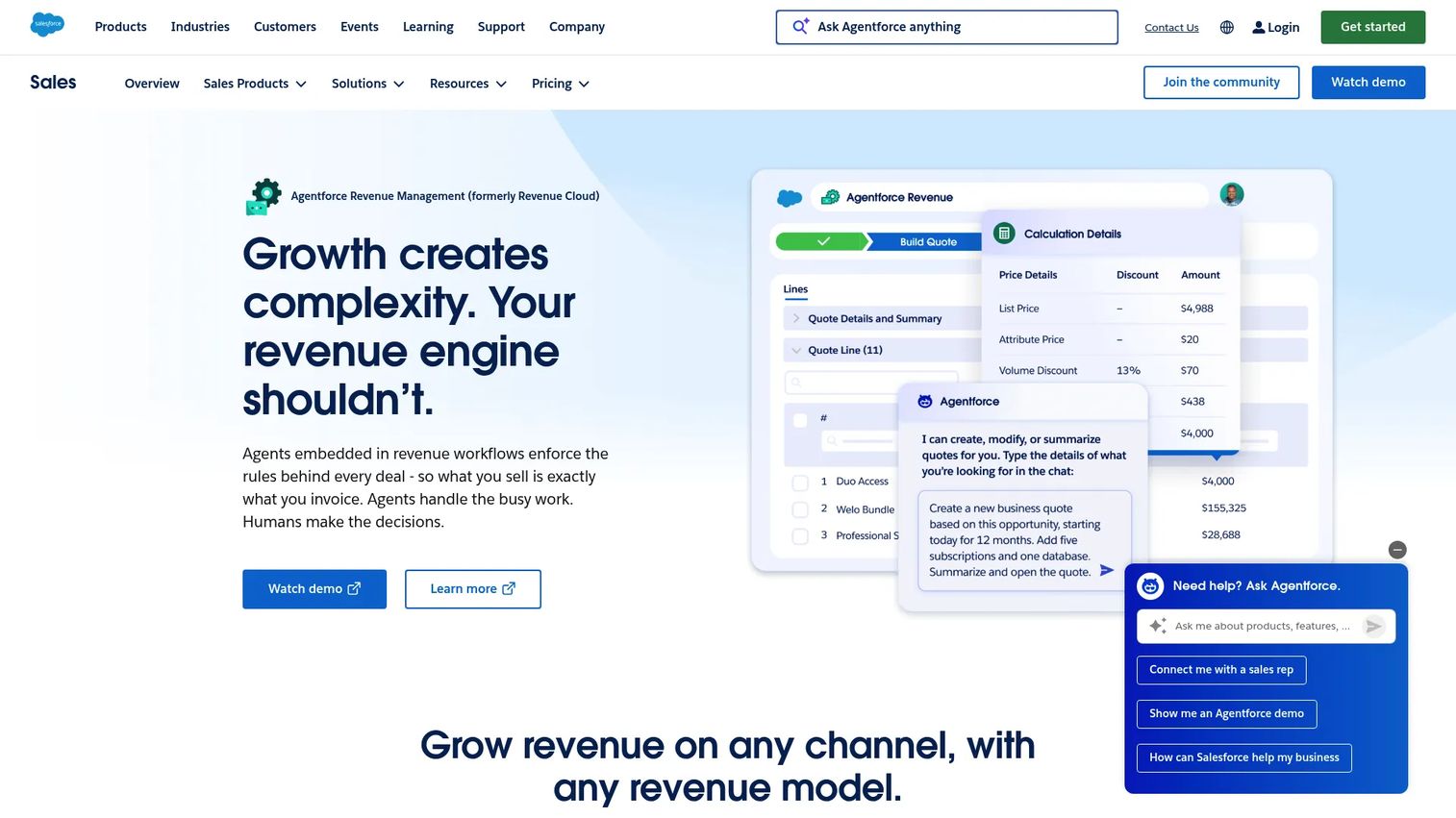
Salesforce Revenue Cloud is Salesforce's revenue lifecycle software covering quoting, pricing, ordering, contracts, invoicing, and subscription management. It brings product catalog and price management, CPQ and quoting, and orders, contracts, and billing into a Salesforce-native environment. For teams already running their GTM motion inside Salesforce, it keeps revenue lifecycle management on the same platform as the pipeline.
Best for: Businesses that need a Salesforce-native quote-to-cash and revenue lifecycle platform.
Key strengths
- Product catalog and price management: manage products and pricing alongside your CRM records.
- CPQ and quoting: configure, price, and quote deals with a native configurator.
- Orders, contracts, and billing: connect the deal to invoicing and subscription management without leaving Salesforce.
Why choose Salesforce Revenue Cloud: If your sales org lives in Salesforce, Revenue Cloud removes the handoff between the deal and the invoice. Quote-to-cash runs on the same platform your reps already work in, so the founder-to-team handoff on revenue data gets cleaner. It fits companies deep enough in Salesforce that a separate billing system would create more reconciliation than it removes.
Salesforce Revenue Cloud pricing: Revenue Cloud Growth starts at $150 per user per month, billed annually, with streamlined CPQ and subscription management. Revenue Cloud Advanced is $200 per user per month, billed annually, as a complete quote-to-cash platform. A Revenue Cloud Billing add-on is available on a quote basis under an annual contract. Pricing is on Salesforce's revenue lifecycle pricing page. A current G2 rating was not listed at the time of writing.
6. Zenskar
Zenskar is an order-to-cash platform for billing, revenue recognition, collections, and SaaS metrics. It automates billing and revenue recognition, supports usage-based and custom pricing, and handles collections with ERP and general ledger sync plus SaaS reporting. For finance teams wrestling with contract complexity and custom pricing, Zenskar aims to remove the manual handoff work between billing and the ledger.
Best for: Finance teams needing flexible billing and revenue automation for complex pricing models.
Key strengths
- Billing and rev rec automation: automate invoicing and revenue recognition together.
- Usage-based and custom pricing: model complex, contract-specific pricing without workarounds.
- Collections and ERP sync: manage collections and sync to your general ledger and SaaS reporting.
Why choose Zenskar: Zenskar fits founders whose contracts are too bespoke for template-based billing. Custom pricing per contract, usage metering, and automated revenue recognition reduce the manual reconciliation that complex deals usually create. The ERP and general ledger sync keeps finance in one source of truth, which matters when every enterprise contract has its own terms.
Zenskar pricing: Zenskar uses quote-based pricing across Starter, Standard, and Enterprise plans, each with custom pricing and no public numeric figure listed. Pricing details come from a conversation with their team. Pricing tiers are shown on Zenskar's pricing page. Zenskar holds a 4.8/5 rating on G2.
7. Sage Intacct
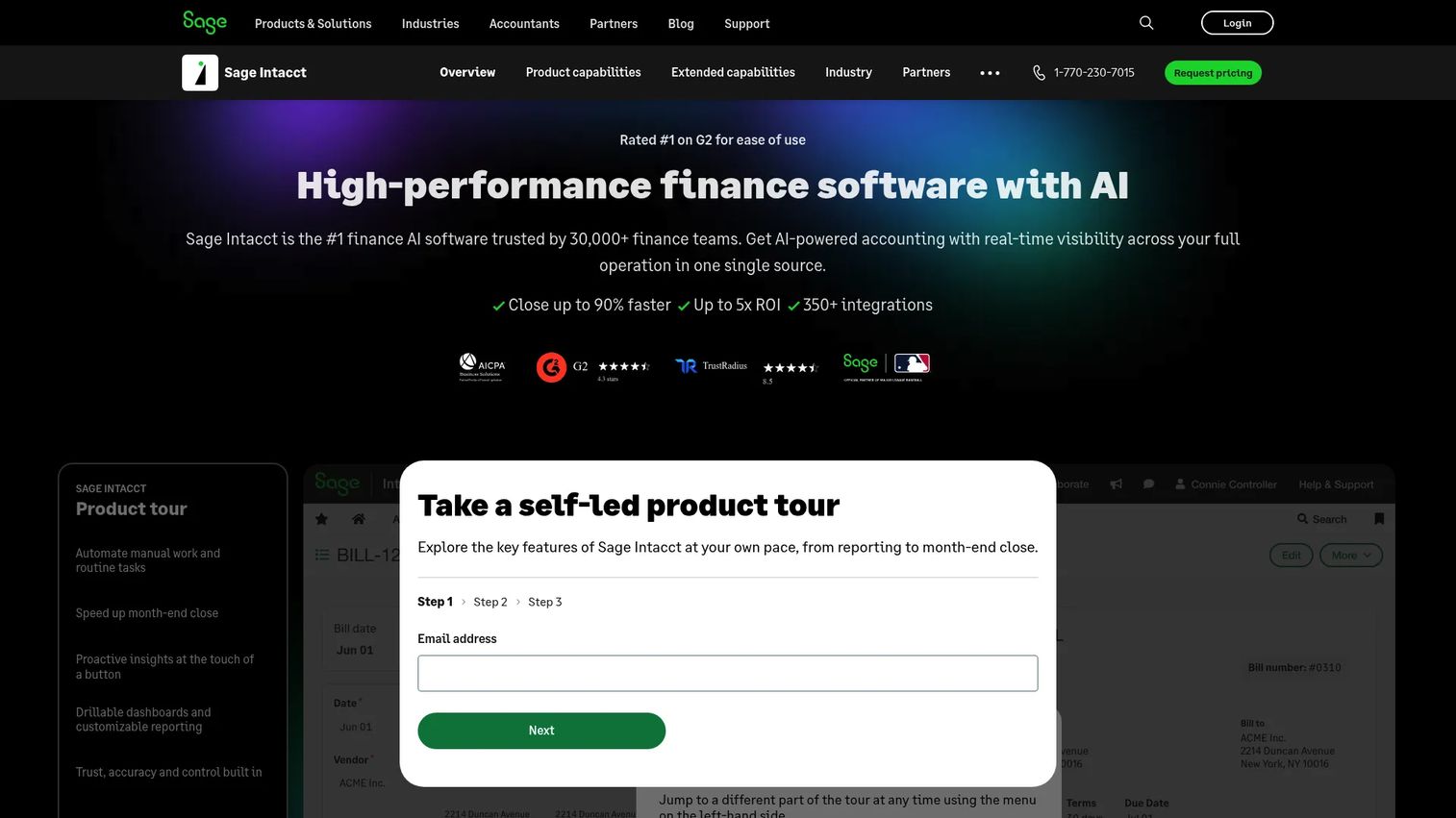
Sage Intacct is cloud financial management and accounting software for mid-sized organizations. It delivers core financials and accounting automation, multi-entity and consolidation support, and APIs and platform services for integration. It sits closer to your accounting system of record than a pure billing tool, which is exactly why finance-led teams reach for it when subscription revenue reporting has to meet accounting-grade controls.
Best for: Finance teams needing scalable cloud accounting with multi-entity and automation needs.
Key strengths
- Core financials and accounting automation: run the general ledger and automate accounting workflows.
- Multi-entity and consolidation: manage multiple entities and consolidate reporting for complex structures.
- APIs and integrations: connect billing, CRM, and other systems through platform services.
Why choose Sage Intacct: Sage Intacct fits founders whose primary pain is the ledger, not the billing engine. When subscription revenue has to reconcile across multiple entities and survive audit scrutiny, accounting-grade controls matter more than billing flexibility. Pair it with a dedicated billing tool and Sage Intacct becomes the finance backbone that produces the revenue recognition software and reporting your board and auditors expect.
Sage Intacct pricing: Sage Intacct uses custom pricing based on modules, industry, and organization size, with no public starting price shown. Sage tailors pricing through their team. Details are described on Sage's Intacct pricing page. Sage Intacct holds a 4.3/5 rating on G2.
8. Zoho Billing
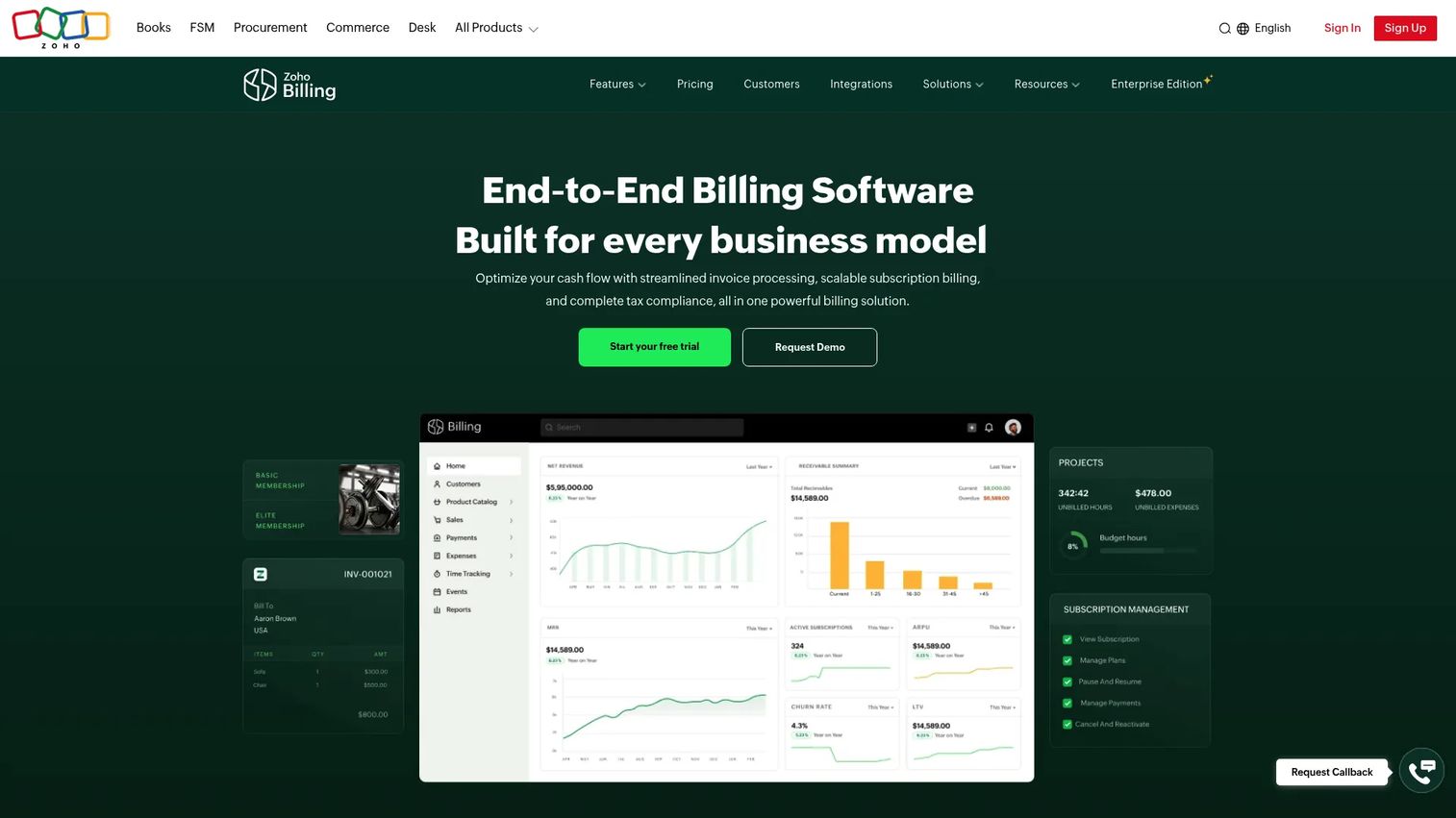
Zoho Billing is cloud billing software for invoices, subscriptions, payments, and revenue operations. It handles recurring and metered billing, manages the full subscription lifecycle, and includes a customer portal, reporting, and automation. For smaller teams or companies already running the Zoho ecosystem, it offers straightforward subscription operations without a heavy implementation.
Best for: Businesses that need subscription and usage-based billing with strong Zoho ecosystem integration.
Key strengths
- Recurring and metered billing: run subscription and usage-based billing from one place.
- Subscription lifecycle management: handle signups, changes, and renewals across the lifecycle.
- Customer portal and automation: give customers a self-service portal with reporting and billing automation.
Why choose Zoho Billing: Zoho Billing works for founders who want clean subscription billing without over-buying. If your company already runs Zoho CRM or Books, billing data flows into tools you use, which keeps the stack tight. The lower entry price makes it a sensible option for earlier-stage teams that need real subscription lifecycle management before they need enterprise-grade finance ops.
Zoho Billing pricing: Zoho Billing's Standard plan starts at $39 per organization per month, billed annually, with a Premium plan at $79 per organization per month, billed annually. An Enterprise edition is available on a custom, contact-sales basis. No free tier is shown on the US pricing page. Pricing is listed on Zoho Billing's pricing page. Zoho Billing holds a 4.4/5 rating on G2.
Considerations before you buy
Before you commit, run each shortlisted tool against the criteria that actually move your numbers.
Lifecycle coverage
Confirm the tool handles the full subscription lifecycle, not just the initial charge. Test proration on mid-cycle upgrades and downgrades, and check how it treats add-ons, overages, and cancellations. A tool that only bills on a schedule will push the hard cases back onto finance.
Revenue recognition and finance fit
If your board scrutinizes recognized revenue, confirm the platform offers ASC 606 compliant revenue recognition software or syncs cleanly to a system that does. Ask how it reconciles to your accounting ledger. The goal is diligence-ready data, not a second reconciliation project.
Payment recovery and churn
Look closely at the dunning software and payment retries. Involuntary churn from failed cards is recoverable revenue, so evaluate retry logic, save flows, and how the customer self-service portal handles card updates. This is where churn reduction turns into cash.
Integration depth
Map the required integrations before you buy: CRM, ERP, accounting, and payment processors. Shallow integrations create manual re-entry that undoes the automation you paid for. Verify the specific connectors you need, not just that an integration exists.
Stage and cost fit
Match the tool to your stage. An engineering-led team may extend Stripe Billing, a finance-heavy team may want Maxio or Sage Intacct, and a pricing-experimental team may lean on Chargebee. Weigh cost against the finance and CS time it removes, not against the sticker alone.
Conclusion
The right subscription fulfillment software depends on where your pain concentrates. If recurring revenue is the core of the business and payment recovery matters, Recurly is built for that scale. If your pricing keeps evolving, Chargebee handles usage, hybrid, and seat-based models without a re-platform. For finance-first founders, Maxio combines billing with revenue recognition and SaaS metrics, while Sage Intacct anchors accounting-grade control for multi-entity structures. Engineering-led teams get pragmatic value from Stripe Billing, Salesforce-native orgs should look at Revenue Cloud, complex-contract businesses fit Zenskar, and earlier or Zoho-native teams can move fast with Zoho Billing.
Your next step is practical: shortlist two tools that match your dominant pain, whether that is billing complexity, revenue recognition, or integration depth, and run each against a real mid-cycle upgrade and a failed-payment scenario. The tool that handles your messiest edge case cleanly is the one that earns its place in your stack.
FAQs
Subscription fulfillment software is the platform that automates the full recurring revenue lifecycle, from plan creation and billing through payment recovery, subscription changes, and revenue recognition. It connects the moment a customer subscribes to the moment revenue lands correctly in your finance system. Think of it as the operating layer for recurring revenue, not just a charging engine.
Subscription billing software focuses on charging customers on a schedule and generating invoices. Subscription fulfillment software includes billing but extends into the full lifecycle: proration on plan changes, dunning and payment retries, self-service portals, revenue recognition, and finance reporting. Billing is one function inside a broader fulfillment system.
Chargebee and Stripe Billing both handle usage-based billing well, with Chargebee supporting hybrid models that blend usage with seats and subscriptions, and Stripe Billing offering API-driven metering for engineering-led teams. Zenskar is also strong for usage combined with custom, contract-specific pricing. The best fit depends on whether you value pricing flexibility, developer control, or contract complexity.
If your board scrutinizes recognized revenue, or you are approaching a fundraise or audit, built-in revenue recognition software saves significant reconciliation work. Tools like Maxio, Chargebee, and Zenskar include rev rec, while Sage Intacct provides accounting-grade recognition as a finance system of record. If you are earlier and simpler, a billing tool that syncs cleanly to accounting may be enough for now.
The integrations that matter most are your CRM, accounting or ERP system, and payment processors. These connections keep subscription data, recognized revenue, and cash reconciled without manual re-entry. Before buying, confirm the specific connectors you need exist and are deep enough to avoid exporting spreadsheets between systems.
Upgrade when you run more than one pricing model, when upgrades and downgrades happen frequently, or when failed-payment volume outpaces manual recovery. A reliable signal is your finance lead spending the first week of every month reconciling billing instead of closing the books. At that point, billing automation costs less than the time it replaces.
For engineering-led teams already running Stripe, Stripe Billing handles recurring billing, usage-based billing, invoicing, and payment retries well. Whether it is enough depends on your finance needs. If you require deep revenue recognition, multi-entity reporting, or a rich self-service portal out of the box, teams often pair it with a finance-focused platform or choose a broader subscription management platform.
Recurly is engineered for high-volume recurring revenue, with payment orchestration and churn management built for scale. Chargebee and Maxio also handle significant volume, with Maxio leaning toward finance operations and SaaS metrics. For businesses where the ledger and multi-entity consolidation dominate, Sage Intacct provides the accounting-grade backbone to support high transaction volumes.