You built a target account list. You know the logos. You even know a few names on the buying committee. Then the deal stalls, and you spend a Tuesday afternoon reconstructing who touched the account, what they cared about, and whether the last email even landed.
That is the gap account based selling software is supposed to close. Not more leads. Better focus on the accounts already worth your time.
The category has grown up fast. According to DigitalApplied (2026), ABM lifts tier-1 account engagement 3.4 times over non-ABM cohorts and shortens median sales cycles by 32 days across more than 1,400 B2B teams. That is real money for anyone carrying a number. But the label "account based" now covers intent data vendors, account intelligence platforms, ad orchestration tools, and full account based marketing software suites. They are not interchangeable, and the wrong pick will sit unused in your stack.
This guide ranks 8 best ABM software and account based selling platforms through the lens of a deal owner: does it help you prioritize, multi-thread, and forecast with less guesswork?
What's inside
This guide is built for AEs, sales leaders, and RevOps evaluating account based marketing tools that actually move pipeline. We picked platforms on four criteria that matter to revenue teams:
- Account intelligence and intent data that tells you which accounts to work now
- Multi-channel orchestration across ads, email, and sales outreach
- CRM integration so signals reach the rep in their existing workflow
- Account-level analytics you can defend on a forecast call
We skipped tools that only serve marketing dashboards with no path to a seller's day.
TL;DR
- Best for enterprise pipeline: 6sense Revenue Marketing and Demandbase One lead on predictive scoring, buying group visibility, and account-based orchestration.
- Best for account research and timing: ZoomInfo Marketing pairs data enrichment with visitor identification and CRM activation.
- Best for lean teams that need fast execution: AdRoll ABM and Apollo.io combine targeting with hands-on selling motion.
- Best for consolidation: HubSpot Marketing Hub keeps account lists, workflows, and engagement analytics CRM-native.
- Best for demand-gen automation: Metadata.io and ActiveCampaign automate account-style campaigns tied to revenue.
What is account based selling software?
Account based selling software is a category of sales and revenue tools that help teams target, prioritize, personalize, and coordinate outreach to a defined set of named accounts rather than chasing individual leads. It combines account intelligence, intent data, and multi-channel orchestration so revenue teams can focus effort on the accounts most likely to buy.
The category overlaps with account based marketing software, since both rally around the same target accounts. The difference is where the value lands. ABM platforms focus on generating and warming demand; account based selling tools focus on progressing and closing named opportunities. Most abm platforms today do both.
Core capabilities you should expect:
- Target account selection: Build and score account lists using firmographic, technographic, and fit data.
- Account intelligence: Surface who sits on the buying committee and what they are researching.
- Intent data: Detect in-market signals from third-party and first-party sources.
- Multi-channel orchestration: Coordinate ads, email, and sales touches across an account.
- CRM integration: Push signals and engagement into Salesforce or HubSpot where reps live.
- Account-level analytics: Measure engagement and pipeline movement by account, not by lead.
- Personalization: Tailor messaging and creative by account, persona, or stage.
The strongest tools connect these into a single account based marketing workflow, so marketing sourcing and sales execution share one view of the account.
When to use account based selling software
Prioritize a finite set of high-value accounts
If your ideal deals are large and few, spraying outbound wastes time. Account based selling software ranks your target account list by fit and intent, so you work the accounts most likely to close first. This matters most for mid-market and enterprise AEs carrying 3 to 7 stakeholder deals.
Coordinate outreach across a buying committee
B2B deals rarely close with one contact. When 8 or more people influence a purchase, you need multi-channel orchestration that keeps ads, email, and sales touches aligned. Account intelligence tells you who to reach next and what they already care about.
Rescue stalled late-stage deals
Deals go quiet at gates, not because interest died. Account-level analytics show which stakeholders re-engaged, which went cold, and where the account stopped moving. That signal turns a guessing game into a next step you can defend on a forecast call.
Comparison table
Here is how the eight platforms stack up for revenue teams. Pricing and G2 ratings reflect verified values at the time of writing. Several enterprise tools use custom pricing, which is common for account based marketing software sold on annual contracts.
| # | Product | Best for | Key use case | Pricing | G2 rating |
|---|---|---|---|---|---|
| 1 | 6sense Revenue Marketing | Enterprise revenue teams | Predictive account scoring and orchestration | Custom | Not listed |
| 2 | Demandbase One | Enterprise ABM programs | Unified account data and orchestration | Custom | 4.4/5 |
| 3 | ZoomInfo Marketing | Account research and timing | Data enrichment and buyer signals | Custom | 4.5/5 |
| 4 | AdRoll ABM | Lean mid-market teams | Account-based advertising and retargeting | Media-based | 4.1/5 |
| 5 | HubSpot Marketing Hub | CRM consolidation | CRM-native account workflows | Free to $3,600/mo | 4.4/5 |
| 6 | Apollo.io | Outbound-heavy teams | Prospecting plus sequencing | Free to $119/user/mo | 4.7/5 |
| 7 | ActiveCampaign | Lifecycle automation | Automated account journeys | From $15/mo | 4.4/5 |
| 8 | Metadata.io | Demand-gen automation | Paid campaign automation and pipeline | Custom | 4.6/5 |
Best 8 tools for account based selling software in 2026
1. 6sense Revenue Marketing
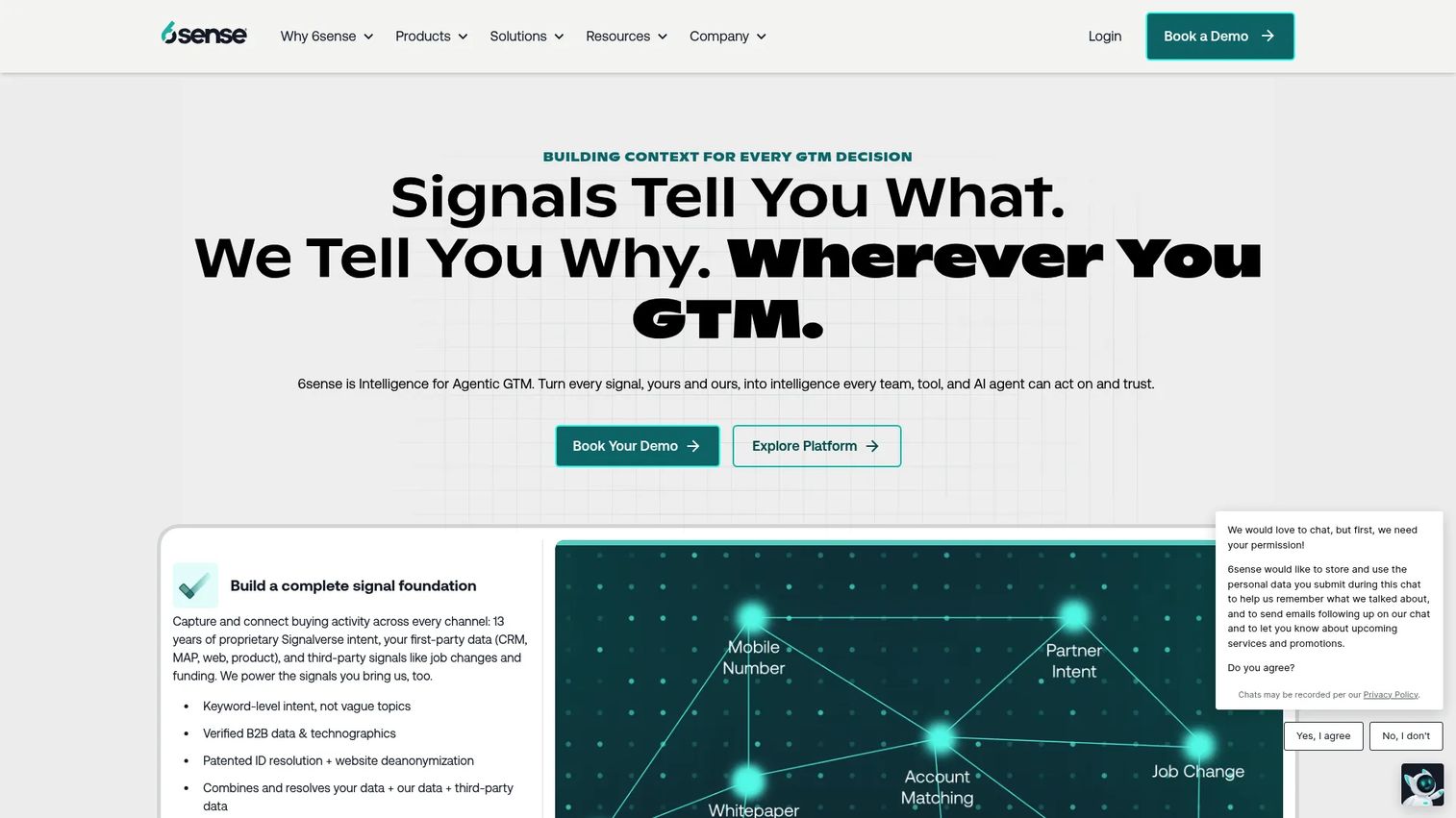
6sense Revenue Marketing is a B2B revenue marketing platform that uses buyer signals, account intelligence, and AI to help teams target accounts, run campaigns, and measure pipeline impact. For AEs, the draw is predictive scoring that ranks accounts by likelihood to buy, plus buying group visibility that shows who on the committee is active. That prioritization turns a flat target list into a ranked work queue.
Best for: Enterprise B2B revenue teams that need account-based orchestration tied to revenue attribution.
Key strengths
- Buyer-signal identification and account intelligence
- Omnichannel campaign orchestration
- Pipeline and closed-won revenue reporting
Why choose 6sense: It fits enterprise deal cycles where 8 to 15 stakeholders and a long evaluation demand early signal. If you need to know which accounts are in-market before a rep reaches out, predictive scoring is the reason to look here.
6sense pricing: Public pricing is not shown for Revenue Marketing. Product pages route to a book-a-demo flow, which is standard for enterprise ABM platforms sold on annual contracts.
2. Demandbase One
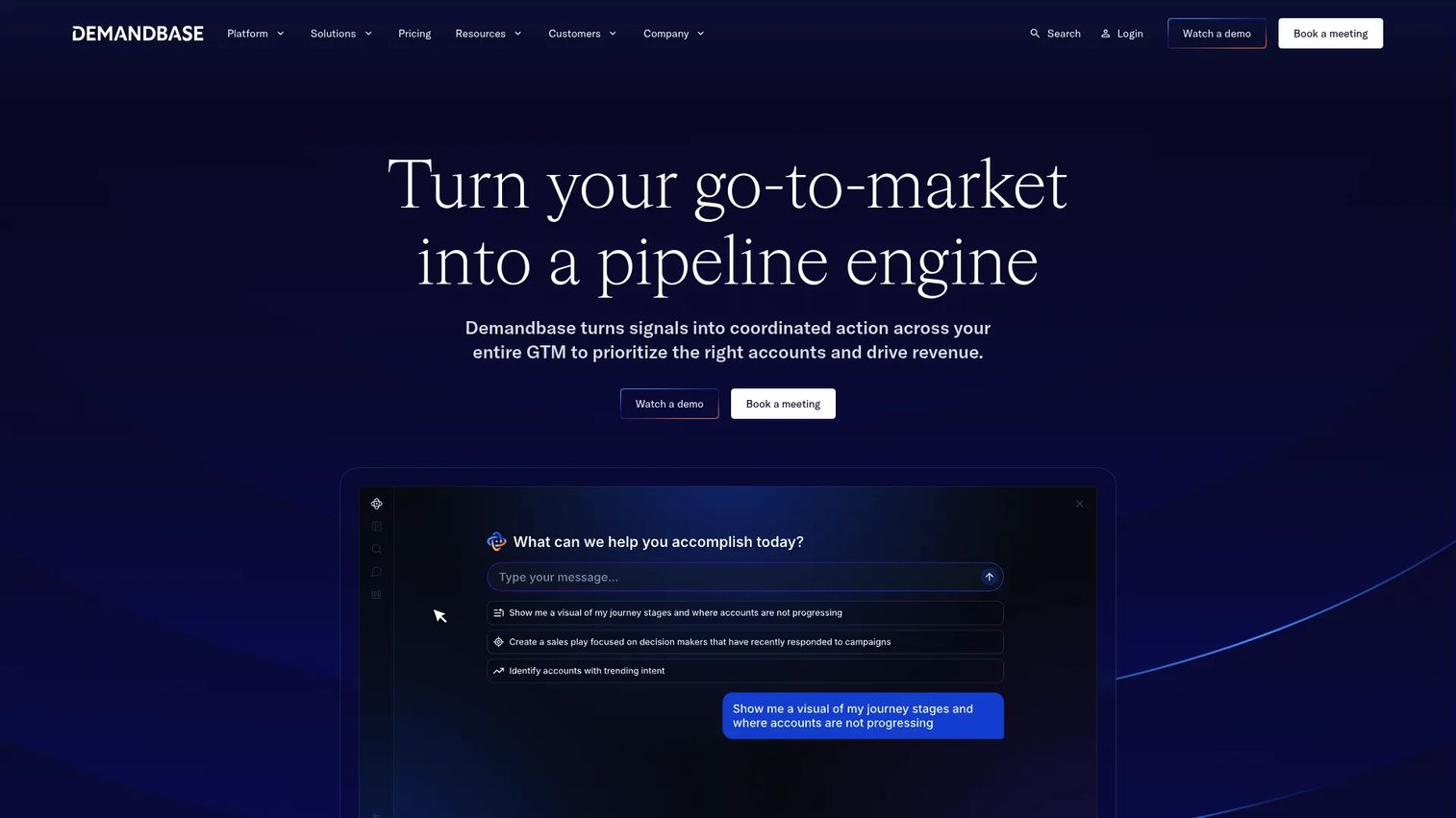
Demandbase One is an account-based go-to-market platform for sales and marketing teams. It unifies account data, automates execution, and surfaces in-market accounts so reps can act on shared insights. The value for revenue teams is alignment: marketing and sales work from one account view, which reduces the handoff friction that kills mid-market and enterprise deals.
Best for: B2B enterprise teams running account-based sales and marketing motions in parallel.
Key strengths
- Unified account data with shared insights and workflows
- AI-powered account intelligence to engage top accounts
- In-market account surfacing with automated sales outreach
Why choose Demandbase One: Choose it when sales-marketing alignment is the bottleneck. Its account engagement analytics give both teams the same signal, which is what enterprise pipeline programs need to run without finger-pointing.
Demandbase One pricing: Pricing is customized per account. The official pricing page describes a platform fee plus a flat fee per user, but no public numeric price is shown. Demandbase holds a 4.4/5 rating on G2.
3. ZoomInfo Marketing
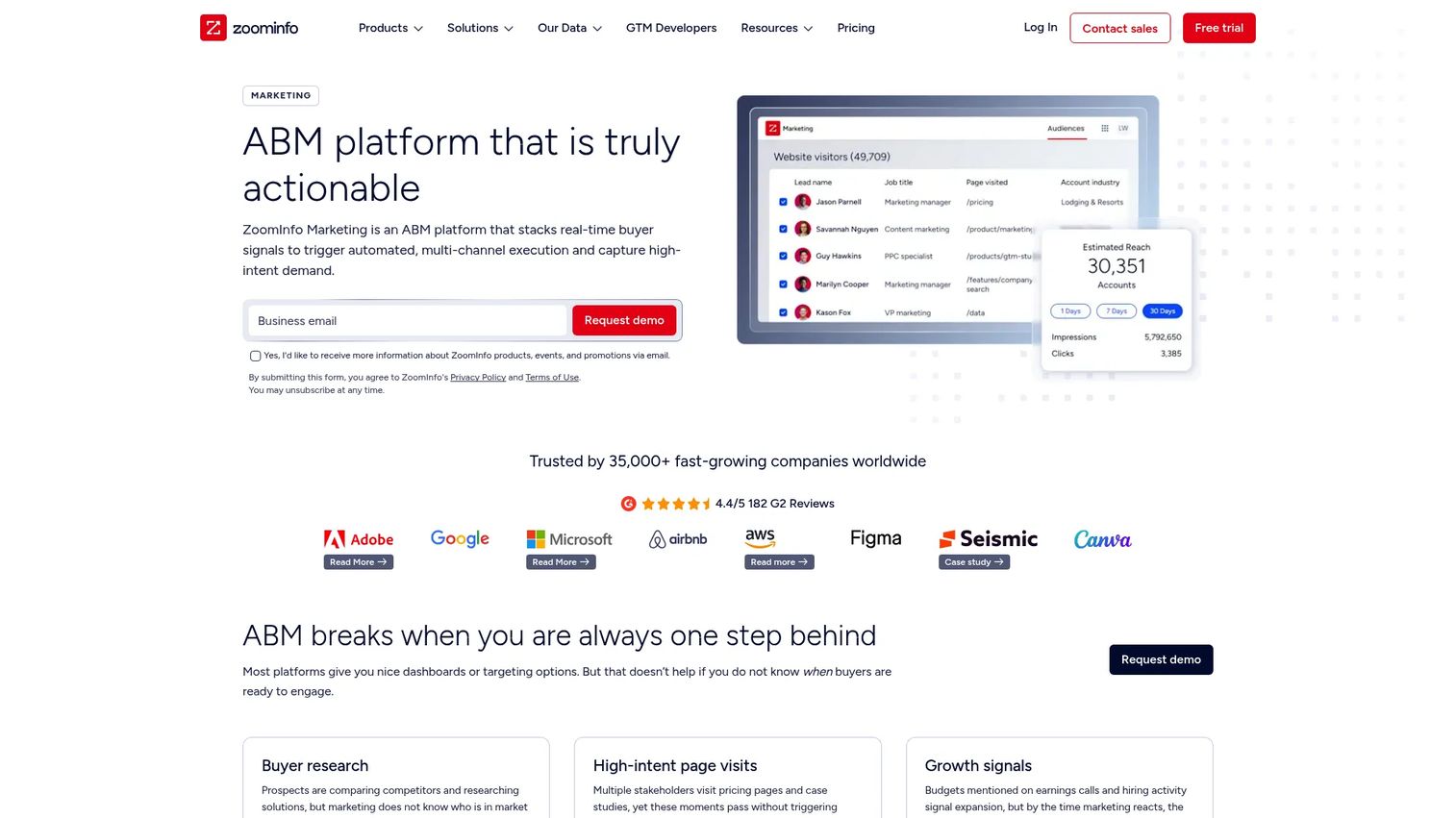
ZoomInfo Marketing is a go-to-market intelligence product for marketing teams, part of ZoomInfo's broader platform. Its strength is data. AEs use it for account research, contact enrichment, visitor identification, and buyer signals that inform timing and outreach prioritization. When you need to know who to call and when, this is the account intelligence layer.
Best for: B2B marketing and sales teams that need deep account intelligence and buyer signals.
Key strengths
- AI-powered go-to-market workspace
- Unified signals, systems, and teams
- Campaign activation and data enrichment
Why choose ZoomInfo Marketing: It performs best when paired with existing revenue workflows. Feed its enrichment and intent data into your CRM and sequencer, and reps get cleaner accounts and better timing without switching tools.
ZoomInfo Marketing pricing: Public pricing was not visible during research, which is typical for enterprise data platforms sold by quote. ZoomInfo holds a 4.5/5 rating on G2.
4. AdRoll ABM
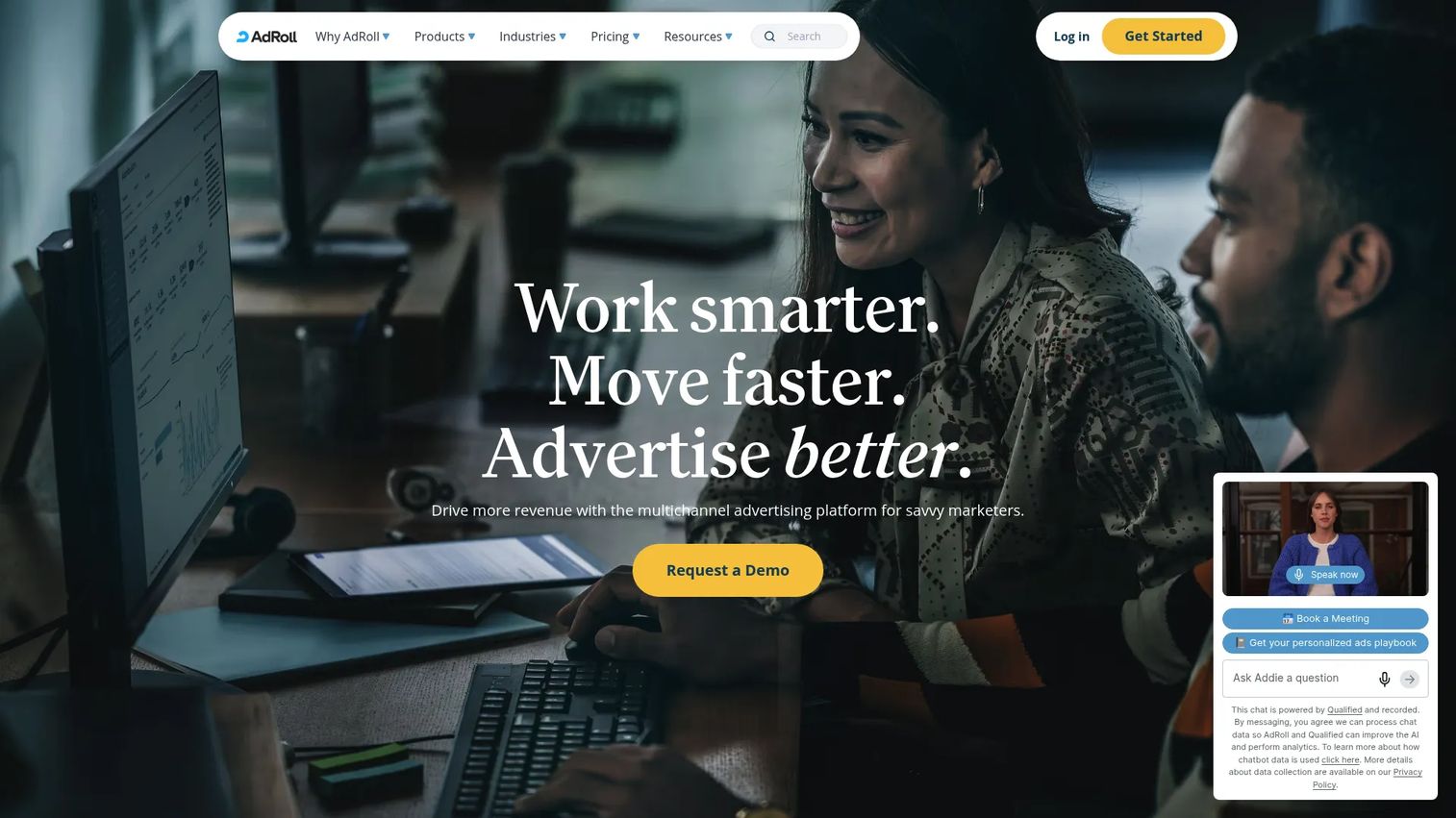
AdRoll ABM is a B2B account-based marketing and advertising platform from AdRoll and NextRoll, formerly RollWorks. It combines buying-signal consolidation, GTM orchestration workflows, and personalized cross-channel advertising across web, mobile, social, and CTV. For leaner teams, it is a fast path to account-based advertising without a heavy program build.
Best for: B2B teams running ABM plus cross-channel advertising and orchestration on a mid-market budget.
Key strengths
- Command Center for buying-signal consolidation
- Workflows for GTM orchestration and automation
- Personalized cross-channel advertising and retargeting
Why choose AdRoll ABM: It works well when you need execution speed over deep enterprise orchestration. Smaller revenue teams can launch account-based retargeting and get advertising in market quickly.
AdRoll ABM pricing: ABM packages are demo-based with no public numeric price. Account-Based Retargeting has no fee to get started, and you pay only for media. AdRoll holds a 4.1/5 rating on G2.
5. HubSpot Marketing Hub
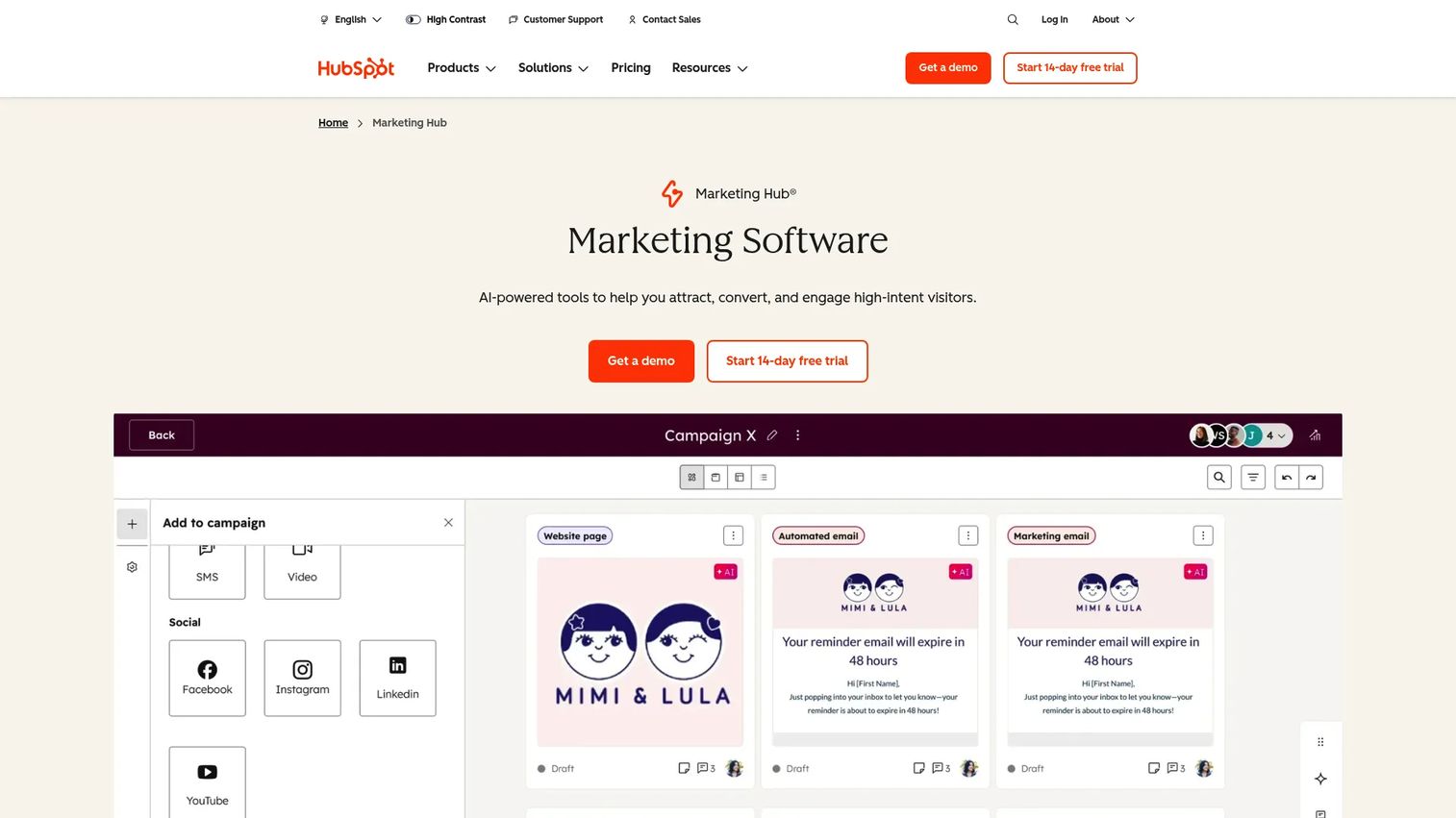
HubSpot Marketing Hub is marketing automation software for lead generation, campaign management, and analytics, with account-centric features layered on its CRM. Teams already living in HubSpot use account lists, CRM-native workflows, and engagement analytics without adding a separate platform. It is a consolidation choice more than a pure ABM specialist.
Best for: Teams that want an all-in-one marketing automation platform with CRM-connected workflows.
Key strengths
- Automated marketing campaigns
- Lead capture forms and live chat
- Built-in analytics and custom reporting
Why choose HubSpot Marketing Hub: If you already run on HubSpot CRM, the account based motion lives where your reps work. That CRM integration removes the sync headaches that come with bolting a standalone ABM tool onto an existing stack.
HubSpot Marketing Hub pricing: Free tier available. Starter is $10 per seat per month, Professional is $890 per month with 3 seats, and Enterprise is $3,600 per month with 5 seats. HubSpot Marketing Hub holds a 4.4/5 rating on G2.
6. Apollo.io
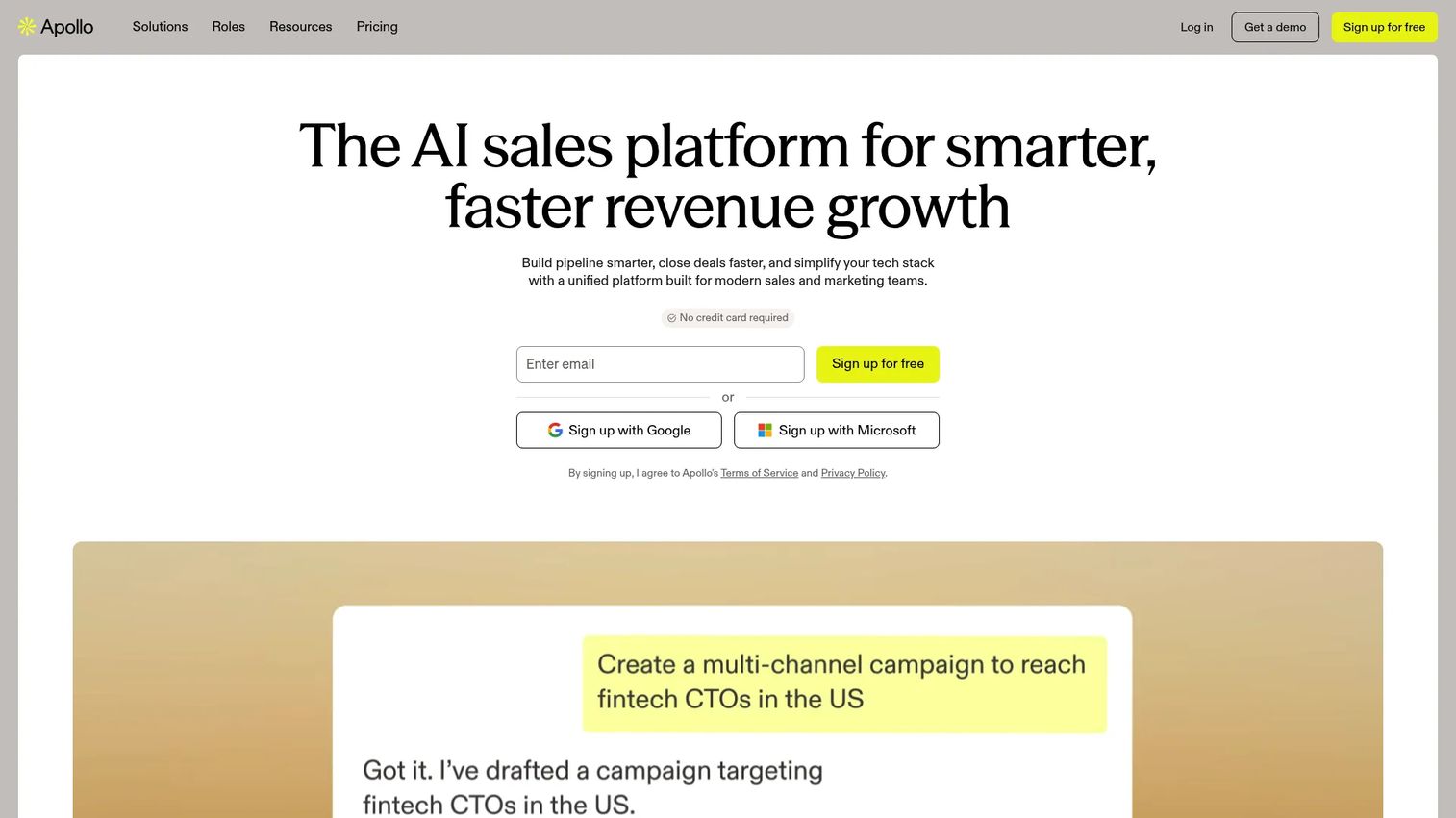
Apollo.io is an AI-powered GTM platform for prospecting, engagement, enrichment, and deal execution. It packages a B2B contact database, sales engagement sequencing, and data enrichment in one place. For AEs and SDRs who need targeting and selling in the same tool, it removes the tab-switching that slows outbound-heavy motions.
Best for: B2B sales teams needing prospecting data plus outbound engagement in one platform.
Key strengths
- B2B contact and company database
- Sales engagement automation and sequencing
- Data enrichment and workflow automation
Why choose Apollo.io: It fits smaller teams and outbound-heavy motions where practical execution beats enterprise orchestration. You research the account, build the list, and run sequences without leaving the platform.
Apollo.io pricing: Starter is free forever. Basic is $49 per user per month, Professional is $79 per user per month, and Organization is $119 per user per month with a 3-user minimum, all billed annually. Apollo.io holds a 4.7/5 rating on G2.
7. ActiveCampaign
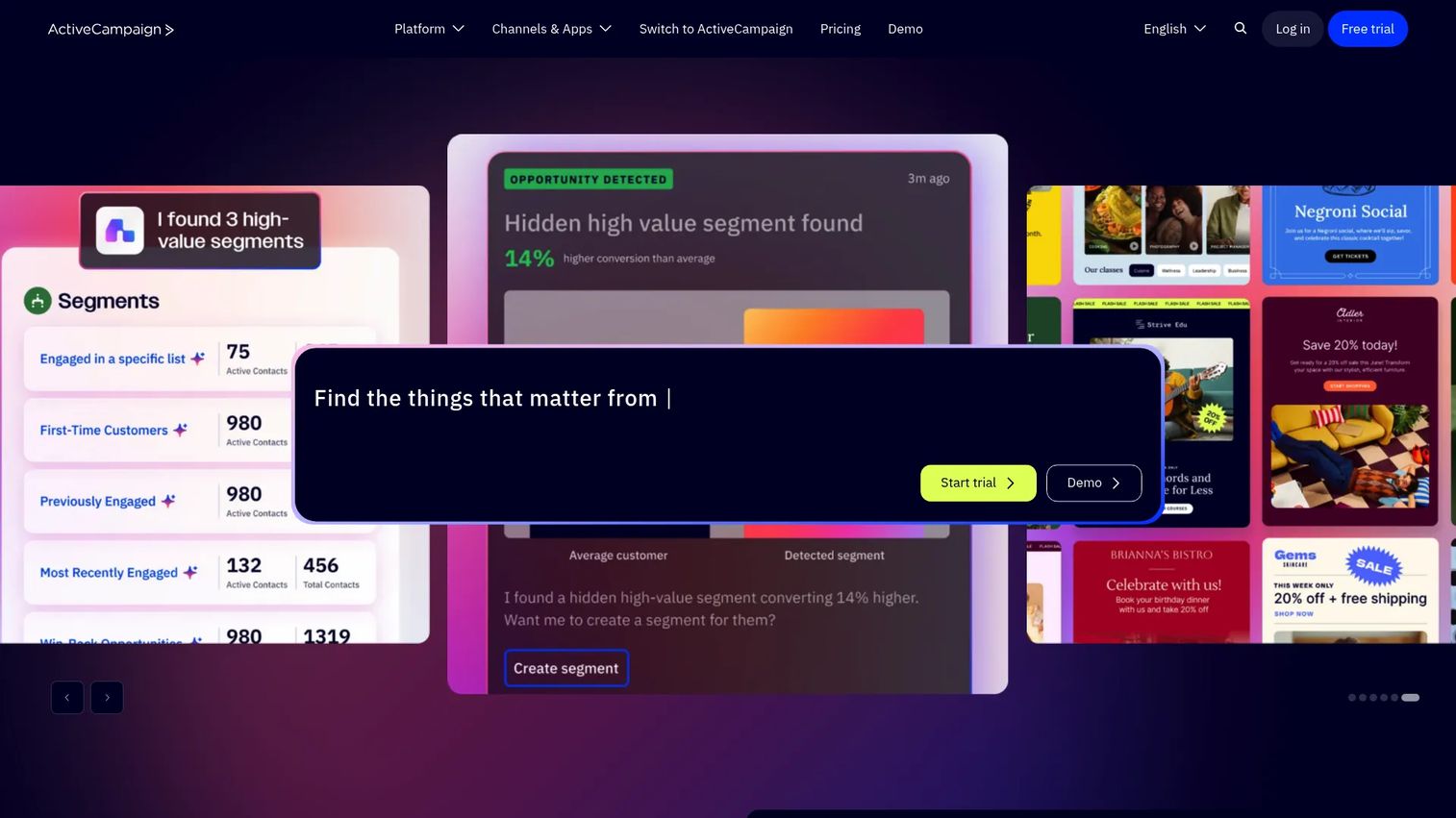
ActiveCampaign is a marketing automation platform for email, automation, CRM, SMS, and WhatsApp. Its strength is segmentation and personalized lifecycle journeys that can be shaped into account-style workflows. Teams that want marketing automation with some account based motion support, rather than a dedicated ABM platform, find it a practical fit.
Best for: Teams needing marketing automation with CRM and multichannel messaging.
Key strengths
- Marketing automation and CRM
- Email, SMS, and WhatsApp messaging
- Landing pages, analytics, and 1,000+ integrations
Why choose ActiveCampaign: Choose it when lifecycle automation is your priority and account based selling is a secondary motion. For deep account intelligence and intent data, a specialized platform will go further, but ActiveCampaign covers personalized journeys well.
ActiveCampaign pricing: Starter begins at $15 per month. Plus, Professional, and Enterprise tiers scale up from there. A 14-day free trial is available. ActiveCampaign holds a 4.4/5 rating on G2.
8. Metadata.io
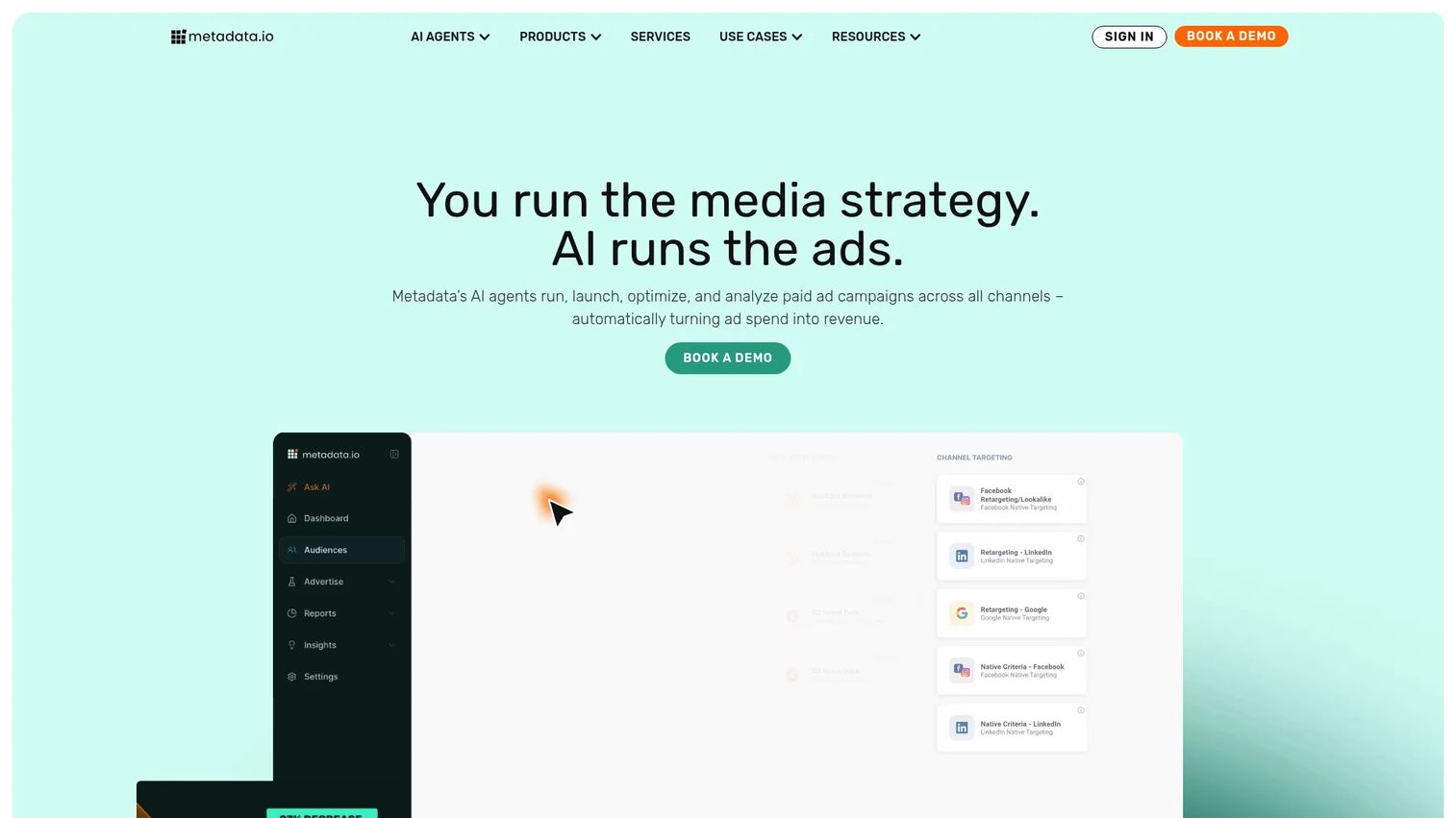
Metadata.io is a B2B marketing automation and AI ad campaign optimization platform. It automates paid campaigns across channels, builds and scales targeted B2B audiences, and optimizes toward revenue and pipeline. For demand-gen and revenue teams that want more automation around account campaigns, it handles the paid media heavy lifting.
Best for: B2B teams running paid acquisition and demand gen who want campaign automation tied to revenue outcomes.
Key strengths
- Automates paid campaigns across channels
- Builds and scales targeted B2B audiences
- Optimizes campaigns toward revenue and pipeline
Why choose Metadata.io: It fits when paid media is a core account-based channel and you want optimization tied to pipeline. The handoff value for AEs and RevOps is cleaner attribution on which campaigns produced qualified account engagement.
Metadata.io pricing: Public numeric pricing is not shown on first-party pages, which reference flat pricing and a consultation. Metadata.io holds a 4.6/5 rating on G2.
Considerations before you buy
Revenue impact, not activity
The only metric that matters is whether the tool moves win rate, cycle length, or forecast accuracy. Ask each vendor for account-level analytics that map to pipeline, not vanity engagement dashboards. A tool that produces reports nobody uses on a forecast call is dead weight.
Fit with your existing workflow
The best platform is the one reps actually open. Check CRM integration depth first. If signals do not flow into Salesforce or HubSpot where your team works, adoption dies within a quarter. Native beats bolted-on every time.
Data quality and intent accuracy
Account intelligence and intent data are only as good as their sources. Ask how intent is scored, how often data refreshes, and how the vendor handles duplicate and stale records. Bad data means wasted touches on accounts that were never in-market.
Multi-channel orchestration depth
If you sell to buying committees, single-channel tools leave gaps. Evaluate whether the platform coordinates ads, email, and sales touches, and whether it tracks engagement across the whole account rather than one contact.
Team size and time to value
Enterprise ABM platforms reward large programs and long cycles. Lean teams often get faster ROI measurement from tools that combine targeting and execution. Match the platform to your segment, not to the longest feature list.
Conclusion
The right account based selling software depends on your motion, not on feature count. For enterprise revenue teams that need predictive scoring, buying group visibility, and deep orchestration, 6sense Revenue Marketing and Demandbase One lead. For account research and timing, ZoomInfo Marketing supplies the account intelligence layer that feeds everything else.
Mid-market and lean teams get faster execution from AdRoll ABM and Apollo.io, which pair targeting with hands-on selling. Teams consolidating their stack should look at HubSpot Marketing Hub for CRM-native workflows. And demand-gen teams that live in paid media will find Metadata.io and ActiveCampaign strong on automation and campaign measurement.
Do not buy on the demo alone. Shortlist your top two or three by workflow fit, then run a live pilot against real accounts. Watch whether reps actually open the tool and whether signals reach them in their CRM. That single test predicts adoption better than any feature matrix.
Once your accounts are prioritized, the next friction is proving product value to a full buying committee. That is where a well-built Guideflow interactive demo earns its place, letting each stakeholder experience the product without waiting on a live call.
Start your journey with Guideflow today!
FAQs
Account based selling software helps revenue teams target, prioritize, and coordinate outreach to a defined list of named accounts instead of chasing individual leads. It combines account intelligence, intent data, and multi-channel orchestration so AEs focus effort on the accounts most likely to close. The goal is fewer wasted touches and clearer next steps on high-value deals.
Account based marketing focuses on generating and warming demand within target accounts, usually owned by marketing. Account based selling focuses on progressing and closing named opportunities, owned by sales. Most account based marketing software today supports both motions, which is why the categories overlap and share the same target account lists.
6sense Revenue Marketing and Demandbase One are the strongest picks for enterprise pipeline. Both offer predictive scoring, buying group visibility, and account-based orchestration built for 8-plus stakeholder deals and long evaluation cycles. ZoomInfo Marketing is a strong companion when you need deep account research and buyer signals feeding those programs.
Prioritize account intelligence, intent data, multi-channel orchestration, CRM integration, and account-level analytics. AEs specifically want signals that reach them inside their CRM, buying committee visibility, and reporting they can defend on a forecast call. Personalization and target account selection round out the core feature set.
No. Account based selling software sits on top of your CRM, not in place of it. Your CRM remains the system of record for deals and contacts, while the ABM platform layers in account intelligence, intent data, and orchestration. Strong CRM integration is the difference between a tool reps adopt and one they ignore.
Track account-level metrics rather than lead volume. Watch engagement lift on target accounts, sales cycle length, win rate on named accounts, and pipeline sourced or influenced by the program. Tie those to closed-won revenue over a full cycle, and compare against a baseline of non-targeted accounts to isolate the impact.
Yes. Lean teams often get faster value from tools that combine targeting and execution, such as Apollo.io for outbound or AdRoll ABM for account-based advertising. Enterprise-grade platforms reward large programs, so smaller teams should match the tool to their deal count and cycle length rather than buying the most feature-dense option.
CRM integration comes first, since Salesforce or HubSpot is where reps work and where signals must land. After that, prioritize connections to your sales engagement platform, calendar and email, marketing automation, and analytics. The tighter the account intelligence and intent data flow into existing tools, the higher the adoption and the account engagement analytics you can trust.