Your mobile release is ready. Then AppSec asks how the app handles reverse engineering, rooted devices, runtime hooks, and tampered builds.
Static code scanning catches vulnerabilities before shipping. A WAF protects traffic at the network edge. Neither defends an app once it sits on an untrusted device. Application shielding software adds protections directly to the binary, so the app can resist inspection, cloning, and runtime abuse after distribution.
The numbers make the case for acting: 83% of monitored applications experienced attacks in January 2025, according to Digital.ai (2025). Yet 60% of organizations had not implemented runtime application self-protection (RASP) as of the same period, per Enterprise Strategy Group (2025). For a PM, that gap lands squarely on the roadmap. Security requirements compete with activation work, and the wrong choice turns every release into a coordination project.
This guide compares 8 application shielding tools across Android and iOS coverage, code hardening depth, runtime protection, and build pipeline fit, so you can make the decision with a clear threat model instead of a vendor checklist.
What's inside
This guide is for product managers, mobile engineering leads, and AppSec owners evaluating application shielding software. Tools were selected based on:
- Platform coverage: Android, iOS, web, SDK, or hybrid support
- Protection depth: Code hardening, RASP, anti-tamper, and runtime policy controls
- Release workflow fit: CI/CD integration, configuration ownership, and build impact
- Visibility: Threat telemetry, runtime event data, and false-positive management
You'll find a comparison table with verified pricing and G2 ratings, per-tool summaries, a buyer checklist, and FAQs.
TL;DR
- Best for broad mobile defense automation: Appdome No Code Mobile App Security covers RASP, code obfuscation, fraud, and bot defense for Android and iOS without SDK work
- Best for compiler-based Android and iOS hardening: Guardsquare provides platform-specific protection products with polymorphic obfuscation and RASP
- Best for mobile banking and high-risk transactions: OneSpan App Shielding targets financial services apps with overlay, keylogging, and jailbreak defenses
- Best for JavaScript and client-side web protection: Jscrambler covers browser-facing code, third-party scripts, and client-side fraud
- Best for content protection combined with mobile app security: DoveRunner pairs DRM, watermarking, and mobile RASP in one platform, with a published starting price of $299/month
What is application shielding software?
Application shielding software protects a distributed application by hardening its code and adding runtime checks that resist reverse engineering, tampering, instrumentation, and other client-side attacks.
The category splits into two layers that usually work together.
Static application protection
Static protection transforms the application binary before distribution. Techniques include code obfuscation, control flow transformation, string encryption, asset protection, and native library hardening. Anti-repackaging controls prevent attackers from modifying the app and redistributing it under the original identity.
Static hardening raises the cost of extracting secrets, copying proprietary logic, or cloning the app. It does not detect runtime conditions on its own.
Dynamic protection and RASP
Runtime application self-protection (RASP) adds checks that execute while the app is running. A RASP-enabled app can detect debuggers, dynamic instrumentation frameworks, emulators, rooted devices, jailbroken devices, modified binaries, and malware overlays. When a risky condition appears, the app applies a configured policy: Log the event, restrict a sensitive flow, require step-up authentication, or end the session.
Why PMs should treat shielding as a product requirement
Payment flows, account recovery, authentication logic, and proprietary algorithms all sit inside the mobile client. An attacker with the right tools can inspect that logic, extract API keys, clone the app, or manipulate runtime behavior. App store cloning and repackaging also create customer trust and brand exposure that security teams alone cannot own.
What application shielding does not replace
| Security layer | What it protects | Why it still matters |
|---|---|---|
| Application shielding | Code, runtime integrity, client-side secrets, device context | Protects the installed app on untrusted devices |
| API security and attestation | Authenticity of app-to-backend requests | Helps backends distinguish genuine apps from modified clients |
| WAF and rate limiting | Edge traffic and abuse patterns | Mitigates network and API-level attacks |
| Application security testing | Vulnerabilities before release | Finds issues before hardening is applied |
When to use application shielding software
Protect high-risk customer actions
Login, MFA, payments, transfers, and account recovery all depend on code that runs on devices you do not control. Server-side controls matter, but an attacker who can inspect or manipulate the mobile client may find paths that your backend never sees. Shielding keeps sensitive flows from becoming leverage points.
Defend apps and SDKs against reverse engineering
Apps that contain proprietary algorithms, embedded payment logic, API request patterns, license checks, or game mechanics are extraction targets. SDK vendors face a related problem: Third-party developers who receive your SDK can analyse it. Code hardening and obfuscation raise that bar meaningfully.
Keep security aligned with a rapid release cadence
Teams shipping frequent mobile updates need security controls that fit their CI/CD tools and build processes without becoming release blockers. Look for tools that accept a reusable security configuration, integrate into existing build pipelines, and produce repeatable results across release segments.
Application shielding software comparison
These eight products do not all cover the same platform, operating model, or threat surface. Some focus on Android and iOS mobile binaries. Others add fraud, device trust, content protection, or browser-level JavaScript coverage. Pricing below reflects verified information from each vendor's site as of October 2026. G2 ratings are sourced from each tool's current G2 listing.
| # | Product | Best for | Key differentiator | Pricing | G2 rating |
|---|---|---|---|---|---|
| 1 | Appdome No Code Mobile App Security | Mobile teams needing automated Android and iOS defense | No-code RASP, fraud, and bot defense without SDK changes | Contact for quote | 4.8/5 |
| 2 | Guardsquare | Compiler-based Android and iOS hardening | Platform-specific products with polymorphic protection and RASP | From €3,499/app (AppSweep); Core/Control/Command: Contact for quote | 4.3/5 |
| 3 | OneSpan App Shielding | Banking and transaction apps | Overlay, keylogging, and jailbreak defense for high-risk user journeys | Contact for quote | 4.3/5 |
| 4 | DoveRunner | OTT, content, and mobile security combined | Multi-DRM, watermarking, and mobile RASP in one platform | From $299/month | 4.7/5 |
| 5 | Jscrambler | JavaScript and client-side web protection | Polymorphic obfuscation, third-party script control, and client-side fraud defense | Contact for quote | 4.4/5 |
| 6 | Build38 Mobile App Security Platform | Runtime protection and cryptographic security | In-app protection with white-box cryptography and active hardening | Contact for quote | Not listed |
| 7 | Lookout Embedded AppDefense | Enterprises embedding threat defense into customer-facing apps | SDK-based mobile threat detection with SIEM and fraud-management integration | Contact for quote | 4.3/5 |
| 8 | Zimperium zKeyBox | Cryptographic key protection across platforms | White-box cryptography for keys at rest, in transit, and in use | Contact for quote | 4.0/5 |
Best 8 application shielding software tools for 2026
1. Appdome No Code Mobile App Security
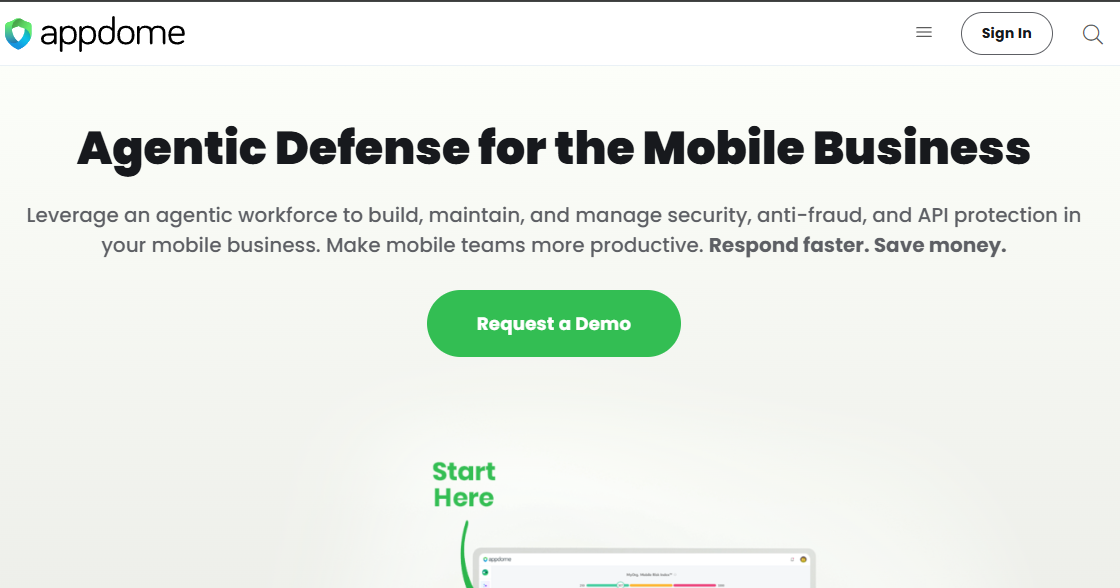
Appdome is an AI-powered, no-code platform that builds mobile app security controls into Android and iOS apps during the CI/CD build process. Teams select the defenses they need, connect their build pipeline, and Appdome injects the protections without requiring SDK installation or code changes. The platform covers application shielding, RASP, code obfuscation, fraud prevention, bot defense, and threat telemetry under a single operating model.
Best for: Product and security teams that need broad Android and iOS mobile defense without adding SDK work to every release cycle.
Key features
- Mobile RASP and application shielding
- Android root and iOS jailbreak detection
- Data encryption including FIPS 140-2
- Mobile fraud and bot defenses
- Threat-Events telemetry with configurable UX responses
Why choose Appdome: The platform fits teams whose product risk extends beyond code hardening into fraud, account takeover, and runtime threat signals. For PMs, the operating model matters: Security controls are maintained at the platform level, so they evolve with app changes without requiring engineering cycles per release. The breadth of defense categories means buyers should prioritize the controls tied to their specific threat model before configuring a package.
Appdome pricing: Appdome offers three plans (GO, SRM, DEV) with pricing by quote. Request a quote at appdome.com/appdome-pricing to get package details matched to your app count and defense requirements.
G2 rating: 4.8/5
2. Guardsquare
Guardsquare provides a mobile application security suite built around platform-specific products. Its Android product (DexGuard) and iOS product (iXGuard) use compiler-level integration to apply obfuscation, encryption, control flow transformation, and polymorphic protection that changes between builds. ThreatCast adds real-time monitoring of runtime threat events, and AppSweep handles mobile application security testing before hardening is applied.
Best for: Product teams with mature Android and iOS release processes that want deep, compiler-integrated application hardening and runtime monitoring.
Key features
- Compiler-based obfuscation and encryption for Android and iOS
- Polymorphic code hardening that varies across builds
- Root and jailbreak detection with runtime RASP checks
- Real-time threat monitoring via ThreatCast
- Support for cross-platform frameworks including Flutter and React Native
Why choose Guardsquare: It suits organizations protecting source code, API request logic, payment workflows, and SDK-distributed functionality where hardening depth matters more than zero-code configuration. Teams should validate how licensing, build integration, and configuration ownership work across both platforms before procurement. The engineering investment is higher than no-code alternatives, which is relevant when release cadence is the primary constraint.
Guardsquare pricing: AppSweep security testing starts at €3,499 per app. The Core, Control, and Command protection plans require a quote from guardsquare.com/pricing, with pricing driven by app count, platform coverage, and support tier.
G2 rating: 4.3/5
3. OneSpan App Shielding
OneSpan App Shielding protects Android and iOS apps against intrusion, tampering, reverse engineering, malware, and runtime attacks. The product applies post-compile code obfuscation, repackaging prevention, and secure local storage, then adds runtime detection for overlays, jailbreaks, root access, debuggers, emulators, and hooking frameworks. Anti-keylogging and screen-reader protection make it particularly relevant for apps handling credential input and payment authentication.
Best for: Financial services and enterprise product teams protecting Android and iOS apps that handle sensitive transactions, identity verification, or account administration.
Key features
- Post-compile code obfuscation and repackaging prevention
- Overlay, jailbreak, root, debugger, and emulator detection
- Anti-keylogging and screen-reading protection
- Configurable real-time runtime responses
- Zero-code shielding portal with CI/CD integration
Why choose OneSpan App Shielding: The key evaluation question is whether runtime protections can secure high-value actions without generating false positives or adding friction for legitimate users. Implementation should include user experience testing for risk responses. Blocking a legitimate user at a payment step creates avoidable abandonment that lands on activation and retention metrics, not just on the security team.
OneSpan App Shielding pricing: OneSpan directs buyers to speak with an expert for tailored packaging. Contact onespan.com to discuss trial options, proof-of-concept availability, and regional packaging.
G2 rating: 4.3/5
4. DoveRunner
DoveRunner is a cloud-based platform combining digital content protection and mobile application security. Its content protection side covers multi-DRM licensing for PlayReady, Widevine, and FairPlay, plus forensic watermarking and anti-piracy monitoring. Its mobile app security side adds code protection, RASP, anti-tampering, root and jailbreak detection, and emulator blocking. The combination makes it relevant for OTT providers and content-driven mobile apps that need both layers.
Best for: OTT providers and mobile app teams that need integrated content protection and application security from a single vendor.
Key features
- Mobile app code protection and RASP
- Root, jailbreak, and emulator detection
- Anti-tampering controls
- Multi-DRM licensing for major playback standards
- Forensic watermarking and anti-piracy monitoring
Why choose DoveRunner: It belongs in the shortlist for teams where content piracy and app security are connected requirements. The platform's published pricing makes it easier to model costs before a sales conversation, which reduces procurement friction. Teams that need only mobile binary hardening without content protection should compare the scope against purpose-built mobile shielding alternatives.
DoveRunner pricing: A 30-day free trial is available. Paid plans start at $299/month (Standard) and $499/month (Professional) for Multi-DRM, with separate watermarking pricing at doverunner.com/pricing.
G2 rating: 4.7/5
5. Jscrambler
Jscrambler is a client-side security platform for JavaScript and web application protection. It applies polymorphic code obfuscation, anti-tampering controls, and runtime code integrity checks to browser-facing applications. Beyond code protection, it provides continuous inventory and behavioral monitoring of third-party scripts, data leakage prevention, and defenses against Magecart-style supply chain attacks on payment pages.
Best for: Product teams protecting JavaScript applications, payment pages, or browser-based customer workflows from client-side tampering and supply chain compromise.
Key features
- Polymorphic JavaScript code obfuscation
- Runtime code integrity and tamper detection
- Continuous third-party script inventory and behavioral monitoring
- Data leakage prevention and form fencing
- Real-time threat response for client-side fraud
Why choose Jscrambler: It covers browser and JavaScript exposure specifically. A PM with both web and native mobile applications may need this type of tool alongside mobile binary protection. Do not select it as an Android or iOS binary hardening solution; the two categories address different attack surfaces and require separate evaluation. Jscrambler's scope is web and client-side risks.
Jscrambler pricing: Jscrambler prices by quote based on application scope and deployment needs. Contact jscrambler.com/pricing for packaging options.
G2 rating: 4.4/5
6. Build38 Mobile App Security Platform
Build38 provides a mobile application security platform with in-app protection, active hardening, and white-box cryptography. The platform defends against reverse engineering, tampering, repackaging, and API abuse, and adds secure storage, secure communication channels, and real-time threat visibility. Note that Build38's official site now presents its offering as part of OneSpan's next-generation app shielding portfolio, so buyers should confirm current product availability and roadmap directly with the vendor.
Best for: Mobile teams evaluating runtime application protection alongside cryptographic security and threat intelligence for financial or enterprise-grade apps.
Key features
- In-app protection against reverse engineering and repackaging
- Active hardening and runtime environment assessment
- White-box cryptography for key and secret protection
- Secure storage and secure communication channels
- Real-time threat visibility and response
Why choose Build38: The PM angle is visibility. The platform surfaces runtime threat data, which means security events need a defined owner and response process to produce value. Confirm the operating requirements for collecting and acting on telemetry before procurement. Buyers should also verify current product positioning given the integration with OneSpan.
Build38 pricing: Build38 uses quote-based pricing. Contact build38.com to confirm current product availability, app volume pricing, and professional services terms.
7. Lookout Embedded AppDefense
Lookout Embedded AppDefense provides mobile threat defense through a lightweight SDK that developers integrate into Android and iOS apps. The SDK connects to cloud-powered threat detection covering devices, apps, and networks. An App Defense developer console gives security teams visibility into security events, configurable risk ratings, and alerts. An Event Feed API lets teams route threat signals into SIEM platforms, fraud management systems, or backend risk engines.
Best for: Enterprises embedding mobile security into banking, payments, retail, or regulated customer-facing apps where device risk informs access or transaction policy.
Key features
- Lightweight SDK for Android and iOS integration
- Cloud-powered device, app, and network threat detection
- Developer console with risk ratings and configurable alerts
- Event Feed API for SIEM and fraud-management integration
- Custom remediation workflows for rooted devices and malware
Why choose Lookout Embedded AppDefense: The product fits when backend or fraud teams need app-level risk signals to influence a policy decision, such as restricting a transaction from a compromised device. Confirm whether the packaging addresses consumer apps, employee apps, or both before scoping, since the use case changes the value of device risk data and the integration architecture.
Lookout Embedded AppDefense pricing: Lookout prices Embedded AppDefense by quote. Contact lookout.com to confirm packaging model (per user, per device, or enterprise-wide) and integration scope.
G2 rating: 4.3/5
8. Zimperium zKeyBox
Zimperium zKeyBox is a white-box cryptography product that protects cryptographic keys and cryptographic operations within applications, including on compromised devices. It supports major cryptographic algorithms (AES, 3DES, RSA, ECC, HMAC) and runs across Android, iOS, Linux, Windows, macOS, and several embedded and gaming platforms. Rather than detecting threats at runtime, zKeyBox focuses on preventing cryptographic key extraction regardless of the device state.
Best for: Enterprise mobile, payment, financial, and embedded application teams that need cryptographic key protection against extraction and tampering on any device.
Key features
- Cryptographic key protection at rest, in transit, and in use
- Support for AES, 3DES, RSA, ECC, and HMAC algorithms
- Cross-platform coverage including Android, iOS, and embedded targets
- Schema design and auto-generated white-box cryptographic code
- Secure PIN, Secure Network, Secure Database, and Secure Storage modules
Why choose Zimperium zKeyBox: It addresses a specific problem: Key extraction from mobile and embedded applications, including on rooted or jailbroken devices. Teams that need full application hardening alongside key protection may need to combine zKeyBox with a broader mobile shielding product. The G2 rating sourced here reflects the broader Zimperium Mobile Application Protection Suite, since zKeyBox does not have a standalone G2 listing.
Zimperium zKeyBox pricing: Pricing is by quote. Contact zimperium.com to confirm deployment options, platform coverage, and licensing model for your application portfolio.
G2 rating: 4.0/5
Considerations when choosing application shielding software
Start with the threat model
Do not buy against a generic checklist. Identify whether the priority is reverse engineering, app cloning, API abuse, account takeover, malware overlays, root and jailbreak exposure, cryptographic key extraction, or SDK protection. The threat model determines which controls belong in the first release and which can wait.
Match protection to your platform surface
Document your Android coverage, iOS coverage, web-facing JavaScript, hybrid frameworks, native libraries, and any SDKs you distribute. A tool that protects one codebase well may leave another surface exposed. Evaluate application security testing software alongside shielding to find vulnerabilities before hardening is applied.
Test the release workflow before you commit
Request a proof of concept inside your existing build process. Validate build times, code signing compatibility, rollback steps, and CI/CD integration behavior. API monitoring tools and application performance monitoring tools can help establish baselines for measuring any performance impact from added protections.
Define runtime response policies before go-live
Detection is only useful when the team knows what happens next. Set policies for warn, log, restrict, require step-up authentication, or end the session for each threat type. Undefined policies mean events accumulate without action, and legitimate users may get blocked by an over-aggressive default.
Measure product impact alongside security coverage
Track crash rates, app startup time, authentication completion, payment completion, and false-positive incident volume after deployment. These are guardrail metrics. A security control that degrades activation or payment completion rates needs tuning before it ships to production.
Conclusion
Application shielding software sits at the intersection of security requirements and release cadence. The right choice depends on the threat model, product surface, and how the team owns security configuration across releases.
Choose Appdome for broad Android and iOS mobile defense automation without SDK changes. Choose Guardsquare for compiler-based hardening depth on mature mobile platforms. Choose OneSpan App Shielding for financial services apps where overlay, keylogging, and jailbreak defenses directly protect high-value transactions. Choose Jscrambler for JavaScript and browser-facing client-side protection. Evaluate DoveRunner where content protection and mobile security overlap. For runtime telemetry, device risk signals, and cryptographic key protection, assess Build38, Lookout Embedded AppDefense, and Zimperium zKeyBox against your specific architecture.
The practical next step: Build a proof of concept around one high-risk workflow, then compare security coverage against release friction, telemetry quality, and customer experience impact before expanding across your mobile portfolio.
Start your journey with Guideflow today!
FAQs
Application shielding software hardens application code and adds runtime defenses against reverse engineering, tampering, hooks, unauthorized modification, and risky execution environments. The term is most common in mobile application security, though it also applies to JavaScript and web application protection. Products typically combine static code hardening applied before distribution with runtime checks that execute while the app is running.
RASP (runtime application self-protection) is one component of application shielding. A complete shielding implementation usually combines static protections, such as obfuscation, encryption, and control flow transformation, with runtime checks that detect threats while the app runs. RASP handles the dynamic layer; code hardening handles the static layer. Both are typically needed together.
No. Application shielding protects the installed app on the device. WAFs and API gateway software protect traffic and backend interfaces from network-level attacks. High-risk mobile apps typically need both layers. App shielding addresses what happens after distribution; edge controls address what arrives at the backend.
Often yes. Android and iOS have different build systems, binary formats, operating system security models, and attack techniques. Some platforms cover both operating systems through a unified interface, while others use dedicated products per platform. Verify whether a vendor's Android and iOS coverage matches your release processes for each before procurement.
It makes reverse engineering substantially harder. Code obfuscation, encryption, and polymorphic transformations obscure logic and raise the cost of analysis. But shielding reduces exposure rather than eliminating it. Secure backend design, proper secret management, and AI security posture management tools all remain necessary parts of the overall architecture.
Track release lead time, build stability, app startup performance, crash rates, authentication completion rates, payment completion rates, support ticket volume, runtime threat event volume, and false-positive incident counts. These metrics tell you whether the security controls are working without harming the customer experience. A rise in false positives or a drop in payment completion rates signals a policy tuning problem, not a product success.
It can support the technical controls that organizations map to security and compliance requirements in verticals such as banking, payments, and healthcare. No specific tool makes an application compliant on its own. Compliance depends on the full system, evidence processes, organizational policies, and governance. Describe capabilities to your compliance and legal teams and let them determine how shielding fits your specific framework requirements.
It depends on the platform, codebase complexity, existing release pipeline, chosen defenses, and validation requirements. A no-code platform like Appdome typically integrates faster than a compiler-level product like Guardsquare, where build integration requires more configuration. Run a proof of concept on one high-risk app flow first. Expand coverage across the mobile portfolio only after validating build stability, performance, and customer experience impact in a controlled release segment.