
A client wants to book the 6am strength class. It's Sunday night. Your front desk is closed. So they DM your Instagram, get no reply, and book a competitor's class instead.
That's the friction. Bookings arrive through phone, email, DMs, and paper sign-up sheets, and none of it connects to payments, capacity, or membership records. Staff spend hours chasing no-shows and reconciling who actually paid. Classes that should be full run half-empty because nobody could reserve a spot at the moment they decided to show up.
The market has already moved on this. The global fitness booking software market reached $0.6B in 2025 and is projected to hit $1.29B by 2034 at an 8.5% CAGR, according to MarketIntelo (2025). Over 45% of North American gyms had adopted cloud-based software for memberships, scheduling, and billing, per Business Research Insights (2024).
The question isn't whether to run bookings as a system. It's which system connects class capacity, payments, and memberships without adding another disconnected tool to your stack.
What's inside
This guide is for gym owners, studio operators, and founders scaling class-based fitness businesses who need booking to run like infrastructure, not a mailbox.
We evaluated each tool on the operational criteria that decide whether software earns its place:
- Class capacity and waitlists: how it handles limited spots, overflow, and auto-promotion
- Payments, memberships, and packages: recurring billing, prepaid packs, deposits, and POS
- Omnichannel booking and mobile: widgets, booking pages, social channels, and client apps
- Reporting and multi-location fit: analytics, staff management, and cross-site scale
Every tool here serves class-based fitness operations. Pricing and ratings were verified against each vendor's live pricing page and current listings.
TL;DR
- Best overall for fitness studios: ClassFit, revenue-based pricing with unlimited classes and a branded app
- Best for transparent pricing tiers: Appointy, a visible free-to-Enterprise ladder with staff and resource scheduling
- Best for multi-channel booking: SimplyBook.me, bookings across your site, social, and Google surfaces
- Best for straightforward booking mechanics: Lunacal, recurring sessions, payments, and reminders without extra weight
- Best for retail plus booking in one stack: Vagaro, POS, memberships, and packages together
- Best for larger and multi-site operations: Mindbody or Zen Planner, deeper reporting and membership billing at scale
What is fitness booking software?
Fitness booking software is a cloud-based system that lets clients reserve classes, appointments, and sessions online while automating payments, memberships, capacity, and communication for the business.
For gyms, studios, coaches, and class-based fitness businesses, it replaces the tangle of phone calls, DMs, and spreadsheets with one system of record. A client books a spot, pays or draws down a package, gets a reminder, and shows up. The business sees who's coming, what's paid, and which classes fill.
Core features to expect:
- Online booking and scheduling: self-serve reservations 24/7 through a website, widget, or app
- Class capacity and waitlists: hard limits per class with automatic promotion when spots open
- Memberships, packages, and payments: recurring billing, prepaid packs, drop-ins, and deposits
- Reminders and notifications: automated email and SMS to cut no-shows
- Mobile apps and admin tools: client-facing apps and staff-facing scheduling controls
- Reporting, analytics, and staff management: attendance, revenue, and payroll-adjacent visibility
The category leans heavily cloud-based. MarketIntelo (2025) found 72.5% of the fitness booking software market was cloud-based, and 85.0% was tied to commercial fitness facilities and studios.
When to use fitness booking software
Reduce manual booking work
If staff are still taking bookings by phone, replying to Instagram DMs, or updating a paper sign-up sheet, you're paying people to do what a booking page does for free. The tipping point is usually volume: once you run more than a handful of classes a week, manual coordination starts leaking revenue through double-bookings and missed replies. Self-serve booking moves that work to the client and frees the front desk for higher-value tasks.
Fill classes faster
Empty spots don't come back. If your classes run below capacity while demand exists at inconvenient hours, you need bookable class pages, embeddable widgets, automated reminders, and discovery through social and Google. The goal is to let a client reserve the moment they decide, not the next time your desk is staffed. Waitlists then recapture demand for popular slots automatically.
Scale memberships and multiple locations
When recurring revenue matters as much as headcount, you need recurring billing, packages, and membership management that hold up across sites. Multi-location operators need one view of capacity, staff, and revenue across every studio, plus consistent pricing and rules. This is the stage where booking software stops being a calendar and becomes the operational backbone of the business.
Comparison table
The tools below are ordered by relevance to class-based fitness operators, not alphabetically. Studio-first platforms lead, followed by broader scheduling tools and enterprise-grade operations software. Pricing and ratings reflect verified values from each vendor's live pricing page and current listings at the time of writing.
| # | Product | Best for | Key differentiator | Pricing | G2 rating |
|---|---|---|---|---|---|
| 1 | ClassFit | Fitness studios and class-based businesses | Revenue-based pricing with unlimited classes | 2% of monthly revenue ($45 min, $120 max) | Not listed |
| 2 | Appointy | Businesses wanting transparent pricing tiers | Visible free-to-Enterprise ladder | Free; paid from $19.99/mo (annual) | 4.5/5 |
| 3 | SimplyBook.me | Multi-channel and social booking | Bookings across site, social, and Google | Free; paid from $9.90/mo | 4.4/5 |
| 4 | Lunacal | Straightforward booking mechanics | Recurring sessions and paid bookings | From $9/user/mo | 4.9/5 |
| 5 | Vagaro | Studios wanting POS plus booking | Retail checkout and booking in one stack | From £20/mo | 4.6/5 |
| 6 | Mindbody | Larger studios and multi-site operators | All-in-one management with discovery reach | From $79/mo per location | 3.7/5 |
| 7 | Zen Planner | Membership-heavy gyms and studios | Member management and billing together | From $99/mo | 4.2/5 |
Best fitness booking software for 2026
Each tool below is scored on how well it handles the fitness operations stack: class capacity, payments, memberships, omnichannel booking, and multi-location scale. The right pick depends on whether you're a solo coach, a single studio, or a multi-site operator.
1. ClassFit
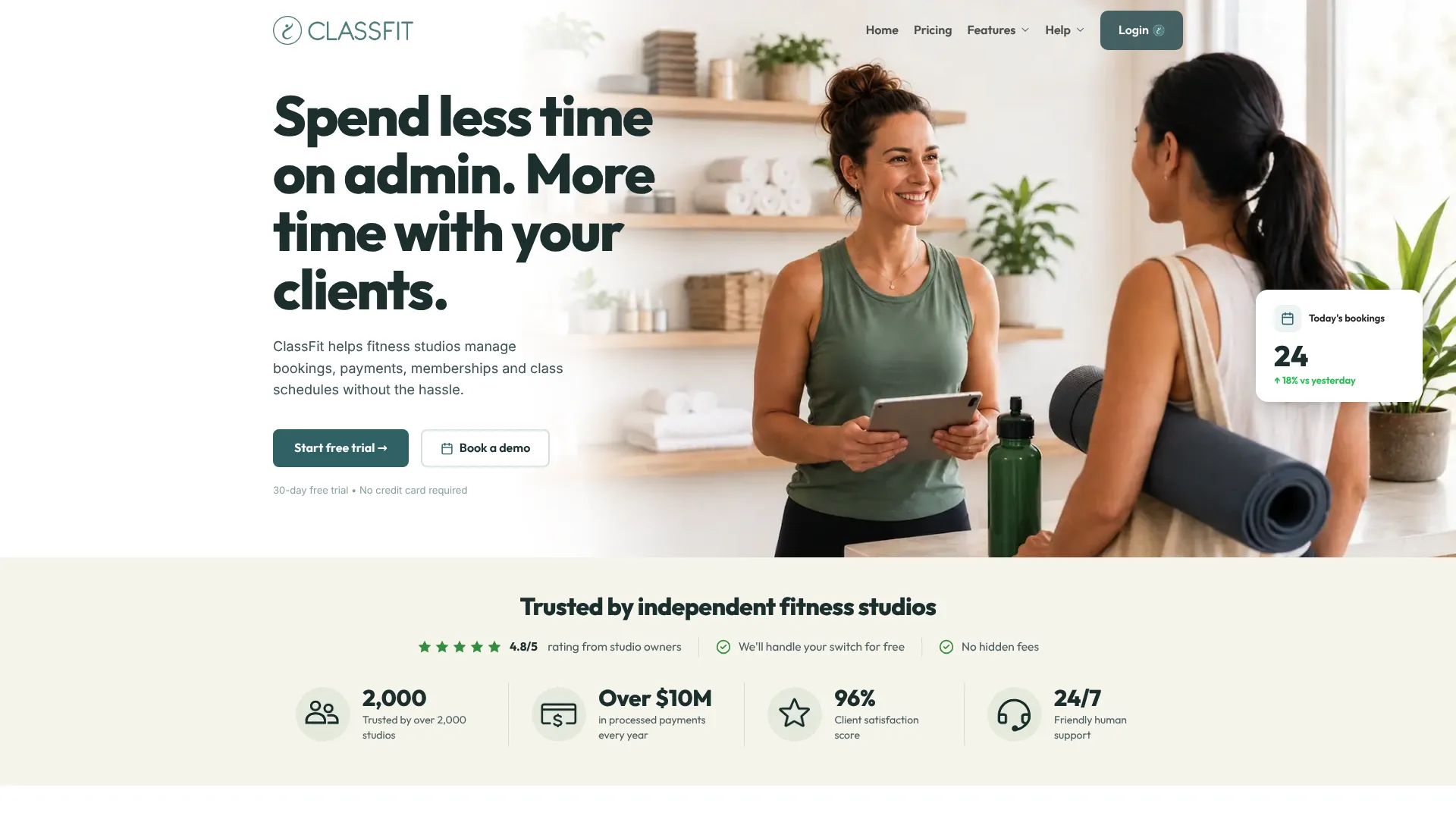
ClassFit is a fitness class scheduling platform built for studios and class-based businesses that want booking, payments, and member management in one place. It handles the core operational loop: a client books, pays or uses a package, gets a reminder, and shows up. The pricing model scales with your revenue rather than charging a flat monthly fee, which lines up cost with how much the software is actually earning you.
Best for: Independent studios that want a simple operational system without per-feature upsells.
Key strengths
- Unlimited classes and appointments
- Packages and memberships
- Client profiles, waivers, reminders, and reporting
- Branded app and Stripe payments
- 30-day free trial, no card required
Why choose ClassFit: If you value ease of use and predictable operations over a sprawling feature set, ClassFit fits. Revenue-based pricing means a slow month costs less, which matters for studios with seasonal swings.
ClassFit pricing: ClassFit charges 2% of monthly revenue processed through the platform, with a $45 minimum and $120 maximum monthly fee. A 30-day free trial is available with no credit card required.
2. Appointy

Appointy is online scheduling software that covers gym and fitness booking alongside broader appointment types. Its strength is a transparent pricing ladder that runs from a free plan up through Enterprise, so you can see exactly what each tier costs before you commit. It handles staff scheduling, resource booking, and multi-location needs, which makes it a fit for operators who want breadth without a sales call.
Best for: Operators who want a visible pricing ladder and broad scheduling coverage across staff and resources.
Key strengths
- Online 24x7 self-scheduling, rescheduling, and recurring bookings
- Calendar sync with Google Calendar, iCal, and Outlook
- Resource scheduling, payments, reminders, and staff logins
- Google bookings and Stripe/PayPal payments
- Multi-location management and POS
Why choose Appointy: Appointy suits teams that want pricing they can plan around and scheduling that stretches beyond classes to appointments and resources. The free tier lets you test the core workflow before paying.
Appointy pricing: Appointy offers a free plan. Growth is $19.99/mo billed annually or $29.99/mo monthly. Professional is $49.99/mo annually or $59.99/mo monthly. Enterprise is $79.99/mo annually or $99.99/mo monthly. Premium plans include a 14-day free trial.
3. SimplyBook.me
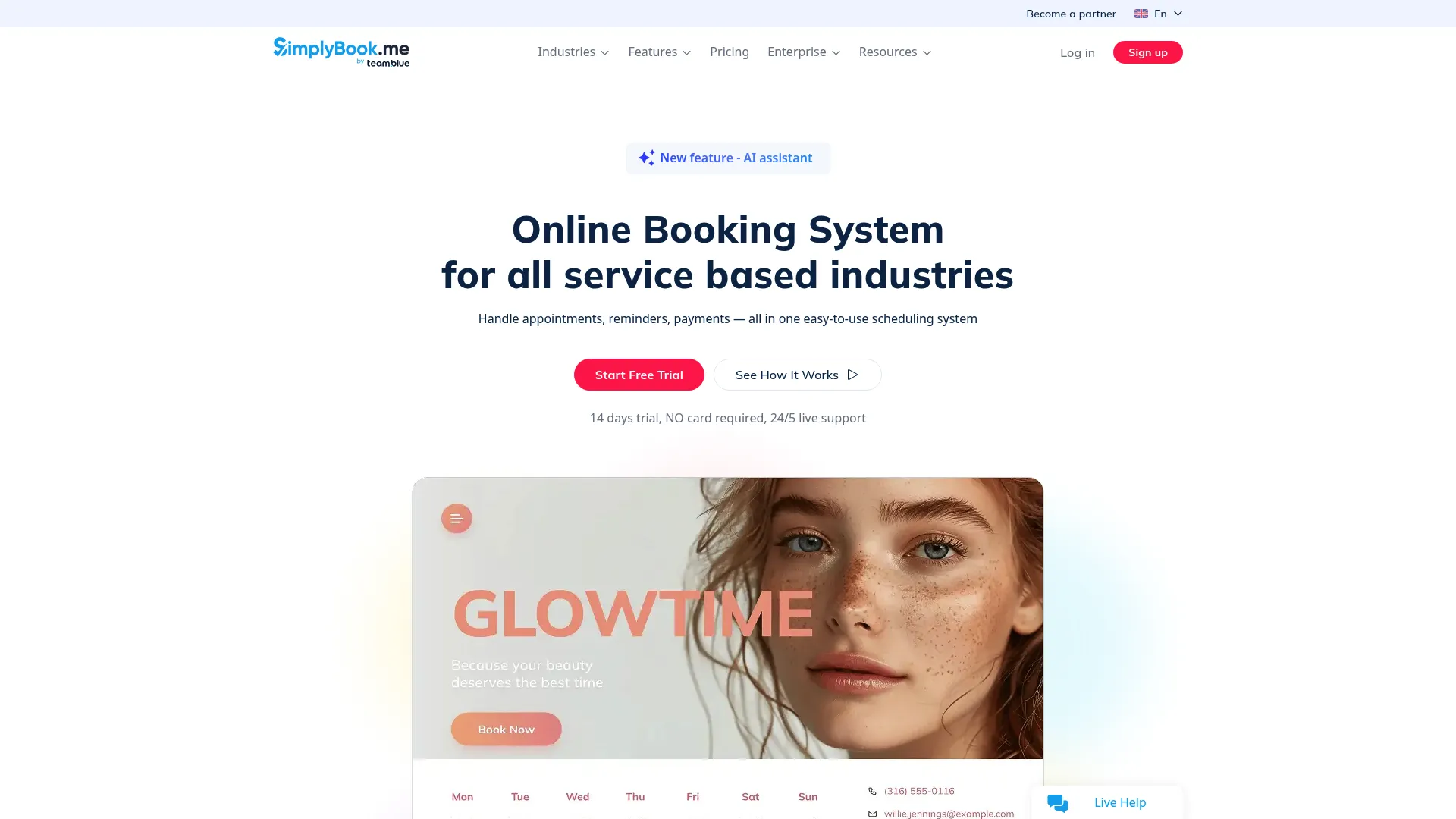
SimplyBook.me is booking and scheduling software built for service businesses that want to sell across many channels at once. For a fitness business chasing omnichannel acquisition, it takes bookings through your website, social profiles, and Google surfaces, so clients reserve wherever they find you. It pairs that reach with a customizable booking page, automated reminders, and deposits.
Best for: Businesses prioritizing social and marketplace booking as an acquisition channel.
Key strengths
- 24/7 online bookings via website, social, and Google channels
- Facebook, Instagram, and Google Maps booking surfaces
- Automated reminders and deposits
- Booking widget, client app, and admin app
- Payments, memberships, POS, and reports
Why choose SimplyBook.me: Founders who want a broad booking surface and treat social channels as real acquisition will get the most from it. The customization depth means the booking page can match your brand rather than looking generic.
SimplyBook.me pricing: A free plan is available. Basic is $9.90/mo, Standard is $30/mo, and Premium is $59/mo, with an annual billing discount. Enterprise pricing is custom.
4. Lunacal
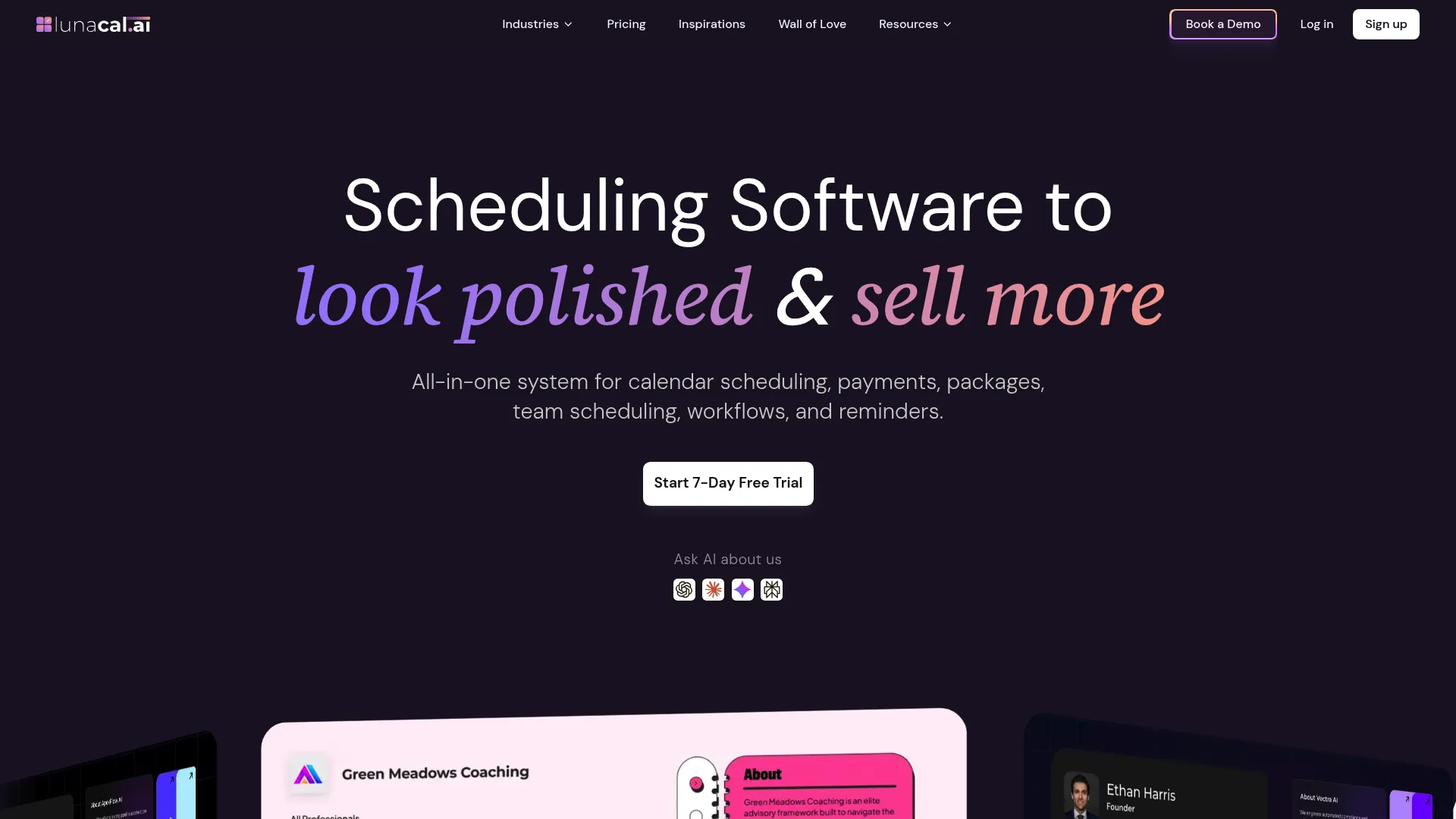
Lunacal is appointment booking and scheduling software with a focus on clean booking mechanics rather than a heavy operations suite. For class-based businesses it covers recurring sessions, group booking, branded booking pages, reminders, and payments through Stripe and PayPal. It's a fit when you want strong booking fundamentals and paid bookings without carrying features you won't use.
Best for: Teams that need capacity, reminders, and paid bookings without extra operational weight.
Key strengths
- Unlimited calendars and services
- Payments via Stripe and PayPal
- Automated SMS and email reminders
- Team scheduling, round-robin, and collective scheduling
- Branded pages and promotional codes
Why choose Lunacal: Lunacal suits solo coaches and small studios that want booking to just work, with paid sessions and reminders handled cleanly. Its highest-in-list rating reflects a product that does the core job well.
Lunacal pricing: Standard is $9/user/month, Teams is $15/user/month, and Enterprise is $25/user/month. A 7-day free trial is available; there is no permanently free tier.
5. Vagaro
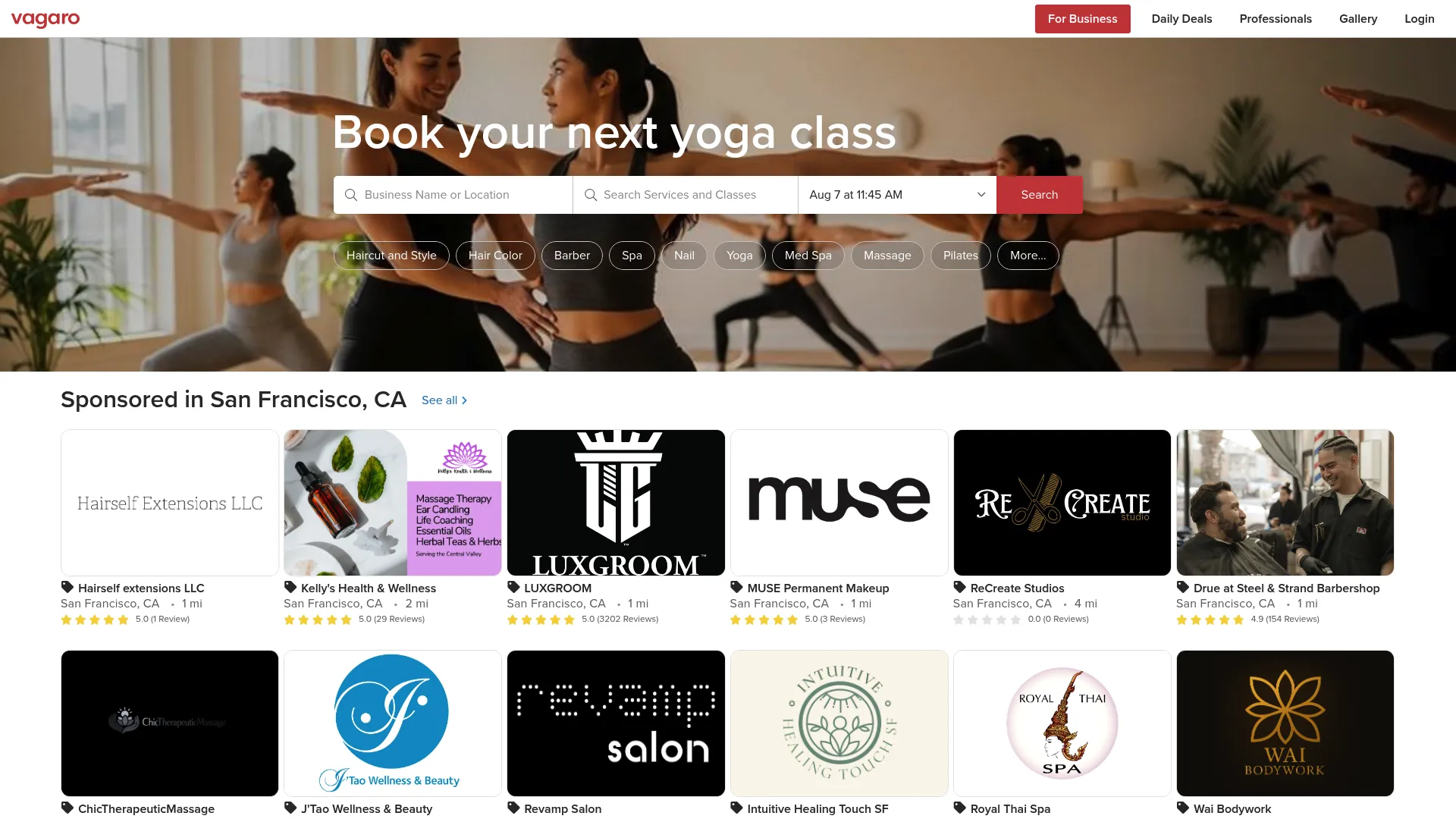
Vagaro is all-in-one booking and business management software used across beauty, wellness, and fitness. For studios, it combines class and workshop scheduling with retail checkout, so booking and POS live in one stack. That matters if you sell merchandise, supplements, or gear alongside classes and want a single system for both.
Best for: Studios that want retail checkout and memberships sitting alongside class booking.
Key strengths
- Online booking with calendar and waitlist management
- Classes, workshops, and staff calendars
- Permissions and staff controls
- Packages and memberships
- Payments, POS, and reporting
Why choose Vagaro: Vagaro fits businesses where retail revenue is real and you'd rather not run a separate POS. The waitlist and calendar management keep class capacity under control while the checkout handles product sales.
Vagaro pricing: Pricing scales with locations and bookable calendars. The One Location plan starts at £20/mo, with a Multiple Locations plan at £30, and a 30-day free trial is available.
6. Mindbody
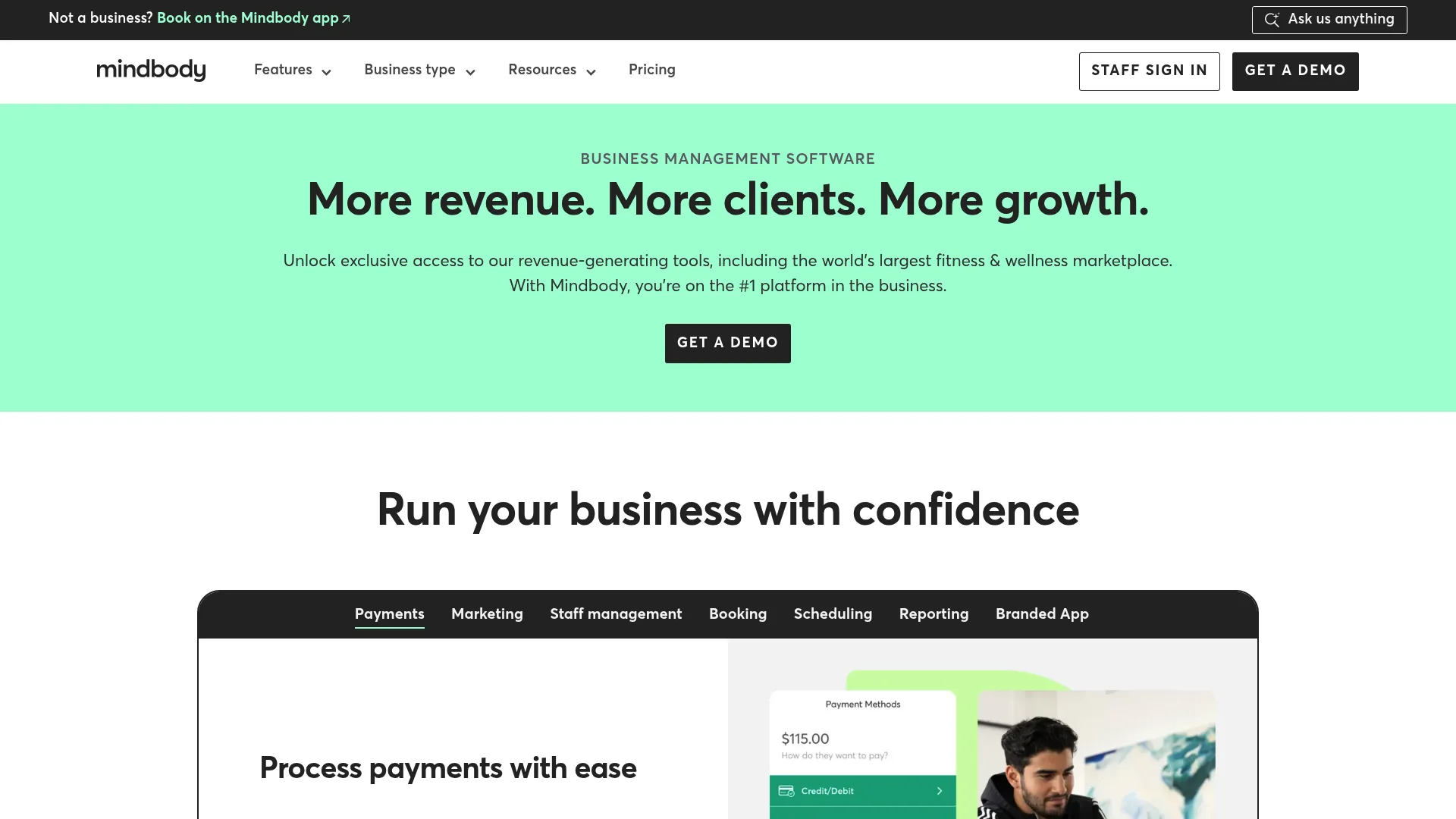
Mindbody is business management software for fitness, wellness, and beauty operators that need an all-in-one platform at scale. It handles class schedules, memberships, booking widgets, rooms and resources, and deep reporting, plus discovery reach through its marketplace. For larger studios and multi-site businesses with established workflows, that breadth and reporting depth carry weight.
Best for: Larger studios and multi-site operators with complex scaling needs and an established workflow.
Key strengths
- Online booking and integrated payments
- Class schedules, memberships, and booking widgets
- Rooms and resources management
- Marketplace discovery reach
- Reporting, analytics, lead management, and marketing automation
Why choose Mindbody: Mindbody suits operators who need reporting depth and discovery reach and are running a business complex enough to justify the platform. The marketplace can put your classes in front of clients actively searching for fitness.
Mindbody pricing: The Starter plan begins at $79 USD/month per location. Accelerate and Ultimate are quote-based; contact Mindbody for pricing.
7. Zen Planner
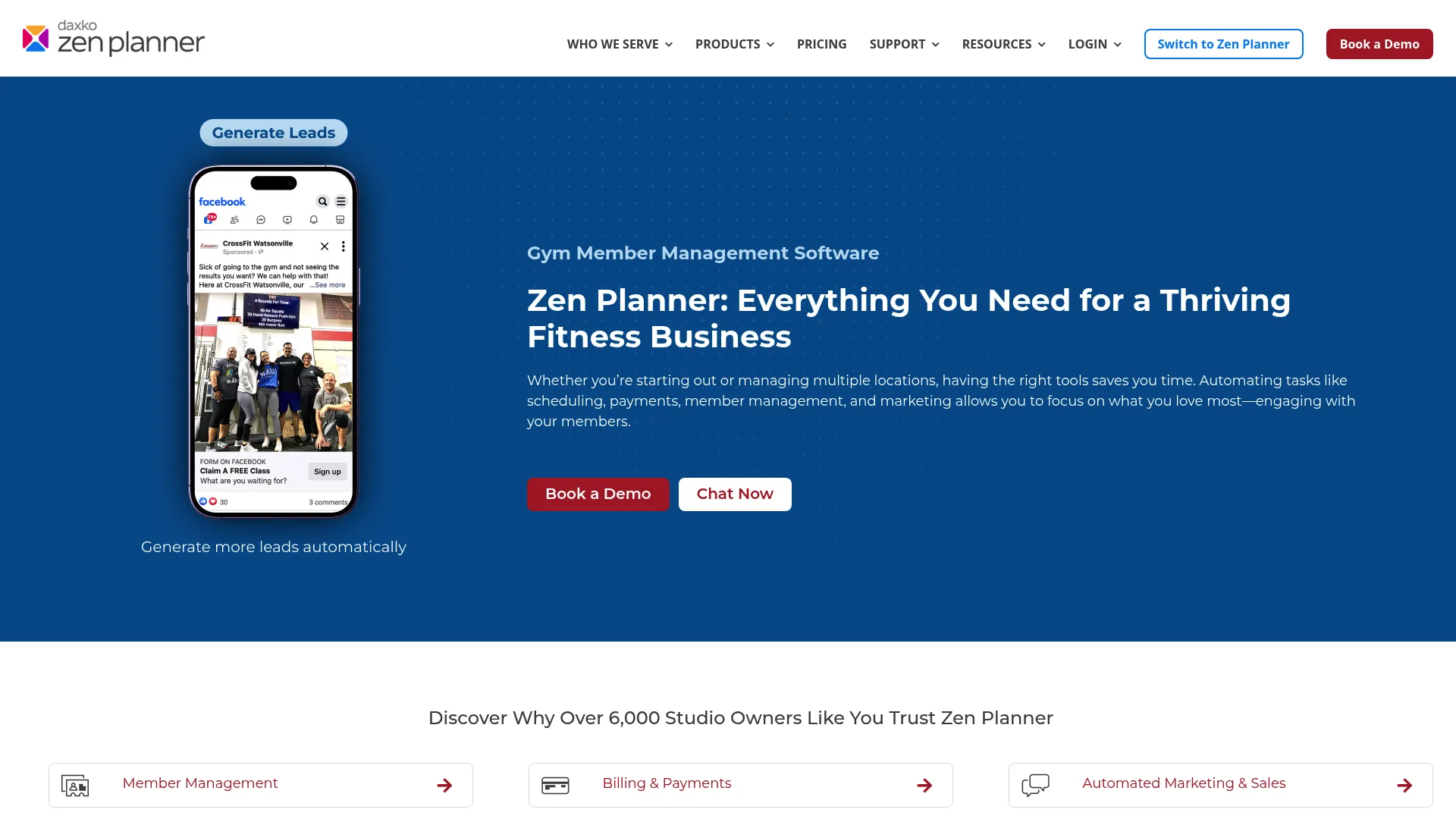
Zen Planner is gym, studio, and martial arts management software built for membership-heavy businesses that need operations and billing together. It combines member management, class scheduling, billing, attendance tracking, automation, and reporting, with mobile access for members and staff. When recurring revenue and retention matter as much as filling classes, having billing and membership management in the same system removes reconciliation work.
Best for: Membership-heavy gyms, studios, and martial arts schools that need member management and billing in one place.
Key strengths
- Member and staff management
- Class scheduling and attendance tracking
- Memberships, billing, and payments
- Automation and reporting
- Branded app and mobile access
Why choose Zen Planner: Zen Planner fits businesses where the membership base is the business and retention drives the numbers. Pricing scales by active members, so cost tracks the size of the operation.
Zen Planner pricing: Pricing is tiered by active members. The Studio package starts at $99/month, with add-ons and bundles including Website, Engage, Branded App at $39/month, Essentials, Ultimate, and a New Business Bundle.
Considerations
Before you commit to a platform, run through the operational controls that actually decide whether it fits.
Class capacity and waitlists
Capacity limits and waitlists are the core operational controls for class-based businesses. Check that the tool enforces hard limits per class and auto-promotes from the waitlist when a spot opens. Without automatic promotion, someone on your team has to manually chase cancellations, which defeats the point of a booking system.
Payments and recurring revenue
Look at how the tool handles prepayments, memberships, packages, class tickets, gift cards, and POS. If recurring billing is core to your model, verify that failed-payment handling and dunning are built in. A missed card charge that nobody follows up on is silent churn.
Omnichannel booking
Evaluate where clients can actually book: embeddable widgets, a hosted booking page, social profiles, and Google surfaces. Each channel you add is a place a client can reserve at the moment they decide. The more surfaces you cover, the fewer bookings you lose to a closed front desk.
Mobile and admin workflows
Separate the client-facing app from the admin app. Clients need a fast way to book and manage reservations on their phone. Staff need scheduling controls, calendar sync, and coordination tools that work across a team. Check both experiences before buying.
Reporting and multi-location scale
For anything beyond a single studio, reporting and multi-location management stop being nice-to-haves. You want attendance, revenue, and staff visibility in one place, plus consistent rules across sites. Franchise or chain operators should confirm the platform supports cross-location reporting rather than forcing you to stitch reports together.
Conclusion
The right fitness booking software depends on the shape of your business, not a feature checklist.
For a single studio that wants simplicity and support, ClassFit is the strongest starting point, with revenue-based pricing that flexes with your months. Appointy fits operators who want transparent pricing tiers and scheduling that stretches beyond classes. SimplyBook.me is the pick when social and Google channels are real acquisition sources. Lunacal handles clean booking mechanics for solo coaches and small teams. Vagaro suits studios that want retail checkout alongside booking. For heavier membership management and multi-site scale, Mindbody and Zen Planner carry the reporting depth and billing infrastructure larger operations need.
Start with a free trial where one exists, run your busiest week through it, and watch what breaks. The tool that survives your real class schedule, payment flow, and no-show pattern is the one worth paying for.
If your business also needs to show off a product experience, walk prospects through a workflow, or onboard new members through a guided path, Guideflow builds interactive demos and guided walkthroughs that work across landing pages, onboarding flows, help centers, and training. Teams use it to capture a flow in a few clicks, personalize it for different audiences, share it anywhere, and analyze engagement.
Start your journey with Guideflow today!
FAQs
For most independent studios, ClassFit is a strong overall pick because it bundles booking, payments, memberships, and a branded app with revenue-based pricing. Larger or multi-site studios often lean toward Mindbody or Zen Planner for deeper reporting and membership billing. The best choice depends on your class volume, membership model, and whether you run one location or several.
Yes. Most tools here support memberships, prepaid packages, and recurring billing. ClassFit, Vagaro, Mindbody, and Zen Planner all handle recurring revenue directly, and Zen Planner in particular is built around membership-heavy businesses. Confirm that failed-payment handling and dunning are included so a declined card doesn't quietly become lost revenue.
When a class hits capacity, clients join a waitlist instead of booking. If someone cancels, the software promotes the next person automatically and notifies them, usually by email or SMS. This recaptures demand for popular classes without your staff manually chasing open spots. Check that auto-promotion is included rather than requiring manual intervention.
At minimum: online booking with class capacity and waitlists, memberships and packages, integrated payments, automated reminders, a client-facing mobile experience, and reporting. Multi-location operators should also confirm cross-site management and staff scheduling. The goal is one system that connects capacity, payments, and membership records rather than several disconnected tools.
Some tools support this directly. SimplyBook.me takes bookings through Facebook, Instagram, and Google Maps surfaces, and Appointy supports Google bookings. This matters because clients often decide to book at the moment they discover you on social or in search. Covering those surfaces means fewer bookings lost to a closed front desk.
Several tools do. Appointy, Vagaro, Mindbody, and Zen Planner all support multi-location management, though pricing often scales with locations or active members. For franchise or chain operators, confirm the platform offers cross-location reporting and consistent rules across sites rather than forcing you to stitch reports together manually.
For a growing studio, often yes. A branded client app keeps your business on the client's home screen, makes booking a two-tap action, and reinforces brand loyalty. ClassFit and Zen Planner offer branded apps. If most of your bookings already come through a mobile browser, a well-built booking page may cover you until app-level loyalty becomes a priority.
Automated email and SMS reminders prompt clients ahead of a class, which cuts the number who simply forget. Many tools also make canceling easy from the reminder, so a spot that would have gone empty opens up for a waitlisted client. The combination of reminders plus waitlist auto-promotion is what turns booking software into recovered revenue rather than just a calendar.