Your scanner just returned 4,000 findings. Your engineering team has capacity to fix maybe 40 this sprint. Which 40?
That is the real problem with application security testing software in 2026. It is not scan coverage anymore. Almost every tool scans source code, dependencies, and running apps. The gap is what happens after the scan: triage, prioritization, and whether a developer can actually action a finding without a security engineer translating it first.
The market reflects the pressure. The global application security testing market is projected to grow from USD 1.83 billion in 2025 to USD 7.60 billion by 2031, a 26.7% CAGR, according to MarketsandMarkets (2026). Static application security testing alone held 36.38% of application security revenue in 2025 per Mordor Intelligence (2026), the single largest testing segment by spend. Money is flowing in. Noise is not going down.
For presales teams and technical evaluators, this changes how you buy. Buyers arriving at a shortlist do not want another scan engine. They want proof the tool fits their SDLC, survives a security review, and produces findings developers will fix. That means testing in a real repo, a real pipeline, and a real web app, not a canned vendor demo. If you build AppSec-adjacent evaluation environments for prospects, a stable sandbox or hands-on validation surface often matters more than any slide. This guide is built for that kind of decision.
What's inside
This guide compares 9 application security testing tools for teams evaluating SAST, DAST, SCA, runtime validation, and AppSec platform consolidation. We selected tools based on four criteria that matter to technical buyers: coverage depth across code, runtime, and dependencies; CI/CD integration and developer workflow fit; prioritization and remediation guidance quality; and security governance plus enterprise fit. This is a buying guide for teams shortlisting vendors and planning a POC, not a feature glossary. Every pricing figure and rating here is sourced from each vendor's own pages and G2 listings.
TL;DR
- Best overall platform for unified AppSec: Checkmarx, for teams consolidating SAST, SCA, DAST, IaC, secrets, and API security under one governance layer.
- Best enterprise risk management footprint: Veracode, for mature secure-SDLC programs that need scanning scale and executive reporting.
- Best for developer-first workflows: Snyk, for engineering orgs that want security embedded in the IDE and pipeline with a free entry point.
- Best for web and API DAST: Invicti, for teams that want proof-based scanning and confidence that findings are exploitable.
- Best for open source and supply chain risk: Black Duck, for compliance-heavy orgs with mature open source governance needs.
- Best for code quality plus security: SonarQube, for teams that want developer feedback in code review and CI/CD.
- Best for manual testing depth: Burp Suite, the standard for hands-on web app testing and technical validation.
What is application security testing software?
Application security testing software is a category of tools that scans, analyzes, and validates software for security vulnerabilities across the software development lifecycle, from source code to running applications to third-party dependencies.
It sits at multiple points in the SDLC. Modern teams combine several testing types rather than relying on one. Static analysis reads source code before it runs. Dynamic analysis probes the running application. Software composition analysis inventories open source and flags known vulnerabilities. Infrastructure-as-code scanning catches misconfigurations before deployment. Secrets detection finds credentials committed by mistake. Runtime validation confirms whether a theoretical vulnerability is actually exploitable in production conditions.
The category is broader than static code scanning alone. A serious evaluation covers where and how each capability plugs into your existing pipeline, much like assessing any application performance monitoring tools or audit management software against real operational workflows.
Core capabilities buyers should expect from modern AppSec tools:
- SAST: static analysis of source code and binaries, ideally in the IDE and CI/CD.
- DAST: dynamic testing of running web apps and APIs, with exploitability signals.
- SCA: open source dependency scanning, SBOM management, and license compliance.
- IaC and secrets scanning: catching misconfigurations and leaked credentials pre-merge.
- Vulnerability prioritization: risk scoring that separates critical, reachable issues from noise.
- Remediation guidance: fix suggestions developers can apply inside their workflow.
- ASPM and governance: a consolidation layer that orchestrates findings, policy, and reporting.
When to use application security testing
Different testing types earn their place at different moments. Matching the tool to the moment is what separates a clean POC from a stalled one.
Secure code before merge
SAST and IDE or CI/CD scanning matter most when you want to catch issues before they ship. Teams practicing shift left run static analysis on every pull request, so a developer sees a vulnerability while the code is still fresh in their head. This is where developer workflow fit decides adoption. If findings show up in the IDE with a clear fix, developers act. If they show up in a separate dashboard three days later, they do not.
Validate real runtime risk
DAST, API testing, and proof-based scanning become essential for internet-facing apps and security reviews. Static analysis can flag a theoretical SQL injection. Runtime validation confirms whether it is actually reachable and exploitable. For presales and security teams answering diligence questions, exploitability evidence carries far more weight than a raw severity score. This is also where false positives get expensive: a finding you cannot reproduce burns credibility on both sides.
Govern open source and supply chain risk
SCA, SBOM management, license compliance, and dependency controls become decision drivers when most of your codebase is code you did not write. Modern applications lean heavily on open source, so software supply chain security is now a board-level concern. Teams facing compliance pressure or customer security questionnaires need to inventory every component, track known vulnerabilities, and prove license compliance on demand.
Comparison table
The table below separates broad AppSec platforms from focused point solutions, so you can see at a glance which tools fit consolidation and which fit a specific job. Sort your own shortlist by whichever column maps to your primary buying trigger.
| # | Product | Intent | Key differentiation | Pricing | G2 rating |
|---|---|---|---|---|---|
| 1 | Checkmarx | Enterprise AppSec platform | Unified SAST, SCA, DAST, IaC, secrets, API security, ASPM, AI supply chain | Custom quote | 4.4/5 |
| 2 | Veracode | Enterprise risk management | Broad scanning scale mapped to secure-SDLC programs | Custom quote | 4.0/5 |
| 3 | Snyk | Developer-first AppSec | IDE and CI/CD native, free entry tier | Free; Team from $25/mo per dev | 4.5/5 |
| 4 | Invicti | Web and API DAST | Proof-based scanning, exploitability confirmation | Quote-based | 4.3/5 |
| 5 | Black Duck | Supply chain and SCA | Open source inventory, SBOM, license compliance | Custom quote | 4.0/5 |
| 6 | SonarQube | Code quality plus security | Static analysis with 6000+ rules, quality gates | Free; Developer from $750/yr | 4.4/5 |
| 7 | Burp Suite | Manual web testing | Deep hands-on pentesting and DAST | Free Community; paid by quote | 4.8/5 |
| 8 | Contrast Security | Runtime AppSec | IAST and runtime application detection | Quote-based | 4.5/5 |
| 9 | Aikido Security | Consolidated dev security | Multiple scanners in one platform | Free; Basic from 300/mo | 4.6/5 |
The 9 best application security testing software tools
1. Checkmarx
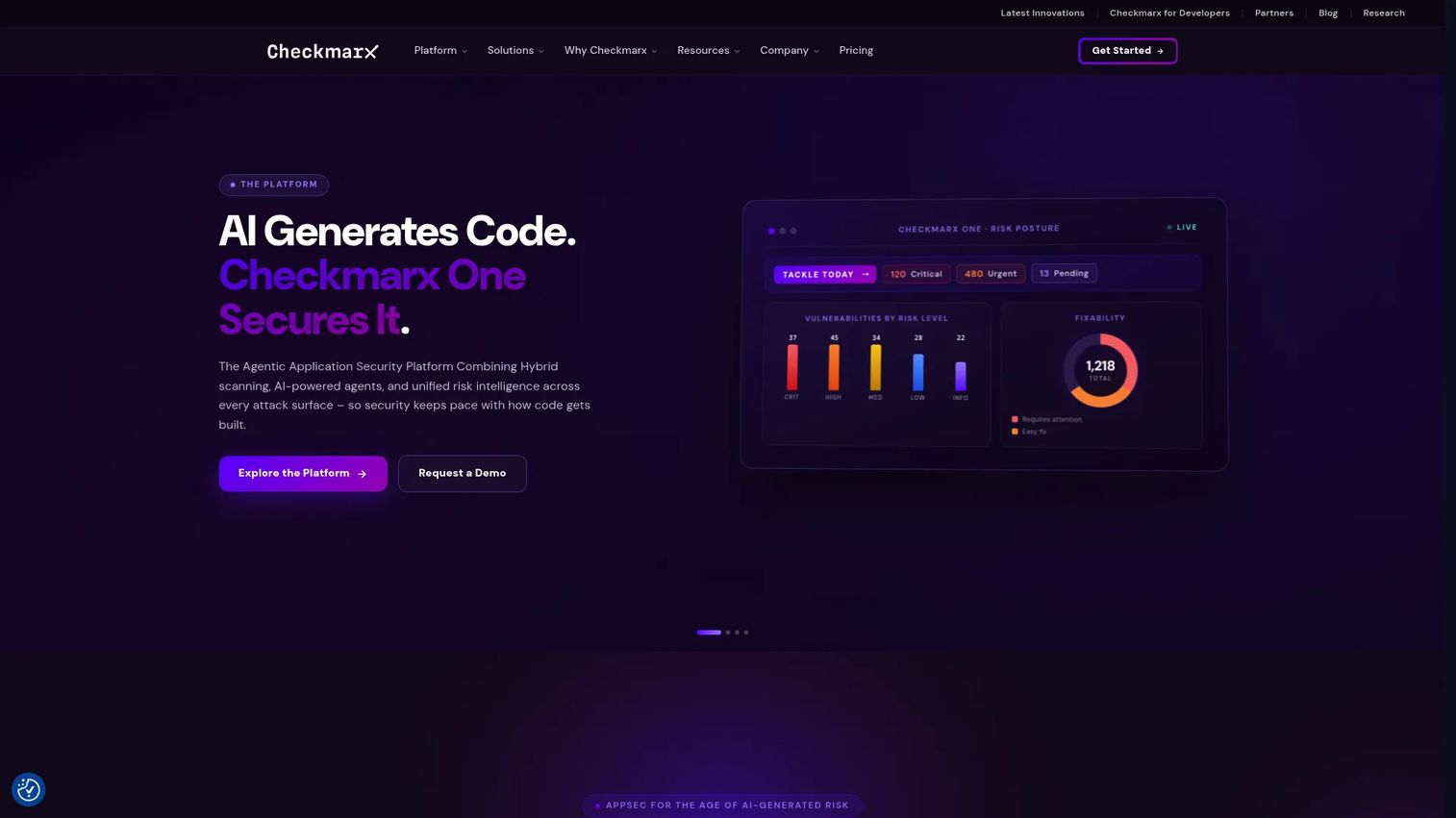
Checkmarx is an enterprise application security platform built to scan, prioritize, and remediate code and supply-chain risk across the SDLC. It unifies static analysis, secrets detection, IaC security, SCA, API security, and container scanning under a single ASPM layer, with AI-driven triage on top. For teams tired of stitching together five point tools and reconciling five dashboards, it is the consolidation play.
Best for: Large engineering and security teams needing enterprise AppSec across code, CI/CD, and supply chain.
Key strengths
- Unified coverage: SAST, SCA, DAST, IaC, secrets, API security, and container scanning in one platform, reducing tool sprawl.
- ASPM and risk orchestration: correlates findings across scanners so teams focus on the vulnerabilities that actually matter.
- AI supply chain security: agentic triage that helps cut through noise and prioritize reachable, exploitable issues.
Why choose Checkmarx: If your buying trigger is consolidation and governance in a complex enterprise, Checkmarx maps to how AppSec programs are actually run at scale. The ASPM layer is the differentiator: it is less about any single scanner and more about orchestrating everything into a defensible risk picture. For presales conversations, that breadth also makes it easier to answer wide-ranging security and compliance questions in one place.
Checkmarx pricing: Checkmarx uses custom quote pricing. The packaging page asks you to build a bundle and request a quote, with cost based on the number of developers, applications, and usage. There is no public starting price, so budget planning requires a sales conversation.
2. Veracode
Veracode is a long-standing application risk management and AppSec platform for finding and fixing software vulnerabilities across the SDLC. It covers SAST, DAST, and SCA, and has one of the larger enterprise footprints in the category. Teams that want a mature vendor with proven scanning scale and executive-friendly risk reporting gravitate here.
Best for: Enterprises needing a unified application security platform mapped to a secure-SDLC program.
Key strengths
- Breadth across testing types: SAST, DAST, and SCA under one platform for consistent coverage.
- Scanning scale: built to handle large application portfolios common in big enterprises.
- Program-level reporting: risk reduction views that map cleanly to executive and compliance audiences.
Why choose Veracode: Veracode is the pick when maturity and footprint matter more than novelty. If your security program needs a vendor that has been operating at enterprise scale for years and produces reporting your CISO and auditors already recognize, it fits. The tradeoff is that its strength is program breadth rather than developer-first speed, so weigh it against your team's workflow priorities.
Veracode pricing: Veracode does not publish numeric pricing on its site. Plans are packaged around a unified platform and quoted through sales, so expect a custom quote based on your application portfolio and scanning volume.
3. Snyk
Snyk is a developer-first security platform for finding and fixing vulnerabilities across code, open source, containers, and IaC. Its whole design philosophy is low friction: security lives in the IDE and the pipeline, where developers already work, rather than in a separate security console. That is why fast-moving product and engineering orgs adopt it early.
Best for: Developer teams that want security scanning embedded directly in the SDLC.
Key strengths
- Developer workflow fit: Snyk Code, Open Source, Container, and IaC scanning surface issues inside the IDE and CI/CD.
- Low-friction entry: a genuinely usable free tier lets teams start scanning before a procurement cycle.
- Actionable remediation: fix guidance and pull-request suggestions aimed at getting developers to resolve issues themselves.
Why choose Snyk: If developer adoption is your make-or-break criterion, Snyk is the strongest fit on this list. Security teams that have struggled to get engineers to open a separate dashboard find that meeting developers in their tools changes adoption entirely. It leans developer-first over deep enterprise governance, so pair it against Checkmarx or Veracode if ASPM-grade orchestration is the priority.
Snyk pricing: Snyk publishes pricing openly. The Free plan is $0 per contributing developer. Team starts at $25 per contributing developer per month. Ignite starts at $1,260 per contributing developer per year. Enterprise pricing is available through sales.
4. Invicti
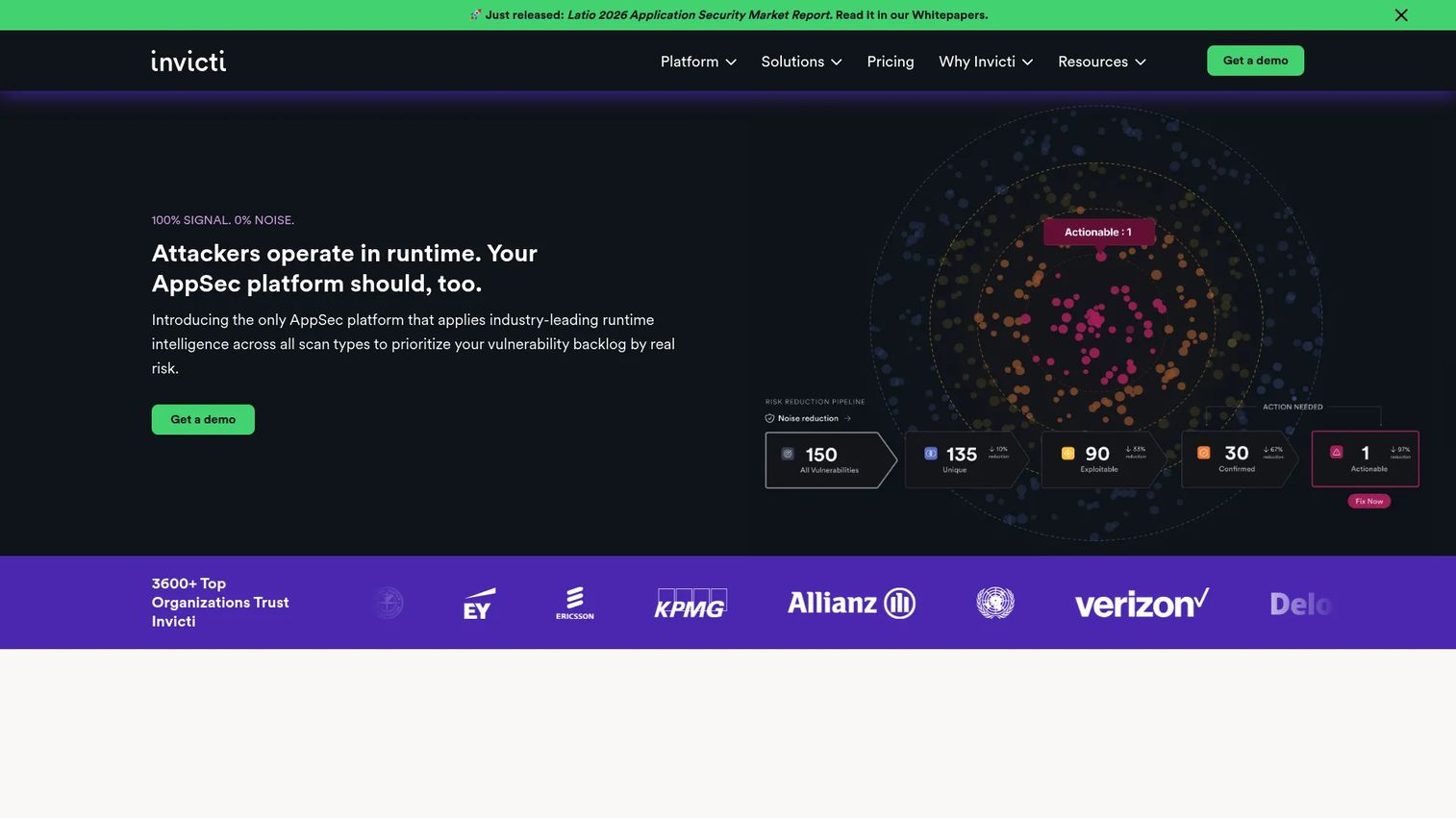
Invicti is an enterprise application security platform built around web apps and APIs, with proof-based scanning at its core. Instead of handing you a list of maybe-vulnerabilities, it aims to confirm that a finding is genuinely exploitable, which is exactly what security reviewers and technical evaluators want. It also covers API security, SAST, SCA, SBOM, IaC, secrets, and container scanning.
Best for: Security teams needing automated web, API, and application vulnerability testing at enterprise scale.
Key strengths
- Proof-based DAST: confirms exploitability so teams spend time on real issues, not chasing false positives.
- API security and discovery: finds and tests APIs, a growing attack surface many scanners miss.
- Broad supporting coverage: SAST, SCA, SBOM, IaC, secrets, and container security round out the platform.
Why choose Invicti: If your primary pain is vulnerability noise and you need confidence that findings are actionable, proof-based scanning is a strong differentiator. For presales and security reviews, being able to demonstrate exploitability rather than theoretical risk shortens the argument considerably. It shines on web and API DAST specifically, so evaluate whether that matches your dominant risk surface.
Invicti pricing: Invicti uses quote-based pricing across its Web & API DAST and AppSec Core plans. No public numbers are listed, so pricing requires a demo or quote request scoped to your application count.
5. Black Duck
Black Duck is an application security platform with a strong center of gravity in software composition analysis and supply chain governance. It builds a detailed inventory of open source and third-party dependencies, generates SBOMs, enforces policy, and analyzes vulnerability, license, and component health. For organizations under compliance pressure, that depth is the draw.
Best for: Enterprises needing open-source software supply chain security and compliance at scale.
Key strengths
- Deep SCA: thorough inventory of open source and third-party components with vulnerability tracking.
- SBOM management: generation and policy enforcement to satisfy customer and regulatory requirements.
- License and component health analysis: flags legal and maintenance risk alongside security risk.
Why choose Black Duck: When open source risk and license compliance are your leading concerns, Black Duck's SCA depth is hard to match. Organizations with mature governance programs and heavy regulatory exposure use it to answer supply chain questions with real evidence. Its strength is SCA and supply chain governance specifically, so weigh it against broader platforms if you also need extensive DAST or SAST as primary capabilities.
Black Duck pricing: Black Duck does not display public pricing. The site directs you to request a customized quote or contact sales, so pricing is scoped to your deployment and component volume.
6. SonarQube
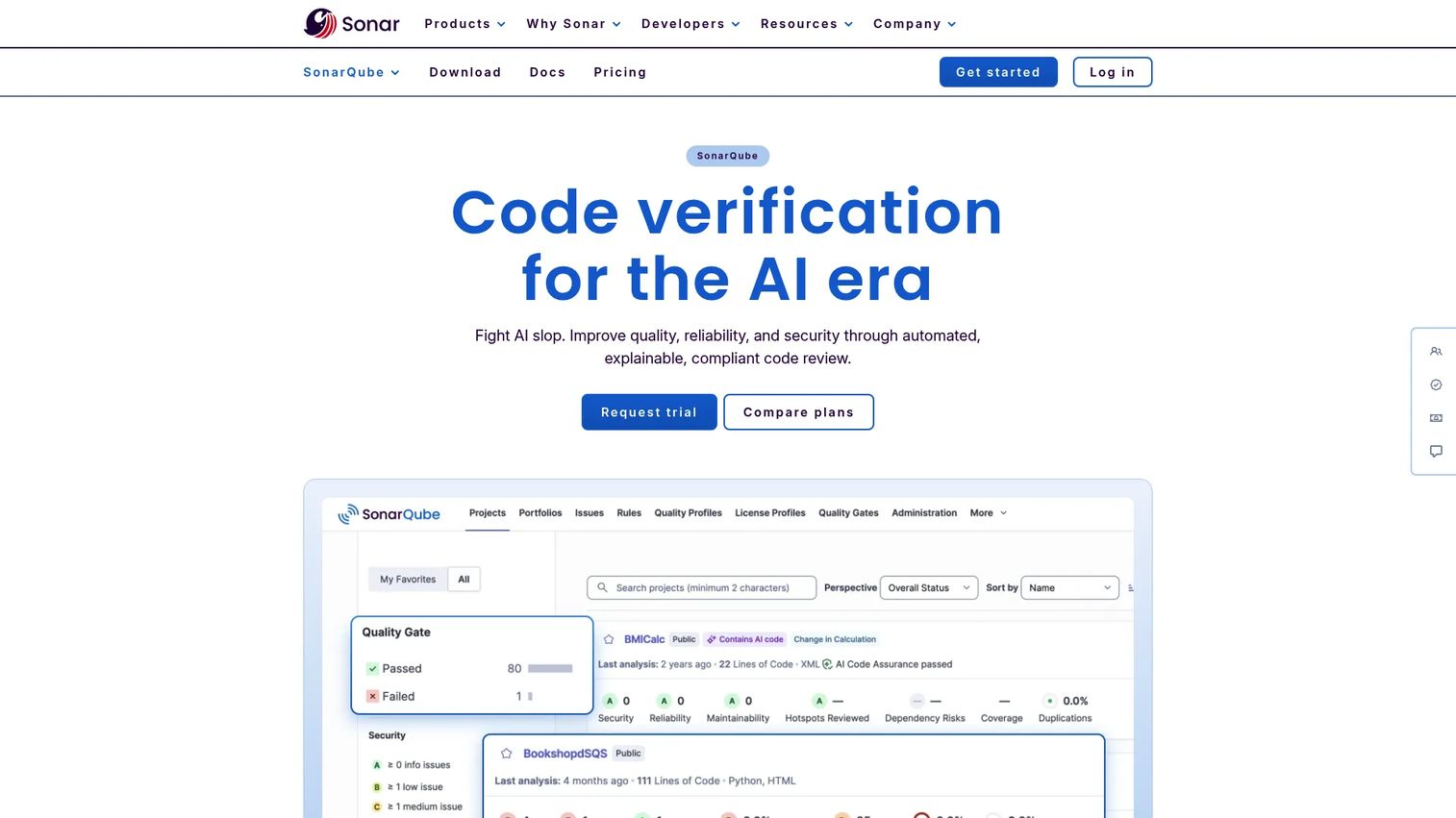
SonarQube is a static code analysis platform from SonarSource that blends code quality and security scanning. It runs on more than 6,000 language-specific rules to catch bugs, code smells, vulnerabilities, and security hotspots, and it plugs directly into IDEs and CI/CD. Teams choose it when they want developer-friendly feedback right inside code review.
Best for: Teams that want automated code quality and security checks in CI/CD.
Key strengths
- Broad language and rule coverage: 6,000+ rules across many languages for consistent static analysis.
- Quality gates: enforceable thresholds that block problematic code from merging.
- Developer-friendly feedback: results surface in the IDE and pull request, close to where code is written.
Why choose SonarQube: SonarQube is strongest for code quality and static analysis, where it doubles as a security scanner in the same pass. If your team already treats code quality as a first-class discipline, adding security hotspots to that existing workflow is a natural fit. It is a static analysis and quality tool rather than a runtime testing platform, so pair it with a DAST or runtime tool for full-lifecycle coverage.
SonarQube pricing: SonarQube publishes pricing openly. The Developer edition starts at $750 annually. Enterprise is quote-based. A free, open-source Community Build is also available.
7. Burp Suite
Burp Suite from PortSwigger is the standard for manual web application security testing. Where automated scanners cover breadth, Burp gives security testers the depth to probe edge cases, validate behavior, and explore an application by hand. Its 4.8/5 G2 rating reflects how entrenched it is among pentesters and security engineers.
Best for: Security teams and pentesters doing hands-on web app testing and DAST.
Key strengths
- Manual testing tools: deep, hands-on capabilities for probing and validating web app behavior.
- Burp Scanner: automated vulnerability scanning to complement manual work.
- Extensibility: a mature ecosystem that testers rely on for specialized checks.
Why choose Burp Suite: For presales SEs and security testers who need to validate what a scanner reports, Burp is the tool of record. It complements automated platforms rather than replacing them: automated scans surface candidates, and Burp confirms or dismisses them through manual investigation. It is built for hands-on testing depth rather than pipeline automation, so it usually sits alongside a SAST or SCA tool.
Burp Suite pricing: Burp Suite Community Edition is free. Professional and Burp Suite DAST pricing is not publicly displayed and requires contacting PortSwigger for a quote.
8. Contrast Security
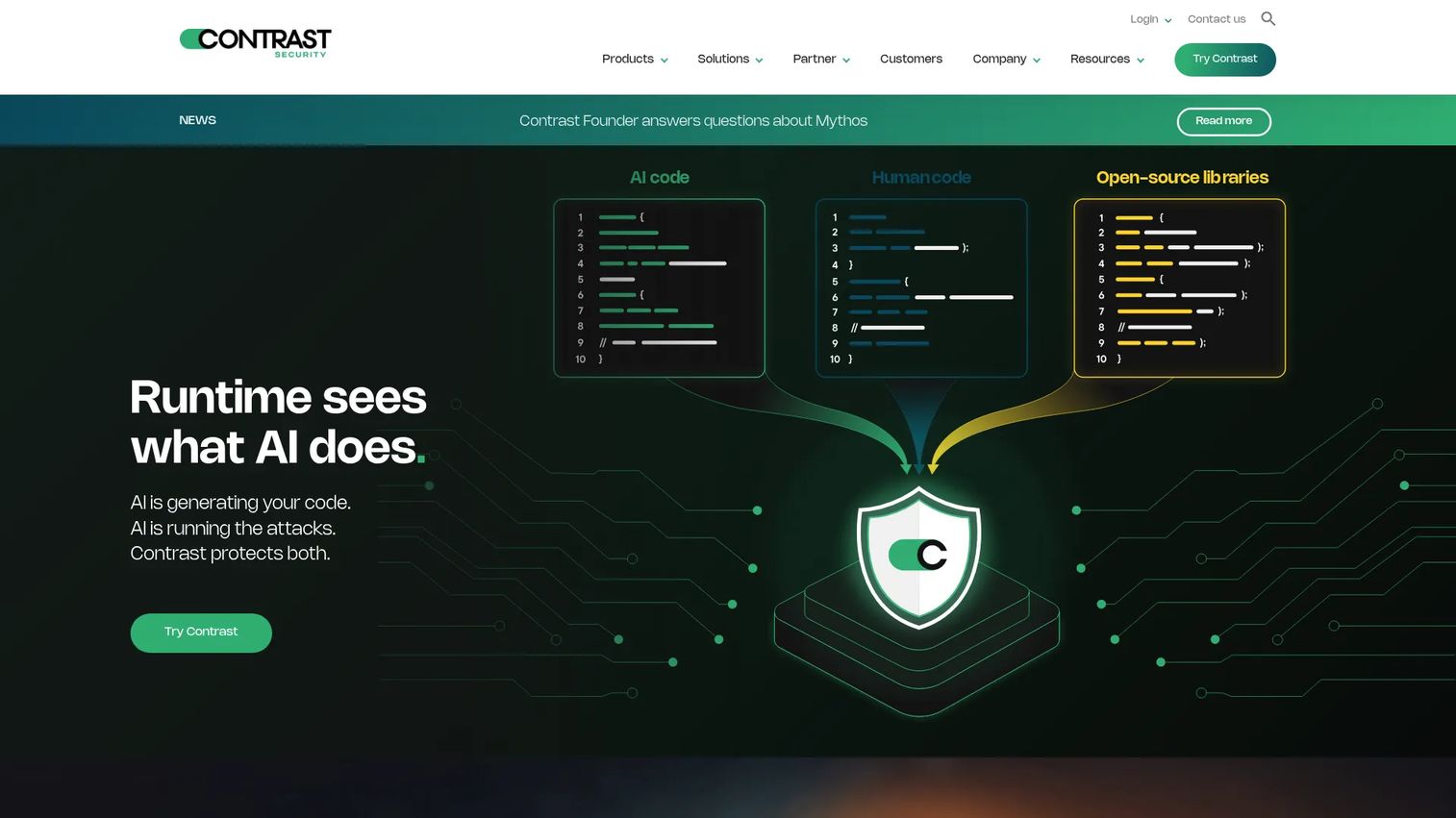
Contrast Security is an application security platform focused on runtime protection, testing, and vulnerability detection. Its IAST and runtime approach instruments the application so you can see what is actually happening during execution, which is a fundamentally different signal from static or purely external scanning. It supports 30+ languages and frameworks.
Best for: Teams that need runtime application and API security with developer-focused vulnerability detection.
Key strengths
- Runtime visibility: application detection and response that shows what is happening inside the app during execution.
- Application security testing: IAST-style detection that ties findings to real runtime behavior.
- Broad language support: coverage across 30+ languages and frameworks.
Why choose Contrast Security: If your priority is understanding real runtime risk rather than theoretical findings, Contrast's instrumentation approach supports faster, more confident triage. Seeing exploitability from inside the running application cuts down the back-and-forth between security and engineering. Its strength is runtime and IAST specifically, so pair it with SAST or SCA if you need heavy pre-merge static coverage as well.
Contrast Security pricing: Contrast does not publish numeric pricing. Contrast ADR is priced by concurrent host, Contrast AST by GiB hour, and Contrast One varies by package. Request pricing scoped to your environment.
9. Aikido Security
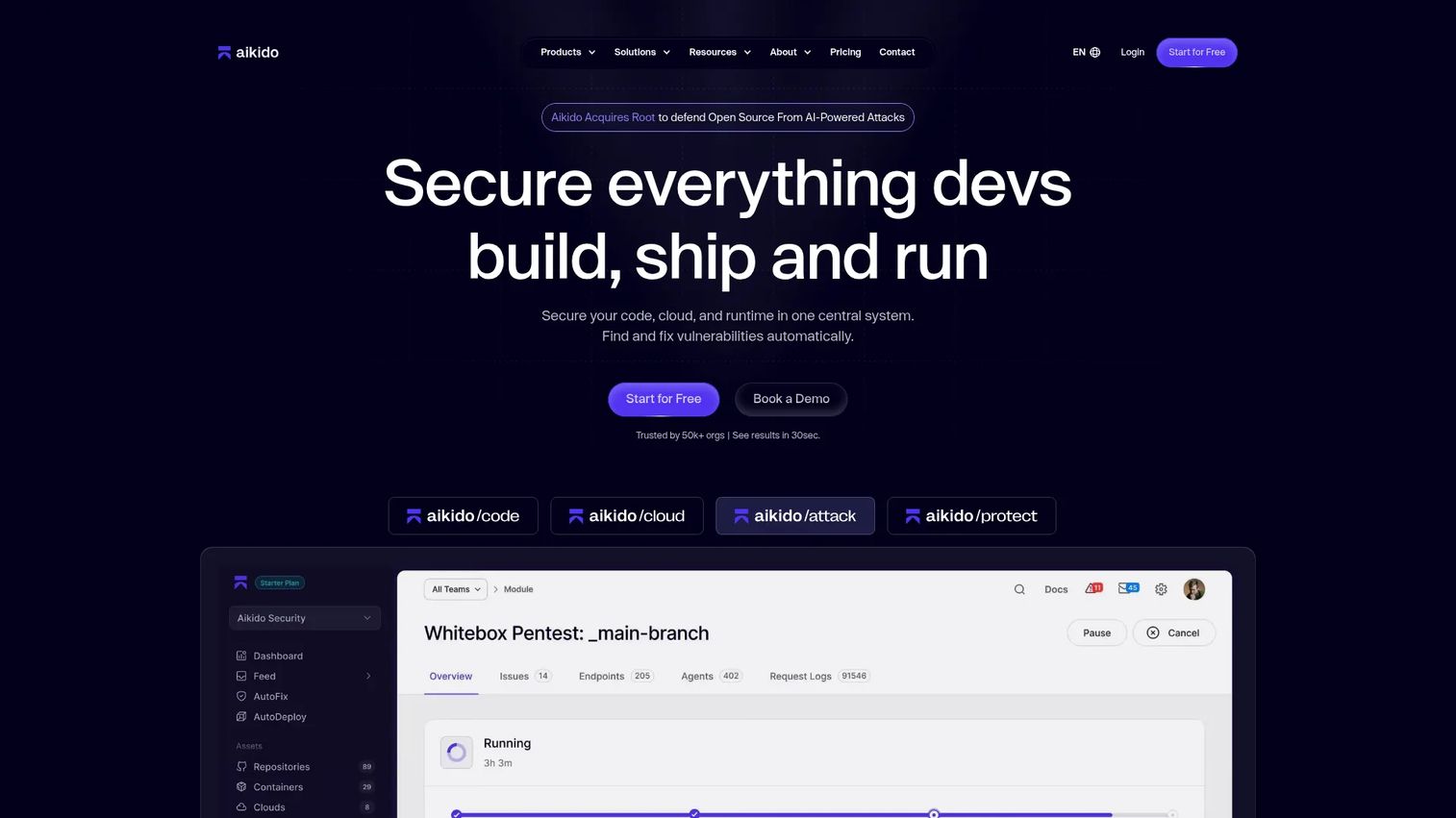
Aikido Security is a unified security platform that pulls multiple scanners into one place across code, cloud, and runtime. For smaller teams or teams that want a simpler operational footprint without giving up coverage, it is a compelling option. It combines SCA, SAST and AI SAST, secrets detection, CSPM, IaC, container and VM scanning, and more.
Best for: Teams wanting one platform for application security across code, cloud, and runtime.
Key strengths
- Broad scanner coverage: SCA, SAST, AI SAST, secrets, CSPM, IaC, container, and VM scanning in one tool.
- Developer-friendly design: built to reduce noise and fit lean teams without a dedicated security ops function.
- Extended capabilities: attack surface monitoring, fuzzing, and AI pentesting round out the platform.
Why choose Aikido Security: Aikido is the pick for teams that want consolidation without enterprise complexity. Smaller engineering orgs get a single platform covering most common AppSec needs, with pricing that starts free and scales predictably. It targets simplicity and consolidation for lean teams, so larger enterprises with deep ASPM and governance requirements should also evaluate the broader platforms above.
Aikido Security pricing: Aikido publishes pricing openly. The Developer plan is free forever. Basic is 300 per month, Pro is 600 per month, and Advanced is 600 per month, with Enterprise on tailored pricing. A standard pentest is available at $4,000 per assessment.
Considerations before you buy
Coverage on a feature grid is not the same as coverage in your pipeline. Use this checklist to pressure-test any shortlist before signing.
Coverage depth versus your risk surface
Map each tool's strengths to where your actual risk lives. A web-heavy app estate leans on DAST and API testing; a dependency-heavy codebase leans on SCA and SBOM management. Do not pay for breadth you will never run.
CI/CD integration and developer workflow
The best scanner is the one developers actually use. Verify that findings appear in the IDE and pull request, not just a separate dashboard. Weak developer workflow fit is the most common reason AppSec tools go unused after purchase.
Prioritization and false positives
Ask how the tool separates critical, reachable issues from noise. Proof-based scanning and runtime validation reduce false positives and protect credibility with engineering. High false-positive rates quietly kill adoption.
Remediation and evidence quality
Evaluate the fix guidance, not just the finding. Can a developer resolve the issue from what the tool provides? For security reviews, exploitability evidence matters more than raw severity scores.
Consolidation versus best-of-breed
Decide early whether you want one AppSec platform or specialized point tools. Consolidation simplifies governance and reporting; best-of-breed maximizes depth in each category. Neither is universally right; it depends on team size and program maturity.
Conclusion
The right application security testing software depends entirely on your buying trigger. If consolidation and governance drive the decision, Checkmarx and Veracode lead. If developer experience is the priority, Snyk is the clearest fit. For proof-based web and API DAST, Invicti stands out. For open source and supply chain governance, Black Duck goes deep. For code quality plus security in CI/CD, SonarQube fits. For manual testing depth, Burp Suite is the standard. For runtime visibility, Contrast Security delivers. And for lean teams wanting consolidation without complexity, Aikido Security is worth a serious look.
Do not buy from a datasheet. Shortlist two or three tools, then validate each in a real repo, a real pipeline, and a real web app. Watch how findings surface for a developer, how many false positives you chase, and whether the remediation guidance is actually followed. The tool that wins your POC on those terms is the one that will earn adoption after the contract is signed.
FAQs
Application security testing software scans and analyzes applications for security vulnerabilities across the development lifecycle, from source code to running apps to third-party dependencies. It differs from general vulnerability management, which focuses on tracking and prioritizing known issues across infrastructure. AST tools generate the findings; vulnerability management often orchestrates the response.
SAST (static application security testing) reads source code before it runs, catching issues early in the SDLC. DAST (dynamic application security testing) probes the running application from the outside to find exploitable flaws in web apps and APIs. SCA (software composition analysis) inventories open source dependencies and flags known vulnerabilities and license risk. Most mature programs run all three.
For CI/CD integration and developer workflow fit, Snyk and SonarQube are strong choices because findings surface in the IDE and pull request where developers already work. Aikido Security also fits lean teams that want consolidated scanning inside the pipeline. The deciding factor is whether developers act on findings without leaving their tools.
Tools built around proof-based scanning and runtime validation tend to reduce false positives most effectively. Invicti confirms exploitability before reporting a web or API finding, and Contrast Security uses runtime instrumentation to tie findings to real behavior. Both reduce the noise that erodes engineering trust in AppSec tooling.
It depends on team size and program maturity. Consolidated platforms like Checkmarx, Veracode, and Aikido Security simplify governance, reporting, and vendor management. Best-of-breed point tools like Burp Suite for manual testing or Black Duck for SCA go deeper in a single category. Many teams run a platform for breadth plus one or two specialists for depth.
Test against a real repository, a representative sample app, and your actual CI/CD pipeline rather than a vendor sandbox. Measure how findings surface for a developer, false-positive rates, and remediation quality. Involve your security approval workflow early, and confirm the reporting satisfies the stakeholders who will review it. A short list of two or three tools tested this way beats any feature comparison.
Ask how findings reach developers, what fix guidance the tool provides, and whether remediation happens inside the existing developer workflow. Probe the quality of exploitability evidence, since that determines how confidently a team can prioritize. The goal is not just detection; it is whether a developer can resolve the issue from what the tool gives them.
Modern AppSec tools support compliance through SBOM management, license compliance tracking, audit-ready reporting, and policy enforcement. SCA-heavy platforms like Black Duck help satisfy software supply chain security requirements and customer security questionnaires. Governance and ASPM layers, like those in Checkmarx, produce the reporting auditors and CISOs expect.