
Most security teams cannot staff a security operations center that runs around the clock with real depth across detection, investigation, threat hunting, and response. Attackers do not keep business hours. A single missed alert at 3 a.m. can turn into a full breach by the time the day shift logs in.
That is the gap managed detection and response fills. Instead of hiring a dozen analysts you cannot find or afford, you buy 24/7 threat monitoring, investigation, and active response as a service. The provider watches your telemetry, filters the noise, hunts for threats, and in many cases contains the attack before it spreads.
The pressure to move is real. Gartner projected that 50% of all organizations would be using MDR services by 2025 for 24/7 threat monitoring, detection, and containment, according to CyberProof (2023). The market backs that up: MarketsandMarkets (2024) forecasts the global MDR market growing from USD 6.22 billion in 2026 to USD 17.64 billion by 2031, a 23.2% CAGR.
But the label "MDR" hides enormous variation. Some providers only alert you. Others contain the threat on your behalf. Some cover endpoints alone. Others pull telemetry from identity, cloud, email, and network. If you are on a buying committee or supporting one as a presales or security engineer, the differences decide whether the service actually reduces your risk or just adds another dashboard nobody watches.
What's inside
This guide compares eight MDR providers for 2026: Sophos, Arctic Wolf, CrowdStrike, SentinelOne, Rapid7, eSentire, Bitdefender, and Expel. We selected them based on detection and response coverage, 24/7 operations, telemetry breadth, analyst support, and buyer fit across mid-market and enterprise environments. Each section covers who the provider fits, its core strengths, why teams choose it, and current pricing where a public figure exists. The goal is a decision guide, not a feature dump, so you can shortlist based on response depth and stack compatibility rather than marketing claims.
TL;DR
- Strongest all-around pick: Sophos MDR combines full-scale human-led response with broad, vendor-agnostic integration coverage.
- Best for managed security operations: Arctic Wolf pairs 24/7 monitoring with a concierge model for teams that want hands-on operational support.
- Best if you already run CrowdStrike: CrowdStrike Falcon Complete is the natural fit for endpoint-centered operations with mature hunting.
- Best for automation-heavy endpoint and XDR coverage: SentinelOne brings AI-native detection and real-time response into its managed service.
- Best for outsourced, human-led transparency: Expel and eSentire both center 24/7 human analysts and multi-signal visibility.
- Best for broad platform consolidation: Rapid7 and Bitdefender fold MDR into wider security platforms.
What is managed detection and response?
Managed detection and response is a security service that combines technology and human analysts to deliver 24/7 threat monitoring, investigation, and active response on a customer's behalf.
Unlike a tool you install and operate yourself, MDR is an operating model. A provider runs a security operations center, ingests your telemetry, detects and triages threats, hunts for what automated rules miss, and either guides or executes containment and remediation. You get the outcome of a mature SOC without building one.
Core MDR capabilities usually include:
- 24/7 monitoring across your environment, including nights and weekends
- Threat hunting to find active threats that signatures and rules do not catch
- Incident response with investigation, containment, and eradication
- Managed remediation so the provider acts, not just alerts
- Multi-source telemetry spanning endpoint, identity, network, cloud, email, and apps
- Reporting and escalation with clear handoffs to your internal team
MDR vs EDR, XDR, MSSP, SIEM, and SOC
These acronyms get used interchangeably, and they should not be. Endpoint detection and response (EDR) is a tool that gives visibility and response on endpoints. MDR is a service that layers people and process on top of EDR, and often other telemetry too.
Extended detection and response (XDR) broadens detection across endpoint, identity, cloud, and network in one correlated view. MDR vs XDR comes down to product versus service: XDR is technology you can buy and run, while MDR is the managed operation that may use XDR under the hood.
MDR vs MSSP is a common point of confusion. A managed security service provider (MSSP) often focuses on monitoring, log management, and alerting. MDR adds active detection, investigation, and response, so you get containment, not just a ticket.
MDR vs SIEM is similar. A security information and event management (SIEM) platform aggregates and correlates logs. It is a tool. MDR is the team and process that make sense of that data and act on it. A SOC is the internal function MDR effectively replaces or augments.
When to use MDR
When your internal security team is too small
Most organizations cannot fund the eight to twelve analysts a real 24/7 SOC requires. If you have coverage gaps after hours, thin response depth, or a single overworked security lead, MDR gives you continuous coverage without the headcount. It closes the nights-and-weekends gap that attackers exploit most.
When alert noise is slowing response
A busy environment generates thousands of alerts a day. When your team spends its time triaging false positives, real threats slip through and analyst fatigue sets in. MDR providers filter, correlate, and investigate signals so your team acts on what matters. Faster triage means less dwell time and fewer missed incidents.
When you need help with actual incident response
Alerting is not the same as responding. If a threat is already inside, you need containment, forensic investigation, and post-incident reporting, not another notification. MDR is the right model when you want a partner that contains breaches, eradicates the threat, and helps you understand what happened and how to prevent a repeat.
MDR provider comparison
The table below ranks the eight providers by relevance to managed detection and response as a service. Pricing reflects publicly available figures where a vendor lists them; many MDR offerings are quote-based, which is normal for this category. G2 ratings are current at the time of writing.
| # | Product | Intent | Key differentiation | Pricing | G2 rating |
|---|---|---|---|---|---|
| 1 | Sophos | Full-service MDR with human-led response | Vendor-agnostic integrations, 500+ open integrations, Sophos Central console | Quote-based; free trial available | 4.6/5 |
| 2 | Arctic Wolf | Managed security operations and concierge | 24/7 monitoring with concierge security team | Quote-based; awareness training from $2.99/user/mo | 4.7/5 |
| 3 | CrowdStrike | Endpoint-centered MDR (Falcon Complete) | Single lightweight sensor, endpoint-to-cloud | Falcon Go from $59.99/device/yr; Complete is quote-based | 4.6/5 |
| 4 | SentinelOne | AI-native endpoint and XDR MDR | Autonomous detection with agentic workflows | Singularity Core from $69.99/endpoint/yr | 4.9/5 |
| 5 | Rapid7 | MDR inside a broad security platform | Vulnerability management plus SIEM plus MDR | InsightVM from $1.62/mo per asset | 4.3/5 |
| 6 | eSentire | Outsourced 24/7 MDR service | Multi-signal visibility, 300+ integrations | Quote-based (Atlas packages) | 4.6/5 |
| 7 | Bitdefender | Endpoint security plus managed services | Cross-platform protection with managed layer | Consumer from USD 24.99/yr; business quote-based | Not published |
| 8 | Expel | Transparent, human-led MDR | Cross-product correlation, human analyst focus | Quote-based (Starter, Select, Premium) | 4.6/5 |
1. Sophos
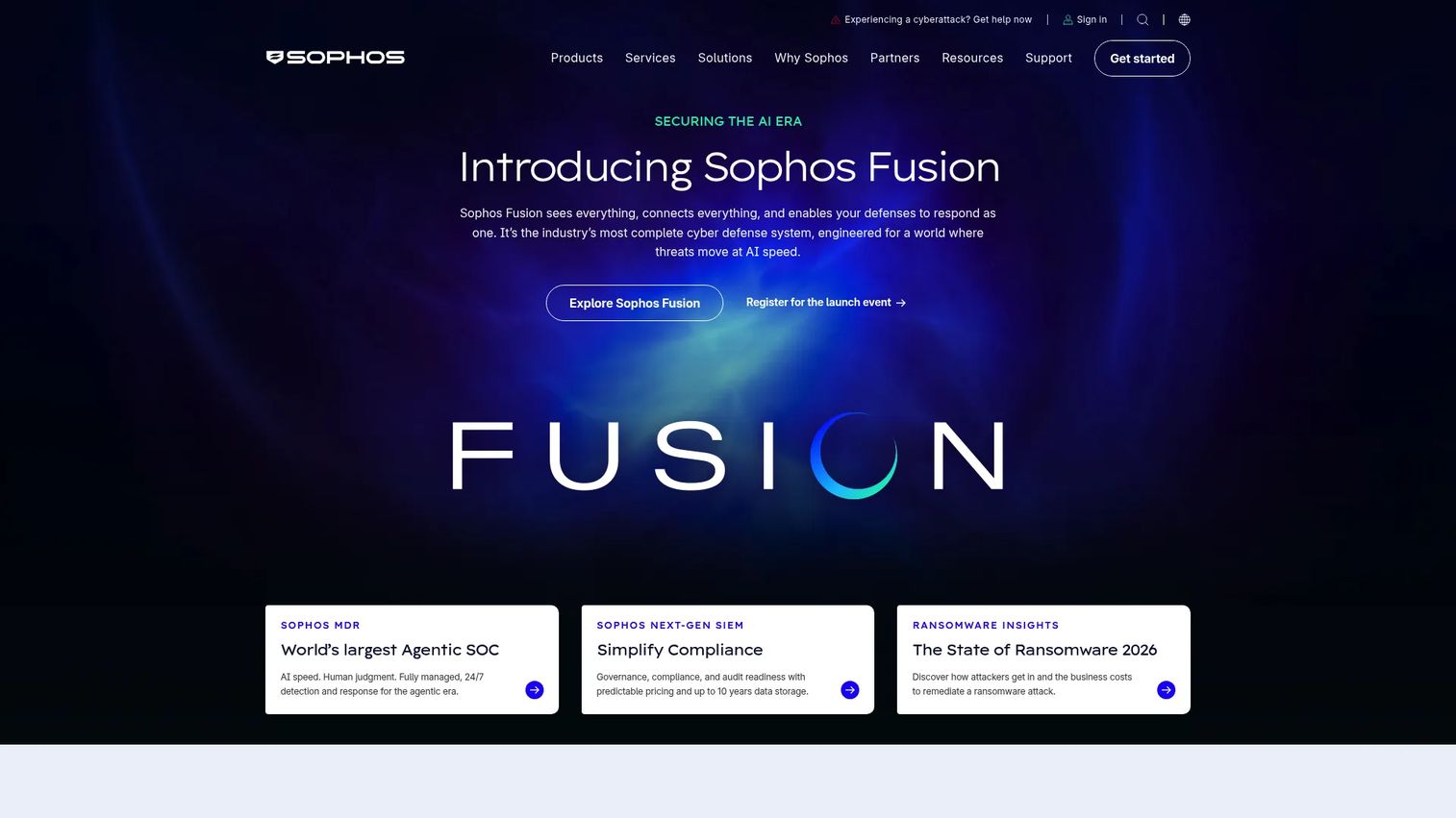
Sophos is a cybersecurity platform and services provider covering endpoint, network, email, cloud, and managed detection and response. Its MDR service is built around a human-led response model backed by an AI-native defense system, and it stands out for being genuinely vendor-agnostic. You do not have to rip out your existing tooling to adopt it.
Best for: Organizations that want full-scale managed response and centralized security management without being locked into a single vendor's stack.
Key strengths
- Vendor-agnostic integrations: 500+ open integrations mean Sophos MDR ingests telemetry from tools you already run, not just Sophos products.
- Human-led response: The service does not stop at alerts. Analysts investigate and take containment action on your behalf.
- Sophos Central console: A unified management console pulls endpoint, network, email, and cloud signals into one place for the analyst team.
Why choose Sophos: The combination of full-scale response and broad integration coverage makes it a strong starting point for teams that have mixed tooling and want a provider that meets them where they are. It handles detection, hunting, and remediation as a service, so a lean internal team gets the output of a mature SOC. For presales and security buyers running diligence, the vendor-agnostic story removes a common integration objection early.
Sophos pricing: Sophos does not publish a list price for its MDR service; pricing is quote-based and typically scales with environment size and the level of response you want. Sophos Central, the management console, is included automatically with any Sophos product. A 30-day free trial is available, which gives evaluators a way to validate fit before committing.
2. Arctic Wolf
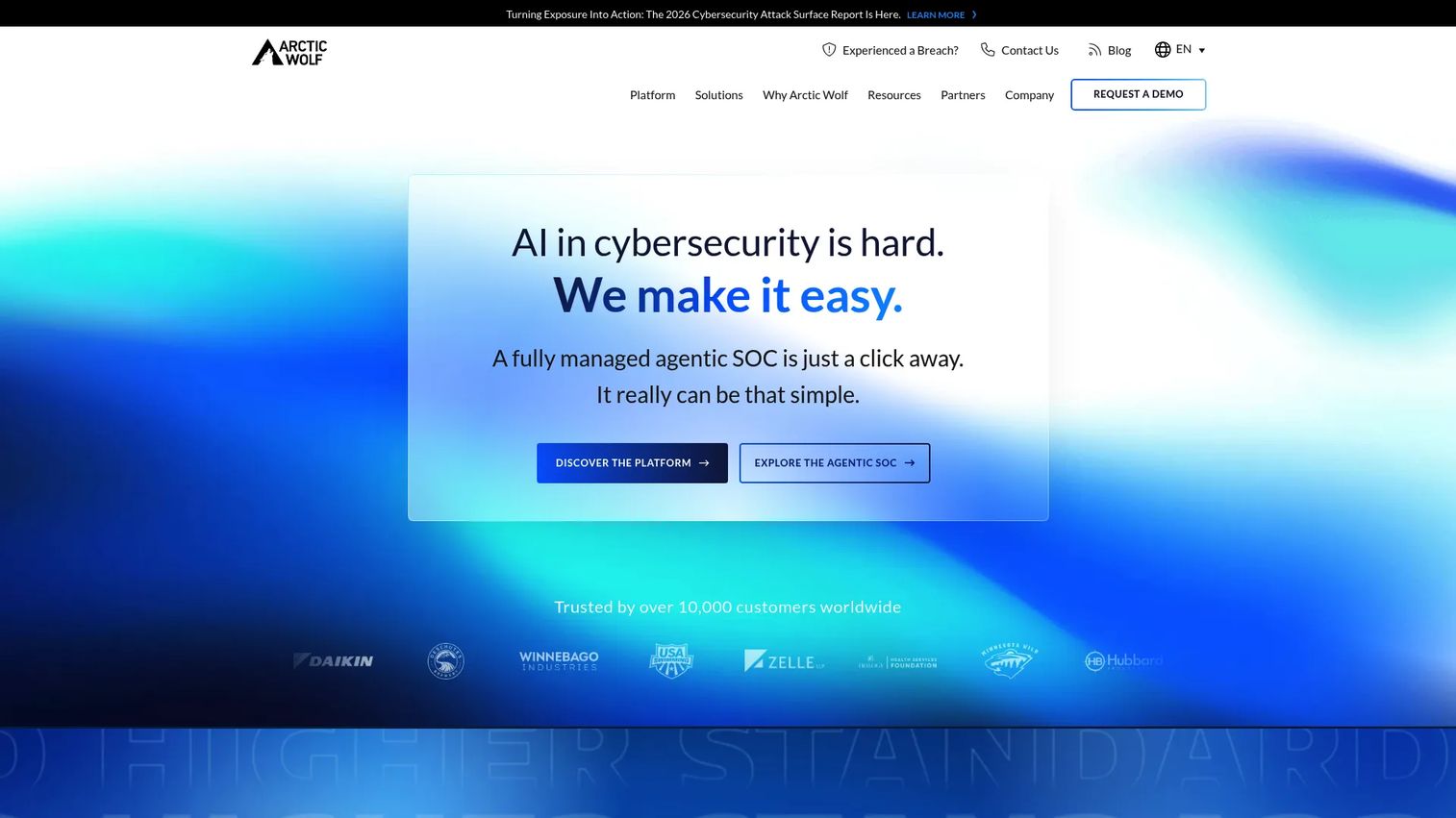
Arctic Wolf is a security operations provider offering managed detection and response, exposure management, and security awareness training. Its differentiator is the concierge model: a named security team that works alongside your staff rather than a faceless queue. That relationship-driven approach is why mid-market and enterprise teams shortlist it for managed operations.
Best for: Mid-market and enterprise teams that want 24/7 managed security operations with a dedicated, hands-on security team.
Key strengths
- 24/7 monitoring: Continuous coverage across networks, endpoints, and cloud environments closes after-hours gaps.
- Concierge security team: Managed detection, response, and recovery delivered through a named team that learns your environment over time.
- Aurora exposure management: Vulnerability scanning and remediation guidance extend the service beyond detection into proactive risk reduction.
Why choose Arctic Wolf: Teams that want a partner, not just a platform, gravitate to the concierge model. Because the same security team stays with your account, tuning and context improve over time, which reduces false positives and speeds investigation. It fits organizations that value the operational relationship as much as the technology behind it.
Arctic Wolf pricing: Arctic Wolf's core MDR and security operations offerings are quote-based, which is standard for services scoped to environment size. Its Managed Security Awareness training is publicly priced from $2.99 per user per month, billed annually, with tiers up to $4.99 per user per month for awareness plus additional coverage. For the full operations package, expect a custom quote after scoping.
3. CrowdStrike
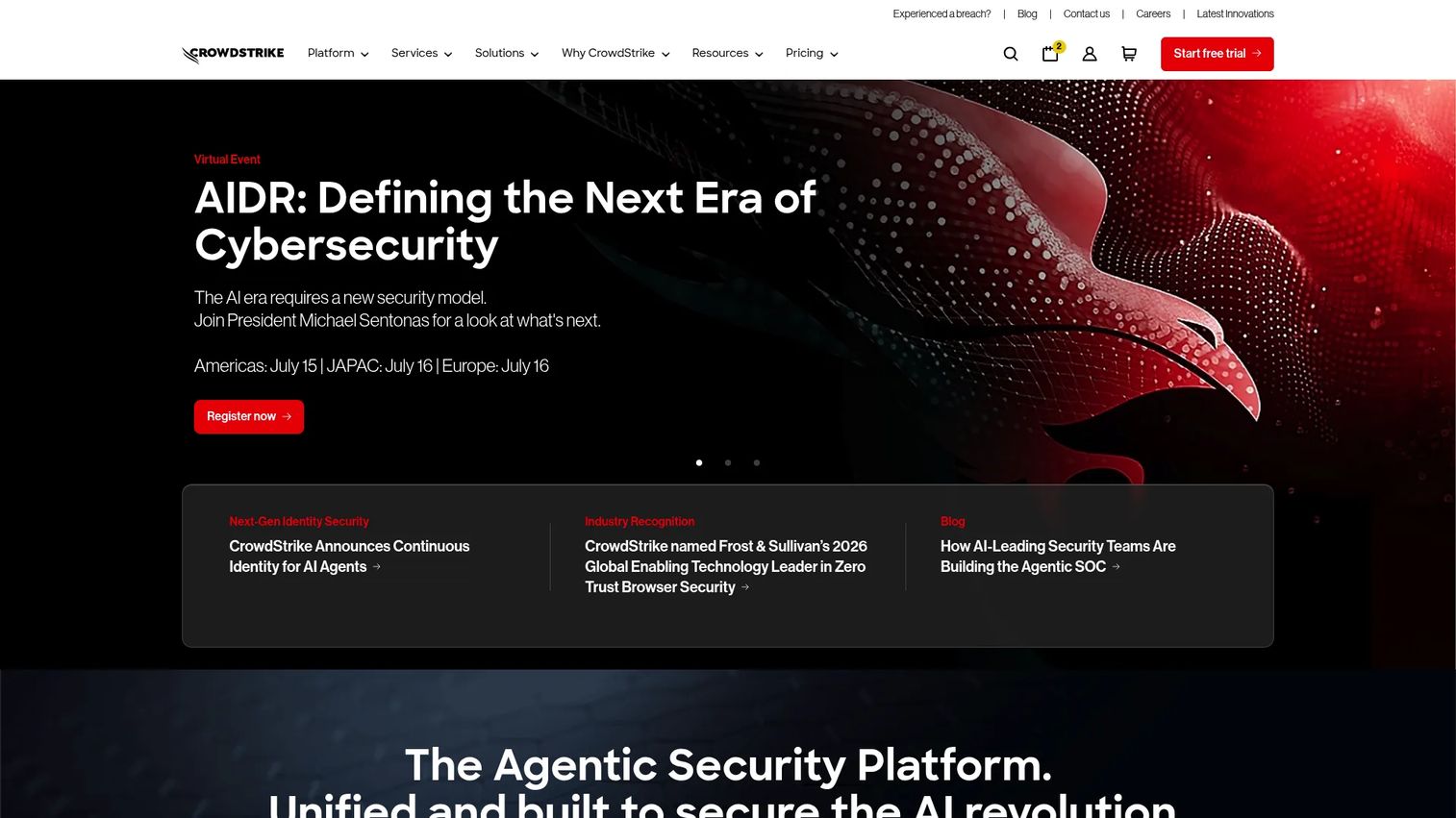
CrowdStrike is a cloud-native cybersecurity platform spanning endpoints, cloud workloads, identity, data, and AI security. Its managed service, Falcon Complete, is the natural MDR choice for teams already invested in the Falcon platform. The single lightweight sensor and endpoint-to-cloud visibility make it a mature option for organizations that want response speed rooted in strong endpoint detection and response.
Best for: Organizations already in the CrowdStrike ecosystem, or those that want endpoint-centered MDR with proven threat hunting.
Key strengths
- Single lightweight sensor: One agent covers endpoint, identity, cloud, SaaS, and AI protection, simplifying deployment.
- Managed hunting and response: Falcon Complete adds 24/7 human analysts, threat hunting, and remediation on top of the platform.
- Automated detection and threat intelligence: Detection, remediation, and intelligence run together, cutting dwell time on active threats.
Why choose CrowdStrike: If your endpoint security already runs on Falcon, layering Falcon Complete on top gives you managed operations without a new architecture. The endpoint-first heritage means fast, confident response on endpoint-borne threats, which remain the most common intrusion vector. It suits teams that treat the endpoint as the center of their security operations.
CrowdStrike pricing: CrowdStrike publishes SMB-friendly pricing for its platform tiers. Falcon Go starts at $59.99 per device annually, Falcon Pro at $99.99 per device annually, and Falcon Enterprise at $184.99 per device annually. Monthly options exist at $7.99, $14.99, and $19.99 per device. Falcon Complete, the fully managed MDR tier, is quote-based through sales. A 15-day free trial is available.
4. SentinelOne
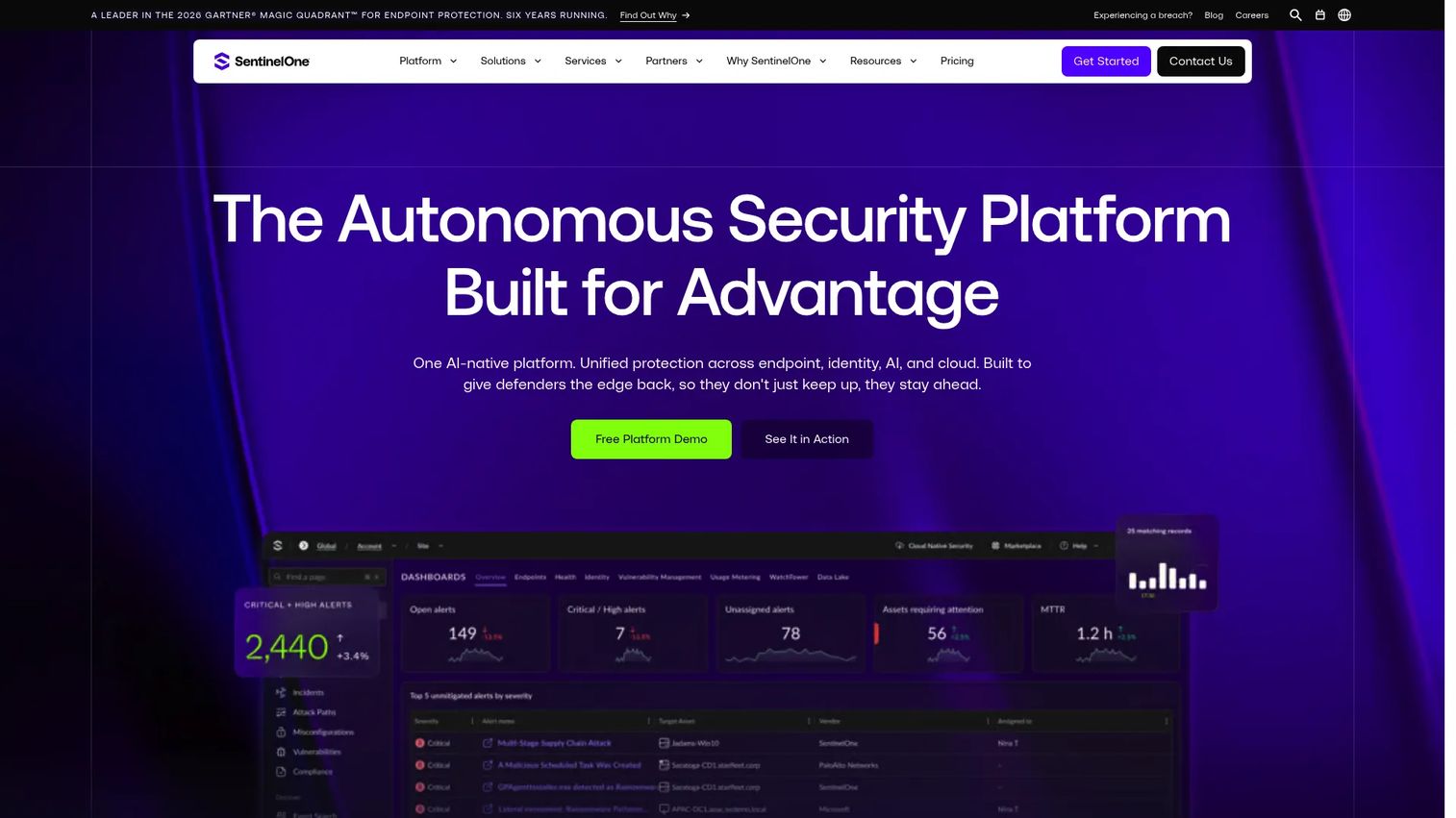
SentinelOne is an AI-powered cybersecurity platform covering endpoint, identity, cloud, and SOC operations. Its MDR offering appeals to teams that want extended detection coverage backed by heavy automation. Autonomous, real-time detection and response reduce the manual load, and the platform pairs that with human-led managed operations for teams that want both.
Best for: Teams that want endpoint and extended detection coverage with strong automation and AI-driven response.
Key strengths
- AI-native detection: Real-time threat detection and autonomous response act on threats at machine speed.
- Unified console with agentic workflows: Purple AI and agentic automation speed investigation and reduce analyst toil.
- Endpoint and identity protection: Coverage extends across endpoint, identity, and cloud in one platform.
Why choose SentinelOne: Automation is the pitch. For teams that want detection and response that moves faster than a human triage queue, the autonomous response model is compelling, and the managed service adds analyst oversight on top. It fits organizations comfortable leaning on AI-driven workflows while keeping human review in the loop for complex incidents.
SentinelOne pricing: SentinelOne publishes annual per-endpoint pricing. Singularity Core starts at $69.99 per endpoint annually, Singularity Complete at $179.99 per endpoint annually, and Singularity Commercial at $229.99 per endpoint annually. Singularity Enterprise is quote-based through sales. Final pricing runs through authorized partners and can vary by region, so confirm during evaluation.
5. Rapid7
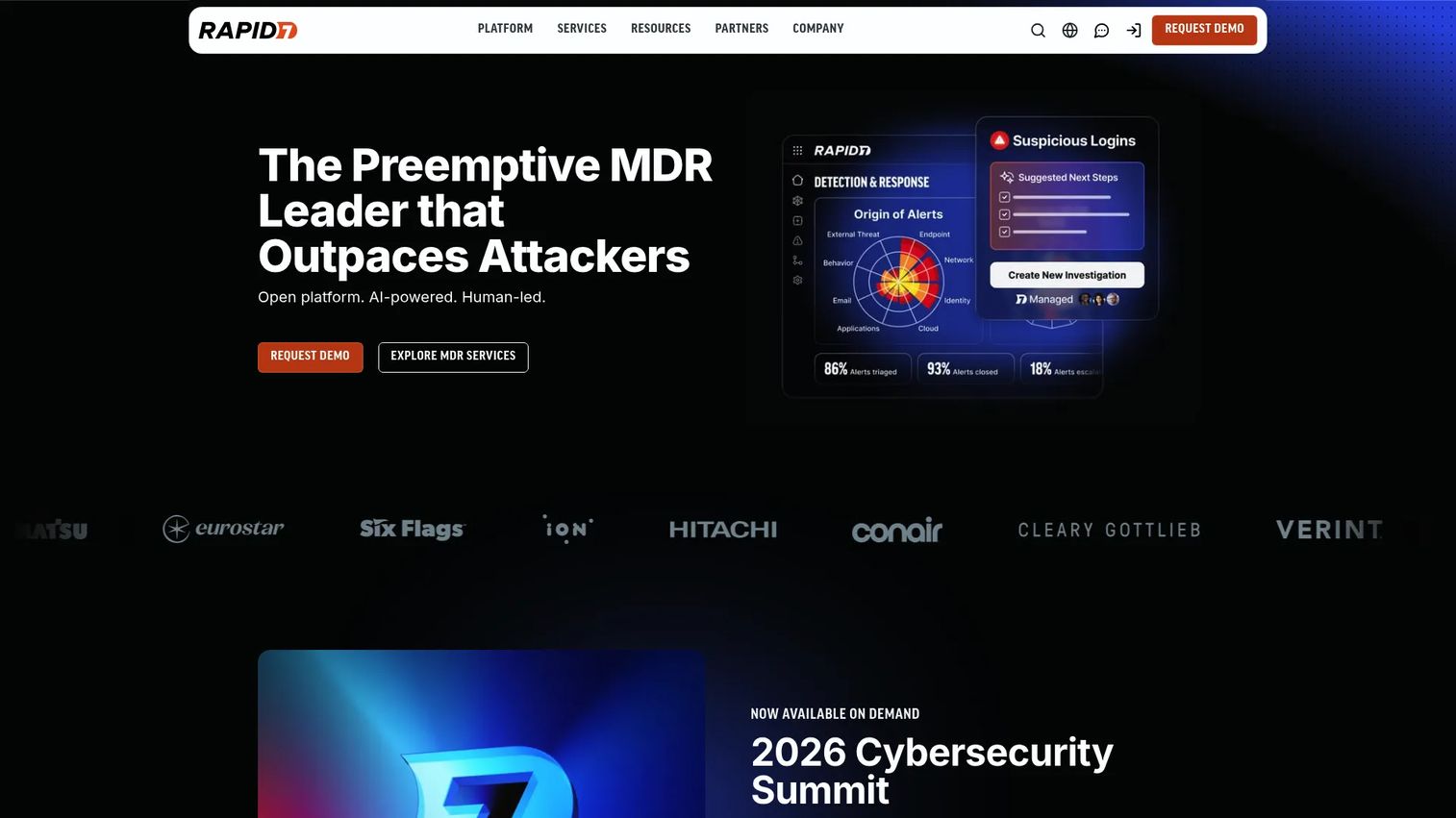
Rapid7 is a cybersecurity platform and services provider spanning vulnerability management, detection and response, and cloud security. Its MDR service sits inside a broader detection and response workflow, which appeals to teams that want visibility, investigation, and operational handoff support in one place rather than stitching separate tools together.
Best for: Organizations that want MDR as part of an enterprise platform that also covers vulnerability management and SIEM.
Key strengths
- Vulnerability management (InsightVM): Detection and response connect to exposure data, so you see risk and threat in the same view.
- Next-gen SIEM: Incident Command provides correlation and investigation depth across log sources.
- Application and cloud security: Coverage extends beyond endpoint into app security and cloud posture.
Why choose Rapid7: The consolidation story is the draw. Teams that already use InsightVM or Rapid7's SIEM get a coherent detection and response workflow without adding another vendor relationship. It suits organizations that value a single platform spanning exposure management, SIEM, and MDR, with clean handoffs between them.
Rapid7 pricing: Rapid7 publishes pricing for several Insight products. InsightVM starts at $1.62 per month per asset for 500 assets, InsightAppSec at $175 per month per app, and InsightCloudSec at $5,775 per month for up to 500 instances. The MDR service and some bundled packages are quote-based, so scope with sales for a full operations price.
6. eSentire
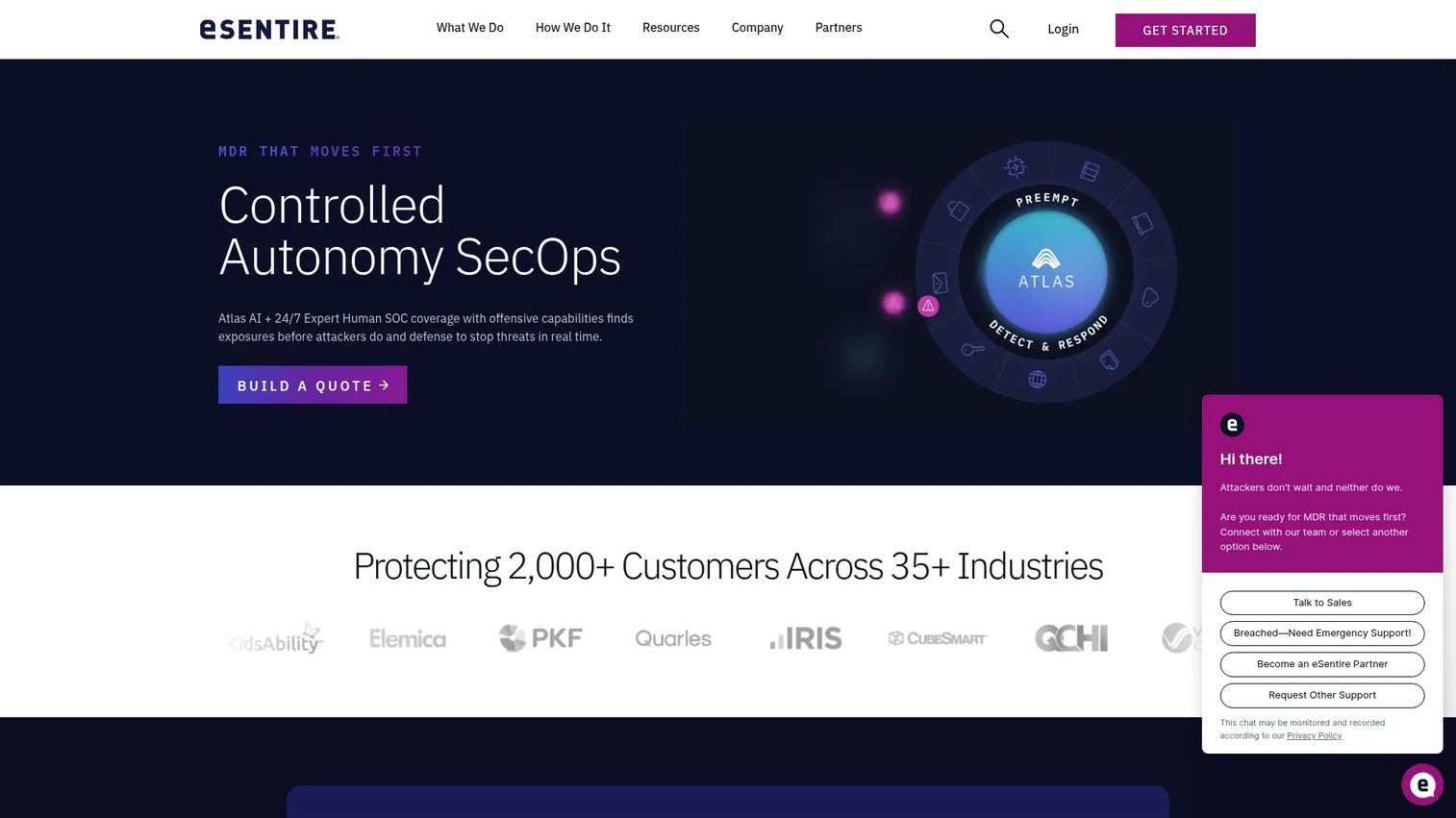
eSentire is a managed detection and response and security operations services provider. Its focus is service depth: 24/7 threat hunting and incident handling backed by multi-signal visibility. For teams that want a hands-on managed operation rather than a tool with a support add-on, eSentire's response readiness is a strong draw.
Best for: Organizations that want outsourced MDR with deep 24/7 monitoring, hunting, and incident handling.
Key strengths
- 24/7 threat hunting and incident handling: Continuous hunting plus response readiness for active incidents.
- Multi-signal visibility: Coverage across endpoint, network, log, cloud, identity, and vulnerability data.
- 300+ technology integrations: Broad integration coverage means eSentire works with your existing stack.
Why choose eSentire: Teams that want managed operations with genuine incident-handling depth, not just monitoring, tend to shortlist eSentire. The multi-signal approach improves detection quality by correlating across telemetry sources, and the service-first model fits security teams that want a partner handling the operational load. It is a good match when hands-on response is a top requirement.
eSentire pricing: eSentire's MDR service is quote-based. It offers three packages, Atlas Essentials, Atlas Advanced, and Atlas Complete, with pricing customized to your environment and the level of response you need. No public numeric price is listed, which is typical for scoped MDR services, so expect a tailored quote after discovery.
7. Bitdefender
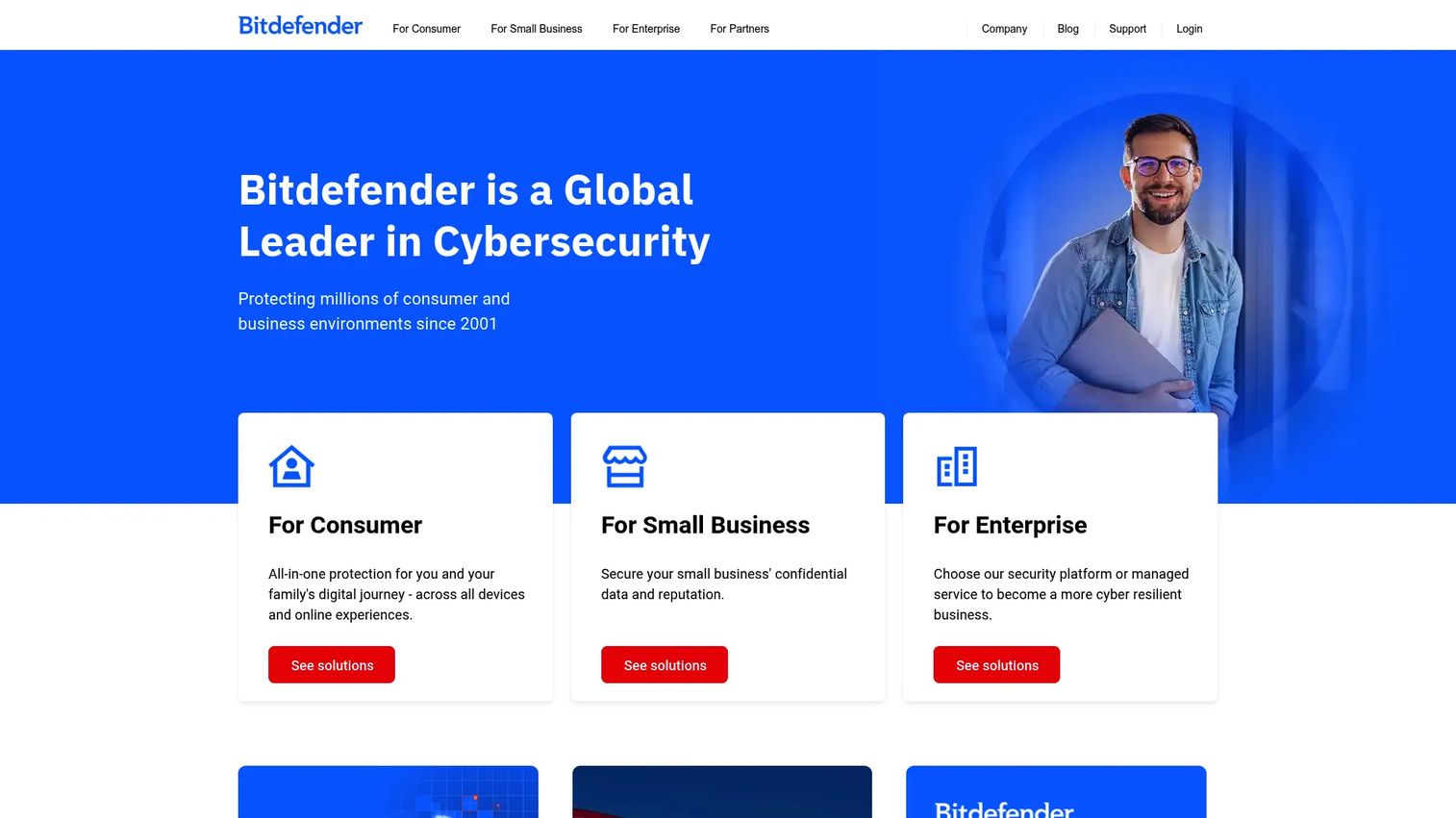
Bitdefender is a cybersecurity software provider serving consumers, small businesses, and enterprises. Some buyers evaluate its managed services because they already know and trust Bitdefender's endpoint security. That familiarity, combined with strong cross-platform protection, makes it a natural consideration for teams extending into managed detection and response.
Best for: Teams that already rely on Bitdefender endpoint security and want to extend into managed detection and response coverage.
Key strengths
- AI-powered threat protection: Detection built on Bitdefender's endpoint engine, layered with managed response.
- Cross-platform coverage: Protection spans multiple operating systems and device types.
- Bundled security tooling: VPN, password management, and identity monitoring round out the security stack.
Why choose Bitdefender: The endpoint security engine is well regarded, and buyers who already run it find the managed layer a low-friction extension. It fits organizations that want detection quality rooted in a proven endpoint product, with the option to add managed operations on top rather than adopting an entirely new vendor.
Bitdefender pricing: Bitdefender publishes consumer pricing starting at USD 24.99 for the first year on Antivirus Plus, up to USD 119.99 for its most complete individual tier. Business and managed service pricing is quote-based and scoped to your environment. A free antivirus tier and free trial are available for evaluating the underlying protection before moving to managed services.
8. Expel
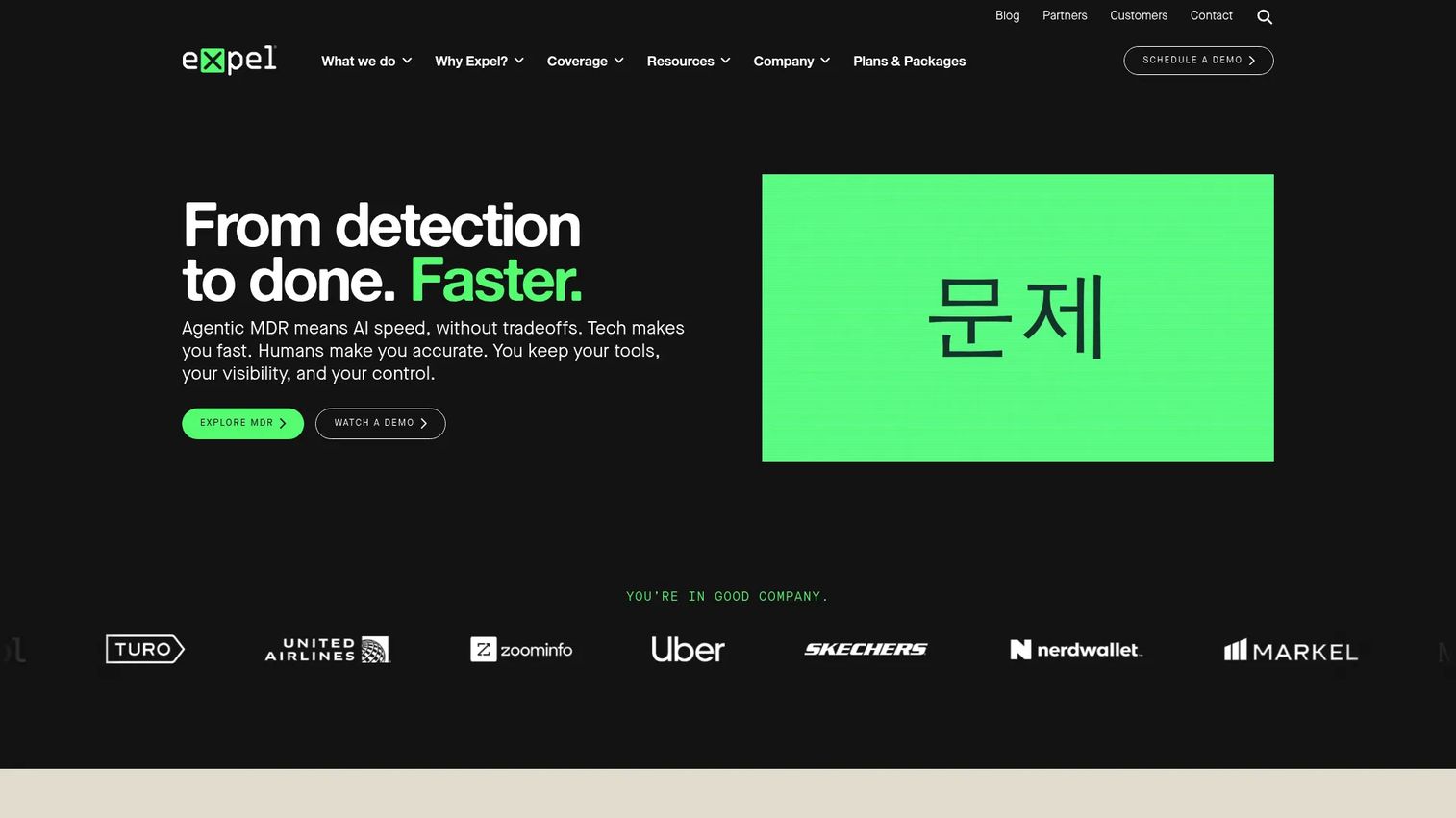
Expel is a managed detection and response provider built around transparent, human-led security operations. Its appeal is a service-first model with real analyst visibility: you see what the analysts see and why they act. For teams that want outsourced detection, investigation, and response without a black box, Expel is a frequent shortlist entry.
Best for: Organizations that want outsourced MDR with transparent, human-led operations and clear analyst reasoning.
Key strengths
- 24/7 human analyst monitoring: Around-the-clock coverage staffed by analysts, not just automated rules.
- AI and automation-powered detections: Automation handles scale while humans handle judgment.
- Cross-product correlation: Detection spans cloud, endpoint, network, and identity for a connected view.
Why choose Expel: Transparency is the differentiator. Teams frustrated by opaque providers value seeing the analyst reasoning behind each detection and response action. The human-led model, backed by automation for scale, fits organizations that want to outsource operations while keeping insight into what is happening. It works well when trust and visibility into the SOC's decisions matter.
Expel pricing: Expel's MDR service is quote-based, with three packages: Starter, Select, and Premium. All list request-pricing rather than public numbers, which is standard for MDR scoped to environment complexity and the level of managed response. Expect a custom quote after a scoping conversation with sales.
What to check before choosing an MDR provider
What telemetry sources does the provider support?
Detection quality depends on what the provider can see. Evaluate coverage across endpoint, identity, network, cloud, email, and business applications. A provider that only watches endpoints will miss identity-based attacks and cloud misconfigurations. Broader telemetry means better correlation and fewer blind spots, so confirm the sources map to where your risk actually lives.
How much of the response is actually managed?
This is the line that separates real MDR from glorified alerting. Ask whether the provider only notifies you or also contains and remediates the threat. Some services stop at a ticket. Others isolate hosts, disable accounts, and eradicate the threat on your behalf. Make the difference explicit before you sign, because it determines how much operational load actually leaves your team.
How does the service fit your stack?
An MDR service that cannot ingest your existing tools creates gaps. Look for integrations with your identity systems, endpoint tools, SIEM or XDR products, and cloud platforms. Vendor-agnostic providers reduce rip-and-replace risk. Stack compatibility is a common late-stage blocker, so raise it early in evaluation and get specifics, not just a logo wall of supported integrations.
What does onboarding and tuning look like?
A service is only valuable once it is operational and tuned. Ask how long onboarding takes, how the handoff works, and how the provider tunes detections to your environment to cut false positives. A rushed deployment with poor tuning produces the same alert fatigue you were trying to escape. Understand the path to a stable, low-noise state.
How will you measure value?
Tie evaluation to operational outcomes, not feature checklists. Useful metrics include time-to-detect, time-to-respond, false positive reduction, and analyst time saved. Agree on how you will measure these before onboarding so you can hold the provider accountable. If a provider cannot articulate how it will move these numbers, that is a signal worth noting during diligence.
Choosing the right MDR provider
The strongest all-around pick for most teams is Sophos, thanks to full-scale human-led response and vendor-agnostic integrations that reduce adoption friction. If you want managed operations with a dedicated team, Arctic Wolf's concierge model stands out. Teams already on Falcon should look hard at CrowdStrike, while SentinelOne appeals to those betting on AI-native automation. For outsourced, human-led transparency, Expel and eSentire both deliver, and Rapid7 and Bitdefender fit teams consolidating into a broader platform.
The right choice comes down to three filters: how much of the response is actually managed, how broad the telemetry coverage is, and whether the service fits your existing stack. Shortlist two or three providers that clear those filters, then run a scoped evaluation against your real incident-response expectations. That is how you separate a provider that reduces risk from one that just adds another dashboard.
FAQs
Managed detection and response is a security service that combines technology and human analysts to deliver 24/7 threat monitoring, investigation, and active response. Instead of building an internal SOC, you outsource continuous detection, threat hunting, and containment to a provider that runs those operations on your behalf.
EDR (endpoint detection and response) is a tool focused on visibility and response on endpoints. MDR is a managed service that layers people and process on top of EDR, and often other telemetry sources too. In short, EDR is technology you operate; MDR is the team and process that operate detection and response for you.
An MSSP (managed security service provider) often focuses on monitoring, log management, and alerting, handing you a ticket when something looks wrong. MDR adds active detection, investigation, and response, so the provider contains and remediates threats rather than just notifying you. The practical difference is who does the response work.
Focus on telemetry coverage across endpoint, identity, network, cloud, and email; response depth (whether the provider contains and remediates, not just alerts); integration fit with your existing stack; and the support model. Also confirm onboarding time, tuning approach, and how you will measure outcomes like time-to-respond.
Yes. Smaller security teams often use MDR to gain 24/7 coverage they could never staff internally. Building a SOC that runs around the clock takes eight to twelve analysts, which is out of reach for most organizations. MDR delivers that coverage as a service, reducing the staffing burden while closing after-hours gaps.
Ask about response scope (alert-only versus full containment), which telemetry sources and integrations the service supports, escalation paths and handoff to your internal team, and reporting depth. Frame these around security diligence: request proof of detection quality, onboarding timelines, and references from similar environments to validate fit before committing.
Yes. Many teams run MDR alongside existing SIEM or XDR tools, with the provider ingesting that telemetry rather than replacing it. Vendor-agnostic providers make this straightforward. The key is confirming compatibility and clean operational handoff during evaluation, so the service augments your stack instead of creating another silo.