You pushed a config change to 40 devices last night. This morning, three of them are unreachable, one violates a compliance policy nobody caught, and the runbook you followed lives in a wiki that is six months stale. Sound familiar?
Manual network work does not scale, and it does not fail quietly. Every hand-typed CLI command is a chance to drift from the intended state. Every undocumented change widens the gap between what your network actually is and what your source of truth claims it is. And when a technical buyer sits across from you during an evaluation asking how you validate changes before rollout, "we test it in prod and hope" is not an answer that closes deals.
The market is moving fast enough that this gap matters more each year. The global network automation market is projected to reach USD 36.86 billion in 2026, growing at 18.51% CAGR toward USD 86.16 billion by 2031, according to Mordor Intelligence (2026). The software segment already held 68.4% of the market in 2025, per Global Market Insights (2026). Teams are not just buying automation. They are betting their operations on it.
This guide is built to help you choose network automation software by fit, not by hype. If you evaluate tools, run technical validations, or answer "how does this work in our stack?" for a living, the goal here is to give you a shortlist you can defend. For teams comparing other automation categories, our roundups of the best AI orchestration platforms and best marketing automation software tools apply the same fit-first logic. And if part of your job is showing prospects how automation works without exposing a live environment, an interactive demo does that far better than a slide.
What's inside
This guide covers seven network automation software options chosen for one thing: how well they fit a real operating model. We looked at multi-vendor support, configuration and change automation, visibility and analytics, orchestration depth, and enterprise readiness. Each pick maps to a distinct job, whether that is building a source of truth, validating topology before a rollout, orchestrating governed change, or handling compliance and backups.
The list is written for presales teams and technical buyers who need to validate fit quickly. The ranking is deliberate, not alphabetical. It moves from data foundation to assurance to orchestration to practical compliance, so you can find the archetype that matches your current stack and skip the ones that do not.
TL;DR
- Best for source-of-truth-first teams: NetBox, the network data foundation clean automation depends on.
- Best for per-device assurance and topology validation: IP Fabric, a vendor-neutral digital twin of your live network.
- Best for flexible, declarative automation at scale: Red Hat Ansible Automation Platform, the agentless engine for hybrid environments.
- Best for governed workflow orchestration: Itential, built for policy-driven change across multi-domain operations.
- Best for enterprise troubleshooting and dynamic mapping: NetBrain, for large multi-vendor networks that need runbooks and observability.
- Best for service provider lifecycle automation: Cisco Crosswork, closed-loop orchestration across multivendor IP and optical networks.
- Best for pragmatic, multi-vendor compliance and backup: Unimus, with a usable free tier and per-device licensing.
What is network automation software?
Network automation software is a category of tools that configures, provisions, validates, and manages network infrastructure programmatically instead of manually. It replaces hand-typed CLI commands and one-off scripts with repeatable, auditable workflows that run consistently across many devices.
In practice, these platforms do several distinct jobs. Not every tool does all of them, and the best network automation platforms tend to specialize.
- Configuration automation: Push standardized, version-controlled configs across devices instead of editing each one by hand.
- Provisioning automation: Bring new devices, VLANs, or services online from templates rather than manual setup.
- Change automation: Stage, approve, and roll out changes through governed workflows with rollback paths.
- Monitoring and analytics: Collect state data, surface network visibility and analytics, and flag drift from intended state.
- Network orchestration: Coordinate multi-step, multi-device, multi-domain workflows as a single governed process.
- Policy enforcement: Validate configs against security and compliance rules automatically.
- Trust and state validation: Confirm the live network matches the intended design before and after every change.
The line between automation software and simple scripting is repeatability and governance. A script runs once and forgets. Network configuration automation software maintains a source of truth, enforces approvals, records an audit trail, and models intent so the same change produces the same result every time.
When to use network automation software
Standardize configuration changes across a large environment
When you manage tens of devices, ad hoc fixes are survivable. At hundreds or thousands, they are how outages start. This is where network configuration automation earns its keep. If your team keeps re-solving the same change on different hardware, or config drift is a recurring incident theme, repeatability matters more than any single quick fix. Template-driven change turns a risky manual task into a reviewable, auditable one.
Validate topology and change impact before rollout
Bad deployments usually come from a wrong mental model of the network, not a fat-fingered command. Discovery and modeling close that gap. When a platform maps the live topology and lets you model change impact before you touch anything, you catch the reachability break or policy violation in staging, not at 2am. Teams running frequent changes across complex, multi-vendor estates need this assurance layer most.
Close the loop between monitoring, policy, and remediation
The step from tooling to operating system happens when monitoring, policy, and remediation connect. Self-healing and closed-loop remediation mean the platform detects drift, checks it against policy, and either flags or fixes it without a human in the loop for every event. This is where automated network operations stop being a collection of scripts and become a system that holds the network to its intended state.
Comparison table
Here is the shortlist at a glance. Pricing for most enterprise network automation platforms is quote-based, so verify current figures and G2 ratings against each vendor's live listing before you build a business case. Tools are sorted by relevance to the keyword and buyer intent, moving from data foundation to orchestration to practical compliance.
| # | Product | Intent | Key differentiation | Pricing | G2 rating |
|---|---|---|---|---|---|
| 1 | NetBox | Source of truth | Network source of truth with IPAM and DCIM | Contact sales | 3.6/5 |
| 2 | IP Fabric | Assurance and discovery | Vendor-neutral digital twin, per-device licensing | Quote-based, per active device | Not listed |
| 3 | Red Hat Ansible Automation Platform | Declarative automation | Agentless engine with Event-Driven Ansible | Custom quote by sizing | 4.6/5 |
| 4 | Itential | Governed orchestration | Low-code workflows, 300+ integrations, RBAC | Annual subscription plus node licenses | 4.3/5 |
| 5 | NetBrain | Troubleshooting and mapping | No-code automation with dynamic maps and runbooks | Quote-based by devices and modules | 4.4/5 |
| 6 | Cisco Crosswork | Service provider orchestration | Closed-loop, multivendor, multidomain automation | Suite-based, contact Cisco | Not listed |
| 7 | Unimus | Compliance and backup | Config backup, versioning, per-device licensing | Free tier, SMB from $5.90 | 4.4/5 |
1. NetBox
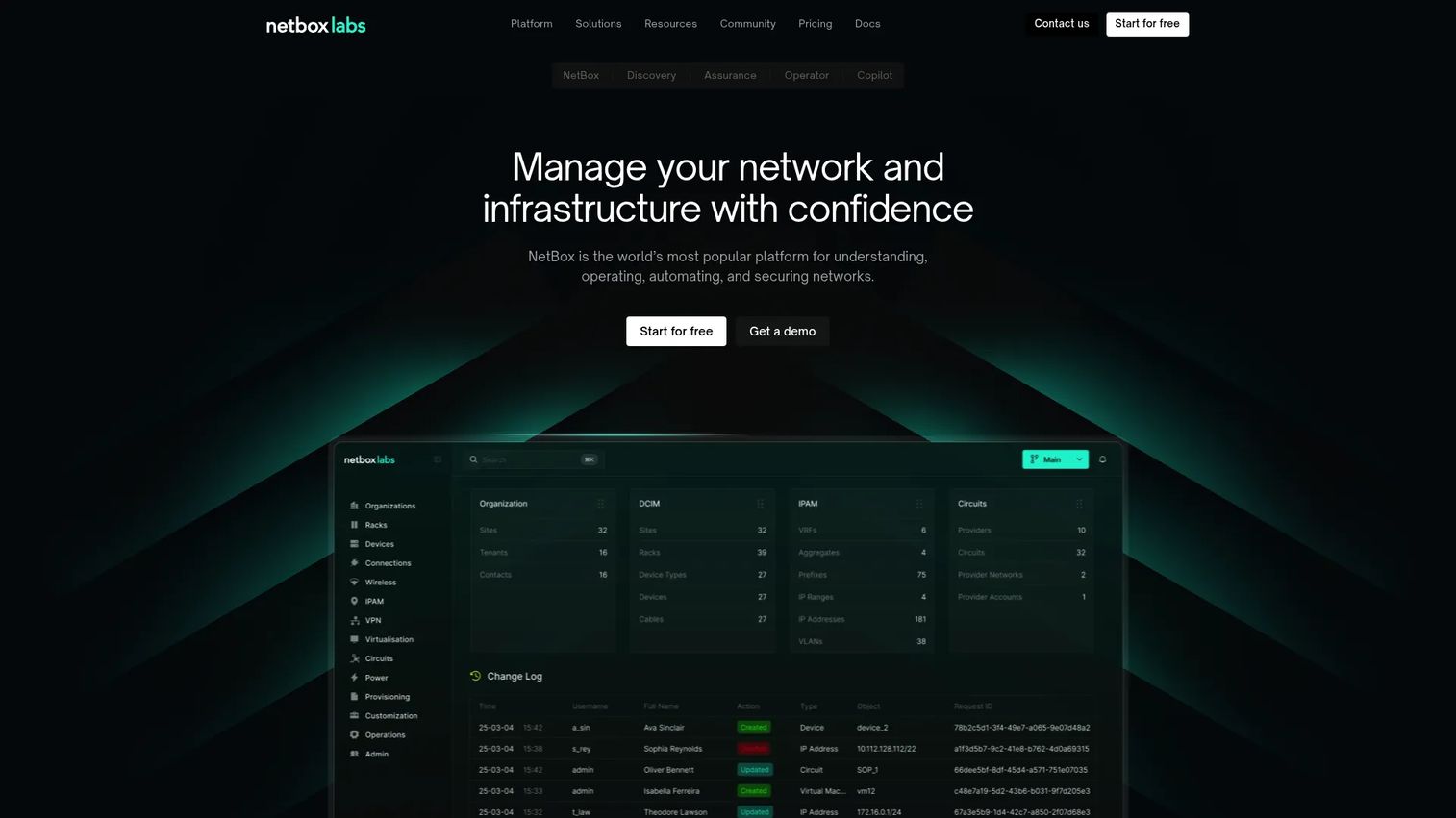
NetBox is the network source-of-truth platform that documents, operates, automates, and secures infrastructure. Before you automate anything, you need to know what you have. NetBox is the system of record that answers that question with structured data on devices, IP space, and connections. It is where most serious automation programs actually start, because dirty inventory data breaks every downstream workflow.
Best for: Teams that need a reliable source of truth for network and infrastructure inventory before layering automation on top.
Key strengths
- Network source of truth: A single authoritative model of your infrastructure that automation tools can query and trust.
- IP address management (IPAM): Structured tracking of IP space, prefixes, and assignments across the whole estate.
- Data center infrastructure management (DCIM): Physical and logical inventory of racks, devices, and cabling in one place.
Why choose NetBox: If your automation keeps breaking because tools disagree about what the network contains, the problem is upstream of the automation. NetBox fixes the data layer first. In presales discovery and architecture conversations, it is the natural anchor for "align the automation on accurate data" arguments, since orchestration and config tools are only as good as the source of truth feeding them.
NetBox pricing: NetBox Labs lists Cloud and Enterprise plans across Starter, Professional, and Premium tiers. Public numeric pricing is not shown on the pricing page, and all tiers direct buyers to contact sales for a quote. NetBox holds a 3.6/5 rating on G2.
2. IP Fabric
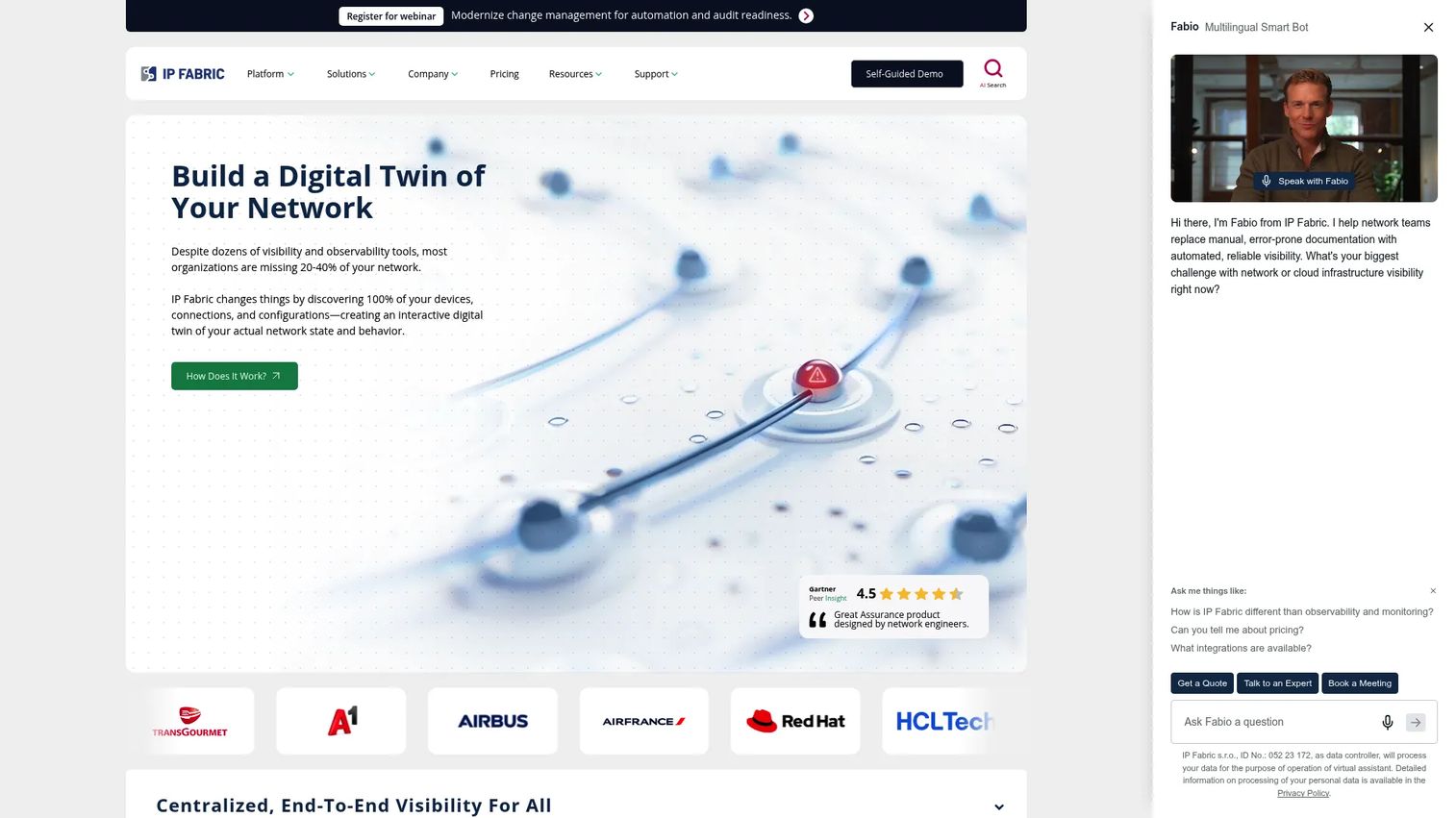
IP Fabric is a network assurance platform that discovers, maps, and analyzes enterprise networks as a digital twin. Where NetBox holds the intended state, IP Fabric captures the actual live state and lets you compare the two. It crawls the network, builds a vendor-neutral model, and gives you the topology discovery and analysis you need to validate reality before you change it.
Best for: Enterprises that need automated network discovery, assurance, and topology visibility before they trust automation.
Key strengths
- Automated network discovery and topology mapping: Builds a current, accurate map of the live network without manual documentation.
- Vendor-neutral visibility and compliance analysis: Analyzes state and policy across mixed hardware, supporting vendor neutral network automation.
- Per-device subscription licensing: Scales cost with the size of the network you actually assure.
Why choose IP Fabric: Strong visibility has to come before confident automation. If your team has been burned by changes that looked fine on paper but broke reachability in production, IP Fabric is the assurance layer that catches those gaps. It speaks directly to teams that want to model change impact and confirm intended state as part of their validation cycle.
IP Fabric pricing: Pricing is quote-based. The pricing page states the product is priced per active network device per year and invites buyers to contact sales for a proposal. A current G2 star rating was not available to verify at publish time.
3. Red Hat Ansible Automation Platform
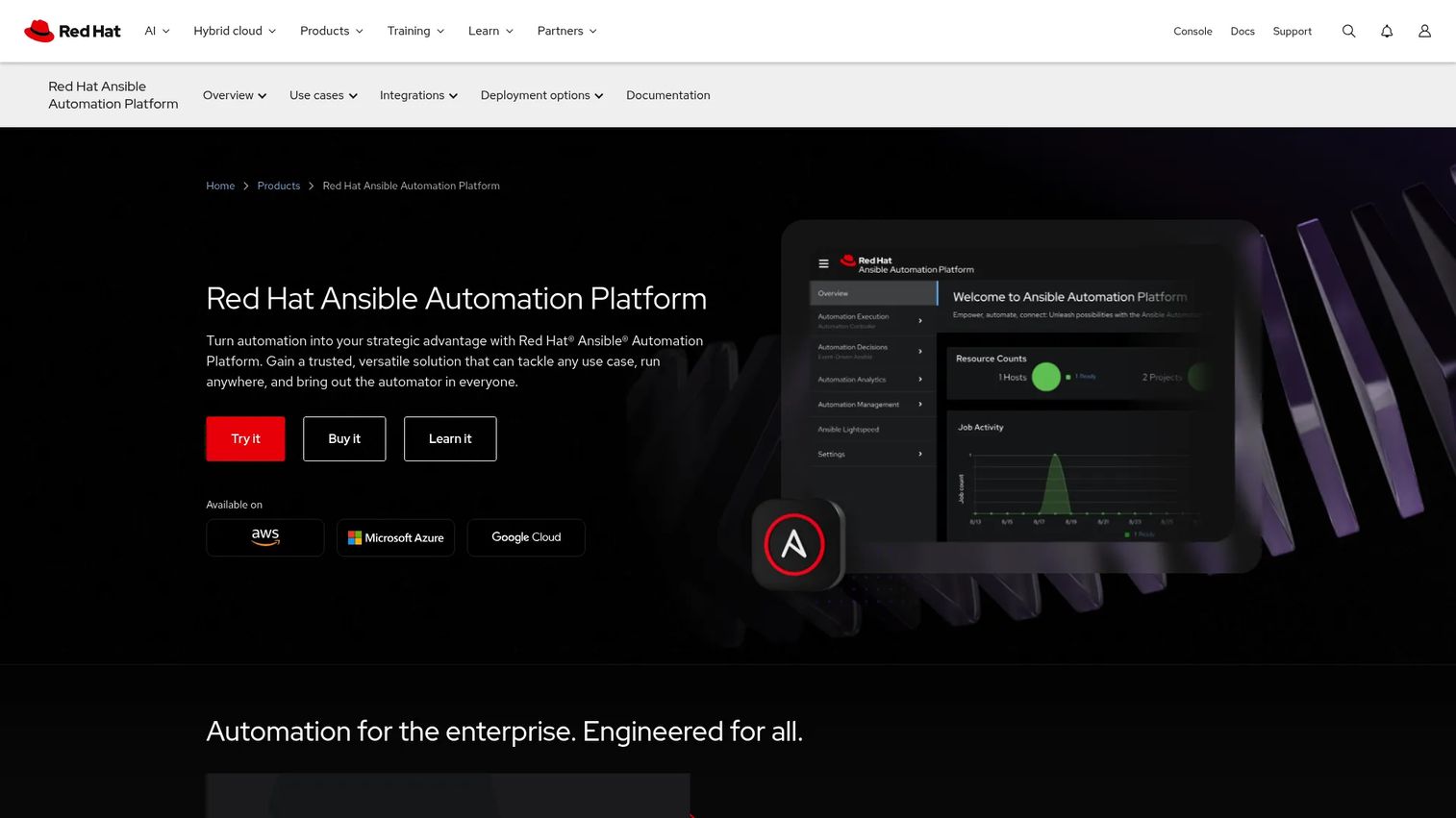
Red Hat Ansible Automation Platform is an enterprise automation platform for building, running, and managing IT automation at scale. It is the declarative, agentless engine many teams standardize on because it reaches beyond networking into servers, cloud, and hybrid infrastructure. Playbooks describe the desired state, and Ansible makes it so, without installing agents on every target.
Best for: Enterprises standardizing flexible, declarative automation across hybrid infrastructure, not just the network.
Key strengths
- Automation controller: Centralized management, scheduling, and RBAC for running automation at scale.
- Event-Driven Ansible: Trigger playbooks automatically from network events for closed-loop responses.
- Automation hub: A curated library of certified content and reusable roles across vendors.
Why choose Red Hat Ansible Automation Platform: If your automation ambitions cross domains, and you want one tool for network config, provisioning, and change automation alongside your broader IT estate, Ansible is the flexible common language. Its agentless model and huge content ecosystem make it a strong fit for teams that want multi-vendor support without a heavy per-device footprint.
Red Hat Ansible Automation Platform pricing: Red Hat sells Standard and Premium subscription tiers. Pricing varies by sizing and subscription, and Red Hat directs buyers to contact sales or an authorized partner for a custom quote. The platform holds a 4.6/5 rating on G2.
4. Itential
Itential is an infrastructure and network orchestration platform for automating and governing changes across hybrid environments. Where a config engine pushes changes, Itential wraps them in process: approvals, audit, RBAC, and multi-step workflows that span systems. It is the orchestration layer for teams that need change automation to be governed, not just fast.
Best for: Enterprises that need governed network and infrastructure automation across hybrid, multi-domain environments.
Key strengths
- Low-code workflow design: Drag-and-drop automation that non-scripters can build and maintain.
- 300+ integrations: Pre-built adapters connect existing systems, source-of-truth tools, and ticketing.
- Governed orchestration: Built-in audit, RBAC, compliance, and AI and MCP capabilities for policy enforcement.
Why choose Itential: When change management, compliance automation, and multi-domain operations all need to run through one repeatable process, Itential is built for that governance. It sits well above individual device tools, coordinating them into workflows with approvals and an audit trail, which is exactly what enterprise change control demands.
Itential pricing: Public pricing is not shown. Itential uses a fixed annual platform subscription plus node-element licenses in usage-based tiered blocks, with optional application add-ons and a one-time deployment-architecture fee for on-prem or hybrid installs. Itential holds a 4.3/5 rating on G2.
5. NetBrain
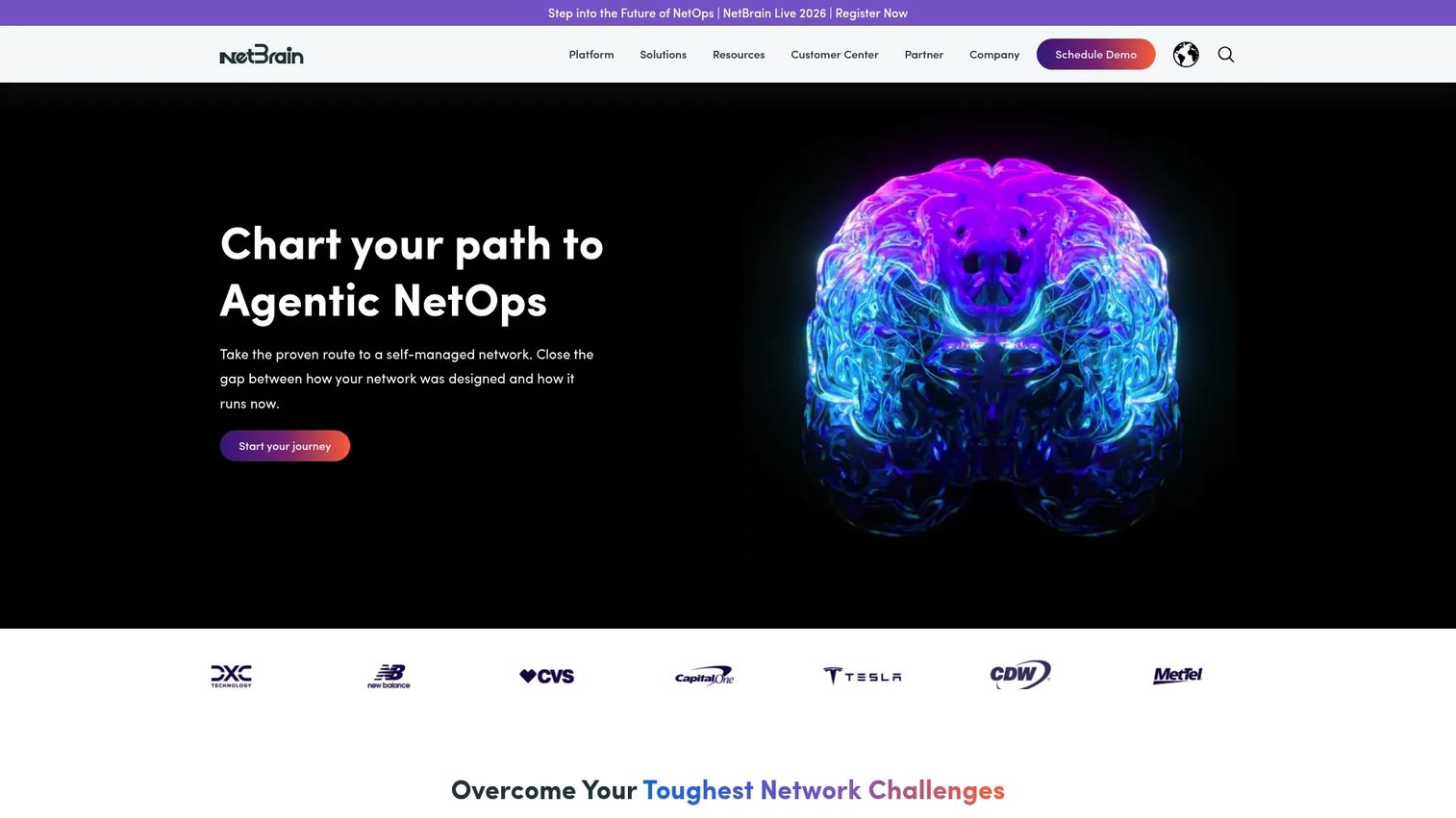
NetBrain is an enterprise network automation platform for observability, troubleshooting, and change management. It is built around dynamic maps and no-code runbooks that automate the day-to-day tasks network teams repeat constantly: diagnosing an issue, documenting a path, verifying a change. For large, complex, multi-vendor estates, it turns tribal knowledge into repeatable automation.
Best for: Large enterprise IT teams managing complex, multi-vendor hybrid networks that need troubleshooting and documentation at scale.
Key strengths
- No-code network automation: Build runbooks and automated tasks without writing scripts.
- Hybrid network observability: Monitor state across on-prem and hybrid infrastructure in one view.
- Dynamic mapping and network discovery: Auto-generate current topology maps for troubleshooting and documentation.
Why choose NetBrain: If your team spends more time diagnosing and documenting than deploying, NetBrain targets that reality directly. Dynamic maps keep documentation current automatically, and runbooks codify the troubleshooting steps your best engineers run from memory. NetBrain offers a test-drive option, which helps presales teams validate fit against their own environment. It holds a 4.4/5 rating on G2.
NetBrain pricing: Pricing is not publicly listed. NetBrain says cost depends on the number and type of network devices plus the modules you deploy, and directs buyers to request a quote through its licensing page.
6. Cisco Crosswork
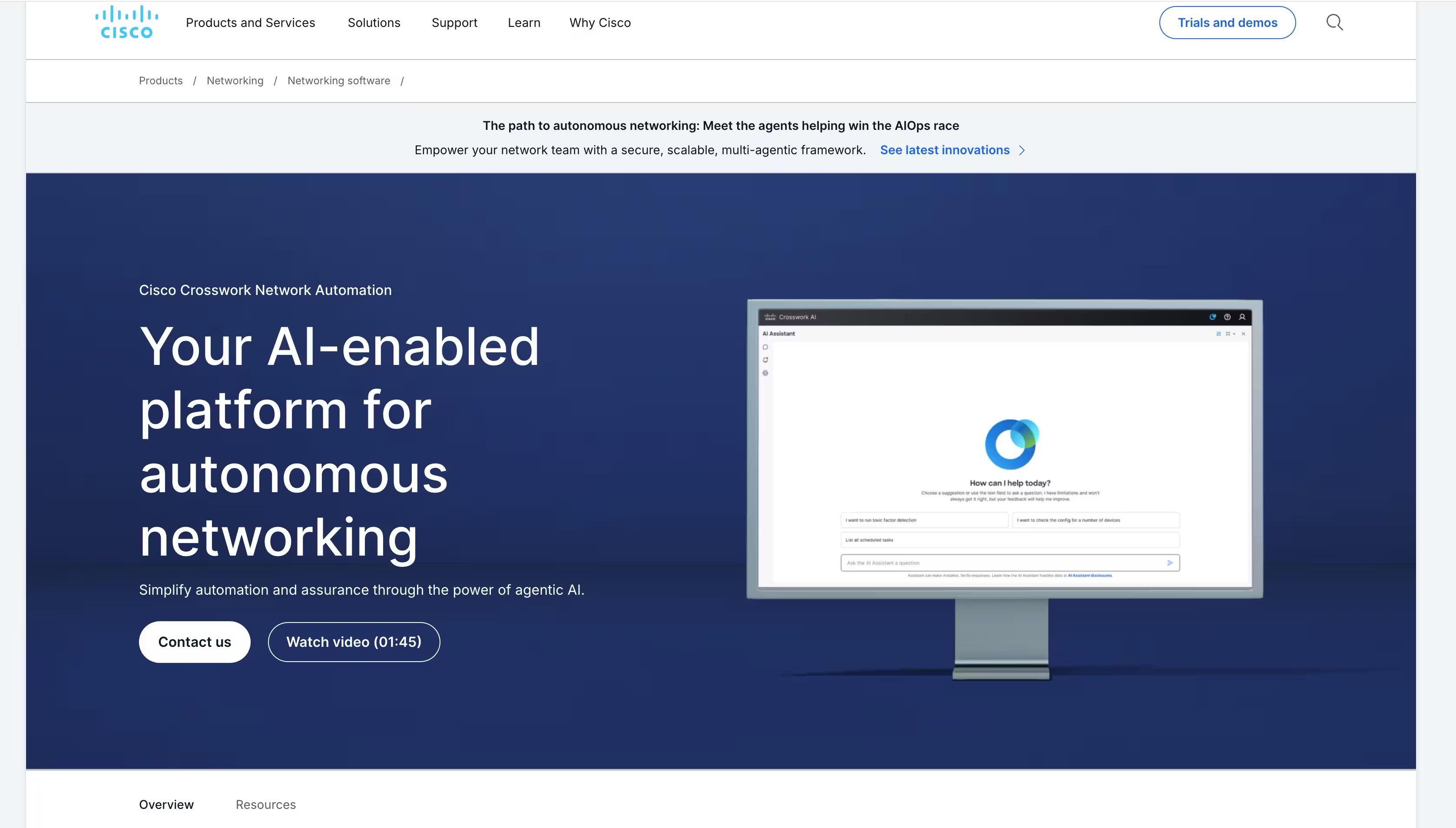
Cisco's AI-enabled network automation platform for service providers and autonomous networking. It is the heavyweight option for operators running network operations at massive scale, with closed-loop automation, routing insight, trust validation, and proactive remediation across multivendor IP and optical environments. This is lifecycle control, not one-off scripting.
Best for: Service providers automating network operations across multivendor IP and optical environments at scale.
Key strengths
- AI-enabled closed-loop automation and assurance: Detect, decide, and remediate across the lifecycle with less manual intervention.
- Multivendor, multidomain network support: Coordinate automation across mixed hardware and domains.
- Suite of applications: Modular apps for visibility, insights, and action, licenseable individually or packaged.
Why choose Cisco Crosswork: Crosswork is strongest where operators need broad lifecycle control and self-healing at service-provider scale, not just device configuration. If your remit spans routing insight, assurance, and closed-loop remediation across a huge multivendor estate, this is the class of orchestration built for it.
Cisco Crosswork pricing: Cisco sells Crosswork Essentials and Advantage as suites, licenseable individually or packaged, on annual RTU plus per-device RTM with one-to-five-year term contracts. Public numeric pricing is not displayed, and Cisco directs buyers to contact sales. A current G2 rating was not available to verify at publish time.
7. Unimus
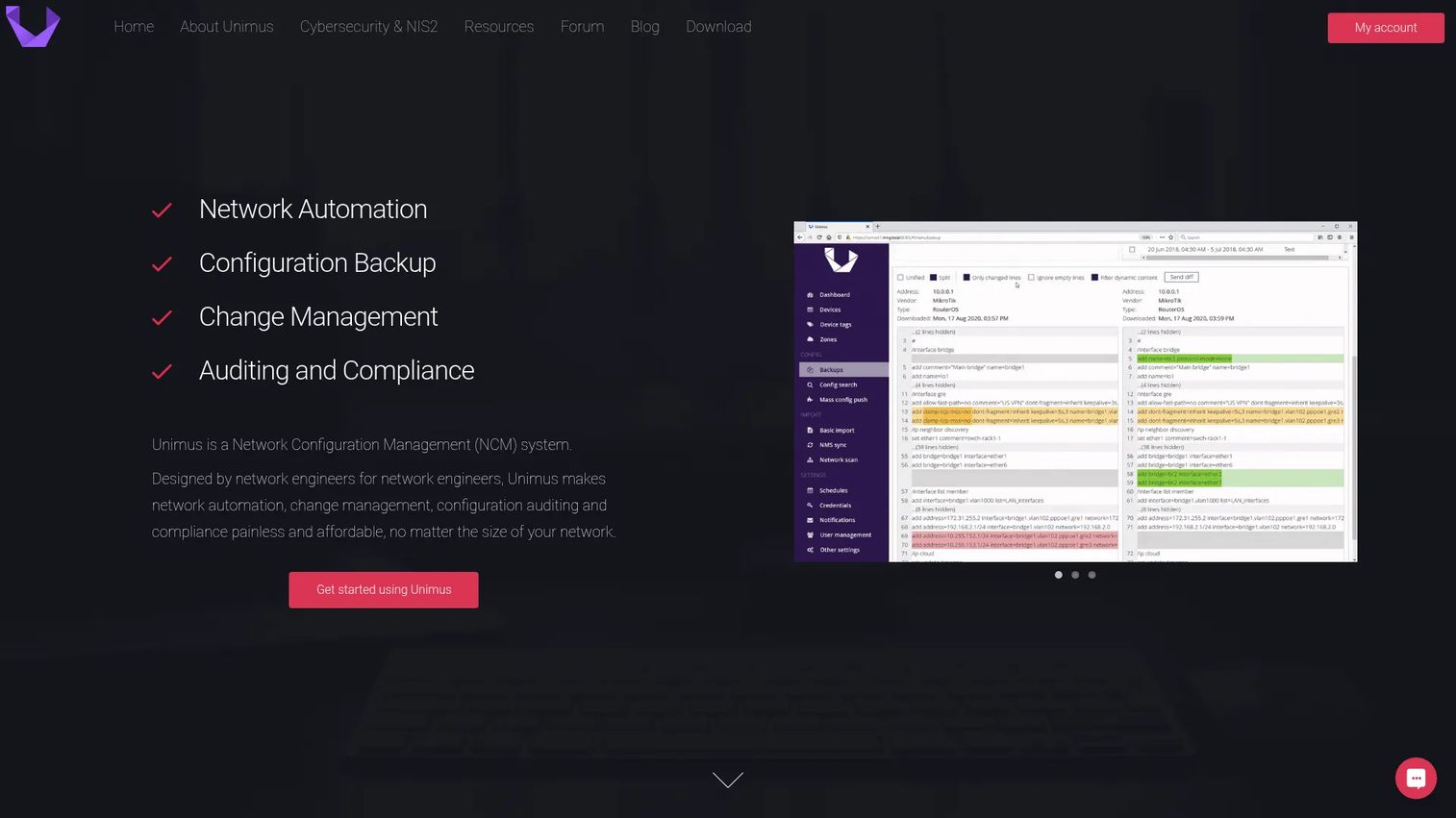
Unimus is on-premise network automation and configuration management software for backing up, auditing, and automating network devices. It is the pragmatic pick for teams that want practical automation quickly rather than building an orchestration program from scratch. Config backup, versioned history, and compliance auditing come out of the box, and a free tier lets you prove value before you spend.
Best for: IT teams that need on-prem network configuration backup, compliance, and automation without heavy setup.
Key strengths
- Configuration backup and versioned history: Automatic backups with full version history for every device.
- Change management with graphical diffs and alerts: See exactly what changed and get alerted when it does.
- Automation, auditing, and compliance: CLI access, config auditing, and compliance checks across multi-vendor devices.
Why choose Unimus: When your immediate need is reliable backup, change tracking, and compliance across a mixed fleet, Unimus delivers that without a long implementation. Its free 5-seat license makes it easy for presales and technical teams to trial the workflow before committing budget, and its vendor-neutral approach supports mixed hardware out of the box.
Unimus pricing: Unimus offers a free 5-seat license, an SMB license for up to 1000 devices starting at $5.90 per seat per year, and an Enterprise license for unlimited devices starting at $8,500.00 per year, according to G2's pricing listing. Unimus holds a 4.4/5 rating on G2.
Considerations before you buy
A network automation platform is a long-term commitment. Here is what to pressure-test before you shortlist.
Source of truth and data accuracy
Automation is only as trustworthy as the data behind it. Decide whether you need a dedicated source of truth like NetBox, or whether an assurance tool that discovers live state will cover your accuracy needs. Skipping this step is the fastest way to automate the wrong thing at scale.
Multi-vendor support
Most real networks are mixed. Confirm the platform genuinely supports every vendor and OS in your estate, not just the marquee ones. Vendor neutral network automation matters most when a single change has to land consistently across hardware from several manufacturers.
Orchestration and governance depth
Ask whether you need simple config push or full orchestration with approvals, RBAC, and audit trails. Change automation without governance is faster but riskier. If your organization has real change-control requirements, weight orchestration and policy enforcement heavily.
Integration with your existing stack
A tool that does not integrate becomes another silo. Check for connections to your CRM, ticketing, source of truth, and monitoring systems. Ask how many pre-built adapters exist versus how much custom work each integration will take.
Proof and validation before purchase
Before you recommend anything, validate it against your own environment. Free tiers, test drives, and sandboxes let you confirm fit on real data. When you present findings to stakeholders, showing the actual workflow beats describing it, which is why many technical teams pair their evaluation with an interactive product experience to communicate value clearly.
Conclusion
The seven picks here are archetypes, not just products. NetBox is the source of truth your automation depends on. IP Fabric is the assurance layer that validates live state before you touch it. Red Hat Ansible Automation Platform is the flexible, declarative engine for hybrid environments. Itential is the governed orchestration layer for policy-driven change. NetBrain is the troubleshooting and documentation platform for complex multi-vendor networks. Cisco Crosswork is the service-provider-grade lifecycle orchestrator. And Unimus is the pragmatic compliance and backup choice with a free tier.
The best network automation solution depends entirely on your operating model. If your data is messy, start with a source of truth. If your changes keep breaking things, start with assurance. If your problem is governance, start with orchestration. If you just need reliable backup and compliance today, start there.
Narrow the field to two or three tools that match your current reality, then validate each against your own environment before you commit. If part of that validation involves showing stakeholders how a tool works, try building an interactive demo so the workflow speaks for itself.
FAQs
Network automation software configures, provisions, validates, and manages network infrastructure programmatically instead of manually. Teams use it to standardize config changes, enforce compliance policies, discover topology, and coordinate multi-step changes across many devices. The core goal is repeatable, auditable operations that do not depend on hand-typed commands.
Network automation handles individual tasks, like pushing a config or backing up a device. Network orchestration coordinates many of those tasks into a governed, multi-step workflow that can span devices, domains, and systems. Put simply, automation does one thing well, and orchestration strings those things together with approvals, sequencing, and policy enforcement.
Most tools on this list support mixed hardware, but the strongest multi-vendor options are IP Fabric for vendor-neutral discovery, Red Hat Ansible Automation Platform for agentless config across vendors, Cisco Crosswork for multivendor lifecycle automation, and Unimus for cross-vendor backup and compliance. Always confirm support for every specific OS in your estate before you commit.
In most cases, yes. Automation trusts whatever data it reads, so inaccurate inventory produces confidently wrong changes at scale. A dedicated source of truth like NetBox, or an assurance platform that discovers live state, gives your automation a reliable foundation. Skipping this step is the most common cause of automation that breaks in production.
Ask about multi-vendor support for the exact hardware in play, integration with the existing stack, governance depth (approvals, RBAC, audit), and how the vendor supports validation. Also ask whether a free tier, test drive, or sandbox is available so the team can prove fit on real data before purchase. Those answers separate a demo-ready tool from a shelfware risk.
For governed change control at enterprise scale, Itential leads with approvals, RBAC, and audit built in. For straightforward config compliance, backup, and change tracking, Unimus covers it with graphical diffs and alerts. NetBrain also helps here by keeping documentation and runbooks current, which supports audit readiness.
Track reduction in manual change time, config drift incidents, mean time to resolution, and the percentage of changes that pass compliance checks on the first attempt. Teams also watch how many changes run through governed workflows versus ad hoc CLI. Improvement across those metrics is the clearest signal that automated network operations are actually working.