Your branch office in Denver just lost its MPLS circuit for the third time this quarter. The failover took four minutes. During those four minutes, the local sales team could not reach Salesforce, and the warehouse scanners went dark. You escalate the ticket, the carrier shrugs, and the renewal quote for that same rigid circuit lands on your desk at a higher price than last year.
That is the exact friction that pushed most enterprises toward software-defined WAN. Traditional WAN and MPLS were built for a world where applications lived in a data center you controlled. They were not built for a world where your critical apps live in five different clouds and half your workforce connects from home. The result is a network architecture that fights against how your business actually runs.
The market reflects the shift. The global SD-WAN market is projected to grow from USD 9.5 billion in 2026 to USD 44.3 billion by 2033, a 24.7% CAGR, according to Persistence Market Research (2024). Among the 5,000 largest global enterprises, SD-WAN is projected to be installed at 81% of WAN sites by 2026, up from 61% in 2023, per TeleGeography via SDxCentral (2023). This is no longer an emerging category. It is the default.
If you evaluate infrastructure for a living, you already know the hard part is not deciding whether to modernize. It is choosing the right software, the right architecture, and the right deployment model for your specific situation. Presales and network teams need comparison-ready criteria, not vendor marketing. This guide is built for that job. For adjacent evaluations, our roundups of application performance monitoring tools and AI security posture management tools pair well with any WAN modernization project.
What's inside
This guide is for IT buyers, network architects, infrastructure leads, presales engineers, and service providers comparing SD-WAN options before a proof of concept or internal recommendation. We selected entries based on four criteria that matter during real evaluation: architecture fit and dynamic path selection, security model, cloud and SaaS optimization, and deployment ownership. We include five named platforms plus two deployment-model categories, SD-WANaaS and managed services, because the right answer for many teams is not a product at all but a delivery model. Every entry is framed for how presales teams actually validate technical fit.
TL;DR
- Best for large enterprise WAN teams: Cisco SD-WAN, deep policy control and multicloud reach at scale.
- Best for SASE-aligned modernization: Prisma SD-WAN, AI-assisted path steering with cloud-first architecture.
- Best for unified networking and security: Fortinet Secure SD-WAN, one OS for WAN and security.
- Best for service providers and flexible deployment: flexiWAN, open-source with pay-as-you-go SaaS pricing.
- Best for lean IT and distributed branches: Cisco Meraki SD-WAN, cloud-managed simplicity and fast rollout.
- Best when you want to offload operations: SD-WANaaS or managed SD-WAN services, control and burden balanced by a provider.
What is SD-WAN software?
SD-WAN software is a software-defined wide area network technology that decouples network control from the underlying hardware, letting you manage traffic across multiple connection types (MPLS, broadband, LTE, 5G) from a single centralized controller. In plain terms, the SD-WAN meaning comes down to this: instead of manually configuring each router at each site, you define policy once, and the software applies it everywhere.
That answers the common question of what is SD-WAN. It is an overlay that sits on top of your existing transport, steering application traffic dynamically based on real-time link conditions and business policy rather than static routing tables.
Core capabilities you should expect from any serious SD-WAN solution:
- Dynamic path selection: The software continuously measures latency, jitter, and packet loss, then routes each application over the best available link in real time.
- Application aware traffic steering: Traffic is classified by application, so a video call gets treated differently than a backup job, and business-critical apps get priority.
- Centralized management: A single console pushes policy, monitors health, and reports on the entire fabric, replacing device-by-device CLI work.
- Zero touch provisioning: New sites come online by shipping an appliance that phones home and pulls its configuration automatically, with no engineer on site.
- Integrated SD-WAN security: Encryption, segmentation, and increasingly full firewall and SASE capabilities are built into the fabric.
- WAN optimization and cloud connectivity: Deduplication, caching, and direct-to-cloud breakout improve app performance and reduce backhaul.
- Network visibility: Deep telemetry into flows, sites, and applications so teams can troubleshoot and plan capacity.
The distinction from legacy transport is the whole point. On the SD-WAN vs MPLS question, MPLS gives you a private, predictable circuit but no application intelligence and a high per-megabit cost. SD-WAN layers intelligence on top of any transport, including cheap broadband, so you keep MPLS where you need it and offload the rest. Many teams run both during a phased migration.
When to use SD-WAN software
Replace or augment rigid MPLS
If your WAN spend is climbing while your circuits stay static, SD-WAN lets you add broadband or LTE alongside MPLS and steer traffic intelligently. You keep private transport for the flows that need it and move everything else to cheaper links, often cutting connectivity cost while improving resilience.
Fix cloud and SaaS performance
When your users complain that Microsoft 365 or your CRM feels slow, the culprit is usually backhaul, routing all traffic through a central data center before it reaches the cloud. SD-WAN enables direct cloud connectivity from each branch, with local breakout to SaaS, which cuts latency and removes the data center bottleneck.
Scale distributed and hybrid sites fast
If you are opening branches, retail locations, or remote sites faster than your network team can configure routers, zero touch provisioning changes the math. Ship an appliance, plug it in, and centralized management does the rest. This is where lean IT teams get the most leverage.
Comparison table
The table below maps each SD-WAN software option against intent, key use case, pricing, and G2 rating. Use it as a shortlist starter, then read the item sections for the detail that matters to your evaluation.
| # | Product | Intent | Key use case | Pricing | G2 rating |
|---|---|---|---|---|---|
| 1 | Cisco SD-WAN | Enterprise scale | Secure, centrally managed WAN across branch, cloud, and SaaS | Custom quote | 4.4/5 |
| 2 | Prisma SD-WAN | SASE alignment | AI-assisted path steering and cloud-first modernization | Custom quote | Not listed |
| 3 | Fortinet Secure SD-WAN | Unified security | WAN and security on a single OS and console | Custom quote | 4.6/5 |
| 4 | flexiWAN | Flexible deployment | Open-source SD-WAN and SASE for enterprises and MSPs | From $33/instance/mo (annual) | Not listed |
| 5 | Cisco Meraki SD-WAN | Cloud-managed simplicity | Fast, centrally managed SD-WAN for distributed branches | Custom quote | 4.3/5 |
| 6 | FatPipe | Operational offload | Co-managed or fully managed WAN for lean teams | Custom quote | 4.5/5 |
1. Cisco SD-WAN
Cisco SD-WAN is Cisco's cloud-managed WAN solution for secure, scalable connectivity across branch, cloud, and SaaS environments. It brings decades of enterprise networking depth into a single fabric that centralizes policy control, applies application-aware routing, and enforces security at every edge. For teams already standardized on Cisco hardware, it extends what they run rather than replacing it.
Best for: Enterprises needing secure, centrally managed SD-WAN at scale.
Key strengths
- Centralized cloud-managed control: One controller enforces policy and segmentation across the entire WAN fabric, replacing device-by-device configuration.
- Built-in zero-trust security: Segmentation and encryption are native, so security travels with the traffic instead of bolting on separately.
- Multicloud and SaaS connectivity: Cloud OnRamp and AI-powered analytics optimize paths to cloud and SaaS applications automatically.
Why choose Cisco SD-WAN: If your organization runs a large, multi-site WAN and already has Cisco expertise on staff, this is the option with the deepest policy control and the widest cloud reach. The scale that makes it powerful also means it rewards teams with the network depth to configure and operate it fully. For presales validation, its granular segmentation and analytics give you concrete proof points to walk security stakeholders through.
Cisco SD-WAN pricing: Cisco does not publish a public starting price for SD-WAN. Licensing is subscription and tier based, with the exact figure depending on site count, throughput, and the security features you enable. Expect a custom quote through Cisco or a partner, and budget time for a scoping conversation during evaluation. Cisco Catalyst SD-WAN holds a 4.4/5 rating on G2.
2. Prisma SD-WAN

Prisma SD-WAN is Palo Alto Networks' cloud-delivered, AI-driven SD-WAN built for security-first WAN modernization. It leans hard into autonomous operations, using machine learning to steer traffic along the best path and to remediate issues before users notice them. For teams already mapping out a SASE strategy, it fits naturally into that broader architecture.
Best for: Teams modernizing branch connectivity while planning a SASE rollout.
Key strengths
- AI-assisted path steering: Machine learning selects and adjusts paths dynamically, reducing manual tuning as conditions change.
- Cloud-ready architecture: Built for direct cloud connectivity and app performance rather than data center backhaul.
- Security-first design: Policy control and visibility align tightly with Palo Alto's broader security and SASE portfolio.
Why choose Prisma SD-WAN: If your evaluation is really a SASE evaluation in disguise, and many are in 2026, Prisma gives you a WAN layer designed to converge with cloud-delivered security from day one. Its strength is branch performance, deep network visibility, and centralized policy control that a security team can reason about. That makes technical validation smoother when security stakeholders are in the room early.
Prisma SD-WAN pricing: Palo Alto Networks does not list public pricing for Prisma SD-WAN. Packaging is quote based and typically scoped alongside the wider Prisma and SASE offering, so pricing depends on sites, bandwidth, and which security services you attach. Plan for a sales-led scoping cycle and factor the broader platform commitment into your evaluation.
3. Fortinet Secure SD-WAN
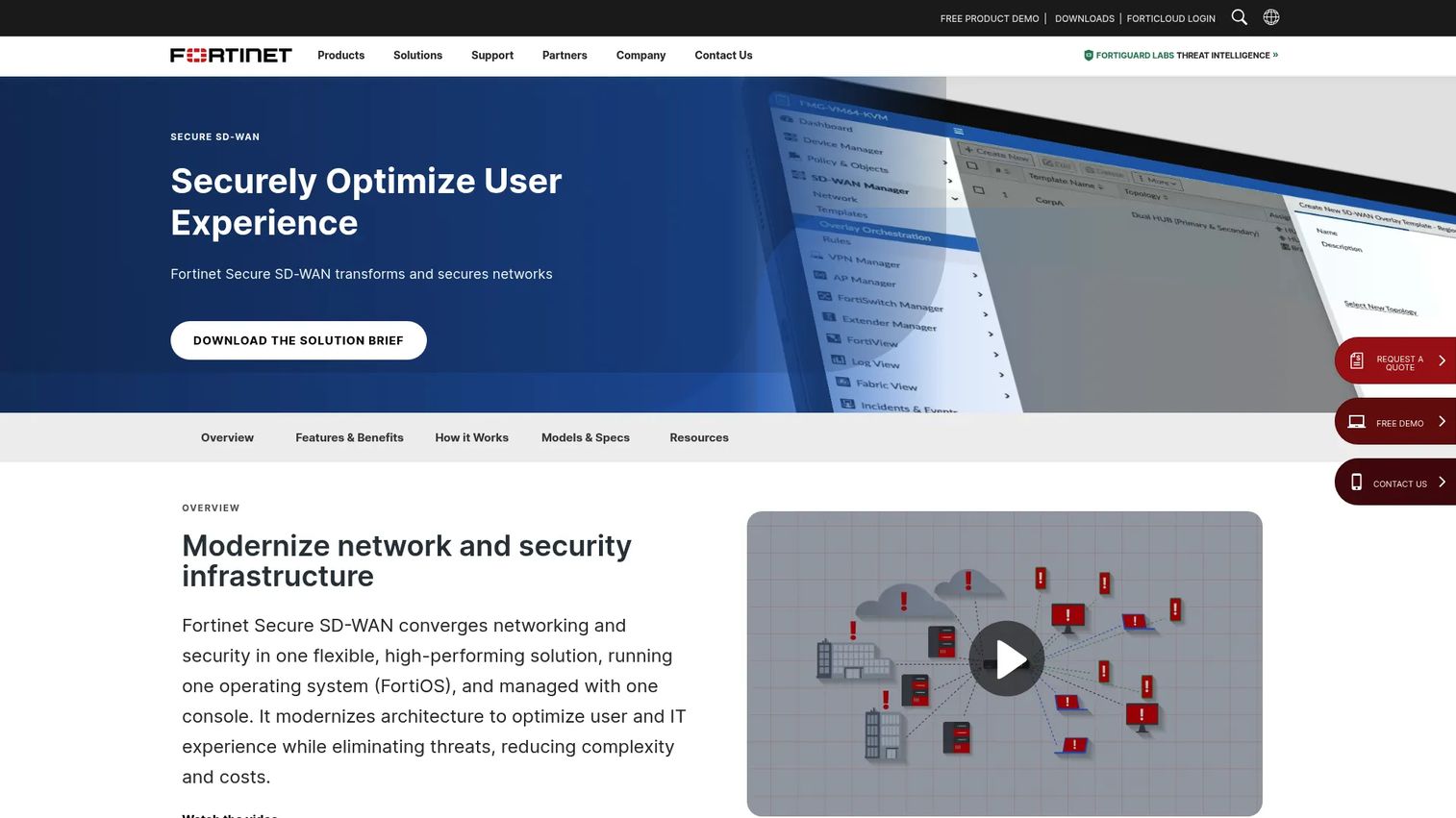
Fortinet Secure SD-WAN is a secure SD-WAN solution that combines networking and security on FortiOS with centralized management. The pitch is convergence: instead of stitching together a separate SD-WAN box and a separate firewall, you run both on one operating system and one console. For teams that want WAN and SD-WAN security to work as a single stack, that is a meaningful simplification.
Best for: Enterprises needing unified networking and security for branch, cloud, and hybrid WANs.
Key strengths
- Single OS and single console: FortiOS runs networking and security together, managed from one place, which cuts operational sprawl.
- Application-aware traffic steering and WAN remediation: Traffic is steered by application, with automatic remediation when a link degrades.
- Integrated security services: Native FortiGate NGFW and FortiSASE integration means security is part of the fabric, not an add-on.
Why choose Fortinet Secure SD-WAN: If your security and networking teams are tired of managing two separate stacks, Fortinet's single-OS approach collapses that into one. It is a strong fit for cloud-first and hybrid environments where consistent policy across WAN and security matters. During a POC, the unified console gives presales a clean story to demonstrate, and the security integration answers diligence questions without a second vendor conversation. Fortinet Secure SD-WAN holds a 4.6/5 rating on G2, the highest in this shortlist.
Fortinet Secure SD-WAN pricing: Fortinet does not publish a public price for Secure SD-WAN. Pricing is quote or partner based and scales with appliance model, throughput, and the security subscriptions you enable. Because networking and security are bundled on one platform, scope both together when you request a quote so the comparison against separate-vendor stacks is apples to apples.
4. flexiWAN
flexiWAN is an open-source SD-WAN and SASE platform with SaaS and service-provider deployment options. Its open architecture and hardware flexibility set it apart from the appliance-locked incumbents. You can run it on the hardware you choose, customize the stack, and pay per instance rather than committing to a large upfront license. That combination makes it the standout choice for service providers and teams that value deployment freedom.
Best for: Enterprises and service providers wanting open-source SD-WAN and SASE with centralized management.
Key strengths
- Open-source SD-WAN and SASE: An open codebase means customization and hardware freedom that closed appliances do not offer.
- Zero touch provisioning: New edges register and pull configuration automatically, so distributed rollouts stay fast.
- Firewall, routing, and QoS: Core networking and security functions are built in, managed from a central controller.
Why choose flexiWAN: If you are an MSP building a repeatable managed SD-WAN offering, or an enterprise that wants to avoid vendor lock-in, flexiWAN's open model and per-instance pricing give you flexibility the appliance vendors do not. The pay-as-you-go structure also lowers the barrier to a proof of concept, so presales and infrastructure teams can validate real workloads without a heavy commitment.
flexiWAN pricing: flexiWAN publishes clear pricing. Enterprise SaaS is priced per registered flexiEdge instance: $40 per instance per month for 1 to 10 instances billed monthly, or $33 per instance per month billed yearly. A free trial is available for 1 to 5 instances, and service-provider pricing is custom with volume discounts. This transparency is rare in the category and makes budgeting straightforward.
5. Cisco Meraki SD-WAN

Cisco Meraki SD-WAN is cloud-managed secure SD-WAN for branch, campus, and hybrid network connectivity. Where Cisco's flagship SD-WAN targets deep enterprise control, Meraki optimizes for operational simplicity. The entire fabric is managed from a clean cloud dashboard, appliances provision themselves, and distributed sites come online fast. For teams that value straightforward operations over maximum configurability, it is a natural fit.
Best for: Organizations wanting centrally managed SD-WAN with Cisco Meraki appliances.
Key strengths
- Cloud-managed security and SD-WAN: A single dashboard runs the whole fabric, so lean teams operate at scale without device-by-device work.
- Zero touch provisioning: Appliances self-configure on connection, making multi-site rollouts fast and low-effort.
- Application visibility and smart path selection: Built-in analytics and dynamic path selection keep branch app performance steady.
Why choose Cisco Meraki SD-WAN: If you run a distributed, multi-site environment with a small IT team, Meraki's cloud-first management removes most of the operational overhead of a traditional WAN. It is the right pick when you want fast deployment, clear network visibility, and centralized control without a dedicated networking specialist. Presales teams find it easy to demonstrate because the dashboard tells the whole story in one view. Cisco Meraki holds a 4.3/5 rating on G2.
Cisco Meraki SD-WAN pricing: Cisco Meraki does not display public pricing. Licensing is subscription based, tied to appliance model and license term, and quoted through Cisco or a partner. The product pages emphasize free trials and contact-style CTAs, so start with a trial to validate the management experience before you scope a full quote.
6. FatPipe
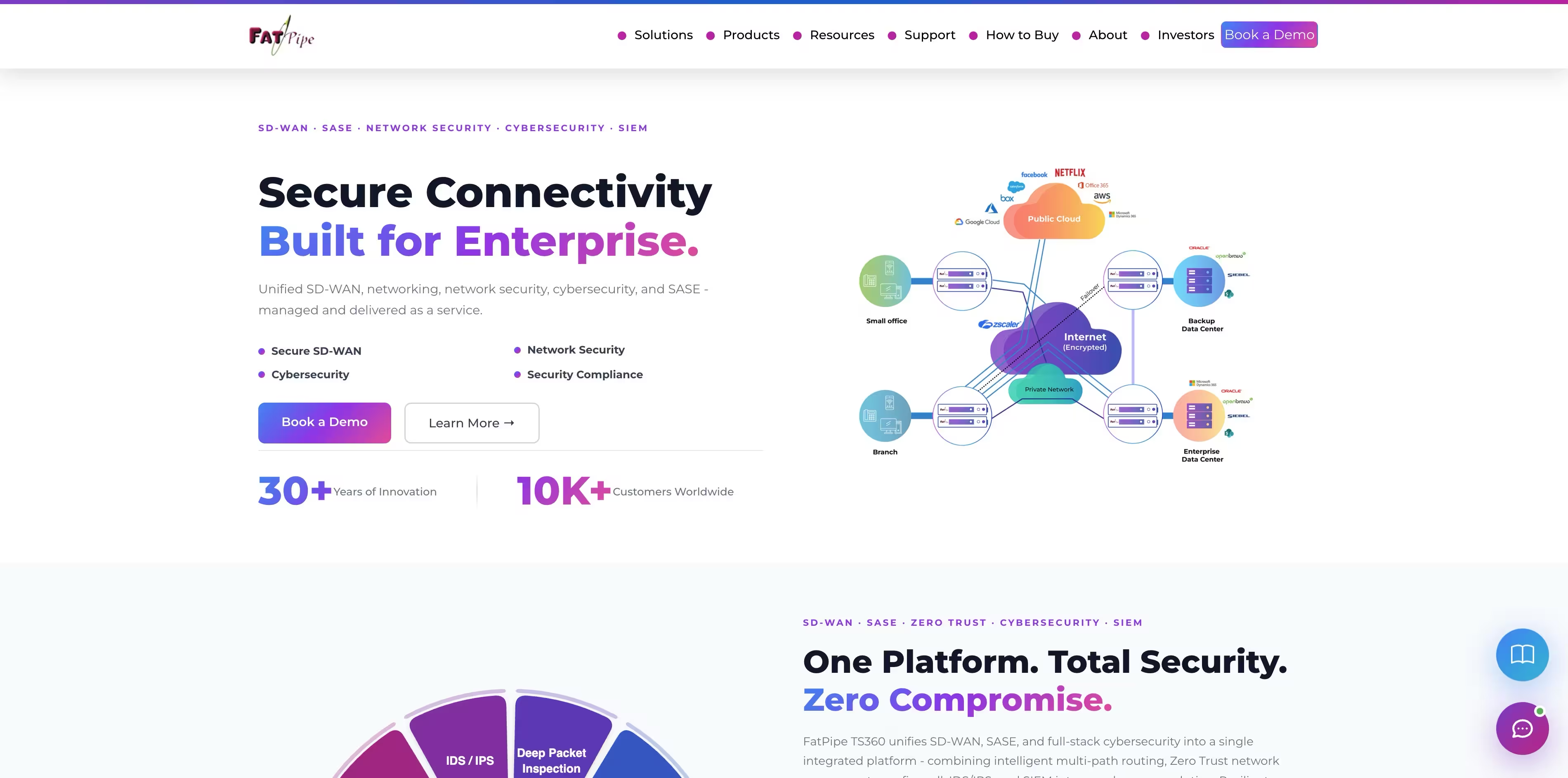
Managed SD-WAN services cover fully managed and co-managed delivery models, where a provider takes on some or all of the design, deployment, and ongoing operation of your WAN. FatPipe is one example of a vendor in this space, offering managed, secure SD-WAN, SASE, and network security services for enterprise connectivity. The defining trait of this category is that operational responsibility is shared or handed off entirely.
Best for: Enterprises needing managed SD-WAN with redundancy and security, especially teams lacking deep in-house network expertise.
Key strengths
- Sub-second failover: Managed platforms prioritize resilience, keeping sessions alive when a link drops.
- Application classification and policy-based routing: Traffic is classified and routed by policy, so critical apps stay prioritized.
- Centralized management and monitoring: The provider operates a central console and monitors the fabric around the clock.
Why choose managed SD-WAN services: If you run a distributed enterprise but do not have the internal network depth to design and operate SD-WAN yourself, a managed model balances control against operational burden. Co-managed options let you keep policy ownership while offloading day-to-day operations, which is often the sweet spot for teams that want a say without staffing a full NOC. During evaluation, scrutinize the SLA, the escalation path, and exactly which responsibilities stay with you versus the provider. FatPipe SD-WAN holds a 4.5/5 rating on G2.
Managed SD-WAN services pricing: Managed services do not publish standard public pricing. Cost depends on the number of sites, the level of management (co-managed versus fully managed), the SLA tier, and any bundled security. Providers direct you to a sales conversation, so come prepared with your site count, bandwidth needs, and required response times to get an accurate quote.
Considerations before you buy
Architecture and path intelligence fit
Look past the marketing and test how the software actually handles dynamic path selection and application aware traffic steering under real conditions. In a POC, degrade a link deliberately and watch how fast the fabric reroutes. The quality of that behavior separates strong SD-WAN software from repackaged routing.
Security model and SASE trajectory
Decide early whether you want networking and security converged or kept separate. Some options build SD-WAN security into the fabric, others expect you to bring your own. If SASE is on your roadmap, weight vendors whose SD-WAN and security share a control plane, because retrofitting convergence later is painful.
Deployment ownership and operational load
Be honest about your team's capacity. A powerful DIY platform rewards teams with network depth, while SD-WANaaS and managed services trade some control for operational relief. Zero touch provisioning and centralized management reduce the load either way, but they do not replace a clear ownership decision.
Cloud connectivity and visibility
Verify how the software handles direct cloud connectivity, local breakout, and WAN optimization for your specific SaaS and cloud apps. Then check the depth of network visibility, because you cannot troubleshoot or optimize what you cannot see. Ask for the analytics dashboard during the demo, not after the contract.
Conclusion
There is no single best SD-WAN software, only the best fit for your architecture, your security posture, and your team's capacity to operate an enterprise WAN.
For large enterprise IT with Cisco depth and multicloud demands, Cisco SD-WAN offers the deepest policy control. If your modernization is really a SASE journey, Prisma SD-WAN aligns WAN and cloud security from the start. Teams that want networking and security in one stack should shortlist Fortinet Secure SD-WAN. Service providers and lock-in-averse enterprises get real flexibility from flexiWAN's open-source, per-instance model. Lean IT teams running distributed branches will find Cisco Meraki SD-WAN the simplest to operate. And if you would rather own outcomes than infrastructure, SD-WANaaS or managed SD-WAN services put operations in a provider's hands.
Start by naming your deployment ownership model, then let architecture, security, and cloud requirements narrow the field. Run a real proof of concept, degrade a link, and watch the software work before you sign anything.
If your team also evaluates the software you sell through interactive demos and hands-on validation, Start your journey with Guideflow today!
FAQs
SD-WAN software is a software-defined wide area network technology that separates network control from hardware, letting you manage traffic across MPLS, broadband, LTE, and 5G from one centralized controller. It applies dynamic path selection and application-aware routing so business-critical apps get the best available link. In short, the SD-WAN meaning is intelligent, policy-driven WAN management delivered in software.
On the SD-WAN vs MPLS question, MPLS is a private, predictable circuit with no application intelligence and a high per-megabit cost. SD-WAN is an overlay that runs on any transport, including cheap broadband, and steers traffic dynamically based on real-time conditions and policy. Most teams keep MPLS for a few sensitive flows and move the rest to SD-WAN, often during a phased migration.
Most SD-WAN software includes encryption and segmentation as baseline SD-WAN security, but the depth varies widely. Some platforms build a full firewall and SASE capabilities into the fabric, while others expect you to add security separately. During evaluation, confirm exactly what is native versus add-on, and how policy is enforced at each edge.
SD-WAN is the networking layer that steers WAN traffic intelligently. SASE (Secure Access Service Edge) is a broader cloud-delivered model that converges SD-WAN with security services like secure web gateway, CASB, and zero-trust access. Put simply, SD-WAN is a component of a full SASE architecture, and many 2026 evaluations start as SD-WAN projects and expand into SASE.
Neither is universally better; it depends on your team's capacity. A DIY build gives you maximum control and rewards teams with network depth. Managed SD-WAN and SD-WAN as a service trade some control for operational relief, which suits lean teams or distributed enterprises without a full network staff. Co-managed models split the difference, letting you keep policy ownership while offloading daily operations.
Yes. SD-WAN improves cloud connectivity by enabling local internet breakout at each branch, so SaaS and cloud traffic goes direct instead of backhauling through a central data center. Combined with dynamic path selection and WAN optimization, this cuts latency and reduces bottlenecks for apps like Microsoft 365 and cloud-hosted CRMs.
Ask how the software handles a degraded link in real time, what security is native versus add-on, and how much network visibility the analytics dashboard actually provides. Clarify the deployment ownership model, the SLA if a provider is involved, and whether you can export configuration to avoid lock-in. Run a proof of concept that deliberately stresses a link rather than trusting a scripted demo.
SD-WANaaS, or SD-WAN as a service, is a delivery model where a provider hosts, deploys, and operates the SD-WAN fabric for you on a subscription basis. You consume it monthly and scale sites without large capital outlay, while the provider handles operations and lifecycle. It sits between a fully DIY build and a fully managed service, giving you SD-WAN outcomes with less operational load.