An auditor asks for the approved version of a critical SOP. You have three versions across two shared drives, an approval thread buried in email, and no clean record of who signed off or when. That gap is where audit findings, warning letters, and rework come from.
Controlled documents break when the process behind them lives in the wrong tools. Approvals happen over email. Versions multiply across folders. Retention becomes a spreadsheet someone forgot to update. And when an inspector or internal reviewer shows up, the evidence gets assembled late, under pressure, with gaps nobody planned for. In regulated or risk-sensitive environments, that is not a minor inconvenience. It is a compliance liability with real cost.
The market has responded. The global document control software market is projected to reach USD 9.91 billion by 2035, growing at a 10.35% CAGR over 2026 to 2035, according to Spherical Insights (2024). The broader document management system market is expanding even faster, with Fortune Business Insights (2025) projecting growth from USD 9.74 billion in 2026 to USD 29.78 billion by 2034. Teams are investing because manual document control does not scale, and the penalty for getting it wrong keeps rising.
This guide ranks seven document control software platforms that actually manage the full lifecycle: version control, approval workflows, immutable audit trails, retention, search, and access control. If you are evaluating a document management system or a purpose-built quality platform, the shortlist below is built to help you match governance depth to your real compliance needs. For adjacent evaluation, our guides on audit management software and enterprise search cover the surrounding stack.
What's inside
This guide is for product, quality, compliance, legal, and operations leaders evaluating document control software for teams that manage controlled documents at scale. We selected tools based on four criteria: lifecycle coverage (drafting through retirement), compliance support (audit trails, retention, regulatory mapping), workflow automation (routing and approvals), and ecosystem fit (integrations and usability). Each platform below is real and web-verifiable, with verified G2 ratings and pricing context where public data exists. We prioritized tools that treat document control as governed process, not just file storage.
TL;DR
- Regulated life sciences teams needing a full eQMS: Qualio, MasterControl, and Montrium build document control into broader quality and compliance workflows.
- Enterprise quality at scale: MasterControl and ETQ Reliance offer deep process rigor and configurable quality applications for highly regulated manufacturing and pharma.
- Broad business document control plus workflow automation: DocuWare pairs cloud document management with AI-powered capture and business process automation.
- Connected quality and compliance governance: Ideagen ties document control to EHS, audit, and risk management in one platform.
- Security-first document management with a wide use case: Folderit delivers OCR search, versioning, approval workflows, and e-signatures with published pricing.
What is document control software?
Document control software is a system that governs the full lifecycle of controlled documents, from drafting and review through approval, publication, revision, and retirement, with enforced version control, audit trails, and access rules.
Unlike general file storage, it treats documents as governed records rather than static files. That distinction matters most in regulated industries where you must prove not just what a document says, but who wrote it, who approved it, when it changed, and why.
A capable document control system typically includes:
- Controlled document lifecycle: structured stages for drafting, review, approval, effective release, revision, and retirement, so no document goes live without sign-off.
- Version control: automatic version history that preserves every revision and prevents anyone from working off an outdated copy.
- Approvals and acknowledgements: configurable approval workflows plus read-and-understand acknowledgements that capture who signed and when.
- Audit trails: immutable, time-stamped records of every action, the evidence auditors and inspectors ask for first.
- Retention and archiving: retention policies that automatically archive or dispose of documents on schedule for records governance.
- Permissions and search: role-based permissions and access control plus search and OCR so the right people find the right approved version fast.
Together, these capabilities turn document handling from a manual, error-prone chore into a system that produces audit-ready evidence as a byproduct of normal work. That is the core difference between document control software and generic document management system software.
When to use document control software
Not every team needs strict document control. Here is how to tell when the governance layer is worth it.
Controlled document lifecycles
Use it when documents must move through a governed sequence: draft, review, approve, publish, revise, retire. This fits SOPs, work instructions, quality manuals, policies, and regulated procedures where an uncontrolled or outdated version creates real risk. If you find people asking "is this the current version?" or approving changes over Slack, you have outgrown shared drives. Document lifecycle management enforces the sequence so every effective document has a clean approval history behind it.
Audit-ready compliance workflows
Use it when the goal is traceable evidence for auditors, inspectors, or internal governance. Frameworks like ISO 9001, ISO 13485, FDA 21 CFR Part 11, HIPAA, GDPR, and GxP all expect you to demonstrate control over documents and records. Immutable audit trails, electronic signatures, and controlled retention turn audit prep from a fire drill into a query. When audit readiness is a standing requirement rather than an annual scramble, purpose-built compliance software pays for itself.
Cross-functional document governance
Use it when multiple teams need one source of truth. Product, quality, legal, operations, and enablement often touch the same controlled documents. Role-based access control, search and OCR, and integrations with tools like Microsoft 365 and SharePoint keep everyone on the approved version without emailing files around. This is where document control stops being a compliance tax and starts reducing operational overhead across the org.
Comparison table
The table below summarizes each platform by intent, primary use case, pricing, and G2 rating. Most quality-focused vendors use quote-based pricing, so treat the pricing column as a signal of packaging, not a fixed number. For teams also evaluating adjacent governance layers, our roundups on AI governance tools and contract lifecycle management software pair well with this shortlist.
| # | Product | Intent | Key use case | Pricing | G2 rating |
|---|---|---|---|---|---|
| 1 | DocuWare | Document management plus workflow automation | Cloud document control with AI capture and business process automation | Quote-based, cloud tiers 4/15/40/100 | 4.4/5 |
| 2 | Qualio | Life sciences eQMS | Controlled documents inside a validated quality system | Quote-based (Foundation, Growth, Scale) | 4.4/5 |
| 3 | MasterControl | Enterprise quality and manufacturing | ISO-aligned document control at enterprise scale | Contact sales | 4.4/5 |
| 4 | ETQ Reliance | Cloud-native eQMS | Configurable quality workflows with document routing | Contact sales | 4.3/5 |
| 5 | Ideagen | Connected quality, EHS, and compliance | Document control tied to audit and risk management | Contact sales | 4.2/5 |
| 6 | Montrium | Life sciences content management | Clinical, quality, and regulatory document control | Quote-based, request price | Not enough reviews |
| 7 | Folderit | Security-first document management | OCR search, versioning, workflows, e-signatures | From $55/month | 4.3/5 |
The 7 best document control software platforms
1. DocuWare
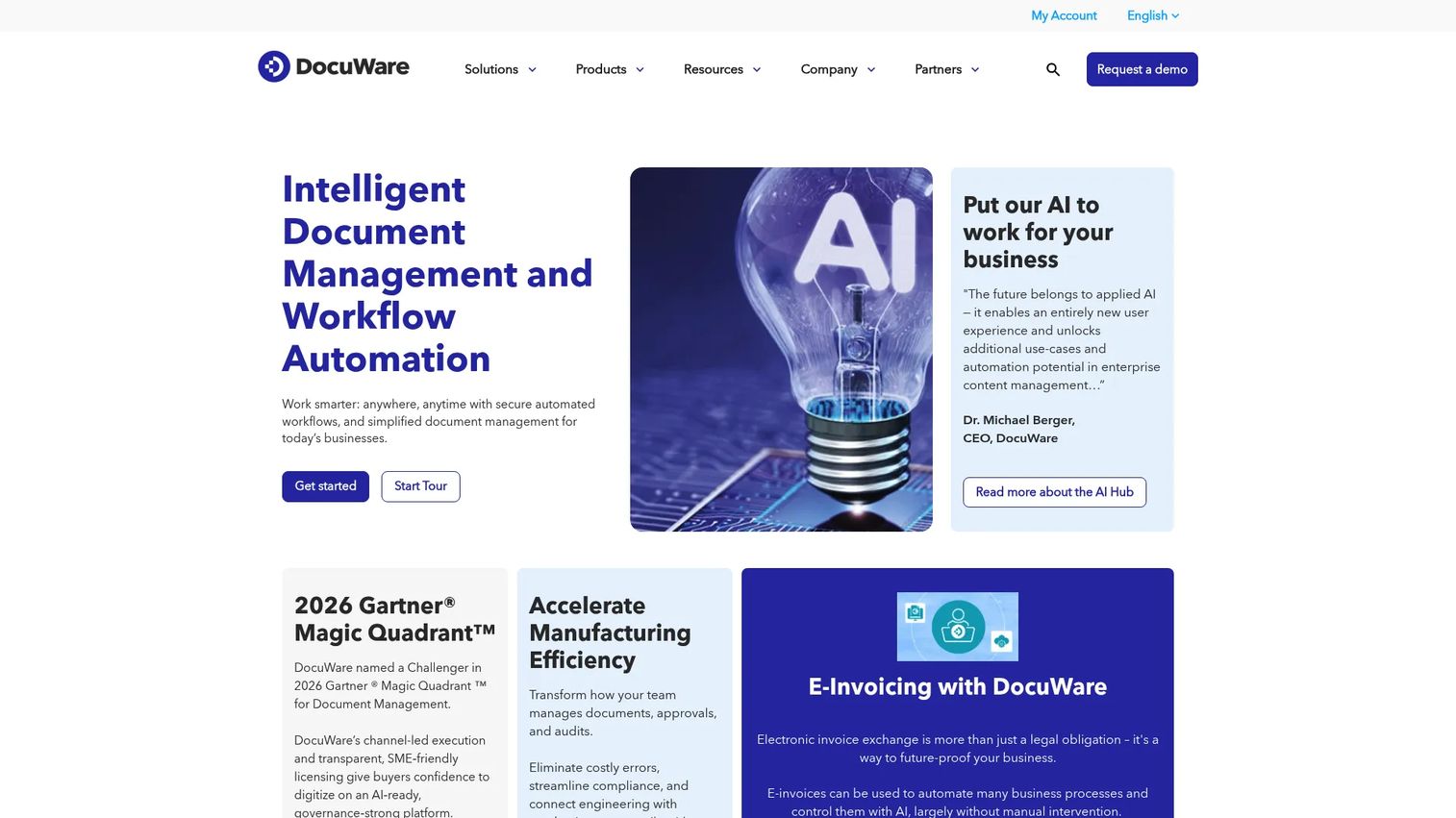
DocuWare is document management and workflow automation software built for organizations that need broad document control alongside business process automation. It combines cloud document management, configurable approval workflows, and AI-powered capture and indexing so documents get filed, routed, and retrieved without manual sorting. It suits teams that want controlled documents plus automation for invoices, HR files, contracts, and operational records, not only quality documents.
Where DocuWare stands out is breadth. It handles secure storage, metadata-driven organization, OCR search, and audit-ready retrieval across many document types and departments. That makes it a strong fit for finance, HR, and operations teams that want one system for document lifecycle management rather than a narrow quality-only tool.
Key strengths
- AI-powered capture and indexing: automatically extracts and tags document data, cutting manual filing and speeding retrieval.
- Workflow automation: routes documents for review and approval with configurable rules, reducing email-based approvals.
- Cloud document management: secure storage with version control, metadata, and permissions across teams and locations.
Why choose DocuWare: Pick it when your document control need spans multiple business functions, not just regulated quality. The automation layer means approvals, routing, and retention run without someone shepherding each file, which reduces the operational overhead that PMs and ops leaders care about.
DocuWare pricing: DocuWare uses cloud tiers named Cloud 4, Cloud 15, Cloud 40, and Cloud 100, billed on annual or multi-year contracts. Pricing depends on users, storage, contract term, and professional services, and the company directs prospects to contact sales for a quote. No public numeric starting price is published on the first-party pricing page. DocuWare holds a 4.4/5 rating on G2.
2. Qualio
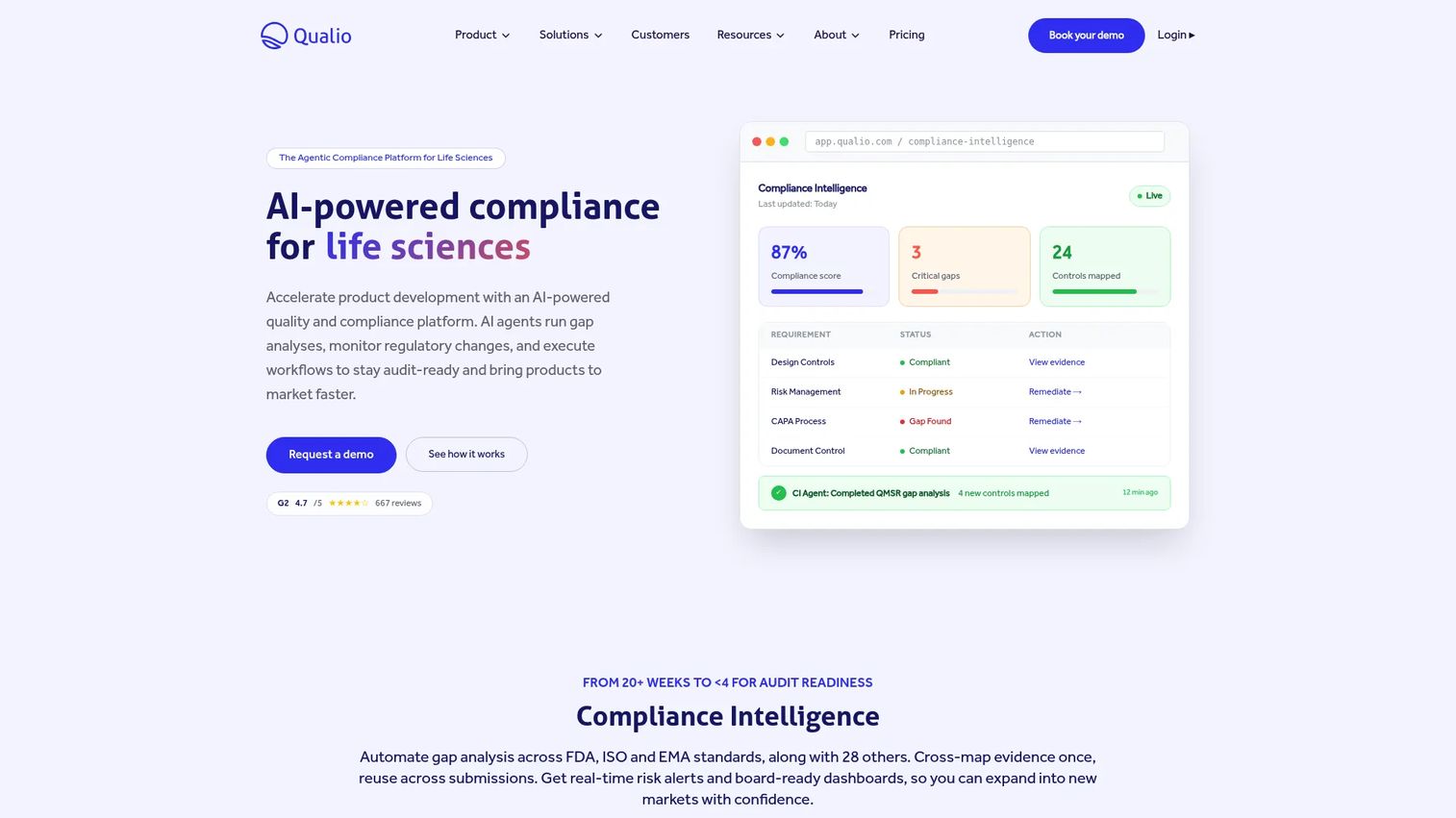
Qualio is an AI-powered compliance platform built for life sciences teams that need controlled documents inside a broader quality management system. It handles controlled document creation, version history, immutable audit trails, in-app editing, and compliance workflows, so quality teams manage documents, training, and change control in one validated system rather than stitching tools together.
Qualio suits scaling medical device, pharma, and biotech teams that need document control as part of a full eQMS. Because document management sits alongside training management, supplier management, CAPA, and audit management, an approved SOP can trigger training assignments and acknowledgements automatically, which keeps records governance tight.
Key strengths
- Immutable audit trails: time-stamped records of every document action, built for FDA 21 CFR Part 11 and ISO 13485 audit readiness.
- In-app editing with version control: draft, review, and approve documents inside the platform with full version history preserved.
- Compliance Intelligence and AI gap analysis: surfaces regulatory requirements and flags gaps across your quality system.
Why choose Qualio: Choose it when document control cannot be separated from your broader quality obligations. For life sciences teams that need validated software and connected quality processes, a standalone document tool leaves too many manual handoffs between documents, training, and change control.
Qualio pricing: Qualio offers three plans, Foundation, Growth, and Scale, all on annual recurring subscriptions with Scale on custom pricing. The company tailors pricing after an initial conversation, and implementation fees apply to all plans. No public numeric price is listed. Qualio holds a 4.4/5 rating on G2.
3. MasterControl
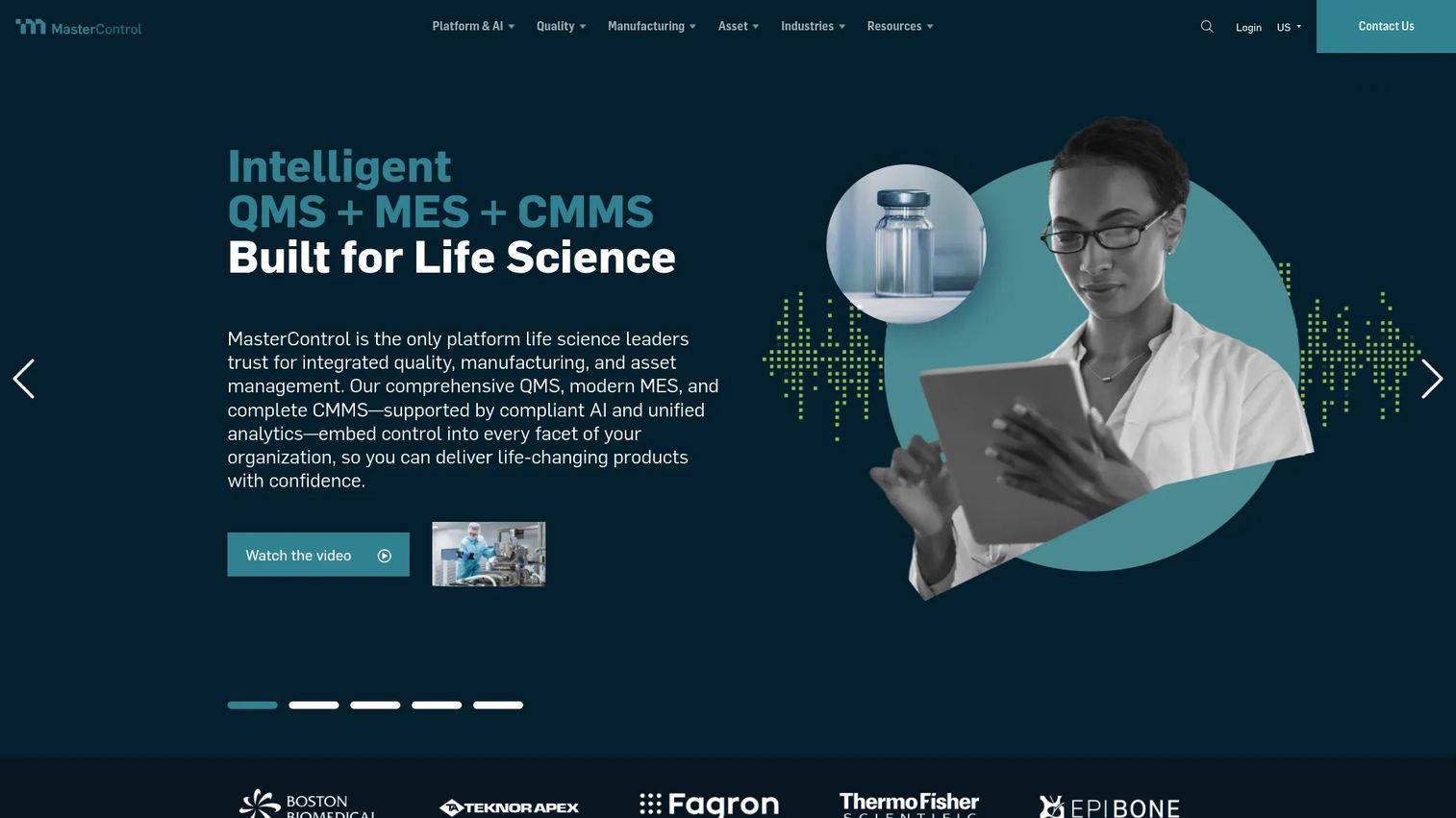
MasterControl is cloud software for regulated life sciences quality, manufacturing, and asset management, with document control at the core of its quality suite. It emphasizes revision control, controlled routing, and compliance-centric governance, making it a fit for organizations that need enterprise-grade process rigor across quality and manufacturing.
MasterControl suits highly regulated pharma, medical device, and biotech companies where document control connects to manufacturing execution and asset management. Its Quality Excellence module governs controlled documents through structured lifecycles, while Manufacturing Excellence and Asset Excellence extend that control into production and equipment records.
Key strengths
- Quality Excellence QMS: controlled document lifecycle with revision control, routing, and electronic signatures for regulated environments.
- Manufacturing Excellence: extends document control into production records and batch documentation.
- Asset Excellence: manages equipment and asset records under the same governed system.
Why choose MasterControl: Choose it when you need enterprise scale and deep process rigor across quality and manufacturing, not just documents. For large regulated organizations, connecting document control to production and asset records in one validated platform reduces the seams where compliance gaps appear.
MasterControl pricing: MasterControl tailors plans to each business and directs visitors to contact sales for pricing. No public numeric price or tier list is published on the first-party pricing page. MasterControl holds a 4.4/5 rating on G2.
4. ETQ Reliance
ETQ Reliance is a cloud-native eQMS that delivers document control as part of a broader quality management system. It emphasizes controlled document routing, training records, audit management, and configurable quality workflows, with a codeless application designer that lets teams shape processes without heavy development work.
ETQ Reliance suits manufacturing, life sciences, and industrial quality teams that need document control connected to the full quality picture. Because workflows are configurable rather than fixed, quality teams can align document routing, approvals, and retention to their specific regulatory and operational requirements.
Key strengths
- Configurable quality workflows: codeless application designer adapts document routing and approvals to your process.
- Integrated quality applications: connects document control with training, audit, CAPA, and nonconformance management.
- Advanced analytics and predictive insights: surfaces trends across quality data to support audit readiness and continuous improvement.
Why choose ETQ Reliance: Choose it when configurability matters and your quality processes do not fit a rigid template. For manufacturing and industrial teams, the codeless designer means quality owns the workflow logic without waiting on developers, which lowers the maintenance burden over time.
ETQ Reliance pricing: ETQ does not list public pricing. Cost depends on the applications implemented and the number of users, and the company directs prospects to request a demo or contact sales. ETQ Reliance holds a 4.3/5 rating on G2.
5. Ideagen
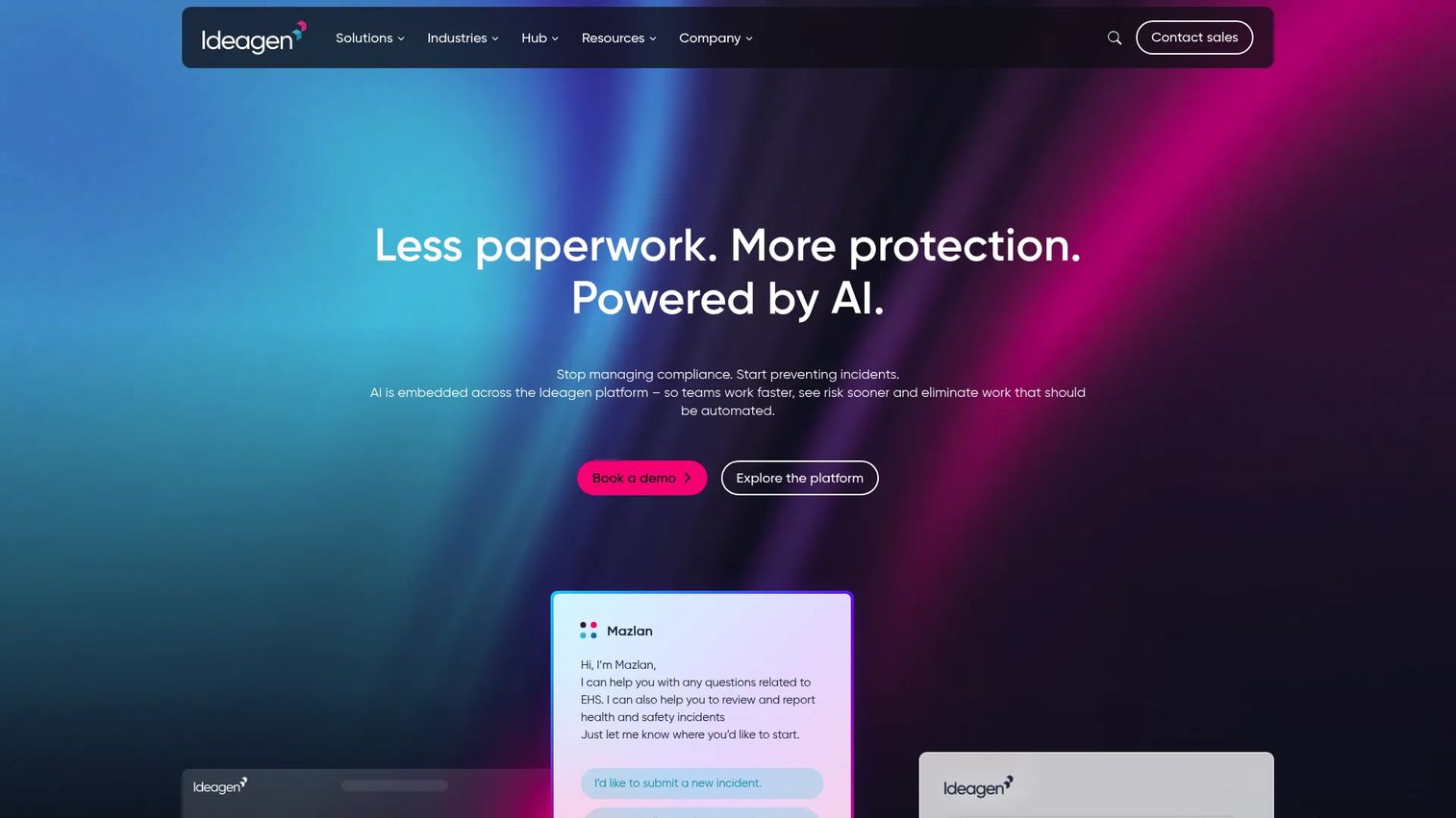
Ideagen is a B2B software platform for EHS, quality, compliance, audit, and risk management, with document control woven into connected governance workflows. It covers version control, approval workflows, audit trails, and compliance mapping, positioning document control as one part of a wider regulated operations suite.
Ideagen suits regulated organizations that want document control tied closely to broader quality and compliance functions. When your documents, audits, incidents, and risk registers live in one platform, a policy update can flow into audit scope and compliance tracking without manual reconciliation across systems.
Key strengths
- Compliance workflows: manages audits, policies, and controlled documents under one governance layer.
- Quality management with NCR and CAPA: connects document control to nonconformance and corrective action tracking.
- EHS incident and inspection management: extends control into safety, hazard, and inspection records.
Why choose Ideagen: Choose it when document control is one piece of a larger compliance mandate spanning quality, safety, and risk. For teams that already manage audits and incidents, consolidating documents into the same platform reduces tool sprawl and keeps governance connected end to end.
Ideagen pricing: Ideagen uses quote-based pricing and directs visitors to contact sales. No public numeric pricing is displayed on the first-party site. Ideagen holds a 4.2/5 rating on G2.
6. Montrium
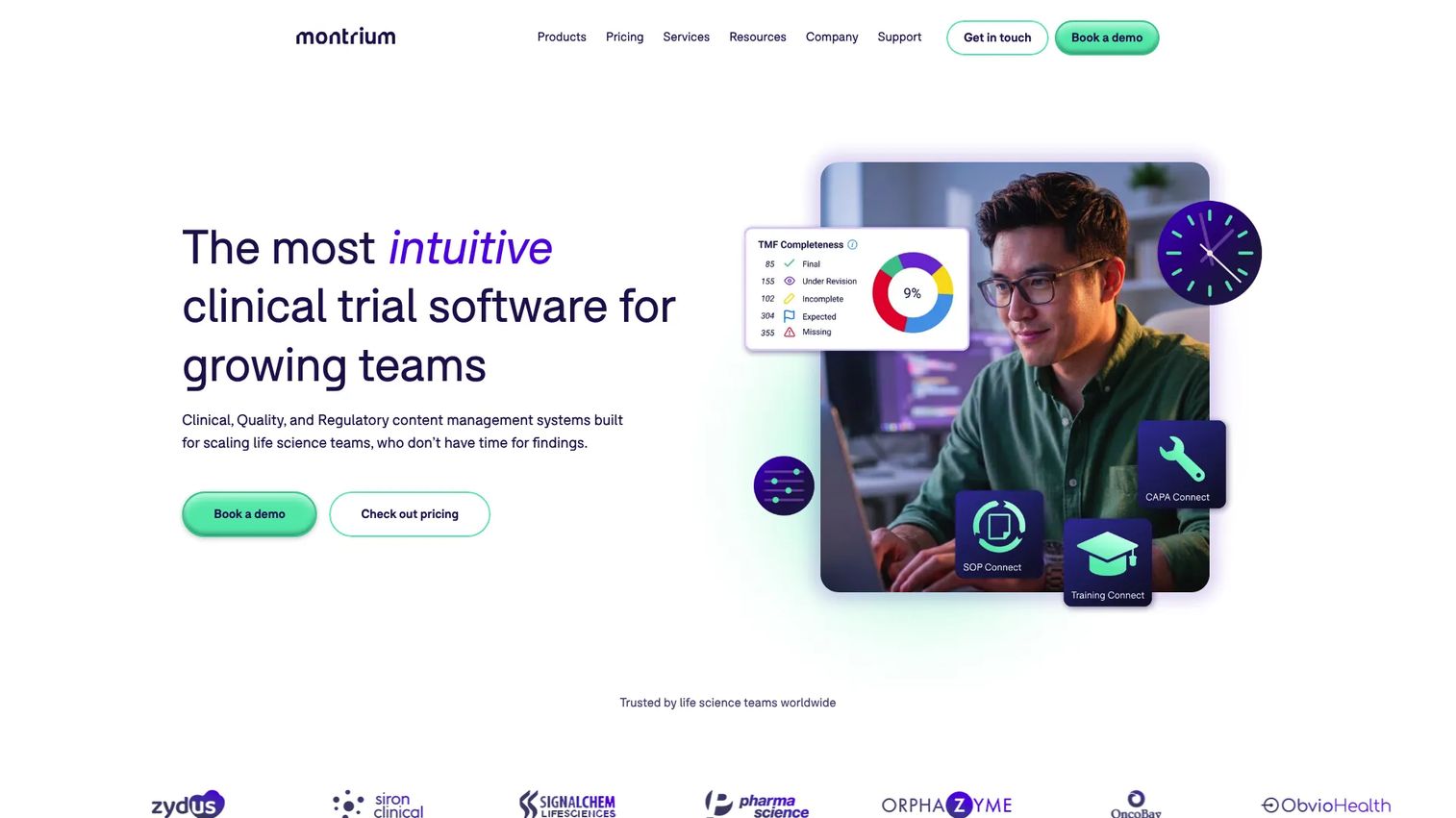
Montrium is life sciences software for clinical, quality, and regulatory content management, with document control built for compliance-heavy environments. It supports document drafting, review, approval, distribution, and training release, and its Quality Connect module handles document control, training, CAPA, audit, and change control with strong Microsoft Office collaboration built in.
Montrium suits scaling life sciences teams that want a quality-first platform with deep compliance framing. Its eTMF Connect manages trial documents and inspection readiness, Quality Connect governs controlled documents and quality processes, and RegDocs Connect supports regulatory authoring and eCTD-aligned submissions, so document control spans clinical, quality, and regulatory work.
Key strengths
- Quality Connect: document control, training, CAPA, audit, and change control in one compliant module.
- eTMF Connect: manages trial master file documents and inspection readiness for clinical teams.
- Microsoft Office collaboration: authors and reviews documents in familiar tools while keeping control intact.
Why choose Montrium: Choose it when your document control spans clinical, quality, and regulatory content in a life sciences setting. Building on the Microsoft ecosystem means teams draft in familiar tools while the platform enforces the compliance layer, which eases adoption for reviewers.
Montrium pricing: Montrium uses quote-based pricing across its products, with plan names including Essentials, Growth, Quality Connect, and RegDocs Connect shown as "request price" rather than public numbers. An Adobe Acrobat Sign Validation pack is available for free. Montrium does not currently have enough G2 reviews to display a rating.
7. Folderit
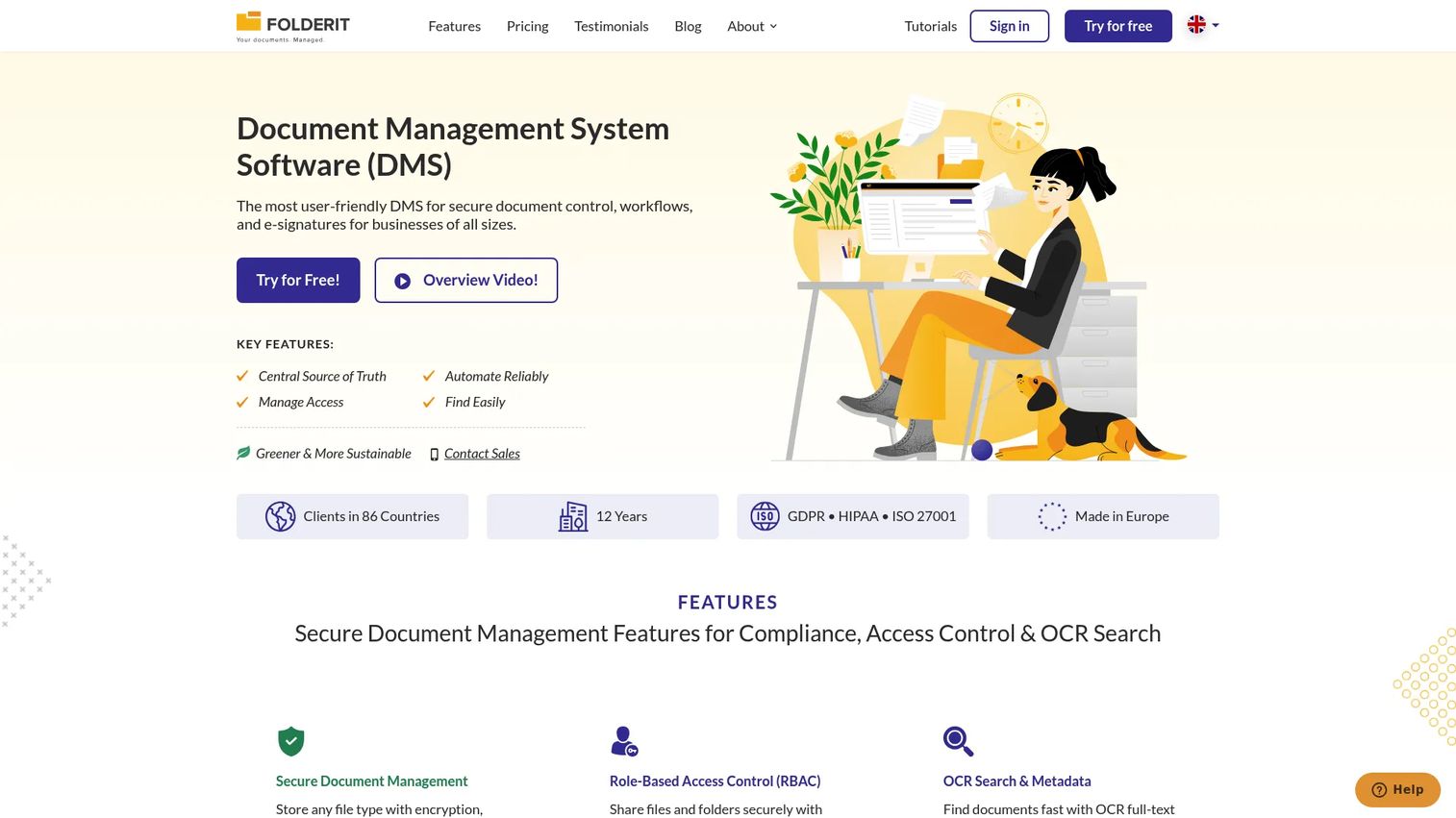
Folderit is a document management system for secure storage, search, workflows, and e-signatures, built security-first with a broad business use case. It delivers strong permissioning, custom metadata, OCR full-text search, versioning, approval and acknowledgement workflows, and retention automation, plus a DocuSign integration and built-in e-signatures on higher tiers.
Folderit suits teams that want controlled document management across the business, not only quality workflows. It is one of the few tools on this list with published pricing, which makes it approachable for smaller organizations and departments that need real document control without an enterprise sales cycle.
Key strengths
- OCR full-text search: finds documents by content, not just filename, across your entire repository.
- Approval and acknowledgement workflows: routes documents for sign-off and captures read-and-understand records.
- Versioning and access management: preserves version history with role-based permissions and access control.
Why choose Folderit: Choose it when you want secure, controlled document management with transparent pricing and a fast start. For teams that need versioning, audit trails, and e-signatures without committing to a full eQMS, it delivers the core controls at a predictable cost.
Folderit pricing: Folderit publishes three plans: Mini at $55/month or $515/year, Medium at $96/month or $1,047/year, and Tailor at $125/month or $1,392/year, with unlimited Folderit e-Sign on the Tailor plan. Pricing is not per-user, and a free trial is offered. Folderit holds a 4.3/5 rating on G2.
What to evaluate before you buy
Before you commit to a document control system, run the shortlist against these criteria. They separate tools that genuinely govern controlled documents from those that just store files.
Lifecycle depth
Confirm the tool enforces the full lifecycle: draft, review, approve, effective release, revision, and retirement. Check whether it prevents anyone from using an unapproved or superseded version. If a document can go effective without recorded sign-off, the control is cosmetic.
Audit trail and version integrity
Verify that audit trails are immutable and time-stamped, capturing who did what and when. Confirm that version control preserves every revision automatically, not on manual save. For regulated teams, check FDA 21 CFR Part 11 and electronic signature support explicitly.
Compliance and retention fit
Match the tool to your frameworks: ISO 9001, ISO 13485, HIPAA, GDPR, or GxP. Confirm retention policies can automate archiving and disposition on schedule. Ask whether the vendor supports validation documentation for regulated use.
Access, search, and integrations
Check role-based permissions and access control, plus SSO and MFA for security. Confirm search and OCR actually surface the right approved version fast. Verify integrations with Microsoft 365, SharePoint, and DocuSign if those are in your stack, since integration gaps create manual work.
Adoption and maintenance
The best control system fails if people route around it. Evaluate editor usability, review the vendor's onboarding resources, and confirm how much maintenance the workflows need as your documents and org change. Low ongoing overhead is what keeps governance from decaying.
Which document control software should you choose?
The right pick depends on how much governance you need and where document control sits in your operation.
If you are a regulated life sciences team that needs document control inside a validated quality system, Qualio, MasterControl, and Montrium are the strongest fits, with MasterControl best for enterprise scale across quality and manufacturing. If your quality processes need configurability without heavy development, ETQ Reliance and its codeless designer earn a close look. If document control is one piece of a wider compliance mandate spanning audits, safety, and risk, Ideagen consolidates it all in one platform.
For teams that need broad business document control plus workflow automation across finance, HR, and operations, DocuWare is the most versatile choice. And if you want secure, controlled document management with transparent pricing and a fast start, Folderit delivers the core controls without an enterprise sales cycle.
The main lens stays constant: match governance depth to your compliance needs, weigh workflow automation and integration fit, and never sacrifice adoption for features. Start by mapping your document lifecycle and audit requirements, then shortlist the two tools that fit your regulatory reality and run a scoped trial before you commit.
FAQs
For regulated life sciences teams, Qualio, MasterControl, and Montrium lead because they build document control into a validated quality system with immutable audit trails and FDA 21 CFR Part 11 support. The best choice depends on scale: MasterControl suits enterprise quality and manufacturing, Qualio fits scaling medical device and biotech teams, and Montrium spans clinical, quality, and regulatory content.
Document management software stores, organizes, and retrieves files. Document control software adds a governance layer: enforced lifecycle stages, mandatory approvals, immutable audit trails, and controlled retention. Every controlled document has a recorded approval history and version trail. In short, document management handles files while document control handles governed records.
Version control, approval workflows, immutable audit trails, retention policies, and role-based permissions and access control are the core. For regulated teams, electronic signatures and FDA 21 CFR Part 11 support are essential. Search and OCR matter for finding the right approved version fast. Prioritize lifecycle enforcement over storage capacity.
Yes. Immutable, time-stamped audit trails and automatic version history are defining features of true document control software. Tools like Qualio, MasterControl, and Ideagen capture who did what and when, and preserve every revision so you can prove document integrity to auditors and inspectors without manual reconstruction.
Many platforms integrate with Microsoft 365 and SharePoint, and some, like Montrium, build directly on the Microsoft ecosystem for authoring and collaboration. Folderit offers a DocuSign integration for e-signatures. Always confirm the specific integration scope with the vendor, since depth varies between native connectors and lighter file-level sync.
Regulated industries need it most: pharmaceuticals, medical devices, biotech, food and beverage, aerospace, automotive, and manufacturing. Any organization operating under ISO 9001, ISO 13485, FDA 21 CFR Part 11, HIPAA, GDPR, or GxP benefits, because these frameworks require demonstrable control over controlled documents and records governance.
Look for support for the standards that apply to you: ISO 9001 and ISO 13485 for quality, FDA 21 CFR Part 11 for electronic records and signatures, HIPAA for health data, GDPR for personal data, and GxP for life sciences. Strong tools also support SSO and MFA for access security and provide validation documentation for regulated use.
Choose a QMS tool like Qualio, MasterControl, ETQ Reliance, or Montrium when document control must connect to training, CAPA, audits, and change control in a regulated setting. Choose a general document control platform like DocuWare or Folderit when you need broad document governance across finance, HR, legal, and operations without full quality management overhead.