
Your pickers walk too far. They read paper lists, hunt for bin locations, second-guess quantities, and reach into the wrong slot more often than anyone wants to admit. Every one of those seconds compounds across a shift, and every mis-pick turns into a return, a credit, or a support ticket downstream.
That friction is exactly what light-directed picking is built to remove. Instead of asking a picker to interpret a document, the system lights the location, shows the quantity, and confirms the pick with a button press. The picker follows lights, not paperwork.
The category is scaling fast because the operational math holds up. The global pick-to-light market was valued at roughly USD 0.62 billion in 2025 and is projected to reach USD 1.01 billion by 2030, a 10.28% CAGR, according to Mordor Intelligence (2024). North America alone holds about 38.23% of that market, and e-commerce and retail account for roughly 28.33% of demand, driven by the same pressure every fulfillment operation feels: more orders, smaller lines, tighter accuracy targets.
Choosing the right pick to light software matters because the light hardware is the easy part. The software decides whether the system talks to your warehouse management system, how it handles split-case and piece picking, and whether you can actually see picker productivity in a report. Pick the wrong fit and you get expensive lights bolted onto a workflow they were never designed for.
What's inside
This guide covers four pick to light software options for teams evaluating warehouse order picking software and light-directed fulfillment. It is written for operations leaders, warehouse managers, and product or systems owners building a shortlist, not a purchase order.
We selected and compared these systems on the criteria that decide real-world fit:
- Picking speed and walking-time reduction
- Picking accuracy and error control
- Support for split-case, piece, and broken-case picking
- Kitting and assembly workstation coverage
- Integration with WMS, ERP, or MES host systems
- Operational visibility and productivity reporting
TL;DR
- Best for high-volume light-directed fulfillment: Lightning Pick, a well-known pick-to-light platform covering picking, putting, sorting, and kitting.
- Best for software modernization and warehouse execution: Matthews Automation Solutions, for teams that care about controls, host-system integration, and warehouse execution systems.
- Best for application-led and assembly-heavy environments: Banner Engineering, for sensor- and indicator-driven confirmation at workstations.
- Best for straightforward guided picking and sorting: Pick to Light Systems, for teams wanting a focused, category-first picking and put-to-wall setup.
Match the tool to your dominant picking motion first, then confirm it integrates cleanly with your host systems.
What is pick to light software?
Pick to light software is the control layer that directs warehouse pickers with lights and digital displays instead of paper lists or handheld screens, telling them where to pick, how many units to take, and when the pick is confirmed.
In a pick-to-light system, each storage location has a light module with a display and a confirm button. When an order drops, the software illuminates the correct locations in sequence, shows the quantity on the display, and waits for the picker to press the button to confirm. Then it lights the next location. The picker never interprets a document. They follow the lights, which is why light-directed picking consistently reduces both walking time and decision errors.
Core capabilities buyers should expect from pick-to-light systems:
- Directed picking: Lights guide the picker to the exact location in optimized sequence.
- Quantity confirmation: Displays show the count and capture button-press confirmation to reduce short-picks and over-picks.
- Real-time visibility: Live status of orders, lines, and picker activity across the floor.
- Workflow control: Support for batch, zone, put-to-wall, and cluster picking motions.
- Split-case and piece-picking support: Handling for broken-case work where orders contain many small individual picks.
- Kitting and assembly: Guided sequencing for building kits and assembling multi-part orders.
- Host integration: Data exchange with WMS, ERP, or MES so the light system reflects real order and inventory data.
The output is a picking operation that runs on visual instruction rather than manual interpretation. That shift is what drives the productivity and accuracy gains that make the category worth evaluating.
When to use pick to light software
Not every warehouse needs light-directed picking. It earns its cost in specific operational conditions. Here is where it consistently pays off.
Speed up split-case and piece picking
When orders are made up of many small picks, walking and searching dominate the labor cost, not the pick itself. Pickers spend more time traveling and reading than actually grabbing product. Light-directed picking removes the reading step and optimizes the sequence, so the picker moves in a tight path and confirms each pick with a press.
For split-case picking and piece picking, that adds up fast. A picker filling a 20-line order from paper stops to read, search, and verify at every line. The same order under lights becomes a follow-the-lights motion. Throughput rises because walking time and cognitive load both drop.
Improve accuracy in repetitive fulfillment workflows
Mis-picks are expensive twice: once when the wrong item ships, and again when it comes back as a return and rework. In repetitive fulfillment, the risk is highest, because pickers running the same motions hundreds of times a day stop reading carefully.
Visual cues fix that. The light says exactly which location, the display says exactly how many, and the button confirms it happened. Before, a picker relied on memory and a printed line. After, the decision is made for them and verified in the moment. Fewer decisions mean fewer mis-picks, fewer returns, and less rework downstream.
Standardize kitting and assembly workstations
Kitting and assembly work depends on doing the same sequence the same way, shift after shift. When that sequence lives in someone's head or on a laminated sheet, it drifts across teams and shifts.
Light-directed picking standardizes it. The system lights each component in the correct assembly order, so a new hire on the night shift builds the kit the same way as a veteran on days. That consistency matters most in operations where a missing or wrong component means a defective finished unit. Common scenarios that benefit:
- Multi-component kit building for e-commerce bundles
- Sub-assembly at manufacturing workstations
- Sequenced part presentation for line-side supply
- Repetitive value-added services like labeling or bundling
Comparison table
Below is a side-by-side view of the four pick to light software options. Pricing across this category is quote-based and not published, and verified public G2 ratings were not available for these industrial vendors, so those columns are marked accordingly. Use the table to match intent and use case, then validate pricing and fit directly with each vendor.
| # | Product | Intent | Key use case | Pricing | G2 rating |
|---|---|---|---|---|---|
| 1 | Lightning Pick | High-volume light-directed fulfillment | Picking, putting, sorting, and kitting automation | Quote-based | Not available |
| 2 | Matthews Automation Solutions | Warehouse execution and modernization | Integrated WES with light-directed fulfillment | Quote-based | Not available |
| 3 | Banner Engineering | Application-led sensing and indication | Assembly and workstation confirmation | Quote-based | Not available |
| 4 | Pick to Light Systems | Focused guided picking and sorting | Guided picking, put-to-wall, and kitting | Quote-based | Not available |
The read: Lightning Pick and Pick to Light Systems are the most directly picking-focused. Matthews leans toward teams standardizing broader warehouse execution and controls. Banner fits application-led environments where sensing and indication at the workstation matter as much as the pick list itself.
1. Lightning Pick
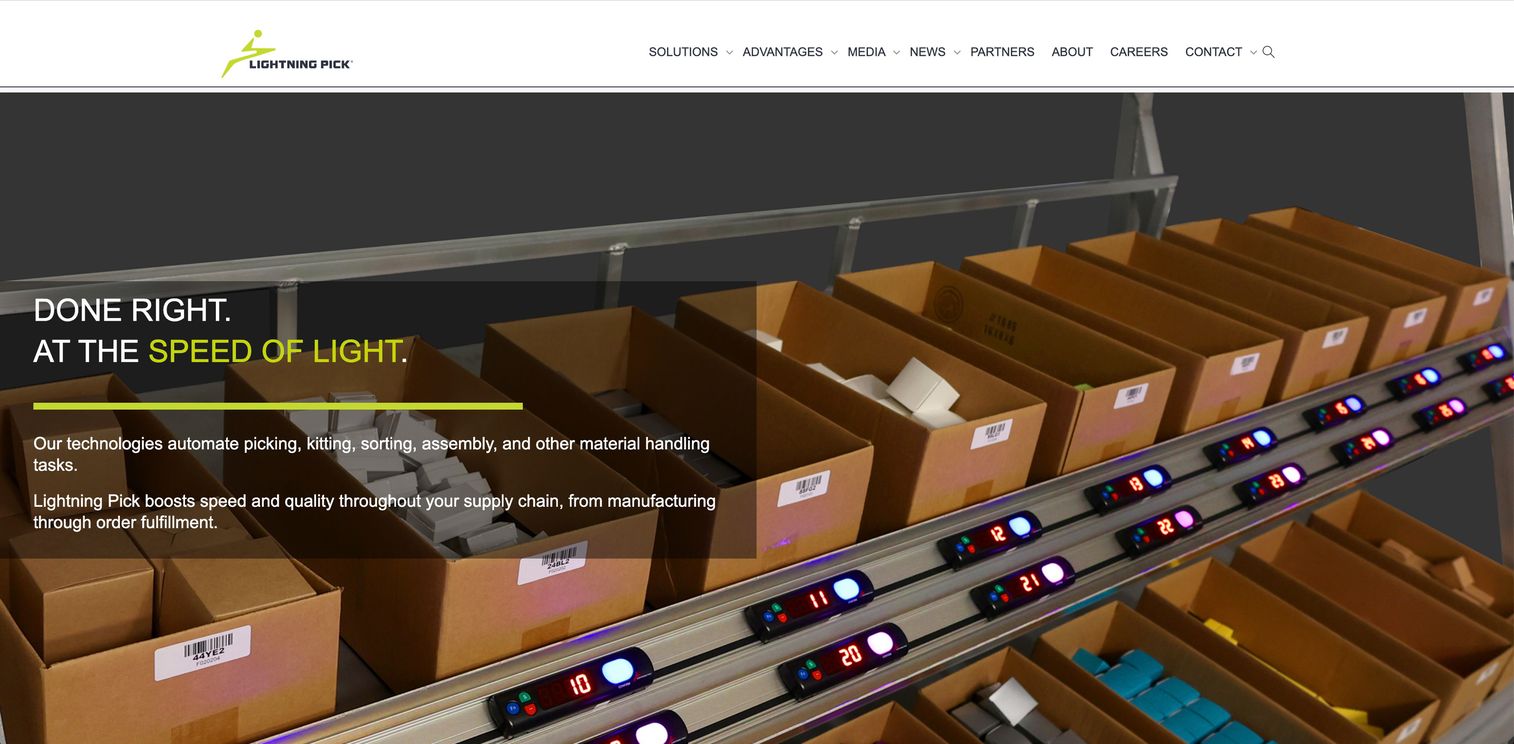
Lightning Pick is a light-directed order fulfillment and material-handling platform covering picking, putting, sorting, and kitting. It is one of the better-known names in the pick-to-light category, positioned for warehouses and manufacturers that need directed picking automation across high-volume operations. The software drives light modules across the floor and connects them to order and inventory data so pickers follow lights instead of paper.
Best for: Warehouses and manufacturers that need light-directed picking automation at volume.
Key strengths
- Pick-to-light order fulfillment: Directs pickers to exact locations with quantity displays and button confirmation to raise speed and accuracy.
- Projection picking: Uses projected visual cues to guide picks, useful in workstation and put-wall contexts where fixed modules are limiting.
- Put walls and smart picking carts: Extends light-directed workflows beyond static shelving into batch and cart-based motions.
Why choose Lightning Pick: If your operation runs high-volume fulfillment and you want a platform built specifically around light-directed material handling, Lightning Pick covers the full motion set: picking, putting, sorting, and kitting. It suits teams that want depth in the picking discipline itself rather than a broader automation suite, and its projection and put-wall options give flexibility for split-case and piece-picking work.
Lightning Pick pricing: Lightning Pick does not publish public pricing on its site. Like most industrial pick-to-light vendors, it works on a quote basis tied to your facility size, number of light locations, and integration scope. Contact the vendor directly for a scoped quote based on your workflow and hardware footprint.
2. Matthews Automation Solutions
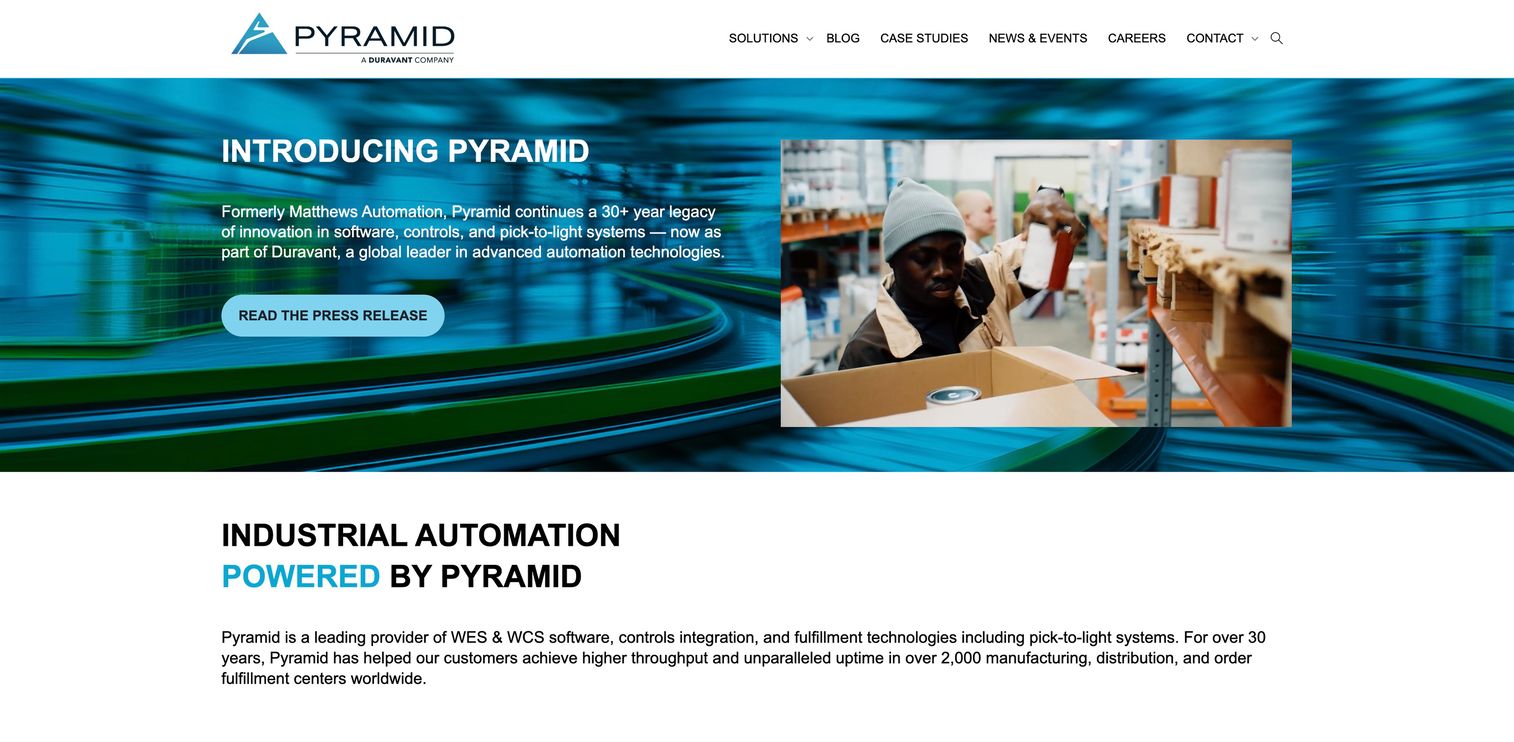
Matthews Automation Solutions is an industrial automation provider offering warehouse execution systems, controls, and light-directed fulfillment. Rather than a picking-only tool, it positions around the broader execution layer: the software and controls that coordinate conveyors, sorters, and light-directed picking across a facility. That makes it a fit for teams thinking about modernization and host-system integration, not just the lights themselves.
Best for: Manufacturers and distributors needing integrated warehouse automation and fulfillment systems.
Key strengths
- Warehouse execution systems (WES): Coordinates picking, sorting, and material flow as one orchestrated system rather than isolated stations.
- Conveyor and sorter controls: Ties light-directed picking into automated material movement across the facility.
- Pick-to-light / light-directed fulfillment: Delivers directed picking with quantity confirmation inside the broader execution stack.
Why choose Matthews Automation Solutions: Choose this option if you care about software architecture, controls, and connecting light-directed picking to host systems and automated material handling. It fits operations that are modernizing warehouse execution as a whole and want light-directed picking as one coordinated piece, with real-time data exchange between the floor and the systems above it.
Matthews Automation Solutions pricing: Matthews does not publish first-party pricing. The site directs buyers to contact and request-information pages rather than listing prices, which is standard for warehouse execution and controls projects scoped per facility. Expect a consultative quote based on system scope, integration requirements, and hardware.
3. Banner Engineering

Banner Engineering is an industrial automation manufacturer known for sensors, lighting, indicators, safety products, wireless, remote I/O, and machine vision, plus software for configuration and IIoT data services. In a pick-to-light context, its strength is application-led: using sensing and indication hardware to guide and confirm work at assembly and kitting workstations. This is the option for teams thinking in terms of workstation applications rather than a picking-only platform.
Best for: Manufacturers and industrial automation teams needing sensing, safety, and machine-vision hardware.
Key strengths
- Industrial automation product catalog: A broad range of sensing and indication hardware that can be composed into guided picking and confirmation setups.
- Sensors, lighting, indicators, and machine vision: Optical and sensor-based confirmation that verifies the right part was taken at the workstation.
- Configuration and IIoT software: Product setup tools plus cloud data services to feed workstation activity into monitoring systems.
Why choose Banner Engineering: Choose Banner when your priority is application fit at the workstation, especially for assembly, kitting, and guided part presentation where optical or sensor confirmation matters. It suits teams that want to build a solution around sensing and indication components rather than adopt a single packaged picking platform, and value the flexibility to tailor confirmation to the exact motion.
Banner Engineering pricing: Banner does not publish product pricing on its site; sales run through quotes and distributors. Pricing depends on the specific mix of sensors, indicators, and software you configure. Reach out through Banner or an authorized distributor for a quote scoped to your workstation setup.
4. Pick to Light Systems

Pick to Light Systems provides industrial pick-to-light and guided-picking systems for logistics and manufacturing. It is the most category-focused option here, built squarely around guided order picking, put-to-wall workflows, and assembly and kitting. For teams that want a straightforward, picking-first system without a broader automation suite around it, this is the cleanest fit.
Best for: Warehouses and manufacturers seeking error-reducing guided picking automation.
Key strengths
- Pick-to-light guided order picking: Directs pickers to locations with displays and confirmation to cut errors and lift throughput.
- Put-to-wall and batch picking: Supports batch and put-wall motions for consolidating multi-order picks efficiently.
- Assembly, kitting, and sequencing: Extends guided direction into kit building and sequenced assembly work.
Why choose Pick to Light Systems: Choose this when you want a focused, category-first picking and sorting system rather than a full warehouse execution platform. It fits operations optimizing order preparation and accuracy directly, with clear support for split-case and piece picking plus put-to-wall consolidation. Teams with a defined picking problem, rather than a facility-wide automation program, tend to find the tightest fit here.
Pick to Light Systems pricing: Pick to Light Systems does not display public pricing or a pricing page on its domain. Consistent with the category, expect a quote based on the number of light locations, workflow complexity, and integration needs. Contact the vendor for a scoped estimate.
Considerations
Before you commit to any pick to light software, pressure-test it against these four factors. The lights look similar across vendors. The fit is decided by what sits underneath.
Workflow fit
Confirm the software supports the exact picking motion your team runs today, not a generic version of it. Piece picking, broken-case, split-case, put-to-wall, kitting, and assembly each place different demands on the system. A platform tuned for full-case picking may not handle a high-line-count piece-picking operation well. Map your dominant motion first, then check coverage.
Integration requirements
The hardest part of any deployment is rarely the lights. It is the data. Verify that the software integrates cleanly with your WMS, ERP, or MES, and confirm the direction and timing of data flow, not just that a connector exists. Ask how orders reach the light system, how confirmations flow back, and how inventory stays in sync. Integration gaps are where projects stall.
Accuracy and visibility
Ask each vendor exactly how the system measures picker productivity and error rates, and what reporting it exposes. Operational visibility is what lets you prove the investment and find the next bottleneck. If the system directs picks but gives you no report on throughput, accuracy, or drop-off by zone, you lose the feedback loop that justifies the spend.
Implementation and support
Validate rollout time, training needs, and retrofit support against your real constraints. Can the system layer onto your existing racking, or does it need new infrastructure? How long until pickers are productive on it? What does support look like during peak season? These operational realities matter more than any feature list.
Conclusion
There is no single best pick to light software. There is the one that fits your picking motion and your host systems. Lightning Pick and Pick to Light Systems are the most directly picking-focused, strong when order fulfillment and accuracy are the core problem. Matthews Automation Solutions fits teams modernizing warehouse execution and controls as a whole. Banner Engineering suits application-led environments where sensing and indication at the workstation drive the design.
Your next step is a short shortlist exercise. Write down your dominant picking motion, the host systems the light software must talk to, and the accuracy and reporting you need to prove impact. Take that one-page spec to each vendor and ask them to scope against it. The right choice becomes obvious when you compare quotes against your actual workflow instead of a generic feature grid.
Match the tool to the work, confirm the integration, and validate the reporting before you sign.
FAQs
Pick to light software is used to direct warehouse workers through order picking, kitting, and assembly using lights and displays instead of paper lists or handheld screens. It tells pickers where to go, how many units to take, and confirms each pick with a button press. The goal is faster picking, fewer errors, and consistent workflows across shifts.
Yes. Split-case and piece picking are among the strongest use cases for light-directed picking. When orders contain many small individual picks, walking and reading dominate the labor cost. Lights remove the reading step and optimize the pick sequence, so throughput rises and mis-picks drop on high-line-count orders.
It replaces manual decision-making with visual direction and confirmation. The light shows the exact location, the display shows the exact quantity, and the button press confirms the pick happened. Because the picker interprets fewer documents and makes fewer judgment calls, mis-picks fall, which means fewer returns and less rework downstream.
Integration is a core buying question, not an afterthought. Most pick-to-light systems are designed to exchange data with a WMS, ERP, or MES so the lights reflect real order and inventory data. Before you buy, verify the specific host systems supported and confirm how orders flow in and confirmations flow back, rather than assuming a connector exists.
Repetitive, high-volume workflows benefit most: multi-line order fulfillment, split-case and piece picking, put-to-wall consolidation, kitting, and assembly workstations. Any operation where pickers repeat the same motions many times a day, and where walking time or accuracy is a bottleneck, tends to see the clearest gains.
Match the approach to your problem. Software-led and warehouse-execution options like Matthews Automation Solutions suit teams modernizing controls and integration across a facility. Application-led options like Banner Engineering suit workstation-specific assembly and kitting where sensing and confirmation drive the design. Picking-first platforms like Lightning Pick and Pick to Light Systems fit teams whose core problem is the pick itself. Start from your dominant workflow and the complexity you need to support.