Last updated: October 2026
A large prospect asks your legal team to produce three months of Slack conversations, meeting transcripts, and mobile messages. Your team points to an email archive. That gap is now a deal blocker.
According to Theta Lake's 2025/26 Digital Communications Governance Report, 92% of firms struggle to capture business communications for recordkeeping and supervision, or disable features over compliance concerns. The same report found that 82% of organizations already use four or more communication and collaboration tools. Email archiving alone does not close that gap.
The consequence shows up during enterprise security reviews, due-diligence processes, and internal investigations. What started as a simple retention question becomes a conversation about whether the company can find, preserve, and produce records across every channel employees actually use.
This guide compares 10 digital communications governance platforms across retention, discovery, supervision, and channel coverage, and helps you decide which fits your current stage and compliance obligations. You won't find tools named here; that's what the list is for.
What's inside
This guide is for founders and operational leaders evaluating a governance posture before enterprise expansion or a major communications-stack rollout.
- What digital communications governance covers beyond email and chat archiving
- How 10 platforms compare across retention, eDiscovery, supervision, and modern channel support
- Which tools fit Microsoft 365, Google Workspace, regulated firms, and large legacy archives
- What to verify before signing a multi-year governance contract
Tools were selected based on channel coverage breadth, governance depth (retention through defensible disposition), search and legal hold capability, and evidence of enterprise deployment at scale.
TL;DR
- Best overall for large-scale communications archiving: Smarsh Enterprise Platform, for organizations needing capture across 100-plus channels with mature surveillance and discovery workflows
- Best for integrated risk and supervision workflows: Proofpoint Archive, when governance must sit inside a broader security and compliance program
- Best for regulated communications and global records: Global Relay Archive, for financial services and enterprises with strict retention and review obligations
- Best for governed retention and legacy data disposition: Archive360, when the challenge includes inherited archives, data sovereignty, and defensible deletion
- Best for AI-driven voice, video, and collaboration supervision: Theta Lake Risk and Compliance Suite, for teams where risk lives in meetings and calls, not email threads
- Best for Microsoft-first environments: Microsoft Purview Data Lifecycle Management, for companies standardized on Microsoft 365
- Best for Google Workspace-first companies: Google Vault, for a practical starting point when the communication estate stays inside Google's suite
What is digital communications governance?
Digital communications governance is the set of policies, systems, and workflows used to capture, retain, supervise, search, preserve, and produce business communications across digital channels.
What digital communications governance software does
Modern governance platforms handle a broader operating remit than a traditional archive:
- Captures communication records from business channels in near-real-time
- Applies retention and disposition policies based on record type, user group, or jurisdiction
- Preserves content under legal holds to prevent deletion during active matters
- Supports cross-channel search, review, and export for eDiscovery and investigations
- Supervises communications for conduct, policy, or regulatory risk
- Produces audit trails and governance reporting for compliance officers and legal teams
- Controls access to archived records by role and matter
Digital communications governance vs. email archiving
Email archiving focuses on retaining and retrieving email records. A governance platform extends that scope to chat, meetings, collaboration tools, mobile messaging, voice, video, and sometimes social channels. More importantly, governance adds policy enforcement, supervision workflows, investigation case management, access controls, retention schedules, legal holds, and audit-ready evidence chains. The distinction matters when a legal hold or regulatory inquiry spans channels that an email archive never touched.
Channels a modern governance program should assess
Before reviewing vendors, inventory every channel your employees use for business communication:
- Email and calendar
- Team chat and collaboration platforms
- Meeting recordings, transcripts, and screen-share content
- Mobile messaging and business texting
- Voice calls and contact-center interactions
- Social media and web communications
- AI-assisted workplace interactions
When to use digital communications governance software
Prepare for enterprise and regulated-customer diligence
When a prospect's security team asks how you retain communications across Slack, Teams, and mobile, "we have email archiving" is not a sufficient answer. A defensible governance posture gives your legal and RevOps teams a clear, documented answer before the question becomes a deal blocker. This is governance as a sales readiness asset, not just an IT checkbox.
Replace fragmented channel-by-channel retention
At a certain point, separate email retention, Slack exports, meeting-recording storage, and mobile archives create an investigation and operations problem. Finding records across four disconnected systems, with different formats, retention windows, and access controls, costs time and introduces risk. Consolidating into a governance platform converts that operational debt into a repeatable process.
Support legal discovery and internal investigations
When legal needs to find relevant content across conversations, preserve it, restrict deletion, and export it with defensible metadata, the governance platform becomes an operating tool rather than a compliance nice-to-have. Legal holds, case management, and audit trails matter more at this stage than the raw storage capacity of an archive. An audit management software layer can complement governance workflows, but the communications record system itself needs to hold.
Digital communications governance software comparison
Dedicated governance platforms typically price through sales-led quotes. Cost drivers include archived users, communication channels covered, data volume, retention duration, supervision workflows, and implementation services. Native-suite options from Microsoft and Google follow their own licensing models.
| # | Product | Best for | Key differentiator | Pricing | G2 rating |
|---|---|---|---|---|---|
| 1 | Smarsh Enterprise Platform | Large regulated organizations with many channels | 100-plus channel capture with surveillance, discovery, and connected archive | Contact sales | 4.8/5 |
| 2 | Proofpoint Archive | Security and compliance teams needing broader governance | Cloud-native archive with capture, discovery, supervision, and automation | Contact sales | 4.0/5 |
| 3 | Global Relay Archive | Financial services and global records programs | Compliance-focused archive with reporting and review evidence | Contact sales | 3.7/5 |
| 4 | Archive360 | Legacy archive consolidation and data lifecycle governance | Unified governance across communications, legacy data, and AI interactions | Contact sales | 4.3/5 |
| 5 | Theta Lake Risk and Compliance Suite | Voice, video, meeting, and collaboration supervision | AI-assisted risk detection across modern multimodal communications | Contact sales | 5.0/5 |
| 6 | Microsoft Purview Data Lifecycle Management | Microsoft 365-centered organizations | Native retention, records, eDiscovery, and compliance controls | From $12/user/month (annual) | 4.5/5 |
| 7 | Google Vault | Google Workspace-first companies with focused governance needs | Native retention, search, and export for Google Workspace data | Included with qualifying Workspace editions | 4.3/5 |
| 8 | Jatheon Cloud | Mid-market teams needing multi-channel archiving | Email, social, text, and collaboration archiving with eDiscovery and FOIA support | Contact sales | 4.7/5 |
| 9 | Bloomberg Vault | Financial services with high-volume investigation needs | Managed archive and eDiscovery workflows for regulated firms | Contact sales | 4.3/5 |
| 10 | Barracuda Message Archiver | Organizations prioritizing email archiving and discovery | Email-focused retention, search, and compliance archiving | Contact sales | 4.4/5 |
Pricing and G2 ratings verified October 2026 from each vendor's official pricing page and G2 listing.
Best 10 digital communications governance software tools for 2026
1. Smarsh Enterprise Platform
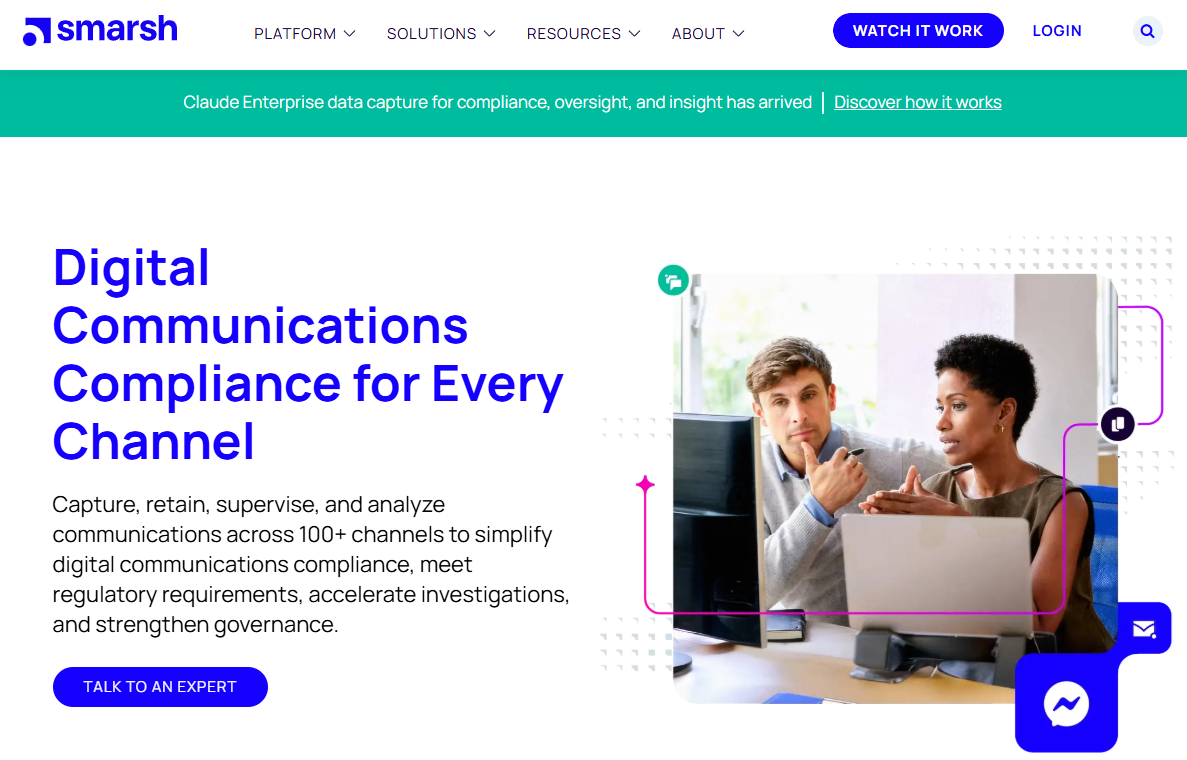
Smarsh Enterprise Platform is a unified, cloud-native platform for capturing, archiving, analyzing, supervising, and discovering regulated communications data at enterprise scale. It captures communications across 100-plus channels in native format, making it one of the broadest-coverage platforms in the category. Regulated industries use it for everything from email and collaboration to mobile, voice, and social content.
Best for: Large organizations with multi-channel compliance obligations and formal governance programs spanning legal, compliance, and IT owners.
Key features
- Captures 100-plus communication channels in native format
- Scalable cloud archive with retention and immutability controls
- AI-powered surveillance and risk detection workflows
- Legal hold, case management, and defensible export
- APIs for capture, search, analytics, and workflow automation
Why choose Smarsh Enterprise Platform: Choose Smarsh when the governance requirement spans a wide range of communication channels and the organization needs mature discovery and supervision workflows at scale. It fits companies where legal and compliance teams operate as distinct functions with formal oversight responsibilities.
Smarsh Enterprise Platform pricing: Smarsh quotes based on archived users, channels covered, data volume, and services scope. Contact sales directly to scope the engagement.
G2 rating: 4.8/5
2. Proofpoint Archive
Proofpoint Archive is a cloud-native communications archive designed for organizations that need retention, eDiscovery, and governance as part of a broader security and compliance program. The platform provides immutable retention and WORM-compliant preservation, advanced search and legal hold workflows, and a centralized archive spanning email, collaboration, mobile, social, and voice communications.
Best for: Companies that need communications governance tied closely to their existing security stack, where retention and investigation workflows must sit alongside threat detection and data protection.
Key features
- Immutable retention with WORM-compliant preservation
- Advanced full-text search, legal holds, and self-service export
- Centralized archive across email, collaboration, mobile, and voice
- Role-based access controls and governance reporting
- Supervision and investigation workflow modules
Why choose Proofpoint Archive: Use Proofpoint when governance cannot sit apart from the company's broader security and risk program. The archive integrates with Proofpoint's threat protection and data security portfolio, which matters when the legal and security teams share accountability for investigation workflows.
Proofpoint Archive pricing: Proofpoint uses enterprise sales pricing with no published tiers. Cost depends on data volume, channels, users, and the governance modules included. Contact sales for a formal scope.
G2 rating: 4.0/5
3. Global Relay Archive
Global Relay Archive captures, normalizes, preserves, searches, and analyzes regulated business communications from a wide range of channels. The platform provides immutable record preservation with retention and legal-hold controls, cross-channel search and eDiscovery, AI-enabled surveillance and transcription, and role-based access control with compliance reporting. It captures channels including WhatsApp, SMS, iMessage, Signal, WeChat, Telegram, LINE, and more than 100 additional sources.
Best for: Larger enterprises and financial-services firms with formal records-management obligations, complex audit requirements, and multi-channel capture needs.
Key features
- Unified cross-channel capture across 100-plus sources
- Immutable record preservation with retention and legal-hold controls
- AI-enabled surveillance, transcription, translation, and risk identification
- Cross-channel eDiscovery, export, and audit reporting
- Role-based access control and compliance classification
Why choose Global Relay Archive: Global Relay fits organizations where communications governance is a core operational function rather than a supplementary control. Documented oversight, durable recordkeeping, and mature reporting for compliance teams are the primary strengths here.
Global Relay Archive pricing: Global Relay prices through sales. User populations, channels, data volume, and service requirements all affect the contract scope. Contact the sales team for a quote.
G2 rating: 3.7/5
4. Archive360
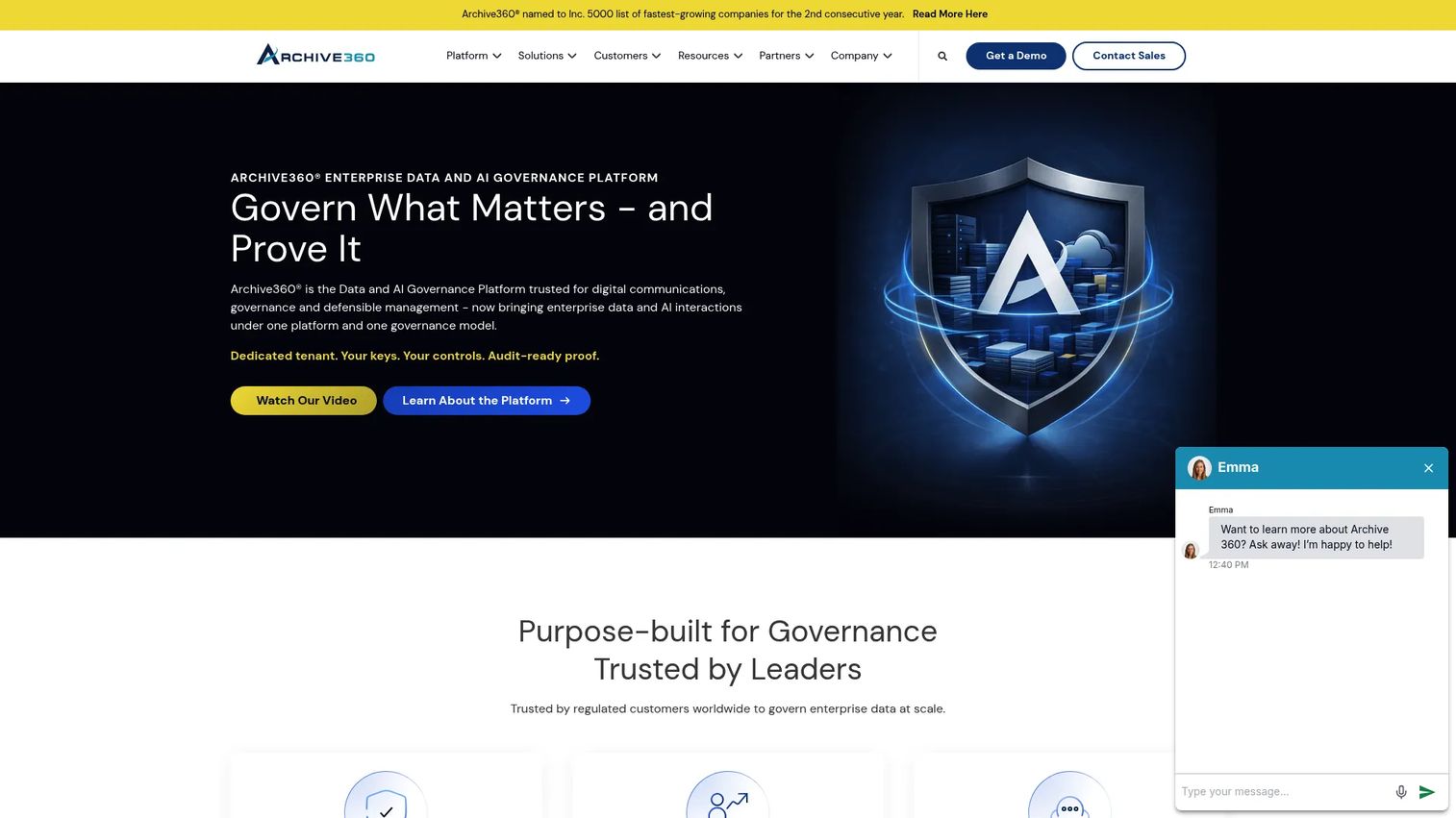
Archive360 is an enterprise data and AI governance platform for regulated organizations. It governs communications, content, legacy data, and AI interactions through policy-based classification, retention, legal hold, access controls, and disposition workflows. A dedicated cloud tenant with customer-managed encryption keys and a traceable AI Investigator tool for review-ready investigation summaries distinguish it from pure-archive alternatives. Archive360 was named a Leader in the 2025 Gartner Magic Quadrant for Digital Communications Governance and Archiving Solutions.
Best for: Companies consolidating legacy archives while building disciplined retention, disposition, and AI-data oversight practices, particularly in regulated or government contexts.
Key features
- Policy-driven classification, retention, legal hold, and disposition
- Cross-system search, eDiscovery case management, and defensible export
- Customer-managed encryption keys on a dedicated cloud tenant
- AI Investigator for traceable, review-ready investigation summaries
- Audit trails and proof of disposal for defensible disposition
Why choose Archive360: Choose Archive360 when the challenge extends beyond capturing current communications and includes legacy data, inherited archives, data sovereignty requirements, or defensible deletion programs. The AI governance tools layer is particularly relevant as organizations bring AI-generated content into their records management scope.
Archive360 pricing: Archive360 prices through sales. Deployment model, stored data volume, migration requirements, and governance modules all influence the contract. Contact sales to scope.
G2 rating: 4.3/5
5. Theta Lake Risk and Compliance Suite
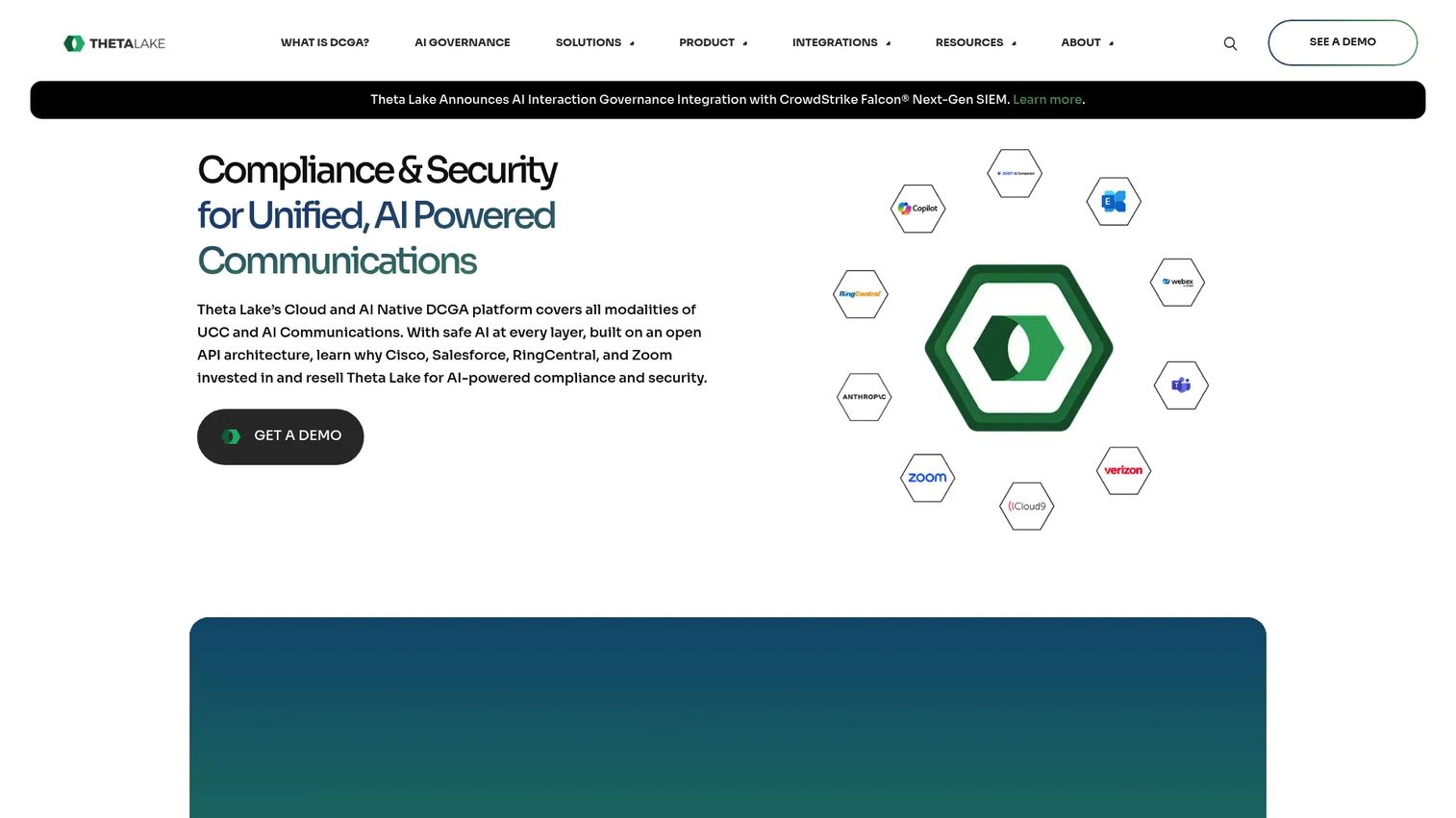
Theta Lake Risk and Compliance Suite captures, archives, searches, and detects regulatory, privacy, conduct, and cybersecurity risks across video, voice, chat, and other collaboration content. Its automatic risk detection spans audio, video, chat, images, documents, and screen-shared content. The platform provides 17a-4-compliant archiving, unified search and eDiscovery, and AI-assisted review workflows with risk prioritization, routing, and audit trails. According to Theta Lake's own research, 88% of firms report challenges with AI governance and data security.
Best for: Regulated organizations where the primary risk lives in spoken, visual, and collaborative communications rather than email threads.
Key features
- Automatic risk detection across audio, video, chat, images, and documents
- 17a-4-compliant archiving and unified eDiscovery search
- AI-assisted review with risk prioritization, routing, and audit trails
- Collaboration-platform capture for meetings and modern channels
- Communication risk analytics and remediation workflows
Why choose Theta Lake Risk and Compliance Suite: Use Theta Lake when your supervision requirement centers on meetings, calls, and collaboration platforms rather than email alone. It is purpose-built for organizations where conduct and regulatory risk surfaces in multimodal communications.
Theta Lake Risk and Compliance Suite pricing: Theta Lake prices through sales. Channel packages, review workflow scope, user counts, and storage requirements all factor into the quote.
G2 rating: 5.0/5
6. Microsoft Purview Data Lifecycle Management
Microsoft Purview Data Lifecycle Management helps organizations retain, delete, classify, review, and dispose of Microsoft 365 content to meet compliance and regulatory requirements. Core capabilities include retention policies and labels for Microsoft 365 workloads, mailbox archiving, inactive mailboxes, disposition reviews, and proof of disposal. It integrates directly with Microsoft's broader Purview compliance suite, including eDiscovery tools.
Best for: Microsoft-first companies that want governance controls integrated with their existing Microsoft 365 productivity environment without adding a separate vendor.
Key features
- Retention and deletion policies for Microsoft 365 workloads
- Retention labels with automated content classification
- Mailbox archiving, inactive mailboxes, and PST import
- Disposition reviews and proof of disposal
- Native eDiscovery integration within the Microsoft compliance suite
Why choose Microsoft Purview Data Lifecycle Management: This is the logical starting point for organizations whose communications and documents sit primarily inside Microsoft 365. It reduces vendor sprawl and keeps governance inside the same administrative environment your IT team already manages. Validate coverage carefully before assuming it reaches every external channel your team uses.
Microsoft Purview Data Lifecycle Management pricing: The product is included in the Microsoft Purview Suite, which starts at $12.00 per user per month billed annually. That suite requires Microsoft 365 E3 or Office 365 E3 plus Enterprise Mobility and Security E3. Verify current licensing requirements with Microsoft before purchasing.
G2 rating: 4.5/5
7. Google Vault
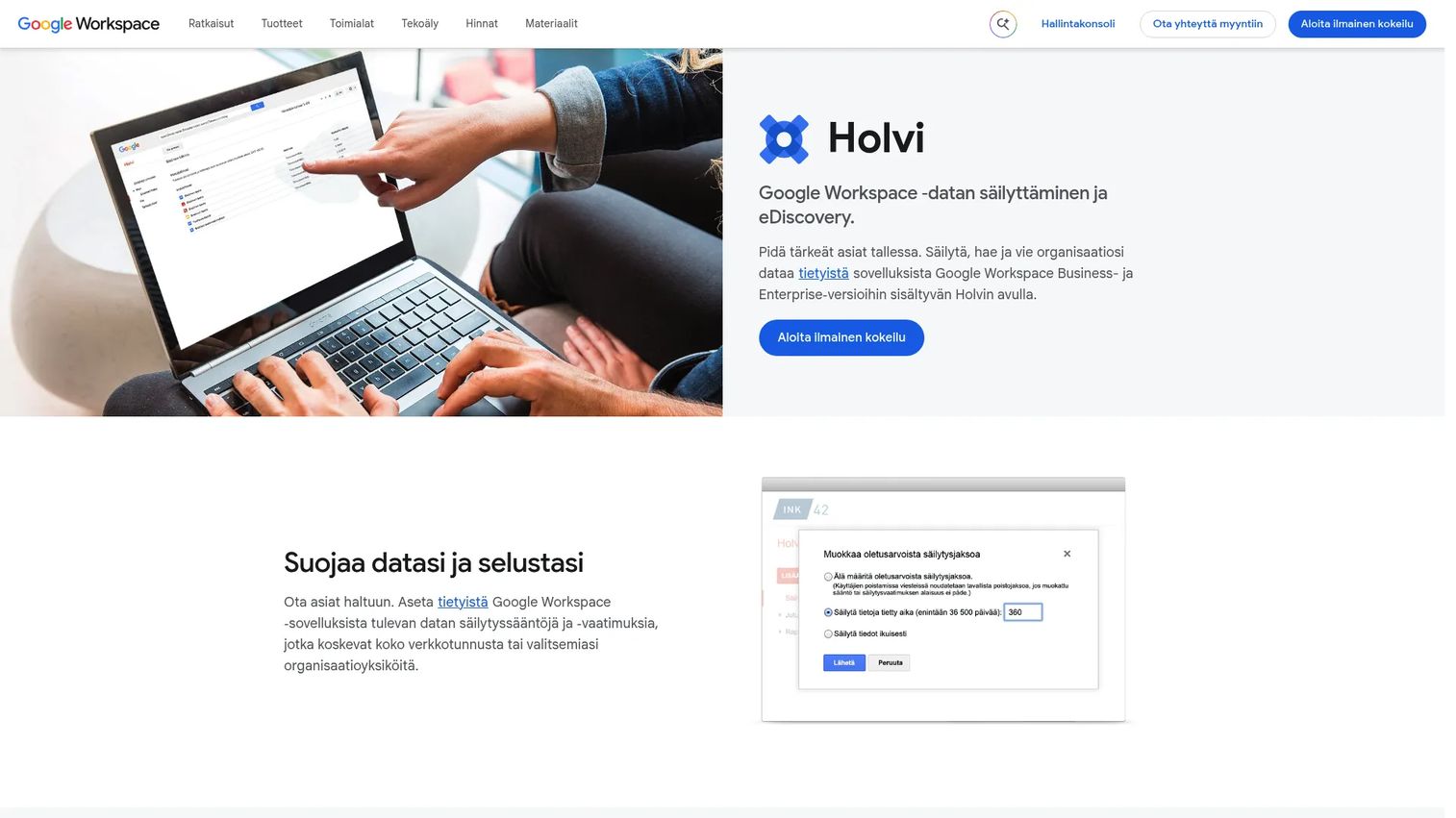
Google Vault is an information governance and eDiscovery service for retaining, holding, searching, and exporting Google Workspace data. It covers Gmail, Google Drive, Google Chat, and Google Meet content, with retention rules, legal holds, immutable audit logs, and access controls. It functions as the native governance layer for organizations operating primarily inside Google Workspace.
Best for: Google Workspace-first SaaS companies that need a practical foundation for retention, legal holds, and eDiscovery when the communication estate stays mostly inside Google's suite.
Key features
- Retention rules for supported Google Workspace data
- eDiscovery search, legal holds, and exports
- Access controls and immutable audit logs
- Gmail, Drive, Chat, and Meet governance
- Google Workspace administration integration
Why choose Google Vault: Google Vault is a logical first step when the team's communication footprint stays inside Google Workspace and governance needs remain focused. It avoids adding a separate vendor and keeps retention and discovery inside your existing admin environment.
Google Vault pricing: Google Vault is included with certain Google Workspace editions. An add-on license is available for editions that do not include it by default. Google does not publish the add-on price on its standard product pages. Verify plan eligibility and licensing requirements with Google or a Google Workspace reseller.
G2 rating: 4.3/5
8. Jatheon Cloud
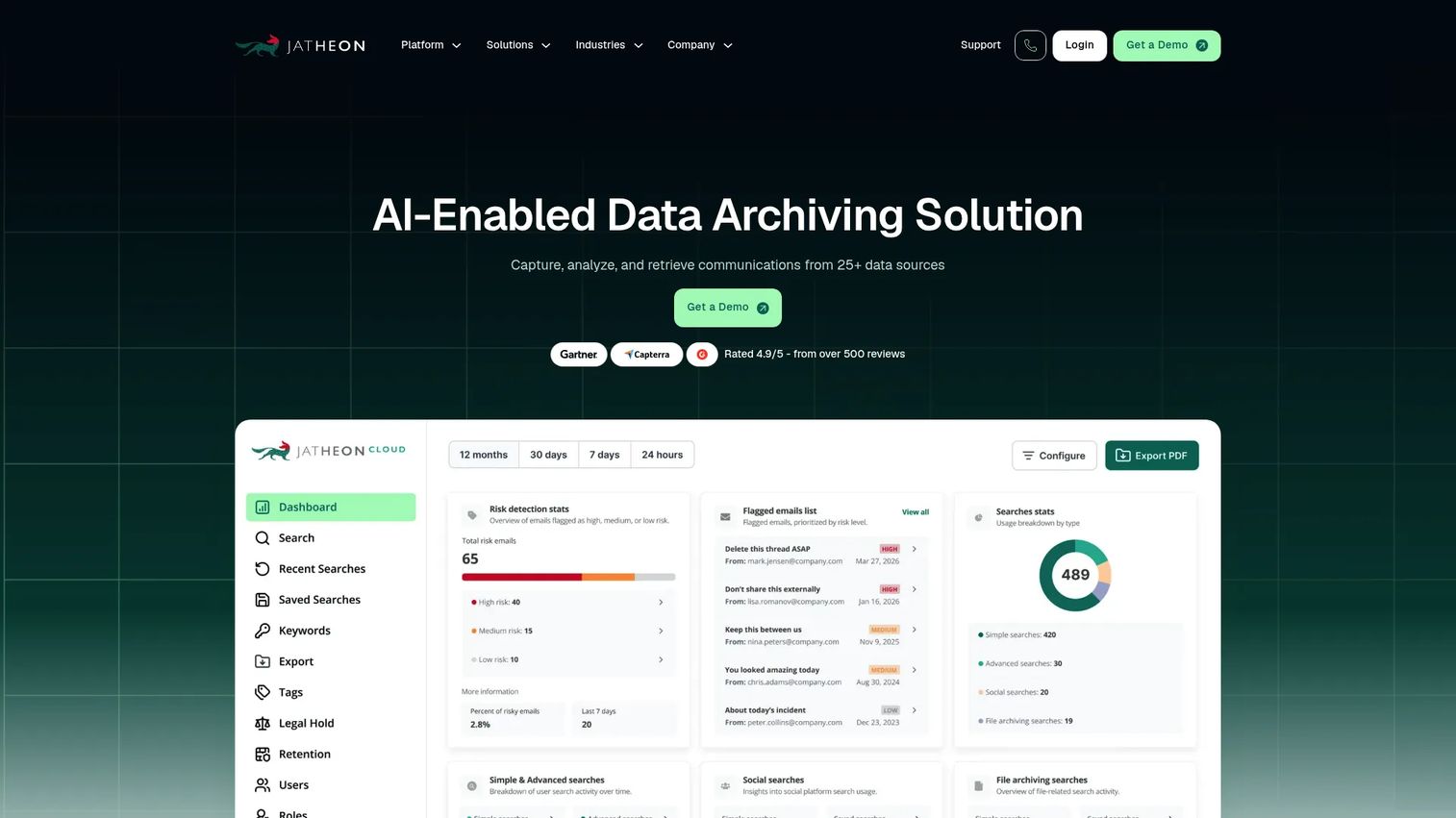
Jatheon Cloud is an AI-enabled cloud archiving and compliance platform for capturing, searching, retaining, and governing business communications. It covers email, social media, text messages, collaboration tools, websites, files, and other communications in a unified archive. Compliance tools include retention policies, role-based permissions, audit trails, legal holds, redaction, and export. AI-powered search, classification, sentiment analysis, and FOIA workflow automation round out the feature set.
Best for: Regulated organizations, including public-sector entities, that need broad archiving coverage across communication channels, records requests, and compliance reporting without limiting governance to one collaboration suite.
Key features
- Multi-channel archiving for email, social, text, collaboration tools, and files
- Retention policies, legal holds, redaction, and audit trails
- AI-powered search, classification, and sentiment analysis
- FOIA and public-records request workflow automation
- Role-based permissions and compliance monitoring
Why choose Jatheon Cloud: Jatheon fits teams that need channel breadth beyond what native-suite tools cover, with FOIA automation and compliance monitoring built in. It addresses the compliance monitoring and records-request workflows that many enterprise governance platforms relegate to add-on modules.
Jatheon Cloud pricing: Pricing is customized by deployment option, user count, communication sources, storage, and retention requirements. Contact Jatheon for a formal quote.
G2 rating: 4.7/5
9. Bloomberg Vault
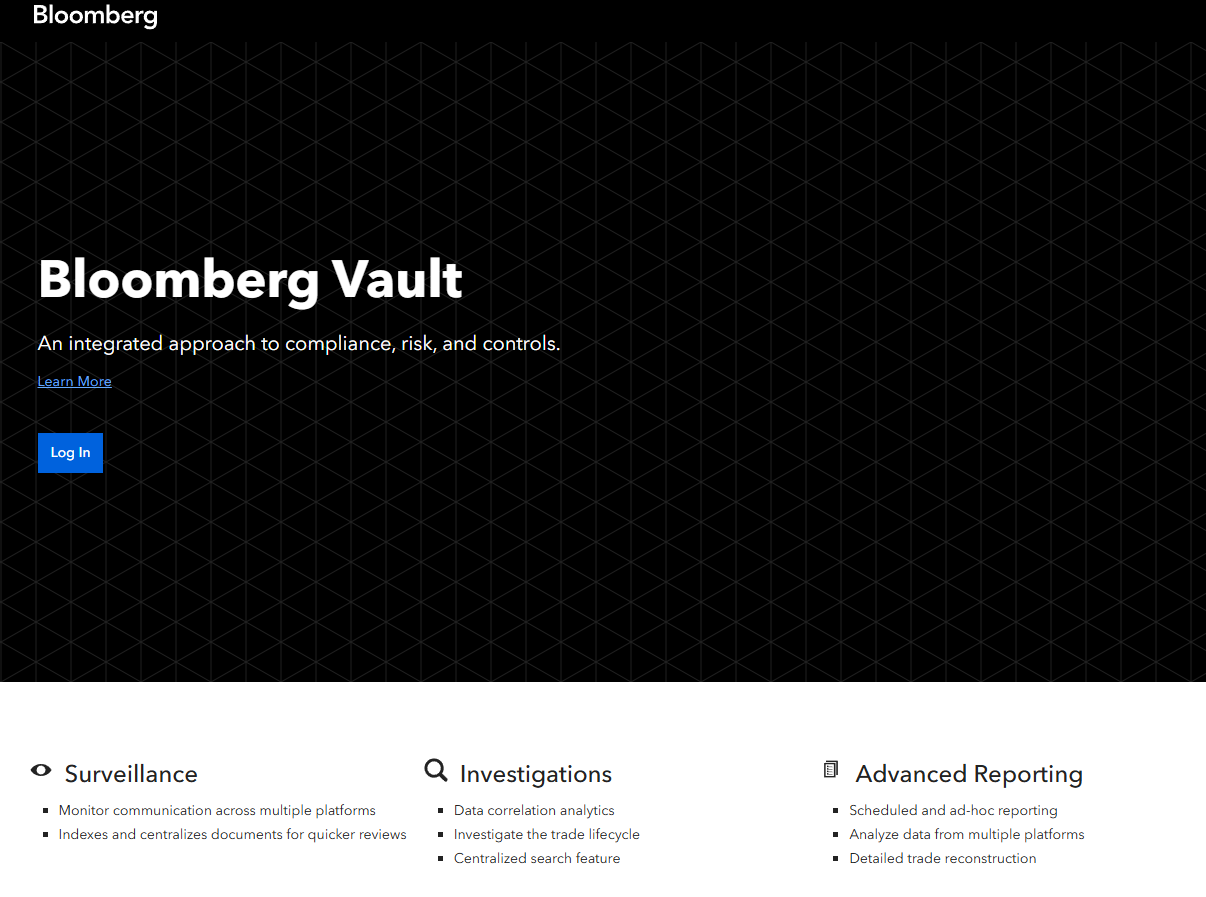
Bloomberg Vault is an integrated platform for compliance, risk controls, managed archiving, and eDiscovery. It provides communication surveillance across multiple platforms, document indexing, centralized search, data correlation analytics, trade-lifecycle investigations, and scheduled and ad-hoc reporting. Multi-platform analysis and detailed trade reconstruction make it a specialist tool for capital markets environments.
Best for: Financial-services firms in capital markets, wealth management, or adjacent regulated industries with deep communications recordkeeping requirements and high investigation volumes.
Key features
- Communication surveillance across multiple platforms
- Document indexing and centralized search
- Data correlation analytics and trade-lifecycle investigations
- Scheduled and ad-hoc compliance reporting
- Multi-platform analysis and trade reconstruction
Why choose Bloomberg Vault: Bloomberg Vault belongs on the shortlist when the operational context is financial services and the investigation workflow involves high-volume trade reconstruction and regulatory reporting. It is a specialist tool for that environment, not a generalist governance platform.
Bloomberg Vault pricing: Bloomberg Vault prices through sales. Managed services scope, communications sources, storage, and discovery workflows all factor into the quote. Contact Bloomberg directly.
G2 rating: 4.3/5
10. Barracuda Message Archiver
Barracuda Message Archiver is a cloud-connected email archiving solution for secure retention, retrieval, compliance, and eDiscovery. It provides a tamper-proof email repository with granular retention policies, role-based security controls, comprehensive audit trails covering all system and user activity, and mobile or desktop access to archived email. Physical appliances and virtual deployments are both supported.
Best for: Organizations whose immediate requirement is governed email retention, search, and discovery, where a broader multi-channel governance platform would add more scope than the current stage requires.
Key features
- Tamper-proof email repository with granular retention policies
- Role-based security controls and comprehensive audit trails
- Mobile and desktop access to archived messages
- eDiscovery search and compliance export
- Physical appliance and virtual deployment options
Why choose Barracuda Message Archiver: Barracuda fits a focused email archiving requirement. If email remains the primary record of business communication and multi-channel supervision is not yet a requirement, it provides a governed, searchable archive without the operational complexity of a full governance platform.
Barracuda Message Archiver pricing: Barracuda sells through channel partners. Physical appliances are licensed per appliance and virtual machines by CPU cores. Contact a Barracuda reseller or the vendor directly for current pricing.
G2 rating: 4.4/5
Considerations when choosing digital communications governance software
Start with channel coverage, not a vendor shortlist
Inventory every business communication channel before evaluating software, including the channels employees use informally. Mobile messaging, recorded meetings, shared workspaces, and external collaboration tools often create records that a governance program must address. A vendor comparison without that inventory will miss the requirement gaps that matter most.
Separate retention needs from supervision needs
Retention stores and retrieves records. Supervision reviews behavior, flags policy concerns, and routes exceptions. An organization that only needs legal holds and eDiscovery may not need the same platform as one with continuous conduct-monitoring obligations. Choosing a supervision-heavy platform for a retention-only requirement adds operational overhead and cost that the current stage may not justify.
Verify search, export, and legal hold workflows with a live test
Ask legal to run a real scenario before signing. The relevant questions: Can the team find records across channels? Can it apply a legal hold, restrict deletion, and export with metadata and audit history intact? A platform that demonstrates this in a live test is more credible than one that describes the capability in a demo slide.
Model implementation and operating ownership before purchase
The governance platform will need owners across legal, compliance, security, and IT. Confirm who maintains policies, reviews alerts, validates capture health, and approves retention changes. Platforms that require ongoing configuration and exception management need a named owner before go-live, not after.
Price the full operating model, not just the license
Cost may increase with retained data volume, archived users, additional channels, supervision workflows, implementation services, and premium integrations. Compare vendors on the total operating model rather than a first-year license. A lower entry price that scales poorly with data growth can cost more over a three-year horizon than a higher-priced platform with predictable volume pricing.
Conclusion
The right governance platform depends on the channels your team uses, the obligations you must meet, and the operating ownership your legal, compliance, and IT teams can realistically sustain.
Smarsh Enterprise Platform, Proofpoint Archive, Global Relay Archive, and Archive360 are enterprise governance options with different operating models. Smarsh leads on channel breadth. Proofpoint fits when governance lives inside a broader security program. Global Relay serves regulated industries with formal records obligations. Archive360 addresses legacy data and disposition alongside active communications.
Microsoft Purview and Google Vault are the natural starting points for organizations standardized on those collaboration suites. Theta Lake is the specialist for voice, video, and collaboration supervision. Jatheon Cloud, Bloomberg Vault, and Barracuda Message Archiver each address a distinct fit condition: Public-sector and multi-channel archiving, financial-services investigations, and focused email retention, respectively.
The clearest next step: Map your channels and legal requirements first. Then book vendor evaluations around real scenarios, specifically cross-channel search, legal hold application, export with metadata, and audit trail review. That test will tell you more than any feature matrix.
When you're ready to show prospects what your product does during enterprise evaluations, Guideflow lets teams build and share interactive demos without engineering involvement.
Start your journey with Guideflow today!
FAQs about digital communications governance software
Digital communications governance is the policy, technology, and operating process for capturing, retaining, supervising, searching, and producing business communications. It applies across email, chat, meetings, mobile, voice, video, and other records. The goal is to ensure records are preserved, accessible, and defensible when a legal, regulatory, or operational need arises.
Email archiving focuses on preserving and retrieving email. Governance adds multi-channel capture, retention policy enforcement, legal holds, supervision, investigation support, access controls, and auditability. An email archive answers the question "do we have this message?" A governance platform answers the question "can we prove we preserved it, who accessed it, and why it was retained or deleted?"
The right scope depends on where employees conduct business. At minimum, consider email, collaboration chat, meeting recordings, mobile messaging, voice calls, and file-sharing systems. Organizations with sales teams using social platforms or customer-facing teams on messaging apps may also need to capture those channels. Inventory actual usage before selecting a platform.
Many early-stage SaaS companies can begin with native-suite retention controls in Microsoft 365 or Google Workspace. A dedicated platform becomes more relevant when the business adds regulated customers, many communication channels, legal discovery demands, or supervisory obligations. Gartner projects that by 2028, 25% of enterprises will proactively manage employee digital communications, up from fewer than 10% in 2024, which reflects the direction enterprise buyers are moving.
It can be sufficient for organizations whose communications and documents stay primarily inside Microsoft 365, with defined retention and eDiscovery requirements. Companies with external channels, mobile messaging, third-party collaboration tools, or specialized supervision needs should test coverage carefully. Native controls work well within the Microsoft estate; gaps tend to appear at the boundaries of that estate.
Google Vault supports retention, legal holds, search, and export for supported Google Workspace data, including Gmail, Drive, Chat, and Meet. Its fit depends on whether business communications remain inside Google Workspace. External email, third-party messaging tools, and mobile communications are outside its scope. Verify which data sources your users actually rely on before treating Vault as a complete governance layer.
Run a live scenario rather than watching a scripted walkthrough. Ask the vendor to show a cross-channel search across email and chat, apply a legal hold on a specific user's records, export those records with metadata and chain-of-custody documentation, and display the audit trail for all access and activity. Also ask how retention policy changes are approved and logged, and who validates that capture is running correctly.
Most dedicated platforms price through sales-led quotes. The main cost drivers are archived user count, number and type of communication channels, stored data volume, retention duration, supervision workflow complexity, implementation services, and premium integrations. Native-suite options like Microsoft Purview start at $12 per user per month on an annual Microsoft Purview Suite license. Google Vault is included with qualifying Google Workspace editions. Dedicated enterprise platforms typically run into tens of thousands to hundreds of thousands of dollars annually, depending on the operating scope. Always model the three-year total cost, including data growth, before comparing options.
Defensible disposition is the process of deleting records at the end of their retention period in a way that can be documented and defended legally. It requires evidence that a retention schedule existed, that the records were held under applicable legal holds, and that deletion followed an approved, auditable process. Platforms like Archive360 include proof-of-disposal workflows specifically for this purpose.