Your roadmap looks clean until someone surfaces a dependency you didn't know existed. A legacy integration blocks the API migration. A shared identity provider sits under five product lines. An aging data pipeline feeds three downstream features your team owns but doesn't control. By the time those constraints appear, the sprint is committed and the stakeholders are aligned.
That's the problem enterprise architecture software is built to prevent. These platforms maintain a connected view of business capabilities, applications, data, technology, and their relationships, so teams can analyze change before it's too late to sequence it differently. According to Fortune Business Insights (2026), the global enterprise architecture software market was valued at $1.23 billion in 2025 and is forecast to reach $2.09 billion by 2034. The growth reflects how many organizations are treating architecture data as a planning prerequisite, not an afterthought.
The catch: A powerful repository nobody keeps current becomes a costly diagram archive. Which tool gives your team decision-grade architecture data without creating a second full-time data maintenance job?
What's inside
This guide covers 10 enterprise architecture tools across repository-led platforms, modeling software, open source options, and portfolio planning products. It's written for product managers, transformation leads, and IT portfolio teams who need architecture evidence to support roadmap decisions.
Selection criteria:
- Repository quality: Connected data model that reflects real applications, capabilities, and dependencies
- Integration depth: Connections to CMDB, ITSM, cloud, development, and data systems
- Analysis capability: Impact analysis, scenario planning, and portfolio assessment
- Stakeholder accessibility: Role-specific views that non-architects can use to answer a decision question
Pricing and G2 ratings reflect verified figures from October 2026.
TL;DR
- Best for application portfolio management: SAP LeanIX, with per-application pricing and unlimited user access across the organization
- Best for collaborative discovery: Ardoq, for teams building a living repository through surveys, integrations, and scenario analysis
- Best for transformation planning: Bizzdesign Horizzon, for mapping strategy, capabilities, and operating model changes
- Best for formal modeling: Sparx Systems Enterprise Architect, starting at $245 per license with broad UML, BPMN, SysML, and TOGAF support
- Best for CMDB-connected architecture: ServiceNow Enterprise Architecture, for organizations with mature ServiceNow data and operational workflows
- Best open source option: Essential Open Source, free and self-hosted for teams building a first architecture repository
What is enterprise architecture software?
Enterprise architecture software is a system for documenting, connecting, analyzing, and governing an organization's business capabilities, applications, data, technology, and transformation plans.
The category combines several distinct jobs. An application portfolio management software layer tracks lifecycle status, cost, ownership, and risk for every application. A capability mapping layer connects business functions to the systems that support them. A modeling layer lets architects represent business, application, information, and technology domains using formal notation. An analysis layer runs impact and scenario assessments before a migration, consolidation, or major roadmap decision. Governance workflows enforce standards, manage reviews, and create audit trails.
What enterprise architecture tools do
- Maintain an enterprise architecture repository as a connected data model
- Map business capabilities to applications and supporting technology
- Inventory applications by lifecycle, cost, technical risk, and ownership
- Model business, application, information, and technology architecture
- Analyze dependencies and impacts before a migration or retirement decision
- Publish roadmaps, dashboards, and stakeholder-specific views
- Support governance with standards management and review workflows
Core capabilities to evaluate
- Application portfolio management
- Business capability mapping
- Architecture modeling and notation support (ArchiMate, UML, BPMN, SysML)
- Dependency mapping and impact analysis
- Scenario planning and transformation roadmaps
- Repository integrations with CMDB, ITSM, cloud, and development systems
- Collaboration, reporting, and stakeholder views
- Governance, standards management, and audit trails
Category boundary
| Category | Primary job | When it is enough |
|---|---|---|
| Diagramming software | Communicate a visual architecture view | A team needs static or workshop-based visuals |
| Enterprise modeling tool | Build formal technical and architecture models | Systems and engineering teams need standards-based models |
| EA repository platform | Keep enterprise data connected and analyze change | Leaders need portfolio decisions and transformation planning |
| CMDB or ITSM platform | Track operational configuration items | The org already has reliable operational data |
For product managers, the last two categories matter most when roadmap decisions touch shared platforms, data services, identity systems, or application rationalization choices.
When to use enterprise architecture tools
Rationalize overlapping applications
SaaS consolidation, technical debt, and post-acquisition cleanup all require more than a spreadsheet. A repository connects each application to capability ownership, lifecycle stage, data sensitivity, cost, and integration dependencies before a retire-or-consolidate decision reaches the planning board. Without that view, rationalization programs tend to stall on ownership disputes rather than evidence.
Plan a modernization or cloud migration
Cloud migration software addresses provisioning and deployment. Enterprise architecture tools address sequencing and risk. A modernization program needs dependency analysis, a target state, and migration paths that account for shared services and compliance controls. Teams that skip this step tend to discover blockers mid-sprint.
Align product roadmaps with enterprise constraints
A feature may look small until it touches an identity provider, event pipeline, compliance control, or aging integration. Enterprise architecture tools surface those relationships early enough to change sequencing before the sprint is committed. For PMs, this is the practical reason to have read access to an EA repository even without owning it. Better architecture data means fewer late-stage surprises and more defensible roadmap decisions.
Enterprise architecture tools comparison
No tool wins across every dimension. A formal modeling platform built for systems engineering differs substantially from a SaaS repository built for portfolio management. Use the table below to shortlist by primary job before scheduling evaluations.
| # | Product | Best for | Key differentiator | Pricing | G2 rating |
|---|---|---|---|---|---|
| 1 | SAP LeanIX | Application portfolio management | Per-application pricing with unlimited users | Contact sales (per application) | 4.5/5 |
| 2 | Ardoq | Collaborative architecture discovery | Graph-native repository with surveys and scenario analysis | Custom quote | 4.5/5 |
| 3 | Bizzdesign Horizzon | Transformation planning | Strategy-to-execution with ArchiMate, BPMN, and UML | Custom quote | 4.2/5 |
| 4 | Avolution ABACUS | EA governance and analysis | Configurable metamodels, dynamic roadmaps, and no-code algorithms | Contact vendor | 4.8/5 |
| 5 | ServiceNow Enterprise Architecture | CMDB-connected architecture | EA workflows inside ServiceNow with Advanced and Prime packages | Custom quote | 4.4/5 |
| 6 | Sparx Systems Enterprise Architect | Formal modeling and systems engineering | UML, BPMN, SysML, TOGAF, code, and database modeling from $245 | From $245/license | 4.1/5 |
| 7 | OrbusInfinity | Business and IT transformation | Governed repository with TOGAF, ArchiMate, BPMN, and 150+ workflow connectors | Custom quote | 4.5/5 |
| 8 | Essential Open Source | Open source EA foundation | Free, self-hosted repository with 140+ visualizations | Free (paid cloud options available) | N/A |
| 9 | erwin Evolve | Data and process-centric architecture | EA modeling with data governance and process analysis context | Contact vendor | N/A |
| 10 | Planview Portfolios | Portfolio and investment planning | Strategic portfolio management with OKRs, roadmaps, and AI insights | Custom quote | 3.8/5 |
Pricing and G2 ratings verified in October 2026 from vendor pricing pages and current G2 listings.
Best 10 enterprise architecture tools for 2026
1. SAP LeanIX
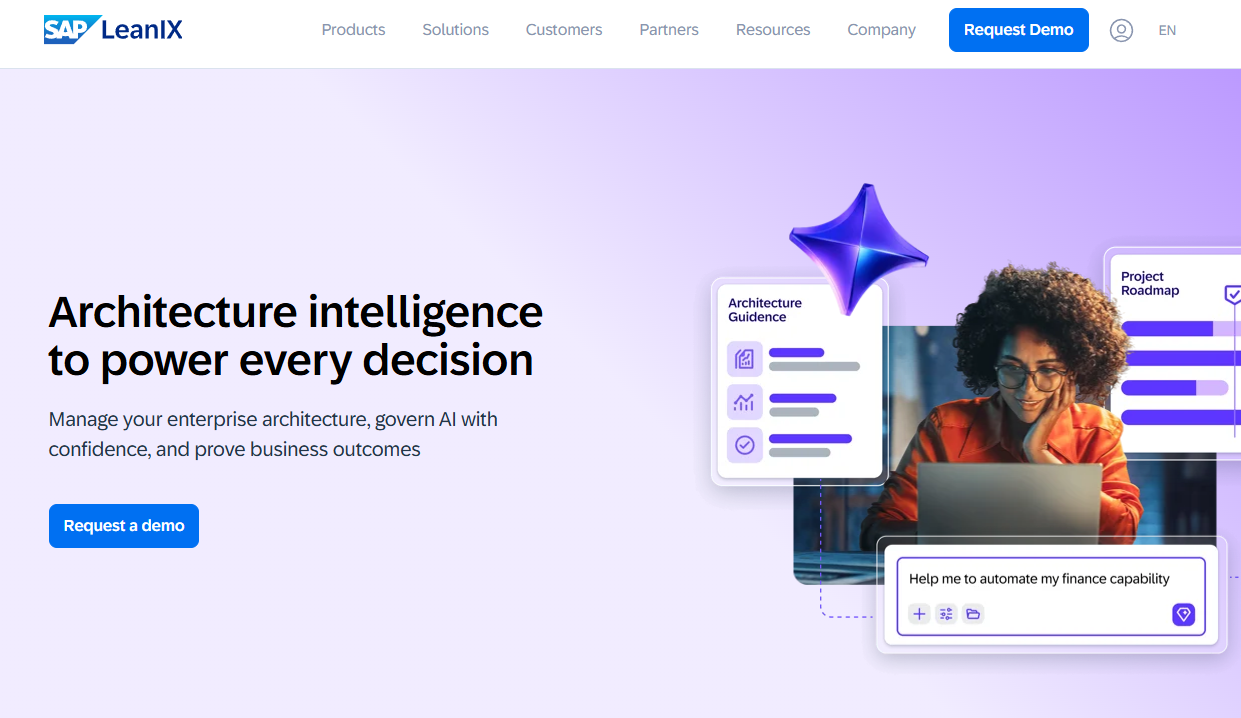
SAP LeanIX is an AI-powered enterprise architecture platform built around application portfolio management, technology risk visibility, and transformation road-map planning. Its pricing model charges by the number of applications in the repository, while user access across the organization remains unlimited. According to SAP LeanIX's own 2025 research, 64% of surveyed companies increased their investment in enterprise architecture, reflecting how central portfolio visibility has become to modernization decisions.
Best for: Product and enterprise architecture teams that need an accessible, organization-wide application inventory and portfolio decision layer.
Key features
- Application portfolio assessment and lifecycle tracking
- Technology risk and compliance management
- AI-assisted discovery and natural-language queries
- Configurable dashboards, surveys, and automations
- SSO, IP restrictions, and open API integrations
Why choose SAP LeanIX: The unlimited user model removes the seat-count friction that usually keeps architecture data locked inside a small team. It performs best when the central job is application rationalization, lifecycle decisions, and a shared source of truth that finance, security, and product teams can all read.
SAP LeanIX pricing: Pricing is tiered by the number of applications managed, with unlimited user access included. The platform offers three modules: Application Portfolio Management, Technology Risk and Compliance, and Architecture and Road Map Planning. All require a quote from sales. G2 reviewer-reported ranges suggest annual contracts scale with application count, so the cost driver is portfolio size, not headcount.
G2 rating: 4.5/5 (verified October 2026).
2. Ardoq
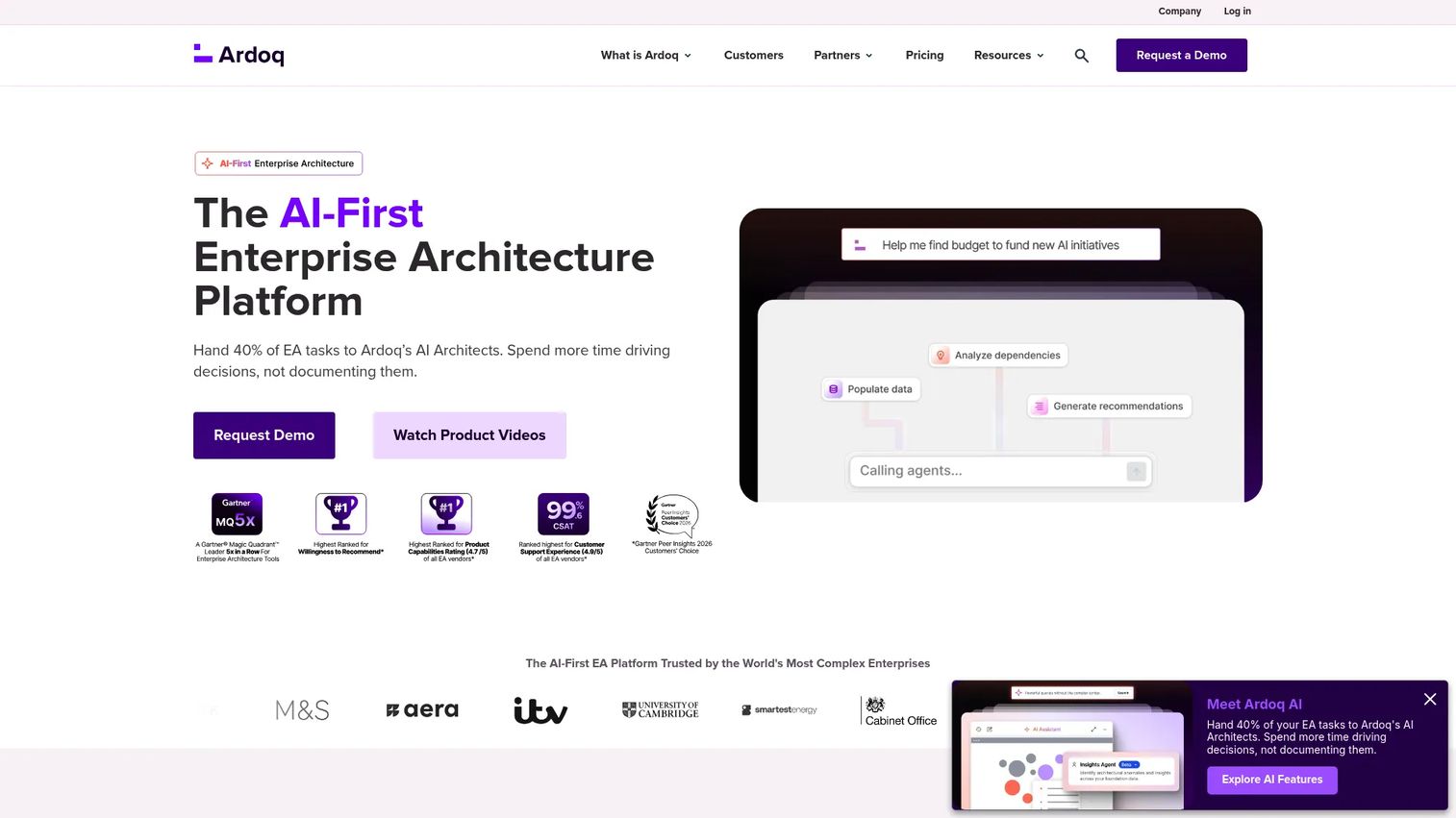
Ardoq is a graph-native enterprise architecture platform that connects applications, people, processes, capabilities, and other architecture data into a single repository. Its configurable metamodel and survey-driven data collection make it relevant for organizations where architecture knowledge is distributed across application owners, technology teams, and business stakeholders rather than held by a central team.
Best for: Organizations building a collaborative EA practice where architecture data must be gathered from distributed owners rather than manually maintained by architects.
Key features
- Configurable metamodels and connected graph data
- Surveys and data collection for distributed ownership
- AI Assistant with semantic search and natural-language queries
- Scenario modeling and roadmaps with impact analysis
- Permission-aware AI Gateway using the Model Context Protocol
Why choose Ardoq: It fits teams that want the repository to become a living operating model rather than a diagram archive. The combination of discovery tooling, AI-generated viewpoints, and scenario analysis makes it strong for cross-functional modernization programs where no single team holds a complete picture.
Ardoq pricing: Pricing is based on the number of applications managed and includes unlimited users and core platform capabilities. A custom quote is required. No individual tier prices are displayed on the pricing page. G2 reviewers note pricing is negotiated by application count and use case scope.
G2 rating: 4.5/5 (verified October 2026).
3. Bizzdesign Horizzon
Bizzdesign Horizzon is designed for enterprise transformation planning, connecting strategy to execution through capability maps, architecture governance, and stakeholder-specific roadmaps. It supports open modeling standards including ArchiMate, C4, BPMN, ERD, and UML, making it relevant for organizations that need a formal shared language across business and technology teams.
Best for: Enterprise architecture and transformation offices coordinating business strategy, operating model changes, and large modernization portfolios.
Key features
- AI-powered architecture design and governance
- Capability-based planning with transformation roadmaps
- Open-standards modeling: ArchiMate, C4, BPMN, ERD, UML
- Tailored dashboards, analytics, and stakeholder views
- Enterprise-wide collaboration across business and IT teams
Why choose Bizzdesign Horizzon: It performs best when architecture must inform business change decisions, investment sequencing, and executive reporting alongside technical planning. For PMs navigating enterprise-level constraints, capability maps and roadmaps produced here provide the evidence needed to explain why an initiative must wait, split, or receive additional platform investment.
Bizzdesign Horizzon pricing: Bizzdesign directs all pricing inquiries to a demo booking rather than publishing tier information. All pricing requires a custom quote. No G2 reviewer-reported ranges were available at time of verification.
G2 rating: 4.2/5 (verified October 2026).
4. Avolution ABACUS
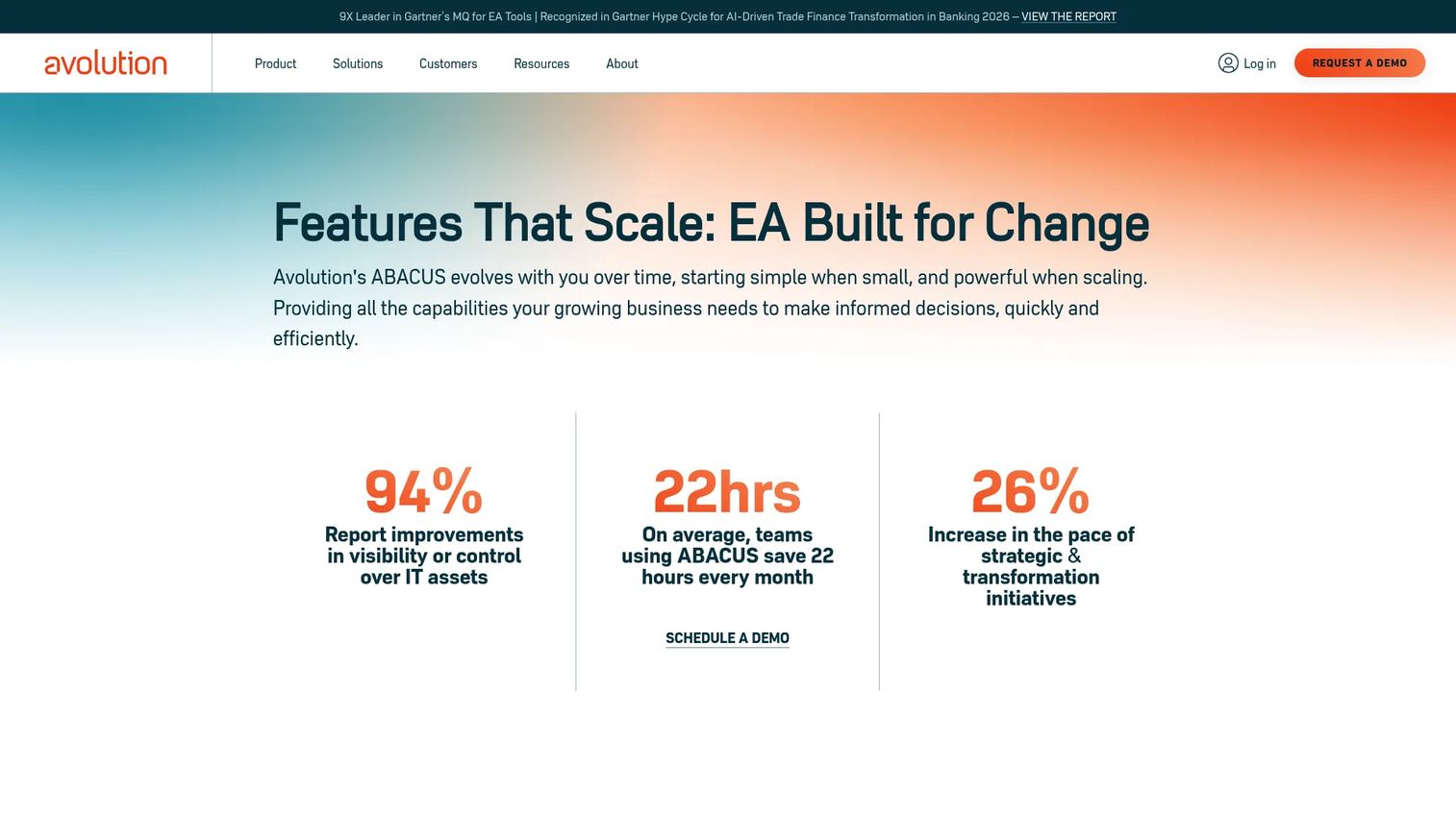
Avolution ABACUS is an enterprise architecture and transformation platform for modeling, roadmapping, visualization, impact analysis, and governance. Its configurable metamodels and no-code automation capabilities make it a strong fit for mature architecture teams that need to represent complex enterprise relationships without custom development work.
Best for: Mature architecture teams that need governance depth, configurable structures, and detailed dependency analysis across a complex enterprise.
Key features
- Enterprise architecture modeling, diagramming, and repository
- Dynamic roadmaps with scenario comparison
- Business capability mapping and portfolio assessment
- Data visualization, dashboards, and graph analysis
- No-code automation algorithms and REST API integrations
Why choose Avolution ABACUS: It suits organizations that already have a defined EA operating model and need a platform capable of handling complex relationships, governance practices, and scenario-based change planning. The no-code automation layer reduces the engineering overhead of keeping repository data current across a large application estate.
Avolution ABACUS pricing: Avolution publishes two packages: Foundation (5 Modelers, 25 Editors, 500 Collaborators, ABACUS Core, AI Assistant) and Enterprise (tailored for scale, adds Solution Accelerators). Both include unlimited applications, standard support, and AI Assistant. All pricing requires contact with the vendor. No numeric prices are displayed on the pricing page.
G2 rating: 4.8/5 (verified October 2026).
5. ServiceNow Enterprise Architecture
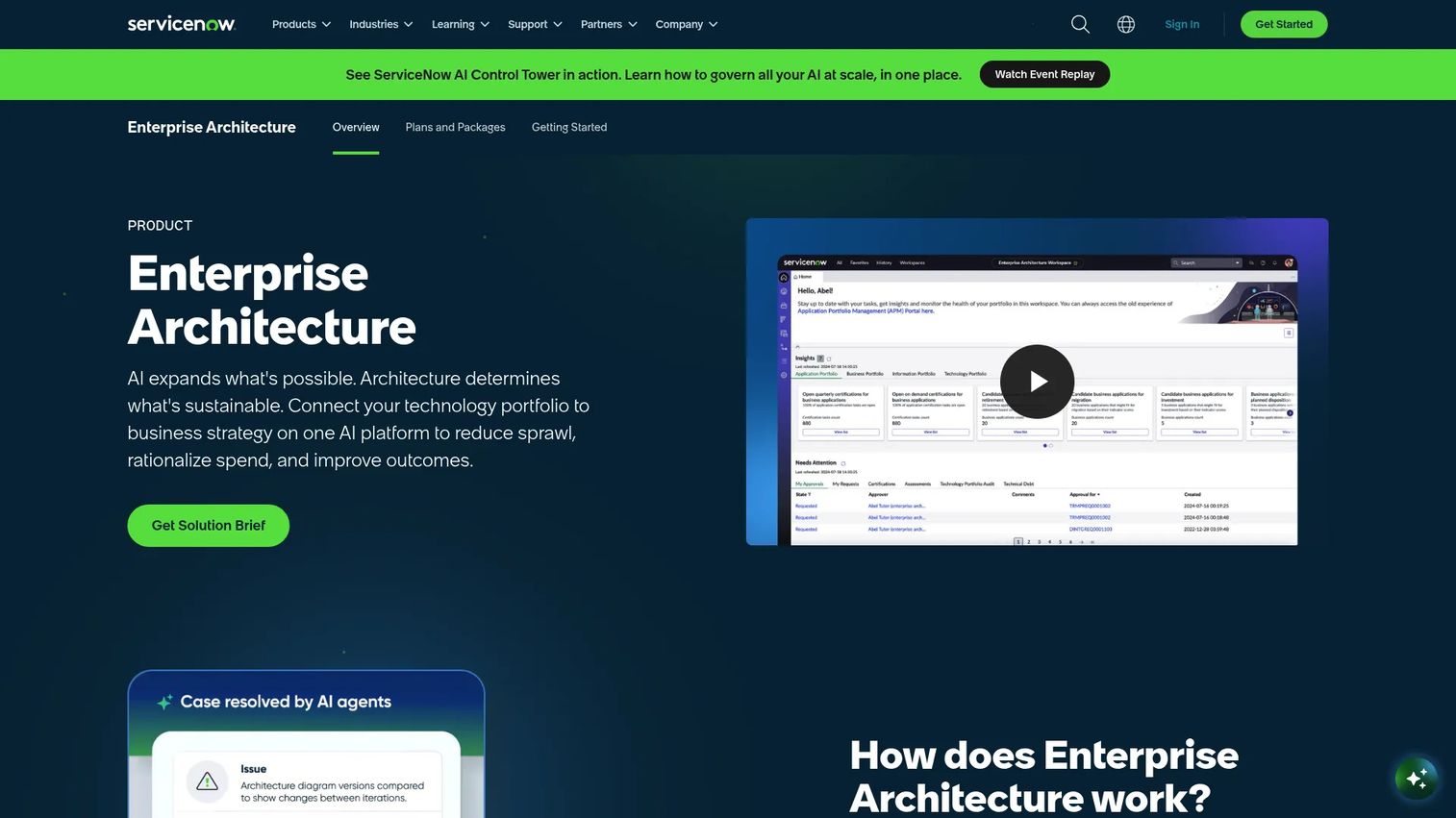
ServiceNow Enterprise Architecture connects EA workflows to the ServiceNow platform, allowing organizations to build architecture views on top of existing CMDB data, service mappings, and operational records. It covers application rationalization, digital portfolio management, enterprise modeling, and technology portfolio management.
Best for: Large organizations with established ServiceNow practices and reliable CMDB data that want architecture decisions connected to operational context.
Key features
- AI-generated enterprise architecture diagrams
- Application rationalization with total-cost-of-ownership analysis
- Enterprise modeling: CSDM, AWS, ArchiMate, and BPMN shape libraries
- Technology portfolio management and lifecycle monitoring
- Conversational Enterprise Architecture Query Agent
Why choose ServiceNow Enterprise Architecture: The strongest argument is data proximity. If the CMDB, service mapping, and operational workflows are already trustworthy in ServiceNow, architecture teams can avoid duplicate data maintenance by building views on what already exists. For PMs, this matters when product dependencies run through shared enterprise services, change governance, or incident ownership tracked in ServiceNow.
ServiceNow Enterprise Architecture pricing: Two packages are available: Enterprise Architecture Advanced and Enterprise Architecture Prime. Both require a custom quote. No numeric prices are displayed.
G2 rating: 4.4/5 (verified October 2026).
6. Sparx Systems Enterprise Architect
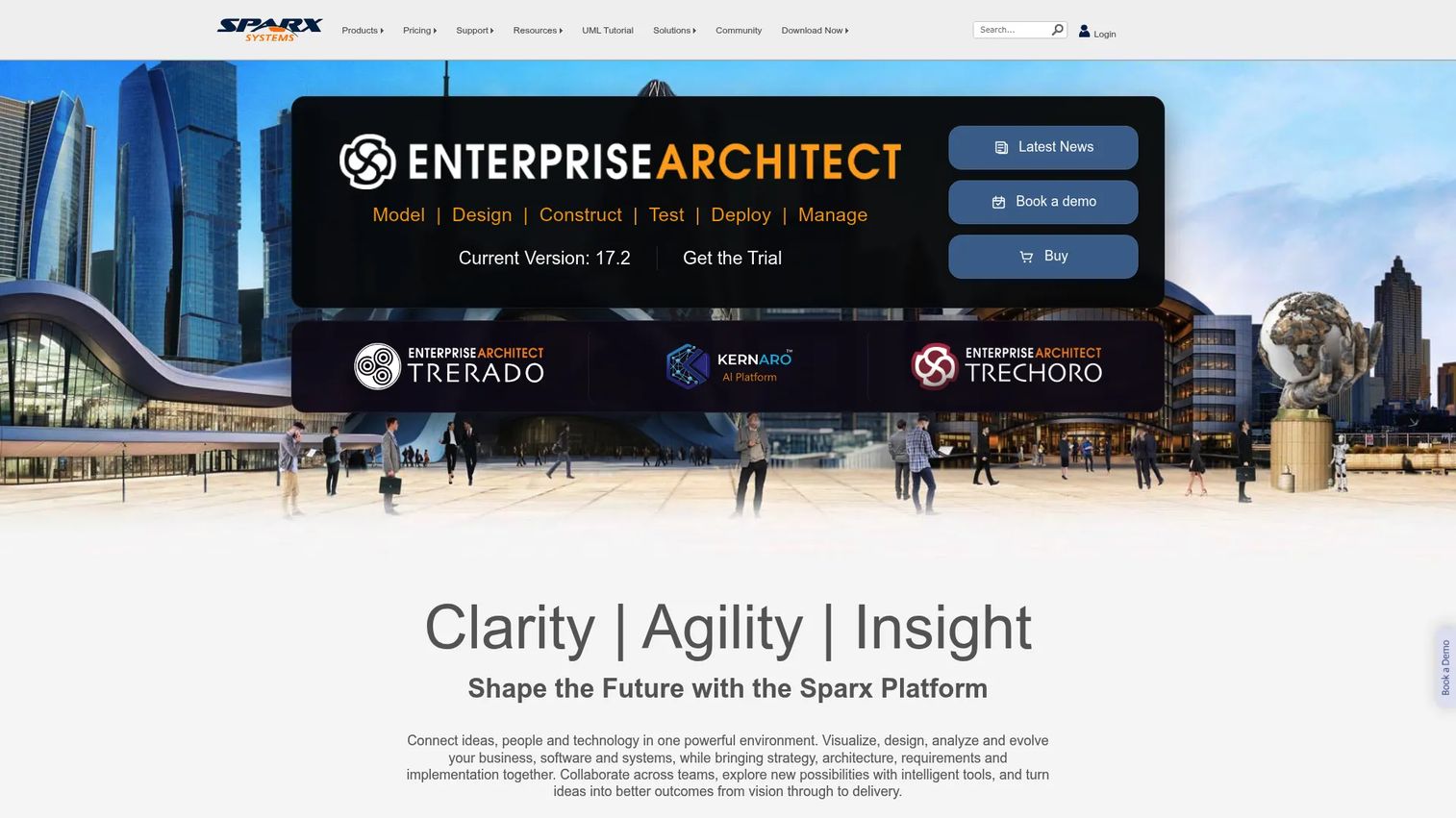
Sparx Systems Enterprise Architect is a formal modeling and engineering platform supporting UML 2.5, BPMN, SysML, requirements traceability, code engineering, database modeling, and enterprise architecture frameworks including TOGAF, UAF/UPDM, ArchiMate, and Zachman. It differs from SaaS portfolio repositories because its core value is modeling depth and engineering precision rather than portfolio-layer accessibility.
Best for: Architecture, systems engineering, and software teams that need detailed standards-based models, traceability, code support, and technical design depth.
Key features
- UML 2.5, BPMN, and SysML modeling with notation libraries
- Requirements management with full traceability
- Code generation and reverse engineering
- TOGAF, ArchiMate, UAF/UPDM, and Zachman framework support
- Database design and DDL generation
Why choose Sparx Systems Enterprise Architect: The entry price and broad standards coverage make it a strong candidate for technically mature teams that need precise models rather than a business-friendly portfolio layer. PMs should join evaluations when product architecture, integration contracts, or technical debt must be represented with engineering precision.
Sparx Systems Enterprise Architect pricing: Licenses are sold as one-time purchases. The Starter Edition costs $245 (standard) or $320 (floating). Corporate Edition: $320 standard, $425 floating. Unified Edition: $535 standard, $699 floating. Ultimate Edition: $750 standard, $965 floating. Floating licenses allow sharing across a team. No free tier is available, though a free trial is offered.
G2 rating: 4.1/5 (verified October 2026).
7. OrbusInfinity
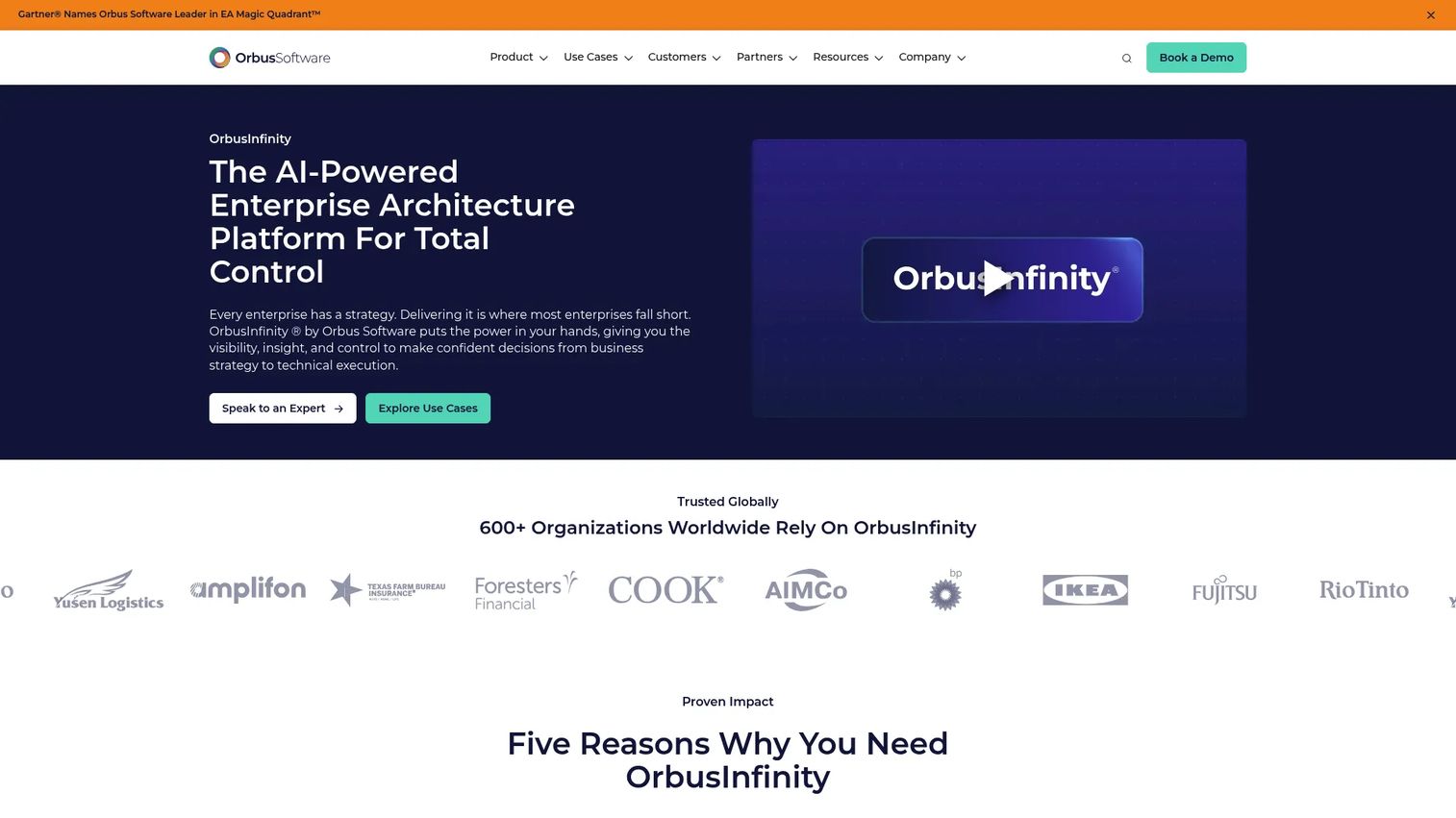
OrbusInfinity is an AI-powered enterprise transformation platform covering enterprise architecture, business architecture, IT portfolio management, business process management software, and governance. Its configurable metamodel, 150+ workflow connectors, and built-in diagramming tools support both formal architecture governance and stakeholder-accessible reporting from a single repository.
Best for: Organizations that need architecture data accessible to business stakeholders while maintaining formal governance and transformation planning practices.
Key features
- Centralized governed architecture repository with configurable metamodel
- TOGAF, ArchiMate, BPMN, and ITIL framework support
- OrbusInfinity Draw diagramming with Visio integration
- 150+ workflow connectors and REST API
- Dashboards, AI Charts, and role-based permissions with enterprise SSO
Why choose OrbusInfinity: It fits teams that want to publish architecture insights to product, finance, and security stakeholders without reducing the practice to static diagrams. The combination of formal governance and accessible views makes prioritization conversations between IT, product, and delivery teams more grounded in shared data.
OrbusInfinity pricing: Pricing is modular and customized by use case, integrations, user roles, and support requirements. No numeric prices are displayed. Contact the vendor for a quote.
G2 rating: 4.5/5 (verified October 2026).
8. Essential Open Source
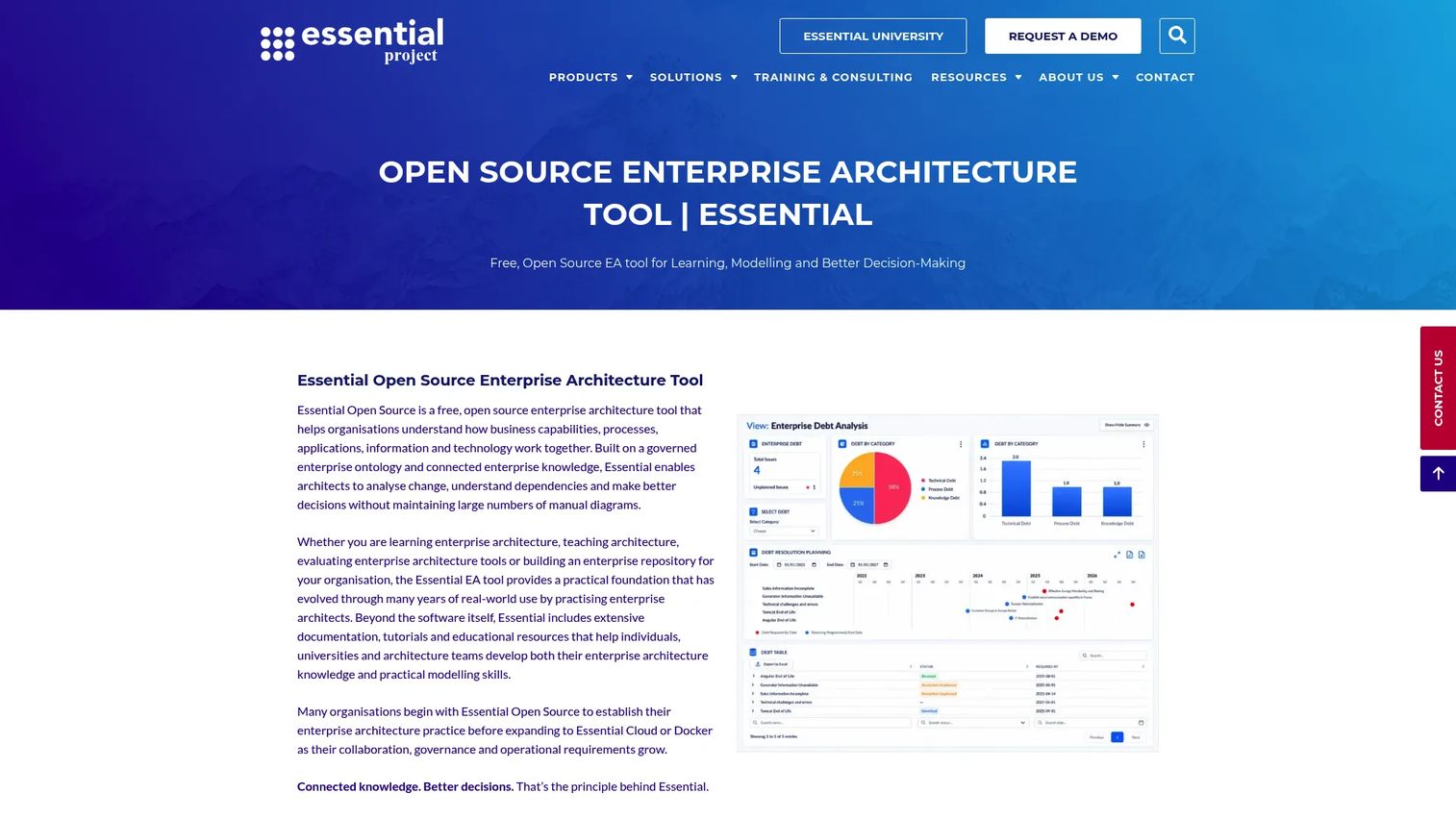
Essential Open Source is a free, self-hosted enterprise architecture tool that connects business capabilities, processes, applications, information, technology, people, projects, and strategy into a single architecture knowledge base. It includes approximately 140 automatically generated visualizations, dashboards, reports, and roadmaps out of the box.
Best for: Teams that need an open source enterprise architecture foundation and can commit internal ownership to configuration, modeling discipline, and ongoing data governance.
Key features
- Free, self-hosted open source deployment
- Business, application, and technology portfolio management
- 140+ automatically generated visualizations, dashboards, and reports
- Impact analysis and strategic planning
- Business process architecture and technical debt management
Why choose Essential Open Source: It makes sense when procurement constraints, deployment control, or customization requirements make commercial SaaS platforms a poor initial fit. The open source model reduces licensing cost. It does not reduce the work required to populate, govern, and maintain architecture data. Teams building a first repository around a bounded modernization program often use it to establish process before investing in a broader commercial platform.
Essential Open Source pricing: The core product is free to use under an open source license. Paid Essential Cloud editions are available separately for organizations that want managed hosting and additional support. Contact the Essential Project for cloud pricing details.
9. erwin Evolve
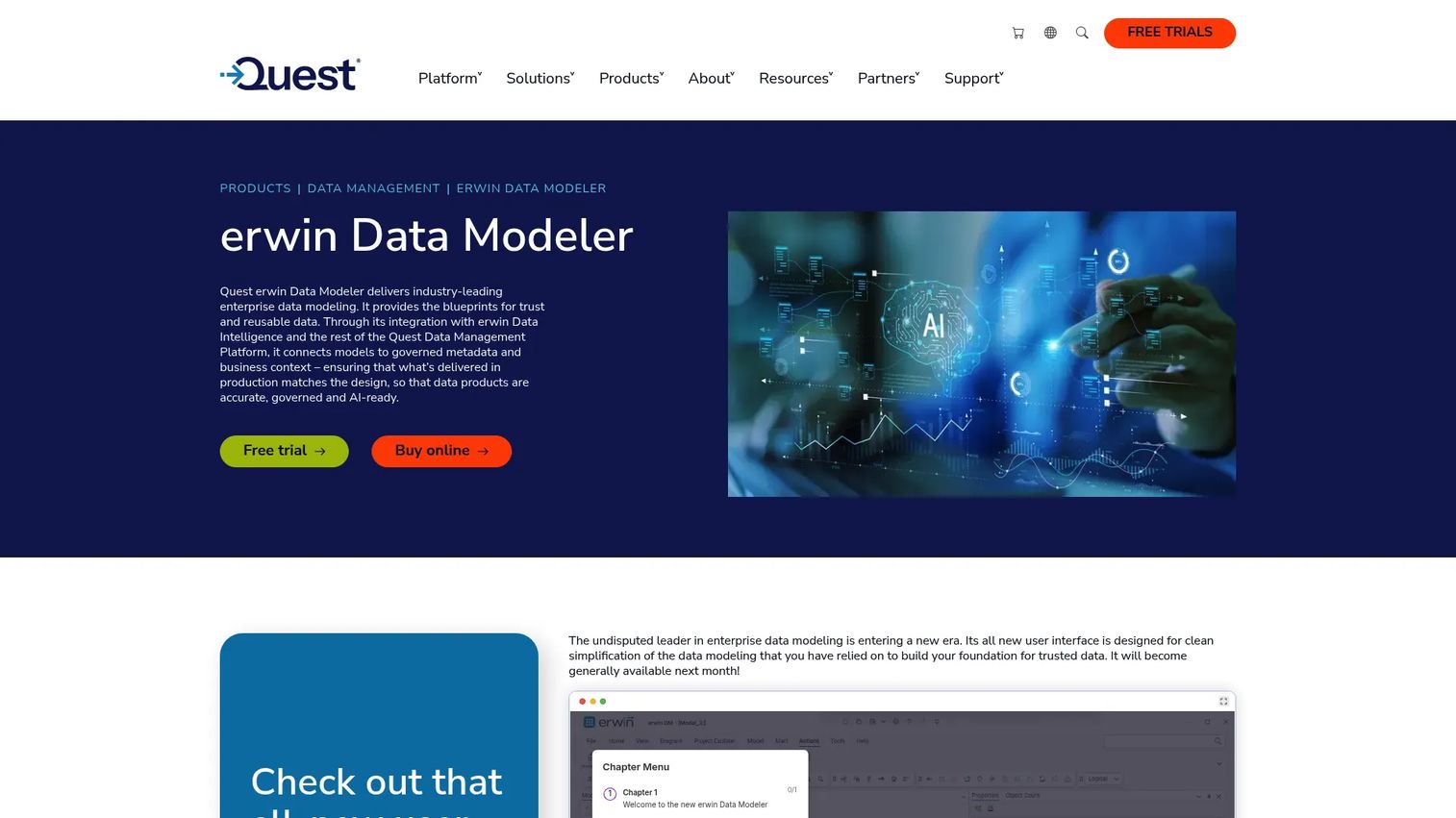
erwin Evolve is a configurable enterprise architecture and business process modeling suite. It combines an EA repository, web-based collaborative modeling, impact and dependency analysis, and centralized documentation with integrations across platforms including ServiceNow and Zendesk. It is distinct from erwin ER Studio, which focuses on data modeling specifically.
Best for: Teams that need architecture planning informed by process, information ownership, and data governance context in a single platform.
Key features
- Enterprise architecture and business process modeling
- Model element, link, dependency, and impact analysis
- Configurable metamodels and role-based views
- Heatmaps, reports, charts, and dashboards
- Integrations with ServiceNow, Zendesk, RSA Archer, and CAST
Why choose erwin Evolve: It suits organizations where data lineage, information ownership, process change, and enterprise architecture must inform the same decisions. Data-intensive product teams benefit when architecture decisions include data ownership, process impact, and governance requirements across a shared application estate.
erwin Evolve pricing: The official homepage was inaccessible during research. No current tier prices or a verified pricing page were available. Contact the vendor directly for current package details and pricing.
10. Planview Portfolios
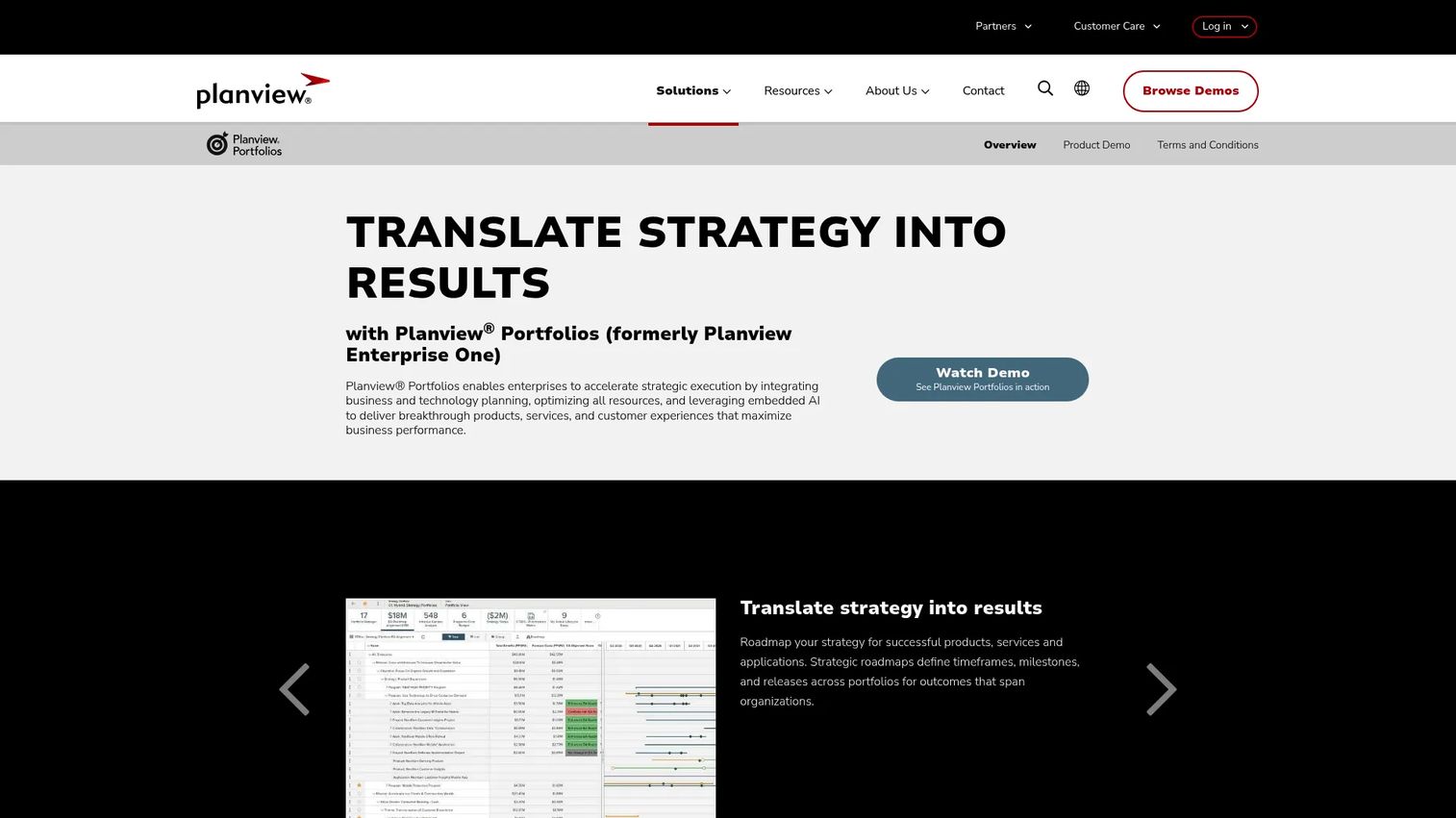
Planview Portfolios is an enterprise strategic portfolio management platform connecting strategy, investments, resources, and delivery. It earns a place here because many organizations need architecture decisions connected to strategic initiatives, funding, and delivery portfolios. It is more portfolio and investment planning oriented than a formal EA modeling tool, and organizations with deep modeling requirements typically pair it with a dedicated architecture repository.
Best for: Portfolio, transformation, and product operations teams that need to connect strategic investment decisions to technology roadmaps and enterprise change.
Key features
- Strategic alignment with OKRs and investment prioritization
- Roadmapping and scenario planning
- Financial, capacity, and resource management
- Portfolio analytics and reporting dashboards
- AI-powered insights and workflow automation
Why choose Planview Portfolios: It fits when the central question is where to invest, sequence, pause, or retire initiatives across a complex portfolio. For PMs, the value shows up in tradeoff conversations: Opportunity cost, roadmap sequencing, investment cases, and how technology constraints affect portfolio commitments. Teams that need formal EA modeling alongside this will need to pair it with a repository platform.
Planview Portfolios pricing: No pricing page was accessible during verification. All pricing requires a custom quote. Contact Planview directly for current package details and contract terms.
G2 rating: 3.8/5 (verified October 2026).
Considerations when choosing enterprise architecture tools
Decide whether you need a repository, a modeling tool, or both
A technical modeling team may need UML, SysML, traceability, and code-level depth. A transformation office may need application inventory, capability maps, and stakeholder reporting. Buying a formal modeling platform to solve an application rationalization problem adds unnecessary complexity. Match the tool category to the actual decision you need to support.
Verify data sources before evaluating dashboards
The best dashboard cannot repair poor ownership data. Before shortlisting, list the systems that will populate the repository: CMDB, cloud inventories, ITSM, source control, project systems, and data catalogs. Confirm who owns data quality for each source. This question typically surfaces more implementation risk than the platform comparison itself.
Test stakeholder accessibility
Architects tolerate complex metamodels. Product managers, finance leaders, security reviewers, and executives need focused views that answer a decision question quickly. Ask vendors to demonstrate role-specific dashboards rather than a generic repository browser. If the view a non-architect sees requires explanation, adoption will stall outside the architecture team.
Measure maintenance effort during the pilot
License cost is not the hidden cost. Data stewardship is. During any pilot, track time spent importing data, resolving duplicates, assigning owners, updating relationships, and publishing usable views. That number tells you the actual operating cost of keeping the repository decision-grade.
Match governance to your delivery cadence
A quarterly architecture review may work for a stable estate. Fast-shipping SaaS teams need architecture updates connected to release planning, platform changes, migrations, and deprecation work. Choose a governance process that survives your actual release cadence, not the one you plan to have.
Conclusion
Enterprise architecture tools are decision systems, not diagram archives. The right platform depends on whether your organization needs portfolio visibility, collaborative discovery, formal technical models, CMDB-connected governance, open source control, or investment planning.
The shortlist by use case: SAP LeanIX for application portfolio management at scale; Ardoq for collaborative, data-driven architecture discovery; Bizzdesign Horizzon for transformation planning with strategy-to-execution alignment; Avolution ABACUS for governance depth and impact analysis; ServiceNow Enterprise Architecture for organizations already operating on ServiceNow with solid CMDB data; Sparx Systems Enterprise Architect for formal modeling and engineering; OrbusInfinity for stakeholder-accessible business and IT architecture; Essential Open Source as a free starting point for teams with internal ownership capacity; erwin Evolve for data and process-aware architecture work; Planview Portfolios for investment prioritization and strategic portfolio decisions.
Whatever you choose, start with a 30 to 60 day pilot focused on one business capability, one application domain, or one modernization decision. Require the pilot to prove data freshness, stakeholder adoption, and one concrete decision improvement before expanding scope.
Start your journey with Guideflow today!
FAQs
Application portfolio management is one major capability within enterprise architecture. APM focuses on applications, their lifecycle, cost, risk, ownership, and rationalization decisions. Full enterprise architecture software extends that to business capabilities, data, technology standards, processes, target architectures, and transformation roadmaps. Many EA platforms include APM as a module rather than a separate product.
The strongest fit depends on existing data sources and your operating model. Shortlist platforms with application lifecycle tracking, business capability maps, dependency analysis, roadmapping, and integrations with CMDB or IT service data. SAP LeanIX and Ardoq both address this job directly. ServiceNow Enterprise Architecture is the right route if your CMDB is already the authoritative source.
PMs don't need to own EA models, but read access is valuable when roadmap work touches shared services, platform dependencies, data systems, identity, security controls, or legacy applications. The practical case: Better architecture data means dependency conflicts surface before the sprint is committed rather than after.
No. A CMDB manages operational configuration data, service relationships, and incident tracking. EA software adds strategic context, capability mapping, portfolio planning, and transformation analysis on top of that operational foundation. Most mature organizations connect the two systems rather than replacing either one.
Choose one bounded use case: An application rationalization decision, a cloud migration program, a product platform dependency map, or a business capability assessment. Define the source systems upfront, name the data owners for each, identify the reporting audience, and specify one decision the pilot must improve. A pilot without a named decision question tends to drift into documentation for its own sake.
Open source can work at scale when the organization has committed owners, modeling standards, governance routines, and technical resources to manage deployment and updates. The licensing model removes per-seat cost. It does not remove the need for repository maintenance, stakeholder adoption, or integration work. Essential Open Source is used by teams ranging from small modernization programs to larger enterprise practices.
Requirements vary by team. ArchiMate and TOGAF matter for many enterprise architecture practices. BPMN becomes important when teams also need process modeling alongside architecture. UML and SysML become critical for software, systems, or engineering modeling. Clarify which standards your architects and engineering teams already use before evaluating notation support.
Implementation time depends on repository scope, data quality, system integrations, and stakeholder adoption requirements. A bounded pilot focused on one application domain can produce usable outputs within 30 to 60 days. Enterprise-wide adoption typically takes quarters, not weeks, and is gated more by data ownership decisions and change management than by platform configuration.