You have a promising AI feature on the roadmap. Engineering says the model is feasible. Data says the training set needs more work. Leadership wants a date.
The hard part is not finding a neural network framework. It is choosing one your team can validate, instrument, deploy, and maintain after the launch pressure moves elsewhere. A model that performs well in a notebook can still fail the activation workflow it was built to improve.
The global neural network software market was valued at $34.76 billion in 2025 and is forecast to reach $177.55 billion by 2031, a 31.25% compound annual growth rate, according to Mordor Intelligence (2026). That growth is pulling more product teams into decisions they were not trained to make. The right choice depends on the model job, team skills, deployment path, and how much engineering control the project actually requires.
This guide is built for PMs and cross-functional product teams evaluating artificial neural network software options. Researchers and pure ML engineers will find it useful too, but every section is framed around the product and organizational stakes, not just the technical ones.
What's inside
This guide covers seven neural network software tools for 2026, spanning frameworks for custom model development, high-level APIs for faster building, performance-oriented computing tools, and visual modeling platforms.
- Who it's for: Product managers, technical leads, and ML engineers evaluating their training and deployment stack
- Selection criteria: Ecosystem maturity, production readiness, learning curve, pricing model, and community support
- Also included: A side-by-side comparison table, PM-specific buying considerations, and eight FAQ answers
TL;DR
- Best for broad production work: TensorFlow covers training, deployment, and production tooling across a mature ecosystem
- Best for research-driven teams: PyTorch suits data scientists who need fast experiment iteration and Python-native workflows
- Best for fast model building: Keras offers a readable, multi-backend API that reduces prototype time significantly
- Best for high-performance computing: JAX targets advanced teams doing accelerator-heavy numerical work and large-scale ML research
- Best for visual, lower-code workflows: Neural Designer provides a GUI-led path to model development without writing framework-level code
- Best for established computer vision pipelines: Caffe fits teams maintaining existing CV infrastructure rather than starting fresh
- Best for C++ predictive modeling: OpenNN suits engineering teams building neural network models directly in C++
What is neural network software?
Neural network software is a framework, library, or visual platform used to build, train, evaluate, and deploy models made of connected computational layers that learn patterns from data.
These tools handle the technical infrastructure of machine learning: Defining model architecture, running optimization loops, tracking performance, and exporting trained models for use in products and services.
What neural network software does
A typical deep learning software workflow covers:
- Preparing and transforming training data into usable formats
- Defining network architecture, layers, weights, and biases
- Configuring loss functions, optimizers, and activation functions
- Training models using CPUs, GPUs, or specialized accelerators
- Evaluating accuracy, latency, calibration, and error patterns
- Exporting and deploying models into production workflows
- Monitoring model quality and drift over time
The main types of neural network software
| Type | What it is | Best use |
|---|---|---|
| Deep learning frameworks | Low-level and high-level building blocks for custom models | Production systems and advanced research |
| High-level APIs | Simplified interfaces over frameworks | Faster experimentation and smaller ML teams |
| Numerical computing tools | Accelerator-focused arrays and transformations | Research-heavy performance work |
| Visual model platforms | GUI-based training and deployment environments | Lower-code workflows and stakeholder visibility |
| Specialized libraries | Tools focused on computer vision or a defined domain | Narrow model types and established pipelines |
How neural networks work
Neural networks learn by adjusting internal values across connected layers. Inputs, such as usage events, images, or transaction attributes, pass through layers that detect patterns at increasing levels of abstraction. Weights and biases are updated during training to reduce prediction error. Loss functions measure that error, and optimizers adjust the weights to minimize it.
One important ecosystem note: Keras can run on TensorFlow, JAX, or PyTorch backends, which lets teams use a consistent model-building API while switching the underlying execution engine. That flexibility matters when your team is not ready to commit to one framework for the long term.
When to use neural network software
Build product features that learn from behavior
Teams reach for neural network tools when standard rules or linear models cannot capture the complexity in their data. Classification, demand forecasting, recommendation ranking, anomaly detection, and document understanding all suit this category. The selection question is not just "which model type?" but which product metric the model is meant to move: Activation, early retention, support deflection, or conversion.
Validate an AI use case before committing engineering capacity
A PM's job before choosing a framework is defining what a successful model would change. Set a baseline metric, test data quality, identify the decision the model improves, and run a minimal experiment. Picking PyTorch for fast iteration or Keras for readable prototype code makes more sense at this stage than committing to a full production stack. Speed to validate is worth more than breadth of capabilities early on.
Scale training and inference into a production workflow
Production deployment is a different job than model training. Teams need reproducibility, deployment compatibility, monitoring, privacy review, fallback behavior, and clear ownership for model updates. A framework choice that works well in a notebook may require significant re-engineering when inference latency, regional hosting, and release cadence come into play. Plan for the operational model, not just the first experiment.
Use simpler statistical or rules-based approaches when they meet the product requirement. Neural networks earn their complexity when data volume and performance requirements justify it.
Neural network software comparison
No single deep learning framework wins across experimentation speed, visualization, raw performance, and deployment tooling. The table below helps route the technical discussion to the right tool for each team's constraints.
| # | Product | Best for | Key differentiator | Pricing | G2 rating |
|---|---|---|---|---|---|
| 1 | TensorFlow | Production-oriented deep learning | Broad ecosystem for training, deployment, and model tooling | Free, open source | 4.5/5 |
| 2 | PyTorch | Research and flexible model experimentation | Python-first imperative programming style | Free, open source | 4.6/5 |
| 3 | Keras | Fast model prototyping | Multi-framework high-level API | Free, open source | 4.6/5 |
| 4 | JAX | Accelerator-heavy numerical computing | Program transformations for high-performance array workflows | Free, open source | N/A |
| 5 | Caffe | Established computer vision pipelines | Configuration-driven deep learning framework | Free, open source | 4.0/5 |
| 6 | OpenNN | Applied predictive analytics and C++ teams | C++ neural network library | Free, open source | N/A |
| 7 | Neural Designer | Visual model development | GUI-led neural network design and deployment workflow | Free tier, paid plans from $300/month | 4.4/5 |
Best 7 neural network software tools for 2026
1. TensorFlow
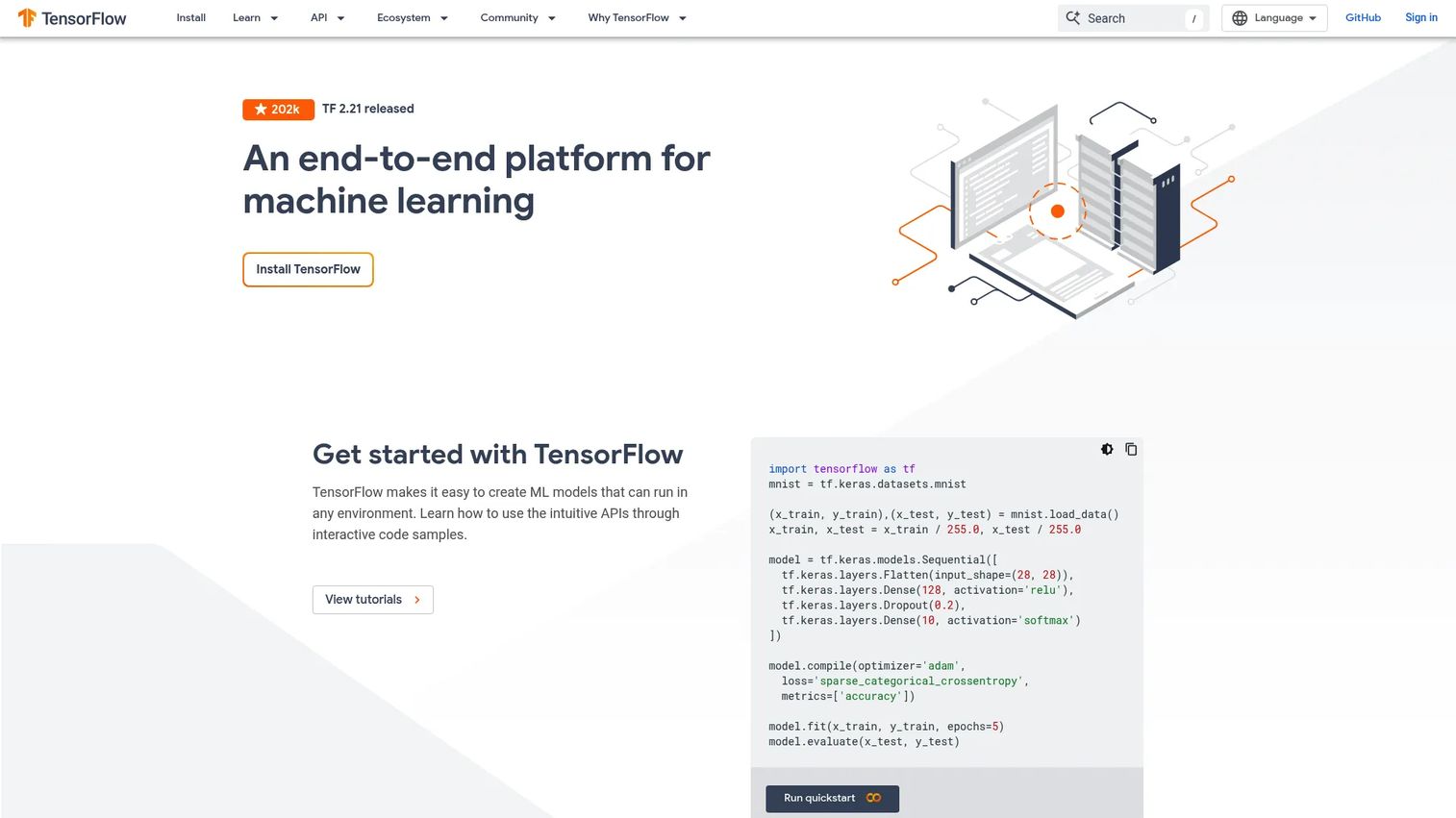
TensorFlow is an end-to-end open-source platform for building, training, and deploying machine learning models at scale. Developed by Google, it supports a wide range of tasks including computer vision, language processing, forecasting, and recommender systems. The platform covers the full model lifecycle, from dataset preparation through production serving, and supports high-level model building through its Keras API. TensorFlow Extended (TFX) adds production MLOps tooling for teams that need reproducible pipelines.
Best for: Product teams with dedicated ML engineering support that need a single framework spanning experimentation and production.
Key features
- Keras-based model construction and training
- GPU and distributed processing support
- TensorFlow Serving for production model deployment
- TensorBoard for training visualization and debugging
- TFX pipeline tooling for production ML workflows
Why choose TensorFlow: Its depth of ecosystem documentation and production pathways make it a strong fit when the AI feature will outlive its first experiment and needs clear ownership across data, engineering, and platform teams. The breadth can introduce more setup choices for a small team running its first model validation.
TensorFlow pricing: TensorFlow is free and open source with no software license cost. Infrastructure costs for training compute, cloud serving, and storage vary by provider.
G2 rating: TensorFlow holds a 4.5/5 rating on G2.
2. PyTorch
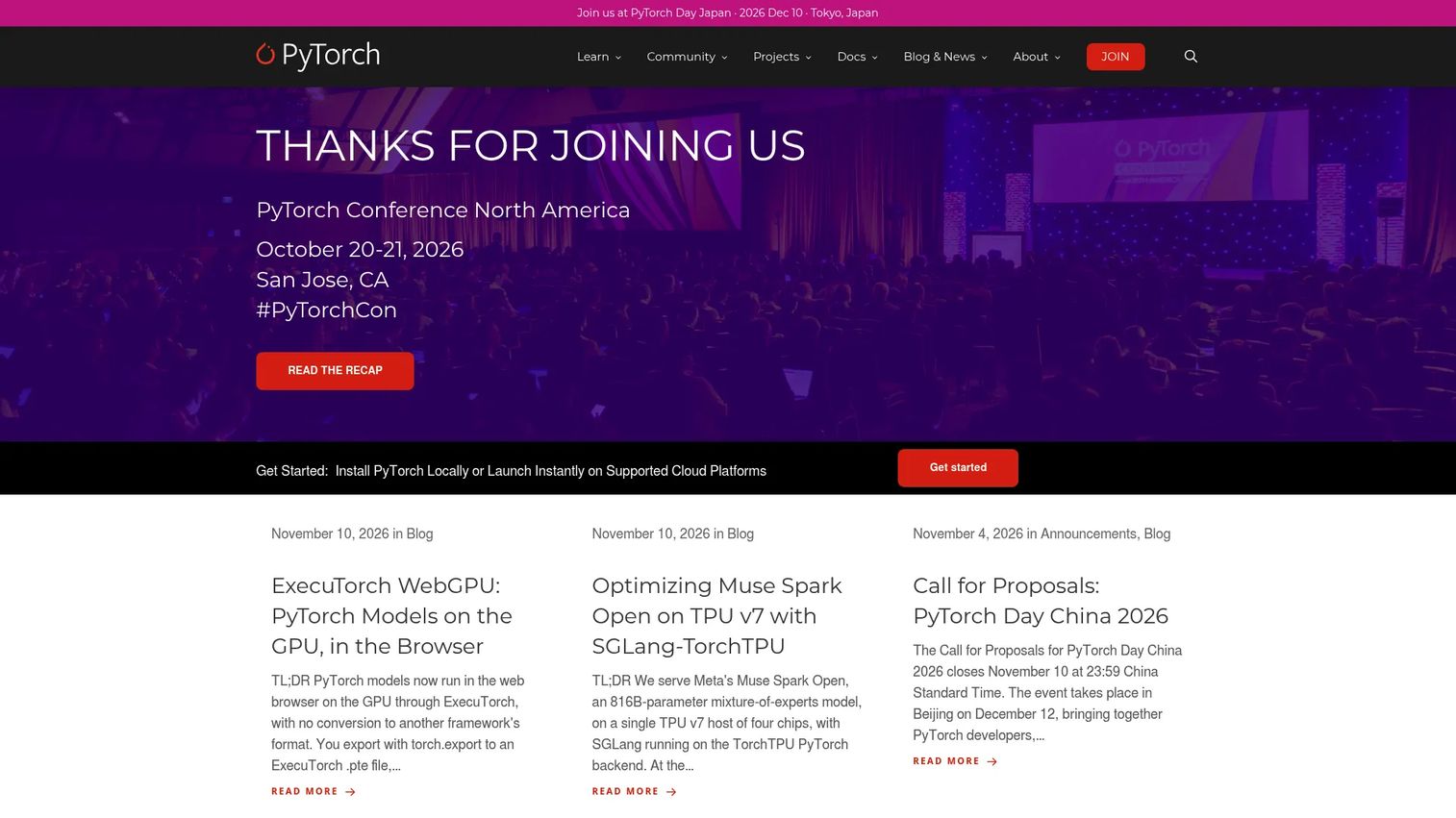
PyTorch is an open-source machine learning framework built around Python-native programming. Its imperative approach means developers can inspect and modify model behavior as they build, which makes debugging faster during experimentation. PyTorch supports GPU acceleration, distributed training, C++ deployment via TorchScript, model export through ONNX, and production serving with TorchServe. The TorchVision library extends its usefulness for computer vision work.
Best for: Data scientists and ML engineers who need fast iteration on new model architectures and research-style experiment cycles.
Key features
- Imperative Python programming with dynamic computation graphs
- GPU and CPU acceleration
- Automatic differentiation for gradient-based training
- TorchVision for computer vision tasks
- Distributed training and ONNX model export
Why choose PyTorch: Its dynamic graph model fits well when experiment design changes frequently, particularly for product teams validating novel models or working with difficult data distributions. Deployment planning should start early, since PyTorch's research strengths do not automatically translate to a production-ready serving setup.
PyTorch pricing: PyTorch is free and open source. Budget separately for infrastructure, training compute, observability tooling, and deployment.
G2 rating: PyTorch holds a 4.6/5 rating on G2.
3. Keras
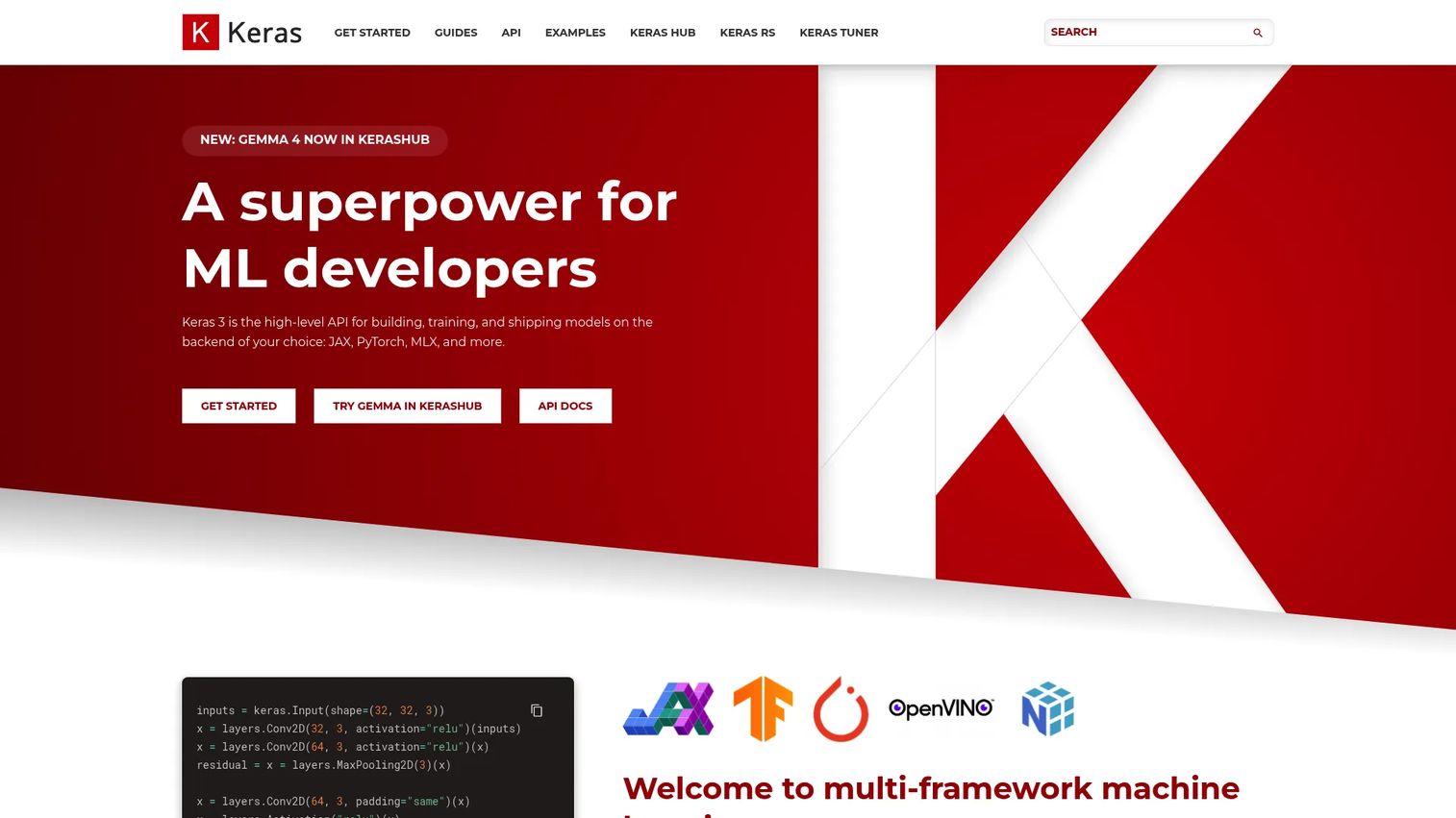
Keras is a Python deep learning API designed to reduce the boilerplate involved in building and training neural networks. Keras 3 runs on TensorFlow, JAX, or PyTorch backends, so teams can use its model-building interface while choosing the execution engine that fits their infrastructure. It offers Sequential, Functional, and subclassing model APIs, plus prebuilt layers, optimizers, and built-in training workflows. For teams exploring AI model deployment software, Keras is often the starting point for a readable proof of concept.
Best for: PMs and engineering teams that need shorter proof-of-concept cycles and backend flexibility without rewriting model code.
Key features
- Multi-backend support: JAX, TensorFlow, and PyTorch
- Prebuilt layers, optimizers, and training workflows
- Sequential, Functional, and subclassing model APIs
- Pre-trained models for prediction and fine-tuning
- TPU backend support for high-performance training
Why choose Keras: Its abstraction layer reduces implementation overhead for standard neural network tasks, and its backend flexibility means teams are not locked into one execution framework from the start. Advanced performance work still requires deep familiarity with the underlying backend.
Keras pricing: Keras is free and open source, available via PyPI with no paid tiers.
G2 rating: Keras holds a 4.6/5 rating on G2.
4. JAX
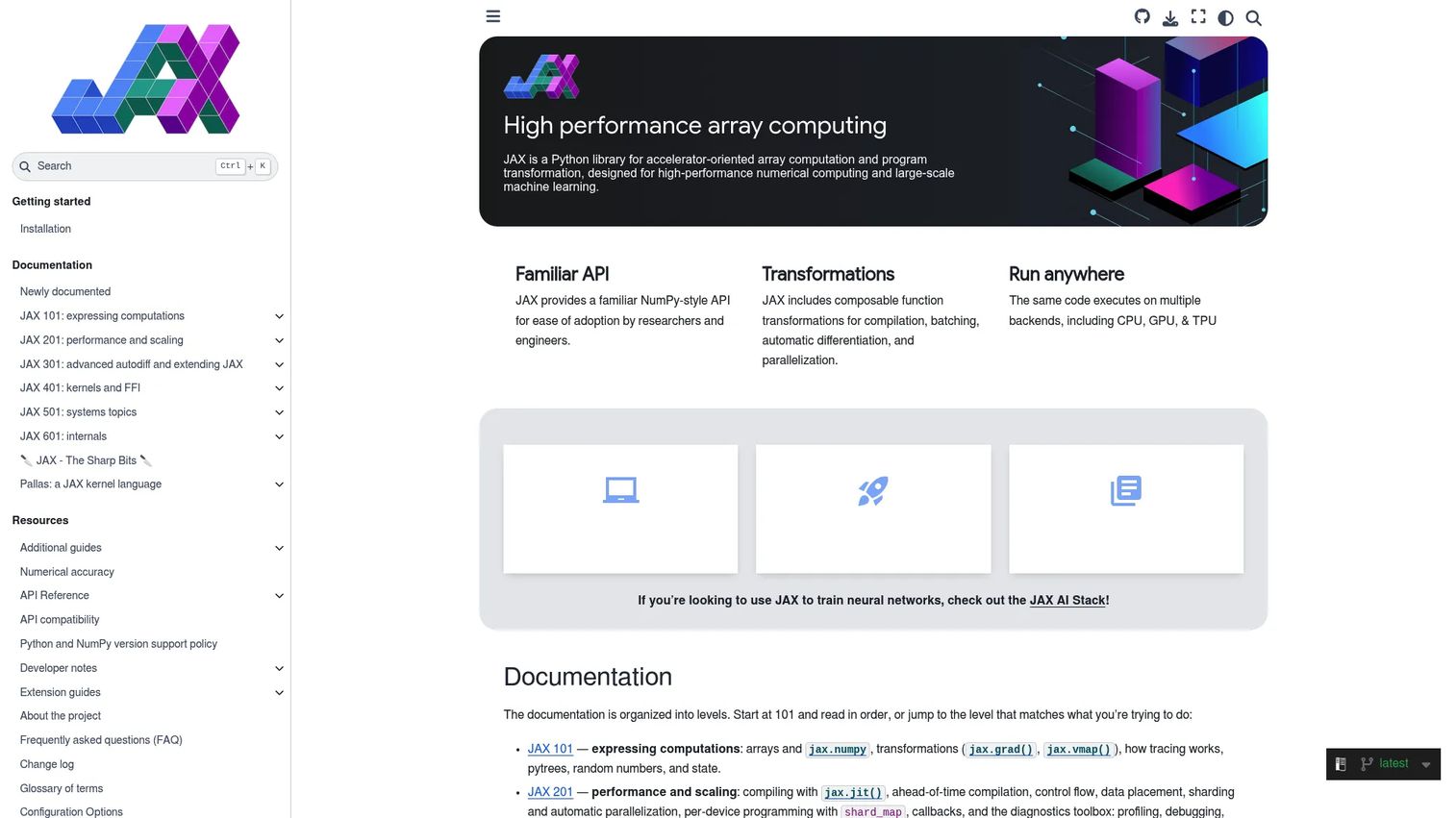
JAX is a Python library for accelerator-oriented array computation and program transformation. It is built around a NumPy-style API with composable function transformations for automatic differentiation, just-in-time compilation, vectorization, and multi-device parallelization. JAX runs on CPUs, GPUs, and TPUs. Teams commonly pair it with neural network libraries such as Flax or Haiku for higher-level model building. It sits closer to the numerical computing layer than a full framework, which makes it a tool for teams where performance architecture is part of the model strategy.
Best for: Advanced technical teams doing large-scale ML research, high-performance numerical computing, or custom gradient-based optimization work.
Key features
- NumPy-compatible API for array operations
- JIT compilation for high-performance execution
- Automatic differentiation via function transformations
- Vectorization with the vmap transform
- Multi-device execution across GPU and TPU
Why choose JAX: Choose JAX when technical differentiation depends on model performance at scale and your team has experienced ML engineers comfortable with low-level numerical programming. It is not the right starting point for a PM-led experiment without that specialist capacity in place.
JAX pricing: JAX is free and open source.
5. Caffe
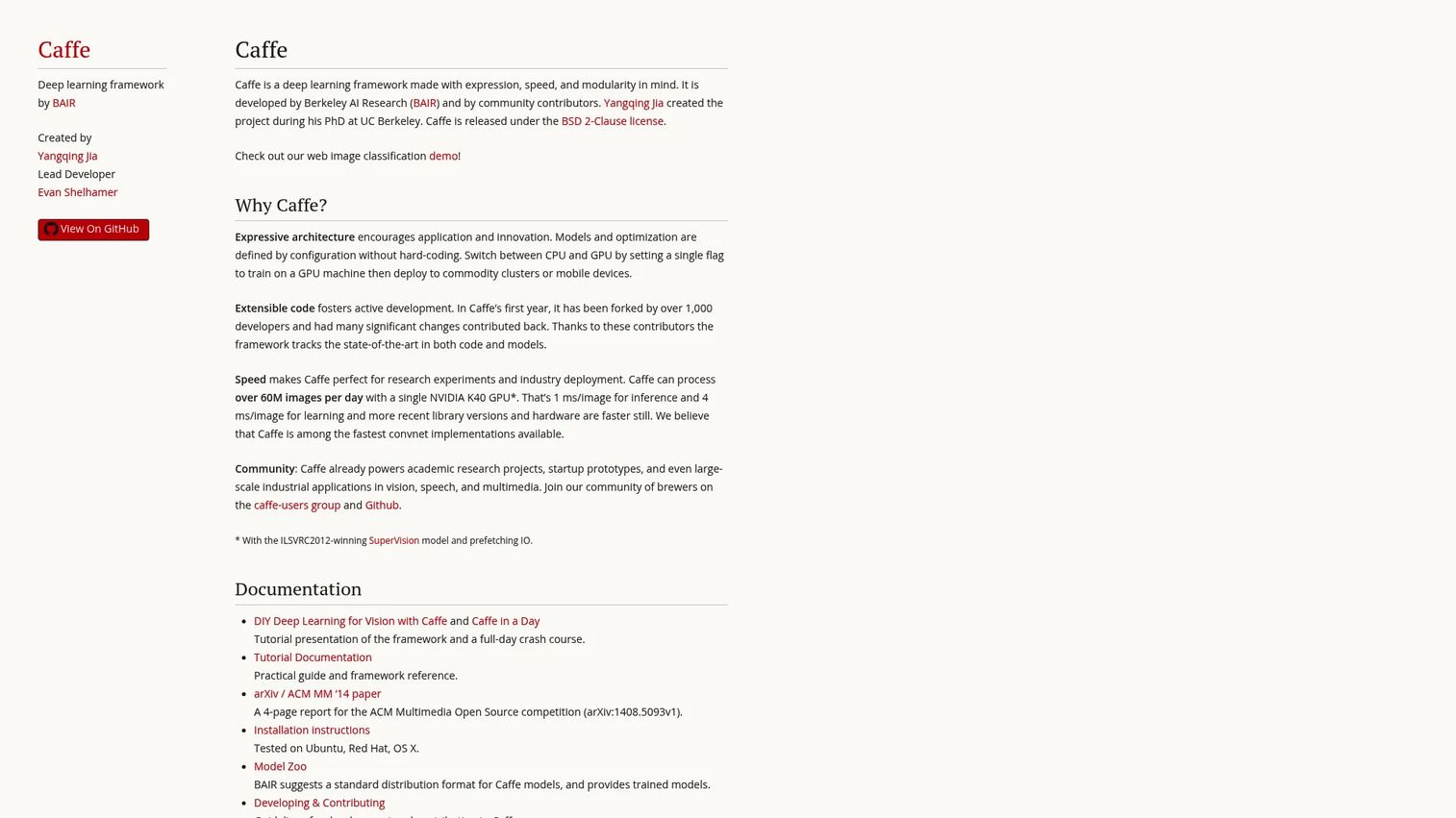
Caffe is an open-source deep learning framework developed by Berkeley AI Research and community contributors. Its configuration-driven model definitions and C++ core made it a go-to tool for computer vision research during the mid-2010s. Caffe supports GPU and CPU execution, includes Python and MATLAB interfaces, and provides access to pretrained model resources. It is released under the BSD 2-Clause license. For teams working with AR training simulator software or legacy CV pipelines, Caffe often appears in the existing stack.
Best for: Teams maintaining established computer vision workflows or evaluating existing Caffe-based models rather than starting a greenfield build.
Key features
- Configuration-driven model definitions (prototxt format)
- C++ core with GPU acceleration
- Python and MATLAB interface support
- Pretrained model library for common CV tasks
- CPU and GPU execution options
Why choose Caffe: It fits organizations with existing infrastructure, trained models, or engineering expertise in the Caffe ecosystem. For new projects that need broader model coverage or more active community support, modern frameworks are a stronger choice. The practical PM question is what it costs to preserve, migrate, or extend the model assets the team already has.
Caffe pricing: Caffe is free and open source under the BSD 2-Clause license.
G2 rating: Caffe holds a 4.0/5 rating on G2 based on 16 reviews.
6. OpenNN
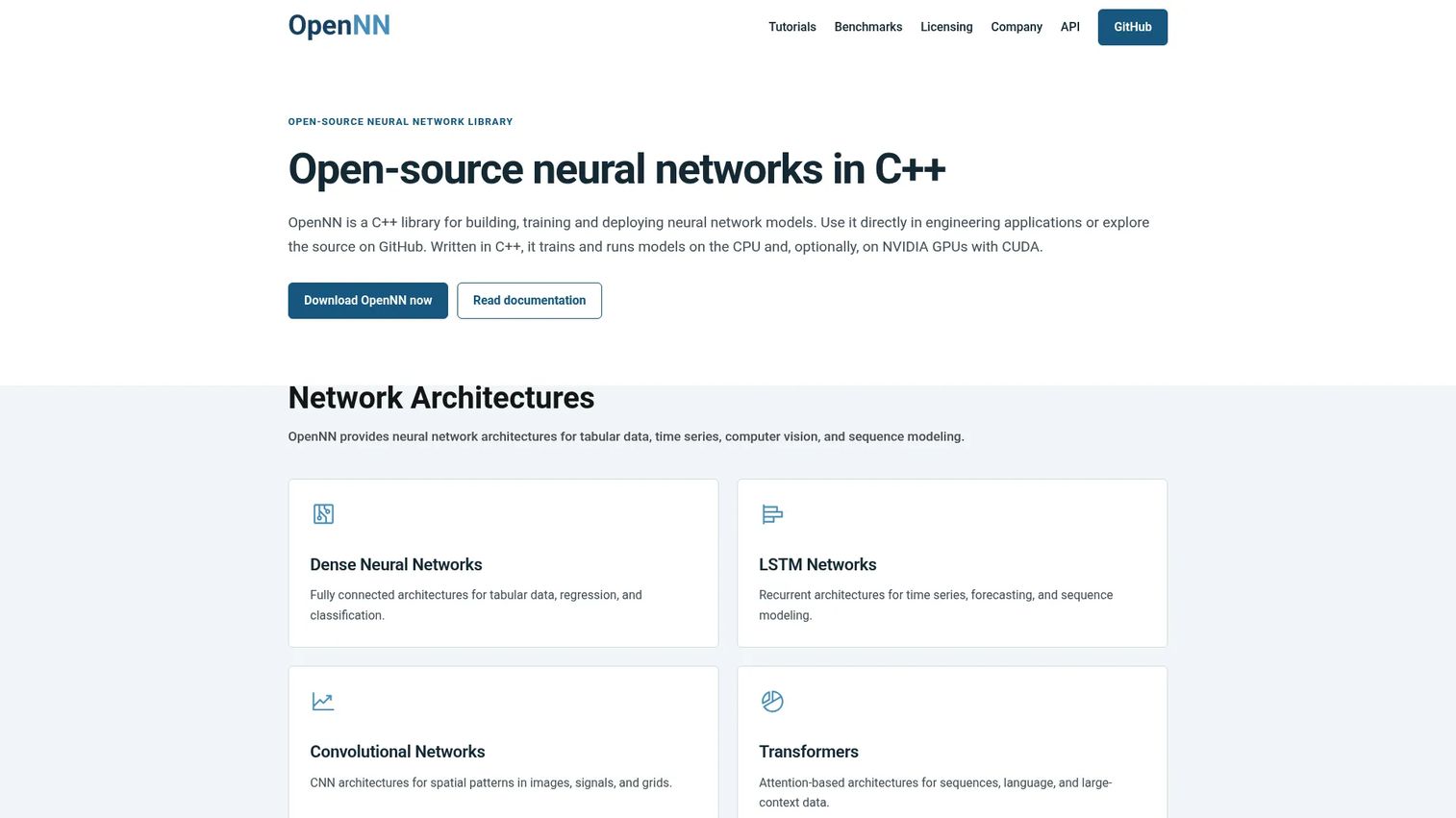
OpenNN is an open-source C++ library for building, training, and deploying neural network models. It supports dense networks for tabular data, LSTM networks for time series, convolutional networks for images, and transformer architectures. OpenNN runs on CPUs and optionally on NVIDIA GPUs via CUDA. The official licensing page also references commercial licensing options through Artelnics. For teams comparing options in best predictive analytics software tools, OpenNN is a focused library rather than a broad framework.
Best for: Engineering teams building predictive modeling workflows with C++ integration requirements and a defined analytics use case.
Key features
- C++ neural network library with optional CUDA GPU support
- Dense, LSTM, convolutional, and transformer network types
- Data preprocessing and transformation tools
- Model testing and evaluation utilities
- Optimization algorithms for training
Why choose OpenNN: It is a focused option when the team has a defined predictive analytics use case and engineering comfort in C++. Talent availability, integration requirements, and deployment environment should drive the decision. Product teams should define false-positive cost, false-negative cost, latency, and data refresh cadence before prioritizing the build.
OpenNN pricing: OpenNN is free and open source. Commercial support and licensing options are available through Artelnics; contact them for pricing details.
7. Neural Designer
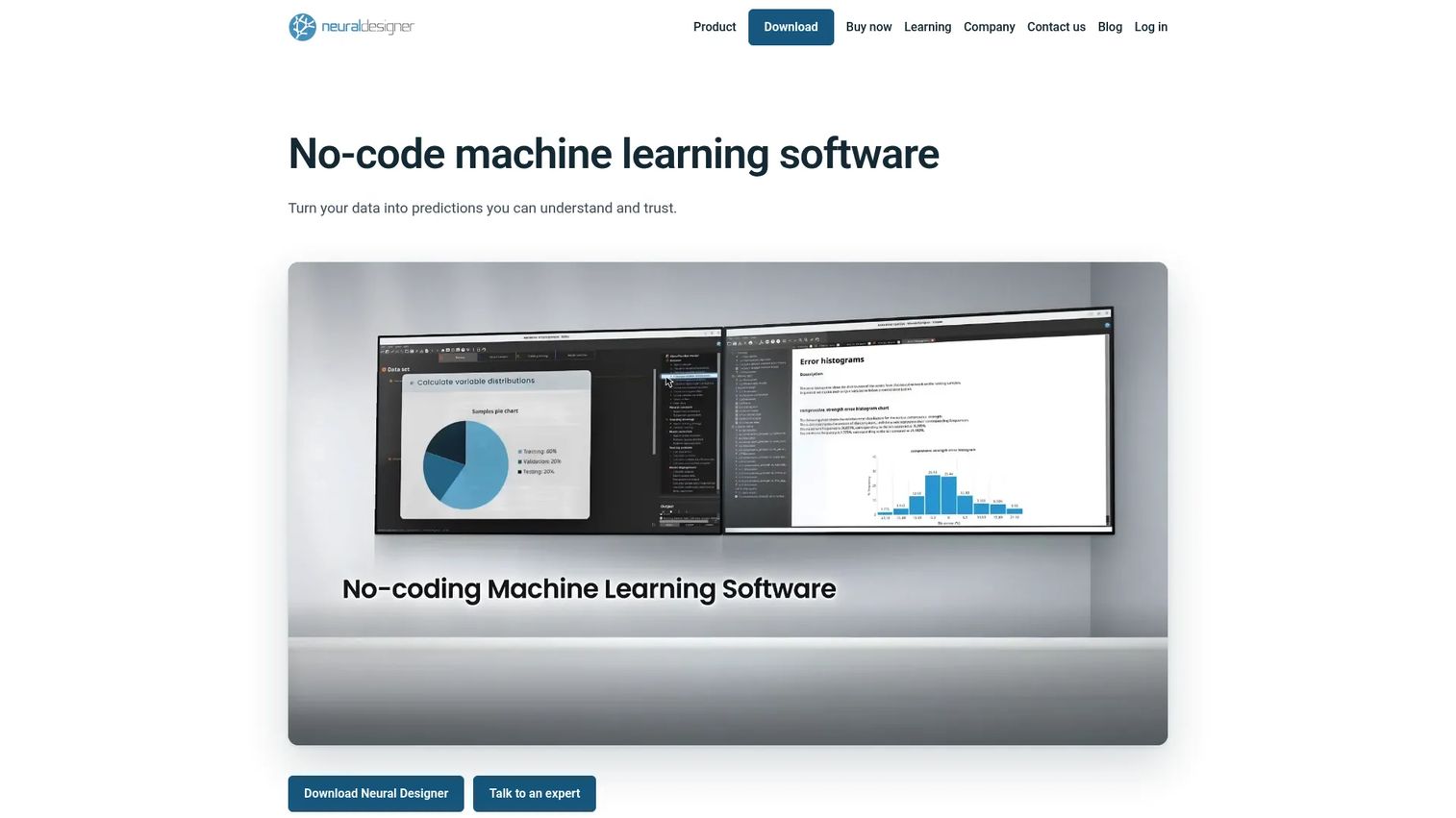
Neural Designer is a no-code machine learning platform for building, training, validating, and deploying neural network models through a graphical interface. It supports approximation, classification, forecasting, anomaly detection, image classification, and text classification tasks. Models can be exported for deployment in C, Python, JavaScript, and PHP. Neural Designer includes built-in model explainability and reporting tools, which helps product teams communicate results to non-specialist stakeholders without translating notebook outputs. For teams exploring best AI code generation tools or no-code modeling, Neural Designer sits at the accessible end of the spectrum.
Best for: Product, analytics, and domain teams that want a visual modeling environment without writing framework-level code.
Key features
- No-code visual model building and training interface
- Data preprocessing and input variable management
- Model optimization and explainability reporting
- Testing dashboards for performance evaluation
- Deployment exports for C, Python, JavaScript, and PHP
Why choose Neural Designer: A visual workflow speeds up model review sessions with leadership and makes assumptions more visible across the team. The tradeoff is flexibility: Unusual architectures or highly customized production systems may need a framework-level tool. It is a strong fit when the team needs to evaluate neural network approaches with less custom infrastructure.
Neural Designer pricing: A free version is available with no time limit, capped at 1,000 samples and 10 variables. The Research and Standard plans start at $300/month per user (or $2,495/year). Teaching licenses start at $600/month per module. Campus and Enterprise plans are priced on request.
G2 rating: Neural Designer holds a 4.4/5 rating on G2 based on 6 reviews.
Considerations when choosing neural network software
Start with the product decision, not the model type
Define the user problem and product metric before selecting a tool. Is the model supposed to improve recommendation relevance, classify content, detect anomalies, or forecast demand? Framework choice should follow that definition, not precede it. A team that picks PyTorch before defining success criteria will struggle to instrument and evaluate the model once it ships.
Match the stack to technical ownership
Assess who will build, debug, deploy, and maintain the model across release cycles. A machine learning framework can be free while the organizational cost remains high if the team lacks ML engineering capacity. PMs should ask which team member owns the model quality metric six months after launch, not just who trains the first version.
Confirm compute, latency, and deployment constraints
Check GPU or accelerator access, expected model size, inference latency targets, regional hosting requirements, and runtime environment before settling on a framework. Notebook results and production serving are different problems. Do not let a successful experiment in a local environment dictate the production architecture.
Design instrumentation before launch
Track offline model quality and product outcomes as separate signals. Precision, recall, calibration, and drift tell you whether the model is working. Activation rate, time to first value, and support deflection rate tell you whether it is working for the product. Both matter, and neither is a substitute for the other.
Plan for release cadence and model maintenance
Require model owners, versioning, evaluation datasets, rollback criteria, and a refresh policy before the feature ships. A neural network trained on last quarter's data may perform well at launch and degrade quietly as user behavior shifts. The team needs a process for catching that before it shows up in retention numbers.
Conclusion
The right neural network software for your team is the one that fits your model job, your engineering capacity, and your ability to maintain the outcome after launch.
TensorFlow suits broad production-grade needs with a mature ecosystem. PyTorch fits research-driven teams that need fast experiment iteration. Keras reduces prototype overhead with backend flexibility. JAX targets advanced high-performance and research work. Caffe is the practical choice for teams with established computer vision infrastructure. OpenNN covers focused predictive analytics in C++. Neural Designer gives product and analytics teams a visual path to model development without framework-level code.
Start with one product decision, one baseline metric, and one narrow experiment. The framework matters, but the operating model matters more. A neural network only earns its place on the roadmap when the team can measure, ship, and maintain the outcome through the next release cycle.
Start your journey with Guideflow today!
FAQs
Keras is often the most accessible starting point for teams new to neural network model training, thanks to its readable API and strong documentation. Neural Designer is worth evaluating when the team wants a graphical interface without writing Python. The best choice depends on whether the learner needs to understand framework-level code or primarily wants to validate a modeling approach quickly.
The right choice depends on deployment plans, existing code, team expertise, and how the experiment loop is structured. TensorFlow tends to fit teams with dedicated ML engineering support and a production-first mindset. PyTorch is more common for flexible experimentation and research-style development where the model architecture evolves frequently. Both are strong frameworks with active ecosystems.
Keras is a high-level API for building neural networks, not a standalone framework. It runs on TensorFlow, JAX, or PyTorch backends, letting teams use its model-building interface while the chosen backend handles execution. That separation means Keras can follow your team's backend preferences rather than locking you into one runtime.
Product managers should not need to own model implementation, but understanding the model's inputs, expected outputs, and evaluation criteria is essential for making good roadmap decisions. Visual tools like Neural Designer can support stakeholder reviews and reduce reliance on engineering for initial exploration. Production systems still require technical ownership regardless of the tooling.
Skip neural networks when simpler rules, linear models, retrieval, or conventional statistical methods meet the product requirement. Data volume, interpretability, inference latency, and ongoing maintenance cost should shape the decision alongside model performance. A linear model that explains its predictions and runs in milliseconds often beats a neural network that is accurate but opaque and expensive to maintain.
Small models train and run on CPUs without issue. Larger training workloads benefit from GPUs or specialized accelerators like TPUs to reduce training time and cost. Separate the hardware question for training from the question for inference. Many production environments need far less compute at inference time than during training, which affects architecture and cost planning.
Offline evaluation should cover an acceptance threshold dataset, precision and recall targets, calibration, stress testing, bias review, and latency benchmarks. Beyond the model itself, test how predictions behave in the actual product workflow before broad release. User-facing product metrics such as activation rate and support deflection should be measured alongside model quality metrics from the first rollout.
Neural network software is a subset of the broader machine learning software category. Machine learning tools also include decision trees, linear models, clustering algorithms, feature engineering pipelines, and model monitoring platforms. Neural network frameworks and libraries specifically focus on layered computational models that learn complex patterns, while broader ML platforms often cover the full pipeline from data preparation through model governance.