Maintenance teams rarely lose time because they lack a checklist. They lose time because the work order, the serialized part, the technician qualification, and the aircraft record live in different places. Nobody sees the full chain until something breaks.
The aviation MRO software market reached $7.56 billion in 2025 and is forecast to grow to $9.82 billion by 2031, according to Mordor Intelligence (2025). Yet 33% of small-scale business aviation fleet operators still rely on spreadsheets or homegrown systems, per the Veryon Aviation Maintenance Benchmark Report (2025). That gap is where aircraft availability erodes, compliance exposure builds, and turnaround time bleeds out.
The real decision is not which platform has the longest feature list. It is whether you need maintenance tracking, a full MRO operating system, repair-shop control, or records management. Get that wrong and you spend a year implementing the wrong tool for your maintenance model.
This guide cuts through the noise to help you shortlist the right aircraft MRO software for your operation.
What's inside
This guide is for aviation operators, Part 145 repair stations, business aviation departments, and founders evaluating operational infrastructure before scaling maintenance capacity. Tools were selected based on:
- Maintenance model fit (airline, fleet operator, repair station, records-focused)
- Depth of core workflows: Work orders, inventory, compliance, and records
- Pricing transparency and commercial model clarity
- Evidence of deployment across relevant operation sizes
TL;DR
- Best for enterprise airline and complex MRO operations: AMOS covers maintenance, engineering, airworthiness, and supply-chain coordination for large fleets
- Best for business aviation and fleet tracking: Veryon Tracking offers focused aircraft maintenance tracking with AD monitoring and electronic logbooks
- Best for large multi-function MRO businesses: Ramco Aviation spans line, hangar, engine, and component MRO alongside commercial workflows
- Best for repair stations with inventory-heavy workflows: Quantum Control ties work orders, estimates, and parts control into one repair-shop operating model
- Best for MRO providers needing configurable shop control: Impresa MRO connects work scope, labor scheduling, and inventory in one platform
- Best for aviation businesses needing maintenance tied to financials: CORRIDOR links repair operations to purchasing, billing, and accounting
- Best for aircraft records and continuing airworthiness data: AircraftCloud organizes CAMO, maintenance records, and flight data for operators focused on asset documentation
What is aviation MRO software?
Aviation MRO software is a system used by airlines, operators, repair stations, and maintenance organizations to plan, execute, document, and analyze aircraft maintenance, repair, and overhaul work.
Unlike a general CMMS, aviation-specific platforms add aircraft maintenance programs, airworthiness workflows, serialized-component traceability, regulated documentation, and fleet-level planning. A general maintenance tool can track work orders. An aviation MRO platform connects those work orders to aircraft records, technician qualifications, AD compliance, and audit-ready documentation.
Core functions of aviation MRO software
- Maintenance forecasting and due-date tracking
- Work orders, task cards, and discrepancy management
- Inventory, serialized parts, rotables, purchasing, and traceability
- Labor planning, technician qualifications, and time capture
- Airworthiness directives, service bulletins, and technical publications monitoring
- Electronic signatures, records, audit trails, and maintenance documentation
- Fleet status, capacity, turnaround, and work-in-progress dashboards
- Mobile access for technicians and line maintenance teams
- Integrations with flight operations, finance, ERP, and procurement
The four product categories to distinguish
Not every platform is built for the same job. Before shortlisting, classify your need:
| Category | Primary job | Typical buyer |
|---|---|---|
| Enterprise MRO suite | Runs maintenance, engineering, supply chain, and commercial workflows | Airlines, large MROs, complex fleets |
| Maintenance tracking platform | Tracks due events, records, discrepancies, and fleet status | Business aviation, operators, flight departments |
| Repair-shop MRO system | Controls work orders, inventory, labor, estimates, and billing | Part 145 repair stations, component shops |
| Aircraft records platform | Organizes digitized maintenance records and asset documentation | Aircraft owners, lessors, business aviation teams |
When to use aviation MRO software
Replace disconnected maintenance records and spreadsheets
Invest when maintenance history, due dates, parts data, and compliance records require manual reconciliation. According to the Veryon Aviation Maintenance Benchmark Report (2025), 33% of small-scale fleet operators still run on spreadsheets. That figure represents an organization-level risk where one person holds all the institutional knowledge and one departure triggers a compliance gap.
Coordinate labor, parts, and work scope across a busy shop
A platform becomes operationally critical when delays trace back to incomplete task cards, missing parts, unclear technician availability, or shifting work priorities. The bottleneck is usually visibility: Nobody can see the full picture of what is open, what is blocked, and what finishes next. MRO software makes that picture available to planners, controllers, and managers without a daily coordination meeting.
Prepare for fleet growth, new locations, or more regulated work
Adding an aircraft type, a new repair capability, or a second maintenance location multiplies the complexity without a corresponding increase in coordination capacity. Standardized workflows, records control, and management dashboards are what let a growing aviation operation scale without the founder or operations director becoming the bottleneck in every maintenance decision.
Aviation MRO software comparison
The table below gives you a first-pass shortlist. Use it to eliminate clear mismatches before running a workflow-based evaluation. Pricing figures reflect what vendors have disclosed; most enterprise platforms require a direct conversation to get a number tied to your specific fleet size and modules.
| # | Product | Best for | Key differentiator | Pricing | G2 rating |
|---|---|---|---|---|---|
| 1 | AMOS | Airlines and large fleet MRO operators | Enterprise maintenance, engineering, and airworthiness depth | Contact for quote | 3.9/5 |
| 2 | Veryon Tracking | Business aviation and fleet maintenance tracking | Aircraft-based subscriptions with AD monitoring and e-logbooks | Annual subscription, priced by aircraft | 4.6/5 |
| 3 | Ramco Aviation | Complex airline, engine, component, and hangar MRO | Broad MRO plus commercial and supply-chain coverage | Contact for quote | 4.6/5 |
| 4 | Impresa MRO | MRO providers needing configurable shop control | Work scope, inventory, labor scheduling, and compliance workflows | Contact for quote | Not listed on G2 |
| 5 | Quantum Control | Repair stations and inventory-heavy aviation shops | Repair-shop workflows, inventory, estimates, and financial operations | Contact for quote | 4.1/5 |
| 6 | CORRIDOR | Aviation repair organizations needing maintenance tied to financials | Aviation ERP approach spanning maintenance, inventory, purchasing, and accounting | Contact for quote | 4.4/5 |
| 7 | AircraftCloud | Airlines, CAMOs, and operators focused on records and airworthiness | Cloud-native platform covering CAMO, safety, flight data, and materials management | Contact for quote | Not listed on G2 |
Best aviation MRO software platforms for 2026
1. AMOS
AMOS is an enterprise MRO suite built for airlines, large operators, and complex maintenance organizations. Developed by Swiss Aviation Software, it covers aircraft maintenance, engineering, logistics, and airworthiness in one integrated platform. The system is designed for organizations whose maintenance process spans fleet-level planning, technical records, and supply-chain coordination across multiple locations.
Best for: Airlines, major fleet operators, and maintenance organizations with enterprise-scale engineering and airworthiness requirements.
Key features
- Integrated maintenance, engineering, and logistics processes
- Built-in regulatory compliance support across multiple authorities
- Mobile, paperless maintenance task execution
- Real-time mobile inventory management
- Digital technical logbook with structured defect reporting
- Open interfaces and modular ecosystem integrations
Why choose AMOS: AMOS belongs on the shortlist when the business has genuine enterprise-scale maintenance complexity and the organizational capacity to run a structured implementation. It is not the right starting point for a smaller shop that needs basic work-order and inventory control without an extended configuration project.
AMOS pricing: AMOS uses enterprise quote-based pricing. Contact the vendor to discuss licensing model, module scope, implementation fees, and minimum contract terms. The cost will vary by fleet size, operational scope, and the modules required.
G2 rating: 3.9/5 based on 19 reviews, per the live G2 listing.
2. Veryon Tracking
Veryon Tracking is an aviation maintenance tracking platform built for business aviation, helicopter operators, and fleet managers who need reliable maintenance visibility without implementing an airline-scale MRO suite. The platform covers maintenance forecasting, work orders, discrepancy tracking, airworthiness directive monitoring, and electronic logbooks. AI-powered Veryon AIRE agents and mobile access extend the platform into operational workflows for technicians and flight teams.
Best for: Business aviation departments, charter operators, and fleet managers that need focused maintenance tracking with AD monitoring and e-logbook capability.
Key features
- Aircraft maintenance forecasting with real-time fleet visibility
- Work order and discrepancy tracking
- Airworthiness directive and service bulletin monitoring
- Electronic logbooks and eSignatures
- Mobile access and API integrations
Why choose Veryon Tracking: The platform fits teams that need a dependable system for fleet maintenance tracking, compliance records, and operational coordination without the configuration overhead of a full airline MRO suite. It is a stronger fit for tracking and operator workflows than for complex heavy-maintenance commercial operations.
Veryon Tracking pricing: Veryon describes annual aircraft-based subscriptions, with cost varying by aircraft make and model plus a one-time enrollment fee. Contact the vendor for your fleet's specific figure.
G2 rating: 4.6/5 based on 18 reviews, per the live G2 listing.
3. Ramco Aviation

Ramco Aviation is a broad aviation software suite that addresses line maintenance, component maintenance, engine MRO, hangar MRO, heavy maintenance, and commercial MRO workflows. It handles both maintenance execution and business operations including contracts, estimates, invoicing, and margin tracking. The platform also covers flight operations, crew scheduling, electronic flight bags, and defense asset readiness for organizations with those requirements.
Best for: Large MRO businesses, airlines, and multi-function maintenance operations that need one platform across maintenance, supply chain, engineering, and commercial workflows.
Key features
- Digital task cards and electronic job cards
- Mobile mechanic workflows for line and hangar maintenance
- Line, hangar, engine, and component MRO coverage
- Contract, estimates, and billing controls
- Supply-chain and inventory visibility
Why choose Ramco Aviation: Ramco suits an organization that needs broad functional coverage across maintenance and commercial operations, and can resource a larger implementation program. Evaluate it by workflow depth in the specific maintenance areas your business actually operates, not by the breadth of what the platform can theoretically support.
Ramco Aviation pricing: Pricing is quote-based. Contact Ramco to discuss modules, implementation services, user counts, and annual contract structure. G2 reviewers do not report a standard per-seat figure.
G2 rating: 4.6/5, per the live G2 listing.
4. Impresa MRO
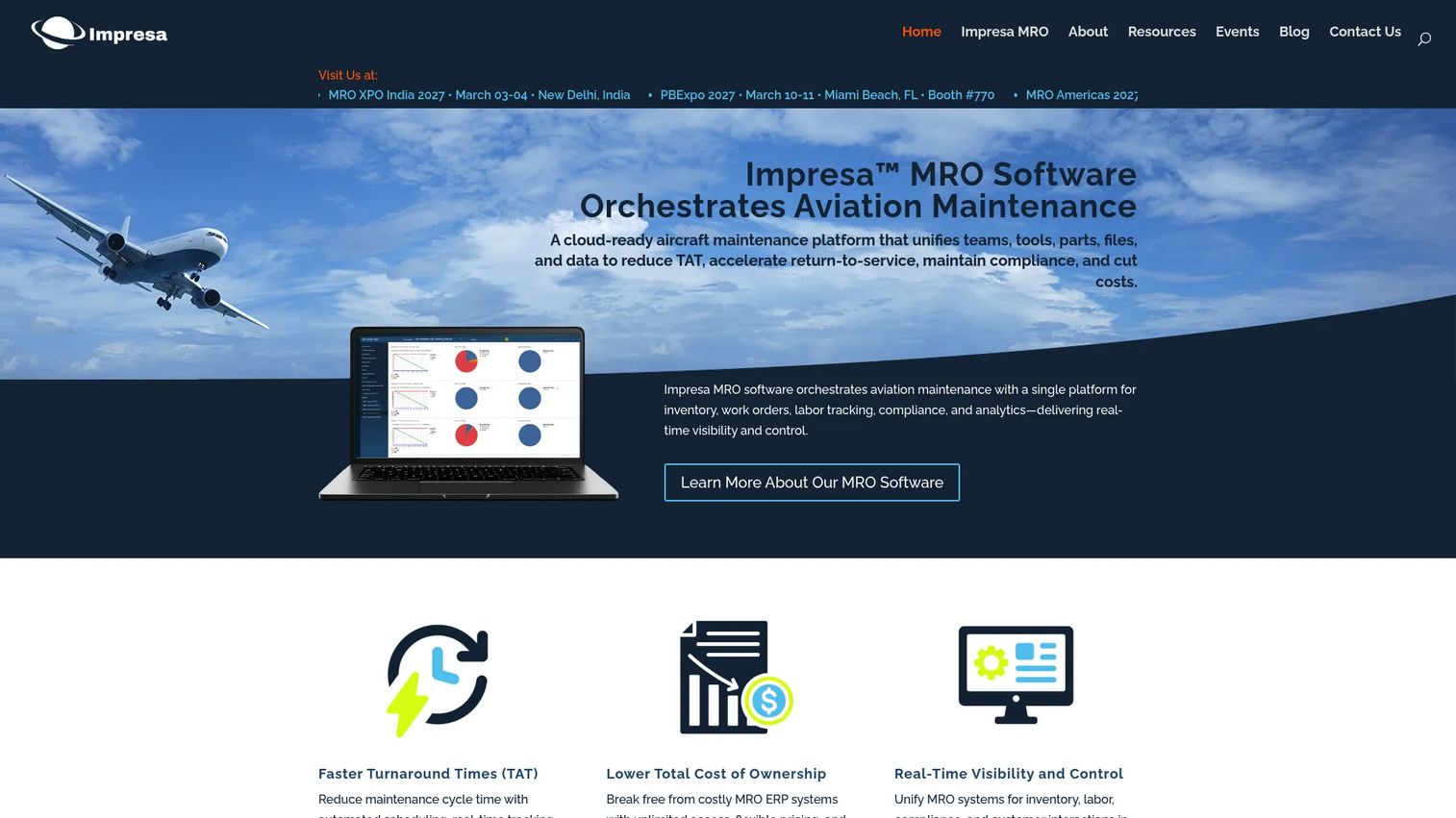
Impresa MRO is an aviation maintenance platform built to coordinate people, parts, tools, documents, and compliance data in one operating environment. The system covers heavy maintenance, line maintenance, component maintenance, and inventory traceability, with barcode and RFID tracking, tool calibration monitoring, and digital task cards built into the workflow. Open APIs support integrations with ERP, PLM, IoT, and OEM systems, making it practical to connect the platform to existing enterprise infrastructure rather than replace it.
Best for: MRO providers, airlines, OEMs, and component or heavy-maintenance operations that need configurable shop-floor control and audit-ready compliance management.
Key features
- Inventory and parts traceability with barcode and RFID tracking
- Work order, planning, scheduling, and execution management
- Labor scheduling with technician skills and certification matching
- Tool calibration, readiness, usage, and location tracking
- Document control with version history and audit-ready records
Why choose Impresa MRO: Impresa is worth evaluating when the MRO business needs shop-floor control, commercial operations, and maintenance data in one model. The key question is how it handles your team's actual workflow from induction through invoicing, not whether a feature checkbox exists.
Impresa MRO pricing: Impresa describes subscription pricing with unlimited users, but does not publish a numeric price. Contact the vendor to discuss deployment options, configuration scope, and implementation costs.
5. Quantum Control

Quantum Control is an aviation ERP platform built for repair stations, parts distributors, and aviation service businesses with inventory-intensive workflows. The platform handles work orders, serialized inventory, purchasing, customer quotations, sales orders, and invoicing in one system. It is designed to give repair shops operational control across the full cycle from parts receipt through customer billing, with labor tracking and shop-floor reporting included.
Best for: Part 145 repair stations, component shops, and aviation service businesses managing inventory-heavy repair workflows alongside commercial operations.
Key features
- Aviation work order management from shop floor through invoicing
- Serialized inventory and parts traceability
- Estimates, quotes, and customer invoicing
- Purchasing, receiving, and vendor management
- Labor tracking and shop reporting
Why choose Quantum Control: Put Quantum Control on the shortlist when the organization's operational bottleneck sits in parts control, repair orders, estimating, or shop throughput. It is a more focused fit for a repair station than an airline-scale maintenance suite. Poor parts control and inaccurate labor capture can turn a busy shop into an unprofitable one. That is the problem this platform is designed to solve.
Quantum Control pricing: SaaS pricing is described as a single monthly figure per user, but the amount is not displayed. Contact the vendor for your specific user count and module requirements. G2 reviewers do not report a standard tier price.
G2 rating: 4.1/5 based on 7 reviews, per the live G2 listing.
6. CORRIDOR
CORRIDOR is an aviation service platform for MROs, repair stations, FBOs, operators, and component repair organizations. It covers work orders and job management from shop-floor operations through invoicing, inventory tracking, procurement, customer records, and accounting integration. CORRIDOR also includes planning and scheduling, training and qualifications tracking, time and attendance, and tool management. The platform is available as cloud or on-premise deployment, and recent additions include an AI Operations Manager and AI-powered parts pricing.
Best for: Aviation repair organizations that need maintenance management connected to inventory, purchasing, customer billing, and accounting controls in one operating record.
Key features
- Work order and job management from operations through invoicing
- Inventory tracking, procurement, and shipping and receiving
- Customer, vendor, and aircraft records
- Pricing, barcoding, accounting integration, and invoicing
- Planning and scheduling, and tool management
Why choose CORRIDOR: CORRIDOR is worth evaluating when the organization needs one operational record spanning repair activity and commercial performance. An operational platform only earns its place if maintenance, inventory, and financial data agree. That data alignment is the control point founders need for margin and capacity decisions.
CORRIDOR pricing: Current pricing is not displayed on the CORRIDOR website. Contact the vendor for platform pricing, module scope, and implementation structure.
G2 rating: 4.4/5 based on 6 reviews, per the live G2 listing.
7. AircraftCloud

AircraftCloud is a cloud-native aviation platform covering CAMO and airworthiness management, MRO maintenance planning, materials management, safety and quality management, flight data monitoring, and crew operations. Unlike records-only tools, AircraftCloud integrates continuing airworthiness, operational safety, and maintenance execution in one cloud environment. It supports API integrations and is designed for airlines, CAMOs, and operators that want to consolidate aviation data without maintaining on-premise infrastructure.
Best for: Airlines, CAMOs, and aviation operators that need integrated continuing airworthiness, maintenance records, safety management, and flight data in a cloud-native platform.
Key features
- CAMO and airworthiness management
- MRO maintenance planning and work-order tracking
- Inventory, materials, parts, and tools management
- Safety and Quality Management System (SMS and QMS)
- Flight Data Monitoring (FDM and FOQA) and flight operations
Why choose AircraftCloud: AircraftCloud fits teams whose immediate need is stronger continuing airworthiness control, consolidated maintenance records, and flight data in one platform. Accurate and accessible maintenance documentation affects transaction readiness, lease returns, and day-to-day operational confidence. Pair it with a dedicated repair-shop system if work-order execution and inventory control are also required.
AircraftCloud pricing: AircraftCloud describes a SaaS subscription model tailored to operational requirements, with no standard list price displayed. Contact the vendor to discuss fleet scope, modules, and onboarding.
Considerations when choosing aviation MRO software
Match the platform to your maintenance model
Airlines, business aviation departments, Part 145 repair stations, component shops, and aircraft lessors do not need the same system. Start with the workflow that creates the most delays, compliance exposure, or management uncertainty. An enterprise MRO suite is the right answer for a complex airline operation, not for a 10-aircraft charter department.
Audit your current data before committing to migration
The platform will not fix incomplete aircraft records, duplicate part numbers, or unclear maintenance programs by itself. Before selecting a vendor, require a demonstration of how your historical records, serialized components, and open work orders will migrate. Data cleanup before go-live is usually the longest phase of any MRO implementation.
Test the technician workflow, not only the management dashboard
A polished management view does not matter if technicians avoid the task-card flow or cannot find the information they need on the hangar floor. Ask for a scenario test covering a discrepancy, a parts request, an inspection signoff, and a final record update. If that flow is clunky, adoption will be the biggest implementation risk.
Confirm integration ownership before signing
Clarify whether flight operations, procurement, finance, technical publications, or ERP data will be integrated, replaced, or manually exchanged. The right outcome is reduced duplicate data entry. The wrong outcome is moving that manual work to a different team after go-live.
Model the full implementation cost, not just the license
Quote-based systems can include configuration, data cleanup, integrations, training, and ongoing support. Ask every shortlisted vendor for a phased rollout plan tied to measurable operating milestones, not a total-project estimate that obscures where the cost actually lands.
How to choose the right aviation MRO software for your team
If you operate an airline or complex fleet
Start with AMOS or Ramco Aviation. Evaluate maintenance planning depth, engineering workflows, airworthiness control, and multi-site operations before looking at commercial breadth. Require a demonstration built around one real aircraft maintenance program and one delayed maintenance event. If neither vendor can walk through your actual maintenance motion, that is the answer.
If you run a business aviation department or aircraft operator
Start with Veryon Tracking. Prioritize maintenance due tracking, discrepancy management, digital records, and usability for both flight and maintenance teams. Check how the platform handles each aircraft type in your fleet before expanding the evaluation.
If you manage a repair station or component shop
Start with Quantum Control, CORRIDOR, or Impresa MRO. The core decision is whether your bottleneck sits in shop throughput, serialized inventory, parts purchasing, commercial estimates, or broader MRO workflow coordination. Evaluate each platform against your highest-cost delay, not against a generic feature list.
If your immediate problem is aircraft records and continuing airworthiness
Start with AircraftCloud. Use it when records fragmentation, document retrieval, transaction readiness, and maintenance history visibility are the pressing issues. Pair it with a maintenance execution system if work-order and inventory control are also required. Related aviation software categories worth reviewing include aerospace ERP software and airline reservation software for adjacent operational infrastructure decisions.
Conclusion
The best aviation MRO software is not the one with the most features. It is the one that matches your maintenance model, fleet complexity, and capacity to implement it.
AMOS and Ramco Aviation suit organizations with enterprise-scale maintenance engineering and multi-site complexity. Veryon Tracking is the focused choice for business aviation tracking and fleet compliance. Quantum Control, CORRIDOR, and Impresa MRO each address repair-shop and component operations, with different emphasis on inventory depth, financial integration, and shop-floor configurability. AircraftCloud is the choice for operators who need continuing airworthiness, safety management, and flight data in one cloud platform.
Pick two or three platforms that match your maintenance model and run the same workflow test in each evaluation:
- Forecast a due maintenance event
- Create and assign a work order with task cards
- Reserve or purchase a serialized part
- Complete electronic signoff and update the maintenance record
- Report the impact on fleet status, capacity, cost, and turnaround
That sequence will reveal more about operational fit than any product demonstration. For teams also evaluating broader aviation software categories or airport management software, those guides cover adjacent platforms worth including in your infrastructure review.
FAQs
Maintenance tracking software focuses on due dates, aircraft status, discrepancies, records, and compliance workflows. Full MRO software adds deeper planning, labor control, inventory, repair operations, commercial workflows, and multi-site maintenance management. A tracking platform is the right fit for a fleet operator who needs visibility and compliance; a full MRO suite is the right fit for an organization running complex maintenance, engineering, and supply-chain operations.
Core functions include maintenance forecasting, work orders, digital task cards, parts inventory, serialized traceability, airworthiness directive monitoring, service bulletin tracking, electronic signoffs, records, and reporting. Integrations with flight operations, finance, and procurement are important for organizations where maintenance data needs to connect to broader operational decisions. The required depth varies by maintenance model.
No. Business aviation departments, helicopter operators, charter companies, repair stations, component shops, and aircraft owners all use aviation maintenance platforms. The system needs to match fleet size, maintenance complexity, and regulatory recordkeeping requirements. A Part 145 repair station and an airline have very different needs, and the platform choice should reflect that.
Most enterprise MRO platforms use quote-based pricing because the total cost depends on fleet size, user count, modules, implementation, data migration, and ongoing support. Some maintenance tracking platforms, such as Veryon Tracking, use annual aircraft-based subscriptions. Expect significant variation between a targeted tracking platform for a small fleet and an enterprise suite for a multi-site maintenance operation.
Aviation MRO software can help teams organize maintenance records, approvals, airworthiness directives, service bulletins, and audit trails in a structured and searchable format. That organizational capability supports the recordkeeping workflows that regulatory frameworks require. Using a platform does not independently ensure compliance with FAA, EASA, or any other authority. Your own regulatory team needs to confirm that the system meets the specific requirements for your operation and certification basis.
Ask the vendor to walk through a real workflow: Opening a work order, assigning labor, checking technician qualifications, reserving parts from inventory, completing task-card signoff, handling a discrepancy, producing customer documentation, and posting the transaction to inventory and billing. If any step requires switching systems or manual data entry outside the platform, that is a gap worth pricing into your implementation estimate.
Timelines vary widely by scope. A smaller maintenance tracking implementation for a business aviation department can move faster than a multi-site MRO transformation. The main drivers are record cleanup, configuration complexity, integration requirements, training scope, and rollout sequence. Ask each vendor for a phased rollout plan tied to specific go-live milestones rather than a single total timeline.
It depends on the operation. A records platform may be sufficient for aircraft owners or lessors focused on asset documentation and transaction readiness. An MRO system is needed when work-order execution, labor tracking, and inventory control are also required. Some platforms, like AircraftCloud, combine continuing airworthiness with operational data; others specialize in one or the other. Map your primary bottleneck first, then decide whether one platform can address it or whether two systems need to work together.