A technician misses a scheduled maintenance visit because the AMC renewal lived in a spreadsheet nobody checked. A breakdown call sits unassigned for two hours because dispatch happened over the phone and never made it into the system. A billing dispute drags on because the service report, the parts used, and the signature are in three different places. If any of that sounds familiar, you already know the real problem: your service, maintenance, dispatch, parts, and reporting data is scattered across tools that don't talk to each other.
Elevator management software exists to pull those workflows into one system. Done right, elevator service software cuts missed visits, speeds up dispatch, keeps compliance records audit-ready, and gives you KPIs you can actually trust. The market reflects the pressure. The elevator maintenance software market was valued at USD 1.21 billion in 2024 and is projected to reach USD 3.50 billion by 2035, a 10.1% CAGR, according to WiseGuyReports (2024). Software and connectivity platforms are the fastest-growing elevator control component at a 6.25% CAGR, per Mordor Intelligence (2026).
This guide is written for the person doing the evaluation: an operations or service leader at an elevator company, or a product-minded buyer selecting tooling for field operations. The same "show, don't tell" logic that powers modern software evaluation, where buyers want to see a product work through an interactive demo before they commit, applies here. You want proof of fit, not a brochure. Below, you get honest comparisons, verified pricing where it's public, and a buyer's framework for AMC, preventive maintenance, breakdowns, and compliance.
What's inside
This guide covers nine tools that support elevator service, maintenance, dispatch, inventory, reporting, and compliance workflows. Some are purpose-built for elevator businesses. Others are broader field service platforms that elevator teams adapt.
We selected and evaluated tools on:
- Elevator-specific fit: how well the tool handles AMC, preventive maintenance, breakdowns, and compliance versus generic job tracking.
- Workflow breadth: coverage across scheduling, dispatch, inventory, CRM, estimating, projects, and reporting.
- Automation and mobile: technician mobile experience, alerts, and reduced manual coordination.
- Proof and transparency: verified pricing and ratings where publicly available.
TL;DR
- Best for all-in-one elevator operations: FIELDBOSS, built on Microsoft Dynamics 365 for elevator and specialty contractors.
- Best for QuickBooks-centric teams: Method:Field Services, starting at $15/month per field crew technician.
- Best for heavy dispatch and larger service orgs: ServiceTitan, quote-based pricing with deep operational controls.
- Best for small to mid-sized field teams: Workever and ManageMart, both with accessible entry pricing and mobile-first workflows.
- Best purpose-built elevator focus: LiftKeeper and ElevatorPlus for teams that want elevator-native design.
- Best general field service depth: Joblogic and Field Force Tracker for scheduling, mobile work orders, and reporting.
What is elevator management software
Elevator management software is a system that centralizes the service, maintenance, dispatch, inventory, sales, and compliance workflows an elevator company runs every day. Instead of juggling spreadsheets, phone calls, and disconnected apps, teams manage contracts, work orders, technicians, parts, and reports in one place. Many buyers also search for this category as elevator service software, elevator maintenance management software, or AMC software.
Core capabilities usually include:
- AMC and preventive maintenance: contract tracking, renewal alerts, recurring visit scheduling.
- Work order management: breakdown logging, job assignment, status tracking, and closeout.
- Dispatch and scheduling: technician assignment, routing, and calendar visibility.
- Inventory and purchasing: spare parts tracking, reorder alerts, purchase orders.
- CRM and estimating: lead management, quotes, and customer history.
- Project management: modernization and new installation tracking.
- Mobile technician tools: offline access, job updates, photos, signatures, and GPS.
- Reporting and compliance: dashboards, asset history, service reports, and audit trails.
The line between elevator maintenance software and broader elevator field service software matters. Purpose-built tools model AMC and safety inspections natively. General platforms cover the field service basics and get adapted to the elevator use case.
When to use elevator management software
Centralize service and maintenance workflows
When scheduling lives in one place and maintenance history lives in another, visits slip. A preventive maintenance visit due this month gets buried under breakdown calls, and nobody notices until the customer does. Elevator service management software ties contracts, work orders, and technician assignments to a single record. You see which units are due, which are overdue, and who owns each job, without cross-referencing three systems.
Reduce breakdown response time
A breakdown call that gets dispatched by phone depends on whoever is at the desk. Elevator dispatch software routes the call to the nearest available technician, sends the job to their mobile device, and updates status in real time. Technician GPS tracking shows who is closest. The result is faster response and fewer manual calls chasing status updates during an outage.
Improve compliance and reporting
Elevators carry recurring safety inspections, code requirements, and violation tracking. Elevator compliance software keeps asset history, test records, and audit trails in one system, so an inspection or a customer question doesn't trigger a scramble. Elevator reporting software turns that data into dashboards that show completion rates, response times, and contract health, which matters for both renewals and customer confidence.
Comparison table
The nine tools below split into two groups: elevator-native platforms and broader field service tools that elevator teams adapt. Compare them on elevator-specific depth, field workflows, automation, and reporting. Pricing and ratings are verified where public; where a vendor gates pricing behind sales, that is noted.
| # | Product | Best for | Key differentiator | Pricing | G2 rating |
|---|---|---|---|---|---|
| 1 | ElevatorPlus | Elevator-native operations | Purpose-built elevator business modules | Not publicly listed | Not listed |
| 2 | FIELDBOSS | Elevator and HVAC contractors | Built on Microsoft Dynamics 365 | From $90/mobile user, $185/back office | Not listed |
| 3 | Method:Field Services | QuickBooks-centric teams | Native QuickBooks sync | From $15/mo per technician | Not listed |
| 4 | LiftKeeper | Elevator service companies | Elevator-specific office-field design | Not publicly listed | Not listed |
| 5 | Joblogic | General field service ops | Compliance and mobile engineer app | From $59/mo | 4.3/5 |
| 6 | ServiceTitan | Larger service organizations | Deep dispatch and operational controls | Quote-based | 4.5/5 |
| 7 | Workever | Small to mid-sized teams | Mobile-first job management | From £29/mo per user | Not listed |
| 8 | ManageMart | Small field service businesses | All-in-one at low entry price | From $16.25/mo | 4.8/5 |
| 9 | Field Force Tracker | All-in-one field operations | Modular industry add-ons | From $59.99/mo | 4.8/5 |
Best 9 elevator management software for 2026
1. ElevatorPlus
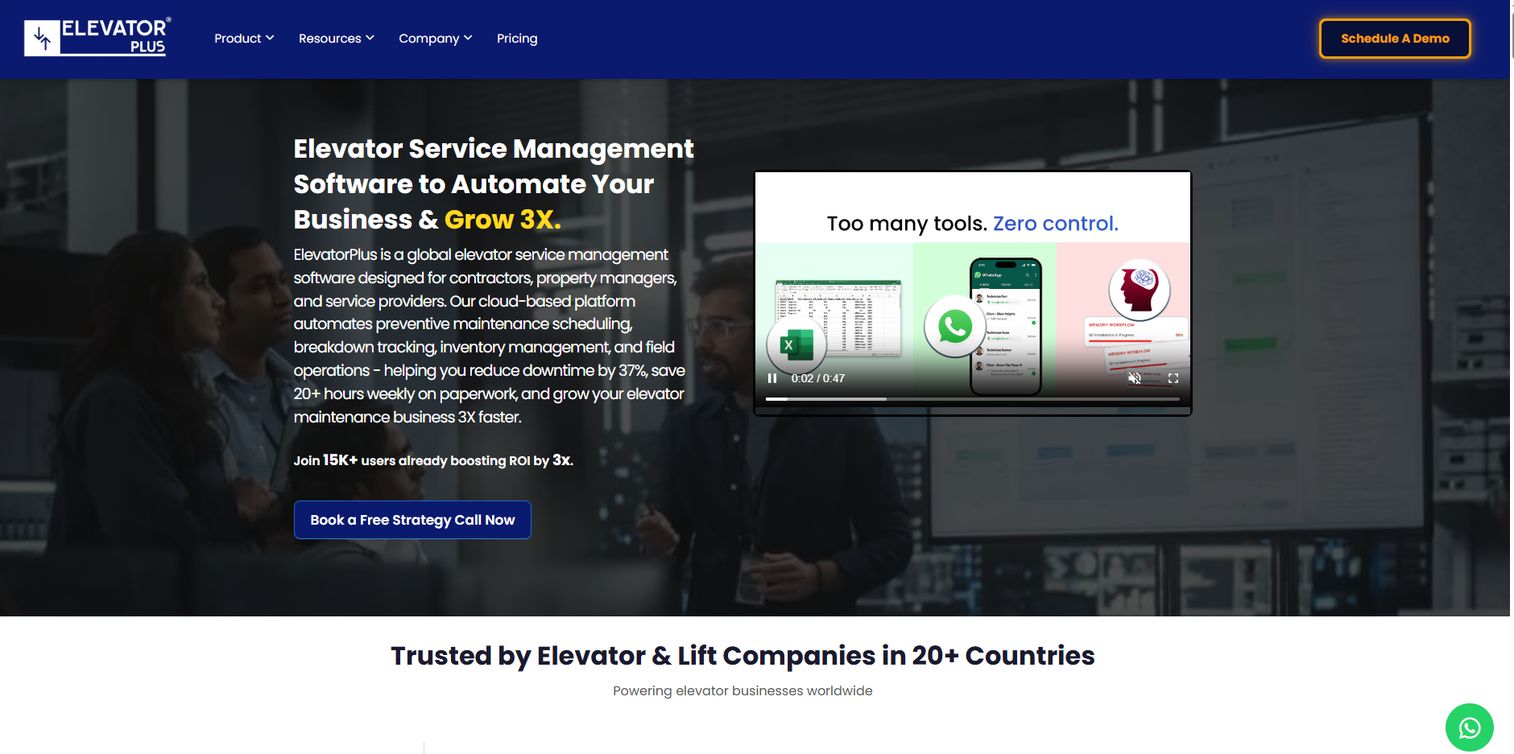
ElevatorPlus positions itself around all-in-one elevator business management: maintenance, AMC, dispatch, inventory, CRM, modernization, and reporting in one elevator-native platform. The appeal is breadth built specifically for elevator operations rather than a generic field service tool bent into shape.
Best for: Elevator companies that want elevator-native modules across the full service lifecycle.
Key strengths
- Elevator-specific maintenance and AMC tracking
- Dispatch and technician assignment
- Inventory and spare parts management
- CRM and lead workflows
- Modernization and project reporting
Why choose ElevatorPlus: If your priority is software modeled around elevator workflows rather than adapted from a general platform, ElevatorPlus targets that gap directly. Verify the current product status and demo access before you commit, since public product information is limited.
ElevatorPlus pricing: Public software pricing is not clearly listed. Confirm current pricing and packaging directly with the vendor before evaluating.
2. FIELDBOSS
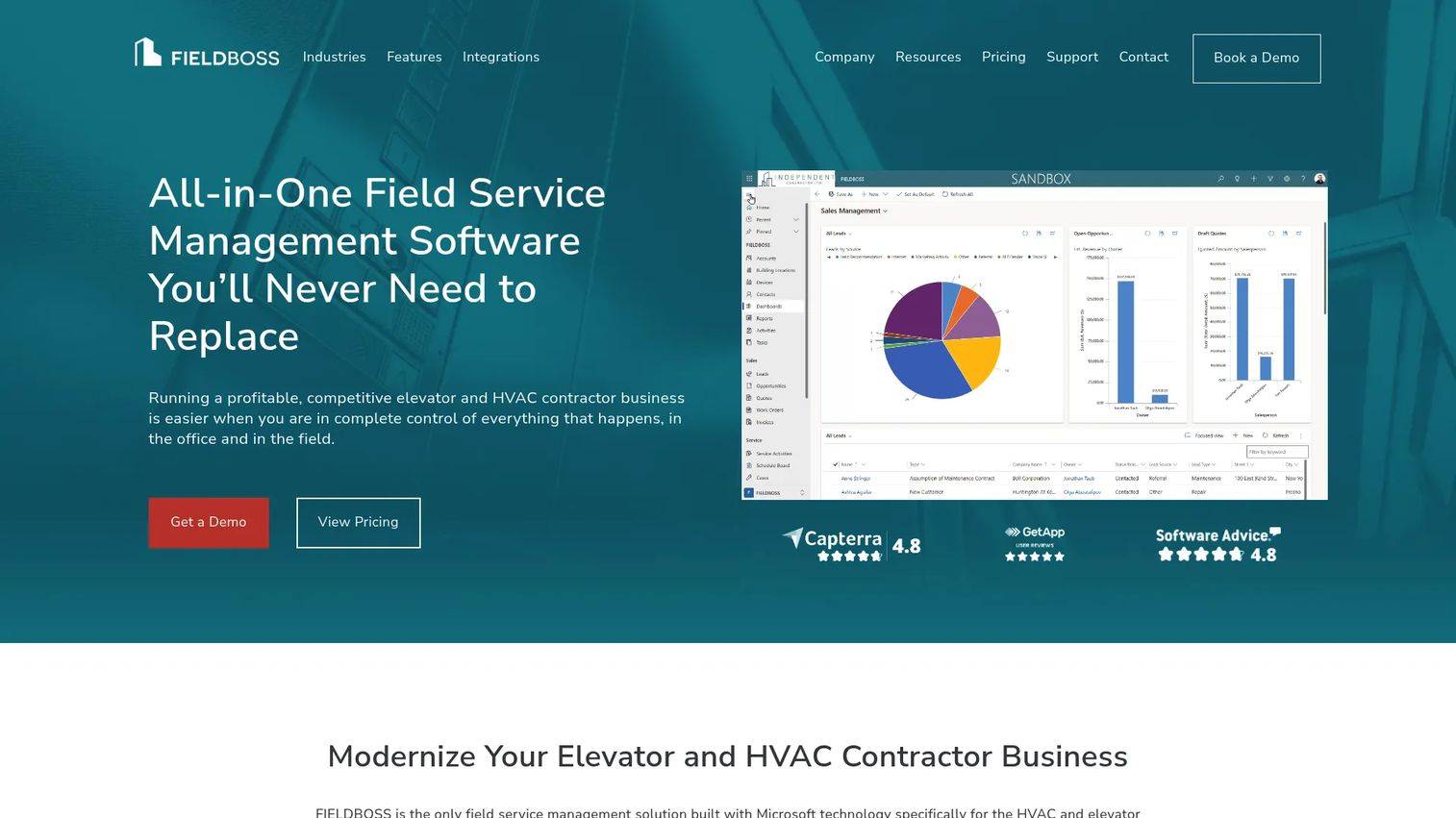
FIELDBOSS is field service management software for elevator, HVAC, and specialty contractors, built on Microsoft Dynamics 365. That foundation gives it enterprise-grade data structure, reporting, and integration depth, which matters when your operation already runs on the Microsoft stack. It covers work orders, scheduling, dispatch, project management, and compliance checklists.
Best for: Elevator and HVAC contractors that want an all-in-one operations platform with Dynamics 365 underneath.
Key strengths
- Work order management
- Scheduling and dispatch
- Project management and reporting
- Compliance checklist workflows
- Microsoft Dynamics 365 foundation
Why choose FIELDBOSS: For teams committed to the Microsoft ecosystem that need operational visibility across service and projects, FIELDBOSS fits the enterprise pattern. The Dynamics base rewards teams that value structured data and reporting over the simplest possible setup.
FIELDBOSS pricing: Mobile user licenses start from $90, back office licenses from $185, per user per month. Implementation starts from $50,000 for rapid onboarding and scales to $75,000 and $100,000 for complete onboarding and enterprise tiers.
3. Method:Field Services
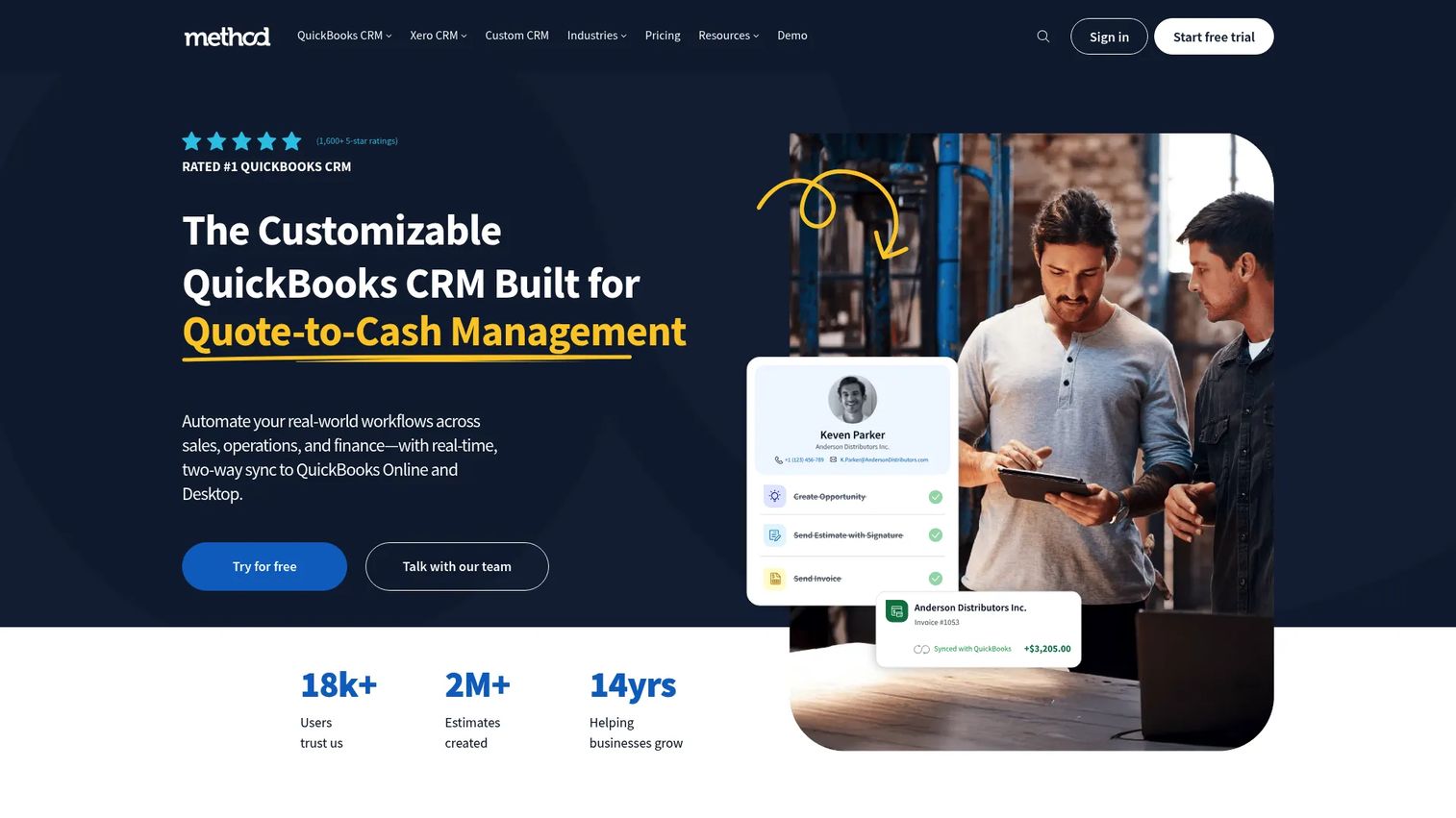
Method:Field Services is a field service CRM built for scheduling, dispatching, work orders, and invoicing, with native QuickBooks sync. If your accounting already runs on QuickBooks, the two-way sync removes the double entry that plagues teams stitching field service to a separate ledger. It covers job scheduling, dispatch, and mobile crew access with time tracking.
Best for: Small-to-midsize field service teams on QuickBooks that need dispatch, mobile crew, and work-order workflows.
Key strengths
- Work order management
- Job scheduling and dispatch
- Field crew mobile access and time tracking
- Estimates and invoicing
- QuickBooks two-way sync
Why choose Method:Field Services: The QuickBooks integration is the differentiator. For teams that already live in QuickBooks, keeping estimates, invoices, and field jobs in sync is worth more than elevator-specific modeling you would need to configure yourself.
Method:Field Services pricing: Field crew technician licenses start at $15 per month. Dispatcher licenses are $45 per month. A free trial is available.
4. LiftKeeper
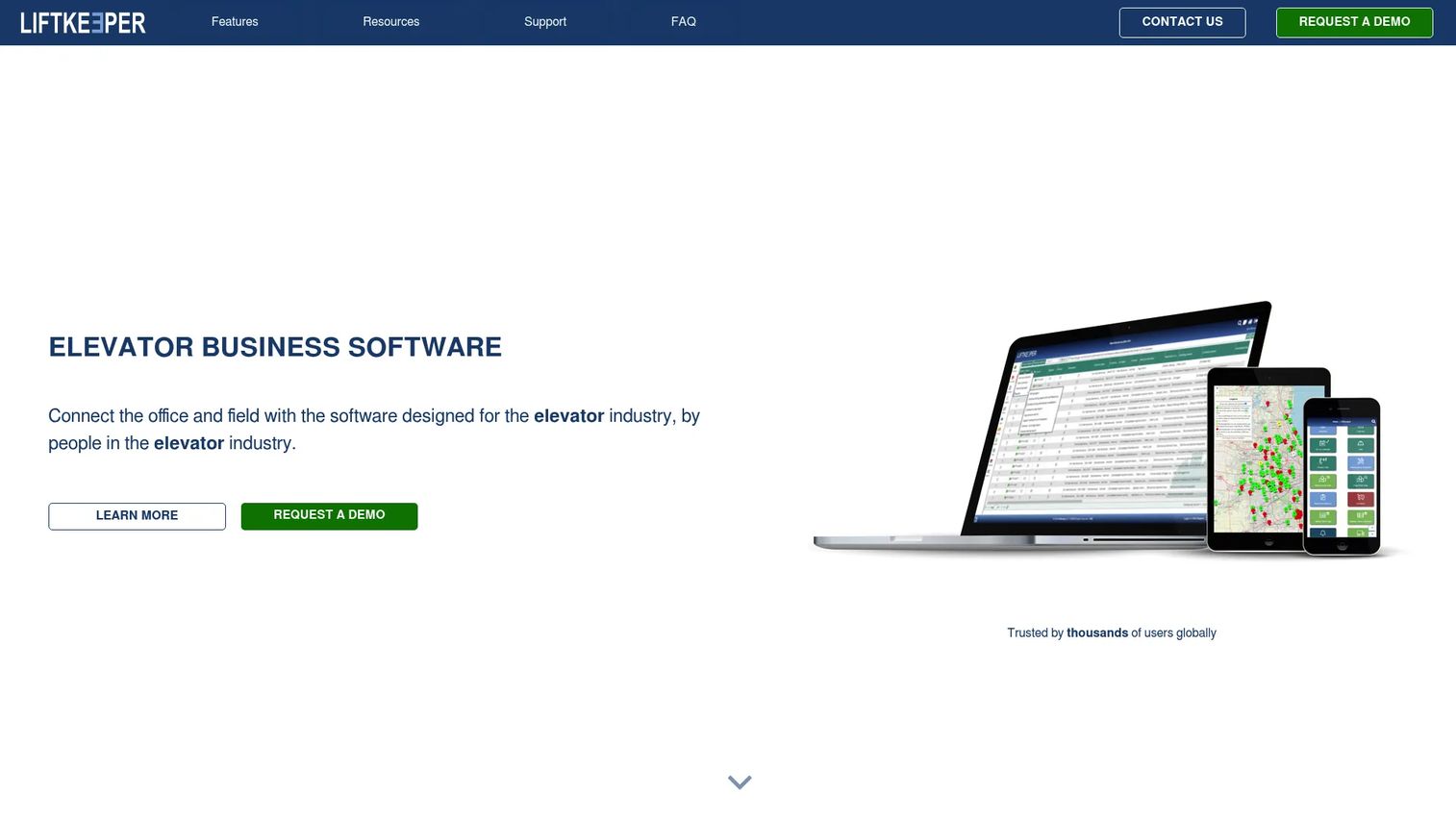
LiftKeeper is elevator business software built to manage office, field, sales, dispatch, finance, and inventory workflows. Its pitch is elevator-native design with a close connection between office and field teams, plus customization and hands-on support. For teams that want a purpose-built tool rather than a general platform, that focus is the draw.
Best for: Elevator service companies that want industry-specific operations software with close vendor support.
Key strengths
- Custom reports and customizable features
- Maintenance and dispatching with mobile access
- Accounting integrations and APIs
- Office-to-field connectivity
- Inventory management
Why choose LiftKeeper: If you value an elevator-specific system and a supplier that customizes to your workflows, LiftKeeper leans into that model. The trade-off is a smaller public footprint, so request a walkthrough to confirm depth against your AMC and compliance needs.
LiftKeeper pricing: Public numeric pricing is not listed. Contact the vendor for a quote based on your team size and modules.
5. Joblogic
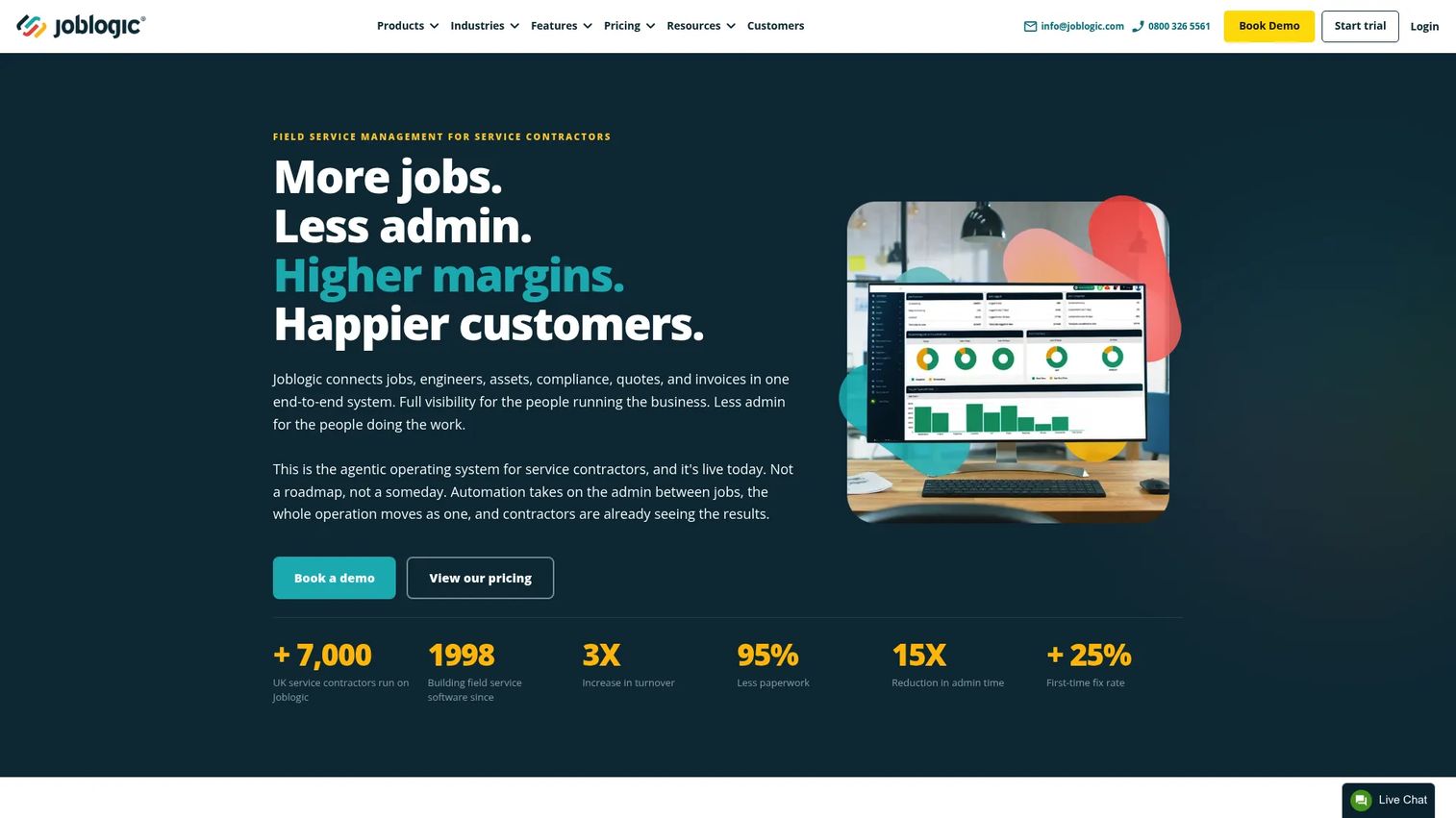
Joblogic is field service and facilities management software covering scheduling, job tracking, invoicing, compliance, and mobile workforce coordination. It is not elevator-specific, but its compliance features and mobile engineer app map well to elevator service workflows, including preventive maintenance and asset tracking.
Best for: Field service businesses that want one system for dispatch, mobile engineers, and back-office operations.
Key strengths
- Job management and job tracking
- Job scheduling and route optimization
- Mobile engineer app with forms and tracking
- Compliance and certificate management
- Invoicing and back-office tools
Why choose Joblogic: For general field ops that need strong compliance handling and a capable mobile app, Joblogic covers the bases. Confirm how well its asset and maintenance modeling fits AMC-heavy elevator contracts before rollout.
Joblogic pricing: The Standard plan starts at $59 per month. Premium pricing is not exposed publicly, and Enterprise is custom-priced with annual billing. A free tier is available. Prices are shown ex. tax.
6. ServiceTitan
ServiceTitan is a cloud platform for contractors, strongest in commercial and residential service businesses. It brings deep dispatch, scheduling, invoicing, pricebook, call booking, and reporting. It is a broad field service platform rather than an elevator-native tool, which suits larger service organizations that need heavy operational controls.
Best for: Larger service organizations needing an all-in-one field service platform with deep dispatch and reporting.
Key strengths
- Dispatching and scheduling
- Invoicing and pricebook
- Call booking and reporting
- Customer communication tools
- Operational dashboards
Why choose ServiceTitan: When scale is the priority and you need mature dispatch, reporting, and customer communication, ServiceTitan delivers depth. For elevator-specific AMC and compliance modeling, plan for configuration rather than out-of-the-box elevator modules.
ServiceTitan pricing: Per-technician packages are Starter, Essentials, and The Works. Pricing is quote-based; each plan uses a request-pricing model rather than public rates.
7. Workever

Workever is field service and job management software for trades and service businesses. It covers job management, scheduling, quotes, invoices, payments, and mobile apps with offline support for field workers. For smaller to mid-sized elevator teams that want practical workflow coverage without a heavy implementation, it is an accessible option.
Best for: Small trades and service teams needing field scheduling, invoicing, and mobile job management.
Key strengths
- Job management and scheduling
- Quotes, invoices, and payments
- Mobile apps with offline fieldworker support
- Customer management
- No long-term contracts
Why choose Workever: The mobile-first, offline-capable field app suits technicians working in buildings with spotty signal. Pricing is accessible, and the lack of contracts lowers the commitment. Verify elevator-specific AMC and compliance handling for your workflows.
Workever pricing: The Base plan starts at £29/month per user. The Ultimate plan is £39/month per user. Workever offers a free 30-day trial and no contracts.
8. ManageMart
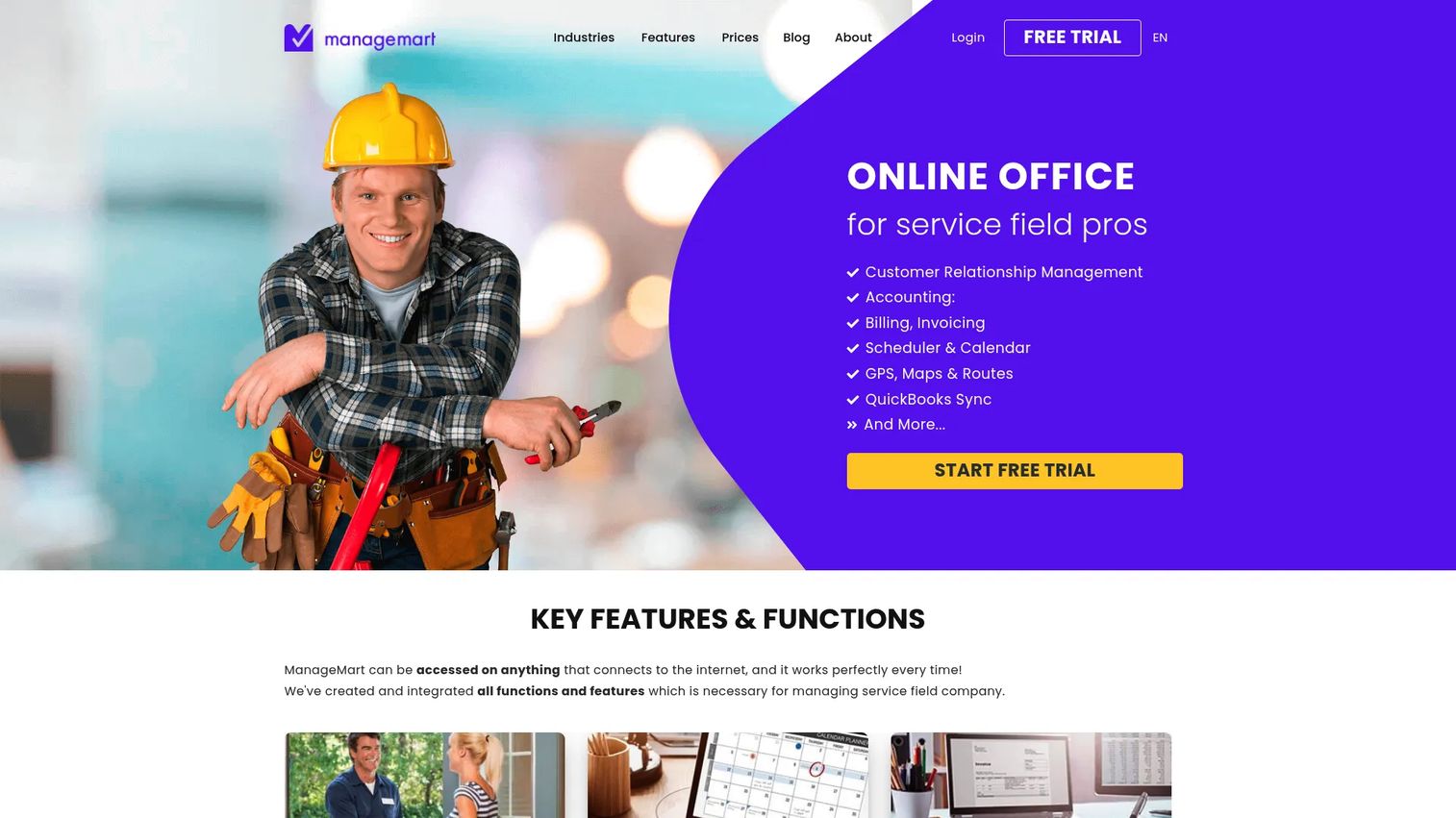
ManageMart is cloud field service management software for scheduling, invoicing, GPS tracking, accounting, and customer management. It packages an all-in-one operations toolkit at a low entry price, which appeals to small and mid-sized field service businesses that want coverage without complexity.
Best for: Small to mid-sized field service businesses that need an all-in-one operations platform.
Key strengths
- Invoicing and estimating
- Scheduling and calendar management
- GPS tracking and routes
- Accounting features
- Customer management
Why choose ManageMart: For a small elevator service team, ManageMart offers broad coverage and GPS tracking at an accessible price. Its strengths are basic scheduling, work order tracking, and technician coordination. Confirm how it handles AMC renewals and compliance records before choosing it for elevator-specific work.
ManageMart pricing: The single All Included plan is $16.25/month billed yearly, or $19.99/month billed monthly. A 7-day free trial is available with no credit card required.
9. Field Force Tracker
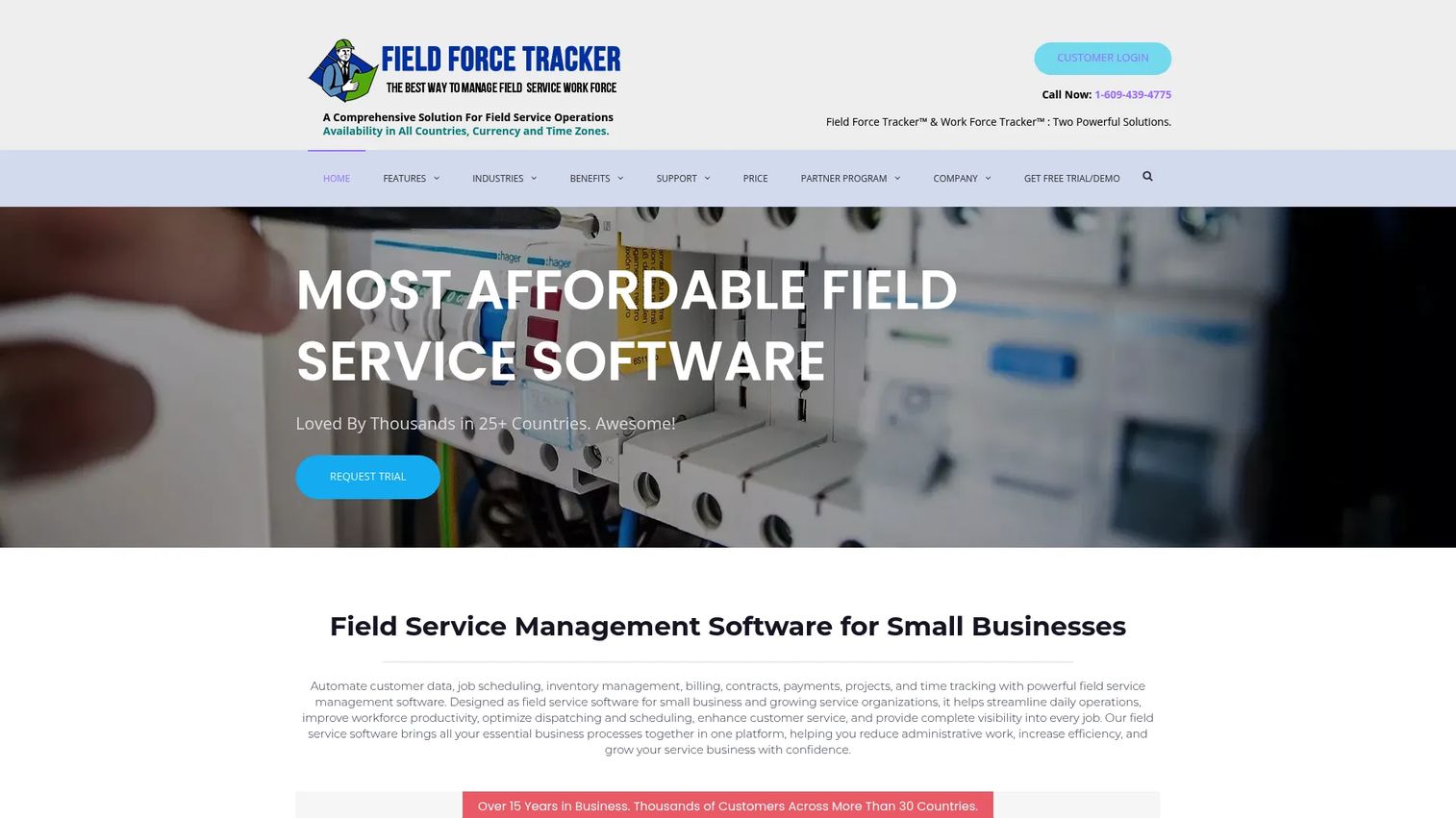
Field Force Tracker is field service management software for scheduling, dispatch, invoicing, tracking, and contract management. It offers work order management, GPS tracking, mobile apps, and modular industry add-ons, which gives teams technician visibility and straightforward field execution.
Best for: Service businesses that want an all-in-one field operations platform with industry-specific add-ons.
Key strengths
- Work order management and dispatch scheduling
- GPS tracking and mobile apps
- Invoices, quotes, and recurring billing
- Contract management
- Modular industry add-ons
Why choose Field Force Tracker: For teams that prioritize technician GPS visibility and simple field execution, Field Force Tracker covers the essentials with contract management that supports recurring service. Check which add-on modules cover elevator-specific compliance before you buy.
Field Force Tracker pricing: The Starter Plan is $59.99 per month plus optional industry modules. Professional Business Plans run $24.99 to $49.99 per user per month with industry add-on features. Annual commitment discounts and setup fees may apply.
Considerations
Elevator-specific workflow depth
The biggest evaluation question is whether the tool genuinely models AMC, preventive maintenance, breakdowns, and compliance, or whether it tracks generic jobs you would have to configure into elevator workflows. Purpose-built tools handle contract renewals and safety inspections natively. Broad platforms are flexible but need setup. Map your actual contract types and inspection cadences against each tool before deciding.
Technician mobile experience
Your field team lives in the mobile app. Check offline access for buildings with no signal, job updates from the field, parts capture, photo and signature attachment, and GPS visibility. A weak mobile experience pushes technicians back to phone calls and paper, which undoes the point of the software.
Inventory and purchasing control
Spare parts drive both cost and downtime. Look for spare parts tracking, reorder alerts, purchase orders, and warehouse visibility. Elevator inventory software that ties parts usage to work orders gives you accurate billing and prevents the stockouts that leave a unit down while you wait on a component.
Reporting and audit trails
Confirm the tool provides dashboards, asset history, service reports, and compliance logs. Elevator reporting software should show completion rates, response times, and contract health at a glance, and produce the audit trail an inspection or a customer dispute demands. If you cannot pull a unit's full service history in a few clicks, the reporting is too shallow.
Integration and implementation effort
Evaluate accounting, CRM, and ERP integrations, plus the maintenance burden after rollout. A tool that syncs with your existing QuickBooks or Dynamics stack removes double entry. Weigh implementation cost and timeline honestly. Enterprise platforms carry larger setup investments; lighter tools go live faster but may need more manual workarounds.
Conclusion
The right elevator management software depends on whether you need elevator-native depth or broader field-service flexibility. For all-in-one operations on the Microsoft stack, FIELDBOSS fits. For QuickBooks-centric teams, Method:Field Services removes double entry at $15/month per technician. For scale and heavy dispatch, ServiceTitan brings deep operational controls. For small to mid-sized teams, Workever and ManageMart offer accessible entry pricing and mobile-first workflows. For elevator-native design, LiftKeeper and ElevatorPlus target that focus directly, and for general field service depth, Joblogic and Field Force Tracker cover scheduling, mobile work orders, and reporting.
Your next step: build a shortlist based on your top three priorities, usually AMC and preventive maintenance, dispatch and technician GPS visibility, and inventory control. Then request a working demo of each finalist against your real contract types and compliance requirements. See the tool handle your workflows before you commit, not a canned walkthrough.
FAQs
The terms overlap heavily and vendors often use them interchangeably. Elevator management software usually implies the full business scope: service, maintenance, dispatch, inventory, CRM, projects, and reporting. Elevator service software tends to emphasize the field service side, service requests, work orders, dispatch, and technician workflows. When comparing tools, look at actual module coverage rather than the label.
Prioritize AMC and preventive maintenance scheduling, recurring visit tracking, and renewal alerts, since missed visits are the most common failure point. Add work order management, a strong technician mobile app, parts tracking tied to jobs, and compliance records with audit trails. Reporting that surfaces overdue visits and contract health rounds out the core.
For most service operations, yes. Technician GPS tracking lets dispatch route a breakdown call to the nearest available technician, which cuts response time during outages. It also gives supervisors visibility into field activity and supports accurate arrival-time updates to customers. Smaller teams with a fixed local route get less value from it, so weigh it against your dispatch volume.
Downtime often comes down to a missing part. Elevator inventory software tracks spare parts stock, triggers reorder alerts before you run out, and ties parts usage to specific work orders. That means a technician arrives with the right component instead of making a second trip, and you avoid the stockouts that leave a unit out of service while a part is on order.
Confirm the tool provides dashboards for completion rates, response times, and contract health, plus full asset history for each unit. Check that it produces the audit trail an inspection requires and that you can export service reports for customers. Test how many clicks it takes to pull a single elevator's complete service and inspection history, that is a good proxy for reporting depth.
It can be, with configuration. Broad platforms like ServiceTitan, Joblogic, and Field Force Tracker cover scheduling, dispatch, mobile work orders, and reporting well. The gap is elevator-specific modeling: AMC contract structures, safety inspection cadences, and compliance tracking. If your team can configure those workflows and does not need them out of the box, generic field service software works. If you want native handling, favor purpose-built tools.
AMC software manages annual maintenance contracts: the recurring agreements that cover scheduled visits, breakdown coverage, and parts terms. It tracks each contract's scope, schedules the preventive maintenance visits it requires, alerts you before renewals lapse, and logs the service history against the contract. That prevents missed visits, protects recurring revenue, and gives you a clean record when a customer questions what the contract covers.
Start with your jurisdiction's inspection and code requirements, then check whether the tool tracks safety tests, violations, and certificate expiries against each asset. Confirm it keeps a full audit trail and can produce inspection-ready reports on demand. Elevator compliance software should also flag upcoming inspection due dates automatically, so nothing slips between recurring cycles.