Your last physical inventory count took three people two full days. The spreadsheet still didn't match the shelves. An asset went missing between two sites, and nobody could say when it left or where it went. Reporting came in a week late, stitched together from scans, memory, and guesswork.
This is the exact problem RFID software solves. Tags and readers generate a constant stream of events, but raw reads mean nothing on their own. The software is the layer that turns those events into accurate inventory counts, live asset locations, audit trails, and workflow automation. It decides what a read means, updates [the right record, and pushes that signal into the systems your team already uses.
The market reflects how much this matters. The global RFID software segment is projected to reach USD 8.6 billion by 2026, according to Global Industry Analysts (2022), while Grand View Research (2025) values the broader RFID technology market at USD 20.10 billion in 2024, climbing toward USD 47.63 billion by 2030.](https://www.grandviewresearch.com/industry-analysis/radio-frequency-identification-rfid-technology-market) Retail and apparel alone accounted for 46.05% of RFID market share in 2025, per Mordor Intelligence (2026). Growth like that means more vendors, more overlap, and a harder buying decision.
Most buyer guides list products without helping you decide. This one leads with fit. We compare RFID tracking software by use case, integration depth, deployment model, and pricing, so you can match a tool to your most important operational workflow instead of chasing a feature checklist.
What's inside
This guide covers seven RFID software tools built for real operational work: real-time asset tracking, inventory visibility, RFID middleware, audits and reporting, and integration into ERP or WMS systems. We selected products that solve a clear operational job, connect to existing readers and business systems, and serve identifiable use cases across retail, manufacturing, IT asset management, and libraries.
We evaluated each tool on four criteria: the core job it solves, integration depth with hardware and business systems, deployment model and maintainability, and pricing transparency. Every pricing figure and rating here comes from a verified source at the time of writing. Where a vendor gates pricing behind sales, we say so rather than guess.
TL;DR
- Best for configurable real-time tracking: Avancir, with public pricing and a SaaS model that connects fixed and handheld reads to automations and alerts.
- Best for enterprise location intelligence: Zebra MotionWorks, for organizations tracking assets and people across multiple sensor technologies.
- Best for manufacturing and supply chain visibility: Xemelgo, built around item-level traceability and a rules engine.
- Best for IT asset management: Asset Management Global (AMG), combining ITAM, ITSM, CMDB, and RFID tracking in one platform.
- Best for libraries: EnvisionWare RFID Software Suite, for encoding, validation, and circulation-linked inventory.
- Best for label and RFID encoding: BarTender, when labeling, encoding, and operational printing must connect to your tracking workflow.
Background
RFID software is the application layer that reads data from RFID tags through readers, converts those reads into accurate operational records, and feeds inventory, asset, and reporting workflows. It sits between physical tags and the business systems that act on the data.
Here is how the pieces fit together and why each one matters for a buyer:
- How data moves from tags to software. A reader emits radio waves, tags respond with their unique IDs, and the reader passes raw reads to software. Because RFID does not need line of sight, a single reader can capture hundreds of tags at once, which is what makes fast cycle counts possible.
- How software supports inventory and asset visibility. The software deduplicates reads, maps each tag to an item or asset, and maintains a current state: what exists, how many, and where. This is what produces reliable inventory visibility instead of a pile of timestamps.
- Where RFID middleware software fits. Middleware sits between readers and business systems. It filters noisy reads, applies rules, and routes clean events to the right destination. Some platforms bundle middleware; others expect you to supply it. Knowing which is which prevents a costly integration gap.
- How integrations turn scans into workflow automation. A read becomes useful when it triggers something: a stock adjustment, a check-out record, an alert, or an ERP update. Integrations and RFID reader software compatibility are what convert a scan into an action.
- Why reporting and audits matter. Auditable trails of what moved, when, and by whom are often the reason a team buys in the first place. Strong reporting turns tracking data into decisions and compliance evidence.
For product and operations leaders, the practical question is not "does it read tags" but "does it turn reads into records my systems trust, without constant manual reconciliation."
When to use RFID software
RFID software earns its cost in specific operational moments. Use these three patterns to check whether your situation fits.
Track assets in real time
When equipment, tools, or high-value items move between people, rooms, or sites, manual logs fall behind fast. RFID asset tracking software gives you live location, movement history, and location awareness without someone scanning each item by hand. This is the pattern for field equipment, lab instruments, IT hardware, and returnable containers, where knowing where something is right now prevents loss and downtime.
Control inventory and reduce count errors
Warehouses, retail stockrooms, and distribution centers live and die on count accuracy. RFID inventory tracking software reads many items at once, so a cycle count that took hours takes minutes. This is where speed and accuracy compound: fewer stockouts, fewer write-offs, and inventory records that match the shelf. Retail inventory counts are a common entry point because the payback is easy to measure.
Automate audits, checkouts, and reporting
Any team that reconciles what should be there against what is there benefits from automation. RFID software can log check-in and check-out events, flag missing items, and generate audit reports on a schedule. This reduces manual reconciliation in libraries, tool cribs, healthcare supply rooms, and IT asset audits, and it supports broader supply chain visibility when the data feeds an ERP or WMS.
Comparison table
The table below maps each RFID tracking software tool to its buying intent and primary use case, with verified pricing and ratings where a source was confirmed. Rows are ordered by relevance to common buyer needs, starting with configurable real-time tracking and moving through enterprise, vertical-specific, and labeling use cases.
| # | Product | Intent | Key use case | Pricing | G2 rating |
|---|---|---|---|---|---|
| 1 | Avancir | Configurable RFID tracking | Real-time asset and inventory visibility | From $269/month, billed annually | Not enough reviews |
| 2 | TagMatiks | Multi-workflow tracking | Asset and inventory modules | Not publicly listed | Not confirmed |
| 3 | Zebra MotionWorks | Enterprise location intelligence | Real-time tracking across sensor types | Contact sales | Not confirmed |
| 4 | Xemelgo | Supply chain operations | Item-level traceability and automation | Contact sales | Not confirmed |
| 5 | Asset Management Global (AMG) | IT asset management | ITAM, ITSM, CMDB, RFID tracking | From $99/month | Not confirmed |
| 6 | EnvisionWare RFID Software Suite | Library circulation | Tag encoding and inventory | Contact vendor | Reported at 2.7/5 |
| 7 | BarTender | Label and RFID encoding | Design, encode, and print labels | From $199/year | 4.2/5 |
1. Avancir
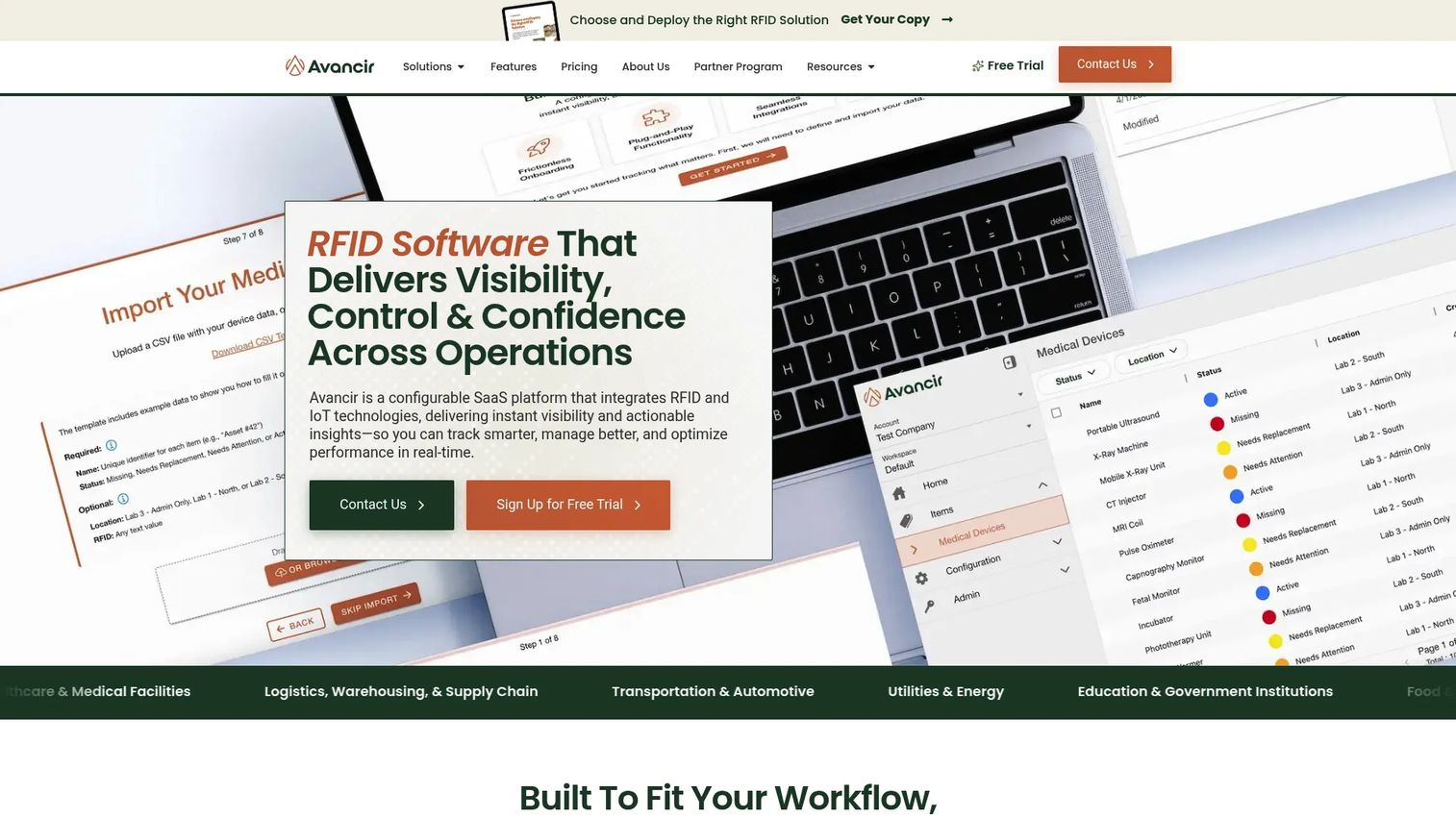
Avancir is a configurable RFID and IoT SaaS platform for real-time tracking, visibility, and workflow automation. It connects fixed RFID hardware and handheld or mobile devices into one system, then layers automations, alerts, analytics, and integrations on top. The result is a platform that turns reads into records your team can act on, without a long custom build. For buyers who want published pricing and a clear SaaS model, Avancir is one of the most transparent options on this list.
Best for: teams that need RFID-based asset, inventory, and item-level visibility with configurable workflows and no heavy engineering lift.
Key strengths
- Fixed and handheld capture: Reads from both stationary readers and mobile devices feed a single source of truth, so cycle counts and live tracking share the same data.
- Automations and alerts: Rules trigger notifications and actions when items move, go missing, or cross a threshold, which cuts manual reconciliation.
- Analytics and integrations: Built-in analytics plus connectors let you push clean event data into the systems your operations team already runs.
Why choose Avancir: Avancir fits teams that want to stand up RFID inventory tracking software quickly and see value without a services engagement. The configurable workflow layer means you can adapt the platform to asset tracking, stockroom counts, or item-level visibility without rebuilding it each time. That flexibility is what makes it a strong default for mid-size operations.
Avancir pricing: Avancir publishes four tiers on its pricing page, all billed annually with no hardware included. Starter starts at $269 per month, Basic at $998 per month, Pro at $1,649 per month, and Premium at $2,419 per month. A free option is available to start. G2 currently lists Avancir as not having enough reviews to provide buying insight, so no numeric rating is confirmed.
2. TagMatiks
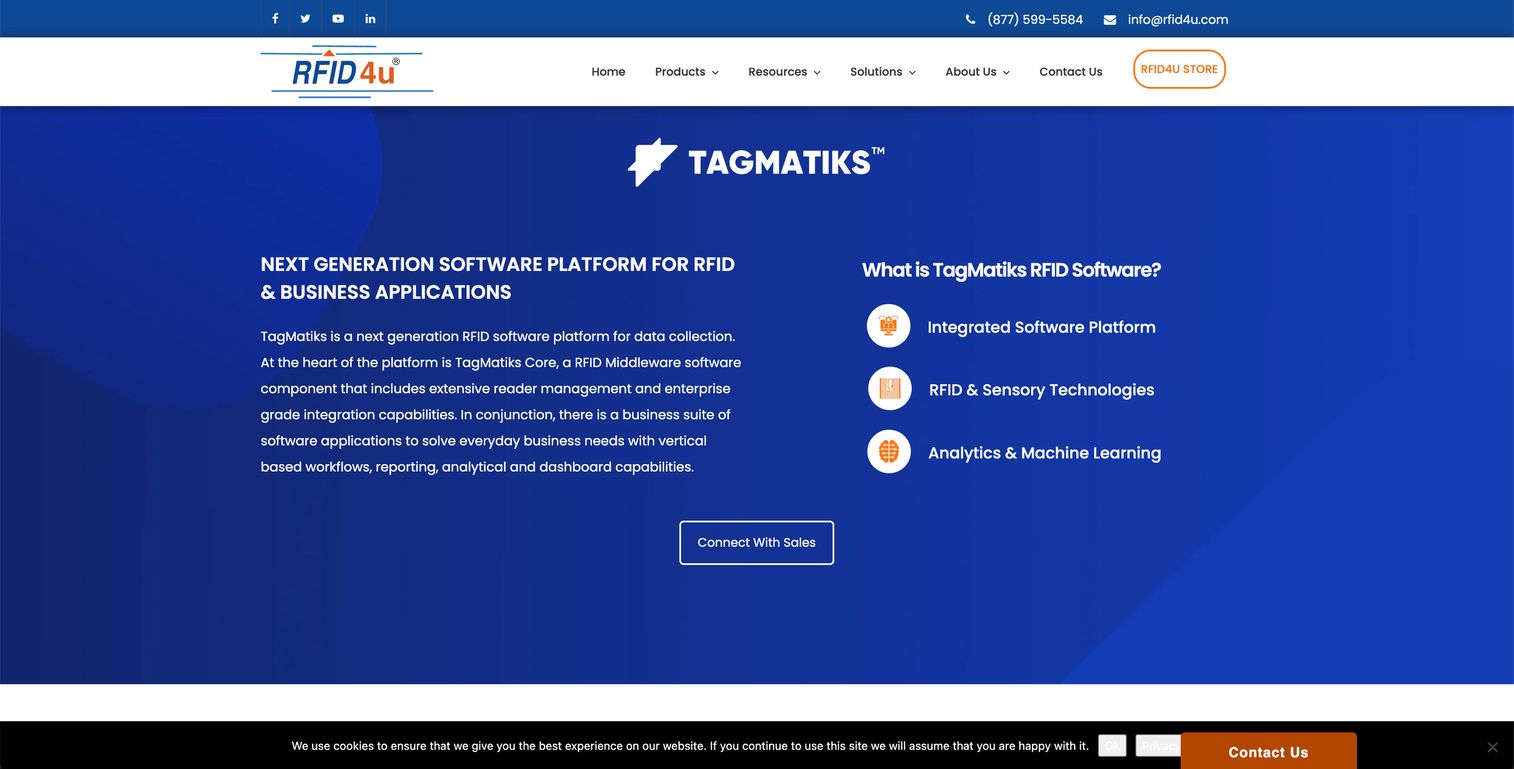
TagMatiks is an RFID software family focused on asset tracking and inventory management, built on more than two decades of RFID delivery experience. Its product line spans multiple modules so operational teams can address several workflows from one vendor, whether that is fixed-reader inventory, handheld cycle counts, or asset check-in and check-out. The platform is oriented toward teams that want RFID asset tracking software that adapts to different sites and use cases rather than a single fixed workflow.
Best for: operational teams that need multiple RFID workflows, from inventory counts to asset tracking, under one product family.
Key strengths
- Module breadth: Separate modules for asset tracking and inventory management let teams adopt what they need and expand over time.
- Multi-device support: Coverage across handheld, mobile, and fixed reads supports both live tracking and periodic counts.
- Operational focus: The platform targets accuracy and speed in day-to-day counting and reconciliation work.
Why choose TagMatiks: TagMatiks suits organizations that expect their RFID needs to grow across departments or sites. Because the product line is modular, a team can start with inventory and add asset tracking later without switching vendors. That continuity matters when you are standardizing operations across multiple locations.
TagMatiks pricing: TagMatiks does not publish pricing on its site, and a current, clearly matching third-party rating was not confirmed at the time of writing. Teams evaluating it should request a quote scoped to their reader hardware, site count, and module needs, since those factors drive cost in RFID deployments.
3. Zebra MotionWorks
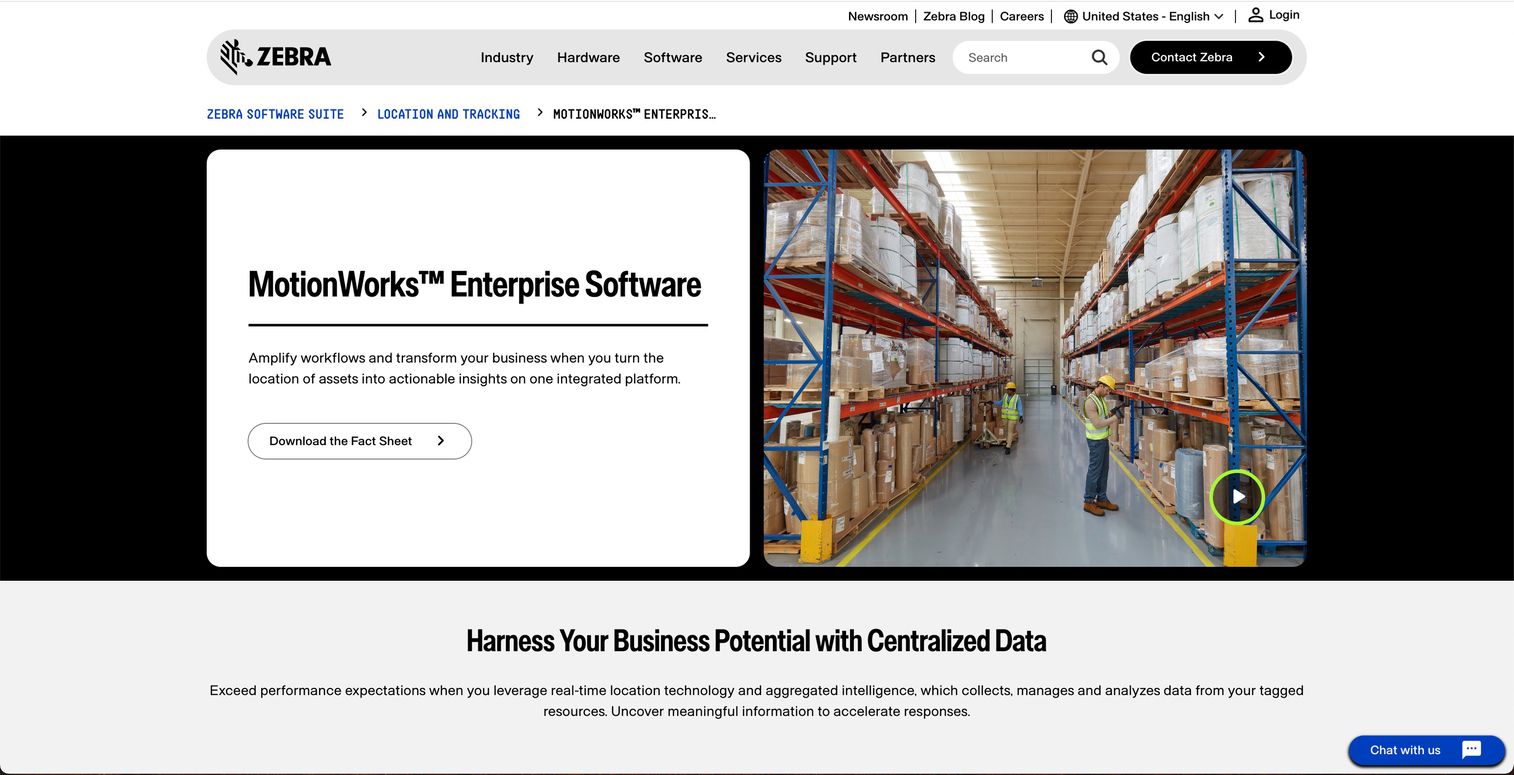
Zebra MotionWorks is enterprise location-and-tracking software that turns asset and personnel location data into operational insights. It manages multiple sensor technologies from one place, so RFID reads sit alongside other location signals in a single view. For large operations that already run mixed hardware, this centralization is the point: one platform tracking machines, products, devices, and people across the floor.
Best for: organizations needing centralized real-time asset tracking across multiple sensor technologies and large physical sites.
Key strengths
- Real-time tracking at scale: Live location for machines, products, devices, and people supports operations where visibility gaps cause real cost.
- Centralized sensor management: One platform coordinates multiple location technologies, reducing the number of disconnected tools.
- Third-party integration: Connections to existing applications and business systems fit MotionWorks into an established enterprise stack.
Why choose Zebra MotionWorks: MotionWorks fits enterprises that have outgrown point solutions and need one system for location intelligence across a large footprint. If your operation already runs Zebra readers and printers, the software slots into that ecosystem naturally. It is a fit when the requirement is breadth and scale rather than a single-site count.
Zebra MotionWorks pricing: Zebra directs buyers to sales and partners for MotionWorks, and no public price is listed on its product pages. Enterprise deployments are typically scoped around site size, sensor count, and integration needs. Because pricing is quote-based, plan for a sales-led evaluation rather than a self-serve start.
4. Xemelgo
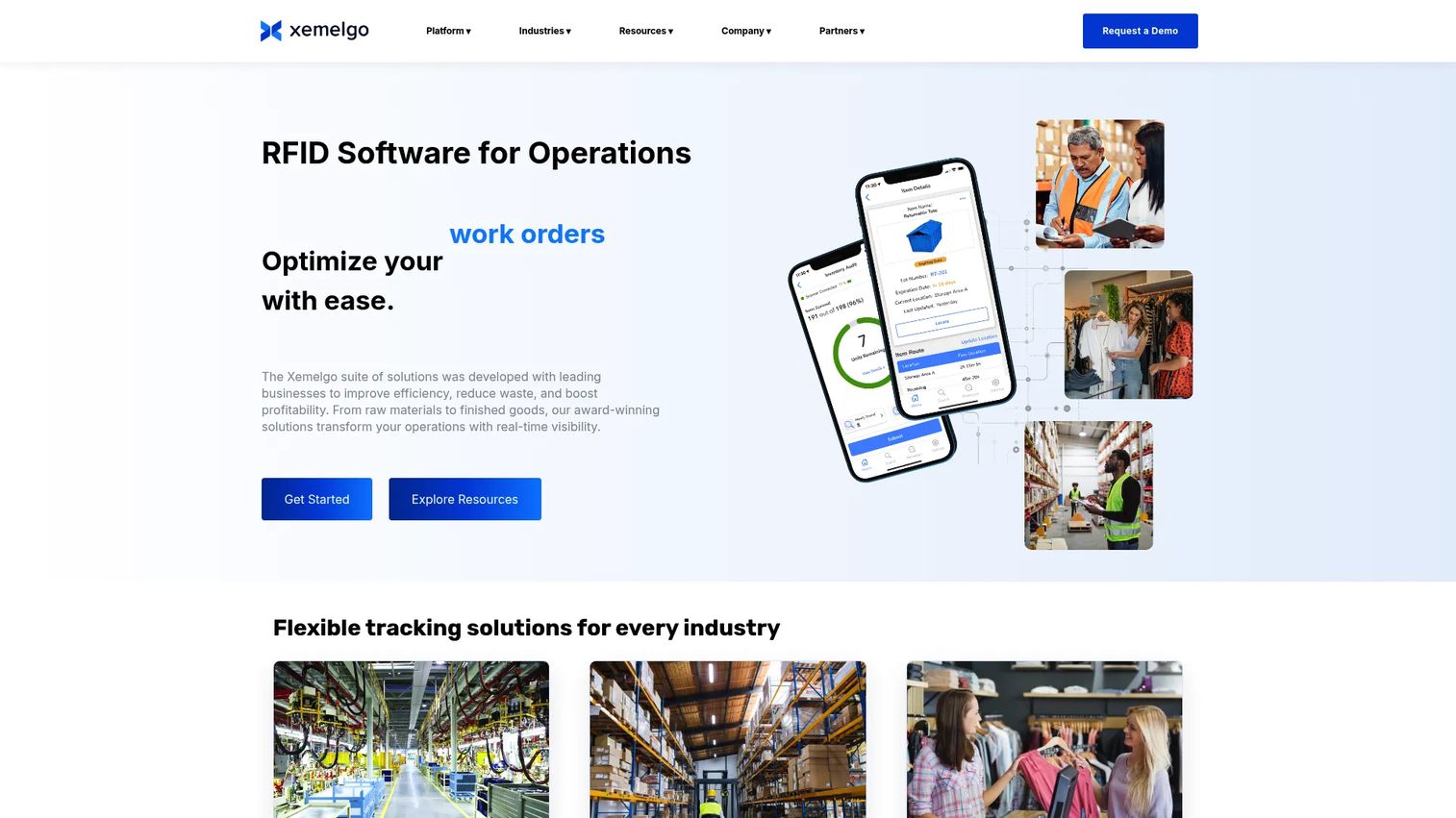
Xemelgo is RFID software for operations, offering real-time tracking, automation, and visibility across inventory, assets, shipments, and internal delivery. It is built around item-level traceability and a rules engine, which makes it a strong fit for manufacturing and warehouse environments where knowing the exact state of each item drives throughput. Dashboards and AI-generated reports turn the read stream into something operations leaders can review at a glance.
Best for: manufacturers and supply chain teams needing RFID-based operational visibility and workflow automation.
Key strengths
- Item-level traceability: Real-time visibility down to the individual item supports quality, compliance, and precise inventory control.
- Rules engine and automation: Configurable workflows, alerts, and rules automate the responses that used to require manual checks.
- Integrations and reporting: Connectors, dashboards, and AI report generation feed clean data into decisions and other systems.
Why choose Xemelgo: Xemelgo fits teams whose value comes from tracking material and product movement through a process, not just counting stock in a room. The rules engine lets manufacturing and logistics teams encode their own logic, so the software matches how the floor actually runs. That process orientation separates it from simple counting tools.
Xemelgo pricing: Xemelgo describes straightforward monthly subscription pricing for its asset management software, but no public numeric price is shown on the pages reviewed. G2 currently lists no usable rating. Expect a scoped quote based on sites, item volume, and the workflows you plan to automate.
5. Asset Management Global (AMG)
Asset Management Global (AMG) is an enterprise IT asset management platform that combines ITAM, ITSM, CMDB, RFID asset tracking, procurement, infrastructure monitoring, service desk, and AI-powered automation in one integrated system. For IT teams, the appeal is consolidation: RFID tracking of physical hardware lives in the same platform that manages tickets, configuration data, and lifecycle. That structure supports the audits and reporting IT organizations are held to.
Best for: mid-size to enterprise IT teams needing unified asset and service management with RFID tracking built in.
Key strengths
- Unified IT asset management: ITAM, ITSM, and CMDB in one platform keep physical hardware, tickets, and configuration data connected.
- RFID tracking module: RFID asset tracking ties physical location and movement to the same records the service desk uses.
- Structured controls and reporting: Patch management, infrastructure monitoring, and procurement add the governance IT audits require.
Why choose AMG: AMG fits IT organizations that want RFID tracking without buying a standalone system to bolt on. Because tracking lives inside a full ITAM and ITSM platform, asset location, ownership, and service history stay in one place. That reduces the reconciliation gaps that appear when hardware tracking and service management live in separate tools.
AMG pricing: AMG lists a Startup Plan at $99 per month covering up to 500 IT assets across a single site, including ITAM, Service Desk, and CMDB. The Enterprise Plan uses custom pricing for 500-plus assets across multiple sites, with the full AI suite and dedicated support. There is no free tier. A current third-party rating was not confirmed from a primary source.
6. EnvisionWare RFID Software Suite
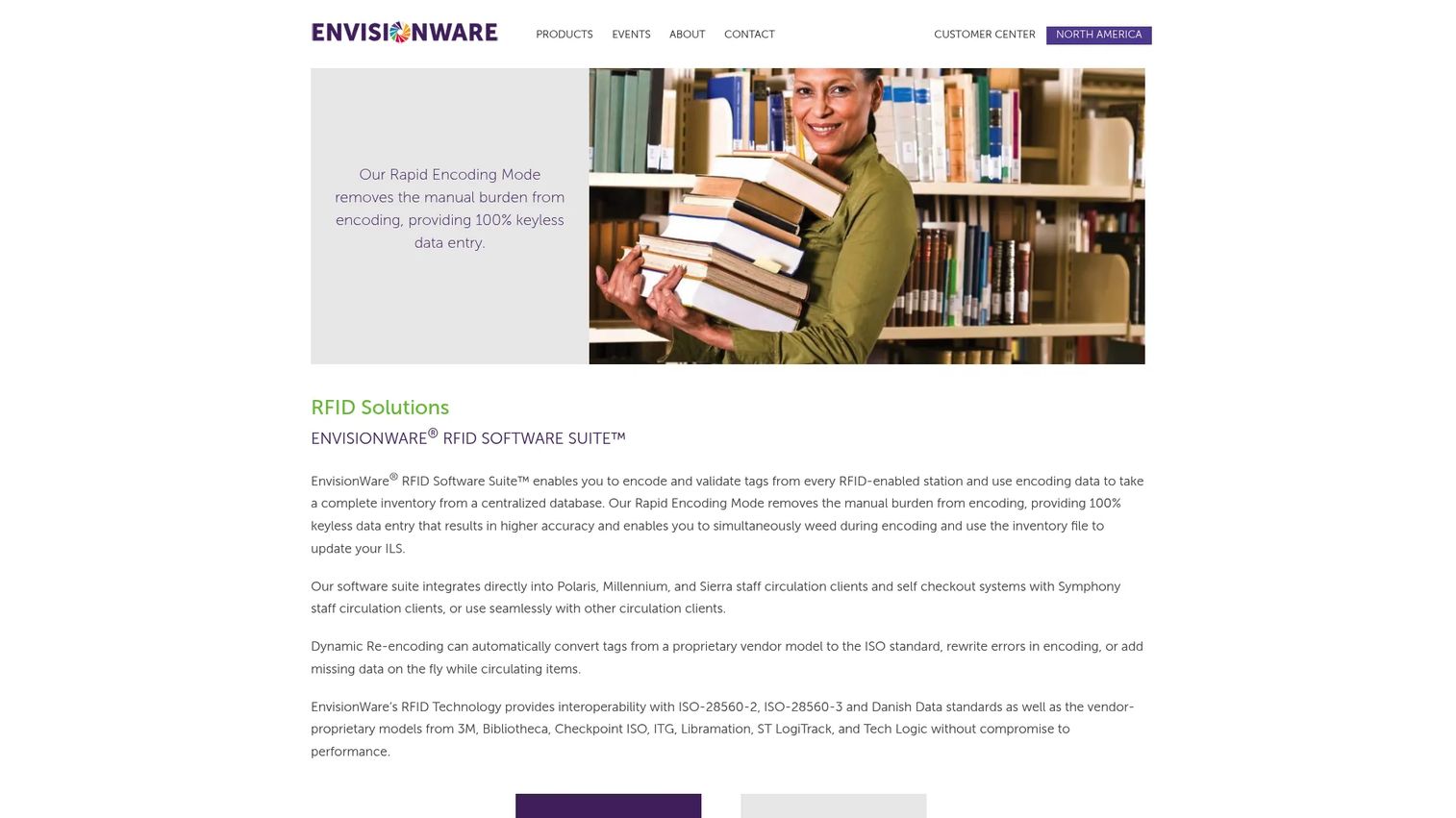
EnvisionWare RFID Software Suite is RFID software built for libraries. It lets staff encode, validate, inventory, and re-encode RFID tags across circulation and self-checkout workflows. Where general asset platforms treat items generically, EnvisionWare speaks the language of library RFID: tags tied to circulation records, self-checkout stations, and shelf inventory. That specialization is what makes it a natural fit for library technology teams rather than a general-purpose tracker.
Best for: libraries needing RFID encoding and inventory management tied directly to circulation systems.
Key strengths
- Tag encoding and validation: Encode and validate tags from RFID-enabled stations, keeping item data accurate from the first scan.
- Rapid encoding mode: Keyless data entry speeds up bulk tagging of new and existing collections.
- Dynamic re-encoding and ILS integration: Re-encode tags on the fly and connect to the integrated library system so records stay in sync.
Why choose EnvisionWare: EnvisionWare fits library teams that need RFID workflows purpose-built for circulation, self-checkout, and shelf inventory rather than a generic asset tool adapted to the job. The ILS integration keeps tag data and circulation records aligned, which is the core requirement in a library setting. That domain focus is the reason to choose it.
EnvisionWare pricing: EnvisionWare does not publish pricing for the RFID Software Suite on its site, so plan to request a quote through the vendor. A G2 result exists for a related EnvisionWare product, LPT:One, reported at 2.7/5, but that rating is for a different product and may not reflect the RFID Software Suite specifically. Evaluate the suite on its circulation fit rather than that number.
7. BarTender
BarTender is label and barcode software with on-premises and cloud subscription plans for designing, managing, and printing labels, including RFID encoding. It is the tool you reach for when RFID software must connect to labeling and operational printing, not just reading. If your workflow starts with encoding a tag and printing a label at the point of receipt or production, BarTender covers that front end and pairs with barcode integration for mixed environments.
Best for: teams that need enterprise label and barcode software with RFID encoding and automation options.
Key strengths
- Barcode and RFID label design: Design and encode labels that carry both barcode and RFID data from one tool.
- Anywhere printing: Print across locations and devices, supporting distributed operations and multiple sites.
- Flexible integrations: REST API, File Drop, and no-code builders connect printing to the systems that request labels.
Why choose BarTender: BarTender fits operations where the RFID story begins at labeling and encoding. Rather than treating tag creation as a separate step, it ties label design, encoding, and printing into one workflow that connects to your other systems. For teams standardizing how tags get created and applied, that front-end control is the reason to choose it.
BarTender pricing: BarTender is subscription-only, billed annually, with on-premises tiers starting at $199 per year for Starter, $299 for Professional, and $575 for Automation, plus Enterprise via sales quote. Cloud plans start at $390 per year for Cloud Essentials and $1,750 for Cloud Automation, with Cloud Enterprise quoted by sales. There is no free tier. BarTender holds a 4.2/5 rating on G2.
Considerations
Before you commit, work through this checklist against your actual environment. The right RFID software depends less on the feature list and more on how it fits what you already run.
Reader and hardware compatibility
RFID software depends on readers, tags, printers, and handhelds to function. Confirm the platform supports your specific hardware, or the readers you plan to buy, before anything else. A mismatch here is the fastest way to stall a deployment, so treat compatibility as a gate, not a nice-to-have.
ERP and WMS integration
A read only creates value when it updates the system your team acts on. Check whether the vendor offers native connectors, APIs, or middleware for your ERP or WMS. For many buyers, ERP and WMS integration is the deciding factor, because tracking data that lives in a silo does not change decisions.
Reporting and audit depth
Look closely at how the software handles audits and reporting. Can it schedule reports, flag discrepancies, and produce the audit trail your compliance or finance team requires? Shallow reporting turns a tracking investment into another data source someone has to reconcile by hand.
Deployment model and maintainability
Decide whether a SaaS platform with published pricing or a sales-led enterprise deployment fits your team. Then ask how the software holds up as your operation changes: new sites, new item types, new workflows. Maintainability across change is what prevents a promising rollout from decaying six months in.
Scalability across sites and use cases
If you expect to expand beyond one workflow or location, favor platforms with modular or multi-site support. Growing into a tool beats replacing one. Confirm the vendor can scale from your first use case to the full footprint you have in mind.
Conclusion
There is no single winner in RFID software, only the best fit for your most important workflow. If you want configurable real-time asset tracking with transparent pricing, Avancir is a strong default. For enterprise location intelligence across many sensors, Zebra MotionWorks fits. Xemelgo suits manufacturing and supply chain visibility, AMG consolidates IT asset management with RFID built in, EnvisionWare owns library circulation, BarTender covers labeling and encoding, and Zebra RFID Reader Software keeps the reader layer healthy.
The practical move is to start with the tool that matches your highest-value operational workflow, whether that is inventory counts, real-time asset tracking, or audits. Then validate two things before you buy: does it integrate with your ERP or WMS, and does its reporting produce the audit trail you need. Get those right and the read stream turns into inventory visibility your team can trust.
FAQs
RFID software reads data from RFID tags through readers, then converts those raw reads into usable operational records. It maps each tag to an item or asset, maintains a current count and location, and feeds inventory, asset tracking, and reporting workflows. In short, it turns radio-frequency events into decisions.
RFID middleware software sits between readers and business systems, filtering noisy reads, applying rules, and routing clean events to the right destination. Broader RFID software often includes middleware plus tracking, reporting, workflow, and analytics layers. Some platforms bundle both; others expect you to supply middleware separately, so confirm which model a vendor follows.
RFID is better for non line-of-sight reads, scanning many items at once, and faster cycle counts, which is why warehouses and retail teams adopt it for speed and accuracy. Barcode workflows can still be cheaper and simpler for lower-volume or single-item scanning. Many operations run both, using barcode integration where it makes sense and RFID where volume and speed justify it.
Prioritize reader compatibility, reporting depth, ERP or WMS integration, audit support, and how easily you can update workflows as your operation changes. Reader compatibility is a gate: if the software does not support your hardware, nothing else matters. After that, integration depth usually decides whether the data actually changes decisions.
Yes, when the vendor supports the right integrations, APIs, or middleware connectors. Compatibility with your specific ERP or WMS is often the deciding factor in a purchase, because tracking data that cannot reach your system of record does little to improve operations. Confirm native connectors or a documented integration path before committing.
Retail and apparel lead adoption, accounting for the largest share of the RFID market, followed by logistics, manufacturing, healthcare, libraries, and IT asset management. Each uses it for the same core reason: faster, more accurate visibility into where items are and how they move. The specific workflow, from retail inventory counts to library circulation, shapes which platform fits best.
Pricing varies widely by scope, seats, hardware support, and enterprise integration needs. Some vendors publish tiers: Avancir starts at $269 per month billed annually, AMG at $99 per month, and BarTender at $199 per year. Others, including Zebra MotionWorks and Xemelgo, scope pricing through sales based on sites, item volume, and integration requirements.
Yes. RFID software depends on readers, tags, and often printers or handhelds to function, so hardware compatibility is a core part of selection. Confirm the software supports the readers and tags you own or plan to buy before you commit. Some vendors sell software separately from hardware, so budget for both when you scope a deployment.