Your welding coordinator just spent three hours pulling paper WPS records for an audit. A welder's qualification lapsed two weeks ago and nobody caught it. The spreadsheet that tracks weld history has four versions floating around, and none of them match the data book you handed the client.
This is the reality most fabrication teams live in. Procedures live in binders. Qualification logs live in Excel. Heat input records live in a welder's memory. When an auditor asks for traceability on a single weld, the search takes hours, and the answer is rarely complete.
The wrong welding software makes this worse, not better. Teams buy a tool expecting relief and instead inherit a second system that duplicates the paperwork they already had. The right welding management software does the opposite. It becomes one source of truth for procedure control, welder qualifications, traceability, and production reporting, and it holds up when a code inspector starts asking hard questions.
The welding software market was valued at roughly USD 1.2 to 1.48 billion in 2024 and is projected to reach USD 2.5 to 3.5 billion by the early 2030s, an 8 to 9 percent CAGR, according to MarketSizeAndTrends and WiseGuyReports (2024 to 2025). That growth tracks a real shift. Fabrication teams are moving off paper and spreadsheets toward digital welding procedure software that keeps WPS, PQR, WPQ, and production data aligned in one place.
This guide compares seven tools worth shortlisting in 2026, ordered by relevance to procedure control, compliance, and traceability. Manufacturers adopting smart manufacturing technologies, including welding software, have reported up to 30 percent productivity gains after implementation, per Verified Market Reports citing NIST (2023).
What's inside
This guide is for operations leaders, fabrication managers, welding coordinators, and QA/QC teams evaluating software to replace manual documentation. It covers welding procedure control, traceability, personnel qualification, production monitoring, and fabrication workflow management.
We selected tools based on four criteria: standards coverage across ASME, AWS, ISO, and API code families, traceability depth for audit-ready weld records, modular architecture that scales across fabrication sites, and reporting quality for both compliance and production visibility. Each entry notes verified pricing where the vendor publishes it, plus who the tool fits best.
TL;DR
- Best for engineering-led compliance teams: TWI Software Welding Software, with built-in code rules for ASME, ISO, AWS, and API plus dedicated qualification and coordinator modules.
- Best for combined compliance and production monitoring: WeldEye, a modular cloud platform pairing traceability with real-time arc-on time and parameter tracking.
- Best for all-in-one project execution: WeldTrace, an ERP-style system covering procedures, continuity, weld mapping, NDE, and data books.
- Best for connected fabrication workflows: ESAB Digital Solutions, a broad ecosystem spanning welding, cutting, and quality tools.
- Best for machine-level weld data: WeldCloud and WeldQAS, for teams prioritizing production analytics and fault detection.
- Best for plate optimization: Columbus III CAD/CAM nesting software, an adjacent tool for cutting and nesting workflows tied to fabrication.
What is welding software?
Welding software is a category of applications that digitizes welding procedure qualification, welder management, traceability, and production reporting for fabrication and manufacturing operations.
The category splits into three overlapping types. Welding procedure software focuses on creating and approving WPS, PQR, and WPQ documents against code rules. Welding management software adds broader workflow control: personnel qualifications, welder continuity tracking, traceability, and audit-ready records across projects. Welding fabrication software extends further into project execution, weld mapping, NDT reporting, and production analytics. Most serious platforms blend all three.
Core capabilities to expect from a modern platform:
- WPS, PQR, and WPQ creation and approval workflows
- Standards support across ASME, AWS, ISO, EN ISO, API 1104, AS/NZS, and JIS
- Traceability and audit-ready records tied to each weld
- Welder continuity and qualification tracking with expiry alerts
- Production analytics and heat input monitoring
- Weld mapping and NDE reporting for project data books
Modular platforms matter most for large fabrication teams. A shop running multiple sites rarely needs every module on day one. A modular structure lets you start with procedure control, add traceability when spreadsheets break, and layer in welding productivity monitoring once the documentation backbone is stable. That staged rollout keeps procurement manageable and avoids paying for capabilities the team is not ready to use.
When to use welding software
Standardize procedures across sites
Teams running fabrication in more than one location face a version-control problem. Site A revises a WPS, Site B keeps using the old one, and the mismatch surfaces during an audit. Centralized WPS software gives every site one approved source of truth for procedures and qualification workflows. Approval consistency becomes enforceable rather than aspirational, and documentation control stops depending on which engineer emailed which PDF.
Replace spreadsheets with traceability
Excel works until it doesn't. The trigger moment usually comes when a client requests a full weld history and the team realizes the records are scattered across tabs, machines, and memory. Welding traceability software ties weld history, welder continuity, inspection results, and NDT reporting to each joint. When an auditor points at a weld map, you produce the complete record in minutes, not days.
Monitor productivity and heat input
Arc-on time, shift reports, and consumables tracking matter once throughput becomes the bottleneck. Welding productivity monitoring surfaces where time is lost between arcs and flags heat input management issues before they cause rework. Tying production analytics to quality data connects rework reduction directly to throughput visibility, which is the argument that gets these tools funded.
Comparison table
The table below sorts tools by relevance to welding procedure and compliance workflows. Pricing reflects verified vendor pages where public; several ESAB products publish features but route pricing through a quote request.
| # | Product | Intent | Key use case | Pricing | G2 rating |
|---|---|---|---|---|---|
| 1 | TWI Software Welding Software | Procedure and compliance | WPS/PQR/WPQ qualification and site-wide traceability | From £1,500 (Welding Qualifier licence) | Not listed |
| 2 | WeldEye | Compliance and monitoring | Traceability plus real-time welding parameter tracking | From €490/year (ArcVision) | Not listed |
| 3 | WeldTrace | All-in-one management | Procedures, continuity, weld mapping, NDE, data books | From $250 one-time (Lite) | 0/5 (no reviews) |
| 4 | ESAB Digital Solutions | Connected workflows | Welding and cutting workflow documentation | Quote-based | Not listed |
| 5 | WeldCloud | Documentation and data | Cloud WPS/PQR/WPQ records and weld documentation | Annual user licence | Not listed |
| 6 | WeldQAS | Weld monitoring | Real-time parameter tracking and fault detection | Quote-based | Not listed |
| 7 | Columbus III CAD/CAM nesting software | Nesting and cutting | Plate optimization and CNC cutting workflows | Quote-based | Not listed |
The 7 best welding software tools for 2026
1. TWI Software Welding Software
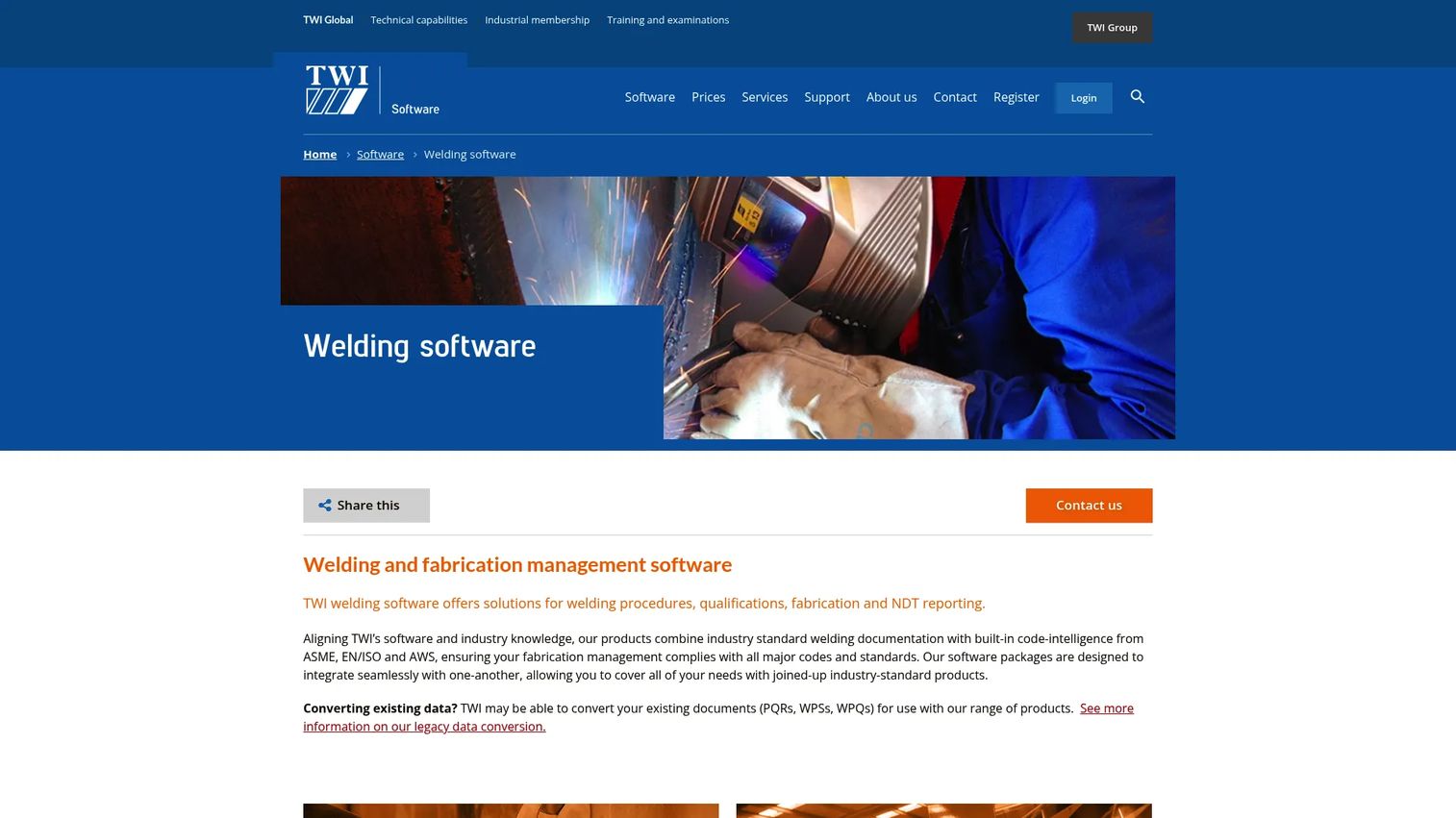
TWI Software Welding Software is welding and fabrication management software built around two core modules: Welding Qualifier and Welding Coordinator. Welding Qualifier handles PQRs, WPSs, welder qualifications, and continuity. Welding Coordinator extends into site-wide fabrication management, traceability, and reporting. The platform's differentiator is code intelligence, built-in rules for ASME, ISO, AWS, and API standards that check procedures against the applicable code as you write them.
Best for: Engineering-led compliance teams that need procedure qualification and traceability grounded in code rules.
Key strengths
- Built-in code intelligence: Rules for ASME, ISO, AWS, and API validate procedures against the applicable standard during creation.
- Qualification and continuity workflows: Welding Qualifier manages PQRs, WPSs, welder qualifications, and welder continuity tracking in one module.
- Site-wide traceability: Welding Coordinator handles fabrication management, traceability, and audit-ready reporting across an operation.
Why choose TWI Software Welding Software: If your buying logic starts with code compliance rather than production dashboards, this is the natural fit. The code intelligence reduces the manual cross-checking that eats coordinator time, and legacy data conversion helps teams migrate off existing records without rebuilding from scratch. It rewards teams that treat procedure qualification as the foundation everything else sits on.
TWI Software Welding Software pricing: Pricing is published on the vendor site in multiple currencies. Welding Qualifier starts at £1,500 (roughly $2,250) for an original licence covering three named users, with maintenance and support payable after 12 months at 20 percent of the licence fee. Welding Coordinator starts at £7,500 (roughly $11,995), with annual maintenance of £1,500. Downloads are free and the software runs in demonstration mode until a licence is purchased. Some products require a quote. There is no free tier.
2. WeldEye
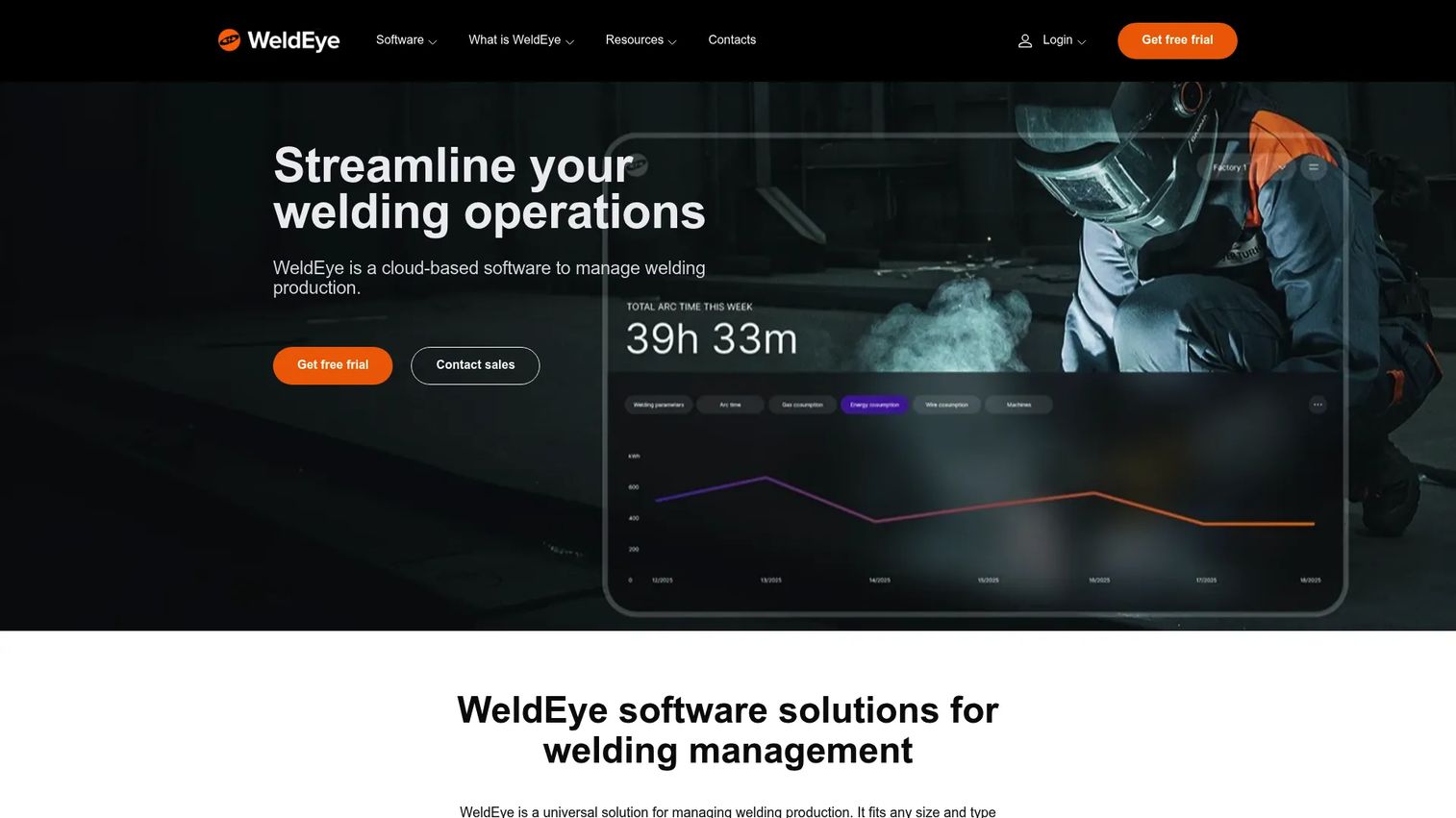
WeldEye is cloud-based welding management software that pairs traceability and quality management with real-time production monitoring. Its modular architecture spans ArcVision, Quality Management, Welding Procedures, Personnel Qualifications, and Production Analysis. The platform collects welding parameters directly from equipment, supports cross-brand hardware, and offers standard layouts for EN ISO, ASME, AWS, AS/NZS, and JIS. Heat input verification and WPS checks run against the collected data.
Best for: Operations teams that want compliance documentation and welding productivity monitoring in one cloud platform.
Key strengths
- Traceability and compliance data: Collects weld-level data for full traceability across production.
- Quality management with heat input verification: Validates heat input and WPS conformance against real production parameters.
- Arc-on time and parameter monitoring: Tracks welding parameters and arc-on time in real time across cross-brand equipment.
Why choose WeldEye: WeldEye fits teams that refuse to choose between compliance and production visibility. Because it collects parameters straight from the arc, the traceability records and the productivity data come from the same source, which keeps quality and throughput arguments aligned. The modular pricing lets a shop start with monitoring or procedures and expand as needs grow.
WeldEye pricing: WeldEye publishes public pricing for several modules and offers a free trial. ArcVision starts at €490 per year. Welding Procedures starts at €1,290 per year. The combined Welding Procedures and Personnel Qualifications module runs €89 per month per user, or a €2,990 one-time licence. Production Analysis, Fleet Management, and Quality Management are quote-based. Billing is annual for the published tiers.
3. WeldTrace
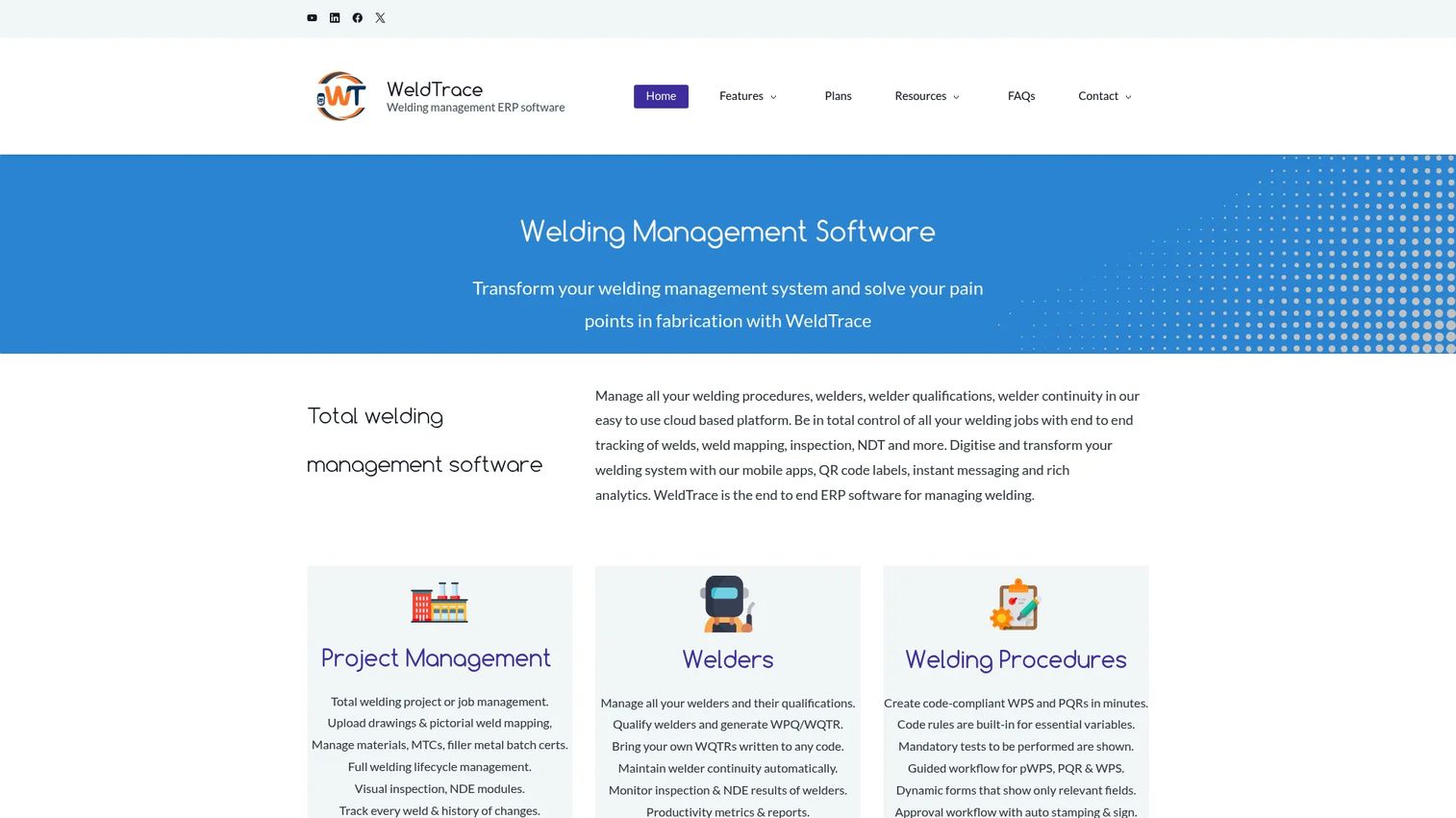
WeldTrace is welding management software built for teams that need procedures, welder qualifications, and fabrication project tracking in one system. It handles WPS and PQR creation, welder qualification and continuity tracking, and full project or job management with weld mapping, NDE, work packs, and reporting. The platform is structured to replace spreadsheet-driven project tracking with an ERP-style workflow for welding.
Best for: Fabrication teams that need all-in-one project execution and complete data books in a single system.
Key strengths
- Procedure and qualification management: WPS/PQR creation plus welder qualification and continuity tracking with code-compliant modules for ASME IX, AWS D1.1, AWS D1.2, AWS D1.5, AWS D1.6, ISO 9606-1, ISO 9606-4, and API 1104.
- Project management with weld mapping: Job management with weld mapping, NDE, work packs, and reporting for complete data books.
- Extensive material libraries: A base metal library with over 5,000 materials and a filler metal library with over 3,500 filler metals.
Why choose WeldTrace: WeldTrace suits teams whose real pain is project-level fragmentation, where weld maps, continuity logs, and inspection records live in separate spreadsheets. Field workflow support and QR-code weld labeling connect the shop floor to the record system, so weld tracking software captures data at the joint rather than after the fact. The one-time pricing model appeals to teams wary of recurring per-seat costs.
WeldTrace pricing: WeldTrace uses a fixed-price plus pay-as-you-go model published in its pricing PDF. Lite starts at $250 one-time, Plus at $950 one-time, and Pro at $2,250 one-time. Initial setup costs start at $250. There is no free tier. The one-time structure differs from the subscription model most cloud tools use, which changes the total-cost math for smaller shops.
4. ESAB Digital Solutions
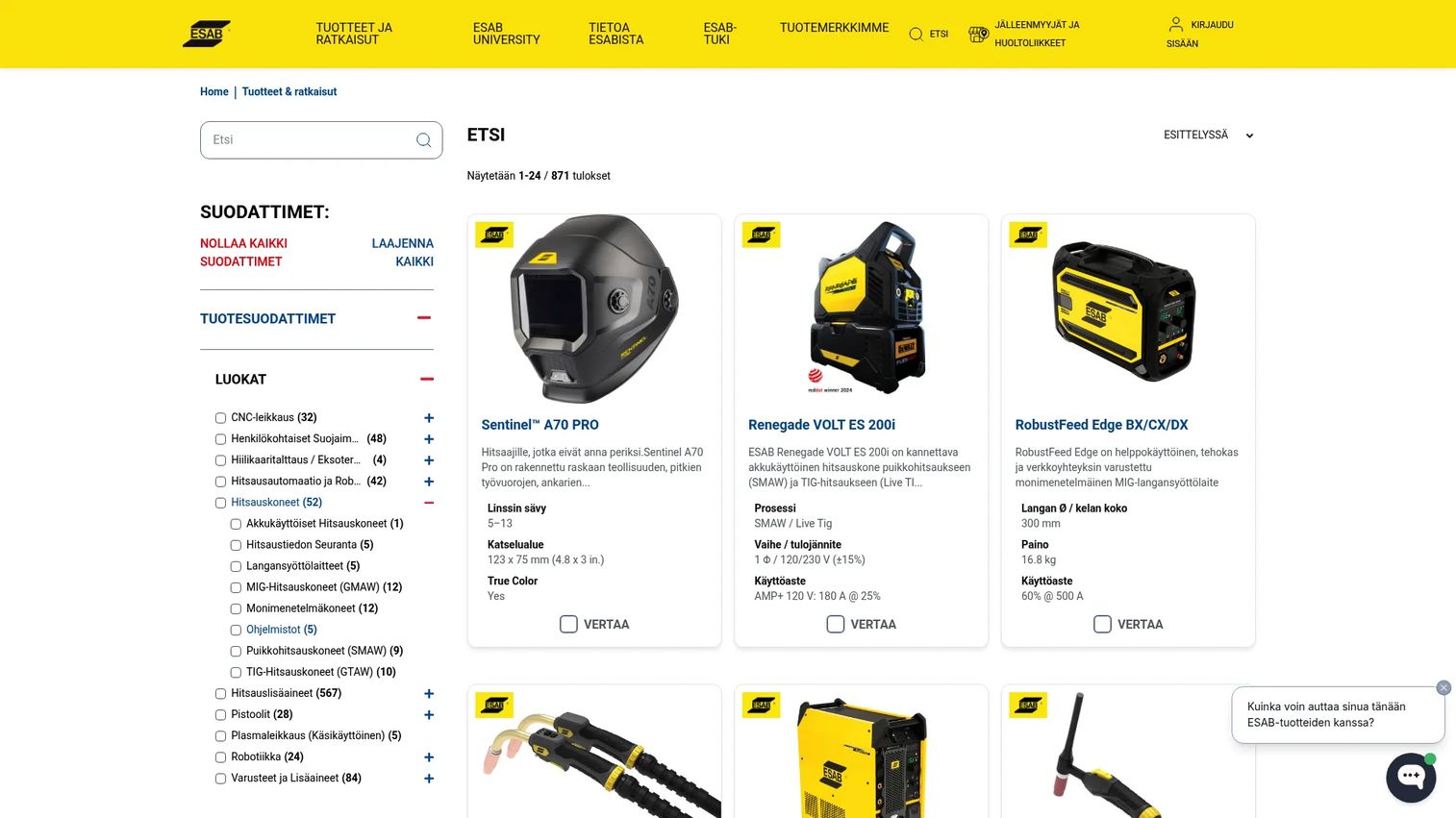
ESAB Digital Solutions is less a single product than a connected ecosystem of software spanning welding, cutting, robotics, and fabrication workflows. It covers welding management software for documentation, connected data tools for productivity, quality, asset management, and traceability, plus solutions across cutting, gas management, and quality assurance. WeldCloud sits inside this stack as the documentation layer.
Best for: Fabricators already invested in ESAB equipment, or teams wanting connected welding and cutting workflow software under one vendor.
Key strengths
- Welding management software: Streamlines workflows and documentation across the fabrication operation.
- Connected data tools: Cover productivity, quality, asset management, and traceability from equipment through reporting.
- Cross-process coverage: Spans cutting, welding, gas management, and quality assurance in one ecosystem.
Why choose ESAB Digital Solutions: ESAB makes sense for teams pursuing broader fabrication optimization rather than a standalone procedure tool. The value is consolidation: if your welding and cutting hardware already comes from ESAB, keeping the digital layer in the same ecosystem reduces integration friction and gives you production visibility across processes. It rewards teams optimizing the whole floor, not just the WPS binder.
ESAB Digital Solutions pricing: ESAB does not publish public pricing for the Digital Solutions category. The product pages describe features and use cases, and pricing routes through a request to sales. Expect quote-based pricing shaped by the modules and equipment footprint involved.
5. WeldCloud
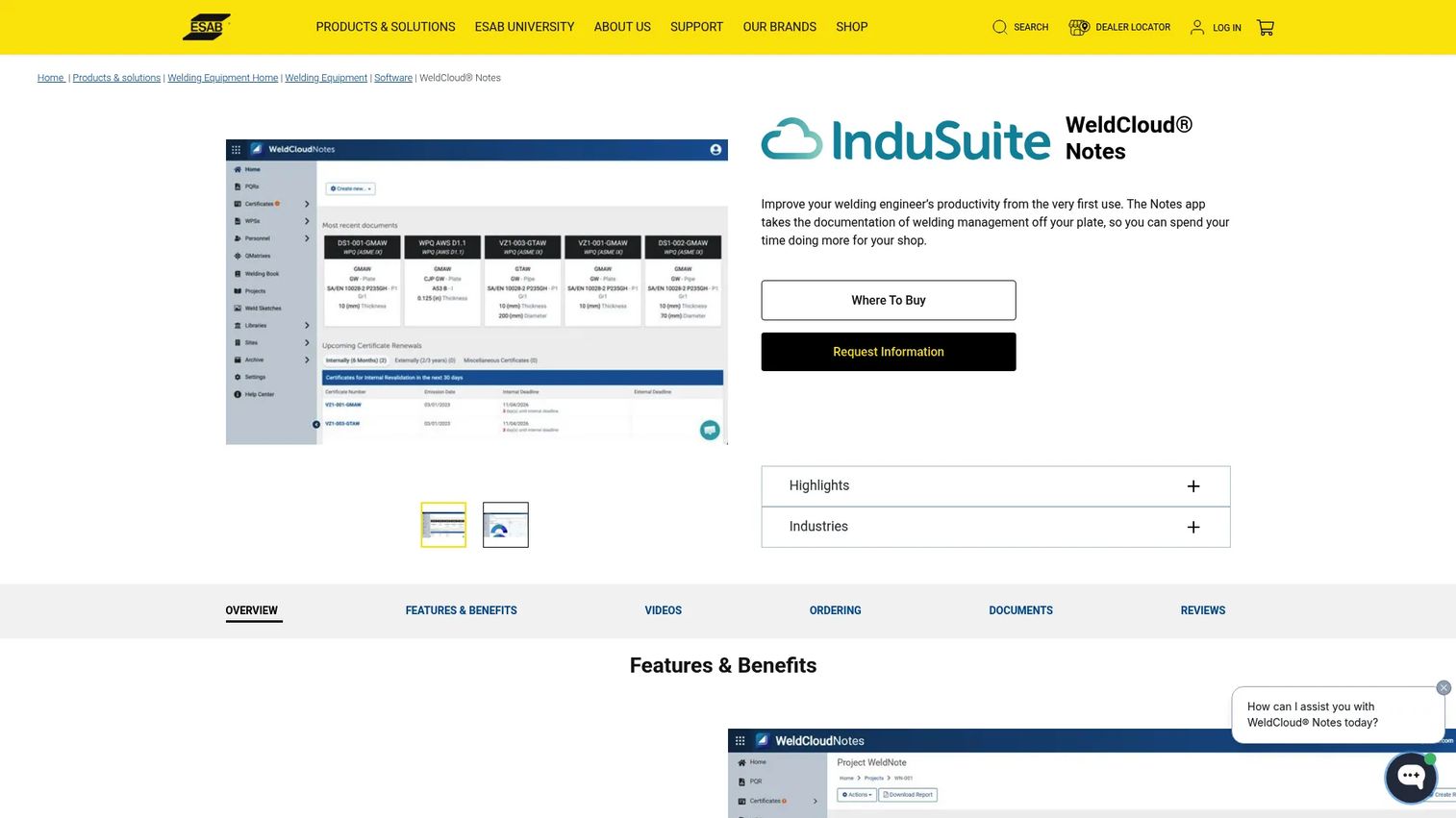
WeldCloud is ESAB's cloud-based welding documentation software for managing PQR, WPS, and WPQ records. It lets teams write WPS documents based on qualified PQRs, track welder qualifications and expiration dates, document welds with full traceability, and auto-generate dashboard views and PDF production records. It functions as the documentation and compliance layer within the wider ESAB digital stack.
Best for: Welding teams that want centralized documentation and compliance management with real-time production visibility.
Key strengths
- WPS from qualified PQRs: Write compliant WPS documents directly from qualified PQR records.
- Welder qualification tracking: Track welder qualifications and expiration dates with continuity visibility.
- Full weld traceability: Document welds with complete traceability and auto-generate dashboards and PDF production records.
Why choose WeldCloud: WeldCloud fits teams that want the WPS, PQR, and WPQ workflow handled in the cloud with production records generated automatically. Because it lives in the ESAB ecosystem, it connects naturally to machine data and welding analytics for shops already running ESAB hardware. The auto-generated PDF records shorten the gap between welding and the audit-ready document.
WeldCloud pricing: ESAB lists WeldCloud Notes and Assembly as an annual user license but does not display a public price on the product page. Pricing routes through ESAB. The annual license structure suggests per-user subscription billing rather than a one-time purchase.
6. WeldQAS
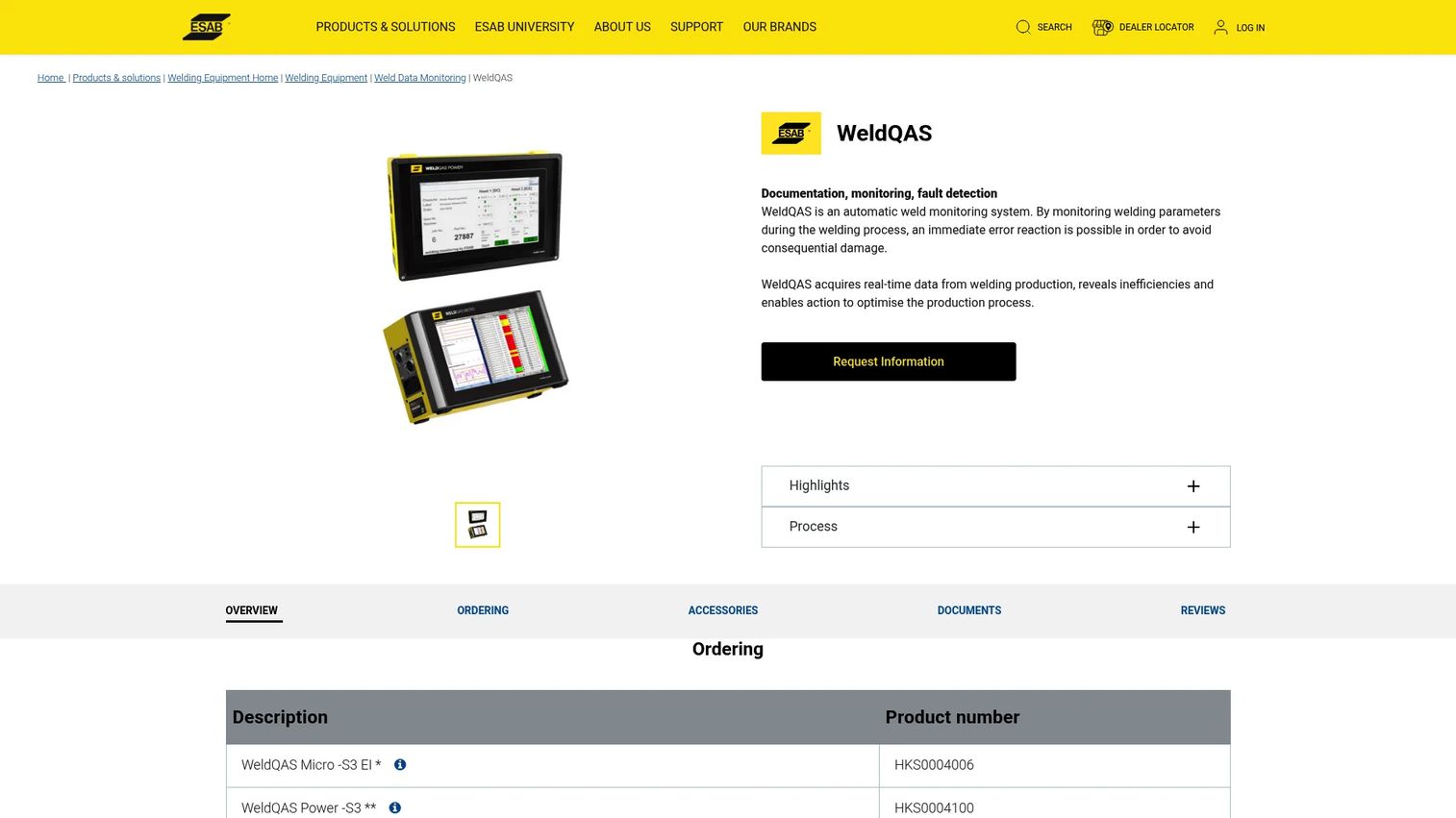
WeldQAS is ESAB's weld monitoring system for real-time welding parameter tracking and fault detection. It records welding current, voltage, gas flow rate, and wire feed speed online, then uses patented algorithms to detect pores, burn-through, wire defects, and other irregularities. Data is stored in databases and on a central server, giving teams both real-time production monitoring and a traceable record for optimization.
Best for: Industrial welding teams focused on quality risk control, defect reduction, and advanced production analytics.
Key strengths
- Real-time parameter recording: Captures current, voltage, gas flow rate, and wire feed speed online during welding.
- Algorithmic fault detection: Detects pores, burn-through, wire defects, and other irregularities as they happen.
- Centralized data storage: Stores welding data in databases and on a central server for optimization and traceability.
Why choose WeldQAS: WeldQAS earns its place when quality risk is the primary concern and defects are expensive to catch downstream. By flagging irregularities in real time rather than during inspection, it moves quality control upstream to the arc itself. That upstream detection is the argument for teams where rework or field failure carries heavy cost.
WeldQAS pricing: ESAB does not publish a public price for WeldQAS. The product page uses a Request Information flow, so pricing is quote-based and shaped by the monitoring setup and number of stations involved.
7. Columbus III CAD/CAM nesting software
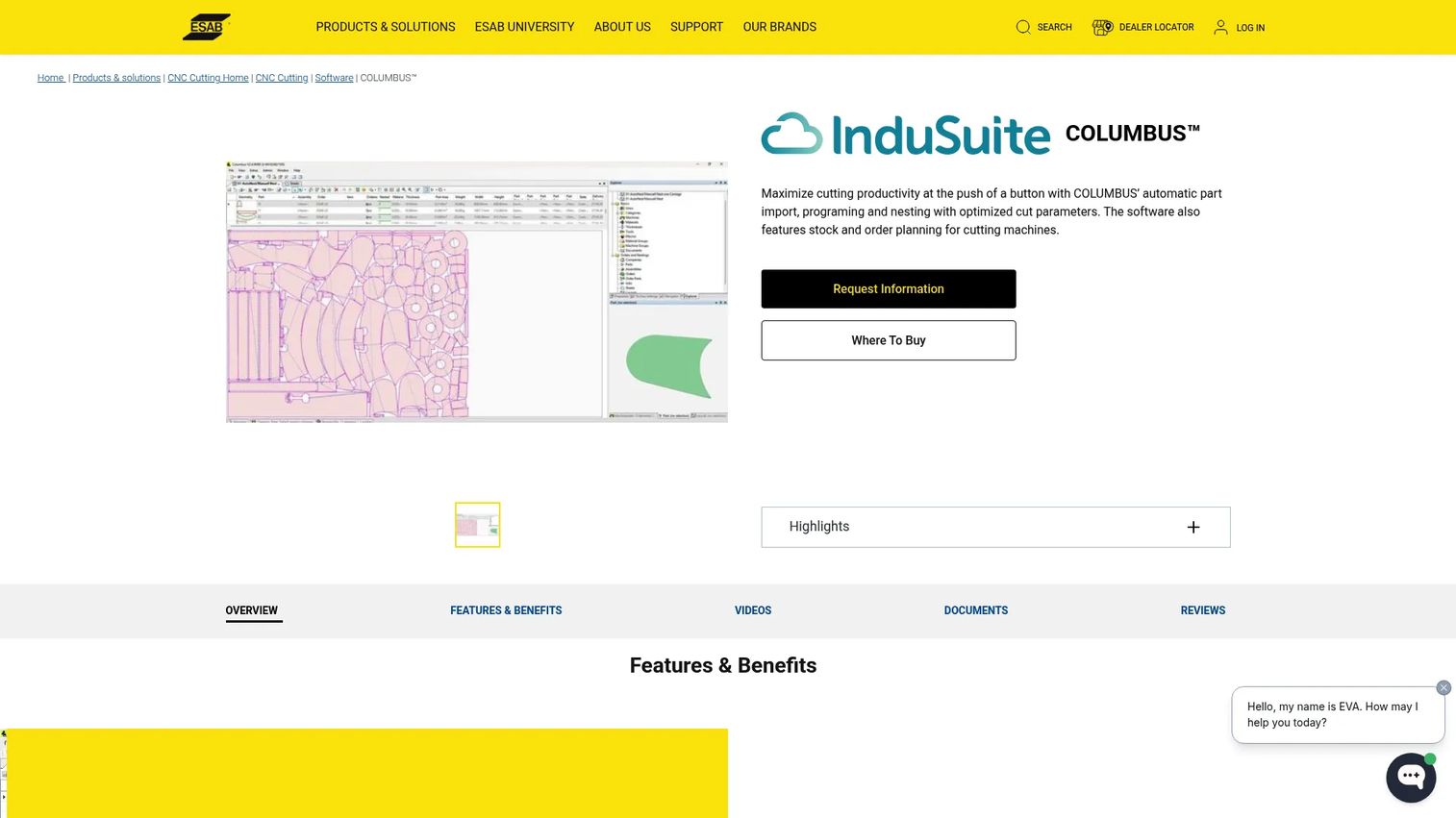
Columbus III CAD/CAM nesting software is CAD/CAM nesting software for automated part import, programming, nesting, bevel cutting, job control, layout design, plate management, and reporting. It supports true-shape nesting with multi-torch capability, a bevel programming module for oxy-fuel, plasma, and laser bevel heads, and a Layout Designer with DXF/DWG import and integrated 2D CAD part construction. The software also features stock and order planning for cutting machines.
Best for: Manufacturers needing integrated nesting and CNC cutting workflow software tied to fabrication operations.
Key strengths
- Automatic true-shape nesting: Optimizes plate usage with true-shape nesting and multi-torch support.
- Bevel programming: Dedicated module for oxy-fuel, plasma, and laser bevel heads.
- Layout Designer with CAD import: DXF/DWG import plus integrated 2D CAD part construction, with stock and order planning.
Why choose Columbus III: Columbus III is adjacent to procedure and traceability systems, not a replacement for them. It belongs on this list because plate optimization and cutting sit upstream of welding in the fabrication workflow. If material waste and cutting efficiency are draining margin, this addresses a different link in the same chain, useful alongside a procedure and traceability platform rather than instead of one.
Columbus III pricing: ESAB does not publish public pricing for Columbus III. The product page confirms features and positioning, and pricing routes through a quote. Expect pricing shaped by the modules, cutting hardware, and number of workstations.
Considerations before buying welding software
Standards and code coverage
Confirm the platform supports the exact code families your work falls under: ASME, AWS, ISO, EN ISO, API 1104, AS/NZS, or JIS. Support varies by module and standard family, so verify that the specific codes you weld to are covered, not just the general standard. Code intelligence that validates procedures during creation saves the most coordinator time.
Traceability depth
Ask how granular the weld record goes. Full traceability ties welder, procedure, heat input, inspection, and NDT reporting to each individual joint. Weaker systems track at the project level only, which does not survive an audit that points at a single weld. Test the retrieval speed, not just the storage claim.
Production monitoring and analytics
If throughput or rework is a live problem, weigh how the platform captures arc-on time, welding parameters, and heat input management data. The strongest production analytics pull directly from equipment rather than relying on manual entry, which keeps the data trustworthy enough to act on.
Deployment model and total cost
Compare subscription against one-time licensing carefully. Cloud subscriptions spread cost and include updates; one-time licences favor teams avoiding recurring fees. Factor in maintenance percentages, per-user costs, setup fees, and legacy data conversion effort before comparing headline prices.
Mobile and field access
Fabrication happens away from the desk. Check whether the platform supports mobile capture, QR-code weld labeling, and offline field workflows. Data captured at the joint is more accurate than data reconstructed later from a shift report.
Conclusion
The right welding software depends less on feature counts and more on which axis matters most to your operation. If code compliance and procedure qualification are the foundation, TWI Software Welding Software leads with built-in code intelligence and dedicated qualification and coordinator modules. If you need compliance and welding productivity monitoring from the same source, WeldEye pairs traceability with real-time parameter tracking. If project-level fragmentation is the pain, WeldTrace consolidates procedures, continuity, weld mapping, and NDE into one system with data books.
For connected fabrication across welding and cutting, ESAB Digital Solutions, WeldCloud, and WeldQAS form a coherent ecosystem, with Columbus III covering plate optimization upstream.
Shortlist by compliance depth first. Confirm your code families are fully supported, test traceability retrieval against a single weld, then compare production monitoring and fabrication workflow software fit. Procedure control, traceability, and production analytics are the real decision axes. Rank the tools against those three, and the right fit for your shop becomes clear.
FAQs
Welding software is the broad category covering any application that digitizes welding work, from procedure writing to weld monitoring. Welding management software usually implies broader workflow control: procedures, personnel qualifications, welder continuity tracking, traceability, and audit-ready records across projects. If you only need to write WPS documents, procedure software may be enough. If you need to run the whole documentation and compliance operation, management software is the better fit.
For WPS software and PQR software depth grounded in code rules, TWI Software Welding Software stands out because its Welding Qualifier module validates procedures against ASME, ISO, AWS, and API as you write them. WeldTrace offers code-compliant qualification modules covering ASME IX, several AWS D1 codes, ISO 9606, and API 1104. WeldCloud lets teams write WPS documents directly from qualified PQRs in the cloud. The best choice depends on which codes you weld to and whether you want a standalone procedure tool or a full management system.
Welding traceability software ties a complete record to each weld: which welder made it, under which procedure, at what heat input, with what inspection and NDT reporting results. Its purpose is auditability. When a client or code inspector asks for the full history of a specific joint, traceability software produces the record in minutes instead of hours of spreadsheet searching. It is the difference between passing an audit smoothly and scrambling to reconstruct records.
Many do, but support varies by module and standard family. TWI Software Welding Software builds in code rules for ASME, ISO, AWS, and API. WeldEye offers standard layouts for EN ISO, ASME, AWS, AS/NZS, and JIS. WeldTrace includes code-compliant modules for ASME IX, AWS D1.1 through D1.6, ISO 9606, and API 1104. Always confirm the specific code you weld to is covered before buying, since general standard support does not guarantee every sub-code is included.
TWI Software Welding Software tracks welder qualifications and continuity through its Welding Qualifier module. WeldTrace handles welder qualification and continuity tracking alongside its project management features. WeldCloud tracks welder qualifications and expiration dates as part of its documentation layer. Welder continuity tracking with automatic expiry alerts is one of the highest-value features for compliance teams, since a lapsed qualification caught late can invalidate work.
Yes. Digital records replace paper WPS binders and scattered spreadsheets, approval workflows cut manual routing, and expiry alerts flag lapsed qualifications before they cause problems. On the production side, real-time weld tracking software and heat input monitoring catch quality issues at the arc rather than during inspection, which reduces rework. Manufacturers adopting smart manufacturing technologies including welding software have reported up to 30 percent productivity gains, per Verified Market Reports citing NIST.
Compare six things: standards and code coverage for your specific work, traceability depth down to the individual weld, production analytics and heat input management, mobile and field access including QR-code weld labeling, integrations with existing systems, and pricing structure. Weigh subscription against one-time licensing based on your cash and update preferences, and factor in setup fees, per-user costs, and legacy data conversion effort before comparing headline prices.