Your leadership team agrees on the quarterly priorities. Then a hiring freeze, a major customer request, and an AI initiative land in the same two weeks.
Annual plans were built for stable environments. When funding assumptions, team capacity, and delivery timelines are tracked in separate tools, every new priority triggers a debate instead of a decision. The roadmap drifts. The board asks why committed work slipped. Nobody has a clean answer.
According to Research in Action (2024), 65% of enterprise buyers who evaluated SPM vendors are already using, implementing, or planning to adopt strategic portfolio management software. SPM adoption still trails project portfolio management by a wide margin: 31.9% for SPM versus 57.9% for PPM. That gap is closing as more organizations discover that project tracking alone cannot answer executive-level investment questions.
This guide helps founders choose the right strategic portfolio management platform before the next board cycle.
What's inside
This guide is written for Series B SaaS founders, heads of product, strategy leaders, and PMO executives who need a trustworthy shortlist they can hand to a new VP of Product or finance lead.
- What we reviewed: 11 platforms with genuine SPM capability, covering strategy alignment through outcome tracking
- How we chose them: Verified feature scope, third-party ratings, pricing transparency, and fit for scaling SaaS organizations
- Selection criteria: Strategy-to-execution coverage, portfolio scenario planning, resource capacity visibility, and implementation fit relative to company maturity
- Who this is not for: Teams that need basic project tracking only; this guide covers investment-grade portfolio governance
TL;DR
- Best for enterprise portfolio governance: Planview covers investment planning, capacity, and outcome management at scale
- Best for ServiceNow-centered enterprises: ServiceNow Strategic Portfolio Management connects portfolio decisions to existing workflow infrastructure
- Best for complex financial modeling: Planisware Enterprise suits organizations where a wrong funding call carries material financial risk
- Best for Microsoft-aligned planning: OnePlan consolidates portfolio visibility across Microsoft 365, Project, and Azure DevOps
- Best for flexible portfolio visibility before heavy governance: Smartsheet or Businessmap give teams structured cross-functional views without full SPM overhead
- Best for product and agile portfolio planning: Apptio Targetprocess (now IBM Targetprocess) aligns product roadmaps, agile delivery, and technology investment across teams
What is strategic portfolio management software?
Strategic portfolio management software is a system that helps organizations select, fund, sequence, track, and adjust initiatives against business strategy, available capacity, financial constraints, and expected outcomes.
Where project portfolio management tracks delivery across active projects, SPM adds the upstream layer: Which investments deserve funding, what must stop or move when priorities shift, whether capacity matches committed work, and whether funded initiatives produced the expected business result.
What SPM software connects
A well-implemented SPM platform ties together the following hierarchy:
- Business goals and strategic themes
- Portfolios and investment areas
- Programs, products, and strategic initiatives
- Projects, epics, and delivery work
- Capacity, cost, benefit, risk, and outcome measures
Core capabilities to look for
When evaluating strategic portfolio management tools, the capabilities that separate genuine SPM platforms from rebranded project trackers include:
- Strategic roadmaps and goal alignment
- Portfolio scoring and prioritization
- Financial planning and budget tracking
- Resource and capacity planning
- Scenario modeling and portfolio rebalancing
- Demand intake and governance workflows
- Executive dashboards and outcome reporting
- Integrations with delivery, finance, and analytics systems
Strategic portfolio management versus project portfolio management
Project portfolio management answers: Are projects on track and on budget? Strategic portfolio management adds a different set of questions: Which investments should exist at all, how should funding shift when strategy changes, and did the money produce the intended result? The two categories overlap, but SPM is the layer where executives make funding decisions rather than track delivery status.
When to use strategic portfolio management software
Rebalance investments before the roadmap becomes fiction
Priorities change faster than annual planning cycles. When a net-new initiative arrives mid-quarter, someone needs to show what moves, what pauses, and what the cost-timing impact looks like. SPM software makes that conversation happen in the tool rather than in a leadership off-site debate built on stale slides.
Match growth plans to real delivery capacity
Leadership is often approving more initiatives than product, engineering, customer success, or GTM teams can absorb. Portfolio prioritization software surfaces that mismatch before commitments are made rather than after deadlines slip. Founders who have hired a new VP of Product particularly benefit from a system that makes capacity constraints visible on day one.
Give the board one trusted view of strategic execution
Board updates built on manual spreadsheet merges take days to prepare and are outdated by the time they are presented. SPM platforms generate executive portfolio views directly from live initiative data, cutting preparation time and reducing the risk of inconsistencies between what product, finance, and engineering each believe to be true.
You probably need SPM software when:
- You manage more than one product line or strategic portfolio
- Quarterly reprioritization creates recurring delivery conflict
- Executive reporting takes days of manual preparation
- Budget and resource trade-offs currently lack a single system owner
Strategic portfolio management software comparison
The 11 platforms below cover the full spectrum from enterprise portfolio governance suites to flexible work management platforms with portfolio capability. All pricing and ratings are sourced from vendor pricing pages and G2 listings verified October 2026. Where no public price exists, custom pricing is noted.
| # | Product | Best for | Key differentiator | Pricing | G2 rating |
|---|---|---|---|---|---|
| 1 | Planview | Enterprise portfolio governance | Investment, capacity, and outcome management | Custom pricing | 4.1/5 |
| 2 | ServiceNow SPM | ServiceNow-centered enterprises | Workflow-connected strategy execution | Custom pricing | 4.1/5 |
| 3 | Planisware Enterprise | Complex capital and product portfolios | Deep portfolio financial planning | Custom pricing | 4.0/5 |
| 4 | OnePlan | Microsoft-centered organizations | Portfolio planning across Microsoft tools | From $10/user/month | 4.3/5 |
| 5 | Smartsheet | Flexible portfolio visibility | Familiar collaborative work management | From $9/member/month | 4.4/5 |
| 6 | Businessmap | Strategy execution with flow metrics | Portfolio-level Kanban and business mapping | Custom pricing | 4.0/5 |
| 7 | Apptio Targetprocess | Agile product and technology portfolios | Portfolio planning for product delivery | Custom pricing | 4.3/5 |
| 8 | Triskell Software | Configurable enterprise portfolio management | Strong modeling and governance flexibility | Custom pricing | 4.4/5 |
| 9 | Shibumi | Enterprise transformation portfolios | Strategy execution and value realization | Custom pricing | 3.9/5 |
| 10 | Cora SPM | Regulated project-heavy organizations | Governance, planning, and delivery controls | Custom pricing | N/A |
| 11 | Bizzdesign Alfabet | IT strategy and technology portfolios | Enterprise architecture and investment alignment | Custom pricing | N/A |
Pricing and ratings verified October 2026 from each vendor's pricing page and G2 listing.
11 best strategic portfolio management software tools for 2026
1. Planview
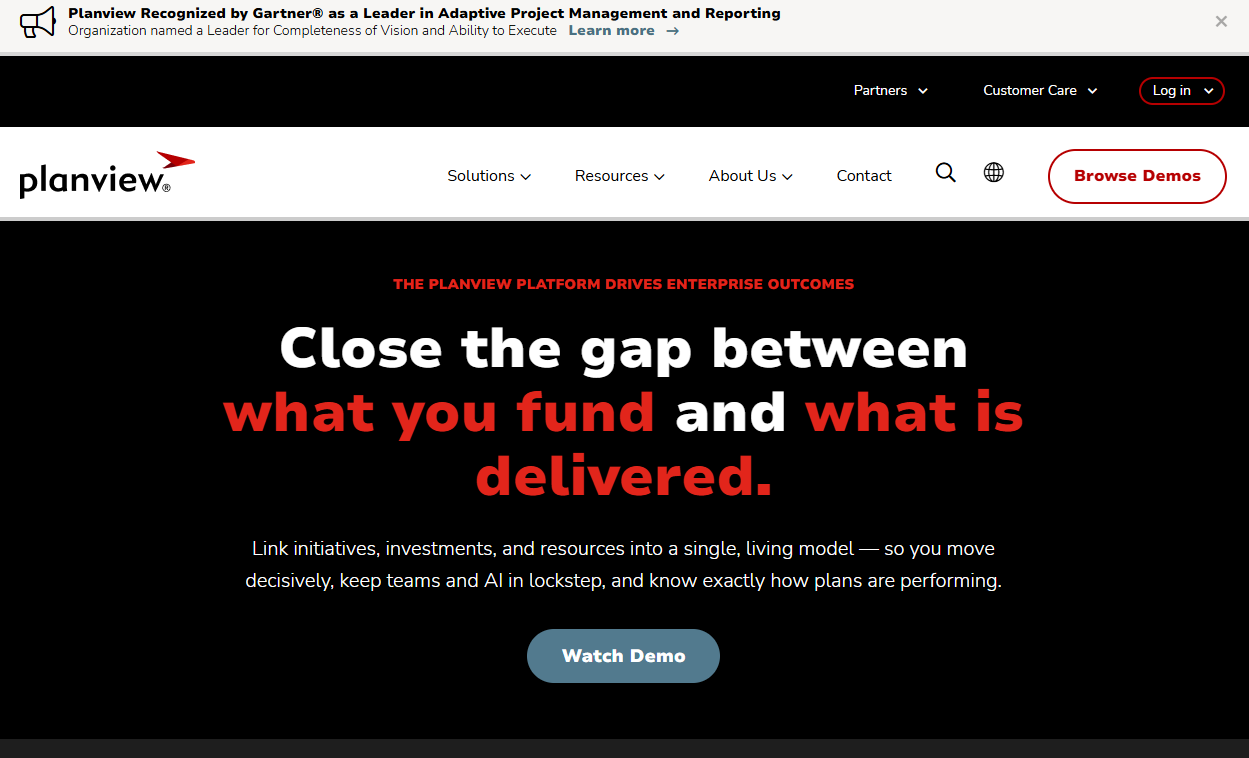
Planview is an enterprise strategic portfolio management platform connecting investment planning, resource capacity, delivery execution, and business outcomes across complex multi-portfolio environments. It covers the full spectrum from strategic roadmapping to professional services automation, making it one of the broadest SPM offerings in the market. Organizations with mature planning functions and multiple business units use it to govern portfolio investment decisions from funding approval through benefits realization.
Best for: Large enterprises that need board-level portfolio controls tied to funding, capacity, and delivery execution.
Key features
- Portfolio prioritization and investment planning
- Resource and capacity management across teams
- Scenario planning and portfolio rebalancing
- Strategic roadmaps with outcome tracking
- AI-powered portfolio analytics and executive dashboards
- Value stream and agile portfolio management
Why choose Planview: Planview suits teams that need a single system to answer investment, capacity, and delivery questions together. The platform's depth is its strongest point, but it also means a clear operating model and dedicated internal owners are prerequisites for getting value.
Planview pricing: Planview requires sales engagement for pricing; a 30-day fully functional free trial is available through their ProjectPlace offering. Contact sales directly for enterprise SPM package pricing.
G2 rating: 4.1/5 (verified October 2026)
2. ServiceNow Strategic Portfolio Management
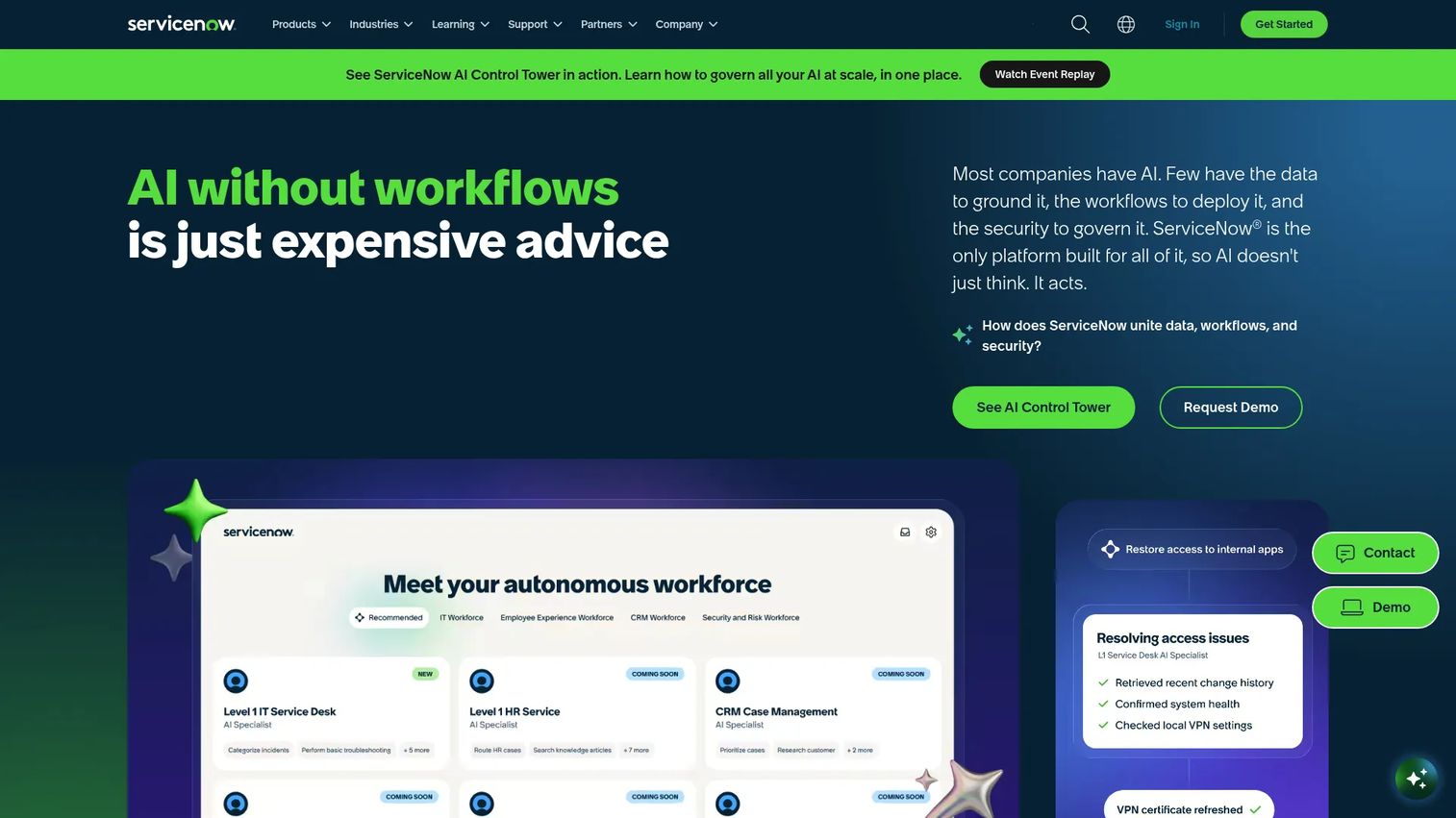
ServiceNow Strategic Portfolio Management connects strategic planning, demand management, investment governance, and work execution inside the ServiceNow platform. For organizations already running IT operations, service management, or enterprise governance through ServiceNow, the value is obvious: Portfolio decisions sit inside the same workflow infrastructure the organization already trusts. Adding a separate SPM tool means a separate data model; ServiceNow SPM avoids that problem for organizations already in the platform.
Best for: Large enterprises that want strategic planning, demand management, and investment governance tightly integrated with existing ServiceNow workflows.
Key features
- Strategic planning with goals, targets, and hybrid roadmaps
- Demand intake and portfolio prioritization
- Investment funding and scenario planning
- Resource and capacity management
- Portfolio performance analytics and dashboards
Why choose ServiceNow Strategic Portfolio Management: The strongest case is workflow continuity. If your organization already governs IT, HR, or service operations through ServiceNow, portfolio decisions made here flow naturally into execution. The practical caution: This is a large platform commitment. Evaluate it as a strategic enterprise decision, not a lightweight planning purchase.
ServiceNow SPM pricing: Custom pricing based on organizational needs; ServiceNow requires a custom quote. No free tier is publicly documented for the SPM module.
G2 rating: 4.1/5 (verified October 2026)
3. Planisware Enterprise
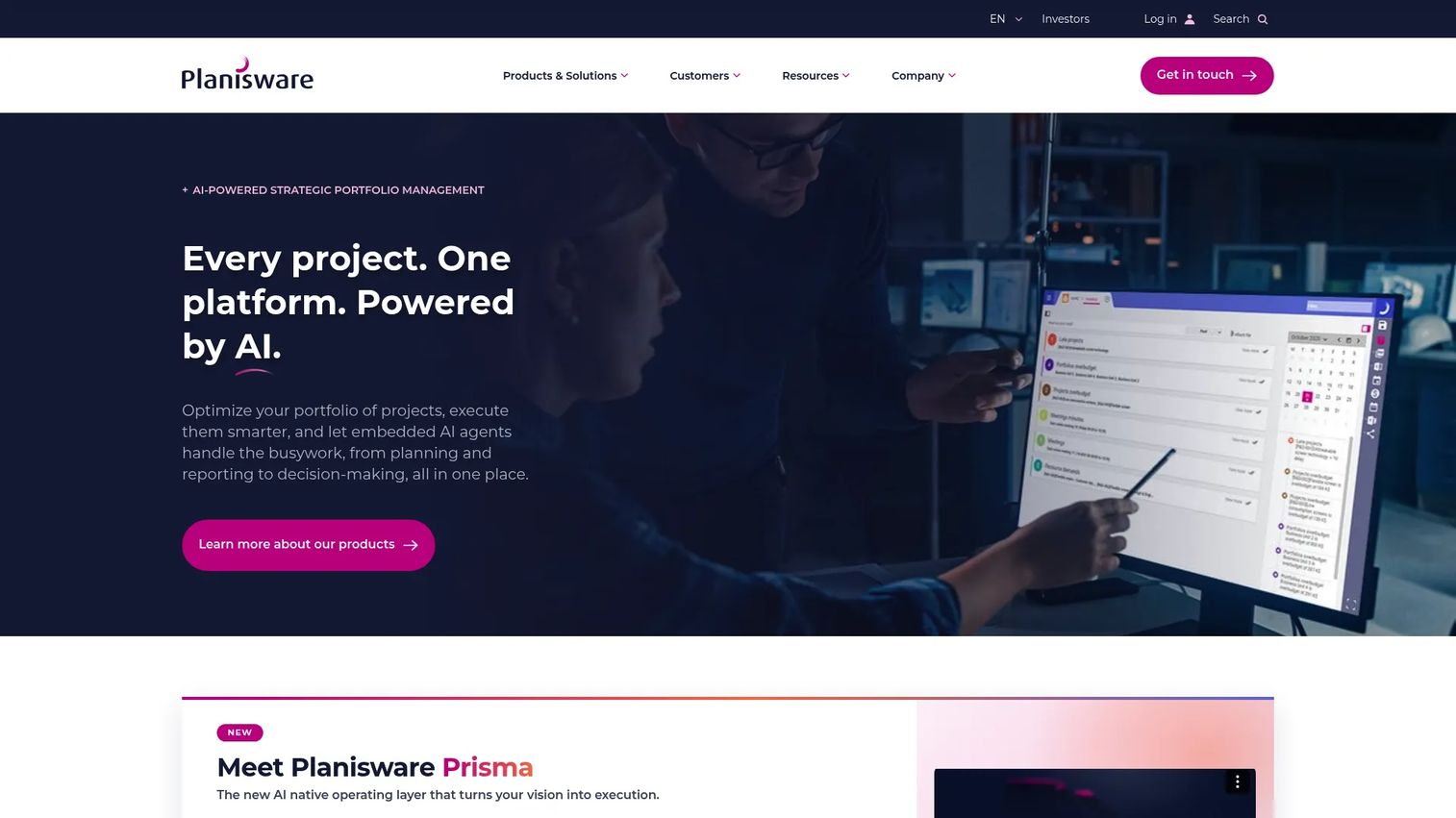
Planisware Enterprise is built for complex portfolio environments where finance, product development, engineering capacity, and long-range scenario modeling must live in a single planning model. It handles portfolio financial planning, resource forecasting, waterfall and agile project management, and advanced scheduling in one integrated system. Organizations in capital-intensive industries, pharmaceuticals, aerospace, and large technology portfolios use it where a wrong investment call carries material financial risk.
Best for: Organizations managing complex portfolios with formal financial controls and a need to model high-value, multi-year investment decisions.
Key features
- Portfolio financial planning and business-case analysis
- Resource and capacity forecasting
- Scenario analysis and what-if modeling
- Agile, waterfall, and hybrid project management
- Governance and reporting workflows with REST API integrations
Why choose Planisware Enterprise: Choose it when your portfolio planning process needs financial rigor at the initiative level, not just project-level cost tracking. Budget and resource errors at the portfolio layer are expensive; Planisware is built to surface those conflicts early. Expect specialist implementation support and a data governance commitment.
Planisware Enterprise pricing: Pricing requires contacting Planisware directly. No public plan prices are published on their site.
G2 rating: 4.0/5 (verified October 2026)
4. OnePlan
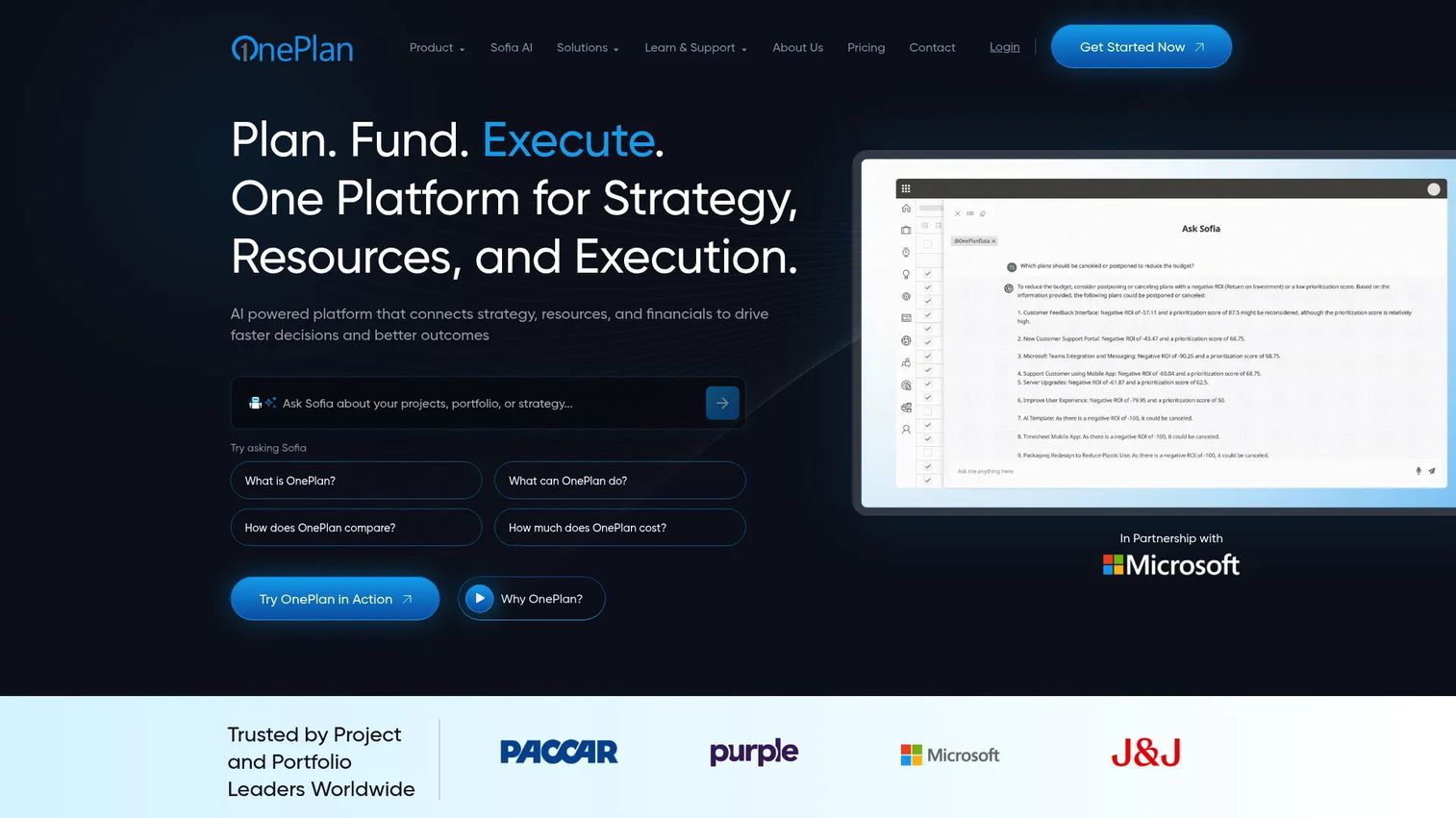
OnePlan is an AI-powered strategic portfolio management platform designed for organizations running planning and reporting through Microsoft 365, Project, Planner, Azure DevOps, and Power BI. It connects strategy, financial planning, resource capacity, and execution without requiring teams to leave the Microsoft environment they already know. The platform includes a Sofia AI assistant for planning support and portfolio scenario modeling, plus a separate Innovation Portal for ideation and project intake.
Best for: Enterprise PMOs and portfolio leaders whose planning and reporting infrastructure is built on Microsoft tools.
Key features
- Strategic planning and portfolio roadmaps
- Financial planning and budget tracking
- Resource capacity management and scenario modeling
- Microsoft 365 and Azure DevOps integrations
- Sofia AI assistant for planning support
- Executive portfolio dashboards and time tracking
Why choose OnePlan: The Microsoft-stack advantage is real and significant for the right organization. Teams that already consolidate reporting in Power BI and manage work in Project or Planner will see immediate value from a portfolio layer that sits natively inside that environment. The caveat: If your organization is not deeply committed to the Microsoft planning stack, this advantage shrinks considerably.
OnePlan pricing: Basic plans start at $10 per user per month (billed annually). Enterprise plans use custom pricing based on scope. An Innovation Portal add-on starts at $3,000 per platform.
G2 rating: 4.3/5 (verified October 2026)
5. Smartsheet
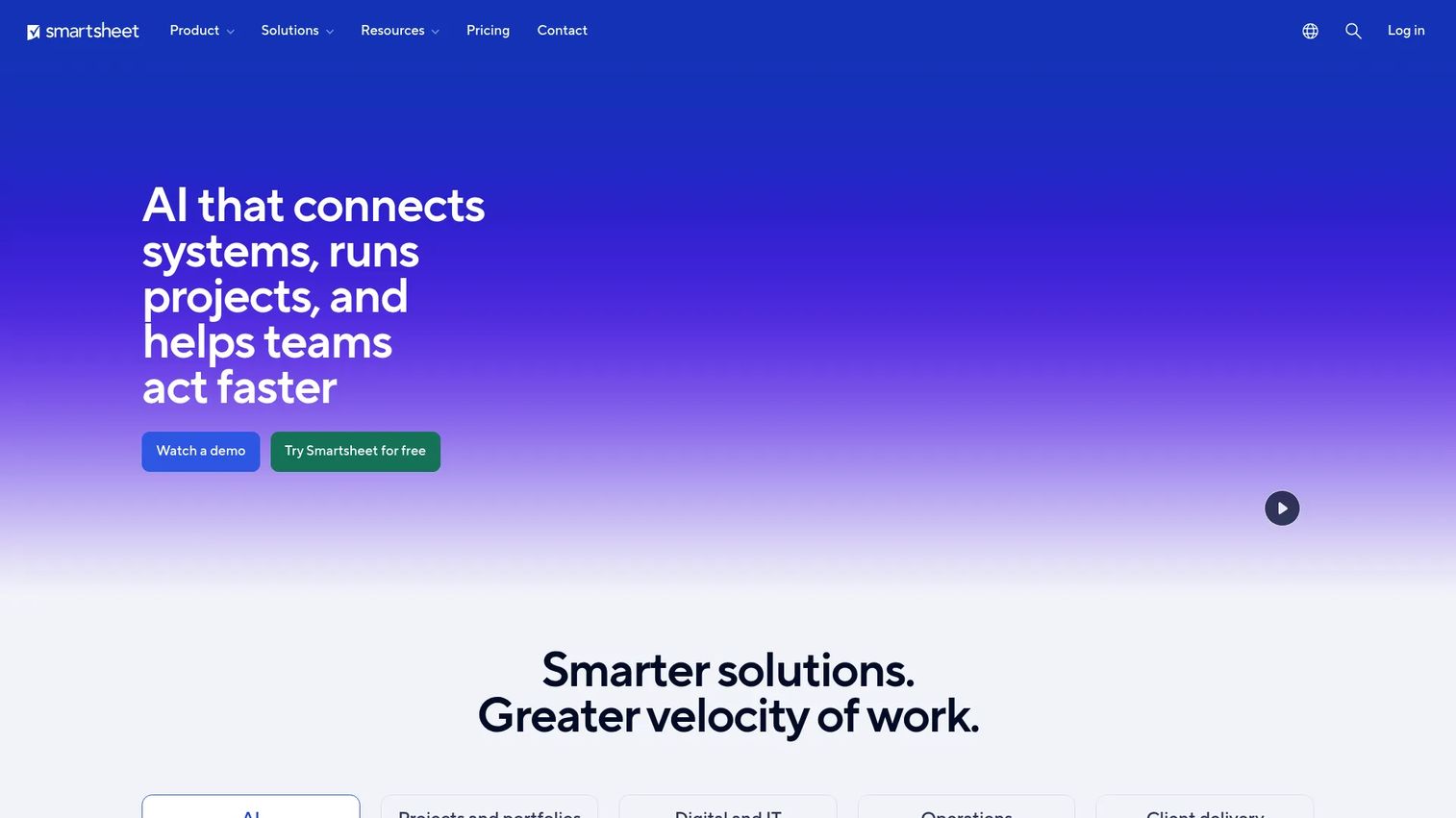
Smartsheet is an AI-powered work management platform that supports portfolio dashboards, project rollups, resource planning, automated approvals, and executive reporting. It is not a dedicated SPM system, but it is often the right first step for Series B organizations that need structured cross-functional portfolio visibility before adopting heavier governance infrastructure. Its familiarity to non-technical users means faster adoption across product, marketing, finance, and operations teams.
Best for: Scaling SaaS teams and mid-market organizations that need portfolio visibility and intake management before committing to enterprise SPM governance.
Key features
- Collaborative portfolio dashboards and project rollups
- Multiple project views: Grid, Gantt, board, calendar
- Resource and workload tracking
- Automated approvals, intake forms, and workflows
- AI-assisted formula generation and data analysis
Why choose Smartsheet: The strongest case is speed to value. A cross-functional team can be running portfolio rollups and executive dashboards in days, not weeks. For founders who need operational visibility now and plan to migrate to a dedicated SPM platform later, Smartsheet bridges the gap without a heavy implementation. It is a stronger choice for visibility and intake than for sophisticated investment optimization.
Smartsheet pricing: Pro plans start at $9 per member per month (billed annually) or $12 month-to-month. Business plans are $19 per member per month annually or $24 monthly. Enterprise and Advanced Work Management use custom pricing.
G2 rating: 4.4/5 (verified October 2026)
6. Businessmap
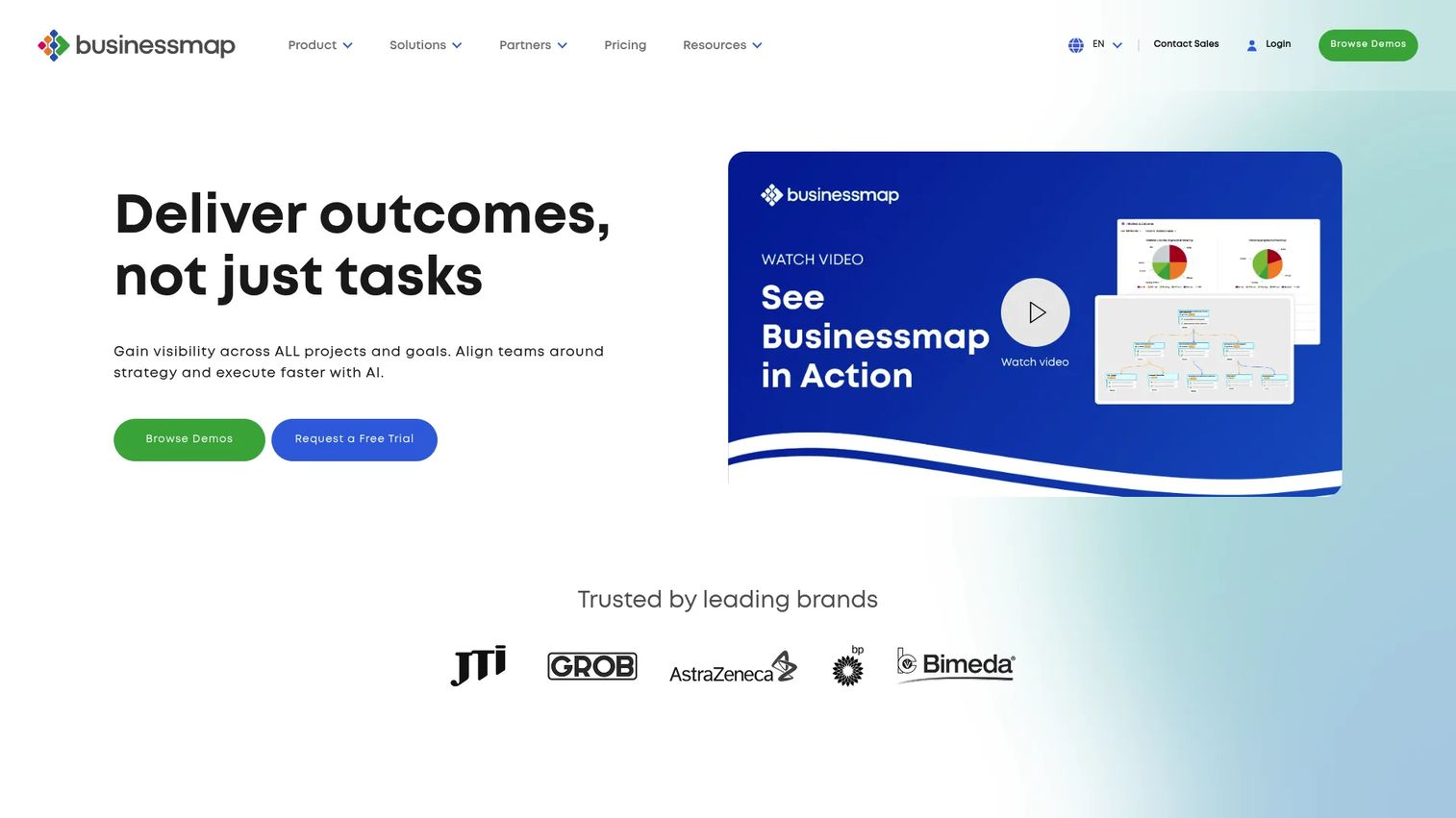
Businessmap is an enterprise project portfolio and work-management platform that connects OKRs and KPIs, strategic portfolios, and delivery workflows through a Kanban and flow-based operating model. It gives executives a visual layer showing how strategy moves through delivery bottlenecks, dependencies, and portfolio-level execution data. Teams that have adopted Kanban or flow-based practices find it easier to see where initiatives are stalling rather than simply tracking whether projects are on schedule.
Best for: Organizations using flow-based or Kanban operating models that need executives to see how strategy progresses through delivery constraints.
Key features
- Portfolio Kanban visualization with dependency management
- OKRs and KPIs linked to outcomes and work
- Strategy-to-execution mapping and workflow analytics
- Gantt chart planning and business capacity forecasting
- AI-powered automation and custom business rules
Why choose Businessmap: It is particularly useful for organizations where work-in-progress constraints and blocked initiatives are the primary visibility problem. Unlike traditional project hierarchy tools, it surfaces flow metrics at the portfolio level so leaders can see which strategic commitments are genuinely moving. Teams that manage strategy through linear project plans rather than flow-based practices will find less of an immediate fit.
Businessmap pricing: Standard and Enterprise plans are available; pricing requires contacting sales directly. A 30-day free trial is available on request.
G2 rating: 4.0/5 (verified October 2026)
7. Apptio Targetprocess
Apptio Targetprocess, now marketed as IBM Targetprocess following Apptio's acquisition by IBM, is a strategic portfolio management platform connecting strategy, investments, resources, and agile work execution. It is built for product-led organizations managing multiple product lines, engineering teams, and technology investments that need one planning layer across all of them. The platform supports program increment planning, product roadmaps, and financial integration in a way that aligns with scaled agile frameworks.
Best for: Product-led companies managing several product lines, agile delivery teams, and technology investment portfolios in one planning environment.
Key features
- Strategic planning and portfolio alignment
- Financial integration, budgeting, and cost allocation
- Resource, capacity, and demand management
- Product roadmaps and program increment planning support
- Custom reports and cross-team integrations
Why choose Apptio Targetprocess: The fit is strongest for technology organizations where product roadmaps, engineering capacity, and strategic investment decisions need to live together. Founders who have hired a new Head of Product and want a system that spans product strategy through delivery execution will find the portfolio layer valuable. Validate implementation complexity and reporting requirements before selecting; the IBM acquisition has added some organizational transitions to account for.
Apptio Targetprocess pricing: Pricing is not publicly displayed on Apptio's current product pages. Contact IBM or Apptio sales directly for packaging and quotes.
G2 rating: 4.3/5 (verified October 2026)
8. Triskell Software
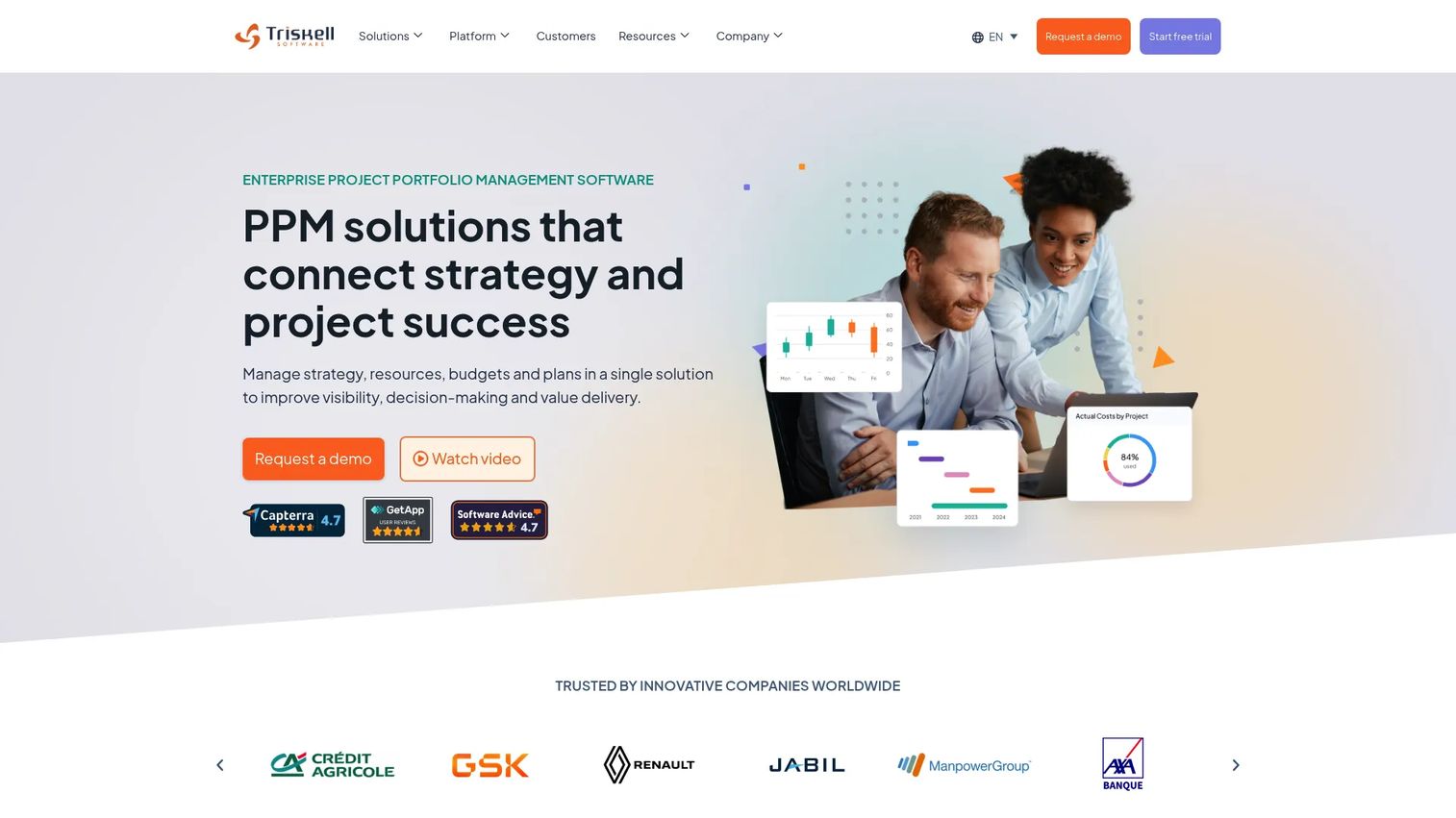
Triskell Software is a configurable enterprise portfolio management platform covering strategy execution, project and program portfolio management, resource planning, and financial governance. Its differentiating characteristic is configuration depth: Organizations whose portfolio processes do not conform to a standard template can build the intake workflows, scoring models, dashboards, and governance approval chains they need without building a custom system from scratch.
Best for: Companies with nonstandard portfolio processes that need governance flexibility without commissioning a custom-built planning system.
Key features
- Configurable portfolio scoring and prioritization
- Resource and capacity planning
- Budget and cost management
- Demand intake and project governance workflows
- Custom dashboards, Kanban boards, and Gantt views
Why choose Triskell Software: The argument for Triskell is that your portfolio process is genuinely different from what most platforms assume, and you need a system that will accommodate that without workarounds. The counterargument: Configuration ownership is real work. Someone internally needs to own the governance model and maintain it as the business evolves. A 14-day free trial is available.
Triskell Software pricing: Custom pricing; contact Triskell sales directly. A 14-day free trial is offered.
G2 rating: 4.4/5 (verified October 2026)
9. Shibumi
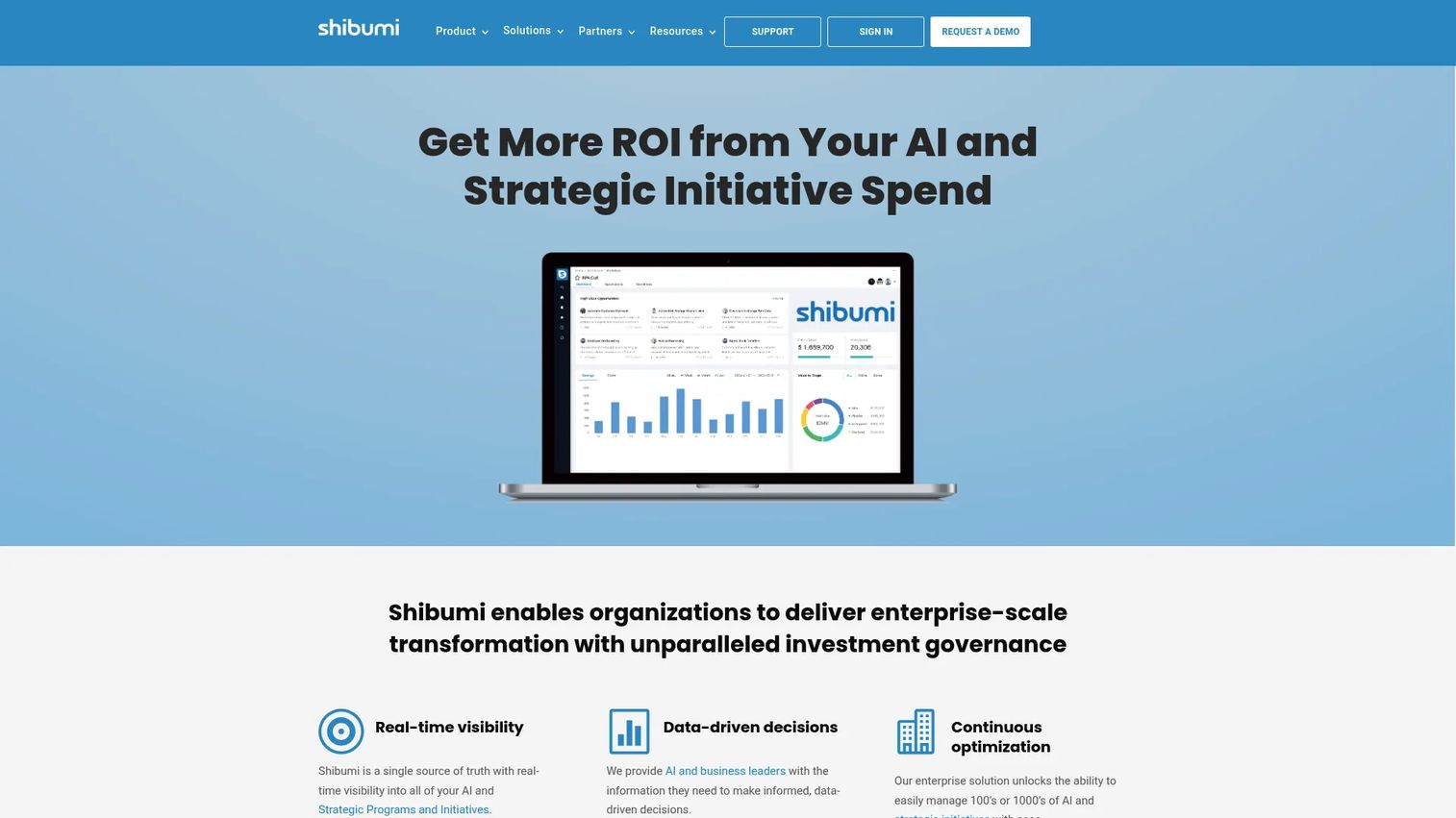
Shibumi is an enterprise strategic portfolio management platform focused on managing strategic initiatives, transformation programs, investment governance, and benefits realization. It gives leadership teams a consistent way to review the status, risks, and business value of strategic programs across departments, supported by AI-powered analysis, configurable dashboards, and over 1,000 integrations through Shibumi Connect.
Best for: Large enterprises and transformation, EPMO, and strategy leaders managing complex multi-departmental strategic portfolios with structured accountability.
Key features
- End-to-end strategic initiative lifecycle management
- Real-time dashboards, KPI tracking, and benefits reporting
- Roadmaps with milestones and dependency visualization
- Risk, issue, and decision tracking
- AI-powered analysis and dashboard creation
- 1,000+ integrations via Shibumi Connect
Why choose Shibumi: For organizations running enterprise-scale transformation programs, Shibumi provides the structure to keep dozens of initiatives visible, accountable, and tied to business outcomes. For a lean SaaS team at Series B, the platform may be more structured than the operating cadence justifies at this stage. Evaluate whether your current program complexity actually requires this level of governance before committing.
Shibumi pricing: Custom pricing through Shibumi's pricing request form. No public plan prices are displayed.
G2 rating: 3.9/5 (verified October 2026)
10. Cora SPM
Cora SPM (officially at corasystems.com) is a strategic portfolio management platform built for complex, capital-intensive, and regulated organizations that need formal governance across planning, delivery oversight, and reporting. It covers portfolio and program planning, resource and capacity management, risk and issue management, earned value management, and governance workflows in an integrated environment.
Best for: Regulated, project-intensive organizations requiring structured portfolio controls and repeatable delivery governance across complex programs.
Key features
- Strategic alignment and initiative prioritization
- What-if scenario comparison and portfolio balancing
- Workforce planning and capacity management
- Financial control and earned value management
- Real-time portfolio visibility and governance workflows
Why choose Cora SPM: It is appropriate when portfolio management must support repeatable governance across complex, multi-year programs, particularly in regulated or capital-intensive sectors. Founders evaluating it for a SaaS context should validate whether the governance depth matches current operating maturity; the overhead may exceed what a 50 to 150-person organization needs in its first planning system.
Cora SPM pricing: Quote-based, with pricing depending on required modules and organization size. Contact Cora Systems sales for current packaging.
G2 rating: No verified G2 rating currently available. Gartner Peer Insights lists Cora at 4.1/5, though this source falls outside the standard G2 verification scope for this guide.
11. Bizzdesign Alfabet
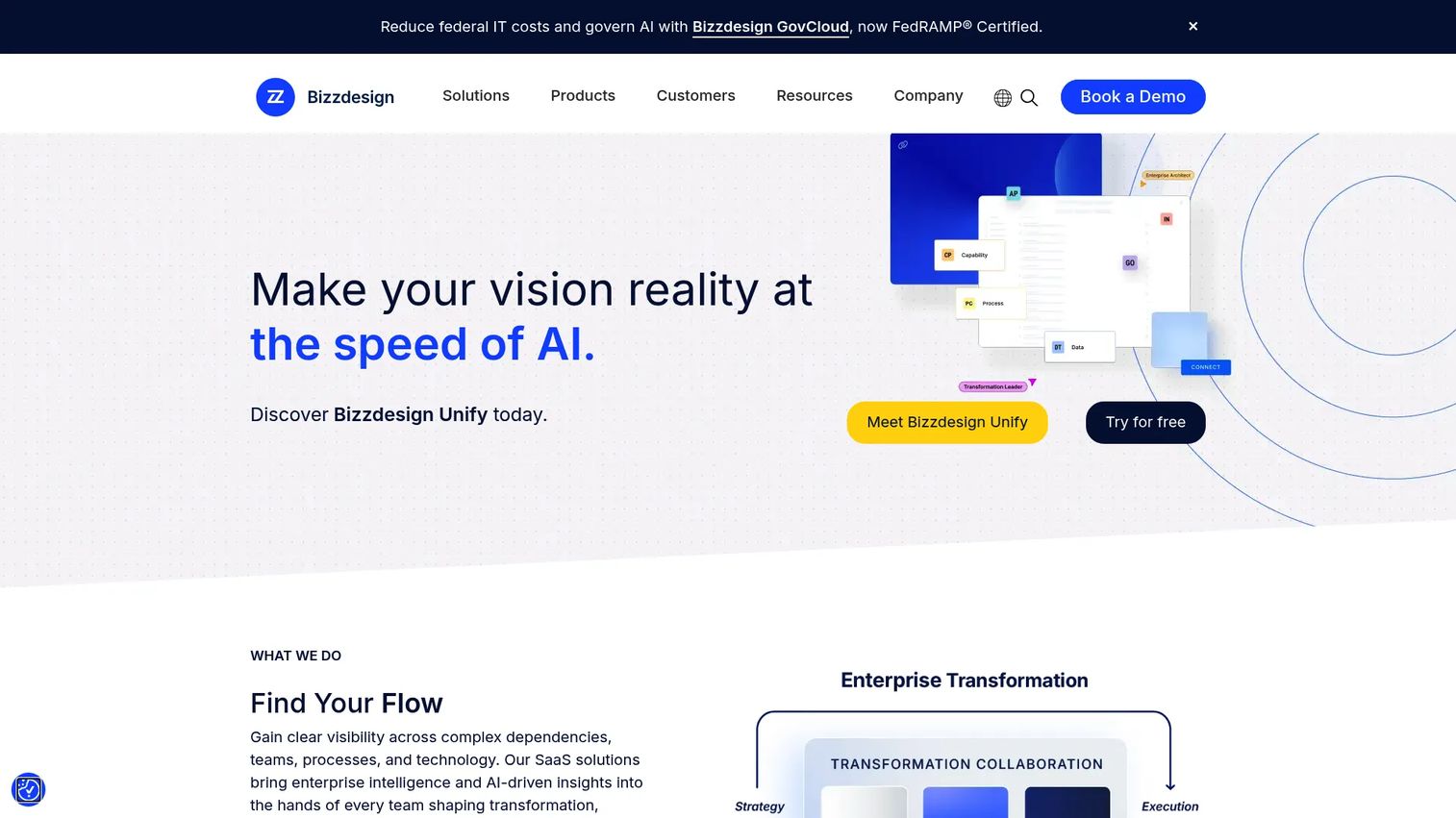
Bizzdesign Alfabet sits at the intersection of IT portfolio management, enterprise architecture, technology strategy, and investment planning. It provides portfolio-wide visibility across application, project, technology, AI initiative, and service portfolios, with AI-enhanced decision-making and a Value Accelerators Library of pre-configured use cases for common IT strategy scenarios.
Best for: CIO organizations aligning technology investments, application portfolios, architecture decisions, and business strategy in a governed planning environment.
Key features
- Portfolio-wide visibility across IT and technology portfolios
- Enterprise architecture and capability mapping
- Lean portfolio management for agile development
- AI-enhanced analytics and executive dashboards
- Value Accelerators Library with pre-configured use cases
Why choose Bizzdesign Alfabet: The fit is specific and strong: When software architecture choices, application rationalization, and technology investment decisions are central to your portfolio governance, Alfabet provides a dedicated environment for that work. It is a specialized IT strategy tool. Product-led SaaS founders whose primary portfolio problem is product investment prioritization rather than application architecture will find more relevant options elsewhere on this list.
Bizzdesign Alfabet pricing: Pricing requires contacting Bizzdesign sales directly. No public pricing is available.
Considerations when choosing strategic portfolio management software
Start with the decisions you cannot make today
Before evaluating platforms, identify the specific portfolio decisions that are failing. Do you need to prioritize competing investment requests? Rebalance funding when a new initiative enters? Resolve resource conflicts between product and GTM? Each problem points to a different capability tier. A tool built for enterprise investment governance may be more than a team needs if the core problem is simply better cross-functional visibility.
Match governance depth to company maturity
The wrong platform creates operating drag. A 60-person SaaS company may need scenario planning and portfolio rollups before it needs formal approval workflows and governance committees. Check whether the platform requires a mature planning process as a prerequisite, or whether it can help you build one. The best product management tools at this stage are the ones that improve decision quality without demanding a full PMO transformation first.
Confirm the data model for delivery and finance
SPM software is only as useful as the data feeding it. Before selecting a platform, map out where actuals come from: Delivery systems, finance tools, marketing resource management platforms, CRM, and HR systems. Understand who owns data quality and how often it updates. A portfolio dashboard built on stale or inconsistent data produces false confidence, not better decisions.
Test scenario planning with a real quarterly trade-off
Run this scenario in any platform you shortlist: A net-new strategic initiative enters mid-quarter, engineering capacity is fixed, and a major customer request is urgent. Can the system show the cost, timing, and displaced work for each option? This test separates tools that look good in demos from tools that work during actual planning pressure.
Measure planned versus realized benefits
Status reporting is not the same as outcome tracking. The platform you choose should show whether funded work improved a defined metric, reduced a measurable risk, or created revenue capacity. Many organizations invest without closing the loop on results. SPM software that tracks benefits realization makes that accountability systematic rather than dependent on whether someone remembers to follow up.
How to choose the right strategic portfolio management software for your team
Choose Planview or Planisware Enterprise for mature enterprise portfolio control. Both platforms suit organizations with formal portfolio governance, multiple business units, and a dedicated planning function. Planview covers the broadest spectrum from strategy through professional services delivery. Planisware is the stronger choice when portfolio financial modeling and long-range scenario analysis are the primary requirements.
**Choose ServiceNow Strategic