You shipped the app. Downloads are climbing. Sessions look healthy. And yet the revenue line stays flat, because monetization got bolted on as an afterthought instead of designed in.
That gap is expensive. The global app monetization platforms market was valued at roughly $15 billion in 2023 and is projected to exceed $35 billion by 2030, growing at a CAGR near 20%, according to LinkedIn's market analysis. In-app advertising alone generated about $307 billion in app market revenues in 2023, per Statista. Money is moving through mobile apps at scale. The question is whether your stack captures any of it.
Here is the part most teams get wrong. Monetization is not one decision. It is a set of decisions about ads, in-app purchases, subscriptions, and how those streams interact with retention. Choose the wrong model and you either leave revenue on the table or torch the user experience chasing it. Choose the wrong platform and you bolt complexity onto a stack that already sprawls across attribution, analytics, and lifecycle tools.
This guide cuts through that. We compare eight platforms by monetization model, analytics depth, integration quality, and fit by app type, so you can shortlist fast and test against real app revenue metrics. If you also need to measure where users drop off before they ever pay, pair these with the right marketing analytics and mobile attribution tooling so revenue optimization and acquisition stay connected.
What's inside
This guide is built for mobile growth marketers, UA managers, and founders who need to turn app traffic into revenue without wrecking retention. We compared platforms across four buying criteria that actually move the number:
- Monetization model coverage: ads, ad mediation, in-app purchases, subscriptions, and hybrid monetization.
- Analytics and reporting depth: cohort analysis, LTV prediction, and revenue visibility your CFO will believe.
- Integration quality: SDK effort, analytics connections, and how cleanly it fits an existing stack.
- Fit by app type: ad-led publishers, subscription apps, games, and hybrid revenue models.
We also weighted pricing transparency and G2 ratings where verifiable, so the shortlist reflects real cost and real sentiment, not marketing claims.
TL;DR
Short on time? Here are the decision shortcuts by app type and monetization model.
- Best for ad-led publishers: Google AdMob, with deep ad mediation, full format coverage, and Firebase reporting.
- Best for subscription and paywall testing: Adapty, built around paywall A/B testing and predictive LTV.
- Best for cross-platform subscription infrastructure: RevenueCat, with one SDK across iOS, Android, and web.
- Best for ad yield optimization: AppLovin MAX for in-app bidding and impression-level revenue data.
- Best for game studios: Unity Ads for rewarded video and combined user acquisition plus monetization.
- Best for automated mediation: Appodeal, with auction controls across many demand sources.
What are mobile app monetization platforms?
Mobile app monetization platforms are tools that help app publishers generate revenue from their apps through in-app advertising, in-app purchases, subscriptions, or a combination of these models, while measuring and optimizing performance along the way.
They split into two broad camps. Ad monetization platforms (AdMob, AppLovin MAX, Appodeal, Unity Ads, InMobi, Start.io) connect your inventory to advertiser demand and run ad mediation to maximize fill rate and eCPM. Subscription and IAP platforms (Adapty, RevenueCat) manage purchase infrastructure, paywalls, and recurring billing. Many modern apps run both, which is where hybrid monetization comes in.
Core capabilities you should expect:
- Ad mediation and real-time bidding: route each impression to the highest-paying demand source across networks.
- Ad format support: rewarded ads, banner ads, native ads, interstitial ads, and video ads.
- In-app purchase and subscription management: entitlements, billing, renewals, and refund handling.
- Paywall testing: A/B test pricing, layout, and offers to lift conversion without a code release.
- Analytics and reporting: cohort analysis, ARPU, fill rate, retention, and predictive lifetime value.
- SDK integration: a single SDK that connects monetization to your existing data and attribution stack.
The monetization models break down cleanly. In-app ads work when you have high session frequency and engaged users. In-app purchases suit games and utility apps selling consumables or unlocks. Subscriptions fit content, creator, and SaaS-style apps where value compounds over time. Hybrid monetization layers two or more streams to lift ARPU without betting the business on one source.
Subscription monetization is currently the fastest-growing slice. Store-processed subscription revenue grew 105% year over year in Q1 2026, against 29% for in-app purchases and 14% for ad revenue, according to AppsFlyer. That trend shapes where many teams now invest, even as ads remain the largest absolute revenue pool.
When to use each monetization model
The right platform follows the right model. Here is how to pattern-match your app before you scan the list.
Use ad monetization when your app has high engagement and repeat sessions
Ads pay out per impression, so the math works when users open the app often and stay a while. Casual games, news, weather, and utility apps are classic fits. Match the format to the moment: rewarded ads for opt-in value exchanges, interstitial ads at natural breaks, banner ads for persistent low-friction inventory, and native ads when you want the placement to feel in-product. Strong ad mediation across networks is what lifts fill rate and eCPM here. If acquisition is also a priority, connecting ad revenue to mobile marketing campaigns keeps spend and yield in one view.
Use subscriptions and in-app purchases when value compounds inside the app
When the product gets more valuable the longer someone uses it, recurring revenue beats impressions. Content libraries, creator tools, fitness apps, and productivity utilities all fit. Subscriptions reward retention and make revenue predictable. In-app purchases handle one-off unlocks, consumables, and premium upgrades. The lever that matters most here is paywall testing: small changes to price, trial length, and offer framing can move conversion more than any acquisition tweak.
Use hybrid monetization when you need multiple revenue streams
Most mature apps do not pick one model. A free tier monetized with rewarded ads can upsell to a subscription. A game can run interstitials between sessions and sell consumable IAPs. Hybrid monetization maximizes ARPU and diversifies revenue so a single eCPM dip or pricing change does not sink the quarter. The tradeoff to manage is experience: stacking ads on top of a paywall on top of upsells can fatigue users, so instrument retention closely and test each layer.
Comparison table
Sorted by relevance to ad-led and subscription monetization, not alphabetically. Pricing and G2 ratings reflect verified values where publicly available; usage-based and account-based pricing is noted as such.
| # | Product | Intent | Key differentiation | Pricing | G2 rating |
|---|---|---|---|---|---|
| 1 | Google AdMob | Ad-led publishers | Mediation, full ad format coverage, Firebase reporting | Free to use | 4.3/5 |
| 2 | Adapty | Subscription apps | Paywall A/B testing and predictive LTV | Free until $5K/mo, then 1% of revenue | 4.7/5 |
| 3 | RevenueCat | Cross-platform subscriptions | One SDK for iOS, Android, and web billing | Free up to $2.5K MTR, then 1% | 4.8/5 |
| 4 | AppLovin MAX | Ad yield optimization | In-app bidding and impression-level revenue | Account-based | 4.2/5 |
| 5 | Appodeal | Automated mediation | Auction controls across many demand sources | Free tier available | 4.7/5 |
| 6 | Unity Ads | Game studios | Rewarded video plus user acquisition in one SDK | Account-based | 4.3/5 |
| 7 | InMobi | Programmatic demand | Global ad demand and DSP buying | CMP from $20/property/mo | Not listed |
| 8 | Start.io | Audience monetization | Real-time mobile audiences and AI targeting | Account-based | 4.6/5 |
Best mobile app monetization platforms for 2026
1. Google AdMob
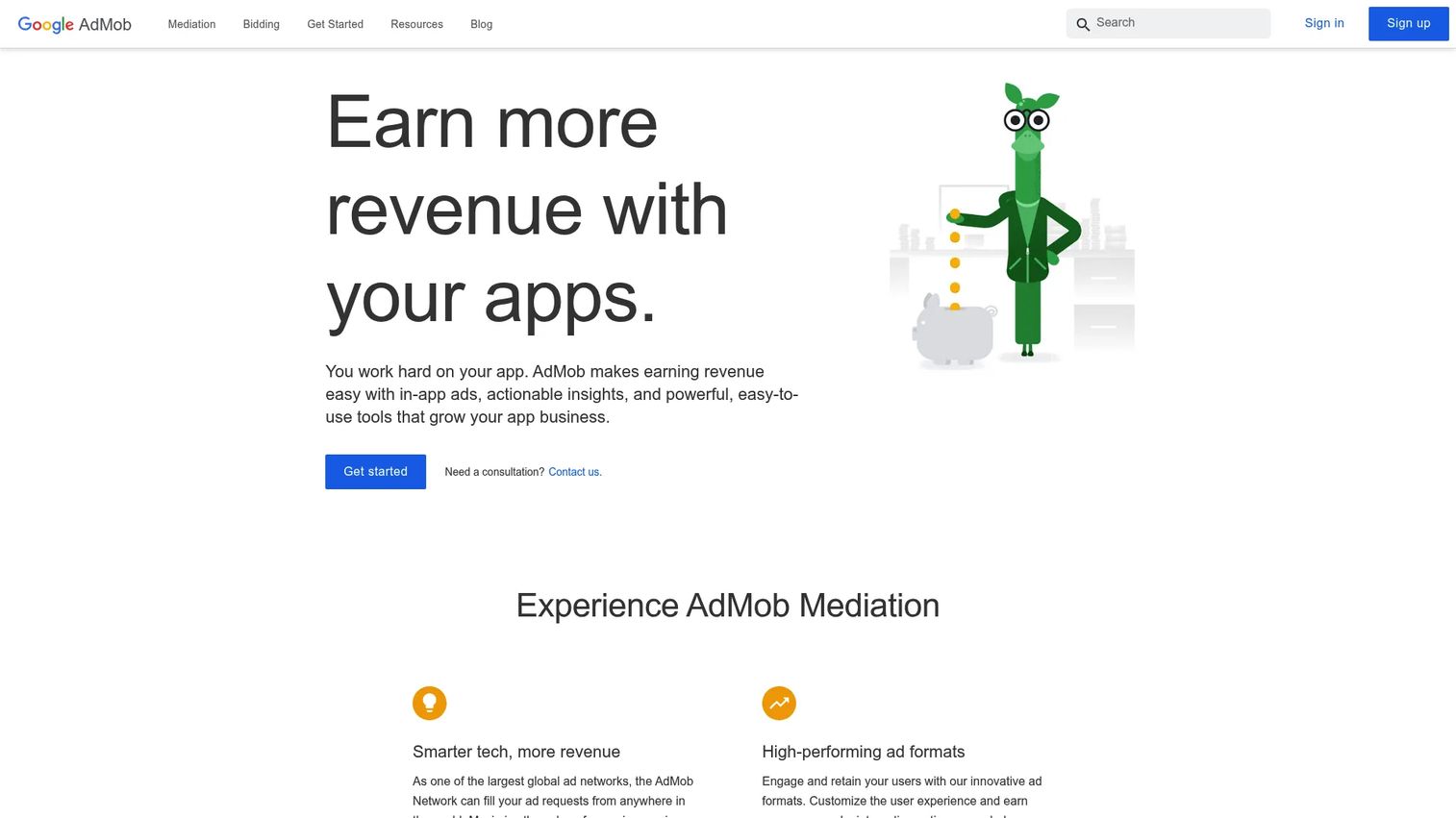
Google AdMob is Google's mobile app monetization platform for earning revenue from in-app ads. It combines a massive advertiser pool with ad mediation, real-time bidding, and reporting, which is why it anchors most ad-led monetization stacks. For teams already on Firebase and Google Analytics, the data picture is unusually complete.
AdMob supports every common ad format, so you can match placement to context rather than forcing one unit everywhere. Bidding lets multiple networks compete for each impression in real time, which lifts fill rate and eCPM without manual waterfall babysitting. The reporting ties ad revenue back to user behavior when integrated with Firebase, giving growth marketers cohort-level visibility into what each segment actually earns.
Best for: App developers monetizing mobile apps with ads who want broad format coverage and deep Google ecosystem integration.
Key strengths
- Ad mediation: routes impressions across networks to maximize fill rate and eCPM.
- Full format coverage: rewarded ads, banner ads, native ads, interstitial ads, and video ads in one SDK.
- Actionable analytics: Firebase and Google Analytics integration ties ad revenue to user behavior.
Why choose Google AdMob: If your app is engagement-heavy and ad-led, AdMob gives you scale, format breadth, and reporting depth without a separate analytics build. The Firebase tie-in is the differentiator for teams that want monetization and product analytics speaking the same language.
Google AdMob pricing: Google describes AdMob as free to use, with no public pricing tiers. Revenue comes from a share of ad earnings rather than a subscription fee, so there is no upfront platform cost to start monetizing.
2. Adapty
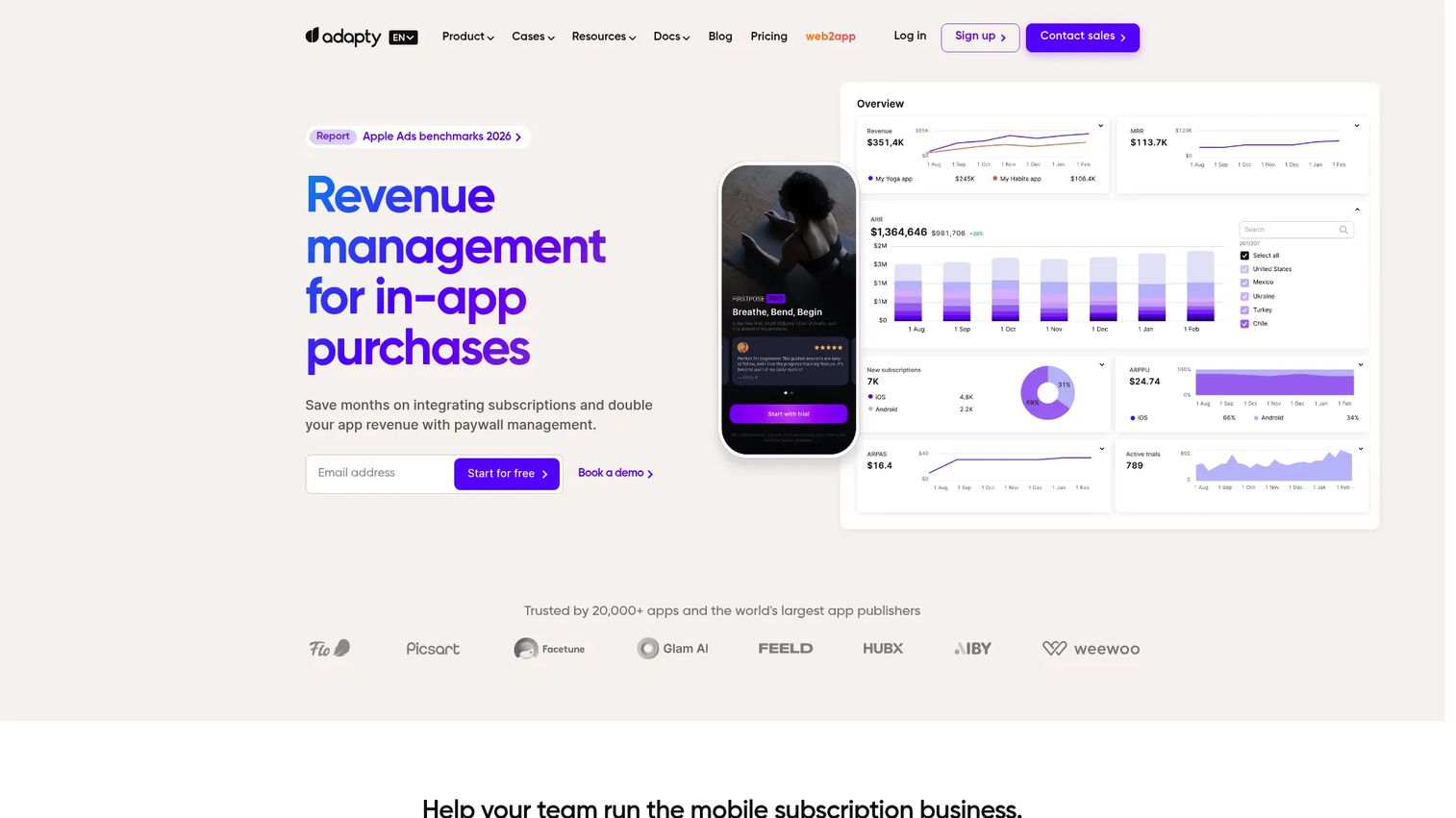
Adapty is a mobile in-app purchase and subscription monetization platform built for apps that grow revenue through recurring billing. It pairs subscription infrastructure with a no-code paywall builder and serious A/B testing, so growth teams can run pricing experiments without shipping a release. The analytics layer leans into cohort analysis and predictive LTV.
The standout is paywall testing. You can test price points, trial lengths, layouts, and offers, then read the impact on conversion and lifetime value in the dashboard. Open-source SDKs keep integration clean across platforms, and the revenue analytics surface the metrics that actually drive subscription decisions: trial-to-paid conversion, churn, and predicted LTV by cohort.
Best for: Mobile apps that need subscription infrastructure, paywall testing, and revenue analytics in one place.
Key strengths
- No-code paywall builder and A/B testing: experiment on pricing and offers without engineering.
- Open-source SDKs: clean integration across mobile platforms.
- Predictive analytics: cohort analysis and LTV prediction for subscription revenue.
Why choose Adapty: For subscription-led apps, the paywall experimentation engine is the reason to look. It turns pricing from a guess into a testable lever, which is exactly the kind of defensible revenue optimization a growth marketer can take to leadership.
Adapty pricing: The Pro plan is free until $5,000 in monthly tracked revenue, then costs 1% of revenue. Enterprise is custom pricing, and add-ons like Refund Saver and Apple Ads carry separate usage-based fees.
3. RevenueCat
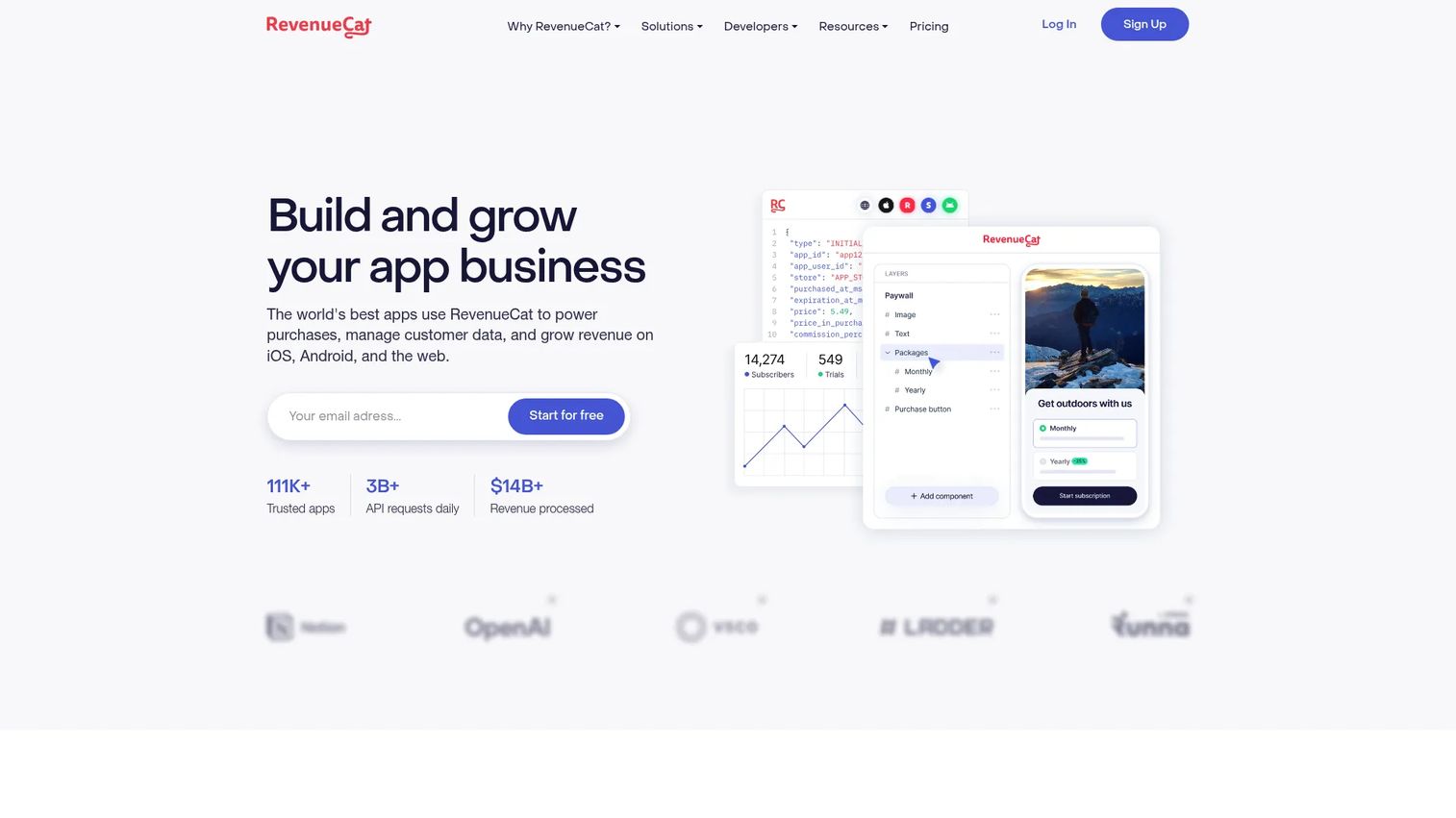
RevenueCat is a subscription management and monetization platform for app developers who want to ship recurring billing fast and maintain it across platforms. One SDK handles in-app subscriptions and billing on iOS, Android, and web, which removes a huge amount of store-specific plumbing. The analytics and customer management tools round out the lifecycle picture.
The cross-platform consistency is the draw. Instead of maintaining separate purchase logic per store, you integrate once and let RevenueCat normalize entitlements, renewals, and receipts. Dynamic paywalls and experiments let you adjust offers, and the charts surface MRR, churn, and conversion so teams can act on subscription health without exporting raw store data.
Best for: App teams that need cross-platform subscription infrastructure, paywalls, and monetization analytics shipped quickly.
Key strengths
- Cross-platform billing: one SDK manages subscriptions across iOS, Android, and web.
- Dynamic paywalls and experiments: adjust offers and test without redeploying.
- Subscription analytics: MRR, churn, and conversion charts plus customer management.
Why choose RevenueCat: If speed to ship subscriptions is the priority and you support multiple platforms, RevenueCat removes the billing headache so the team can focus on conversion and retention. It is the pragmatic choice for engineering-light teams shipping recurring revenue.
RevenueCat pricing: The Pro plan is free up to $2,500 in monthly tracked revenue, then 1% of MTR above that threshold. Enterprise is custom-quoted, and a Just Paywalls option is available via sales.
4. AppLovin MAX
AppLovin MAX is a mobile app monetization and ad mediation platform built for publishers who want to squeeze maximum yield from ad inventory. In-app bidding and waterfall mediation let demand sources compete for every impression, and the impression-level revenue APIs give analytics teams granular data to optimize against.
The yield focus is what sets MAX apart for ad-heavy apps and games. Real-time bidding pushes networks to bid against each other on each placement, lifting eCPM and fill rate. Ad Review lets you inspect creatives and catch problematic ads before they hurt the experience, and the revenue reporting is detailed enough to feed your own data warehouse for deeper revenue optimization.
Best for: Mobile app publishers looking to maximize ad revenue through mediation and granular reporting.
Key strengths
- In-app bidding and waterfall mediation: demand sources compete to lift eCPM and fill rate.
- Ad Review: inspect creatives and block problematic ads to protect user experience.
- Impression-level revenue APIs: granular data for custom analytics and optimization.
Why choose AppLovin MAX: When ad revenue is a core line, not a side stream, MAX gives you the bidding depth and impression-level data to optimize aggressively. It rewards teams with the analytics maturity to act on granular yield signals.
AppLovin MAX pricing: Pricing is account-based and not publicly listed; access is configured through your account. The platform monetizes through ad revenue share rather than a published subscription fee.
5. Appodeal

Appodeal is a mobile app monetization and growth platform focused on ad mediation and publisher tooling. It connects inventory to a wide pool of demand sources and automates much of the optimization, which appeals to teams that want a more hands-off monetization layer without giving up control.
The breadth of demand is the selling point. Mediation spans many networks, and real-time auction plus waterfall controls let you tune how impressions get filled. User segmentation, A/B testing, and analytics sit on top, so you can test ad placements and frequency against retention rather than flying blind. The result is automation that still surfaces the levers a growth marketer wants to pull.
Best for: Mobile app publishers and game studios seeking automated mediation across many demand sources.
Key strengths
- Mediation across many demand sources: competition across networks to lift fill rate.
- Real-time auction and waterfall controls: tune how impressions are filled.
- Segmentation, A/B testing, and analytics: test placements against retention.
Why choose Appodeal: For teams that want mediation breadth with less manual tuning, Appodeal automates the heavy lifting while keeping segmentation and testing in reach. It fits publishers who value automation but still want optimization controls.
Appodeal pricing: Appodeal does not publish a standard subscription pricing table on its public pages. Its Accelerator program is free, and monetization revenue typically comes from ad earnings rather than a flat platform fee.
6. Unity Ads
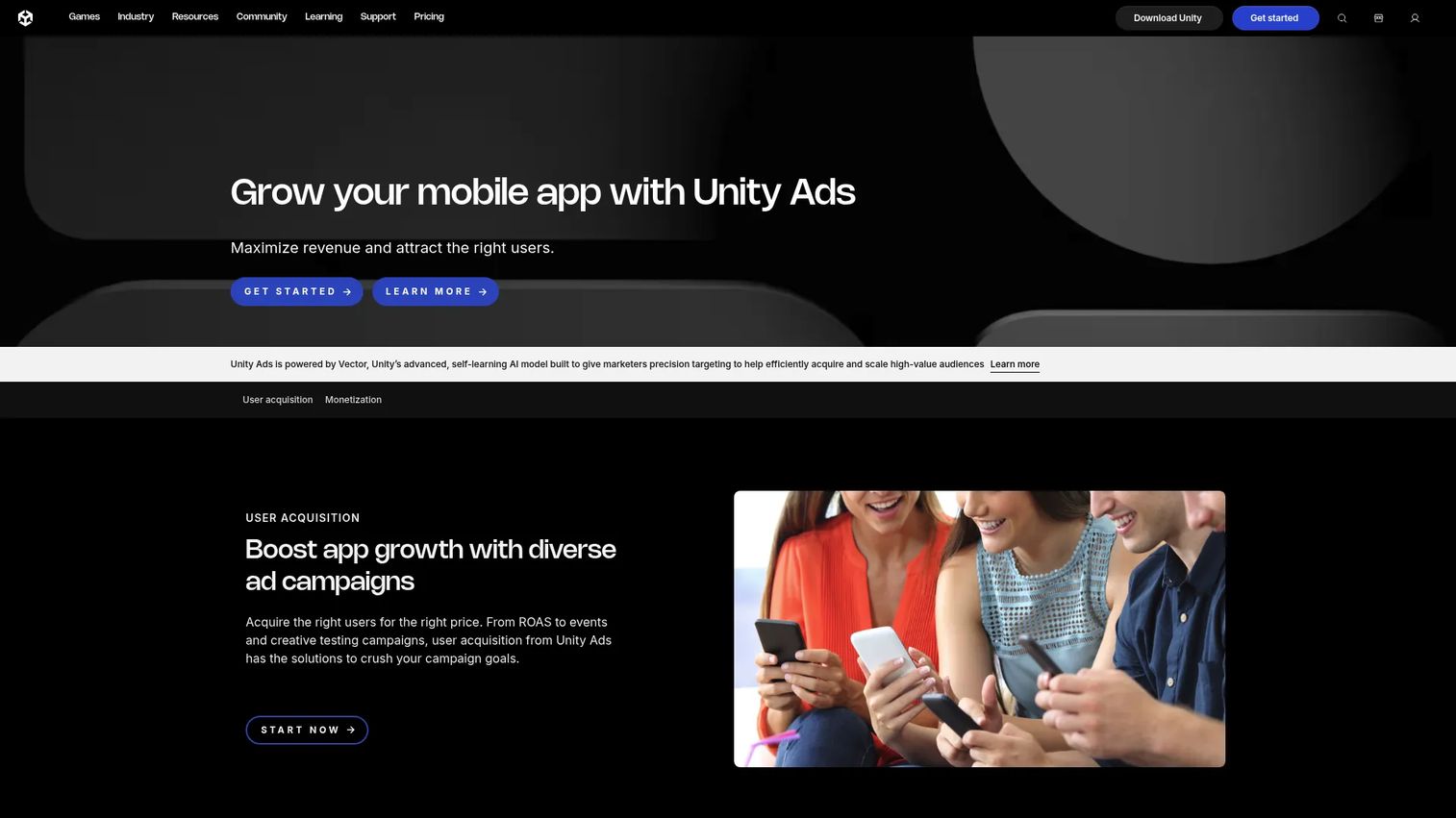
Unity Ads is Unity's mobile app growth platform for user acquisition and in-app monetization, and it is a natural fit for game studios. A single SDK gives access to the Unity Ads network and Unity Exchange, covering both buying users and monetizing them with ads.
The game-first angle matters. Rewarded video is a staple of mobile game economies, and Unity Ads supplies strong demand for it alongside interstitials and banners. Because the same vendor handles ROAS-based user acquisition and ad monetization, studios can manage both sides of the equation in one place, with reporting and analytics tying spend to ad revenue per cohort.
Best for: Mobile game and app publishers who want user acquisition and ad monetization from one vendor.
Key strengths
- Rewarded video, interstitials, and banners: monetization formats tuned for games.
- ROAS, event, and creative testing campaigns: user acquisition alongside monetization.
- Single-SDK access: one integration for the Unity Ads network and Unity Exchange.
Why choose Unity Ads: For studios already building in Unity or running mobile games, consolidating acquisition and monetization under one SDK reduces stack sprawl. The rewarded inventory is the draw for game economies built around opt-in ad value.
Unity Ads pricing: Unity does not display public pricing on the Unity Ads product page, and access is configured per account. As with other ad networks, revenue comes from a share of ad earnings rather than a fixed fee.
7. InMobi

InMobi is a GenAI-powered consumer internet and advertising platform with deep roots in mobile monetization and global ad demand. Founded in 2007, it brings programmatic buying through InMobi DSP and consent management through InMobi CMP, making it a fit for publishers who need scale and compliance together.
The global reach and programmatic demand are the differentiators. InMobi connects publishers to advertiser demand across many markets, which helps fill inventory in regions where smaller networks fall short. The DSP supports programmatic buying for teams running both sides, and the CMP handles consent and privacy compliance, an increasingly load-bearing concern as regulations tighten.
Best for: Mobile app and web publishers and advertisers needing programmatic ad tech, DSP, and consent tooling at global scale.
Key strengths
- Mobile advertising and monetization: broad demand and global publisher reach.
- InMobi DSP: programmatic buying for advertisers and growth teams.
- InMobi CMP: consent management and privacy compliance.
Why choose InMobi: When global fill and programmatic demand matter, InMobi adds reach that complements a primary mediation layer. Its consent tooling is a practical bonus for teams managing privacy compliance across markets.
InMobi pricing: InMobi DSP pricing is custom and dynamic, set in consultation with the InMobi team. InMobi CMP offers a free Essentials tier and a Premium tier at $20 per property per month, or free via SSP integration.
8. Start.io
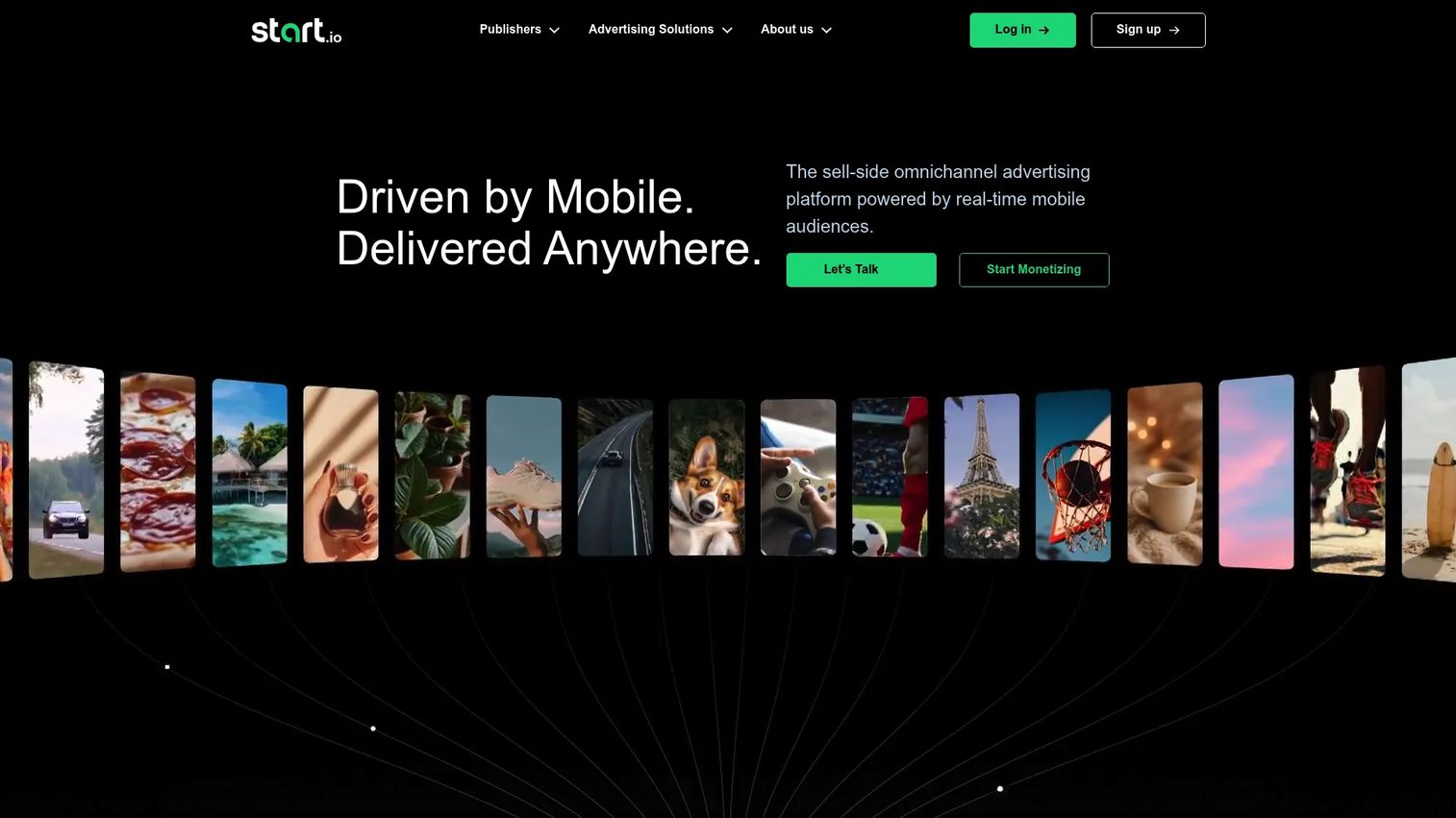
Start.io is a sell-side omnichannel advertising platform powered by real-time mobile audiences. It leans into audience data and AI-driven monetization, which positions it as a fit for publishers who want targeting depth alongside ad demand.
The audience angle is where it stands out. Start.io builds mobile AI audiences and syndicated segment taxonomies, then uses that data to drive more relevant, higher-value ad placements. For publishers and marketers who care about who is seeing each impression, the targeting layer can lift the value of inventory beyond what a generic network delivers, while the analytics support keeps performance visible.
Best for: Mobile publishers and marketers needing audience data and ad monetization tools together.
Key strengths
- Mobile AI audiences: audience exploration and activation for targeting.
- Syndicated audience segments: a taxonomy to sharpen ad relevance.
- AI-driven monetization: data-led optimization for publishers and developers.
Why choose Start.io: For teams that want monetization tied to audience intelligence, Start.io pairs ad demand with targeting data. It suits publishers looking to raise inventory value through better audience signals.
Start.io pricing: Start.io does not publish a first-party pricing table, and access is account-based. Revenue for publishers comes from ad earnings rather than a fixed platform fee.
Considerations before you commit
Feature lists do not pay invoices. These are the criteria that actually separate a good fit from an expensive mistake.
Match the platform to your monetization model
Decide first whether the app is ads-led, subscription-led, or hybrid. Model fit matters more than feature count. An ad-heavy casual game and a subscription content app have almost nothing in common in what they need from a platform. Picking the right camp narrows the list faster than any feature comparison.
Check analytics and experimentation depth
A monetization platform without strong analytics and reporting is a black box. Confirm it supports cohort analysis, ARPU tracking, retention views, and the kind of testing that lets you prove what moved revenue. Growth marketers live and die by attribution and ROI visibility, so reporting that reconciles with your other tools is non-negotiable.
Verify integration quality
Review the SDK effort and how the platform connects to your existing analytics and attribution stack. Poor integration costs you twice: once in engineering time and again in broken reporting that muddies attribution. A clean SDK that plays well with your data warehouse and lifecycle tools is worth more than a longer feature list.
Review pricing and revenue share carefully
Understand whether pricing is take-rate, usage-based, or contract-based. Ad networks typically take a share of ad revenue, while subscription platforms like Adapty and RevenueCat charge a percentage of tracked revenue above a free threshold. Model the cost at your projected scale, because a 1% take rate feels trivial until revenue compounds.
Consider user experience impact
Ad frequency, format choice, and paywall aggressiveness all shape retention. A few extra interstitials can lift short-term ARPU and quietly raise churn. Instrument retention alongside revenue, and treat every monetization change as an experiment you measure, not a setting you fire and forget.
Conclusion
The best mobile app monetization platform is the one that fits your model and lifts revenue without harming retention. For ad-led, engagement-heavy apps, Google AdMob, AppLovin MAX, Appodeal, Unity Ads, InMobi, and Start.io give you mediation, format breadth, and demand at scale. For subscription and IAP-led apps, Adapty and RevenueCat handle paywalls, billing, and the analytics that make recurring revenue predictable. Most mature apps end up running hybrid monetization, combining two or more streams to maximize ARPU.
Here is the next step. Shortlist one platform per monetization model you actually run, integrate it, and test it against your real app metrics: ARPU, retention, fill rate, and lifetime value. Do not optimize for the highest theoretical eCPM or the slickest paywall in isolation. Optimize for revenue that holds up against retention over a full cohort. The platform that wins that test is the one worth scaling.
FAQs
They are tools that help apps generate revenue through in-app advertising, in-app purchases, subscriptions, or a mix of all three, while measuring performance. Ad platforms connect inventory to advertiser demand and run ad mediation, while subscription platforms manage paywalls, billing, and recurring revenue. Many apps combine both in a hybrid monetization setup.
It depends on audience behavior, app type, and retention patterns. High-frequency apps with engaged users often do well with ads, while apps where value compounds over time tend to favor subscriptions. Games and utilities frequently lean on in-app purchases, and many mature apps blend models to maximize ARPU.
The issue is almost always poor format choice or excessive frequency, not ads themselves. Rewarded ads and well-placed native ads can feel like part of the product, while too many interstitials can fatigue users. Instrument retention alongside revenue and treat ad frequency as something you test, not set once.
Focus on SDK quality, ad mediation depth, analytics and reporting, experimentation support, pricing, and integration with your existing stack. The right answer depends on whether you are ads-led, subscription-led, or hybrid. Match the platform to your model first, then compare features within that camp.
Some platforms support broader monetization workflows, but many teams still combine specialized tools. A common pattern is an ad mediation platform for ad revenue paired with a subscription platform for IAP and recurring billing. If you run hybrid monetization, plan for two systems and make sure their analytics reconcile cleanly.
Choose by monetization model. AdMob is the pick when your app is ad-led and you want mediation plus full format coverage. Adapty fits subscription apps that want deep paywall A/B testing and predictive LTV, while RevenueCat suits teams shipping cross-platform subscriptions fast with one SDK. Many subscription apps run AdMob for ads and Adapty or RevenueCat for recurring revenue together.