An attacker is inside your network. Your SIEM is quiet. Your EDR flagged nothing worth escalating. The dashboards look fine. That gap between initial compromise and detection is where breaches turn expensive, and most security stacks are built to watch real assets, not to bait the people probing them.
Deception technology flips that model. Instead of waiting for a signature to fire or a behavioral anomaly to cross a threshold, you scatter decoys, fake credentials, and traps across the environment. Anything that touches them is, by definition, suspicious. No legitimate user has a reason to authenticate with a planted service account or connect to a decoy database. So when the alert fires, it means something.
The market reflects that shift. The global deception technology market reached roughly USD 3.3 billion in 2025 and is projected to hit USD 3.85 billion in 2026, growing at a 16.8% CAGR through 2030, according to Research and Markets (2026). Buyers are not just experimenting anymore. They are budgeting for deception-based security as a core detection layer, especially in environments where direct monitoring is hard.
This article compares the deception technology software worth shortlisting in 2026. The focus is practical: decoy realism, alert quality, deployment flexibility, and how well each tool feeds signal into the rest of your security operations.
What's inside
This guide is for security buyers evaluating cyber deception tools, including SOC leads, security engineers, and architects covering enterprise, OT, and hybrid environments. It is not a category primer dressed up as a shortlist. It is a decision aid.
Tools were selected against five criteria that actually matter during a security review:
- Decoy realism: how convincing the traps, lures, and fake artifacts are to an active adversary.
- Alert quality: how high-signal the notifications are, and how much noise they cut.
- Deployment flexibility: coverage across cloud, on-premises, identity, and OT.
- Integration depth: how cleanly signals reach your SIEM, SOAR, and EDR.
- Use-case coverage: lateral movement, credential theft, insider threat, and post-breach intelligence.
No vendor paid for placement. Ordering reflects relevance to the keyword and buyer utility.
TL;DR
- Best for modern cloud and identity deception: Tracebit, with canary-based detection across cloud, Kubernetes, CI/CD, and workstations.
- Best for enterprise IT/OT security operations: FortiDeceptor, tied into a broader security fabric with automated containment.
- Best for distributed decoys and active defense: Smokescreen (Zscaler Deception), covering endpoints, network, cloud, and identity.
- Best for anti-evasion endpoint deception: Minerva Anti-Evasion Platform, which turns evasive malware against itself.
- Best for early network intrusion detection: Labyrinth Cyber Deception Platform, with high-interaction decoys and low false positives.
- Best for managed detection and response: LMNTRIX, folding deception into an XDR/MDR service.
- Best for in-network attacker engagement: BOTsink from Attivo Networks, built for high-interaction deception.
What is deception technology software?
Deception technology software is a category of cybersecurity tooling that deploys fake assets, such as decoys, traps, lures, honeypots, and false credentials, across an environment so that any interaction with them signals malicious activity. Legitimate users never touch these planted assets, so an alert from a decoy is inherently high-fidelity.
The core mechanics are consistent across vendors, even when the terminology differs:
- Decoys: convincing fake systems, servers, databases, or services that look like real production assets. When an attacker scans, connects, or authenticates against one, the platform logs it and alerts.
- Lures and breadcrumbs: planted artifacts on real endpoints, such as fake credentials, saved connections, or config files, that point attackers toward the decoys. This is how deception guides lateral movement into a trap.
- Honeypots vs deception technology: a honeypot is a single decoy system, usually standalone. Modern deception technology orchestrates decoys, lures, and breadcrumbs at scale across the whole environment, with centralized alerting and response.
- Fake credentials: planted account details that trigger an alert the moment they are used, which is why deception is effective at credential theft detection.
Why this lowers false positives is simple. Traditional detection watches real assets and has to distinguish malicious behavior from normal work. Deception assets have no legitimate purpose, so interaction is the anomaly. That is the structural reason deception-based security produces cleaner signal.
Where AI/ML and dynamic deception fit: newer platforms generate decoys that mimic the specific environment and adapt as it changes, rather than dropping static honeypots that a skilled adversary can fingerprint. Dynamic deception keeps the traps believable over time.
Environments covered range from cloud and identity systems to on-premises networks, endpoints, and OT or segmented networks where direct monitoring is risky or impractical.
When to use deception technology
Deception is not a replacement for your EDR, SIEM, or firewall. It is a high-signal detection layer that works best in specific scenarios.
Detect lateral movement earlier
Once an attacker gets past the perimeter, they move laterally to find valuable systems. That phase is where dwell time accumulates. Deceptive assets sit directly in the paths attackers use, planted credentials, decoy shares, fake admin consoles, so probing during lateral movement trips a trap before the adversary reaches production. You catch the intrusion in the reconnaissance phase, not after data leaves.
Reduce false positives and alert fatigue
SOC teams drown in low-value alerts. Deception inverts the ratio. Because no real user interacts with a decoy, an alert on one is almost never a false positive. Teams running deception typically report high-fidelity notifications they can act on immediately, which frees analyst time for real investigation instead of triage.
Enrich threat intelligence after compromise
When an attacker engages a high-interaction decoy, the platform can watch what they do: the tools they run, the commands they type, the paths they take. That behavioral record feeds threat intelligence enrichment, informs incident response, and helps you understand the adversary rather than just block one IP.
Protect enterprise, OT, and segmented environments
OT and industrial networks are hard to monitor with agents, and active scanning can break fragile systems. Deception is passive by design: decoys sit in the network and wait. That makes it well suited to OT security, air-gapped segments, and any environment where installing heavy monitoring is risky. The same logic applies to insider threat detection, where a curious employee touching a decoy reveals intent without disrupting real operations.
Comparison table
Use this table to shortlist fast. "Intent" describes the primary buying situation each tool fits. "Key differentiation" is the concrete reason a team picks it. Pricing for most enterprise deception vendors is quote-based and not published, so treat the pricing column as a guide to model rather than an exact figure.
| # | Product | Intent | Key differentiation | Pricing | G2 rating |
|---|---|---|---|---|---|
| 1 | Tracebit | Cloud and identity deception | Canary-based detection across cloud, Kubernetes, CI/CD, workstations | Community Edition free; Enterprise custom quote | 4.9/5 |
| 2 | FortiDeceptor | Enterprise IT/OT deception | Decoy VMs plus automated containment inside the security fabric | Quote-based | 4.0/5 |
| 3 | Smokescreen (Zscaler Deception) | Enterprise active defense | Decoys, lures, breadcrumbs across endpoint, network, cloud, identity | Contact sales | 4.0/5 |
| 4 | Minerva Anti-Evasion Platform | Anti-evasion endpoint deception | Blocks evasive malware by deceiving it into disarming | Quote-based | 3.8/5 |
| 5 | Labyrinth Cyber Deception Platform | Network intrusion detection | High-interaction decoys with low false positives | Quote-based | 4.9/5 |
| 6 | LMNTRIX | Managed detection and response | Deception folded into a 24/7 XDR/MDR service | Quote-based | 4.9/5 |
| 7 | BOTsink | In-network attacker engagement | High-interaction deception for inside-the-network threats | Quote-based | 4.0/5 |
| 8 | 8i | Verify category fit before evaluation | Listed for completeness; confirm deception scope directly | Contact sales | 4.5/5 |
1. Tracebit
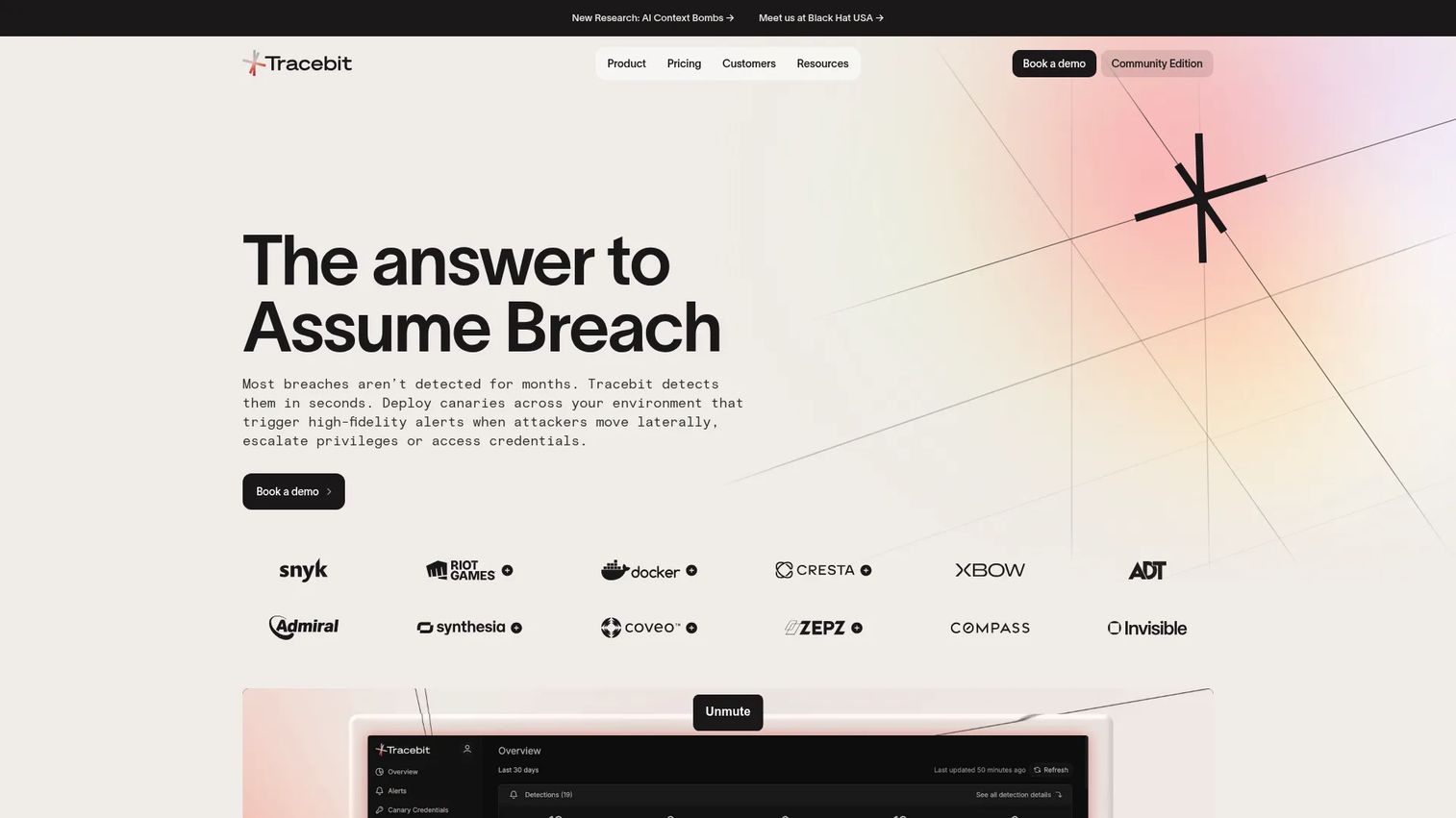
Tracebit is a modern security deception platform built for cloud-first teams. It deploys canaries, high-fidelity tripwires, across cloud accounts, identity systems, Kubernetes, CI/CD pipelines, and workstations. The design goal is simple: put believable decoys where attackers actually go in a cloud environment, then alert only when one is touched.
Best for: Security teams running modern cloud and identity infrastructure who want deception-based detection without standing up honeypot farms.
Key strengths
- Canary-based high-fidelity detection: alerts fire on interaction, so signal-to-noise stays high and analysts spend less time triaging false positives.
- Broad modern coverage: canaries span cloud, Kubernetes, identity, CI/CD, and workstations, which matches where attacker activity concentrates in cloud-native stacks.
- Community Edition: free canary credentials let teams start detecting without a procurement cycle.
Why choose Tracebit: If your attack surface is cloud and identity rather than a traditional on-premises data center, Tracebit meets you where the risk is. Its canary approach maps cleanly to lateral movement and credential theft detection in AWS, Kubernetes, and CI/CD, and the free Community Edition lowers the bar to a pilot. It holds a 4.9/5 rating on G2, which reflects how teams rate the signal quality.
Pricing: Tracebit offers a Community Edition that is free forever, with free canary credentials. Enterprise pricing is a custom quote based on environment size and coverage needs, and is not published. Start with the Community Edition to validate detection quality before scoping the paid tier.
2. FortiDeceptor
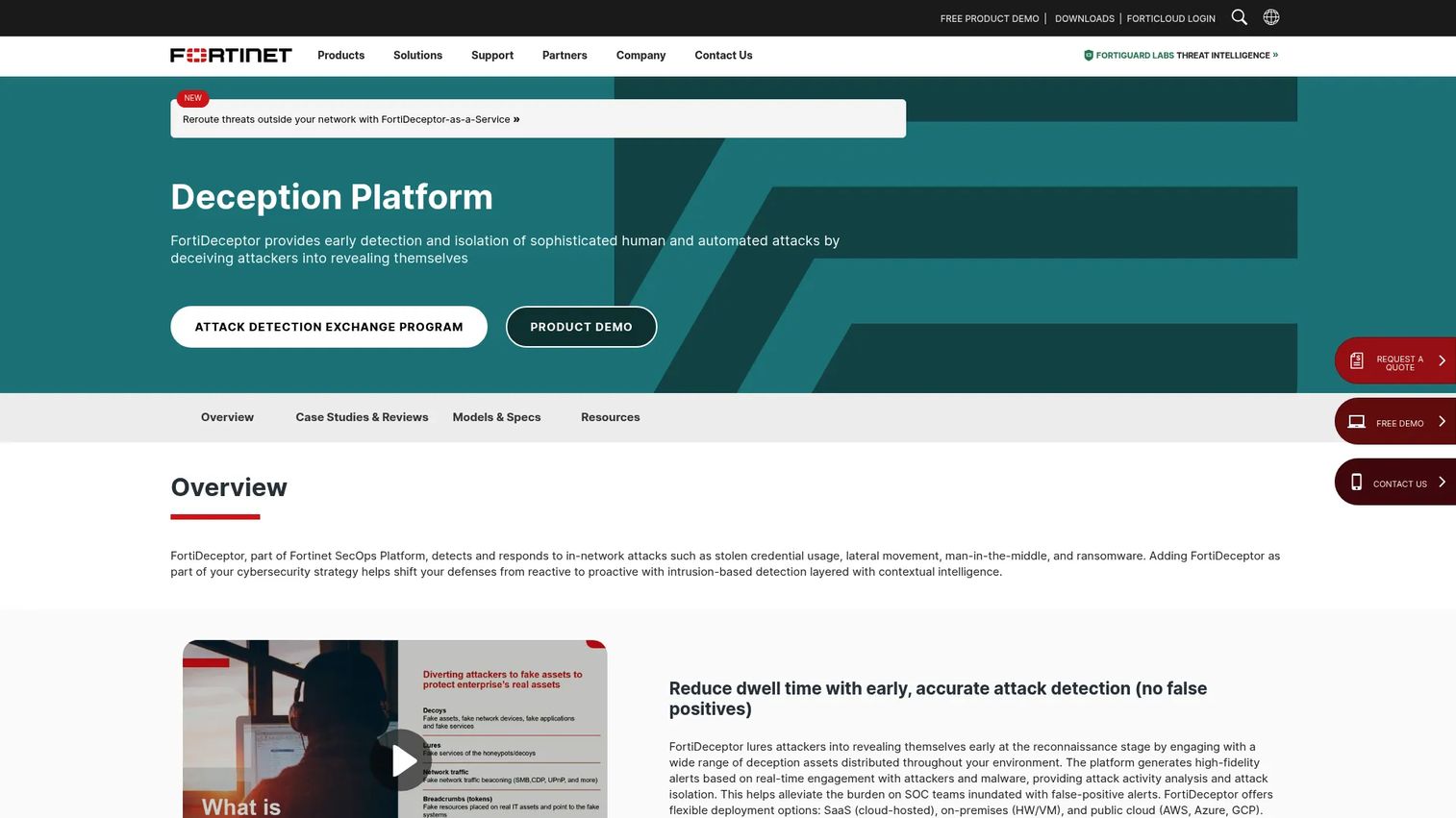
FortiDeceptor is Fortinet's deception-based breach protection product. It builds a network of decoy VMs and deception tokens that lure attackers into engaging, then detects, analyzes, and isolates the activity early. Its strongest fit is inside larger security operations, especially teams already running a Fortinet-centric stack.
Best for: Enterprises and OT operators that want deception-driven detection integrated into a broader security fabric with automated response.
Key strengths
- Decoy VMs and deception tokens: a network of decoys plus planted tokens catches attackers during reconnaissance and lateral movement.
- Automated containment: compromised endpoints can be quarantined automatically, which shortens the window between detection and response.
- Deep integration: connects to the Fortinet Security Fabric and third-party SIEM, SOAR, and EDR tools, so deception signals reach the rest of the SOC.
Why choose FortiDeceptor: The value here is operationalization. Deception alerts are only useful if they trigger action, and FortiDeceptor's automated containment and Security Fabric integration turn a decoy hit into a contained incident. It supports IT, OT, and IoT environments, which makes it a fit for organizations protecting industrial or segmented networks alongside corporate IT.
Pricing: Fortinet does not publish public pricing for FortiDeceptor. Buyers are routed to a sales or request-a-quote flow, so cost depends on deployment scale and environment. Expect deployment options spanning SaaS, on-premises, and public cloud when you scope the quote.
3. Smokescreen
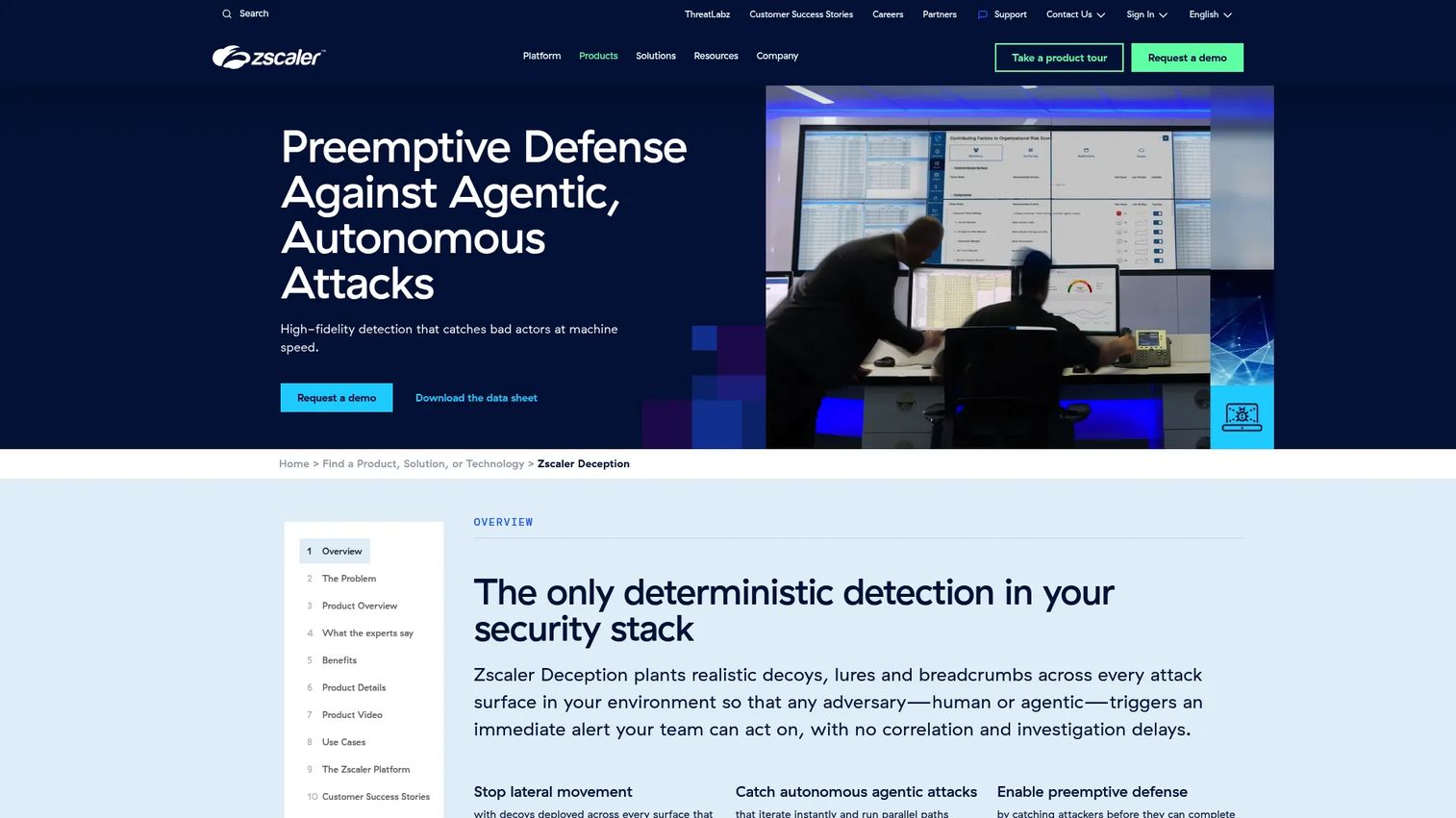
Smokescreen, now delivered as Zscaler Deception, is an active defense platform that scatters realistic decoys, lures, and breadcrumbs across endpoints, network, cloud, and identity systems. The design leans hard on realism to detect and disrupt sophisticated attacks that slip past traditional controls.
Best for: Enterprises that want distributed deception across multiple attack surfaces as part of an active defense strategy.
Key strengths
- Multi-surface decoys: realistic decoys, lures, and breadcrumbs span endpoints, network, cloud, and identity, so coverage is not limited to one layer.
- High-fidelity detection: the platform is built for near-zero false positives, which keeps SOC alert queues clean.
- Tiered capability: Standard and Advanced plans differ in deception and orchestration depth, so teams can match scope to maturity.
Why choose Smokescreen: Being part of the Zscaler portfolio means deception can slot into a broader zero trust and network security posture rather than running as an island. If you want lateral movement detection and credential theft alerts across a distributed enterprise, the breadth of surfaces covered is the draw. Reviewers rate it 4.0/5 on G2.
Pricing: Zscaler lists Deception as a standalone product but does not show a public price. It is sold through a demo or contact-sales motion, so pricing depends on scope and the surfaces you deploy across.
4. Minerva Anti-Evasion Platform
Minerva Anti-Evasion Platform takes a distinct angle on deception. Rather than only planting decoy systems, it deceives evasive malware itself, tricking it into disarming before it can execute. It automatically blocks attacks designed to slip past existing defenses, without relying on signatures, models, or behavioral patterns.
Best for: Enterprises that want anti-evasion endpoint protection against advanced malware and ransomware that defeats conventional tools.
Key strengths
- Anti-evasion by design: blocks attacks built specifically to evade your existing security stack, closing a gap signature-based tools miss.
- No reliance on signatures or models: detection does not depend on prior knowledge of the threat, which helps against novel and evasive samples.
- Lightweight footprint: a light agent keeps operational burden low, and the platform supports malware sandboxing and incident response use cases.
Why choose Minerva: For teams where the real problem is malware that evades EDR, Minerva's deception model turns the attacker's own evasion logic into a trigger. It fits credential theft, lateral movement, and threat-intel workflows on the endpoint, and it pairs well with a larger security team that wants an additional layer against evasive payloads. It holds a 3.8/5 rating on G2.
Pricing: Minerva does not publish public pricing, and G2 notes pricing details are not currently available. Scope cost directly with the vendor based on endpoint count and use case.
5. Labyrinth Cyber Deception Platform
Labyrinth Cyber Deception Platform is a deception-based intrusion detection platform focused on catching attackers inside corporate networks at the earliest stages. It blends high-fidelity imitations of IT services and fake artifacts into the real infrastructure so an adversary's movements do not go unnoticed, with a deliberate emphasis on keeping false positives low.
Best for: Security teams that want early, high-interaction network deception for enterprise or segmented environments.
Key strengths
- Early-stage detection: designed to surface malicious activity at the earliest phase of an attack, before it reaches production systems.
- High-interaction decoys: convincing imitations of IT services and fake artifacts keep attackers engaged and generate rich forensic detail.
- Automated response and reporting: incident logging and automated response help teams act on a decoy hit quickly.
Why choose Labyrinth: The combination of high-interaction decoys and a low false-positive design makes Labyrinth a strong network deception option for teams that want believable traps without a flood of noise. It fits enterprise visibility goals and segmented networks where you need clear signal about lateral movement. It carries a 4.9/5 rating on G2 across its reviews.
Pricing: Labyrinth does not publicly disclose pricing on its site. Plan to scope cost directly with the vendor based on network size and decoy coverage.
6. LMNTRIX
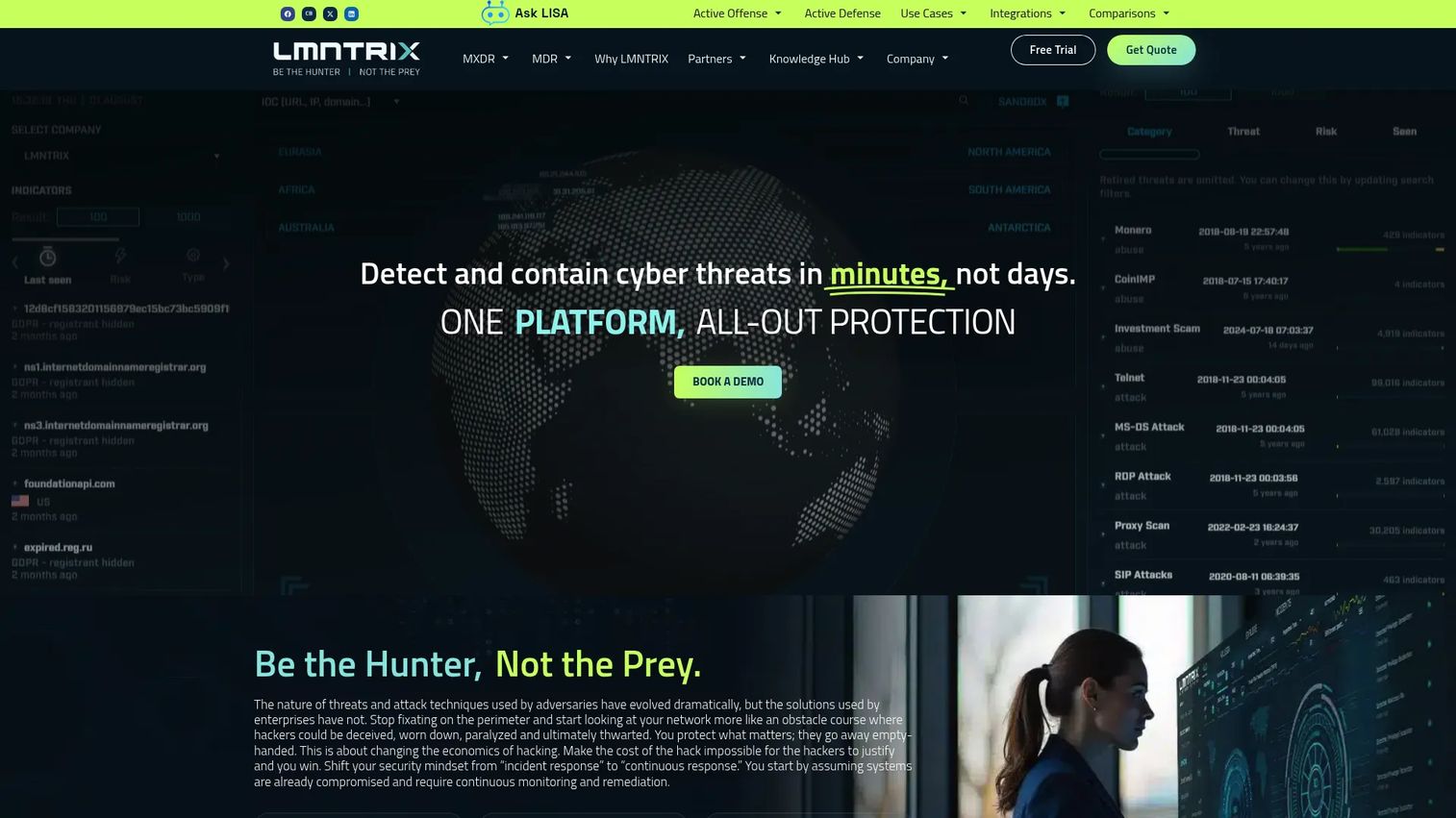
LMNTRIX approaches deception as one capability inside a broader managed detection and response service. Its XDR spans endpoint, network, cloud, mobile, deception, and threat intelligence, backed by 24/7 monitoring, investigation, containment, and remediation. For teams that want detection outcomes rather than another console to staff, that managed model is the appeal.
Best for: Organizations that want deception embedded in a managed XDR/MDR service rather than a self-run platform.
Key strengths
- Deception inside XDR: deception is one of several detection domains, so decoy signals are correlated with endpoint, network, and cloud telemetry automatically.
- 24/7 managed operations: monitoring, investigation, containment, and remediation are handled by the service, which offloads SOC workload.
- Automated response and root-cause analysis: alerts come with context and remediation, not just a notification.
Why choose LMNTRIX: If your team lacks the headcount to run and tune a deception platform in-house, LMNTRIX folds it into a managed service that accelerates response. Deception signals are enriched by the wider XDR context, which speeds investigation and root-cause analysis. It holds a 4.9/5 rating on G2, and the vendor offers a free trial to evaluate the service.
Pricing: LMNTRIX does not display public pricing. The site notes cost varies by deployed endpoint agents and network architecture, and directs buyers to request a quote, with a free trial available.
7. BOTsink

BOTsink, from Attivo Networks, is a deception platform built for inside-the-network threat detection. It stands guard within the environment, using high-interaction deception and decoy technology to lure attackers into engaging and revealing themselves. Once an adversary interacts, it captures the forensic detail security teams need to respond.
Best for: Organizations that want to detect and analyze in-network threats through high-interaction deception, beyond simple honeypots.
Key strengths
- High-interaction deception: decoys are designed to draw attackers into real engagement, which produces stronger signal than passive honeypots.
- Inside-the-network detection: the platform focuses on threats that have already bypassed the perimeter, catching lateral movement in progress.
- Forensic visibility: attacker engagement is recorded, giving analysts the detail to understand tooling and intent.
Why choose BOTsink: For teams that have outgrown standalone honeypots and want richer attacker engagement, BOTsink's high-interaction model delivers the forensic depth that turns a detection into an investigation. It fits environments where catching in-network movement and building threat intelligence matter more than perimeter alerts. Reviewers rate it 4.0/5 on G2.
Pricing: No public pricing or plan detail is available for BOTsink on its first-party site. Scope cost directly with the vendor.
8. 8i

8i appears on some deception-related shortlists, but buyers should verify category fit before spending evaluation time. 8i's publicly documented product is volumetric video and hologram technology for capturing, transforming, and streaming immersive 3D experiences, which is a different domain from network deception. If you encountered 8i in a deception context, confirm the specific product and scope directly before proceeding.
Best for: Buyers who need to confirm exactly what deception capability, if any, is on offer before evaluation.
Key strengths
- Documented capture and streaming stack: the verified product line covers hologram capture hardware and software, ML-based transformation, and streaming to browsers and headsets.
- Direct-quote model: pricing is demo or quote-based, so scope is defined per engagement.
- Clear verification path: the vendor directs buyers to contact the company or schedule a demo, which is where you should confirm deception relevance.
Why choose 8i: Include 8i only after you have confirmed a deception offering that matches your requirements. The publicly verifiable product is not network deception software, so the honest recommendation is to treat this as a due-diligence step rather than a shortlist finalist. It carries a 4.5/5 rating on G2 based on a small number of reviews.
What to verify: Ask the vendor to define the exact deception product, its decoy types, alerting model, deployment options, and integration with SIEM/SOAR/EDR. Confirm whether it covers cloud, on-premises, or OT before scheduling a technical deep-dive.
Pricing: No public pricing is shown on the 8i site; the company directs visitors to contact sales or schedule a demo.
Considerations before you buy
A deception platform is only as good as its fit with your environment and your SOC workflow. Run every shortlisted tool through these criteria before committing.
Decoy realism and dynamic deception
A skilled adversary fingerprints static honeypots quickly. Evaluate how convincing each vendor's decoys, lures, and fake artifacts are, and whether they adapt as your environment changes. Ask for dynamic deception or AI-driven decoy generation if your threat model includes sophisticated attackers.
Alert quality and false-positive rate
The whole point of deception is high-signal detection. Validate the false-positive rate in a pilot, not a slide. Confirm that a decoy interaction produces an actionable alert with enough context to investigate, rather than another line in the queue.
Deployment model and environment coverage
Match the tool to your environment: cloud and identity, on-premises networks, endpoints, or OT and segmented systems. Verify supported deployment options, whether SaaS, on-premises VM, or public cloud, and confirm the platform can cover the surfaces where your risk actually sits.
Integration depth
Deception signals need to reach the rest of your stack. Confirm native integration with your SIEM, SOAR, and EDR, and check whether the platform supports automated containment. A decoy hit that cannot trigger response workflow is a wasted signal.
Operational overhead
Consider who tunes and maintains the platform. Self-run tools give you control; managed services offload the work. Weigh your team's headcount and expertise against the model each vendor offers before you scope seats or agents.
Conclusion
The right deception technology software depends on where your risk sits and how you want to run it.
- For cloud and identity-first attack surfaces, Tracebit's canary model delivers high-fidelity detection with a free entry point.
- For enterprise and OT environments that need deception tied to automated response, FortiDeceptor and Smokescreen integrate deception into broader security operations.
- For network intrusion detection with believable, high-interaction decoys, Labyrinth is a strong shortlist candidate, and BOTsink suits teams that have outgrown standalone honeypots.
- For endpoint anti-evasion, Minerva turns evasive malware against itself, and for teams that want detection as a service, LMNTRIX folds deception into managed XDR/MDR.
Verify 8i's category fit before committing evaluation time to it.
The next step is a scoped pilot. Shortlist two or three tools, validate decoy realism and false-positive rate in your own environment, and confirm the integration path into your SIEM and SOAR. Deception earns its place by producing signal you can act on, so prove that in a pilot before you sign.
FAQs
Deception technology software deploys fake assets, such as decoys, traps, lures, honeypots, and false credentials, across an environment to detect attackers. Because no legitimate user has a reason to interact with these planted assets, any interaction is a strong indicator of malicious activity. This produces high-fidelity alerts and adds a detection layer that complements EDR, SIEM, and firewalls.
It plants decoys and breadcrumbs in the paths attackers use during reconnaissance and lateral movement. When an adversary scans a decoy, uses a planted credential, or connects to a fake service, the platform logs the interaction and alerts. High-interaction decoys go further and record the attacker's tools and commands for forensic analysis.
A honeypot is typically a single, standalone decoy system used to observe attackers. Deception technology orchestrates decoys, lures, and breadcrumbs at scale across the entire environment, with centralized alerting, automated response, and integration into the broader security stack. In short, honeypots are one tactic; modern deception is a coordinated detection layer.
Yes, structurally. Traditional detection watches real assets and must separate malicious behavior from normal work, which generates noise. Deception assets have no legitimate use, so interaction with one is the anomaly itself. That is why teams running deception typically report high-signal alerts and less analyst time spent on triage.
Deception is effective against lateral movement, credential theft, insider threat, reconnaissance, and post-perimeter activity that has already bypassed initial defenses. Planted credentials catch credential theft the moment they are used, decoys catch scanning and lateral movement, and high-interaction traps enrich threat intelligence on attacker tooling and intent.
Very. OT and industrial networks are hard to monitor with agents, and active scanning can disrupt fragile systems. Deception is passive: decoys sit in the network and wait for interaction, so it adds detection without touching sensitive processes. Platforms that support IT, OT, and IoT environments are the ones to prioritize for segmented or air-gapped networks.
When an attacker engages a high-interaction decoy, the platform can record their behavior: the commands they run, the tools they deploy, and the paths they take. That behavioral record enriches threat intelligence, informs incident response, and helps teams understand the adversary rather than simply block a single indicator. Over time this builds a clearer picture of the threats targeting you.
Prioritize decoy realism and dynamic deception, alert quality and a validated low false-positive rate, deployment coverage for your environment (cloud, on-premises, OT), and integration depth with your SIEM, SOAR, and EDR. Also weigh operational overhead: decide whether a self-run platform or a managed service fits your team's headcount and expertise, then validate the top candidates in a scoped pilot before you buy.