
You issued 4,000 certificates last quarter. Someone forwarded a screenshot of one to a hiring manager, and the hiring manager had no way to confirm it was real. Then a recipient emailed asking why their certificate PDF wouldn't open on mobile. Then your ops lead spent a full afternoon re-running a mail merge because 200 names imported wrong.
That is what manual credential issuance costs at scale: not one big failure, but a slow tax on trust and time.
Digital credential management software fixes the underlying problem. It turns certificates and badges into verifiable, tamper-resistant records with public verification pages, automated issuing, and analytics on who shared what. The category matters more in 2026 because credentials are now infrastructure, not marketing collateral. According to The Business Research Company, the digital credential management software market grows from $2.58B in 2025 to $2.91B in 2026, a 12.7% rate, on its way to $4.36B by 2030. Industry Research Biz reports that around 60% of organizations now treat digital credentialing as essential to their identity frameworks.
If you run a certification program, a customer training track, or a partner enablement motion, credential software is the piece that makes issuance repeatable without routing every request through a person. The same instinct that makes teams adopt interactive demos for buyer education, digital adoption platforms for activation, or community management tools for engagement applies here: build the system once, then let it run. Tools like these usually pair with marketing analytics and a customer data platform so you can see what your programs actually produce.
What's inside
This guide is for founders, ops leaders, L&D teams, and certification owners who need to design, issue, manage, store, verify, and share digital credentials without piling on manual work. We picked eight tools that cover the full workflow, from small programs to enterprise governance.
We evaluated each product on six criteria that matter for a real credential program:
- Verification strength: public verification pages, fraud resistance, tamper-evident records
- Standards support: Open Badges 3.0 and W3C Verifiable Credentials
- Automation: bulk issuing, LMS and CRM triggers, API and webhooks
- Security and compliance: data protection, SOC 2, ISO 27001, GDPR posture
- Integrations: LMS, CRM, and analytics connectivity
- Brand control: white-label, custom domains, and recipient experience
TL;DR
- Best overall for program growth: Accredible pairs branded credentials with pathways and learner analytics, strong for teams scaling certification.
- Best for enterprise recognition and network scale: Credly connects credentials to a wide employer network and skills-based programs.
- Best for fast, simple rollout: Certifier ships a free tier and clean certificate automation for teams that want credential ops running this week.
- Best for enterprise-friendly verification: CertifyMe covers QR verification, bulk issuance, and analytics with a yearly subscription model.
- Best for education and records: Parchment handles transcripts, diplomas, and institutional credential exchange better than marketing-led platforms.
- Best value for L&D teams: Sertifier offers a free tier with 250 recipients per year plus open-standard verification and automation.
What is digital credential management software?
Digital credential management software is a platform for designing, issuing, managing, storing, verifying, and sharing digital certificates and badges as tamper-resistant, verifiable records. It replaces manual PDF workflows with automated issuance, public verification, and analytics.
A quick vocabulary check, because the terms get muddled:
- Digital credentials: the umbrella term for any issued, verifiable proof of achievement or status.
- Certificates: document-style credentials, often designed to look like a printable award.
- Badges: compact, metadata-rich credentials built for sharing on profiles and social platforms.
- Verification pages: public URLs where anyone can confirm a credential is authentic and unrevoked.
- Open standards: shared specifications so credentials work across platforms instead of being locked to one vendor.
- Interoperability: the practical result of open standards, where a badge issued in one system verifies in another.
Two standards define the 2026 conversation. Open Badges 3.0 is the widely adopted specification for portable, metadata-rich badges. W3C Verifiable Credentials is the broader cryptographic framework for tamper-evident, machine-verifiable credentials that a recipient controls. A serious digital credential platform should support at least one, and increasingly both, because portability is what keeps you from being trapped in a single vendor.
Core capabilities to expect from any credential management software:
- Automated, secure credential issuance in bulk
- Public verification pages with fraud resistance
- White-label branding and custom domains
- LMS integration and CRM connectivity
- API and webhooks for programmatic issuing
- Credential analytics on issuance, opens, and shares
- Lifecycle governance: expiry, renewal, and revocation
These tools matter in 2026 because credentials are increasingly a trust signal that employers, partners, and regulators check directly. When a credential can be verified in one click and shared to LinkedIn without losing its proof, it stops being a nice-to-have and starts doing real work.
When to use digital credential management software
Scale certification or training programs
The trigger: your program outgrew spreadsheets. When you issue hundreds or thousands of credentials per cohort, manual design and delivery breaks down. Digital badge software automates issuing, ties into your LMS, and gives each recipient a shareable, verifiable credential. Success looks like a cohort of 2,000 receiving branded, verifiable credentials the day they finish, with zero manual mail merges.
Replace manual certificate issuance and verification
The trigger: someone asks you to prove a certificate is real and you can't. Manual PDFs have no verification layer, so fraud is trivial and confirmation is impossible. Credential verification software gives every credential a public verification page and a tamper-evident record. Success looks like a hiring manager or partner confirming authenticity in seconds, without emailing your team.
Standardize brand-safe, shareable credentials across teams
The trigger: three teams issue three different-looking certificates. Inconsistent credentials erode brand trust and confuse recipients. Certificate management software with white-label controls and custom domains keeps every credential on-brand and easy to share. Success looks like one credential template system, consistent across training, partner, and customer programs, that recipients actually post.
Comparison table
Here are the eight tools ranked by fit for a growth-minded credential program. Read pricing as public list price where available; several vendors gate higher tiers behind sales, so treat "custom" as a signal to scope your recipient volume before the call. Ratings reflect current G2 listings and should be checked against the live page before you buy.
| # | Product | Intent | Key differentiation | Pricing | G2 rating |
|---|---|---|---|---|---|
| 1 | Accredible | Program growth with branded credentials | Pathways, learner analytics, white-label | From $45/mo (Launch); custom higher tiers | 4.7/5 |
| 2 | Credly | Enterprise recognition and network reach | Employer network, skills-based programs | Request a quote | 4.8/5 |
| 3 | Certifier | Fast, simple credential ops | Free tier, clean certificate automation | Free; Pro $67/mo; Advanced $339/mo | 4.6/5 |
| 4 | CertifyMe | Enterprise-friendly issuance | QR verification, bulk issuing, analytics | Free StartUp; paid tiers by quote | 4.8/5 |
| 5 | Parchment | Education and records exchange | Transcripts, diplomas, institutional fit | Quote-based | 4.1/5 |
| 6 | Sertifier | Scalable L&D credentialing | Free tier, open-standard verification | Free; Pro $250/yr; Enterprise custom | 4.8/5 |
| 7 | Give My Certificate | Bulk certificates at smaller scale | QR verification, API, white-label options | Free tier; Basic $99/yr; custom | 5.0/5 |
| 8 | Virtualbadge.io | Straightforward badge and certificate issuance | Cryptographic signing, drag-and-drop design | From €26/mo (Lite); Enterprise custom | 4.8/5 |
1. Accredible
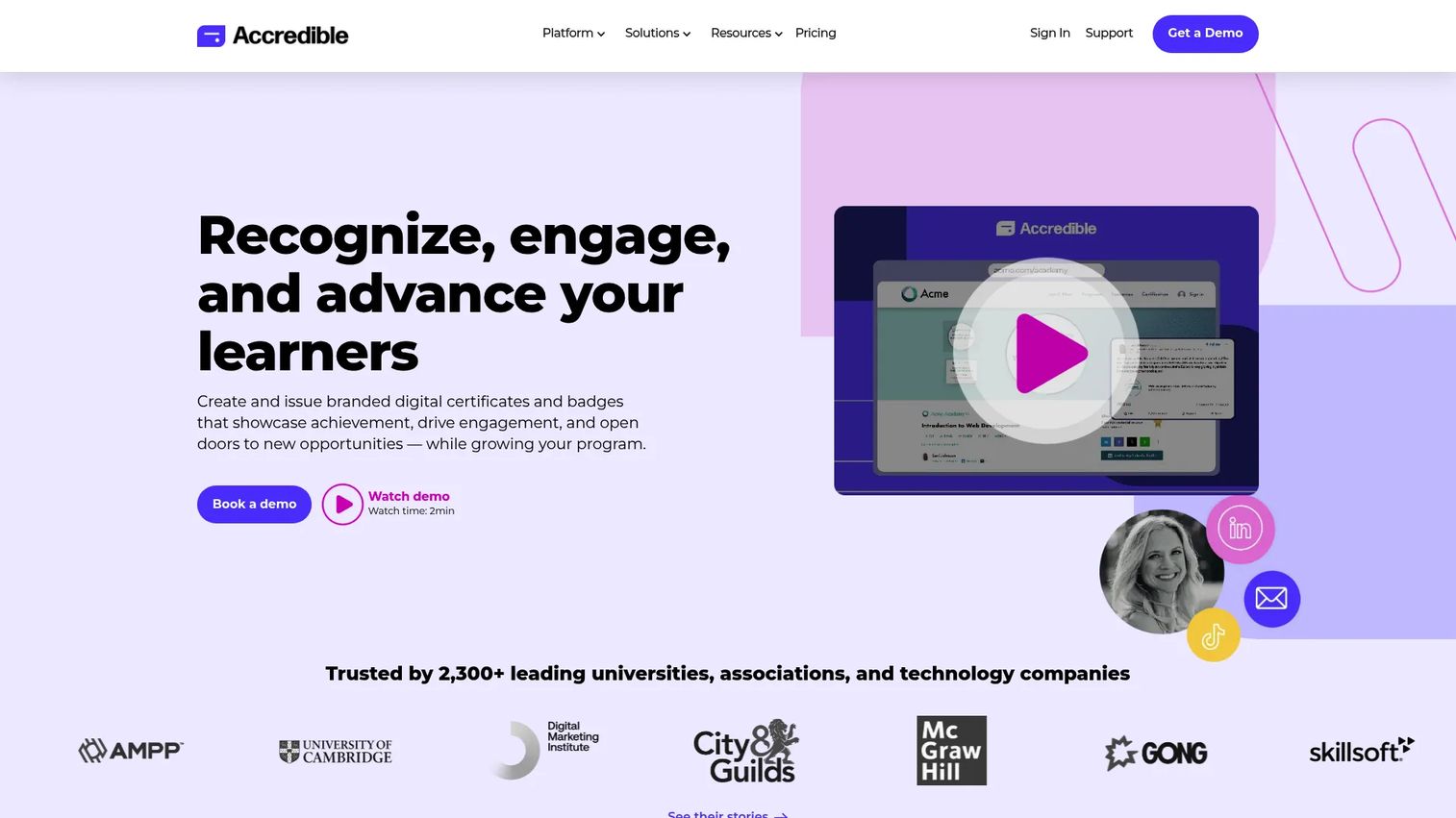
Accredible is a digital credential platform built for issuing, managing, and tracking badges and certificates at scale. It leans hard into program growth: alongside issuance and verification, it offers pathways that group multiple credentials into a learning journey, plus analytics on how learners engage and share. For teams whose credentials are part of a broader education or certification motion, that combination does real work.
Best for: education, training, and certification teams that need branded digital credentials issued at scale.
Key strengths
- Verifiable badges and certificates: every credential comes with a public verification page and tamper-resistant record.
- White-label credential experiences: branding controls keep the recipient experience on your domain and on-brand.
- Pathways and analytics: group credentials into pathways and track learner engagement and sharing.
Why choose Accredible: pick it when credentials are a growth lever, not just a formality. The pathways model suits programs where one credential leads to the next, and the analytics help you prove which credentials actually get shared. If you only need to fire off a few certificates a month, this is more platform than you need, and a lighter tool will get you there faster.
Accredible pricing: a free trial is available. The Launch plan starts at $45 per month on a 12-month term, billed monthly, and plans are priced by unique recipients per year. Higher Connect and Growth tiers are custom, so scope your annual recipient volume before you talk to sales. On verification, credentials carry public verification pages by default.
2. Credly
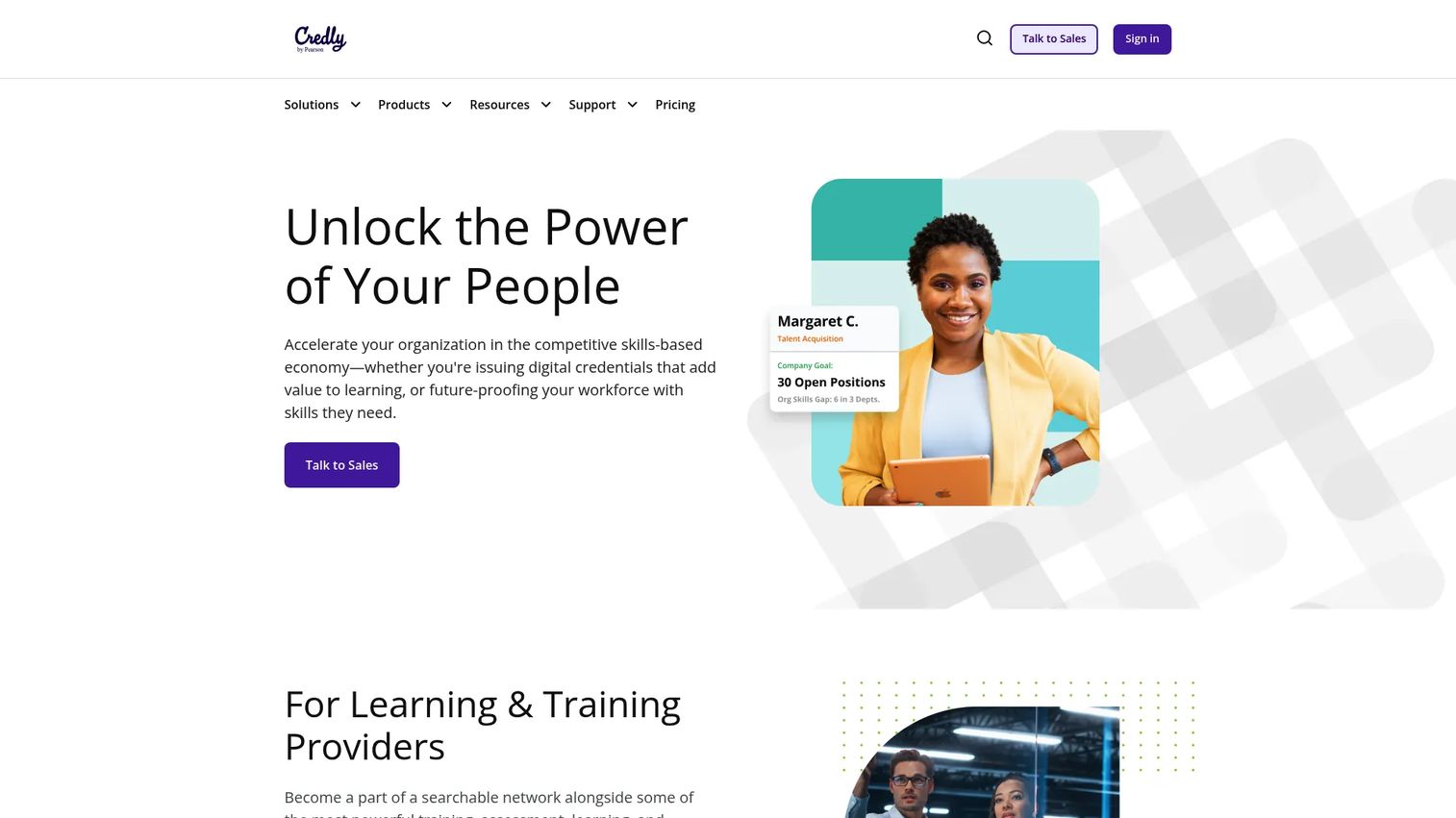
Credly is one of the most recognized names in digital credentialing, with a platform for issuing, managing, and sharing badges and certificates. Its differentiator is network scale: Credly badges are widely recognized by employers, which matters when your recipients want their credential to carry weight on a resume or LinkedIn profile. It fits organizations running skills-based credential programs where employer recognition is the point.
Best for: organizations that need a widely recognized digital credentialing and badge management platform.
Key strengths
- Credential issuance and management: issue and manage badges and certificates from a central platform.
- Badge sharing and verification: recipients share verifiable badges to social and professional profiles.
- Analytics and reporting: track issuance, acceptance, and sharing across your programs.
Why choose Credly: choose it when recognition and reach matter more than anything else. The network effect is the value here, and few competitors match it for employer familiarity. On governance, an enterprise buyer should confirm data ownership, revocation controls, and export terms, because portability of the underlying credential is what protects you long-term.
Credly pricing: pricing is not publicly listed. The site asks visitors to request a quote, so plan for a sales conversation and scope your recipient volume and governance needs ahead of it. Given the lack of public tiers, ask directly about seat structure, per-credential costs, and contract length.
3. Certifier
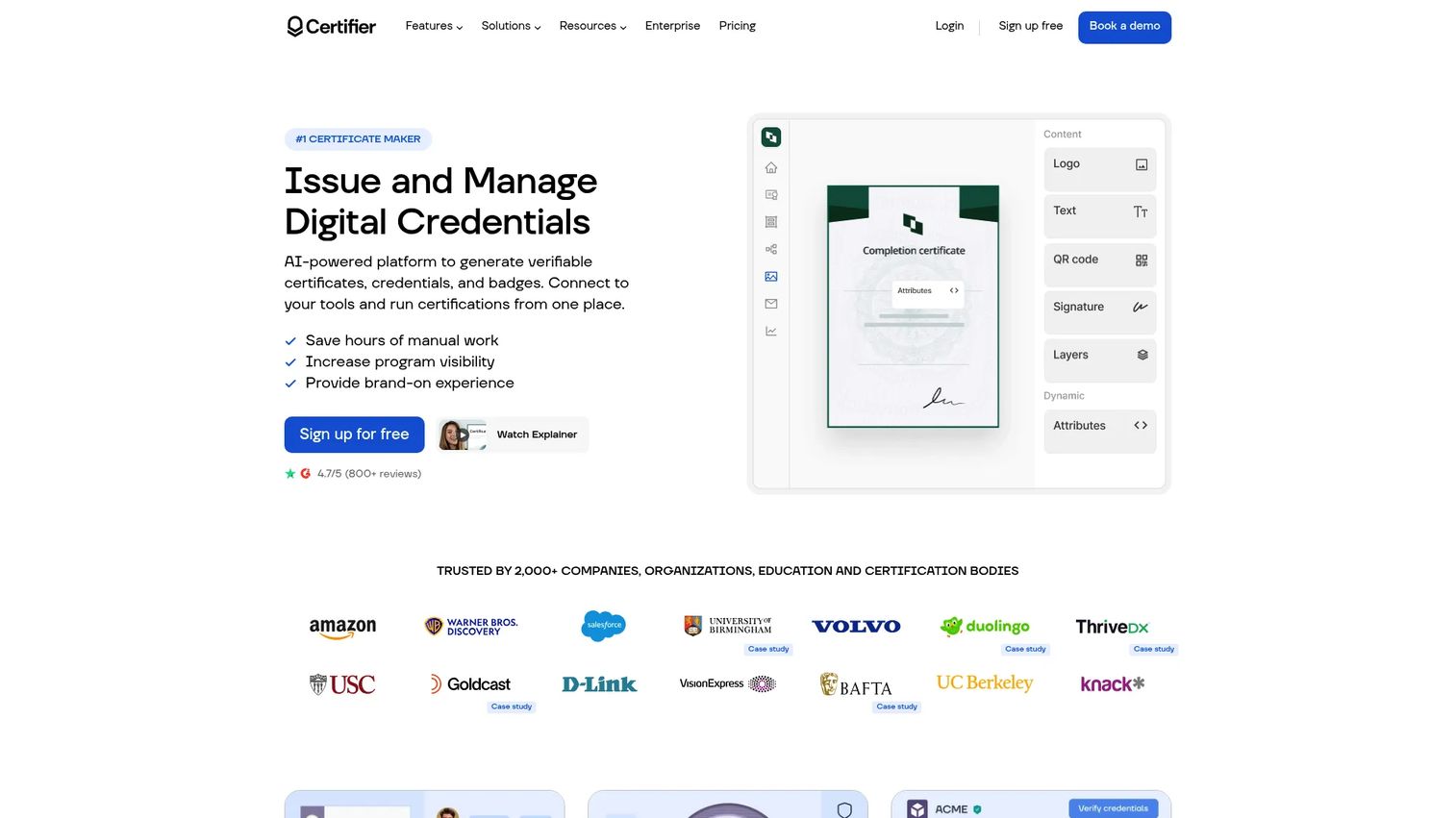
Certifier is a digital credential platform for creating, issuing, verifying, and tracking certificates and badges, built for teams that want credential ops running quickly. It combines certificate and badge creation, bulk issuing and delivery, plus verification and analytics in a package that does not demand a long implementation. The free-forever tier makes it easy to test with a real workflow before committing.
Best for: organizations that need branded digital certificates and badges with verification and bulk issuance, fast.
Key strengths
- Certificate and badge creation: design branded credentials without a designer in the loop.
- Bulk issuing and delivery: send credentials to a full cohort in one pass.
- Verification and analytics: public verification plus data on opens and shares.
Why choose Certifier: pick it when speed to first issuance matters and you want to prove value before you spend. A free tier plus clean automation makes it a strong starting point for a founder or ops lead standing up credential operations for the first time. If you need deep institutional records or transcript workflows, an education-first platform is the better fit.
Certifier pricing: the Starter plan is free forever. Professional is $67 per month billed annually, and Advanced is $339 per month billed annually. Enterprise is contact-sales. Monthly-billed amounts differ from the annual figures, so confirm the billing cadence that fits your cash timing.
4. CertifyMe
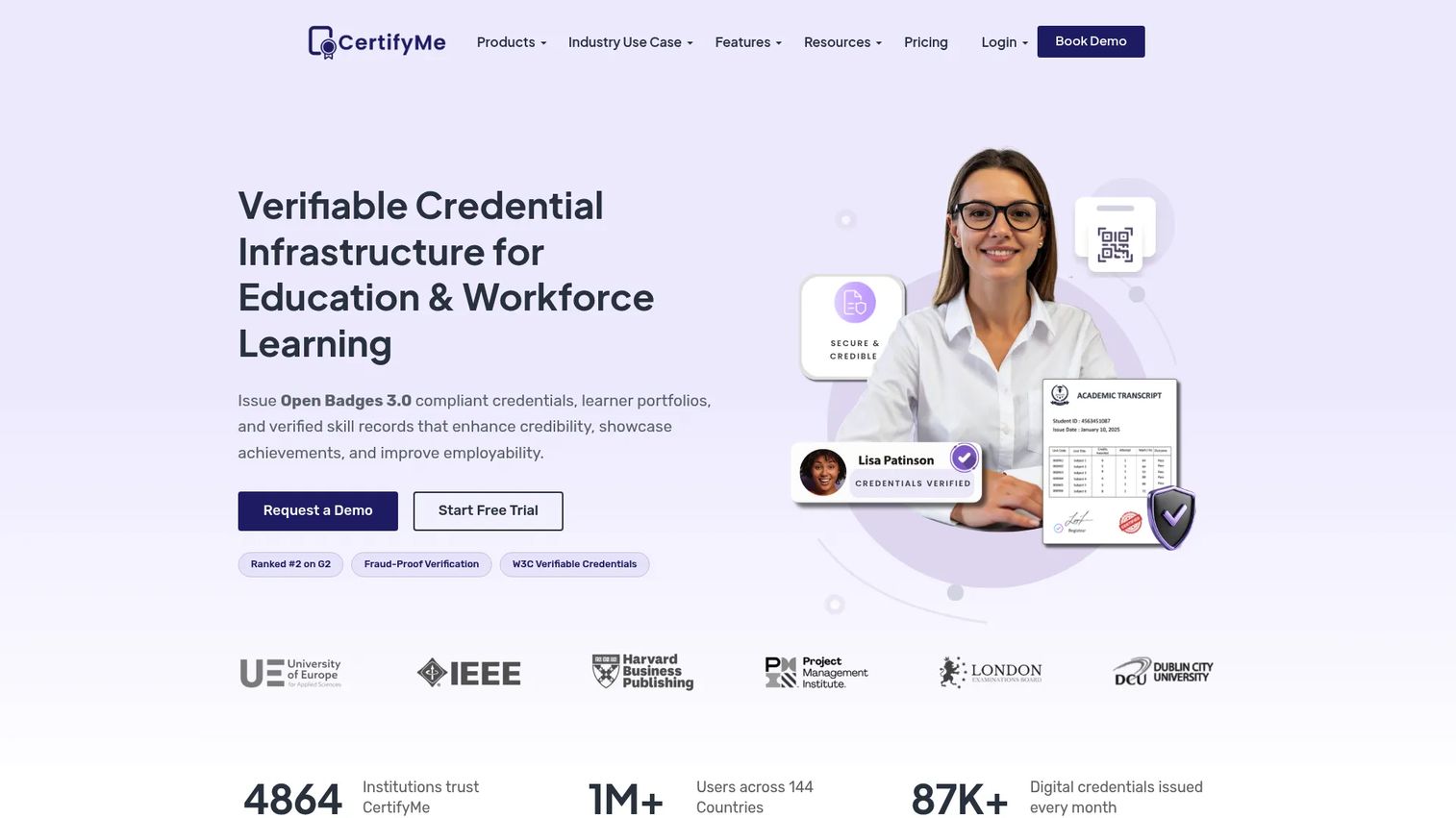
CertifyMe is a digital credential management platform for issuing, managing, and verifying certificates, badges, and related credentials. It focuses on the practical machinery of a credential program: verifiable QR codes with one-click verification, bulk issuance via CSV uploads, and analytics that show engagement. That mix suits institutions and teams that want branded issuance with verification built in.
Best for: institutions and teams that need branded digital credential issuance and verification.
Key strengths
- Verifiable QR codes: one-click verification from the credential itself.
- Bulk issuance and CSV uploads: issue to large cohorts without manual entry.
- Analytics and engagement insights: see how credentials are opened and shared.
Why choose CertifyMe: choose it when you want QR-first verification and multi-channel sharing without heavy setup. It fits teams standardizing issuance across programs. Because paid pricing is gated, factor a sales conversation into your rollout timeline rather than expecting instant self-serve on the top tiers.
CertifyMe pricing: the StartUp plan is free. Signature and Enterprise tiers require contacting sales, and the platform follows a yearly subscription model. No public numeric price is listed for the paid tiers, so ask about recipient limits, verification volume, and integration scope on the call.
5. Parchment
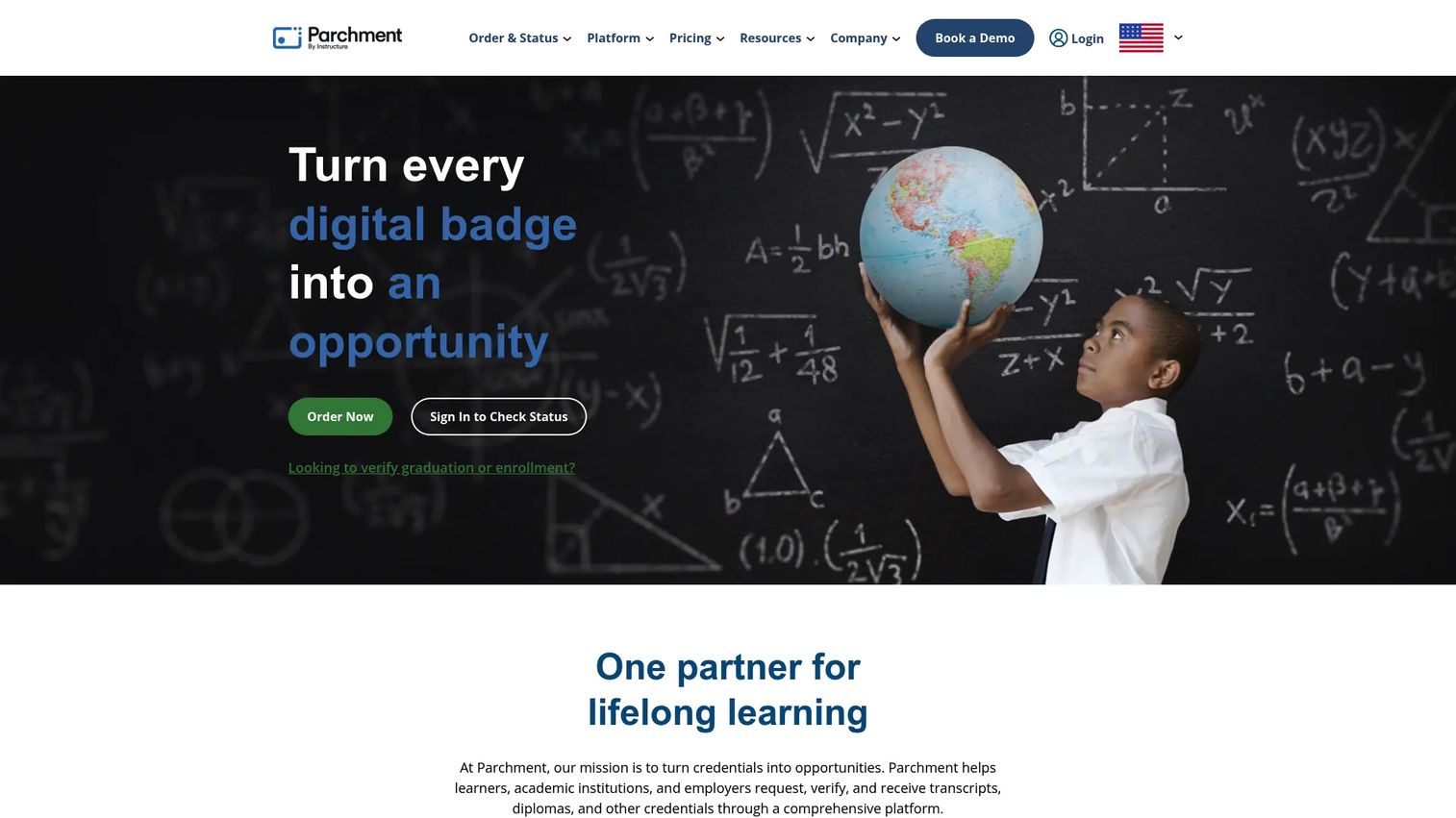
Parchment is a credential and records management platform for sending, receiving, verifying, and issuing transcripts, diplomas, badges, certificates, and related records. It stands apart from the marketing-led tools on this list because it is built for institutions: K-12, higher education, government, and workforce use cases where records exchange and transcript workflows are the core job. If credentials sit next to official academic records, this is the category fit.
Best for: institutions that need a single platform for credential exchange and records workflows.
Key strengths
- Broad credential issuing: covers K-12, higher ed, government, workforce, and international cases.
- Records management: digitizes and manages institutional records, not just badges.
- Verification and transcript services: diplomas, certificates, and verified transcript exchange.
Why choose Parchment: choose it when your credentials are academic or governmental in nature and need to interoperate with institutional records systems. It fits registrars and workforce programs better than a badge-first marketing tool ever will. If your program is customer training or partner enablement, a lighter, brand-led platform will move faster.
Parchment pricing: pricing is quote-based on the public pricing pages, with no public numeric price listed. Plans route to a "Get a Quote" flow, so expect a scoping conversation around institution size and records volume before you see numbers.
6. Sertifier
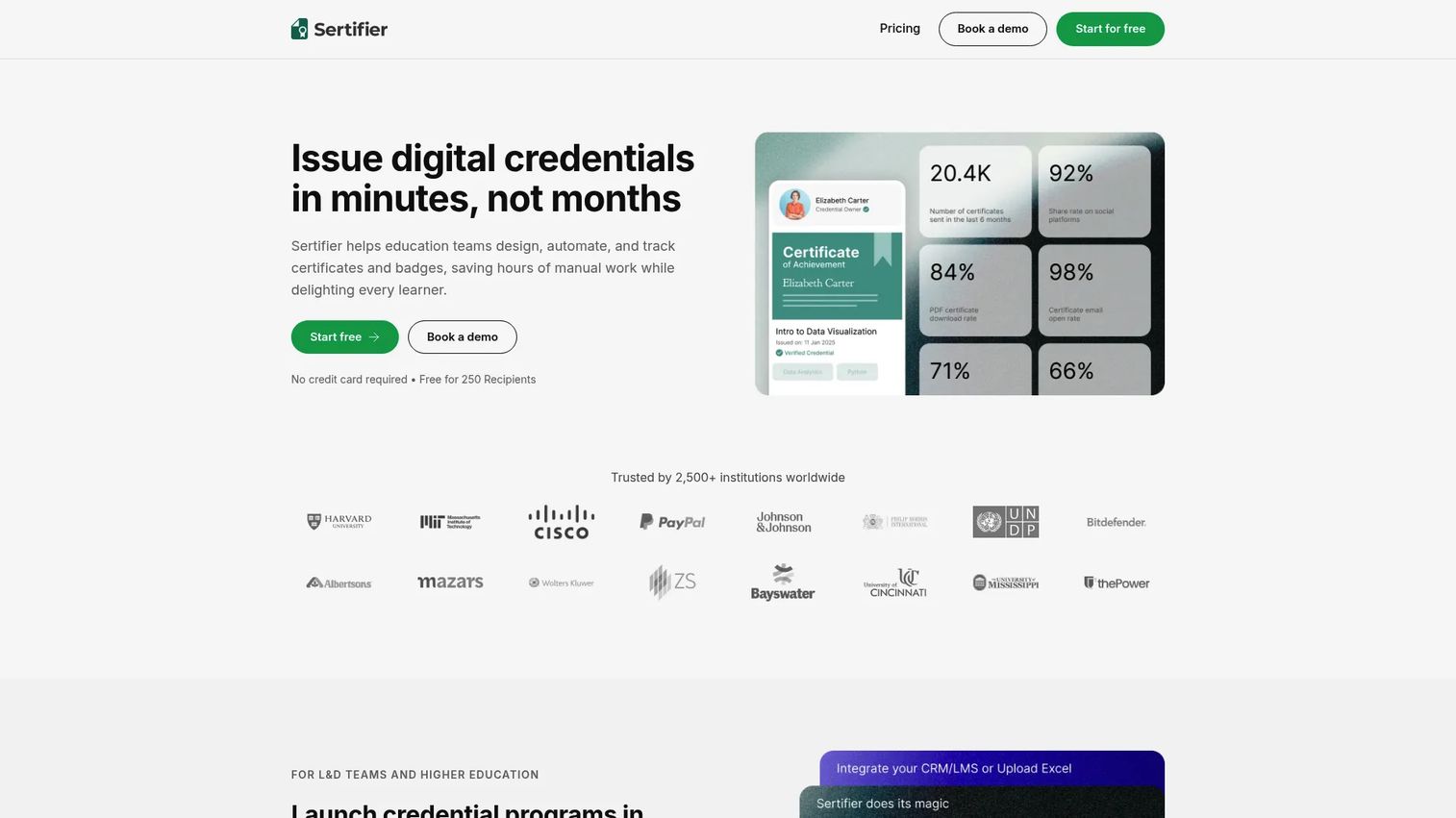
Sertifier is digital credentialing software for issuing, managing, tracking, and verifying certificates and badges, aimed at education and L&D teams that need scalable, verifiable issuance. It automates issuing through LMS, CRM, and API integrations, and every credential gets branding, analytics, and a QR or public verification page. The free tier is generous enough to run a real program before paying.
Best for: education and L&D teams that need scalable, verifiable credential issuance.
Key strengths
- Verifiable certificates and badges: open-standard credentials with public verification pages.
- Automated issuing: fire credentials from LMS, CRM, or API triggers.
- Branding and analytics: QR and public verification plus engagement data.
Why choose Sertifier: pick it when you want open-standard verification and automation without a big upfront spend. The free tier covering 250 recipients per year makes it easy to validate the workflow, and the Pro tier adds a branded portal and advanced analytics. For teams that want white-label and dedicated onboarding, the Enterprise tier layers those on.
Sertifier pricing: the Free plan is $0 per year and includes 250 yearly recipients, unlimited credentials, and core integrations. Pro is $250 per year and adds a branded portal, branded email, advanced analytics, and priority support. Enterprise is custom and adds a white-label portal, a dedicated CSM and onboarding, and custom SLAs and security reviews.
7. Give My Certificate
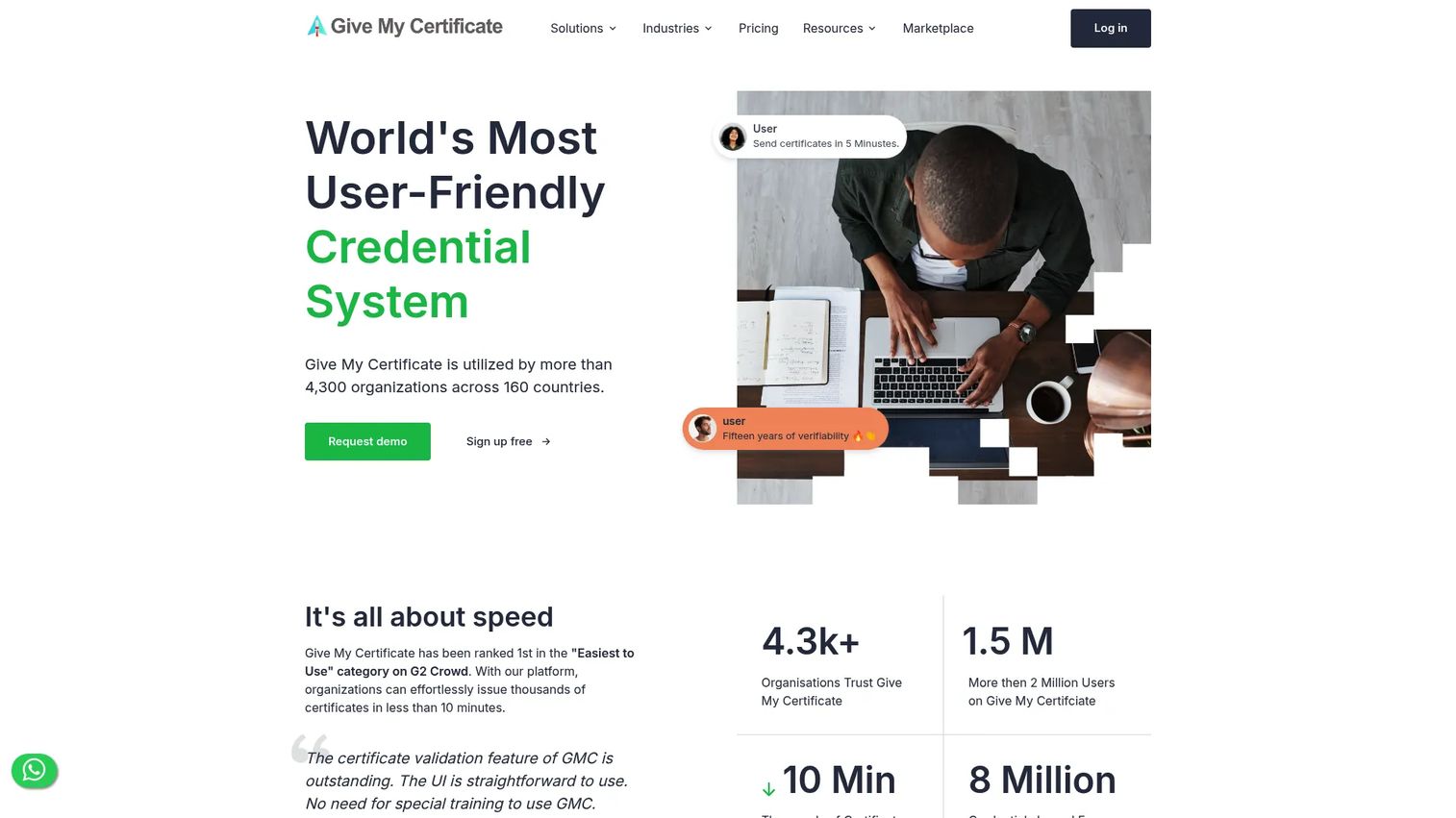
Give My Certificate is a digital credential platform for issuing and verifying certificates and badges, with a practical focus on getting bulk certificates out the door. It offers verifiable QR-code certificates, API and custom integrations, and email or white-label branding options. For smaller programs that still need real verification and the option to bulk-issue, it hits a useful middle ground.
Best for: organizations needing bulk, verifiable digital certificates and badge issuance.
Key strengths
- Verifiable QR-code certificates: every certificate carries a scannable verification path.
- API and custom integrations: automate issuing and connect to your stack.
- Branding options: email branding and white-label controls on higher plans.
Why choose Give My Certificate: choose it when you want straightforward, verifiable certificate issuance at a modest price point, with room to add white-label as you grow. It suits smaller teams and lean programs. As volume and governance needs climb, evaluate whether the white-label and custom tiers cover your requirements before you scale on it.
Give My Certificate pricing: a free tier includes 10 certificates per month. The Basic plan is $99 per year. White Label and Custom plans require contacting sales. The pricing page offers a currency selector, so confirm your currency and the exact plan limits before purchase.
8. Virtualbadge.io
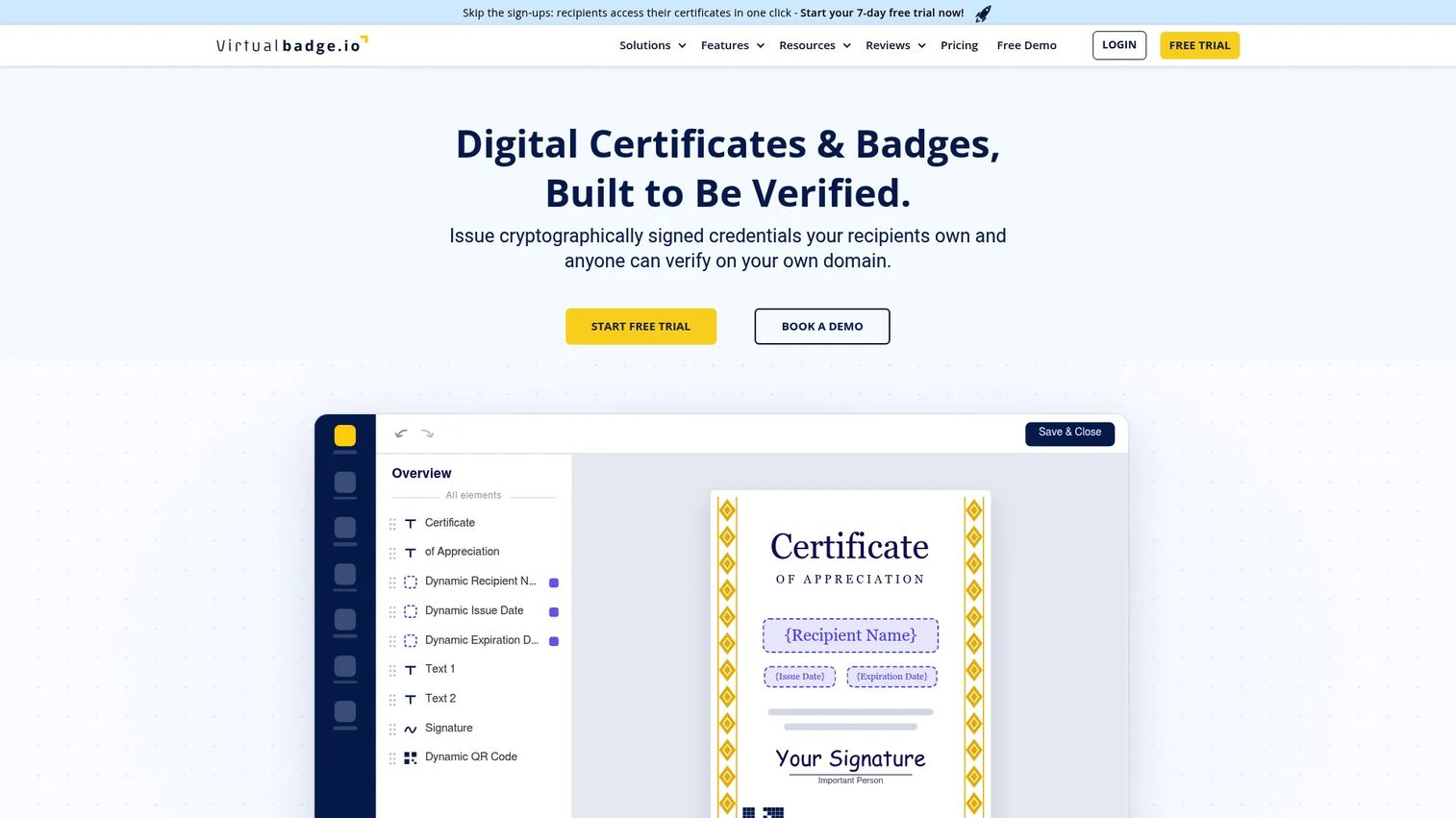
Virtualbadge.io is digital credentialing software for creating, issuing, verifying, and sharing certificates and badges, built for teams that want a clean, straightforward workflow. It issues cryptographically signed credentials with QR or branded verification pages, offers drag-and-drop credential design with template upload, and automates issuing through LMS, CRM, CSV, and API. For smaller teams or uncomplicated programs, it gets you from design to issued fast.
Best for: organizations that need verifiable digital certificates or badges with sharing and automation features.
Key strengths
- Cryptographically signed credentials: tamper-evident records with QR or branded verification pages.
- Drag-and-drop design: build credentials or upload your own template.
- Automation and integrations: LMS, CRM, CSV, and API-driven issuing.
Why choose Virtualbadge.io: pick it when you want cryptographic verification and simple design without a steep learning curve. It fits teams that value speed to a polished, verifiable credential. For programs that need deep lifecycle governance and institutional records exchange, a heavier platform will cover more of those edge cases.
Virtualbadge.io pricing: a 7-day free trial is available. The Lite plan starts at €26 per month billed annually, Growth is €49 per month billed annually, and Plus is €75 per month billed annually. Enterprise is custom. The English pricing page also shows USD figures, so confirm your billing currency before committing.
Considerations before you buy
Use this checklist to pressure-test any digital credential management platform before you commit.
Verification and fraud resistance
Confirm that every credential gets a public verification page and a tamper-evident record. Ask how revocation works, because a credential you cannot revoke is a liability. Fraud resistance is the whole point of the category, so treat weak verification as a dealbreaker, not a footnote.
Open standards and portability
Check for Open Badges 3.0 and W3C Verifiable Credentials support. Open standards are what keep credentials portable, so recipients can carry them across platforms and you avoid vendor lock-in. If a tool issues only proprietary formats, factor migration risk into your decision.
Automation and integrations
Look for LMS integration, CRM connectivity, and API and webhooks. Automation is what removes manual ops debt, so verify the tool triggers issuance from the systems you already run. Confirm the specific LMS and CRM connectors you need exist today, not on a roadmap.
Security, privacy, and compliance
Ask for the security posture directly: SOC 2, ISO 27001, GDPR, and CCPA where relevant, plus FERPA and COPPA if you touch education or minors. Where credentials contain personal data, confirm data residency and retention terms. Compliance gaps surface late and cost more the further you scale.
Brand control and recipient experience
Evaluate white-label, custom domains, and how the recipient experiences the credential. A credential that is hard to view or share on mobile will not get posted, which defeats the recognition goal. Brand control is not vanity, it is trust and reach.
Lifecycle governance and vendor stability
Check expiry, renewal, and revocation controls, plus how you export credentials if you leave. Vendor stability and clean export terms limit migration risk, so ask about data ownership before signing.
Conclusion
The right pick depends on the job, not a leaderboard. For program growth with branded credentials and learner analytics, Accredible is the strongest all-around fit. For enterprise recognition and employer reach, Credly's network is hard to match. For a fast, low-cost start, Certifier and Sertifier both offer real free tiers so you can validate a workflow this week. For academic and government records, Parchment is the category-correct choice, while CertifyMe, Give My Certificate, and Virtualbadge.io cover verifiable issuance for teams that want a clean, direct path.
Here is the practical next step: narrow to two candidates, one enterprise-ready option and one simpler rollout option, then pilot each with a real issuance workflow. Issue a genuine cohort, test the verification page on mobile, and confirm the automation fires from your LMS or CRM. The tool that survives a real cohort, not a sales deck, is the one to standardize on.
FAQs
Digital credential management software is a platform for designing, issuing, managing, storing, verifying, and sharing digital certificates and badges as verifiable, tamper-resistant records. It replaces manual PDF and spreadsheet workflows with automated issuance, public verification pages, and analytics. The goal is repeatable credential operations without manual ops debt.
Each issued credential gets a unique public URL that anyone can open to confirm the credential is authentic, unrevoked, and issued to the named recipient. The page pulls from the issuer's tamper-evident record, so a screenshot or forged PDF will not verify. Many platforms add a QR code so a credential can be checked in one scan.
Certificates are document-style credentials designed to look like a printable award, useful when recipients want something formal to display. Badges are compact, metadata-rich credentials built for sharing on profiles and social platforms, with the achievement data embedded. Many platforms issue both from the same workflow, and open standards like Open Badges 3.0 apply mainly to badges.
Both matter, and increasingly they work together. Open Badges 3.0 is the widely adopted specification for portable, metadata-rich badges. W3C Verifiable Credentials is the broader cryptographic framework for tamper-evident, recipient-controlled credentials. Prioritize a platform that supports at least one, and favor those moving toward both, because portability protects you from vendor lock-in.
Expect LMS integration for issuing credentials on course completion, CRM connectivity for linking credentials to contacts, and API and webhooks for programmatic issuing. Analytics connections and CSV import for bulk issuance are also common. Confirm the specific connectors you need exist today, since roadmap promises often slip.
Read public list prices where available, and treat "custom" or "request a quote" as a signal to scope your annual recipient volume before the sales call. Start with a free tier or trial and pilot a real issuance workflow before committing. The main implementation risk is migration, so confirm export terms and open-standard support up front.
White-labeling matters when the recipient experience reflects on your brand, which is most customer, partner, and certification programs. Custom domains and branded verification pages increase the chance recipients actually share the credential, which is the recognition payoff. If credentials stay internal, white-label is less critical and you can defer it to a higher tier.
Ask directly for SOC 2, ISO 27001, GDPR, and CCPA posture, plus FERPA and COPPA if you handle education data or minors. Confirm data residency, retention, and revocation controls, and get export terms in writing. A vendor that answers these clearly and quickly is signaling the operational maturity you want behind your credentials.