A missed call is a lost rental. A late invoice is cash you already earned but haven't collected. A dumpster sitting on the wrong job site for three extra days is an asset earning nothing while a paying customer waits.
Run a dumpster rental operation on spreadsheets and phone tag long enough, and every one of those small leaks compounds. You know the drill. Someone calls to book a 20-yard roll-off, your dispatcher scribbles it on a whiteboard, the driver never gets the update, and the container lands late. Meanwhile the office is chasing paper invoices at month-end while three cans sit unaccounted for in a customer's driveway.
The industry is growing fast enough that these leaks cost more every year. U.S. dumpster rental revenue reached $654 million in 2025, up 7.2% year over year, according to IBISWorld. Customers are also moving online: in the adjacent junk removal space, 65% of franchise bookings in 2026 come through online scheduling and mobile apps, per Data Insights Market. Buyers expect to book without picking up the phone, and operators who can't offer that lose demand to the ones who can.
That's the job dumpster rental software is built to do: pull booking, dumpster dispatch software, billing, container tracking, and reporting into one system so orders stop slipping through the cracks. Roll off dumpster rental software has matured a lot, and the right platform depends on your fleet size, your routing complexity, and how much of your day is currently eaten by admin. Below are five dumpster rental services software options worth shortlisting for 2026, with honest notes on who each one fits.
What's inside
This guide is for owners and operators of dumpster and roll-off businesses who are done duct-taping spreadsheets, sticky notes, and separate accounting tools together. It's also for operations leaders evaluating a system to replace phone-tag scheduling and manual invoicing.
We selected the five platforms below based on four things that actually move the needle in daily operations:
- Order capture and booking, including online booking and automated confirmations
- Dispatch and routing, from simple one-truck runs to multi-route optimization
- Billing and tracking, covering invoicing, payments, accounting sync, and container tracking
- Fit and cost, meaning pricing structure, mobile driver support, reporting, and integration depth
No paid placements. Just what each tool does well and who it suits.
TL;DR
Short on time? Here's the fast version:
- Best known category peer: Basestation covers customer and order management, routing, asset tracking, and billing for small and mid-sized haulers.
- Best for inbound demand conversion: Docket turns website traffic into qualified, booked leads before a human picks up the phone.
- Best for multi-route waste fleets: Routeware and AMCS bring route optimization, dispatch, and billing to larger and more complex operations.
- Best for established billing-first operations: WAM focuses on billing, routing, and account management for waste-industry businesses.
Pick based on your routing complexity and fleet size, not the longest feature list. More detail on each below.
What are dumpster rental systems?
Dumpster rental software is a platform that manages the full lifecycle of a container rental, from the moment a customer books to the moment you collect payment, all in one system.
Good dumpster management software replaces the pile of disconnected tools most operators start with. Instead of a booking form, a whiteboard, a routing app, a spreadsheet for container tracking, and a separate accounting login, you get modules that talk to each other. The core building blocks:
- Booking and orders: online booking, quote-to-order flows, and automated confirmations
- Dispatch and routing: assigning jobs to drivers, planning routes, and route optimization
- Billing and invoicing: quotes, invoices, payment collection, and recurring contracts
- Container tracking: knowing where every can is, how long it's been there, and when it's due back
- Mobile driver workflows: a mobile driver app for job details, status updates, and proof of service
- Analytics and reporting: utilization, revenue, and operational dashboards
- Customer communications: confirmations, reminders, and a customer portal for self-service
- Integrations: accounting sync, payment processors, and telematics, including QuickBooks integration
The point of all this isn't more software. It's less manual work. When a booking automatically becomes a dispatched job, a tracked container, and an invoice without anyone retyping the details, you cut errors, speed up cash flow, and get visibility into what your fleet is actually doing. That's the operational repeatability that lets an owner step out of the day-to-day firefighting.
When to use dumpster rental software
Not every operator needs the same thing. Here's how to tell which problem you're actually solving.
Stop losing orders to phone tag
If bookings only happen when someone answers the phone, you're capping your own revenue. Online booking lets customers reserve a container at 9 p.m. on a Sunday, and automated confirmations remove the back-and-forth of confirming dates and sizes. Fewer missed calls, less manual follow-up, and every inbound request captured instead of lost to a competitor who picked up first. For a growing operation, this alone often justifies the software.
Keep dispatch and routing under control
The moment you're running more than one truck, dispatch stops being something you can hold in your head. This is where route optimization, real-time driver updates, and job-status visibility matter most. A dispatcher who can see every job, reassign on the fly, and know a container was actually dropped keeps the whole day from unraveling. If you're stacking deliveries and pickups across a service area, coordinated routing turns a chaotic morning into a planned one.
Reduce billing and admin drag
Month-end shouldn't mean a scramble to reconstruct who owes what. When invoicing, payment collection, and accounting sync run off the same order data, billing happens as the work happens. That means cleaner cash flow, fewer accounting errors, and no more chasing paper. Tie it to a QuickBooks integration and your books stay current without double entry, which is exactly the kind of admin drag that quietly steals hours every week.
Comparison table
Here's the shortlist at a glance. Pricing and ratings reflect what each vendor publishes and what verified third-party sources show; where a vendor keeps pricing behind a quote, it's noted.
| # | Product | Intent | Key use case | Pricing | G2 rating |
|---|---|---|---|---|---|
| 1 | Basestation | Small to mid-sized haulers | Order management, routing, asset tracking | Custom quote | 4.7/5 (Capterra) |
| 2 | Docket | AI-driven inbound conversion | Website conversations, CRM sync | From $3K/mo | 4.8/5 |
| 3 | AMCS | Enterprise waste operations | Route optimization, billing, analytics | Custom quote | 2.3/5 |
| 4 | WAM | Billing-first waste ops | Billing, routing, account management | Call for pricing | Not rated |
| 5 | Routeware | Multi-route waste fleets | Routing, dispatch, in-cab reporting | Custom quote | 4.0/5 |
A quick note before the deep dives: the tools here span different corners of the market. Some are purpose-built for dumpster haulers, others are broader waste and recycling platforms that dumpster operators adopt as they scale. Match the tool to your operation, not the other way around.
1. Basestation
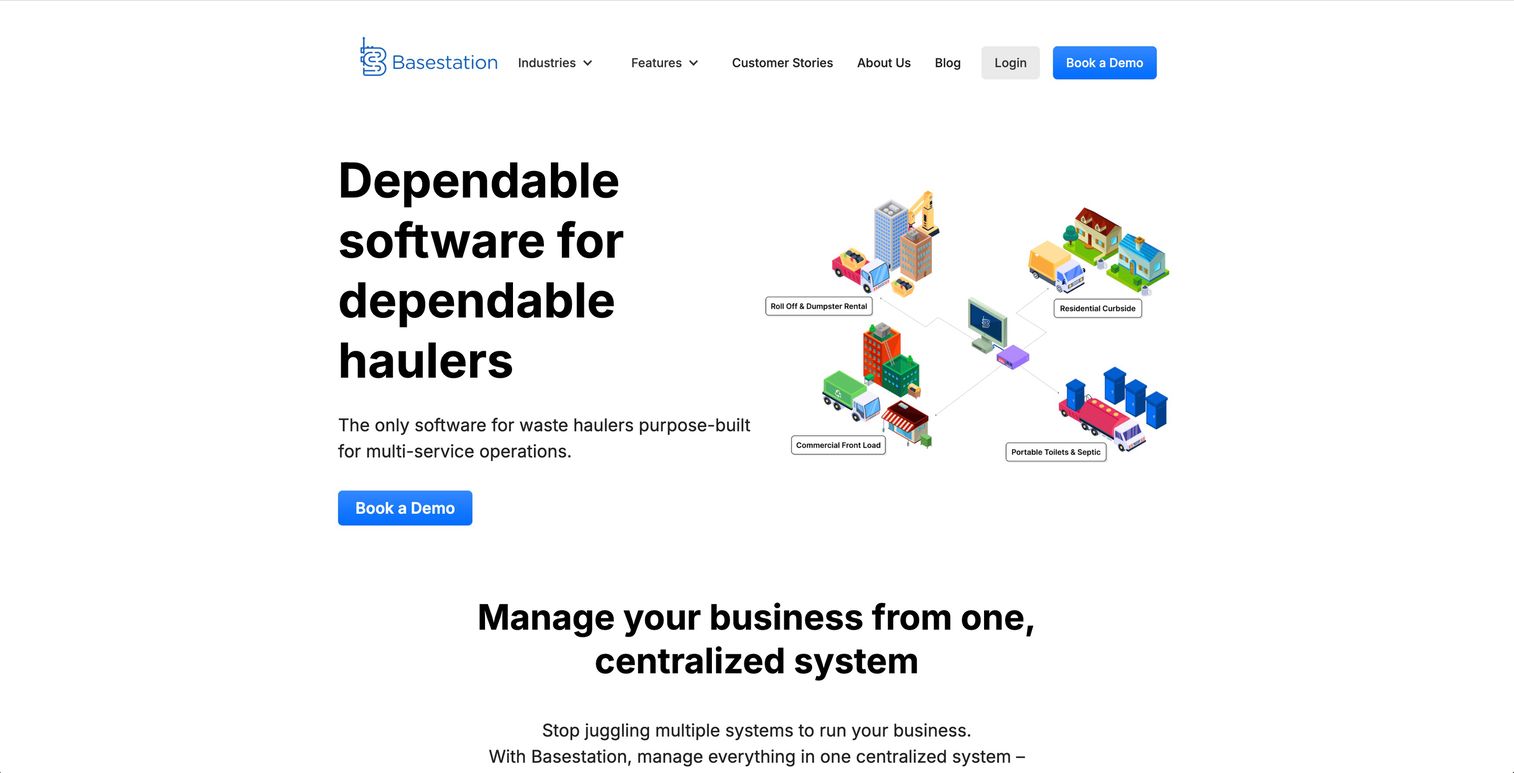
Basestation is a recognized name in waste hauler software, covering scheduling, routing, dispatching, asset tracking, and billing for small and mid-sized operators. If you want a known category peer with broad functionality rather than a newer entrant, it belongs on your shortlist. It handles the full operational loop, from customer and order management through container tracking and invoicing.
Basestation's fit is the operator who wants a proven system that covers waste, recycling, and hauling workflows, not just roll-off. That breadth means it can grow with you if your service mix expands beyond dumpsters.
Best for: Small and mid-sized waste, recycling, and hauling operators who want an established, broadly capable platform.
Key strengths
- Customer and order management: A central view of accounts and orders keeps the office and the field on the same page.
- Routing and dispatching: Route planning and dispatch coordination sized for growing operations.
- Asset and inventory tracking: Know where every container and piece of equipment is at any moment.
Why choose Basestation: For operators who value a known quantity over a newer tool, Basestation offers a mature feature set and a track record with haulers. It's a solid pick if your operation spans more than dumpsters and you want one system for the broader waste workflow.
Basestation pricing: Basestation doesn't publish public pricing, so you'll need to request a quote for your operation. On the review side, it holds a 4.7 out of 5 rating on Capterra across 27 reviews, which is a strong signal from real operators.
2. Docket
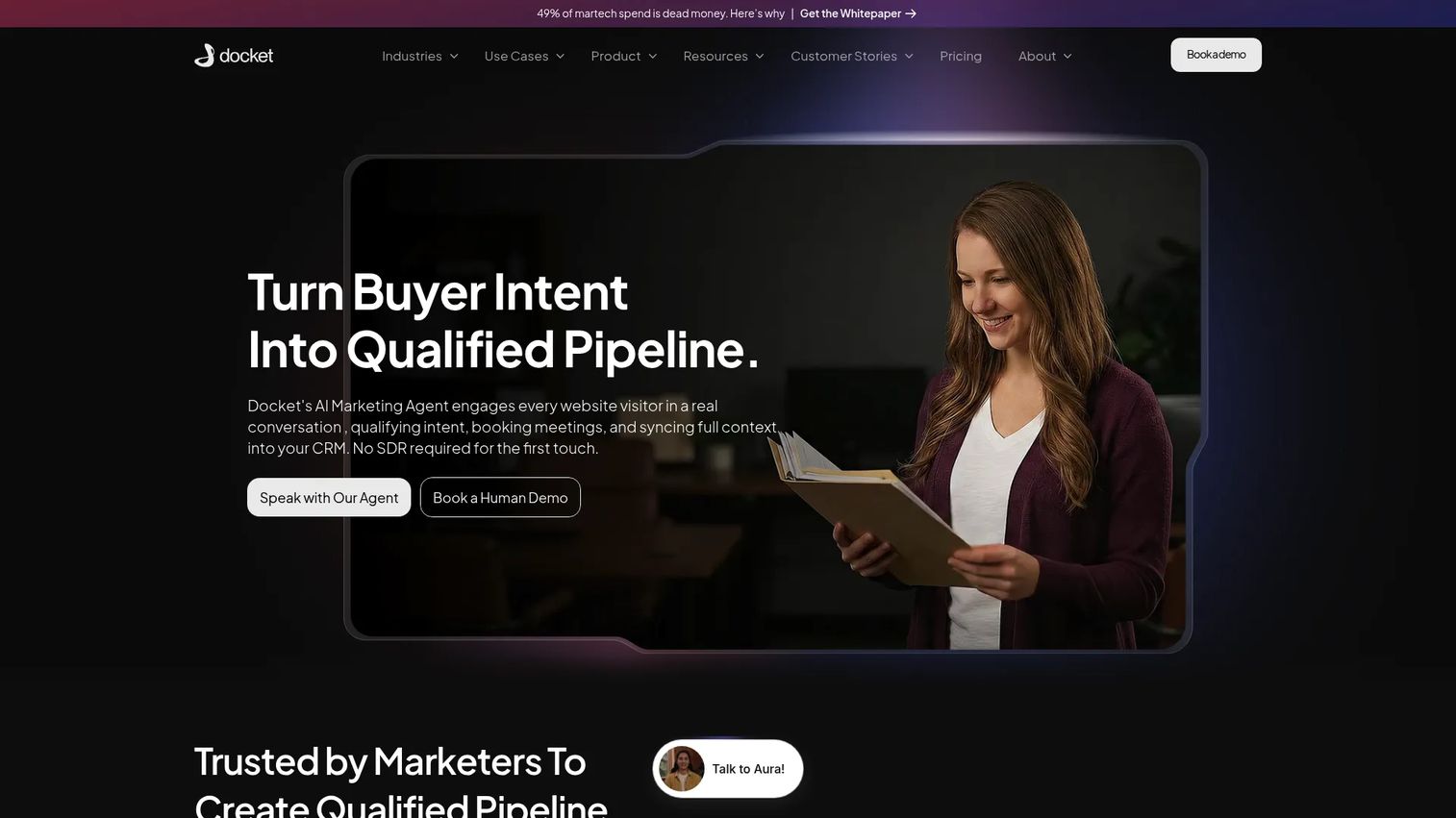
Docket is worth a careful look before you assume it fits every dumpster operation. Its current product is an AI marketing agent for B2B websites that answers buyer questions and converts inbound web traffic into qualified pipeline, with voice and text website conversations, a large sales knowledge base, and CRM sync. For a dumpster operator, the relevant angle is inbound demand capture: turning website visitors into booked, qualified leads before a human ever picks up the phone.
If your operation runs a heavy inbound web motion and you want to qualify and route those leads automatically, this is where Docket earns evaluation. It's less an all-in-one dispatch platform and more a front-of-funnel conversion layer.
Best for: Operators with significant website traffic who want to convert and qualify inbound demand automatically.
Key strengths
- Website conversations: Voice and text conversations answer buyer questions in real time on your site.
- CRM sync and lead routing: Qualified leads flow into your CRM with account-level targeting and meeting booking.
- Deep knowledge base: Pulls from 50-plus data sources to answer prospect questions accurately.
Why choose Docket: If missed inbound web leads are your bottleneck rather than dispatch chaos, Docket addresses the front of the funnel. Pair it with an operations platform from this list and you cover both demand capture and job execution.
Docket pricing: Docket uses traffic-based pricing. The Growth plan starts at $3K/month (billed annually) for up to 20,000 monthly visitors, Scale runs $4K/month for 20,000 to 100,000 visitors, and Enterprise is custom for higher traffic. There's no free trial listed. Docket holds a 4.8 out of 5 rating on G2.
3. AMCS
AMCS sits at the enterprise end of the market, offering AI-enabled software for waste, recycling, transport, and related operations. This is infrastructure for larger fleets and more complex operations: end-to-end automation across route optimization, dispatch, customer management, contracts, pricing, billing, and AI-powered analytics. For a dumpster operator, AMCS becomes relevant when the business grows past what a hauler-focused tool covers and starts needing broad waste-management capability.
The tradeoff is scope. AMCS is built for organizations that need integrated operational, billing, and pricing workflows across a large operation, which is more than a single-truck hauler requires but exactly what a multi-service waste company might.
Best for: Larger waste and recycling operators that need integrated, enterprise-grade operations and billing infrastructure.
Key strengths
- End-to-end operations automation: Route optimization, dispatch, and asset workflows across a full waste operation.
- Integrated billing and pricing: Customer management, contracts, pricing, and billing in one platform.
- AI-powered analytics: Real-time insights to guide operational and financial decisions.
Why choose AMCS: For a scaling operation that has outgrown roll-off-only tools, AMCS offers the broader waste-management infrastructure to run complex, multi-service operations. It's a fit when your requirements extend well beyond dumpster dispatch into full-scale waste operations.
AMCS pricing: AMCS tailors pricing to each organization's requirements rather than publishing set tiers, so expect a custom quote. On G2, AMCS Enterprise Management holds a 2.3 out of 5 rating, though that's based on a very small number of reviews, so weight it accordingly and validate fit through your own evaluation.
4. WAM
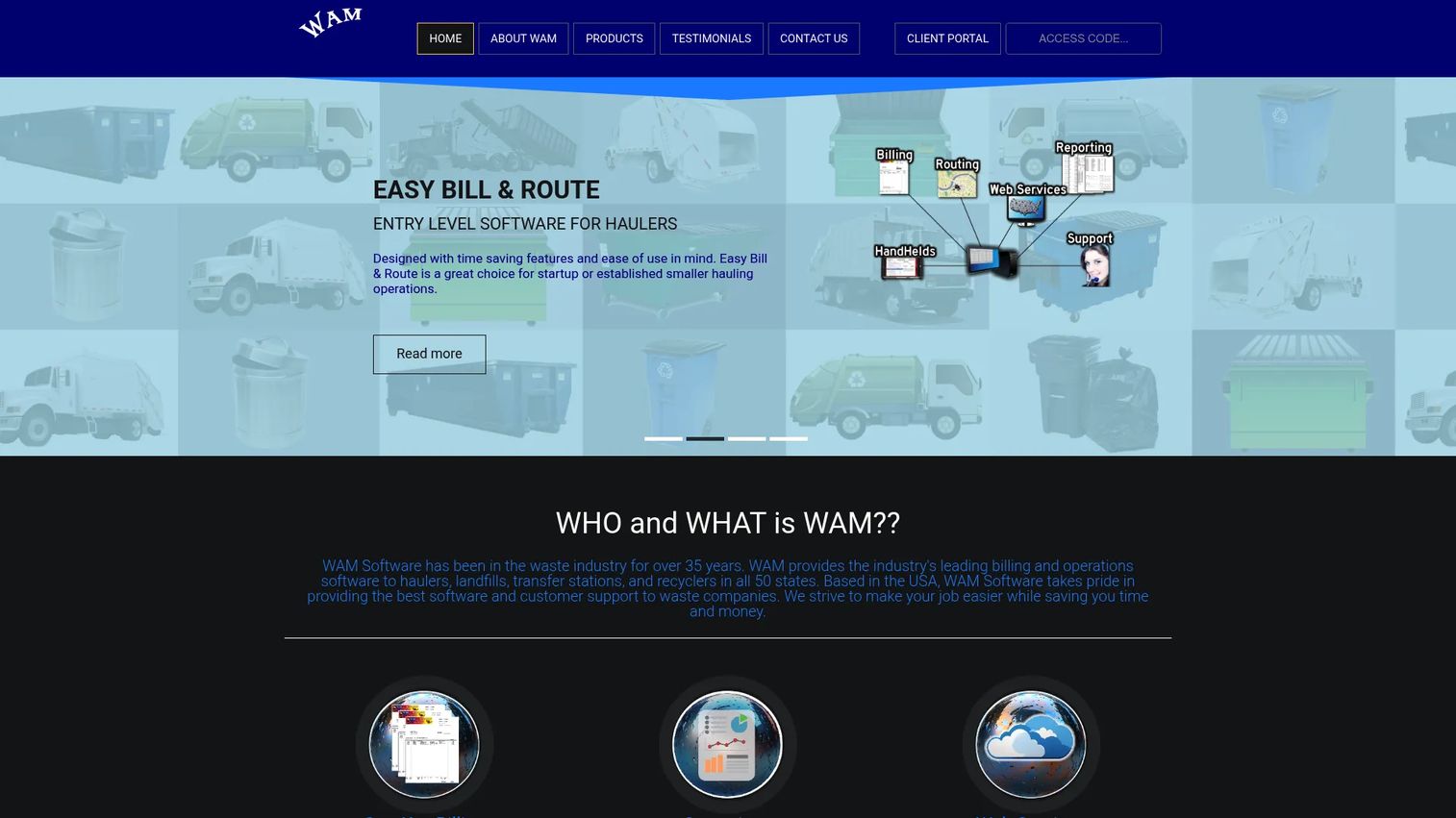
WAM is a waste-industry software company focused on billing and operations for haulers, landfills, transfer stations, and recyclers. Its strength is the financial side: one-key billing, customer account management, route sheets, dispatching, and web services like e-billing, text messaging, and online account management. For a dumpster operation where billing accuracy and account management are the pain points, WAM's billing-first design is the draw.
WAM suits operators who want an established, waste-specific system and are comfortable with a call-for-pricing sales process. It's less about flashy online booking and more about running the money side of the operation cleanly.
Best for: Waste operators who need dependable, industry-specific billing and account management alongside routing.
Key strengths
- One-key billing: Streamlined billing designed for waste-industry account complexity.
- Route sheets and dispatching: Route planning and dispatch tied directly to customer accounts.
- Web services: E-billing, text messaging, and online account management for customer self-service.
Why choose WAM: If your biggest operational drag is billing and account management rather than booking, WAM's financial focus is a strong match. It's an established option for waste operators who prioritize clean billing and are fine with a consultative pricing conversation.
WAM pricing: WAM offers an Easy Bill & Route product described as very low monthly cost, plus WAM-Hauler and WAM-Scale products that are call-for-pricing. The site mentions promotional pricing and extended payment plans, but no public numeric figures are listed, so contact WAM for a quote. No third-party G2 rating was available at the time of writing.
5. Routeware
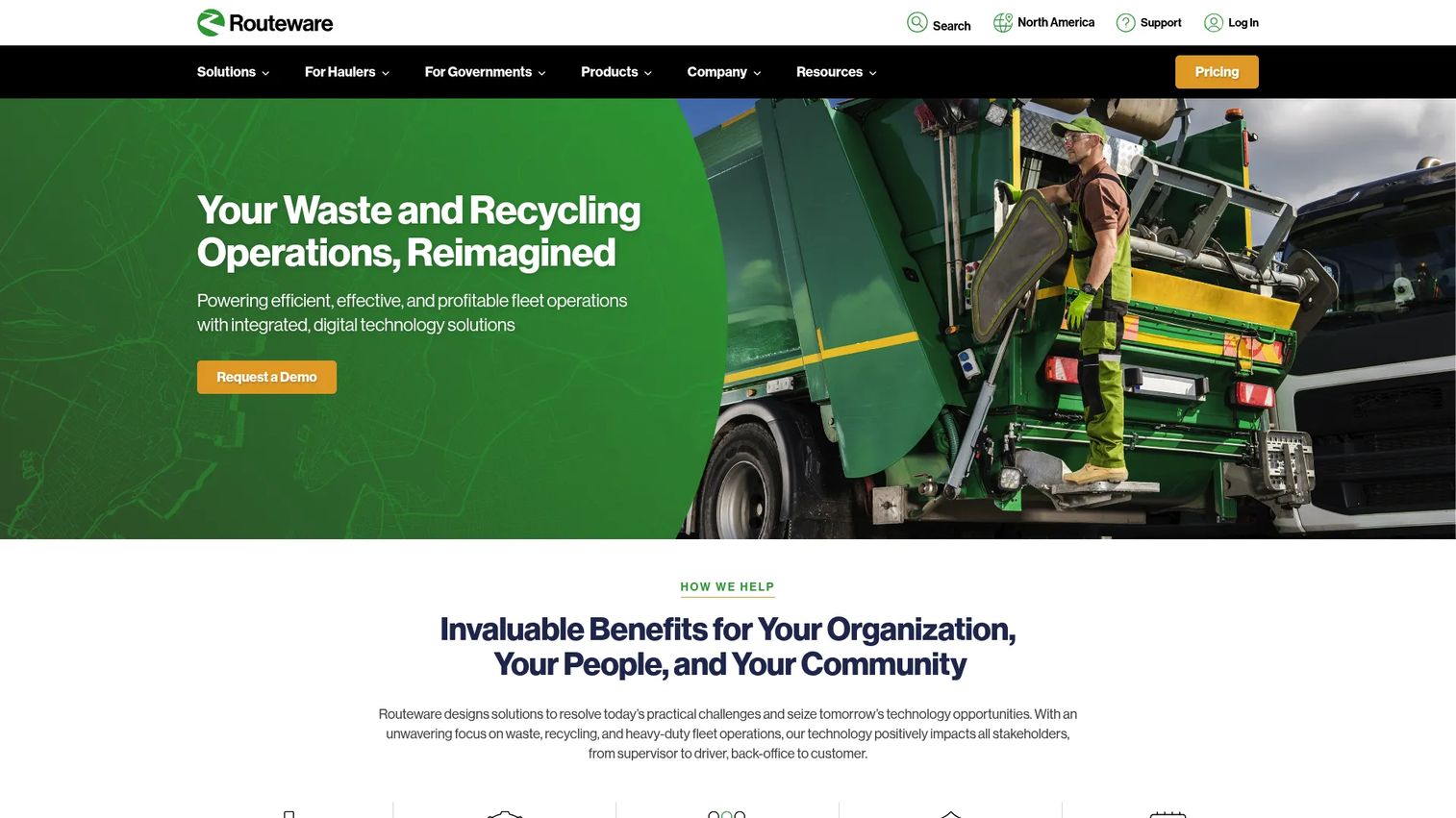
Routeware is built for waste and recycling fleets that need an integrated operations platform, with route optimization, dispatch, in-cab and fleet reporting, billing, payments, and customer self-service tools. For dumpster operators running multiple routes or a broader waste workflow, Routeware is a routing-first platform that scales into full operations management.
The question to answer before choosing Routeware is whether you're buying it primarily as a routing engine or as an end-to-end operations system. It does both, but operators with real routing complexity get the most out of it.
Best for: Waste and recycling fleets with multiple routes that want route optimization inside a full operations platform.
Key strengths
- Route optimization: Plan and optimize routes across a fleet to cut miles and time.
- In-cab and fleet reporting: Drivers and dispatch stay coordinated with real-time reporting from the field.
- Billing and self-service: Integrated billing, payments, and customer self-service tools round out operations.
Why choose Routeware: For fleets where routing is the core challenge, Routeware's optimization and in-cab reporting are the standout. It's a strong fit when your operation spans multiple routes and you want dispatch, routing, and billing under one roof.
Routeware pricing: Routeware quotes pricing custom based on fleet size, services, and operational needs, so there's no public price to reference. Request a quote through its pricing page. Routeware holds a 4.0 out of 5 rating on G2.
Considerations
Before you commit, run each shortlisted tool through this checklist. The sticker price is rarely the whole story.
Match the tool to your routing complexity
Be honest about how much routing you actually need. A single-truck operation may do fine with a no-routing entry plan, while a two-to-five-truck operation benefits from basic route planning. Multi-route fleets need genuine route optimization. Buying more routing than you use wastes money; buying too little caps your growth. Verify the routing capability at your specific plan tier, not just what the top tier offers.
Confirm billing and accounting workflow fit
Check that invoice automation, payment collection, and contract handling match how you actually bill. Recurring commercial accounts have different needs than one-off residential rentals. Confirm QuickBooks integration or whatever accounting tool you use, and make sure finance and ops are aligned on how order data becomes an invoice. This is where dumpster rental software cost gets real: a tool that saves ten admin hours a week pays for itself fast.
Check tracking and field visibility
Container tracking and a solid mobile driver app aren't nice-to-haves once you're running real volume. You need to know where every can is, how long it's been on site, and whether a job was actually completed. Test the driver app on a real phone, and confirm live status updates reach the office. Good field visibility improves customer service and asset utilization at the same time.
Evaluate onboarding and support
For smaller teams without admin bandwidth, human onboarding and migration help matter as much as features. Ask what implementation looks like, whether historical data migrates cleanly, and how fast support responds when a truck is idle and something breaks. Downtime during migration is a real cost, so weight vendors that offer hands-on setup.
Compare pricing structure, not just sticker price
Flat monthly pricing, tiered can-based plans, and custom quotes each suit different operators. A flat model is predictable; tiered plans scale with your fleet; custom quotes flex to complex needs. Look past the headline number at included users, add-ons, and dumpster rental software integration costs. Compare the total cost of the plan that fits your actual operation, not the cheapest entry tier.
Conclusion
The right dumpster rental software depends on the shape of your operation, not on who has the longest feature list.
Basestation is the established category peer for small and mid-sized haulers who want a proven, broadly capable tool. Docket addresses the inbound demand side, converting website traffic into qualified leads. For larger, multi-route waste operations, AMCS and Routeware bring enterprise routing and operations depth, while WAM leads with billing-first strength for account-heavy operators.
Your next step is simple: shortlist two or three tools that match your routing complexity and fleet size, then book a demo with each. Bring your real numbers, truck count, monthly rentals, and current admin hours, and ask each vendor to show you how their system handles your actual workflow. The one that removes the most manual work for the fairest price is your winner.
FAQs
Dumpster rental software is a platform that manages the full lifecycle of a container rental, from online booking through dispatch, routing, container tracking, billing, and reporting. It replaces spreadsheets, whiteboards, and separate accounting tools with one connected system so orders don't slip through the cracks and admin work drops.
Dumpster rental software cost varies widely by model. Some tools scale by fleet size, while enterprise waste systems and routing-first tools like AMCS and Routeware use custom quotes based on your operation. Focus on the total cost of the plan that fits your actual truck count and routing needs, including any add-ons and integration fees.
Most do, though the depth varies. Some tools offer a no-routing entry plan for single-truck operations and unlock route optimization at higher tiers, while platforms like Routeware and AMCS are built around advanced routing for multi-route fleets. Confirm the dispatch and routing capability at the specific plan tier you're buying.
Yes. Container tracking is a core feature of most dumpster management software, letting you see where every can is, how long it's been on a job site, and when it's due back. Combined with a mobile driver app that reports status from the field, this gives the office live visibility into asset utilization.
Many platforms offer a QuickBooks integration so invoices, payments, and customer data sync without double entry. Basestation and other operations platforms emphasize accounting-friendly billing. Always confirm the exact integration and whether it's two-way sync before buying, since accounting fit is one of the biggest time-savers.
Most modern dumpster rental software includes a mobile driver app. Drivers use it to see job details, update delivery and pickup status, and capture proof of service, which closes the loop with dispatch and keeps container tracking accurate. Test the app on a real phone during your evaluation.
The highest-value integrations for dumpster rental operations software are accounting (especially QuickBooks integration), payment processing, and telematics or GPS for fleet tracking. A customer portal and communications tools also matter for self-service and reminders. Confirm each integration you rely on is supported at your plan tier before committing.
For most small haulers, yes. Even a single-truck operation loses revenue to missed calls and hours to manual invoicing. A low-cost entry plan with online booking, basic dispatch, and QuickBooks-friendly billing typically pays for itself by capturing more orders and cutting admin time. Match the tool to your real workload rather than overbuying routing you won't use.