You cannot scale a manufacturing operation from a spreadsheet that updates after the shift ends.
Plant data sits in MES exports, machine logs, maintenance records, quality systems, and operator notebooks, rarely in the same place and almost never in real time. By the time the weekly report lands, the line that caused last Wednesday's miss has already caused another one.
According to Deloitte's 2025 manufacturing industry research, 92% of manufacturers believe smart manufacturing will be the primary driver of competitiveness over the next three years, yet most plants still make decisions from delayed, disconnected data. That gap between ambition and visibility is exactly what manufacturing intelligence software is built to close.
This guide cuts through the vendor noise. It maps 17 platforms to the specific operational problems they solve, so you can build a shortlist that reflects your actual bottleneck, whether that's OEE, process analytics, quality compliance, equipment health, or multi-site standardization.
What's inside
This guide is built for operations leaders, manufacturing executives, and founders evaluating the category for the first time or replacing a tool that stopped delivering signal.
Tools were selected based on:
- Category relevance: Genuine manufacturing intelligence use cases, not adjacent software with a manufacturing label
- Operational depth: Real support for OEE, process analytics, equipment health, quality, or connected worker workflows
- Integration fit: Connectivity to ERP, MES, QMS, SCADA, historians, and industrial IoT systems
- Buyer evidence: Verified G2 ratings, pricing data, and confirmed product positioning from first-party sources
Pricing and G2 ratings were verified at draft time. Where a vendor does not publish prices, that is noted plainly.
TL;DR
- Best enterprise manufacturing intelligence platform: Siemens Opcenter Intelligence, for large operations standardizing data across ERP, MES, QMS, and MOM
- Best for regulated quality manufacturing: MasterControl Manufacturing Excellence, for pharma, medtech, and life sciences with compliance-driven production records
- Best for process analytics: TrendMiner and Seeq, for engineers analyzing time-series data from historians without waiting on a data science team
- Best for OEE and line performance: Lineview and Factbird, for operations teams that need production visibility fast
- Best for maintenance and equipment health: L2L and TRACTIAN, for maintenance teams reducing unplanned downtime
- Best for modern frontline operations: Tulip, for manufacturers building custom no-code apps connected to machine data
What is manufacturing intelligence software?
Manufacturing intelligence software collects, contextualizes, analyzes, and visualizes production data so manufacturers can make faster decisions about performance, quality, equipment health, and operational efficiency.
Unlike general business intelligence tools that handle sales or financial data, manufacturing intelligence software is built for the plant floor. It handles time-series machine data, production events, OEE calculations, quality records, and shift-level context that a standard BI tool cannot interpret without heavy customization.
Key capabilities to look for:
- Real-time production monitoring and OEE analysis
- Equipment health scoring and downtime categorization
- Manufacturing data contextualization across systems
- ERP, MES, QMS, SCADA, CMMS, and IIoT integrations
- Quality and traceability analytics
- Predictive maintenance signals and anomaly detection
- Energy and emissions monitoring
- Root-cause analysis and multi-site benchmarking
How manufacturing intelligence differs from adjacent categories:
| Dimension | MES | Business intelligence | Manufacturing intelligence |
|---|---|---|---|
| Primary job | Manage and record production execution | Visualize business data across functions | Analyze and contextualize plant performance |
| Data types | Work orders, production records, routing | Financial, sales, HR, and operational data | Time-series, machine events, OEE, quality records |
| User | Production supervisors, operators | Finance, sales, and executive teams | Operations, engineering, maintenance, quality |
| Decision speed | Real-time execution control | Weekly or monthly reporting | Shift-level to daily actionable insight |
The best manufacturing intelligence platforms sit between plant-floor systems and executive decision-making. They pull from SCADA, historians, MES, ERP, and maintenance systems, then surface the patterns that drive throughput, quality, and uptime decisions.
When to use manufacturing intelligence software
See production performance before the shift ends
OEE reports that land Monday morning cannot fix what happened on Friday. Teams that deploy manufacturing intelligence software as a real-time monitoring layer can act on throughput drops, scrap spikes, and downtime events while the line is still running. The decision you need to make is whether your current reporting cadence matches the pace your operation actually moves.
Connect plant data to business decisions
Enterprise buyers use manufacturing intelligence platforms to connect what happens on the floor with cost, quality, fulfillment, and capacity outcomes. A plant that misses its OEE target in isolation is one thing. A plant where that miss maps directly to a late shipment and a margin hit is something leadership can act on. The platform earns its seat when it makes that connection visible.
Standardize improvement across sites
Multi-site operators need comparable metrics, shared dashboards, and repeatable improvement workflows that do not depend on one analyst who knows which CSV to pull. Repeatability is the goal. Give your new VP of Operations something that works on day one, not a bespoke Excel model only the previous person understood.
Manufacturing intelligence software comparison
The 17 tools below cover enterprise manufacturing intelligence, process analytics, OEE monitoring, connected worker platforms, maintenance intelligence, quality execution, and manufacturing data platforms. No single tool wins across every dimension.
| # | Product | Best for | Key differentiator | Pricing | G2 rating |
|---|---|---|---|---|---|
| 1 | Siemens Opcenter Intelligence | Enterprise manufacturing intelligence | Cross-system data aggregation and KPI analytics | Custom pricing | 4.1/5 |
| 2 | MasterControl Manufacturing Excellence | Regulated quality manufacturing | Electronic batch records and compliance workflows | Custom pricing | 4.4/5 |
| 3 | aPriori Manufacturing Intelligence Platform | Product cost and manufacturability | CAD-driven cost, DFM, and sourcing analysis | Custom pricing | 4.4/5 |
| 4 | TrendMiner | Process analytics for engineers | Self-service time-series analytics on historian data | Custom pricing | 4.6/5 |
| 5 | Fabriq | Continuous improvement teams | Shop-floor routines, action tracking, and KPI management | Custom pricing | 4.6/5 |
| 6 | Lineview | OEE and line performance | Real-time line visibility with causal loss analysis | Custom pricing | 4.5/5 |
| 7 | Seeq | Advanced industrial analytics | Time-series investigation with collaboration workbooks | Custom pricing | 4.6/5 |
| 8 | L2L | Connected workforce and maintenance | Shop-floor execution, maintenance, and analytics in one platform | Custom pricing | 4.3/5 |
| 9 | Factbird | Fast OEE monitoring | Transparent per-line pricing and plug-and-play deployment | From $399/line/month | 4.5/5 |
| 10 | Amper | Machine monitoring for factories | Real-time utilization and downtime from machine data | Custom pricing | 4.4/5 |
| 11 | Fulcrum | Job shops replacing legacy ERP/MES workflows | Combined ERP, MRP, and MES capabilities for high-mix manufacturers | Custom pricing | N/A |
| 12 | TRACTIAN | Equipment reliability and predictive maintenance | Sensor-based asset monitoring with integrated CMMS | Custom pricing | 4.7/5 |
| 13 | iObeya | Lean and visual management | Digital Obeya rooms for operational routines and collaboration | From €3,780/room/year | 4.5/5 |
| 14 | Tulip | No-code frontline operations | App-based manufacturing workflows with machine connectivity | From $100/interface/month | 4.5/5 |
| 15 | CADDi | Drawing and part intelligence | AI-powered search and analysis across manufacturing data | Custom pricing | 4.9/5 |
| 16 | Illuminate Manufacturing Intelligence | OEE, video, and equipment health | Event-triggered video capture for root-cause analysis | Custom pricing | N/A |
| 17 | Hexagon Manufacturing Intelligence | Metrology, quality, and digital manufacturing | Integrated hardware and software across the production lifecycle | Custom pricing | 4.2/5 |
Best 17 manufacturing intelligence software tools for 2026
1. Siemens Opcenter Intelligence
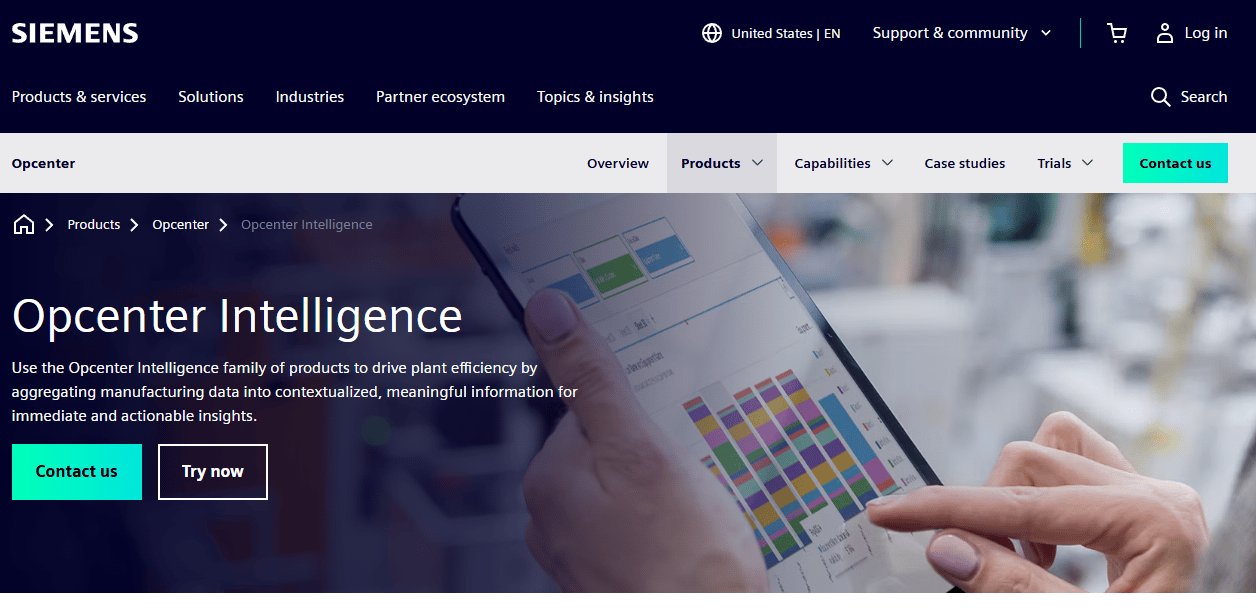
Siemens Opcenter Intelligence is enterprise manufacturing intelligence software that connects and contextualizes data from ERP, MES, MOM, QMS, IoT, and shop-floor systems into a unified analytical layer. It supports cloud and on-premises deployment and is built around ISA-95 data modeling, which gives large manufacturers a standards-compliant foundation for multi-plant visibility. The platform covers real-time KPI dashboards, self-service analytics, trend and anomaly identification, and root-cause analysis across complex operational environments.
Best for: Large and complex manufacturers that need standardized operational intelligence across multiple plants and enterprise systems.
Key features
- Enterprise manufacturing data aggregation and contextualization
- Real-time and historical KPI dashboards with drill-down analytics
- Self-service reporting and customizable dashboard creation
- Integration with Siemens, third-party MES, MOM, OT, and IoT sources
- Advanced analytics, trend identification, and anomaly detection
Why choose Siemens Opcenter Intelligence: Choose it when the buyer needs mature enterprise architecture that connects engineering, planning, quality, and production data. It fits large operations where a narrow OEE tool would leave critical system gaps.
Siemens Opcenter Intelligence pricing: Siemens does not publish prices for Opcenter Intelligence. Contact Siemens directly for enterprise pricing based on deployment scope, plant count, and integration requirements.
G2 rating: 4.1/5 (based on Opcenter MOM portfolio reviews)
2. MasterControl Manufacturing Excellence
MasterControl Manufacturing Excellence is a cloud-based manufacturing execution and digital production-record platform built for regulated life-sciences manufacturers. It replaces paper-based batch records and logbooks with electronic workflows that enforce data integrity, review-by-exception, and audit-ready documentation. The platform covers electronic batch records (EBR), electronic device history records (eDHR), recipe and product-variant management, and equipment calibration tracking. It is particularly relevant where quality records and FDA or ISO compliance shape every production decision.
Best for: Regulated pharmaceutical, biotechnology, medical-device, and life-sciences manufacturers replacing paper-based production records.
Key features
- Electronic batch records (EBR) and device history records (eDHR)
- Real-time production visibility through MES capabilities
- Review-by-exception and automated data-integrity checks
- Recipe and product-variant management
- Equipment calibration and maintenance management
Why choose MasterControl Manufacturing Excellence: Choose it when manufacturing intelligence starts with quality risk, traceability, and production record accuracy. It is less about generic plant dashboards and more about disciplined, compliant production execution.
MasterControl Manufacturing Excellence pricing: MasterControl prices each implementation based on organizational scope and requirements. Contact MasterControl for a proposal.
G2 rating: 4.4/5
3. aPriori Manufacturing Intelligence Platform
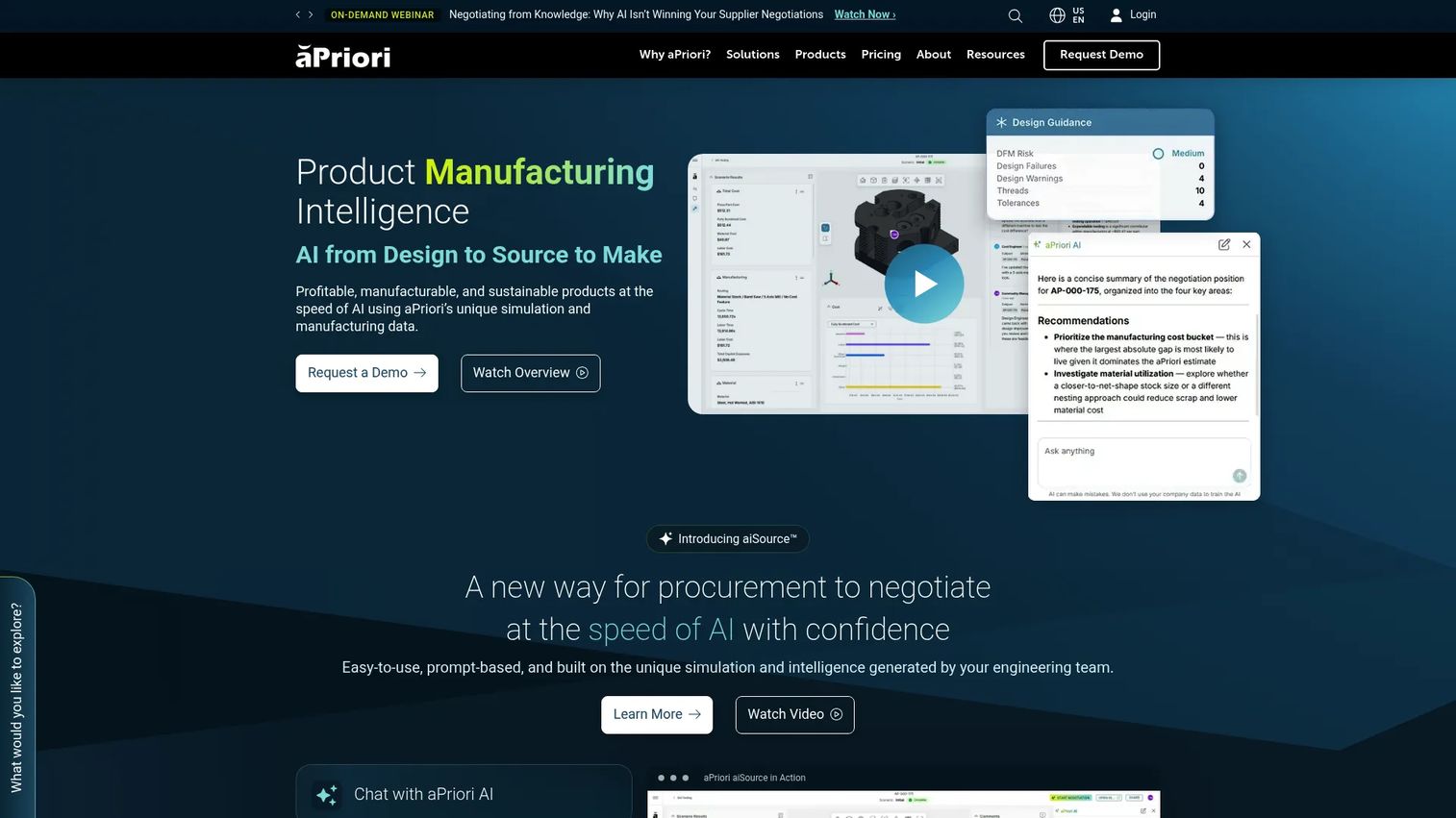
aPriori is a manufacturing intelligence platform that generates product cost, manufacturability, sustainability, and sourcing insights directly from 3D CAD models and digital factory simulations. Rather than analyzing what happened on the shop floor, aPriori focuses on decisions that happen before production locks in: Should-cost analysis, design-for-manufacturability (DFM) feedback, supplier evaluation, and CO2e impact modeling. It integrates with PLM, CAD, and BI systems and supports cross-functional collaboration between engineering and procurement teams.
Best for: Enterprise manufacturers that need cost, design, and sourcing intelligence before production decisions are finalized.
Key features
- Automated product cost insights from 3D CAD
- DFM and manufacturability analysis
- Product CO2e and sustainability modeling
- Digital factory simulation and supplier cost evaluation
- PLM, CAD, BI, and API integrations
Why choose aPriori: Choose aPriori when the expensive decisions happen before the factory runs. It gives engineering, sourcing, and operations teams a shared view of cost and manufacturability tradeoffs that shape margin before a part ever hits a machine.
aPriori pricing: aPriori offers Design, Quote, Source, and Automate packages but does not publish prices. Contact aPriori for a proposal.
G2 rating: 4.4/5
4. TrendMiner
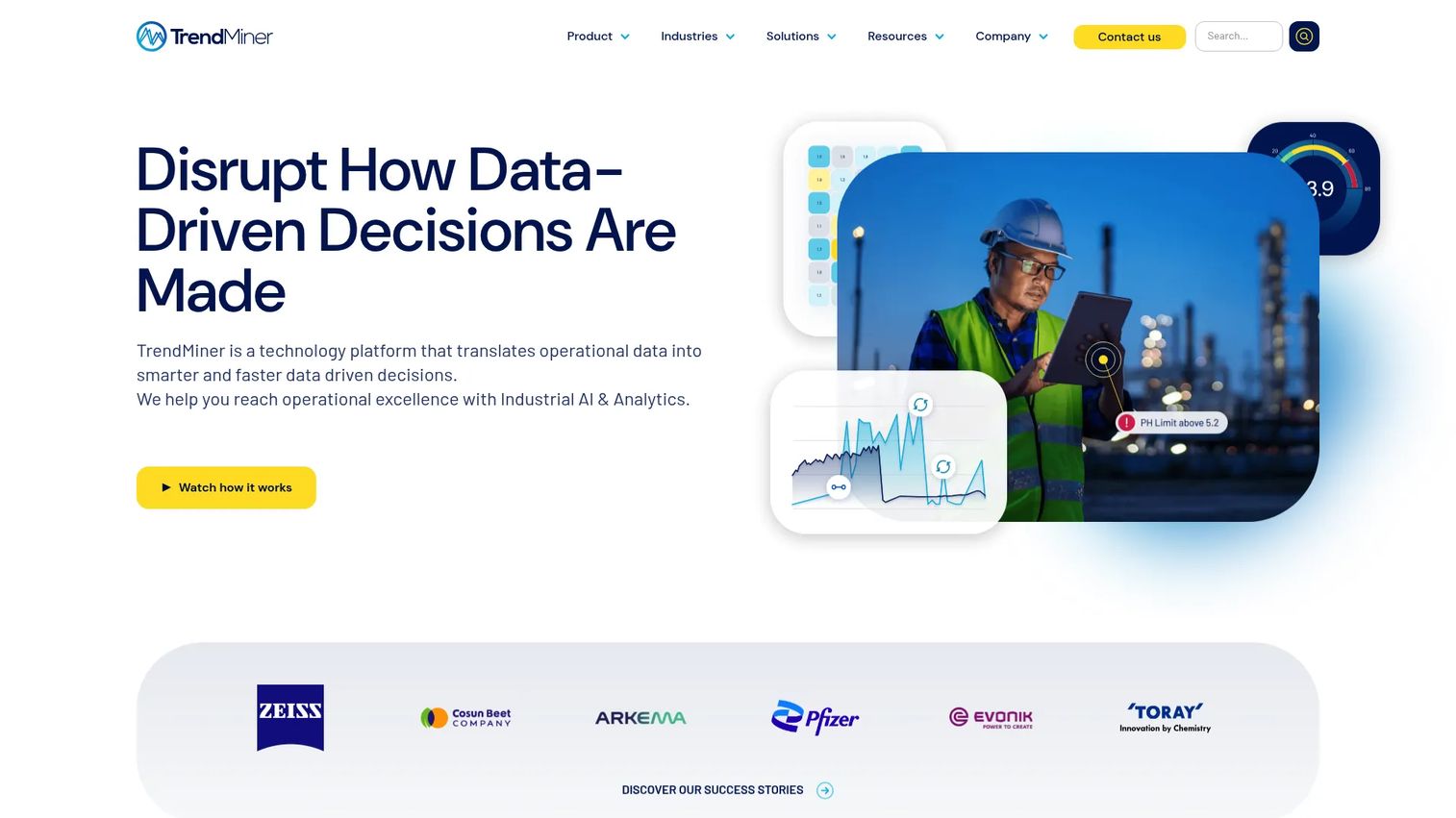
TrendMiner is an industrial AI and analytics platform built for process manufacturing teams that need engineers, not data scientists, to investigate operational data. It connects to process historians and time-series data sources, letting subject-matter experts search for patterns, correlations, and fingerprints across historical production data without waiting on an analytics team. The platform covers 24/7 monitoring and alerting, anomaly detection, dashboards, and collaboration tools. Python notebooks and custom functions extend the platform for teams with more technical depth.
Best for: Process manufacturers, including chemical, oil and gas, pharma, and food and beverage, where engineers need fast answers from complex operational data.
Key features
- Time-series and event analytics on historian data
- Pattern search, correlations, and fingerprint analysis
- 24/7 monitoring, alerting, and anomaly detection
- Self-service dashboards and team collaboration
- Machine learning, Python notebooks, and custom functions
Why choose TrendMiner: Choose TrendMiner when engineers and process experts need to investigate production behavior directly. It fits teams that already have rich process data but struggle to turn it into action without a data team in the loop.
TrendMiner pricing: TrendMiner does not publish prices and directs prospects to request a demo. Contact TrendMiner for pricing.
G2 rating: 4.6/5
5. Fabriq
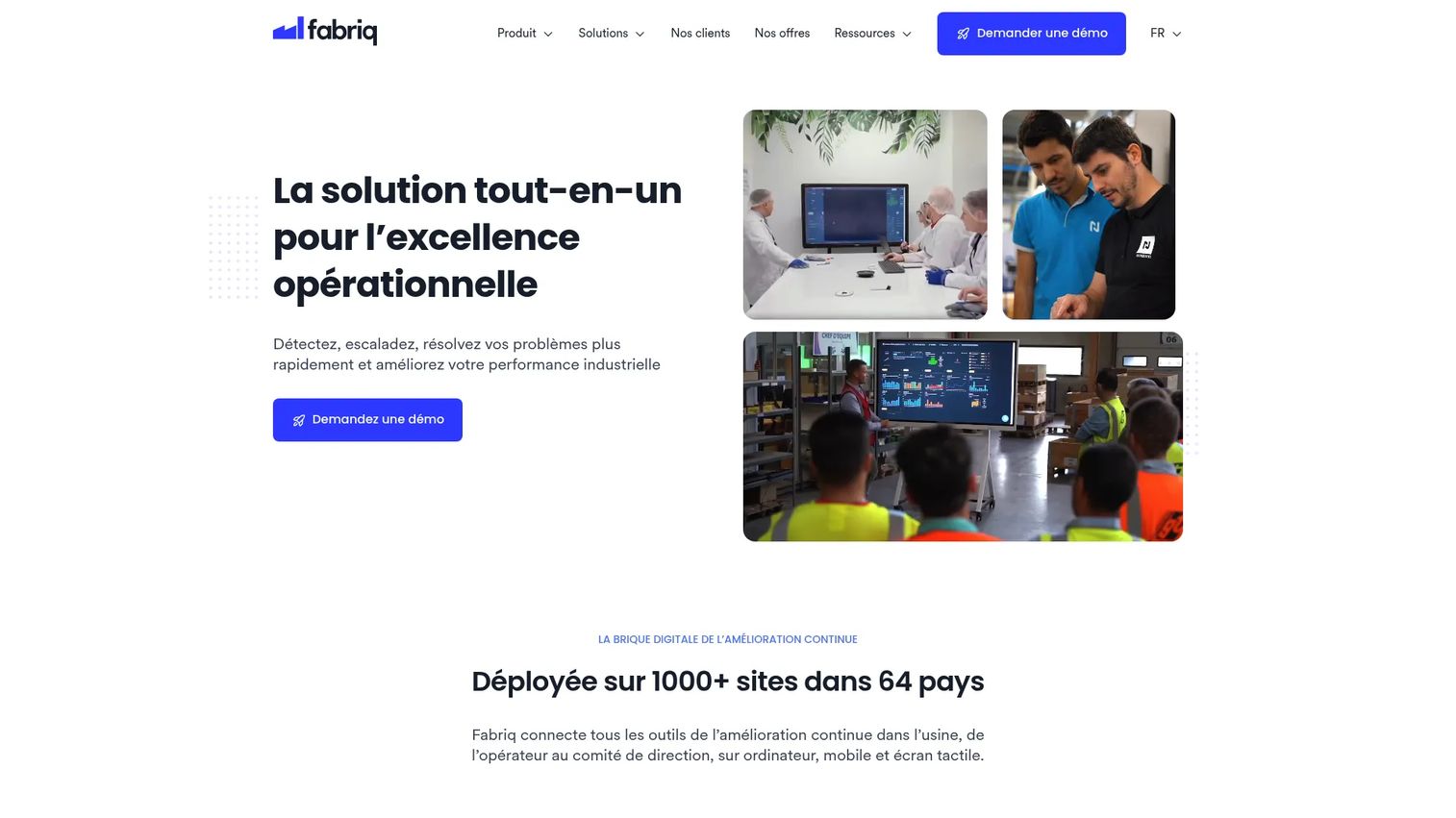
Fabriq is an operational excellence platform for manufacturing and logistics teams focused on daily management, continuous improvement, and structured problem solving. It digitizes shop-floor routines, escalation workflows, action plans, and KPI tracking so that plant teams operate from a shared system rather than scattered whiteboards and morning meeting printouts. The mobile app puts these workflows in the hands of operators and supervisors directly on the floor. An AI knowledge management layer can surface similar past issues to speed up root-cause resolution.
Best for: Operations teams building a repeatable continuous improvement system across one or more factory sites.
Key features
- Real-time dashboards and visual performance management
- Digital routines, audits, and field inspection rounds
- Action tracking, tickets, and structured problem solving
- KPI integrations and multi-site benchmarking
- Mobile app for shop-floor operators and supervisors
Why choose Fabriq: Choose Fabriq when the goal is to build accountability loops around metrics, not just display them. It fits teams where daily management meetings, escalation paths, and improvement actions need to run on a repeatable system.
Fabriq pricing: Fabriq offers Standard (single site), Advanced (2 to 10 plants), and Enterprise (10+ plants) tiers. Prices require a demo or sales contact.
G2 rating: 4.6/5
6. Lineview
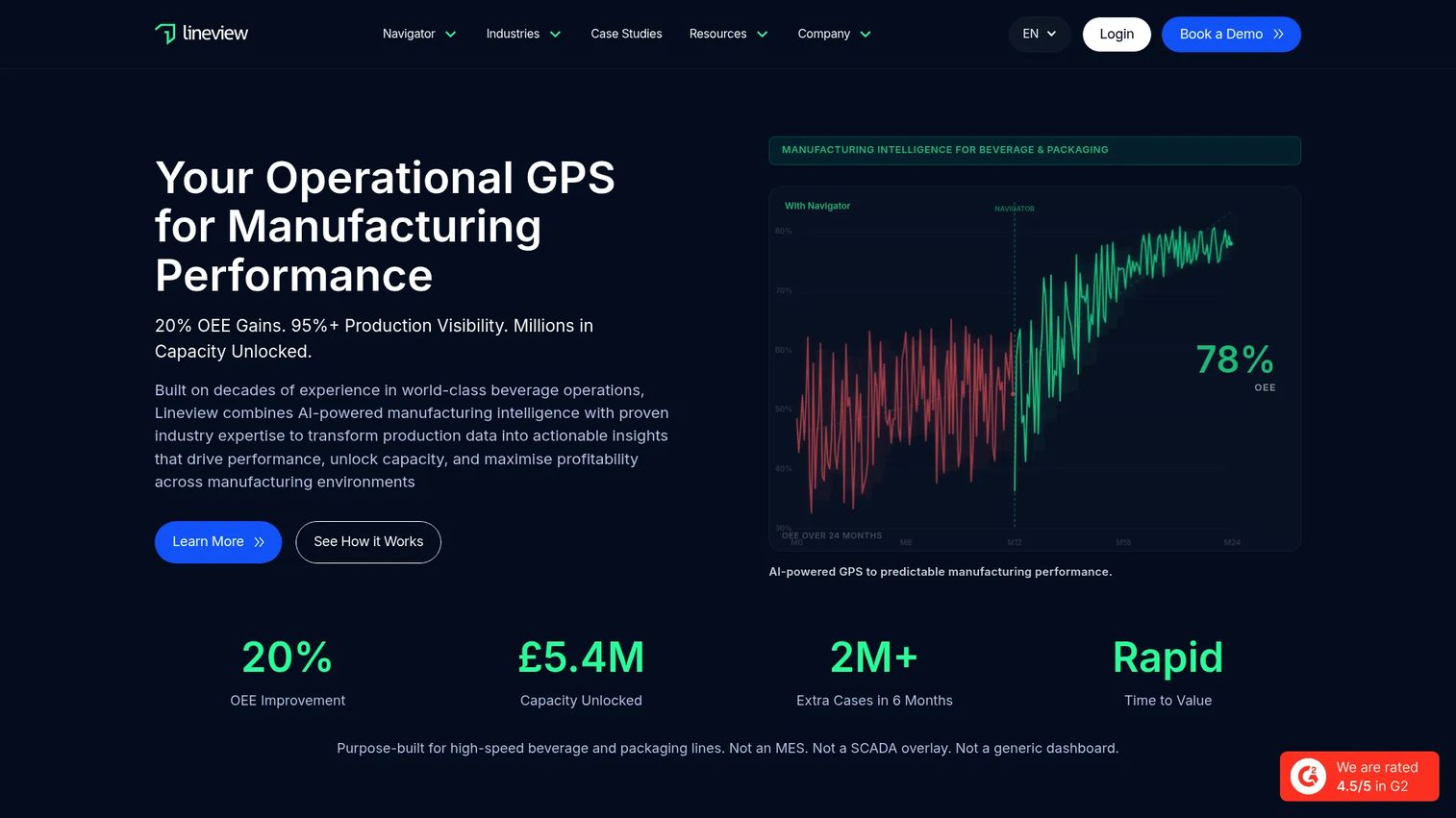
Lineview provides manufacturing intelligence software specifically designed for production-line performance, OEE improvement, and throughput optimization. It delivers real-time monitoring of OEE, line speed, throughput, and status, paired with causal loss analysis and exception-based prioritization so teams focus on the losses that matter most. Automated shift, day, and week reporting reduces the time supervisors spend building performance summaries. Guided digital workflows, task management, and AI-powered production Q&A help translate the data into action.
Best for: Manufacturing organizations, particularly beverage, packaging, and high-throughput producers, focused on line performance and OEE improvement.
Key features
- Real-time OEE, throughput, and line-status monitoring
- Causal loss analysis and exception-based prioritization
- Automated shift, day, and week performance reporting
- Cross-site benchmarking and focused-improvement analysis
- Guided digital workflows and AI production Q&A
Why choose Lineview: Choose Lineview when lost minutes on a production line translate directly into margin pressure. It fits operators who need to move from downtime reports to performance routines, with the analysis already done.
Lineview pricing: Lineview does not publish prices. Contact Lineview to discuss deployment scope and pricing.
G2 rating: 4.5/5
7. Seeq

Seeq is an industrial AI and analytics platform for organizations working with complex time-series and operational data across plants, assets, and enterprise systems. It combines data connectivity, AI assistants, advanced calculations, and collaboration workbooks so engineers and operations experts can investigate process behavior, share findings, and build persistent dashboards without heavy IT involvement. A Python-based Data Lab environment extends the platform for teams with data science capability. Seeq lists Premium, Premium Plus, and Ultimate customer success plans.
Best for: Advanced industrial analytics teams working with complex process data across process industries, utilities, and asset-intensive operations.
Key features
- Operational data connectivity and contextualization
- Time-series analysis, visualization, and advanced calculations
- AI assistants and custom analytical agents
- Collaboration workbooks and shared dashboards
- Python-based Data Lab for advanced modeling
Why choose Seeq: Choose Seeq when manufacturing analytics requires deeper investigation than a standard dashboard can handle. It fits technical teams with recurring root-cause questions and complex process data that spans multiple historians and systems.
Seeq pricing: Seeq does not publish subscription prices. Contact Seeq to discuss Premium, Premium Plus, or Ultimate plan options.
G2 rating: 4.6/5
8. L2L
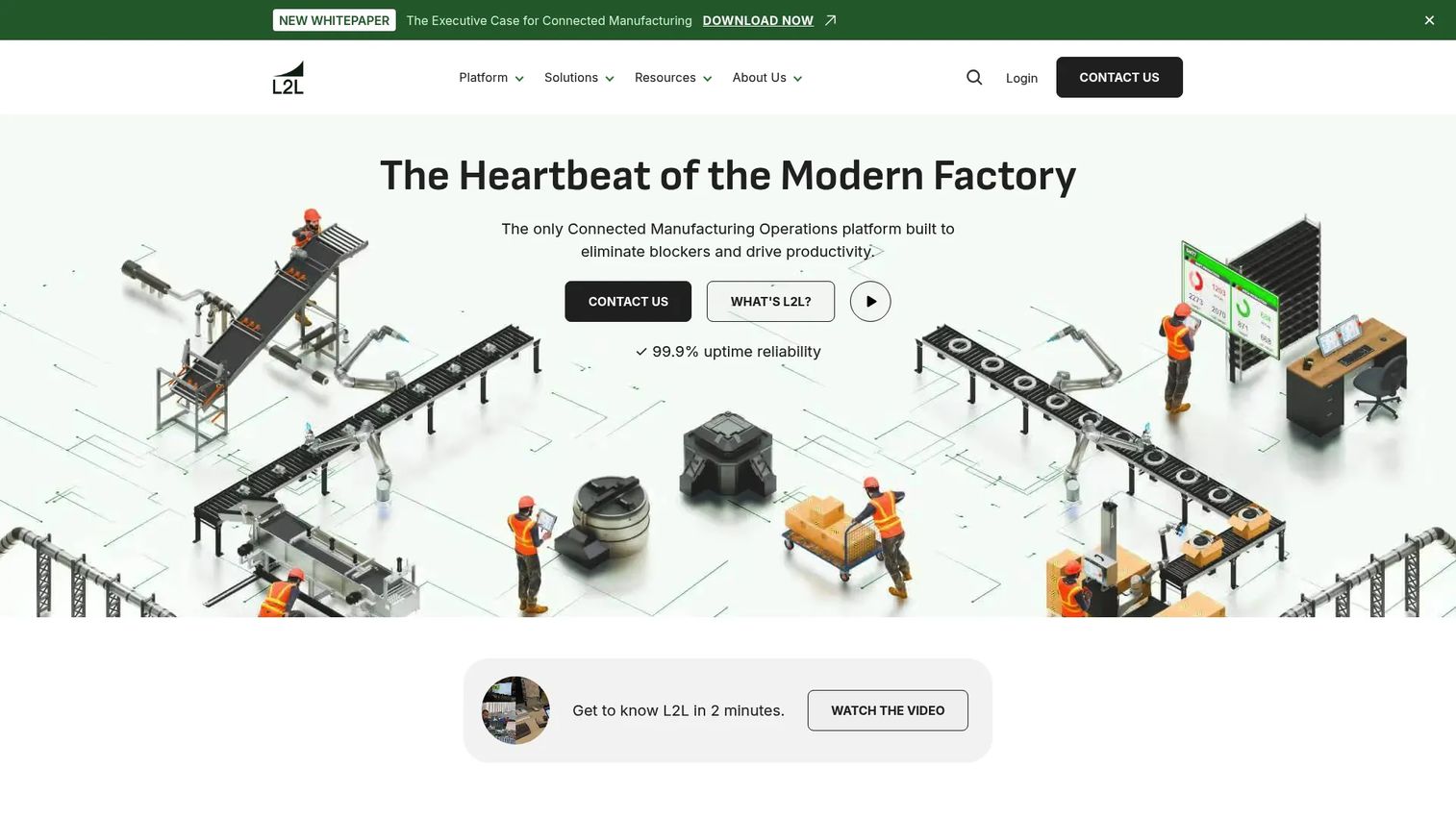
L2L is a connected manufacturing operations platform that covers shop-floor execution, maintenance management, production performance monitoring, digital skills, and manufacturing analytics in a single system. It is designed for frontline teams that need operational intelligence to show up as a workflow, not a report. Maintenance teams use it to respond to downtime events and manage work orders. Production teams use it to track performance and execute improvement plans. Skills and SOPs help teams standardize how work gets done across shifts.
Best for: Manufacturers seeking a unified platform for shop-floor operations, maintenance execution, and operational analytics.
Key features
- Shop-floor execution and frontline communication
- Maintenance management and downtime response workflows
- Production performance monitoring and analytics
- Digital skills, SOPs, and knowledge management
- Manufacturing intelligence dashboards
Why choose L2L: Choose L2L when manufacturing intelligence needs to turn into action on the floor rather than sit in a reporting layer. It works well for teams where maintenance, production, and continuous improvement share a workflow and need a common system.
L2L pricing: L2L does not publish prices. Contact L2L for pricing based on deployment scope and user requirements.
G2 rating: 4.3/5
9. Factbird
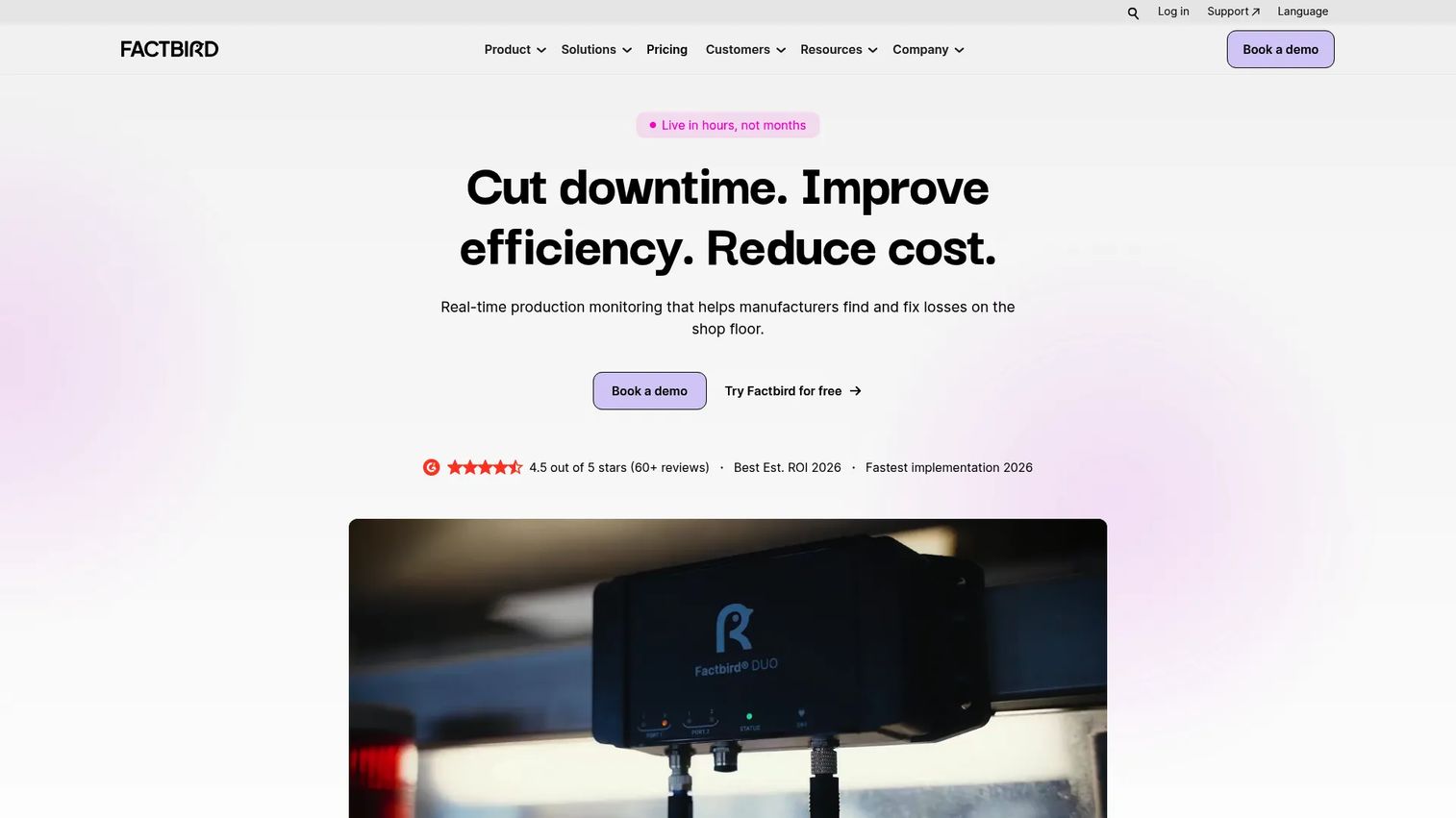
Factbird is a manufacturing intelligence platform that combines real-time production monitoring, OEE analytics, and digitized shop-floor workflows in a modular, per-line pricing model. Unlike most enterprise manufacturing platforms that require a lengthy scoping engagement before pricing, Factbird publishes what it costs. Production Insights starts at $399 per line per month, covering data capture, OEE, downtime tracking, scheduling, and performance analytics. Connected Operations, which adds digital guidance, quality checks, and maintenance workflows, is priced at the same rate. A Knowledge Excellence module covers skills, training, and continuous improvement.
Best for: Manufacturers that want fast OEE visibility and digitized frontline workflows without a long enterprise sales process.
Key features
- Real-time production monitoring and OEE analytics
- Digital SOPs, quality checks, and e-signatures
- AI-powered visual counting and production insights
- Downtime tracking and performance alerting
- Modular per-line deployment
Why choose Factbird: Choose Factbird when the first win is getting clean production visibility fast. Its per-line pricing makes it easier to scope a pilot, run it in one area, and expand. This is the tool for teams that want operational signal before committing to a large enterprise architecture project.
Factbird pricing: Production Insights starts at $399 per line per month. Connected Operations is also $399 per line per month. Knowledge Excellence is $500 per site per month. A platform fee of $1,000 per site per month applies. Enterprise pricing is available for larger deployments.
G2 rating: 4.5/5
10. Amper
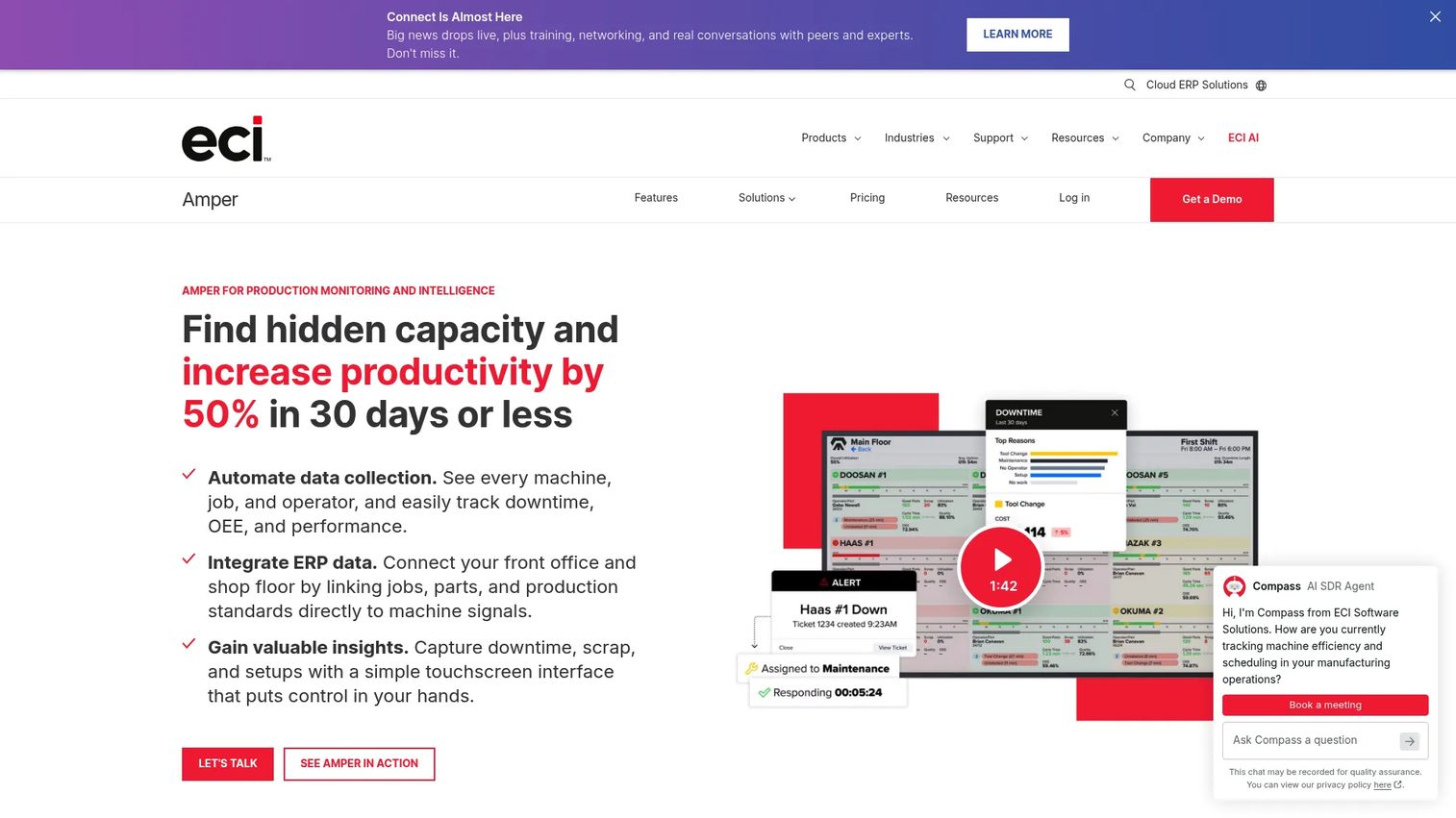
Amper is a production monitoring and intelligence platform that captures real-time machine data and turns it into utilization, downtime, OEE, and operator visibility for factory teams. It connects to machines through IoT hardware and delivers automated monitoring with real-time uptime counts, cycle tracking, and downtime prompts. Operators see shift targets and job progress on a simple interface. Managers and supervisors get dashboards, alerts, and scheduling tools that show real-time capacity and job forecasts. ERP and MES integration options connect the platform into existing systems.
Best for: Small and mid-market manufacturers that need machine monitoring and production visibility without a complex enterprise implementation.
Key features
- Automated machine monitoring with uptime, downtime, and cycle counts
- OEE and downtime tracking with operator prompts
- Smart scheduling with real-time capacity and job forecasts
- Issue and maintenance management
- ERP and MES integration and IoT hardware connectivity
Why choose Amper: Choose Amper when the team needs to stop guessing why machines sit idle. It fits manufacturers moving from manual tracking to live operational data, particularly where the priority is shop-floor visibility rather than enterprise analytics.
Amper pricing: Amper does not display prices on its website. Contact Amper for pricing.
G2 rating: 4.4/5
11. Fulcrum
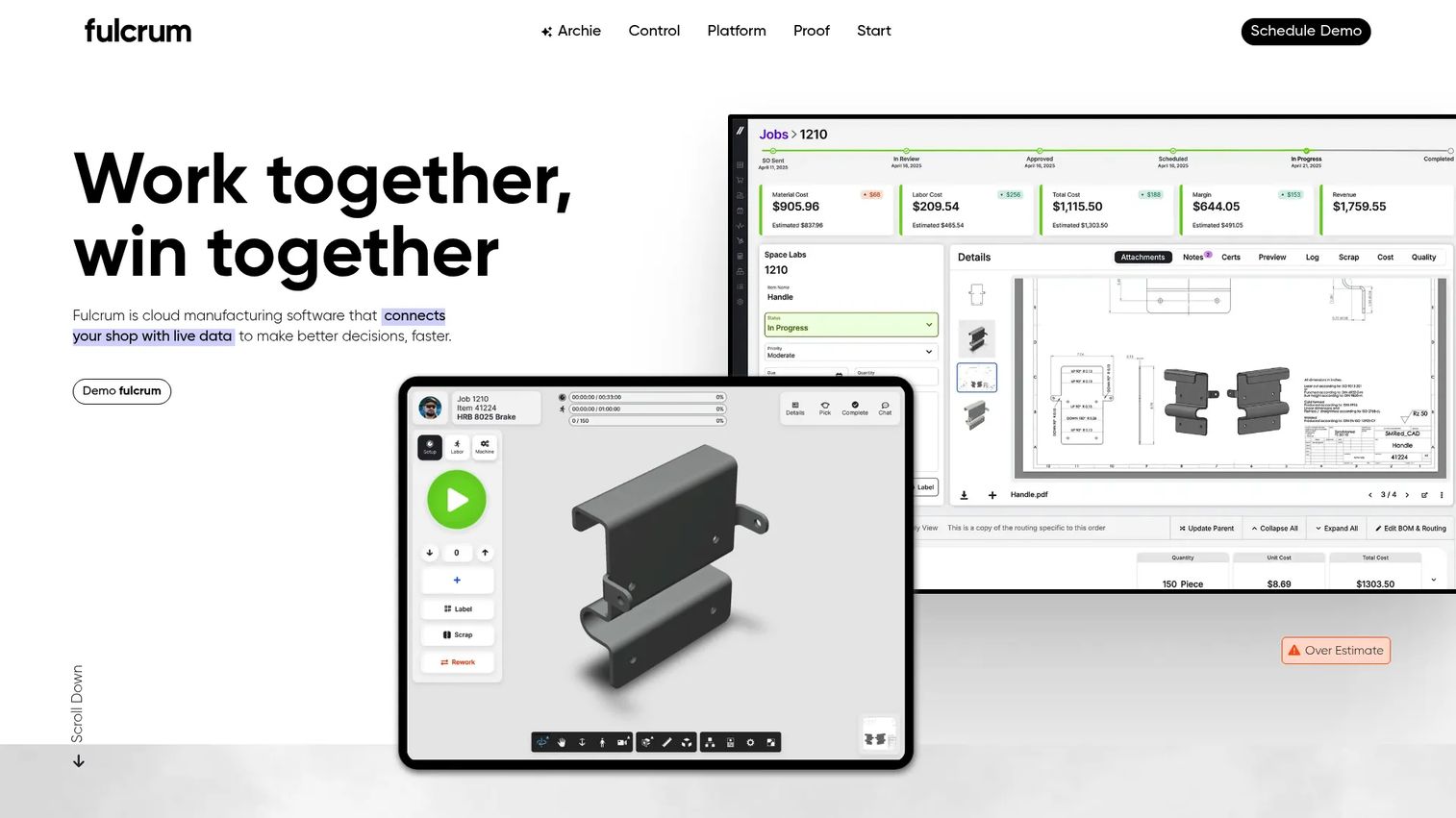
Fulcrum is cloud-based manufacturing operations software that combines ERP, MRP, and MES capabilities for small and mid-sized manufacturers, particularly CNC, sheet-metal, aerospace, and defense job shops running high-mix production. Rather than separating operations execution from production intelligence, Fulcrum captures operational data where the work happens: Job tracking, quoting, scheduling, purchasing, inventory, BOM and routing management, and quality control with inspection checkpoints and traceability. Pricing is customized based on company size, scope, revenue, integrations, and implementation requirements.
Best for: Small and mid-sized high-mix manufacturers replacing fragmented spreadsheets and legacy systems with connected operational visibility.
Key features
- Real-time job tracking and production scheduling
- Quoting, job costing, purchasing, and inventory management
- BOM and routing management
- Quality control with inspection checkpoints and traceability
- CMM imports and document generation
Why choose Fulcrum: Choose Fulcrum when the manufacturing intelligence problem starts with disconnected operations execution. It fits job shops and high-mix manufacturers that need quoting, scheduling, and shop-floor visibility in one system rather than a pure analytics layer on top of fragmented data.
Fulcrum pricing: Fulcrum prices by scope, company size, and implementation requirements rather than per-user. Contact Fulcrum for a demo and proposal.
12. TRACTIAN
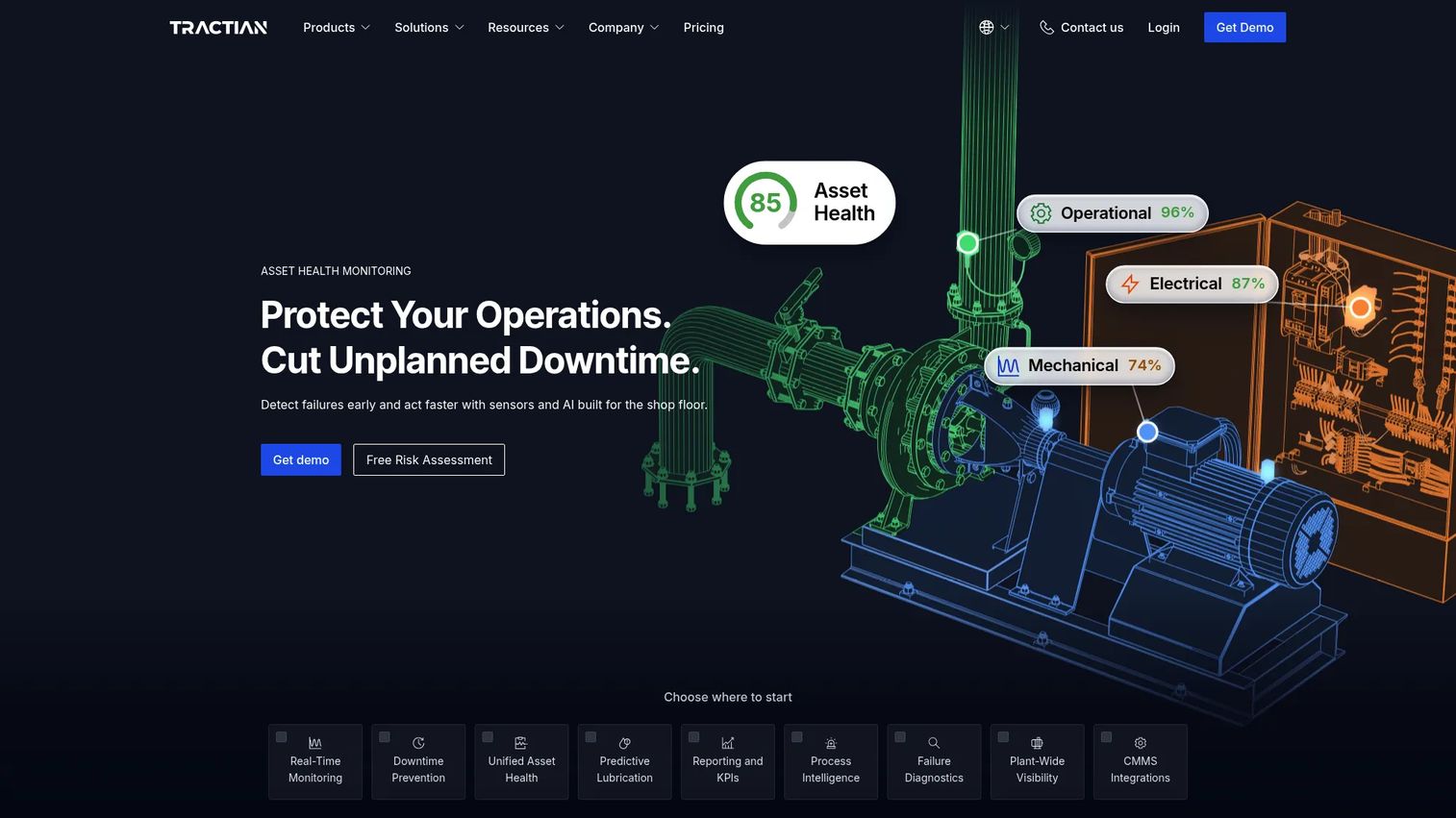
TRACTIAN is an AI-powered asset-health and maintenance platform that combines industrial IoT sensors with software to detect failures, manage maintenance, and reduce unplanned downtime. Sensors monitor vibration, ultrasound, temperature, and RPM in real time, and an AI layer identifies failure patterns, assigns severity, and surfaces root-cause guidance before a breakdown occurs. The platform also covers CMMS workflows: Work orders, preventive maintenance scheduling, parts inventory, and maintenance reporting. It positions predictive maintenance and reactive CMMS in a single system rather than requiring two separate tools.
Best for: Manufacturing and industrial operations teams that need integrated predictive maintenance, condition monitoring, and CMMS workflows.
Key features
- Real-time vibration, ultrasound, temperature, and RPM monitoring
- AI failure detection with severity-based alerts and root-cause guidance
- Work orders, preventive maintenance, and parts inventory management
- Maintenance reporting and reliability dashboards
- Sensor-based asset health scoring
Why choose TRACTIAN: Choose TRACTIAN when downtime risk sits inside critical assets and the maintenance team needs both earlier warnings and cleaner work-order execution. It removes the gap between knowing a machine is at risk and acting on it.
TRACTIAN pricing: TRACTIAN's pricing flow requires a demo or quote. Contact TRACTIAN for asset-based pricing.
G2 rating: 4.7/5
13. iObeya
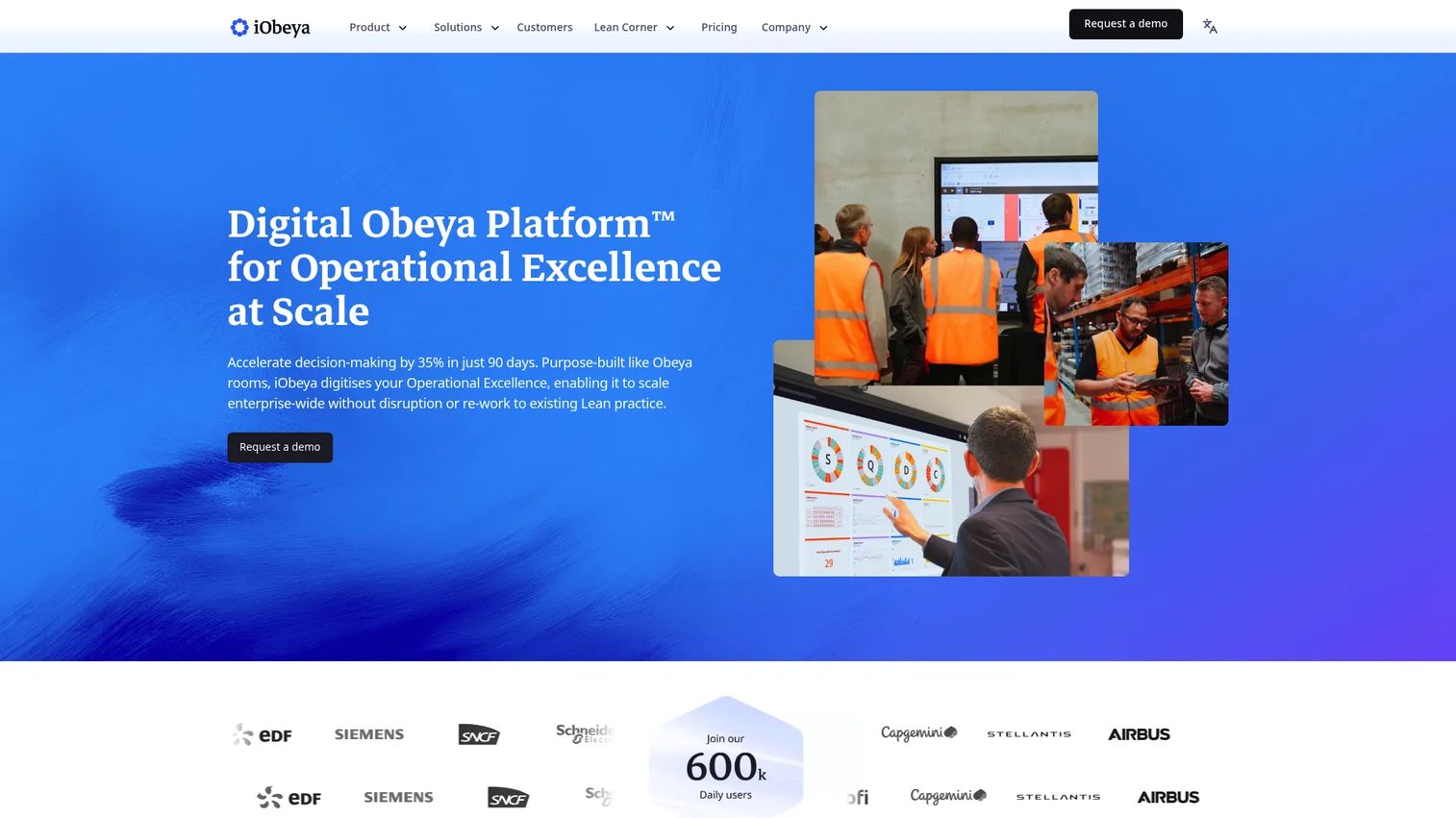
iObeya is a Digital Obeya Platform for visual management, Lean, Agile, and operational excellence collaboration. It replaces physical Obeya rooms with digital equivalents where teams run daily management meetings, strategy deployment sessions, capacity reviews, and SQCDP boards. Jira and Azure DevOps integrations connect digital boards to engineering and product workflows. For manufacturing teams, iObeya's value is in structured operational rituals, keeping cross-functional teams aligned on priorities, problems, and actions, rather than in machine-data analytics.
Best for: Mid-to-large organizations coordinating Lean, manufacturing, and operational-excellence workflows across distributed or hybrid teams.
Key features
- Digital Obeya rooms and visual management boards
- Real-time collaboration and whiteboarding
- SQCDP and daily capacity management boards
- Agile planning, Kanban, and PI Planning boards
- Jira and Azure DevOps integrations
Why choose iObeya: Choose iObeya when the bottleneck is operational alignment and structured routines rather than sensor data. It fits teams that rely on daily management disciplines to turn metrics into improvement actions, particularly in multi-site or distributed operations.
iObeya pricing: Team+ starts at €3,780 per room per year and supports up to 50 users with unlimited guest access. Enterprise pricing (minimum 10 rooms) requires a sales conversation.
G2 rating: 4.5/5
14. Tulip
Tulip is a composable frontline operations platform where manufacturers build custom no-code apps that guide operators, collect production data, run quality checks, and connect to machines and enterprise systems. Rather than a fixed dashboard, Tulip gives operations teams the ability to build the specific interfaces each workflow needs, from an assembly guidance app to a defect logging screen to a machine-monitoring dashboard, without writing code. Native AI, computer vision, OCR, and analytics forecasting extend what those apps can do. The platform supports regulated environments with audit trails and electronic signatures.
Best for: Manufacturers and regulated operations teams digitizing frontline workflows, production, quality, traceability, and machine-connected processes without heavy engineering.
Key features
- No-code app and dashboard creation for frontline workflows
- Native AI, computer vision, OCR, and analytics forecasting
- Machine, device, and enterprise-system connectivity
- Real-time analytics, tables, and machine monitoring
- Audit trails, electronic signatures, and governance tools
Why choose Tulip: Choose Tulip when every factory process has its own workflow and off-the-shelf screens do not fit. It works well for teams that want configurable, connected apps rather than a rigid system that forces process change to match the software.
Tulip pricing: Essentials starts at $100 per interface per month (billed annually, 10-interface minimum). Professional is $250 per interface per month (same minimum). Enterprise and Regulated Industries plans require a sales conversation.
G2 rating: 4.5/5
15. CADDi
CADDi is an AI data platform for manufacturing that structures, connects, and helps organizations use fragmented manufacturing data, particularly engineering drawings, specifications, and production records spread across disconnected systems. Its geometry and similarity analysis searches 2D and 3D product data so teams can find existing designs, avoid duplicate work, and apply historical cost and supplier knowledge to new parts. Discovery is handled through CADDi Explorer, and an AI agent layer automates workflows across design, procurement, and production preparation.
Best for: Manufacturing organizations that need to centralize, search, and operationalize engineering drawing, part, and supplier data.
Key features
- Manufacturing data ingestion across systems and file formats
- Geometry and similarity analysis for 2D and 3D product data
- Semantic mapping, relationships, and access controls
- CADDi Explorer discovery engine and CADDi Agent AI
- Workflow products for design, procurement, and production preparation
Why choose CADDi: Choose CADDi when valuable manufacturing knowledge is buried in old drawings, part histories, and sourcing records. It fits teams trying to reduce duplicate engineering work, improve cost decisions, and make historical manufacturing data searchable across functions.
CADDi pricing: CADDi does not display prices. Contact CADDi for a proposal.
G2 rating: 4.9/5
16. Illuminate Manufacturing Intelligence
Illuminate Manufacturing Intelligence is an IIoT manufacturing intelligence platform from ATS that uses real-time machine-performance data to monitor throughput, uptime, cost, quality, and OEE across production cells, lines, and facilities. A distinctive capability is event-triggered video capture, which records footage around a fault or performance loss event so teams can see what was happening on the floor at the moment of the problem. This gives root-cause analysis a visual layer that timestamps and machine logs alone cannot provide. The platform also covers equipment health scoring, anomaly detection, and energy and emissions monitoring.
Best for: Manufacturers that want OEE, equipment health, and event-driven root-cause visibility in a single platform.
Key features
- Real-time OEE monitoring and production KPI dashboards
- Event-triggered video capture for root-cause analysis
- Equipment health scoring and anomaly detection
- Proactive maintenance support and issue sharing
- Energy and emissions monitoring
Why choose Illuminate Manufacturing Intelligence: Choose Illuminate when root-cause analysis needs more context than a timestamp and a fault code can provide. Event-triggered video makes it possible to see what was actually happening around a machine at the moment of a performance loss or fault.
Illuminate Manufacturing Intelligence pricing: Illuminate is sold through ATS Automation. Contact ATS for pricing based on site scope and deployment requirements.
17. Hexagon Manufacturing Intelligence
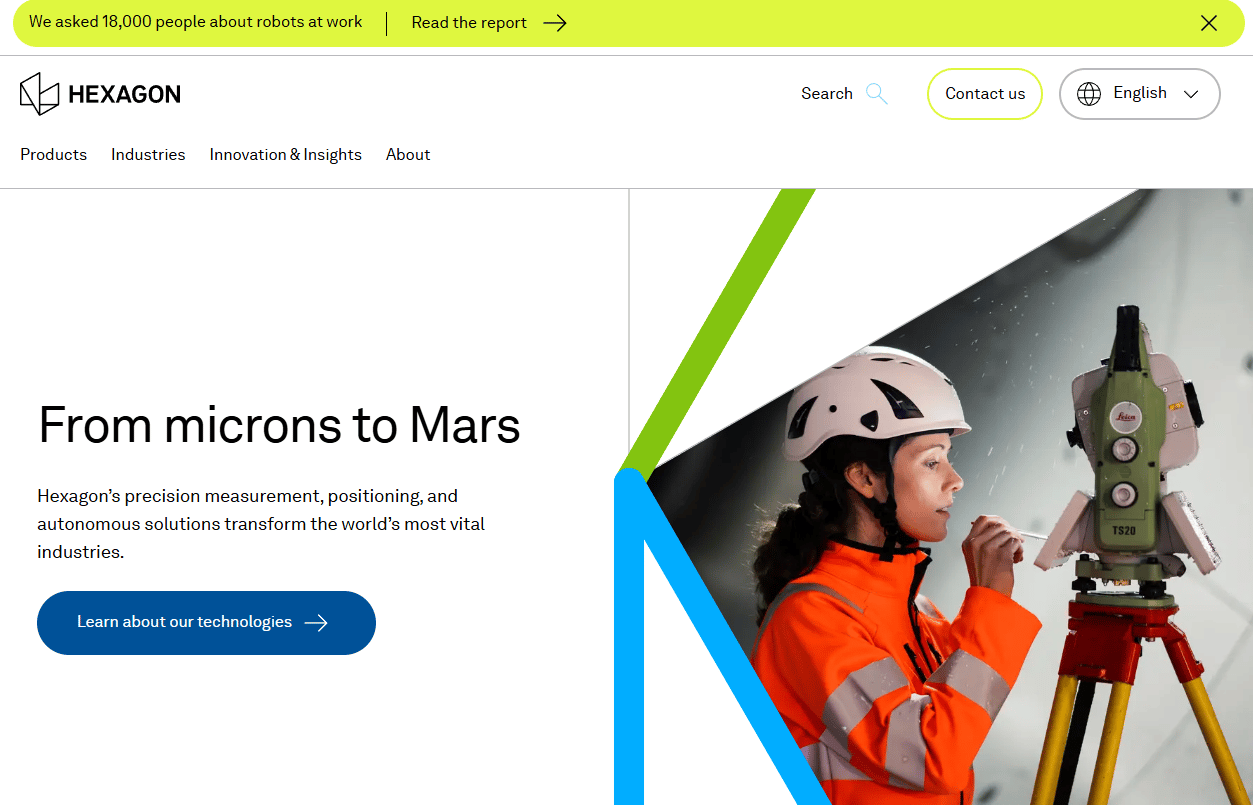
Hexagon Manufacturing Intelligence is a broad manufacturing hardware and software portfolio spanning design, production, metrology, quality management, data analytics, and digital twins. It covers CAD/CAM, CNC simulation, computed tomography, measurement and inspection hardware and software, statistical process control, quality management systems, and the Nexus digital manufacturing platform. Hexagon's approach connects measurement data with production intelligence so manufacturers can tie inspection and metrology outcomes to broader operational and quality decisions. Because it is a portfolio rather than a single product, capability and pricing vary by product group.
Best for: Manufacturers connecting metrology, quality, inspection, and digital manufacturing workflows across the product lifecycle.
Key features
- CAD/CAM and production software
- Metrology hardware and measurement and inspection software
- Data management, analytics, and real-time manufacturing insights
- Digital twins using real-world data and AI
- Quality management systems and SPC
Why choose Hexagon Manufacturing Intelligence: Choose Hexagon when manufacturing intelligence is tied to measurement, inspection, and quality control. It fits manufacturers where precision metrology and traceability shape operational decisions, not just production throughput.
Hexagon Manufacturing Intelligence pricing: Pricing varies by product group within the portfolio. Contact Hexagon for information on the specific products relevant to your use case.
G2 rating: 4.2/5
Considerations when choosing manufacturing intelligence software
Match the tool to the operational bottleneck
OEE monitoring tools, process analytics platforms, quality execution systems, and maintenance intelligence products solve different problems. A team that deploys an OEE monitor when its real problem is process variation will be disappointed. Name the specific decision you need to improve, whether it's downtime response, quality yield, process stability, or multi-site benchmarking, before shortlisting platforms.
Check integration depth with existing plant systems
Manufacturing intelligence depends on data that already lives somewhere: MES, ERP, QMS, SCADA, historians, CMMS, and industrial IoT systems. A platform that cannot connect to the systems already running the plant becomes another dashboard to reconcile. Integration depth matters more than dashboard polish. Ask specifically which systems each vendor has pre-built connectors for and what a custom integration requires.
Decide between site-level speed and enterprise standardization
Some teams need a fast first win: OEE visibility on one line within a week. Others need a standards-compliant enterprise data model that works across 15 plants and survives an IT governance review. Both are valid, but they are different buying decisions. Factbird and Amper serve the former well. Siemens Opcenter Intelligence serves the latter. Know which problem you are solving before the demo.
Verify deployment model, security, and data ownership
Cloud, on-premises, and hybrid deployment options carry different IT involvement, data residency, and security requirements. In regulated industries, where data lives matters as much as what the platform shows. Get clear answers on access controls, data residency, and who owns the data before procurement starts.
Measure action taken, not dashboard adoption
A platform earns its place when it changes decisions. Define the metrics you will track before the contract is signed: Downtime reduction, OEE movement, scrap rate, maintenance response time, or throughput improvement. Dashboard adoption is an input metric, not an outcome. Track what happens to the number that drove the purchase.
Conclusion
Manufacturing intelligence software is not one category with one winner. The buying decision spans several distinct operational jobs.
For enterprise standardization across plants and systems, Siemens Opcenter Intelligence is the mature choice. For regulated manufacturing where quality records and compliance discipline shape production, MasterControl Manufacturing Excellence connects those requirements to production execution. TrendMiner and Seeq both serve process manufacturers that need engineers investigating time-series data directly. Lineview and Factbird are the practical picks for fast OEE visibility and line-performance improvement, with Factbird offering rare pricing transparency. TRACTIAN leads for predictive maintenance and asset reliability. L2L brings maintenance, production, and skills into a single connected workflow. For frontline operations that need custom, no-code apps connected to machines, Tulip is the platform to evaluate. Hexagon Manufacturing Intelligence covers the dimension that most manufacturing intelligence tools miss entirely: Metrology, inspection, and quality data as intelligence, not just documentation.
The best starting point is picking one operational problem you are ready to measure and finding the tool that fits that specific job. Give your operations team something that works in the first quarter, not a six-month implementation that delivers a dashboard nobody reads.
If your team sells manufacturing software and needs prospects to experience the product's value without a live call, interactive demos can help buyers explore what you've built before they ever talk to sales. Start your journey with Guideflow today!
FAQs about manufacturing intelligence software
Manufacturing intelligence software collects, contextualizes, and analyzes data from production machines, quality systems, maintenance records, ERP, MES, and SCADA so operations teams can make faster decisions about performance, quality, and equipment health. It sits between plant-floor systems and management reporting, turning raw operational data into actionable signals. The category covers everything from OEE monitoring to advanced process analytics to predictive maintenance.
MES controls and records production execution: Work orders, routing, labor tracking, and production records. Manufacturing intelligence software analyzes performance across MES output, ERP, SCADA, historians, and other systems to surface trends, anomalies, and improvement opportunities. The two are complementary, and many enterprise platforms overlap, but their primary jobs differ. MES tells you what happened; manufacturing intelligence tells you what it means.
Business intelligence handles general organizational data: Financials, sales pipelines, HR metrics, and customer data. Manufacturing intelligence is built specifically for plant-floor context: Time-series machine data, OEE calculations, production events, shift-level comparisons, quality records, and equipment health. A standard BI tool can display a chart of daily output, but it cannot contextualize a vibration anomaly against a process historian or flag an OEE drop tied to a specific machine state. The data types, integration requirements, and analytical models are fundamentally different.
Siemens Opcenter Intelligence is the strongest enterprise option for large manufacturers that need standards-compliant data modeling, multi-plant visibility, and connectivity across ERP, MES, QMS, MOM, and OT systems. The right choice still depends on your plant architecture and existing systems. Hexagon Manufacturing Intelligence is worth evaluating when metrology, inspection, and quality data are central to operational intelligence.
Lineview, Factbird, Amper, and Illuminate Manufacturing Intelligence are all strong candidates for OEE monitoring and machine-level visibility. Factbird publishes per-line pricing, which makes piloting straightforward. Lineview adds causal loss analysis and guided workflows on top of OEE metrics. Amper focuses on utilization and downtime from machine data. Compare deployment speed, machine connectivity method, and downtime categorization depth before deciding.
TrendMiner and Seeq are both purpose-built for process manufacturing analytics. TrendMiner is designed for engineers who need self-service investigation of time-series and historian data without data science support. Seeq adds collaboration workbooks, AI assistants, and a Python Data Lab for teams with more analytical depth. Both require historian connectivity and work best in chemical, refining, pharma, food and beverage, and similar continuous-process environments.
Pricing in this category varies significantly based on plant count, number of production lines, user count, data sources, deployment model, hardware requirements, integrations, and support tier. Most enterprise platforms use custom quote-based pricing, including Siemens Opcenter Intelligence, TrendMiner, Seeq, and MasterControl. Factbird is a notable exception, publishing prices starting at $399 per line per month. iObeya publishes room-based pricing starting at €3,780 per room per year. Tulip publishes interface-based pricing starting at $100 per interface per month. For machine-monitoring tools that include hardware sensors, pricing typically combines a hardware cost with a software subscription.
Priority integrations depend on what systems your plant already runs, but the most common requirements are ERP (SAP, Oracle, Microsoft), MES, QMS, SCADA, process historians (OSIsoft PI, Aspentech IP.21), CMMS, and industrial IoT sensor infrastructure. Data warehouse and analytics platform integrations matter for teams that want to push manufacturing data into broader enterprise reporting. Integration depth is often more important than dashboard design. A platform that connects to your existing systems and enriches that data is more valuable than one with a better interface that requires a separate data pipeline to get there.