An inquiry lands in your inbox on a Saturday. You reply Monday. By then the couple booked the venue that answered in an hour.
That gap is where wedding venues lose revenue. Not on pricing. On follow-up.
Most venues run bookings across a booking spreadsheet, a shared inbox, a paper contract folder, and a calendar nobody trusts. Inquiries slip. Deposits go uncollected. A floor plan change never reaches the kitchen. Then the couple asks about the cake table and three people give three answers.
The global venue management software market hit USD 1.18B in 2024 and is projected to reach USD 3.85B by 2033, according to Probity Market Insights (2024). Venue operators are consolidating tools because the manual stack stops working the moment volume climbs.
Good wedding venue software closes those gaps. It captures every inquiry, moves couples from tour to signed date, collects deposits on time, and keeps sales, operations, and vendors reading the same run-of-show. A single venue booking software system replaces the patchwork.
This guide ranks seven wedding venue management software platforms for 2026, with real pricing, G2 ratings, and clear guidance on which venue each one fits.
What's inside
This guide is for venue owners, event sales managers, and operators choosing wedding venue software in 2026. We compared seven platforms on the workflow that actually matters, inquiry to wedding day.
We evaluated each tool on four criteria:
- Workflow coverage from lead capture through wedding day execution
- Proposals, contracts, deposits, payments, and client portals
- BEOs, banquet event orders, calendars, reminders, and operations
- Integrations, migration support, and reporting depth
Pricing and G2 ratings reflect verified values checked against each vendor's own page and live G2 listing.
TL;DR
- Best for venue ops at scale: Tripleseat. Centralized event sales and planning for restaurants, hotels, and hospitality-led venues.
- Best for all-in-one venue management: Planning Pod. Broad workflow coverage from booking calendars to floor plans and payments.
- Best wedding venue CRM for small teams: HoneyBook. Polished client-facing workflows with proposals, contracts, and payments.
- Best for fast setup and AI-assisted follow-up: Perfect Venue. Automatic BEOs, one calendar, and AI Reply for quick lead response.
- Best for planning plus venue coordination: Aisle Planner. Sales, project management, and client collaboration in one platform.
- Best for hotel-style booking discipline: Event Temple. Pipeline CRM and catering workflows for hospitality-driven venues.
- Best for food and beverage operations depth: Caterease. Detailed event, menu, and staffing workflows for catering-heavy venues.
What is wedding venue software
Wedding venue software is a venue management platform that runs the full booking workflow, from first inquiry to wedding day, in one system instead of scattered spreadsheets and inboxes.
It combines a venue CRM with proposals, contracts, deposits, and operations so sales and event teams work from shared, current data. Most platforms are cloud-based and used by venue owners, event sales managers, and coordinators.
Core capabilities of event venue management software:
- Lead capture and inquiry management from web forms and email
- Proposals, contracts, e-signatures, and deposits
- Client portals and approvals for couples and planners
- BEOs, banquet event orders, and run-of-show documents
- Scheduling, calendars, and tour scheduling
- Automation, reminders, and reporting
- Integrations with accounting and productivity tools like QuickBooks and Google Calendar
The difference between generic event tools and true wedding venue software is depth. A wedding is a single high-stakes date with one shot to get it right. The software has to track the deposit schedule, the seating layout, the vendor list, and the timeline without anything falling between systems.
A strong venue CRM also gives you the reporting to see what converts. Which inquiry sources book. How long tours take to close. Where deposits stall. That visibility is what turns a reactive booking process into a repeatable one.
When to use
Replace patchwork spreadsheets and inbox threads
You know it's time when nobody can answer "is this date booked?" without checking three places. Manual coordination breaks once you pass a handful of active bookings. Double-bookings, missed deposits, and lost inquiry details are symptoms of a stack that has outgrown spreadsheets. Wedding venue booking software gives you one source of truth for dates, holds, and payments.
Speed up the path from inquiry to signed date
Response time decides bookings. If leads sit unanswered, proposals take days, or deposits require back-and-forth, you're losing couples to faster venues. Software with automation, templated proposals, and online deposit collection compresses the timeline from first touch to signed contract. Reminders keep follow-up from slipping through the cracks.
Keep sales, operations, and vendors aligned
The handoff from signed contract to wedding day is where mistakes hide. When a headcount change or a floor plan edit never reaches the kitchen or the coordinator, service suffers. Software with shared BEOs, task ownership, and live schedule updates keeps everyone reading the same run-of-show. One update propagates instead of living in someone's memory.
Comparison table
Here is how the seven platforms compare on fit, differentiator, pricing, and G2 rating. Pricing reflects each vendor's published or stated figures as of August 2026.
| # | Product | Best for | Key differentiator | Pricing | G2 rating |
|---|---|---|---|---|---|
| 1 | Tripleseat | Venue sales and ops at scale | Centralized event sales for hospitality venues | Quote-based | 4.5/5 |
| 2 | Planning Pod | All-in-one venue management | Broad workflow coverage in one platform | From $199/month | 4.0/5 |
| 3 | HoneyBook | Wedding venue CRM for small teams | Polished client-facing workflows | From $29/month | Not listed |
| 4 | Perfect Venue | Fast setup, AI-assisted follow-up | Automatic BEOs and AI Reply | From $99/month per location | 4.8/5 |
| 5 | Aisle Planner | Planning plus venue coordination | Sales and project management combined | From $49.99/month | 4.3/5 |
| 6 | Event Temple | Hotel-style booking discipline | Pipeline CRM plus catering | From $249/month | 4.8/5 |
| 7 | Caterease | Food and beverage ops depth | Detailed event, menu, and staffing workflows | From $99/month | 3.5/5 |
Best 7 wedding venue software for 2026
1. Tripleseat
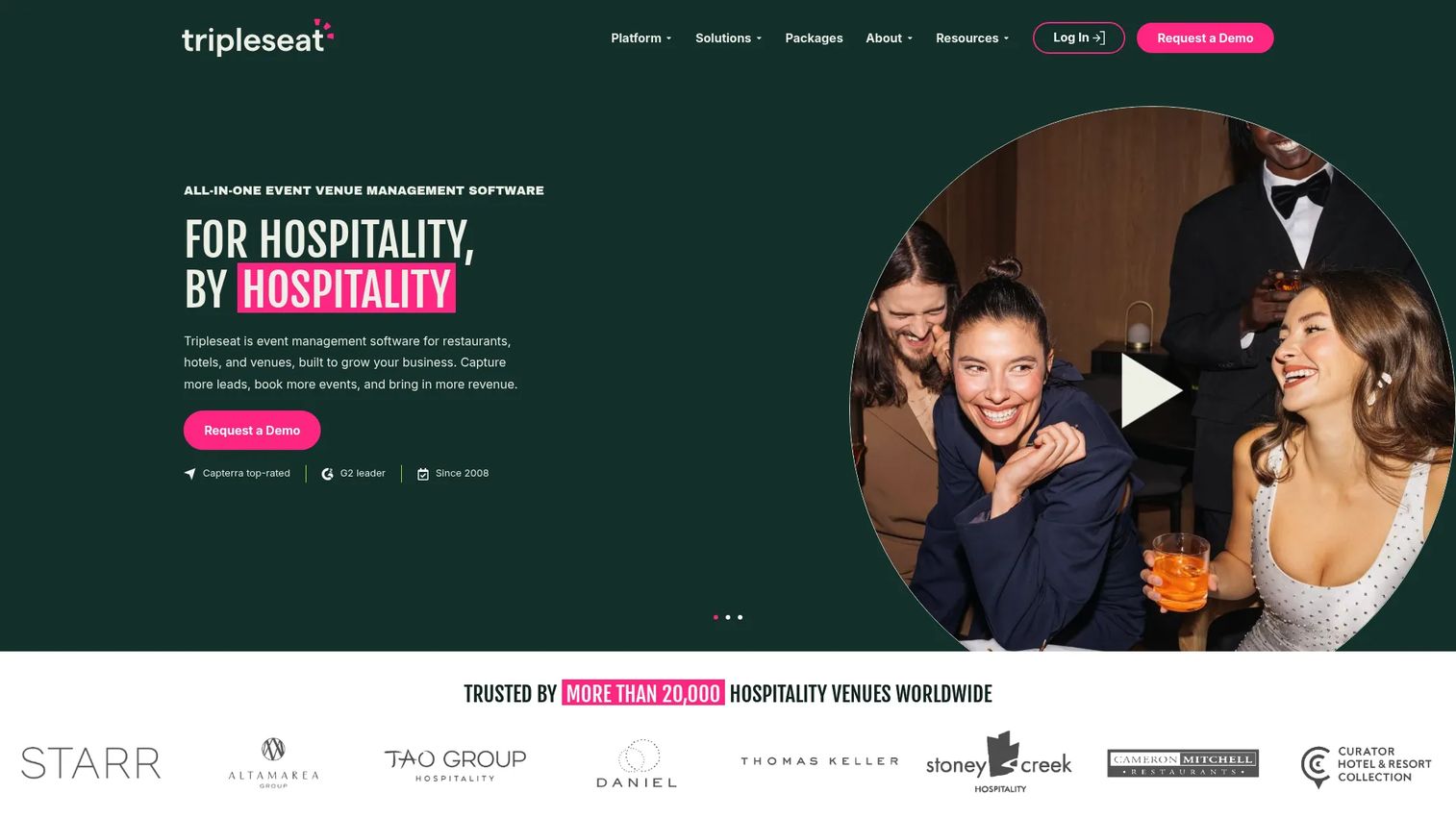
Tripleseat is all-in-one event management software built for hospitality venues. It captures inquiries and routes them automatically, then carries the booking through proposals, contracts, budgets, and payments. For larger venues and hospitality-led teams, it centralizes event sales and planning that would otherwise sprawl across departments.
Best for: Restaurants, hotels, and venues that need centralized event sales and planning across multiple rooms or teams.
Key strengths
- Capture inquiries and route them automatically
- Send proposals and contracts, manage budgets and payments
- Plan events with floor plans, guest portal, and ticketing
Why choose Tripleseat: If your venue runs high event volume across a hospitality group, Tripleseat scales the sales-to-execution workflow without leaning on manual handoffs. It fits teams where event sales is a real department, not a side task. The guest portal and floor plans keep couples and operations aligned on the same details.
Tripleseat pricing: Tripleseat uses quote-based pricing. The site directs you to request a customized quote through a pricing call rather than publishing plan prices, so cost depends on your venue size and needs.
Tripleseat holds a 4.5/5 rating on G2.
2. Planning Pod
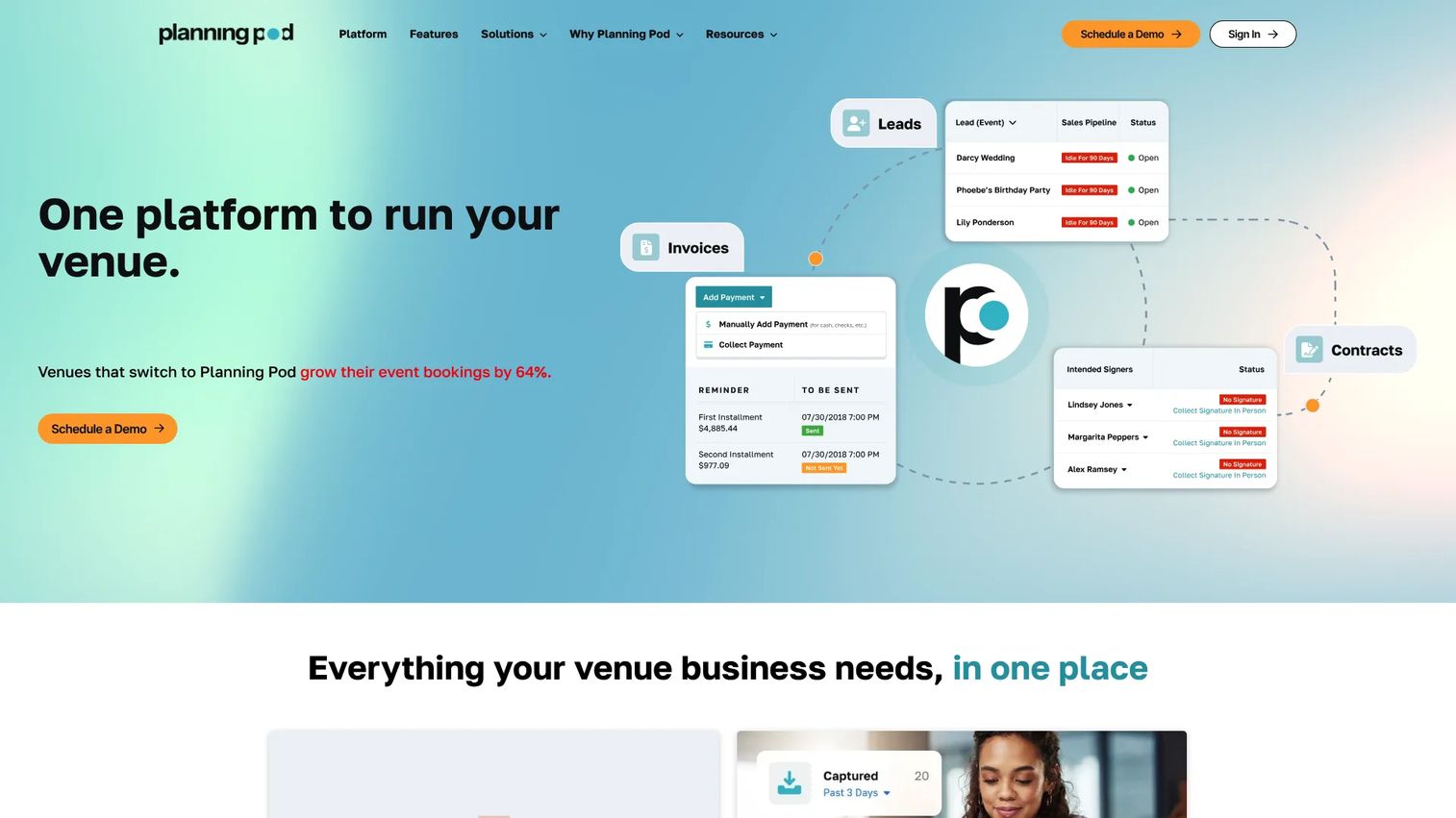
Planning Pod is web-based event and venue management software that covers the full operational stack. It handles booking calendars, holds, and tours on the front end, then proposals, contracts, e-signatures, invoices, deposits, and integrated payments through to the event. The breadth is the point: most of what a venue does day to day lives in one platform.
Best for: Event venues and planners who want an all-in-one operations platform instead of stitched-together tools.
Key strengths
- Booking calendars, holds, blackouts, and tours
- Proposals, contracts, and e-signatures
- Invoices, deposits, and integrated payments
Why choose Planning Pod: Planning Pod fits venues that want to centralize operations rather than specialize in one function. It replaces a booking calendar, a contract tool, and a payments processor with a single venue management platform. That consolidation is what makes it a strong fit for growing single-location venues.
Planning Pod pricing: Pricing is based on how many events you manage at a time. Plans start at $199 per month, and Planning Pod states most single-location venues land between $199 and $319 per month. A free 14-day trial is available, with monthly and yearly subscription options.
Planning Pod holds a 4.0/5 rating on G2.
3. HoneyBook
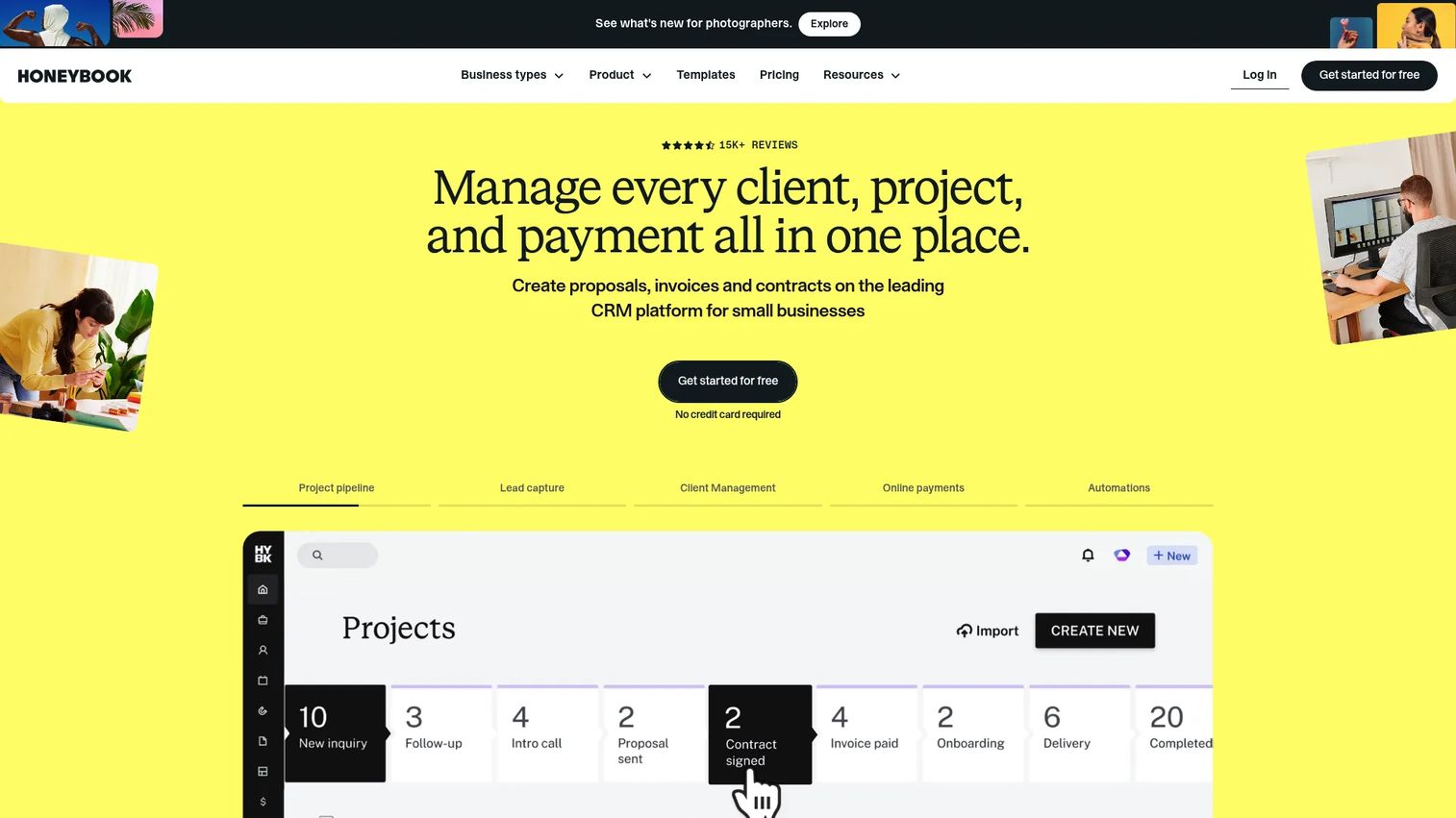
HoneyBook is AI-powered client relationship software for service-based businesses, and it works well as a wedding venue CRM for smaller teams. It captures leads through contact forms, then moves them through proposals, contracts, invoices, and payments with a polished client-facing experience. Automations and project tools keep the follow-up moving without manual effort.
Best for: Service-based solo operators and small venue teams that want client management, proposals, contracts, and payments in one place.
Key strengths
- Lead and contact forms with automations
- Proposals, contracts, invoices, and payments
- Project management tools and HoneyBook AI
Why choose HoneyBook: HoneyBook is the right fit when the client experience is your differentiator and the team is lean. The proposals and contracts feel modern to couples, and the automation reduces the busywork a small team can't absorb. It leans toward service-heavy operators rather than high-volume hospitality groups.
HoneyBook pricing: Plans are billed yearly at $29 per month for Starter, $49 per month for Essentials, and $109 per month for Premium. All plans begin with a free trial. There is no permanent free tier.
A current G2 rating for HoneyBook was not listed at the time of writing.
4. Perfect Venue
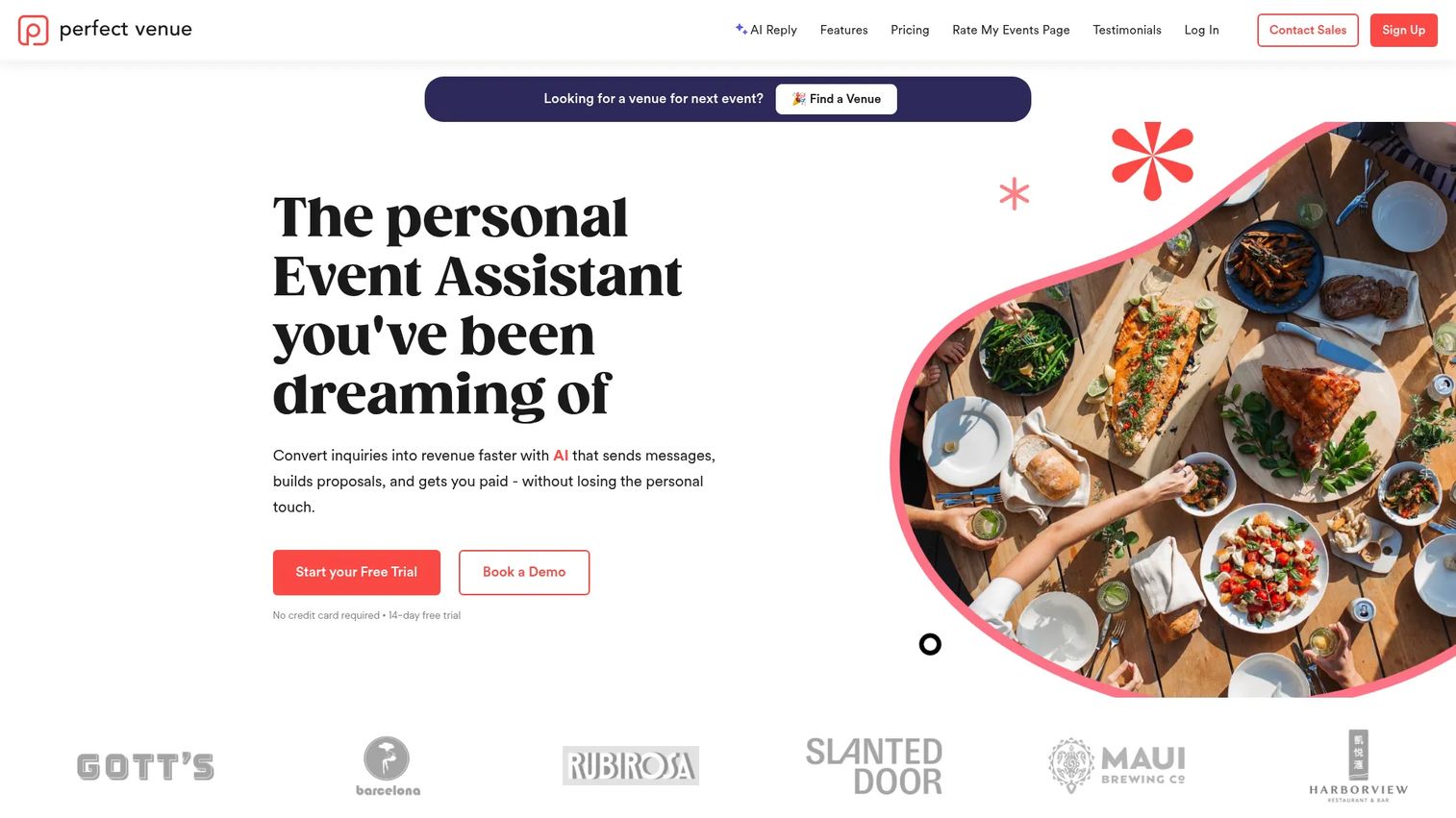
Perfect Venue is private event management software for venues, restaurants, and hospitality groups, built for speed. One central calendar anchors the workflow, automatic BEOs and docs cut manual prep, and AI Reply helps teams respond to inquiries fast. Payments, team tasks, and analytics round out a system designed to be simple to run day to day.
Best for: Independent venues and hospitality teams that want faster setup and less manual admin managing private events.
Key strengths
- One central calendar and automatic BEOs
- Email templates and AI Reply for fast follow-up
- Payments integration, team tasks, and analytics
Why choose Perfect Venue: Perfect Venue fits teams that want to be productive quickly without a long implementation. The automatic BEOs and AI-assisted replies remove two of the most repetitive tasks in venue ops. It's a practical pick when simplicity and speed matter more than deep customization.
Perfect Venue pricing: The Basic plan starts at $99 per month per location, and the Premium plan is $299 per month per location. An Enterprise tier is available by contacting sales, and the pricing page indicates a free trial.
Perfect Venue holds a 4.8/5 rating on G2.
5. Aisle Planner
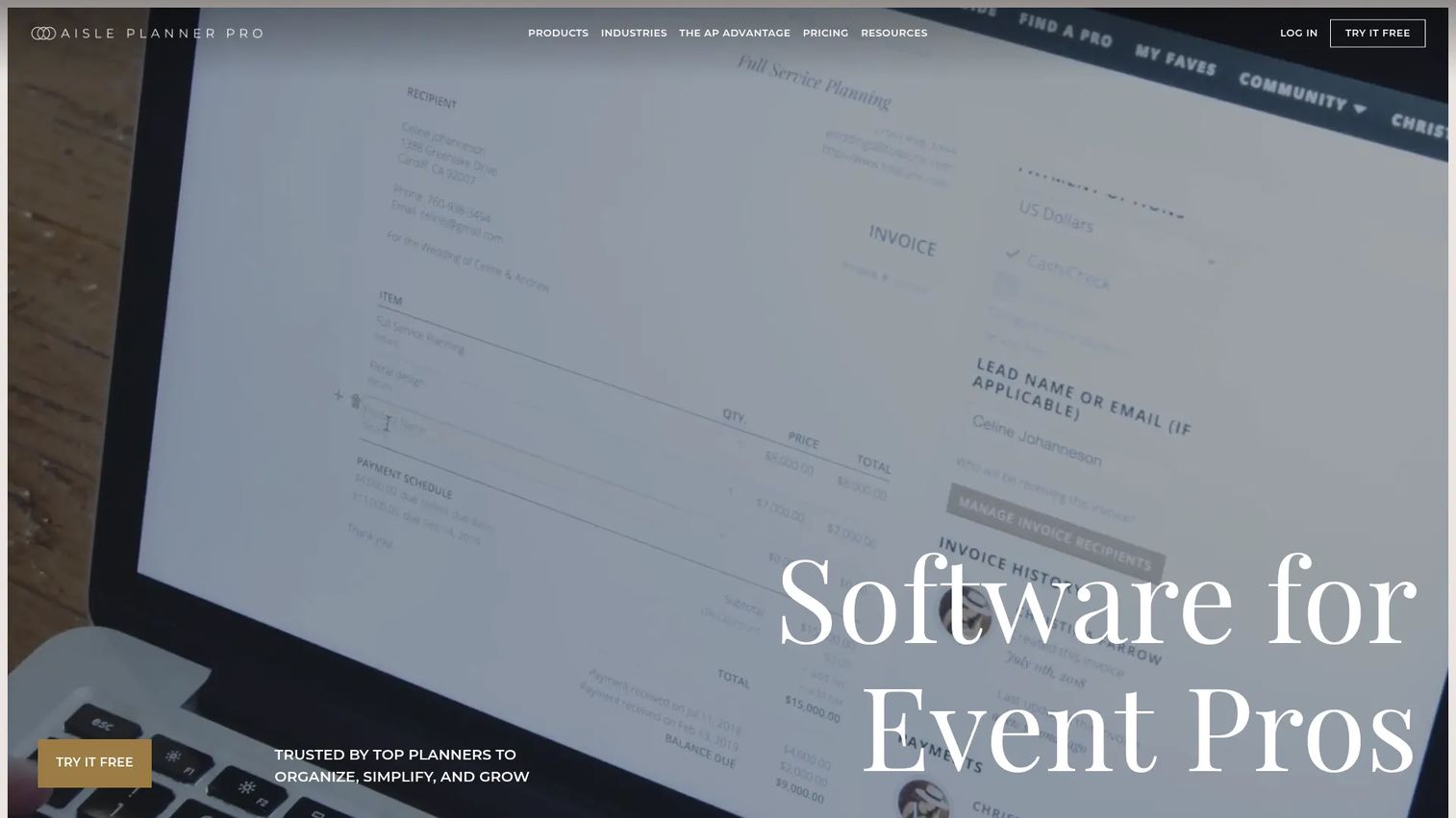
Aisle Planner is all-in-one planning, sales, and project management software for wedding and event professionals. It combines lead management, proposals, contracts, and online payments with deep project tools like checklists, timelines, budgets, and seating layouts. Client collaboration features, including guest management and event websites, make it strong for teams that plan as well as book.
Best for: Wedding and event planners who need sales, client collaboration, and project management in one platform.
Key strengths
- Lead management, proposals, contracts, invoicing, and payments
- Checklists, timelines, budgets, calendars, and vendor management
- Guest management, messaging, layouts, seating, and event websites
Why choose Aisle Planner: Aisle Planner fits venues that also handle planning and coordination, not just the booking. The project management depth keeps the wedding organized from contract through the day itself. It's the pick when your team lives in timelines and seating charts, not only in the sales pipeline.
Aisle Planner pricing: Pricing is based on active projects. Plans start at $49.99 per month for Sales Essentials, then scale by project count to $69.99, $109.99, $164.99, and $229.99 per month. All plans include a free 30-day trial, and annual billing saves 10 percent.
Aisle Planner holds a 4.3/5 rating on G2.
6. Event Temple
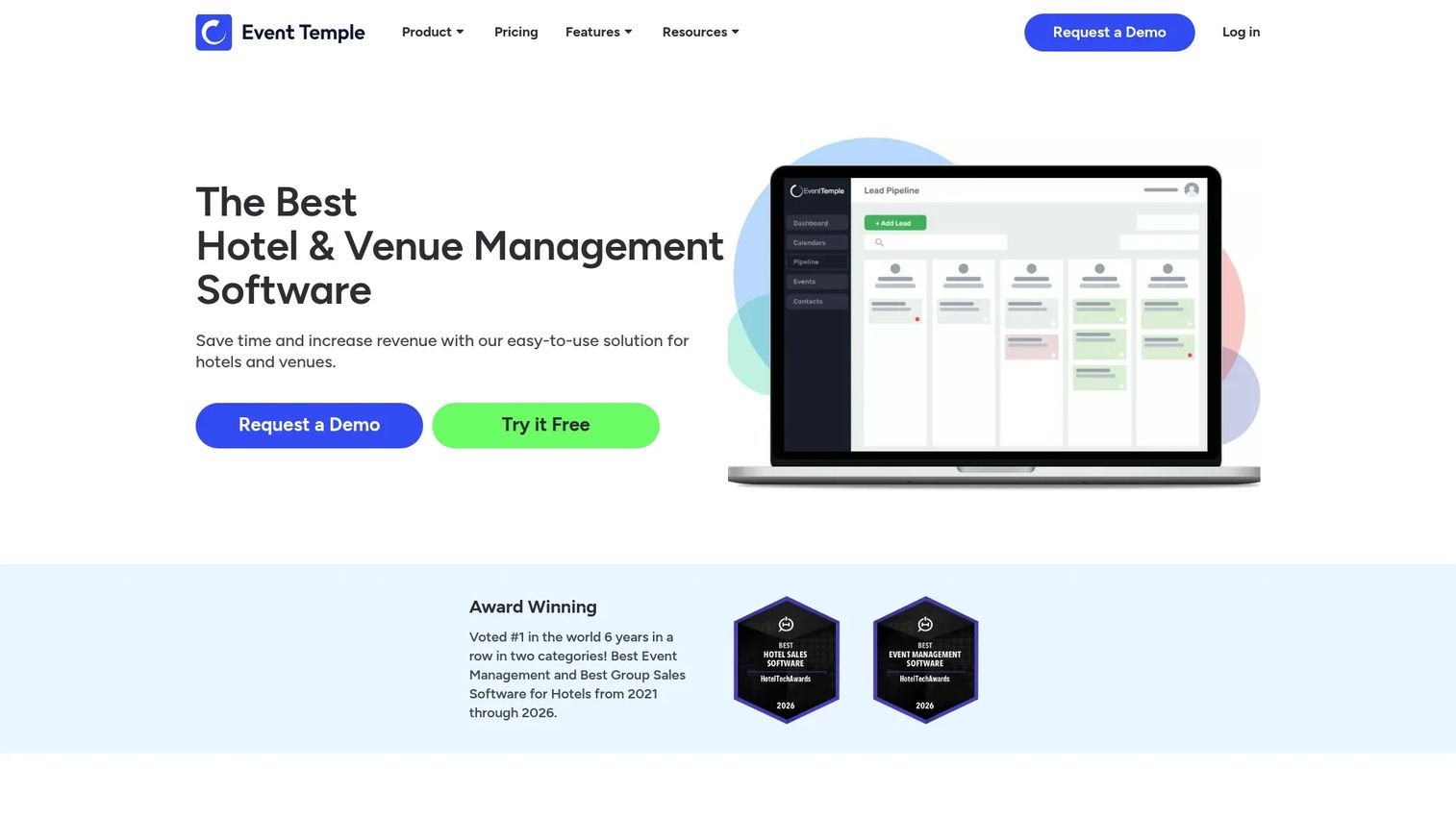
Event Temple is cloud-based hotel and venue management software for sales, events, and catering. Its pipeline and sales CRM brings booking discipline to hospitality-driven venues, while event and catering management handles execution. E-proposals, smart mail, digital invoicing, and workflows keep the booking flow structured from lead to event.
Best for: Hotels and venues that need sales, event, and catering workflow software with a strong booking pipeline.
Key strengths
- Pipeline and sales CRM for booking discipline
- Event management and catering
- E-proposals, smart mail, digital invoicing, and chain management
Why choose Event Temple: Event Temple fits hospitality operations that treat the sales pipeline as a discipline, especially hotels and multi-property groups. Chain management supports venues that run more than one location. It's built for teams that want booking flow structure rather than a lightweight tool.
Event Temple pricing: Pricing starts as low as $249 per month, billed annually, and requires a custom quote based on your needs. Event Temple lets you try it before you buy.
Event Temple holds a 4.8/5 rating on G2.
7. Caterease
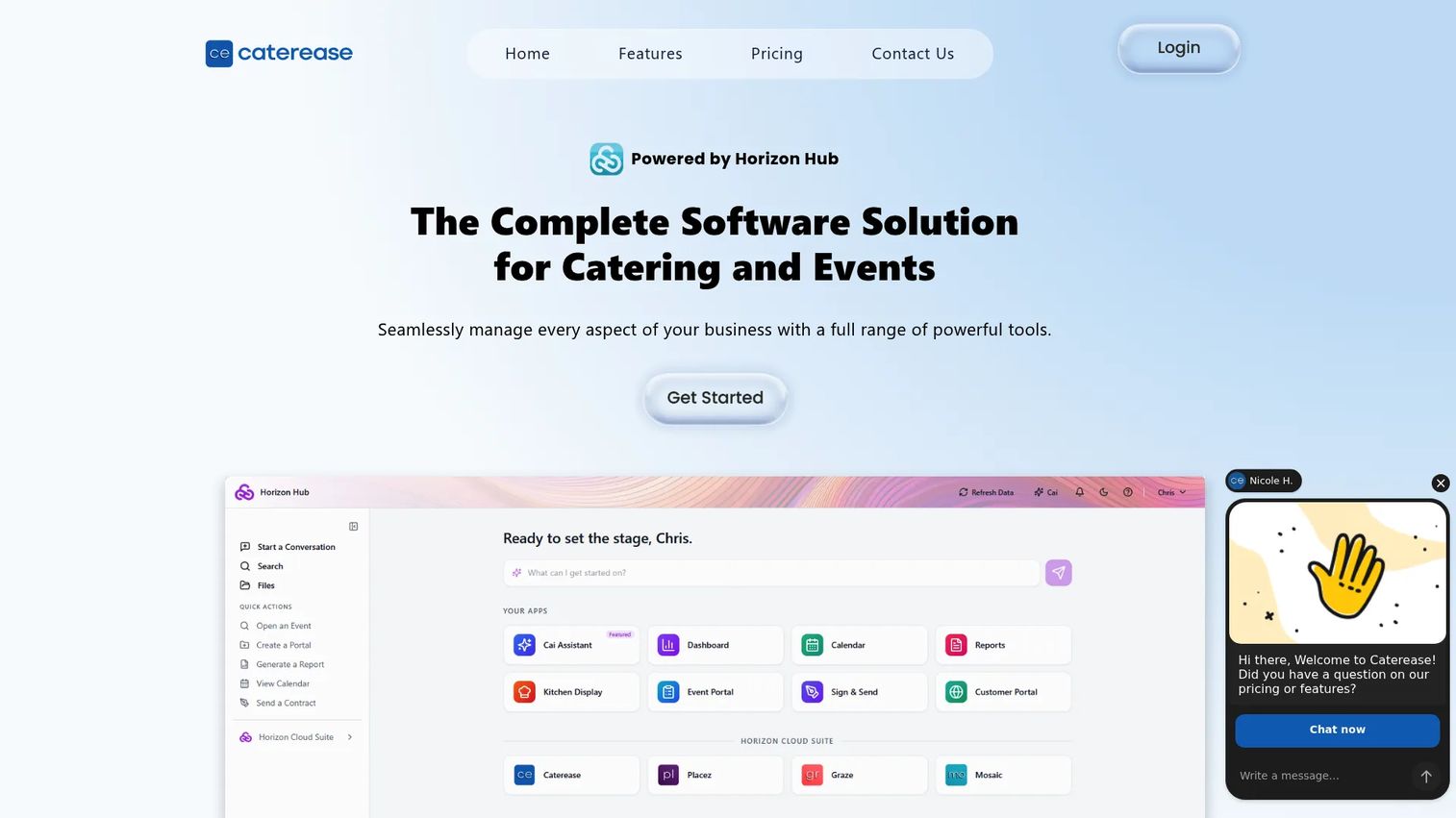
Caterease is catering and event planning software for managing events, menus, staffing, payments, and client data. Its wizard-driven event and client management keeps complex operations organized, while custom event prints and screen displays give the kitchen and floor exactly what they need. For venues where food and beverage carry the operation, the depth is the draw.
Best for: Catering and event operations that need detailed planning, menu, and staffing workflows.
Key strengths
- Wizard-driven event and client management
- Custom event prints and screen displays
- Menu management, shift and staff management, and batch payment processing
Why choose Caterease: Caterease fits venues with heavy food and beverage complexity, where menus, staffing, and service coordination drive the event. The process control suits operations that need tight control over kitchen and staff logistics. It's the specialist pick for catering-forward venues rather than a general booking tool.
Caterease pricing: Plans are billed annually at $99 per month for Express, $149 per month for Standard, and $199 per month for Professional. Optional enhance modules run $25 per month each, and all plans carry a one-time launch fee of $200 per user.
Caterease holds a 3.5/5 rating on G2.
Considerations
Before you commit, check how each tool fits your current stack and team. Use this checklist.
Workflow coverage
Map the tool against your actual booking flow, from inquiry to wedding day. A platform that captures leads but forces you back into spreadsheets for BEOs leaves gaps where mistakes live. Confirm it covers the specific steps your team repeats every week.
Client experience
Couples and planners judge you by the proposals, contracts, and portals they touch. Check whether the client-facing side feels current and simple, because a clunky portal reflects on your venue. A polished venue CRM front end can be the difference in a booking decision.
Operations handoff
The signed-contract-to-execution handoff is where service breaks. Verify that BEO updates, task ownership, and schedule changes propagate to the kitchen and coordinators automatically. One live source beats a stack of emailed PDFs that go stale.
Integrations and reporting
Confirm the venue management platform connects to your accounting and calendar tools, such as QuickBooks and Google Calendar. Then check the reporting: can you see which inquiry sources convert and where deposits stall? Reporting depth is what turns booking data into decisions.
Migration and onboarding
Switching from spreadsheets or another tool carries risk if data doesn't move cleanly. Ask what migration and switching support the vendor provides, and how long setup takes. A tool that takes a quarter to implement costs you bookings in the meantime.
Conclusion
The right wedding venue management software depends on your bottleneck, not the longest feature list.
For all-in-one operators running high volume, Tripleseat and Planning Pod centralize sales and execution. Smaller teams that live on client experience should start with HoneyBook, a clean venue CRM with polished proposals and contracts. Venues that want fast setup and less manual admin fit Perfect Venue with its automatic BEOs and AI Reply.
Planning-heavy teams that manage timelines and seating belong on Aisle Planner. Hospitality-driven and multi-property venues get booking discipline from Event Temple. And catering-forward operations with deep food, beverage, and staffing needs get the most from Caterease.
Start with the tool that matches where your process breaks today. If inquiries are slipping, prioritize lead capture and follow-up speed. If wedding day execution is the problem, prioritize BEOs and operations handoff. Then pressure-test migration and switching support before you commit, so the move itself doesn't cost you bookings.
Book demos with your top two, run a real inquiry through each, and pick the one that fits your team.
FAQs
For small venues, HoneyBook is a strong wedding venue booking software choice because it pairs a polished client experience with proposals, contracts, and payments at a low entry price. Perfect Venue also fits small teams that want fast setup and automatic BEOs. The best pick depends on whether your priority is client-facing polish or operational speed.
Pricing ranges widely. Entry plans start around $29 per month for HoneyBook and $49.99 per month for Aisle Planner, while operations-focused platforms like Planning Pod start at $199 per month and Event Temple at $249 per month. Tripleseat uses quote-based pricing. Expect to pay more for multi-location, catering, or high event volume.
Yes. Most platforms here handle proposals and contracts with e-signatures, plus deposits, payments, and invoicing. HoneyBook, Planning Pod, and Aisle Planner all include online payment collection. This is core functionality, so confirm the tool supports your specific deposit schedule and payment processor.
Many do. BEOs, banquet event orders, are central to venue operations, and Perfect Venue generates them automatically. Tripleseat, Event Temple, and Caterease also support detailed event documents and run-of-show. If BEO discipline is your weak point, prioritize it when comparing tools.
Start by exporting your current bookings, contacts, and calendar into a clean file. Then ask each vendor what migration and switching support they offer, since most will help import your data. Move one workflow at a time, inquiries first, then contracts and payments, so the team adjusts without losing active bookings.
Event Temple supports chain management for groups running more than one property, and Tripleseat scales across hospitality teams and multiple rooms. Both handle the reporting and centralized event sales that multi-venue operations need. Confirm the platform separates data cleanly by location while giving you rollup reporting.
Accounting and calendar integrations matter most day to day. Look for QuickBooks for invoicing and payments, and Google Calendar for scheduling and tour coordination. Payment processing integrations also matter for collecting deposits. Confirm the venue management platform connects to the tools your team already runs before you commit.
Yes. A venue CRM is what keeps every inquiry, tour, and follow-up in one place instead of a shared inbox. It's the difference between responding in an hour and losing the couple to a faster venue. Strong wedding venue CRM functionality also gives you reporting on which sources convert, which turns booking into a repeatable process.