Your directory says the cardiologist is accepting new patients. She retired eight months ago. A member calls the number, gets a disconnected line, and files a complaint that lands on your compliance desk.
That gap has a name. Regulators call it a ghost network, and it is the visible symptom of provider data that went stale between updates. Most teams blame the volume of records. That is not the real problem. The real problem is that verification, directory publishing, and credentialing usually run on separate systems that never reconcile, so drift accumulates faster than manual work can catch it.
Provider network software exists to close that gap. The category is growing fast. The healthcare provider network management market is projected to reach USD 11.51 billion by 2030, up from USD 5.52 billion in 2025, a 15.7% CAGR according to The Business Research Company (2024). Software already accounts for roughly 57% of that market, per Industry Research (2024), which tells you where payers are putting their budgets.
Accurate provider data is not a directory problem. It is a network adequacy problem, an audit readiness problem, and a member trust problem all at once. This guide breaks down 10 provider network management solutions so you can match the tool to your actual failure mode.
What's inside
This guide is built for payer and health plan teams evaluating provider network management software in 2026. It covers verification-heavy platforms, directory accuracy tools, and end-to-end lifecycle systems.
We selected and ranked tools based on four criteria that matter most for payers:
- Provider data accuracy and continuous monitoring
- Workflow automation across credentialing and contracting
- Compliance support and audit readiness
- Interoperability and ability to scale across states and provider types
Pricing for this category is almost entirely quote-based, so we note that transparently rather than guessing at numbers.
TL;DR
- Best for primary-source verification and monitoring: Verisys, with sanctions screening, licensure checks, and real-time credential alerts.
- Best for payer directory accuracy and compliance: symplr, as an integrated healthcare operations platform.
- Best for end-to-end provider lifecycle management: Virsys12, covering enrollment, credentialing, contracts, and directory automation.
- Best for AI-assisted discrepancy detection: HiLabs, built to clean provider data at health plan scale.
- Best for audit readiness and network adequacy: MCheck NetworkIQ, with audit-ready templates and geospatial modeling.
- Best for multi-state scale: Medallion and Kyruus Health, for credentialing automation and directory search across large footprints.
What is provider network software?
Provider network software is a category of platforms that help payers and health plans collect, verify, store, monitor, and share provider data across credentialing, contracting, directory management, and claims workflows.
It sits at the center of how a health plan knows who is in its network, whether those providers are credentialed and sanctioned-free, and whether the published directory matches reality. The category overlaps with credentialing software, provider lifecycle management platforms, and directory accuracy tools, but the strongest systems tie all of these together.
Core capabilities to expect:
- Primary source verification: direct checks against licensing boards, sanctions lists, and disciplinary databases
- Provider lifecycle management: onboarding, enrollment, credentialing, recredentialing, and offboarding in one workflow
- Continuous monitoring: ongoing alerts on license status, exclusions, and regulatory changes rather than point-in-time checks
- Workflow automation: roster ingestion, task routing, and status tracking that reduce manual re-keying
- Audit trails: date-stamped, source-traceable evidence for internal and external review
- **Interoperability:** integration with claims systems, credentialing feeds, member portals, APIs, and FHIR-based exchange
- Directory publishing and accuracy support: tools that keep public and member-facing directories aligned with verified data
The distinction that matters most: some platforms verify data, some manage the workflow around it, and some focus on the directory that members actually see. Knowing which layer you need shapes the entire evaluation.
When to use provider network software
Improve directory accuracy
Reach for this software when directory drift is generating complaints, correction cycles, or regulatory exposure. Stale listings and ghost networks usually mean your verified data and your published directory have fallen out of sync. Continuous monitoring and directory publishing tools reconcile the two so members reach providers who are actually in-network and accepting patients.
Automate provider lifecycle workflows
When onboarding, credentialing, and contracting overwhelm a manual team, workflow automation becomes the priority. Roster files arrive in inconsistent formats, recredentialing dates slip, and status lives in spreadsheets. Provider lifecycle management platforms route tasks, track status, and cut the re-keying that introduces errors in the first place.
Strengthen audit readiness
When internal review or a CMS or state audit is on the horizon, source-traceable verification and date-stamped evidence matter more than anything else. You need to show not just that a provider was verified, but when, against which source, and by whom. Audit-ready platforms keep that trail intact and exportable so you are not reconstructing evidence under deadline.
Comparison table
Comparison matters here because these tools solve different problems under the same category label. Some lead with verification. Some lead with the directory. Some cover the full lifecycle. The table below sorts by relevance to core provider network management work, with the intent, key use case, pricing, and available G2 rating for each.
| # | Product | Intent | Key use case | Pricing | G2 rating |
|---|---|---|---|---|---|
| 1 | Verisys | Verification and monitoring | Sanctions, licensure, and credential monitoring | Quote-based | 4.6/5 |
| 2 | symplr | Enterprise operations | Provider data, compliance, and workforce management | Quote-based | Not listed |
| 3 | Virsys12 | Lifecycle management | Network, enrollment, credentialing, and contracts | Quote-based | Not listed |
| 4 | HiLabs | Data quality and AI | Provider data cleaning and directory accuracy | Quote-based | Not listed |
| 5 | NCQA | Standards and accreditation | Credentialing standards and recognition programs | From $928 | Not listed |
| 6 | MCheck NetworkIQ | Network adequacy | Adequacy, compliance, and gap-closure intelligence | Quote-based | Not listed |
| 7 | HealthEdge | Payer platform | Claims, care management, and payment integrity | Quote-based | 4.3/5 |
| 8 | Medallion | Credentialing automation | Enrollment, CVO credentialing, roster management | Quote-based | 3.6/5 |
| 9 | Kyruus Health | Directory and access | Provider search, scheduling, and data APIs | Quote-based | Not listed |
| 10 | Cedar Gate Technologies | Value-based care | Data management, analytics, and payment tools | Quote-based | Not listed |
Best provider network software for 2026
1. Verisys
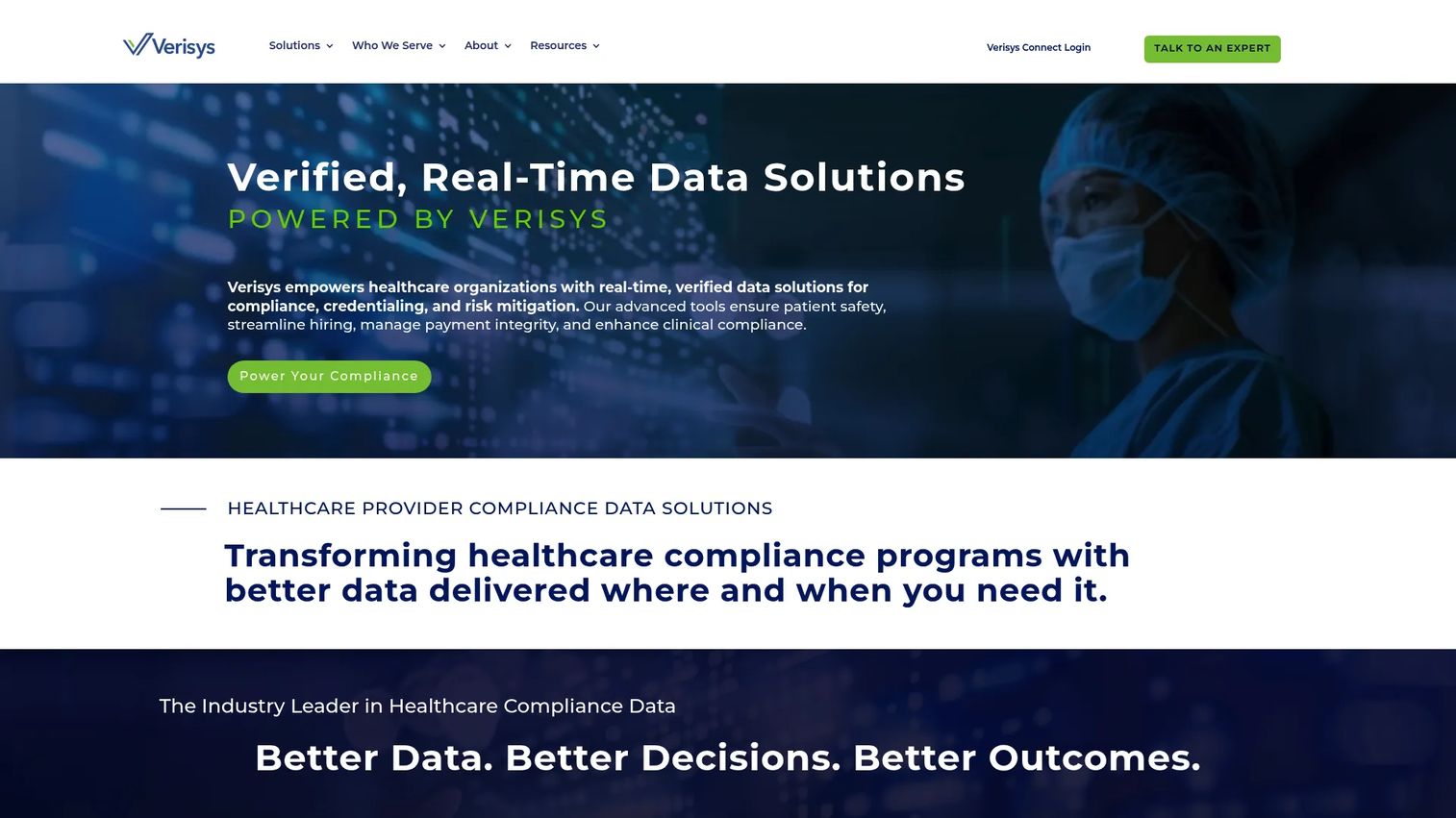
Verisys is a healthcare compliance and credentialing data company focused on provider verification, monitoring, and payment integrity. It is built around primary source verification, checking provider credentials directly against licensing boards and regulatory sources rather than trusting self-reported data. For payers whose main failure mode is a bad provider slipping through, this is the verification layer.
Best for: Health plans and healthcare organizations that need provider compliance, credentialing, and continuous monitoring workflows.
Key strengths
- FACIS sanctions, exclusions, debarments, and disciplinary screening
- Licensure verification across all U.S. states and jurisdictions
- True Monitoring for real-time credential and license alerts
- EligibilityCheck for real-time eligibility and payment integrity
Why choose Verisys: If your priority is knowing that every provider in your network is currently licensed, sanction-free, and eligible, Verisys concentrates on that verification and monitoring layer rather than trying to own every downstream workflow.
Verisys pricing: Pricing is quote-based. Verisys directs prospective buyers to request a quote rather than publishing public rates.
2. symplr
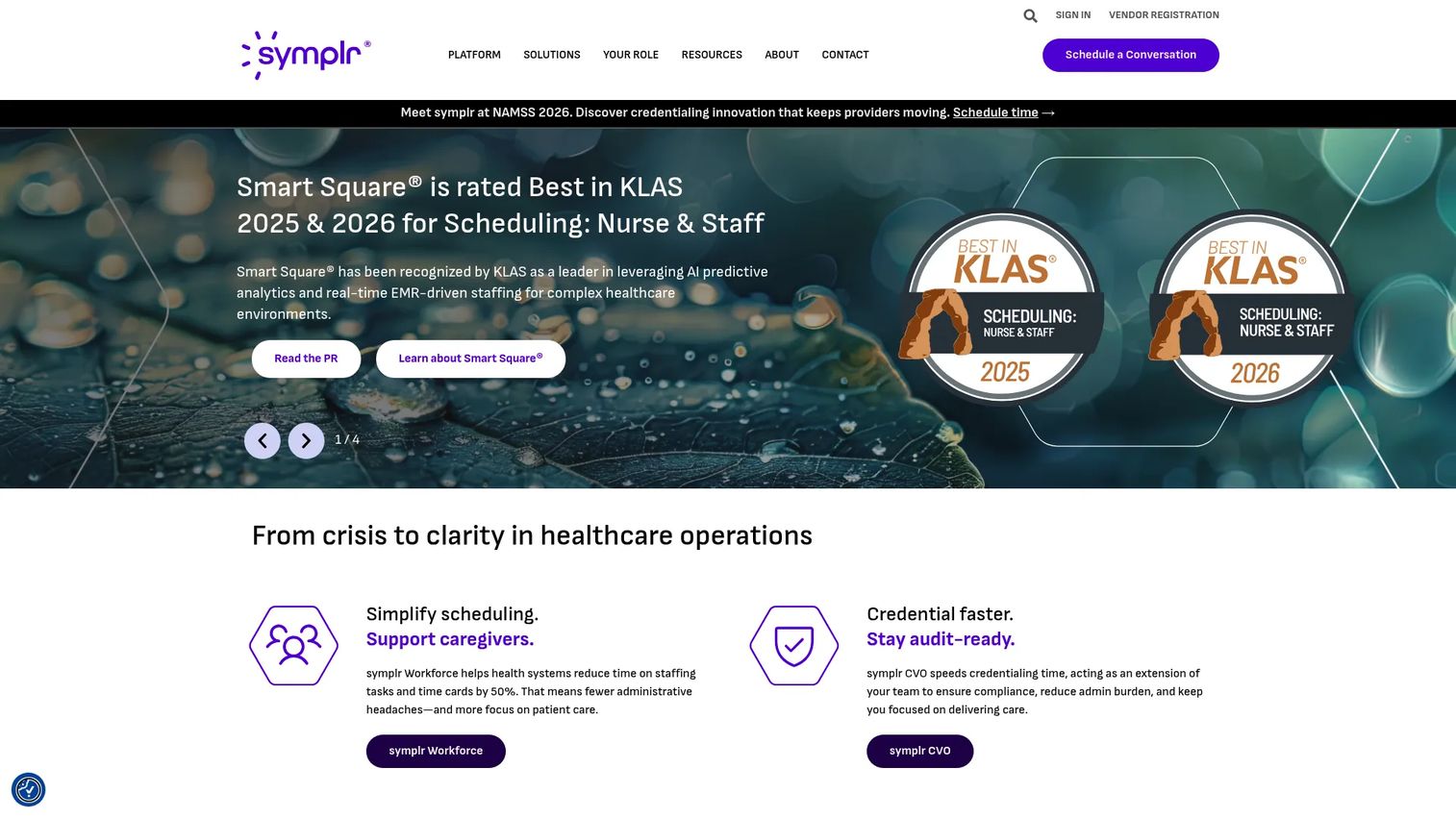
symplr is an enterprise healthcare operations platform serving hospitals, health systems, and payers. It bundles provider data management with workforce, compliance, contract, and spend management, so provider network work lives alongside the broader operational stack rather than in a standalone tool.
Best for: Large healthcare organizations that want provider data accuracy and compliance inside one integrated operations platform.
Key strengths
- Unified healthcare operations platform
- Provider data, compliance, contract, and spend management
- AI-powered workflows and automation
Why choose symplr: symplr fits payers and health systems that would rather consolidate provider data, credentialing, and compliance into a single platform than stitch together point tools. The breadth is the selling point for larger, multi-domain operations.
symplr pricing: Pricing is quote-based. symplr routes most product evaluations through a demo or sales conversation rather than listing public prices.
3. Virsys12
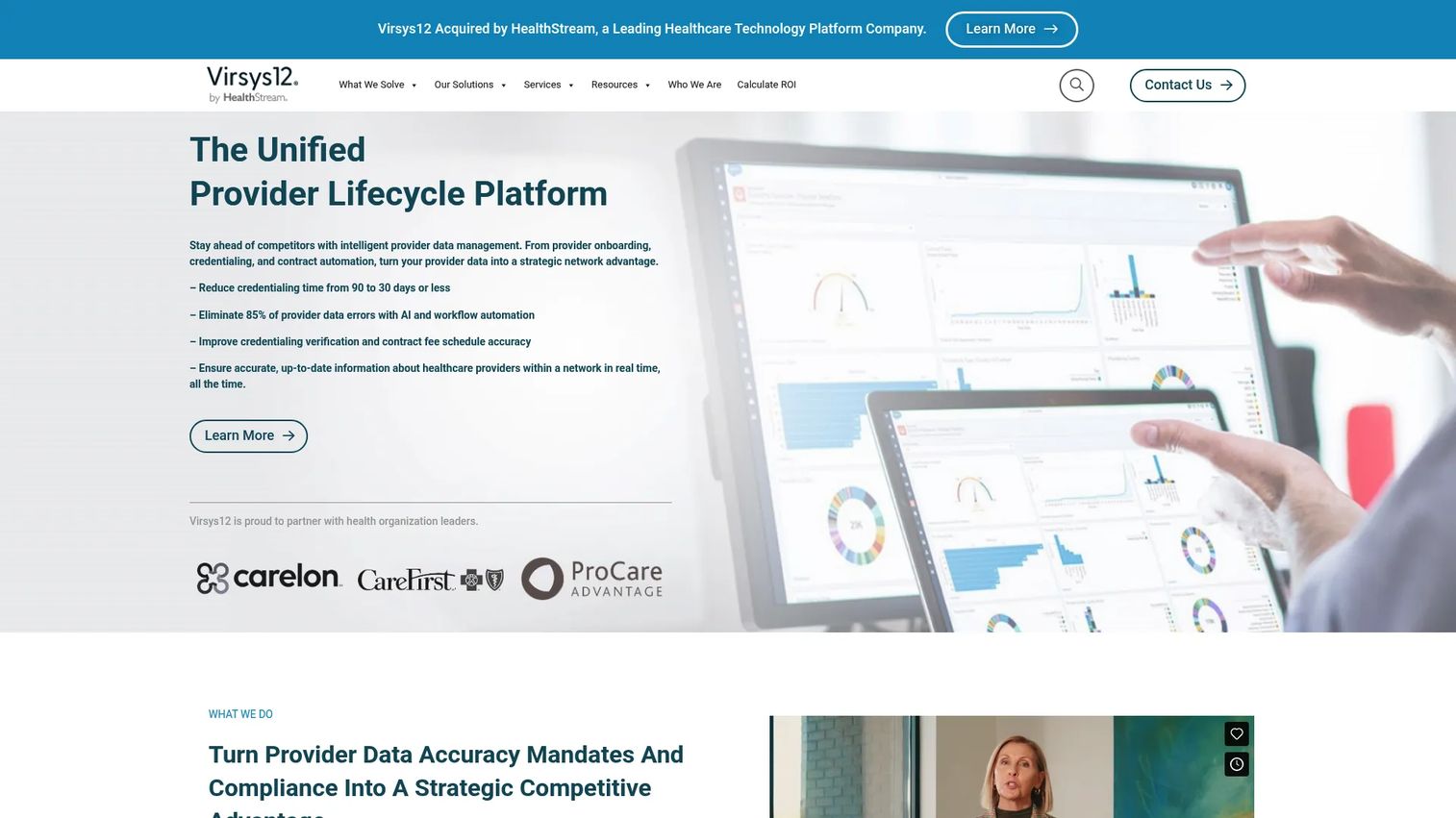
Virsys12 is a healthcare software company focused specifically on provider network management and provider data lifecycle management. Its V12 Network product handles enrollment, credentialing, contracts, and directory automation, with pre-built integrations for data exchange across systems.
Best for: Healthcare organizations that need provider lifecycle and network management automation in one place.
Key strengths
- Provider network management
- Enrollment and credentialing workflows
- Contracts and fee schedule management
- Provider data management and directory automation
- Pre-built integrations and data exchange
Why choose Virsys12: If your bottleneck is the lifecycle itself, moving a provider from enrollment through credentialing, contracting, and directory publishing, Virsys12 is built around that end-to-end workflow rather than a single step.
Virsys12 pricing: Pricing is quote-based. The Virsys12 site routes visitors to speak with an advisor rather than publishing rates.
4. HiLabs
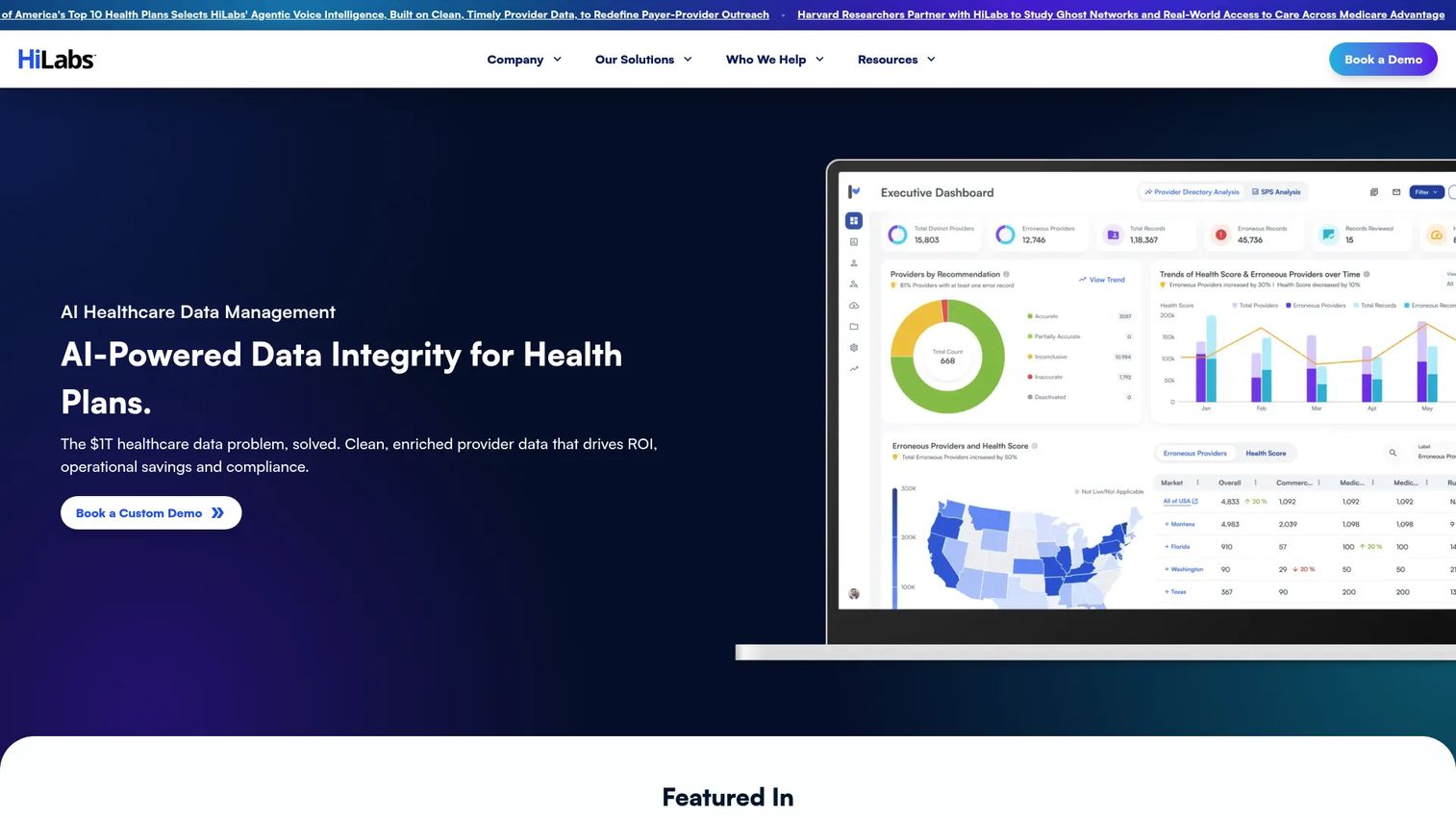
HiLabs is a healthcare AI company focused on payer-provider data management and automation. Its MCheck platform cleans provider data, automates roster processing, and flags discrepancies at health plan scale, with NetworkIQ and ContractsAI extending into network and contract management.
Best for: Health plans that need enterprise-scale provider data cleaning and directory accuracy automation.
Key strengths
- MCheck platform for healthcare data workflows
- Provider data and directory accuracy with roster automation
- NetworkIQ and ContractsAI for network and contract management
Why choose HiLabs: When your directory drift is a data quality problem at scale, HiLabs applies AI-assisted discrepancy detection to catch mismatches that manual review misses. It fits payers whose provider records number in the hundreds of thousands.
HiLabs pricing: Public pricing is not listed. HiLabs directs buyers to request a demo to scope pricing.
5. NCQA
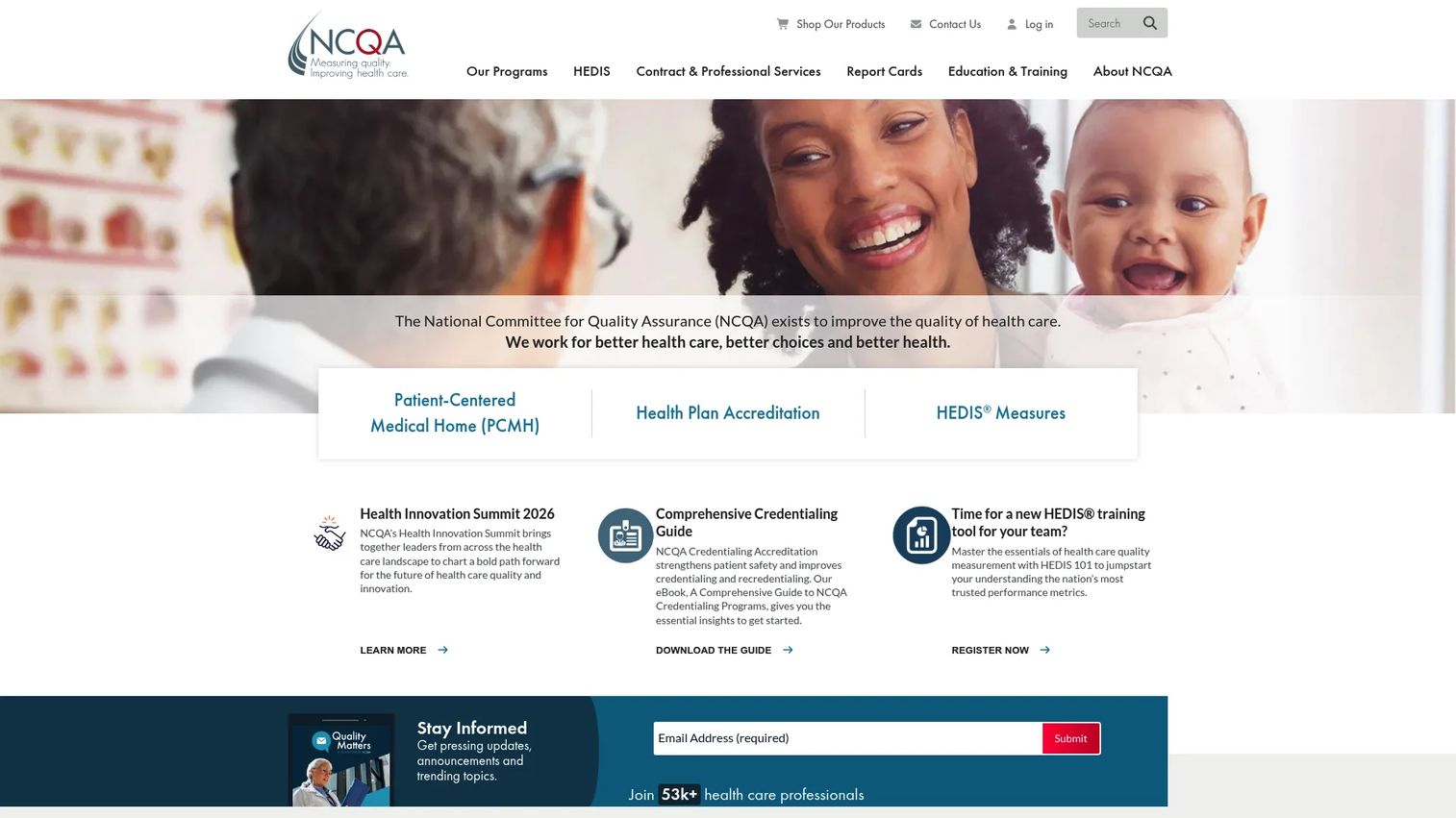
NCQA is a nonprofit that develops accreditation, certification, and recognition programs for healthcare quality. It is not a workflow tool in the same sense as the others. Teams use NCQA as the standards framework and reference point that credentialing and directory programs are measured against.
Best for: Healthcare organizations seeking accreditation, certification, or recognition to anchor their credentialing standards.
Key strengths
- Health plan accreditation and HEDIS measures
- Practice recognition programs such as PCMH
- Certification programs for health information products
Why choose NCQA: NCQA belongs on this list because provider network software is often evaluated against NCQA credentialing standards. If you want your internal program to map to a recognized external benchmark, this is the framework layer.
NCQA pricing: PCMH Recognition pricing starts at $928 per clinician for the smallest single-site practices, with published per-clinician fees that decrease as clinician count rises. NCQA publishes several fee schedules by program.
6. MCheck NetworkIQ
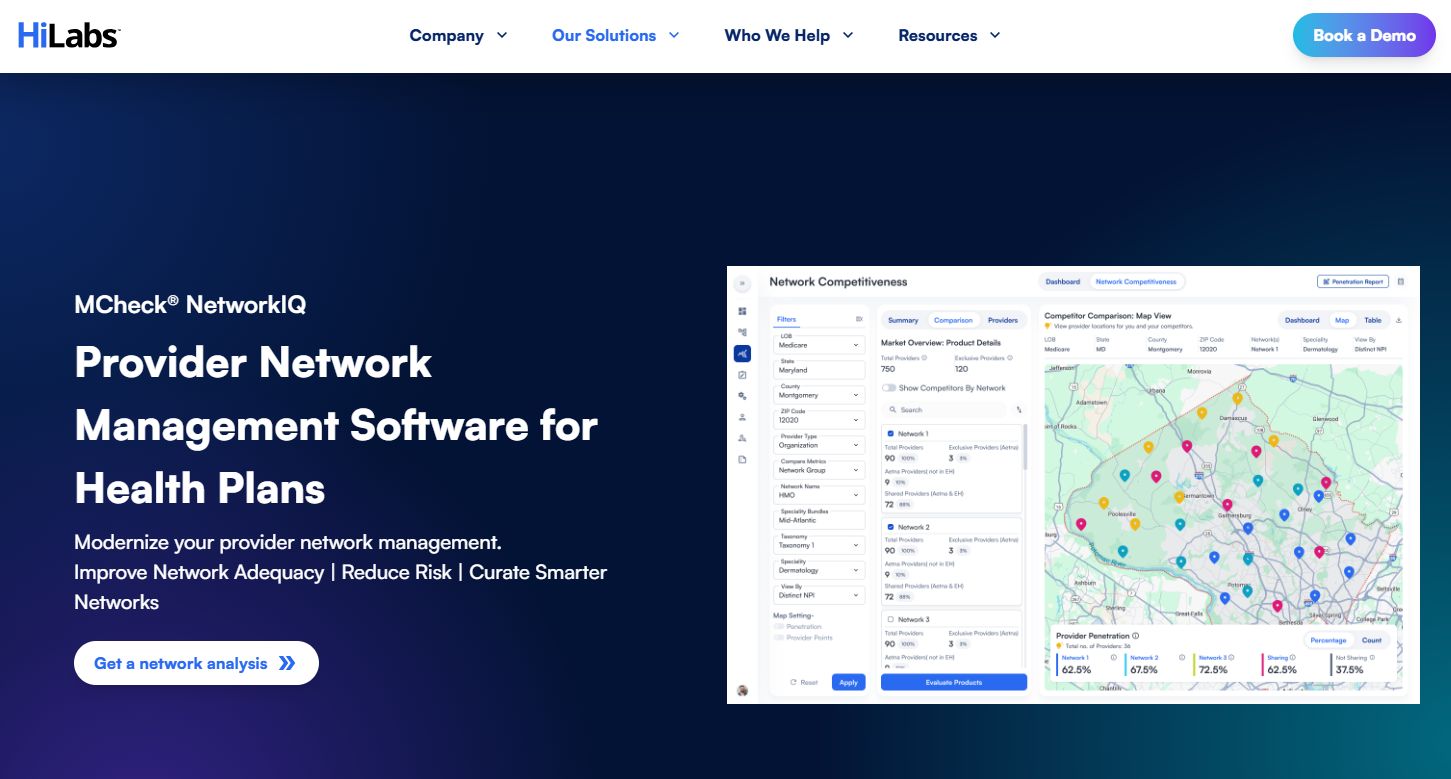
MCheck NetworkIQ is HiLabs' provider network management solution built specifically for health plans. It focuses on network adequacy, compliance, and gap-closure intelligence, pulling provider data from internal systems, credentialing feeds, claims, and third-party sources into one adequacy view.
Best for: Health plans that need network adequacy analysis, compliance support, and gap-closure intelligence.
Key strengths
- Unified provider data ingestion from internal systems, credentialing feeds, claims, and third-party sources
- CMS and state compliance support with audit-ready templates and HSD outputs
- Network adequacy analysis, competitive intelligence, and provider prioritization with geospatial modeling
Why choose MCheck NetworkIQ: When your pressing question is whether the network meets adequacy standards and clears audits, NetworkIQ is purpose-built for that. Audit-ready templates and geospatial analysis turn adequacy reporting into a repeatable output rather than a fire drill.
MCheck NetworkIQ pricing: Public pricing is not listed on the product page, which emphasizes demo and contact options instead.
7. HealthEdge
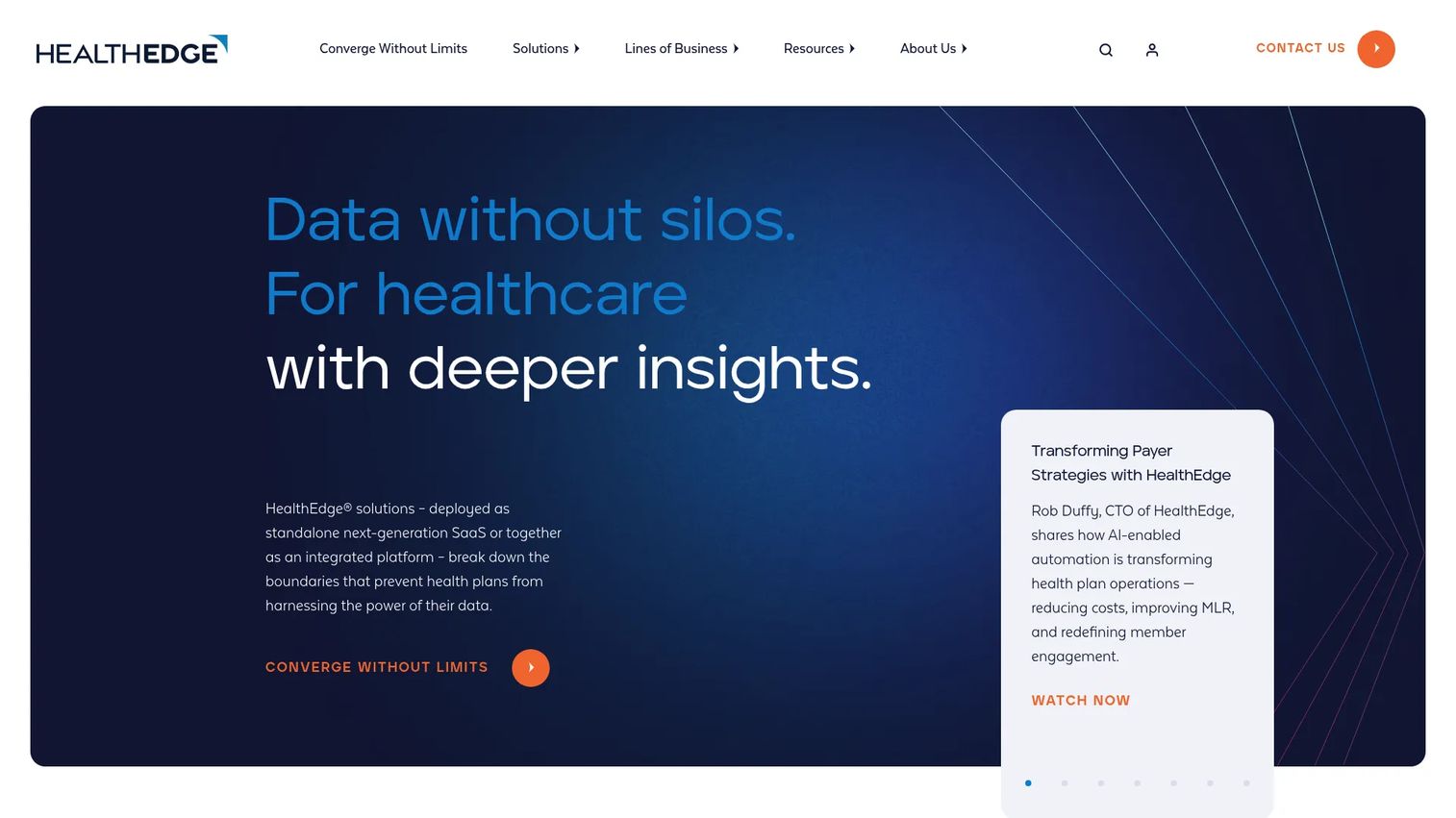
HealthEdge is a healthcare SaaS platform for health plans, centered on claims administration, care management, and payment integrity. Provider network work here is claims-adjacent: the platform ties provider data to the administrative and claims processing that depend on it.
Best for: Health plans that want an integrated SaaS platform spanning claims, care, and payment integrity.
Key strengths
- Claims administration and processing
- Care management workflow
- Payment integrity and claims pricing and edits
Why choose HealthEdge: If your provider data problem is really a claims accuracy problem, HealthEdge fits payers who want provider information tightly connected to the claims and payment workflows it feeds. The value is in the integration between provider data and core administration.
HealthEdge pricing: Public pricing is not listed. HealthEdge scopes pricing through direct sales conversations.
8. Medallion
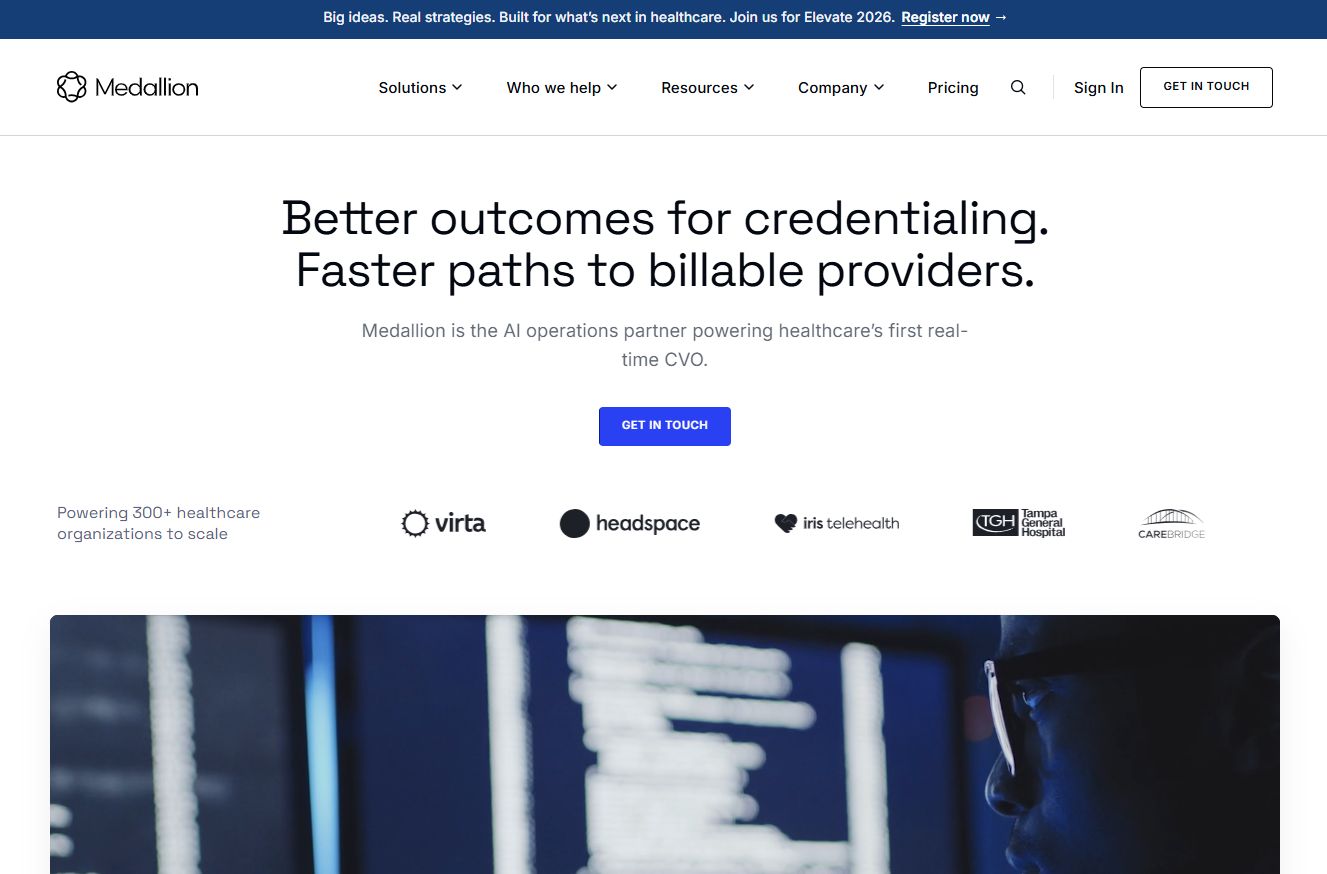
Medallion is a healthcare operations platform for credentialing, enrollment, licensing, and monitoring. It automates the provider operations workflows that otherwise consume credentialing teams, with CVO credentialing and roster management as core pieces.
Best for: Healthcare organizations that need provider credentialing and enrollment workflow automation at scale.
Key strengths
- Provider enrollment
- CVO credentialing
- Roster management
Why choose Medallion: For teams drowning in credentialing and enrollment volume, especially across multiple states, Medallion automates the repetitive lifecycle work. It fits payers and provider organizations expanding their footprint faster than a manual team can credential.
Medallion pricing: Pricing is quote-based. Medallion's pricing page asks visitors to request a personalized quote based on a tailored engagement model.
9. Kyruus Health
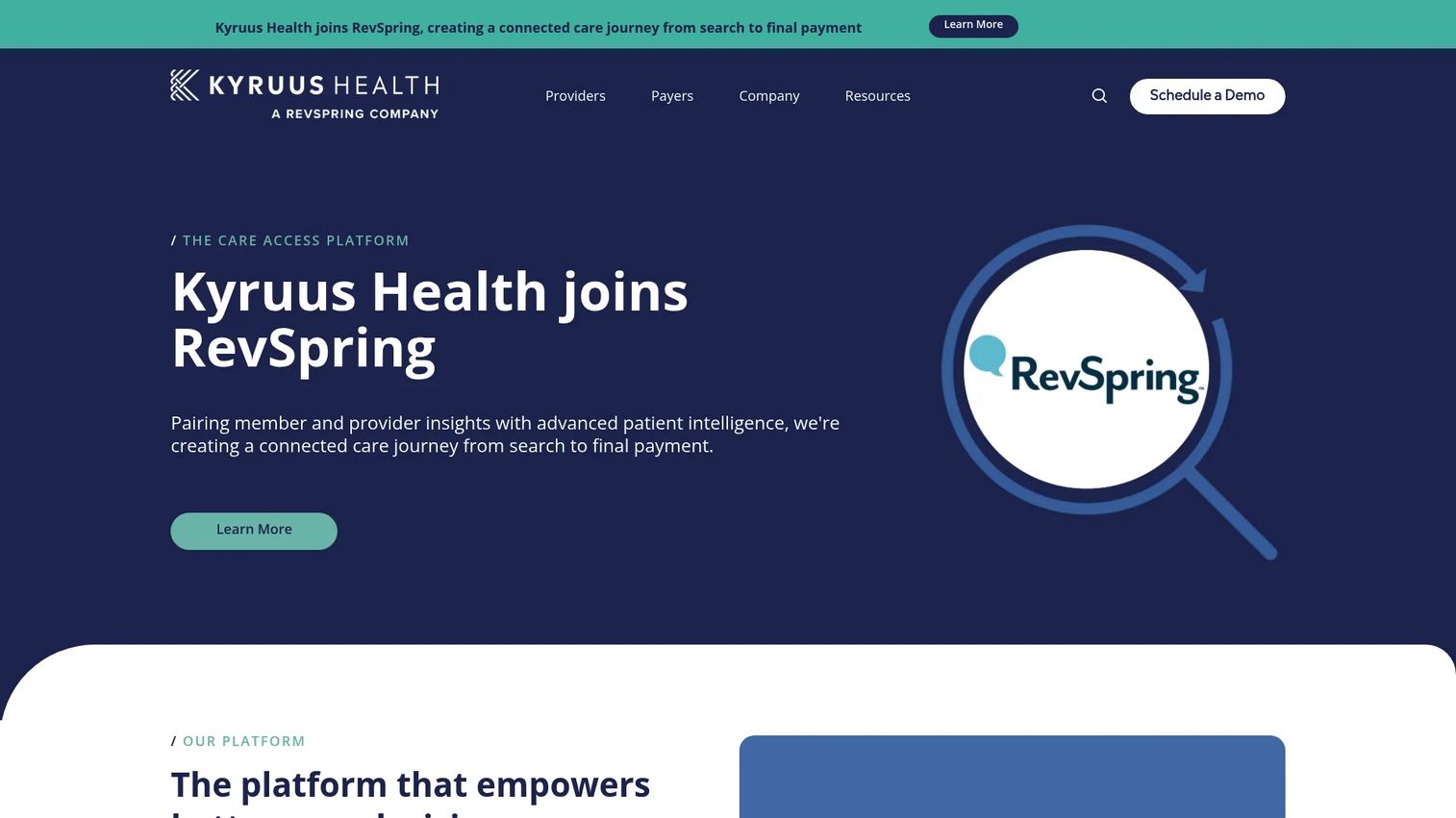
Kyruus Health is a care-access platform for health systems, medical groups, and health plans. Its focus is the member-facing side of provider provider search, scheduling, and the data APIs that keep directory and access experiences accurate.
Best for: Healthcare organizations that need provider search, scheduling, intake, and directory accuracy tools.
Key strengths
- Provider data management and APIs
- Provider search, appointment scheduling, and check-in
- Price transparency and analytics
Why choose Kyruus Health: When your failure mode is what members experience, wrong provider listings, broken search, dead-end scheduling, Kyruus Health targets the access and directory layer directly. It fits plans focused on the member-facing accuracy that drives complaints.
Kyruus Health pricing: Public pricing is not listed. Kyruus Health routes prospective buyers to demo and sales conversations.
10. Cedar Gate Technologies
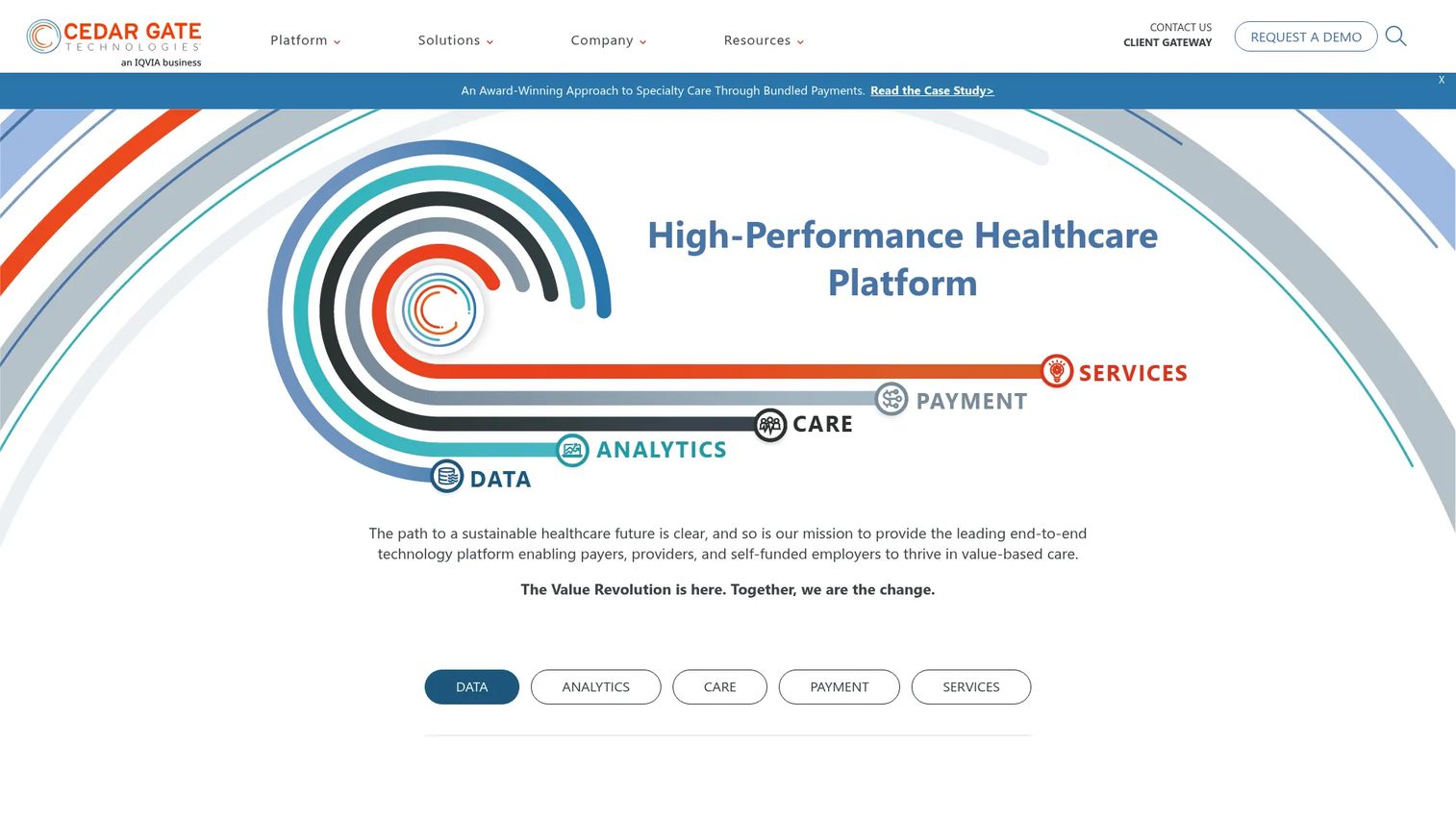
Cedar Gate Technologies is a healthcare technology platform for value-based care, combining data management, analytics, care, and payment tools. For network teams, its strength is payer data and network analytics that inform how networks perform under value-based arrangements.
Best for: Payers, providers, and self-funded employers pursuing value-based care operations.
Key strengths
- Enterprise data management across 50+ data types and sources
- Healthcare benefits analytics and value-based care analytics
- Care management, utilization management, and payment adjudication
Why choose Cedar Gate Technologies: When your provider network question is analytical, how the network performs and how to structure value-based payment, Cedar Gate brings data management and analytics together. It fits organizations where network management and value-based care strategy are the same conversation.
Cedar Gate Technologies pricing: Public pricing is not listed. Cedar Gate routes visitors to contact sales and demo requests.
Considerations
Verify data sources and freshness
Ask where the data comes from and how often it refreshes. Primary source verification against licensing boards beats self-reported or aggregated data every time. Then check the refresh cadence: continuous monitoring catches a lapsed license in days, while quarterly batch checks let drift accumulate for months.
Check interoperability
Map the integration points before you buy. Your provider data has to move between credentialing systems, claims platforms, member portals, and public directories. Confirm support for APIs, FHIR-based exchange, and file-based feeds, and ask specifically which of your existing systems have pre-built connectors versus custom work.
Evaluate audit readiness
Audit readiness lives in the evidence trail. Ask what gets timestamped, whether verification is source-traceable back to the original database, and how exports work. Under a CMS or state audit, you want to pull date-stamped proof of what was verified, when, and against which source, without reconstructing it by hand.
Confirm scale across states and provider types
Multi-state operations multiply complexity fast. Licensure rules, sanctions databases, and directory requirements vary by jurisdiction. Confirm the platform handles every state you operate in and every provider type you credential, from individual clinicians to facilities and ancillary providers.
Map the tool to the operational bottleneck
Choose based on your dominant failure mode, not the longest feature list. If bad providers slip through, prioritize verification. If listings are stale, prioritize directory accuracy and monitoring. If the team is buried, prioritize workflow automation. If adequacy reporting is the fire drill, prioritize analytics and audit-ready outputs.
Conclusion
The right provider network management solution depends entirely on which problem is costing you the most right now.
For verification-heavy needs, where the risk is a sanctioned or unlicensed provider in-network, Verisys and MCheck NetworkIQ lead on primary source verification, monitoring, and adequacy. For workflow-heavy needs, where credentialing and enrollment volume overwhelm the team, Virsys12 and Medallion automate the lifecycle end to end. For directory-heavy needs, where members hit stale listings and ghost networks, HiLabs and Kyruus Health target data quality and member-facing accuracy.
Larger operations that want provider data inside a broader stack should look at symplr, HealthEdge, and Cedar Gate Technologies, while NCQA anchors the standards your program is measured against.
Do not buy on feature count. Name your primary failure mode first, whether it is verification, directory drift, workflow load, or adequacy, then choose the platform built for that specific problem. That single decision does more for compliance risk reduction than any comparison table.
FAQs
Provider network software is used by payers and health plans to collect, verify, monitor, and share provider data across credentialing, contracting, directory management, and claims. It reduces manual work, keeps directories accurate, and produces the audit trails needed for internal and regulatory review. In practice, it is how a plan knows who is actually in its network and whether those providers are credentialed and compliant.
It improves provider directory accuracy by reconciling verified provider data with the published directory on a continuous basis. Instead of quarterly manual checks, continuous monitoring flags a lapsed license, a moved practice, or a retired provider quickly. Strong platforms also automate roster ingestion so updates from providers and groups flow in without re-keying, which is where most errors start.
Provider network management is the broad discipline of building, maintaining, and monitoring the network as a whole, including adequacy and directory accuracy. Provider lifecycle management is the narrower workflow of moving an individual provider through onboarding, enrollment, credentialing, recredentialing, and offboarding. Lifecycle management is one component inside the larger network management picture.
Primary source verification checks credentials directly against the issuing authority, a state licensing board, a sanctions list, a disciplinary database, rather than trusting self-reported data. It matters because a provider can report an active license that has actually lapsed or been sanctioned. Verifying at the source is what protects the plan from putting an ineligible provider in-network and facing the compliance exposure that follows.
Ghost networks, where directories list providers who are unreachable or not actually accepting patients, shrink when verified data and the published directory stay synced. Teams reduce the risk with continuous monitoring, automated roster updates, and regular outreach to confirm provider status. The underlying fix is closing the gap between what the plan has verified and what members actually see.
Look for date-stamped evidence, source-traceable verification, and clean export functionality. Under a CMS or state audit, you need to show exactly what was verified, when, and against which source, without reconstructing the record by hand. Audit-ready templates and structured reporting outputs, like the HSD outputs some adequacy tools produce, turn audit prep from a fire drill into a repeatable export.
Interoperability determines whether your provider data actually moves between the systems that depend on it. Provider records feed credentialing, claims processing, member portals, and public directories, so the software has to support APIs, FHIR-based exchange, and file-based feeds. Weak interoperability creates data silos, which is one of the main ways directory drift and reconciliation errors creep back in.
Evaluate AI on the specific job it does, usually discrepancy detection, roster matching, or data cleaning, rather than the label. Ask what data it was trained on, how it flags a match or mismatch, and whether a human reviews edge cases before changes hit the directory. The useful question is not whether a tool has AI, but whether it measurably reduces the manual review load on your provider data team.