A delivery breaks the moment its coordination lives in five places at once. Orders sit in a spreadsheet. Dispatch happens over text. Driver status is a phone call. Customer updates are a manual copy-paste. Proof of delivery is a photo buried in someone's camera roll. Every handoff between those tools is where an ETA slips, a package gets marked delivered to the wrong door, or a support ticket lands about a shipment nobody can locate.
That coordination cost is not a rounding error. The global last-mile delivery software market is projected to rise from USD 13.6 billion in 2026 to USD 33.4 billion by 2033, at a 13.7% CAGR, according to Persistence Market Research (2026). Teams are not buying software because it is trendy. They are buying it because manual dispatch does not survive contact with volume.
The pattern most operators recognize looks like this: you can add drivers, but you cannot add visibility. More stops means more exceptions, more "where is my order" calls, and more time spent reconstructing what happened after the fact. The real problem is not the number of deliveries. It is that dispatch, routing, driver execution, and customer communication were never wired into one system.
So what changes when they are? You stop guessing. Routes get planned against real constraints. Drivers capture proof at the door. Customers get a live tracking link instead of a promise. And you get a record you can audit when a delivery is disputed. This guide is about picking the software that does that for your specific operation.
What's inside
This guide compares seven delivery management software tools for teams that move physical goods and need route planning, live tracking, proof of delivery, customer notifications, and integrations that fit their stack. It is written for operators and product leaders shortlisting tools before a demo or trial, so the framing stays operational and metric-driven.
We selected and evaluated each tool on the criteria that actually decide fit: live tracking quality, route optimization depth, proof-of-delivery capture, customer communication, pricing clarity, integration coverage, and use-case fit by industry. Every pricing figure and rating below was pulled from each vendor's live source. Where a vendor gates pricing, we say so rather than guess.
TL;DR
- Best overall for broad delivery operations: Track-POD, for teams that want dispatch, route optimization, ePOD, and branded tracking in one workflow.
- Best for restaurants and local delivery: Shipday, with a free tier, SMS/WhatsApp notifications, and in-house plus third-party driver support.
- Best for courier and logistics teams: Onro, built for white-label courier operations and delivery automation.
- Best for enterprise last-mile scale: Bringg for orchestration across owned, 3PL, and hybrid fleets; Onfleet for high-volume dispatch and route optimization.
- Best for proof-of-delivery and visibility: Detrack, for per-driver ePOD, live tracking, and customer notifications.
- Best for route planning and scheduling: Routific, for route-heavy teams that want better daily output without a heavy stack.
What is delivery management software?
Delivery management software is a system that plans, dispatches, tracks, and documents the movement of goods from order to doorstep. It replaces the spreadsheets, group texts, and phone calls that break down as delivery volume grows, and it gives operators a single view of where every order and driver is at any moment.
The core workflow runs in a predictable sequence: order import, dispatch, route planning, driver execution, customer communication, proof of delivery, and reporting. A good delivery management system connects each of those steps so information does not get re-entered or lost between them.
Buyers evaluating a delivery management platform should expect these core capabilities:
- Route optimization: Sequencing multi-stop routes against time windows, driver capacity, and traffic to cut miles and improve ETA accuracy.
- Live tracking: Real-time GPS visibility into driver location and delivery status for dispatchers and customers.
- Proof of delivery (ePOD): Digital capture of signatures, photos, geotags, and timestamps that create an audit trail.
- Customer notifications: Automated SMS, email, or WhatsApp updates plus branded tracking links and real-time ETA.
- Dispatch software: Manual and automated driver assignment with a dispatcher panel and mobile driver app.
- Integrations: API access and connections to e-commerce, ERP, POS, and WMS systems so orders flow in automatically.
- Analytics and reporting: Delivery performance, on-time rates, exception tracking, and driver productivity data.
Adjacent categories worth distinguishing: courier management systems focus on multi-client dispatch and billing, last mile delivery software focuses on the final leg to the customer, and shipment tracking software focuses narrowly on visibility. Most tools below span more than one of these.
When to use delivery management software
Reduce manual dispatch work
Reach for delivery scheduling software when coordination starts eating your team's day. If a dispatcher is assigning stops by hand, texting drivers for status, and re-keying order data between systems, the manual overhead is already costing you. Missed updates and duplicated effort scale linearly with volume, which means every new driver adds coordination load instead of capacity. Software absorbs that load so headcount goes to delivery, not to firefighting.
Improve route efficiency and ETA accuracy
Use route optimization when delivery density, tight time windows, or multi-stop routes make manual planning unreliable. A dispatcher can eyeball a five-stop route. They cannot optimally sequence forty stops across overlapping windows and vehicle capacities. Route planning software solves for those constraints in seconds, which shortens drive time, fits more stops per shift, and produces a real-time ETA customers can trust.
Standardize proof of delivery and customer communication
Turn to proof of delivery and live tracking when disputes and "where is my order" tickets pile up. When a customer claims a package never arrived, a geotagged photo and timestamped signature settle it fast. When they want to know the status, a branded tracking link answers before they open a ticket. Standardizing ePOD and customer notifications reduces disputes and cuts support load at the same time.
Comparison table
Use this table to compare the seven tools at a glance before reading the detailed breakdowns below. Tools are sorted by relevance to broad delivery management software needs, not alphabetically. Pricing and ratings reflect each vendor's live source at the time of writing.
| # | Product | Intent | Key use case | Pricing | G2 rating |
|---|---|---|---|---|---|
| 1 | Track-POD | Broad delivery operations | Dispatch, route optimization, ePOD, branded tracking | From $49/mo (min 3 drivers) | 4.5/5 |
| 2 | Shipday | Restaurants and local delivery | Local dispatch, tracking, SMS/WhatsApp updates | Free tier; paid from $19/mo | Not yet rated |
| 3 | Onro | Courier and logistics | White-label courier ops and automation | From $239/mo | 5.0/5 |
| 4 | Onfleet | Enterprise last-mile | High-volume dispatch, route optimization, tracking | From $619/mo | 4.6/5 |
| 5 | Detrack | Proof of delivery and visibility | Per-driver ePOD, live tracking, notifications | From $29/license/mo | 4.5/5 |
| 6 | Routific | Route planning and scheduling | Route optimization, dispatch, tracking | Free tier; paid from $150/mo | Capterra-rated |
| 7 | Bringg | Enterprise orchestration | Multi-fleet last-mile coordination | Custom | 4.6/5 |
1. Track-POD
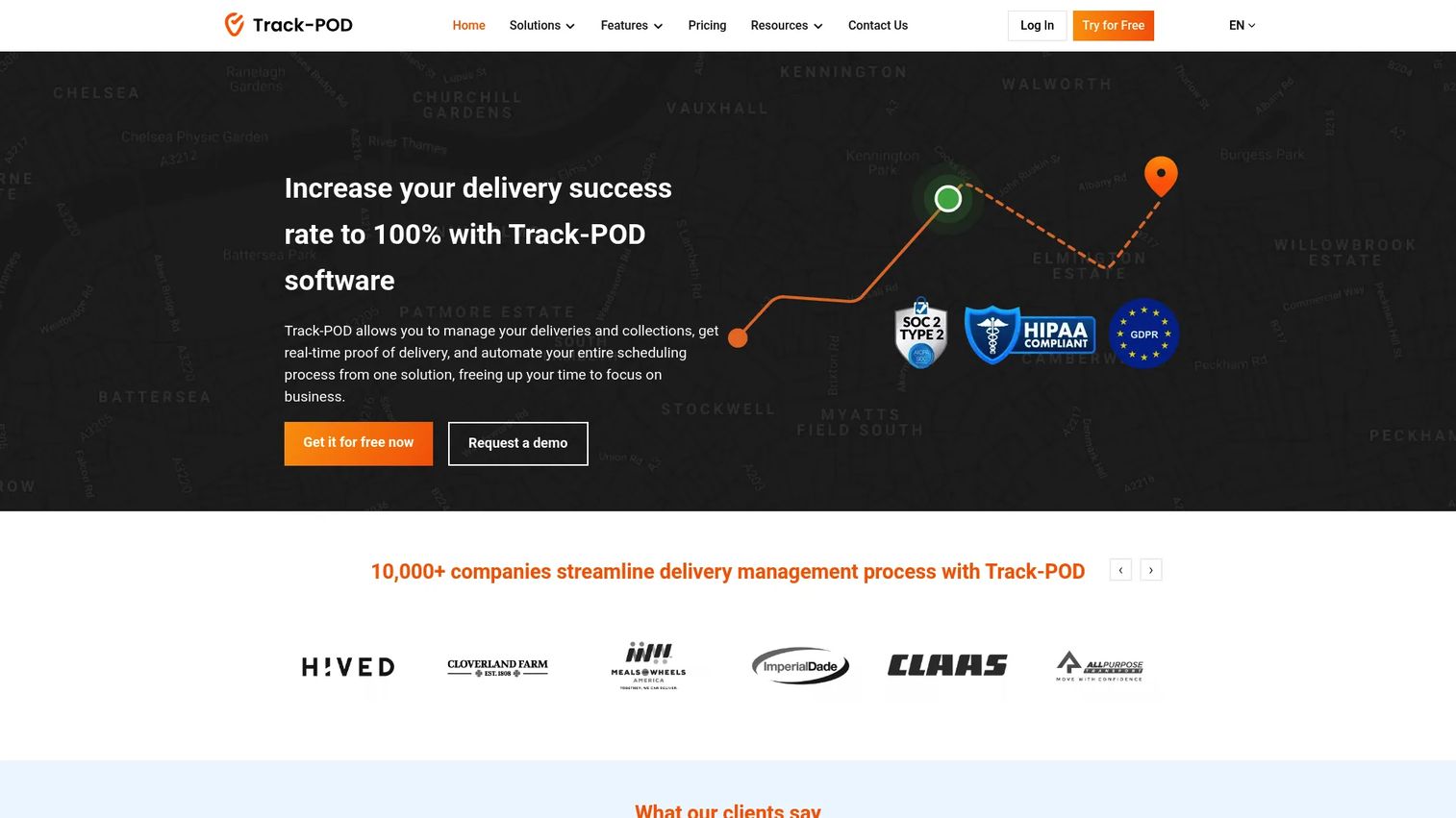
Track-POD is delivery management software that combines dispatch, route optimization, electronic proof of delivery, and live tracking in a single end-to-end workflow. It fits teams that want to run the full delivery cycle, from order import through a branded customer tracking experience, without stitching separate tools together. The mobile driver app captures ePOD at the door while dispatchers manage routes and monitor status from one dashboard.
Best for: Last-mile delivery teams that need dispatch, live tracking, and ePOD in one broad workflow.
Key strengths
- Real-time delivery tracking: Live GPS visibility into drivers and orders so dispatchers and customers always know status.
- Route optimization: Sequences multi-stop routes against constraints to cut miles and tighten ETAs.
- Electronic proof of delivery: Captures signatures, photos, and timestamps that create a defensible audit trail.
Why choose Track-POD: Choose Track-POD when you want breadth in one system rather than a specialist tool for a single step. Its combination of routing, ePOD, and branded notifications suits operators who value a consistent customer-facing delivery experience alongside back-office visibility. It rewards teams ready to run their whole delivery motion in one place.
Track-POD pricing: Track-POD offers driver-based plans starting at Advanced for $49/month billed annually (or $59 month-to-month) with a three-driver minimum. Advanced Plus is $69/month and Ultimate is $89/month, both annual, with an Enterprise tier available on request for fleets of 20 or more drivers. Order-based plans also exist, starting at $285/month for 1,500 orders and scaling up. A free trial is available.
2. Shipday
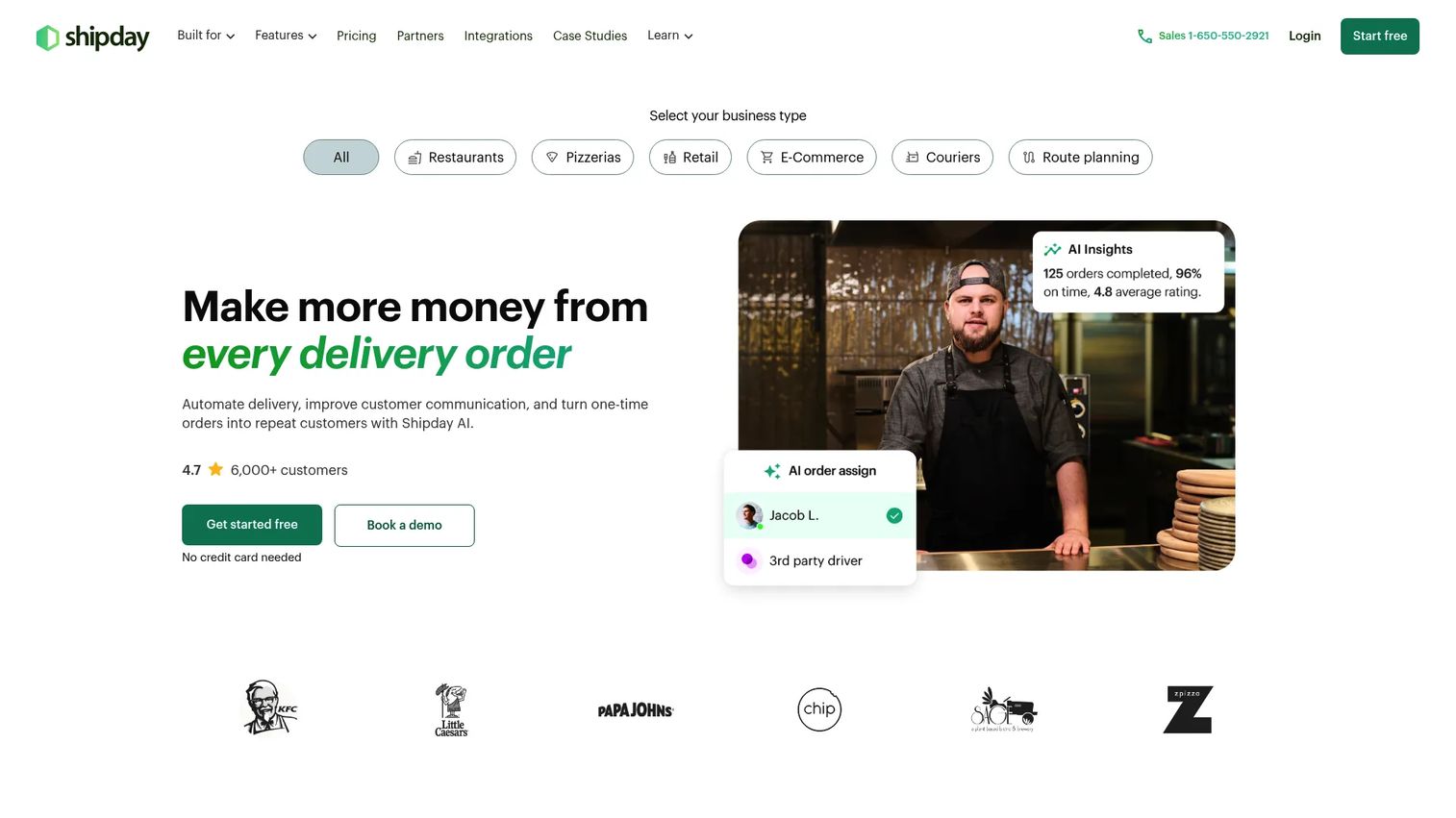
Shipday is delivery management software built for local delivery businesses that need dispatch, real-time tracking, and branded customer communication without enterprise overhead. It supports both in-house drivers and third-party delivery, which makes it a practical fit for operations that flex between their own fleet and on-demand couriers. Restaurants, grocery, and retail delivery teams use it to move from ad hoc coordination to a structured dispatch workflow fast.
Best for: Restaurants and local delivery businesses that need dispatch and delivery tracking with a low barrier to entry.
Key strengths
- Real-time driver tracking: Live location and status so dispatchers see every active delivery at once.
- SMS/WhatsApp notifications: Automated customer updates that cut inbound "where is my order" messages.
- Route optimization: Smarter stop sequencing to improve driver efficiency across local routes.
Why choose Shipday: Choose Shipday when you run local delivery and want to start without a large upfront commitment. Its free tier and low paid entry point make it accessible for small operators, while third-party driver support means you are not locked into your own fleet as volume swings.
Shipday pricing: Shipday's Basic plan is free forever. Paid plans start at Professional Lite for $19/month and scale through Professional at $39/month, Branded Premium at $79/month, Elite at $99/month, and Business AI at $349/month, with included orders and per-order overages at higher tiers. G2 does not yet show a review-based rating for Shipday.
3. Onro
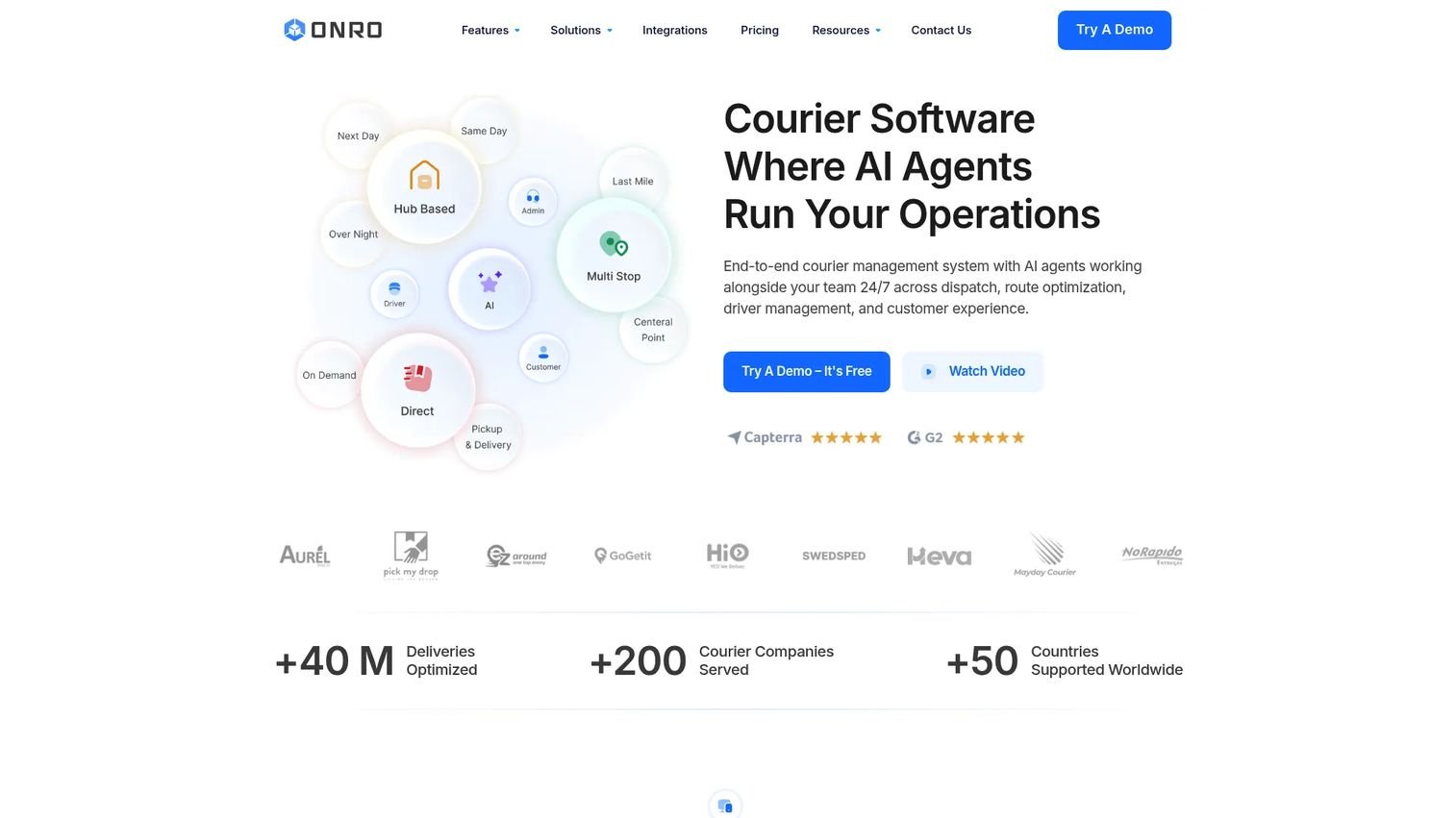
Onro is an AI-powered courier management system built for end-to-end delivery operations, with a strong emphasis on white-label branding. It ships a driver app, dispatcher panel, admin dashboard, customer API, and white-label tracking page, which makes it well suited to courier businesses that want their own branded delivery experience rather than a generic one. Real-time tracking and order pricing tools support multi-client courier operations out of the box.
Best for: Courier and last-mile delivery businesses that need white-label operations and delivery automation.
Key strengths
- Driver app, dispatcher panel, and customer apps: A full operational stack for running courier dispatch end to end.
- Real-time tracking: Live delivery visibility for dispatchers and customers on a branded page.
- Order pricing and fees: Built-in pricing logic that supports courier billing and multi-client workflows.
Why choose Onro: Choose Onro over more generalized tools when your business is the delivery, not just a company that delivers. Its white-label depth and courier-specific pricing tooling fit operators reselling delivery under their own brand. Onro holds a 5.0/5 rating on G2, reflecting strong satisfaction among its courier user base.
Onro pricing: Onro's Business plan starts at $239/month and includes 1,500 deliveries, the driver app, dispatcher panel, admin dashboard, customer API, and a white-label tracking page. Enterprise pricing is custom and adds further white-label and customization options. A free trial is available, and Onro notes that final pricing depends on business size, order volume, and white-label needs.
4. Onfleet
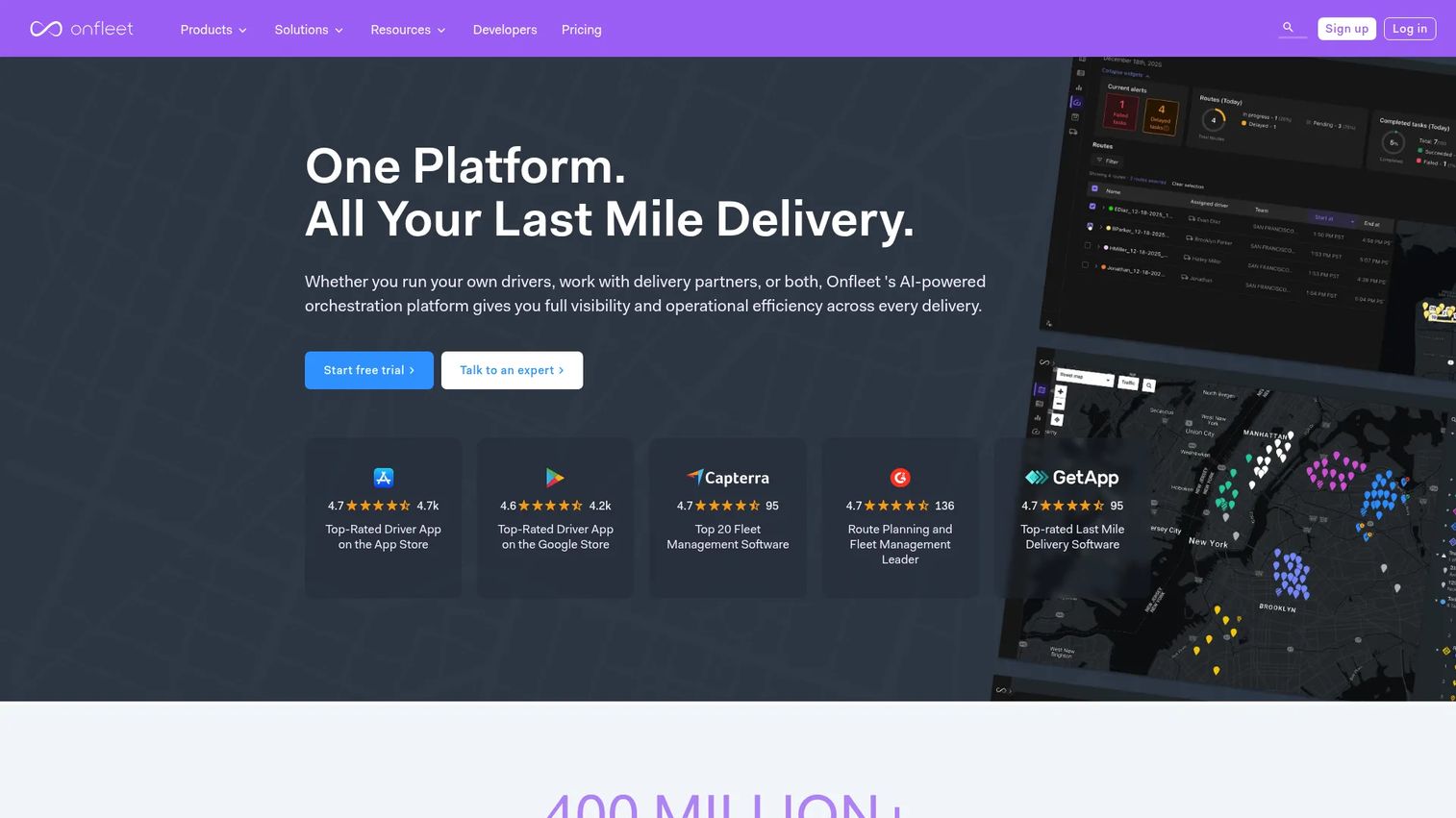
Onfleet is last-mile delivery orchestration software for managing dispatch, route optimization, tracking, and customer communications at scale. It pairs a dispatcher dashboard with a driver mobile app and real-time delivery visibility, so higher-volume delivery organizations can coordinate large fleets without losing sight of individual stops. Its strength shows up when the daily route count climbs and manual dispatch stops keeping up.
Best for: Businesses that need last-mile delivery management and route optimization at higher volume.
Key strengths
- Route optimization: Automated sequencing that keeps large multi-stop routes efficient.
- Real-time delivery visibility and tracking: Live status across the whole fleet for dispatchers and customers.
- Driver mobile app and dispatcher dashboard: A coordinated toolset for assignment, execution, and monitoring.
Why choose Onfleet: Choose Onfleet when volume is the pressure point and you need dispatch, routing, and tracking that hold up as the fleet grows. Its orchestration focus and 4.6/5 G2 rating make it a fit for operations that have outgrown lightweight tools but do not need full enterprise orchestration across third-party carriers.
Onfleet pricing: Onfleet's public pricing starts with Launch at $619/month, Scale at $1,349/month, and Enterprise at $3,099/month. A Courier Suite add-on is available at $299/month. There is no free tier, so plan for a paid commitment from the start. Pricing reflects Onfleet's positioning toward established, higher-volume delivery operations.
5. Detrack
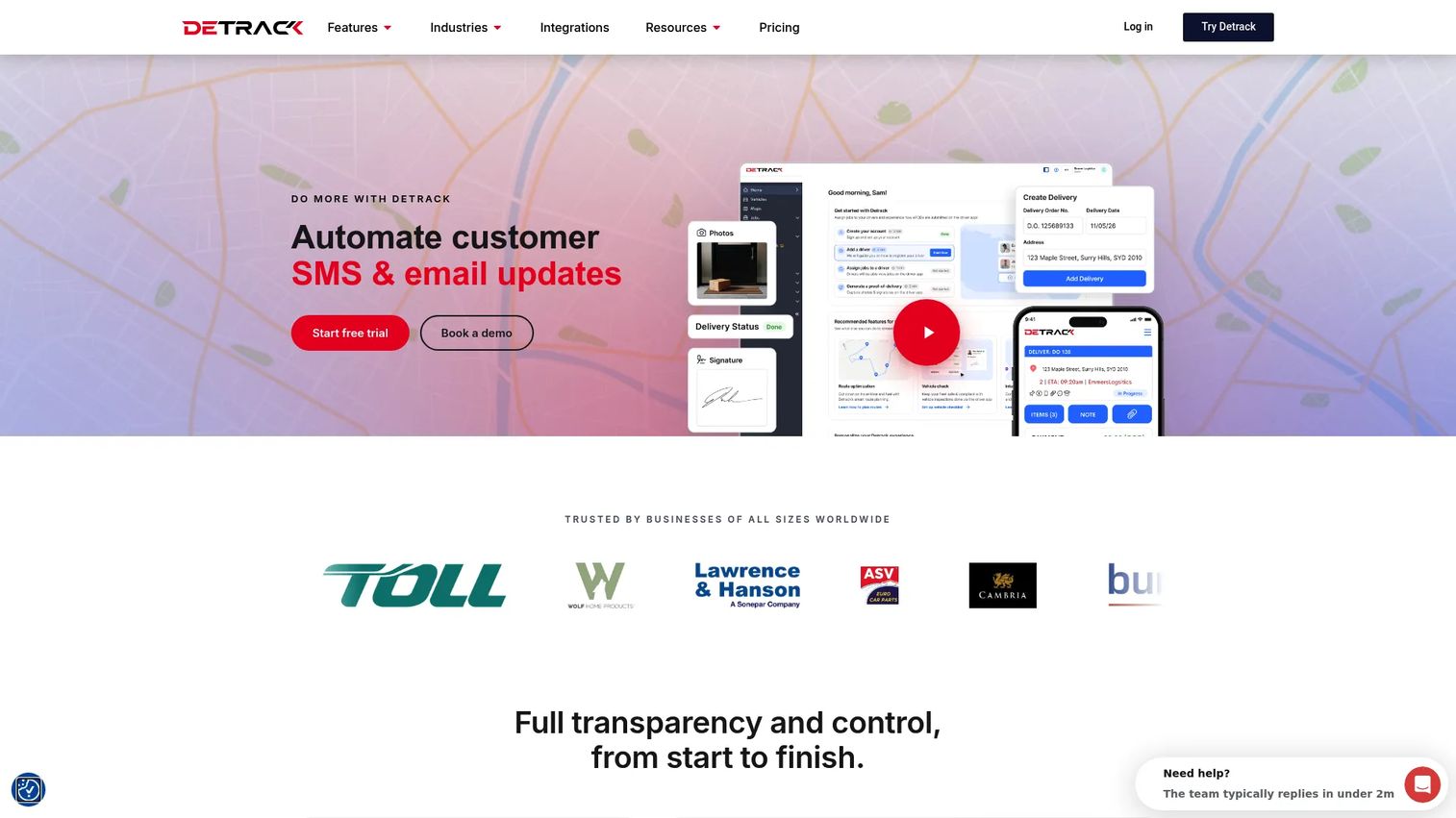
Detrack is delivery management software for last-mile operations, with proof of delivery, live tracking, customer notifications, and route optimization at its core. It captures ePOD with photos, signatures, and timestamps, and gives dispatchers live driver and vehicle tracking alongside automated customer tracking links. The per-driver licensing model makes it straightforward to match cost to fleet size.
Best for: Businesses that need per-driver delivery management with strong POD and live tracking.
Key strengths
- Electronic proof of delivery: Photos, signatures, and timestamps that document every drop and settle disputes.
- Live driver and vehicle tracking: Real-time visibility into where every asset is during the route.
- Customer notifications and tracking links: Automated status updates that reduce inbound support contacts.
Why choose Detrack: Choose Detrack when proof capture and operational visibility are your top priorities and you want pricing that scales cleanly with driver count. Its ePOD depth and 4.5/5 G2 rating make it a dependable pick for teams where documentation and dispute resolution matter most.
Detrack pricing: Detrack charges per active driver license. The Pro plan is $29/license/month and Advanced is $39/license/month, with an Enterprise tier available on custom quote. Annual billing saves 10%, and a 14-day trial is available. The per-license model keeps cost predictable as you add or remove drivers.
6. Routific
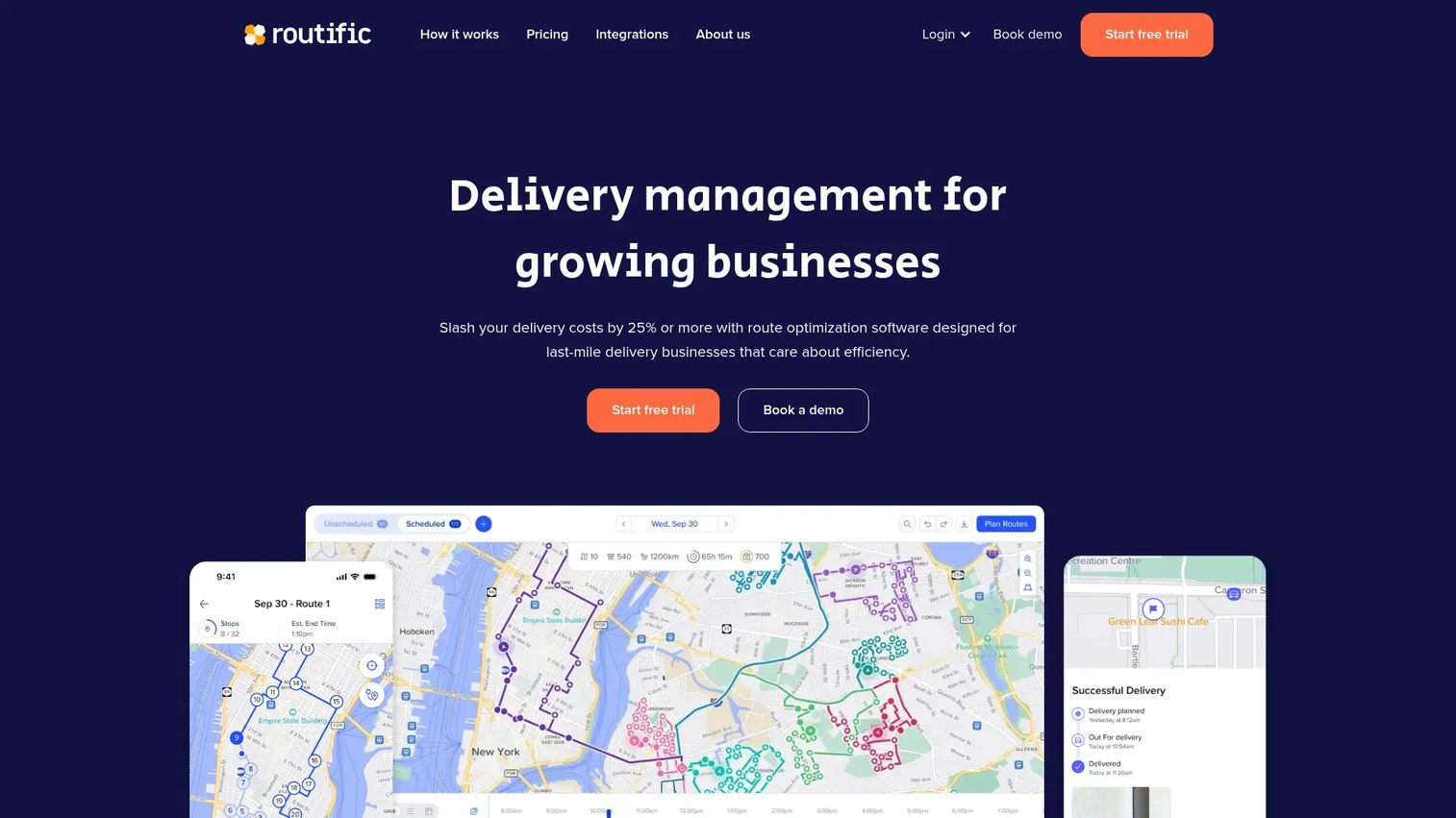
Routific is delivery management and route optimization software focused on getting better daily route output without overcomplicating the stack. Its smart route optimization, driver mobile app, and real-time GPS tracking suit route-heavy teams that want planning efficiency as the main win. It is a strong fit when the core problem is sequencing stops well and dispatching them cleanly, not orchestrating a sprawling operation.
Best for: Teams that need route planning, dispatch, and delivery tracking for last-mile operations.
Key strengths
- Smart route optimization: Fast, constraint-aware sequencing that maximizes stops per shift.
- Driver mobile app: A simple app for drivers to follow routes and update status.
- Real-time GPS tracking: Live visibility into progress across the day's routes.
Why choose Routific: Choose Routific when route planning is the heart of the job and you want output without stack complexity. Its free tier for smaller volumes and clean per-order scaling make it easy to start, and route-heavy operations get daily efficiency gains quickly. Reviewers on Capterra rate it highly for ease of use.
Routific pricing: Routific offers a free tier for up to 100 orders per month. The next step is $150/month for 101 to 1,000 orders, after which volume pricing applies per order, from $0.15/order and dropping as low as $0.03/order at high volume. Operations above 50,000 orders per month get custom pricing. SMS notifications are quoted separately and are not included in the free tier.
7. Bringg
Bringg is enterprise last-mile delivery software for planning, dispatch, driver management, and customer delivery experiences across complex operations. Its modular platform spans planning, dispatch, drive, and delivery-experience modules, and it connects to a delivery network of third-party, crowdsourced, and autonomous carriers. That makes it the pick for larger organizations coordinating many moving parts across owned and outsourced fleets.
Best for: Enterprises managing complex last-mile delivery across owned, 3PL, or hybrid fleets.
Key strengths
- Modular last-mile platform: Planning, dispatch, drive, and delivery-experience modules you can compose to fit the operation.
- Delivery network access: Connections to third-party, crowdsourced, and autonomous carriers for flexible capacity.
- Automation, intelligence, and integrations: Tooling built for the scale and complexity of enterprise delivery.
Why choose Bringg: Choose Bringg when your delivery operation spans multiple fleets, carriers, and regions and needs orchestration rather than a single dispatch board. Its enterprise focus and 4.6/5 G2 rating fit organizations where coordination across owned and third-party delivery is the central challenge.
Bringg pricing: Bringg does not publish public pricing or plan tiers on its website. Pricing is enterprise, quote-based, and reflects the modular platform and delivery-network capabilities an organization configures. Expect a sales-led evaluation sized to fleet complexity and volume.
Considerations before you buy
Before you commit to any delivery management system, pressure-test it against the criteria that decide fit for your operation. These are the areas where the difference between tools actually shows up.
Route optimization depth
Verify how the tool handles time windows, driver capacity, stop sequencing, recurring routes, and exception handling. A tool that sequences stops but ignores capacity or time windows will produce routes drivers cannot actually run. Ask how re-optimization works mid-day when a stop is added or a driver falls behind.
Proof of delivery workflow
Check what the ePOD captures: signatures, photos, geotags, and timestamps, plus whether it works offline when drivers lose signal. The audit trail quality matters most when a delivery is disputed. Confirm you can export and search proof records without friction.
Customer communication
Look at branded tracking links, SMS and email notifications, live ETA updates, and customer self-service visibility. Notifications that fire at the right moments deflect support tickets before they open. Verify whether branding is included in your tier or gated behind a higher plan.
Integrations and data flow
Confirm API access and connections to your e-commerce, POS, ERP, and WMS systems, plus any automation hooks you need. Orders should flow in without manual entry. A tool that cannot ingest your orders automatically shifts the manual work rather than removing it.
Pricing and implementation effort
Weigh free trials, free tiers, setup time, contract terms, and whether pricing is seat, driver, or order based. A low headline price can hide per-order overages or driver minimums. Match the pricing model to how your volume actually behaves across the year.
Conclusion
The right delivery management software depends less on feature counts and more on the workflow you need most. Lead with your bottleneck.
If you want broad end-to-end delivery operations with dispatch, routing, ePOD, and branded tracking in one system, start with Track-POD. For restaurants and local delivery that need a low-friction entry point, Shipday's free tier and third-party driver support fit well. Courier businesses that resell delivery under their own brand should evaluate Onro for its white-label depth. When volume is the pressure point, Onfleet handles higher-scale dispatch and routing, while Bringg is built for enterprises orchestrating owned and third-party fleets together. If proof of delivery and visibility top your list, Detrack delivers per-driver ePOD and tracking, and for route-heavy teams that just want better daily output, Routific keeps planning efficient without a heavy stack.
Shortlist two tools that match your primary workflow, run a trial with your real order data, and measure on-time rate, support ticket volume, and dispatcher time before you commit.
FAQs
Delivery management software plans, dispatches, tracks, and documents the movement of goods from order to doorstep. It replaces manual coordination like spreadsheets and group texts with a single system that handles route planning, live tracking, proof of delivery, and customer notifications. The goal is to give operators one view of every order and driver.
Delivery tracking software uses GPS from the driver's mobile app to report location and status in real time. Dispatchers see progress on a live map, and customers get a branded tracking link with a real-time ETA. As drivers complete stops and capture proof, the system updates status automatically, so nobody has to call for an update.
Courier management systems benefit most from multi-client dispatch, order pricing and billing, a driver app, a dispatcher panel, and white-label customer tracking. Because couriers often resell delivery under their own brand, white-label depth and per-order pricing logic tend to matter more than for in-house delivery operations. Real-time tracking and ePOD round out the essentials.
Yes. Shipday offers a free forever Basic plan for local delivery businesses, and Routific includes a free tier for up to 100 orders per month. Several other tools, including Track-POD, Onro, and Detrack, offer free trials rather than permanent free tiers. Free plans usually limit order volume, notifications, or branding, so confirm the limits against your volume.
Proof of delivery, or ePOD, is the digital record that a package was delivered. It typically captures a signature, a photo, a geotag, and a timestamp at the drop point. That record creates an audit trail that settles disputes quickly, since a geotagged photo answers "it never arrived" claims far better than a driver's memory.
Route optimization sequences multi-stop routes against constraints like time windows, driver capacity, and traffic. Instead of a dispatcher guessing the order of forty stops, the software solves for the shortest feasible sequence in seconds. That cuts drive time, fits more stops per shift, and produces ETAs accurate enough to share with customers.
Shipday is a strong fit for restaurants and local delivery because it combines dispatch, real-time tracking, and SMS or WhatsApp notifications with a free tier and support for both in-house and third-party drivers. That flexibility lets local operators scale coverage up or down without committing to a large fleet or a high upfront cost.
Look for API access plus native connections to your e-commerce platform, POS, ERP, and WMS, so orders flow in without manual entry. Automation hooks that trigger notifications or update records elsewhere are valuable too. The test is simple: if the software cannot ingest your orders automatically, it moves the manual work rather than removing it.