
Your data lives in six places at once. A warehouse for analytics, a lake for raw ingestion, operational databases running the business, a couple of SaaS apps holding customer records, and something on-prem nobody wants to touch. Every team that needs a usable view builds its own pipeline to get one.
That duplication is the actual cost. Not storage, not compute. It is the fifteen slightly different versions of "revenue by region" that each team maintains, and the governance gaps that open up every time someone copies data to a new place.
The data fabric market reflects how sharp this pain has become. Grand View Research valued it at roughly USD 3.25 billion in 2024, projecting growth to around USD 19.5 billion by 2033 at a 21.3% CAGR. The Business Research Company puts 2025 at USD 3.42 billion, rising to USD 10.43 billion by 2030 at a 24.9% CAGR. Both agree on the direction: unified data access is becoming a purchasing priority, not a nice-to-have.
So the question is not whether you need one usable view across distributed systems. It is which data fabric platform gives you unified access, governance, and an AI-ready data foundation without forcing you to copy everything into one box first.
What's inside
This guide is for data platform leaders, architecture teams, presales engineers, and enterprise buyers evaluating data fabric tools for a real decision, not a definition search.
We chose the eight platforms below based on the criteria that actually matter in a technical evaluation:
- Unified access across distributed and hybrid sources
- Governance and security that works tenant-wide, not per tool
- Metadata-driven discovery and active metadata support
- Hybrid and multi-cloud integration depth
- Platform architecture and AI-readiness
This is a comparison, not a glossary. We cover what each platform is best for, where it fits in an enterprise data fabric architecture, and the questions to ask before you sign.
TL;DR
- Best for Microsoft-centric enterprise data stacks: Microsoft Fabric, a unified SaaS analytics platform.
- Best for logical unified access in Microsoft ecosystems: OneLake, the single logical data lake inside Fabric.
- Best for catalog and discovery depth: OneLake Catalog, the discovery and governance surface for Fabric items.
- Best for hybrid AI-ready data plane approaches: HPE Data Fabric Software, built for distributed hybrid access.
- Best for governance-heavy enterprise environments: IBM Data Fabric, a mature architectural pattern.
- Best for integration-heavy data virtualization: Denodo, focused on federated logical access.
- Best for data movement and orchestration at scale: Qlik Talend Cloud, strong on ingestion and integration.
- Best for enterprise metadata and data management: Informatica Intelligent Data Management Cloud.
Read the comparison table below for pricing and G2 ratings, then jump to the item that matches your architecture.
What is data fabric software?
Data fabric software is an architecture and integration layer that gives unified, governed access to data spread across warehouses, lakes, operational systems, and clouds, without forcing you to physically consolidate it first.
The word "software" matters here. A data fabric is an architectural pattern. A data fabric platform is the product you buy to implement it. IBM, for example, frames data fabric primarily as an architecture rather than a single SKU, while Microsoft Fabric ships it as a packaged SaaS platform. Both are valid; they sit at different points on the same spectrum.
Core characteristics of any serious data fabric platform:
- Unified data access across distributed data. One logical view over many physical sources, whether through data virtualization, zero-copy access, or managed replication.
- Metadata-driven discovery and automation. A data catalog and active metadata layer that makes assets findable, and that drives automation instead of manual wiring.
- Governance and policy enforcement. Access controls, lineage, and policy that apply consistently across every connected source.
- Hybrid and multi-cloud connectivity. Native support for on-prem, cloud, and cross-cloud sources without a rebuild per environment.
- AI-ready data foundation. Discoverable, trustworthy, well-governed data that models and analytics can actually rely on.
How does it differ from adjacent approaches? A data lakehouse is storage-and-analytics centric: it unifies where data sits and how you query it. A data mesh is an operating model, decentralizing ownership to domain teams. Data fabric focuses on unified access and metadata across whatever you already run, and it often coexists with both. You can run a fabric over a lakehouse, and a fabric can support a mesh operating model.
When to use data fabric software
Not every data problem needs a fabric. These three situations are where it earns its cost.
Unify data across hybrid and multi-cloud environments
When you have data in three clouds, an on-prem system, and a handful of SaaS tools, the instinct is to copy everything into one warehouse. That works until you count the pipelines. A data fabric gives you a single logical view over those sources, so a query resolves to the right place instead of forcing a copy. Use it when the cost of duplicated pipelines and inconsistent access patterns exceeds the cost of the fabric itself. Cloud deployments accounted for roughly 58 to 62% of data fabric market revenue in 2025, per Market Intelo and Global Growth Insights, which tells you where most of this hybrid pain sits.
Improve governance without slowing access
Governance gets exponentially harder as sources multiply. Every new copy of data is a new place for access rules to drift. A data fabric enforces policy, access controls, and lineage across the whole environment rather than tool by tool. Use it when governance and security need to hold across a growing set of sources, and when you want controlled self-serve access rather than a bottleneck through one central team.
Prepare data for AI and analytics use cases
AI models are only as good as the data feeding them. Trustworthy, discoverable, well-governed data is the prerequisite, and it is usually the part nobody budgets for. Metadata-driven discovery and automation cut the manual wrangling that stalls most AI projects. Use it when model accuracy and insight reliability depend on data your teams can actually find and trust. This is the AI-ready data foundation everyone talks about, and it is mostly a metadata and governance problem, not a modeling one.
Comparison table
The table below sorts by relevance to data fabric software, with Microsoft Fabric first given its SERP dominance. Pricing for most enterprise data fabric tools is capacity- or consumption-based and quoted through sales, so we note that where public numbers are not published. G2 ratings reflect current listings; where a product rolls up under a parent seller rating, we say so.
| # | Product | Best for | Key differentiator | Pricing | G2 rating |
|---|---|---|---|---|---|
| 1 | Microsoft Fabric | Microsoft-centric enterprise data stacks | Unified SaaS analytics platform over OneLake | Capacity-based, free trial available | 4.7/5 |
| 2 | OneLake | Logical unified access in Microsoft ecosystems | Single logical data lake with shortcuts | Included with Fabric capacity | 4.5/5 |
| 3 | OneLake Catalog | Catalog and discovery depth | Discovery and governance surface for Fabric | Included with Fabric capacity | Not listed separately |
| 4 | HPE Data Fabric Software | Hybrid AI-ready data plane | Unified access across files, objects, streams | Quote-based | Not listed |
| 5 | IBM Data Fabric | Governance-heavy enterprise environments | Mature architectural pattern with active metadata | Quote-based | 4.3/5 (IBM seller) |
| 6 | Denodo | Integration-heavy data virtualization | Federated logical access without replication | From $63.00/DCU (Agora PAYGO) | 4.3/5 |
| 7 | Qlik Talend Cloud | Data movement and orchestration at scale | Multi-modal integration with quality and lineage | Contact sales, free trial available | 4.6/5 |
| 8 | Informatica IDMC | Enterprise metadata and data management | CLAIRE AI and metadata-driven automation | Consumption-based (IPUs), quote | Not listed |
Best 8 data fabric tools for 2026
1. Microsoft Fabric
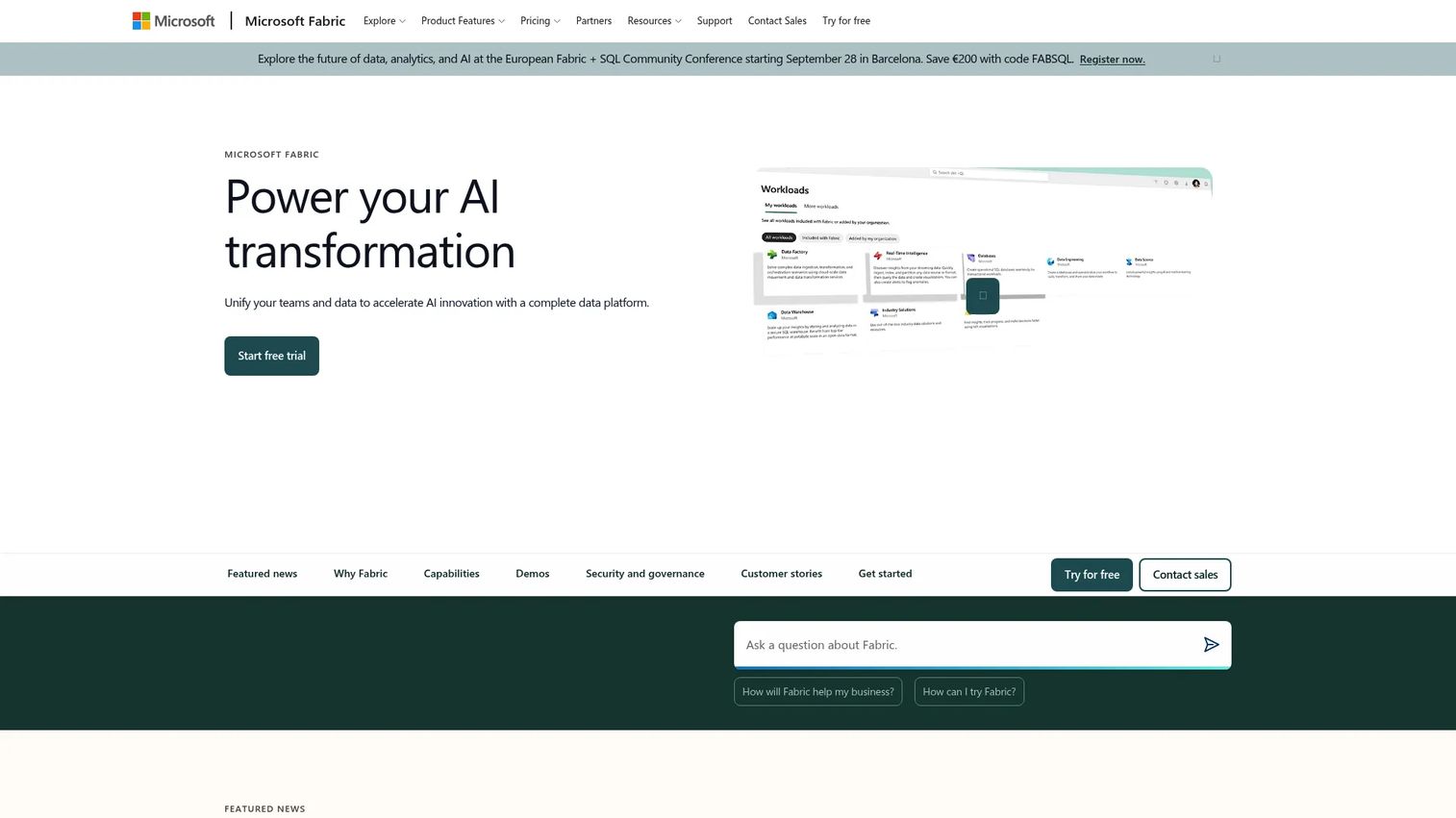
Microsoft Fabric is Microsoft's unified SaaS analytics platform, bundling data integration, engineering, science, warehouse, real-time intelligence, BI, and databases on top of a single logical lake called OneLake. Instead of stitching together separate services, you get shared compute, shared storage, and one governance surface across every workload. For organizations already running on the Microsoft stack, this is the anchor option in the data fabric conversation.
The architecture is what sells it. Every workload writes to OneLake, so Power BI, Data Factory, Data Engineering, Real-Time Intelligence, Warehouse, and Databases all read from the same governed store. That removes the copy-and-sync tax that plagues multi-tool stacks. Copilot in Fabric adds AI assistance across those workloads.
Best for: enterprises standardized on Microsoft and Azure that want analytics, engineering, and BI unified under one platform.
Key strengths
- Unified SaaS platform across analytics workloads
- OneLake as a single logical data lake
- Data integration and engineering in one place
- Copilot in Fabric for AI assistance
- Shared governance across every workload
Why choose Microsoft Fabric: If your stack is already Microsoft-first, Fabric collapses a pile of separate tools into one platform with consistent governance. The fit is strongest when you value ecosystem cohesion over best-of-breed independence.
Microsoft Fabric pricing: Fabric capacity is offered as pay-as-you-go or reservation, billed by the hour. Microsoft's public pricing page lists SKU rows without visible numeric values, so exact figures come through Azure. A free Fabric trial is available.
2. OneLake
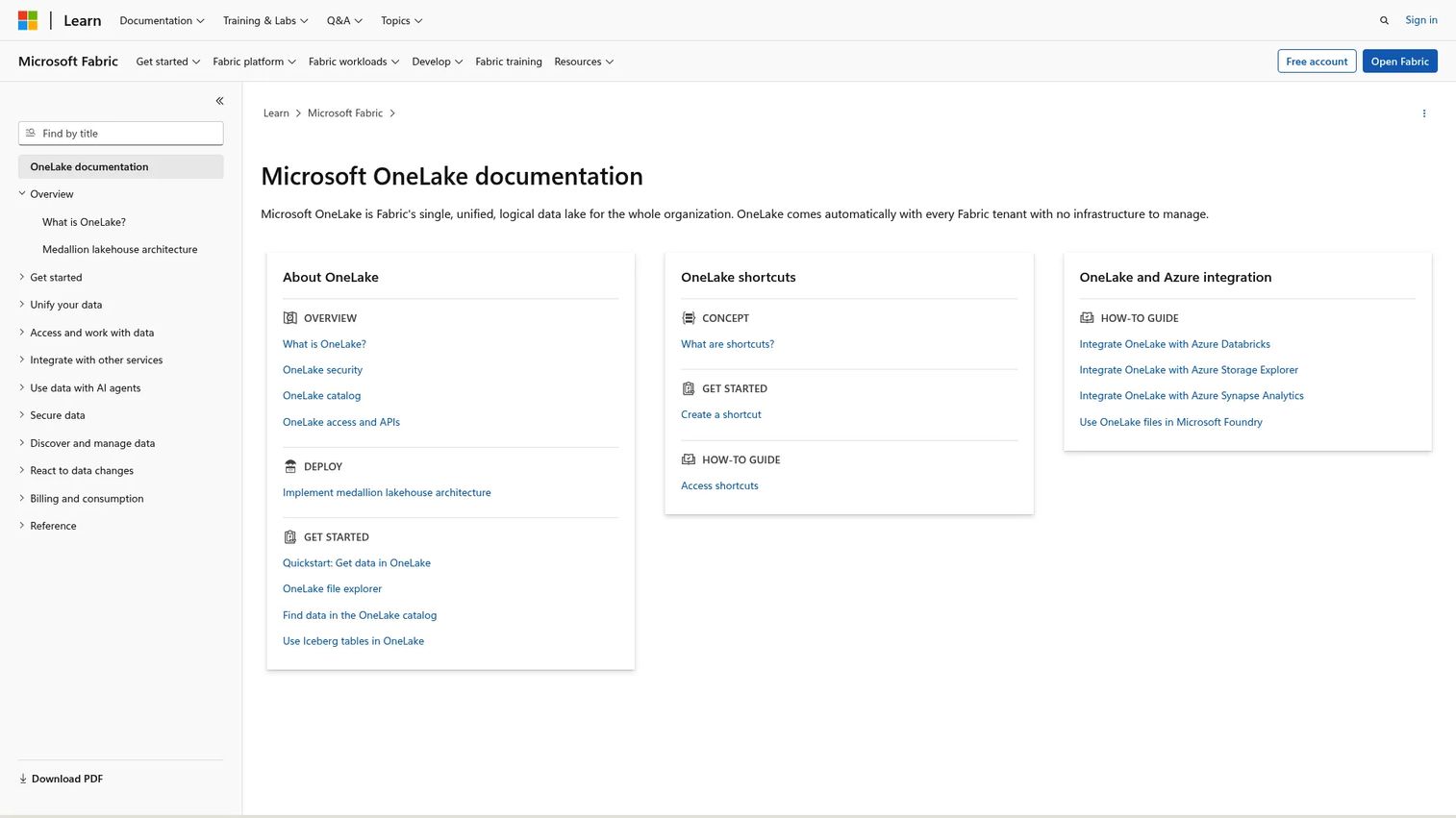
OneLake is the unified logical data lake inside Microsoft Fabric, giving your whole organization one storage layer instead of a lake per team. It is built on a single logical namespace, so every Fabric workload reads and writes to the same place. Think of it as the storage and access foundation that makes the rest of Fabric coherent.
Its standout feature is shortcut-based zero-copy access. Shortcuts and mirroring let you reference data where it already lives, in another lake, another cloud, or another Fabric workspace, without physically copying it. That is the mechanism behind unified data access without replication sprawl. Access spans every workload, so the same governed data serves engineering, analytics, and BI.
Best for: organizations using Microsoft Fabric that want one governed data lake for analytics and sharing across teams.
Key strengths
- Unified logical storage across the organization
- Shortcut-based zero-copy access to external data
- Mirroring for no-copy data access
- Access across every Fabric workload
- Single governed namespace for all data
Why choose OneLake: it is narrower than the full Fabric platform, but it is the central storage abstraction that makes the Microsoft data fabric story work. Choose it as the access layer when you are committing to Fabric.
OneLake pricing: OneLake is part of Microsoft Fabric rather than a standalone purchase. Consumption is handled through Fabric capacity, so there is no separate OneLake price line; Microsoft points to Fabric pricing.
3. OneLake Catalog
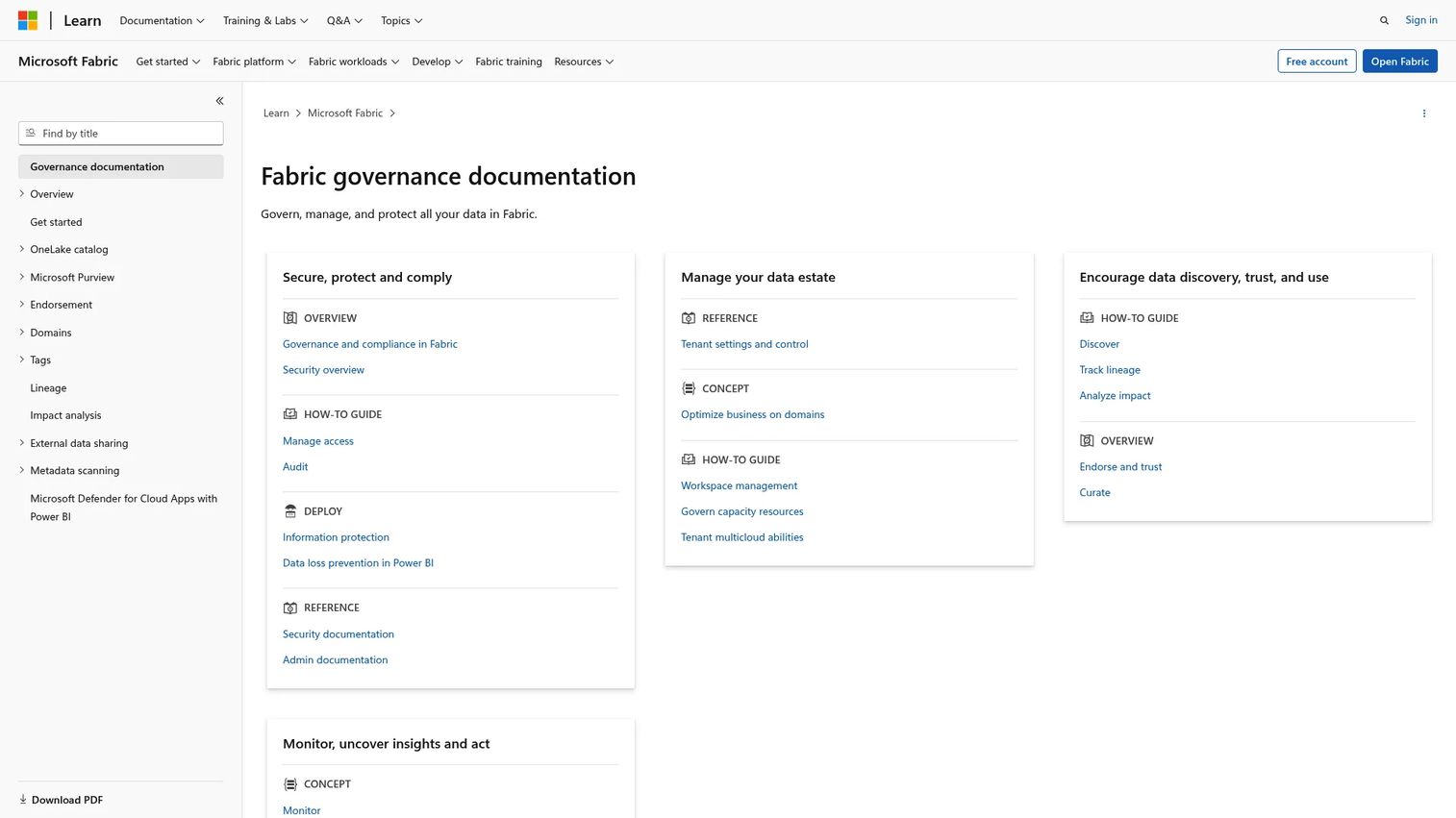
OneLake Catalog is Microsoft Fabric's centralized catalog for finding, exploring, securing, and governing Fabric items. It is the discovery and metadata surface that sits on top of OneLake, turning a big shared lake into something teams can actually navigate with confidence. When self-service access needs to coexist with control, this is where that balance lives.
The catalog lets you explore Fabric items with filters and an item details view, so users find the right asset instead of guessing. It surfaces governance insights and recommended actions, and it exposes unified workspace and OneLake security role views for lineage-oriented, searchable governance context. That combination is what metadata-driven discovery looks like in practice.
Best for: organizations on Microsoft Fabric that need a central place to discover and govern data items at scale.
Key strengths
- Explore Fabric items with filters and detail views
- Governance insights and recommended actions
- Unified workspace and OneLake security role views
- Lineage-oriented navigation across items
- Searchable governance context for self-service
Why choose OneLake Catalog: Catalog depth is what separates a lake from a usable data fabric. Choose it when teams need self-serve discovery without losing governance control over sensitive assets.
OneLake Catalog pricing: As a Fabric governance capability, OneLake Catalog runs on Fabric capacity rather than a separate price. There is no public standalone pricing; Fabric capacity is purchased through Azure or a CSP.
4. HPE Data Fabric Software
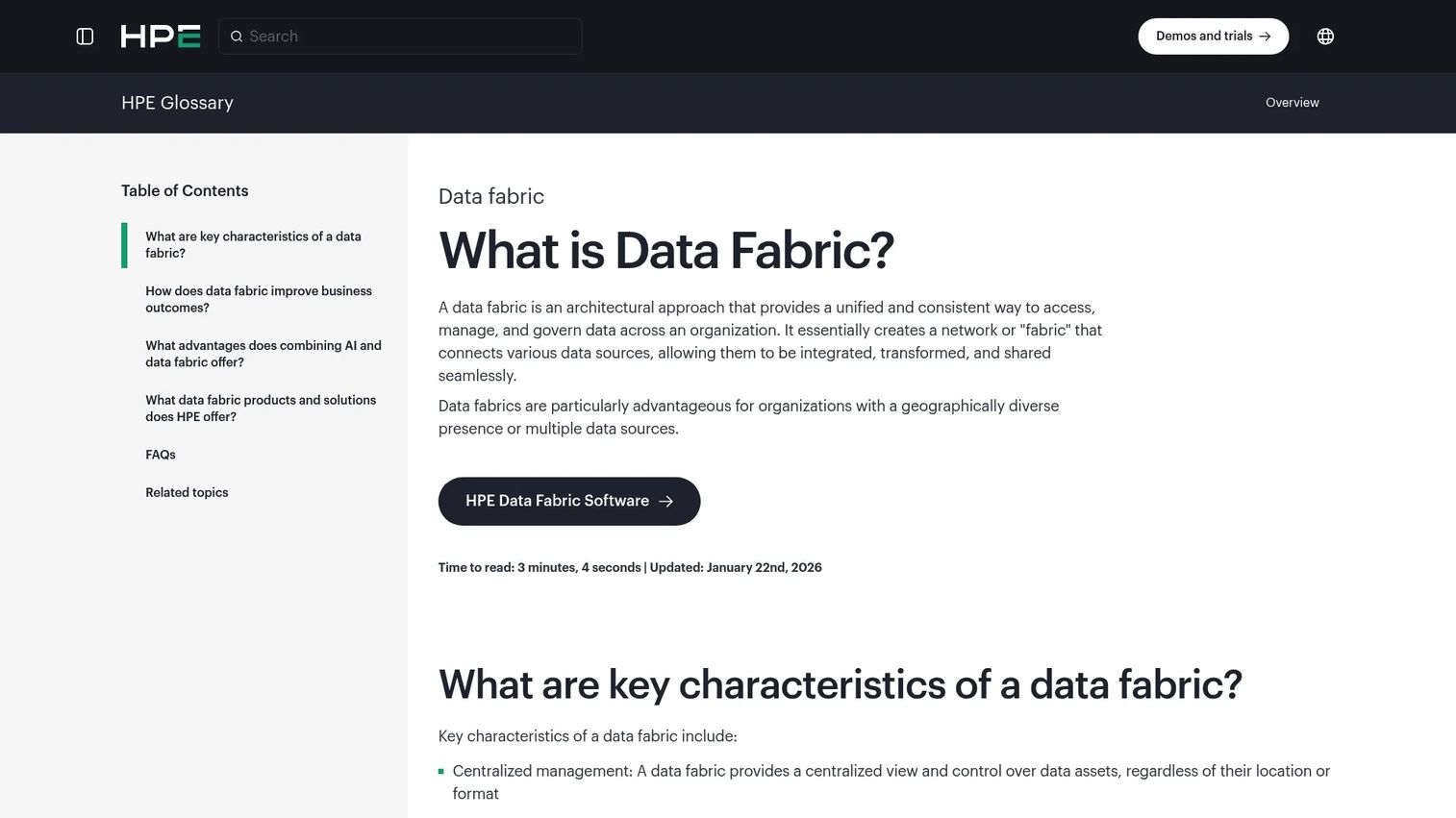
HPE Data Fabric Software is HPE's data platform for unifying, governing, and accessing hybrid enterprise data for AI and analytics. It frames itself as an AI-ready data plane, giving teams a single consistent view across distributed storage without moving everything into one system. For enterprises that want direct access to hybrid data for AI workloads, this is the storage-agnostic option.
Its strength is breadth of data types under one global namespace. HPE provides unified access to files, objects, NoSQL, and streams, federating them across hybrid environments. AI-powered governance and compliance apply across that data plane, which matters when you are feeding models from many sources. The storage-agnostic positioning means it sits over your existing infrastructure rather than replacing it.
Best for: enterprises needing a governed data fabric for hybrid analytics and AI across distributed storage.
Key strengths
- Unified global data plane across hybrid environments
- Unified access to files, objects, NoSQL, and streams
- AI-powered governance and compliance
- Federated stores with a global namespace
- Storage-agnostic hybrid support
Why choose HPE Data Fabric Software: It fits best when your data is genuinely distributed across storage types and locations, and you want one access plane for AI without a forced migration. The hybrid and infrastructure angle is the differentiator.
HPE Data Fabric Software pricing: Purchasing routes through HPE's buy flow or an HPE expert for a quote, which is typical for enterprise data platform software.
5. IBM Data Fabric
IBM Data Fabric is IBM's approach to data fabric as an architecture for integrating, governing, and securing distributed enterprise data across hybrid environments. Rather than a single SKU, IBM frames it as an architectural pattern assembled from data catalogs, integration, and governance capabilities. This is the glossary-plus-vendor bridge: strong on the conceptual model, backed by real products.
The capabilities cluster around data catalogs, data integration, and data governance and security. Active metadata and automation drive the fabric, reducing manual data management as sources grow. IBM ties the whole story to hybrid cloud and AI use cases, positioning the fabric as the foundation for trustworthy AI. Compared to a data mesh, IBM's fabric leans architectural and centralized on governance; compared to a lakehouse, it emphasizes access and metadata over storage.
Best for: enterprises needing a hybrid data architecture for integration, governance, and AI readiness.
Key strengths
- Data catalogs for discovery and trust
- Data integration across hybrid sources
- Data governance and security
- Active metadata and automation
- Hybrid cloud and AI-ready framing
Why choose IBM Data Fabric: Choose it when governance maturity and a clear architectural narrative matter as much as any single feature. It fits enterprises that buy into a coherent hybrid-cloud data strategy.
IBM Data Fabric pricing: IBM describes data fabric as an architecture rather than a standalone priced product, so the reviewed pages show no public price. Costs depend on the specific IBM products assembled to implement the pattern. G2 shows a 4.3/5 seller rating for IBM overall rather than a dedicated Data Fabric product listing.
6. Denodo
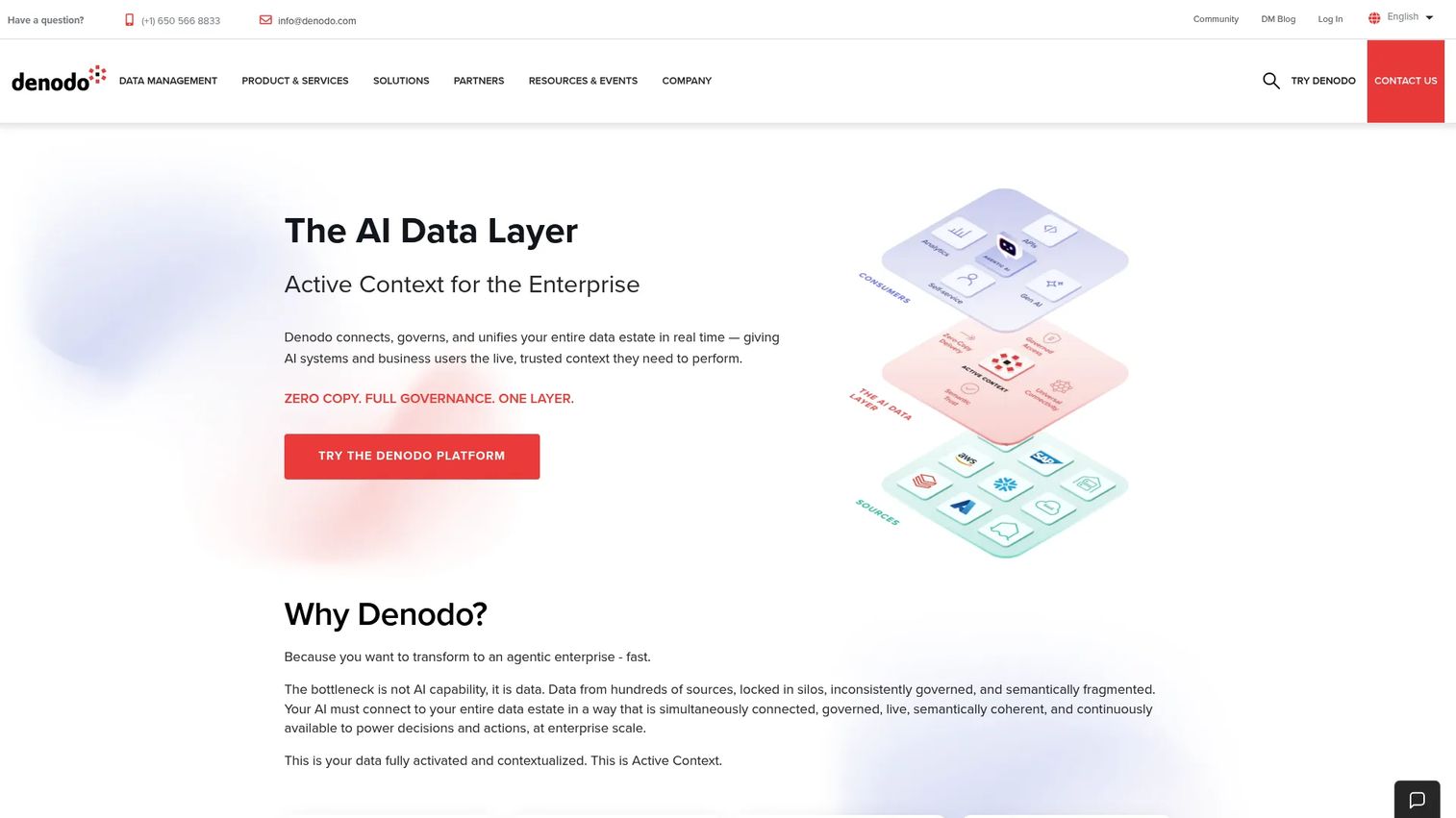
Denodo is an enterprise data virtualization and logical data management platform. It gives you federated access to distributed sources through a single logical layer, so applications query one place while data stays where it lives. When teams want direct access over replication, Denodo is the platform that usually makes the shortlist.
Data virtualization is the core differentiator. Denodo provides logical data access across sources, with intelligent query optimization and selective caching to keep federated queries performant. A data catalog with AI-driven recommendations and collaboration handles discovery and governance context on top. This model suits hybrid environments and self-service data access where copying everything is not an option, whether for cost, latency, or governance reasons.
Best for: enterprises needing governed access to distributed data without heavy replication.
Key strengths
- Data virtualization and logical data access
- Federated access across distributed sources
- Intelligent query optimization and caching
- Data catalog with AI-driven recommendations
- Collaboration features for governed access
Why choose Denodo: Pick it when a virtualized, zero-copy access model fits your architecture better than replication-heavy integration. Performance tuning matters at scale, so plan for query optimization work.
Denodo pricing: Pricing is listed for Denodo Agora at $63.00 USD per DCU on a pay-as-you-go basis, billed per minute of usage and settled monthly in arrears. Prepaid pricing with volume discounts is available through sales.
Denodo holds a 4.3/5 rating on G2.
7. Qlik Talend Cloud
Qlik Talend Cloud is Qlik's cloud data integration, quality, and governance platform, combining Talend capabilities for trusted, AI-ready data. It is strong where a fabric needs serious ingestion and integration mechanics: moving data across sources reliably, then keeping it clean and governed. Buyers usually evaluate it when integration depth is the priority rather than a broad platform story.
The platform handles multi-modal data integration across batch, real-time, ETL, ELT, and APIs, with change data capture for keeping sources in sync. Data quality and governance come through Data Products and lineage, so the data you move stays trustworthy. Deployment flexes across cloud, on-premises, and hybrid. This is data movement and orchestration at scale, with governance-adjacent delivery baked in.
Best for: teams needing a unified SaaS and hybrid data integration platform with quality and governance features.
Key strengths
- Multi-modal integration: batch, real-time, ETL, ELT, APIs
- Change data capture across sources
- Data quality and governance with lineage
- Data Products for trusted delivery
- Cloud, on-premises, and hybrid deployment
Why choose Qlik Talend Cloud: Choose it when ingestion, movement, and integration quality are the core requirement. It is often selected for movement depth rather than as an all-in-one fabric, and it pairs well with a virtualization or catalog layer.
Qlik Talend Cloud pricing: offered in Starter, Standard, Premium, and Enterprise editions, with capacity-based pricing measured by data volume moved, job executions, and duration. Public dollar figures are not shown; pricing is quoted through sales. A free trial is available.
Qlik Talend Cloud holds a 4.6/5 rating on G2.
8. Informatica Intelligent Data Management Cloud
Informatica Intelligent Data Management Cloud is a cloud-native, AI-powered platform for discovering, connecting, governing, and managing enterprise data across hybrid and multi-cloud environments. It is the broad enterprise data management option, covering integration, quality, catalog, governance, and master data management under one roof. For organizations with heavy governance and stewardship needs, this is the full-breadth choice.
Breadth is the point. IDMC combines data integration and engineering with data quality, governance, catalog, and master data management, so you are not assembling five vendors. CLAIRE AI drives metadata-driven automation across those capabilities, which is where the AI-ready trust and discoverability come from. Catalog and lineage make assets findable and defensible. This is enterprise data management wide enough to underpin a full data fabric, not a single feature.
Best for: enterprises needing a unified cloud platform for data integration, governance, quality, and MDM.
Key strengths
- Data integration and engineering
- Data quality, governance, and catalog
- Master data management
- CLAIRE AI metadata-driven automation
- Hybrid and multi-cloud coverage
Why choose Informatica IDMC: Choose it when governance, stewardship, and data management breadth outweigh the appeal of a lighter, more focused tool. It suits enterprises consolidating many data disciplines onto one platform.
Informatica IDMC pricing: Informatica uses consumption-based pricing measured in Informatica Processing Units (IPUs), quoted per organization. The vendor directs buyers to request a quote.
Considerations
Treat this as your procurement checklist before you commit to any data fabric platform.
Data access model
Decide up front whether you want data virtualization, zero-copy access, or replication-heavy integration. Virtualization keeps data in place and queries it live, which lowers copy overhead but puts more weight on query performance. Zero-copy access like OneLake shortcuts references data without moving it. Replication gives you a physical copy to optimize against. This choice shapes your entire architecture and operational overhead, so make it deliberately.
Governance and policy controls
Verify how access control, metadata linkage, lineage, and tenant boundaries actually work. The real test is whether governance holds across the whole fabric, not inside one tool. Ask how policy propagates when a new source connects, and how lineage tracks across virtualized and replicated data. Governance and security that fragment per source will undo the point of buying a fabric.
AI-readiness
Trustworthy data for AI comes from cataloging, active metadata, and quality automation, not from the model layer. Check how the platform surfaces data quality, how discoverable assets are, and whether metadata drives automation or just describes it. An AI-ready data foundation is mostly a metadata and governance capability.
Integration depth
Map the platform's connectors against your actual stack, including hybrid, cloud, change data capture, and streaming sources. A fabric that connects cleanly to your warehouse but chokes on your operational databases is a partial fabric. Confirm real support, not a roadmap promise.
Scalability and adoption
A pilot proves nothing if the platform stalls at enterprise scale. Evaluate how it performs under production load, and be honest about internal adoption. Operating model, change management, and whether your teams will actually use the catalog matter as much as any feature. Tool sprawl and unclear ownership sink more data fabric projects than technical gaps.
Conclusion
The right data fabric platform depends on your architecture, governance needs, and integration model, not on brand size.
If you are Microsoft-first, Microsoft Fabric with OneLake and OneLake Catalog gives you a unified platform, storage layer, and discovery surface in one ecosystem. For hybrid, storage-agnostic AI access, HPE Data Fabric Software fits distributed environments. IBM Data Fabric suits governance-heavy enterprises that want a mature architectural narrative. Denodo is the pick when virtualized, zero-copy access beats replication. Qlik Talend Cloud earns its place on integration and data movement depth, while Informatica IDMC covers the widest span of enterprise data management and governance.
Next step: shortlist two or three based on your access model and governance requirements, then run a proof of concept against your actual sources. The fabric that connects cleanly to your messiest system, not your cleanest, is the one worth buying.
FAQs
Data fabric is an architecture and software layer that unifies access across distributed sources through metadata and integration. Data mesh is an operating model that decentralizes data ownership to domain teams. One is mostly technical, the other mostly organizational, and they often coexist: you can run a data fabric to support a mesh operating model.
They overlap but differ in scope. A data lakehouse is storage-and-analytics centric, unifying where data sits and how you query it. A data fabric focuses on unified access and metadata across whatever sources you already run, including lakehouses. You can run a fabric over a lakehouse; the fabric handles access and governance, the lakehouse handles storage and compute.
Look for a data catalog, governance and lineage, hybrid and multi-cloud access, active metadata, automation, and an AI-ready data foundation. Unified data access across distributed sources is the baseline. Metadata-driven discovery and consistent policy enforcement are what separate a real data fabric platform from a rebadged integration tool.
Data architecture, platform engineering, data governance, and analytics teams typically drive the purchase, with presales engineers supporting enterprise evaluations. Because a fabric touches access, security, and AI-readiness at once, buying is cross-functional. Expect security, IT, and sometimes compliance to sit on the evaluation alongside the data platform team.
Assess fit against your data access model, integration depth with your actual stack, governance across the whole fabric, and scalability from pilot to production. Factor in operational complexity honestly. The strongest signal comes from a proof of concept run against your real sources, especially the messy ones, not a vendor demo on clean sample data.
Yes, indirectly but meaningfully. Data fabric improves AI by making data more accessible, trustworthy, and discoverable through cataloging, metadata, and governance. It does not build or train models. It builds the foundation models rely on, and better data quality tends to improve model accuracy and insight reliability more than most tuning does.
The common risks are tool sprawl, unclear data ownership, integration gaps against real sources, and governance complexity that grows faster than expected. None are fatal, but all are avoidable with clear scoping. Confirm real integration support, assign ownership before rollout, and pilot governance across multiple sources before you scale across the enterprise.