Filing deadlines don't move. The FEC report is due whether or not your donor data reconciled cleanly, whether or not three volunteers entered the same contribution in three different spreadsheets, and whether or not your treasurer has slept. That pressure is the real product political teams are buying software to solve.
The category is growing fast because the operational load is growing faster. The global political campaign software market sits at USD 2.81 billion in 2026 and is projected to reach USD 4.36 billion by 2035, according to Business Research Insights (2026). Digital adoption is now near-universal: Market Growth Reports (2026) found 92% digital adoption across U.S. federal and state campaigns, with more than 400,000 political organizations and committees actively running on this kind of software.
Here's the buying problem underneath all of that. Most teams aren't choosing a feature. They're choosing which category of tool anchors their stack: a compliance-first platform built around the treasurer, an all-in-one suite that folds fundraising and accounting together, or an organizing-heavy system built for field operations. Pick wrong and you're stitching four tools together with manual exports and reconciliation work that eats the hours you need for actual campaigning. The right platform reduces tool sprawl, keeps filings accurate, and gives you real-time reporting you can trust when someone asks where the money is.
If you build interactive experiences to explain complex products, you may find our roundups of the best CRM software and best event management software useful adjacent reading, since campaigns lean heavily on both.
What's inside
This guide compares four political campaign software platforms across the workflows that actually matter on a campaign: fundraising, campaign finance and compliance, CRM for political campaigns, organizing and voter outreach, and reporting. It's written for treasurers, campaign managers, digital operators, and the marketers who own donor and voter data.
We selected and ranked these platforms on four criteria: workflow breadth (how many jobs the platform covers without a second tool), compliance depth (treasurer support, filing accuracy, automated checks), integrations (how cleanly it connects to accounting, CRM, and outreach), and audience fit (who the tool is genuinely built for). We prioritized platforms with a clear point of view over feature checklists.
TL;DR
- Best overall for treasurers and compliance-heavy teams: ISPolitical, built around campaign finance, FEC workflows, and treasurer support.
- Best for organizing and voter outreach: NGP VAN, with canvassing, phone banking, texting, and petitions in one organizing stack.
- Best for integrated fundraising, accounting, and donor insight: Aristotle Campaign Manager, an all-in-one campaign platform for compliance, fundraising, and accounting automation.
- Best for all-in-one CRM and analytics breadth: Campaign Nucleus, a data-rich operations hub with CRM, email, events, and real-time reporting.
Match the platform to your top job. Compliance-first teams and organizing-first teams need genuinely different software.
What is political campaign software?
Political campaign software is a category of tools that centralizes fundraising, campaign finance compliance, donor and voter CRM, outreach, and reporting so a campaign, PAC, nonprofit, or advocacy group can run operations from one place instead of a pile of spreadsheets.
Most platforms in the category combine some mix of the following core modules:
- Campaign finance and compliance: Contribution limit checks, FEC and state filing workflows, treasurer tools, and audit-ready records.
- Political fundraising software: Donor management, contribution tracking, online giving pages, segmentation, and follow-up automation.
- CRM for political campaigns: Unified supporter and donor profiles that connect giving history, contact data, and engagement.
- Outreach and voter engagement workflows: Email, SMS, canvassing, phone banking, petitions, and events.
- Accounting automation: Bank reconciliation, expense tracking, and financial reporting tied to compliance.
- Reporting and analytics: Real-time dashboards on money raised, spent, and remaining, plus program performance.
- Integrations: Connections to accounting, payment processors, CRM, and outreach tools.
What separates the tools is emphasis. A campaign manager software platform built for treasurers treats compliance as the spine and everything else as supporting cast. An organizing-heavy system treats field operations that way. An all-in-one platform tries to hold fundraising, CRM, and reporting in a single stack. That difference in center of gravity is the single most important thing to understand before you buy, because it decides which manual work the software eliminates and which it leaves on your plate.
When to use each type
The right choice depends less on the feature list and more on which job keeps you up at night.
Use compliance-first software when filing accuracy is the top concern
If your biggest risk is a late or inaccurate FEC filing, lead with a compliance-first platform. These tools put treasurer support, contribution limit checks, and filing workflows at the center, so the person accountable for the numbers has automated guardrails instead of a spreadsheet and a prayer. Campaign finance software of this kind pays for itself the first time it catches an over-limit contribution before it's filed.
Use all-in-one platforms when you want fundraising, CRM, and reporting together
If you're consolidating a sprawling stack, an all-in-one campaign platform makes sense. You get political fundraising software, donor CRM, accounting, and real-time reporting under one login, which cuts the manual exports between systems. This fits campaigns and committees that want defensible reporting without wiring five tools together.
Use organizing-heavy software when field operations matter most
If your program lives on doors knocked, texts sent, and calls made, choose an organizing-heavy platform. These systems are built around canvassing, phone banking, texting, and petitions, with fundraising and compliance attached. Movement organizations, unions, and field-first campaigns get more from this shape than from a finance-first tool.
Comparison table
Here's the shortlist side by side. Ratings and pricing reflect the most current public sources we could verify; where a vendor keeps pricing behind a sales conversation, we've noted the ranges that are public.
| # | Product | Intent | Key differentiation | Pricing | G2 rating |
|---|---|---|---|---|---|
| 1 | ISPolitical | Compliance and campaign finance first | FEC workflows, AI bank reconciliation, treasurer support | Starts at $0, free trial | Not listed on G2 |
| 2 | NGP VAN | Organizing and voter outreach | Canvassing, phone banking, texting, and petitions in one organizing stack | Custom pricing | 4.0/5 |
| 3 | Aristotle Campaign Manager | Integrated fundraising and accounting | Compliance, fundraising, and accounting automation in one platform | From $250 to $350/mo | 4.0/5 |
| 4 | Campaign Nucleus | All-in-one CRM and analytics | CRM, email, text, events, and automation with real-time analytics | From $150/mo | Not yet rated |
Sorted by relevance to the core keyword: compliance-first tools lead, organizing and all-in-one platforms follow.
1. ISPolitical
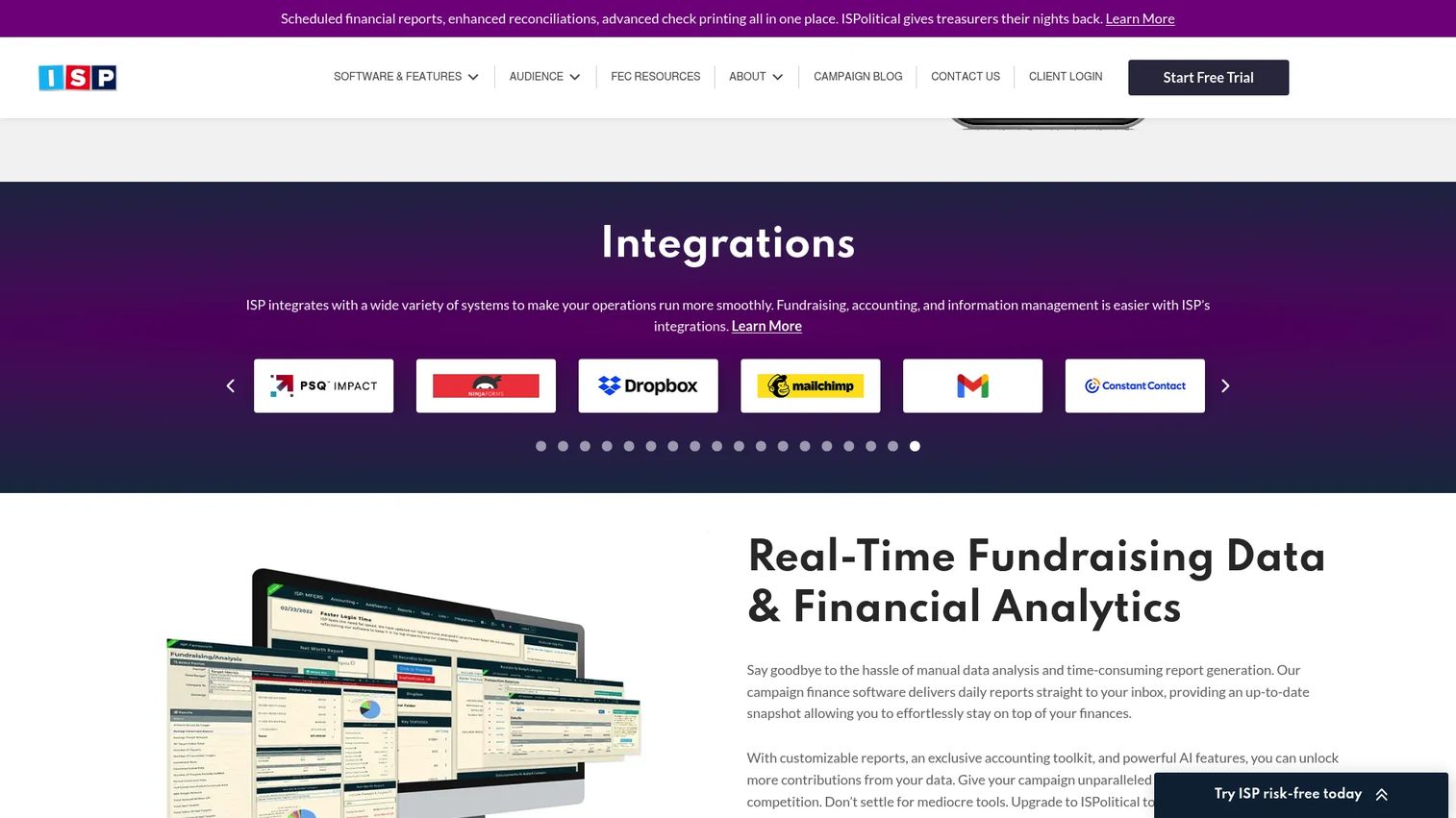
ISPolitical is political campaign finance and compliance software built for campaigns, PACs, and the treasurers who carry the liability. It puts compliance at the center: automated FEC workflows, contribution limit checks, and audit-ready records sit alongside integrated fundraising and accounting. Where most platforms treat compliance as a module, ISPolitical treats it as the spine of the product.
The standout is how much manual finance work it automates. AI-powered bank reconciliation and data entry cut the tedious matching that usually falls to a treasurer late at night, and fundraising, accounting, and compliance live in one system rather than three exports.
Best for: Political committees and treasurers who need an all-in-one compliance and fundraising platform where filing accuracy is non-negotiable.
Key strengths
- FEC compliance automation: Filing workflows and contribution limit checks built to reduce reporting errors before they're submitted.
- AI bank reconciliation: Automated reconciliation and data entry that removes hours of manual matching.
- Integrated finance stack: Fundraising, accounting, and compliance in one platform with unlimited users and no contracts.
Why choose ISPolitical: If the person losing sleep on your team is the treasurer, this is the platform built for them. It's the strongest fit when compliance accuracy and treasurer support outrank organizing breadth, and the unlimited-user, no-contract model removes the seat-math that complicates other tools. Teams that live in field operations will want to weigh an organizing-heavy option instead.
ISPolitical pricing: The platform advertises that you can start at $0 and offers a free trial, according to the ISPolitical site as of mid-2026. A detailed public tier table was not readable on the brand site, so exact paid-plan pricing is best confirmed directly with the vendor. Capterra reviewers rate it 4.9/5, though it does not carry a verified G2 listing.
2. NGP VAN
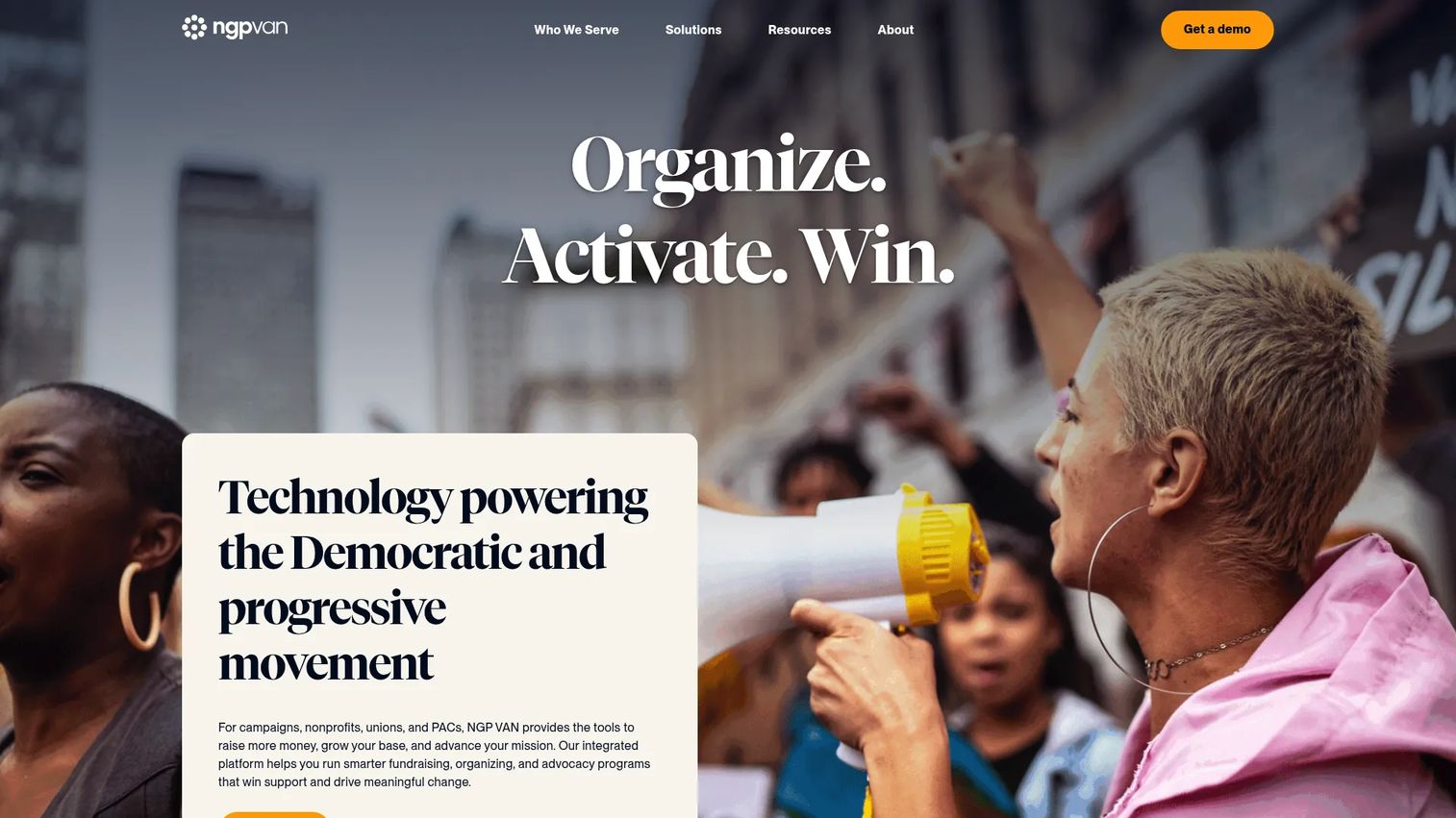
NGP VAN is the technology platform for Democratic and progressive campaigns, nonprofits, unions, PACs, and advocacy groups. Its center of gravity is organizing. Where compliance-first tools build outward from the treasurer, NGP VAN builds outward from the field, with fundraising and compliance attached to a deep organizing stack.
That organizing stack is the reason field-heavy operations choose it. Tools like VAN, MiniVAN, OpenVPB, and Mobilize cover canvassing, phone banking, texting, and volunteer coordination, so the door-knocking and dialing that define a ground game run on the same platform as your donor data.
Best for: Democratic and progressive organizations that need integrated fundraising, compliance, and organizing software with serious field capability.
Key strengths
- Organizing suite: Canvassing, phone banking, texting, petitions, and online actions built for volunteer-driven programs.
- Fundraising and compliance: Contribution tracking and filing tools connected to the same supporter records used for outreach.
- Advocacy and member tools: Purpose-built for unions, PACs, and advocacy groups running large-scale member organizing.
Why choose NGP VAN: If your program is measured in doors knocked and calls made, NGP VAN is built for that reality. It's the strongest fit for movement organizations and field-first campaigns that need voter engagement workflows and fundraising in one place. Finance-first committees whose main concern is treasurer support may find a compliance-led platform a tighter fit.
NGP VAN pricing: NGP VAN did not expose a public pricing page during our review, so plan pricing is best confirmed directly with the vendor. The platform holds a 4.0/5 rating on G2. Because packaging varies by organization type and size, budget a scoping conversation into your evaluation timeline.
3. Aristotle Campaign Manager
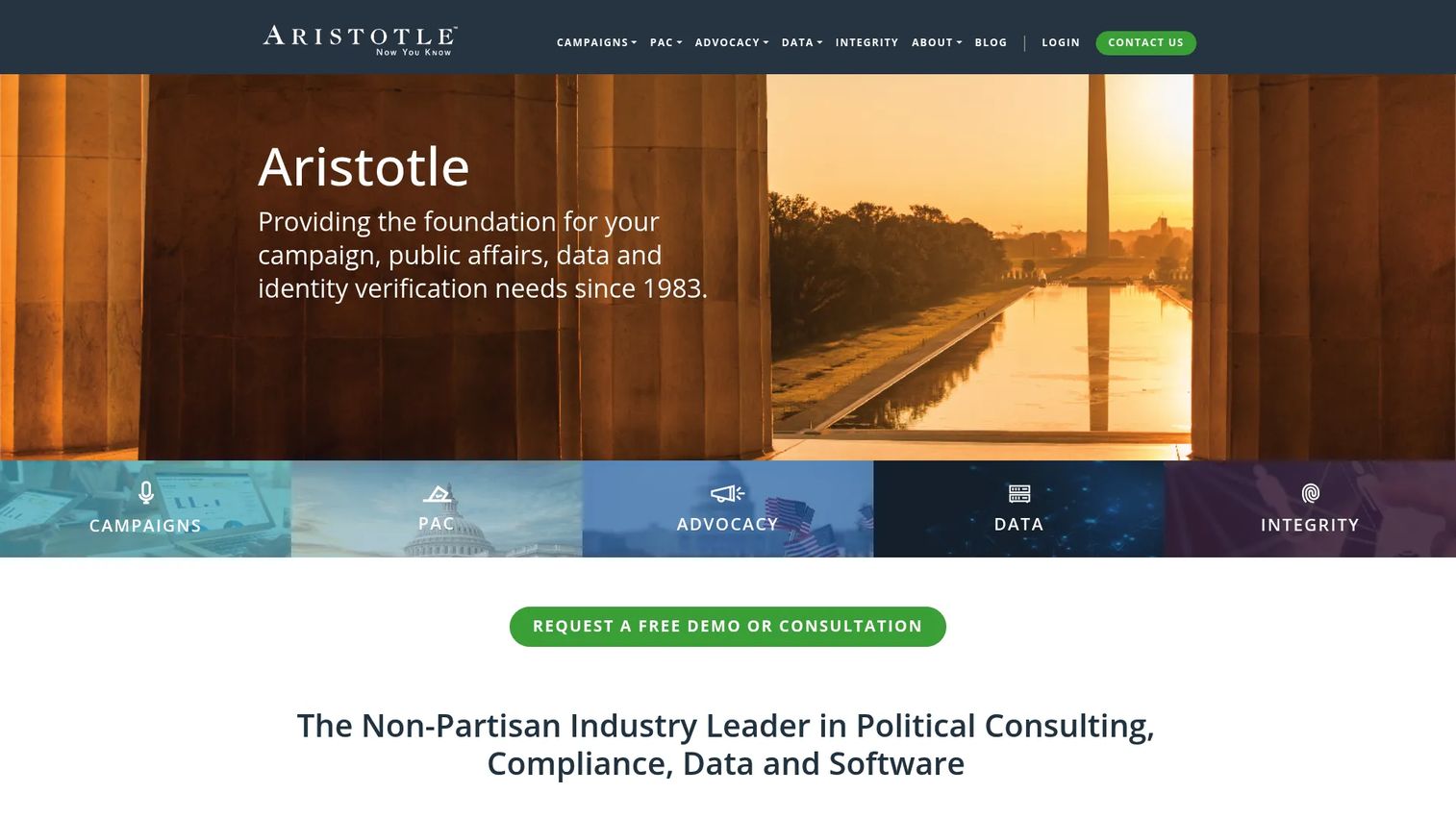
Aristotle Campaign Manager is cloud-based political campaign management software that folds compliance, fundraising, and accounting into one platform. It's the classic all-in-one shape: donor management, contribution tracking, and financial reporting share a system, so the money side of a campaign runs without constant exports between fundraising and accounting.
Its strength is integrated finance workflows with clean donor insight. Compliance reporting and limit checks run against the same records fundraisers work in, and accounting automation ties spending and filings together in one flow.
Best for: Political campaigns that want an all-in-one CRM for compliance, fundraising, and accounting under a single login.
Key strengths
- Compliance reporting: Limit checks and filing workflows built into the same platform as fundraising.
- Fundraising and donor management: Contribution tracking, donor profiles, and segmentation for follow-up.
- Accounting automation: Financial reporting and reconciliation workflows connected to compliance data.
Why choose Aristotle Campaign Manager: Choose it when you want fundraising, accounting, and compliance in one integrated finance stack rather than a field-first organizing platform. It fits treasurers and campaign operators who value donor insight and clean financial reporting in a single tool. Teams whose primary need is large-scale canvassing and texting will get more from an organizing-heavy option.
Aristotle Campaign Manager pricing: Aristotle does not publish pricing on its own site, but G2 lists provider-supplied pricing across three plan types. The Local Office plan runs $250 to $350 per month, U.S. House is listed at $750 per month, and the Statewide Office or U.S. Senate tier runs $750 to $1,200 per month. There is no free tier. The product holds a 4.0/5 rating on G2.
4. Campaign Nucleus
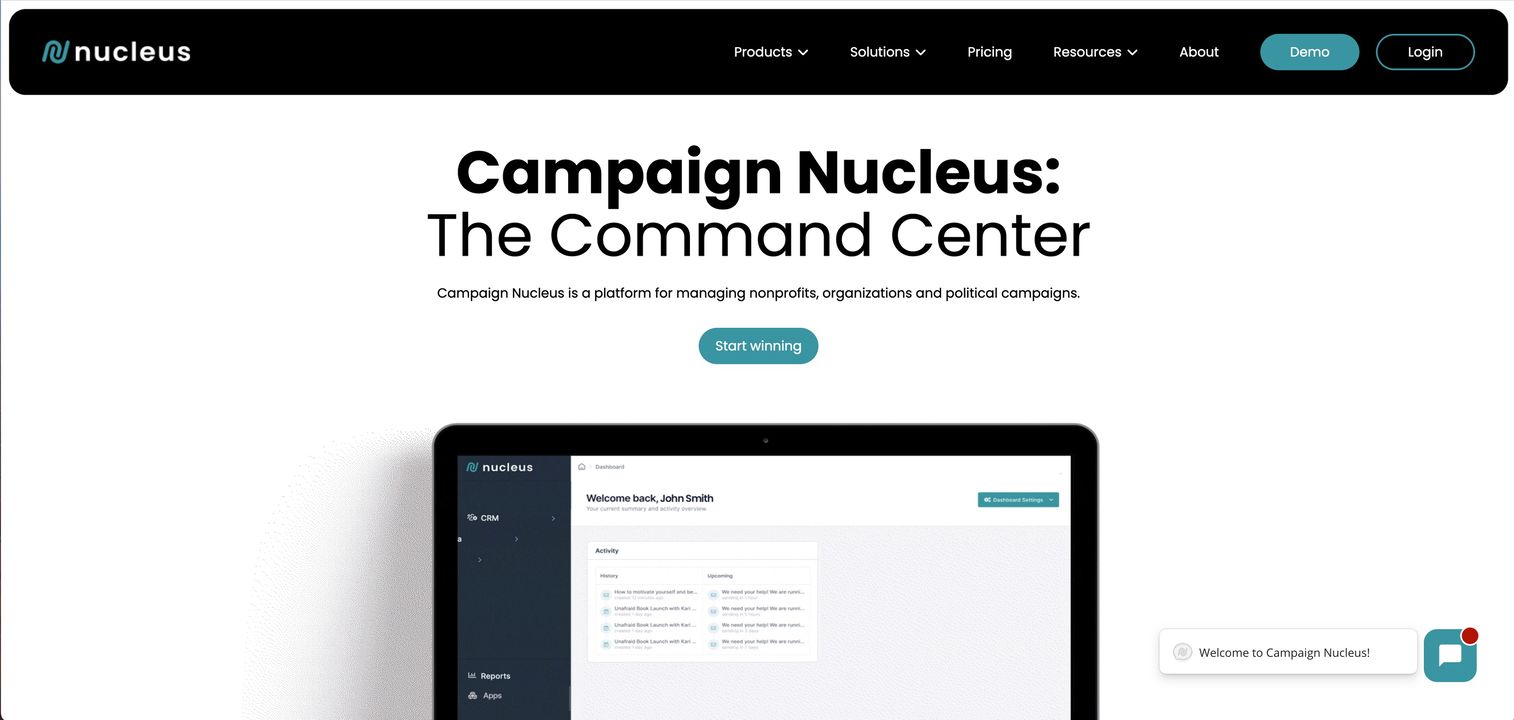
Campaign Nucleus is an all-in-one political campaign and advocacy operations platform built as a data-rich hub. Its breadth is the pitch: CRM, email, text, event management, automation, and analytics live together, so voter engagement and campaign orchestration run from one operational center rather than a scattered set of point tools.
For teams that want a single command surface, that consolidation is the draw. Supporter profiles feed email and text outreach, events tie back to CRM records, and real-time analytics sit over the whole operation, which is what makes it appealing to data-forward campaigns.
Best for: Political campaigns and advocacy groups that want a unified operations stack with strong CRM, outreach, and analytics.
Key strengths
- CRM and supporter profiles: A unified CDP-style layer connecting donor, voter, and engagement data.
- Email, text, and automation: Outreach and lifecycle automation built directly on supporter records.
- Analytics and dashboards: Real-time reporting across the CRM, outreach, and events in one view.
Why choose Campaign Nucleus: Pick it when you want analytics and orchestration breadth in one hub rather than a finance-first or field-first specialist. It fits teams that treat data and automation as the backbone of their program and want CRM, outreach, and reporting under one roof. Committees whose single biggest need is FEC filing accuracy may prefer a compliance-led platform.
Campaign Nucleus pricing: According to the Campaign Nucleus pricing page, plans start from $150 per month, and every plan includes CRM, email, text, data management, analytics, event management, and automations. There is no free tier visible on the pricing page. The platform does not yet carry a rated G2 listing, so weigh it on capability fit and a hands-on trial rather than review volume.
What to check before you buy
Feature lists blur together. These are the criteria that actually separate a fit from a mismatch.
Compliance and treasurer support
Confirm the platform automates the filings you're actually responsible for, whether that's FEC, a specific state, or both. Look for contribution limit checks that fire before submission, audit-ready records, and treasurer tooling. This is where the wrong choice costs you the most.
Fundraising and CRM depth
Check that donor and voter data live in one place, with contribution tracking, segmentation, and follow-up automation. A shared record between fundraising and outreach is what stops duplicate data entry and keeps your political campaign fundraising software honest.
Outreach and organizing fit
If field operations matter, verify canvassing, phone banking, texting, and petition tools are native, not bolted on. If they don't matter, don't pay for organizing depth you won't use.
Reporting and real-time visibility
You want to answer "how much have we raised, spent, and got left" without exporting anything. Test the dashboards on real questions during a trial.
Integrations and data ownership
Confirm the platform connects cleanly to your accounting, payment processor, and any outreach tools you'll keep. Ask who owns the data and how you export it if you leave. A platform that traps your donor records is a liability, not an asset.
Which platform fits your team
The decision comes down to your center of gravity. If the treasurer carries the most risk on your team, ISPolitical is the strongest overall pick, with compliance-first workflows, FEC automation, and finance work that reconciles itself. If your program lives on doors, calls, and texts, NGP VAN's organizing stack is built for that ground game. If you want fundraising, accounting, and compliance folded into one integrated finance platform, Aristotle Campaign Manager is the all-in-one fit. And if you want a data-rich hub where CRM, outreach, and real-time reporting orchestrate the whole operation, Campaign Nucleus is the breadth play.
Shortlist by the job that keeps you up at night, not the longest feature list. Run a trial against your real filing deadline, your real donor file, and your real outreach program. The platform that removes the most manual reconciliation from your week, not just the most reporting screens, is the one to buy. Start with one criterion, compliance, organizing, or all-in-one consolidation, and let it narrow the list to two before you book demos.
FAQs
It centralizes fundraising, campaign finance compliance, donor and voter CRM, outreach, and reporting in one place. The core job is consolidation: instead of running your campaign across spreadsheets and disconnected tools, one platform handles the money, the people, and the filings. That reduces manual data entry and keeps your reports accurate and current.
At minimum: CRM for donor and voter records, fundraising with contribution tracking, compliance and filing workflows, real-time reporting, and integrations with accounting and payment tools. Depending on your program, add outreach features like email, SMS, canvassing, or phone banking. The right mix depends on whether compliance, fundraising, or organizing is your primary job.
Look at compliance-first platforms that put the treasurer at the center. ISPolitical is built around FEC workflows, contribution limit checks that fire before submission, automated bank reconciliation, and audit-ready records. The best compliance tool reduces filing errors before they happen, not just after, and gives your treasurer automated guardrails instead of manual checks.
Organizing-heavy software is the better fit when field operations are core. NGP VAN's organizing stack, including VAN, MiniVAN, OpenVPB, and Mobilize, covers canvassing, phone banking, texting, and petitions natively. If your program is measured in doors knocked and calls made, choose a platform built around the ground game rather than one where outreach is bolted onto a finance tool.
It gives fundraisers donor management, contribution tracking, segmentation, and follow-up automation on shared records. Instead of exporting between systems, giving history and contact data sit in one CRM, so you can segment donors, track contributions against limits, and automate follow-up without duplicate entry. Real-time reporting shows where the money is at any moment.
Prioritize error reduction and auditability: contribution limit checks that catch problems before filing, automated reconciliation, secure and audit-ready records, and integration with your accounting workflow. A treasurer's biggest risk is a late or inaccurate filing, so the software should provide guardrails and a clean paper trail, not just a place to store data.
Yes for most operational workflows. The best platforms don't just move your reporting into a nicer interface; they reduce the manual reconciliation underneath it, matching bank records, catching over-limit contributions, and syncing donor data across fundraising and outreach automatically. That's the real gain: fewer hours spent reconciling, not just prettier reports.
Compare on five things: audience fit (who the tool is genuinely built for), compliance depth, outreach and organizing tools, reporting quality, and integration cleanliness. An all-in-one platform is only worth it if its breadth covers the jobs you actually do; extra modules you won't use aren't a benefit. Run a trial against your real workflows before committing.