You launched recurring billing on a spreadsheet and a basic payment processor. It worked at 50 customers. At 500, the cracks show. A renewal slips through unbilled. A failed card sits untouched for three weeks. Finance asks for accurate MRR and you spend a day reconciling exports that should have matched in the first place.
The job here is bigger than collecting payments. It is managing the full subscription lifecycle: recurring billing, renewals, dunning on failed payments, self-service subscription changes, and reporting that connects to your CRM and finance stack. The structural pressure is real. The subscription economy is projected to generate USD 722 billion in revenue in 2025, rising to USD 1.2 trillion by 2030, according to Juniper Research (2024). When that much revenue runs on recurring models, manual processes stop being a nuisance and start being a leak.
This guide is written with cross-functional teams in mind, including the enablement and RevOps people who own how pricing rollouts, renewal motions, and customer handoffs stay consistent. If you are also evaluating adjacent systems, it helps to see how a subscription management platform sits next to your best crm software, your best contract lifecycle management software, and your best loyalty management software. The right pick depends less on a feature checklist and more on your business model.
What's inside
This guide compares 11 subscription management tools across three buyer types: B2B SaaS companies, ecommerce and Shopify brands, and finance-led enterprise teams. Each tool earned its spot on five criteria: recurring billing automation, lifecycle workflows (renewals, dunning, self-service), pricing model flexibility, integrations with CRM and ERP systems, and reporting depth. We pulled verified pricing from each vendor's official page and current G2 ratings where available. The aim is simple: help you match the platform to how your business actually charges customers, not to a generic best-of list.
TL;DR
- Best overall for enterprise subscription operations: Recurly, for global billing, churn mitigation, and built-in revenue recognition.
- Best for B2B SaaS with complex pricing: Maxio, which pairs billing and RevRec for finance and revenue teams.
- Best for Stripe-native teams: Stripe Billing, for usage-based billing and developer flexibility on the Stripe stack.
- Best for Shopify subscription brands: Skio or Ordergroove, depending on whether you want modern retention flows or enterprise membership programs.
- Best for lower-cost Shopify startups: Appstle Subscriptions and PayWhirl, both with free entry tiers.
- Best for finance-heavy reporting and revenue recognition: Sage Intacct, where subscription billing ties directly into accounting.
What subscription management software does
Subscription management software is a system that automates recurring billing, renewals, plan changes, failed-payment recovery, and revenue reporting across the entire subscription lifecycle. It replaces the spreadsheets, scripts, and disconnected billing tools that break once recurring revenue scales past a few hundred customers.
A recurring billing software tool handles the narrow job of charging cards on a schedule. A full subscription management system does more. It manages the lifecycle around the charge: when a plan upgrades, when a renewal fires, when a payment fails and needs a dunning sequence, and how all of that rolls up into MRR reporting and revenue visibility.
Core capabilities to expect from a subscription management platform:
- Recurring billing and invoicing: automated charges, proration, and tax handling across plans and currencies.
- Renewal workflows: automatic renewals, renewal reminders, and churn reduction logic.
- Dunning and failed payments: retry schedules, card-updater integrations, and revenue recovery on declined cards.
- Self-service subscription changes: customer portals where users pause, skip, swap, upgrade, downgrade, and update payment details without a support ticket.
- Usage-based billing: metering and complex pricing for hybrid, tiered, and consumption models.
- MRR reporting and subscription analytics: revenue, churn, and forecasting that connect to your CRM and finance workflows.
- Integrations: CRM integration, ERP integration, APIs, and webhooks to keep billing data in sync with the rest of the stack.
The distinction matters when you buy. Billing-only tools cover the transaction. A subscription management system covers the relationship, and that is where recurring revenue management either holds together or leaks.
When to use subscription management software
When spreadsheets start breaking
The first sign is an error you cannot trace. A customer was billed the old price after an upgrade. A renewal date drifted because someone fat-fingered a cell. Finance and CS see different numbers for the same account. At low volume you catch these by hand. Past a few hundred subscriptions, manual adjustments become a risk surface, not a workflow. Missed renewals quietly cost revenue, and invoice errors erode trust with the customers you can least afford to lose.
When self-service matters
Every plan change that routes through a support ticket is friction for the customer and cost for your team. Buyers expect to pause, skip a cycle, swap a plan, upgrade, downgrade, and update a card on their own. Self-service subscription changes in a customer portal reduce ticket volume and lift retention, because the easiest path to keep a subscription is one the customer can manage themselves. When a downgrade is one click instead of a cancellation email, you keep more revenue.
When revenue operations need cleaner signals
RevOps and finance need MRR, churn, expansion, and failed-payment data they can trust. When that data lives in a billing tool that does not talk to your CRM or ERP, forecasting turns into a reconciliation project. A subscription management platform with real CRM integration and ERP integration gives sales, success, and finance one set of numbers. That is also what keeps renewal conversations and pricing rollouts consistent across teams, which is the same reason enablement leaders care about a clean best customer data platform and tidy contract management.
Comparison table
Rows are ordered by breadth of subscription management fit and relevance to teams evaluating recurring billing software, then by market prominence. Pricing and G2 ratings reflect verified values from each vendor's pricing page and current G2 listing. Where a vendor does not publish prices, the table notes custom pricing.
| # | Product | Intent | Key differentiation | Pricing | G2 rating |
|---|---|---|---|---|---|
| 1 | Recurly | Enterprise subscription operations | Billing, retention, and revenue recognition in one platform | From $249/mo + 0.9% of billing volume | 4.0/5 |
| 2 | Chargebee | B2B subscription monetization | Billing plus CPQ and revenue operations tooling | Free to start, then 0.75% on billing | 4.4/5 |
| 3 | Stripe Billing | Stripe-native, developer-led teams | Usage-based billing on the Stripe payments stack | From 0.7% of billing volume | 4.4/5 |
| 4 | Maxio | B2B SaaS finance and RevRec | Billing and revenue recognition for SaaS teams | From $599/mo | 4.3/5 |
| 5 | Appstle Subscriptions | Shopify subscription apps | Feature-rich Shopify subscriptions with a free tier | Free tier available | Not yet rated |
| 6 | PayWhirl | Lower-friction subscription billing | Free-to-install recurring billing for Shopify | Free, paid from $49/mo | 4.3/5 |
| 7 | Skio | Modern Shopify subscriptions | Retention-focused subscription commerce | From $499/mo (annual) | 2.3/5 |
| 8 | Ordergroove | Enterprise subscription commerce | Subscriptions, memberships, and clubs at scale | Custom pricing | 4.5/5 |
| 9 | Zoho Billing | SMB and mid-market billing | Recurring billing plus invoicing in the Zoho stack | From $39/org/mo (annual) | 4.6/5 |
| 10 | Zenskar | Complex and usage-based pricing | AI-native revenue automation for nonstandard models | Custom pricing | 4.8/5 |
| 11 | Sage Intacct | Finance-first subscription management | Cloud financials with subscription billing built in | Custom pricing | 4.3/5 |
1. Recurly
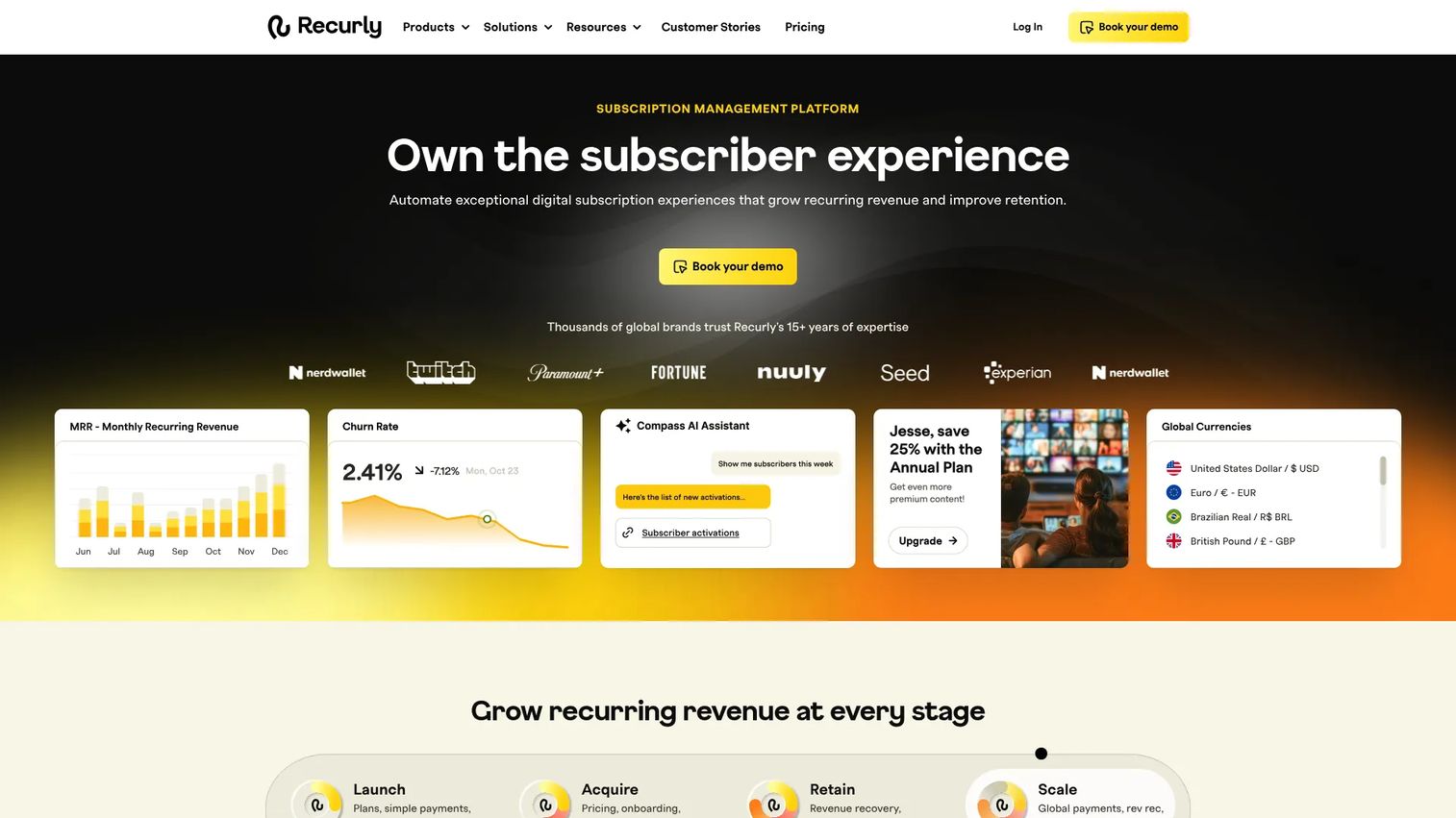
Recurly is a subscription management and recurring billing platform built for businesses that run recurring revenue at scale and across borders. It pairs automated global billing with churn mitigation and, through its RevRec product, revenue recognition, so a single platform covers the lifecycle from first charge to recognized revenue. It also offers a dedicated All-Access for Shopify plan for merchants that need subscriptions inside their commerce stack.
Best for: Subscription businesses that need billing, retention, and revenue recognition under one roof, with governance for heavier operations.
Key strengths
- Automated global subscription billing: handles multi-currency recurring charges, proration, and renewals without manual intervention.
- Churn mitigation tools: built-in dunning, decline recovery, and retention logic to reduce involuntary churn on failed payments.
- Flexible plans and pricing: supports tiered, usage, and hybrid models so pricing changes do not require engineering.
Why choose Recurly: It fits larger subscription businesses that want lifecycle control, not just a billing endpoint. The Engage add-on layers in retention campaigns and RevRec adds revenue recognition, which means finance, RevOps, and growth teams can work from one source of subscription truth rather than stitching tools together.
Recurly pricing: The Starter plan begins at $249 per month plus 0.9% of billing volume. All-Access and All-Access for Shopify plans drop the volume rate to under 1% and are billed annually. The Engage product is listed at $1,600 per month and RevRec at $850 per month, both billed annually. Recurly publicly offers a 90-day free trial and sandbox. Its G2 rating sits at 4.0/5.
2. Chargebee
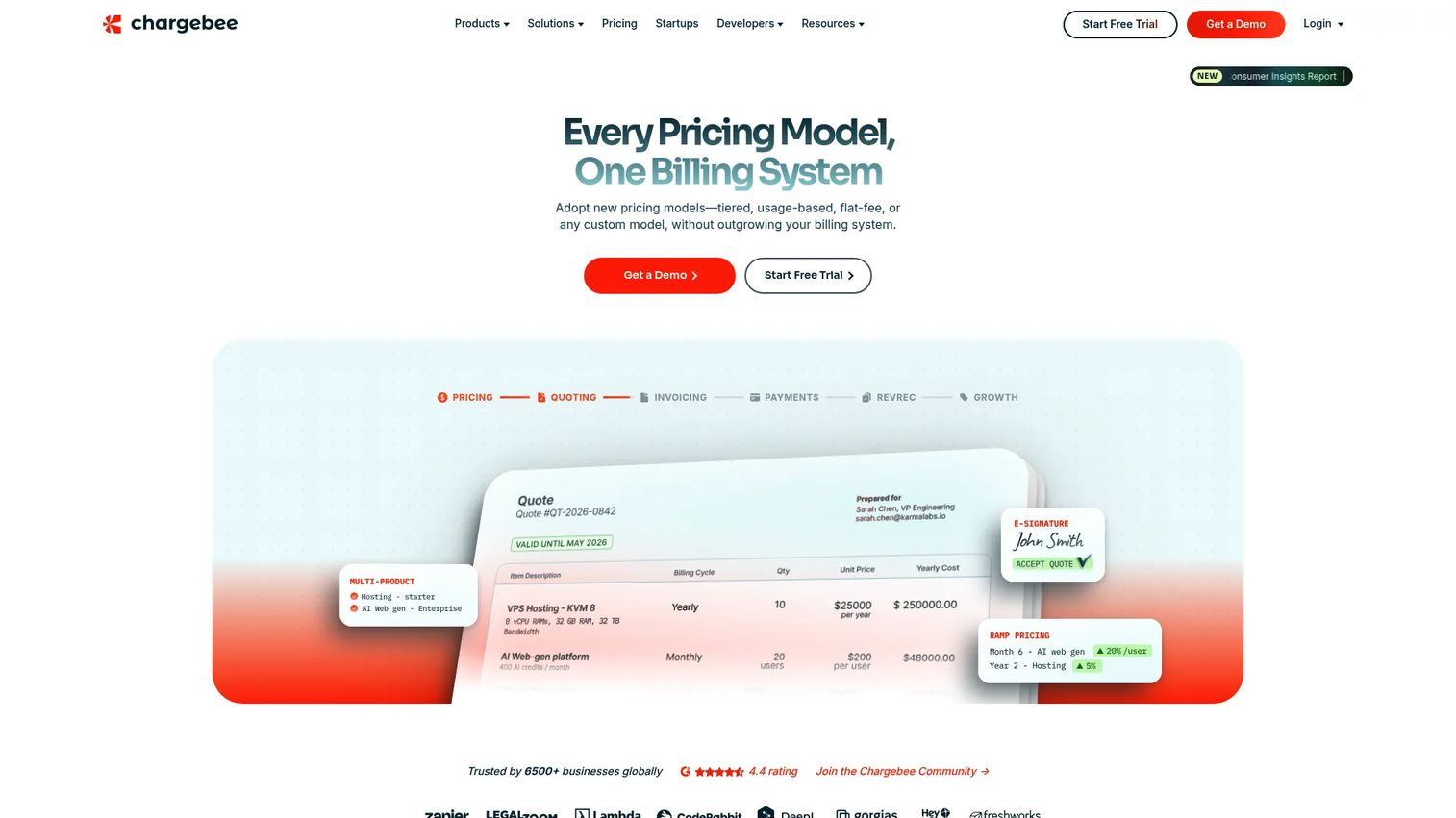
Chargebee is a subscription billing, monetization, and revenue management platform aimed at B2B subscription businesses. Beyond core billing, it adds quoting through CPQ and revenue recognition through RevRec, positioning it as a monetization platform rather than a narrow billing tool. That breadth suits teams whose pricing and quote-to-cash motion is too complex for a single-purpose billing app.
Best for: B2B subscription teams that need recurring billing, usage-based billing, CPQ, and revenue operations tooling together.
Key strengths
- Subscription management: automated recurring and usage-based billing across plans, currencies, and pricing models.
- Hosted checkout and self-serve portal: lets customers manage upgrades, downgrades, and payment details without support.
- Revenue operations tooling: CPQ for quoting and RevRec for recognition connect billing to the wider finance workflow.
Why choose Chargebee: Pick it when your monetization is the complex part, not just the charge. Sales-led deals with custom quotes, usage components, and renewal terms all live in one system, which keeps pricing rollouts and renewal workflows consistent across sales and finance.
Chargebee pricing: The Starter plan is free for the first $250K of cumulative billing, then charges 0.75% on billing. Performance is listed at $7,188 per year on an annual commitment. Enterprise uses custom pricing scaled by active subscribers. CPQ and RevRec are separate offerings. Chargebee holds a 4.4/5 rating on G2.
3. Stripe Billing
Stripe Billing is Stripe's subscription and recurring billing layer, covering pricing, invoicing, subscriptions, and retention on top of Stripe's payments infrastructure. It is the natural choice for teams already standardized on Stripe that want developer flexibility through APIs and webhooks rather than a configuration-only tool. Usage-based billing runs through the Meters API, and a customer portal handles self-service subscription changes.
Best for: Developer-led teams already on Stripe that want subscriptions, usage-based billing, and recovery automations in one stack.
Key strengths
- Recurring billing and subscriptions: proration, billing schedules, and flexible plan structures handled natively.
- Usage-based billing via Meters API: meters consumption for usage and hybrid pricing models.
- Customer portal and recovery: self-service subscription management plus automated retries and recovery on failed payments.
Why choose Stripe Billing: If your payments already run on Stripe, Billing removes the integration overhead of bolting on a separate subscription system. Engineering gets webhooks and APIs to build custom flows, while finance gets recovery automations that reduce involuntary churn on declined cards.
Stripe Billing pricing: Pay as you go starts at 0.7% of billing volume with no recurring fee. Annual subscription tiers, billed monthly on a one-year contract, run at $620, $1,500, $2,950, and $5,750 per month depending on volume. Custom pricing is available at scale. Stripe Billing is rated 4.4/5 on G2.
4. Maxio
Maxio is a B2B SaaS billing and financial operations platform that combines recurring billing, usage-based pricing, collections, dunning, and revenue recognition in one system. It is built specifically for SaaS finance and revenue teams that need billing and RevRec to live together rather than in two disconnected tools. Contract management, forecasting, and financial reporting round out the lifecycle.
Best for: B2B SaaS companies that need billing, subscription management, and revenue operations, especially revenue recognition, in one platform.
Key strengths
- Recurring and usage-based billing: supports subscription, consumption, and hybrid pricing for SaaS contracts.
- Revenue recognition and reporting: automates RevRec and gives finance MRR reporting and forecasting in one view.
- Collections and dunning: manages failed payments and revenue recovery alongside contract management.
Why choose Maxio: It is the strong pick when finance owns the buying decision. A SaaS team that needs auditable revenue recognition tied directly to billing avoids the reconciliation gap between a billing tool and a separate RevRec system. Developers can validate flows in the platform's sandbox before going live.
Maxio pricing: The Build plan is free to try. Grow starts at $599 per month for up to $100K in monthly billings. Scale is quote-based for higher-volume customers above that threshold. Maxio carries a 4.3/5 rating on G2.
5. Appstle Subscriptions
Appstle Subscriptions is a Shopify-native subscription and recurring-billing app built for merchants who want feature depth without enterprise overhead. It covers build-a-box, bundling, flexible billing, a customizable customer portal, automations, and powerful APIs, with a free tier that lets smaller merchants start without upfront cost. Subscription migration support makes it practical for brands switching apps.
Best for: Shopify merchants that want a feature-rich subscription app with an accessible entry point.
Key strengths
- Build-a-box and bundling: lets shoppers assemble custom recurring orders, a strong fit for ecommerce subscription software.
- Customizable customer portal: self-service pause, skip, swap, and payment updates without support tickets.
- Flexible billing and automations: recurring billing logic, customer tags, and membership controls for retention.
Why choose Appstle Subscriptions: It hits the sweet spot for Shopify brands that have outgrown a barebones app but do not want enterprise pricing. The free tier and accessible model let merchants validate subscription revenue, then scale features as the program grows.
Appstle Subscriptions pricing: The pricing page confirms multiple plans, including a free tier and a custom plan for enterprise and Shopify Plus merchants. Numeric subscription prices were not publicly visible on the page at the time of review, so confirm current tiers directly with Appstle. Its G2 seller profile does not yet show a product review rating.
6. PayWhirl
PayWhirl is a subscription billing and recurring payments platform with strong Shopify support and a free-to-install entry point. It covers recurring billing, order management, workflow automation, embedded payment widgets, and custom customer portals, with APIs for teams that want to build their own flows. Failed-payment actions and recovery logic are built in.
Best for: Brands validating subscription revenue before scaling, especially on Shopify, that want a low-friction starting point.
Key strengths
- Recurring billing and subscriptions: automated charges, renewals, and order management out of the box.
- Embedded payment widgets and checkout: drop-in subscription checkout without heavy build work.
- APIs and custom portals: webhooks and APIs for failed-payment actions and self-service subscription changes.
Why choose PayWhirl: It is a practical, lower-friction choice for teams testing recurring revenue. The free Starter tier lets you launch without commitment, and the tiered upgrade path scales as volume grows, so you only pay more once subscriptions are working.
PayWhirl pricing: The Starter plan is $0 per month. Paid tiers run at $49 per month (Business Pro), $149 per month (Business Plus), and $249 per month (Business Ultimate), with Enterprise on custom pricing. Transaction fees also apply. PayWhirl holds a 4.3/5 rating on G2.
7. Skio
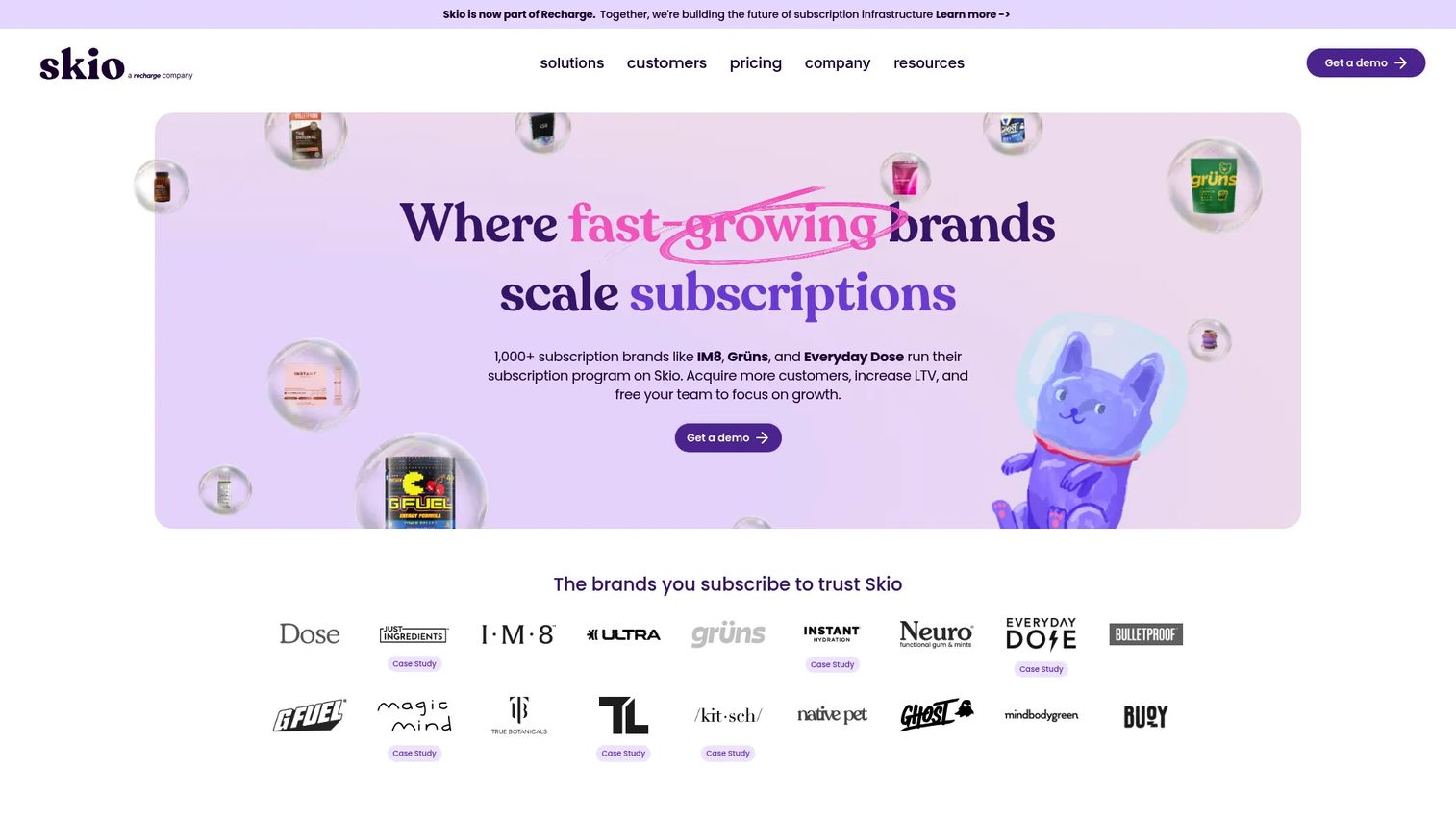
Skio is a Shopify subscription platform built for brands that treat retention as a core metric. It covers subscription management, a self-service customer portal, build-a-box, prepaid subscriptions, volume discounts, payment recovery, analytics, segmentation, SMS, and translations. The modern ecommerce flows make it a fit for brands that want pause, skip, and cancel controls that keep customers subscribed rather than churning.
Best for: Shopify subscription brands that prioritize retention and modern ecommerce subscription flows.
Key strengths
- Self-service customer portal: pause, skip, swap, and cancel controls designed to reduce churn, not just process it.
- Build-a-box and prepaid subscriptions: flexible recurring formats with volume discounts for higher order value.
- Analytics and lifecycle automation: segmentation, SMS, and payment recovery for failed payments and win-back.
Why choose Skio: It suits brands that want a retention-first subscription tool with migration support and modern flows. Skio's homepage notes it is now part of Recharge, which signals broader ecommerce subscription backing behind the product.
Skio pricing: The Scale plan is $499 per month billed annually, or $599 per month billed monthly, and includes subscription management, analytics, automation, and SMS. Enterprise is custom. Skio's G2 seller rating currently sits at 2.3/5, so weigh reviews carefully against your specific requirements.
8. Ordergroove
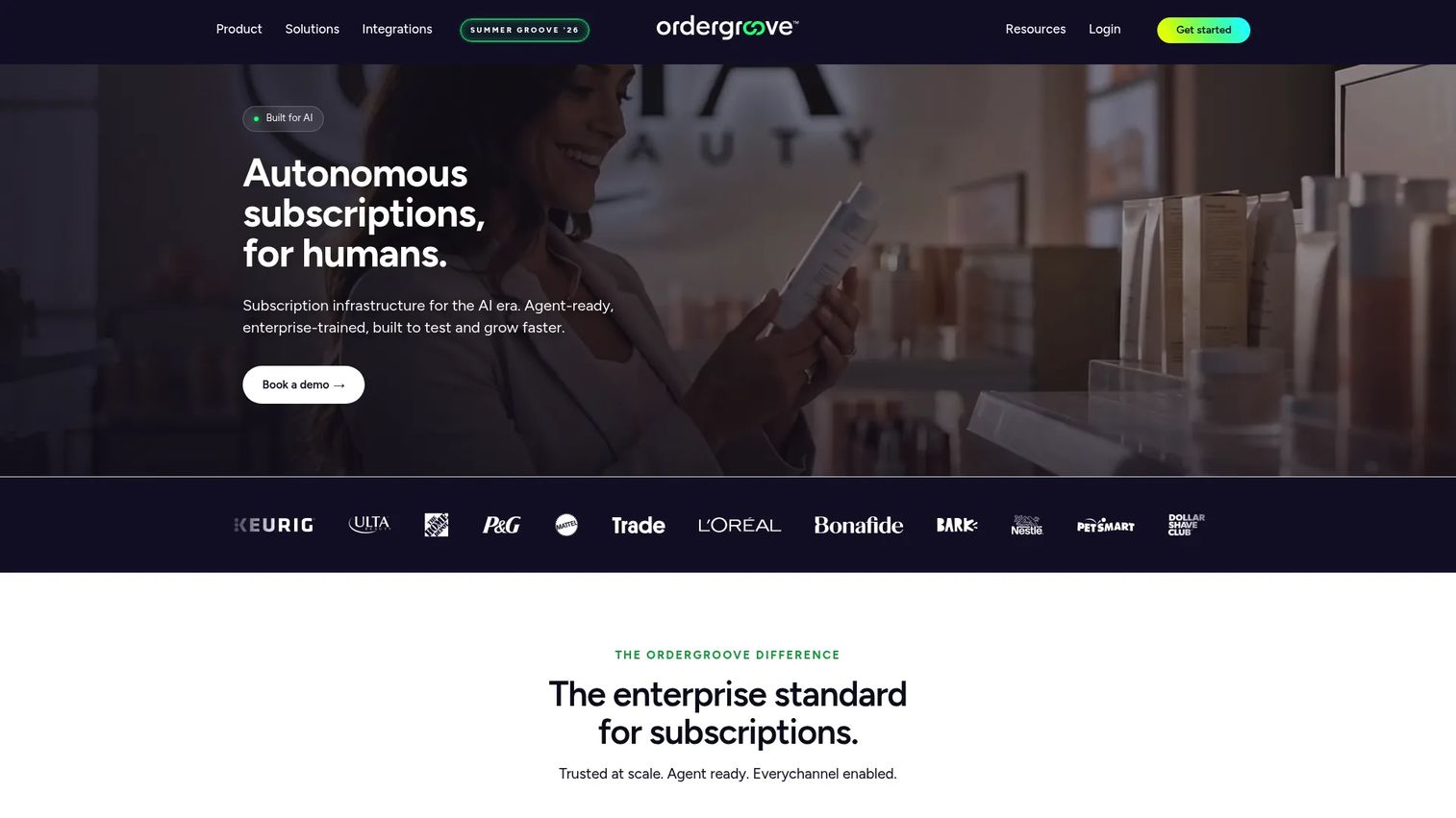
Ordergroove is an enterprise subscription and membership commerce platform for large brands running complex recurring revenue programs. It covers subscribe-and-save, bundles, clubs, memberships, and digital-access subscriptions, with native integrations into major commerce platforms and A/B testing for enrollment optimization. The customer autonomy features, like self-service management and churn-prevention logic, are built for higher-order complexity.
Best for: Established consumer brands running subscription, membership, and recurring revenue programs at scale.
Key strengths
- Subscription and membership management: subscribe-and-save, clubs, and memberships under one program.
- Native commerce integrations: connects to major commerce platforms without custom plumbing.
- A/B testing and enrollment optimization: tools to lift conversion into subscriptions and reduce churn over time.
Why choose Ordergroove: It is the strong fit when subscription complexity is the differentiator. Larger brands with multiple program types, high order volume, and dedicated retention goals get self-service controls and optimization tooling built for that scale rather than a startup-tier app.
Ordergroove pricing: Ordergroove does not publish public pricing; plans are quote-based and tailored to program scale and needs. Contact their team for a tailored estimate. Ordergroove carries a 4.5/5 rating on G2.
9. Zoho Billing
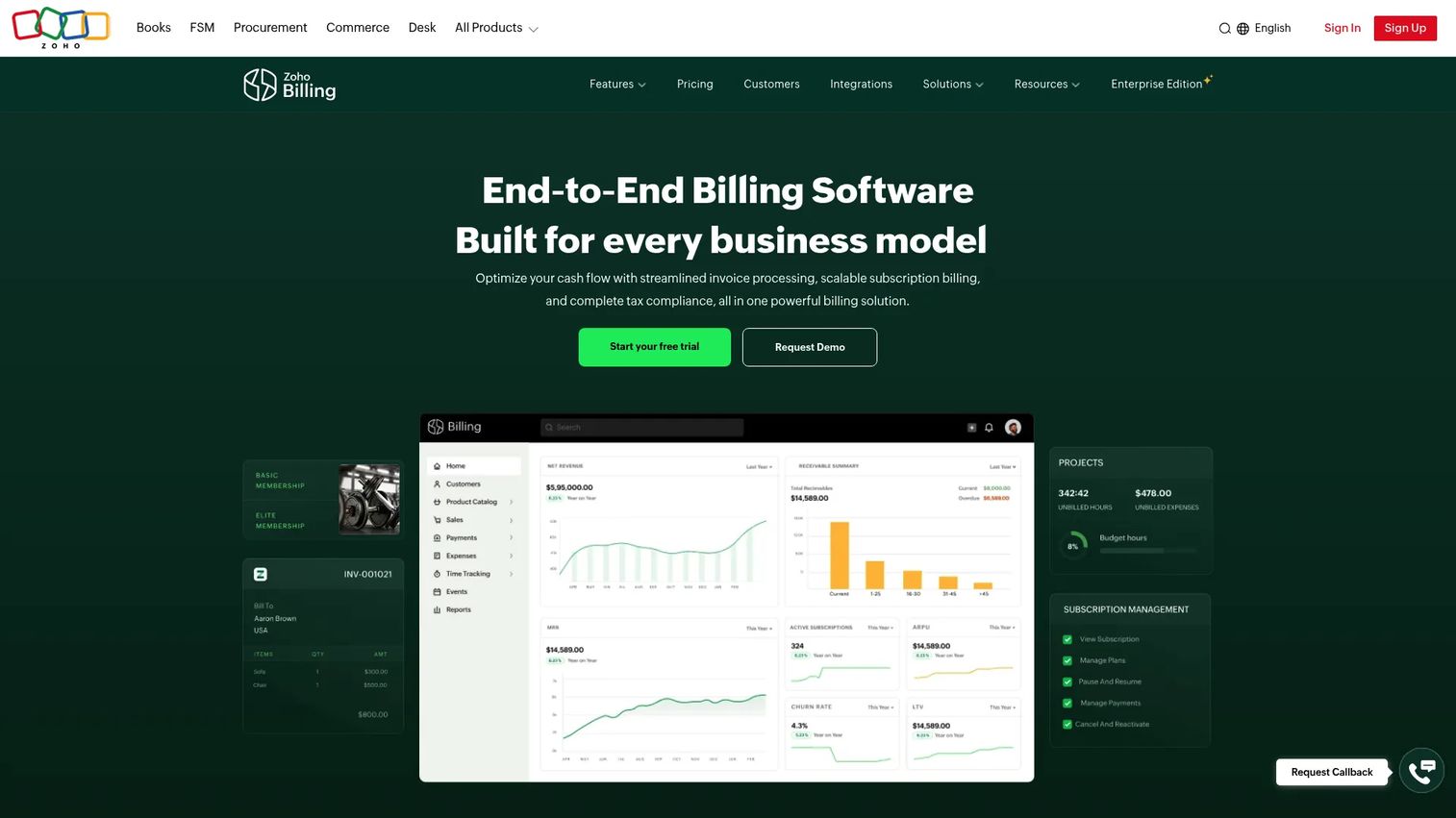
Zoho Billing is cloud billing software that combines recurring billing, invoicing, and payment collection in one tool. It handles consolidated billing, price lists, multi-subscription invoicing, proration, hosted payment pages, and dunning management, with multi-currency and tax-compliant billing for international teams. It fits naturally into the broader Zoho ecosystem for businesses already using those apps.
Best for: SMB and mid-market teams that want recurring billing plus invoicing, especially those already in the Zoho stack.
Key strengths
- Recurring invoicing and subscription billing: automated charges and consolidated billing across multiple subscriptions.
- Proration, hosted pages, and dunning: built-in dunning management and recovery on failed payments.
- Multi-currency and tax compliance: localized, compliant billing for businesses operating across regions.
Why choose Zoho Billing: It is a sensible pick for teams that want billing and invoicing without enterprise pricing, and a real advantage if you already run Zoho CRM or finance apps. The shared ecosystem keeps subscription data and the rest of your business stack connected.
Zoho Billing pricing: The Standard plan is $50 per organization per month, or $39 billed annually. Premium is $100 per organization per month, or $79 billed annually. An Enterprise Edition is available but not publicly priced, and a 14-day free trial is offered. Zoho Billing holds a 4.6/5 rating on G2.
10. Zenskar
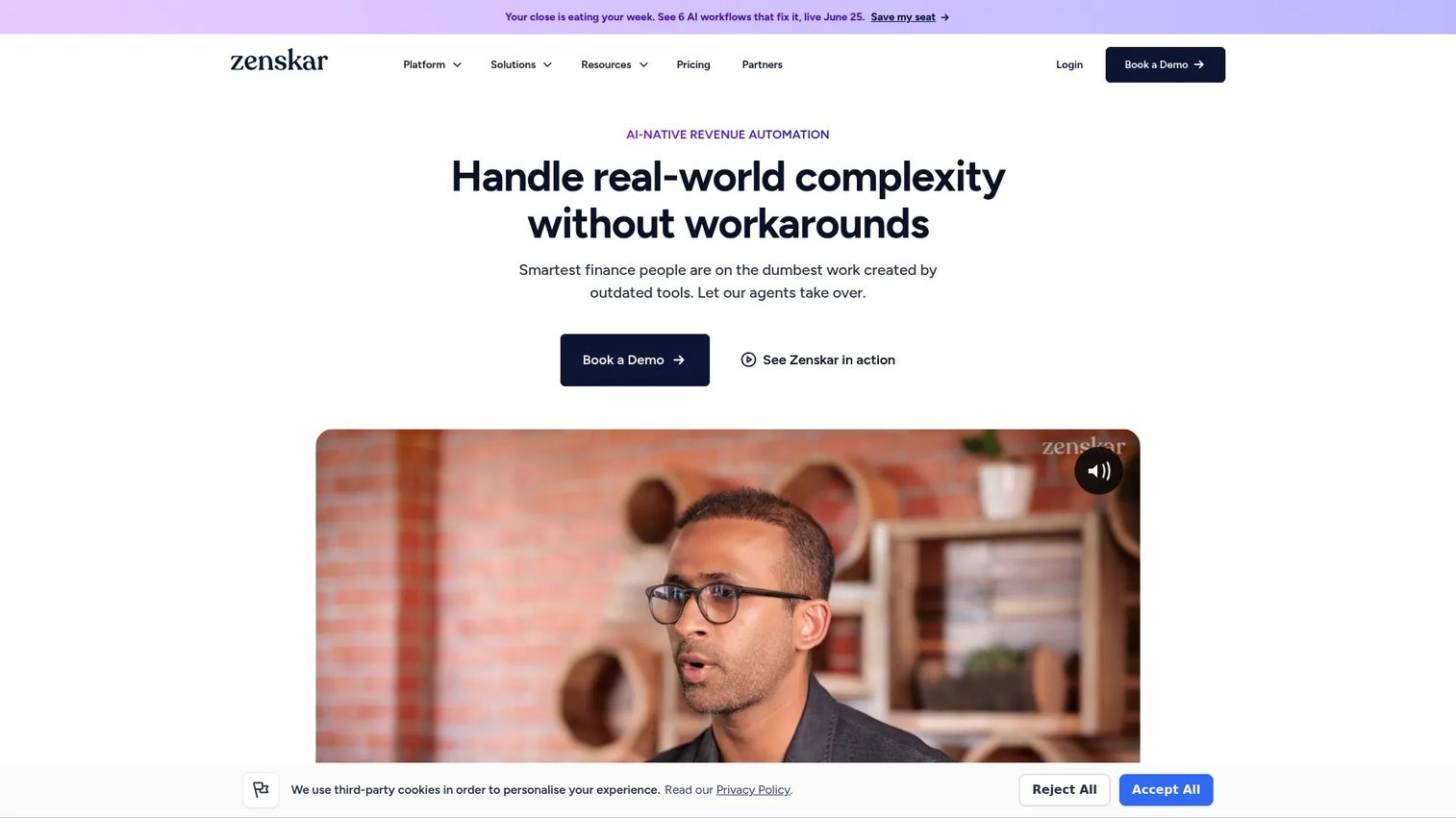
Zenskar is an AI-native revenue automation platform for finance teams wrestling with complex, nonstandard pricing. It handles billing for subscriptions, usage, hybrid pricing, and custom contracts, plus revenue recognition, journal entries, ERP and GL sync, and usage ingestion from more than 100 data sources. The positioning fits teams monetizing usage or AI products where standard subscription tools struggle.
Best for: Finance teams that need flexible order-to-cash automation for usage-based, hybrid, or AI-driven pricing models.
Key strengths
- Flexible billing automation: subscriptions, usage, hybrid, and custom contracts in one billing engine.
- Revenue recognition and ERP sync: journal entries and GL sync keep billing aligned with finance systems.
- Usage ingestion at scale: aggregates metered data from 100+ sources for accurate usage-based billing.
Why choose Zenskar: Pick it when your pricing logic is the hard part. Consumption-based and AI monetization models with complex contracts get a billing system built around that complexity, plus revenue recognition that connects directly to the GL.
Zenskar pricing: Pricing is quote-based across Starter, Standard, and Enterprise plans, with no public numeric price listed. Contact Zenskar for a tailored quote. Zenskar carries a strong 4.8/5 rating on G2.
11. Sage Intacct
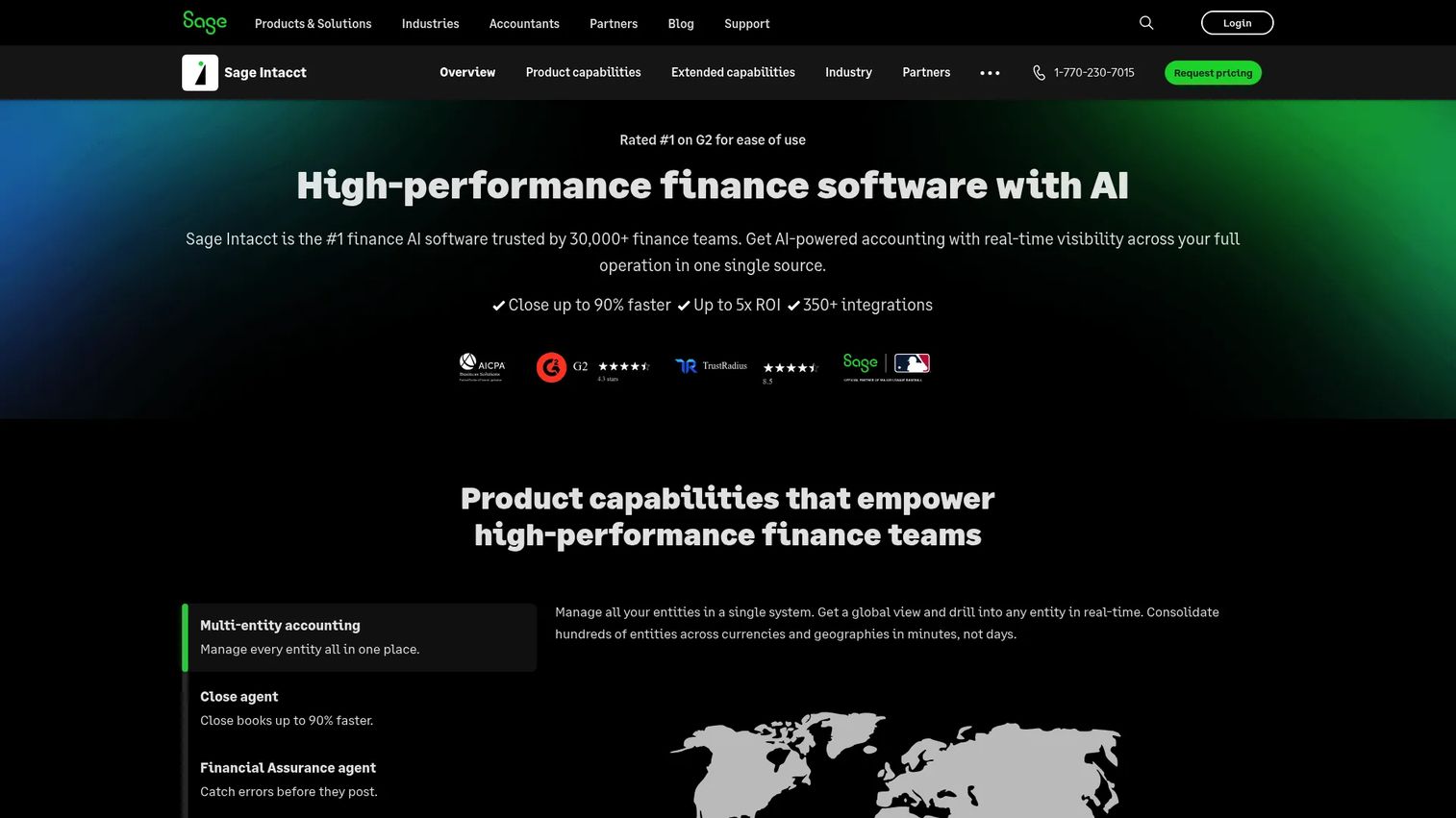
Sage Intacct is cloud financial management and ERP software for scaling and mid-sized businesses, with subscription management tied directly into accounting. It is most relevant where subscription billing needs to live inside broader financial operations: multi-entity accounting, global consolidations, dashboards, reporting, and Web Services APIs for integration. Revenue recognition and finance-grade reporting are the core strengths here.
Best for: Finance teams that need multi-entity accounting, strong reporting, and subscription management inside a broader ERP.
Key strengths
- Dashboards and reporting: finance-grade subscription analytics and revenue visibility in one place.
- Multi-entity insights and consolidations: global consolidations for businesses operating across entities.
- Web Services APIs and integrations: connects subscription billing to the rest of the finance and operations stack.
Why choose Sage Intacct: It is the right call when subscription management is inseparable from accounting. For finance-led organizations that want billing, revenue recognition, and reporting under one financial system, Sage Intacct keeps the books and the subscriptions in the same place.
Sage Intacct pricing: Sage does not publish public pricing. Plans are customized by modules, organization size, and needs, so you request a quote from sales. Sage Intacct holds a 4.3/5 rating on G2.
Considerations before you buy
Before committing to a subscription management system, work through these criteria against your actual business model rather than a feature wish list.
Business model fit
A Shopify subscription app and a B2B SaaS RevRec platform solve different problems. Match the tool to how you charge: ecommerce subscription software for physical goods and replenishment, SaaS-focused platforms for contracts and seats, finance-first ERP where accounting drives the decision. Buying the wrong category is the most expensive mistake here.
Pricing model flexibility
If you charge on usage, tiers, or hybrid models, confirm the platform handles usage-based billing and complex pricing natively. Tools built only for flat recurring plans force workarounds that break at scale. Check that plan changes, proration, and mid-cycle upgrades work without engineering involvement.
Lifecycle automation depth
Look past the charge to renewals, dunning on failed payments, self-service subscription changes, and revenue recovery. The platforms that reduce manual work are the ones that automate the whole lifecycle, not just the transaction. Renewal workflows and churn reduction logic are where recurring revenue holds together.
Integrations and reporting
Verify CRM integration, ERP integration, APIs, and webhooks against your specific stack, not a generic logo wall. MRR reporting and revenue visibility are only useful when the data flows to the teams that need it. Clean integrations are also what keep renewal motions and pricing consistent across sales, success, and finance, which is why this overlaps with how you evaluate your best account based marketing software tools and event management systems.
Conclusion
The best subscription management software is the one that matches your business model, not the one with the longest feature list. Recurly is the strongest pick for enterprise subscription operations that need billing, retention, and revenue recognition together. Maxio leads for B2B SaaS finance teams that want billing and RevRec in one system. Stripe Billing is the natural fit for developer-led teams already on Stripe. For ecommerce, Skio and Ordergroove serve retention-focused and enterprise Shopify brands, while Appstle Subscriptions and PayWhirl offer accessible entry points for startups. Zenskar and Sage Intacct anchor the finance-heavy and complex-pricing end.
Narrow by business model first, then by reporting and integration needs, and only then by feature depth. Get the category right and the rest of the evaluation gets much simpler. If your evaluation also touches adjacent systems, it is worth keeping your community management and ai customer service tooling in view, since subscription data rarely lives in isolation.
FAQs
Subscription management software automates the full lifecycle of recurring revenue: billing, renewals, plan changes, failed-payment recovery, and reporting. It replaces spreadsheets and basic payment tools with a system that handles dunning, self-service subscription changes, and MRR reporting in one place. The goal is to reduce manual work and revenue leakage as subscriptions scale.
Subscription billing software handles the narrow job of charging customers on a schedule and generating invoices. A subscription management system covers the wider lifecycle around that charge: renewals, upgrades and downgrades, dunning on failed payments, self-service changes, and revenue reporting. If you only need to collect recurring payments, billing software is enough; if you need to manage the relationship and recognize revenue, you want full subscription management.
Maxio is a strong fit for B2B SaaS finance and revenue teams because it combines billing, usage-based billing, and revenue recognition in one platform. Chargebee suits teams that need CPQ and complex monetization alongside billing. Recurly works well for larger SaaS businesses that want billing, churn mitigation, and RevRec together with global support.
Skio and Ordergroove serve Shopify and ecommerce brands focused on retention and larger membership programs respectively. Appstle Subscriptions offers a feature-rich Shopify app with a free tier, and PayWhirl provides a low-friction, free-to-install entry point. The right choice depends on program complexity and how much you prioritize retention flows versus a simple starting cost.
Prioritize recurring billing automation, renewal workflows, dunning and failed-payment recovery, self-service subscription changes, and MRR reporting. Confirm it handles your pricing model, including usage-based billing if relevant, and integrates with your CRM and ERP through APIs and webhooks. The platforms that reduce the most manual work automate the entire lifecycle, not just the charge.
They run automated dunning sequences that retry declined cards on a schedule, send reminders, and trigger recovery actions. Many integrate with card-updater services to refresh expired payment details automatically. Strong revenue recovery reduces involuntary churn, which is often a larger source of lost revenue than customers actively canceling.
Yes. Platforms like Stripe Billing, Maxio, Chargebee, and Zenskar support usage-based billing through metering and consumption tracking. They aggregate usage data, apply tiered or hybrid pricing, and bill accurately for what customers consume. If usage or hybrid pricing is central to your model, confirm the platform meters and bills it natively rather than through workarounds.
For most teams, yes. CRM integration keeps sales and success working from accurate subscription and renewal data, while ERP integration ties billing to accounting and revenue recognition. APIs and webhooks let you sync data across the stack so MRR reporting and revenue visibility stay consistent. Without these integrations, forecasting and reconciliation become manual projects.