You ran out of your best-selling SKU three days before a promotion. At the same time, a warehouse aisle is packed with product nobody is ordering. Both problems trace back to the same root cause: a spreadsheet trying to do a job it was never built for.
Manual planning holds up until SKU counts climb, channels multiply, and lead times start swinging. Then the cracks show. A planner updating reorder points by hand cannot keep pace with seasonality, supplier delays, and demand shifts across five warehouses. The result is predictable: missed sales on one side, trapped working capital on the other.
The market has noticed. The global inventory forecasting software market was valued at USD 2.1 billion in 2024 and is projected to reach USD 6.8 billion by 2033, a 16.2% CAGR from 2026 to 2033, according to a 2024 Inventory Forecasting Software Market Analysis published on LinkedIn. AI- and ML-enabled forecasting can reduce excess inventory by up to 25% through better forecast accuracy, per that same analysis.
That is the promise of modern inventory forecasting software: predict demand accurately enough that you order the right quantity at the right time. Stockout prevention on one end, overstock reduction on the other, and less cash tied up in the middle. For teams evaluating inventory planning software, the hard part is not the pitch. It is figuring out which tool fits your actual stack, your SKU complexity, and your replenishment workflow.
What's inside
This guide is for teams comparing inventory forecasting, planning, and inventory optimization software, whether you run an SMB, an ecommerce operation, or a complex enterprise supply chain. We looked past marketing claims and evaluated tools on the things that decide operational fit.
We chose these eight tools based on four criteria:
- Forecast accuracy and the modeling approach behind it
- System integrations across ERP, ecommerce, WMS, POS, and accounting
- Automation depth for replenishment and purchase order workflows
- Multi-location support for teams planning across warehouses or channels
Each entry includes who it fits, where it is strongest, and pricing where it is publicly available.
TL;DR
- Best overall for AI-driven planning: Netstock pairs demand forecasting with downstream inventory optimization and tight ERP integration.
- Best for SMBs: StockTrim delivers demand forecasting and working capital savings without heavy planning overhead.
- Best for ecommerce: Descartes ForecastMine and Inventory Planner both lead on ecommerce inventory forecasting and automated replenishment across channels.
- Best for complex enterprise planning: Relex handles enterprise-scale demand forecasting, replenishment, and store-level optimization.
- Best for deep analytical control: Lokad suits teams that want probabilistic forecasting and programmatic optimization.
- Best for mid-market replenishment cycles: EazyStock and GMDH Streamline both automate forecasting and replenishment planning for distributors and manufacturers.
What inventory forecasting software is
Inventory forecasting software predicts future demand at the SKU level so planning teams can decide how much to order and when, minimizing both stockouts and excess stock.
At its core, the software does one job well: it turns historical sales, seasonality, and demand signals into a forecast, then translates that forecast into concrete purchasing and replenishment decisions. That distinguishes it from generic inventory tracking, which tells you what you have now but not what you will need next quarter.
Most modern platforms bundle several capabilities:
- Demand forecasting: statistical and AI models that predict future sales by SKU, location, and channel, accounting for seasonality and trends.
- Replenishment planning: reorder points, order quantities, and safety stock calculations that keep stock at the right level.
- Inventory optimization: balancing service levels against carrying costs so you neither run dry nor overstock.
- Integration across systems: connectors into ERP, ecommerce platforms, POS, WMS, and accounting so forecasts run on live data.
- Forecast accuracy measurement: tracking how predictions perform against actuals so planners can trust the output.
Cloud-native SaaS deployments drive most new growth in this category, favored for scalability and remote access, per the 2024 LinkedIn market analysis. Retail and manufacturing together generate over 60% of global revenue, and North America holds roughly 40% of the market. The takeaway for a buyer: this is a mature category with well-differentiated tools, so operational fit matters more than novelty.
When to use inventory forecasting software
Reduce stockouts and overstock
If you are missing sales because popular SKUs run dry, while cash sits frozen in slow-movers, spreadsheets have hit their ceiling. The operational signal is usually a planner spending hours each week manually updating reorder points and still getting caught off guard by seasonal swings. Forecasting software applies consistent demand models across every SKU, so stockout prevention and overstock reduction stop depending on one person's memory.
Automate replenishment decisions
When planners want the system to suggest reorder quantities and timing rather than calculate them by hand, automated replenishment earns its keep. The stronger tools go further with purchase order automation, generating draft POs and routing them through approval workflows. That turns replenishment from a weekly firefight into a review-and-approve motion, which is exactly the kind of workflow automation a Product Manager wants: high leverage, low ongoing maintenance.
Coordinate across multiple systems
If your data lives in an ERP, an ecommerce platform, a WMS, an accounting tool, and a POS all at once, decisions get made on stale, fragmented numbers. A forecasting layer centralizes those signals so planning runs on one source of truth. ERP integration in particular matters here, because it keeps forecasts, orders, and stock levels synchronized instead of drifting apart across systems.
Comparison table
Here is a side-by-side view of the eight tools, sorted by relevance to teams evaluating inventory optimization software. Pricing and ratings reflect publicly available figures at the time of writing; several vendors use quote-based pricing.
| # | Product | Intent | Key use case | Pricing | G2 rating |
|---|---|---|---|---|---|
| 1 | Netstock | SMB demand planning + optimization | AI forecasting tied to an ERP | From $900/month | 4.6/5 |
| 2 | StockTrim | SMB demand forecasting | Multi-location forecasting and order planning | From $298/month (revenue-based) | 4.9/5 (Capterra) |
| 3 | Descartes ForecastMine | Ecommerce replenishment | Automated forecasting and PO management | Quote-based | 4.1/5 |
| 4 | Inventory Planner | Ecommerce planning | Replenishment and purchase order automation | Quote-based | 4.5/5 |
| 5 | EazyStock | Mid-market replenishment | ERP-connected optimization | Quote-based | 4.4/5 |
| 6 | GMDH Streamline | Analytical planning | Scenario and multi-location planning | Quote-based | 4.5/5 |
| 7 | Lokad | Advanced optimization | Probabilistic forecasting and decisions | From $150/month | 4.5/5 |
| 8 | Relex | Enterprise optimization | Unified demand, inventory, and pricing | Quote-based | 4.6/5 |
1. Netstock
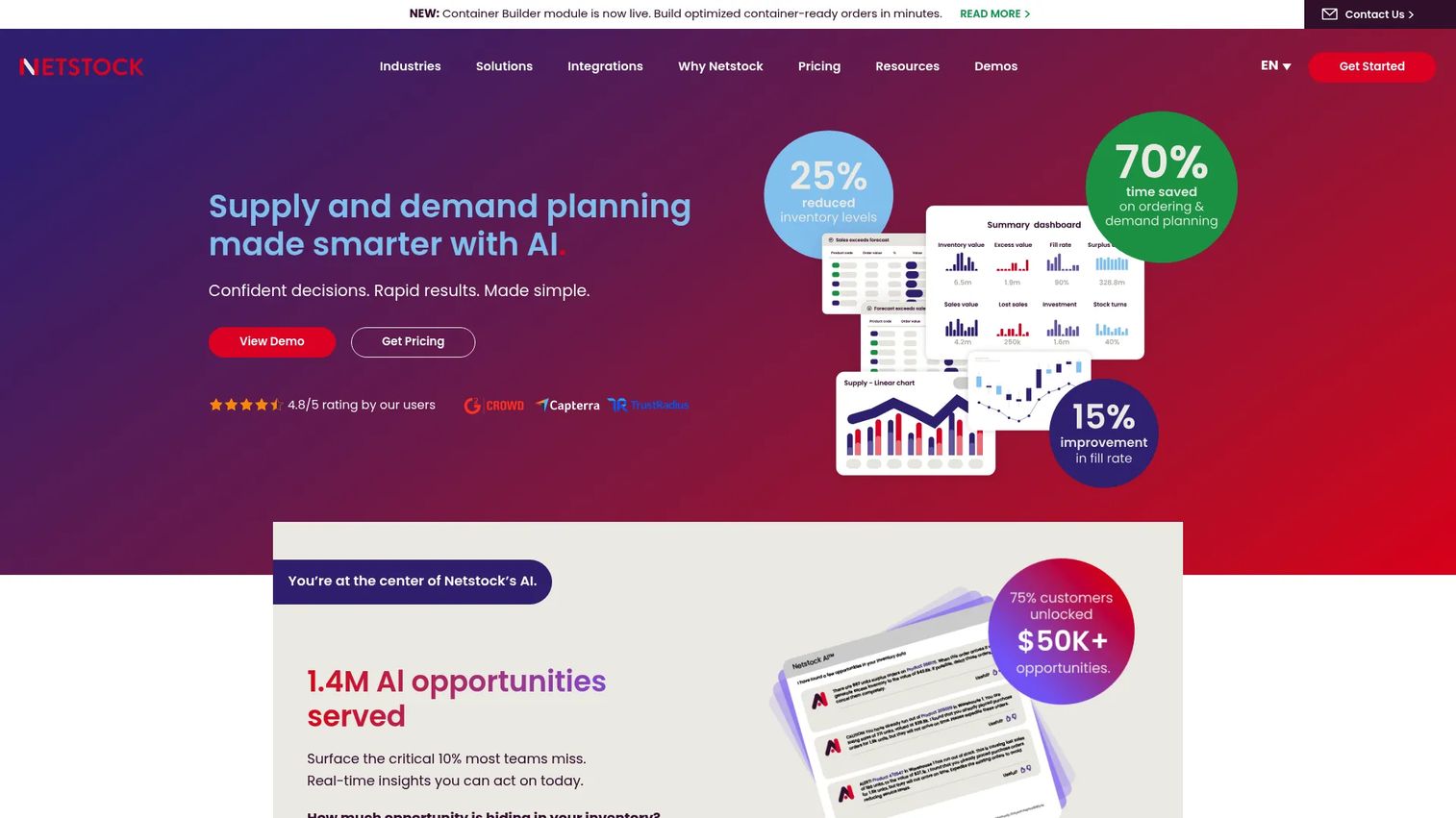
Netstock is AI-powered supply and demand planning software built for inventory optimization and forecasting. It sits on top of your ERP, pulls sales history and stock data, and turns it into demand forecasts, ordering recommendations, and inventory policies. For teams that want forecasting plus the downstream planning that acts on it, Netstock closes the loop rather than stopping at a prediction.
The platform layers AI features, including AI Pack and AI Opportunities, on top of its forecasting engine to surface where you are overstocked, understocked, or exposed to demand shifts. Visibility dashboards give planners a clear read on inventory health across locations, which matters when you are managing service levels against carrying costs.
Best for: SMBs that need AI-assisted inventory and demand planning tied directly to an ERP.
Key strengths
- Demand forecasting and ordering: Predicts demand by SKU and generates ordering recommendations planners can review and act on.
- Inventory optimization and visibility: Dashboards flag overstock and stockout risk so you can rebalance before it costs you.
- AI features: AI Pack and AI Opportunities surface where forecast accuracy and inventory policy can improve.
Why choose Netstock: If your business already runs an ERP and you want a forecasting layer that produces buffer stock logic and reorder recommendations without a heavy implementation, Netstock fits. It leans toward SMBs and mid-market teams that want the analytics without staffing a full supply chain planning function.
Netstock pricing: Netstock publishes a starting price of $900/month on its pricing page, with full bundle prices available by custom quote. Plans are structured around the product bundle you select, from Essentials and Advanced through specialist Demand Planner, Supply Planning, and Capacity Planner options, billed as annual subscriptions. There is no free tier.
2. StockTrim
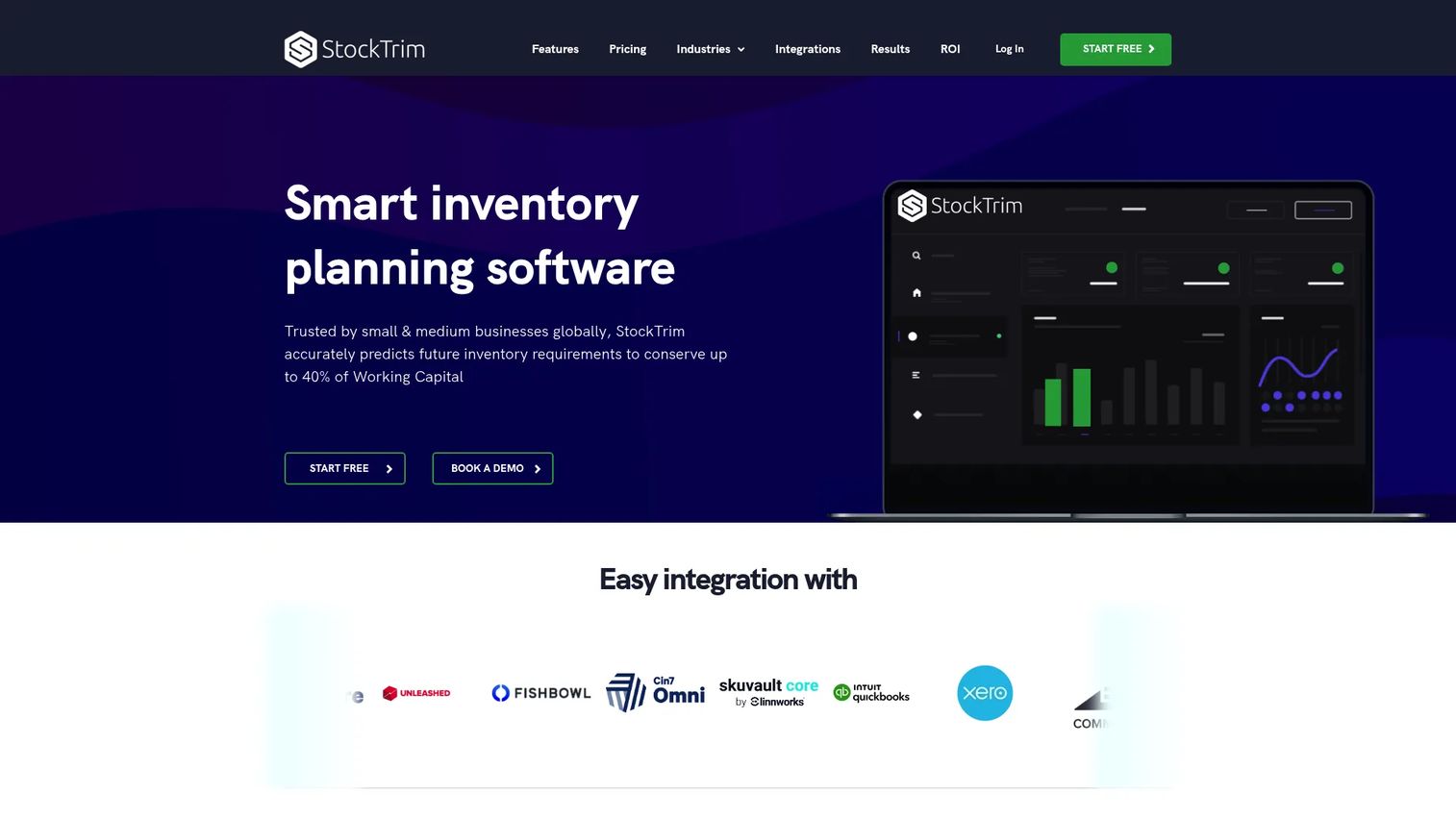
StockTrim is cloud-based inventory forecasting and planning software built for SMBs. It uses AI to forecast demand and generate intelligent order plans, which is especially useful for smaller operations that cannot dedicate a planner to the work. StockTrim's pitch centers on working capital: better forecasts mean less cash trapped in stock you do not need and fewer lost sales from stock you ran out of.
One standout is its handling of new products, which are notoriously hard to forecast without sales history. StockTrim also supports multi-location inventory planning, so teams selling across channels or warehouses can plan from one place. For systems without a native connector, an API fallback keeps data flowing.
Best for: SMBs that need demand forecasting and inventory planning across multiple sales channels or locations.
Key strengths
- AI inventory forecasting: Predicts demand including for new products with limited sales history.
- Intelligent order planning: Generates order recommendations that protect working capital.
- Multi-location planning: Plans stock across channels and warehouses from a single view.
Why choose StockTrim: For SMB and ecommerce operations that want forecasting without the overhead of a full sales and operations planning suite, StockTrim keeps things practical. The appeal is operational simplicity: get accurate forecasts and order plans without a long deployment.
StockTrim pricing: StockTrim uses transparent, revenue-based pricing with monthly and annual billing. The annual plan starts around $298/month for businesses in the $3M to $5M revenue band. A Raw Materials Forecasting and Multi-Level BOMs add-on runs an extra $90/month. A 14-day free trial is available, and onboarding carries a $299 fee.
3. Descartes ForecastMine
Descartes ForecastMine is AI-driven demand forecasting and inventory planning software aimed at ecommerce brands. It automates the forecasting and replenishment work that gets unmanageable once you are selling high volume across multiple channels and marketplaces. For ecommerce teams juggling channel complexity, ForecastMine keeps stock decisions coordinated.
The platform combines AI-driven demand forecasting with automated replenishment and purchase order management, so reorder timing and quantities flow through with less manual intervention. Multi-location inventory planning gives brands with several fulfillment points a unified view of stock health across the network.
Best for: High-volume ecommerce teams that want automated demand forecasting and replenishment planning.
Key strengths
- AI-driven demand forecasting: Predicts demand across channels using machine learning.
- Automated replenishment and PO management: Generates reorder recommendations and manages purchase orders.
- Multi-location inventory planning: Coordinates stock across fulfillment points and marketplaces.
Why choose Descartes ForecastMine: ForecastMine is strongest operationally where ecommerce channel complexity meets replenishment automation. If you sell across your own store, marketplaces, and multiple warehouses, the platform's integration story across ecommerce platforms, WMS, ERP, and marketplaces keeps everything in sync.
Descartes ForecastMine pricing: Descartes does not publish public pricing on its site and directs prospects to request a demo. The company notes that pricing varies by SKU count, order volume, supplier complexity, integrations, and forecasting needs, so expect a scoped quote rather than a flat rate.
4. Inventory Planner
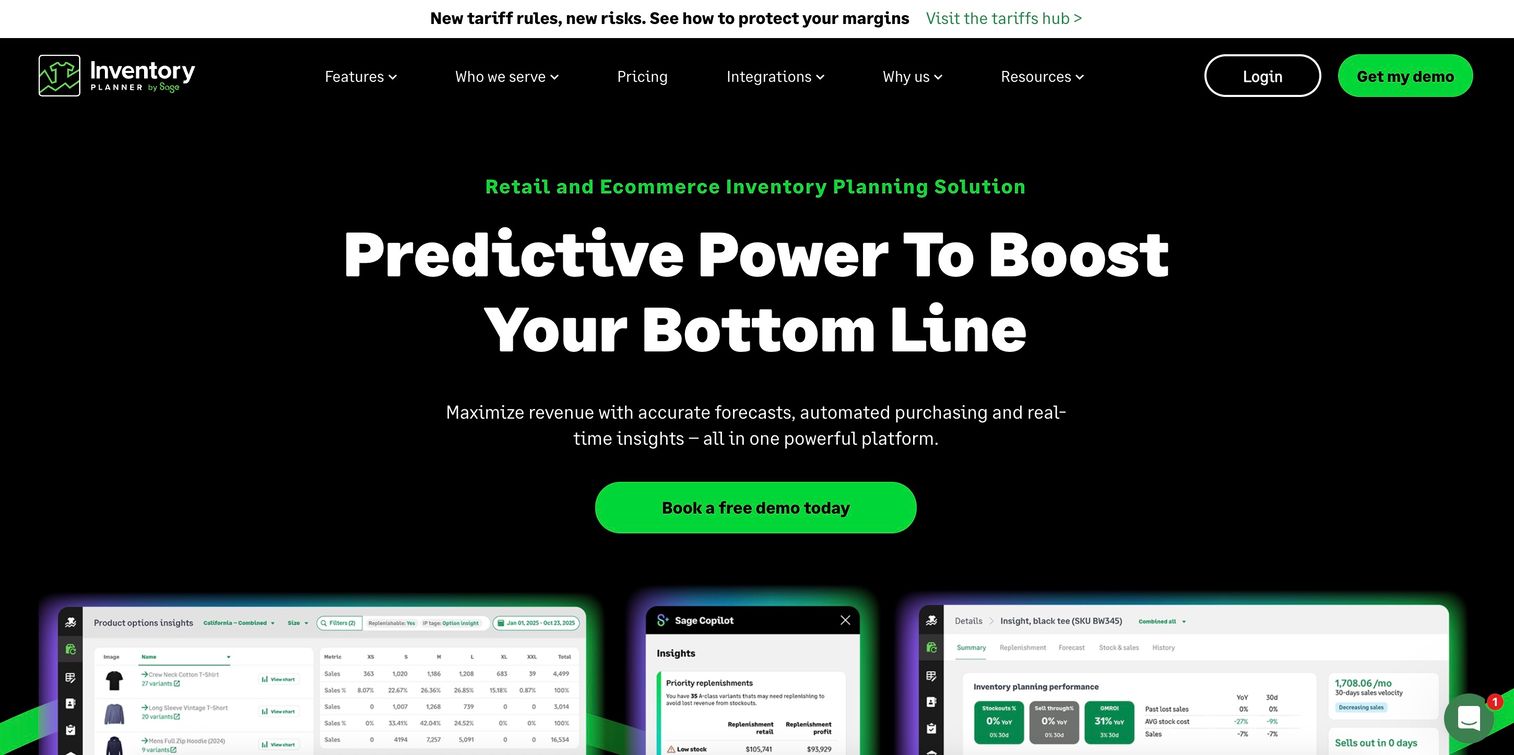
Inventory Planner is inventory planning software for forecasting demand, automating replenishment, and improving purchasing decisions. It is ecommerce-first and popular with merchants running high SKU counts who need replenishment recommendations they can trust. In a modern retail stack, it slots in as the planning layer that turns raw sales data into concrete buy decisions.
The tool leans on plug-and-play integrations to connect with the platforms merchants already use, then generates automated purchase orders and multi-location plans. That makes it directly useful for buyers who want to move from forecast to purchase order without exporting data into a spreadsheet first.
Best for: Retailers, ecommerce brands, wholesalers, and manufacturers needing demand forecasting and replenishment planning.
Key strengths
- Multi-location planning: Forecasts and plans stock across warehouses and channels.
- Plug-and-play integrations: Connects quickly to common ecommerce and ERP platforms.
- Automated purchase order creation: Turns forecasts into ready-to-review purchase orders.
Why choose Inventory Planner: For merchants who want planning that maps directly to purchasing, Inventory Planner keeps the workflow tight. The direct usefulness of automated PO creation is the draw, especially for brands whose SKU counts have outgrown manual reordering.
Inventory Planner pricing: Inventory Planner does not display public numeric pricing and uses a request-a-quote flow, though the company says pricing is provided upfront during that conversation. Expect a quote scoped to your catalog size and integration needs.
5. EazyStock
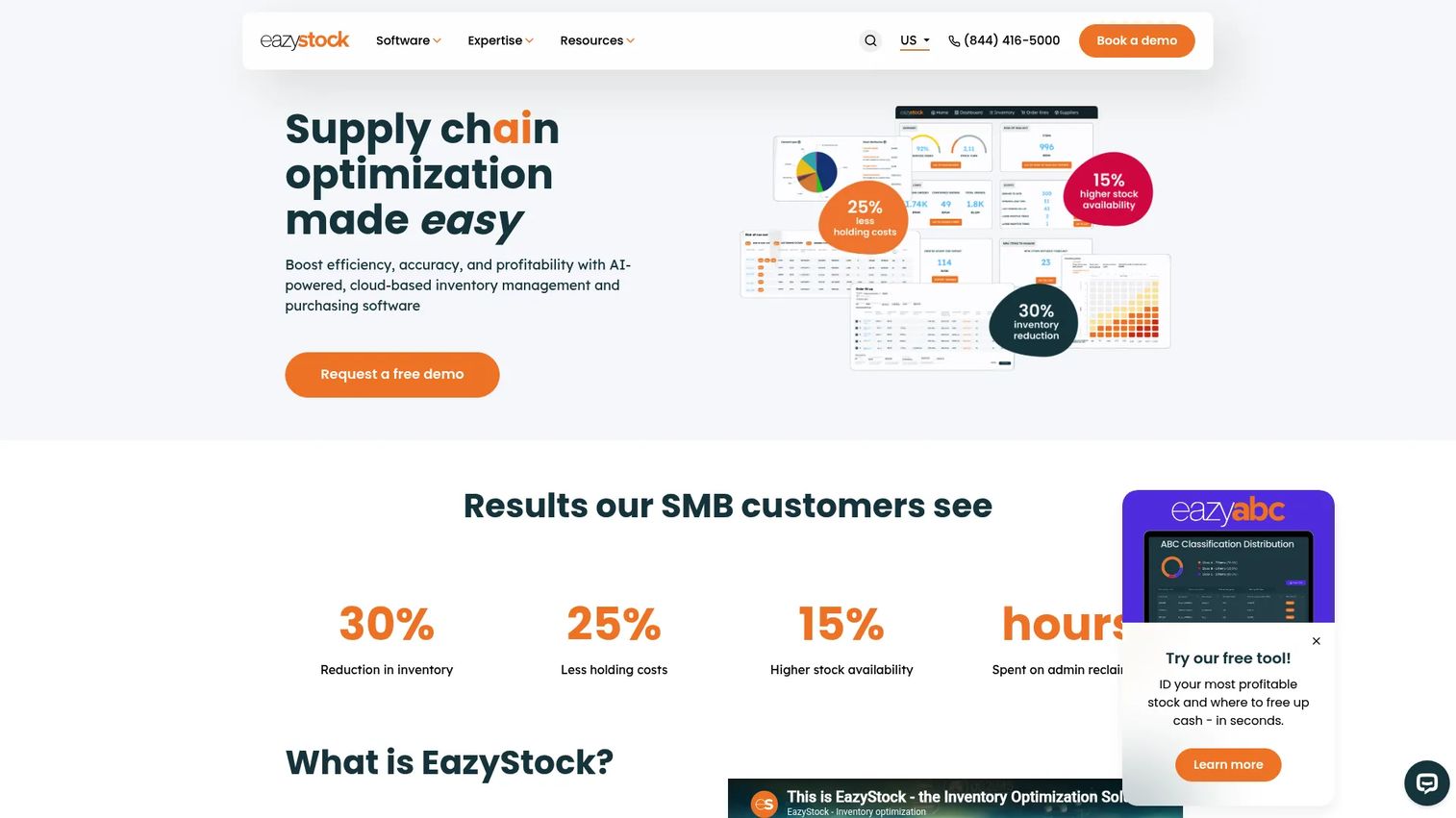
EazyStock is AI-powered cloud inventory optimization software for SMBs. It automates demand forecasting and replenishment, then calculates the reorder points, order quantities, and safety stock levels that keep inventory balanced. For distributors and businesses with recurring replenishment cycles, that automation removes a lot of repetitive manual planning.
EazyStock connects to your ERP through ready-made connectors, so it enriches your existing system rather than replacing it. Its machine-learning forecasting adapts to demand patterns and lead time variability, and reporting gives planners visibility into the decisions the system is making.
Best for: Stock-holding SMBs that need automated inventory planning and replenishment.
Key strengths
- ERP integration: Ready-made connectors sync data with your existing ERP.
- ML demand forecasting: Machine-learning models predict demand and adjust to changing patterns.
- Inventory optimization: Calculates reorder points, order quantities, and safety stock automatically.
Why choose EazyStock: EazyStock fits mid-market and SMB planning teams that run an ERP and want an optimization layer on top of it. Before buying, verify that your specific ERP is supported and confirm how the connector handles your data volume, since integration depth is what makes or breaks this kind of add-on.
EazyStock pricing: EazyStock uses quote-based pricing generated from a standard price list, and requires a free quote to get a figure. No public starting price is listed, so pricing will depend on your catalog and integration scope.
6. GMDH Streamline
GMDH Streamline is supply chain planning software focused on forecasting, scenario planning, and multi-location coordination. It suits teams that need to balance operational complexity against planning accuracy, giving planners room to model different demand scenarios before committing to a plan. For businesses coordinating stock across several sites, that scenario flexibility is the differentiator.
Streamline supports demand planning workflows and integrations into common ERP and ecommerce systems, so it can run on live data. The emphasis on analytical planning makes it a fit for teams that want more than a single automated recommendation, they want to test assumptions.
Best for: Planning teams that need scenario modeling and multi-location coordination alongside accurate forecasting.
Key strengths
- Scenario planning: Model multiple demand scenarios before committing to a plan.
- Multi-location coordination: Plan and forecast across several warehouses or sites.
- Demand planning workflows: Structured planning that runs on integrated, live data.
Why choose GMDH Streamline: Streamline earns its place for analytical planning use cases where a single black-box recommendation is not enough. Teams that want to interrogate the forecast and test scenarios get that control here.
GMDH Streamline pricing: GMDH does not publish standardized public pricing on an accessible pricing page, so plan to contact the vendor for a scoped quote. Confirm current pricing and included modules directly before you commit.
7. Lokad
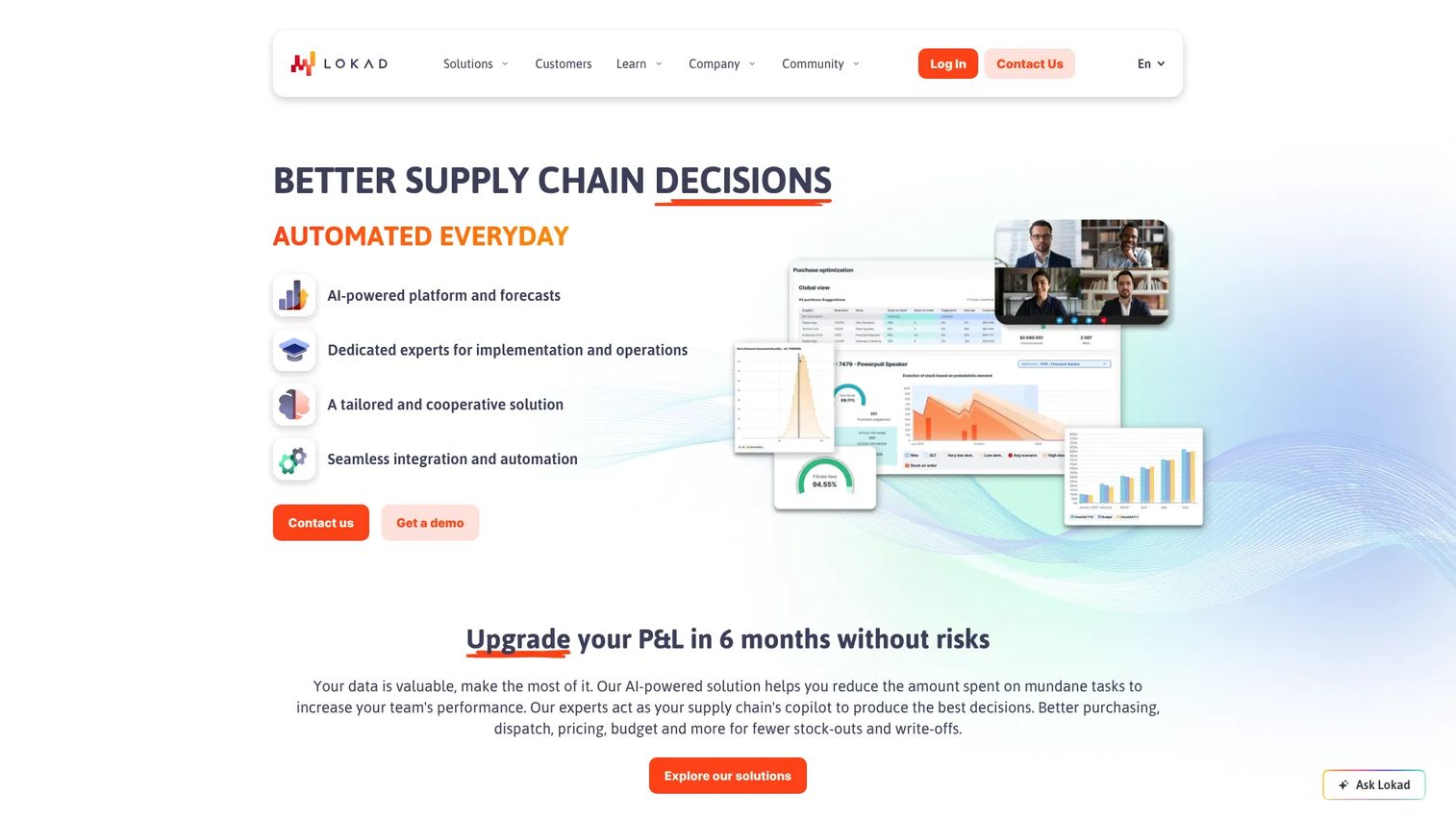
Lokad is a supply chain optimization SaaS that uses probabilistic forecasting and optimization to improve inventory, pricing, and replenishment decisions. It is built for teams that want deep analytical control rather than a fixed set of recommendations. Its Envision DSL, a programmatic layer, lets analysts express custom supply chain logic, which is powerful for organizations with the analytics maturity to use it.
Where most tools give you a forecast, Lokad gives you probabilistic forecasts that quantify uncertainty, then optimizes decisions against it. That approach is more technical than typical SMB tools, which matters because it rewards teams with data and analytics skills while asking more of them upfront.
Best for: Mid-market to enterprise teams optimizing supply chain decisions across inventory, pricing, and replenishment.
Key strengths
- Probabilistic forecasting: Quantifies demand uncertainty rather than producing a single-number forecast.
- Supply chain decision optimization: Optimizes inventory, pricing, and replenishment decisions together.
- Envision DSL platform: A programmatic SaaS layer for expressing custom supply chain logic.
Why choose Lokad: Choose Lokad when your team has the analytical depth to exploit probabilistic modeling and wants control over the logic behind every decision. The tradeoff is that this fits organizations with stronger analytics maturity, not teams looking for plug-and-play simplicity.
Lokad pricing: Lokad's FAQ indicates it typically charges a fixed monthly fee by module and scope, and does not usually charge per user. G2 lists an Express free tier that does not expire and a Basic tier at $150/month, though the company notes starting prices for a distinct supply chain decision typically run into the low thousands of EUR or USD. Confirm scope-based pricing with Lokad directly.
8. Relex
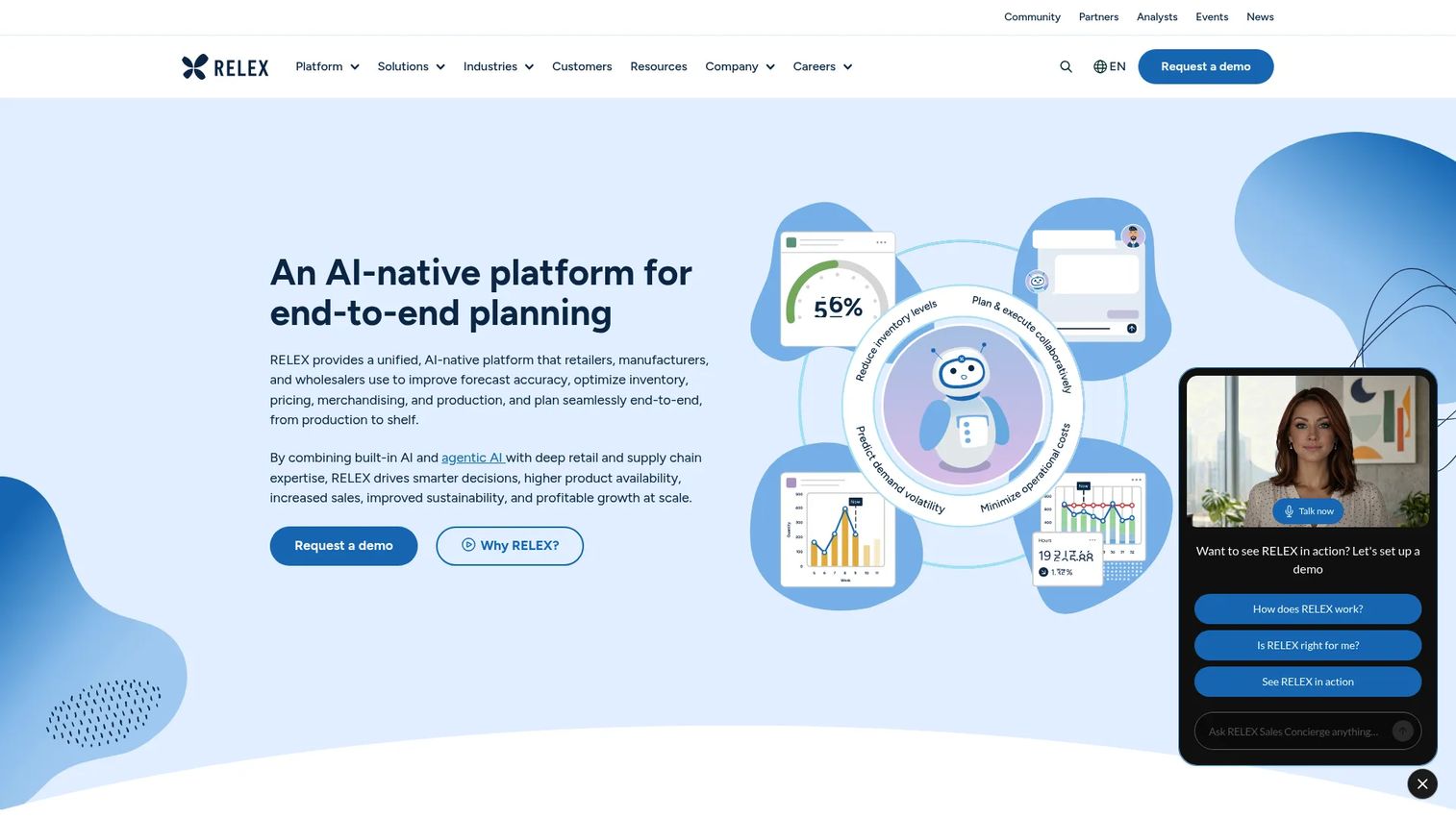
Relex is AI-native supply chain and retail planning software for retailers, manufacturers, and wholesalers. It handles enterprise-scale demand forecasting, replenishment, and store-level or location-level planning, which is why it fits large retailers and complex supply chains. When you are planning across hundreds of stores and thousands of SKUs, Relex is built for that scale.
The platform unifies demand planning and demand sensing, inventory and replenishment optimization, and pricing and promotions optimization in one system. That breadth gives large operations visibility and automation across planning layers that would otherwise live in separate tools.
Best for: Large retailers and supply chain organizations needing unified planning across demand, inventory, pricing, and merchandising.
Key strengths
- Demand planning and demand sensing: Forecasts at scale and senses near-term demand shifts.
- Inventory and replenishment optimization: Optimizes stock and automates replenishment across locations.
- Pricing and promotions optimization: Aligns pricing and promotions with inventory planning.
Why choose Relex: Relex is the choice for large, complex retail operations that need one platform spanning demand, inventory, pricing, and merchandising. The scale and breadth are the point, so it fits organizations with the volume and complexity to justify an enterprise deployment.
Relex pricing: Relex does not publish public pricing and directs prospects to request a demo. Given the enterprise scope, expect a custom quote scoped to your store count, SKU volume, and planning requirements.
Considerations before you buy
Shortlisting is easier when you evaluate against the operational realities that decide whether a tool sticks. Here is a buyer's checklist for a Product Manager or planning lead.
Data quality and forecast accuracy
A forecast is only as good as the data feeding it. Confirm how the tool handles messy sales history, promotions, and lead time variability, and ask how it measures forecast accuracy against actuals. If you cannot see whether the forecast is improving, you cannot trust the reorder recommendations built on it.
Integration depth
Native ERP integration, ecommerce connectors, WMS, POS, and accounting sync are what keep forecasts running on live data. Verify that your specific systems are supported, not just the category. A connector that syncs daily behaves very differently from one that syncs in near real time.
Automation and workflow fit
Look at how far automation goes. Does the tool only suggest reorder points, or does it handle purchase order automation and approval routing? The more of the replenishment workflow it covers, the less ongoing manual work your team carries, which is the whole point of adopting it.
Multi-location and scale
If you plan across warehouses, channels, or stores, confirm the tool supports multi-location inventory planning at your scale. A tool that shines with one location can struggle across ten. Match the platform's ceiling to your growth trajectory, not just today's footprint.
Maintenance burden
Every tool adds operational overhead. Ask what breaks when your catalog changes, how updates are handled, and how much planner time the system needs weekly. A low-maintenance tool that runs reliably beats a powerful one nobody has time to feed.
Conclusion
The right pick depends on your business shape, not a generic ranking. For SMBs that run an ERP and want AI-assisted forecasting plus optimization, Netstock is a strong overall choice. Smaller operations focused on working capital and simplicity should look at StockTrim. Ecommerce brands with channel complexity are well served by Descartes ForecastMine and Inventory Planner, while distributors and mid-market teams with recurring replenishment cycles fit EazyStock and GMDH Streamline. Teams with real analytics maturity get the most from Lokad, and large, complex retailers should evaluate Relex.
The practical next step: pick two or three tools that match your business type, then validate the three things that decide operational fit. Confirm the integrations against your actual stack, test the reporting and forecast accuracy on your own data, and walk through the replenishment workflow end to end. Marketing claims are cheap. A tool that syncs cleanly with your ERP and produces reorder recommendations you trust is what actually reduces stockouts and frees up working capital.
FAQs
Inventory forecasting software predicts future demand at the SKU level so planning teams can decide how much to order and when. It turns sales history, seasonality, and demand signals into forecasts, then translates those forecasts into reorder points, order quantities, and purchase orders. The goal is to prevent stockouts and reduce overstock at the same time.
They overlap but are not identical. Forecasting predicts future demand, while inventory planning software turns that prediction into replenishment and purchasing decisions like reorder points, safety stock, and purchase orders. Most modern inventory forecasting tools do both, so the distinction matters mainly when a tool stops at the forecast without automating the actions that follow.
For ecommerce inventory forecasting, Descartes ForecastMine and Inventory Planner are strong options, since both are built around ecommerce channels, marketplaces, and automated replenishment. The right fit depends on your stack and scale: high-volume brands with multiple fulfillment points benefit from strong multi-location planning and platform integrations. Test each against your own store, marketplace, and warehouse setup before committing.
ERP integration is usually the most important, because it keeps forecasts, orders, and stock levels synchronized. Beyond that, ecommerce platform connectors, WMS, POS, accounting, and marketplace integrations all matter depending on where your data lives. Confirm your specific systems are supported and check how frequently the connector syncs, since stale data undermines even the best forecast.
Yes. Better demand prediction and reorder timing directly lower the chance of running out of stock before you can replenish. By modeling seasonality, lead time variability, and demand trends consistently across every SKU, the software flags reorder needs earlier than manual planning would. AI- and ML-enabled tools can also reduce excess inventory by up to 25%, per a 2024 LinkedIn market analysis, addressing overstock at the same time.
AI improves forecasting by detecting patterns humans and simple statistical models miss, including seasonal trends, anomalies, and multi-factor demand signals. It can automatically select or blend models per SKU, adapt to changing demand, and quantify uncertainty rather than producing a single number. That translates into more reliable reorder recommendations and better inventory optimization across a large catalog.
Focus on five things: data quality and how the tool handles messy history, integration depth against your actual stack, automation coverage across replenishment and purchase order workflows, measurable forecast accuracy you can track over time, and the ongoing maintenance burden. A tool that scores well on paper but needs constant manual feeding creates operational overhead that erodes its value. Validate all five on your own data before you commit.