Most compliance programs still run on spreadsheets, shared drives, and a Slack thread nobody can find at 4 p.m. before an audit. It works right up until it doesn't. When an auditor asks for a signed procedure, its revision history, and proof that everyone was trained on it, the gap between "we do this" and "we can show we do this" becomes expensive fast.
That gap is getting harder to defend. The global compliance software market is projected to grow from $40.82 billion in 2026 to $74.12 billion by 2031, a 12.67% CAGR, according to Mordor Intelligence (2024). Cloud deployment already accounts for roughly 69% of compliance software usage. Teams are moving off manual tracking because the cost of a missed control, a stale document, or a scramble before recertification keeps climbing.
The shift that matters most: certification is a moment, but continuous compliance is a state. A one-time audit sprint gets you the badge. Staying audit-ready between audits, without a fire drill every quarter, is what separates a mature program from a stressful one. Good iso compliance management software collapses that distance by keeping documents controlled, evidence current, and ownership visible in one place.
This guide breaks down seven platforms worth your shortlist. If your evaluation touches adjacent territory, it's worth skimming a roundup of audit management software and AI security posture management tools alongside this one, since ISO programs rarely live in isolation.
What's inside
This guide is for teams comparing iso compliance software tools with a real decision on the calendar, whether you own certification directly or sit adjacent to it as a product, security, or operations lead. We focused on platforms that centralize the work: iso document control software, evidence workflows, audit trails, and reporting that holds up under scrutiny.
We chose tools based on four criteria: breadth of standards support, how much manual effort remains after setup, quality of audit readiness and reporting, and how cleanly the platform fits into an existing stack. Pricing and G2 ratings reflect verified sources at drafting time. Where a vendor keeps pricing behind a sales conversation, we say so rather than guess.
TL;DR
- Best for a full cloud eQMS: Qualio, built for life sciences quality and compliance in one system.
- Best for continuous ISO 27001 monitoring: Vanta, automation-heavy with strong evidence collection.
- Best for multi-standard operational teams: SafetyCulture, mobile-first inspections and broad workflow coverage.
- Best for enterprise quality depth: ETQ Reliance, with configurable CAPA, risk, and supplier workflows.
- Best for regulated document-heavy programs: MasterControl, built around controlled documents and training.
- Best for fast security audit readiness: Secureframe, streamlined monitoring and remediation.
What is ISO compliance software?
ISO compliance software is a system that helps organizations document, manage, and prove adherence to ISO standards by centralizing controls, records, evidence, and audit activity in one platform. Instead of tracking policies in folders and progress in spreadsheets, teams manage the entire compliance lifecycle in a purpose-built compliance platform.
The core difference from manual tracking is provability. A shared drive stores documents. Iso management software stores documents plus who approved them, when, which version was active during an audit period, who was trained on it, and what corrective action followed a nonconformity. That connected record is what auditors actually test.
Core capabilities most platforms share:
- Document control: version history, approval workflows, controlled distribution, and expiration reminders.
- Evidence collection: automated or structured capture of proof that controls are operating.
- Audit trail: an immutable log of who changed what and when.
- CAPA: corrective and preventive action workflows tied to findings.
- Risk register: documented risks, treatments, and owners.
- Reporting and dashboards: live visibility into gaps, ownership, and readiness.
Two distinctions matter when comparing platforms. First, continuous compliance beats periodic scramble: monitoring controls year-round means recertification is a review, not a rebuild. Second, integrated management system software lets one platform cover several standards at once, so ISO 9001, 14001, 45001, and 27001 share documents, audits, and evidence instead of running as separate programs.
When to use ISO compliance software
Prepare for a first ISO certification
The clearest trigger is moving from spreadsheets to a structured system ahead of a first audit. When a team is chasing its first ISO 9001 or ISO 27001 certificate, the manual approach hides gaps until it's too late. Compliance software surfaces missing controls early through gap analysis, then keeps the resulting documents controlled so audit readiness is a byproduct of daily work rather than a last-minute project.
Manage multiple standards in one place
Teams running more than one standard feel the pain of duplication fast. The same document control policy, the same internal audit schedule, the same corrective-action process gets rebuilt per standard. An integrated management system lets ISO 9001, 14001, 45001, and 27001 share a single evidence base and audit calendar, which cuts overhead and keeps requirements from drifting apart across programs.
Reduce manual evidence chasing
When evidence lives across a dozen tools and compliance depends on someone pinging owners for screenshots, the work never really ends. This is the strongest case for automation. Platforms that connect to the systems where evidence already lives collect proof continuously, so the team stops reconstructing the same records every audit cycle and starts trusting that the state of compliance is always current.
Comparison table
Here's a fast read on the seven iso compliance software tools in this guide. Pricing reflects what each vendor discloses publicly; several use quote-based models, which we've noted rather than estimated. G2 ratings are current at drafting time.
| # | Product | Intent | Key differentiation | Pricing | G2 rating |
|---|---|---|---|---|---|
| 1 | Qualio | Cloud eQMS for life sciences | Connected quality records, document control, and audit readiness in one system | Quote-based (Foundation, Growth, Scale) | 4.4/5 |
| 2 | SafetyCulture | Operational, mobile-first compliance | Inspections, actions, and multi-standard workflows on any device | Free; Premium $24/user/mo billed annually; Enterprise custom | 4.6/5 |
| 3 | CORE Compliance Platform | Compliance and EHS support | Consulting-led compliance, safety training, and environmental services | Not publicly listed | Not listed |
| 4 | Vanta | Continuous ISO 27001 automation | Automated evidence collection and continuous controls monitoring | Quote-based (Essentials, Plus, Professional, Enterprise) | 4.6/5 |
| 5 | ETQ Reliance | Enterprise quality management | Configurable CAPA, risk, supplier quality, and audit workflows | Quote-based | 4.3/5 |
| 6 | MasterControl Quality Excellence | Regulated QMS | Document control and training for regulated life sciences | Quote-based, named-user license | 4.3/5 |
| 7 | Secureframe | Fast security audit readiness | Automated tests, continuous monitoring, and trust center | Quote-based (Fundamentals, Complete, Defense) | 4.7/5 |
1. Qualio
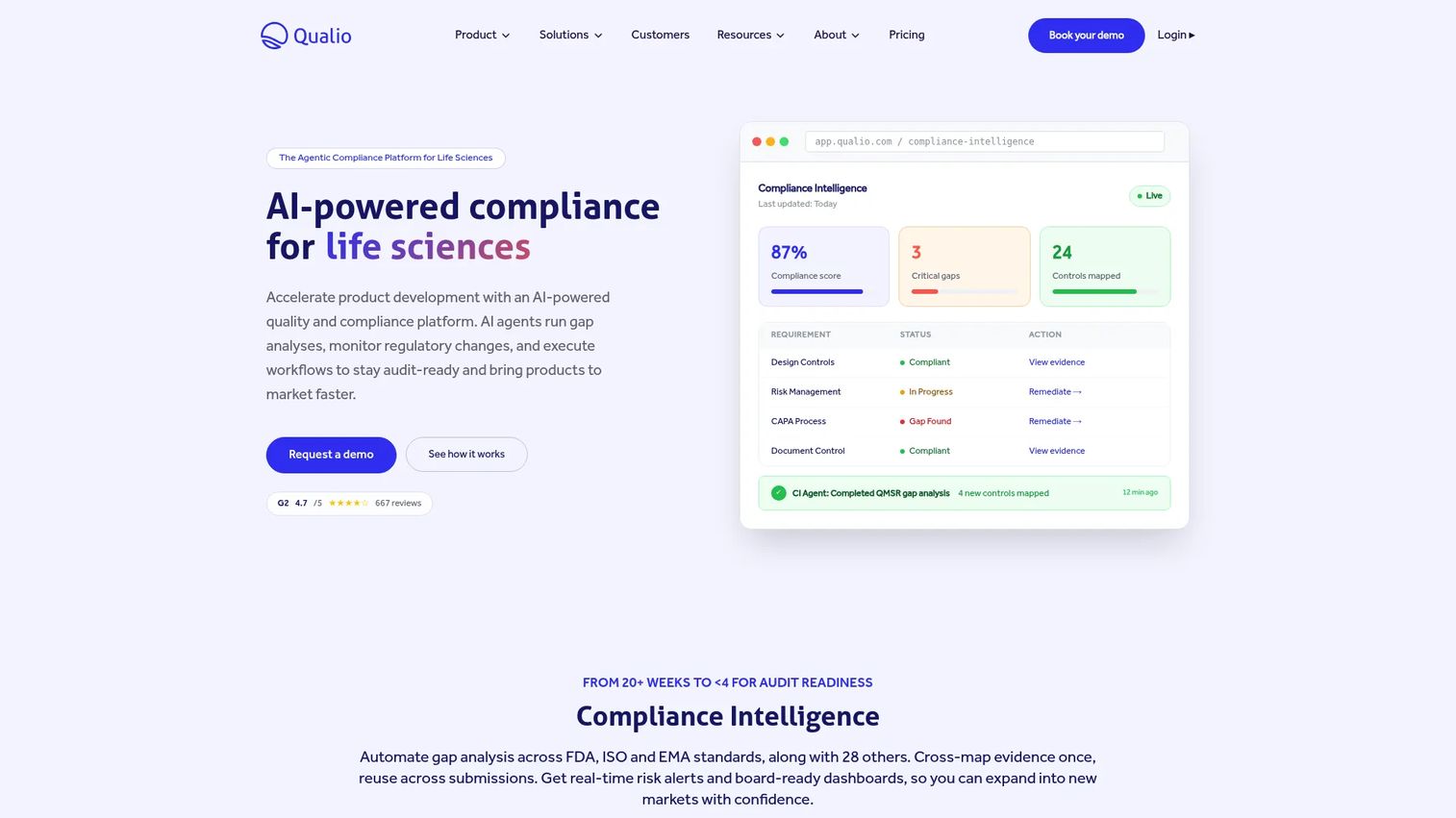
Qualio is a cloud-based quality management and compliance platform built for life sciences companies. It centralizes documents, training, supplier quality, and quality events in a single eQMS, so quality-driven teams manage compliance from one connected record instead of stitching together spreadsheets and shared drives. The platform leans hard into the reality that in regulated environments, the audit trail is the product.
Best for: life sciences and regulated teams that need a cloud eQMS covering quality, compliance, and audit readiness in one system.
Key strengths
- Document control: version history, controlled distribution, and approval workflows that make iso document control software requirements auditable by default.
- Training management: links procedures to training records, so proof that staff were trained on the active document is always current.
- CAPA and quality events: corrective and preventive action workflows tied directly to findings, plus supplier quality and design controls.
Why choose Qualio: if your compliance program lives inside a quality system, Qualio fits the regulated life sciences motion better than a generic tool. It's designed for teams where document control, training, and CAPA are the daily work, not an afterthought. Product and operations leads who need clean visibility into ownership and revision history without maintaining a spreadsheet will find the connected records worth the switch.
Qualio pricing: Qualio uses quote-based pricing rather than public numeric prices. The named plans are Foundation and Growth, both billed as annual recurring subscriptions, plus Scale with custom pricing and custom implementation. Qualio notes an implementation fee applies to all plans, so budget for onboarding alongside the subscription. There is no free tier; pricing is available on request from Qualio.
2. SafetyCulture
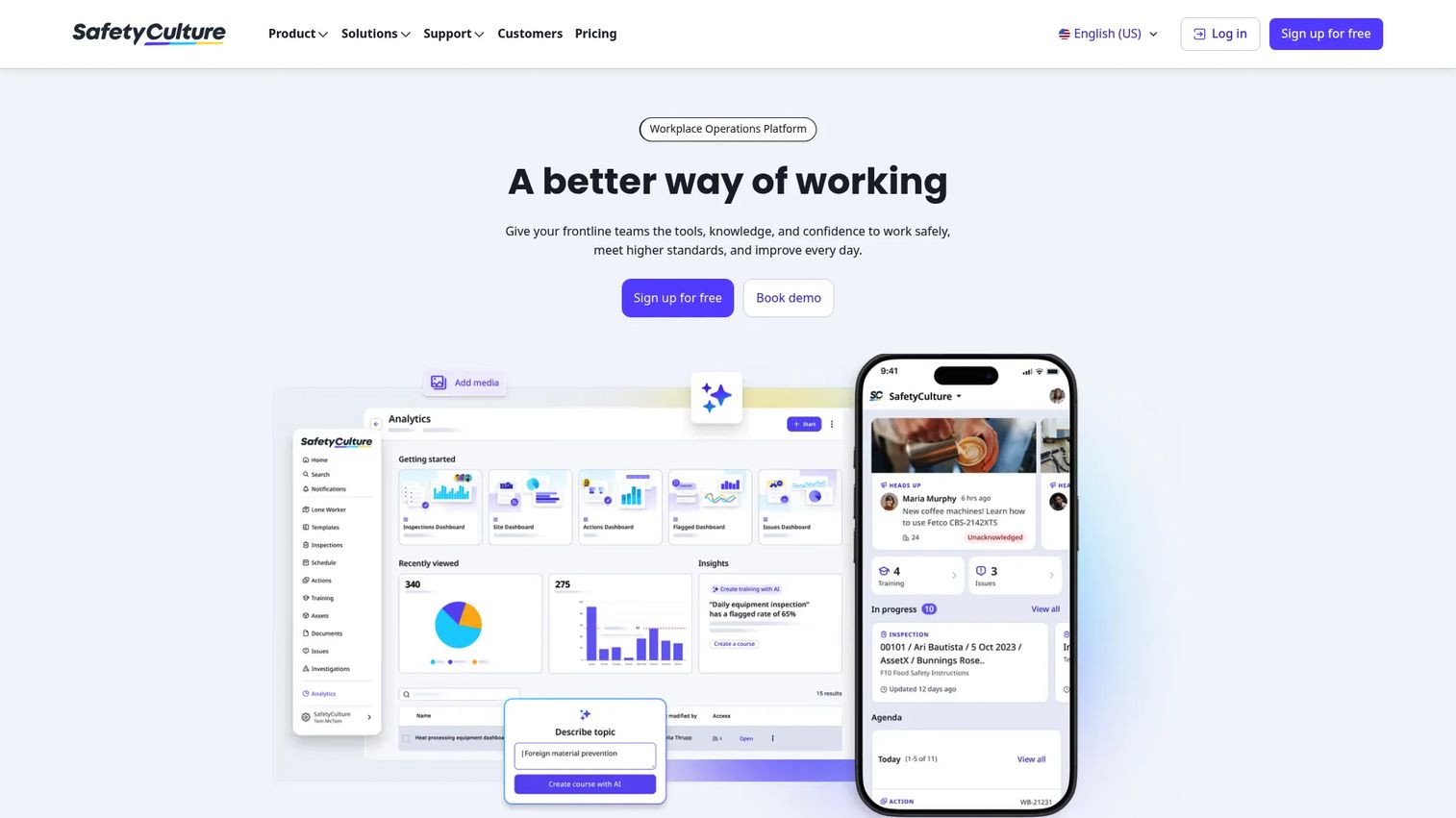
SafetyCulture is an operations platform for inspections, actions, assets, training, and workplace communications. Its strength is turning compliance tasks into repeatable, mobile-first workflows that field and operations teams actually complete. For multi-standard compliance, SafetyCulture handles the recurring inspection and checklist work that underpins ISO 9001, 14001, and 45001 programs, then rolls the results into analytics and reporting.
Best for: field and operations teams that need mobile-first inspections and workflow management across multiple standards.
Key strengths
- Inspections and reports: template-driven inspections that generate audit-ready reports, useful as iso document control software for the operational evidence side.
- Actions and issues: every finding becomes a tracked action with an owner and due date, so corrective work doesn't fall through the cracks.
- Training and analytics: built-in training plus dashboards that turn completed checklists into visibility on where compliance is slipping.
Why choose SafetyCulture: if compliance work happens on the floor, in the field, or on a shop-level device, SafetyCulture meets it there. It's the practical pick when inspections, asset checks, and frontline training are the backbone of your ISO program, and when a laptop-only tool would sit unused. The mobile fit and broad workflow coverage make it a strong operational layer.
SafetyCulture pricing: SafetyCulture offers three editions. The Free plan is $0 per year. Premium runs $24 per user per month billed annually. Enterprise is a custom quote. The free tier makes it easy to trial inspection workflows before committing, which matters for teams validating fit before rolling out across sites.
3. CORE Compliance Platform
CORE Compliance operates as a compliance and EHS partner focused on services rather than a self-serve SaaS product. Primary-site evidence points to compliance consulting, occupational health and safety support, and environmental services rather than a software platform with public plans. For teams that want hands-on help building an integrated management system rather than software to run themselves, this is a different model worth understanding.
Best for: organizations that need compliance consulting, safety training, and environmental or EHS support alongside their standards work.
Key strengths
- OSHA compliance and safety training: structured safety training and compliance support for teams building out their program.
- Environmental consulting and permitting: environmental services and permitting help that pure software rarely covers.
- Compliance auditing and assessment: audit and assessment services that complement iso document control software by validating the program itself.
Why choose CORE Compliance: the fit here is for teams that want expertise attached to the work, not just a tool. If your gap is knowing how to build the management system rather than where to store it, a consulting-led partner covers ground software doesn't. It pairs well with a document platform for the records side while the services handle strategy and audits.
CORE Compliance pricing: CORE Compliance does not publish software pricing, SaaS plans, or a self-serve product tier on its site. Because it operates as a services firm, engagements are scoped and quoted directly. Contact the team for a proposal based on your standards, sites, and audit needs.
4. Vanta
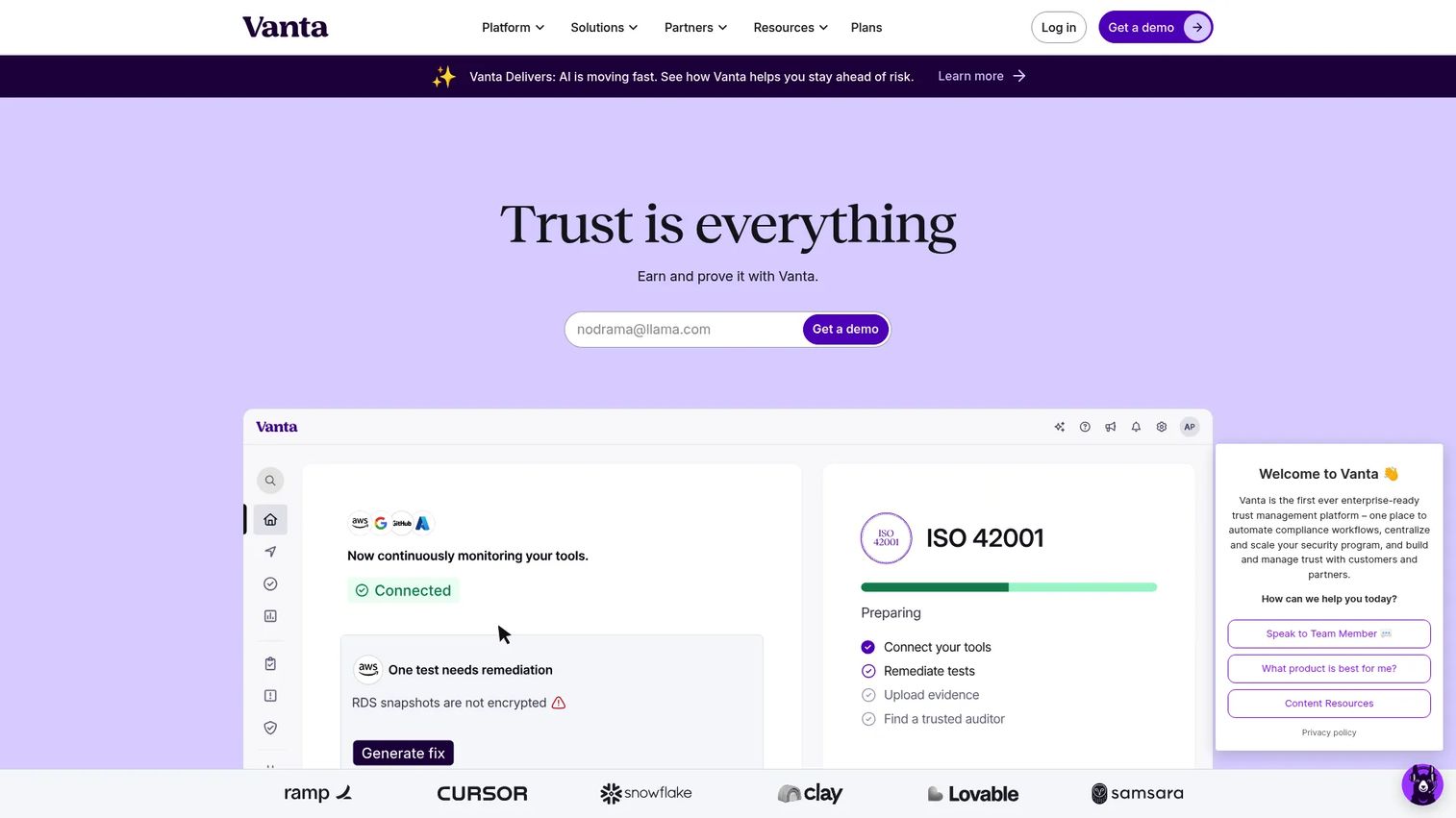
Vanta is a trust platform for automating compliance, risk, and security workflows. It's one of the strongest picks for iso 27001 compliance software because it connects to your stack and collects evidence continuously instead of at audit time. For SaaS teams, that automation is the difference between a quarterly scramble and a program that stays current on its own.
Best for: SaaS teams that prioritize security compliance automation and want continuous ISO 27001 monitoring rather than static certification prep.
Key strengths
- Automated evidence collection: integrations pull proof from cloud infrastructure and tools automatically, cutting the manual evidence collection grind.
- Continuous controls monitoring: ongoing monitoring flags drift the moment a control breaks, not months later.
- Risk and questionnaire automation: built-in risk management, a trust center, and security questionnaire automation that speeds up buyer reviews.
Why choose Vanta: for a product-led SaaS company, Vanta reduces the manual effort that makes ISO 27001 feel like a tax on engineering time. The remediation workflow flags what's broken and routes it, so ownership is clear and fixes don't stall. Product and security leads who want continuous compliance without standing up a dedicated GRC team tend to land here.
Vanta pricing: Vanta uses quote-based pricing and does not display public numeric prices. The plan names on its pricing page are Essentials, Plus, Professional, and Enterprise, and the vendor asks visitors to request a demo for personalized pricing. Scope your quote around the number of frameworks and integrations you need, since that drives the tier.
5. ETQ Reliance
ETQ Reliance is a cloud-native quality management platform for centralizing and automating enterprise quality processes. It's built for organizations where process depth and configurability matter more than speed to a single certificate. As integrated management system software, it handles the breadth larger quality-led operations need across documents, audits, risk, and suppliers.
Best for: enterprise teams that need a configurable QMS with deep compliance and quality workflow automation.
Key strengths
- CAPA and change management: robust CAPA and change control workflows that hold up in complex, regulated operations.
- Supplier quality and risk: supplier management, risk assessment, and a working risk register that connect quality to the supply chain.
- Audit and document control: audit management, document control, and training management with advanced analytics and mobile access.
Why choose ETQ Reliance: when complexity is the reality rather than the exception, ETQ's configurability pays off. Enterprise quality teams that outgrew lighter tools value being able to shape workflows to their exact process instead of bending process to fit the software. It's the pick where CAPA depth, supplier quality, and multi-standard governance all have to coexist.
ETQ Reliance pricing: ETQ does not expose public pricing on its site, and plan details are handled through direct conversations. Pricing is scoped to your process complexity, user count, and modules, so expect an enterprise-style quote rather than a published tier. Contact ETQ for a tailored estimate based on your quality program.
6. MasterControl Quality Excellence
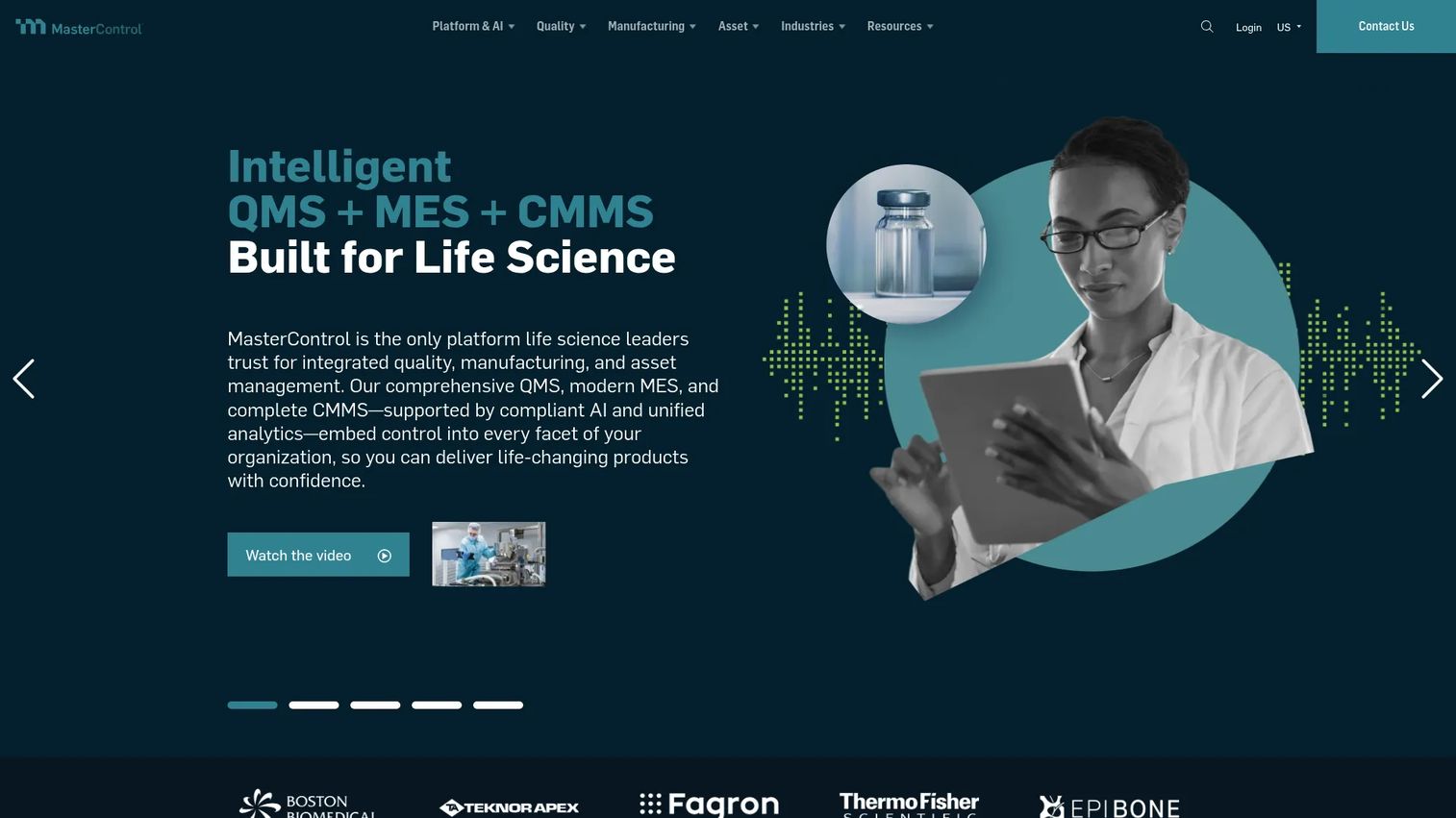
MasterControl is a cloud-based quality management platform for regulated life sciences organizations. It's built around controlled documents, training, and quality events, which makes it a natural fit for document-heavy compliance programs where every procedure needs a controlled lifecycle and a clean audit trail. As integrated management system software and an eQMS, it centralizes the records regulated auditors expect.
Best for: regulated life sciences companies that need a formal QMS with rigorous document and training controls.
Key strengths
- Document control: controlled document lifecycles with revision history and approval routing built for regulated scrutiny.
- Training management: training tied to documents, so competency records stay aligned with the active procedure.
- Quality event management: structured handling of deviations, nonconformities, and the follow-up work they trigger.
Why choose MasterControl: if your compliance burden is fundamentally about documents and training, MasterControl is purpose-built for that weight. Regulated teams that need defensible evidence of what was approved, when, and who was trained on it get a system designed for exactly that proof. It fits process environments where formality is a requirement, not a preference.
MasterControl pricing: MasterControl tailors pricing to the organization and directs prospects to contact sales. It uses a named-user license model for Quality Excellence, so cost scales with your user base. There's no public starting price; request a quote scoped to your team size and modules.
7. Secureframe
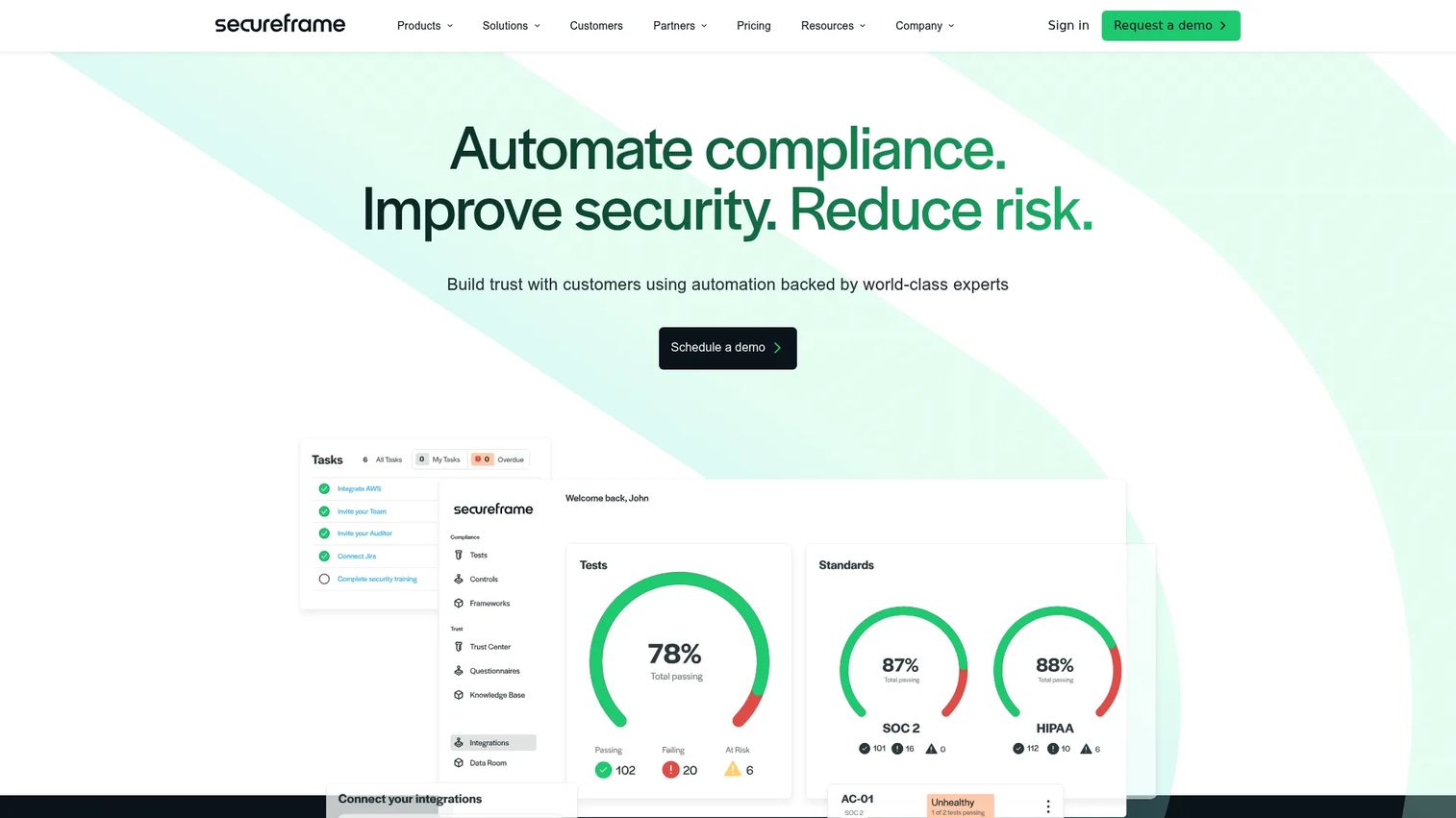
Secureframe is a security and compliance automation platform for managing audits, continuous monitoring, and trust centers. Like Vanta, it's a strong iso 27001 compliance software option for security-conscious SaaS teams that want fast audit readiness without a manual evidence project. Automated tests and continuous monitoring keep the program current between audits.
Best for: mid-market and enterprise SaaS teams automating security compliance and audit readiness.
Key strengths
- Automated tests and evidence: continuous tests and automated evidence collection that keep proof current across connected systems.
- Continuous monitoring: ongoing monitoring that surfaces control drift early, supporting genuine continuous compliance.
- Trust center and questionnaires: a trust center and questionnaire automation that shorten buyer security reviews.
Why choose Secureframe: for teams that want streamlined monitoring and a clean remediation workflow, Secureframe keeps audit prep tight. It's a good fit when the priority is getting to a defensible ISO 27001 posture quickly and staying there, with automation carrying the ongoing load. Security and product leads who want fast readiness without heavy internal lift tend to shortlist it against Vanta.
Secureframe pricing: Secureframe lists three packages, Fundamentals, Complete, and Defense, each with quote-based pricing shown as "Get a quote." No public numeric price is displayed. Scope your quote around the frameworks and integrations you need, then compare packages on monitoring depth and support.
Considerations before you buy
Feature lists blur together fast. Use this checklist to pressure-test any platform against your actual operating model before you commit.
Scope of standards
Confirm the platform supports the exact ISO standards you need, not just the headline one it markets. A tool strong on ISO 27001 may be thin on ISO 9001 or 45001, and vice versa. If you run more than one standard, verify that they share documents, audits, and evidence rather than living in separate silos inside the same product.
Evidence and integrations
The value of automated evidence collection depends entirely on whether the tool connects to the systems where your evidence actually lives. Map your cloud infrastructure, HR system, and ticketing tools against the vendor's integration list before signing. A platform that can't reach your evidence sources leaves you doing the manual work it promised to remove.
Workflow ownership
Compliance fails quietly when nobody owns it. Make sure the platform lets you assign clear owners across product, operations, security, and quality, with due dates and escalation. The best tool in the world won't help if corrective actions and document reviews have no name attached to them.
Audit readiness and reporting
Storage is not readiness. Verify the platform supports real audit readiness, generating reports auditors accept, surfacing gaps before they become findings, and maintaining a clean audit trail. Ask to see a sample audit export, not just a dashboard screenshot.
Maintenance and scalability
Assess how much human work remains after setup. Some platforms front-load configuration then run quietly; others need constant tending. Since your org, standards scope, and product will change, confirm the system scales without a rebuild every time your process evolves. For adjacent tooling decisions, a look at contract lifecycle management software and contract management software tools can help you plan how compliance connects to the rest of your governance stack.
Conclusion
The right pick comes down to your operating model, not a feature scoreboard. If your compliance program lives inside a quality system, Qualio and MasterControl are built for that regulated, document-heavy reality. If you're a SaaS team chasing continuous ISO 27001 without adding headcount, Vanta and Secureframe automate the evidence grind and keep you audit-ready between audits.
For operational teams whose compliance work happens in the field, SafetyCulture meets the work on mobile with inspections and tracked actions. When enterprise quality depth and configurability are non-negotiable, ETQ Reliance handles the CAPA, supplier, and risk complexity that lighter tools can't. And if you'd rather have expertise attached to the program, CORE Compliance brings a consulting-led model.
Start by mapping your standards scope, where your evidence lives, and how much automation you actually need. Then shortlist the two platforms that match that profile and run a real trial or scoped demo before you sign. The goal isn't just passing the next audit; it's building continuous compliance that holds without a fire drill every quarter.
FAQs
ISO compliance software is a platform that helps organizations document, manage, and prove adherence to ISO standards by centralizing controls, records, evidence, and audit activity. It replaces spreadsheets and shared drives with a system that tracks document versions, approvals, training, and corrective actions in one connected place. The result is that compliance becomes provable, not just claimed.
The features that carry the most weight are document control, evidence collection, audit trails, CAPA workflows, a risk register, and reporting. Document control keeps procedures versioned and approved, while automated evidence collection cuts the manual chasing that eats audit prep. Reporting and dashboards give you live visibility into gaps and ownership so nothing surfaces as a surprise during an audit.
They overlap but aren't identical. An eQMS (electronic quality management system) manages the full quality lifecycle including documents, training, CAPA, and supplier quality, and is common in life sciences. ISO compliance software is a broader category that includes eQMS platforms plus security-focused tools built for standards like ISO 27001. Many teams pick a tool that spans both.
For ISO 27001, automation-first platforms like Vanta and Secureframe are strong choices. Both connect to your cloud stack, collect evidence continuously, and monitor controls year-round rather than only at audit time. That continuous model suits SaaS teams that want to stay audit-ready without standing up a dedicated compliance team.
Yes, integrated management system software is designed for exactly this. A single platform lets multiple standards share documents, audits, and evidence instead of running as separate programs, which cuts duplication. Tools like ETQ Reliance and SafetyCulture support multi-standard programs, though you should verify depth on each specific standard you need before committing.
It keeps you audit-ready as a byproduct of daily work rather than a last-minute sprint. By maintaining a live audit trail, controlled documents, and current evidence, the platform can generate the reports auditors ask for on demand. Gap analysis and continuous monitoring surface issues early, so recertification becomes a review rather than a rebuild.
A SaaS company should prioritize automation, integration depth, and low maintenance burden. Look for a tool that connects to your cloud infrastructure and existing systems so evidence collection is continuous, not manual. Strong reporting, clear workflow ownership across product and security, and a model that scales as your product and team change round out the shortlist.
When the platform integrates with the systems where your evidence actually lives, yes, substantially. Automated evidence collection pulls proof from cloud tools and infrastructure on a schedule, so the team stops reconstructing the same records every cycle. The reduction depends on integration coverage, so map your evidence sources against the vendor's supported integrations before you buy.